Source: The Conversation – Global Perspectives – By Lister Staveley-Smith, Professor at the International Centre for Radio Astronomy Research (ICRAR), The University of Western Australia
A composite image shows a diffuse ‘bridge’ of gas linking two dwarf galaxies. ICRAR, N. Deg, Legacy Surveys (D.Lang / Perimeter Institute)
Most of the ordinary matter in the universe is hydrogen. But surprisingly, less than 20% of this hydrogen sits inside galaxies. The rest lies in the vast spaces between them – the so-called intergalactic medium.
This cosmic reservoir is thought to fuel the birth of new stars, as gas slowly falls into galaxies over billions of years. Yet much of that material doesn’t stay put: supernova explosions and powerful outflows from supermassive black holes can fling gas back out into intergalactic space.
The push-and-pull between inflows and outflows is central to understanding how galaxies grow and change over cosmic time. Probing this balance is one of the aims of the WALLABY survey, carried out using the Australian SKA Pathfinder (ASKAP) telescope at Inyarrimanha Ilgari Bundara, CSIRO’s Murchison Radio-astronomy Observatory in Western Australia.
A new discovery from WALLABY, published today in Monthly Notices of the Royal Astronomical Society, sheds new light on the cosmic cycle of matter into, through and out of galaxies.
What is WALLABY?
Despite its name, WALLABY isn’t about animals. It’s a somewhat contrived acronym – Widefield ASKAP L-band Legacy All-sky Blind surveY – for a large survey of neutral hydrogen (the atomic form of hydrogen) across nearly half the southern sky. The ASKAP telescope is sensitive enough to detect hydrogen in and around galaxies up to a billion light years away.
The ASKAP radio telescope can detect hydrogen up to a billion light years away. ICRAR
Because it’s a “blind” survey, WALLABY doesn’t target known galaxies. Instead, it scans huge patches of sky – each night covering an area about 150 times the size of the full Moon.
A galactic bridge
We then use automated algorithms to search for signs of hydrogen in the resulting data. One such search revealed an unusual gas bridge linking two otherwise unremarkable galaxies on the outskirts of the Virgo cluster, in the constellation Virgo. The bridge, at least 160,000 light years long, likely formed through tidal interactions between two dwarf galaxies known as NGC 4532 and DDO 137.
Left: Radio astronomy image of neutral hydrogen gas in and around the galaxies NGC 4532 / DDO 137. Right: An optical image of the galaxies. ICRAR and D.Lang (Perimeter Institute)
These tides are the cosmic equivalent of Earth’s ocean tides, but on a vastly larger scale and made of hydrogen rather than water. Gas pulled from the galaxies now stretches between them, filling the surrounding intergalactic space.
Such bridges are hard to detect because they contain few stars. But we have a local example: the Large and Small Magellanic Clouds, two dwarf galaxies orbiting the Milky Way, are joined by a 70,000-light-year-long gas bridge.
An extraordinary tail
The newly discovered bridge also helps explain a long-standing puzzle: an enormous gas tail streaming away from the dwarf galaxies NGC 4532 and DDO 137, first detected more than 30 years ago with the Arecibo telescope. This tail is ten times longer than the bridge and is the largest ever observed from a galaxy system.
New observations suggest that while tidal forces created the bridge and the envelope of gas around the galaxies, the spectacular tail was produced by another process.
As the pair of galaxies plunges into the Virgo cluster, they encounter extremely hot, thin gas that fills the cluster. The galaxies’ motion through this medium produces ram pressure – much like the resistance felt when cycling into a strong headwind – which strips gas from them and sweeps it out behind.
Remarkably, the gas density required for this effect is only around ten atoms per cubic metre, a value consistent with new measurements from the eROSITA X-ray telescope. Thanks to the galaxies’ high infall speed – more than 800 kilometres per second – this sparse medium is enough to create the vast tail.
The bigger picture
These two galaxies are just a fraction of the 200,000 WALLABY expects to detect by the end of its survey. Each discovery adds to our picture of how gas flows in and out of galaxies, enriching the intergalactic medium and shaping galactic evolution.
Together, they will help astronomers untangle the so-called baryonic cycle – the continuous recycling of matter between galaxies and the space around them.
Lister Staveley-Smith receives research funding from ICRAR, the Western Australian government, and the University of Western Australia.
New health recommendations aim to discourage pregnant women from taking the painkiller paracetamol – also known as acetaminophen and by the brand name Tylenol – to prevent autism.
The recommendations also include using the drug leucovorin to treat speech-related difficulties that children with autism sometimes experience.
So what is leucovorin and what does the science say about its ability to treat autism?
What is leucovorin?
Leucovorin is a form of folic acid, a B vitamin our bodies usually get from foods such as legumes, citrus fruits and fortified grains.
The medication is most often used in cancer treatment. It’s typically used alongside the chemotherapy drug fluorouracil, a cancer treatment that stops cancer cells from making DNA and dividing. Leucovorin enhances the effects of fluorouracil.
Methotrexate works by blocking the body’s use of folate, which healthy cells need to make DNA. Leucovorin provides an active form of folate that healthy cells can use to make DNA, thereby “rescuing” them while methotrexate continues to target cancer cells.
Because methotrexate is also used to treat the skin condition psoriasis, leucovorin can also be used as a rescue agent during treatment for this autoimmune condition.
Why is folate important?
Because folate is essential for making DNA and other genetic material, which cells need to grow and repair properly, it’s especially important during pregnancy.
This is because insufficient folate is linked to the development of spina bifida, a condition where a baby’s spine does not develop correctly. For this reason, women are advised to take folic acid supplements before conception and during the early months of pregnancy.
Folate is also important for supporting the production of red blood cells and overall brain function.
Why is it being considered to treat autism?
The recommendation to use leucovorin to treat autism seems to stem from a theory that low levels of folate in the brain can lead to a condition called cerebral folate deficiency.
As the signs of autism are similar and it usually presents at around the same age, some people have proposed a link between cerebral folate deficiency and autism.
What does the evidence say?
So can giving children folate, in the form of leucovorin, help them to function better with autism? The evidence says maybe yes, and here’s what we know so far.
A review of the evidence in 2021 analysed the results of 21 studies that used leucovorin for autism or cerebral folate deficiency. Children who took the drug generally had improved autism symptoms. But the authors also said more studies were needed to confirm the findings.
Since then, a small 2024 study involved about 80 children aged two to ten years with autism. Half took a daily maximum dose of 50mg of folinic acid (similar to leucovorin), the other half took a placebo. Children given folinic acid showed more pronounced improvement when compared with those who took the placebo.
A similar 2025 study examined the same dose of folinic acid given to Chinese children with autism. Those given folinic acid had greater improvement in a type of social skill known as social reciprocity when compared with children given placebo.
While promising, none of these trials are at the level to change medical practice. We’d need further, larger studies before doctors can make a proper recommendation.
Like all drugs, leucovorin has side effects. The most serious or common are severe allergic reactions, seizures and fits, and nausea and vomiting.
In a nutshell
Overall, the latest health recommendations are not yet backed by sufficient evidence.
While the US Food and Drug Administration will now allow doctors to prescribe leucovorin to treat autism symptoms, the Australian government should not change its prescribing guidance.
Support for people with autism should continue to follow evidence-based best practice until the data from clinical trials of leucovorin is more robust.
Nial Wheate in the past has received funding from the ACT Cancer Council, Tenovus Scotland, Medical Research Scotland, Scottish Crucible, and the Scottish Universities Life Sciences Alliance. He is a fellow of the Royal Australian Chemical Institute. Nial is the chief scientific officer of Vaihea Skincare LLC, a director of SetDose Pty Ltd (a medical device company) and was previously a Standards Australia panel member for sunscreen agents. He is a member of the Haleon Australia Pty Ltd Pain Advisory Board. Nial regularly consults to industry on issues to do with medicine risk assessments, manufacturing, design and testing.
Jasmine Lee does not work for, consult, own shares in or receive funding from any company or organisation that would benefit from this article, and has disclosed no relevant affiliations beyond their academic appointment.
The Irish mathematician and physicist William Rowan Hamilton, who was born 220 years ago last month, is famous for carving some mathematical graffiti into Dublin’s Broome Bridge in 1843.
But in his lifetime, Hamilton’s reputation rested on work done in the 1820s and early 1830s, when he was still in his twenties. He developed new mathematical tools for studying light rays (or “geometric optics”) and the motion of objects (“mechanics”).
Intriguingly, Hamilton developed his mechanics using an analogy between the path of a light ray and that of a material particle. This is not so surprising if light is a material particle, as Isaac Newton had believed, but what if it were a wave? What would it mean for the equations of waves and particles to be analogous in some way?
The answer would come a century later, when the pioneers of quantum mechanics realised Hamilton’s approach offered more than just an analogy: it was a glimpse of the true nature of the physical world.
The puzzle of light
To understand Hamilton’s place in this story, we need to go back a little further. For ordinary objects or particles, the basic laws (or equations) of motion had been published by Newton in 1687. Over the next 150 years, researchers such as Leonard Euler, Joseph-Louis Lagrange and then Hamilton made more flexible and sophisticated versions of Newton’s ideas.
“Hamiltonian mechanics” proved so useful that it wasn’t until 1925 – almost 100 years later – that anybody stopped to revisit how Hamilton had derived it.
His analogy with light paths worked regardless of light’s true nature, but at the time, there was good evidence that light was a wave. In 1801, British scientist Thomas Young had performed his famous double-slit experiment, in which two light beams produced an “interference” pattern like the overlapping ripples on a pond when two stones are dropped in. Six decades later, James Clerk Maxwell realised light behaved like a rippling wave in the electromagnetic field.
But then, in 1905, Albert Einstein showed some of light’s properties could only be explained if light could also behave as a stream of particle-like “photons” (as they were later dubbed). He linked this idea to a suggestion made by Max Planck in 1900, that atoms could only emit or absorb energy in discrete lumps.
Energy, frequency and mass
In his 1905 paper on the photoelectric effect, where light dislodges electrons from certain metals, Einstein used Planck’s formula for these energy lumps (or quanta): E = hν. E is the amount of energy, ν (the Greek letter nu) is the photon’s frequency, and h is a number called Planck’s constant.
But in another paper the same year, Einstein introduced a different formula for the energy of a particle: a version of the now-famous E = mc ². E is again the energy, m is the mass of the particle, and c is the speed of light.
So here were two ways of calculating energy: one, associated with light, depended on the light’s frequency (a quantity connected with oscillations or waves); the other, associated with material particles, depended on mass.
In 1905, Albert Einstein published two ways of calculating the energy of a particle: one linked to the frequency of wave, the other to the mass of the particle itself. Hulton Archive / Getty Images
Did this suggest a deeper connection between matter and light?
This thread was picked up in 1924 by Louis de Broglie, who proposed that matter, like light, could behave as both a wave and a particle. Subsequent experiments would prove him right, but it was already clear that quantum particles, such as electrons and protons, played by very different rules from everyday objects.
A new kind of mechanics was needed: a “quantum mechanics”.
The wave equation
The year 1925 ushered in not one but two new theories. First was “matrix mechanics”, initiated by Werner Heisenberg and developed by Max Born, Paul Dirac and others.
A few months later, Erwin Schrödinger began work on “wave mechanics”. Which brings us back to Hamilton.
Schrödinger was struck by Hamilton’s analogy between optics and mechanics. With a leap of imagination and much careful thought, he was able to combine de Broglie’s ideas and Hamilton’s equations for a material particle, to produce a “wave equation” for the particle.
An ordinary wave equation shows how a “wave function” varies through time and space. For sound waves, for example, the wave equation shows the displacement of air, due to changes in pressure, in different places over time.
But with Schrödinger’s wave function, it was not clear exactly what was waving. Indeed, whether it represents a physical wave or merely a mathematical convenience is still controversial.
Waves and particles
Nonetheless, the wave-particle duality is at the heart of quantum mechanics, which underpins so much of our modern technology – from computer chips to lasers and fibre-optic communication, from solar cells to MRI scanners, electron microscopes, the atomic clocks used in GPS, and much more.
Indeed, whatever it is that is waving, Schrödinger’s equation can be used to predict accurately the chance of observing a particle – such as an electron in an atom – at a given time and place.
That’s another strange thing about the quantum world: it is probabilistic, so you can’t pin these ever-oscillating electrons down to a definite location in advance, the way the equations of “classical” physics do for everyday particles such as cricket balls and communications satellites.
Schrödinger’s wave equation enabled the first correct analysis of the hydrogen atom, which only has a single electron. In particular, it explained why an atom’s electrons can only occupy specific (quantised) energy levels.
It was eventually shown that Schrödinger’s quantum waves and Heisenberg’s quantum matrices were equivalent in almost all situations. Heisenberg, too, had used Hamiltonian mechanics as a guide.
Today, quantum equations are still often written in terms of their total energy – a quantity called the “Hamiltonian”, based on Hamilton’s expression for the energy of a mechanical system.
Hamilton had hoped the mechanics he developed by analogy with light rays would prove widely applicable. But he surely never imagined how prescient his analogy would be in our understanding of the quantum world.
Robyn Arianrhod does not work for, consult, own shares in or receive funding from any company or organisation that would benefit from this article, and has disclosed no relevant affiliations beyond their academic appointment.
Penguin Books, Goodreads, Harper Collins, Text Publishing
Literature has long portrayed messed-up families. As poet Philip Larkin famously wrote, “They fuck you up, your mum and dad. / They may not mean to, but they do.”
In honour of this rich vein of dysfunction, we asked experts to nominate the worst literary fathers and mothers. Today we delve into dads. Tomorrow, we turn to mothers.
Of course, complex characters – neither wholly good nor bad – are the best sort. Author Andrew O’Hagan has spoken eloquently about striving to humanise even his most unpleasant creations, to fully amplify a novel.
Still, some characters are awfully hard to like. My least favourite dad might be Shug Bain, a cruel, violent man who abandons his wife and kids in Douglas Stuart’s Booker Prize-winning novel. Shug is appalled by his son Shuggie’s feminine mannerisms. “Look how twisted you’ve made him,” he tells his wife.
Here are our experts’ picks.
James Mortmain, I Capture the Castle – Dodie Smith
Penguin Books
Perhaps the worst parent is not an obvious “monster”, but one you can all too easily imagine as your own. In Dodie Smith’s I Capture The Castle, James Mortmain, a once-successful writer in the grip of decade-long writer’s block, threatens his first wife with a cake knife and assaults a neighbour. His younger daughter, Cassandra, softens Mortmain’s awfulness with disarming humour. In court, she writes, everyone was being very funny, but “Father made the mistake of being funnier than the judge … he was sent to prison for three months.” The self-focused Mortmain condemns his family to penury in a crumbling castle, where he reads detective novels in the gatehouse and Cassandra captures their plight in her journal.
– Carol Lefevre
Heathcliff, Wuthering Heights – Emily Bronte
Penguin books
For me, Heathcliff even beats bad-dads King Lear and Agamemnon. Most readers won’t remember that Heathcliff is a dad at all, which is part of what makes him so bad. The sadistic, dysfunctional passion between Heathcliff and Catherine dominates Brontë’s novel, leaving young Linton, the kid Heathcliff has with another woman, Isabella, neglected, abused and dominated by his terrifying father.
Heathcliff doesn’t even meet his son until he’s 13, after Isabella dies. Linton is then forced to live in tormented isolation and tortured into marrying his first cousin, Cathy. All this so Heathcliff can take revenge on Cathy’s father Edgar, who married his beloved Catherine Earnshaw.
– Sophie Gee
Zeus, the Iliad
Penguin Books
Zeus wakes up in book 15 of the Iliad, having been lulled to sleep by Hera with sex and potions. Poor Zeus – with his sneaky wife, bickering, divine siblings and children, all trying to manipulate the war at Troy – and he is only trying to keep the Olympian show on the road. Seriously? Who started the family games? And, if he had canned the swan costume and not raped Leda (or the dozens of other nymphs he “manifested himself” to), no Helen, no war, no problems.
He really is the paterfamilias of toxic patriarchy.
– Robert Phiddian
Reunion – John Cheever
The last time you see your father, I hope he is not drunk on Beefeater Gibsons. I hope he doesn’t clap at the wait staff or demand they speak languages they do not know. I hope he doesn’t get you removed from four restaurants in a single afternoon. Walking away as he curses at a newsstand clerk, I hope you don’t mourn his flaws as “your future and your doom”. But, were this all to occur, I hope it’s happening inside a John Cheever story, where the comic and tragic mix like flesh and blood, or gin and vermouth.
– Alex Cothren
Kev, Last Ride – Denise Young
Harper Collins
I’m not in favour of binaries of any kind, so I’m not comfortable with “best” vs “worst”. Rather, I contribute a father figure from Australian literature who may be both/and best/worst. I’m thinking of Kev, the father in Denise Young’s astonishingly moving novel, Last Ride, who takes his ten-year old son, Chook, with him on the run from the law across outback NSW after committing a brutal murder. Kev is among the worst, because: who would drag a kid into that? But Kev is simultaneously among the best, because his love for Chook, and his deep-seated impulse to protect him from another man’s abuse, is as genuine and moving as the paternal instinct gets. Kev wields fatherhood as double-edged sword. I feel for him.
– Julienne van Loon
Albion Gidley Singer, Dark Places – Kate Grenville
Text Publishing
The worst father in literature is an easy one for me, though it has been decades since I have read his story. I first encountered the incestuous father Albion Gidley Singer in Kate Grenville’s novel Lilian’s Story, in which he is a somewhat shadowy but menacing figure. But it’s in Dark Places that Albion’s evil is brought fully to bear. I can’t remember the details of the book, but I can remember all too well the feeling of suffocation that came from being too close to Albion, to his thoughts and his feelings. A tremendous book I never want to read again.
– Natalie Kon-yu
Sam Pollit, The Man Who Loved Children – Christina Stead
Goodreads
In Christina Stead’s exhilarating and suffocating semi-autobiographical The Man Who Loved Children, the naturalist and patriarch Sam Pollit is nicknamed by his wife Henny “the Great Mouthpiece” for his endless maxims and sickening Pollit-“fambly” patois. He claims to love his many children but mocks, cajoles, and insults them; even has them spy on each other. Family life is so bad that the novel’s heroine, the adolescent Louisa, believes her only hope of escape from the squalor and tyranny is through murder.
– Jane Messer
My pick is a towering figure in Australian fiction: Sam Pollit of Christina Stead’s 1940 masterpiece The Man Who Loved Children. Sam’s oppressive sunniness, his maniacal refusal to look reality in the face, and his demand that his family play along with his ego-fantasy force them to absorb cruelty, mockery and contempt, all the while descending into more and more perilous poverty at his hands. He is a modern day narcissist par excellence, but also a grotesquerie or travesty of optimism as a virtue in the world. In Sam, “positivity” is transformed into dangerous and delusional thinking that steamrolls everything before it and leaves destruction in its wake.
– Edwina Preston
Allie Fox, The Mosquito Coast – Paul Theroux
Charismatic, brilliant and narcissistic, Allie Fox drags his family off to live in an isolated part of Honduras’ Mosquito Coast to escape what he has persuaded himself is the impending end of the world. Like any colonist, he takes over a village and attempts to introduce Western technology and ideas. It all ends in catastrophe of course, and his wife and children barely escape with their lives. Allie is the exemplar of the charming destroyer and is at the top of my “bad dad” list.
– Jen Webb
Captain Ahab, Moby-Dick – Herman Melville
Penguin Books
Herman Melville, a great American author, was a lamentable father and an erratic provider for his family, who drove his son Malcolm to shoot himself in his bedroom in his parents’ house in 1867 after a row about the 18-year-old’s late hours. Melville’s fictional character Captain Ahab in Moby-Dick behaves even more reprehensibly, abandoning his own wife and son to focus obsessively on a doomed quest for a white whale that ultimately leads his whole crew to destruction. Ahab takes his name from the worst king of Israel in the Old Testament, and the author of this epic novel trains his gaze not just on one bad father, but the whole nature of patriarchy.
– Paul Giles
Victor Frankenstein, Frankenstein – Mary Shelley
Penguin books
The worst father in fiction has to be one of the first fathers in the horror genre, the eponymous figure in Mary Shelley’s Frankenstein (1818). Victor, of course, does not beget the monstrous creature via the conventional method of procreating with a female, and he fashions his infamous progeny out of corpses, but he is very much a horrible dad when he denies his ghastly son his love. The Swiss medical genius is the true Gothic monster here, not the hapless and unsightly creature who just wants to be loved.
– Ali Alizadeh
My dear Victor,
I should address you Father, but how can I? I do not have your own creator’s Miltonic power to throw moral injunction at you, as Satan did to God: “Did I request thee … from darkness to promote me?” Was there ever a son whose “being” (your own word) is not named but de-named as monster, dreaded spectre, fiend, vile insect, abhorred devil? I have entered literature as a hideous progeny, as an abortion and an anomaly. You never gave me love but do not forget, Father, that my form is “a filthy type of yours, more horrid from its very resemblance”.
Your son.
– Vijay Mishra
The novel’s horror is set in motion not just by Victor’s transgressive hubris as a scientist, but also by his refusal to accept responsibility. Victor abandons his “monster” at almost the moment after its birth, and repeatedly rejects its appeals for compassion and empathy. Victor’s attempts to disavow his legacy are ultimately futile, as his creation relentlessly pursues his “father” to the end of his days.
– Julian Novitz
Thomas Sutpen, William Faulkner – Absalom, Absalom!
Goodreads
“They feared him and they hated him because of his ruthlessness.” Thomas Sutpen is truly one of William Faulkner’s most terrifying creations: a man who arrives in Mississippi with nothing and wills a dynasty into being. Everything – his marriage, his children, his land – is subsumed by his amoral “design,” which he pursues at any cost and with no concern for those who get in his way.
When a hidden fact about his first marriage comes to light, he casts aside his wife and child, setting in motion a cycle of vengeance that consumes the Sutpen line. In Faulkner’s hands, this ghastly patriarch ultimately becomes a figure for the antebellum South itself – built on inhumanity, colonialism and slavery, unwilling to reckon with the horrors of the reality it has brought into being.
– Alexander Howard
Do you have a nomination for the worst father – or mother – in literature? If so, let us know by scrolling to the end of this article and adding your choice in the comments.
Congress faces a deadline of Oct. 1 to adopt a spending measure to keep the federal government open. Various reporters will be interviewing serious people saying serious things in the basement corridors of the U.S. Capitol. There will also be political posturing, misrepresentation and either braggadocio or evasion. Politics editor Naomi Schalit interviewed congressional expert Charlie Hunt, a political scientist at Boise State University, about the now-perennial drama over spending in Congress and what’s very different about this year’s conflict.
In the past, how did Congress pass budgets so that government could keep operating?
Typically, you would get an actual passage of a full budget for a year. But in the last 20 or 30 years or so, since we’ve become a more polarized country with a polarized Congress, we have a lot of what are called continuing resolutions, or CRs.They’re stopgap measures – not the full budget – and don’t tend to make a lot of changes on a lot of the spending priorities that Congress has.
The president has the power to veto any piece of legislation, and that includes the federal budget. Essentially, what majorities in Congress need when they are going into a budget fight is either the president’s implicit sign-off on whatever they pass, or they need enough votes to override the president’s veto.
Congress and the presidency right now are both held by Republicans, they’re in pretty deep alignment, so that’s not as much of a concern this time. It’s really just what Trump wants that needs to be a part of this legislation, and if there’s something in it that he really doesn’t like, then Congress needs to go back to the drawing board and the Republicans need to find out a way to get that into the bill.
What is driving each party in these negotiations?
Two different things are at work here. One is that Congress, as I mentioned, is really polarized. The two parties are farther apart from each other than they used to be. So the average Democrat and the average Republican aren’t going to agree as much on policy priorities and funding priorities than they did, say, in the 1980s or 1970s or before that.
The other thing is that Congress in recent decades has been more closely divided than they have been in the recent past, say, the last century. In both chambers, House and Senate, it’s very rare for one party or the other to have some massive majority. You need a majority of 60 in the Senate to have a chance at passing most legislation, for example, and this big a majority hasn’t happened since 2009. That’s something President Obama enjoyed with the Democrats for just a short period of time.
Since then, there have been very closely divided chambers in Congress, and that means that you need, at least in the Senate, some bipartisanship in order to pass that 60-vote threshold to break a filibuster. That’s what’s really gumming up the works right now. Democrats don’t feel like they’re being included in negotiations, and so they’re not likely to agree to a Republican-only budget in the Senate.
Speaker of the House Mike Johnson, a Republican from Louisiana, has been key to rallying House Republicans behind a stopgap funding bill to avert a shutdown. Kent Nishimura/Getty Images
What is different about the 2025 budget fight than previous ones?
A lot of the dynamics are still the same. You still have partisan fighting. And you still have some divides within the two parties that I think are worth mentioning. One example: There was a Senate vote just the other day on one of these budget resolutions, and a couple of Republicans voted with the Democrats. So for some of these more deficit-hawk Republicans, that concern is still playing a role.
What’s new this time around is this element of rescissions. This is a tool that’s been available since the 1970s in which presidents ask Congress to rescind spending that they had allocated. This is what happened earlier this year with the rescissions on public broadcasting – NPR and PBS – that got a lot of attention, as well as on USAID. Trump said he wanted to cut funding for public broadcasting – the GOP in the Senate and House voted to let him. They didn’t need 60 votes in the Senate for a rescission, either. Just a majority for this move.
So in this case, Democrats are looking at this and thinking, “Why should we negotiate, if you’re just going to rescind that later on without our consent?” That’s a major element that’s changed. While it’s a power that has been in place for a while, Trump and the Republicans have been really willing to wield that.
Do you see this rescission power being exercised with every budget or continuing resolution that Congress passes?
This is a pretty serious breach of what we call Congress’ “power of the purse.” That spending power is set out in Article 1 of the Constitution. It is a key power, maybe their most important power and point of leverage they have in going back and forth with the president and making sure the executive branch doesn’t accrue too much power.
But if this rescission authority is going to be used in this way going forward, where basically any spending priority that the president doesn’t want or doesn’t want to fund is going to be subject to rescission, then Congress doesn’t really have the power of the purse, right? They have a president who is going to veto anything that doesn’t live up to their expectations, or they can just sign it and then ask for these rescissions later.
The key thing here is that President Trump currently has in Congress a set of Republicans in both the House and the Senate who are willing to do virtually anything he wants and are subject to a lot of the political pressures in their districts that put him in office in the first place. So if they don’t go along with rescissions, they’re going to face the wrath of their Republican voters in their district.
That’s one thing that’s really changed in the last 30 years that I think gives the president a lot more authority in these matters, and makes rescission such a powerful tool that did not exist before.
Charlie Hunt does not work for, consult, own shares in or receive funding from any company or organization that would benefit from this article, and has disclosed no relevant affiliations beyond their academic appointment.
En République centrafricaine (RCA), voter devient un outil d’exclusion : les élections en décembre ne visent pas à refléter la volonté populaire, mais à effacer ceux que le régime ne reconnaît pas comme pleinement centrafricains, en particulier les musulmans.
Le 28 décembre, les citoyens de la RCA se rendront aux urnes pour la première élection depuis la réforme de la Constitution, qui a supprimé la limite du nombre de mandats présidentiels.
Avec 2,3 millions d’électeurs inscrits, dont près de 750 000 nouveaux, ce scrutin est présenté par les médias comme un signe d’engagement démocratique renouvelé. Mais derrière les chiffres se dessine une réalité bien plus inquiétante : une élection soigneusement façonnée pour consolider le pouvoir d’un régime nativiste, qui redéfinit la citoyenneté pour mieux exclure.
Sous le couvert d’une procédure démocratique, le gouvernement de Faustin-Archange Touadéra recourt à la répression pour créer un électorat composé uniquement de « vrais » Centrafricains, excluant ceux qu’il considère comme étrangers, en particulier les musulmans. Il en résulte une élection qui n’est ni libre ni représentative, mais plutôt un outil d’exclusion nativiste.
Le nativisme repose sur une distinction entre les « autochtones » supposés légitimes et les « étrangers » perçus comme une menace pour l’identité nationale. Ces conceptions donnent lieu à des hiérarchies d’appartenance, où certains groupes sont considérés comme des membres plus légitimes de la nation que d’autres.
Cette idéologie est bien connue au-delà du continent africain. Aux États-Unis, par exemple, ce réflexe nativiste se traduit non seulement par des politiques anti-immigration de Donald Trump, mais aussi par une hostilité croissante envers les migrants eux-mêmes, présentés comme une menace culturelle et économique. En Inde, sous la direction de Narendra Modi et de son parti nationaliste hindou, le BJP, un nativisme religieux s’est renforcé, redéfinissant l’identité nationale en termes hindous et marginalisant les minorités, notamment musulmanes.
Cet article utilise ces concepts pour démontrer qu’en RCA, le nativisme dépasse la simple construction de hiérarchies d’appartenance pour servir activement de moteur idéologique à la répression étatique. En tant que chercheuse en science politique à l’Université de Montréal, spécialisée sur la République centrafricaine, je m’appuie sur mon expérience récente de terrain auprès de musulmans centrafricains.
Qui est vraiment Centrafricain ? Quand le pouvoir redéfinit l’identité
Malgré les discours nativistes, les musulmans ne sont pas des nouveaux arrivants en RCA. Leur présence dans le pays remonte en effet à deux siècles. Alors que le pays est depuis longtemps polarisé sur le plan ethnique, plus récemment, les discours nativistes mobilisés par l’ancien président François Bozizé ont exacerbé les tensions entre la majorité chrétienne et la minorité musulmane du pays, jouant un rôle important dans le déclenchement de la guerre civile de 2013-2014.
Malgré la fin officielle du conflit, l’instabilité persiste. En continuant à présenter les musulmans comme des invités, souvent liés à leurs origines du Tchad ou du Soudan actuels, les discours nativistes du gouvernement du président Faustin-Archange Touadéra délégitiment la citoyenneté musulmane, tant dans les discours que dans la pratique, et justifient la répression violente et administrative menée par l’État.
Quand voter devient un privilège
Entre janvier et mars 2025, j’ai mené 42 entretiens de terrain avec des musulmans centrafricains au sujet de leurs expériences de répression en RCA. Bien que leurs vécus varient, ces entretiens ont permis de mieux comprendre les obstacles bureaucratiques et les problèmes de sécurité qui limitent et entravent la participation politique des musulmans, réduisant ainsi l’électorat en fonction de l’identité.
Cette exclusion repose sur trois mécanismes : un accès inégal aux cartes d’identité nécessaires pour s’inscrire, des obstacles à la participation le jour du vote, et l’exclusion des réfugiés, majoritairement musulmans.
Peu de musulmans centrafricains ont pu obtenir leur carte d’identité nationale facilement… quand ils y parviennent. Beaucoup se voient exiger des documents supplémentaires pour prouver leur citoyenneté : certificats de naissance, de résidence et de nationalité, souvent remontant jusqu’aux parents et grands-parents. Tous disent avoir payé plus que leurs compatriotes chrétiens pour les mêmes démarches.
Ces paiements sont parfois présentés comme des frais administratifs ; d’autres parlent ouvertement de pots-de-vin. Certains ont même été harcelés par les forces armées centrafricaines (FACA) et leurs alliés russes en tentant de régulariser leur situation. Une femme, venue obtenir les papiers de sa famille à Bangui, raconte avoir été menacée par les FACA et sommée de quitter le pays.
Pour ceux qui ont perdu leurs documents dans les déplacements liés aux conflits, obtenir une carte est quasiment impossible. Face à ces obstacles, beaucoup renoncent. D’autres, refusant de céder, s’accrochent malgré le harcèlement, les coûts et les humiliations, souvent sans succès.
À cela s’ajoute une pratique alarmante : la confiscation des papiers par les FACA. Un homme témoigne :
En 2023, ils m’ont arrêté, volé mes papiers, mon certificat de naissance, ma carte d’identité. Ils m’ont battu et dit que je n’étais pas digne d’avoir des documents centrafricains
Et même parmi ceux qui parviendront à voter, la peur domine. Lors des élections de 2020-2021, plusieurs musulmans disent avoir été forcés à voter pour Touadéra. Une femme se souvient :
Les FACA m’ont suivie jusqu’à l’isoloir et m’ont montré son nom sur le bulletin. Je savais que c’était illégal, mais j’avais trop peur pour dire non.
Les réfugiés centrafricains — qui ont fui pendant la guerre civile ou depuis — n’ont plus le droit de vote. Bien qu’ils aient participé aux premières élections d’après-guerre, le gouvernement les maintient à l’écart depuis, malgré les appels répétés des Nations unies pour leur inclusion.
« Nous sommes exclus à cause de la mentalité que les musulmans ne sont pas centrafricains », résume un homme interrogé.
Un vote qui divise
Ces obstacles et restrictions à l’exercice du droit de vote sont des indicateurs clairs d’une marginalisation systémique. Ils soulignent que lorsque des élections post-guerre civile ont lieu dans des régimes nativistes, elles ne sont pas des signes de progrès, mais des instruments permettant de légitimer l’exclusion et de consolider le pouvoir parmi ceux qui sont considérés comme de « vrais » citoyens.
L’exclusion des musulmans n’est pas une réponse aux troubles persistants dans le pays, mais une stratégie visant à restreindre l’accès à la vie politique et à redéfinir les contours de la citoyenneté. À l’approche des élections en RCA, cette dynamique illustre comment les régimes nativistes peuvent utiliser les élections pour décider à qui appartient — et qui est exclu — de la nation.
Ce cas ne s’inscrit pas seulement dans l’histoire de la République centrafricaine : il reflète une tendance mondiale où le populisme, le nationalisme et les politiques identitaires redéfinissent les frontières de l’appartenance. En RCA comme aux États-Unis, en Europe ou en Inde, les régimes nativistes peuvent transformer les élections en armes d’exclusion.
Alexandra Lamarche est financée par le Conseil de recherches en sciences humaines (CRSH) du Canada
Jane Austen penned the last sentences of her unfinished manuscript for the novel we know as Sanditon in March 1817 before she died that July. Like me, many Austen fans often stumble upon this work after they have read all six of her completed novels.
At this point, readers of Austen feel like they know her and have sought out Sanditon because they want more of what they loved in her other works. However, they are often surprised by what they find.
In the final months of her life, Austen had moved away from writing about the English country house. The titular Sanditon is instead a seaside health resort, and the novel follows characters who spend a season there trying to get healthy or wealthy.
Austen’s most striking departure from the rest of her work, however, is in her inclusion of the character of Miss Lambe – a young heiress staying at the resort who is of African descent. Sanditon is the only Austen novel to contain an explicitly Black character.
Sanditon’s narrator explains that Miss Lambe is a mixed-race Black heiress of just 17 years old. Austen calls her a “chilly and tender” girl who attracts attention because she requires luxuries such as “a maid of her own”, and “the best room in the lodgings”.
Far from being disadvantaged because of race, Miss Lambe has more privileges than many of her white peers, and they react with interest and envy. The resort’s scheming foundress, Lady Denham, even fantasises about making an advantageous match for her nephew with the girl.
This article is part of a series commemorating the 250th anniversary of Jane Austen’s birth. Despite having published only six books, she is one of the best-known authors in history. These articles explore the legacy and life of this incredible writer.
Miss Lambe’s presence in Austen’s novel presents a stark challenge to any assumptions that Austen never wrote about people of colour. Many still assume that authors in Austen’s time simply weren’t writing about Black characters.
However, Miss Lambe is not the only character of this background to appear in books of the period. I am currently finishing up a book on the subject of Black representation in British marriage plots. I research Black characters who are heiresses, escapees, keepers of dark secrets, and participants in all manner of surprise twists and turns.
For example, in the anonymously authored 1808 novel The Woman of Colour, trouble ensues when a young Black woman, Olivia Fairfield, travels to England from Jamaica in order to marry according to her father’s wishes.
There have also been several rich and wonderful research projects demonstrating the enormous variety of Black British history in Jane Austen’s England. The writer and academic Gretchen Gerzina’s book Black England, for example, brings to life a vision of this world that included Black community, activism and intellectualism.
The Mapping Black London project, a stunningly detailed digital resource from Northeastern University, London, provides interactive maps demonstrating evidence of Black life in the city through the records of everyday people. We can see the proof of Black Britons being baptised, getting married, or being buried in London during Austen’s lifetime.
We can also turn to Black writers from the period who tell us their story directly, such as Olaudah Equiano, Ottobah Cugoano, and Mary Prince. Black British writers like these commented directly on their experience of finding ways to survive the violence of transatlantic chattel slavery.
In contrast to these writers’ real experiences, however, Miss Lambe’s in Austen’s literary take on Regency England is markedly different. As an heiress, she has a lot more in common with real historical figures who were the children of white British enslavers and Afro-Caribbean women.
The scholar of early American and Atlantic history, Daniel Livesay, has written extensively on these figures in his book Children of Uncertain Fortune, detailing the lives of the privileged few who were acknowledged by white fathers, and were either born free or granted their freedom. Such children were often educated on both sides of the Atlantic and might apply for special legal status, giving them similar rights to those of white British subjects.
Austen hints at this background for Miss Lambe in discussions of her wealth. Like the children Livesay discusses, Miss Lambe has left the West Indies and is now growing up in England. She is in the care of Mrs Griffiths, an older lady who treats her as “beyond comparison the most important and precious” client. This is because Miss Lambe “paid in proportion to her fortune”.
A wealthy family member would have needed to set up this arrangement with Mrs Griffiths. The family member also would have helped Miss Lambe gain the special legal status necessary for a Black person to inherit a fortune under colonial law.
While we can celebrate Austen’s inclusion of a Black character, we know that representation alone is not empowerment. As Kerry Sinanan, an academic in pre-1800 literature and culture, has insisted, we need to be careful about an uncritical celebration of Austen’s “radical politics”.
When we think of Black life in Austen’s world we need to think both about the Black wealth and privilege Austen chooses to represent in Miss Lambe as well as the enslavement Austen never addresses. If we long for Austen to be a champion of all women, including Black women, we may be sorely disappointed by Austen’s ten brief sentences mentioning her sole Black character.
Nevertheless, Miss Lambe remains an important reminder as we celebrate Austen’s enduring legacy 250 years on: Black British life and experience have always been part of British literature and history. Remembering this character in Austen’s writing can only help to add urgency to the ongoing re-evaluation of how we teach, learn and understand that literature and history.
This article features references to books that have been included for editorial reasons, and may contain links to bookshop.org. If you click on one of the links and go on to buy something from bookshop.org The Conversation UK may earn a commission.
Looking for something good? Cut through the noise with a carefully curated selection of the latest releases, live events and exhibitions, straight to your inbox every fortnight, on Fridays. Sign up here.
Olivia Carpenter does not work for, consult, own shares in or receive funding from any company or organisation that would benefit from this article, and has disclosed no relevant affiliations beyond their academic appointment.
Source: The Conversation – UK – By Bob Walley, Researcher in Climate Change Engagement and Communication, University of Lancashire
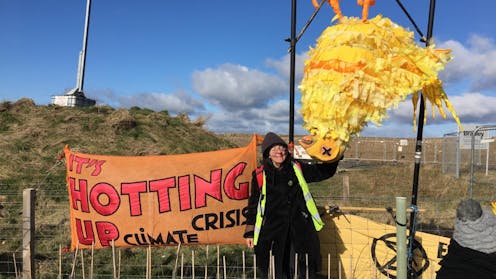
A protestor outside Preston New Road Fracking Site in Lancashire.Bob Walley, CC BY-NC-ND
“Get a job!” shouted yet another driver going past me in the sweeping rain outside Preston New Road fracking site, on another bitingly cold winters day. Recipients of these outbursts were mostly retirees like the Nanas of Lancashire (a group of women from the northern shire of England who had become prominent anti-fracking activists).
My mum often joined me and other protesters to oppose the exploratory drilling that throughout 2018 and 2019 caused earthquakes. Local people were worried about the damage this could do to their homes, the water they rely on and the area’s nature and wildlife.
When it got too cold and I could see mum was starting to get the shivers, we would go back to my family home for a nice cup of tea, leaving the die hards to keep guard 24/7, continuing the fight until we could rejoin them next time.
“It’ll never make any difference,” Dad would comment as we put the kettle on. As a reader of Rachel Carson’s Silent Spring – the 1962 book which exposed the destruction of wildlife through the widespread use of pesticides – and a school teacher all his life, he knew all too well the threats of the climate and ecological emergency. Especially once I joined the environmental protest movement.
But activism was not for him. “What was the point?” he’d wonder.
I can see why many people might feel like that. Especially when the decision by Lancashire County Council to reject fracking at Preston New Road was overruled by the Conservative government of the time, and the magnitude of permitted earthquakes was raised.
Frontline activism is certainly not for everyone. Especially when some journalists and politicians would have people believe these “eco-zealots” are the “enemies of society”, due to the disruption that can be caused by increasingly desperate and urgent protests and actions.
Stereotypes remain strong in public opinion and news sources often get basic climate change facts wrong. A quick google image search for “environmental activists” shows people with banners blocking roads, shouting into megaphones and looking angry. Perhaps even throwing soup at a painting or gluing themselves to the front of an office building if you scroll down a bit.
Local activists blockade the front gate of Preston New Road Fracking Site in Lancashire, stopping any vehicles coming in and out of the site. Bob Walley, CC BY-NC-ND
The radical flank frontline
More radical groups know that more disruptive actions lead to greater likelihood of coverage. This can lead to a “radical flank effect”, referring to the comparative outcome that occurs when more radical factions of a social movement like climate activism operate in the same arena as more moderate or less confrontational sections of that movement. The radical flank creates space behind it for others to move into and opportunities for social change can appear.
A vital role it would seem. But this doesn’t tell the whole story of what an activist is.
In a recent research study, I interviewed activists across a range of different ages, circumstances and ideological positions, from Just Stop Oil and Greenpeace to local wildlife trusts and community garden projects. All share concern for the future of life on this planet, trying to do what they can, where they can, to help shape a society we all deserve to live in.
Many express frustration and anger, alongside recognition, that the status quo and current economics are given more importance in political discourse and action than the large‐scale changes required to live sustainably within the natural world. One middle-aged woman who volunteers at the local climate hub (a public space for people involved in climate action) expressed “very little faith in governments. Just massive disappointment.”
The recent changes to protest laws which further vilify environmental activists and mean harsher sentences for attending zoom calls or holding a placard are seen as terrifyingly authoritarian. Yet a young employee of the group Surfers Against Sewage noted they are effective in that they “turn away the people who were kind of on the fence a little bit about it. But … it will also inspire others who are just like, dead against the injustice of it.”
My team’s research indicates a sense of despair due to this political inaction and pushback against those who speak out. Some on the radical flanks are seen by more conservative activists as too radical, and some on the flanks see those more conservative as too “soft” to generate the required changes.
Yet there is recognition of the vital roles everyone can play. A long-term Extinction Rebellion activist who now resides in Calderdale in West Yorkshire, recognised there needed to be “people fighting in different ways on so many different fronts, and I think there’s strength in supporting each other, if we can”.
Fracking was stopped in Lancashire. It was stopped by the Nanas, my mum and the many others on the radical flank frontline. But also by all of those working behind the scenes who put in time to lobby or protest in their own way. It was all these pieces of the puzzle working together that led to victory in Lancashire.
Our research shows you don’t have to be waving a placard shouting into a megaphone, although there is an important place for that too. Crucially, there are many roles for us all and ways we can work towards that future we all deserve to live in.
Don’t have time to read about climate change as much as you’d like?
Bob Walley receives funding from various internal research institutes and external funding bodies for the research and community projects he coordinates. He is affiliated with the University of Exeter, the University of Lancashire and Envirolution Network.
De los smartphones a los vehículos eléctricos, las baterías de litio son componentes tecnológicos críticos para una transición energética sostenible.
Como parte de la estrategia europea para lograr la neutralidad climática para 2050, Europa está realizando una firme apuesta por su reciclaje, para contribuir a la economía circular y a la reducción de residuos. España, por su parte, tiene varias plantas y proyectos en marcha para recuperar materias primas con alto valor añadido, como litio, cobalto y níquel.
Este hecho se debe principalmente a la dificultad que tiene la industria para extraer litio y procesarlo a un ritmo suficientemente rápido: los nuevos proyectos mineros tardan más de una década en desarrollarse. Ante este desafío, el reciclaje de baterías se presenta como una solución clave, con el potencial de reducir la necesidad de nuevo litio en un 10 % para 2040.
España, aunque sin minas de litio en explotación comercial, demuestra su compromiso con la economía circular a través de iniciativas concretas. Por ejemplo, están las plantas de A.3 Aprofitament Assessorament Ambiental en Granollers (Barcelona) y Novolitio en León –con una capacidad de reciclaje estimada de hasta 25 000 toneladas anuales–, o la iniciativa BeeCycle en Navarra.
Por otro lado, el interés de gigantes en el sector, como la empresa china Tianneng, que tiene prevista la implantación de una planta local en Jaén, pone de manifiesto el gran potencial industrial y estratégico de España.
La reutilización de las baterías es otra solución estratégica, ya que darles una segunda aplicación al final de su vida útil puede reducir las emisiones de carbono en 56 millones de toneladas para 2050, según un estudio reciente liderado por la Universidad de Münster (Alemania).
China lleva la delantera
Según un artículo de 2023, solo un reducido número de países tiene empresas capaces de gestionar el ciclo completo del reciclaje, incluyendo recogida, desmontaje y procesado químico y mecánico.
El proceso de reciclaje presenta importantes desafíos, como las bajas tasas de recolección, los altos costos de transporte y los posibles problemas de seguridad. Este último aspecto se ha puesto de manifiesto por los incidentes ocurridos recientemente en las plantas de reciclado de baterías de Sant Julià de Llor (Girona), el pasado mes de abril, y Azuqueca de Henares (Guadalajara), en julio.
De este modo, diversos estudios ponen de manifiesto que la viabilidad económica se alcanza en aquellos supuestos donde el punto de recolección de las baterías y las plantas de reciclado se encuentran dentro del mismo país.
El reciclaje incluye desde la recogida y desmontaje hasta la separación de materiales críticos. Pedro Jesús Navarrete.
Hacia una economía circular avanzada
Para superar estos retos, Europa está impulsando activamente la innovación y una sólida política regulatoria. El Reglamento de Baterías de la UE (2023) fija los objetivos de reciclaje y exige un contenido mínimo de componentes reciclados en las baterías.
La tecnología también está evolucionando, con investigaciones centradas en el reciclaje directo, que permite preservar la estructura de la batería a la vez que reduce el coste energético y la complejidad del proceso. Además, la robotización minimiza riesgos y dependencia del trabajo manual.
Otra innovación clave es el pasaporte digital de baterías, que permitirá rastrear cada una con datos de composición, origen e historial. Esto facilitará enormemente los procesos de reutilización y reciclaje al final de su vida útil.
Manos a la obra
Proyectos europeos como BeyondBattRec, RESTORE y RECYCALYSE, buscan desarrollar procesos de reciclaje más sostenibles y rentables.
Así, BeyondBattRec, con la participación de socios españoles como la Universidad de Jaén y Andaltec, aspira a recuperar hasta un 95 % de materiales críticos y a reducir las emisiones de CO₂ del proceso en un 50 %.
Por su parte, RESTORE –liderado por la fundación LEITAT, con participación de las empresas españolas Toratecnica SLU, Indumental Recycling SA y Dlyte Chemicals– tiene como objetivo revolucionar la gestión de los residuos procedentes de baterías al final de su vida útil.
Complementando este esfuerzo, el proyecto RECYCALYSE se enfoca en perfeccionar un sistema de circuito completamente cerrado que recupere y reutilice los materiales directamente, con la empresa española Sustainable Innovations como socio.
Aunque afronta retos significativos, el reciclaje de baterías es clave para la autonomía tecnológica de Europa y España. Con iniciativas locales, regulación ambiciosa y nuevas tecnologías, el desafío se convierte en oportunidad: no basta con extraer, hay que recuperar y reutilizar lo ya consumido para garantizar una transición energética y un futuro más sostenibles.
Pedro J. Navarrete desarrolla su labor como investigador en el proyecto BeyondBattRec, referido en este artículo. Esta vinculación no ha condicionado el contenido, que refleja exclusivamente su propio análisis y opinión.
Antonio Peñas Sanjuán es investigador en el proyecto BeyondBattRec, referido en este artículo. Esta vinculación no ha condicionado el contenido, que refleja exclusivamente su propio análisis y opinión
“¿Cómo pensamos?”. Aunque parece una pregunta sencilla, en realidad es una de las más profundas que una persona puede plantearse.
La educación puede ayudar a responderla, pero no mediante soluciones prefabricadas sino enseñando a las personas a pensar por sí mismas, a cultivar su autonomía y a convertirse en seres reflexivos y capaces de dirigir su propio aprendizaje. Pensar no es memorizar: requiere de métodos que afinen el juicio y amplíen la mirada.
El método socrático, por ejemplo, obliga a justificar las propuestas con argumentos razonables y convincentes.
La técnica del juego del rol invita a ponerse en la piel del otro, a asumir sus valores e intereses para comprender cómo toma sus decisiones.
El estudio comparado, por su parte, reconoce que la cultura y el idioma moldean el conocimiento: personas de distintas geografías pueden razonar de manera muy distinta, y reconocer esas diferencias enriquece nuestra propia vida intelectual.
En conjunto, todas estas metodologías muestran que existen múltiples maneras de pensar, cada una de las cuales configura la forma en que deliberamos, decidimos y actuamos.
En psicología cognitiva, el análisis de este proceso se denomina metacognición. Practicar la metacognición significa tomar conciencia de nuestros procesos mentales, detectar los patrones que los guían y dar un paso atrás para preguntarnos:
¿Qué problema intento resolver?
¿Cómo lo estoy abordando?
¿Acepto esta respuesta demasiado deprisa?
En educación, la metacognición es lo que permite a los estudiantes planificar sus estrategias, supervisar su aprendizaje y ajustar sus métodos. Pero estas habilidades no surgen de manera espontánea, sino que deben cultivarse de forma deliberada.
Intuición versus análisis
Un avance decisivo en la comprensión de la metacognición llegó de la mano de Daniel Kahneman, Nobel de Economía en 2002, quien sintetizó décadas de investigación en psicología en su libro Pensar rápido, pensar despacio. Kahneman mostró que la mente no funciona como un único motor racional, sino a través de dos sistemas complementarios.
El sistema 1, rápido, intuitivo y automático, permite reconocer al instante el rostro de un amigo, terminar la frase de otra persona o frenar bruscamente antes de que el peligro llegue siquiera a registrarse conscientemente. Es eficaz, pero propenso al error, porque se basa en atajos mentales construidos a partir de la experiencia.
El sistema 2, en cambio, es lento, deliberado y analítico y se activa cuando resolvemos un problema complejo, hacemos una evaluación detallada o cuestionamos nuestras primeras impresiones. Es más preciso, pero también más exigente, razón por la cual solemos evitarlo.
Kahneman y su coautor Amos Tversky demostraron que muchos de nuestros errores de juicio provienen de confiar en exceso en el sistema 1 y no activar el sistema 2 cuando la exactitud resulta crucial.
En este sentido, Kahneman prolonga una tradición filosófica que se extiende de Platón y Aristóteles a Hume, Locke y Wittgenstein: la búsqueda de marcos conceptuales para comprender cómo razonamos, decidimos y actuamos.
Alimentar la experiencia
La llegada de la inteligencia artificial ha alterado el equilibrio. Si se delega demasiado en las máquinas la resolución de problemas, el riesgo no es solo que el sistema 2 quede infrautilizado, sino que el sistema 1 también se debilite. La intuición no surge de la nada: se entrena y se alimenta con el trabajo paciente de la razón.
Cada vez que nos enfrentamos a un problema, probamos soluciones y refinamos nuestros juicios, estamos nutriendo al sistema 1 con la experiencia que necesita para, en el futuro, elaborar evaluaciones rápidas y certeras. Si la IA hace esos pasos en nuestro lugar, el depósito de experiencias se reduce. El sistema 1 seguirá funcionando, pero su biblioteca de experiencias será más pobre y menos fiable.
El reto es claro: si se usa de manera acrítica, la herramienta que promete liberar nuestra energía mental puede dejarnos con menor capacidad tanto para el análisis profundo como para la intuición rápida. Y dado que la IA no solo refleja sino que puede amplificar los sesgos humanos –y, además, es capaz de generar sus propias alucinaciones–, el ejercicio disciplinado del sistema 2 se vuelve más necesario que nunca.
Sin embargo, usada con criterio, la IA puede ayudar a estructurar el pensamiento, ofrecer perspectivas alternativas y estimular la reflexión. Pero esto exige diseñar experiencias de aprendizaje en las que los usuarios comparen, cuestionen y vuelvan a comparar y cuestionar los resultados que ofrece la máquina.
En cambio, usada sin cuidado la IA se convierte en una muleta cognitiva, una manera de evitar el esfuerzo reflexivo y de conformarse con respuestas fáciles.
La cuestión es el cómo
Un estudio reciente en China ilustra bien esta tensión. En un curso de inglés académico, los estudiantes llevaban diarios reflexivos y participaban en entrevistas. Aplicando la teoría del aprendizaje experiencial –según el cual, el aprendizaje se produce en un ciclo de acción, reflexión, conceptualización y experimentación– los investigadores observaron que los estudiantes que reflexionaban sobre el uso de la IA desarrollaban un conocimiento más profundo e integrado sobre cuándo, por qué y cómo utilizarla. Otros, en cambio, la trataban como un atajo y temían que debilitara sus competencias lingüísticas.
Los autores concluyeron que el uso excesivo de la IA con fines instrumentales puede minar el desarrollo del lenguaje, lo que subraya la necesidad de una utilización reflexiva más que solo funcional. La enseñanza es clara: lo decisivo no es si se usa la inteligencia artificial sino cómo.
¿Por qué?
El método de gestión los cinco porqués de Toyota es una herramienta simple y poderosa para llegar a la raíz de un problema. El principio es directo: al preguntar repetidamente, y al menos cinco veces, “¿por qué?” ante cada explicación, quedan atrás las respuestas superficiales y se llega a sus causas profundas. Este método es un recurso de gestión pero también una forma de metacognición: obliga a ir más allá de la primera respuesta, a interrogar las propias suposiciones y a dirigir de manera consciente el pensamiento.
En un mundo donde la IA puede generar en segundos una respuesta a casi cualquier cuestión, la verdadera ventaja pertenece a quienes saben interrogar esas respuestas, rastrear su propio razonamiento y elegir deliberadamente cómo proceder. La IA puede ser una compañera en ese proceso, pero solo si seguimos siendo los autores de nuestro pensamiento.
Por ello es fundamental adoptar estrategias prácticas que impidan que la IA erosione ese músculo intelectual tan esencial que es la metacognición. Algunas recomendaciones útiles son:
Delimitar el problema antes de consultar a la IA: definir el propósito, la pregunta central y la conclusión que se espera alcanzar.
Verificar las fuentes que ofrece la IA, seleccionar las más creíbles y leerlas con espíritu crítico.
No permitir que la IA dicte las conclusiones; anticiparlas uno mismo.
Trabajar en varias iteraciones, idealmente cinco o más, afinando el razonamiento en cada intercambio.
Añadir experiencias personales y reflexiones propias para hacer el texto original e inconfundible.
Al terminar, reflexionar explícitamente sobre lo que se ha aprendido en el proceso; cada reflexión refuerza la metacognición.
En definitiva, la metacognición no consiste en demorarse ni en dudar por dudar. Consiste en asumir la autoría consciente de nuestros procesos mentales. En una era en la que la IA puede ofrecer una respuesta instantánea a casi cualquier pregunta, la verdadera inteligencia no pertenece a quien responde más rápido, sino a quien es capaz de cuestionar esa respuesta, repensarla y decidir conscientemente cómo avanzar.
Una versión de este artículo se publicó en LinkedIn.
Santiago Iñiguez de Onzoño no recibe salario, ni ejerce labores de consultoría, ni posee acciones, ni recibe financiación de ninguna compañía u organización que pueda obtener beneficio de este artículo, y ha declarado carecer de vínculos relevantes más allá del cargo académico citado.