How to discover a planet

Source: The Conversation – UK – By Christopher Watson, Professor, Astrophysics Research Centre, School of Mathematics and Physics, Queen’s University Belfast

Nasa animation depicting the first 5,000 exoplanets to have been discovered, up to March 2022. M. Russo and A. Santaguida/Nasa-JPL

On October 6 1995, at a scientific meeting in Florence, Italy, two Swiss astronomers made an announcement that would transform our understanding of the universe beyond our solar system. Michel Mayor and his PhD student Didier Queloz, working at the University of Geneva, announced they had detected a planet orbiting a star other than the Sun.

The star in question, 51 Pegasi, lies about 50 light years away in the constellation Pegasus. Its companion – christened 51 Pegasi b – was unlike anything written in textbooks about how we thought planets might look. This was a gas giant with a mass of at least half that of Jupiter, circling its star in just over four days. It was so close to the star (1/20th of Earth’s distance from the Sun, well inside Mercury’s orbit) that the planet’s atmosphere would be like a furnace, with temperatures topping 1,000°C.

The instrument behind the discovery was Elodie, a spectrograph that had been installed two years earlier at the Haute-Provence observatory in southern France. Designed by a Franco-Swiss team, Elodie split starlight into a spectrum of different colours, revealing a rainbow etched with fine dark lines. These lines can be thought of as a “stellar barcode”, providing details on the chemistry of other stars.

What Mayor and Queloz spotted was 51 Pegasi’s barcode sliding rhythmically back-and-forth in this spectrum every 4.23 days – a telltale signal that the star was being wobbled back and forth by the gravitational tug of an otherwise unseen companion amid the glare of the star.

After painstakingly ruling out other explanations, the astronomers finally decided that the variations were due to a gas giant in a close-in orbit around this Sun-like star. The front page of the Nature journal in which their paper was published carried the headline: “A planet in Pegasus?”

The discovery baffled scientists, and the question-mark on Nature’s front cover reflected initial skepticism. Here was a purported giant planet next to its star, with no known mechanism for forming a world like this in such a fiery environment.

While the signal was confirmed by other teams within weeks, reservations about the cause of the signal remained for almost three years before being finally ruled out. Not only did 51 Pegasi b become the first planet discovered orbiting a Sun-like star outside our Solar System, but it also represented an entirely new type of planet. The term “hot Jupiter” was later coined to describe such planets.

Diagram showing 51 Pegasi b to be 50% larger than Jupiter, and 51 Pegasi to be 23% larger than the Sun.

NASA/JPL-Caltech

This discovery opened the floodgates. In the 30 years since, more than 6,000 exoplanets (the term for planets outside our Solar System) and exoplanet candidates have been catalogued.

Their variety is staggering. Not only hot but ultra-hot Jupiters with a dayside temperature exceeding 2,000 °C and orbits of less than a day. Worlds that orbit not one but two stars, like Tatooine from Star Wars. Strange “super-puff” gas giants larger than Jupiter but with a fraction of the mass. Chains of small rocky planets all piled up in tight orbits.

The discovery of 51 Pegasi b triggered a revolution and, in 2019, landed Mayor and Queloz a Nobel prize. We can now infer that most stars have planetary systems. And yet, of the thousands of exoplanets found, we have yet to find a planetary system that resembles our own.


Read more:
Nobel Prize in Physics: how the first exoplanet around a sun-like star was discovered


The quest to find an Earth twin – a planet that truly resembles Earth in size, mass and temperature – continues to drive modern-day explorers like us to search for more undiscovered exoplanets. Our expeditions may not take us on death-defying voyages and treks like the past legendary explorers of Earth, but we do get to visit beautiful, mountain-top observatories often located in remote areas around the world.

We are members of an international consortium of planet hunters that built, operate and maintain the Harps-N spectrograph, mounted on the Telescopio Nazionale de Galileo on the beautiful Canary island of La Palma. This sophisticated instrument allows us to rudely interrupt the journey of starlight which may have been travelling unimpeded at speeds of 670 million miles per hour for decades or even millennia.

Each new signal has the potential to bring us closer to understanding how common planetary systems like our own may (or may not) be. In the background lies the possibility that one day, we may finally detect another planet like Earth.

The origins of exoplanet study

Up until the mid-1990s, our Solar System was the only set of planets humanity ever knew. Every theory about how planets formed and evolved stemmed from these nine, incredibly closely spaced data-points (which went down to eight when Pluto was demoted in 2006, after the International Astronomical Union agreed a new definition of a planet).

All of these planets revolve around just one star out of the estimated 10¹¹ (roughly 100 billion) in our galaxy, the Milky Way – which is in turn one of some 10¹¹ galaxies throughout the universe. So, trying to draw conclusions from the planets in our Solar System alone was a bit like aliens trying to understand human nature by studying students living together in one house. But that didn’t stop some of the greatest minds in history speculating on what lay beyond.

The ancient Greek philosopher Epicurus (341-270BC) wrote: “There is an infinite number of worlds – some like this world, others unlike it.” This view was not based on astronomical observation but his atomist theory of philosophy. If the universe was made up of an infinite number of atoms then, he concluded, it was impossible not to have other planets.

Epicurus clearly understood what this meant in terms of the potential for life developing elsewhere: “We must not suppose that the worlds have necessarily one and the same shape. Nobody can prove that in one sort of world there might not be contained – whereas in another sort of world there could not possibly be – the seeds out of which animals and plants arise and all the rest of the things we see.”

In contrast, at roughly the same time, fellow Greek philosopher Aristotle (384-322 BC) was proposing his geocentric model of the universe, which had the Earth immobile at its centre with the Moon, Sun and known planets orbiting around us. In essence, the Solar System as Aristotle conceived it was the entire universe. In On the Heavens (350BC), he argued: “It follows that there cannot be more worlds than one.”

Such thinking that planets were rare in the universe persisted for 2,000 years. Sir James Jeans, one of the world’s top mathematicians and an influential physicist and astronomer at the time, advanced his tidal hypothesis of planet formation in 1916. According to this theory, planets were formed when two stars pass so closely that the encounter pulls streams of gas off the stars into space, which later condense into planets. The rareness of such close cosmic encounters in the vast emptiness of space led Jeans to believe that planets must be rare, or – as was reported in his obituary – “that the solar system might even be unique in the universe”.


The Insights section is committed to high-quality longform journalism. Our editors work with academics from many different backgrounds who are tackling a wide range of societal and scientific challenges.


But by then, understanding of the scale of the universe was slowly changing. In the “Great Debate” of 1920, held at the Smithsonian Museum of Natural History in Washington DC, American astronomers Harlow Shapley and Heber Curtis clashed over whether the Milky Way was the entire universe, or just one of many galaxies. The evidence began to point to the latter, as Curtis had argued for. This realisation – that the universe contained not just billions of stars, but billions of galaxies each containing billions of stars – began to affect even the most pessimistic predictors of planetary prevalence.

In the 1940s, two things caused the scientific consensus to pivot dramatically. First, Jeans’ tidal hypothesis did not stand up to scientific scrutiny. The leading theories now had planet formation as a natural byproduct of star formation itself, opening up the potential for all stars to host planets.

Then in 1943, claims emerged of planets orbiting the stars 70 Ophiuchus and 61 Cygni c – two relatively nearby star systems visible to the naked eye. Both were later shown to be false positives, most likely due to uncertainties in the telescopic observations that were possible at the time – but nonetheless, it greatly influenced planetary thinking. Suddenly, billions of planets in the Milky Way was considered a genuine scientific possibility.

For us, nothing highlights this change in mindset more than an article written for the Scientific American in July 1943 by the influential American astronomer Henry Norris Russell. Whereas two decades earlier, Russell had predicted that planets “should be infrequent among the stars”, now the title of his article was: “Anthropocentrism’s Demise. New Discoveries Lead to the Probability that There Are Thousands of Inhabited Planets in our Galaxy”.

Strikingly, Russell was not merely making a prediction about any old planets, but inhabited ones. The burning question was: where were they? It would take another half-century to begin finding out.

View of two hi-tech telescopes with the sea beyond.
The Harps-N spectrograph is mounted on the Telescopio Nazionale de Galileo (left) in La Palma, Canary Islands.
lunamarina/Shutterstock

How to detect an exoplanet

When we observe myriad stars through La Palma’s Italian-built Galileo telescope using our Harps-N spectrograph, it is amazing to consider how far we have come since Mayor and Queloz announced their discovery of 51 Pegasi b in 1995. These days, we can effectively measure the masses of not just Jupiter-like planets, but even small planets thousands of light years away. As part of the Harps-N collaboration, we have had a front-row seat since 2012 in the science of small exoplanets.

Another milestone in this story came four years after the 51 Pegasi b discovery, when a Canadian PhD student at Harvard University, David Charbonneau, detected the transit of a known exoplanet. This was another hot Jupiter, known as HD209458b, also located in the Pegasus constellation, about 150 light years from Earth.

Transit refers to a planet passing in front of its star, from the perspective of the observer, momentarily making the star appear dimmer. As well as detecting exoplanets, the transit technique enables us to measure the radius of the planet by taking many brightness measurements of a star, then waiting for it to dim due to the passing planet. The extent of blocked starlight depends on the radius of the planet. For example, Jupiter would make the Sun 1% dimmer to alien observers, while for Earth, the effect would be a hundred times weaker.

In all, four times more exoplanets have now been discovered using this transit technique compared with the “barcode” technique, known as radial velocity, that the Swiss astronomers used to spot the first exoplanet 30 years ago. It is a technique that is still widely used today, including by us, as it can not only find a planet but also measure its mass.

A planet orbiting a star exerts a gravitational pull which causes that star to wobble back and forth – meaning it will periodically change its velocity with respect to observers on Earth. With the radial velocity technique, we take repeated measurements of the velocity of a star, looking to find a stable periodic wobble that indicates the presence of a planet.

These velocity changes are, however, extremely small. To put it in perspective, the Earth makes the Sun change its velocity by a mere 9cm per second – slower than a tortoise. In order to find planets with the radial velocity technique, we thus need to measure these small velocity changes for stars that are many many trillions of miles away from us.

The state-of-the-art instruments we use are truly an engineering feat. The latest spectrographs, such as Harps-N and also Espresso, can accurately measure velocity shifts of the order of tenths of centimetres per second – although still not sensitive enough to detect a true Earth twin.

But whereas this radial velocity technique is, for now, limited to ground-based observatories and can only observe one star at the time, the transit technique can be employed in space telescopes such as the French Corot (2006-14) and Nasa’s Kepler (2009-18) and Tess (2018-) missions. Between them, space telescopes have detected thousands of exoplanets in all their diversity, taking advantage of the fact we can measure stellar brightness more easily from space, and for many stars at the same time.

Despite the differences in detection success rate, both techniques continue to be developed. Applying both can give the radius and mass of a planet, opening up many more avenues for studying its composition.

To estimate possible compositions of our discovered exoplanets, we start by making the simplified assumption that small planets are, like Earth, made up of a heavy iron-rich core, a lighter rocky mantle, some surface water and a small atmosphere. Using our measurements of mass and radius, we can now model the different possible compositional layers and their respective thickness.

This is still very much a work in progress, but the universe is spoiling us with a wide variety of different planets. We’ve seen evidence of rocky worlds being torn apart and strange planetary arrangements that hint at past collisions. Planets have been found across our galaxy, from Sweeps-11b in its central regions (at nearly 28,000 light years away, one of the most distant ever discovered) to those orbiting our nearest stellar neighbour, Proxima Centauri, which is “only” 4.2 light years away.

Illustration of the exoplanet Proxima b
Illustration of Proxima b, one of the exoplanets orbiting the nearest star to our Sun, Proxima Centauri.
Catmando/Shutterstock

Searching for ‘another Earth’

In early July 2013, one of us (Christopher) was flying out to La Palma for my first “go” with the recently commissioned Harps-N spectrograph. Keen not to mess up, my laptop was awash with spreadsheets, charts, manuals, slides and other notes. Also included was a three-page document I had just been sent, entitled: Special Instructions for ToO (Target of Opportunity).

The first paragraph stated: “The Executive Board has decided that we should give highest priority to this object.” The object in question was a planetary candidate thought to be orbiting Kepler-78, a star a little cooler and smaller than our Sun, located about 125 light years away in the direction of the constellation Cygnus.

A few lines further down read: “July 4-8 run … Chris Watson” with a list of ten times to observe Kepler-78 – twice per night, each separated by a very specific four hours and 15 minutes. The name above mine was Didier Queloz’s (he hadn’t been awarded his Nobel prize yet, though).

This planetary candidate had been identified by the Kepler space telescope, which was tasked with searching a portion of the Milky Way to look for exoplanets as small as the Earth. In this case, it had identified a transiting planet candidate with an estimated radius of 1.16 (± 0.19) Earth radii – an exoplanet not that much larger than Earth had potentially been spotted.

I was in La Palma to attempt to measure its mass which, combined with the radius from Kepler, would allow the density and possible composition to be constrained. I wrote at the time: “Want 10% error on mass, to get a good enough bulk density to distinguish between Earth-like, iron-concentrated (Mercury), or water.”

In all, I took ten out of our team’s total of 81 exposures of Kepler-78 in an observing campaign lasting 97 days. During that time, we became aware of a US-led team who were also looking for this potential planet. In true scientific spirit, we agreed to submit our independent findings at the same time. On the specified date. Like a prisoner swap, the two teams exchanged results – which agreed. We had, within the uncertainties of our data, reached the same conclusion about the planet’s mass.

Its most likely mass came out as 1.86 Earth masses. At the time, this made Kepler-78b the smallest extrasolar planet with an accurately measured mass. The density was almost identical to that of Earth’s.

But that is where the similarities to our planet ended. Kepler-78b has a “year” that lasts only 8.5 hours, which is why I had been instructed to observe it every 4hr 15min – when the planet was at opposite sides of its orbit, and the induced “wobble” of the star would be at its greatest. We measured the star wobbling back and forth at about two metres per second – no more than a slow jog.

Kepler-78b’s short orbit meant its extreme temperature would cause all rock on the planet to melt. It may have been the most Earth-like planet found at the time in terms of its size and density, but otherwise, this hellish lava world was at the very extremes of our known planetary population.

Illustration of the exoplanet Kepler-78b
Illustration of the Kepler-78b ‘lava world’ – similar in size and density to Earth.
simoleonh/Shutterstock

In 2016, the Kepler space telescope made another landmark discovery: a system with at least five transiting planets around a Sun-like star, HIP 41378, in the Cancer constellation. What made it particularly exciting was the location of these planets. Where most transiting planets we have spotted are closer to their star than Mercury is to the Sun (due to our detection capabilities), this system has at least three planets beyond the orbital radius of Venus.

Having decided to use our Harps-N spectrograph to measure the masses of all five transiting planets, it became clear after more than a year of observing that one instrument would not be enough to analyse this challenging mix of signals. Other international teams came to the same conclusion and, rather than compete, we decided to come together in a global collaboration that holds strong to this day, with hundreds of radial velocities gathered over many years.

We now have firm masses and radii for most of the planets in the system. But studying them is a game of patience. With planets much further away from their host star, it takes much longer before there is a new transit event or the periodic wobble can be fully observed. We thus need to wait multiple years and gather lots of data to gain insight in this system.

The rewards are obvious, though. This is the first system that starts resembling our Solar System. While the planets are a bit larger and more massive than our rocky planets, their distances are very similar – helping us to understand how planetary systems form in the universe.

The holy grail for exoplanet explorers

After three decades of observing, a wealth of different planets have emerged. We started with the hot Jupiters, large gas giants close to their star that are among the easiest planets to find due to both deeper transits and larger radial velocity signals. But while the first tens of discovered exoplanets were all hot Jupiters, we now know these planets are actually very rare.

With instrumentation getting better and observations piling up, we have since found a whole new class of planets with sizes and masses between those of Earth and Neptune. But despite our knowledge of thousands of exoplanets, we still have not found systems truly resembling our solar system, nor planets truly resembling Earth.

It is tempting to conclude this means we are a unique planet in a unique system. While this still could be true, it is unlikely. The more reasonable explanation is that, for all our stellar technology, our capabilities of detecting such Earth-like planets are still fairly limited in a universe so mind-bogglingly vast.

The holy grail for many exoplanet explorers, including us, remains to find this true Earth twin – a planet with a similar mass and radius as Earth’s, orbiting a star similar to the Sun at a distance similar to how far we are from the Sun.

While the universe is rich in diversity and holds many planets unlike our own, discovering a true Earth twin would be the best place to start looking for life as we know it. Currently, the radial velocity method – as used to find the very first exoplanet – remains by far the best-placed method to find it.

Thirty years on from that Nobel-winning discovery, pioneering planetary explorer Didier Queloz is taking charge of the very first dedicated radial velocity campaign to go in search of an Earth-like planet.

A major international collaboration is building a dedicated instrument, Harps3, to be installed later this year at the Isaac Newton Telescope on La Palma. Given its capabilities, we believe a decade of data should be enough to finally discover our first Earth twin.

Unless we are unique after all.


For you: more from our Insights series:

To hear about new Insights articles, join the hundreds of thousands of people who value The Conversation’s evidence-based news. Subscribe to our newsletter.

The Conversation

Christopher Watson receives funding from the Science and Technology Facilities Council (STFC).

Annelies Mortier receives funding from the Science and Technology Facilities council (STFC) and UK Research and Innovation (UKRI).

ref. How to discover a planet – https://theconversation.com/how-to-discover-a-planet-266550

European countries are now turning to landmines to create new deadly defensive barriers from Russia

Source: The Conversation – UK – By Rod Thornton, Senior Lecturer in International Studies, Defence and Security., King’s College London

Five Nato countries neighbouring Russia or its ally, Belarus, have announced that they are to opt out of the Ottawa treaty of 1997.

This treaty bans the use by signatories of anti-personnel (AP) landmines. These states – Poland, Finland, Lithuania, Estonia and Latvia – now have plans to create a 2,000-mile stretch of mined areas as part of a defensive effort against any possible attack from Russia.

The move to create such minefields comes as the result of both a recognition of the perceived growing threat from Russia and of the important defensive effect – as proved during the current Ukraine war – that both AP and anti-tank (AT) landmines can generate.

AT mines are not covered by the Ottawa treaty and all countries are free to use them. AT mines target only vehicles (the weight of a human cannot set them off). The main issue with AP mines, which target humans, is that they can be set off by civilians as well as soldiers.

As such, they are deemed to be not only indiscriminate weapons but also those whose “persistence” means that they can remain a danger long after any conflict is over. Their banning is seen by many as an “ethical imperative”.

In the current era of military development dominated by the introduction of high-tech weapons systems, it appears that the low-tech, unsophisticated and relatively cheap landmine – which can be laid in their millions – can have a significant role to play in modern warfare.

Minefields have proved very effective as a defensive tool in the current Ukraine war because of their ability to disrupt enemy assaults. This recognition has, for these five Nato states, meant that their adherence to the Ottawa treaty had to end, despite its grounding in humanitarian concerns.

An overhead shot of the Narva bridge in Estonia with the national flag in the foreground.
The Narva bridge forms the border between Estonia and Russia. Estonia is one of the countries planning to add more fortifications along its border.
Alexandre.ROSA/Shutterstock

These five states have been criticised by human rights organisations for withdrawing from the treaty. The UK was also a signatory in 1997 and still remains bound by its stipulations. The US, Russia and China didn’t sign in the first place.

The role of landmines

Landmines have proved a significant defensive tool in the Ukraine war. In the initial days of Russia’s full-scale invasion in February 2022, the Ukrainian side was very quick to deploy some of its stockpile of Soviet-era AT mines.

These were very effective in restricting the early advance of Russian armoured columns (the term “armour” covering both tanks and other armoured vehicles) on Kyiv. These mines created disruption as Russian forces were either stopped or had to find other routes around the minefields.

The delays allowed time for Ukrainian forces to set up firm defensive positions that eventually halted the Russian columns and led to their being turned back before reaching Kyiv.

Ukrainian forces then launched their own armoured offensive in the summer of 2023. These forces, by now trained and equipped by Nato states and using trademark Nato combined arms manoeuvre warfare techniques, were also held up in dense Russian minefields. Their advance ground to a halt.

The presence of vast fields of both AP and AT mines meant that the supposedly war-winning principal of “manoeuvre warfare”, which relies on movement, initiative and surprise, and which the Ukrainians had been taught by Nato instructors, became impossible to conduct. The Russians call their defensive minefields “insurmountable”.

Given the power of minefields, both sides came ultimately to understand that their presence had to mean a rethink of how the war should be conducted. Mines led to a change in tactics.

Both sides had to adopt much more attritional approaches. Outcomes would now largely be dictated by the weight of artillery fire and not by manoeuvre. It is minefields that form the basis for the Ukrainian forces’ “fortress belt” across much of the Donbas region.

Russian use of landmines slowed down a Ukrainian counter attack.

Despite Kyiv having itself signed the Ottawa treaty in 2005, it was clear that its forces were making considerable use of banned AP mines along with the “legal” AT mines.


Read more:
Ukraine joins other Russian neighbours in quitting landmines treaty: another deadly legacy in the making


Ukraine only officially withdrew from Ottawa in June this year. Ukrainian president Volodymyr Zelensky justified the withdrawal on the basis that “antipersonnel mines … very often have no alternative as a tool for defence”.

The Russian defensive arrangements like those of Ukrainian forces make considerable use of mines. The Russian side is able to draw on what is perceived to be the world’s largest stockpile of, in particular, AP mines (said to be amount to some 26.5 million). Zelensky has accused Russia of using AP mines “with extreme cynicism”, (referring to the alleged booby trapping of dead Russian soldiers with AP mines).

Old tech with big impact

What is interesting here is that the very old technology of landmines is being combined with the far newer one of drones. Minefields can now be laid far more efficiently by using drones to plant them rather than, as has been the norm, by hand. The drones have changed how mine warfare is carried out.

Given what is happening in Ukraine, it is now well understood that mines can do more than help decide the course of mere tactical military engagements; they can create strategic outcomes. They can, in essence, decide the outcome of wars.

It is with this understanding in mind that these five Nato states have withdrawn from the Ottawa treaty. AP mines are patently needed on today’s battlefields. They are seen as an essential addition to the AT mines. Each type has their defensive role to play.

As such, these five states are now seeking to both procure their own AP mines domestically and to source them from the US. Somewhat controversially, the administration of former US president, Joe Biden, had already taken a decision, just before Donald Trump became president, to supply Ukraine with considerable numbers of “non-persistent” AP mines. At the time, Kyiv was still a signatory to Ottawa.

AP and AT mines have both proved themselves to be essential tools of modern warfare. Today, the war in Ukraine is characterised and dominated, due to the presence of mines, by defence and not offence. Frontlines are largely static. Humble, cheap and simple they may be, but landmines do, it seems, have a crucial role to play in modern warfare.

The Conversation

The authors do not work for, consult, own shares in or receive funding from any company or organisation that would benefit from this article, and have disclosed no relevant affiliations beyond their academic appointment.

ref. European countries are now turning to landmines to create new deadly defensive barriers from Russia – https://theconversation.com/european-countries-are-now-turning-to-landmines-to-create-new-deadly-defensive-barriers-from-russia-266181

Book of Kells: exploring the evidence that points to Pictish origins in north-east Scotland

Source: The Conversation – UK – By Rachel Moss, Professor in the History of Art and Architecture, Trinity College Dublin

Writing in the early 20th century, the celebrated author James Joyce noted that the Book of Kells – an illuminated manuscript depicting the four gospels of the New Testament in Latin – was “the most purely Irish thing we have”.

By this time, the unique and intricate designs of the approximately 1,200-year-old manuscript were instantly recognisable, having been replicated on everything from embroidered clothing to tea sets coveted by nationalists and the Irish diaspora alike. These designs were deemed symbolic of “pure” Irish visual identity, created before the coming of the Vikings and the Anglo-Normans to Irish shores.

For well over a century, debate has raged as to whether the manuscript was made at Iona on the west coast of Scotland, the northern English monastery of Lindisfarne or indeed a different Columban monastery in Ireland. Now, a new contribution to the debate, The Book of Kells Unlocking the Enigma, soon to be published by archaeologist and art historian Victoria Whitworth, adds further food for thought on the topic.

The manuscript known as the Book of Kells was first referred to as such by the great biblical scholar Bishop James Ussher (1581-1656) to distinguish between two “gospel books of [St] Columcill”, one kept at Kells, county Meath, the other at Durrow in county Offaly.

Land charters transcribed on to the pages of the Kells manuscript prove that it had been there since at least the 11th century, and is therefore likely to be the same “great gospel book of Columcille” recorded as having been stolen and subsequently recovered from the same monastery in 1007.

Although nobody knows exactly when it was made, art historians and paleographers (experts in handwriting and manuscripts) agree that the Book of Kells most likely dates to the late 8th century. And therein lies a problem. The monastery at Kells was not founded until 807, when monks fleeing Viking incursions on the Scottish Hebridean island of Iona were gifted a safer inland site in Ireland to establish a new, ultimately thriving, monastery. So, while we know the manuscript spent at least 650 years at Kells, we do not know where it started its life.

Uncovering new evidence

Between 1994 and 2007, an archaeological excavation at the Pictish monastic site of Portmahomack, Easter Ross in the north-east of Scotland revealed the first-known evidence for the widescale manufacture of parchment in northern Europe.

This was particularly surprising, as no surviving manuscript has previously been identified as coming from this area. In addition to this, Whitworth has identified Pictish stones carved with designs and writing like that found in the Book of Kells. So, does this mean that the most purely Irish thing we have is actually Pictish?

The manuscript was made at a time when Irish churchmen and scholars not only travelled extensively but welcomed people from across Europe to study in its schools. Books also circulated widely at this time, whether as working texts, diplomatic gifts or exemplars distributed to scriptoria (monastery rooms where manuscripts were copied) across Europe.

This cultural mix is evident in the significant range of artistic sources drawn on by the Book of Kells artists. Clearly they had access to designs from contemporary continental gospels, Irish fine metalwork, Byzantine icons and imagery found on Pictish stones. None of the scribes or artists recorded their names, and indeed we don’t even know how many there were, such is the relative consistency of the script.

Non-invasive pigment analysis of the manuscript some years ago revealed the use of pigments typical to manuscript production in Scotland and Ireland during the period, some cleverly blended in such a way as to mimic the precious gold and lapis lazuli that lay beyond their reach.

An estimated 159 calf skins were used to make its surviving pages, some of which were of very poor quality. What we don’t know is whether these animals were reared and processed close to the scriptorium where the manuscript was made, whether they might have been collected up from across the territory of a wealthy donor, or whether they were brought in from a single specialist “processor”, as for example, at Portmahamock. Ultimately, advances in non-invasive DNA testing may provide scientific answers to these questions and reveal much regarding the economy of the period.

While at present it is impossible to prove beyond doubt, Whitworth’s book highlights an important new potential provenance for the Book of Kells. However, it also serves as a timely reminder that our preoccupation with the “nationality” of the manuscript is based on a 19th-century construct, which can distract from other considerations.

Whether based in Pictland, Iona or Ireland, its makers may have come together from a variety of locations, and they certainly had an international outlook. As such, this new research is equally important in considering how these people went about creating an object without borders. In this they were successful, as in 1007 it was deemed “chief relic of the Western World” and two centuries later as “the Work of Angels”.


This article features references to books that have been included for editorial reasons, and may contain links to bookshop.org; if you click on one of the links and go on to buy something from this website The Conversation UK may earn a commission.


Looking for something good? Cut through the noise with a carefully curated selection of the latest releases, live events and exhibitions, straight to your inbox every fortnight, on Fridays. Sign up here.


The Conversation

Rachel Moss works for Trinity College Dublin. In the past she has received funding from the Irish Research Council and Bank of America Merrill Lynch for research work relevant to this article.

ref. Book of Kells: exploring the evidence that points to Pictish origins in north-east Scotland – https://theconversation.com/book-of-kells-exploring-the-evidence-that-points-to-pictish-origins-in-north-east-scotland-266568

The pre-Raphaelite muse who inspired Taylor Swift’s The Fate of Ophelia

Source: The Conversation – UK – By Serena Trowbridge, Reader in Victorian Literature, Birmingham City University

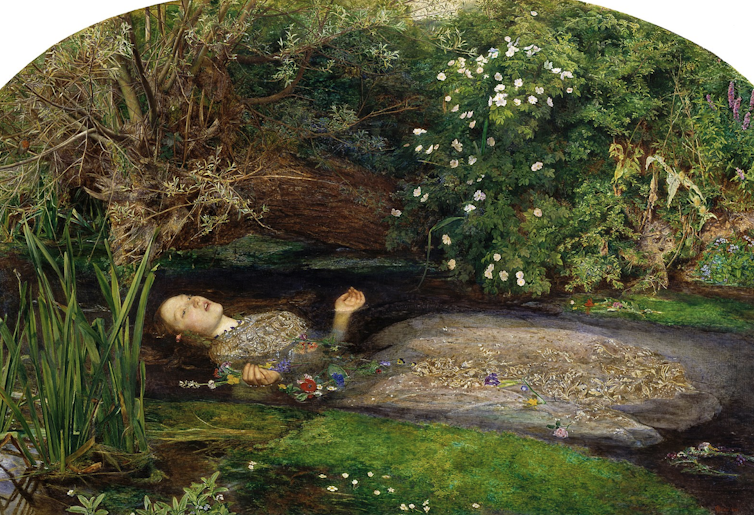
As a professor of pre-Raphaelite studies, I was excited to see that the track list for Taylor Swift’s 12th album, The Life of a Showgirl includes a song called The Fate of Ophelia. Ahead of the album’s release, fans and art historians speculated that the inspiration could come from John Everett Millais’s painting Ophelia (1851-52), one of the most visited paintings at Tate Britain.

The painting shows Ophelia, the heroine of Shakespeare’s play Hamlet (1623), floating in the river after her doomed relationship had driven her to madness and suicide.

The cover art for The Life of a Showgirl confirms this. It shows Swift wearing a silvery outfit, partially submerged in water with her hands floating palm-up to the surface. So far, so Everett Millais. Though the styling is very different from Millais’s work, the pose, with focus on her hands and face, seemed to give a nod to his Ophelia.

Painting of Ophelia in a river
Ophelia by John Everett Millais (1851-52).
Tate Britain

The model who posed for Millais’s painting, Elizabeth Siddal (who is buried in Highgate, near where Swift once lived) lay in a bathtub while he painted her. When the candles heating the water went out, she stayed there for hours, uncomplaining, until she became ill.

As a muse and model, Siddal exemplifies the woman silenced by and sacrificed to male artistic ambition. Swift’s cover transforms the corpse-like Ophelia into a striking image, with her eyes open and staring, as though a dead woman has come back to life to accuse us. The female figure is no longer a muse (or a showgirl).

Siddal was interested in similar themes. In her poem My Lady’s Soul, she wrote about a woman transformed through death into art:

Low sit I down at my lady’s feet

Gazing through her wild eyes,

Smiling to think how my love will fleet

When their starlike beauty dies

The woman in the poem may be silenced, but her eyes accuse us of objectification.

We know Swift is a reader: she’s referenced Daphne du Maurier’s novel Rebecca, the poet Emily Dickinson, The Great Gatsby and Romeo and Juliet among others, in her music. And the first song on the album, The Fate of Ophelia, references Siddal as well as Shakespeare’s tragic heroine.

The song’s conceit is that a happy relationship has saved the singer from Ophelia’s fate of madness and drowning. Swift has said told interviewers that she prefers a happy ending, having rewritten Romeo and Juliet in Love Story (2008), and The Fate of Ophelia is quite detailed in its references to Hamlet: “The eldest daughter of a nobleman / Ophelia lived in fantasy / But love was a cold bed full of scorpions / The venom stole her sanity.”

The Fate of Ophelia is the first track on Swift’s new album, The Life of a Showgirl.

The chorus goes: “All that time / I sat alone in my tower / You were just honing your powers / Now I can see it all. / Late one night / You dug me out of my grave and / Saved my heart from the fate of Ophelia.”

Alone in a tower, waiting for a prince to come? That sounds like some other Shakespearean or pre-Raphaelite heroines, such as Mariana, from Shakespeare’s play Measure for Measure (1604) who was reinterpreted by the poet Alfred Tennyson in 1832. Millais painted Mariana in 1851. The speaker in Swift’s song, however, has been saved from death: “You dug me out of my grave.”

Black and white photo of Siddal
Elizabeth Siddal (circa 1860).
WikiCommons

There are all kinds of interesting resurrection metaphors in the song: was Swift already dead, then? Is this about Ophelia, buried with partial rites due to the suspicion that she killed herself? Or is this about Siddal, the muse and model whose body was exhumed by her husband?

When Siddal died by overdose of laudanum (an opiate many Victorians were addicted to since it was prescribed for many illnesses) in 1862, she was buried at Highgate cemetery. Her grief-stricken (or guilt-ridden) husband Dante Gabriel Rossetti threw his manuscript poems into her coffin. Seven years later, the coffin was exhumed in order to restore the manuscripts to Rossetti for publication.

The myths exploded from that point. Charles Augustus Howell, the unscrupulous friend of Rossetti who oversaw the exhumation, claimed that Siddel’s body was perfectly preserved, her hair had continued growing in her coffin and – as Rossetti wrote to Swinburne in a letter dated October 16 1869 – he believed that “could she have opened the grave, no other hand would have been needed”.

In her reworking of the Ophelia and Siddal story, Swift undermines the stereotype of the mute, decorative showgirl by overlaying it with her own more triumphant ending.

In isolation, Swift’s conflation of Siddal, Ophelia and her own persona isn’t necessarily that progressive: after all, the song features a woman waiting for someone to save her. However, taken in conjunction with the rest of the album, it’s clear that Swift’s approach is to explore the public face of women, from Elizabeth Taylor (reminiscent of Clara Bow from her last album) to Eldest Daughter, and culminating in the title track, which indicates the pain behind the facade of a public figure, “hidden by the lipstick and lace”.


Looking for something good? Cut through the noise with a carefully curated selection of the latest releases, live events and exhibitions, straight to your inbox every fortnight, on Fridays. Sign up here.


The Conversation

Serena Trowbridge does not work for, consult, own shares in or receive funding from any company or organisation that would benefit from this article, and has disclosed no relevant affiliations beyond their academic appointment.

ref. The pre-Raphaelite muse who inspired Taylor Swift’s The Fate of Ophelia – https://theconversation.com/the-pre-raphaelite-muse-who-inspired-taylor-swifts-the-fate-of-ophelia-266713

Dynasties still dominate south-east Asian politics – in democracies and more authoritarian systems

Source: The Conversation – UK – By Neil Loughlin, Lecturer in Comparative Politics, City St George’s, University of London

Paetongtarn Shinawatra walks with her father and prominent Thai political figure, Thaksin Shinawatra, before her endorsement as Thailand’s prime minister in 2024. SPhotograph / Shutterstock

Dynasties are central to south-east Asian politics as parties are weak, patronage is entrenched and family names are the most durable political brands. But they also face persistent difficulties. Heirs inherit office without real authority, patriarchs refuse to step aside and rivals – whether other families or powerful institutions – intervene.

With two prominent political families locked in a bitter feud in the Philippines, the Shinawatra clan currently being sidelined in Thailand and the Hun family navigating an uncertain succession in Cambodia, now is the right moment to take stock of how dynastic politics operates throughout south-east Asia.

The Philippines offers perhaps the starkest example of dynastic democracy in south-east Asia. Philippine politics remains structured less by parties or programmes than by family blocs, with the Marcos and Duterte clans foremost among them. Coalitions rest on name recognition and patronage networks that have proved more durable than any formal party institution.

The Philippine system remains fiercely competitive. But dynastic politics there narrows true democratic representation and weakens accountability. It also leaves coalitions prone to fracture. The alliance between the Marcos and Duterte families that swept the 2022 elections, for example, cracked almost immediately.

The current Philippine vice-president, Sara Duterte, is now in open conflict with President Ferdinand “Bongbong” Marcos Jr – the son and namesake of the former Philippine dictator who was ousted in 1986. This rupture has unsettled government.

Sara Duterte has faced impeachment efforts, which have been blocked by a supreme court shaped by the appointees of her father, Rodrigo Duterte, who was president between 2016 and 2022. At the same time, she is positioning herself as a leading contender for the 2028 presidency.

Campaign posters of candidates Ferdinand Marcos Jr and Sara Duterte taped to a corrugated iron sheet wall.
The Marcos-Duterte alliance swept to victory in the 2022 Philippine elections.
CaveDweller99 / Shutterstock

Indonesia’s newer democracy tells another – albeit relatively similar – story. Since democratisation in 1998, decentralisation and local elections have opened routes from local to national office. Families have used party nominations, money, media and entrenched networks to turn those routes into political power. Dynastic manoeuvring now sits at the centre of national and local Indonesian politics.

Gibran Rakabuming Raka, the son of former president Joko “Jokowi” Widodo, reached Indonesia’s vice-presidency in 2024 after a controversial constitutional court ruling reduced the age requirement for candidacy. The chief justice at the time was Jokowi’s brother-in-law, Anwar Usman.

Puan Maharani, meanwhile, the daughter of former Indonesian president Megawati Sukarnoputri, continues to climb within the Indonesian Democratic Party of Struggle. Figures linked to the family of Indonesia’s last authoritarian leader, Suharto, have also edged back into parliament.

Public unease with hereditary politics in Indonesia has been visible on the streets. Protests in 2024 and wider demonstrations in 2025 have taken place over lawmakers’ perks, cost-of-living pressures and police violence. Much of this anger reflects the trajectory of post-Suharto Indonesia.

The first democratic generation has given way to heirs and wealthy businessmen, steeped in money politics and dependent on patronage. The result has been a crowded system where multiple families compete for leverage. These rivalries make governing alliances unstable and contribute to recurring unrest.

More authoritarian dynasties

Thailand and Cambodia show how dynasties function under less democratic conditions. In Thailand, parties aligned with the Shinawatra family have played a major role in the country’s politics since 2001. Yet governments linked to the family have been routinely constrained or overturned by Thailand’s conservative royalist-military establishment.

The brief premiership of Paetongtarn Shinawatra underscores this point. She took office in 2024 after Pheu Thai, the party founded by her father Thaksin, struck a governing pact with the establishment. This followed an election the previous year, in which the reformist Move Forward party won the most seats but was blocked from taking power by the military-appointed Senate.

However, Paetongtarn was swiftly removed once her actions touched sensitive power balances. A leaked recording of Paetongtarn’s private conversation with former Cambodian prime minister Hun Sen, where she criticised a senior Thai military general, ultimately proved her downfall. The episode reaffirmed that Thailand’s monarchy-military-judicial alliance ultimately calls the shots.

Cambodia illustrates a different dynamic. Prime minister for decades, Hun Sen built a durable coalition of political, economic and security elites, sustained by the brutal suppression of dissent and generous rewards for loyalists. Now the ageing patriarch is attempting to secure his family’s dominance into the next generation.

He installed his son Hun Manet as prime minister in 2023. At the same time, the children and relatives of other long-serving ministers were also promoted. In some cases they even took over their fathers’ portfolios directly.

In Cambodia, where power has long been concentrated in one leader, any transition of rule is likely to be fraught. In autocratic regimes, handovers can create coordination problems and fears of exclusion or retribution among government, military and religious elites. Dynastic succession can reassure these people.

However, Hun Sen and other patriarchs such as Tea Banh and Sar Kheng are still playing prominent roles even as their heirs occupy formal positions. They continue to issue orders and lead diplomacy, undermining the credibility of their children.

The reemergence of Hun Sen as Cambodia’s decisive political voice during the recent border conflict with Thailand, for example, raises doubts about Manet’s readiness for the top job.

Hun Sen speaks during a press conference.
The recent border crisis with Thailand shows that it is Hun Sen that still calls the shots in Cambodia.
Seth Akmal / Shutterstock

Dynasties endure in south-east Asia because they thrive in environments where institutions are weak, parties are underdeveloped and patronage is the main currency of politics. Family names provide continuity that other political structures often cannot.

But dynasties also struggle. Heirs may lack the authority, charisma or networks of their predecessors. Older patriarchs and matriarchs often remain active, limiting renewal. And rival families compete fiercely for power, which can fragment coalitions and unsettle governments.

In the Philippines and Indonesia, two electoral democracies, politics is shaped by bargains among dominant families. This raises doubts about the depth of democratic competition. In Thailand and Cambodia, politics is more tightly controlled. Dynasties there expose the fragility of succession and the limits imposed by entrenched power centres.

Across south-east Asia, dynasties still shape how power is acquired and passed on. But they do not resolve the uncertainties of rule. The only constant seems to be that authority remains concentrated among elites and shifts only within their ranks.

The Conversation

Neil Loughlin does not work for, consult, own shares in or receive funding from any company or organisation that would benefit from this article, and has disclosed no relevant affiliations beyond their academic appointment.

ref. Dynasties still dominate south-east Asian politics – in democracies and more authoritarian systems – https://theconversation.com/dynasties-still-dominate-south-east-asian-politics-in-democracies-and-more-authoritarian-systems-265450

Why we need more Jane Goodalls

Source: The Conversation – UK – By Ben Garrod, Professor of Evolutionary Biology and Science Engagement, University of East Anglia

The pant-hoot of a chimpanzee is one of the most visceral sounds in nature – a rolling call that rises to a crescendo. I once heard the call cutting through the heavy silence of the evening air. The cacophony trailed off and ended with the two apes patting one another, in reassurance and reconciliation.

Unlike most chimpanzee hoots performed in dense African forests, the echoes of this one bounced off the towering sandstone pillars of a cathedral. There were no chimpanzees in sight, just two humans in front of an audience of hundreds, at a science festival. As my heart rate returned to normal, I sat back down to resume my interview with the legendary Dr Jane Goodall.

News of her death, at the age of 91, is being felt around the globe. The grief is both personal and collective. For countless biologists, naturalists, conservationists and animal-lovers, she was a constant presence – a guiding light who shifted how we see the natural world and our place in it.


Read more:
‘Only if we help shall all be saved’: Jane Goodall showed we can all be part of the solution


Having progressed from a secretarial course straight into a doctorate at Cambridge, Jane was no stranger to facing challenges head on. She lived in a tent in rural Tanzania, accompanied by her incredibly supportive mother, to study the behaviour of wild chimpanzees.

Her mentor was the renowned anthropologist Louis Leakey, who believed invaluable insights into our own evolutionary history could be gleaned from the study of orangutans, gorillas and chimpanzees. Many doubted her methods, but Jane was the first to record detailed evidence of hunting and even tool use in chimpanzees. Her groundbreaking work paved the way for identifying culture in non-human animals and, more importantly, helped shatter assumptions about the divide between humans and animals.

Following in her footsteps

Jane changed the way we view and understand animals and hundreds, if not thousands, of academics have followed in her footsteps to carry on and further her work. Many of us academics see the world in a laser focus singularity, at times. It’s what we are trained to do and is often seen as a gold standard. But Jane was always a fan of the wider picture, a more holistic approach. She left active academia to focus on protecting her beloved chimpanzees through community-driven conservation and education.

She took on the seemingly impossible task to engage, support and empower children and young people around the world, setting up “Roots & Shoots” programme through the Jane Goodall Institute. It’s now active in more than 100 countries, with millions of young people having taken part. Her aim was simple but radical: to empower the next generation to act with compassion and knowledge, whatever path they chose.

Moving between worlds

What made Jane extraordinary was not just her science, but her voice. She forged a path in that very grey area between high-level science, political discourse and public engagement. She was plain-speaking and never lacked integrity. She was a calm and trusted voice in a clamouring crowd of increasingly lying politicians and clickbait influencers. Jane brought science, conservation and advocacy to the millions.

She made us all part of the dialogue and equipped us, through patient and diligent explanation, to be able to contribute meaningfully. Her work and her approach meant no one was excluded from having a voice or be unable to offer ideas, advice or solutions. We are rarely very good at doing that in science, but Jane made it her modus operandi. Her calm and trusted voice brought often complex and emotive scientific concepts and challenges to a level where we could all become stakeholders. She made us realise that our actions had global impacts and that what happens across the world can affect us all.

The fact she was so at ease being met by world leaders, sitting on the couch on prime time entertainment shows, in academic conferences or in rural schools in the global south, demonstrated a skill and ability to engage with us all. If we had even a few more voices like Jane’s, perhaps there wouldn’t be such a disconnect between science and society.

There will be countless ways we can carry on with Jane’s legacy, but one of the most powerful is to encourage more of us to make science accessible for all of us. One of her most poignant quotes was: “What do you do makes a difference, and you have to decide what kind of difference you want to make.” We can only make the differences we need to make if we are more compassionate and better scientifically informed.

The Conversation

Ben Garrod does not work for, consult, own shares in or receive funding from any company or organisation that would benefit from this article, and has disclosed no relevant affiliations beyond their academic appointment.

ref. Why we need more Jane Goodalls – https://theconversation.com/why-we-need-more-jane-goodalls-266709

Six everyday habits that could be sabotaging your bladder health

Source: The Conversation – UK – By Dipa Kamdar, Senior Lecturer in Pharmacy Practice, Kingston University

CGN089/Shutterstock

The bladder is easy to overlook – until it starts causing trouble. This small, balloon-like organ in the lower urinary tract quietly stores and releases urine, helping the body eliminate waste and maintain fluid balance.

But just like your heart or lungs, your bladder needs care. Neglect it and you risk discomfort, urinary tract infections and, in some cases, serious conditions such as incontinence (involuntary leakage of urine) or even cancer.


Read more:
Do women have to pee more often? The answer is surprisingly complex


The good news: many bladder problems are preventable and linked to everyday habits. Here are six common habits that can sabotage bladder health.

1. Holding in urine too long

Delaying a bathroom visit allows urine to build up and stretches the bladder muscles. Over time this can weaken their ability to contract and empty the bladder completely, leading to urinary retention. Research shows that holding urine gives bacteria more time to multiply, raising the risk of urinary tract infections (UTIs).

Experts recommend emptying your bladder every three to four hours. In severe cases, chronic retention can even damage the kidneys. When you do go, relax – women in particular should sit fully on the toilet seat rather than hovering, so the pelvic muscles can release. Take your time and consider double voiding: after you finish, wait 10–20 seconds and try again to ensure the bladder is fully emptied.

2. Not drinking enough water

Dehydration makes urine more concentrated, which irritates the bladder lining and increases infection risk. Aim to drink six-to-eight glasses of water (about 1.5 to 2 litres) a day, more if you’re very active or in hot weather. If you have kidney or liver disease, check with your doctor first.

Too little fluid can also lead to constipation. Hard stools press on the bladder and pelvic floor, making bladder control harder.

3. Too much caffeine and alcohol

Caffeine and alcohol can irritate the bladder and act as mild diuretics, increasing urine production. A study found that people consuming over 450mg of caffeine per day – roughly four cups of coffee – were more likely to experience incontinence than those drinking less than 150mg.


Read more:
Caffeine: here’s how quitting can benefit your health


Another study showed men who drank six-to-ten alcoholic drinks per week were more likely to develop lower urinary tract symptoms than non-drinkers. Heavy alcohol use may also increase bladder cancer risk, although the evidence is mixed. Cutting back can ease bladder symptoms and reduce long-term risk.

4. Smoking

Smoking is a major cause of bladder cancer, responsible for about half of all cases. Smokers are up to four times more likely to develop the disease than non-smokers, especially if they started young or smoked heavily for years – cigars and pipes included.

Tobacco chemicals enter the bloodstream, are filtered by the kidneys and stored in urine. When urine sits in the bladder, these carcinogens, including arylamines, can damage the bladder lining.

5. Poor bathroom hygiene

Improper hygiene can introduce bacteria into the urinary tract. Wiping from back to front, using harsh soaps or neglecting hand-washing can all upset the body’s natural microbiome and increase UTI risk.

Sexual activity can also transfer bacteria from the bowel or vaginal area to the urinary tract. Both men and women can reduce their infection risk by urinating soon after sex.

6. Poor diet and lack of exercise

What you eat and how active you are affects your bladder more than you might expect. Excess weight puts pressure on the bladder and increases the likelihood of leakage. Regular exercise helps maintain a healthy weight and prevents constipation, which otherwise presses on the bladder.


Read more:
Pelvic floor dysfunction: what every woman should know


Certain foods and drinks – including fizzy drinks, spicy meals, citrus fruits and artificial sweeteners – can irritate the bladder and worsen symptoms for those already prone to problems. Aim for a fibre-rich diet with plenty of whole grains, fruit and vegetables to protect both digestive and bladder health.

Bladder health is shaped by everyday choices. Staying well-hydrated, avoiding irritants, practising good hygiene and listening to your body can all help prevent long-term problems. If you notice persistent changes such as frequent urination, difficulty emptying the bladder, pain or burning when you pee, cloudy or smelly urine, or any sign of blood, see a healthcare professional. Your bladder will thank you.

The Conversation

Dipa Kamdar does not work for, consult, own shares in or receive funding from any company or organisation that would benefit from this article, and has disclosed no relevant affiliations beyond their academic appointment.

ref. Six everyday habits that could be sabotaging your bladder health – https://theconversation.com/six-everyday-habits-that-could-be-sabotaging-your-bladder-health-262899

Le Carré, Bacchae and radical feminist punk art – what to see and watch this week

Source: The Conversation – UK – By Naomi Joseph, Arts + Culture Editor, The Conversation

John le Carré was a master of the spy novel – not by glamorising espionage, but by stripping it of illusion. His stories abandoned the trope of the suave, heartless agent in favour of morally complex characters navigating the shadowy ethics of Cold War intelligence. Gritty, ambiguous and deeply human, his thrillers elevated the spy genre to literary art.

Much of that authenticity came from le Carré’s own experience in British counterintelligence with MI5. But as a new exhibition at Oxford’s Bodleian libraries reveals, his success was just as rooted in painstaking research, interviews and relentless editing.

John le Carré: Tradecraft offers a rare look into the creative process behind nine of his novels. On display are early character sketches, field notes, photographs, handwritten drafts and personal correspondence – many shown publicly for the first time.

Though some critics accused le Carré of becoming too political in his later years, the exhibition suggests that conscience was always central to his work. He consistently interrogated the global systems that enable corruption, reward self-interest and erode the freedoms promised by democratic societies.

As co-curator Jessica Douthwaite writes, this exhibition exposes “a worldview borne out in the idiosyncrasies of his factual research, acute observations, obsession with accuracy, compulsion to travel, and interest in the humans behind the news events”.

John le Carré: Tradecraft is open at The Bodleian Libraries in Oxford until April 6 2026.


Read more:
A new exhibition explores John le Carré’s writing process and what it says about his political conscience


Much maligned women

At London’s National Theatre, newly appointed director Indhu Rubasingham launches her tenure with a daring production: Nima Taleghani’s radical reimagining of Euripides’s Bacchae.

The ancient tragedy centres on King Pentheus of Thebes, who is punished by his cousin Dionysus (god of wine, ritual madness and theatre) for denying his divine status. In vengeance, Dionysus drives the women of Thebes, including Pentheus’s own mother, into ecstatic madness. They flee to the mountains to join Dionysus’s followers, the Bacchae, and chaos unfolds as Pentheus attempts to bring them back.

As performing arts critic Will Shüler observes, Greek tragedies have always been a mirror of their times – and this adaptation is no exception. Taleghani weaves in themes of decolonisation, feminism, race, LGBTQ+ identity and war, giving this ancient myth a modern political pulse. While occasionally heavy handed, it’s a bold, imaginative and thought-provoking debut for Rubasingham’s directorship.

Bacchae is at the National Theatre until November 1 2025.


Read more:
Bacchae is bold first choice for National Theatre’s new director


Few historical figures have become so synonymous with Dionysian opulence and excess quite like France’s last queen, Marie Antoinette. Branded “Madame Déficit” and vilified for her extravagant lifestyle, she met a violent end during the French Revolution.

Yet modern research has revealed that much of this reputation was unfairly earned. Still, the myth endures.

A new exhibition at the V&A South Kensington, Marie Antoinette Style, aims to unpack that legacy – reframing the queen not as a frivolous spendthrift, but as a complex cultural icon with a keen eye for art and fashion.

“The exhibition confidently places Marie Antoinette not as an exuberant and frivolous monarch, as she is so often seen, but as an intentional, frequently playful, and decidedly modern patron of the arts,” writes reviewer and fashion historian Serena Dyer.

With most of her wardrobe destroyed by revolutionaries, the exhibition turns to creative means: showcasing dresses, furnishings, and glassware inspired by her influence. A few rare personal items do remain – a delicate shoe, fragments of a torn dress – offering glimpses of the refined taste behind the legend.

Marie Antoinette Style is on at the V&A South Kensington in London until March 2 2026.


Read more:
Marie Antoinette Style at the V&A is a rare opportunity to see what survives of the queen’s closet


Punk and political art

In Edinburgh’s Inverleigh House in the Royal Botanic Garden you can catch the first retrospective of the trailblazing artist, Linder. Spanning 50 years, Danger Came Smiling connects with its location as it dives into her fascination with plants.

The photomontages on show remix images from popular culture, ranging from early pin-up photography to house plants, to invite onlookers to challenge societal norms around gender and sexuality. It is a vibrant and transgressive show that is at once joyful and punk, in true Linder style.

Danger Came Smiling is on at Inverleigh House, the Royal Botanic Garden, Edinburgh, until October 19, and then transfers to the Glynn Vivian Art Gallery, Swansea, in November 2025.


Read more:
50 years of Linder’s art – feminism, punk and the power of plants


With rain and gale-force winds sweeping across much of the UK this weekend, staying in might be your best bet. Why not spend it exploring some of the most iconic presidential appearances and opening monologues in American late-night TV history?

The recent cancellation of Jimmy Kimmel Live! — following controversial remarks by Kimmel that reportedly upset the president — has sparked renewed debate around free speech, state interference and censorship in the US. It’s also drawn global attention to the uniquely American tradition of late-night television.

Mocking presidents has long been a hallmark of the genre. In this piece, media expert Faye Davies traces the evolution of the opening monologue as a platform for social commentary and political satire. Many unforgettable moments are available on YouTube – from Richard Nixon’s appearance on The Tonight Show Starring Johnny Carson to Bill Clinton’s saxophone solo on The Arsenio Hall Show, trying hard to sell his cool factor and win votes.


Read more:
Late-night TV in the US has a storied history of political commentary and presidential engagement


Looking for something good? Cut through the noise with a carefully curated selection of the latest releases, live events and exhibitions, straight to your inbox every fortnight, on Fridays. Sign up here.


The Conversation

ref. Le Carré, Bacchae and radical feminist punk art – what to see and watch this week – https://theconversation.com/le-carre-bacchae-and-radical-feminist-punk-art-what-to-see-and-watch-this-week-266528

Manchester synagogue attack: why so many people in Britain’s Jewish community felt a sense of inevitability that this day would come

Source: The Conversation – UK – By Julian Hargreaves, Senior Lecturer, Department of Sociology and Criminology, City St George’s, University of London

A man believed to be Jihad Al-Shamie, a 35-year-old British citizen born in Syria, has been shot dead by police after launching an attack on a synagogue in Manchester on Yom Kippur, the holiest day in the Jewish calendar. Melvin Cravitz, 66, and Adrian Daulby, 55, died in the attack – one having been accidentally shot by police trying to stop the suspect.

According to BBC News, a member of the public called the police at 9:31am to report the incident. Greater Manchester Police deployed firearms officers to the scene at 9:34am. At 9:38am officers declared “Operation Plato” – a code word used by UK emergency services for a marauding terrorist attacker. At 9:39am, armed counter terrorism police officers, shot and killed Al-Shamie who died at the scene. Counter terrorism police later confirmed the attacked as a “terrorist incident”.

Within hours, it had become clear that many foresaw such an attack. The Financial Times reported comments from Marc Levy, chief executive of the Jewish Representative Council, a body representing Jewish communities in Greater Manchester. Levy described the events as “an inevitability”.

The Board of Deputies of British Jews, a national body representing Jewish communities across the UK, described the attack as “sadly something we feared was coming”.

The Jewish Chronicle, a Jewish interest newspaper, reported that staff at the London Centre for the Study of Contemporary Antisemitism were “shocked but not surprised”.

Recent research by the thinktank Antisemitism Policy Trust analysed demonstrations against the war in Gaza. It found public expressions of anti-Jewish hatred alongside more legitimate pro-Palestinian and anti-Israeli government sentiment, including Arabic chants referencing the massacre of Jews in 628BC.

The Community Security Trust, an organisation serving and protecting Jewish communities, records and reports antisemitic incidents in the UK. In 2023, the CST recorded 4,296 incidents – the largest number in a single year. CST used previous lower annual totals to explain how antisemitism is now fuelled by responses to the October 7 Hamas attacks: 1,684 incidents in 2020, 2,261 in 2021 and 1,662 in 2022.

The CST works carefully to investigate and verify all reports of antisemitism. While their work is entirely robust, it cannot easily reveal whether the dramatic rise in incidents reflects growing antisemitic sentiment, or increases in the reporting of antisemitic incidents to the CST, or both.

According to Home Office figures, religious hate crime against Jewish people more than doubled between the years ending March 2023 to March 2024. In 2022-23, there were 1,543 incidents recorded by the police. In 2023-24, there were 3,282.

While the number of incidents is lower than those against Muslim people – 3,432 in 2022-23 and 3,866 in 2023-24 – Jewish people are more likely to suffer religious hate crime. There were 121 incidents for every 10,000 Jewish in England and Wales compared to 10 incidents for every 10,000 Muslim people.

The same caveats apply here. We cannot know whether these increases represent growing hostility towards Jewish people in the UK or more Jewish people reporting hostility to the police. This issue is further complicated by the fact that police-recorded crime is no longer regarded as meeting the standard required of reliable national statistics due to poorly managed recording practices.

How widespread is antisemitism in the UK?

In 2017, the Institute for Jewish Policy Research (JPR) published what is arguably the most robust mapping of antisemitism in the UK. It estimated the extent of anti-Jewish attitudes using a nationally representative survey.

The JPR found that around 2% of the UK population might be labelled as “hardcore” antisemites and a further 3% as “softer” antisemites on the basis that both groups hold multiple antisemitic ideas. It also found that at least one more antisemitic idea is held by 30% of British society.

It is difficult to say with clarity whether or not antisemitism is rising in the UK, mainly because police statistics are so unreliable. But when terrorist attacks occur, we seek to understand what has happened and reach for robust information. This creates an urgent need for fresh research with better police data and more recent crime data.

Regardless of all this, findings from the JPR show that while strong antisemitism remains relatively uncommon in the UK, the odds of Jewish people encountering neighbours with at least one antisemitic idea remains worryingly high. Small wonder then that so many felt this attack was just a matter of time.

The Conversation

Julian Hargreaves does not work for, consult, own shares in or receive funding from any company or organisation that would benefit from this article, and has disclosed no relevant affiliations beyond their academic appointment.

ref. Manchester synagogue attack: why so many people in Britain’s Jewish community felt a sense of inevitability that this day would come – https://theconversation.com/manchester-synagogue-attack-why-so-many-people-in-britains-jewish-community-felt-a-sense-of-inevitability-that-this-day-would-come-266638

Commuters have bemoaned Philly’s public transit for decades − in 1967, a librarian got the city to listen

Source: The Conversation – USA – By Menika Dirkson, Associate Professor of History, Morgan State University

A SEPTA train moves along the Market-Frankford Line in West Philadelphia. AP Photo/Matt Rourke

On April 13, 1967, around 1:30 p.m., Lt. Joseph Larkin of the Philadelphia Police Department’s subway unit visited the Philadelphia High School for Girls to interview the school’s librarian, 61-year-old Miriam S. Axelrod.

Axelrod had written a letter to Mayor James H.J. Tate about poor conditions on Philadelphia’s Broad Street Line subway. In her letter, she stated that the escalators in the subway concourse of the Walnut-Locust station were out of operation for several weeks and requested that they “be put in running order.”

Axelrod also asked that “something be done” about people using the subway stairs “as a latrine.”

As a historian of post-1968 Philadelphia, a proud alumna of Girls’ High and a rider of Philadelphia’s mass transit, Southeastern Pennsylvania Transportation Authority – more commonly known as SEPTA – I was thrilled to find Axelrod’s story among 1960s administrative reports to the police commissioner in the city archives.

Axelrod’s story reminds us that for nearly a century, Philadelphia’s mass transit has been plagued by poor conditions and unstable funding. Commuters’ complaints have often convinced government officials to act. However, no effective plan has ever been implemented to definitively solve the city’s transit crises.

SEPTA’s current turmoil

On Sept. 15, 2025, SEPTA fully restored its service, by court order, after implementing 20% service reductions and a 21.5% fare increase due to a US$213 million budget deficit.

Service cuts began on Aug. 24, just one day before public school students returned to classrooms. This left kids, seniors and people from nonwhite, working-class communities with few alternative routes. Riders faced lengthy travel times or were even stranded on their daily commute.

Passengers board a red, white and blue city bus
Passengers at Olney Transportation Center in North Philadelphia board a SEPTA bus on Aug. 25, 2025, a day after major service cuts went into effect.
AP Photo/Matt Rourke

Over 600,000 people travel on SEPTA’s 172 routes each day. For weeks, state legislators could not agree on how to fund SEPTA within the state budget. City officials, transit executives and tourism experts advocated for a bailout because Pennsylvania will reap tax revenue when Philly hosts millions of tourists in 2026 for America’s 250th birthday, the FIFA World Cup and the Major League Baseball All-Star Game.

Ultimately, Gov. Josh Shapiro authorized the use of the Pennsylvania Department of Transportation’s capital funds to finance SEPTA’s operations through June 2027.

Some lawmakers have argued that SEPTA is guilty of mismanaging funds, since the agency already received over $1 billion in state subsidies last year for operating assistance and asset improvement.

Public transport in the 1920s

As a longtime Philadelphian who lived in Center City, Miriam Axelrod was familiar with the strengths and shortcomings of public transportation.

At the age of 4, her family emigrated from Russia to Carmel, New Jersey. By 1920, they made Philadelphia their home just as the city’s Russian community became the largest immigrant group due to Jewish people escaping pogroms in Europe. Axelrod grew up living in South and North Philadelphia.

At that time, dozens of private transit companies operated in Philly.

Southern Penn operated city buses. Red Arrow provided suburban trolley service. Pennsylvania and Reading railroads offered high-speed rail lines. The Philadelphia Rapid Transit Co. alone brokered deals with 64 underlying companies to annually rent their services under 999-year leases. Fiscal responsibility for quality transportation was complicated and often dependent on public funding.

During PRT’s early years, it paid the city $15,000 annually for snow removal. In return, the city spent $2 million for street paving and bridge repairs.

By 1922, the PRT and the city had built and unified two elevated train routes – with assistance from the Union Traction Co. and the Market Street Elevated Passenger Railway Co. – to create the Market-Frankford Elevated Train Line.

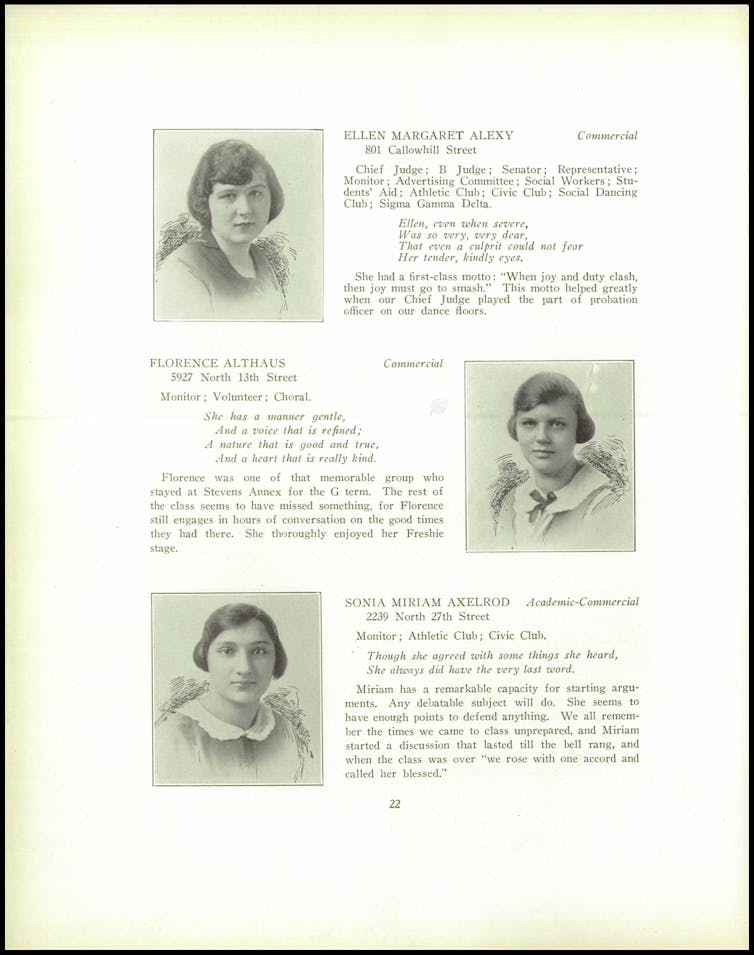
A page from a high school yearbook with photos of three young women
Classmates at William Penn remembered Miriam Axelrod’s ‘remarkable capacity for starting arguments.’
Ancestry.com, U.S. School Yearbooks, 1900-2016

That was the same year Axelrod graduated from William Penn High School for Girls. Her classmates keenly noted in their yearbook that she had a “remarkable capacity for starting arguments” in which “any debatable subject will do.”

Six years later, the first segment of the Broad Street Subway traveling from Olney Station in North Philadelphia to City Hall opened to the public. Unlike the bus, trolley and railways systems, the city owned the El, short for elevated, line and subway. The city leased both systems to PRT and made the transit company responsible for their maintenance.

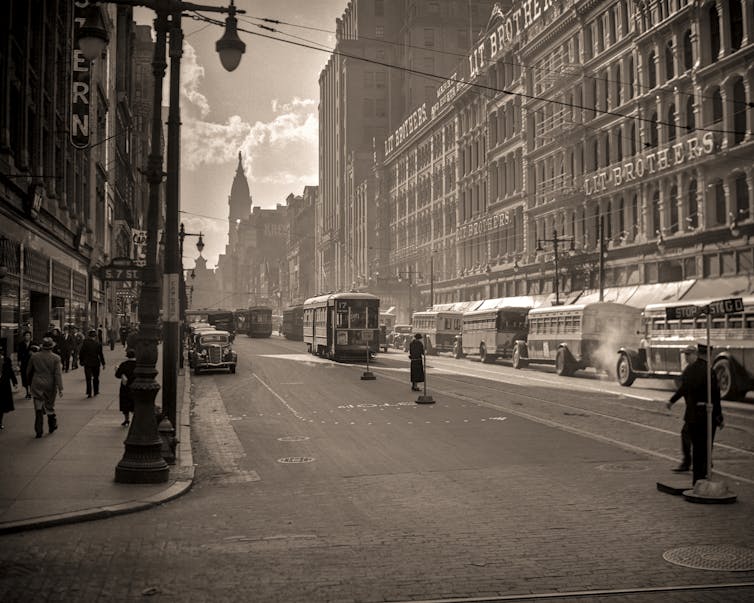
Sepia-toned photo of busy street in a commercial area of a city circa 1930s
Buses and trolley cars drive down Market Street in Philadelphia in the 1930s.
Charles Phelps Cushing/ClassicStock via Getty Images

The Depression years

Philadelphia first witnessed underfunded mass transit during the Great Depression.

In 1934, PRT faced a budget deficit when it was unable to pay the $7.1 million annual rentals to the underliers. PRT later went to court to request a consolidation plan. To make matters worse, PRT had spent approximately $230 million from 1902 through 1939, but that didn’t include spending to modernize old transit equipment.

On Jan. 1, 1940, the Philadelphia Transportation Co., a private company with a 21-member board of directors that included five city representatives including the mayor, Robert E. Lamberton, merged the transit companies and took over PRT’s operations. PTC became responsible for 10,000 employees and providing transportation for 2 million passengers a day.

PTC also acquired extensive financial responsibilities. Payroll expenses cost $327,000 each week. The annual rate for leasing the subway and El was roughly $3 million. PTC had to provide its 25,000 bondholders an annual income of at least $959,207 while also fulfilling its promise to offer modern transit vehicles.

Overcrowding and frequent fare increases

During the 1940s through the 1960s, Axelrod took public transportation to her job as a librarian at Central High School and later Frankford High School.

Meanwhile, PTC made good on its promise to provide better transit service. In its first eight years of operation, PTC spent $22.8 million to purchase 1,506 new streetcars, buses and trackless trolleys while also improving terminal and plant facilities. The company even purchased advertisements in The Philadelphia Inquirer to highlight its achievements. PTC extended 38 existing routes and created 18 new routes that serviced old residential and industrial areas, along with newly developed neighborhoods.

By 1949, however, many of PTC’s 3.2 million daily riders were complaining about overcrowded subways, the end of free exchanges between popular routes and frequent fare increases.

Black and white photo of men and women, some reading newspapers, in a subway car
Passengers ride a subway car in Philadelphia on Feb. 15, 1946.
AP Photo

Both PTC and the city faced scrutiny for these issues, although each party had distinct transit obligations outlined in their joint contract. PTC had to provide “safe and adequate service” that included spending on maintenance and replacement of transit equipment. The city was responsible for police and fire services on mass transit along with auditing PTC’s records. Both parties had to agree on fare changes under the state Public Utility Commission’s supervision.

Nevertheless, when issues on mass transit occurred, the city could persuade PTC to improve conditions, but the city was only required to offer emergency services to commuters.

When Larkin personally addressed Axelrod’s 1967 complaint about the subway, he informed her that the United Elevator Co. was repairing the escalators. He also assured her that the subway unit arrested 45 to 50 intoxicated people each month because they were at risk of falling onto the subway tracks. In “isolated cases,” Larkin explained, police arrested people for public urination and defecation.

Larkin reassured Axelrod that PTC could keep subway conditions clean and under control. In reality, PTC was underwater in responsibilities and debt.

On Sept. 30, 1968, SEPTA, a state agency formed five years earlier, took over PTC and managed transportation for the city and its surrounding areas. SEPTA bought PTC for approximately $47.9 million, settling the company’s debt, accepting its pension liability and buying out the institution’s roughly 1.7 million shareholders. Now federal and state funding rather than fare revenue largely determined the quality of the city’s public transit.

Decades of unpredictable funding

Since the 1960s, annual government funding to SEPTA has been unpredictable. White flight, deindustrialization and job flight have contributed to depopulation, a declining tax base and government defunding of social programs in Philadelphia. These socioeconomic shifts continue to affect Philadelphia’s budget for education, public housing and recreation as well as SEPTA’s $2.743 billion budget as a public transit agency.

Five counties in Greater Philadelphia contribute subsidies to SEPTA in exchange for transit service. Philadelphia alone contributes $110 million. State subsidies also help finance SEPTA’s $1.74 billion operating budget, while federal subsidies support SEPTA’s $1 billion capital budget to pay for major repairs and new equipment. State politicians annually vote on funding for SEPTA, but there has not been a concrete solution to the funding crisis.

For years, politicians have proposed using county sales and gas taxes along with business licensing fees to fund mass transit, without success. Additionally, since 2008 rising rates of car ownership have also led to fewer commuters and reduced fare revenues for SEPTA.

However, Philadelphians never ceased to demand better transit service. During the 1980s, the Pennsylvania Public Interest Coalition established the Transit Riders Action Campaign, also known as TRAC, which advocated that SEPTA have better safety, funding, accountability, service and stable fares. The Transport Workers Union Local 234 advised TRAC, while several organizations partnered with them: the Action Alliance of Senior Citizens, the Clean Air Council, Disabled in Action and the Delaware Valley Interfaith Coalition.

Even today, local groups such as Save the Train with outspoken commuters – like Axelrod was in her day – have launched campaigns to halt service cutbacks and encourage residents to write and telephone legislators who can vote to fund SEPTA. Residents have consistently united to advocate for quality mass transit. All that remains is an agreement among lawmakers to make it possible.

Read more of our stories about Philadelphia and Pennsylvania, or sign up for our Philadelphia newsletter on Substack.

The Conversation

Menika Dirkson does not work for, consult, own shares in or receive funding from any company or organization that would benefit from this article, and has disclosed no relevant affiliations beyond their academic appointment.

ref. Commuters have bemoaned Philly’s public transit for decades − in 1967, a librarian got the city to listen – https://theconversation.com/commuters-have-bemoaned-phillys-public-transit-for-decades-in-1967-a-librarian-got-the-city-to-listen-264860