L’emplacement de la Crète sur la route des importations romaines de blé explique une partie du succès de son vin.Dan Henson/Shutterstock
Le passum, ce vin de raisins secs, était une douceur prisée des Romains. Son succès a-t-il encouragé des viticulteurs crétois de l’époque à le contrefaire ? Un chercheur de l’Université de Warwick mène l’enquête.
Avant l’apparition des édulcorants artificiels, les gens satisfaisaient leur envie de sucré avec des produits naturels, comme le miel ou les fruits secs. Les vins de raisins secs, élaborés à partir de raisins séchés avant fermentation, étaient particulièrement prisés. Les sources historiques attestent que ces vins, dont certains étaient appelés passum, étaient appréciés dans l’Empire romain et dans l’Europe médiévale. Le plus célèbre de l’époque était le malvoisie, un vin produit dans de nombreuses régions méditerranéennes.
Séchage et fermentation
Aujourd’hui, ces vins sont moins populaires, bien que certains soient toujours très recherchés. Les plus connus sont les vins italiens dits « appassimento » (une technique vinicole également connue sous le nom de passerillage), comme l’Amarone della Valpolicella. Dans la région de Vénétie, les meilleurs vins de ce type sont issus de raisins séchés pendant trois mois avant d’être pressés et fermentés – un procédé long et exigeant.
Les sources antiques décrivent des techniques similaires. Columelle, auteur romain spécialisé dans l’agriculture, indique que le séchage et la fermentation duraient au minimum un mois. Pline l’Ancien, quant à lui, décrit une méthode consistant à faire sécher les grappes partiellement sur la vigne, puis sur des claies, avant de les presser huit jours plus tard.
Depuis dix ans, j’étudie la fabrication de ce vin sur le site archéologique de Cnossos, en Crète. Si l’île est surtout connue pour ses vestiges minoens, elle était aussi célèbre à l’époque romaine pour ses vins doux de raisins secs, exportés à grande échelle.
Les vins de raisins secs de haute qualité demandaient du temps et de la patience, mais il semble que les producteurs de Cnossos aient parfois contourné les méthodes traditionnelles. Mes recherches sur un site de production vinicole et sur des sites de fabrication d’amphores indiquent que les vignerons crétois ont peut-être trompé leurs clients romains avec une version contrefaite du passum.
L’héritage viticole de la Crète
Les vestiges d’un site de production de vin à Cnossos montrent les pratiques en vigueur une génération avant la conquête romaine. Plus intéressant encore, les études en cours sur des fours de potiers de l’époque romaine révèlent une production concentrée sur quatre types d’objets : des amphores pour le vin, des supports pour leur remplissage, de grandes cuves de mélange en céramique et des ruches en terre cuite.
La Crète, plus grande île grecque, produit du vin depuis des millénaires. Des indices retrouvés à Myrtos attestent de la vinification dès 2170 avant notre ère. Grâce à sa position stratégique entre la Grèce et l’Afrique du Nord, l’île était âprement convoitée. En 67 av. n. è., après une campagne militaire de trois ans, les Romains en prirent le contrôle.
Après la conquête, l’économie crétoise a subi des changements profonds. Les Romains ont fondé une colonie à Cnossos, réorganisant le pouvoir et développant massivement la production vinicole. L’activité rurale a augmenté, et des fouilles archéologiques ont mis au jour un grand nombre d’amphores, preuve que le vin crétois était largement exporté.
Des raccourcis pour la production
Si les Romains achetaient autant de vin crétois, c’était en partie à cause des routes maritimes. Les navires chargés de blé en provenance d’Alexandrie, à destination de Rome, faisaient souvent escale en Crète, ce qui permettait aux marchands de charger d’autres produits. Mais la demande était aussi stimulée par la réputation du vin crétois, considéré comme un produit de luxe, à l’instar des vins appassimento italiens actuels. Il était aussi apprécié pour ses vertus médicinales supposées. Le médecin militaire Pedanius Dioscoride écrivait dans son traité De Materia Medica que ce vin soignait les maux de tête, expulsait les vers intestinaux et favorisait la fertilité.
L’explosion soudaine de la demande à Rome et dans la baie de Naples a pu inciter les producteurs à accélérer la fabrication.
Pline l’Ancien décrit ainsi un raccourci pour obtenir ce type de vin : faire bouillir le jus de raisin dans de grandes cuves. Mais les cuves retrouvées à Cnossos ne portent aucune trace de chauffe. Une autre hypothèse se dessine : l’ajout de miel au vin avant sa mise en amphore. Les ruches retrouvées dans les fours de potiers romains – reconnaissables à leur surface intérieure rugueuse favorisant la fixation des rayons de cire – suggèrent un lien entre viticulture et apiculture. Des découvertes similaires sur d’autres sites grecs laissent penser que vin et miel pouvaient être mélangés avant expédition.
Cette méthode était plus rapide et moins coûteuse que le séchage des raisins. Mais dans ce cas, pouvait-on encore parler de vin de raisins secs ? Et les consommateurs romains étaient-ils au courant ? Les quantités massives de vin crétois importées à Rome indiquent que cela ne les préoccupait guère. Vu le nombre d’amphores vides retrouvées à Rome, je pense que la population se souciait bien moins de l’authenticité que nous ne le ferions aujourd’hui.
Conor Trainor a reçu des financements de l’University College Dublin, de la British School at Athens, et, auparavant pour cette recherche, de l’Université de Warwick.
Source: The Conversation – Indonesia – By Philippe Ilial, Professeur de Lettres-Histoire. Chargé de cours en Histoire Moderne. Chercheur associé au CMMC, Université Côte d’Azur
Avec sa trilogie les Trois Mousquetaires, Alexandre Dumas mêle réalité historique et fiction héroïque, contribuant à façonner une perception populaire et parfois idéalisée de certaines époques de l’Histoire de France.
La trilogie composée par les Trois Mousquetaires (1844), Vingt ans après (1845) et le Vicomte de Bragelonne (1850), se déroule dans la France du XVIIe siècle, une période tumultueuse marquée par des intrigues de cour, des conflits politiques et des guerres.
Alexandre Dumas père (1802–1870) transforme cette époque en un décor épique où les mousquetaires, figures de loyauté et d’héroïsme, incarnent des valeurs de bravoure, d’amitié et de fidélité.
Ces ouvrages ont diverti les lecteurs, mais ont aussi nourri la perception de l’Histoire française des lecteurs puis plus tard des spectateurs – dès qu’Hollywood s’est emparé du thème. Entre fidélité historique et liberté créative, cette œuvre a profondément marqué l’imaginaire culturel collectif.
Dumas utilise l’Histoire comme une toile de fond, un canevas sur lequel il brode des intrigues souvent complexes. Pour écrire les Trois Mousquetaires, il s’appuie sur des documents tels que les Mémoires de Monsieur d’Artagnan, rédigées par Courtilz de Sandras en 1700, un polygraphe et ancien mousquetaire lui-même, une source qui lui permet de s’imprégner des événements et personnages de l’époque. Cependant, Dumas ne se soucie pas de la précision historique au sens strict. Il est romancier et choisit de sacrifier la rigueur historique à la vivacité de son récit, comme en témoigne la chronologie très libre de certains événements ou l’invention de personnages qui n’ont jamais existé.
La démarche de Dumas se situe à mi-chemin entre le roman historique et le roman d’aventures. Certains faits sont authentiques comme la rivalité entre Richelieu et Buckingham au siège de la Rochelle, point d’orgue de l’opposition entre la France et l’Angleterre soutien des protestants, mais l’auteur se permet d’ajouter des éléments fictifs pour mieux captiver son lecteur, n’oublions pas que l’œuvre est avant tout conçue comme un feuilleton littéraire (paru dans le journal La Presse dès 1844). Il préfère dramatiser les faits plutôt que de les relater avec exactitude. Il insiste, par exemple, sur les rivalités et les duels alors que le fameux siège de la ville est avant tout un évènement militaire.
Ce parti pris témoigne de son ambition : donner à l’histoire une dimension romanesque où l’action, le suspense et l’émotion priment sur la véracité des événements. Ainsi sa trilogie n’est surtout pas à prendre comme un livre d’histoire.
Du lundi au vendredi + le dimanche, recevez gratuitement les analyses et décryptages de nos experts pour un autre regard sur l’actualité. Abonnez-vous dès aujourd’hui !
Les figures historiques telles que Richelieu, Louis XIII ou encore Anne d’Autriche sont au cœur de la trilogie. Dumas les adapte à son intrigue, créant des personnages plus grands que nature. Richelieu, par exemple, devient un symbole de manipulation politique et d’intrigues secrètes, bien plus machiavélique dans le roman que ce qu’il fut en réalité. D’Artagnan, Athos, Porthos et Aramis, bien qu’inspirés de personnages ayant peut-être existé, sont eux aussi construits comme des archétypes de l’honneur, du courage et de l’amitié.
Dumas construit ses personnages comme des mythes, des incarnations de vertus ou de vices. En cela, il contribue à une perception de l’histoire où l’héroïsme prend le pas sur le réel. Bien que complexes, les antagonistes sont réduits à une dimension presque « monomaniaque », ils deviennent des stéréotypes comme celui du méchant, du comploteur, de l’espion…
Alexandre Dumas père (1802–1870) par Nadar (1855). Wikicommons
Les sauts temporels entre les Trois Mousquetaires et Vingt ans après ou encore le Vicomte de Bragelonne permettent à Dumas d’aborder des époques distinctes tout en conservant une continuité narrative. Les romans couvrent ainsi plusieurs décennies d’Histoire française et donnent au lecteur une impression d’enchaînement logique mais cette liberté narrative conduit à une vision linéaire et simplifiée de l’Histoire.
Une vision héroïque de l’Histoire de France
Par le biais de ses mousquetaires, Dumas construit une vision héroïque et valorisante de l’Histoire de France. D’Artagnan et ses compagnons représentent l’esprit français, capable de résister aux complots et aux conflits pour défendre des idéaux de justice et de loyauté. À travers les aventures des mousquetaires, Dumas véhicule aussi une forme de patriotisme : il montre des personnages qui, malgré les querelles et les luttes de pouvoir, restent attachés à leur pays et à leur roi.
Dumas invente et diffuse une version accessible et romancée de l’Histoire de France. Cette popularisation s’est amplifiée avec les nombreuses adaptations cinématographiques qui ont fait des trois mousquetaires des personnages mondialement reconnus. De Douglas Fairbanks incarnant D’Artagnan en 1921 à Gene Kelly en 1948 dans le film de George Sidney, la trilogie de Dumas compte à ce jour plus de 50 adaptations cinématographiques.
Bande annonce des Trois Mousquetaires, de George Sidney, sorti en 1948.
Le succès de ces adaptations a créé une familiarité avec cette période de l’Histoire chez le grand public. Mais cette popularisation a considérablement simplifié la perception du public concernant des événements comme la Fronde ou les intrigues de Richelieu, négligeant la complexité réelle de ces épisodes historiques dans le sens d’un mythe national comme la rivalité entre Richelieu et Buckingham.
Le but premier de Dumas restait de distraire, passionner son lectorat, pas de lui faire un cours d’histoire. Mais c’est parce que l’histoire est omniprésente, à la fois comme cadre et pourvoyeuse d’intrigues et de personnages, que le lecteur/spectateur à l’impression que tout est vrai.
Dumas s’est permis de nombreux anachronismes en même temps que de grandes libertés avec les faits historiques – comme l’histoire d’amour adultérine entre Anne d’Autriche et Buckingham qui n’a pas existé. Ces inexactitudes sont des choix de narration qui servent l’intrigue. Certains faits sont condensés ou déplacés pour accentuer les tensions dramatiques, comme la surreprésentation de Richelieu dans certaines intrigues. Si ces libertés ont été critiquées par des historiens, elles n’ont pas empêché le public d’adhérer aux aventures des mousquetaires.
Les mousquetaires : figures emblématiques du patrimoine français ?
Les personnages de d’Artagnan, Athos, Porthos et Aramis sont devenus des figures emblématiques du patrimoine culturel français. Ils incarnent des idéaux nobles tels que la bravoure, la camaraderie, et le sens de l’honneur, ce qui fait d’eux des héros intemporels. Dumas a créé des archétypes qui dépassent la littérature et sont devenus des symboles dans l’imaginaire collectif.
Au moment de leur parution, au XIXe siècle, les aventures des mousquetaires font écho aux préoccupations sociales de l’époque, période de bouleversements politiques et sociaux pour la France (révolutions de 1830 et de 1848 notamment). La loyauté des mousquetaires envers leur roi, même en dépit de leurs différends personnels, peut être lue comme une réflexion sur le patriotisme et la fidélité envers l’État dans un contexte postrévolutionnaire.
Enfin, la trilogie des Trois Mousquetaires a exercé une influence durable sur le genre du roman historique, non seulement en France mais aussi à l’international. Dumas a su créer une forme de littérature où l’histoire devient une aventure palpitante sans être pour autant un simple prétexte. Il a en quelque sorte fondé un modèle de fiction historique romancée, qui sera repris et adapté par de nombreux auteurs ; on pense à Paul Féval et son Bossu !
Aujourd’hui encore, cette approche influence la manière dont l’histoire est abordée dans les romans, et même dans les médias audiovisuels comme le cinéma et la télévision. La trilogie des Trois Mousquetaires reste une référence incontournable pour quiconque veut mêler l’histoire à la fiction.
Philippe Ilial est enseignant au lycée ainsi qu’à l’université Côte-d’Azur, il est également rédacteur en chef de plusieurs revues de vulgarisation historique.
Source: The Conversation – (in Spanish) – By Apostolos Voulgarakis, AXA Chair in Wildfires and Climate Director, Laboratory of Atmospheric Environment & Climate Change, Technical University of Crete
Understanding how wildfires influence our planet’s climate is a daunting challenge. Although fire occurs nearly everywhere on Earth and has always been present, it is still one of the least understood components of the Earth system. Recently, unprecedented fire activity has been observed in boreal (northern) and Arctic regions, which has drawn the scientific community’s attention to areas whose role in the future of our planet remains a mystery. Climate change likely has a major role in this alarming trend. However, high-latitude wildfires are not just a symptom of climate change; they are an accelerating force that could shape the future of our climate in ways that we are currently incapable of predicting.
A weekly e-mail in English featuring expertise from scholars and researchers. It provides an introduction to the diversity of research coming out of the continent and considers some of the key issues facing European countries. Get the newsletter!
The rising threat of northern fires
As global temperatures rise, wildfires are advancing further north and reaching into the Arctic. Canada, Alaska, Siberia, Scandinavia and even Greenland, all in northern high-latitude regions, have recently experienced some of the most intense and prolonged wildfire seasons on record. With climate change occurring more rapidly in these areas, the future of northern fires appears even grimmer.
Apart from typical forest fires that consume surface vegetation, many high-latitude fires burn through peat, the dense, carbon-rich layers of partially decayed organic material. Despite covering only 3% of the terrestrial surface, peatlands are one of the world’s most important carbon storage environments, containing around 25% of the carbon existing in the Earth’s soils.
Climate warming, which is even faster at high northern latitudes due to polar amplification – the phenomenon of greater climate change near the poles compared to the rest of the hemisphere or globe – is increasing the vulnerability of these ecosystems to fire, with potentially severe implications for the global climate. When peatlands ignite, they release massive amounts of “fossil carbon” that have been locked away for centuries or even millennia. The largest and most persistent fires on Earth, peat fires can smoulder for extended periods, are difficult to extinguish and can continue burning underground throughout the winter, only to reignite on the surface in spring. They have recently been described as “zombie” fires.
Warmer and drier conditions driven by climate change, apart from making boreal forests more flammable, are expected to intensify and increase the frequency of peat fires, potentially transforming peatlands from carbon sinks into net sources of greenhouse gas emissions. Such a shift could trigger a feedback loop, meaning that a warming climate will cause more carbon emissions, which in turn will accelerate climate change.
Air pollution and weather patterns
Wildfires release large quantities of smoke particles (aerosols) into the atmosphere, contributing significantly to both local and widespread air quality degradation. These particles are harmful to human health and can cause serious respiratory and cardiovascular problems, while prolonged exposure may lead to smoke-induced stress, hospitalizations and increased mortality. Wildfires can also cause mental health strains associated with evacuations, loss of homes, livelihoods and lives.
Beyond their long-term effects on climate, wildfire emissions can also influence weather patterns in more short-term ways via their impacts on atmospheric pollution levels. Smoke particles interact with sunlight and cloud formation processes, subsequently affecting temperatures, wind patterns and rainfall.
For example, our recent study on the large-scale atmospheric impacts of the 2023 Canadian wildfires, which we presented at the European Geosciences Union general assembly this spring, demonstrated that wildfire aerosols led to a surface air temperature decrease that expanded to the entire northern hemisphere. The cooling was particularly pronounced over Canada (up to -5.5°C in August), where the emissions were located, but was also significant over remote areas such as Eastern Europe and even Siberia (up to around -2.5°C in July). The average hemispheric temperature anomaly we calculated (close to -1°C) highlights the potential for large regional emissions from wildfires to perturb weather conditions for weeks across a whole hemisphere, with profound implications for forecasting. Unreliable weather forecasts can disrupt daily activities and pose risks to public safety, especially during extreme events such as heatwaves or storms. They also have serious consequences for industries such as farming, fishing and transport, where planning depends heavily on accurate, timely predictions.
Peat fires and the climate puzzle
While incorporating peatland fire feedbacks into Earth System Models (ESMs) is essential for accurate climate projections, most existing models lack a representation of peat fires. Understanding the smouldering behaviour of organic soils when they burn, their ignition probability, and how these processes can be represented at a global scale is of utmost importance. Recent research efforts are focusing on bridging this knowledge gap. For example, at the Technical University of Crete, we are collaborating with the Hazelab research group at Imperial College London and the Leverhulme Centre for Wildfires, Environment and Society to perform field research and cutting-edge experiments) on peat smouldering, with the aim of shedding light on the complex mechanisms of peat fires.
Integrating these lab results into ESMs will enable game-changing fire emission modelling, which holds potential for groundbreaking outcomes when it comes to our skill level for predicting the future of the Earth’s climate. By quantifying how the present-day atmosphere is influenced by fire emissions from boreal forests and peatlands, we can enhance the quality of projections of global temperature rise. This integration will also sharpen forecasts of regional climate impacts driven by fire-related aerosols, such as changes in rainfall patterns or accelerated Arctic ice melt.
Tackling the challenge of northern fires
Undoubtedly, we have entered an era of more frequent megafires – wildfires of extreme size, intensity, duration or impacts – with catastrophic consequences. Recent megafire events at boreal and Arctic regions unveil the dramatic change in wildfire patterns in northern high latitudes, which is a matter that demands urgent attention and action.
As the planet continues to warm, high-latitude fires are expected to help shape the future of our planet. Massive wildfire events, such as those in Canada in 2023, not only burned millions of hectares but also forced hundreds of thousands of people to evacuate their homes. Unprecedented amounts of smoke blanketed parts of North America in hazardous air, prompting school closures and health warnings, and obliging citizens to remain indoors for days. Events like this reflect a growing trend. They underscore why advancing research to better understand and predict the dynamics of northern peat and forest fires, and to mitigate their climate impacts, is not only a scientific imperative but also a moral responsibility.
Created in 2007 to help accelerate and share scientific knowledge on key societal issues, the Axa Research Fund has supported nearly 700 projects around the world conducted by researchers in 38 countries. To learn more, visit the website of the Axa Research Fund or follow @AXAResearchFund on X.
Dimitra Tarasi has received funding from the AXA Chair in Wildfires and Climate, the Leverhulme Centre for Wildfires, Environment and Society and the A.G. Leventis Foundation Educational Grants.
Apostolos Voulgarakis ne travaille pas, ne conseille pas, ne possède pas de parts, ne reçoit pas de fonds d’une organisation qui pourrait tirer profit de cet article, et n’a déclaré aucune autre affiliation que son organisme de recherche.
On wine-rating platforms, amateur ratings better explain the price differences of bottles than professional scores.JuanGarciaHinojosa/Shutterstock
Research in economics has unravelled the workings of the complex market for Bordeaux wines, in which perceived quality, historical reputation and critical reviews are intertwined. The question of how bottles are priced is all the more relevant amid a crisis for the Bordeaux industry, which is facing the threat of higher US tariffs on EU exports.
Reputation, ranking, vintage and climate
A document pertaining to the ranking of Bordeaux wines in the 19th century. Wikimediacommons
To assess the relationship between the quality and price of Bordeaux wines, Jean-Marie Cardebat and I applied the “hedonic” method. The analysis links price to the observable characteristics of a wine: its ranking, vintage, designation of origin, alcohol content, flavour, etc.
The results are striking: the reputation of the wine estate and its official ranking, in particular that of 1855, are more powerful factors in explaining price than taste and sensory characteristics. In other words, a ranked wine, because of the prestige of its label, sells for significantly more than an unranked wine of equivalent taste and sensory appeal.
The economist Orley Ashenfelter has shown that the weather conditions of a vintage – temperature, sunshine, rainfall – are predictors of its quality and therefore its price. A simple model, based solely on climatic data.
Robert Parker and the golden age of experts
For more than 30 years, the critic Robert Parker stirred up the Bordeaux wine market. His famous scores out of 100, published in The Wine Advocate, made and broke the value of wines. The economist Robert H. Ashton measured the scores’ impact: an extra point could boost a price by 10-20%.
Parker was the originator of a tribe of “gurus”, whose scores structured the entire early season for wines. The estates adjusted prices according to their assessments, and wine buyers followed suit, convinced of the accuracy of the scores.
A weekly e-mail in English featuring expertise from scholars and researchers. It provides an introduction to the diversity of research coming out of the continent and considers some of the key issues facing European countries. Get the newsletter!
Fragmented influence
The Bordeaux wine landscape has changed since Parker’s retirement in 2019. The critics are still around but their influence has fragmented. No one has taken over Parker’s leadership. Consensus is now less clear and rating discrepancies are more frequent.
An even deeper turning point is evident when we compare the impact of expert and consumer ratings – notably from the Vivino platform – on the price of French red wines.
The result is clear: in the majority of cases, the scores of amateurs surpass those of professionals when it comes to explaining price differences. The market has therefore moved from a “guru” logic to a “geek” logic, in which the collective intelligence of connected consumers now carries as much weight, if not more, than expert opinions.
During the “primeurs” or early harvest campaign, the most prestigious Bordeaux wines are offered 18 months before bottling, often at a price that is supposed to be lower than the future market price. It’s a great opportunity for a bargain. Philippe Masset’s research shows that most wine estates overestimate the price of early harvest wines.
For example, for the 2021 vintage, over 80% of the wines analysed were priced above their “fair value” as estimated by an econometric model. The more a wine is overpriced on its release, the worse it performs on the secondary market. This discrepancy between asking price and perceived value feeds what is known as “Bordeaux bashing”. There is disaffection with these wines that are considered too expensive, too complex, too austere and totally out of step with today’s expectations – young people’s in particular.
A changing market
While the price of Bordeaux wine is still based on its quality, origin, weather and ranking, it also depends on criticism not just by experts, but by consumers. This shift is redefining the balance of power in the world of wine.
Reputation still pays, but prestige is no longer enough. Nonelite wine consumers are gradually taking over, gaining a new form of power over prices. If the Bordeaux market wants to emerge from crisis and reclaim its place, it will undoubtedly have to rethink the way its prices are set and perceived.
Jean-Marc Figuet has received public funding for his research.
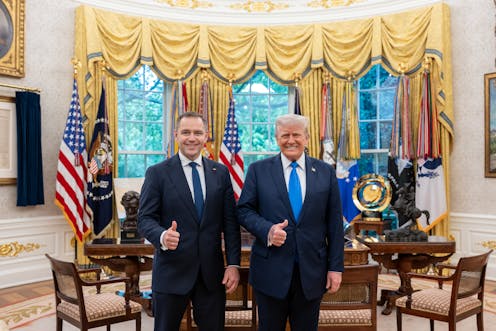
Karol Nawrocki in the Oval Office with Donald Trump on May 25th 2025, ten days before the first round of the Polish presidential election. It is very rare for a sitting US president to receive a candidate in a foreign election. White House X account
Nawrocki’s narrow victory (50.89%) over Trzaskowski, the mayor of Warsaw and candidate of the government coalition, illustrates and reinforces the political polarisation of Poland and the rise of the populist “Trumpist” right in Central and Eastern Europe. Since the start of the war in Ukraine, there has been much speculation about whether Europe’s geopolitical centre of gravity is shifting eastwards. The Polish election seems to confirm that the political centre of gravity is shifting to the right.
A narrow victory
We are witnessing a relative erosion of the duopoly of the two major parties, Civic Platform (PO) and Law and Justice (PiS), whose leaders – the current Prime Minister, Donald Tusk, and Jarosław Kaczyński respectively – have dominated the political landscape for over twenty years.
Kaczyński’s skill lay in propelling a candidate with no responsibilities in his party, who was little known to the general public a few months ago, and, above all, who is from a different generation, to the presidency (a position held since 2015 by a PiS man, Andrzej Duda). Nawrocki, a historian by training and director of the Polish Institute of National Remembrance, has helped shape PiS’s memory policy. He won the second round, despite his troubled past as a hooligan, by appealing to voters on the right.
In the first round, he won 29.5% of the vote, compared to Trzaskowski’s 31.36%, but the two far-right candidates, Sławomir Mentzen (an ultra-nationalist and economic libertarian) and Grzegorz Braun (a monarchist, avowed reactionary, and anti-Semite), won a total of 21% of the vote. They attracted a young electorate (60% of 18–29-year-olds), who overwhelmingly transferred their votes to Nawrocki in the second round.
A weekly email in English featuring expertise from scholars and researchers. It provides an introduction to the diversity of research coming out of the continent and considers some of the key issues facing European countries. Get the newsletter!
Despite a high turnout of 71% and favourable votes from the Polish diaspora (63%), Trzaskowski was unable to secure enough votes from the first-round candidates linked to the governing coalition, including those on the left (who won 10% between them) and the centre-right (Szymon Hołownia’s Third Way movement, which won 5% in the first round).
A Tusk government struggling to implement its programme
There are two Polands facing each other: the big cities, where incomes and levels of education are higher, and the more rural small towns, which are more conservative on social issues and more closely linked to the Catholic Church.
The themes of nationhood – Nawrocki’s campaign slogan was “Poland first, Poles first” – family, and traditional values continue to resonate strongly with an electorate that has been loyal to PiS for more than twenty years. The electoral map, which shows a clear north-west/south-east divide, is similar to those of previous presidential elections and even echoes the partition of Poland at the end of the eighteenth century. The PiS vote is strongest in the part of the country that was under Russian rule until 1918. A more traditional Catholicism in these less developed regions, coupled with a strong sense of national identity, partly explains these historical factors.
The economic explanation for the vote is unconvincing. Over the past 25 years, Poland has undergone tremendous transformation, driven by steady economic growth. GDP per capita has risen from 25% to 80% of the EU average, although this growth has been unevenly distributed. Nevertheless, a relatively generous welfare state has been preserved.
Clearly, however, this growth, driven by investment from Western Europe (primarily Germany) and European structural funds (3% of GDP), does not provide a sufficient electoral base for a liberal, centrist, pro-European government.
It is precisely the government’s performance that may hold the key to Trzaskowski’s failure. Having come to power at the end of 2023 with a reformist agenda, Donald Tusk’s government has only been able to implement part of its programme, and it is difficult to be the candidate of an unpopular government. Conversely, the governing coalition has been weakened by the failure of its candidate.
The main reason for the stalling of reforms is the presidential deadlock. Although the president has limited powers, he countersigns laws and overriding his veto requires a three fifth majority in parliament, which the governing coalition lacks.
The president also plays a role in foreign policy by representing the country, and above all by appointing judges, particularly to the Supreme Court. This has hindered the judicial reforms expected after eight years of PiS rule. It is mainly in this area that Duda has obstructed progress. The election of Nawrocki, who is known for his combative nature, suggests that the period of cohabitation will be turbulent.
What are the main international implications of Nawrocki’s election?
Donald Tusk is now more popular in Europe than in Poland; in this respect, we can speak of a “Gorbachev syndrome”. In Central Europe, the Visegrad Group (comprising Hungary, Poland, the Czech Republic, and Slovakia) is deeply divided by the war in Ukraine, but it could find common ground around a populist sovereignty led by Hungary’s Viktor Orbán. Orbán was the first to congratulate Nawrocki on his victory, followed by his Slovak neighbour Robert Fico. The Czech Republic could also see a leader from this movement come to power if Andrej Babiš wins the parliamentary elections this autumn. Nawrocki would fit right into this picture.
Since Donald Tusk returned to power, particularly during Poland’s EU presidency, which ends on 30 June, the focus has been on Poland’s “return” to the heart of the European process. Against the backdrop of the war in Ukraine and Poland’s pivotal role in coordinating a European response, the Weimar Group (comprising Paris, Berlin, and Warsaw) has emerged as a key player. Three converging factors have made this possible: the French president’s firm stance toward Russia; the new German chancellor, Friedrich Merz, breaking a few taboos on defence and budgetary discipline; and Donald Tusk, the former president of the European Council, regaining a place at the heart of the EU that his predecessors had abandoned. A framework for a strategic Europe was taking shape.
However, President Nawrocki, and the PiS more generally, are taking a different approach to the EU: they are positioning themselves as Eurosceptic opponents defending sovereignty. They are playing on anti-German sentiment by demanding reparations 80 years after the end of the Second World War and asserting Poland’s sovereignty in the face of a “Germany-dominated Europe”. The Weimar Triangle, recently strengthened by the bilateral treaty between France and Poland signed on 9 May 2025, could be weakened on the Polish–German flank.
As a historian and former director of the Second World War Museum in Gdansk and the Institute of National Remembrance, Nawrocki is well placed to exploit this historical resentment. He has formulated a nationalist memory policy centred on a discourse of victimhood, portraying Poland as perpetually under attack from its historic enemies, Russia and Germany.
While there is a broad consensus in Poland regarding the Russian threat, opinions differ regarding the government’s desire to separate the traumas of the past, particularly those of the last war, from the challenges of European integration today.
Memory issues also play a prominent role in relations with Ukraine. There is total consensus on the need to provide military support to Ukraine, under attack: this is obvious in Poland, given its history and geography – defending Ukraine is inseparable from Polish security. However, both Nawrocki and Trzaskowski have touched upon the idea that Ukraine should apologise for the crimes committed by Ukrainian nationalists during the last war, starting with the massacre of more than 100,000 Poles in Volyn (Volhynia), north-western Ukraine) by Stepan Bandera’s troops.
Alongside memory policy, Nawrocki and the PiS are calling for the abolition of the 800 zloty (190 euros) monthly allowance paid to Ukrainian refugees. Poland had more than one million Ukrainian workers prior to the war, and more than two million additional workers have arrived since it started, although around one million have since relocated to other countries, primarily Germany and the Czech Republic.
Prior to the second round of the presidential election, Nawrocki readily signed the eight demands of the far-right candidate Sławomir Mentzen, which included ruling out Ukraine’s future NATO membership. Playing on anti-Ukrainian (and anti-German) sentiment, alongside Euroscepticism and sovereignty, is one of the essential elements of the new president’s nationalist discourse.
A Central and Eastern European Trumpism?
Certain themes of the Polish election converge with a trend present throughout Central and Eastern Europe. We saw this at work in the Romanian presidential election, where the unsuccessful far-right nationalist candidate, George Simion, came to Warsaw to support Nawrocki, just as the winner, the pro-European centrist Nicușor Dan, lent his support to Trzaskowski. Nawrocki’s success reinforces an emerging “Trumpist” movement in Eastern Europe, with Viktor Orbán in Budapest seeing himself as its self-proclaimed leader. A year ago, Orbán coined the slogan “Over there (in the United States), it’s MAGA; here, it will be MEGA: Make Europe Great Again”. The “Patriots for Europe” group, launched by Orbán last year, is intended to unify this movement within the European Parliament.
American conservative networks, through the Conservative Political Action Conference (CPAC), a gathering of international hard-right figures, and the Trump administration are directly involved in this process. Shortly before the presidential election, Nawrocki travelled to Washington to arrange a photo opportunity with Trump in the Oval Office.
“If you (elect) a leader that will work with President Donald J. Trump, the Polish people will have a strong ally that will ensure that you will be able to fight off enemies that do not share your values. […] You will have strong borders and protect your communities and keep them safe, and ensure that your citizens are respected every single day. […] You will continue to have a U.S. presence here, a military presence. And you will have equipment that is American-made, that is high quality.”
“Fort Trump”, that is how the outgoing President Andrzej Duda named the US military base financed by Poland after a bilateral agreement was signed with Donald Trump during his first term in office, in 2018. Similarly, the US House Committee on Foreign Affairs sent a letter to the President of the European Commission accusing her of applying “double standards”, pointing out that EU funds had been blocked when the PiS was in power, and claiming that European money had been used to influence the outcome of the Polish presidential election in favour of Trzaskowski. The letter was posted online on the State Department website. Prioritising the transatlantic link at the expense of strengthening Europe was one of the issues at stake in the Warsaw presidential election.
CPAC is playing a significant role in building a Trumpist national-populist network based on rejecting the “liberal hegemony” established in the post-1989 era, regaining sovereignty from the EU, and defending conservative values against a “decadent” Europe. Beyond the Polish presidential election, the goal seems clear: to divide Europeans and weaken them at a time when the transatlantic relationship is being redefined.
Jacques Rupnik ne travaille pas, ne conseille pas, ne possède pas de parts, ne reçoit pas de fonds d’une organisation qui pourrait tirer profit de cet article, et n’a déclaré aucune autre affiliation que son organisme de recherche.
More than 100 days into his return to the White House, the conclusion is stark: Donald Trump is no longer the same president he was during his first term. His familiar nationalist and populist rhetoric is now openly paired with an authoritarian turn – one without precedent in US history. He has adopted a neo-imperial view of the economy, treating the global order as a zero-sum contest of winners and losers. In this worldview, cooperation gives way to domination: what matters is power and the accumulation of wealth.
Having withstood two impeachment procedures, numerous lawsuits and at least one assassination attempt, Trump now governs with what can appear to be unchecked authority. To his followers, he has become a hero, a martyr – almost a messianic figure. He no longer sees democracy as a framework to be honoured, but as a tool to legitimize his hold on power. His decisive electoral victory now serves as a mandate to cast aside institutional limits.
A weekly e-mail in English featuring expertise from scholars and researchers. It provides an introduction to the diversity of research coming out of the continent and considers some of the key issues facing European countries. Get the newsletter!
Three key features define his style of governance: a radical centralization of executive power grounded in the theory of the “unitary executive”; the politicization of the Department of Justice, used as a weapon against rivals; and the manipulation of federal authority to target cultural, media and educational institutions. His playbook is chaos: unsettle opponents, dominate the media narrative and blur the boundaries of democratic norms. Impulsive and reactionary, Trump often governs in response to Fox News segments or trending posts on Truth Social. Instability has become a strategic tool.
But Trump is not a historical anomaly. While his 2016 victory may have seemed unlikely, his re-election reflects a deeper, long-term transformation rooted in the post-Cold War era.
From an external to an internal enemy
The collapse of the USSR – a structuring external enemy – redirected political confrontation toward the designation of an internal enemy. The culture war has become the dominant ideological battleground, driven by two closely linked forces. On one side, a religious radicalization led by nationalist Christian movements – such as the New Apostolic Reformation – seeks to roll back social progress and promote the vision of an outright theocracy. On the other, growing racial anxiety is fueled by fears of white demographic decline and resistance to civil rights gains.
The commentator Pat Buchanan saw it coming as early as the 1990s. Speaking at the 1992 Republican National Convention, he warned: “There is a cultural war going on for the soul of America… as critical as the Cold War itself.” Too radical for his time, Buchanan championed a white, Christian, conservative US hostile to cosmopolitan elites. Though marginalized then, his ideas laid the groundwork for what would become Trumpism.
Newt Gingrich, who served as Speaker of the House from 1995 to 1999, played a pivotal role in reshaping both the Republican party and US politics. A Republican group he chaired famously distributed a pamphlet to Republican candidates titled “Language: A Key Mechanism of Control”, advising them to use uplifting language to describe themselves, and inflammatory terms like “corrupt”, “immoral” and “traitor” to describe their opponents. This aggressive rhetoric redefined political rivals as enemies to be defeated – helping pave the way for a right-wing politics in which winning trumps democratic norms.
At the same time, the rise of a new conservative media ecosystem intensified polarization. The launch of Fox News in 1996, the growth of right-wing talk radio shows like Rush Limbaugh’s and the later explosion of social media gave the US right powerful tools to shape and radicalize public opinion. Today, algorithm-driven information bubbles trap citizens in alternate realities, where misinformation and outrage drown out reasoned debate. This has deepened polarization and fractured society as a whole.
Channeling anger
This ideological and media realignment has unfolded alongside a broader crisis: the unraveling of the post-Cold War neoliberal consensus. Promises of shared prosperity have been replaced by deindustrialization, deepening inequality and widespread resentment. Successive traumas – from 9/11 and the 2008 financial crash to the Covid-19 pandemic – and foreign wars without real victories have eroded public trust in the establishment.
Trump channels this anger. He offers a vision of a restored and idealized America, a rollback of recent social gains, and a reassertion of national identity grounded in religion and race. His populism is not a coherent ideology but an emotional response – born of perceived injustice, humiliation and loss.
Trump is more than a symptom of America’s democratic crisis: he is its most vivid manifestation. He embodies the legacy of the 1990s – a foundational decade of identity grievance, culture wars and media deregulation. Viewed as a political outsider, he has never been judged as a traditional politician, but rather embraced, by some, as the archetypal “self-made man” – a successful businessman and reality TV celebrity.
His rhetoric – transgressive, provocative and often cruel – gives voice to what had been repressed. The humiliation of opponents becomes part of the performance. For his supporters, it’s exhilarating. It breaks taboos, flouts political correctness and feeds the fantasy of reclaiming a lost America.
And he’s no longer alone. With the vocal support of economic and tech elites like Elon Musk – now a central figure in the radicalized right on X – Trumpism has entered a new phase. Together, they’ve outlined a new kind of authoritarian, cultural and digital power, where influence matters more than institutions.
The US re-elected not just a man, but a style, an era and a worldview built on dominance, disruption and disdain for rules. Still, history is unwritten: intoxicated by hubris and undermined by incompetence, Trumpism may yet crash into the wall of reality – with consequences far beyond America’s borders.
Jérôme Viala-Gaudefroy ne travaille pas, ne conseille pas, ne possède pas de parts, ne reçoit pas de fonds d’une organisation qui pourrait tirer profit de cet article, et n’a déclaré aucune autre affiliation que son organisme de recherche.
Every year, some 100 billion garments are produced worldwide, and 92 million tonnes of clothing waste end up in landfills. Given this enormous amount of waste, it is logical to think that the only way forward is to degrow fashion. But can fashion and degrowth co-exist?
Degrowth is defined as the planned reduction of production and consumption in a way that ensures equitable living. Degrowth principles, such as sufficiency, cooperation and care, clash with growth principles of maximization, commodification and efficiency. For the fashion industry, which is responsible for immense resource extraction and waste creation, reducing resource throughput and ensuring equitable value creation pose enduring challenges.
While some governments and corporations encourage consumers to shop responsibly and reduce waste, collective responsibility is needed to facilitate a degrowth transition, which urges a fundamental shift in the way designers, manufacturers and brands approach fashion waste. Will circular practices help create a just and equitable industry? Is it possible to produce clothing locally and differently than “fast fashion” retailers?
Upcycling as a radical rethinking of our relationship with waste
In a recent study, we explored how the circular fashion practice of upcycling – creative and caring transformation of discarded or waste clothes into something of higher value – pushes industry actors to rethink their relationship to fashion waste and give it value as a resource compatible with degrowth values. We examined how upcycling is practiced across institutions – brands, manufacturers, designers and NGOs – in Turkey, one of Europe’s largest textile producers.
It is important to note that while conversations about recycling – the practice of breaking down textile waste into raw material through mechanical or chemical processes – are prevalent in the fashion world, the painful fact is that only 1% of clothes are recycled into new garments, meaning the majority of fashion waste is doomed to remain as waste. Through upcycling, on the other hand, waste is treated as a resource. Rather than viewing clothes as disposable, upcycling enables us to understand and care about our clothes’ journey and the people and ecosystems behind them. Converting discarded food into natural dyes for colouring fabric, or using sailcloth to make handbags, creates value through the creativity, materials, skill sharing, and caring involved.
As part of green-growth efforts, some circular fashion actors treat waste as a commodity and try to maximize growth through efficient waste reduction. However, this is incompatible with degrowth. We need to reduce production of textiles and make use of existing textile waste, not just discard textile waste efficiently.
Relational ways of working with waste, technology, nature and people
Our research highlights the importance of the socio-ecological value of waste in industry upcycling practices. Such value is generated through social and solidarity networks of relations around waste, including between designers, manufacturers and upcycling brands, and involving nature and technology.
We emphasise the growing interest in the story of waste material, which is reinforcing strong connections to waste and its origins. Upcycling designers highlight local and material heritage in the production of upcycled clothes, which is necessary to foster the ecological and material consciousness required for a degrowth transition. Designers we interviewed evoked the idea that “nature doesn’t waste anything”, and mentioned being inspired by and mimicking nature’s cycles in the design process.
We also reflect on the kind of technology needed to support more relational, localised systems. The practices of upcycling designers and small brands highlight the value of the creation of waste-sharing platforms among industry actors. These platforms serve as waste libraries and provide opportunities to purchase different kinds of textile waste for upcycling.
A weekly e-mail in English featuring expertise from scholars and researchers. It provides an introduction to the diversity of research coming out of the continent and considers some of the key issues facing European countries. Get the newsletter!
Making waste valuable
Industry actors we interviewed said they are not simply trend chasers focused on profit, but seeking to build alternative ways of working with each other, nature, waste and technology. For example, designers partnered with local women in rural areas in Erzurum, Mugla and Kilis provinces to upcycle discarded fabrics into handwoven garments, preserving cultural heritage. A brand collected food waste to create natural textile dyes, collaborating with local cafés and friends in Istanbul. During the Covid-19 crisis, solidarity networks emerged between hospitals, textile manufacturers and designers to make upcycled uniforms for doctors and nurses. We have observed that manufacturers also repurpose waste to give gifts to employees, children and others. These practices aim to reduce waste and reconnect people to waste material, and enable the sharing of local knowledge and skills.
Our data also demonstrates a concern over lack of circular literacy among industry actors. Currently, access to upcycling knowledge and skills, as well as waste material, happens through knowledge hubs and waste-sharing platforms. For example, working with sectoral representatives and local governments, one knowledge hub created a circular economy guide to raise industry awareness about ways to revalue and reduce textile waste.
Upcycling is still a niche circular practice, and access to waste resources for initiatives, as well as lack of public funding and policy support for projects, remain important concerns. Nonetheless, when it is grounded in local communities, new narratives about materials, and care, upcycling can foster degrowth values in fashion.
Handan Vicdan ne travaille pas, ne conseille pas, ne possède pas de parts, ne reçoit pas de fonds d’une organisation qui pourrait tirer profit de cet article, et n’a déclaré aucune autre affiliation que son organisme de recherche.
In an interconnected global economy, regions face recurring economic shocks and intense competition. For policymakers and researchers, understanding the drivers of local employment growth has become critical. Recent theoretical advances highlight the importance of different relational proximities that influence the benefits of the geographic clustering of economic activities.
Our research focusing on France’s labour market areas – “geographical areas within which most of the labour force lives and works” – from 2004 to 2015 offers new insights into how industrial diversity affects local employment. The study finds that having a variety of industries – especially those related to one another – can be a significant driver of employment growth. This finding has crucial implications for regional development strategies.
A weekly e-mail in English featuring expertise from scholars and researchers. It provides an introduction to the diversity of research coming out of the continent and considers some of the key issues facing European countries. Get the newsletter!
Related vs. unrelated diversity
Economic geography literature distinguishes between two types of diversity: related variety and unrelated variety. Here, variety refers to industrial diversity or, more precisely, the different kinds of industrial sectors or technologies. The prevailing argument is that knowledge spillovers within a region, which are known to boost employment, occur primarily among related industries and to a limited extent between unrelated industries.
Related variety describes a situation in which industries share common elements, as do pharmaceuticals and biotechnology. Such elements allow for synergies, collaboration and innovation by the leveraging of similarities in knowledge bases, technologies and skills. By contrast, unrelated variety describes a situation in which industries have little in common, as do agriculture and software development. Unrelated industries operate in entirely different domains, leading to weaker direct synergies, but potentially fostering innovation through difference.
Impacts on employment
While unrelated variety offers protection against industry-specific downturns, it does not have the same direct impact on employment growth as related variety. Our research approach distinguishes between these two varieties at the local level (i.e. within a labour market area) and at the neighbourhood one (i.e. between adjacent labour market areas).
Our analysis finds that regions with industries with high related variety experienced higher employment growth from 2004 to 2015, especially during periods of economic expansion. This effect was particularly pronounced in sectors like machinery, chemicals and IT, which demonstrated strong positive impacts on local employment. We found that when industries share similarities in knowledge bases, technologies or supply chains, they create conditions for interactive learning and innovation. This process fosters intersectoral knowledge flows, enhancing regions’ capacity to adapt and grow. It can help provide balance between regional specialization, which risks stagnation due to industries’ excessive cognitive proximity – a condition economists call “lock-in” – and regional diversity, which may face challenges from too much cognitive distance.
Unrelated variety showed a more complex relationship with employment. While local unrelated variety cushioned regions from economic shocks (since sectors are less vulnerable to industry-specific downturns), it did not directly drive employment growth as related variety did. We also found that unrelated variety in neighbouring regions exerted a negative influence on local employment dynamics.
Employment and the 2008 financial crisis
During the 2008 global financial crisis, knowledge spillovers from neighbouring regions helped mitigate the impact of the economic shock. The neighbourhood effects of related industries acted as a buffer, stabilizing local employment and protecting regions from greater losses.
Drivers of local employment growth in France from 2004 to 2015
Source: INSEE, CLAP 2004-2015. Authors’ calculation. NS: not significant. Fourni par l’auteur
Urban-rural dynamics
The difference between rural and urban areas is another important dimension. Our research found that related variety of diversity had a more pronounced positive effect in urban areas, where high concentrations of industries enable faster innovation and employment growth. Rural areas benefitted less from these knowledge spillovers, likely due to a less dense industrial ecosystem. This urban-rural divide highlights the need for tailored economic policies to support diverse regional needs.
Policy implications
For policymakers, fostering sectoral diversity, particularly the related variety, should be a priority. They could encourage collaboration between related sectors within regions to enhance resilience and growth. This would consist of supporting the development of innovation clusters where businesses in related sectors are geographically concentrated, or platforms for cross-sector collaboration where businesses, universities, research institutions and government agencies can share knowledge and explore partnerships. Promoting interregional cooperation could also help spread the benefits of related variety across neighbouring regions, especially during periods of economic crisis.
Policymakers should also consider the role of the unrelated variety of diversity. While unrelated sectors may not directly contribute to employment growth, they provide stability when economic uncertainty dominates by diversifying the regional economy. Encouraging a balance between related and unrelated sectors could offer the best of both worlds – innovation-driven growth and economic resilience.
Sectoral diversity – especially when it comes to related industries – is a key driver of local employment growth in France. However, for regions to thrive, policymakers must not only support the growth of local industries but also foster cross-regional cooperation. The lessons from France’s labour market areas provide insights for regions worldwide seeking to navigate the complexities of economic development.
Les auteurs ne travaillent pas, ne conseillent pas, ne possèdent pas de parts, ne reçoivent pas de fonds d’une organisation qui pourrait tirer profit de cet article, et n’ont déclaré aucune autre affiliation que leur organisme de recherche.
Les moyens consacrés à l’enseignement supérieur sont souvent résumés en un chiffre, celui de la dépense moyenne d’éducation par étudiant. Pour 2014 par exemple, elle s’élève à 11 834 euros. Ce chiffre ne dit rien, cependant, des différences de dépense selon les filières de formation. Loin d’être uniforme, la dépense par étudiant varie ainsi de 10 576 euros pour un étudiant à l’université à 15 052 euros pour un étudiant de classes préparatoires aux grandes écoles (CPGE) :
La réussite, mesure de la performance des formations
Une formation de premier cycle contribue à la réalisation de plusieurs objectifs simultanément (acquisition de connaissances, certification de compétences, formation du citoyen, etc.). Néanmoins, son objectif premier est bien la réussite des étudiants, qui doit garantir l’atteinte des autres objectifs de la formation.
Dans le cas des diplômes (licence, DUT et BTS), la réussite peut facilement être mesurée par le taux d’obtention du diplôme. Le nombre d’inscriptions étant normalement limité à 3 années en DUT et en BTS, et à 5 années en licence, nous avons pris en compte le taux d’obtention du diplôme en 2 ou 3 ans pour le DUT et le BTS, et en 3, 4 ou 5 ans pour la licence.
La réussite en CPGE, en revanche, ne peut être mesurée par le taux de réussite au diplôme : d’abord parce qu’aucun diplôme n’est délivré à la fin de la formation, ensuite parce que, comme leur nom l’indique, elles ont pour objectif de préparer les étudiants à intégrer les grandes écoles et les écoles d’ingénieurs. Dès lors, la réussite peut être mesurée par le taux d’intégration dans les écoles de niveau bac+5 après 2 ou 3 ans, puisque comme pour le DUT ou le BTS, le nombre d’inscriptions est normalement limité à 3 années. Les données étant communiquées par filière (scientifique, économique, littéraire), nous avons réalisé une moyenne pondérée en fonction de la proportion d’étudiants inscrits dans chacune des filières.
Quelle que soit la formation de premier cycle, les taux de réussite retenus n’intègrent pas les réorientations, bien que, dans de nombreux cas, elles débouchent pourtant sur une réussite de l’étudiant. En effet, pour les formations quittées, il s’agit bien d’un échec, puisque leur objectif premier n’est pas atteint, et que rien n’indique qu’une intégration directe dans la nouvelle formation n’aurait pas permis à l’étudiant d’atteindre le même résultat.
Sur la base du suivi de cohorte des nouveaux inscrits en 2008 (dernier disponible), nous avons obtenu les taux de réussite suivants :
Le coût de la réussite
L’évolution de la dépense moyenne par étudiant confirme l’existence, depuis de nombreuses années, d’une différence notable de coût entre les différentes formations. Si la dépense par étudiant en BTS ou en CPGE est directement exploitable, la dépense par étudiant à l’université est en revanche plus problématique, car elle agrège des étudiants inscrits dans différentes formations. En particulier, depuis l’entrée en vigueur de la LOLF en 2006, il n’est plus possible de repérer les dépenses des IUT, désormais intégrées à celles des universités.
Puisque la dépense par étudiant en IUT est supérieure d’environ 20 % à la dépense par étudiant à l’université, nous avons pu, en prenant en compte la part des effectifs inscrits en DUT, distinguer la dépense par étudiant en DUT de la dépense par étudiant dans les autres formations universitaires. En revanche, faute d’information sur la répartition de la dépense entre les différentes formations universitaires (notamment entre licence et master), nous avons conservé ce dernier chiffre comme estimation de la dépense par étudiant en licence.
Par ailleurs, nous avons retenu dans nos calculs la dépense moyenne par étudiant en 2014. En effet, cette année est à la fois la dernière pour laquelle les informations sont disponibles et celle de la mise en œuvre d’un changement dans le mode de calcul réalisé pour permettre une meilleure évaluation de la dépense à l’université.
Afin d’évaluer le coût de la réussite, nous avons calculé la dépense moyenne par année réussie, c’est-à-dire le rapport de la dépense totale réalisée pour l’ensemble des étudiants ayant intégré en même temps la première année de la formation, sur le nombre total d’années réussies dans la formation (nombre d’années validées ayant conduit à l’obtention du diplôme ou à l’intégration d’une école de niveau bac+5).
Calculer la dépense totale réalisée pour l’ensemble d’une cohorte nécessiterait de pouvoir retracer précisément année après année le parcours réalisé dans la formation. Le détail du parcours des nouveaux entrants n’étant pas disponible pour une même cohorte et pour chacune des formations de premier cycle, nous avons utilisé les taux de réussite en faisant l’hypothèse que les étudiants n’ayant pas réussi ont quitté la formation au bout d’une année. Cette méthode conduit à minorer légèrement la dépense totale (en particulier pour la licence où certains étudiants sont inscrits de nombreuses années sans jamais parvenir à valider leur diplôme), mais elle donne néanmoins une approximation satisfaisante de la dépense totale.
En reprenant l’ensemble des résultats précédents, nous avons obtenu les niveaux de dépense par diplôme suivants :
L’efficacité de la dépense d’éducation
La principale évolution entre la dépense par étudiant et la dépense par année réussie concerne la licence. En effet, si elle présente une dépense plus faible que les autres formations de premier cycle, la licence affiche aussi un taux de réussite bien plus faible avec 47 % au bout de 5 ans. La dépense par année réussie s’élève ainsi à 16 332 euros, un montant 57 % plus élevé que celui de la dépense par étudiant. Le modèle de la licence, qui conjugue un accès de droit pour tous les bacheliers (non remis en cause par la loi ORE) et une faible dépense par étudiant, présente ainsi une efficacité globale plutôt moyenne.
Les trois autres formations de 1er cycle (DUT, BTS et CPGE) fonctionnent sur un modèle différent de celui de la licence, puisque les étudiants sont sélectionnés à l’entrée et bénéficient d’une dépense par étudiant plus importante. Ce modèle conduit à une réussite nettement plus importante avec des taux compris entre 69 % et 81 % au bout de 3 ans. La dépense par année réussie est ainsi seulement 19 % à 33 % plus élevée que la dépense par étudiant correspondante.
Si elle ne bouleverse pas le classement de ces trois formations, la prise en compte de la réussite tend cependant à augmenter les écarts :
Avec une dépense par étudiant relativement limitée et le taux de réussite le plus élevé, le DUT affiche une dépense par année réussie de 14 893 euros, plus faible que dans les autres formations de premier cycle, et donc signe d’une efficacité plus forte.
Le BTS affiche une dépense par année réussie de 17 583 euros, légèrement supérieure à celle de la licence, signe d’une efficacité plutôt moyenne.
Finalement, avec une dépense par étudiant plus élevée et un taux de réussite compris entre celui du BTS et celui du DUT, les CPGE affichent une dépense par année réussie de 20 016 euros, nettement supérieure à celle des autres formations de premier cycle, signe d’une plus faible efficacité.
Cette évaluation de l’efficacité des formations doit néanmoins être étudiée au regard de la population étudiante accueillie et de sa capacité à réussir des études supérieures. Les taux de réussite en licence illustrent les différences de réussite selon le type de baccalauréat et la mention obtenue :
Ainsi, les bacheliers généraux réussissent mieux que les bacheliers technologiques, qui réussissent eux-mêmes mieux que les bacheliers professionnels. De même, les étudiants ayant obtenu les meilleures mentions au baccalauréat réussissent mieux dans les études supérieures. Ce constat peut être étendu aux autres formations de premier cycle.
La prise en compte de la population étudiante accueillie au sein des différentes formations sélectives de premier cycle (DUT, BTS et CPGE) permet alors d’améliorer la compréhension de leur efficacité :
Le DUT accueille près d’un quart de bacheliers technologiques, qui réussissent dans 64,6 % des cas. L’efficacité du DUT, déjà supérieure à celle des autres diplômes de premier cycle, apparaît ainsi d’autant plus forte.
Le BTS accueille une proportion importante de bacheliers technologiques et de bacheliers professionnels. Si la dépense par année réussie est plus importante, elle contribue à faire réussir ces étudiants (77,4 % et 60,7 % respectivement). L’efficacité des BTS apparaît ainsi finalement plutôt correcte.
Dans une perspective plus globale, il ressort que la dépense par année réussie est plus élevée pour les formations en lycée (BTS et CPGE) que pour les formations de premier cycle à l’université (licence et DUT). Sachant que la dépense par étudiant à l’université intègre l’ensemble des coûts de la recherche, l’intégration des seuls moyens consacrés à la formation montrerait une efficacité encore plus marquée en faveur des formations universitaires que sont le DUT et la licence.
Les datavisualisations de cet article ont été réalisées par Diane Frances.
Aurélien Lamy ne travaille pas, ne conseille pas, ne possède pas de parts, ne reçoit pas de fonds d’une organisation qui pourrait tirer profit de cet article, et n’a déclaré aucune autre affiliation que son organisme de recherche.
Mais Paris est également le théâtre d’un jeu social méconnu qui permet d’objectiver l’incidence du lieu de vie sur la sociabilité et le style de vie d’individus sous contrainte de budget. D’un point de vue socio-anthropologique, ces individus déploient des stratégies sociales afin de rendre plus acceptable leur quotidien : ils mettent en place des pratiques visant non pas à sortir de la précarité, mais à ne pas tomber dans la misère, à rendre acceptables les frustrations qu’engendre la situation socio-économique vis-à-vis de la société de consommation. Ils montrent aussi une volonté de monétariser tout ou partie de l’activité, ou des projets déployés au quotidien.
Assurer sa solvabilité
La solvabilité d’un locataire se traduit par sa sa capacité à honorer le loyer de son logement. Elle se calcule par l’intermédiaire d’un indice : le ratio de solvabilité, correspondant au taux d’effort des locataires. Ce chiffre indique le reste à vivre (RAV) mensuel après paiement du loyer. Il ne doit pas excéder 33,3 % du total des ressources de l’individu. Le RAV varie logiquement en fonction du salaire, du montant du loyer, des dépenses contraintes et secondaires d’un individu. Il est également corrélé à un ensemble de variables socioculturelles où le style de vie et les modes de consommation impactent directement sa gestion. Si un individu estime que son RAV est insuffisant pour le niveau de vie auquel il aspire, opter pour un loyer moins élevé, sur un territoire où l’immobilier est plus abordable, peut sembler être une solution pertinente.
Or, l’« adresse postale » d’un logement représente l’épicentre de stratégies de distinctions sociales, qui confère une dimension symbolique au ratio de solvabilité. D’autres notions conduisent les individus à repenser leur budget afin de s’assurer leur solvabilité face à des « adresses postales » où le prix moyen des loyers est supérieur à leur ratio de solvabilité. Il s’agit notamment des politiques liées aux logements sociaux ou du « capital d’autochtonie », c’est-à-dire l’ensemble des ressources (réelles et symboliques) engendrées par l’appartenance à des réseaux et à des relations de proximité. On attribue un caractère réversible à ce capital : alors que l’entre-soi constitue une force à l’échelle individuelle comme à celle d’un groupe social, il peut se retourner en handicap à l’extérieur de ce réseau. D’un point de vue anthropologique, les individus usent de stratégies afin de conserver ces réseaux de proximité.
Classiquement, la sociologie et la géographie objectivent les disparités de revenus des ménages en fonction des différents quartiers de la ville, mettant en tension l’Est et l’Ouest de la capitale. Or, il semble exister une réalité plus complexe du quotidien, notamment pour une partie de ses habitants qui a, malgré de faibles ressources, décidé de vivre dans les quartiers ou les villes de l’Ouest parisien.
Entre « classe ambitieuse » et « classe aspirante »
La sociologue américaine Elizabeth Currid a publié en 2017 The Sum of Small Things à propos de la « classe ambitieuse », où ces créatifs culturels décident non pas de s’émanciper de la société de consommation, mais de se positionner en transition consumériste. Ils aspirent ainsi à changer le monde tout en participant, souvent malgré eux, à une reproduction des distinctions sociales.
Très visibles dans les grandes villes, ces individus investissent Paris et participent au processus de gentrification amorcé dans les quartiers de l’Est parisien. Cependant, il existerait une autre facette de cette « classe ambitieuse » : la « classe aspirante », qui serait sa part d’ombre. Elle investirait les quartiers historiquement les plus huppés de Paris (Triangle d’Or, par exemple) et déploierait un certain nombre de stratégies faisant office d’amortisseurs de la pauvreté, comme la sociologue Martine Abrous l’a étudié au sujet des professions artistiques.
Ces stratégies renvoient vers une pluralité de desseins : conserver une position sociale, acquérir un logement selon ses ressources (stratégies de gentrification), capitaliser sur les aménités de quartier afin de mieux vivre, ou encore, choisir par défaut (attribution de logements sociaux, hébergement chez des proches).
Stratégies pour choisir son lieu de vie
A priori, il existerait une corrélation entre prix du bâti et ressources des ménages. Or, le croisement de certains indicateurs statistiques montre une autre réalité : on observe un lien entre prix du bâti et nombre de chambres de bonnes ou de « service » à la location (le XVIe arrondissement de Paris concentre près d’un tiers du parc de chambres de bonnes de la capitale), ou encore, entre prix du bâti et diversité des types de logements sociaux, comme en atteste la répartition des logements sociaux par arrondissement :
Cette « classe aspirante » a recours à un certain nombre de stratégies afin de préserver son « ratio de solvabilité » : travail au noir, économie informelle, cumul d’emplois, mobilisation de réseaux d’entraide et de solidarité… Elle invoque différentes justifications à ce choix de vie parfois difficile : vivre dans un quartier privilégié, continuer de résider dans le quartier ou la ville dans laquelle on a grandi, assurer une bonne scolarité à ses enfants, s’intégrer dans des réseaux de sociabilité des classes supérieures, etc.
La mixité sociale peut desservir
Cette forme de mixité sociale peut également engendrer de la non-mixité due aux « effets de quartier » et provoquer des tensions à l’échelle des territoires. Le couple de sociologues Pinçon l’avait évoqué, relatant le cas d’une résidence HLM en bas des Champs-Élysées : la volonté initiale de « mixer » différentes populations s’est retrouvée être contre-intuitive pour les habitants. Il s’agit du phénomène de la « double peine ».
Les habitants ont perdu les bénéfices de leur « capital d’autochtonie » et ne sont pas parvenus à s’intégrer sur ce nouveau territoire, provoquant de l’exclusion et une diminution de la qualité de vie. Cet exemple s’intègre dans un jeu social de différenciation entre les habitants de ces quartiers, provoquant des confusions et des sentiments d’injustice, notamment liés aux liens entre ressources et types de logements sociaux.
En définitive, c’est précisément le poids symbolique et culturel qui va conditionner les stratégies individuelles et collectives des individus dans les pratiques de gestion du « ratio de solvabilité », donnant à voir une réalité plus contrastée de la pauvreté par rapport au lieu de vie.
Les datavisualisations de cet article ont été réalisées par Diane Frances.
Fanny Parise a reçu des financements de différentes structures, qui ont participé au financement de son travail de thèse.













.jpg)
.jpg)