Millions of motorists across the UK could be in line for payments of around £700 after car dealers mis-sold finance to earn commission. Finance providers stand to lose billions compensating consumers after the scandal.
The UK regulator, the Financial Conduct Authority (FCA), recently announced that lenders must compensate buyers who took out finance for a new or secondhand car. Millions paid more than they should have because of secret fees paid by lenders to dealerships.
For many, this compensation will be a welcome surprise. For others, it will be hard-won compensation after a complicated legal battle. For others still, £700 may not be enough compensation for the time and stress involved – the sum is lower than the FCA had previously estimated – although the total paid out could top £8 billion.
This settlement begs an interesting question. What should recipients do with this money? This is hardly a trivial question. Organisations such as the National Lottery provide financial advice to big winners, recognising that a windfall involves a lot more than popping the champagne corks.
However, financial advice after winning the lottery – pay off debts, buy a house, invest in long-term assets – does not apply to the relatively small sum of £700. But neither is it smart to write off £700 as if it were only a small win. Economically speaking too, a spending boost of up to £8 billion would show up in UK GDP figures.
Behavioural economists have found that people’s decisions about money depend on their mental frame of reference. If they feel like they’ve lost money, their decisions to save or spend will be quite different to if they feel they’ve gained something. Precisely because many people will have already written off the costs of mis-selling, it is likely that they will choose to spend their compensation.
The psychology of winning can be pernicious because of what economists call “licensing” effects. Licensing happens when a previous event or behaviour influences future actions. If you’ve gone to the gym in the morning, you might choose to have a dessert in the evening – but only because you went to the gym.
Likewise, if you “win” £700 you had mentally written off, you will be more inclined to buy things you would otherwise avoid. In this mental state, small luxuries like eating out or buying designer shoes are likely to feel more tempting. Very quickly, that £700 could disappear.
Spending money is not a bad thing. It is only through spending that the economy grows, which to a lesser or greater extent benefits everyone. And using the money to invest in a new hobby, for instance, is likely to be personally rewarding in ways a cold financial outlook fails to appreciate.
But there is also a more sympathetic, and less explored perspective. Someone might understand what they ought to do financially, but reasonably decide that £700 is not worth the effort. For example, earning 3% on £700 means next year you’d be £21 richer, ignoring inflation. From this perspective, it is reasonable – if not economically rational – to decide spending is preferable to saving.
A growing issue
The question of how to use a windfall is fascinating because it’s an example of something economies like the UK are going to see a lot more of in the coming decades. The movement of wealth from retirees to their adult children (those aged around 30 to 50) has been called the greatest wealth transfer in human history.
It’s not going to be an even transfer. Some millennials will receive enormous sums as their parents pass on houses and savings pots. Others will receive very little. But a large group will receive something in the middle – an unexpected windfall, too large to write off but too small to lay down new financial roots by buying a house, for example.
In the years ahead, what this group does with its slice of a generational inheritance will shape the financial landscape of the UK, and many more countries, too.
Investing in a new hobby could pay dividends that traditional financial metrics can’t measure. mimagephotography/Shutterstock
This £700 settlement is therefore an interesting example. While people may feel they know what they ought to do with unexpected money, behavioural economics can tell us what people probably will do.
The “ought” depends on someone’s financial circumstances. For those set to receive £700, it might be a good idea not to treat it as a windfall. They had probably mentally written it off, so if they avoid seeing it as a gain they are more likely to pay off debts or save it.
Payments could start coming through from early next year. With that in mind, another sensible place for many to “invest” £700 might be in credit with their energy supplier. This could smooth out financial bumps in the road, given rising energy costs.
Many people dislike saving because it can feel like losing money, as they are moving the funds from a “fungible mental account” – where they can do anything with it – to a “non-fungible mental account” (such as a rainy-day fund).
For economists, examples like a £700 compensation are fascinating because they expose elements of human behaviour that we are all guilty of.
But this compensation scheme is also likely to be a precursor to a much bigger economic phenomenon. What will people do when they suddenly receive a sum that’s too big to ignore but too little to change their financial foundations?
Stuart Mills does not work for, consult, own shares in or receive funding from any company or organisation that would benefit from this article, and has disclosed no relevant affiliations beyond their academic appointment.
Young teenagers on TikTok can easily access hardcore porn content, a new study has found.
By creating fake accounts for 13-year-olds, researchers at the non-governmental organisation Global Witness were quickly offered highly sexualised search terms. Despite setting the app to “restrictive mode”, the researchers were able to click through to videos showing everything from women flashing to penetrative sex.
Most of these videos had been created in such a way that they were designed to evade discovery, and TikTok has moved swiftly to take them down.
But the fact that they were easy to find is a fresh blow to the UK Online Safety Act. The act, which came into force over the summer, requires tech companies to prevent children from being able to access pornography and other harmful content.
There have already been reports that Meta’s efforts to make Instagram safer for young people are similarly ineffective.
It would be easy for parents reading these reports to conclude that there is nothing that can be done to make the internet safe for their children. Many will increasingly be tempted to ban access outright rather than try to navigate the risks in a more measured way.
Certainly, the act was introduced for good reason. According to research published in 2025, one in 12 children were being exposed to online sexual exploitation or abuse. An EU report from 2021 that surveyed more than 6,000 children also found that 45% reported they had seen violent content and 49% had encountered cyberbullying.
Yet there is a danger in downplaying progress. Since the act was introduced, most of the top 100 adult sites have introduced age checks or blocked UK access – and so have sites that allow pornographic content such as X and Reddit.
It wouldn’t be the first time that media coverage has over-focused on the online risks to children. Take Roblox, for instance. Launched in 2006, it’s a “virtual universe” that allows users to create their own content. As of 2025 it has over 85 million daily active users, of which 39% are below the age of 13.
This has exposed children to undesirable things such as Nazi roleplaying games and sexual content. One much-quoted report published in 2024 even declared it an “X-rated paedophile hellscape”.
True enough, children can potentially be exposed to harmful content on the platform – as with any platform of user-generated content. But a paedophile hellscape? It’s worth reflecting that Roblox is also being studied by researchers for its ability to help young people learn and explore their identities in more wholesome ways (it also introduced extra safeguards for children a few months ago).
To stress, there are online risks parents need to contend with, but the way these risks are reported does not help. TikTok, for instance, has been in trouble over its content before. In 2022, research by the Centre for Countering Digital Hate concluded that children can be exposed to harmful content every 39 seconds – with one newspaper turning this into a headline about TikTok’s “thermonuclear algorithm”.
Given that some parents already lack confidence in managing digital technology, this kind of sensationalist language doesn’t help. This 2024 study points to the “joy, connection and creativity” that children also experience on the platform.
We’ve been here before
In truth, we’ve been hearing about the technological threat to children for a very long time. The 1935 New York study, Radio and the Child, argued that radio presented a new insidious threat as it encroached into the family home and children’s bedrooms: “No locks would keep this intruder out, nor can parents shift their children away from it.”
A few years later, television had become the focus of parental fears. According to the 1962 BBC Handbook: “Nobody can afford to ignore the dangers of corruption by television through violence or through triviality, especially the young.”
Soon came the 1964 Television Act, which introduced the 9pm watershed. It prevented broadcasters from showing programmes unsuitable for children before that time, which seems quaint next to today’s concerns.
The clear pattern is that one generation’s moral panic becomes a source of amusement to the next one as they focus on a new threat. Time and again, the coverage is so distorted and inflamed that it makes parents feel more anxious and estranged. This makes managing the actual risks much more difficult.
The negotiated alternative
The reality is that restrictive approaches by parents can be counterproductive, especially as they may encourage children to be evasive. Children’s instincts, according to the research, are to talk about potentially harmful material with their parents, but they’re less likely to do so if parents take a hard line since it makes them fear they’ll be judged. In other words, they’ve become more likely to consume harmful content as a result.
The alternative is for parents to adopt a strategy of negotiated decision-making with their children. Instead of viewing online material as alien or inherently negative, it becomes proactively integrated into family life. One researcher described it as “living out family values through technology”. It becomes about accepting risk with a view to building children’s resilience.
Unfortunately this sits uncomfortably with the current rhetoric around the internet, since it’s recommending moderated, negotiated exposure to something “thermonuclear”. Compounding this is the abundance of digital pundits offering reactionary and unworkably prescriptive advice. Any parent who deviates from the “recommended” screen-time for their children runs a risk of judgement, treating technology as a “digital pacifier”.
Just like the watershed before it, the Online Safety Act mitigates risks but won’t remove them altogether. It is ultimately still on parents to decide how to deal with them in accordance with their family values. The more the reporting around this area is endlessly negative, the more difficult that becomes.
Phil Wilkinson does not work for, consult, own shares in or receive funding from any company or organisation that would benefit from this article, and has disclosed no relevant affiliations beyond their academic appointment.
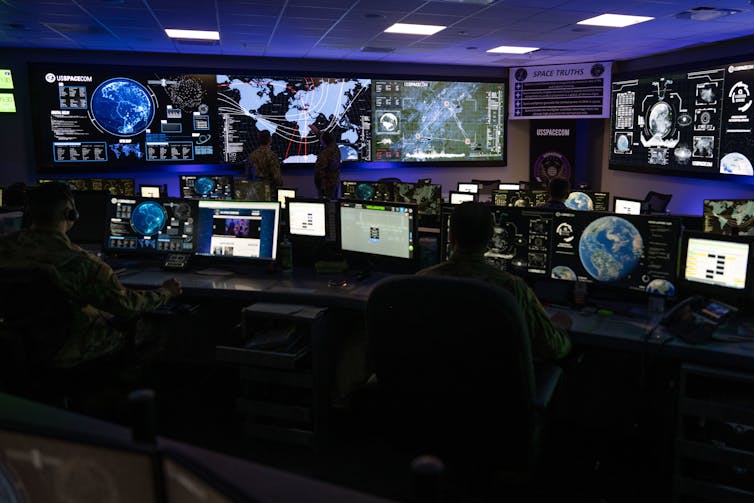
The UK operates the Skynet series of military communications satellites.Defence Images
Russia is targeting UK space infrastructure, and in particular military satellites, on a weekly basis, according to the head of UK Space Command.
In an interview with the BBC, Maj Gen Paul Tedman said that Russia was “shadowing” UK satellites. Shadowing involves orbiting and aligning a satellite close to the target satellite, in order to be near enough to jam communications or intercept signals to steal critical information.
Tedman said Russia’s satellites had “payloads on board that can see our satellites and are trying to collect information from them”. He also confirmed that jamming of UK military satellites was taking place.
This involves broadcasting signals on the same frequencies as those used by satellites, in order to intentionally disrupt or overwhelm legitimate signals. It does not physically damage spacecraft, so as soon as the jamming signal is no longer being emitted, communications can be restored. The jamming of satellite signals can take place from the ground, ocean or air, as well as from space.
But what about other tactics that could be used to disrupt satellites? One thing not mentioned in relation to the attacks on British military satellites, is the use of lasers. These can be deployed to dazzle satellites’ onboard optical sensors. This can interfere with electronic circuity but would not cause lasting physical damage.
The most serious type of attack of course would be the use of a direct-ascent missile, which can be launched from the ground, sea or air, to destroy an orbiting satellite. Previous tests of this kind of anti-satellite (Asat) weapon have generated worrying levels of orbiting debris. This debris can then collide with other satellites, potentially generating even more debris for other space-based assets to avoid.
On February 24, 2022, the day of Russia’s invasion of Ukraine, satellite broadband users across Europe got a taste of the kind of attacks that the military is now used to. A cyber-attack was launched against Viasat’s Ka-Sat satellite network, which supplies internet access to tens of thousands of people across Ukraine and the rest of Europe. Experts said they believed the purpose of the attack was to interrupt service rather than to access data or systems.
A recent talk by German IT researchers also revealed how much damage hackers could potentially do if given unfettered access to a satellite’s onboard systems. The experts said that attackers could exploit vulnerabilities in open source software used by Nasa and Airbus to control satellites. This in turn could give the intruders access to the control functions on a satellite, allowing them to change its orbit by sending a command to fire its thrusters.
Attacks don’t need to target the satellite directly. Targeting control stations on the ground can also disrupt operation of the satellites in orbit. This can also have consequences for end users of a satellite service.
Wider problem
It’s not just the UK’s satellites that are being targeted, however. In September, the head of French space command Maj Gen Vincent Chusseau said there had been a spike in hostile activity in space. Chusseau said activity had increased since Russia’s full-scale invasion of Ukraine in 2022.
He said that adversaries, especially Russia, have diversified methods of disrupting satellites and that jamming, lasers and cyber-attacks have become commonplace.
The same month, Brig Gen Christopher Horner, commander of 3 Canadian Space Division told a space security summit that there were more than 200 anti-satellite weapons orbiting Earth.
While he didn’t provide details on their nature, he said it was a “shocking number” to threaten allied satellites.
Increased investment
It’s possible to satellites by improving the encryption of data transmitted to them as well as with anti-jamming technology. This uses a variety of techniques to block out or nullify the signals used by jammers to interfere with satellite communications. It’s also important to ensure there are alternative providers for critical space services as a backup in case of attack.
In response to increasing threats to UK satellite infrastructure, the UK government has recently increased its investment in projects geared towards space security. The government has invested £500,000 in a project to develop sensors that counter lasers used to blind satellites. The UK has also recently developed Borealis, a software platform designed to monitor and protect critical UK and allied satellites.
As well as investing in its own projects, the UK has also sought to improve space-based security by strengthening international partnerships. For instance, the UK recently invested €163 million (£141 million) in Eutelsat, which provides satellite internet and is a rival to Elon Musk’s Starlink system.
Starlink’s importance not only for consumers, but also for military applications has been demonstrated in the Ukraine war – where Ukrainian troops had come to rely heavily on it for battlefield communications. But the drawback to this dependency on a privately owned company such as Starlink was highlighted when Musk denied coverage to Kyiv in 2023.
The investment in Eutelsat not only strengthens space-based collaboration between the UK and France, but also boosts a company providing a backup system for satellite communications.
The US and UK also recently conducted their first coordinated satellite manoeuvre. The US repositioned one of its own satellites to examine a UK satellite to make sure it was operating normally. Such a manoeuvre could potentially be used following an attack designed to disable a spacecraft.
The reports of Russian meddling highlight the importance of security in orbit as global tensions continue to expand into space.
Jessie Hamill-Stewart does not work for, consult, own shares in or receive funding from any company or organisation that would benefit from this article, and has disclosed no relevant affiliations beyond their academic appointment.
Making assumptions about female voters as a single voting block is tempting, but there are multiple layers and contradictions within this hugely diverse group. Polling shows that there are a few broad conclusions about their voting patterns.
For example, in the modern era, women have higher turnout rates at US elections than men and have consistently been more likely to vote Democrat.
So, who are those women voters that Trump appeals to? The short answer is white women, or at least, some of them. With a couple of election exceptions (1964, 1996) white women tend to prefer Republican candidates over Democrats. They maintained this trend with Donald Trump.
Trumpism and the Maga movement doesn’t tend to appeal to many college-educated white women. However, religion is a factor.
Born-again or Evangelical believers who tend to be committed to the idea of the traditional family where the man goes to work and the woman stays at home and looks after the children have proved essential to Trump’s support in 2024. Eight in ten (80%) of voters who identified as Christian cast their ballots for the Trump/Vance ticket, up from 71% in 2020.
Women in this group may be more likely to appreciate the Trump administration’s attempts to encourage and support women to have more children. Trump’s proposed “National Medal of Motherhood” would create financial incentives for women to have large families. Women with six or more children may be eligible.
The government has already launched what are known as money accounts for growth and advancement. These saving plans will put a US$1000 (£742) deposit from the government into an account for babies born between 2024 and 2028, with families able to add up to US$5,000 annually before the children can access the money at age 18.
Around 64% of all American women support a legal right to abortion. However, national access to abortion is only supported by 39% of Republican women over 50, according to one poll, and this is another group that may be supportive on the Trump administration agenda on families, which has included moves to restrict abortion.
The tradwives movement has become far more widely discussed since it gained support from Maga politicians.
Factory jobs and the future
The Maga-influenced GOP is not the conservative party of yesteryear, but some aspects of its appeal are not new. Voter priority has long been “the economy, stupid”. And around 24% of women (compared to 17% of men) rank inflation and prices as their most important policy issue.
Trump made slashing the price of eggs a major talking point in his recent election campaign, and this will have resonated with women voters worried about the cost of living. Indeed, Trump claimed he won the election on immigration and groceries.
Those reliant on the local economy for their livelihoods are aware that the survival of this community ecosystem is crucial, not only for those working in industry but for those whose lives are intertwined. Such views are not necessarily Maga-centric, but the movement’s cultural concerns align with these challenges.
Trump’s promises to reject globalism and “embrace patriotism” may offer comfort to those whose socio-economic security has been undermined by the trade decisions of his predecessors.
Trump’s political opponents would be well advised to listen to the concerns of conventionally conservative America. Dismissing their anxieties will not dissipate them. Instead, it may encourage more socially traditional women to embrace the some of Trump’s policies.
But Trump will also need to worry about the state of the economy, and delivering on his price promises. If he doesn’t deliver, those women who put the cost of living at the top of the list may take their votes elsewhere.
Clodagh Harrington does not work for, consult, own shares in or receive funding from any company or organisation that would benefit from this article, and has disclosed no relevant affiliations beyond their academic appointment.
Source: The Conversation – UK – By Mari Ellis Dunning, PhD Candidate, Languages and Literature, Aberystwyth University
Shutterstock
Whether they’re knocking at your door trick or treating, or hung as decorations in shop windows, witches are rife at this time of year. They’re easy to recognise, wearing tall, pointed hats, carrying broomsticks, or peering into a cauldron – but where did these stereotypes associated with witches come from?
1. Broomsticks
Much like brooms today, in the 1500s the broomstick was a household tool used to sweep hearths and floors. In rural villages, broomsticks were also often used as a form of signage by alewives, who would place them outside their cottages to show that ale was for sale within. Somehow, this innocuous object found its way into stories of witchcraft.
The image from Martin Le Franc’s Le Champion des Dames believed to be the first of a witch on a broomstick. The Museum of Witchcraft Ltd
The first image of women flying on broomsticks is believed to be in the manuscript of French poet Martin Le Franc’s Le Champion des Dames (The Defender of Ladies), published in 1485. Women sat astride broomsticks are drawn alongside the text, in the margins of the pages, much as accused witches were often maligned women on the margins of society.
One of the most influential pieces of writing on witchcraft was the Malleus Maleficarum published in 1486 by German clergyman Heinrich Kramer. Kramer’s anti-witchcraft tract alluded to witches flying on anointed broomsticks with the aid of the devil. Given that the work is firmly rooted in misogyny, and depicts witches as a direct threat to the domestic sphere, it’s fitting that such a mundane household item became an object of malice.
2. Cauldrons
Another domestic item, the cauldron, has also become synonymous with witchcraft.
Instead of stews and broths, witches are often shown using cauldrons to stir up potions and spells. Again, it’s likely that this is rooted in ideas of women subverting their usual household duties, as well as a connection to healing practices.
In the 16th and 17th century, people relied on lay healers, people who learned their craft through experience and knowledge passed down through the generations. These healers were usually women who had knowledge of herbal remedies and salves that would claim to cure ailments and heal people and sick animals.
As the reformation drew in and the church became more powerful, lay healing practices and unlicensed healing was pushed aside in favour of trained physicians. With this shift, lay healers boiling herbs in their cauldrons were looked on with increasing suspicion.
3. Tall black hats
Portrait of an Older Woman in a Pointed Hat, artist unknown (c. 17th century). Concept Art Gallery
Depictions of witches vary across Europe, but there’s no doubt that a tall, black hat has become associated with witches, especially in the UK and the US.
There’s no definitive source for this strange stereotype, but speculation about where it came from is rife, ranging from ideas about Quaker hats to general medieval dress.
Women in early modern (1500 to 1780) Wales typically dressed in long, heavy woollen skirts, aprons, blouses and a large woollen shawl, and a traditional tall, black hat, so there is speculation among some researchers that this served as inspiration for the wide-brimmed hat of the fairy tale witch.
This is fitting given that Wales, along with Cornwall, was seen by Protestant reformers of the early modern period as a land rife with magic and sorcery.
Outside of Europe, tall black hats have also been found on mummies from 200BC unearthed in Subeshi, China, leading scientists to name them the “the witches of Subeshi”.
4. Long, scraggly hair
Depictions of witches usually involve women with long, scraggly hair, often trailing behind them as they ride their broomsticks.
It’s likely that this conception of witches comes from the dichotomy between “good” Christian women and their “bad” witch counterparts that was established during the reformation.
In the post-medieval period, married women ordinarily covered their hair beneath a cap, and loose hair was generally regarded as an improper attribute of temptresses and the dissolute.
Agnes Griffiths, a Welsh woman accused of witchcraft in 1618, was reportedly seen through the window of her home using something sharp to prick a wax figure, and was described as doing this “with her heare aboute her eares”. The accusation suggests disdain for women who refused to conform to expectations of their gender. In an extension of this, witches were also suspected of hiding wax, which they would use for their sorcery, in their hair, contributing to the stereotype of witches as having greasy locks.
5. Black cats
Women accused of witchcraft between the 14th and 17th centuries were often accused of keeping a familiar – an animal that was actually the devil or a demon in disguise.
Familiar spirits were said to come in any number of guises, from frogs and rats to dogs, small horses and even badgers. In a perverse parody of breastfeeding an infant, witches were believed to feed the familiars from their own bodies, and were often consequently stripped and searched for a “witch’s teat”.
The cleric Robert Holland’s witchcraft treatise, which presents some colourful ideas about witchcraft, recounts a story about a witch who would always have a docile rat feeding in her lap.
It goes on to claim that demons would appear in the form that was easiest to keep as a pet, such as cats, mice and frogs, and tells of an old woman and her daughter who were known to have kept the devil for a long time in various animal guises. Supposedly, the older woman fed the animals with blood from her own breasts.
In one particularly famous case of witchcraft, that of Elizabeth Clarke of Manningtree, Clarke admitted to keeping several familiar spirits, and the most well remembered of these was her cat, Vinegar Tom.
Looking for something good? Cut through the noise with a carefully curated selection of the latest releases, live events and exhibitions, straight to your inbox every fortnight, on Fridays. Sign up here.
Mari Ellis Dunning does not work for, consult, own shares in or receive funding from any company or organisation that would benefit from this article, and has disclosed no relevant affiliations beyond their academic appointment.
Ireland will elect a new president on October 24. But not all Irish people will get to vote. Residents of Northern Ireland are not eligible. A Northern Irish candidate can stand in the election – indeed, the Belfast-born Mary McAleese served as president from 1997-2011 – but not vote for themselves, unless they live in the Republic.
This time, one of the two remaining candidates in the race is an Ulster Protestant. Heather Humphreys is a Presbyterian from county Monaghan – one of three Ulster counties that were not included in the formation of Northern Ireland. She is, therefore, a “northerner” – albeit not from Northern Ireland.
Humphreys has sought to use this dualism – being “of Ulster”, but also “of the Irish republic” – to suggest that she understands both political traditions on the island, Ulster unionist and Irish nationalist. But this pitch, and more specifically Humphreys’s religious heritage, have also been turned against her.
Humphreys is standing for Fine Gael, a centre-right Irish party which is part of the current coalition government in Dublin. Jim Gavin, representing Fianna Fáil, the other centrist party in the coalition, was forced to withdraw from the race over a controversy involving his personal financial dealings. This has left Humphreys facing just Catherine Connolly, an independent candidate but former Labour party member who is backed by most of the left-leaning parties in Ireland.
Humphreys describes herself as a republican, but also acknowledges her unionist heritage. Her grandfather signed the Ulster Covenant in 1912. This pledge – signed by thousands of other Ulster Protestants, some in their own blood – committed them to use “all means which may be found necessary” to resist Irish independence.
A Humphreys victory would not entirely be a first, however. Indeed, the very first president of Ireland, Douglas Hyde, was Protestant. He was also the perfect candidate to inaugurate the office, which is largely ceremonial, but symbolically powerful.
A poet and eminent scholar, Hyde was apolitical, and yet had played a crucial role in the “de-Anglicisation” of Ireland – the effort to revive Irish culture, and particularly the native language, corroded by centuries of British rule.
Having a Protestant as its first president also provided a riposte to those who claimed that independent Ireland was a confessional state. The Catholic church was immensely powerful, but Hyde’s presidency suggested an intention to uphold the non-sectarian ideology of republicanism first articulated by Wolfe Tone – one of the many Protestant leaders celebrated in the story of Irish nationalism.
Humphreys has also played a part in this story. In 2016, she was the government minister in charge of the centenary celebrations of the Easter rising – a rebellion against British rule that sparked a renewed struggle for independence, culminating in the establishment of the Irish state in 1921.
The centenary celebrations had the potential to reopen old wounds. But as an Ulster Protestant, Humphreys could claim to understand unionists’ sensitivities, and her handling of the celebrations was broadly deemed a success.
The place of religion in modern Ireland
The last major symbol of Catholic power in Ireland was toppled when voters chose to end the constitutional ban on abortion in 2018. A referendum allowing gay marriage had passed three years earlier, and liberals celebrated what they could now claim was truly the secular republic imagined by Tone. So why has Humphreys’s religion become a point of controversy?
In truth, the question has been raised indirectly, but no less powerfully, by journalists revealing that her husband was previously a member of the Orange Order. This institution is more associated with Northern Ireland and sectarian conflict there.
There are members among the small number of Protestants in the Irish republic, but the Orange Order is quite different in character there, primarily providing a means of association amongst a minority community, and with none of the triumphalist, provocative marching witnessed in Northern Ireland.
Nonetheless, some people in the republic will associate the Orange Order with sectarianism. They may also feel it is fair game to raise this link to a presidential candidate who has suggested that her heritage would allow her to build bridges with unionists.
And some will see a more malicious intent in raising Humphreys’s link to the Orange Order – a coded questioning of her loyalty to the nationalist tradition in Ireland. There is danger in this. The Northern Ireland Troubles regularly spilled over the border, with Humphreys’s own county particularly affected.
The violence of the Troubles has thankfully ended. But sectarianism has not – and nor is it limited to Northern Ireland.
Whatever the constitutional future of the island, and whatever the outcome of the Irish presidential election, all who hold political power, and all who contribute to public debate, need to be mindful of their words – and the complexity of their history. And southern commentators particularly should remember that there is a reason that the Irish flag includes orange as well as green.
Peter John McLoughlin has received funding in the past from the AHRC, Leverhulme Trust, the Irish Research Council, and the Fulbright Commission. He is a member of Greenpeace.
La prise de conscience de l’impact de l’industrie de la mode sur l’environnement ou sur les droits humains est-elle la même partout dans le monde ? La question mérite d’autant plus d’être posée que cette industrie s’est largement mondialisée. Le consommateur réagit-il de la même façon dans tous les pays, ou bien des différences de culture subsistent-elles ?
Ces dernières années, une prise de conscience à l’échelle mondiale a poussé les consommateurs à faire des choix plus éthiques en matière de mode, en privilégiant les droits humains et des pratiques de fabrication durables. De grandes marques internationales, comme Zara, Levi’s ou H&M, font de plus en plus l’objet de critiques vis-à-vis de leurs pratiques : exploitation des travailleurs, discrimination des clients, ou dégâts environnementaux.
Un récent voyage d’influenceurs organisé par Shein dans l’une de ses usines a, notamment, suscité une vive polémique. L’entreprise a été accusée de manipuler des influenceurs issus de groupes marginalisés pour faire de la propagande, sans remettre en cause ses pratiques, telles que la sous-rémunération de ses ouvriers, le plagiat de créateurs indépendants, ou l’émission annuelle de 6,3 millions de tonnes de dioxyde de carbone.
Notre recherche porte sur les différences de réactions des consommateurs face aux fautes morales des marques. Elle s’appuie sur la théorie institutionnelle, selon laquelle les individus et les organisations adaptent leur comportement en fonction des règles, des normes et des attentes définies par les institutions de leur société. En d’autres termes, les systèmes juridiques, les croyances partagées et les normes sociales propres à chaque pays influencent la manière dont les consommateurs perçoivent ce qui est acceptable et la force de leur réaction quand une marque dépasse les limites de l’éthique.
Des réactions variables
Pour comprendre ces réactions – et comment elles varient d’un pays à l’autre – nous avons mené plusieurs études. Nous avons analysé des données secondaires sur les valeurs morales et les pétitions en ligne dans 12 pays : six marchés développés occidentaux (Australie, Canada, Pays-Bas, Allemagne, Royaume-Uni et États-Unis) et six marchés émergents d’Asie du Sud-Est (Indonésie, Malaisie, Myanmar, Philippines, Thaïlande et Vietnam).
Nous avons aussi réalisé des expériences en ligne avec 940 consommateurs en Allemagne et au Vietnam, afin d’examiner comment les consommateurs de différentes régions justifient ou condamnent les fautes morales des marques.
Les résultats montrent qu’à travers les cultures, lorsque les consommateurs sont confrontés à des preuves concrètes de manquements éthiques – maltraitance des travailleurs, travail des enfants, publicités racistes, discriminations liées au poids, ou atteintes à l’environnement –, ils réagissent négativement, remettent en cause l’éthique de la marque et accordent moins d’importance au prix. Cette tendance reflète une convergence mondiale des préoccupations éthiques, souvent désignée sous le terme de « hypenorms ».
Fracture éthique
Nous avons cependant mis en lumière une claire fracture éthique entre les sociétés occidentales étudiées et celles de l’Asie de l’Est, notamment dans la manière dont les consommateurs rationalisent les comportements immoraux des marques. La sensibilité morale et les jugements éthiques varient selon les pays et les cultures, en fonction des cadres institutionnels) et des conceptions locales de la justice sociale.
Dans les marchés occidentaux développés, comme l’Europe et les États-Unis, des régulations strictes – comme le règlement européen sur la taxonomie verte ou les directives de l’Agence américaine de protection de l’environnement – et un activisme consommateur très actif créent un environnement où les fautes morales des marques entraînent des réactions immédiates et sévères. Les consommateurs y ont des attentes éthiques élevées, et n’hésitent pas à boycotter les marques, signer des pétitions ou dénoncer publiquement leurs dérives via les réseaux sociaux. La responsabilité des entreprises est une exigence forte, et il est difficile pour une marque de se remettre d’un scandale moral.
L’importance du prix
À l’inverse, dans des marchés émergents d’Asie du Sud-Est, comme le Vietnam ou l’Indonésie, des réglementations plus faibles, une sensibilisation limitée des consommateurs et des normes éthiques plus floues mènent à des réactions différentes. L’accessibilité et les prix bas priment souvent sur les considérations morales. Pour de nombreux consommateurs, des pratiques discutables sont tolérées tant que les produits restent abordables. Si la prise de conscience progresse dans ces régions, les consommateurs ont davantage tendance à justifier les comportements douteux des marques. Cette rationalisation morale permet aux marques de continuer à opérer malgré des pratiques qui seraient rejetées dans des marchés plus stricts éthiquement.
En Occident, où le consumérisme éthique est très ancré, un seul scandale peut entraîner des pertes financières et de réputation majeures. Les réseaux sociaux amplifient ces réactions, menant à des appels au boycott ou à des réformes internes. Levi’s a par exemple subi de fortes critiques pour la pollution liée à sa production, et Dolce & Gabbana a été très vivement attaqué pour des campagnes publicitaires jugées culturellement offensantes.
En Asie du Sud-Est, l’indignation publique face aux dérives des entreprises reste plus discrète. Certains abus – destruction de l’environnement, publicités discriminatoires – provoquent des réactions, mais globalement, les critiques sont moins virulentes. Les contraintes économiques, la sensibilité aux prix, et le manque de solutions alternatives poussent de nombreux consommateurs à privilégier l’accessibilité, même au détriment de l’éthique.
Des attentes qui évoluent
Cela ne signifie pas que toutes les marques sont à l’abri dans les marchés émergents. Les gouvernements y renforcent les réglementations et mènent des campagnes de sensibilisation. La pression monte pour que les marques adoptent des pratiques plus responsables.
Par ailleurs, les attentes des consommateurs évoluent, notamment chez les jeunes, plus informés sur les enjeux de la mode éthique et plus prompts à s’exprimer en ligne. Des mouvements comme #WhoMadeMyClothes gagnent en popularité en Asie du Sud-Est, mobilisant la jeunesse autour des questions de transparence et de durabilité.
France 24, 2023.
Ce que les marques doivent retenir
Notre étude suggère plusieurs stratégies pour les marques qui souhaitent conserver la confiance des consommateurs à travers différentes cultures :
Valoriser les aspects éthiques importants aux yeux des consommateurs locaux. Dans les marchés développés, les marques doivent investir dans de meilleures conditions de travail dans les pays de fabrication. Mettre ces efforts en avant de manière transparente renforce la perception du respect de l’éthique.
Les campagnes marketing doivent éviter les sujets polémiques liés à l’origine ethnique, à la culture ou à la discrimination – notamment, dans les marchés émergents.
Mettre en avant l’éthique dans la production et la communication. L’éthique et l’approvisionnement durable doivent devenir des piliers de leur communication et leurs pratiques pour préserver la crédibilité des marques.
Les entreprises doivent évaluer régulièrement l’impact de leurs pratiques sur la perception des consommateurs, car cette perception influence directement la valeur perçue du produit ou du service et celle du prix demandé.
Adapter le discours éthique pour mieux engager les consommateurs. Dans les marchés occidentaux, les campagnes engagées autour du travail équitable et de la responsabilité d’entreprise sont bien perçues.
En Asie du Sud-Est, les marques doivent miser sur une éducation progressive des consommateurs en intégrant des messages de responsabilité sociale à long terme.
L’éthique attire un segment de marché en pleine croissance. Les labels de certification et les partenariats avec des organisations responsables renforcent la confiance et l’engagement des consommateurs.
Des lignes de produits durables et une communication éthique peuvent séduire les consommateurs soucieux de cette dimension éthique, tout en restant abordables pour ceux qui sont plus inquiets du prix de ce qu’ils achètent.
Un avenir universel ?
Nos recherches mettent en évidence les liens complexes entre culture, éthique et comportement des consommateurs. Si les acheteurs occidentaux se montrent plus prompts à sanctionner les marques fautives, leurs homologues d’Asie du Sud-Est ont davantage tendance à rationaliser ces fautes. Mais l’éthique progresse partout dans le monde.
Certaines violations à celle-ci, comme l’exploitation flagrante des travailleurs ou les discriminations raciales, sont désormais universellement rejetées. Pour les marques mondiales, le défi est donc de conjuguer responsabilité éthique et adaptation aux attentes locales. Miser sur la durabilité, sur la transparence et sur des messages éthiques adaptés à chaque marché est désormais crucial pour prospérer dans un monde de plus en plus conscient et exigeant.
Les auteurs ne travaillent pas, ne conseillent pas, ne possèdent pas de parts, ne reçoivent pas de fonds d’une organisation qui pourrait tirer profit de cet article, et n’ont déclaré aucune autre affiliation que leur organisme de recherche.
La dystonie se caractérise par des contractions musculaires involontaires, soutenues ou intermittentes. Les mouvements dystoniques peuvent être associés à des tremblements.Halk-44/Shutterstock
La dystonie se caractérise par des mouvements musculaires involontaires qui peuvent se révéler très invalidants. On fait le point sur ce trouble du système nerveux central qui reste méconnu. En France, 20 000 personnes environ seraient concernées.
Quand nous pensons à un trouble du mouvement, le tremblement associé à la maladie de Parkinson nous vient immédiatement à l’esprit. Mais il existe un autre groupe d’affections, tout aussi invalidantes et beaucoup moins connues, qui affectent profondément la qualité de vie des personnes qui en souffrent.
L’une d’entre elles est la dystonie, un trouble du système nerveux central qui peut apparaître à tout âge et qui pourrait toucher pas moins de 1 % de la population mondiale.
Elle se caractérise par des contractions musculaires involontaires, soutenues ou intermittentes, qui peuvent provoquer des mouvements et des postures de torsion anormales, souvent accompagnés de douleurs et de déformations articulaires. De plus, les mouvements dystoniques peuvent également être associés à des tremblements.
La dystonie s’aggrave généralement avec la fatigue, le stress et les états émotionnels négatifs, mais l’état s’améliore pendant le sommeil et avec la relaxation. Son intensité peut également être réduite grâce à des astuces sensorielles, qui consistent en des gestes volontaires tels que toucher son menton ou ses sourcils, mettre un cure-dent dans sa bouche ou un foulard autour de son cou.
En ce qui concerne les causes, il existe un large éventail de facteurs déclenchants possibles. La dystonie peut être héréditaire, suite à certaines mutations génétiques qui affectent la transmission de la dopamine ou les circuits des noyaux basaux du cerveau. Il existe également des dystonies dites secondaires, ou acquises, qui résultent de lésions structurelles du système nerveux central (comme des traumatismes, accidents vasculaires cérébraux, encéphalites ou tumeurs), d’une exposition à des médicaments et de maladies métaboliques ou dégénératives. Enfin, les dystonies idiopathiques, d’origine inconnue, sont les plus fréquentes.
Un large éventail de manifestations
La forme la plus courante de ce trouble chez l’adulte est la dystonie focale, qui touche une région spécifique du corps. Dans cette catégorie, la plus connue et la plus fréquente est la dystonie cervicale (également appelée torticolis spasmodique) qui touche les muscles du cou et parfois aussi l’épaule. Elle se manifeste par des mouvements de la tête de droite à gauche (comme pour dire « non-non ») ou de haut en bas (comme pour dire « oui-oui »).
Les autres formes de dystonie focale sont les suivantes :
Le blépharospasme, qui provoque des mouvements involontaires des muscles des paupières et entraîne un clignement excessif ou une fermeture involontaire des yeux.
La dystonie de l’écrivain, qui touche la main et le bras lors d’activités spécifiques, telles que l’écriture.
La dystonie oromandibulaire, c’est-à-dire la contraction des muscles de la partie inférieure du visage et des muscles superficiels du cou (qui inclut parfois une dystonie de la langue).
La dystonie laryngée ou dysphonie spasmodique, qui correspond à la contraction anormale des muscles qui régulent la fermeture et l’ouverture des cordes vocales et entraîne des difficultés d’élocution.
Et comme si cela ne suffisait pas, outre les dystonies focales mentionnées ci-dessus, il existe d’autres variétés de dystonies : la dystonie segmentaire, qui touche deux ou plusieurs parties adjacentes du corps (comme le syndrome de Meige qui affecte les muscles du visage, de la mâchoire et de la langue) ; la dystonie généralisée, qui touche la majeure partie du corps, y compris le tronc et les membres ; l’hémidystonie qui concerne tout un côté du corps ; et la dystonie multifocale, localisée au niveau de deux ou plusieurs parties non contiguës du corps.
Comment traiter ce trouble
Bien que la dystonie soit incurable, il existe des traitements susceptibles d’améliorer considérablement la qualité de vie du patient. Il est important de disposer d’une équipe interdisciplinaire de professionnels comprenant des neurologues, des kinésithérapeutes, des ergothérapeutes, des orthophonistes et des psychologues spécialisés dans les troubles du mouvement. Une approche globale combinant soins médicaux, soutien émotionnel et accompagnement humain peut faire la différence et aider ces patients à retrouver confiance en eux.
Au sein de ces équipes, la physiothérapie joue un rôle primordial. Elle vise à améliorer la mobilité, réduire la douleur et aider les patients à gérer leurs mouvements involontaires, ce qui favorise ainsi leur fonctionnalité et leur autonomie dans leur vie quotidienne.
Actuellement, certains champs de la recherche sur la dystonie s’intéressent au développement d’études génétiques, de nouvelles thérapies pharmacologiques et d’interventions de stimulation cérébrale.
Il s’agit d’une maladie très invalidante. Son impact sur la qualité de vie ne se traduit pas seulement par des difficultés physiques. Le stress, l’anxiété et la dépression sont fréquents chez les patients, du fait de la nature chronique de la maladie.
Pour vous donner une idée, la plupart des membres de l’Association espagnole de dystonie (ALDE) ont un taux d’invalidité moyen reconnu qui est compris entre 33 % et 65 %, et dans de nombreux cas, qui est supérieur à ces chiffres.
Les personnes atteintes de cette maladie ont tendance à ne pas parler de leur état ni à se montrer en société, ce qui rend la maladie encore plus invisible. Elles vivent souvent recluses en raison de la douleur constante, des troubles émotionnels et de la stigmatisation sociale.
Ressources et soutien
Pour les personnes atteintes de dystonie et leurs familles, plusieurs organisations offrent soutien, informations et ressources :
L’Amadys, l’association française des malades atteints de dystonie
En Espagne, il existe des groupes de soutien, destinés aux patients et à leurs proches, qui aident à partager expériences et stratégies de gestion de la maladie.
En définitive, la dystonie reste largement méconnue. Le manque de connaissances et la stigmatisation associée aux troubles neurologiques rares rendent difficiles le diagnostic précoce et l’accès à des traitements adaptés. Sensibiliser le grand public, former les professionnels de santé et encourager la recherche fondamentale et clinique sont des mesures essentielles pour améliorer le pronostic des personnes atteintes de ce trouble.
Les auteurs ne travaillent pas, ne conseillent pas, ne possèdent pas de parts, ne reçoivent pas de fonds d’une organisation qui pourrait tirer profit de cet article, et n’ont déclaré aucune autre affiliation que leur organisme de recherche.
En Chine, les ventes de véhicules hybrides et à énergie électrique atteignent le premier rang mondial en 2015.RomanZaiets/Shutterstock
Depuis 1953, la République populaire de Chine monte en puissance dans l’industrie automobile. Comment a-t-elle pu réaliser ce bond en avant en un peu plus de soixante-dix ans seulement ?
En avril 2025, les ventes en Europe de véhicules entièrement électriques du fabricant chinois BYD dépassent pour la première fois celles de Tesla, propulsant l’entreprise dans le top 10 du classement européen des ventes de véhicules à énergie nouvelle. Ce tournant marque non seulement un moment important dans la croissance du plus grand constructeur automobile de la République populaire de Chine, mais symbolise aussi la montée en puissance de l’industrie chinoise des véhicules à énergie nouvelle – véhicules entièrement électriques à batterie aux véhicules hybrides rechargeables.
Yuwu Fu, président honoraire de la Société des ingénieurs automobiles de Chine, estime que le développement de l’industrie automobile chinoise a connu trois phases distinctes. De 1953 à 2000, elle établit ses fondements industriels. Après 2000, elle accélère son développement. Depuis 2020, elle progresse vers le statut de grande puissance automobile.
En 2016, le plan directeur du Conseil d’État chinois pour une stratégie nationale de développement axé sur l’innovation stipule que les capacités nationales devraient passer d’une coexistence d’approches « suivre », « rattraper », « mener », avec une prédominance de l’approche « suivre », à un modèle où les approches « rattraper » et « mener » prennent le dessus.
En combinant perspective historique et perspective stratégique, le présent article décrit les principaux moteurs des trois phases afin de dégager la logique qui sous-tend le bond en avant de l’industrie automobile chinoise.
La phase « suivre », de 1953 à 2000
Si l’industrie automobile occidentale est née au milieu du XIXᵉ siècle, le secteur automobile chinois voit le jour environ un siècle plus tard. En 1953, la première usine automobile de l’entreprise FAW est fondée à Changchun (au nord-est de la Chine) avec l’aide de l’Union soviétique. Elle marque les débuts de la République populaire de Chine dans cette branche.
Le modèle Dongfeng CA71, ce qui signifie « Vent d’est », produit par le constructeur chinois First Automobile Works (FAW), en 1958. Wikimediacommons
À partir de 1985, la Chine met en place des mesures protectionnistes telles que des droits de douane élevés et des quotas d’importation. Parallèlement, elle attire les investissements étrangers pour implanter des usines sur son sol, en s’appuyant sur une main-d’œuvre bon marché et un énorme potentiel commercial. En 1994, pour sortir de sa dépendance aux technologies étrangères, la politique industrielle automobile exige que la participation étrangère dans les coentreprises ne dépasse pas les 50 %.
Durant cette phase, la Chine commence à explorer le secteur des véhicules à énergie nouvelle. En 1992, le scientifique Xuesen Qian suggère :
« L’industrie automobile chinoise devrait passer directement à l’étape des énergies nouvelles pour réduire la pollution environnementale, sans passer par celle de l’essence et du diesel. »
La phase « rattraper », de 2001 à 2019
Après l’adhésion de la Chine à l’Organisation mondiale du commerce (OMC) en 2001, son industrie automobile connaît un développement rapide. Les droits de douane sur les importations automobiles sont réduits, les politiques de protection commerciale sont supprimées, et l’ouverture du marché contraint l’industrie à améliorer sa qualité et à accélérer sa croissance.
Sous l’effet de plusieurs pressions, notamment le monopole des brevets des constructeurs automobiles européens et états-uniens, la sécurité énergétique et les contraintes écologiques, le secteur automobile chinois s’oriente vers le développement accéléré de véhicules à énergie nouvelle.
En 2009, la République populaire de Chine devient le premier producteur automobile mondial. MikeDotta/Shutterstock
L’exploration des véhicules électriques commence dans les années 1830 en Europe et aux États-Unis. Elle stagne ultérieurement en raison de l’exploitation à grande échelle du pétrole et de l’essor de la technologie des moteurs à combustion interne. En République populaire de Chine, lors du 10e plan quinquennal, le programme national 863 pour les véhicules électriques pose, en 2001, le cadre de la recherche et du développement autour de « trois verticaux et trois horizontaux ».
Les « trois verticaux » désignent les véhicules électriques purs, les véhicules électriques hybrides et les véhicules à pile à combustible. Les « trois horizontaux » englobent les trois systèmes électriques : batteries, moteurs électriques et systèmes de contrôle électronique. Le scientifique en chef du projet Gang Wan déclare que si la Chine a environ vingt ans de retard sur les leaders internationaux dans le domaine des véhicules à moteur à combustion interne, l’écart dans le domaine des véhicules électriques n’est que de quatre à cinq ans.
L’État introduit une série de subventions spécifiques pour développer l’industrie des véhicules électriques. Un certain nombre de marques nationales apparaissent, comme BYD laquelle passe de la fabrication de batteries à celle de véhicules complets. Les ventes de véhicules à énergie nouvelle en Chine atteignent, pour la première fois, le premier rang mondial en 2015. La même année, la publication du guide pour le développement des infrastructures de recharge des véhicules électriques (2015-2020) pose les fondations du plus grand réseau de recharge au monde.
La phase « mener », de 2020 à aujourd’hui
L’industrie automobile chinoise effectue un bond en avant technologique en passant des véhicules traditionnels à carburant aux véhicules intelligents à énergie nouvelle. Pour ce faire, quatre conditions sont nécessaires selon les économistes Elise Brezis, Paul Krugman et Daniel Tsiddon.
Premièrement, il doit exister un écart salarial important entre les pays leaders et les pays retardataires. Par rapport aux puissances automobiles établies, la République populaire de Chine affiche toujours une différence significative en matière de coût de main-d’œuvre par véhicule. Selon les derniers chiffres de la société de conseil Oliver Wyman, les constructeurs automobiles chinois engagent des dépenses de main-d’œuvre de 597 dollars par véhicule contre 769 dollars au Japon, 1 341 dollars aux États-Unis, 1 569 dollars en France et 3 307 dollars en Allemagne.
Deuxièmement, les technologies émergentes présentent initialement une efficacité relativement faible. Le secteur des véhicules électriques est confronté à des difficultés importantes à ses débuts. On peut citer, par comme exemple, la Roadster, première voiture électrique pure de Tesla, et la F3DM, première voiture hybride rechargeable au monde de BYD.
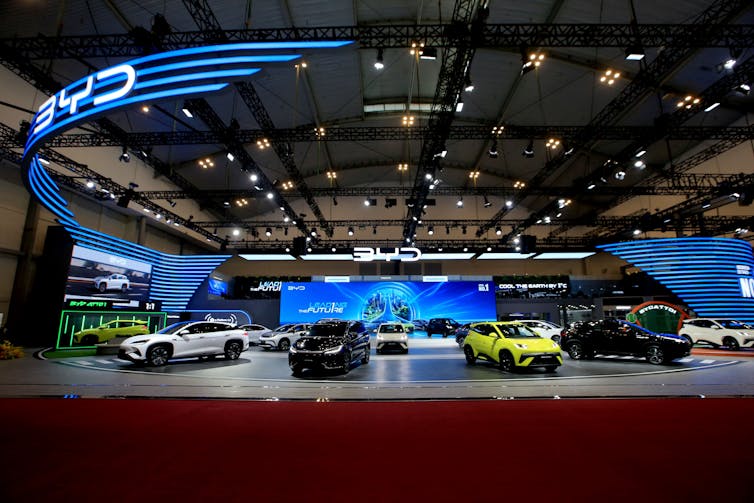
La nouvelle voiture électrique BYD Atto 1, lancée en Indonésie, est présentée au Salon international de l’auto 2025 de Gaikindo Indonésie (GIIAS), le mardi 29 juillet 2025. fotopix/Shutterstock
Troisièmement, l’expertise acquise dans la recherche et le développement des réservoirs, des moteurs et des boîtes de vitesse des véhicules à combustion interne ne peut pas être appliquée aux trois systèmes électriques des véhicules à énergie nouvelle. Créée en 2011, l’entreprise Contemporary Amperex Technology Co. Limited (CATL) n’a aucune expérience dans le domaine des véhicules à combustion interne, mais elle devient en seulement six ans le leader mondial des batteries électriques avec, actuellement, 37,5 % de parts de marché.
De ses débuts où elle suivait le rythme des normes internationales jusqu’à sa position de leader mondial, l’industrie automobile chinoise suit une trajectoire complète consistant à éviter les écueils, à tirer parti de ses atouts et à réaliser des bonds en avant. Cette logique, nommée en Chine « dépasser en changeant de voie », fait écho aux principes de l’innovation disruptive proposés par l’universitaire Clayton Christensen.
Néanmoins, le développement futur du secteur automobile chinois reste semé d’embûches. La concurrence « involutive » qui découle du concept chinois d’« involution », signifiant littéralement « s’enrouler vers l’intérieur », désigne une concurrence excessive caractérisée par la guerre des prix entre constructeurs locaux, est devenue un obstacle majeur pour la pérennité de l’industrie. Les entreprises chinoises de véhicules à énergie nouvelle, impactées par la concurrence nationale et les droits de douane, accélèrent leur expansion à l’étranger tout en étant confrontées à un double défi matériel et culturel.
Cet article a été corédigé par Yuzhen Xie (écrivaine et conférencière), diplômée de Renmin University of China.
Fabien M. Gargam ne travaille pas, ne conseille pas, ne possède pas de parts, ne reçoit pas de fonds d’une organisation qui pourrait tirer profit de cet article, et n’a déclaré aucune autre affiliation que son organisme de recherche.
Au vu de ce qui transparaît du plan élaboré pour Gaza par l’administration Trump, qui lui confère un rôle éminent, il semble que l’action de l’ancien premier ministre britannique Tony Blair sera comparable à son travail en tant qu’envoyé spécial du Quartet en Palestine (2007-2015), qui s’était soldé par un échec, plus qu’à son implication dans l’accord du Vendredi saint qui, en 1998, avait mis fin à trente ans de conflit armé en Irlande du Nord…
Tony Blair, l’homme choisi par Donald Trump pour jouer un rôle clé dans la supervision de la gouvernance de Gaza après la guerre, n’en est pas à sa première négociation d’un plan de paix.
Premier ministre du Royaume-Uni de 1997 à 2007, Blair a contribué en 1998 à la conclusion de l’accord du Vendredi saint, qui a permis de mettre un terme aux violences sectaires en Irlande du Nord. Après son départ du 10, Downing Street, Blair est immédiatement devenu envoyé spécial du Quartet – un groupe diplomatique regroupant l’Organisation des Nations unies (ONU), l’Union européenne (UE), les États-Unis et la Russie pour élaborer une solution durable au conflit israélo-palestinien. Il est demeuré à ce poste jusqu’en 2015.
Comme l’ont tragiquement montré le carnage commis le 7 octobre 2023 par le Hamas et les ravages qui ont été ensuite infligés à Gaza par Tsahal, récemment qualifiés de génocide par un organe des Nations unies, le Quartet a échoué dans sa mission.
Le plan de paix en 20 points actuellement en discussion par les parties prenantes en Égypte est succinct : il insiste sur le retour des otages israéliens encore détenus par le Hamas, la démilitarisation de la bande de Gaza et la création d’une force de sécurité internationale pour opérer sur place.
Le 8 octobre 2025, Trump a annoncé le lancement d’une phase initiale du plan de paix. Un accord a été trouvé sur l’échange des otages contre des prisonniers ainsi qu’une trêve des combats. Mais les négociations sont toujours en cours sur divers points d’achoppement, notamment le désarmement des groupes combattants gazaouis.
L’accord prévoit également qu’après la guerre, Gaza soit gouvernée par un comité palestinien provisoire « technocratique » et « apolitique ». Cet organe temporaire sera supervisé par un « Conseil de paix » dirigé par Trump lui-même. D’autres membres dont les noms n’ont pas été communiqués y siégeront également, mais le seul nom qui a été annoncé à ce stade est celui de Tony Blair, qui, selon certaines informations, était en pourparlers avec l’administration Trump depuis un certain temps pour élaborer le plan de paix actuel.
En tant que spécialiste des relations internationales et de la politique palestinienne, je crains que cette proposition ne comporte les mêmes limites et les mêmes défauts que les précédents plans de paix imposés aux Palestiniens par des organismes extérieurs, notamment les efforts du Quartet de Blair et les précédents accords d’Oslo, et qu’elle soit très éloignée des mécanismes qui ont permis de consolider la paix en Irlande du Nord.
Un plan qui prend racine dans une « paix illibérale »
La faille principale que les critiques voient dans le plan actuel est qu’il ne mentionne pas le droit des Palestiniens à l’autodétermination et à la souveraineté, un droit pourtant inscrit dans le droit international.
Le plan ne prévoit pas non plus de participation significative des Palestiniens, que ce soit par l’intermédiaire de leurs représentants légitimes ou par le biais de mécanismes visant à garantir l’adhésion de la population.
Au contraire, le nouveau cadre est asymétrique, puisqu’il permet au gouvernement israélien d’atteindre bon nombre de ses objectifs politiques tout en imposant plusieurs niveaux de contrôle international et en n’évoquant que des garanties vagues pour le peuple palestinien, et ce, uniquement si celui-ci se conforme aux exigences des auteurs du texte.
En l’état, ce plan s’inscrit dans la continuité de ce que les politologues qualifient de « paix illibérale » en matière de résolution des conflits.
Dans un article publié en 2018, des chercheurs ont défini la « paix illibérale » comme une paix dans laquelle « la cessation du conflit armé est obtenue par des moyens […] ouvertement autoritaires ».
Une telle paix est obtenue grâce à « des méthodes qui évitent les véritables négociations entre les parties au conflit, rejettent la médiation internationale et les contraintes à l’usage de la force, ignorent les appels à s’attaquer aux causes structurelles sous-jacentes du conflit et s’appuient plutôt sur des instruments de coercition étatique et des structures hiérarchiques de pouvoir ».
Cela contraste avec d’autres accords de paix conclus ailleurs, dans des cadres diplomatiques plus inclusifs, comme en Irlande du Nord.
Pendant plus de trente ans, le territoire avait été embourbé dans des violences sectaires entre les « loyalistes », majoritairement protestants et désireux de rester rattachés au Royaume-Uni, et la minorité catholique, qui entendait faire partie d’une république irlandaise unifiée et indépendante.
De plus, le processus de paix en Irlande du Nord a explicitement impliqué la population irlandaise et lui a permis de s’exprimer à travers deux référendums distincts. Les habitants d’Irlande du Nord ont voté pour ou contre le plan, tandis que ceux de la République d’Irlande ont voté pour ou contre l’autorisation donnée à l’État irlandais de signer l’accord.
Grâce à ce processus inclusif et démocratique, le conflit n’a toujours pas repris depuis vingt-sept ans.
Si Tony Blair n’a pas lancé le processus de paix en Irlande du Nord, son gouvernement a joué un rôle central, et c’est lui qui a déclaré que « la main de l’histoire » reposait sur l’épaule de ceux qui ont participé aux derniers jours des négociations.
Échec à Oslo
Le processus nord-irlandais, couronné de succès, contraste fortement avec les nombreux processus de paix qui ont échoué au Moyen-Orient, lesquels s’inscrivent davantage dans le concept de « paix illibérale ».
La tentative la plus sérieuse en faveur d’une paix durable a été celle des accords d’Oslo de 1993, par lesquels l’Organisation de libération de la Palestine (OLP) a accepté le droit d’Israël à exister, renonçant à ses revendications sur une grande partie de la Palestine historique, en échange de la reconnaissance par Israël de l’OLP comme représentant légitime du peuple palestinien.
Ce processus a conduit à la création de l’Autorité palestinienne, qui était censée exercer une gouvernance limitée à titre provisoire, et à la tenue d’élections présidentielles et parlementaires afin d’impliquer la population palestinienne. Mais comme l’ont depuis admis de nombreux anciens responsables américains, les accords étaient asymétriques : ils offraient aux Palestiniens une reconnaissance sous l’égide de l’OLP, mais peu de perspectives pour parvenir à une solution négociée dans un contexte d’occupation par un pays souverain bien plus puissant.
Le processus de paix s’est effondré lorsque cette asymétrie est apparue clairement. Les deux parties entendaient des choses très différentes par le mot « État ». Le gouvernement israélien envisageait une forme d’autonomie limitée pour les Palestiniens et poursuivait l’expansion des colonies et l’occupation militaire. Les Palestiniens, quant à eux, envisageaient un État légitime exerçant sa souveraineté.
Pour aggraver les problèmes, les Palestiniens n’ont jamais eu un pouvoir de négociation égal, et les accords manquaient d’un arbitre neutre, les États-Unis, le principal médiateur, penchant clairement en faveur de la partie israélienne.
Oslo était censé être un processus limité dans le temps afin de donner aux négociateurs le temps de résoudre les questions en suspens. Dans la pratique, il a servi à couvrir diplomatiquement, des années durant, un statu quo dans lequel les gouvernements israéliens se sont éloignés d’une solution à deux États tandis que les Palestiniens sont devenus de plus en plus fragmentés politiquement et géographiquement dans un contexte de difficultés et de violences croissantes.
Le processus de paix d’Oslo s’est effondré au début du mandat du gouvernement Blair, alors même que celui-ci contribuait à mettre la touche finale à l’accord du Vendredi saint.
Répéter les erreurs à Gaza ?
Dans le contexte israélo-palestinien actuel, Blair risque de répéter les erreurs d’Oslo. Il s’apprête à siéger au sein d’un organisme international non démocratique chargé de superviser un peuple soumis à une occupation militaire de facto.
De plus, bien que le plan Trump dépende de l’approbation du Hamas, ce mouvement n’aura aucun rôle à jouer après la phase initiale. En effet, le cadre stipule explicitement que le Hamas doit être exclu de toute discussion future sur l’après-guerre à Gaza. De plus, aucun autre groupe palestinien n’est directement impliqué ; le principal rival du Hamas, le Fatah, qui contrôle l’Autorité palestinienne en Cisjordanie occupée, n’est mentionné que brièvement. Quant à l’Autorité palestinienne, il n’y a qu’une vague allusion à la réforme de cet organisme.
De même, il n’a été fait aucune mention de ce que le peuple palestinien pourrait réellement souhaiter. À cet égard, l’organe proposé rappelle la création de l’Autorité provisoire de la coalition dirigée par les États-Unis lors de l’invasion de l’Irak (2003-2004). Cet organisme, qui a gouverné l’Irak immédiatement après l’invasion, a été sévèrement critiqué pour sa corruption et son manque de transparence.
L’échec de la guerre en Irak et l’implication du Royaume-Uni dans ce conflit ont contribué à la démission de Tony Blair de son poste de premier ministre en 2007, après quoi il a occupé la fonction d’envoyé spécial du Quartet. Formé par l’ONU, les États-Unis, l’UE et la Russie, le Quartet était chargé de préserver une forme de solution à deux États et de mettre en œuvre des plans de développement économique dans les villes palestiniennes.
Mais lui aussi a échoué à répondre aux réalités politiques changeantes sur le terrain, alors que les colonies israéliennes s’étendaient et que l’occupation militaire s’intensifiait.
Selon ses détracteurs, le Quartet aurait largement ignoré le droit des Palestiniens à l’autodétermination et à la souveraineté, se concentrant plutôt sur une amélioration marginale des conditions économiques et sur des initiatives superficielles.
La dernière proposition soutenue par les États-Unis s’inspire largement de cette approche. Même si elle apporte à court terme un répit bienvenu aux souffrances des Gazaouis, une résolution durable et mutuellement acceptée du conflit israélo-palestinien qui dure depuis plusieurs décennies nécessite ce que le plan de Trump met de côté : l’autodétermination palestinienne.
En Irlande du Nord, Blair avait compris l’importance d’une médiation neutre et de l’adhésion de toutes les parties au conflit et de la population elle-même. Le plan auquel il participe aujourd’hui semble fonctionner selon un calcul très différent.
Dana El Kurd est membre de l’Arab Center de Washington.