Immigration : Pourquoi les gouvernements n’écoutent-ils pas les chercheurs ?

Source: The Conversation – France in French (2) – By Antoine Pécoud, Professeur de sociologie, Université Sorbonne Paris Nord

Les gouvernements choisissent des politiques jugées unanimement inefficaces par les chercheurs spécialistes des migrations. Comment comprendre cette absence d’écoute ? Comment y remédier ?


Les migrations sont omniprésentes, dans le débat politique comme dans les médias ou sur les réseaux sociaux. Les chercheurs, pourtant, sont relativement peu visibles.

Cette situation est a priori surprenante. Malgré des moyens importants, les États ne semblent pas parvenir à maîtriser les déplacements de populations et pourraient donc bénéficier d’un échange avec les spécialistes. Or, la recherche sur les migrations est dynamique, avec un nombre croissant de connaissances sur le sujet.

Mais en pratique, le dialogue entre chercheurs et politiques est peu développé. Une des conséquences de cette situation est que les gouvernements s’obstinent dans des politiques qui sont unanimement jugées inefficaces, et même contre-productives, par les spécialistes.

C’est notamment le cas des politiques qui visent à développer l’Afrique pour freiner l’immigration. L’Union européenne y consacre des dizaines de millions d’euros, notamment au travers du Fonds fiduciaire. Pourtant la recherche a de longue date établi que le développement ne limite pas mécaniquement l’émigration, au point que le premier peut même, dans certains cas, favoriser la seconde.

Il en va de même pour la réponse à la « crise » des migrants et des réfugiés en Méditerranée. Les décideurs – et une bonne partie de la société avec eux – sont persuadés que l’Europe fait face à une hausse sans précédent des arrivées de migrants en Europe. Or la recherche montre que la crise n’est pas seulement due à une augmentation des flux, mais aussi à une politique d’accueil inadaptée. En refusant de prendre en compte cette nuance, les politiques migratoires ne font que renforcer le contrôle – avec le risque d’aggraver encore la crise.

Approche idéologique des États

La difficulté majeure tient donc dans l’approche excessivement idéologique des États. Nombre de gouvernements sont élus sur un programme de lutte contre l’immigration et blâment les migrants, les réfugiés (et même leurs descendants) pour toutes sortes de problèmes, du chômage à l’insécurité en passant par la cohésion sociale. On conçoit donc qu’ils soient hostiles aux critiques, et même à tout raisonnement légèrement nuancé.

Cette approche clivante inspire l’ensemble des politiques publiques. En France, par exemple, pas moins de 28 lois sur l’immigration ont été adoptées depuis 1980. À ce rythme, chaque loi est adoptée avant que précédente n’ait été entièrement mise en œuvre – et encore moins évaluée. Là encore, on conçoit que les chercheurs ne soient pas les bienvenus dans une activité législative qui relève en grande partie de l’affichage et de la gesticulation.

Cela s’inscrit dans une défiance plus générale vis-à-vis des sciences sociales, qui ont toujours été accusées d’idéalisme, d’irénisme (attitude favorisant la compréhension plutôt que le conflit) – et aujourd’hui de « wokisme ». Rappelons qu’en 2015, un ancien premier ministre affirmait qu’en « expliquant » certaines réalités (comme la radicalisation), les sciences sociales contribuaient à les « excuser ».

Le paradoxe du financement public de la recherche

La réalité est un peu plus complexe, cependant. L’indifférence des pouvoirs publics à la recherche ne les empêche pas de la financer.

La Commission européenne a ainsi débloqué plus de 160 millions d’euros depuis 2014 pour les universités travaillant sur les migrations. En France, dans le cadre du programme France 2030, l’Agence nationale de la recherche (ANR) a financé à hauteur de près de 14 millions d’euros l’Institut Convergences Migrations (IC Migrations) depuis sa création en 2017.

Cela contribue au dynamisme de la recherche sur les migrations : plus de mille chercheurs vont ainsi se réunir à Aubervilliers, en région parisienne, en juillet 2025 pour la 22ᵉ conférence annuelle du réseau européen IMISCOE, organisée par l’IC Migrations.

Mais, bien que l’écrasante majorité de ces chercheurs soient critiques des politiques migratoires, celles-ci ne changent pas pour autant. Les premiers surpris sont les chercheurs eux-mêmes : en 2020, soixante d’entre eux ont écrit à la présidente de la Commission européenne Ursula von der Leyen pour exprimer leur frustration d’être financés par la Commission – mais jamais écoutés.

Dans une logique de « politiques fondées sur les faits », l’objectif affiché par les bailleurs de fonds est pourtant de mieux comprendre les migrations pour mieux les gouverner. Cette approche est louable et nécessaire, a fortiori dans une époque marquée par les fake news, par l’influence de médias ouvertement populistes et par des politiques « anti-science » dans l’Amérique trumpiste. Mais force est d’admettre que les obstacles sont nombreux.

Des chercheurs peu incités à dialoguer avec les politiques

Rappelons que, si les chercheurs sont en général ouverts au dialogue avec les décideurs ainsi qu’avec les médias et la société civile, il ne s’agit pas de leur cœur de métier.

Ils évoluent dans un milieu professionnel qui a son propre rythme, nécessairement plus lent que celui des médias ou des soubresauts politiques. Leurs carrières répondent à des logiques spécifiques, dans lesquelles les publications jouent un rôle prépondérant – ce qui conduit à une forte spécialisation et à l’usage de la lingua franca de la recherche qu’est l’anglais.

Ajoutons que beaucoup travaillent dans des conditions dégradées, marquées par un précariat croissant et le sous-financement chronique des universités. La grande majorité des chercheurs ne sont donc pas formés, pas incités (et encore moins payés) pour dialoguer avec les politiques.

Cela a conduit à l’émergence d’intermédiaires, comme les think tanks (à l’instar du Migration Policy Institute à Bruxelles) ou certains centres de recherche spécialisés (dont le « Co-Lab » à l’Institut européen, à Florence). De par leurs réseaux parmi les décideurs et leur capacité à leur parler, ces acteurs comblent un manque. Mais leur existence indique aussi à quel point le dialogue recherche-politique est un exercice à part entière, que seule une poignée de chercheurs maîtrise.

Une autre difficulté tient à l’hétérogénéité des positions des chercheurs. Des économistes aux anthropologues en passant par les juristes, tous sont critiques des politiques actuelles – mais pas pour les mêmes raisons. Certains leur reprochent de freiner la croissance en limitant l’immigration de travail, d’autres de violer les droits fondamentaux, etc.

Face à cette multiplicité de critiques, les États peuvent aisément ne « piocher » que les résultats qui les arrangent. Par exemple, quand les sciences sociales documentent la vulnérabilité des migrants et le rôle des passeurs dans l’immigration irrégulière, les États retiennent l’impératif de lutter contre ces réseaux – mais oublient que leur existence est en grande partie une réponse au contrôle des migrations qui, en empêchant les mobilités légales, incitent les migrants à se tourner vers les passeurs.

Des politiques migratoires « occidentalo-centrées »

Il existe enfin des obstacles plus fondamentaux, car la recherche renforce parfois les politiques qu’elle critique. Les politiques migratoires sont ainsi très « occidentalo-centrées ». L’Europe s’affole de l’arrivée de réfugiés sur son sol, en oubliant que la très grande majorité d’entre eux restent dans les pays du Sud. Or, c’est aussi dans les pays du Nord que la majorité du savoir est produit, avec le risque d’étudier davantage ce qui se passe en Europe qu’ailleurs.

Les appels à « décentrer » (voire à « décoloniser ») la recherche se multiplient, mais il reste difficile d’échapper à ce biais. À cet égard, les financements européens sont à double tranchant : s’ils permettent un essor de la recherche, ils sont aussi orientés vers les problématiques jugées importantes en Europe, tout en accentuant les inégalités de financement entre le nord et le sud de la Méditerranée.

Mais surtout, la notion même de « migration » n’est pas neutre : elle suppose un cadre étatique, au sein duquel les populations et les territoires sont séparés par des frontières, où citoyens et étrangers font l’objet d’un traitement bien différencié. Il est possible d’avancer que c’est justement cette organisation « westphalienne » du monde qui empêche de mieux gouverner les migrations, lesquelles témoignent des multiples interdépendances entre États.


Du lundi au vendredi + le dimanche, recevez gratuitement les analyses et décryptages de nos experts pour un autre regard sur l’actualité. Abonnez-vous dès aujourd’hui !


Le dilemme est donc assez clair. Les chercheurs sont des citoyens comme les autres et, à ce titre, ils ne sont donc pas extérieurs aux réalités sur lesquelles ils travaillent. Il est donc logique que la recherche se focalise sur les aspects les plus saillants des migrations contemporaines, et ce, d’autant plus que c’est justement vers ces réalités que les financements sont orientés. À bien des égards, pour produire un savoir pertinent et parler aux politiques, les chercheurs doivent « coller » à l’actualité.

Mais ce faisant, ils risquent de négliger des réalités moins visibles, et en conséquence de renforcer les biais qui affectent la perception sociale et politique des migrations. Il ne s’agit évidemment pas d’en appeler à une illusoire neutralité scientifique, mais de trouver un équilibre entre une logique de recherche autonome et la production d’un savoir utile à l’amélioration des politiques migratoires – à condition bien sûr que les États finissent un jour par les écouter.


Antoine Pécoud intervient sur ce sujet lors du colloque annuel de l’IMISCOE (International Migration Research Network), qui se tient sur le campus Condorcet à Aubervilliers (Seine-Saint-Denis), du 1er>/sup> au 4 juillet 2025.

The Conversation

Antoine Pécoud ne travaille pas, ne conseille pas, ne possède pas de parts, ne reçoit pas de fonds d’une organisation qui pourrait tirer profit de cet article, et n’a déclaré aucune autre affiliation que son organisme de recherche.

ref. Immigration : Pourquoi les gouvernements n’écoutent-ils pas les chercheurs ? – https://theconversation.com/immigration-pourquoi-les-gouvernements-necoutent-ils-pas-les-chercheurs-259933

« Querer », « Adolescence »… les séries sont-elles plus efficaces que les campagnes de sensibilisation ?

Source: The Conversation – France in French (2) – By Mélanie Bourdaa, Professeure en Sciences de l’Information et de la Communication, Université Bordeaux Montaigne

Dans la série _Querer_, dont le rôle principal est interprété par l’actrice espagnole Nagore Aranburu, les représentations débordent de l’écran. Nicolás de Assas/Movistar Plus+/Stars, CC BY-ND

À travers Querer et Adolescence, deux miniséries venues d’Espagne et du Royaume-Uni, 2025 aura vu la fiction européenne s’attaquer de front aux violences de genre et aux modèles de masculinité. Au-delà de leurs récits, ces œuvres posent une question cruciale : que peut la fiction pour sensibiliser à ces enjeux, dans les écoles, dans la sphère privée, comme dans l’espace public ?


On entend souvent que les séries influencent celles et ceux qui les regardent. Et généralement cette influence est décrite comme négative : les séries traduiraient et amplifieraient les stéréotypes, les violences, etc. Ce postulat est très éloigné des travaux de recherche. D’une part, ceux-ci démontrent que le public est (inégalement) actif, notamment en créant du discours face à ces imaginaires. D’autre part, les séries ne participent pas qu’à la diffusion de stéréotypes : elles les transforment et les tordent également.

Masculinité, violences sexistes… des séries qui permettent d’« en parler »

Adolescence est une minisérie britannique de quatre épisodes qui a été diffusée en mars 2025 sur Netflix. Elle suit la mise en accusation pour meurtre (d’une camarade de classe) d’un garçon de 13 ans. Abordant simultanément les questions de masculinité, de féminicide et de l’impact des réseaux sociaux, la série reçoit un fort écho en France et devient le centre d’une discussion sur l’éducation des garçons et le rôle de l’école dans la déconstruction de la masculinité.
Bande-annonce de la série Adolescence.

Querer est également une minisérie de quatre épisodes, mais tournée et conçue en Espagne. Elle a été diffusée en France en juin 2025 sur Arte. Elle suit Miren, qui porte plainte contre son mari pour viols répétés, après trente ans de mariage. La série met notamment en lumière les réactions et le soutien contrastés des proches, la difficulté de ce type de procès et la normalisation des violences au sein des couples. Diffusée peu après le procès médiatisé de Mazan, la série bénéficie d’un important bouche-à-oreille.

Bande-annonce de la série Querer.

Les séries participent de la mise à l’agenda politique et médiatique de ces questions. C’est d’ailleurs l’un de leurs objectifs assumés. Le réalisateur de Querer, Eduard Sala, a déclaré que la série visait « non seulement à divertir mais aussi à changer le monde ». Le scénariste d’Adolescence, Stephen Graham, a déclaré souhaiter que « la série provoque des dialogues entre les parents et leurs enfants », considérant qu’elle « n’est que le début du débat ».

Un rôle actif du public

Querer comme Adolescence sont des dispositifs efficaces pour parler des violences et harcèlements sexistes et sexuels (VHSS) car elles ont su trouver des relais médiatiques importants dans la presse, à la radio et à la télévision.

Mais ce n’est pas tout, si la sensibilisation par les séries se fait, c’est également que le public en parle, notamment le public le plus engagé : les fans. La série devient un levier pour entamer des conversations dans les communautés en ligne, pour sensibiliser à ces questions ou pour partager son expérience et ainsi mettre en lumière les réalités des VHSS.

A contrario, la série peut également provoquer des réactions de cyberviolence et de cyberharcèlement de la part de publics toxiques. Il suffit pour cela de regarder les commentaires des posts Facebook sur la série Querer, où féministes et masculinistes argumentent sur les thèmes de la série. Pour la série Adolescence, les commentaires sur les comptes Instagram de fans mentionnent le besoin de voir la série pour mieux comprendre les adolescents et leur vie privée et sociale.

Des pouvoirs publics qui se saisissent des séries

En juin 2025, s’inspirant d’une mesure prise au Royaume-Uni, la ministre de l’éducation nationale Élisabeth Borne a proposé que la série Adolescence soit utilisée comme support pédagogique à partir de la classe de quatrième. Querer (qui a reçu le grand prix au festival Séries Mania) semble emprunter le même chemin, notamment dans des formations en psychologie ou en criminologie.

Ce n’est pas la première fois que des séries sont mobilisées pour porter un discours de politique publique. En 2017, la série 13 Reasons Why, qui traite du harcèlement allant jusqu’au suicide d’une adolescente, avait bénéficié d’un site ressource avec des dispositifs de prévention et d’un documentaire post-série (Beyond the Reasons).

Dans la série britannique Sex Education (2019), une scène aborde le thème de la thérapie du traumatisme causé par une agression sexuelle.

Utilisée dans des collèges et lycées anglophones avec des guides d’accompagnement pour éducateurs et parents, la série emboîte le pas d’une autre, plus connue encore : Sex Education. Celle-ci est la première teen serie portant aussi explicitement sur les questions de sexualité et de relations amoureuses, dans une approche sex-positive, très tolérante et ayant toujours à cœur la question du consentement. Un guide, « Le petit manuel Sex Education », a été mis à disposition pour des ateliers de prévention et de sensibilisation. Il est utilisé dans certains établissements scolaires. Bref, l’implémentation de séries dans des politiques éducatives ou de prévention : ce n’est pas tout à fait nouveau.


Du lundi au vendredi + le dimanche, recevez gratuitement les analyses et décryptages de nos experts pour un autre regard sur l’actualité. Abonnez-vous dès aujourd’hui !


Sensibiliser par ou avec les séries

Mais ne nous trompons pas : les séries, seules, ne constituent pas des supports de sensibilisation autonomes. Encore faut-il penser autour d’elles des dispositifs de médiation.

Les séries sont de plus en plus nombreuses à avertir de scènes de violences et à renvoyer vers des centres d’aide. Par exemple à partir de la saison 2, chaque épisode de 13 Reasons Why commence par un message d’avertissement : « Cet épisode contient des scènes qui peuvent heurter la sensibilité de certains spectateurs. » Un avertissement vidéo avec les acteurs précède également la diffusion : « Si vous êtes concerné par ces sujets, parlez-en à un adulte ou consultez le site 13reasonswhy.info ».

La série Sex Education s’est aussi prêtée à cet exercice : lors d’un épisode montrant une agression sexuelle dans un bus, des ressources officielles ont été diffusées sur les réseaux sociaux de la série et de la BBC, renvoyant notamment vers le centre d’aide britannique aux victimes de viol.

Premier épisode de la saison 4 de la websérie Skam (France TV, 2019).

Les séries françaises sont plus discrètes dans l’intégration directe de liens dans les épisodes. Dans Skam, une série Slash/France Télévision qui suit le quotidien d’élèves de lycée, des messages apparaissent avec des liens vers le 3018 (cyberviolences), le 3919 (violences conjugales) ou vers SOS Homophobie à la fin de certains épisodes (notamment dans les saisons 4, 5 et 6, qui traitent respectivement de l’islamophobie, de la santé mentale et des violences contre partenaire intime). Le site Slash propose une page complète « Besoin d’aide », mentionnée dans les dialogues ou dans l’habillage final de la série.

Proposer des séries plutôt que des politiques publiques ?

Si sensibiliser aux questions de violences, de discrimination ou de santé mentale semble commencer à faire partie du « cahier des charges » implicite des séries qui abordent ces thématiques, séries et campagnes de sensibilisation publique ne sont pas en concurrence. Les séries résonnent avec le cadre légal de chaque pays de diffusion : la législation contre les violences de genre n’est pas la même en Espagne, en France ou au Royaume-Uni, et sa réception est propre à chaque contexte.

Dans certains cas, séries et politiques publiques peuvent gagner à jumeler leurs discours et leurs actions en matière de prévention et de sensibilisation. L’une des conditions est que les personnes en charge des actions de sensibilisation soient formées.

L’annonce aux agents de l’éducation nationale de l’arrivée d’Adolescence parmi les supports de sensibilisation pose ainsi question. Chez un grand nombre d’enseignants et d’infirmiers scolaires, les séries ne font pas partie de la culture pédagogique en routine. Sans culture commune (on pense notamment à des formations à l’outil sériel), il paraît abrupt de prétendre qu’une série puisse lutter efficacement contre les violences. D’autant plus que la série agit comme un révélateur de la parole, mais aussi des souvenirs – y compris post-traumatiques.

À cet égard, l’outil qu’est la série nécessite un double accompagnement par des encadrants formés à la fois à ce support mais aussi à l’accueil et à l’accompagnement de la parole.

The Conversation

Les auteurs ne travaillent pas, ne conseillent pas, ne possèdent pas de parts, ne reçoivent pas de fonds d’une organisation qui pourrait tirer profit de cet article, et n’ont déclaré aucune autre affiliation que leur organisme de recherche.

ref. « Querer », « Adolescence »… les séries sont-elles plus efficaces que les campagnes de sensibilisation ? – https://theconversation.com/querer-adolescence-les-series-sont-elles-plus-efficaces-que-les-campagnes-de-sensibilisation-259957

Grilling with lump charcoal: Is US-grown hardwood really in that bag?

Source: – By Adriana Costa, Assistant Professor of Sustainable Bioproducts, Mississippi State University

When you’re getting ready to cook, do you know what’s burning underneath? Alexandr Baranov/iStock/Getty Images Plus

People dedicated to the art of grilling often choose lump charcoal – actual pieces of wood that have been turned into charcoal – over briquettes, which are compressed charcoal dust with other ingredients to keep the dust together and help it burn better.

The kinds of wood used to make lump charcoal affect how it burns and how the food tastes when grilled. Dedicated grillers are often willing to pay a premium for higher heat, no additives, particular flavors and the cleaner burn they get from particular wood species in lump charcoal.

Buyers probably expect the label to accurately report how much charcoal they are getting, what kind of wood it is, and where the wood was grown.

A spot-check I helped conduct on lump charcoal for sale in the U.S. has revealed that the information on the label does not always match what is inside the bag. Customers might not know what they are actually buying, potentially affecting their purchasing choices and even their grilling experience.

Origin matters

Charcoal is made from wood heated in a low-oxygen environment to remove water and volatile compounds. This process leaves behind a carbon-rich material that burns hotter and more cleanly than raw wood, making it ideal for grilling.

The origin of the trees used affects charcoal’s ecological sustainability. Some charcoal produced in Mexico, Paraguay and Brazil has been linked to deforestation and unsustainable logging practices. Charcoal from hardwood trees harvested in the U.S. is generally considered to be more sustainable.

We decided to investigate more deeply what consumers are actually getting when they buy a bag of lump charcoal.

We looked at a range of products, some of which were labeled as from the U.S., some from other countries and others that did not specify a country of origin.

We purchased one bag each of 15 major U.S. lump charcoal brands online. We did not identify the specific producers. Instead, we wanted to give an overall sense of the products available on the market and evaluate how closely product claims on the packaging matched what was actually in the bags.

Kinds of charcoal we found

We determined the type of wood the charcoal was made from by examining each lump under a microscope or handheld magnifying lens and matching the patterns in the wood structure with the ones in our collection.

Identifying the species allowed us to broadly infer the origin of the charcoal based on where those kinds of trees typically grow.

Nearly half of all the lump charcoal we examined was oak or mesquite, which are both hardwoods that grow in North America, including in the U.S. and Mexico.

In two out of five bags claiming their charcoal had come from the U.S., 15% or more of the material was actually tropical woods, such as ipe, which are not native to the U.S. These woods may have been harvested unsustainably. Other species we found included pine and sweet gum, which perform poorly as grilling woods.

Much of the tropical wood was in small fragments, which made us think it might have been intentionally used as cheap filler.

We found one bag that was labeled “One ingredient: Oak hardwood” that contained no oak at all. Instead, it was a mix of at least six tropical woods.

Two textures of wood side by side, one darker and clearly burned and the other brighter and not burned.
At left, a cross section of a piece of red oak lump charcoal under magnification, beside a cross section of a piece of raw red oak wood.
Wiedenhoeft and Costa

What else was in the bag?

We also discovered concerns related to product weight and the quantity of extraneous material in the bags. The Fair Packaging and Labeling Act is a U.S. law that requires product containers to carry labels that accurately describe the contents. The National Institute of Standards and Technology has specific methods for measuring and characterizing contents of packaged goods.

These requirements do allow some variations in weight, but nearly half the bags we examined were underfilled, and one-third were far enough underweight that their label claims fell outside what is legally acceptable.

Also, in every bag we found bark and tiny charcoal fragments, which burn quickly and unevenly. Six bags had rocks in them. Without those extra materials, all 15 bags were underweight, and none gave buyers as much effective grilling fuel as they promised.

So when consumers pay more for what they think is a premium charcoal product, they may, in fact, be getting nothing of the sort.

The Conversation

Adriana Costa has received funding from the USDA National Institute of Food and Agriculture, McIntire Stennis, USDA Agricultural Research Service, and the USDA Forest Products Laboratory. Any opinions, findings, conclusions, or recommendations expressed in this publication are those of the author(s) and should not be construed to represent any official USDA or U.S. Government determination or policy.

ref. Grilling with lump charcoal: Is US-grown hardwood really in that bag? – https://theconversation.com/grilling-with-lump-charcoal-is-us-grown-hardwood-really-in-that-bag-258157

Hurricane Helene set up future disasters, from landslides to flooding – cascading hazards like these are now upending risk models

Source: – By Brian J. Yanites, Associate Professor of Earth and Atmospheric Science. Professor of Surficial and Sedimentary Geology, Indiana University

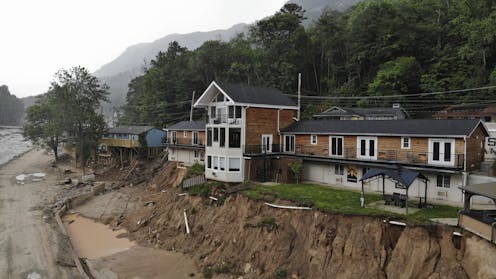
The Carter Lodge hangs precariously over the flood-scoured bank of the Broad River in Chimney Rock Village, N.C., on May 13, 2025, eight months after Hurricane Helene. AP Photo/Allen G. Breed

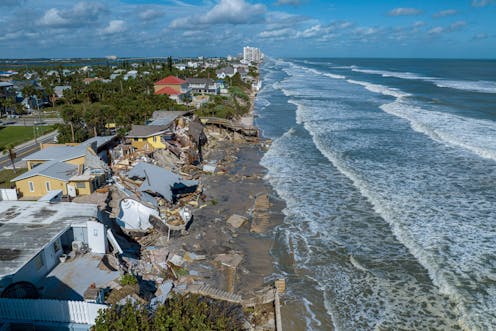
Hurricane Helene lasted only a few days in September 2024, but it altered the landscape of the Southeastern U.S. in profound ways that will affect the hazards local residents face far into the future.

Mudslides buried roads and reshaped river channels. Uprooted trees left soil on hillslopes exposed to the elements. Sediment that washed into rivers changed how water flows through the landscape, leaving some areas more prone to flooding and erosion.

Helene was a powerful reminder that natural hazards don’t disappear when the skies clear – they evolve.

These transformations are part of what scientists call cascading hazards. They occur when one natural event alters the landscape in ways that lead to future hazards. A landslide triggered by a storm might clog a river, leading to downstream flooding months or years later. A wildfire can alter the soil and vegetation, setting the stage for debris flows with the next rainstorm.

Two satellite maps of the same location. One shows changes to the river, loss of trees and landslides.
Satellite images before (top) and after Hurricane Helene (bottom) show how the storm altered landscape near Pensacola, N.C., in the Blue Ridge Mountains.
Google Earth, CC BY

I study these disasters as a geomorphologist. In a new paper in the journal Science, I and a team of scientists from 18 universities and the U.S. Geological Survey explain why hazard models – used to help communities prepare for disasters – can’t just rely on the past. Instead, they need to be nimble enough to forecast how hazards evolve in real time.

The science behind cascading hazards

Cascading hazards aren’t random. They emerge from physical processes that operate continuously across the landscape – sediment movement, weathering, erosion. Together, the atmosphere, biosphere and the earth are constantly reshaping the conditions that cause natural disasters.

For instance, earthquakes fracture rock and shake loose soil. Even if landslides don’t occur during the quake itself, the ground may be weakened, leaving it primed for failure during later rainstorms.

That’s exactly what happened after the 2008 earthquake in Sichuan Province, China, which led to a surge in debris flows long after the initial seismic event.

A volunteer carrying a shovel over his shoulder walks past boulders and a severely damaged building.
A strong aftershock after a 7.8 magnitude earthquake in Sichuan province, China, in May 2008 triggered more landslides in central China.
AP Photo/Andy Wong

Earth’s surface retains a “memory” of these events. Sediment disturbed in an earthquake, wildfire or severe storm will move downslope over years or even decades, reshaping the landscape as it goes.

The 1950 Assam earthquake in India is a striking example: It triggered thousands of landslides. The sediment from these landslides gradually moved through the river system, eventually causing flooding and changing river channels in Bangladesh some 20 years later.

An intensifying threat in a changing world

These risks present challenges for everything from emergency planning to home insurance. After repeated wildfire-mudslide combinations in California, some insurers pulled out of the state entirely, citing mounting risks and rising costs among the reasons.

Cascading hazards are not new, but their impact is intensifying.

Climate change is increasing the frequency and severity of wildfires, storms and extreme rainfall. At the same time, urban development continues to expand into steep, hazard-prone terrain, exposing more people and infrastructure to evolving risks.

The rising risk of interconnected climate disasters like these is overwhelming systems built for isolated events.

Yet climate change is only part of the equation. Earth processes – such as earthquakes and volcanic eruptions – also trigger cascading hazards, often with long-lasting effects.

Mount St. Helens is a powerful example: More than four decades after its eruption in 1980, the U.S. Army Corps of Engineers continues to manage ash and sediment from the eruption to keep it from filling river channels in ways that could increase the flood risk in downstream communities.

Rethinking risk and building resilience

Traditionally, insurance companies and disaster managers have estimated hazard risk by looking at past events.

But when the landscape has changed, the past may no longer be a reliable guide to the future. To address this, computer models based on the physics of how these events work are needed to help forecast hazard evolution in real time, much like weather models update with new atmospheric data.

An aerial view of a river with evidence of a landslide. Broken trees look like toothpicks scattered about, and the river flow is partially blocked.
A March 2024 landslide in the Oregon Coast Range wiped out trees in its path.
Brian Yanites, June 2025
An aerial view of a river with evidence of a landslide. Broken trees look like toothpicks scattered about, and the river flow is partially blocked.
A drone image of the same March 2024 landslide in the Oregon Coast Range shows where it temporarily dammed the river below.
Brian Yanites, June 2025

Thanks to advances in Earth observation technology, such as satellite imagery, drone and lidar, which is similar to radar but uses light, scientists can now track how hillslopes, rivers and vegetation change after disasters. These observations can feed into geomorphic models that simulate how loosened sediment moves and where hazards are likely to emerge next.

Researchers are already coupling weather forecasts with post-wildfire debris flow models. Other models simulate how sediment pulses travel through river networks.

Cascading hazards reveal that Earth’s surface is not a passive backdrop, but an active, evolving system. Each event reshapes the stage for the next.

Understanding these connections is critical for building resilience so communities can withstand future storms, earthquakes and the problems created by debris flows. Better forecasts can inform building codes, guide infrastructure design and improve how risk is priced and managed. They can help communities anticipate long-term threats and adapt before the next disaster strikes.

Most importantly, they challenge everyone to think beyond the immediate aftermath of a disaster – and to recognize the slow, quiet transformations that build toward the next.

The Conversation

Brian J. Yanites receives funding from the National Science Foundation.

ref. Hurricane Helene set up future disasters, from landslides to flooding – cascading hazards like these are now upending risk models – https://theconversation.com/hurricane-helene-set-up-future-disasters-from-landslides-to-flooding-cascading-hazards-like-these-are-now-upending-risk-models-259502

What Trump’s budget proposal says about his environmental values

Source: – By Stan Meiburg, Executive Director, Sabin Center for Environment and Sustainability, Wake Forest University

The president’s spending proposal doesn’t leave much behind. Alexey Kravchuk/iStock / Getty Images Plus

To understand the federal government’s true priorities, follow the money.

After months of saying his administration is committed to clean air and water for Americans, President Donald Trump has proposed a detailed budget for the U.S. Environmental Protection Agency for fiscal year 2026. The proposal is more consistent with his administration’s numerous recent actions and announcements that reduce protection for public health and the environment.

To us, former EPA leaders – one a longtime career employee and the other a political appointee – the budget proposal reveals a lot about what Trump and EPA Administrator Lee Zeldin want to accomplish.

According to the administration’s Budget in Brief document, total EPA funding for the fiscal year beginning October 2025 would drop from US$9.14 billion to $4.16 billion – a 54% decrease from the budget enacted by Congress for fiscal 2025 and less than half of EPA’s budget in any year of the first Trump administration.

Without taking inflation into account, this would be the smallest EPA budget since 1986. Adjusted for inflation, it would be the smallest budget since the Ford administration, even though Congress has for decades given EPA more responsibility to clean up and protect the nation’s air and water; handle hazardous chemicals and waste; protect drinking water; clean up environmental contamination; and evaluate the safety of a wide range of chemicals used in commerce and industry. These expansions reflected a bipartisan consensus that protecting public health and the environment is a national priority.

The budget process in brief

Federal budgeting is complicated, and EPA’s budget is particularly so. Here are some basics:

Each year, the president and Congress determine how much money will be spent on what things, and by which agencies. The familiar aphorism that “the president proposes, Congress disposes” captures the Constitution’s process for the federal budget, with Congress firmly holding the “power of the purse.”

EPA’s budget can be difficult to understand because individual programs may be funded from different sources. It is useful to consider it as a pie sliced into five main pieces:

  • Environmental programs and management: the day-to-day work of protecting air, water and land.
  • Science and technology: research on pollution, health effects and new environmental tools.
  • Superfund and trust funds: cleaning up contaminated sites and responding to emergency releases of pollution.
  • State and Tribal operating grants: supporting local implementation of environmental laws.
  • State capitalization grants: revolving loans for water infrastructure.

The Trump administration’s budget proposals for EPA represent a striking retreat from the national goals of clean air and clean water enacted in federal laws over the past 55 years. In the budget document, the administration argues that the federal government has done enough and that the protection of gains already achieved, as well as any further progress, should not be paid for with federal money.

This budget would reduce EPA’s ability to protect public health and the environment to a bare minimum at best. Most dramatic and, in our view, most significant are the elimination of operating grants to state governments, drastic reductions in funding for science of all kinds, and elimination of EPA programs relating to climate change and environmental justice, which addresses situations of disproportionate environmental harm to vulnerable populations. It would cut regulatory and enforcement activities that the administration sees as inconsistent with fossil energy development. Other proposed changes, notably for Superfund and capitalization grants, are more nuanced.

These changes to EPA’s regular budget allocation are separate from changes to supplementary EPA funding that have also been in the news, including for projects specified in the Inflation Reduction Act and other specific laws.

Environmental programs and management

Funding for basic work to protect the environment and prevent pollution would be cut by 22%. The reductions are not spread equally, however. All activities related to climate change would be eliminated, including the Energy Star program and greenhouse gas reporting and tracking. Funding for civil and criminal enforcement of environmental laws and regulations would be cut by 69% and 50%, respectively.

The popular Brownfields program would be cut by 50%. Since 1995, $2.9 billion in federal funds have produced public and private investments totaling $42 billion for cleaning and redeveloping contaminated sites, and created more than 200,000 jobs.

A program to set standards and conduct training for safe removal of lead paint and other lead-containing materials from homes and businesses would be eliminated.

The administration has been clear that EPA will no longer do environmental justice work, such as funding to monitor toxic air emissions in low-income neighborhoods adjacent to industrial areas. This budget is consistent with that.

Science and technology

Scientific support functions would be cut by 34%. The Office of Research and Development would go from about 1,500 staff to about 500 and would be redistributed throughout the agency. This would diminish science that supports not just EPA’s work but that of organizations, industries, health care professionals and public and private researchers who benefit from EPA’s research.

A stretch of barren land, marked by dirt roads around a bright yellow pond.
A former uranium mill in Colorado is just one of the nation’s extremely contaminated Superfund sites awaiting federal money for cleanup.
RJ Sangosti/MediaNews Group/The Denver Post via Getty Images

Superfund and other trust funds

Superfund is by far the largest of EPA’s cleanup trust funds. It allows EPA to clean up contaminated sites. It also forces the parties responsible for the contamination to either perform cleanups or reimburse the government for EPA-led cleanup work. When there is no viable responsible party, Superfund gives EPA the funds and authority to clean up contaminated sites.

Prior to 2021, Superfund was funded through EPA’s annual budget. In 2021 and 2022, Congress restored taxes on selected chemicals and petroleum products to help pay for Superfund. During the Biden administration, EPA reduced the Superfund’s line in the general budget, with the expectation that the Superfund tax revenues would more than make up for the reduction. Administrator Zeldin, who has said that site cleanup is a priority, is proposing to shift virtually all funding for cleanups to these new tax revenues.

There is risk in this approach, however. The Superfund tax expires in 2031 and has raised less than Treasury Department predictions in both 2023 and 2024. In fiscal year 2024, available tax receipts were predicted to be $2.5 billion, but only $1.4 billion was collected. Future funding is uncertain because it depends on the amounts of various chemicals that companies actually use. Experts disagree on whether this is significant for the Superfund program. The petrochemical industry, on whom this tax largely falls, is lobbying for its repeal.

Funds to address leaks at gas station tanks would be cut nearly in half. Funds to clean up oil and petroleum spills would be cut by 24%.

State operating grants

The budget proposal seeks to reset the EPA’s relationship with state agencies, which implement the vast majority of environmental regulations.

EPA has long delegated some of its powers to state environmental agencies, including permitting, inspections and enforcement of regulations that govern air, water and soil pollution. Since the 1970s, EPA has helped fund those activities through basic operating grants that require minimum state contributions and reward larger state investments with additional federal dollars.

The proposed budget would eliminate all of those grants to states – totaling $1 billion. The document itself explains that federal funding over decades has totaled “hundreds of billions of dollars” and has resulted in programs that “are mature or have accomplished their purpose.”

States disagree. They note that EPA has delegated 90% of the nation’s environmental protection work to state authorities, and states have accepted that workload based on the expectation of federal funding. The states say reduced funding would greatly diminish the actual work of environmental protection – site inspections, air and water monitoring, and enforcement – across the country.

State capitalization grants

Since 1987, EPA has given states money for revolving loan programs that provide low-interest loans to state and local governments to clean up waterways and provide safe drinking water. The proposed budget would cut that funding by 89%, from $2.8 billion to $305 million.

These capitalization grants were originally envisioned as seed money, with future loans available as the initial and subsequent loans were repaid. But the need for water infrastructure continues to grow, and Congress has for many years allocated additional money to the program.

In protecting the environment, you get what you pay for. In past years, Congress has refused to accept proposed drastic cuts to EPA’s budget. It remains to be seen whether this Congress will go along with these proposed rollbacks.

The Conversation

Stan Meiburg is a volunteer with the Environmental Protection Network. He was an employee of the Environmental Protection Agency from 1977 to 2017.

i have worked at the US EPA twice. During the Obama Administration, i was first principal deputy to the Assistant Administrator of the Office of Air and Radiation and then Acting Assistant Administrator. During the Biden Administration, I was Deputy Administrator. I am also a volunteer with the Environmental Protection Network.

ref. What Trump’s budget proposal says about his environmental values – https://theconversation.com/what-trumps-budget-proposal-says-about-his-environmental-values-258962

What’s at risk for Arctic wildlife if Trump expands oil drilling in the fragile National Petroleum Reserve-Alaska

Source: – By Mariah Meek, Associate Professor of Integrative Biology, Michigan State University

Teshekpuk caribou graze in the National Petroleum Reserve-Alaska. Bob Wick/BLM, CC BY

The largest tract of public land in the United States is a wild expanse of tundra and wetlands stretching across nearly 23 million acres of northern Alaska. It’s called the National Petroleum Reserve in Alaska, but despite its industrial-sounding name, the National Petroleum Reserve-Alaska, or NPR-A, is much more than a fuel depot.

Tens of thousands of caribou feed and breed in this area, which is the size of Maine. Migratory birds flock to its lakes in summer, and fish rely on the many rivers that crisscross the region.

The area is also vital for the health of the planet. However, its future is at risk.

The Trump administration announced a plan on June 17, 2025, to open nearly 82% of this fragile landscape to oil and gas development, including some of its most ecologically sensitive areas.

Some of the extraordinary wildlife in the wetlands around Teshekpuk Lake, a fragile “special area” in the National Petroleum Reserve-Alaska that the Trump administration would open to further drilling.

I am an ecologist, and I have been studying sensitive ecosystems and the species that depend on them for over 20 years. Disturbing this landscape and its wildlife could lead to consequences that are difficult – if not impossible – to reverse.

What is the National Petroleum Reserve-Alaska?

The National Petroleum Reserve-Alaska was originally designated in 1923 by President Warren Harding as an emergency oil supply for the U.S. Navy.

In the 1970s, its management was transferred to the Department of Interior under the Naval Petroleum Reserves Production Act. This congressional act requires that, in addition to managing the area for energy development, the secretary of the interior must ensure the “maximum protection” of “any significant subsistence, recreational, fish and wildlife, or historical or scenic value.”

The Bureau of Land Management is responsible for overseeing the reserve and identifying and protecting areas with important ecological or cultural values – aptly named “special areas.”

A map of the NPR-A shows five large areas currently set aside as
The Trump administration plans to open parts of the ‘special areas,’ shown here, that were designated to protect wildlife in the National Petroleum Reserve-Alaska, including in the fragile Colville River and Teshekpuk Lake regions.
U.S. Bureau of Land Management

The Trump administration now plans to expand the amount of land available for drilling in the NPR-A from about 11.7 million acres to more than 18.5 million acres – including parts of those “special areas” – as part of its effort to increase U.S. oil drilling and reduce regulations on the industry.

I recently worked with scientists and scholars at The Wilderness Society to write a detailed report outlining many of the ecological and cultural values found across the reserve.

A refuge for wildlife

The reserve is a sanctuary for many Arctic wildlife, including caribou populations that have experienced sharp global declines in recent years.

The reserve’s open tundra provides critical calving, foraging, migratory and winter habitat for three of the four caribou herds on Alaska’s North Slope. These herds undertake some of the longest overland migrations on Earth. Infrastructure such as roads and industrial activity can disrupt their movement, further harming the populations’ health.

The NPR-A is also globally significant for migratory birds. Situated at the northern end of five major flyways, birds come here from all corners of the Earth, including all 50 states. It hosts some of the highest densities of breeding shorebirds anywhere on the planet.

An estimated 72% of Arctic Coastal Plain shorebirds – over 4.5 million birds – nest in the reserve. This includes the yellow-billed loon, the largest loon species in the world, with most of its U.S. breeding population concentrated in the reserve.

A black and white bird with a yellow bill sits on a nest mostly surrounded by water.
A yellow-billed loon sits on a nest in the National Petroleum Reserve-Alaska. These migratory birds, along with many other avian species, summer in the reserve.
Bob Wick/BLM, CC BY

Expanding oil and gas development in the National Petroleum Reserve-Alaska could threaten these birds by disrupting their habitat and adding noise to the landscape.

Many other species also depend on intact ecosystems there.

Polar bears build dens in the area, making it critical for cub survival. Wolverines, which follow caribou herds, also rely on large, connected expanses of undisturbed habitat for their dens and food. Moose browse along the Colville River, the largest river on the North Slope, while peregrine falcons, gyrfalcons and rough-legged hawks nest on the cliffs above.

A large stretch of the Colville River is currently protected as a special area, but the Trump administration’s proposed plan will remove those protections. The Teshekpuk Lake special area, critical habitat for caribou and migrating birds, would also lose protection.

Two brown bears walk through low-level brush. The big one looks back at the camera.
Brown bears, as well as polar bears, rely on the National Petroleum Reserve-Alaska for habitat and finding food.
Bob Wick/BLM, CC BY

Indigenous communities in the Arctic, particularly the Iñupiat people, also depend on these lands, waters and wildlife for subsistence hunting and fishing. Their livelihoods, food security, cultural identity and spiritual practices are deeply intertwined with the health of this ecosystem.

Oil and gas drilling’s impact

The National Petroleum Reserve-Alaska is vast, and drilling won’t occur across all of it. But oil and gas operations pose far-reaching risks that extend well beyond the drill sites.

Infrastructure like roads, pipelines, airstrips and gravel pads fragment and degrade the landscape. That can alter water flow and the timing of ice melt. It can also disrupt reproduction and migration routes for wildlife that rely on large, connected habitats.

Networks of winter ice roads and the way exploration equipment compacts the land can delay spring and early summer thawing patterns on the landscape. That can upset the normal pattern of meltwater, making it harder for shore birds to nest.

Caribou migrating
The Western Arctic Caribou herd population has fallen significantly in recent years. Here, some of the herd cross a river outside the NPR-A.
Kyle Joly/NPS

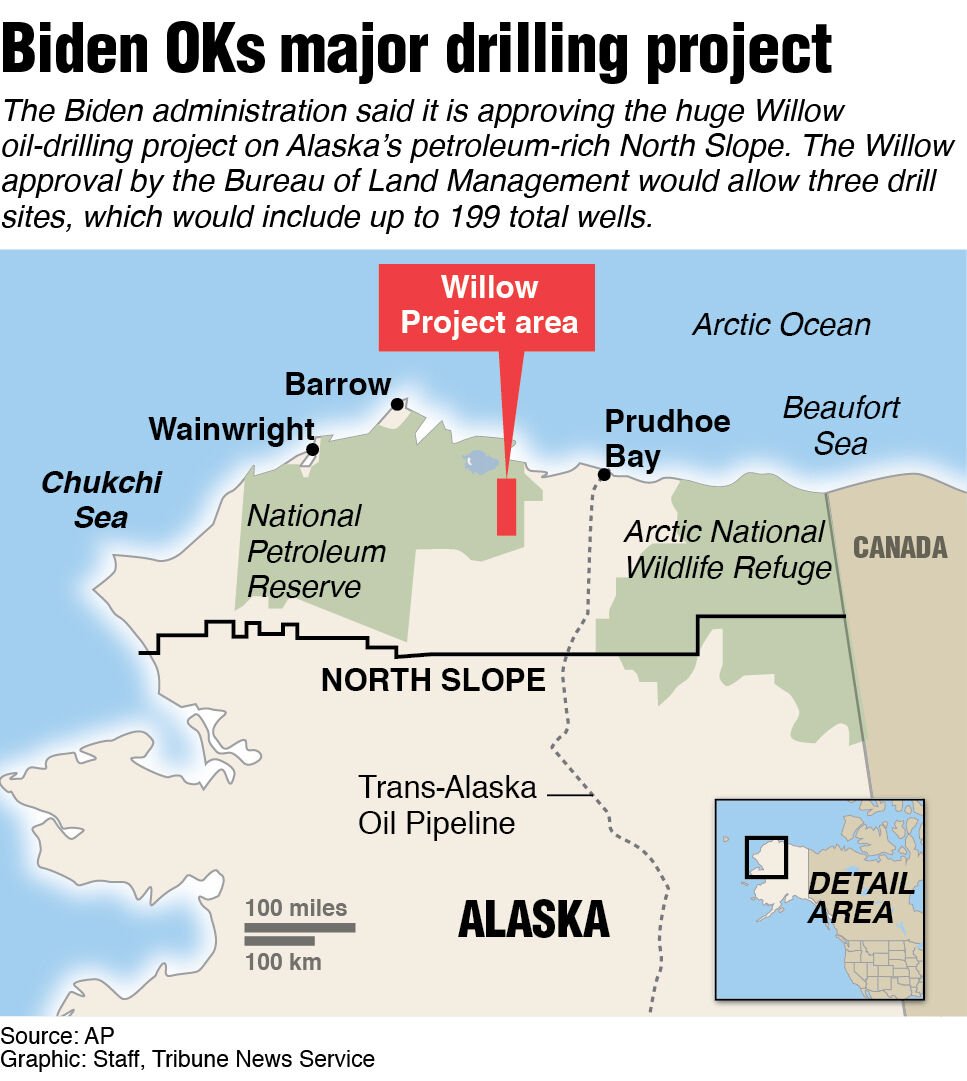
ConocoPhillips’ Willow drilling project, approved by the Biden administration in 2023 on the eastern side of the reserve, provides some insight into the potential impact: An initial project plan, later scaled back, included up to 575 miles (925 kilometers) of ice roads for construction, an air strip, more than 300 miles (nearly 485 kilometers) of new pipeline, a processing facility, a gravel mine and barge transportation, in addition to five drilling sites.

Many animals will try to steer clear of noise, light and human activity. Roads and industrial operations can force them to alter their behavior, which can affect their health and how well they can reproduce. Research has shown that caribou mothers with new calves avoid infrastructure and that this impact does not lessen over time of exposure.

Industrial buildings in the snow have several roads and pipelines running to them and three wells with flares and blackened areas around them.
Oil production facilities, like this one in Prudhoe Bay, require miles of road and pipeline, in addition to the wells and facilities.
Simon Bruty/Anychance/Getty Images

At Alaska’s Prudhoe Bay, the largest oilfield in the U.S., decades of oil development have led to pollution, including hundreds of oil spills and leaks, and habitat loss, such as flooding and shoreline erosion, extensive permafrost thaw and damage from roads, construction and gravel mining. In short, the footprint of drilling is not confined to isolated locations — it radiates outward, undermining the ecological integrity of the region. Permafrost thaw now even threatens the stability of the oil industry’s own infrastructure.

Consequences for the climate

The National Petroleum Reserve-Alaska and the surrounding Arctic ecosystem also play an outsized role in regulating the global climate.

Vast amounts of climate-warming carbon is currently locked away in the wetlands and permafrost of the tundra, but the Arctic is warming close to three times faster than the global average.

Roads, drilling and development can increase permafrost thaw and cause coastlines to erode, releasing carbon long locked in the soil. In addition, these operations will ultimately add more carbon dioxide to the atmosphere, further warming the planet.

The decisions made today will shape the future of the Arctic – and one of the last wild ecosystems in the United States – for generations to come.

The Conversation

Mariah Meek has received funding from the National Science Foundation, the US Fish and Wildlife Service, and several state agencies. In addition to being a professor, she is also the director of research for The Wilderness Society, where she supervises a team of scientists doing research to understand ecological interactions in the Alaskan Arctic.

ref. What’s at risk for Arctic wildlife if Trump expands oil drilling in the fragile National Petroleum Reserve-Alaska – https://theconversation.com/whats-at-risk-for-arctic-wildlife-if-trump-expands-oil-drilling-in-the-fragile-national-petroleum-reserve-alaska-259493

Hurricane forecasters are losing 3 key satellites ahead of peak storm season − a meteorologist explains why it matters

Source: – By Chris Vagasky, Meteorologist and Research Program Manager, University of Wisconsin-Madison

Many coastal communities rely on satellite data to understand the risks as hurricanes head their way.
Ricardo Arduengo/AFP via Getty Images

About 600 miles off the west coast of Africa, large clusters of thunderstorms begin organizing into tropical storms every hurricane season. They aren’t yet in range of Hurricane Hunter flights, so forecasters at the National Hurricane Center rely on weather satellites to peer down on these storms and beam back information about their location, structure and intensity.

The satellite data helps meteorologists create weather forecasts that keep planes and ships safe and prepare countries for a potential hurricane landfall.

Now, meteorologists are about to lose access to three of those satellites.

On June 25, 2025, the Trump administration issued a service change notice announcing that the Defense Meteorological Satellite Program, DMSP, and the Navy’s Fleet Numerical Meteorology and Oceanography Center would terminate data collection, processing and distribution of all DMSP data no later than June 30. The data termination was postponed until July 31 following a request from the head of NASA’s Earth Science Division.

How hurricanes form. NOAA

I am a meteorologist who studies lightning in hurricanes and helps train other meteorologists to monitor and forecast tropical cyclones. Here is how meteorologists use the DMSP data and why they are concerned about it going dark.

Looking inside the clouds

At its most basic, a weather satellite is a high-resolution digital camera in space that takes pictures of clouds in the atmosphere.

These are the satellite images you see on most TV weather broadcasts. They let meteorologists see the location and some details of a hurricane’s structure, but only during daylight hours.

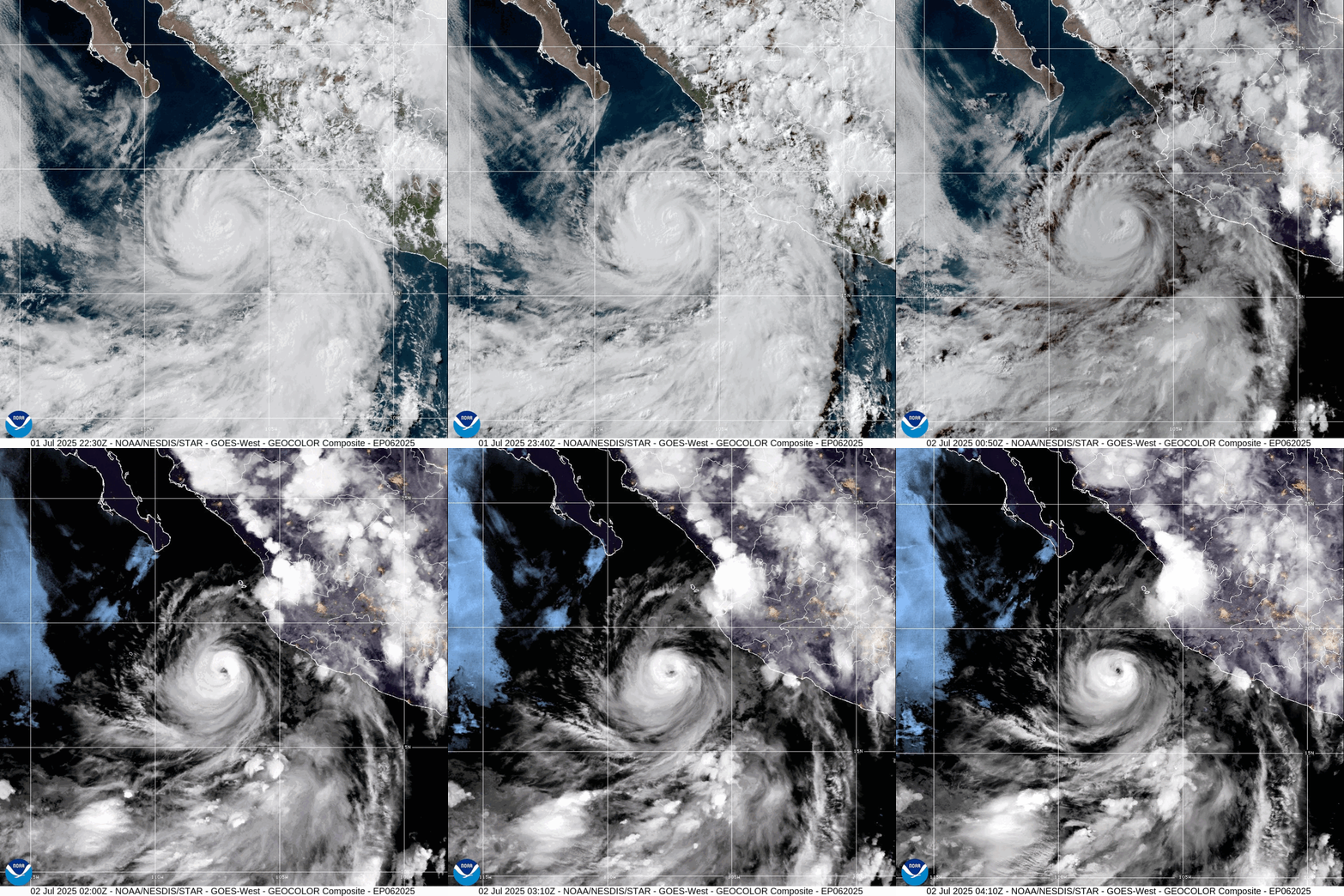
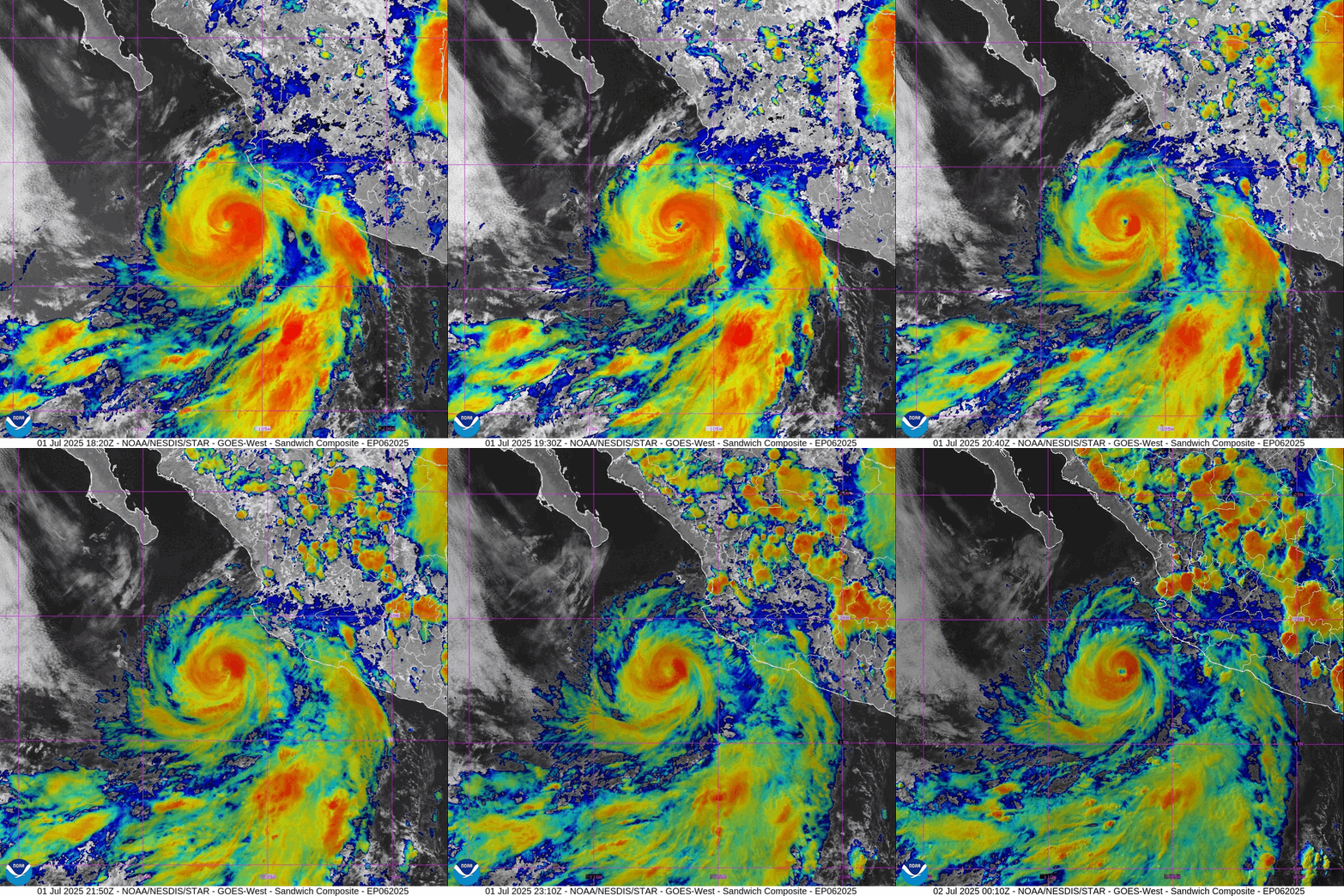
Hurricane Flossie spins off the Mexican coast on July 1, 2025. Images show the top of the hurricane from space as day turns to night. NOAA GOES

Meteorologists can use infrared satellite data, similar to a thermal imaging camera, at all hours of the day to find the coldest cloud-top temperatures, highlighting areas where the highest wind speeds and rainfall rates are found.

But while visible and infrared satellite imagery are valuable tools for hurricane forecasters, they provide only a basic picture of the storm. It’s like a doctor diagnosing a patient after a visual exam and checking their temperature.

Infrared bands show more detail of Hurricane Flossie’s structure on July 1, 2025. NOAA GOES

For more accurate diagnoses, meteorologists rely on the DMSP satellites.

The three satellites orbit Earth 14 times per day with special sensor microwave imager/sounder instruments, or SSMIS. These let meteorologists look inside the clouds, similar to how an MRI in a hospital looks inside a human body. With these instruments, meteorologists can pinpoint the storm’s low-pressure center and identify signs of intensification.

Precisely locating the center of a hurricane improves forecasts of the storm’s future track. This lets meteorologists produce more accurate hurricane watches, warnings and evacuations.

Hurricane track forecasts have improved by up to 75% since 1990. However, forecasting rapid intensification is still difficult, so the ability of DMPS data to identify signs of intensification is important.

About 80% of major hurricanes – those with wind speeds of at least 111 mph (179 kilometers per hour) – rapidly intensify at some point, ramping up the risks they pose to people and property on land. Finding out when storms are about to undergo intensification allows meteorologists to warn the public about these dangerous hurricanes.

Where are the defense satellites going?

NOAA’s Office of Satellite and Product Operations described the reason for turning off the flow of data as a need to mitigate “a significant cybersecurity risk.”

The three satellites have already operated for longer than planned.

The DMSP satellites were launched between 1999 and 2009 and were designed to last for five years. They have now been operating for more than 15 years. The United States Space Force recently concluded that the DMSP satellites would reach the end of their lives between 2023 and 2026, so the data would likely have gone dark soon.

Are there replacements for the DMSP satellites?

Three other satellites in orbit – NOAA-20, NOAA-21 and Suomi NPP – have a microwave instrument known as the advanced technology microwave sounder.

The advanced technology microwave sounder, or ATMS, can provide data similar to the special sensor microwave imager/sounder, or SSMIS, but at a lower resolution. It provides a more washed-out view that is less useful than the SSMIS for pinpointing a storm’s location or estimating its intensity.

Two satellite views of the same storm from different instruments. The SSMIS provides higher resolution of the storm.
Images of Hurricane Erick off the coast of Mexico, viewed from NOAA-20’s ATMS (left) and DMPS SSMIS (right) on June 18 show the difference in resolution and the higher detail provided by the SSMIS data.
U.S. Naval Research Laboratory, via Michael Lowry

The U.S. Space Force began using data from a new defense meteorology satellite, ML-1A, in late April 2025.

ML-1A is a microwave satellite that will help replace some of the DMSP satellites’ capabilities. However, the government hasn’t announced whether the ML-1A data will be available to forecasters, including those at the National Hurricane Center.

Why are satellite replacements last minute?

Satellite programs are planned over many years, even decades, and are very expensive. The current geostationary satellite program launched its first satellite in 2016 with plans to operate until 2038. Development of the planned successor for GOES-R began in 2019.

Similarly, plans for replacing the DMSP satellites have been underway since the early 2000s.

Scientists and engineers in protective white lab clothing use a lift to move a satellite vertical for loading aboard a rocket for launch.
Scientists prepare a GOES-R satellite for packing aboard a rocket in 2016.
NASA/Charles Babir

Delays in developing the satellite instruments and funding cuts caused the National Polar-orbiting Operational Environmental Satellite System and Defense Weather Satellite System to be canceled in 2010 and 2012 before any of their satellites could be launched.

The 2026 NOAA budget request includes an increase in funding for the next-generation geostationary satellite program, so it can be restructured to reuse spare parts from existing geostationary satellites. The budget also terminates contracts for ocean color, atmospheric composition and advanced lightning mapper instruments.

A busy season remains

The 2025 Atlantic hurricane season, which runs from June 1 to Nov. 30, is forecast to be above average, with six to 10 hurricanes. The most active part of the season runs from the middle of August to the middle of October, after the DMSP satellite data is set to be turned off.

Hurricane forecasters will continue to use all available tools, including satellite, radar, weather balloon and dropsonde data, to monitor the tropics and issue hurricane forecasts. But the loss of satellite data, along with other cuts to data, funding and staffing, could ultimately put more lives at risk.

The Conversation

Chris Vagasky is a member of the American Meteorological Society and the National Weather Association.

ref. Hurricane forecasters are losing 3 key satellites ahead of peak storm season − a meteorologist explains why it matters – https://theconversation.com/hurricane-forecasters-are-losing-3-key-satellites-ahead-of-peak-storm-season-a-meteorologist-explains-why-it-matters-260190

The hidden bias in college admissions tests: How standardized exams can favor privilege over potential

Source: – By Zarrina Talan Azizova, Associate Professor of Education, Health and Behavior, University of North Dakota

At first glance, calls from members of Congress to restore academic merit in college admissions might sound like a neutral policy.

In our view, these campaigns often cherry-pick evidence and mask a coordinated effort that targets access and diversity in American colleges.

As scholars who study access to higher education, we have found that when these efforts are paired with pressure to reinstate standardized tests, they amount to a rollback of inclusive practices.

A Department of Education letter sent to congressional offices from Feb. 14, 2025, stated that is “unlawful for an educational institution to eliminate standardized testing to achieve a desired racial balance or to increase racial diversity.” The letter also claimed that the most widely used admissions tests, the SAT and ACT, are objective measures of merit.

In our recent peer-reviewed article, we analyzed more than 70 empirical studies about the SAT’s and ACT’s roles in college admissions. Our work found several flaws in how these exams function, especially for historically underserved students.

Measuring college readiness

Two male students sit in a campus library reviewing notes.
Supporters of admissions tests contend that they are objective tools for measuring whether students are ready for college-level coursework.
The Good Brigade/Digital Vision via Getty Images

Several elite universities – including Yale, Dartmouth and the Massachusetts Institute of Technology – have reinstated SAT or ACT requirements, reversing test-optional policies that institutions expanded during the COVID-19 pandemic.

These changes have reignited debates about how well these tests measure students’ academic preparedness and how colleges should weigh them in admissions decisions.

During a May 21, 2025, hearing of the U.S. House Subcommittee on Higher Education and Workforce Development, some witnesses argued that using test scores allows colleges to admit students based on merit. Others maintained that test scores can function as barriers to higher education.

Our research shows that while these tests are statistically reliable – that is, they produce consistent results for students across subjects and during multiple attempts under similar conditions – they are not as valid as some argue.

High school grade-point averages are typically better predictors of students’ success in college than either test.

In addition, the tests are not equitable or similarly predictive for all students, especially given gender, race and socioeconomic demographics.

That is because they systematically favor those with more access to high-quality schooling, stable socioeconomic conditions and opportunities to engage with test prep coaches and courses. That test prep can cost thousands of dollars.

In short, both tests tend to reflect privilege more than potential.

For example, students from higher-income households routinely outperform their peers on the ACT and SAT.

This isn’t surprising, considering wealthier families can afford test prep services, private tutoring and test retakes. These advantages translate into higher scores and open doors to selective colleges and scholarship opportunities.

Meanwhile, students from low-income families often face challenges – such as less experienced instructors and less access to high-level science, math and advanced placement courses – that test scores do not factor in.

Reflecting deep inequities

An overhead photo of students in a study group sitting around a small glass table.
In the U.S., high school GPA can be a better predictor than standardized tests of college success.
Clerkenwell/Vetta via Getty Images

In our published review, we found that these disparities aren’t incidental – they’re systemic.

Our review revealed long-standing evidence of bias in test design and differences in average scores along lines of race, gender and language background.

These outcomes don’t just reflect academic differences; they reflect inequities that shape how students prepare for and perform on these tests.

We also found that high school GPA outperforms standardized tests in predicting college success. GPA captures years of classroom performance, effort and teacher feedback. It reflects how students navigate real-world challenges, not just how they perform on a single timed exam.

For many students, particularly those from historically marginalized backgrounds, grades can offer a better indication of how prepared they are for college-level work.

This issue matters because admissions decisions aren’t just technical evaluations – they are value statements. Choosing to center test scores in admissions rewards certain kinds of knowledge, experiences and preparation.

The American Council on Education defines equity as opportunities for success. It means building educational environments that recognize diverse forms of potential and equip all learners to thrive.

It’s worth noting that research on testing often focuses on elite institutions, where standardized test scores are more likely to be used as high-stakes screening tools. Our systematic review found that, even in elite schools, the tests’ ability to accurately predict college academic performance is often limited (moderate in statistical terms).

But most college students attend state universities, public regional universities, minority-serving institutions, or colleges that accept most applicants. Our study found that at these institutions, standardized test scores are even less likely to predict how students will do.

This may be because state universities and public regional universities are more likely to serve highly diverse student populations, including older, part-time and first-generation students and those who are balancing work and family responsibilities.

Where does higher ed go from here?

An elevated view of college students walking up stairs.
Prioritizing standardized tests in college admissions could close the doors of opportunity for some capable students.
David Schaffer/istock via Getty Images Plus

With the debate over the role of standardized tests in the admissions process, higher education stands at a crossroads: Will colleges yield to political pressure and narrow definitions of merit and ignore equity? Or will institutions reaffirm their mission by embracing broader, fairer tools for recognizing talent and supporting student success?

The answer depends on what values are prioritized.

Our research and that of others make it clear that standardized tests should not be the gatekeepers of opportunity.

If universities define merit on test scores alone, they risk closing the doors of opportunity to capable students.

The Conversation

The authors do not work for, consult, own shares in or receive funding from any company or organization that would benefit from this article, and have disclosed no relevant affiliations beyond their academic appointment.

ref. The hidden bias in college admissions tests: How standardized exams can favor privilege over potential – https://theconversation.com/the-hidden-bias-in-college-admissions-tests-how-standardized-exams-can-favor-privilege-over-potential-256967

Companies haven’t stopped hiring, but they’re more cautious, according to the 2025 College Hiring Outlook Report

Source: – By Murugan Anandarajan, Professor of Decision Sciences and Management Information Systems, Drexel University

Recent college grads face a tough job market in 2025, but employers are still hiring. sturti/E+ via Getty Images

Every year, I tell my students in my business analytics class the same thing: “Don’t just apply for a job. Audition for it.”

This advice seems particularly relevant this year. In today’s turbulent economy, companies are still hiring, but they’re doing it a bit more carefully. More places are offering candidates short-term work experiences like internships and co-op programs in order to evaluate them before making them full-time offers.

This is just one of the findings of the 2025 College Hiring Outlook Report. This annual report tracks trends in the job market and offers valuable insights for both job seekers and employers. It is based on a national survey conducted in September 2024, with responses from 1,322 employers spanning all major industries and company sizes, from small firms to large enterprises. The survey looks at employer perspectives on entry-level hiring trends, skills demand and talent development strategies.

I am a professor of information systems at Drexel University’s LeBow College of Business in Philadelphia, and I co-authored this report along with a team of colleagues at the Center for Career Readiness.

Here’s what we found:

Employers are rethinking talent pipelines

Only 21% of the 1,322 employers we surveyed rated the current college hiring market as “excellent” or “very good,” which is a dramatic drop from 61% in 2023. This indicates that companies are becoming increasingly cautious about how they recruit and select new talent.

While confidence in full-time hiring has declined, employers are not stepping away from hiring altogether. Instead, they’re shifting to paid and unpaid internships, co-ops and contract-to-hire roles as a less risky route to identify talent and “de-risk” full-time hiring.

Employers we surveyed described internships as a cost-effective talent pipeline, and 70% told us they plan to maintain or increase their co-op and intern hiring in 2025. At a time when many companies are tightening their belts, hiring someone who’s already proved themselves saves on onboarding reduces turnover and minimizes potentially costly mishires.

For job seekers, this makes every internship or short-term role more than a foot in the door. It’s an extended audition. Even with the general market looking unstable, interest in co-op and internship programs appears steady, especially among recent graduates facing fewer full-time opportunities.

These programs aren’t just about trying out a job. They let employers see if a candidate shows initiative, good judgment and the ability to work well on a team, which we found are traits employers value even more than technical skills.

What employers want

We found that employers increasingly prioritize self-management skills like adaptability, ethical reasoning and communication over technical skills such as digital literacy and cybersecurity. Employers are paying attention to how candidates behave during internships, how they take feedback, and whether they bring the mindset needed to grow with the company.

This reflects what I have observed in classrooms and in conversations with hiring managers: Credentials matter, but what truly sets candidates apart is how they present themselves and what they contribute to a company.

Based on co-op and internship data we’ve collected at Drexel, however, many students continue to believe that technical proficiency is the key to getting a job.

In my opinion, this disconnect reveals a critical gap in expectations: While students focus on hard skills to differentiate themselves, employers are looking for the human skills that indicate long-term potential, resilience and professionalism. This is especially true in the face of economic uncertainty and the ambiguous, fast-changing nature of today’s workplace.

Technology is changing how hiring happens

Employers also told us that artificial intelligence is now central to how both applicants and employers navigate the hiring process.

Some companies are increasingly using AI-powered platforms to transform their hiring processes. For example, Children’s Hospital of Philadelphia uses platforms like HireVue to conduct asynchronous video interviews. HR-focused firms like Phenom and JJ Staffing Services also leverage technologies such as AI-based resume ranking, automated interview scheduling and one-way video assessments.

Not only do these tools speed up the hiring process, but they also reshape how employers and candidates interact. In our survey, large employers said they are increasingly relying on AI tools like resume screeners and one-way video interviews to manage large numbers of job applicants. As a result, the candidate’s presence, clarity in communication and authenticity are being evaluated even before a human recruiter becomes involved.

At the same time, job seekers are using generative AI tools to write cover letters, practice interviews or reformat resumes. These tools can help with preparation, but overreliance on them can backfire. Employers want authenticity, and many employers we surveyed mentioned they notice when applications seem overly robotic.

In my experience as a professor, the key is teaching students to use AI to enhance their effort and not replace it. I encourage them to leverage AI tools but always emphasize that the final output and the impression it makes should reflect their own thinking and professionalism. The bottom line is that hiring is still a human decision, and the personal impression you make matters.

This isn’t just about new grads

While our research focuses on early-career hiring, these findings apply to other audiences as well, such as career changers, returning professionals and even mid-career workers. These workers are increasingly being evaluated on their adaptability, behavior and collaborative ability – not just their experience.

Many companies now offer project-based assignments and trial roles that let them evaluate performance before making a permanent hire.

At the same time, employers are investing in internal reskilling and upskilling programs. Reskilling refers to training workers for entirely new roles, often in response to job changes or automation, while upskilling means helping employees deepen their current skills to stay effective and advance in their existing roles. Our report indicates that approximately 88% of large companies now offer structured upskilling and reskilling programs. For job seekers and workers alike, staying competitive means taking the initiative and demonstrating a commitment to learning and growth.

Show up early, and show up well

So what can students, or anyone entering or reentering the workforce, do to prepare?

  • Start early. Don’t wait until senior year. First- and second-year internships are growing in importance.

  • Sharpen your soft skills. Communication, time management, problem-solving and ethical behavior are top priorities for employers.

  • Understand where work is happening. Over 50% of entry-level jobs are fully in-person. Only 4% are fully remote. Show up ready to engage.

  • Use AI strategically. It’s a useful tool for research and practice, not a shortcut to connection or clarity.

  • Stay curious. Most large employers now offer reskilling or upskilling opportunities – and they expect employees to take initiative.

One of the clearest takeaways from this year’s report is that hiring is no longer a one-time decision. It’s a performance process that often begins before an interview is even scheduled.

Whether you’re still in school, transitioning in your career or returning to the workforce after a break, the same principle applies: Every opportunity is an audition. Treat it like one.

The Conversation

Murugan Anandarajan does not work for, consult, own shares in or receive funding from any company or organization that would benefit from this article, and has disclosed no relevant affiliations beyond their academic appointment.

ref. Companies haven’t stopped hiring, but they’re more cautious, according to the 2025 College Hiring Outlook Report – https://theconversation.com/companies-havent-stopped-hiring-but-theyre-more-cautious-according-to-the-2025-college-hiring-outlook-report-257870

Trump administration’s conflicting messages on Chinese student visas reflect complex US-China relations

Source: – By Meredith Oyen, Associate Professor of History and Asian Studies, University of Maryland, Baltimore County

The U.S. announced plans to scrutinize and revoke student visas for students with ties to the Chinese Communist Party or whose studies are in critical fields, but appears to have reconsidered. The decision and apparent about-face could have a wide-ranging impact on both nations. LAW Ho Ming/Getty Images

President Donald Trump appears to have walked back plans for the U.S. State Department to scrutinize and revoke visas for Chinese students studying in the country.

On June 11, 2025, Trump posted on his social media platform TruthSocial that visas for Chinese students would continue and that they are welcome in the United States, as their presence “has always been good with me!”

The announcement came weeks after Secretary of State Marco Rubio announced that his department would begin scrutinizing and revoking student visas for Chinese nationals with ties to the Chinese Communist Party, or whose studies are in critical fields.

The contradictory moves have led to confusion among Chinese students attending college or considering studying in the United States.

Over time, Chinese nationals have faced barriers to studying in the U.S. As a scholar who studies relations between the two nations, I argue that efforts to ban Chinese students in the United States are not unprecedented, and historically they have come with consequences.

Student visas under fire

Two students sit side by side studying in a library.
The Trump administration laid out the terms for revoking or denying student visas to Chinese nationals but then backtracked.
STAP/Getty Images

Since the late 1970s, millions of Chinese students have been granted visas to study at American universities. That total includes approximately 277,000 who studied in the United States in the 2023-2024 academic year.

It is difficult to determine how many of these students would have been affected by a ban on visas for individuals with Chinese Community Party affiliations or in critical fields.

Approximately 40% of all new members of the Chinese Communist Party each year are drawn from China’s student population. And many universities in China have party connections or charters that emphasize party loyalty.

The “critical fields” at risk were not defined. A majority of Chinese students in the U.S. are enrolled in math, technology, science and engineering fields.

A long history

A student holding chalks writes Mandarin text on a blackboard.
Since the late 1970s, the number of Chinese students attending college in the U.S. has increased dramatically.
Kenishiroite/Getty Images

Yung Wing became the first Chinese student to graduate from a U.S. university in 1852.

Since then, millions of Chinese students have come to the United States to study, supported by programs such as the “Chinese Educational Mission,” Boxer Indemnity Fund scholarships and the Fulbright Program.

The Institute for International Education in New York estimated the economic impact of Chinese students in the U.S. at over US$14 billion a year. Chinese students tend to pay full tuition to their universities. At the graduate level, they perform vital roles in labs and classrooms. Just under half of all Chinese students attending college in the U.S. are graduate students.

However, there is a long history of equating Chinese migrants as invaders, spies or risks to national security.

After the outbreak of the Korean War in 1950, the U.S. Department of Justice began to prevent Chinese scholars and students in STEM fields – science, technology, engineering and math – from returning to China by stopping them at U.S. ports of entry and exit. They could be pulled aside when trying to board a flight or ship and their tickets canceled.

In one infamous case, Chinese rocket scientist Qian Xuesen was arrested, harassed, ordered deported and prevented from leaving over five years from 1950 to 1955. In 1955, the United States and China began ambassadorial-level talks to negotiate repatriations from either country. After his experience, Qian became a much-lauded supporter of the Communist government and played an important role in the development of Chinese transcontinental missile technology.

During the 1950s, the U.S. Department of Justice raided Chinatown organizations looking for Chinese migrants who arrived under false names during the Chinese Exclusion Era, a period from the 1880s to 1940s when the U.S. government placed tight restrictions on Chinese immigration into the country. A primary justification for the tactics was fear that the Chinese in the U.S. would spy for their home country.

Between 1949 and 1979, the U.S and China did not have normal diplomatic relations. The two nations recognized each other and exchanged ambassadors starting in January 1979. In the more than four decades since, the number of Chinese students in the U.S. has increased dramatically.

Anti-Chinese discrimination

The idea of an outright ban on Chinese student visas has raised concerns about increased targeting of Chinese in the U.S. for harassment.

In 1999, Taiwanese-American scientist Wen Ho Lee was arrested on suspicion of using his position at Los Alamos National Laboratory in New Mexico to spy for China. Lee remained imprisoned in solitary confinement for 278 days before he was released without a conviction.

In 2018, during the first Trump administration, the Department of Justice launched its China Initiative. In its effort to weed out industrial, technological and corporate espionage, the initiative targeted many ethnic Chinese researchers and had a chilling effect on continued exchanges, but it secured no convictions for wrongdoing.

Trump again expressed concerns last year that undocumented migrants from China might be coming to the United States to spy or “build an army.”

The repeated search for spies among Chinese migrants and residents in the U.S. has created an atmosphere of fear for Chinese American communities.

Broader foreign policy context

two puzzle pieces — one representing the United States flag and the other the Chinese flag — stand separated against a neutral background
An atmosphere of suspicion has altered the climate for Chinese international students.
J Studios/Getty Images

The U.S. plan to revoke visas for students studying in the U.S. and the Chinese response is being formed amid contentious debates over trade.

Chinese Ministry of Foreign Affairs spokesperson Lin Jian accused the U.S. of violating an agreement on tariff reduction the two sides discussed in Geneva in May, citing the visa issues as one example.

Trump has also complained that the Chinese violated agreements between the countries, and some reports suggest that the announcement on student visas was a negotiating tactic to change the Chinese stance on the export of rare earth minerals.

When Trump announced his trade deal with China on June 11, he added a statement welcoming Chinese students.

However, past practice shows that the atmosphere of uncertainty and suspicion may have already damaged the climate for Chinese international students, and at least some degree of increased scrutiny of student visas will likely continue regardless.

The Conversation

Meredith Oyen does not work for, consult, own shares in or receive funding from any company or organization that would benefit from this article, and has disclosed no relevant affiliations beyond their academic appointment.

ref. Trump administration’s conflicting messages on Chinese student visas reflect complex US-China relations – https://theconversation.com/trump-administrations-conflicting-messages-on-chinese-student-visas-reflect-complex-us-china-relations-258351