Who owns digital data about you? South African legal scholar weighs up property and privacy rights

Source: The Conversation – Africa (2) – By Donrich Thaldar, Professor, University of KwaZulu-Natal

alexsl

In the digital economy, data is more than just information – it is an asset with immense economic and strategic value. Yet, despite its significance, a fundamental legal question remains unresolved: Can data be owned? While privacy laws worldwide focus on protecting individuals’ rights over their personal data, they often sidestep the issue of ownership. This has led to legal uncertainty, particularly in South Africa, where the Protection of Personal Information Act (Popia) grants data subjects various rights over their personal information but does not explicitly address ownership.

This gap in legal clarity raises pressing questions: If personal data – such as private health information – exists within a vast and ever-growing digital landscape, can it be owned? And if so, who holds the rightful claim?

Legal academic Donrich Thaldar, whose research focuses on data governance, explores these questions in a recent academic article. He unpacks his findings for The Conversation Africa.

Why does it matter who owns data?

In today’s digital economy, data is the most valuable asset – it’s often referred to as “the new oil”. Whether in commerce, research, or social interactions, the ability to generate, use and trade with data is central to economic competitiveness.

If data ownership is not clearly established, it could stifle innovation and investment. Companies require legal certainty to operate effectively in a knowledge-driven economy.

Countries have taken different legal approaches to tackling the question of who owns data. China, for instance, formally recognises the proprietary rights of data generators, meaning that businesses and individuals who generate data have legally defined rights over its use and commercialisation. This provides legal support for the country’s digital industries.

What does South African law say?

In the past, the South African Information Regulator has taken the position that personal information is automatically owned by the data subject – the person to whom the data relates – rather than by the entity generating the data. In this view, the rights created by Popia imply that data subjects themselves are the owners of their personal data, and nobody else.

I suggest that this stance is legally flawed, as it conflates two different branches of the law: privacy law and property law. Moreover, it could severely disrupt the digital economy. The digital economy depends on data as a tradeable asset – it must be capable of being sold, licensed and commercialised like any other economic object. If ownership must always be with data subjects, businesses face uncertainty in using and monetising data. Uncertainty stifles innovation, discourages investment, and undermines South Africa’s digital competitiveness.

You applied property law to the question of data ownership. Why?

Ownership is a concept in property law, not privacy law. Therefore, to answer the data ownership question, we need to look for answers in property law.

Property law governs the relationship between subjects (legal persons) and objects (things external to the body, whether physical or not). Ownership is about the rights that a subject has over an object. For an object to be capable of being owned, it must be valuable, useful, and – importantly – capable of human control. A bottle of water meets these criteria, but the vast oceans do not, as they are not within human control.

Personal data in the abstract is like the water in the ocean – vast, uncontained, and beyond individual control. However, a digital instance of personal data, such as a computer file, is more like a bottled version of that water – defined and subject to human control. Just like digital money and other valuable digital assets, a specific instance of personal data meets all the requirements under South African common law for private ownership. Thus, in this sense personal data can be owned.

Is the data owner not the data subject?

At first glance this might seem so, but no, not necessarily. The reason that it might seem so, is because some of the privacy rights created by Popia resemble ownership rights. For example, an owner’s agreement is required before someone else can use the owned object (e.g., loan for use and rent). Similarly, a data subject’s consent is in most cases required before personal data can be processed. Furthermore, the owner of a thing has the right to destroy it; similarly, a data subject typically has the right to have personal data deleted.

Do these privacy rights mean that data subjects actually own their personal data? I suggest not. Wearing a feather in one’s hat does not make one a bird. In the same way, privacy rights that resemble ownership rights do not mean that they constitute ownership. Ownership is acquired by following the rules of property law.

So who owns the data?

Because a newly created personal data instance has no antecedent legal object – in other words, it is not created out of another legal object – it initially belongs to no one. It is res nullius. Ownership of res nullius is acquired through appropriation, which requires two elements: control and the intention to own.

This means that the entity generating the data, such as a company or university collecting and recording it, is best positioned to acquire ownership. Since it already has control over the data, the only remaining requirement is simply the intention to be the owner.

If an entity like a university generates data and intends to own it, then – provided it is in control of that data – it will legally become the owner. This in principle allows the entity to use, license and trade the data as an economic asset. Indeed, it is prudent for data-generating entities, such as universities, to explicitly assert ownership over the data they produce. This not only establishes their legal rights with clarity but also serves as a safeguard against unauthorised access and misuse by malicious actors.

Doesn’t this compromise data privacy?

No, it should not. Ownership is always limited by other legal rules. For example, while I might own a car, I cannot drive it in any way I like – I must obey the rules of the road. Similarly, ownership of personal data is subject to strict limitations, particularly the privacy rights of data subjects under Popia.

However, it is also important to understand that privacy rights apply only to personal data. If personal data is de-identified, meaning that it can no longer be linked to the data subjects, privacy rights cease to apply. What remains are the ownership rights in the data itself. It can be a fully tradeable asset.

Recognising that a digital instance of personal data can be owned – and that the rightful owner is typically the data generator – does not undermine the privacy protections of Popia. Rather, it clarifies the legal landscape, ensuring that the rights of both data subjects and data generators are recognised and protected.

The Conversation

Donrich Thaldar receives funding from the NIH.

ref. Who owns digital data about you? South African legal scholar weighs up property and privacy rights – https://theconversation.com/who-owns-digital-data-about-you-south-african-legal-scholar-weighs-up-property-and-privacy-rights-249741

Scientists in Antarctica: why they’re there and what they’ve found

Source: The Conversation – Africa (2) – By David William Hedding, Professor in Geography, University of South Africa

A media storm blew up in mid-March 2025 when a researcher at South Africa’s isolated Sanae IV base in Antarctica accused one of its nine team members of becoming violent.

The Conversation Africa asked geomorphologist David William Hedding, who has previously carried out research from the frozen continent, about the work researchers do in Antarctica, what conditions are like and why it matters.

What do researchers focus on when they’re working in Antarctica?

Currently, the main focus of research in the Antarctic revolves around climate change because the White Continent is a good barometer for changes in global cycles. It has a unique and fragile environment. It’s an extreme climate which makes it highly sensitive to any changes in global climate and atmospheric conditions. Importantly, the Antarctic remains relatively untouched by humans, so we are able to study processes and responses of natural systems.

Also, the geographic location of Antarctic enables science that is less suitable elsewhere on the planet. An example of this is the work on space weather (primarily disturbances to the Earth’s magnetic field caused by solar activity). Studying space weather is significant because the magnetic field of the Earth can impact communication platforms, technology, infrastructure and even human health.

How many countries have teams working there? Where does South Africa fit in?

Currently, about 30 countries have research stations in the Antarctic but these bases serve a far wider community of researchers. Collaboration is a key component of research in the Antarctic because many study sites are isolated, logistics are a challenge and resources are typically limited.

The South African base in Antarctica, named SANAE IV usually has between 10 and 12 researchers and base personnel. This research station is situated on a nunatak (a mountain piercing through the ice) in Western Dronning Maud Land. It is an extremely remote location approximately 220km inland from the ice-shelf.

The researchers and base personnel remain in Antarctica for approximately 15 months working through the cold and dark winter months.

What have been some of the biggest ‘finds’?

The biggest research finding from the Antarctic was the discovery of the ozone hole in 1985 by scientists from the British Antarctic Survey. This discovery led to the creation and implementation of the Montreal Protocol, a treaty to phase out chlorofluorocarbons (synthetic chemical compounds composed of chlorine, fluorine, and carbon) which destroy ozone. This was a major breakthrough in terms of slowly healing the ozone layer.

The second most significant piece of research to come from the Antarctic has been the use of ice cores to reconstruct past climates. Ice cores preserve air bubbles which provide a wealth of information about the conditions of the atmosphere over time. Importantly, ice cores provide an uninterrupted and detailed window into the past 1.2 million years. This is important because only by understanding past climates and the earth’s responses to those changes are we able to predict future responses. This is significant because of the imminent threats resulting from anthropogenic (human-induced) climate change.

What conditions do scientists work under?

Conducting research in the Antarctic is extremely difficult for three primary reasons: remoteness, the cold and daylight.

The remoteness of many study sites makes it difficult to reach. Distances are vast from the limited number of bases in the Antarctic. Thus, logistics for science in the Antarctic is a major challenge and requires collaboration and planning. For example, the geologists from the University of Johannesburg, who work from the SANAE IV base in Antarctica, often spend weeks in the field collecting samples. They travel significant distances via snow mobile and remain self-sufficient while conducting science in tough conditions.

These tough conditions relate specifically to the cold. Most science only occurs in the austral summer months when temperatures become marginally bearable. Also, the summer season only provides a short window in which to operate because access to Antarctic by sea is limited by extent and thickness of the sea ice.

Lastly, during summer there is 24 hours of daylight which lengthens the working day but these conditions are also short-lived.

Why it is important to do scientific work in the area?

The Antarctic is intricately linked to global systems and plays a major role in influencing these systems.

For example, climate change will cause significant melting of land-based ice in Antarctica which when added to the oceans will cause sea-level rise and disruptions to global oceanic currents. Therefore, it is critical that we obtain a better understanding of how responses of terrestrial systems, such as the Antarctic, will impact oceanic systems because ultimately changes in ocean currents will impact the oceanic food web.

In the context of climate change, sea-level rise is a major concern as it will have global impacts for society, so it is critical that the impacts are investigated to enable society to build resilience and adapt.

The Conversation

David William Hedding receives funding from the National Research Foundation.

ref. Scientists in Antarctica: why they’re there and what they’ve found – https://theconversation.com/scientists-in-antarctica-why-theyre-there-and-what-theyve-found-252752

1.5 million-year-old bone tools discovered in Tanzania rewrite the history of human evolution

Source: The Conversation – Africa (2) – By Jackson K. Njau, Associate professor, Indiana University

The ancestors of humans started making tools about 3.3 million years ago. First they made them out of stone, then they switched to bone as a raw material. Until recently, the earliest clear evidence of bone tool making was from sites in Europe, dated to 400,000 years ago. But archaeologists have now found and dated bone tools in Tanzania that are a million years older.

The tools are made from the bones of large animals like hippos and elephants, and have been deliberately shaped to make them useful for butchering large carcasses.

The discovery of bone implements that are the oldest ever found, by far, casts light on human evolution. It shows that our hominin ancestors were able to think about and make this technology a lot earlier than anyone realised.

I am a scientist who co-directs a multidisciplinary research project team at the Olduvai Gorge in Tanzania, focusing on hominin evolution. Our project’s main goal has been to investigate the changes in hominin technology and behaviour that happened between 1.66 million and 1.4 million years ago.

We’re interested in this time period because it marks a pivotal change in human technology, from the rudimentary stone knives and cores of the Oldowan culture to the more advanced crafted stone handaxes of the Acheulean culture.

We found the Olduvai bone tools in 2018 and recently described them in the journal Nature. They show that by 1.5 million years ago, our ancestors (Homo erectus) had already developed the cognitive abilities required to transfer skills from making stone tools to making bone tools.

This leap in human history was a game-changer because it allowed early hominins to overcome survival challenges in landscapes where suitable stone materials were scarce.

Tools at Olduvai

Olduvai Gorge is a Unesco World Heritage site. It became well known in 1959 through the pioneering work of palaeontologists Louis and Mary Leakey, whose discoveries of early human remains reshaped our understanding of human evolution. The site offers an unparalleled window into human history, spanning nearly 2 million years.


Read more:
Finds in Tanzania’s Olduvai Gorge reveal how ancient humans adapted to change


Aside from fossilised bones, it has yielded the most detailed record of stone tool cultures in the world. It has documented the evolution from the simple chopping tools and stone knives of the Oldowan industry (about 2 million years ago) to the more advanced Acheulean tools (1.7 million years ago), such as handaxes, cleavers, picks and spheroids and then on – through arrowheads, points and blades (about 200,000 years ago) to the micro-blades of the Later Stone Age (about 17,000 years ago).

All these tools provide a glimpse into the ingenuity and cultural advancements of our early ancestors.

And now the picture has new detail.

Our team uncovered 27 ancient bone tools during excavations at the T69 Complex, FLK West site at Olduvai. We know how old they are because we found them securely embedded underground where they had been left 1.5 million years ago, along with thousands of stone artefacts and fossilised bones. We dated them using geochronological techniques.

Unlike stone, bone shafts crack and break in a way that allows the systematic production of elongated, well-shaped artifacts. Flaking them by hitting them with another object – a process called knapping – results in pointed tools that would be ideal for butchering, chopping and other tasks.

The knapped tools we found were made from large shaft fragments that came from the limb bones of elephants and hippos, and were found at hippo butchery sites. Hominins likely brought elephant bones to the site on a regular basis, and obtained limb bones from butchered hippos at the site itself.

What Homo erectus knew

The find shows that 1.5 million years ago, Homo erectus could apply knapping skills to bone. Homo erectus, regarded as the evolutionary successor to the smaller-brained Homo habilis, left a lasting imprint on history. Its fossils, found at Olduvai, offer a glimpse into a span of about a million years, stretching from 1.5 million to roughly 500,000 years ago.

Now we know that these hominins not only understood the physical properties of bones but also knew about skeletal anatomy. They could identify and select bones suitable for flaking. And they knew which animals had skeletons large enough to craft reliable tools after the animals’ death.


Read more:
Large mammals shaped the evolution of humans: here’s why it happened in Africa


We don’t know exactly why they chose bones as a raw material. It may have been that suitable stone material was scarce, or they recognised that bones provided a better grip and were more durable.

Why haven’t such old bone tools been found before? The answer is likely that they are destroyed by weathering, abrasion from water transport, trampling and scavenger activity. Organic materials don’t always get time to fossilise. Also, analysts were not used to looking for bone tools among fossils.

This discovery will likely encourage researchers to pay closer attention to the subtle signs of bone knapping in fossil assemblages. This way we will learn more about the evolution of human technology and behaviour.

The Conversation

Jackson K. Njau does not work for, consult, own shares in or receive funding from any company or organisation that would benefit from this article, and has disclosed no relevant affiliations beyond their academic appointment.

ref. 1.5 million-year-old bone tools discovered in Tanzania rewrite the history of human evolution – https://theconversation.com/1-5-million-year-old-bone-tools-discovered-in-tanzania-rewrite-the-history-of-human-evolution-251826

First fossil hyena tracks found in South Africa – how expert animal trackers helped

Source: The Conversation – Africa (2) – By Charles Helm, Research Associate, African Centre for Coastal Palaeoscience, Nelson Mandela University

“The art of tracking may well be the origin of science.” This is the departure point for a 2013 book by Louis Liebenberg, co-founder of an organisation devoted to environmental monitoring.

The connection between tracking in nature, as people have done since prehistory, and “western” science is of special interest to us as ichnologists. (Ichnology is the study of tracks and traces.) We learned our skills relatively late in life. But imagine if we had learned as children and if, as adults, we tracked as if our lives depended on it? What additional visual and cognitive talents would we bring to our field work as scientists?

Our mission is to find and document the fossilised tracks and traces of creatures that existed during part of the Pleistocene Epoch, between 35,000 and 400,000 years ago, on the Cape coast of South Africa. Since 2008, through the Cape South Coast Ichnology project, based in the African Centre for Coastal Palaeoscience at Nelson Mandela University, more than 370 vertebrate tracksites have been identified. They have substantially complemented the traditional record of body fossils. Examples include trackways of giant tortoises and giraffe.

Given the challenges inherent in identifying such tracks, we wondered how hunters who’ve been tracking all their lives would view our work, and how age-old indigenous expertise might align with our approach.

Fortunately we could call on experts with these skills in southern Africa. The Ju/’hoansi (pronounced “Juun-kwasi”) San people of north-eastern Namibia are perhaps the last of southern Africa’s indigenous inhabitants who retain the full suite of their ancient environmental skills. The Nyae Nyae conservancy in which they live gives them access to at least some of their historical land with its remaining wildlife. They still engage in subsistence hunting with bow and poisoned arrow and gather food that’s growing wild.

A handful among them have been recognised as Indigenous Master Tracker, a title created by Liebenberg’s CyberTracker initiative in recognition of their top-flight hunter-gatherer status. And so, late in 2023, the Master Trackers #oma (“Komma”) Daqm and /uce (“Tchu-shey”) Nǂamce arrived in Cape Town.

We were not the first to think along these lines. Ju/’hoansi Master Trackers have assisted scientists in the interpretation of hominin tracksites in French caves, and prehistoric tracks in the rock art record in Namibia. However, we knew that our often poorly preserved tracksites in aeolianites (cemented dunes) might present a stiffer challenge.

Our purpose was to compare our own interpretations of fossil trackways with those of the Master Trackers, and possibly find some we had overlooked. As we’ve set out in a recently published paper with the Ju/’hoansi trackers and our colleague Jan De Vynck as co-authors, they did exactly this, confirming the first fossil hyena trackway ever to be found.

Swapping techniques

The Late Pleistocene is not that far distant from the present (a mere 125,000 years), and many of the species that made tracks on the Cape south coast then are still with us. Some are extinct but have recognisable tracks, like the giant long-horned buffalo and giant Cape zebra.

We knew, though, that tracking in Kalahari sand, like the Ju/’hoansi do, is not the same as tracking on Pleistocene rock surfaces. Many of our tracks are preserved on the undersides of ceilings and overhangs, or are evident in profile in cliff exposures. Our track-bearing surfaces are usually small, and present no associated signs. We can’t follow the spoor for any distance. We don’t know at what time of day the tracks were made or the role of dew, and we have never succeeded in actually tracking down our quarry. Coprolites – fossilised droppings – are seldom found conveniently beside the tracks of the depositor.

We showed our new colleagues known fossil tracksites, without providing our own interpretations. #oma and /uce discussed these between themselves and presented their conclusions about what had made the tracks and how the animal had been behaving. We then shared our insights and our 3D photogrammetry data where applicable, and reached joint conclusions.

Soon they were identifying freshly exposed tracksites without our input, and were providing fascinating, new interpretations for sites which had puzzled us. For example, they saw ostrich tracks which we had missed, beside ostrich egg remnants, and concluded that we were probably looking at a fossilised ostrich nest. On another occasion they pointed out the distinctive track pattern of a scrub hare on the hanging wall of an eroded piece of cliff.

First fossilised hyena trackway

One of the most memorable experiences involved a 400,000-year-old trackway on a rock surface at Dana Bay, identified a few years earlier by local geologists Aleck and Ilona Birch. This rock had only been transiently exposed for a few days in the past decade, usually being covered by beach sand.

Our earlier interpretation had been that the trackmaker might have been a hyena, probably the brown hyena.

We were vindicated when our master tracker colleagues independently reached the identical conclusion. Examining our digital 3D images together fortified our collective judgement.

This was a big deal: it was the first fossil hyena trackway to be confidently identified, as previous examples had involved only individual tracks or poorly preserved possible trackway segments. Hyena trackways are distinctive: the forefoot tracks are substantially larger than those of the hindfoot.

Different ways of seeing

Both of us are privileged to have university degrees and institutional affiliations. But there is another way in which acumen can be measured: the ability to use the ancient methods of discernment and pattern recognition to support and feed one’s family and community through tracking, hunting and gathering.

What we have demonstrated, we believe, is a novel confluence of old and new ways to reveal fascinating features of the past. We use geological understanding, satellite technology, paleontological databases, tracking manuals and sophisticated dating methods. But hunter-gatherers see what escapes us and our drones: obscure strokes and enigmatic configurations on time-beaten surfaces. They tap an alternative knowledge base, both culturally received and cultivated from childhood.

The follow-through challenge must be to develop this partnership for mutual discovery and reward, understanding the past to better equip us for our uncertain future.

The Conversation

Clive Thompson is a trustee of the Discovery Wilderness Trust, a non-profit organization that supports environmental conservation and the fostering of tracking skills.

Charles Helm does not work for, consult, own shares in or receive funding from any company or organisation that would benefit from this article, and has disclosed no relevant affiliations beyond their academic appointment.

ref. First fossil hyena tracks found in South Africa – how expert animal trackers helped – https://theconversation.com/first-fossil-hyena-tracks-found-in-south-africa-how-expert-animal-trackers-helped-251377

Discovery of a 4,000-year-old Bronze Age settlement in Morocco rewrites history

Source: The Conversation – Africa (2) – By Hamza Benattia, Prehistory, Universitat de Barcelona

A new archaeological discovery at Kach Kouch in Morocco challenges the long-held belief that the Maghreb (north-west Africa) was an empty land before the arrival of the Phoenicians from the Middle East in around 800 BCE. It reveals a much richer and more complex history than previously thought.

Everything found at the site indicates that during the Bronze Age, more than 3,000 years ago, stable agricultural settlements already existed on the African coast of the Mediterranean.

This was at the same time as societies such as the Mycenaean flourished in the eastern Mediterranean.

Our discovery, led by a team of young researchers from Morocco’s National Institute of Archaeology, expands our knowledge of the recent prehistory of north Africa. It also redefines our understanding of the connections between the Maghreb and the rest of the Mediterranean in ancient times.

How the discovery was made

Kach Kouch was first identified in 1988 and first excavated in 1992. At the time, researchers believed the site had been inhabited between the 8th and 6th centuries BCE. This was based on the Phoenician pottery that was found.

Nearly 30 years later, our team carried out two new excavation seasons in 2021 and 2022. Our investigations included cutting-edge technology such as drones, differential GPS (global positioning systems) and 3D models.

A rigorous protocol was followed for collecting samples. This allowed us to detect fossilised remains of seeds and charcoal.

Subsequently, a series of analyses allowed us to reconstruct the settlement’s economy and its natural environment in prehistoric times.

What the remains revealed

The excavations, along with radiocarbon dating, revealed that the settlement underwent three phases of occupation between 2200 and 600 BCE.

The earliest documented remains (2200–2000 BCE) are scarce. They consist of three undecorated pottery sherds, a flint flake and a cow bone.

The scarcity of materials and contexts could be due to erosion or a temporary occupation of the hill during this phase.

In its second phase, after a period of abandonment, the Kach Kouch hill was permanently occupied from 1300 BCE. Its inhabitants, who probably numbered no more than a hundred, dedicated themselves to agriculture and animal husbandry.

They lived in circular dwellings built from wattle and daub, a technique that combines wooden poles, reeds and mud. They dug silos into the rock to store agricultural products.

Analysis shows that they cultivated wheat, barley and legumes, and raised cattle, sheep, goats and pigs.

They also used grinding stones for cereal processing, flint tools, and decorated pottery. In addition, the oldest known bronze object in north Africa (excluding Egypt) has been documented. It is probably a scrap metal fragment removed after casting in a mould.

Interactions with the Phoenicians

Between the 8th and 7th centuries BCE, during the so-called Mauretanian period, the inhabitants of Kach Kouch maintained the same material culture, architecture and economy as in the previous phase. However, interactions with Phoenician communities that were starting to settle in nearby sites, such as Lixus, brought new cultural practices.

For example, circular dwellings coexisted with square ones made of stone and wattle and daub, combining Phoenician and local construction techniques.

Furthermore, new crops began to be cultivated, like grapes and olives. Among the new materials, wheel-made Phoenician ceramics, such as amphorae (storage jugs) and plates, and the use of iron objects stand out.

Around 600 BCE, Kach Kouch was peacefully abandoned, perhaps due to social and economic changes. Its inhabitants likely moved to other nearby settlements.

So who were the Bronze Age inhabitants?

It’s unclear whether the Maghreb populations in the Bronze Age lived in tribes, as would later occur during the Mauretanian period. They were probably organised as families. Burials suggest there were no clear signs of hierarchy.

They may have spoken a language similar to the Amazigh, the indigenous north African language, which did not become written until the introduction of the Phoenician alphabet. The cultural continuity documented at Kach Kouch suggests that these populations are the direct ancestors of the Mauretanian peoples of north-west Africa.

Why this matters

Kach Kouch is not only the first and oldest known Bronze Age settlement in the Maghreb but also reshapes our understanding of prehistory in this region.

The new findings, along with other recent discoveries, demonstrate that north-west Africa has been connected to other regions of the Mediterranean, the Atlantic and the Sahara since prehistoric times.


Read more:
Discovery of 5,000-year-old farming society in Morocco fills a major gap in history – north-west Africa was a central player in trade and culture


Our findings challenge traditional narratives, many of which were influenced by colonial views that portrayed the Maghreb as an empty and isolated land until it was “civilized” by foreign peoples.

As a result, the Maghreb has long been absent from debates on the later prehistory of the Mediterranean. These new discoveries not only represent a breakthrough for archaeology, but also a call to reconsider dominant historical narratives. Kach Kouch offers the opportunity to rewrite north Africa’s history and give it the visibility it has always deserved.


Read more:
Ancient DNA reveals Maghreb communities preserved their culture and genes, even in a time of human migration


We believe this is a decisive moment for research that could forever change the way we understand not only the history of north Africa, but also its relationship with other areas of the Mediterranean.

The Conversation

Hamza Benattia, director of the Kach Kouch Archaeological Project, received funding from the National Institute of Archaeology and Heritage of Morocco (INSAP), the Prehistoric Society Research Fund, the Stevan B. Dana Grant of the American Society of Overseas Research, the Mediterranean Archaeological Trust Grant, the Barakat Trust Early Career Award, the Centre Jacques Berque Research Grant, the Institute of Ceutan Studies Research Fund and the University of Castilla La Mancha.

ref. Discovery of a 4,000-year-old Bronze Age settlement in Morocco rewrites history – https://theconversation.com/discovery-of-a-4-000-year-old-bronze-age-settlement-in-morocco-rewrites-history-253172

Armed groups are invading Benin’s forest reserves. Why and what to do about it

Source: The Conversation – Africa (2) – By Papa Sow, Senior Researcher, The Nordic Africa Institute

Benin’s Pendjari Biosphere Reserve, also called Pendjari National Park, and its surroundings have been targeted by non-state armed groups since 2019.

Pendjari National Park, which covers approximately 4,800km², is one of five protected areas in Benin and is one of the main biodiversity conservation areas in west Africa. It has been a World Heritage Site since 2017.

It is an integral part of the W-Arly-Pendjari complex, a transboundary biosphere reserve. The W Park is shared by Niger, Benin and Burkina Faso. Arly is located in Burkina Faso and Pendjari in Benin.

The geographical configuration of the park facilitates all kinds of movements. Non-state armed groups attempt to exploit the porous borders to hide, stock up on natural resources — including gold and poached wildlife — or turn them into rear bases. Non-state armed groups take advantage of the park’s inaccessibility and its dense, wild forests to turn them into refuges.

Bloody battles are underway to conquer special forest territories, which I call “protected jihadism areas” because of their use by armed movements claiming to be jihadists.

As part of a study on the causes of migration in and from the northern parts of Benin Republic, close to Burkina Faso, Niger, Togo and Nigeria, I analysed the impact that these non-state armed groups were having on local populations and protected areas.

I have been working on migration issues for about 25 years, and most of my observations in west Africa show that armed groups cause displacements in the sub-region. They contribute to a land and pastoral crisis, inconsistency in the distribution of forest resources, and a poorly integrated approach to the management of protected areas.

I interviewed experts, local journalists, research assistants who I worked with during several years and displaced people in Benin and the west African sub-region about the direct impacts of smuggling, the depletion of natural resources, threats, and the use of violence in forest reserves.

My observations are that the spiral of violence by non-state armed groups is dangerously disrupting the conservation and protection of the environment, increasing fear and insecurity among communities, and ruining the local economy, especially activities that revolve around the tourism sector.

The violence

On 8 January 2025, close to 30 soldiers were killed in the north of Benin, in Karimama near the “Triple Point” – an extensive area in the W-Arly-Pendjari complex where Benin, Niger and Burkina Faso meet.

More than 120 soldiers were killed in the area between 2021 and 2024. There has also been carnage of the animals and plants.

Since 2018, the Katiba Ansar-ul Islam, Serma, Sekou Muslimou and Abou Hanifa have been operating in Burkina Faso. They are considered jihadists – mostly under the aegis of Jama’a Nusrat ul-Islam wa al-Muslimin (JNIM), the Al Qaeda branch in the Sahel.

Reasons for the proliferation of non-state armed groups in the park are multiple. It’s difficult for the state authorities to reach them there. There is the battle among non-state armed groups over the control of pastures and water bodies in the area. The park is also a place where non-state armed groups work with traffickers of adulterated gasoline from Nigeria, called Kpayo in Benin. They buy thousands of litres of gasoline from them every week at exorbitant prices.

The Beninese state is is not very visible in some places despite the anti-terrorist Operation Mirador launched in 2021 with more than 3,000 soldiers. Since the first attack in 2019, more than US$120 million has been spent on security by Benin. But the number of attacks and kidnappings has multiplied.

The main reason is the fragility of the security of the three state border areas.

The non-State armed groups have their own crossing points that they control. Sub-regional collaboration between states is almost non-existent. The 2017 Accra Initiative, composed of five countries – Benin, Burkina Faso, Ghana, Côte d’Ivoire and Togo – seems to have stagnated since some member states pulled out of the regional grouping Ecowas. A genuine regional force capable of countering the activities of these non-state armed groups is necessary.

Benin is developing a military partnership with France. But the already tense diplomatic relationship between Benin and its neighbours – Niger and Burkina Faso – and the ambivalent policy of Togo, which “threatens” to join the Alliance of Sahel States – are not factors conducive to effective regional military cooperation.

How people are being affected

The park depends, in part, on funding generated by tourism and external partners. Conservation has been managed, since 2020, by the APN – Rangers African Parks Network. In 2024, it employed 337 eco-guards, including six expatriates. These eco-guards, on the front lines against non-state armed groups, are also being killed. Their work in gathering threat-related information is important to the Beninese Armed Forces.

The activities of residents living near the park, transport networks and systems, and trekking services are the hardest hit. The work of NGOs that supported local populations has been reduced. Many NGOs have withdrawn from their activities. Small businesses are under threat.

But the hardest-hit sector is tourism, which has affected the livelihoods of people. There has been a significant decline in the number of tourists. This directly affects local communities for whom tourism activities remain an important source of income.

Tanguiéta, a town 70km from the border with Burkina Faso and not far from Pendjari Park, has been the worst affected due to a decline in income from accommodation and catering activities. Jobs have been lost.

Migrants from the sub-region who had specialised in tourism entrepreneurship, including tour guides and artisans, have turned to other activities or left the town.

What needs to be done

The following measures could help protect the park and local people:

  • strengthen communication and surveillance capabilities

  • increase surveillance aircraft, helicopters and drones with the support of international donors and the Ecowas

  • train Beninese Armed Forces in conservation practices

  • increase support for community development projects

  • diversify activities to reduce dependence on tourism.

The Conversation

Papa Sow does not work for, consult, own shares in or receive funding from any company or organisation that would benefit from this article, and has disclosed no relevant affiliations beyond their academic appointment.

ref. Armed groups are invading Benin’s forest reserves. Why and what to do about it – https://theconversation.com/armed-groups-are-invading-benins-forest-reserves-why-and-what-to-do-about-it-256136

Trump’s Afrikaners are South African opportunists, not refugees: what’s behind the US move

Source: The Conversation – Africa (2) – By Roger Southall, Professor of Sociology, University of the Witwatersrand

South Africans are wearily attuned to governments’ Orwellian misuse of language. After all, South Africa is a country where a one-time government passed a law (the Natives Abolition of Passes and Coordination of Documents Act of 1952) which extended rather than abolishing the notorious pass system. This made it compulsory for black South Africans over the age of 16 to carry a passbook. And the same government passed the Extension of University Education Act of 1959 which made it more, not less, difficult for black students to register at “open” (or white) universities.

So perhaps they should not be unduly surprised that the government of the US has imported 49 Afrikaners and labelled them as “refugees”. The claim is that they are escaping from the persecution of Afrikaners – and white people more broadly – in South Africa today.

The Trump administration knows perfectly well this claim is a complete fabrication. As President Cyril Ramaphosa and his government have pointed out, there is no evidence whatsoever that Afrikaners or white people more generally are subject to genocide.


Read more:
Trump and South Africa: what is white victimhood, and how is it linked to white supremacy?


True, South Africa has one of the highest murder rates in the world. But it is poor black South Africans – not whites – who are principal victims of such deadly violence. Nor are Afrikaners/whites subject to persecution. Along with all other South Africans, their human rights are protected by a constitution. This is no mere piece of paper. Its provisions are (albeit imperfectly, and unlike in the US these days) largely enforced by the courts.

Furthermore, genocide implies the deliberate elimination of a people on racial, ethnic, or religious grounds. Therefore, if a genocide of whites and Afrikaners was taking place, we might assume that their numbers would be falling. In fact the reverse is true. The white population has continued to grow (albeit slowly) in absolute numbers since 1994.

Worse, the characterisation of Afrikaners as refugees at a moment in time when the people of Gaza are daily subject to a regime of death, terror, and murder inflicted on them by the Israeli government is not merely an absurdity but a downright insult to those genuinely subject to genocide.

So, what is really going on?

The drivers

Extensive commentary has correctly highlighted the motivations of the Trump administration.

First, the administration has launched an attack on what it terms the “tyranny” of “diversity, equity and inclusion” policies across the entire spectrum of public and private institutions in America. Critics argue this is driven by an appeal to Trump’s white Christian nationalist political base. Because post-apartheid South Africa, rightly or wrongly, has become the poster-country of diversity, equity and inclusion policies internationally, because of its constitutional commitment to non-racialism and diversity, it has been singled out for attack.

Secondly, labelling Afrikaners as refugees plays to the insecurities of Trump’s political base. This finds the idea of a white minority being ruled by a black majority government difficult to swallow.

Third, characterising Afrikaners as subject to genocide is a very deliberate response to South Africa’s charging of Israel as guilty of genocide against the Palestinian people before the International Court of Justice. But this is unacceptable to the US Christian nationalist right. For them the existence of Israel represents the realisation of Biblical truth – the return of Jews to the Holy Land.

Trump is saying that the US can and will play the same game, using it to clobber South Africa regardless of the groundlessness of the charge. But, being Trump, he will balance pandering to his support base against what economic benefits he can extract from South Africa.

The landscape

But what of the 49 Afrikaners themselves? Why have they chosen to accept the opportunity offered to them by the US government? After all, extensive attention in the South African media has been given to Afrikaners who have defiantly stated that they are committed to staying in South Africa. The reasons they give are that it’s their home. And they fully accept that, at least formally, South Africa has become a non-racial democracy.

Likewise, as I have detailed in my book on Whites and Democracy in South Africa, Afrikaners and whites have not only survived in democratic South Africa but, generally, have prospered economically. Furthermore, whites as a “population group” (to use outdated apartheid-era terminology) have participated fully in South African democracy. They are more highly disposed to voting in elections than other racial groupings, and de facto, they are well represented in parliament and local government by the Democratic Alliance, which is a vigorous defender of their interests.

But (there is always a but), if we want to guess the motivations of Trump’s 49 “refugees”, we need to bear in mind the following.

First, until we know more about the personal circumstances of the individuals involved, we cannot really know what has driven them to take the drastic step of leaving families and their personal history behind by moving to America.

Second, most whites have responded to the arrival of democracy pragmatically. They have their numerous complaints, notably about equity employment (affirmative action policies in favour of blacks) which they view as discriminatory against whites. But they have continued to enjoy high rates of employment. Indeed they continue to occupy the higher ranks of employment in the private sector in disproportionate numbers.

However, although many whites continue to live in a de facto overwhelmingly white world, both at work and at their homes in suburbia, there remains a minority which has remained wholly unreconciled to the changes which have taken place politically and economically since 1994. The armed opposers linked to the far-right have long been defeated. But we may presume the 49 belong to a broader category of passive resisters who have withdrawn into a white world as much as possible.

Third, although most whites continue to do well economically, the changes which have taken place since 1994 have led to the re-appearance of a small class of largely uneducated poor whites who feel excluded from employment by equity employment legislation. And who generally feel the loss of their racial status under democracy.

Opportunists, not refugees

Having said all that, some interesting questions remain.

Presumably the Afrikaner 49 belonged to that category of whites which, for one reason or another, is disposed to leave South Africa. However, emigrating requires jumping through numerous hoops; meeting educational and professional qualifications, getting a job offer, having sufficient financial resources to take with them to support themselves and their families before they can qualify for recipient countries’ social security systems, and so on. Apart from the emotional costs involved, emigration is not always the easiest of options, even for those who wish to “escape”.

The evidence suggests that the heads of household among the Afrikaner 49 are drawn not only from that minority of Afrikaners who are totally unreconciled to democracy, but who – quite simply – are opportunists who have availed themselves of a short cut to emigrate.

The Conversation

Roger Southall does not work for, consult, own shares in or receive funding from any company or organisation that would benefit from this article, and has disclosed no relevant affiliations beyond their academic appointment.

ref. Trump’s Afrikaners are South African opportunists, not refugees: what’s behind the US move – https://theconversation.com/trumps-afrikaners-are-south-african-opportunists-not-refugees-whats-behind-the-us-move-257017

Funding terror: how west Africa’s deadly jihadists get the money they need to survive

Source: The Conversation – Africa (2) – By Egodi Uchendu, Professor (of History and International Studies), University of Nigeria

The west Africa–Sahel region has seen a proliferation of militant Islamist groups since the 1990s.

One of the most vicious groups operating in the region is Jama’at Nusrat al-Islam wal-Muslimin (Support Group for Islam and Muslims). The militant group emerged in 2017 in Algeria and Mali, and has targeted civilian populations.

The UN listed the group as an al-Qaeda affiliate in 2018. Al-Qaeda is an Islamist organisation founded by Osama bin Laden in the 1980s.

The 2024 global terrorism index listed Jama’at Nusrat al-Islam wal-Muslimin as one of the world’s most dangerous terrorist organisations. Its influence has expanded in most parts of the Sahel. The group emerged to strengthen the jihadist insurgency under al-Qaeda. It combines violence with diplomacy to expand its influence and challenge state authorities.

Despite growing pressure from counter militancy campaigns spearheaded by local, regional and international militaries, Jama’at Nusrat al-Islam wal-Muslimin continues to survive and adapt by regrouping and reorganising. This was demonstrated in its latest operation in Burkina Faso in 2024. The group exerted significant control by closing schools, setting up taxation checkpoints and abducting locals.

Its engagement in illicit economies has been key to the group’s successful expansion. This revenue is used to carry out devastating attacks.

We research jihadi-based insurgencies, and have found that this is a common tactic among terrorist groups in the west Africa-Sahel axis, including Boko Haram militants.

From our research, we find that Jama’at Nusrat al-Islam wal-Muslimin funds its activities by relying on

  • artisanal mining

  • kidnapping

  • livestock theft

  • money laundering.

Dismantling the group’s illicit economies and blocking its financial flows are key to countering its activities.

Financial resources

The group needs money for fighting, and to sustain political and social influence in its areas of operation.

Artisanal gold mining has proven to be a major factor in its expansion and resilience. In areas where the group exerts influence, illicit gold mining generates over US$30 billion annually. According to a report by Swissaid, a development group based in Switzerland, the main destinations for this gold are the United Arab Emirates, Turkey and Switzerland.

The jihadists gain access to gold by controlling mining sites and transport routes to and from mines. They sometimes allow trusted allies, who include local armed groups, bandits and other criminal networks, to mine in exchange for a payout. The extent of gold mining funds is not exactly known, but the artisanal sites in areas controlled by the group have the capacity to produce 725 kilograms of gold per year, valued at US$34 million.


Read more:
West Africa could soon have a jihadist state – here’s why


Another source of income – and political influence – is kidnapping for ransom. Kidnap victims include cattle owners, businessmen, state officials and foreigners. The group received a ₤30 million ransom in 2020 to release one French and two Italian hostages. Between 2017 and 2023, the group and its affiliated units were responsible for 845 out of approximately 1,100 recorded kidnappings in Mali, Burkina Faso and Niger. Burkina Faso and Mali remain the epicentre of the group’s violent activities. In the first quarter of 2023, over 180 cases of kidnapping were recorded in these countries’ war-torn areas.

Livestock theft has also been a critical source of funds. The practice of livestock theft as economic warfare and a means to generate funds has led to livestock being forcibly taken from herders who fail to pay zakat (a religious fee among Muslims) or subscribe to the group’s ideology. The stolen livestock are sold in Mali, Mauritania or Senegal. The ability to monetise stolen livestock makes their theft a cornerstone of the Sahelian war economy and a source of cash for weapons and vehicles.

Money laundering is another illicit economy central to the militant group’s financing. It lends money to merchants, invests with banks and funds small shops with the aim of getting profits. This helps ensure a constant flow of money and provisions to support the group’s terrorist acts. It has attached much importance to this illicit economy, to the extent of assassinating those who interfere with its investments.

Way out

To cut down Jama’at Nusrat al-Islam wal-Muslimin’s financial base – and thereby weaken its capacity for militancy – counterinsurgency efforts need to take the following actions.

  • Government security actors should collaborate with local self-defence militias to regulate artisanal mining and thwart kidnappings.

  • Financial intelligence units need to identify merchants who receive money from the militant group to block the flow of illicit funds.


Read more:
Jihadism and coups in West Africa’s Sahel region: a complex relationship


  • Specialised courts that deal with money laundering and terrorism financing cases should be established and made operational in Burkina Faso and Mali, the epicentres of the group’s activities.

  • Burkina Faso and Mali should increase security around civilians to minimise civilian casualties from terror operations.

Since finance is the basis of the militant group’s strength, regional security co-operation should be strengthened. This would help with systematically tracking illicit flows and stopping them.

The Conversation

Egodi Uchendu receives funding from the Alexander von Humboldt Foundation, Germany. She has also received funding from TETFund, Nigeria, the Council for the Development of Social Science Research in Africa (CODESRIA), Senegal, The A. G. Leventis Foundation, Greece, and the Fulbright Commission, USA.

Muhammed Sani Dangusau does not work for, consult, own shares in or receive funding from any company or organisation that would benefit from this article, and has disclosed no relevant affiliations beyond their academic appointment.

ref. Funding terror: how west Africa’s deadly jihadists get the money they need to survive – https://theconversation.com/funding-terror-how-west-africas-deadly-jihadists-get-the-money-they-need-to-survive-242306

Lagos slum evictions don’t work: 6 ways city planners can actually help the poor

Source: The Conversation – Africa (2) – By Oluwaseyi Omowunmi Popogbe, Lecturer, Crawford University

Millions of people in Lagos live in slums. Slums typically have poor housing infrastructure and sanitation, and limited access to education, health facilities and clean drinking water.

These challenges make the people who live in slums vulnerable to health crises, high illiteracy rates and poor standards of living.

A central element of the city authorities’ efforts to address the issue has been to evict people. Over the past decade, more than 50,000 people have been evicted from their homes in Lagos slums.

As a development economist who has carried out studies on urban poverty in Lagos State and social exclusion of slum dwellers from full communal participation, I have observed some notable patterns.

Despite their efforts to contribute to national productivity, these low-income communities are often marginalised and denied access to basic public amenities and a dignified living environment. Instead of addressing their needs, policy and development priorities tend to focus on displacing them. Thereafter, provisions are made for affluent groups, replacing informal settlements with high-rise buildings.

Sadly, survivors of forced eviction usually move to other slum communities as they cannot afford the high cost of living in the city. This shows that forced eviction is not a solution to slum proliferation.

I argue that if Lagos wants to solve the problems faced by the city’s vast population of slum dwellers, it should focus on six things. These are:

  • community-led regeneration processes

  • communal engagement

  • upgrading communities without displacement

  • obeying court orders

  • inclusivity in regeneration

  • adequate compensation to the displaced.

This would help restore trust that the city has all its people’s interests at heart, not just those of the super rich.

Forced evictions are seen as benefiting the rich

In March 2025, a demolition exercise was carried out in the Otumara slum, displacing over 10,000 residents at short notice.

Despite a 2017 Lagos State High Court ruling which condemned forced evictions carried out without due consultation, they have continued.

Known cases are the Otodo-Gbame waterfront eviction (shortly before the court ruling), where over 30,000 residents were displaced, Ilubirin waterfront community, Orisunmibare in Apapa, Otto communities, Ayetoro, and Oko Baba communities.

Mid-April 2025, the Lagos State government revealed plans to regenerate the Otumara slum. Lagos State Urban Renewal Agency (Lasura) then met with community leaders and other stakeholders to discuss how it would be done. That step should have been taken before the demolition.

The idea behind the meeting was to ensure inclusiveness and reduce any challenge to the project. Lasura assured the community representatives of a fair hearing throughout the implementation process. They were told the benefits of the regeneration would extend to the entire community.

As a development economist who has carried out a number of studies on urban vulnerability and inclusion, I’ve found that slum dwellers don’t always trust the government. This lack of trust stems from experiences other slum dwellers have had.

Urban regeneration does not always favour slum dwellers. So government interventions are not seen as a genuine effort to improve their living conditions, but as a mechanism to displace them to make way for the elite.

For instance, Maroko slum residents were forcefully evicted under the guise of improving infrastructural amenities and because the area was below sea level. Now the Oniru Estate, Lekki Phase 1 and other notable residential and commercial buildings are located there.

Luxury apartments on the Lagos lagoon have replaced the former Ilubirin waterfront slum. Lekki foreshore development continues at the former Otodo-Gbame waterfront community.

Survivors of forced eviction usually move to other slum communities as they can’t afford to live in the city.

The attainment of Lagos as a “fair shared city” has been proposed by the Fabulous Urban Foundation in partnership with Heinrich Böll Foundation. These organisations advocate urban inclusiveness and community-driven initiatives. They envision Lagos as an inclusive place where everyone (irrespective of social class or status) has equitable access to amenities and decision-making processes.

The pattern of forced displacement under the guise of urban regeneration, without adequate compensation or resettlement, contradicts the principle of fairness.

Development plans in Lagos follow western ideas and keep widening the gap between the rich and the poor, as amenities are often developed to be accessible by the middle and upper classes.

Specifically, the Lagos State Development Plan (LSDP 2052) contains many lofty ideas and opportunities to make Lagos “Africa’s Model Mega City”. But it’s not clear how the city’s multidimensionally poor population fits into the plan.

Solutions

To include residents of slums marked for regeneration, a more proactive approach would be:

  1. Continuous communal engagement, to reaffirm that government and other stakeholders are committed to including all residents.

  2. Community-led redesign and regeneration processes. Slum conditions are deplorable and dehumanising, but evicting residents to make way for the high class is unacceptable. The redesign should aim to favour the community.

  3. Abiding by court rulings which warn against forced eviction. Lagos courts have often ruled against forced evictions, especially when carried out without due process or resettlement arrangements. The Lagos State government ought to uphold human rights by ceasing all forced eviction procedures, as they are unlawful.

  4. Upgrading instead of displacement. Regeneration within existing settlements should be encouraged where feasible, so that livelihoods and social cohesion are not disrupted.

  5. Regeneration should include all income groups. It should not only focus on physical infrastructure, but also social and economic issues. It would make affordable housing and basic amenities available for all income groups.

  6. Adequate compensation. Where relocation cannot be avoided, a resettlement plan must be in place that will ensure fair treatment and avoid disruption to livelihood.

The Conversation

Oluwaseyi Omowunmi Popogbe does not work for, consult, own shares in or receive funding from any company or organisation that would benefit from this article, and has disclosed no relevant affiliations beyond their academic appointment.

ref. Lagos slum evictions don’t work: 6 ways city planners can actually help the poor – https://theconversation.com/lagos-slum-evictions-dont-work-6-ways-city-planners-can-actually-help-the-poor-255341

Terrorists use food as a weapon: how Boko Haram and Al-Shabaab exploit hunger

Source: The Conversation – Africa (2) – By Simone Papale, Postdoctoral Research Fellow, University of Parma

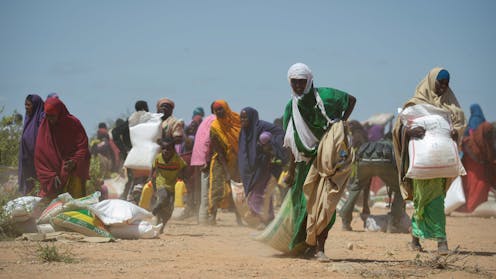
Women receive food aid in Somalia. Terrorism creates food disruptions, undermining production systems and supply routes. Tobin Jones/Wikimedia Commons

Over the last decade, there has been growing international focus on the role of food in conflict, particularly in Africa. The continent has seen an increase in jihadist terrorism in several regions.

Violence, like that exercised by terrorist organisations, is linked with food security conditions, causing a vicious circle of hunger and conflict.

Terrorism generates food disruptions. It undermines production systems and supply routes.

At the same time, growing food shortages intensify tensions and competition over essential resources at the margins of vulnerable societies. This increases the risk of mobilisation into violence.

We are researchers in international security and contemporary warfare. In a recent article, we explored the role of food in Africa’s terrorist insurgencies. We focused on Boko Haram in Nigeria and Al-Shabaab in Somalia.

We show how food is not only a driver or victim of violence. It is also central to how terrorist groups fight, govern and survive.

Terrorists use food as a tool to challenge national authorities and increase their followers. In parallel, they exploit food insecurity to control communities and confront counter-terrorism forces, pushing the state out of contested areas.


Read more:
How crime is closely linked to Al-Shabaab’s survival strategy


This has major implications. The use of food as a weapon worsens humanitarian conditions. It causes the displacement of people in vulnerable settings. As a result, it sets in motion dangerous mechanisms of instability that can even undermine militants themselves, reducing their resources and operational capabilities.

State responses need to address these challenges and promote more comprehensive approaches to counter terrorism.

Weaponising supplies

Since the late 2000s, Boko Haram and Al-Shabaab have engaged African security forces in a strenuous fight. Both groups have sought to overthrow local governments and establish their power.

They have expanded their networks in regions where food security is low. These are Nigeria’s Borno State and southern Somalia.

These areas have witnessed historical frictions between the population and government authorities. Local communities have lamented socioeconomic marginalisation, shortages of essential resources and high levels of unemployment.

Both Boko Haram and Al-Shabaab have sought to capitalise on inequalities to gain appeal among aggrieved populations, seeking to replace the state in the delivery of essential resources.


Read more:
Nigeria’s growing security crisis: 6 essential reads


Boko Haram militants have reportedly provided supplies, such as biscuits, rice and spaghetti, to marginalised villages. As a Borno State resident put it, the militants have shown “love and concern” while addressing local needs.

Al-Shabaab has resorted to similar practices to win the hearts and minds of southern Somalis and enlarge its pool of recruits. The group has supplied struggling communities with meals and goods, and promoted local agricultural activities.

In parallel to these activities, both terrorist groups have adopted more aggressive measures to counter the advance of anti-terrorism forces. They have used food denial to punish civilian insubordination and cooperation with the state, relying on starvation tactics.

Boko Haram has systematically targeted food infrastructures. The group has burned crops, banned farming and fishing activities, and even poisoned water sources. This has happened particularly in places where militants suspected collusion between communities and national authorities.

Likewise, Al-Shabaab has interrupted trade routes. It has destroyed food imports to isolate southern Somali villages controlled by security forces and deprive them of popular support. During Somalia’s 2011–2012 famine, Al-Shabaab militants blocked humanitarian agencies. This was aimed at preventing the distribution of food aid to curb western influence in territories under their control.

The repercussions

The use of food as a weapon has had major repercussions in Borno State and southern Somalia. It is a primary cause of the deterioration of food security in these regions over the last 15 years.

Attacks on food resources and infrastructure have disrupted supply routes. They have pushed people to abandon their crops and pastures. This has decreased the production and availability of essential goods.

As a result, humanitarian conditions have worsened, local economies have weakened and displacement flows have intensified.

This has had detrimental effects for Boko Haram and Al-Shabaab, depriving militants of key assets to sustain their activities and attract new recruits.

The two terrorist groups have become victims of the emergencies they have helped generate. They have increasingly struggled to supply nourishment for their troops and supporters. Consequently, they have witnessed a growing number of defections motivated by unsustainable conditions.

Reports highlight increasing cases of jihadists surrendering to security forces while requesting food.

To address these challenges, Boko Haram and Al-Shabaab have intensified raids on villages, looting goods and livestock.


Read more:
What drives Al-Shabaab in Somalia: foreign forces out, Sharia law in and overthrow the government


However, growing frictions with the population have undermined the groups’ operational capabilities, even opening up new fronts of resistance.

Boko Haram has been forced to transfer part of its resources and operations to the Lake Chad area. The group has intensified incursions to capture food in Nigeria’s neighbouring countries.

In Somalia, tensions with farming and pastoralist communities have led to the creation of militias mobilising against Al-Shabaab.

What next

The relocation of Boko Haram’s operations and the mobilisation of communities against Al-Shabaab have not eradicated the terrorist threat. However, these events further highlight food as a crucial factor shaping insurgencies.

African and international authorities need to tackle the dynamics of food weaponisation. They need to refine their approach to enhance local resilience, addressing the inequalities that insurgents exploit.

The Conversation

The authors do not work for, consult, own shares in or receive funding from any company or organisation that would benefit from this article, and have disclosed no relevant affiliations beyond their academic appointment.

ref. Terrorists use food as a weapon: how Boko Haram and Al-Shabaab exploit hunger – https://theconversation.com/terrorists-use-food-as-a-weapon-how-boko-haram-and-al-shabaab-exploit-hunger-256162