Doctrina Monroe: más de dos siglos de “América para los americanos”

Source: The Conversation – (in Spanish) – By Deborah Besseghini, Doctora Investigadora Marie Curie – Departamento de Geografía, Historia y Filosofía – Historia Moderna, Universidad Pablo de Olavide
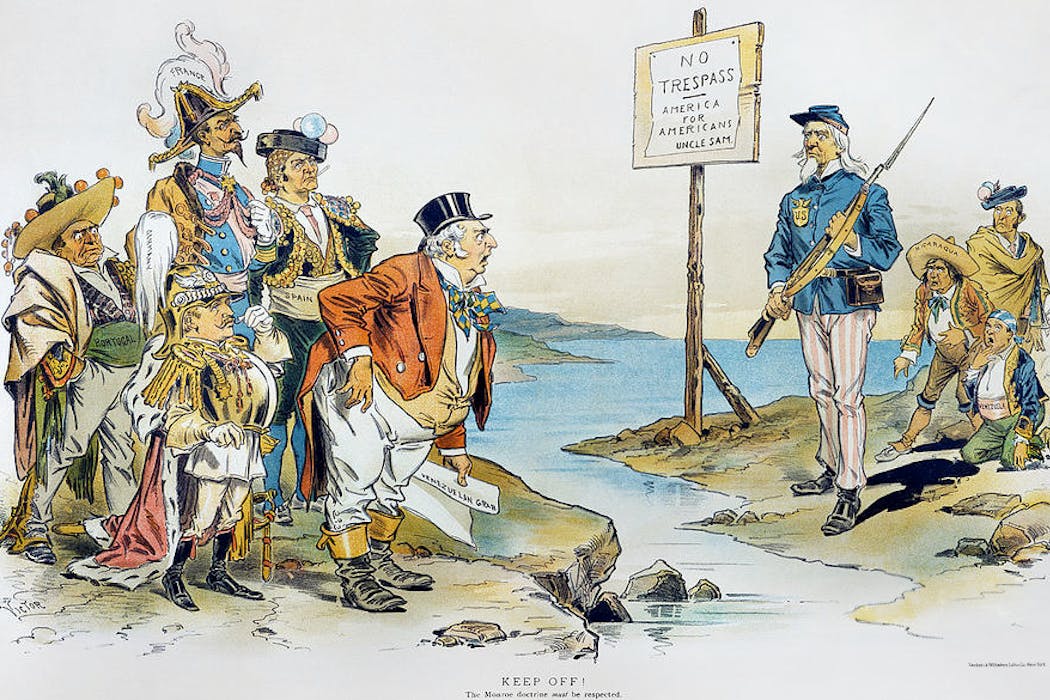
Ilustración satírica de 1896 donde se ve al Tío Sam interponiéndose entre las potencias europeas y unos personajes que representan a Nicaragua y Venezuela. Wikimedia Commons

El 24 de noviembre venció el ultimátum a Nicolás Maduro por el que Estados Unidos clasificó al llamado Cártel de los Soles como organización terrorista, allanando el camino para una posible intervención militar contra Venezuela.

Esa decisión parece menos una exigencia jurídica que una advertencia política.
Como ya se vio en la “guerra de los doce días” contra Irán, que llevó a casi toda la UE a aceptar las exigencias estadounidenses en el marco de la OTAN, Washington se preocupa cada vez menos por sustentar sus ataques mediante justificaciones normativas.

Acoso diplomático

Los detractores del presidente Trump sostienen que ha convertido a EE.UU. en un “Estado mafioso” (mafia state), debido a que recurre a prácticas gansteriles, tanto a nivel internacional como nacional. Para estas voces críticas, Trump busca la cooperación o el sometimiento mediante la amenaza del uso de la fuerza.

No hace falta simpatizar con Maduro para ver los riesgos de este acoso diplomático “bully diplomacy”. Por exitosa que haya sido hasta ahora, socava los ya frágiles cimientos del orden mundial normativo (rule-based global orden) que Occidente dice defender. Sus efectos resultan difíciles de prevenir.

Esto sucede en el aniversario de la llamada doctrina Monroe, que tuvo lugar el 2 de diciembre.

A todos nos suena el lema “América para los americanos” y ahora lo asociamos con el control de fronteras y el proteccionismo industrial. Sin embargo, no es la primera vez que se alzan banderas con este lema.

1823 fue el marco de una auténtica partida de ajedrez geopolítico. Más de dos siglos después del mensaje del presidente James Monroe, resulta útil conocer cómo Londres y Washington compitieron por la proyección política en Latinoamérica. Entender qué ocurrió y cómo Europa perdió gradualmente capacidad de influencia puede ayudarnos a leer mejor lo que se avecina.

El giro intervencionista de la doctrina Monroe

Monroe no podía prever que su declaración contra la injerencia europea en los países independientes de América y a favor del no-intervencionismo estadounidense en Europa (en Grecia, por ejemplo) se transformaría en una “doctrina” útil para justificar no solo el aislacionismo, sino también el intervencionismo en América y más allá.

Sin embargo, el germen de ese giro ya estaba inscrito en el propio mensaje de 1823.

Aquel año, la contrarrevolución alcanzaba su cenit con la invasión francesa de España, que restauró el absolutismo en Europa y parecía anunciar una intervención franco-española en América.

Cuando Monroe leyó su mensaje, Gran Bretaña ya había asegurado el gradual reconocimiento de la independencia hispanoamericana, publicando el compromiso francés a la no-intervención en América que recoge el Memorándum de Polignac. Este hecho constituyó una parte del proceso para la difícil aceptación británica de la intervención francesa en España.

Pero Washington lo desconocía. Como subrayan los expertos, la declaración de Monroe no representó una ambigua cooperación con Londres, sino una potente reacción negativa a un anterior pedido británico de colaboración sobre la independencia latinoamericana.

Fue, en esencia, un manifiesto de emancipación geopolítica.

El secretario John Quincy Adams, autor del documento, se oponía a la propuesta británica de declarar que ni Gran Bretaña ni EE. UU. anexarían territorios previamente españoles, porque pensaba que Londres quería limitar la proyección estratégica de la república. Su negativa contenía en esencia la ideología del “destino manifiesto” y un panamericanismo contradictorio.

Considerando cómo los conflictos imperiales del siglo XVIII habían perturbado la geografía continental, Adams quiso establecer que los territorios americanos ya no eran peones en el ajedrez europeo.

El mensaje de Monroe no fue una herramienta de política interna, como se ha dicho, sino que dejó claro al mundo que EE.UU. interpretaría cualquier amenaza europea a las independencias hispanoamericanas como un ataque a su propia seguridad y paz.

Percibía como interferencia los planes para crear monarquías independientes, porque nuevos lazos dinásticos habrían arrastrado a América a conflictos europeos. Por eso, la “libertad hemisférica” tenía que ser republicana.
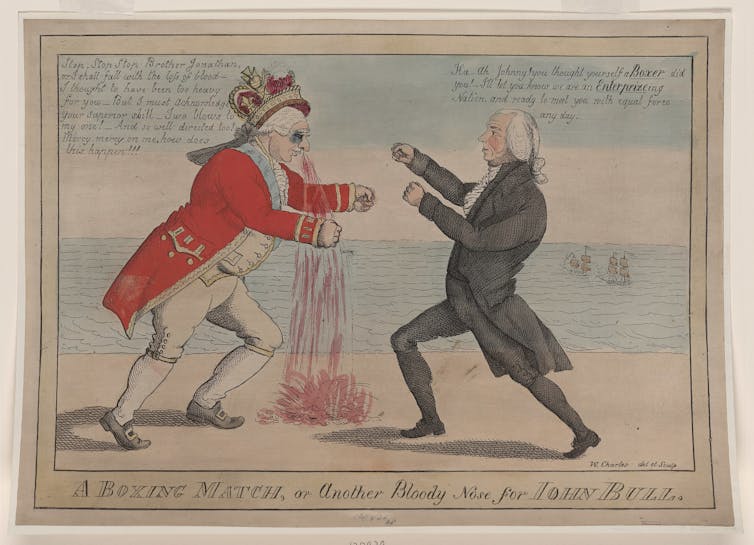
Aguafuerte coloreado a mano de Charles Williams, en el que se ironiza sobre una derrota naval británica durante la Guerra de 1812.
Library of Congress

EE. UU. terminó legitimando como defensiva su teórica intervención contra la interferencia de otras potencias en otros países. Poco importó que careciera de la fuerza y la voluntad de materializar la amenaza. Fue una herramienta propagandística en Latinoamérica, que tuvo profundos efectos en México y Texas. Creó graves divisiones internas entre conservadores probritánicos y liberales proestadounidenses y empujó la reacción británica, una dinámica observada previamente en Sudamérica durante la Guerra de 1812.

Pero al intentar debilitar a la influencia europea, EE. UU. no quería actuar como guía del mundo americano.

El origen del “patio trasero”

Los límites de la declaración de Monroe residían, contrariamente a lo que se cree, en la reticencia de EE. UU. a gobernar un continente que solo deseaba controlar en la medida necesaria para su seguridad. Hispanoamérica representaba un escudo frente a la amenaza europea, la barrera entre el hogar y el mundo. Era su “patio trasero”. Con el tiempo el “hogar” se expandiría al jardín, y el jardín se proyectaría sobre el resto del mundo entre muchas contradicciones. Pero EE. UU. no perdería su hábito, fijado ya en 1823, de interpretar la injerencia ajena en territorios externos como una amenaza directa a su propia seguridad.

Y así como en el siglo XIX no quería gobernar el caos americano, hoy no quiere gobernar el mundo ni Occidente. Como conclusión, la “bully diplomacy” de Trump encarna el lado oscuro de una potencia militar hegemónica que no quiere ser un imperio, sino seguir preservándose a sí misma.

The Conversation

Deborah Besseghini es doctora investigadoras Marie Curie en la Universidad Pablo de Olavide de Sevilla, donde desarrolla el proyecto “UNWANTED – The Revolutionary Impact of Financing a Global War, 1797-1825”, financiado por la Comisión Europea.
Algunos artículos citados son parte de un numero monográfico sobre la Doctrina Monroe en el cual la investigadora participó.

– ref. Doctrina Monroe: más de dos siglos de “América para los americanos” – https://theconversation.com/doctrina-monroe-mas-de-dos-siglos-de-america-para-los-americanos-270607

El imparable triunfo del fútbol femenino español

Source: The Conversation – (in Spanish) – By Pedro César Martínez Morán, Director del Master in Talent Management de Advantere School of Management / Profesor asociado de la Facultad de Ciencias Economicas y Empresariales, Universidad Pontificia Comillas

La selección femenina de España celebra su victoria en la final de la Women’s Nations League el 2 de diciembre. RTVE

Al ganar su segunda Women’s Nations League, la selección femenina de fútbol de España se sucede a sí misma. En 2023, también subió a lo más alto del pódium en el Campeonato Mundial, la primera final en la que participaban. En estos escasos años, tan solo se le ha escapado conseguir medalla en los pasados Juegos Olímpicos.

Cambio de paradigma

En este siglo XXI, España brilla en un conjunto amplio de disciplinas. Tanto es así que en abril de 2025 se han superado por primera vez los 6 000 deportistas de alto nivel, según recoge el Consejo Superior de Deportes.

No obstante, el fútbol acapara todas las atenciones. Según la compañía de marketing deportivo SportsValue, de las diez competiciones deportivas con mayor generación de ingresos en el mundo, cinco se relacionan con este deporte.

La liga masculina de fútbol de España ocupa un meritorio noveno lugar, y en la competición que gestiona juegan el primero y el sexto equipos del mundo por ingresos. Es el deporte más popular en este país.

Sin embargo, hasta épocas recientes, las selecciones nacionales asomaban muy poco la cabeza en los rankings correspondientes. Se atribuye a Alfredo Di Stefano la frase lapidaria de “jugamos como nunca y perdimos como siempre”. Incluso, se publicó un libro con ese título. Eran otros tiempos.

La eclosión del fútbol femenino

La selección española ganó todos los partidos de la última Eurocopa femenina, aunque perdiese el más importante. Si bien en la fase de grupos sus rivales le marcaron algún gol, en los partidos decisivos, los previos a la final, mantuvo su portería a cero. Su planificación ha brillado. El gol en la semifinal ante Alemania, a la que nunca se había derrotado, no fue debido al azar: según comentó la jugadora Aitana Bonmati, “lo habían estudiado”.

En las categorías inferiores, España ocupa el segundo lugar en el ranking de campeonatos europeos ganados en sub-17. En el caso de las sub-19, es el país con más trofeos conquistados.

Por el lado individual, las jugadoras españolas lideran el ranking de balones de oro. Bonmatí y Alexia Putellas sobresalen. Además, las licencias de fútbol femenino en España casi se han multiplicado por tres en el intervalo 2012 a 2024.

Mientras las audiencias televisivas de la semifinal de la Eurocopa alcanzaron cifras muy altas, el partido de vuelta frente a Alemania en la final de la Women´s Nation League registró la mejor entrada a un partido de fútbol femenino en España.

Qué es el fútbol

El fútbol son muchas cosas, demasiadas: juega un rol significativo en la vida diaria. El historiador británico David Goldbaltt incluso llega a aseverar que es “el reflejo más extraordinario de la sociedad”. Estrechamente ligado a la política y a los medios de comunicación, a menudo se utiliza como herramienta de expresión política y de socialización, incluso como medio para moldear la opinión pública y la identidad.

Lo importante en el fútbol, en opinión de Luis Aragonés, futbolista y luego entrenador, es ganar, ganar y volver a ganar. La victoria produce titulares, mientras que la derrota genera abandono.

Aportación de España: talento y perseverancia

El talento individual y el colectivo caminan por senderos diferentes. Según Pablo Atela y Fernando Díez, el primero se puede asociar a creatividad, habilidades superiores al promedio y compromiso con la tarea. El segundo conecta con la cooperación y la armonía social.

En 2007, la psicóloga norteamericana Angela Duckwort, junto con un equipo de expertos, reveló el papel crucial que tiene la determinación en el éxito. Unos años más tarde, en 2016, publicó un libro –Grit: el poder de la pasión y la perseverancia– donde dejaba de manifiesto cómo la resiliencia y la fuerza de voluntad para alcanzar metas resultan tan importantes como el propio talento.

Según BBC Sports, los éxitos del fútbol femenino español han venido de una mezcla entre familiaridad y continuidad. Por su parte, el diario británico The Guardian, justo antes de comenzar la Eurocopa femenina, titulaba que los problemas acontecidos tras ganar el Campeonato del mundo resultaron un revulsivo para transformar el fútbol femenino español.

España gusta

En definitiva, los triunfos futbolísticos de las jugadoras españolas resuenan en el escaparate internacional: a los espectadores de este deporte les gusta como juega España.

Tras superar polémicas y numerosas dificultades, la selección rezuma alegría, simplicidad, desparpajo. En lo estrictamente deportivo juegan como nadie y durante estos últimos años le han tomado la medida a la victoria. A eso hay que sumar el gran trabajo que se está haciendo categorías inferiores. Su rendimiento colectivo demuestra el valor del talento grupal y la gran preparación técnica y táctica a nivel individual.

The Conversation

Pedro César Martínez Morán no recibe salario, ni ejerce labores de consultoría, ni posee acciones, ni recibe financiación de ninguna compañía u organización que pueda obtener beneficio de este artículo, y ha declarado carecer de vínculos relevantes más allá del cargo académico citado.

– ref. El imparable triunfo del fútbol femenino español – https://theconversation.com/el-imparable-triunfo-del-futbol-femenino-espanol-271219

Le secteur de l’énergie, une porte d’entrée pour le Canada en Asie

Source: The Conversation – in French – By Yaxin Zhou, Doctorante en science politique, Université de Montréal

Le Canada a beaucoup à gagner en Asie du Sud-Est. Du sommet de l’Association des nations de l’Asie du Sud-Est (ANASE) à celui de la Coopération économique Asie-Pacifique (APEC), le voyage diplomatique en octobre de Mark Carney en Asie témoigne de l’intérêt et de la nécessité du Canada de trouver un point d’entrée dans l’immense marché asiatique.

La région de l’Indo-Pacifique est aujourd’hui le principal moteur économique du monde, contribuant jusqu’à 60 % de la croissance mondiale. Tandis que le Japon et la Corée du Sud enregistrent un taux de croissance entre 1 et 2 % pour l’année 2025, la Chine maintient une croissance de 4,2 %, l’Inde de 6,6 % et l’ANASE 4,3 %.

Si ces pays asiatiques aspirent, pour certains, à retrouver un nouvel élan économique, ou, pour d’autres, à accéder au statut d’économie à revenu élevé, ils ont en commun de rechercher des sources d’énergie fiables, accessibles et opérationnelles. Dans les prochaines années, la stabilité et la diversification des fournisseurs énergétiques seront des enjeux clés. Les besoins sont bien réels, et vont augmenter. Qui va en profiter ?

Doctorante en science politique, affiliée au Centre d’études et de recherches de l’Université de Montréal, je travaille sur la Chine et sur la région Indo-Pacifique.

Redéfinition de l’échiquier géopolitique

Le 1ᵉʳ février 2025, Donald Trump a déclaré une guerre commerciale contre le Canada et le Mexique, avant même de s’en prendre à la Chine, son ennemi juré. Dès lors, la diversification économique s’est imposée comme une priorité stratégique pour Ottawa.

Élu en promettant d’être l’homme de la situation, Mark Carney a employé un langage totalement différent de celui de son prédécesseur sur l’importance des questions d’ordre économique. À l’occasion de son discours de victoire électorale, le nouveau premier ministre canadien a affirmé vouloir faire du Canada une superpuissance énergétique, autant dans les énergies propres que dans les énergies conventionnelles.


À lire aussi :
Le Canada est en guerre commerciale avec les États-Unis – voici comment y faire face


Ce pivot vers l’économie, la sécurité nationale et le pragmatisme s’arrime bien aux besoins des pays asiatiques, qui cherchent eux aussi à diversifier leurs chaînes d’approvisionnements et à trouver des partenaires commerciaux stables et crédibles sur le plan politique.

L’attrait du Canada pour des pays en quête de diversification

Selon Statistique Canada, en 2024, les minéraux combustibles (dont le pétrole, le gaz naturel et le charbon), les huiles minérales et leurs produits dérivés représentaient 25 % des exportations canadiennes. De fait, les ressources énergétiques constituent le premier poste d’exportation du Canada. Pourtant, 89,33 % de ces ressources sont acheminées aux États-Unis… Ce que le Canada exporte le plus vers les pays de l’ANASE, ce sont des céréales !

Si le Canada veut devenir une superpuissance énergétique, comme le souhaite Mark Carney, il lui faudra développer des partenariats commerciaux et surtout énergétiques ailleurs qu’au sud du 49e parallèle. Le marché asiatique, en pleine croissance et en quête de stabilité et de sécurité énergétique, pourrait constituer une véritable opportunité à long terme.

La consommation croissante d’énergie en Asie

La dépendance aux énergies fossiles demeure la norme dans la région. Selon les données de l’Agence internationale de l’énergie, l’industrie et le transport concentrent la plus grande part des besoins en énergie, qui continueront de croître à mesure que l’industrialisation et l’urbanisation s’accélèreront, notamment dans les pays émergents. Le charbon demeure, de loin, la principale source d’énergie, représentant 49,3 % de la consommation d’énergie primaire de la région d’Indo-Pacifique, et 57 % de la production d’électricité. Les ressources tendent toutefois à s’épuiser.


À lire aussi :
Les États-Unis en repli, la Chine en retrait, le monde dans un vide dangereux


Si les économies développées comme la Corée du Sud, le Japon, Taïwan, et Singapour importent quasiment 100 % de leur pétrole et de leur gaz, l’Indonésie et la Malaisie parviennent à exporter leurs énergies fossiles.

L’Indonésie est le premier exportateur mondial de charbon, et la Malaisie, un exportateur majeur de gaz naturel liquéfié (GNL). Le rapport Asean Oil and Gas Updates 2024 montre cependant que l’Asie du Sud-Est fait face à un épuisement progressif de ses réserves pétrolières, et devrait devenir importatrice nette de gaz d’ici 2027.


Déjà des milliers d’abonnés à l’infolettre de La Conversation. Et vous ? Abonnez-vous gratuitement à notre infolettre pour mieux comprendre les grands enjeux contemporains.


Une région qui s’active pour trouver de l’énergie

Les gouvernements de la région s’entendent de manière quasiment unanime sur deux grandes priorités. D’abord, assurer et préserver leur sécurité énergétique, définie par l’Agence internationale de l’énergie comme étant la disponibilité ininterrompue de sources d’énergie à un prix abordable. Ensuite, exécuter une transition vers des formes d’énergies plus propres que le charbon.

Pour atteindre ces deux objectifs, les pays multiplient des initiatives de diversification énergétique et investissent massivement dans la construction d’infrastructures. En Asie du Sud-Est, les nouvelles usines de regazéification et de liquéfaction se multiplient. En 2023, la région totalisait 57,76 Mtpa de capacité de regazéification, et 64,1 Mtpa de capacité de liquéfaction, avec des projets ambitieux d’expansion d’ici 2030, notamment en Indonésie, en Thaïlande, au Vietnam et aux Philippines.

Le Canada a-t-il les moyens de ses ambitions ?

Le Canada s’est ainsi nouvellement doté des moyens pour compétitionner avec les États-Unis, qui exportent déjà massivement leur GNL depuis 2016 à partir de terminaux situés dans le golfe du Mexique. Cependant, ceux-ci transitent par le canal de Panama, un détour coûteux.

Le Canada possède un avantage concurrentiel considérable, un terminal portuaire directement accessible à partir de la côte ouest. Au mois de juillet 2025, partait le premier navire transportant du GNL canadien à destination de l’Asie, depuis le port de Kitimat, en Colombie britannique. Parmi les cinq multinationales ayant le plus contribué à ce projet, quatre sont d’origines asiatiques : Petronas (Malaisie), PetroChina (Chine), Mitsubishi Corporation (Japon) et Kogas (Corée du Sud).

Du côté du pétrole, malgré les retards et la flambée des coûts associés à sa construction, l’expansion du réseau d’oléoduc de Trans Mountain a porté la capacité d’exportation du Canada à 890 000 barils par jour, ouvrant la voie à des exportations vers des partenaires asiatiques à partir de la côte ouest du pays. Avec plus d’un partenaire à qui vendre son pétrole, le Canada a vu le prix de son baril augmenter rapidement en quelques mois.

N’ayant exporté aucun GNL avant 2016, les États-Unis sont devenus les premiers exportateurs au monde en 2023, et leurs exportations continuent de battre des records. Le marché est là, mais qui va s’enrichir : le Canada ou les autres ?

La Conversation Canada

Yaxin Zhou ne travaille pas, ne conseille pas, ne possède pas de parts, ne reçoit pas de fonds d’une organisation qui pourrait tirer profit de cet article, et n’a déclaré aucune autre affiliation que son organisme de recherche.

– ref. Le secteur de l’énergie, une porte d’entrée pour le Canada en Asie – https://theconversation.com/le-secteur-de-lenergie-une-porte-dentree-pour-le-canada-en-asie-269455

Une partie du cerveau humain grossit avec l’âge – voici ce que cela signifie pour vous

Source: The Conversation – in French – By Esther Kuehn, Professor of Neuroscience, University of Tübingen

Le vieillissement cérébral est propre à chaque individu et dépend de son mode de vie, notamment de ses expériences sensorielles, de ses habitudes de lecture et des défis cognitifs qu’il relève au quotidien. (Shutterstock)

Je me suis demandé dernièrement si mon cerveau restera en bonne santé quand je vieillirai. Même si je suis professeure dans un département de neurologie, il m’est difficile d’évaluer si mon cerveau, ou celui de quiconque, souffre d’une neurodégénérescence précoce.

Mon étude récente montre toutefois que la taille d’une partie du cerveau augmente avec l’âge plutôt que de dégénérer.

La raison pour laquelle il est si complexe d’évaluer la neurodégénérescence, c’est que mesurer les petites structures de notre cerveau constitue tout un défi.


Cet article fait partie de notre série La Révolution grise. La Conversation vous propose d’analyser sous toutes ses facettes l’impact du vieillissement de l’imposante cohorte des boomers sur notre société, qu’ils transforment depuis leur venue au monde. Manières de se loger, de travailler, de consommer la culture, de s’alimenter, de voyager, de se soigner, de vivre… découvrez avec nous les bouleversements en cours, et à venir.


Les technologies modernes de neuro-imagerie permettent de détecter une tumeur au cerveau ou une lésion épileptique. Ces anomalies, qui mesurent plusieurs millimètres, peuvent être visualisées grâce à l’imagerie par résonance magnétique (IRM), dont la puissance est environ 30 000 à 60 000 fois supérieure à celle du champ magnétique naturel de la Terre. Le problème est que la pensée et la perception humaines fonctionnent à une échelle plus petite encore.

Certaines zones du cerveau augmentent de volume avec l’âge

La pensée et la perception se produisent dans le néocortex. Cette partie périphérique de notre cerveau est composée de six couches. Lorsqu’on ressent un contact sur son corps, c’est la couche IV du cortex sensoriel qui est activée. Cette couche a la largeur d’un grain de sable, soit une taille bien inférieure à celle que les appareils d’IRM des hôpitaux peuvent généralement représenter.

Quand on module ses sensations corporelles, par exemple quand on peut lire ce texte plutôt que d’avoir conscience de son mal de dos, ce sont les couches V et VI du cortex sensoriel qui s’activent. Elles sont encore plus petites que la couche IV.

Pour mener mon étude publiée dans la revue Nature Neuroscience, j’ai eu accès à un appareil d’IRM 7 Tesla qui offre une résolution cinq fois supérieure à celle des appareils standard. Il permet d’obtenir des instantanés de minuscules réseaux cérébraux lors de la perception et de la pensée.

Grâce à cet appareil, mon équipe et moi-même avons pu examiner le cortex sensoriel de jeunes en bonne santé (d’environ 25 ans) et de personnes âgées en bonne santé (d’environ 65 ans) afin de mieux comprendre le vieillissement cérébral. Nous avons constaté que seules les couches V et VI, qui modulent la perception corporelle, présentaient des signes de dégénérescence liée à l’âge.

La couche IV, qui permet de ressentir le toucher, était plus développée chez les personnes âgées en bonne santé. Nous avons aussi mené une étude comparative avec des souris. Nous avons obtenu des résultats similaires chez les souris âgées, qui avaient également une couche IV plus développée que les plus jeunes. Notre étude sur les souris comprenait un troisième groupe de souris très âgées où on a pu observer que cette partie du cerveau pouvait dégénérer à un âge plus avancé.

Selon les théories actuelles, notre cerveau rétrécit avec l’âge. Cependant, les découvertes de mon équipe contredisent en partie ces théories. Il s’agit de la première preuve que certaines zones du cerveau augmentent de volume avec l’âge chez les personnes en bonne santé.

Une femme en blouse blanche tape sur une image médicale d’un cerveau sur un écran d’ordinateur
Il nous reste encore beaucoup à apprendre sur le vieillissement du cerveau.
Gorodenkoff/Shutterstock

Le vieillissement cérébral est propre à chaque individu

Les personnes âgées dont la couche IV est plus épaisse devraient être plus sensibles au toucher et à la douleur, et avoir de la difficulté à moduler ces sensations en raison de la diminution des couches profondes.

Pour mieux comprendre cet effet, nous avons étudié un patient d’âge moyen né sans un bras. Ce dernier avait une couche IV plus petite. Comme son cerveau recevait moins d’impulsions qu’une personne ayant deux bras, la masse de la couche IV s’était moins développée. Les parties du cerveau qui sont davantage utilisées forment plus de synapses, et donc plus de masse.


Déjà des milliers d’abonnés à l’infolettre de La Conversation. Et vous ? Abonnez-vous gratuitement à notre infolettre pour mieux comprendre les grands enjeux contemporains.


Plutôt que de dégénérer de manière systématique, le cerveau des personnes âgées semble préserver, au moins en partie, les fonctions qu’il utilise. Le vieillissement cérébral peut être comparé à une machine complexe dans laquelle certaines pièces fréquemment utilisées sont bien huilées, tandis que celles qui le sont moins rouillent. De ce point de vue, le vieillissement cérébral est propre à chaque individu et dépend de son mode de vie, notamment de ses expériences sensorielles, de ses habitudes de lecture et des défis cognitifs qu’il relève au quotidien.

Cela montre également que le cerveau des personnes âgées en bonne santé conserve sa capacité à rester en phase avec son environnement.

Toute une vie d’expériences

Les résultats présentent un autre aspect intéressant. Le schéma des changements cérébraux observés chez les personnes âgées, avec un renforcement de la zone de traitement sensoriel et une réduction des zones responsables de la modulation, possède des similitudes avec des troubles neurodivergents tels que le trouble du spectre de l’autisme ou le trouble déficitaire de l’attention avec hyperactivité.

Ces troubles se caractérisent par une sensibilité sensorielle accrue et une capacité de filtrage restreinte, ce qui entraîne des problèmes de concentration et de flexibilité mentale.

Nos conclusions indiquent-elles que le vieillissement engendre des troubles neurodivergents ? Le cerveau des personnes âgées s’est développé au fil d’une vie d’expériences, tandis que les personnes neurodivergentes naissent avec ces schémas cérébraux. Il est difficile de savoir quels autres effets pourrait avoir la croissance de la masse cérébrale avec l’âge.

Cependant, nos résultats nous fournissent quelques indices sur les raisons pour lesquelles les personnes âgées éprouvent parfois des difficultés à s’adapter à de nouveaux environnements sensoriels. Dans certaines situations, par exemple si elles doivent utiliser un nouvel appareil ou si elles visitent une nouvelle ville, la réduction des capacités de modulation des couches V et VI peut devenir particulièrement manifeste, augmentant ainsi le risque de désorientation ou de confusion.

Cela peut également expliquer pourquoi les capacités à effectuer plusieurs tâches à la fois, comme utiliser un téléphone portable tout en marchant, diminuent avec l’âge. Les informations sensorielles doivent être modulées pour éviter les interférences lors de l’exécution de plusieurs tâches simultanément.

Les couches moyennes et profondes présentaient davantage de myéline, une couche protectrice constituée de graisse et qui est essentielle au fonctionnement et à la communication nerveuse, chez les souris comme chez les humains. Cela indique qu’il pourrait y avoir un mécanisme compensatoire pour la perte de la fonction modulatrice chez les personnes de plus de 65 ans. Cet effet semblait toutefois s’estomper chez les souris très âgées.

Nos résultats démontrent l’influence du mode de vie sur le vieillissement du cerveau.

La Conversation Canada

Esther Kuehn travaille pour l’Institut Hertie de recherche clinique sur le cerveau et le Centre allemand pour les maladies neurodégénératives (DZNE) de Tübingen. Elle bénéficie d’un financement du Conseil européen de la recherche (CER).

– ref. Une partie du cerveau humain grossit avec l’âge – voici ce que cela signifie pour vous – https://theconversation.com/une-partie-du-cerveau-humain-grossit-avec-lage-voici-ce-que-cela-signifie-pour-vous-263498

Disability rights are shaped by the narratives embedded in policies like the Accessible Canada Act and MAID

Source: The Conversation – Canada – By Alfiya Battalova, Assistant Professor in Justice Studies, Royal Roads University

This year’s International Day of Persons with Disabilities centres on “fostering disability inclusive societies for advancing social progress.”

The theme recognizes persistent barriers faced by disabled people: disproportionate poverty, employment discrimination, inadequate social protection and the denial of dignity and autonomy in care systems.

Accessibility gains and losses

In 2022, the disability rate for people aged 15 years and over in Canada was 27 per cent. Nearly eight million people identified as having one or more disabilities, an increase of 1.7 million people over 2017, when the disability rate was 22 per cent.

The United Nations’ latest review of Canada’s implementation of the UN Convention on the Rights of Persons with Disabilities praised Canada’s progress in adopting the Accessible Canada Act and accessibility legislation at the provincial/territorial levels.

At the same time, the committee identified several areas of deep concern, such as the expansion of Medical Assistance in Dying (MAID) for disabled people whose death is not foreseeable. The report warns that inadequate supports risk normalizing death as a “solution” to poverty, lack of services and discrimination, and that the concept of choice can create a false dichotomy, enabling death without guaranteeing support.

All policies tell stories

All policies convey narratives and stories that carry values. They deal with questions of “why” as well as “how.”

Narratives distil and reflect a particular understanding of social and political relations. A story about disability as a phenomenon can be told from different perspectives. A medical model of disability views disability as a personal problem, a social model focuses on removing the barriers, and a human rights model introduces a language of rights and their protection. We often hear deficit-based stories rooted in the medical model about disability.

The Accessible Canada Act (ACA) and Medical Assistance in Dying (MAID) Track 2 in Canada tell contradictory stories about disability rights and state responsibility.

A young person using crutches shakes hands with a person holding open a door
The Accessible Canada Act is framed as a landmark piece of human rights legislation, emphasizing inclusion, accessibility and the removal of barriers.
(Pixabay)

The ACA is framed as a landmark piece of human rights legislation, emphasizing inclusion, accessibility and the removal of barriers to ensure full participation for people with disabilities, with a vision of a barrier-free Canada by 2040. Disability activists played a central role in its development, and the law is celebrated for its systemic, proactive approach to tackling exclusion and discrimination, offering rights to consultation, representation and accessible information.

In contrast, the MAID regime, especially after the expansion through Bill C-7, has been criticized for normalizing assisted death as a response to suffering caused by lack of access to medical, disability and social support, rather than addressing the underlying barriers and systemic failures that the ACA promises to remove.


Read more:
A dangerous path: Why expanding access to medical assistance in dying keeps us up at night


Research shows that the odds for having unmet needs for health-care services, medications, assistive aids or devices, or help with everyday activities increases with disability severity. A coalition of disability rights organizations and two personally affected individuals have filed a Charter challenge with the Ontario Superior Court of Justice opposing Track 2 of the MAID law, which extends eligibility to people whose death is not reasonably foreseeable.

Narrative accounts like the ones below, and research in bioethics, highlights that many people seek MAID not because they are terminally ill, but because they face poverty, inadequate housing and lack of care. This reveals a troubling contradiction: while the ACA proclaims a commitment to inclusion and support, MAID often functions as a default solution for those failed by the very systems the ACA aims to fix.


Read more:
Ontario Chief Coroner reports raise concerns that MAID policy and practice focus on access rather than protection


The stories told by these two policies — on one hand, the promise of full inclusion and on the other, the normalization of state-facilitated death for those marginalized by inadequate support — reveal a profound tension in Canada’s approach to disability rights and social responsibility.

Troubling cases

Cases are emerging where people access MAID due to intolerable suffering caused by systemic failures. There is a story of 66-year-old Normand Meunier who requested medical assistance in dying following a hospital stay last year that left him with a severe bedsore. He died a few weeks later.

The coroner’s report on Meunier’s case highlights the need for guaranteed and prompt access to therapeutic mattresses for patients with spinal cord injuries. Québec coroner Dave Kimpton also calls on the province to create an advisory committee aimed at preventing and treating bedsores with new tools and training. Kimpton observes:

“It is now undeniable to me, after this research, that the body of someone with a spinal cord injury speaks a different language, and that health-care professionals must learn to decode it if they are to anticipate and effectively manage medical complications.”

The stories of disabled people advocating for life-saving treatment is an example of continuing devaluation of disabled lives. Jeremy Bray of Manitoba pleaded for continued coverage of medication for his Type 2 spinal muscular atrophy. In British Columbia, Charleigh Pollock’s family fought for continued coverage of the medication for her neurological disorder. These stories individualize disability and promote a medical model approach.

Disability justice, as championed by the late activist Alice Wong and her Disability Visibility project, insists that storytelling is not “add-on” advocacy — it is evidence that exposes how policies like MAID, income-testing and institutionalization feel on the ground. Wong’s work demonstrates that disabled people’s stories are a powerful form of resistance, providing evidence that disabled people exist in societies that often erase them.

In her book Dispatches from Disabled Country, activist, educator and researcher Catherine Frazee provides an alternative vision of living with a disability. She uses a metaphor of Disabled Country to describe a “place of refuge for outlaws from the rules of fitting in a place where the value of human life is intrinsic, not contingent on a place that yields itself to our being and our capacity to flourish.”

Re-examining Canada’s disability policy story

From a policy-research perspective, understanding these narrative dynamics is essential for evaluating the effects of laws such as the ACA and for anticipating the implications of MAID expansion.

Scholars argue that policy narratives influence everything from budget priorities to program eligibility criteria and institutional cultures. They also shape how disabled people imagine their futures — an increasingly important dimension of well-being research.

As Canada reflects on the International Day of Persons with Disabilities, emerging evidence underscores the importance of aligning disability policy with the lived realities documented through research, monitoring processes and personal accounts.

Examining the narratives embedded in policy frameworks can help clarify how laws and institutions either support or hinder long-term flourishing for disabled people, and can offer insights into how stories told in policies ultimately align with societal values.

The Conversation

Alfiya Battalova does not work for, consult, own shares in or receive funding from any company or organisation that would benefit from this article, and has disclosed no relevant affiliations beyond their academic appointment.

– ref. Disability rights are shaped by the narratives embedded in policies like the Accessible Canada Act and MAID – https://theconversation.com/disability-rights-are-shaped-by-the-narratives-embedded-in-policies-like-the-accessible-canada-act-and-maid-271094

Ocho cuestiones clave sobre la peste porcina africana

Source: The Conversation – (in Spanish) – By Christian Gortazar, Catedrático de Sanidad Animal en el IREC, responsable del grupo SaBio, Universidad de Castilla-La Mancha

El virus de la peste porcina africana se transmite entre jabalíes, pero puede afectar también a los cerdos. David Relimpio

A finales de noviembre de 2025 se confirmaron los primeros casos de peste porcina africana (PPA) en jabalíes en la provincia de Barcelona. El foco se localizó en un entorno periurbano, atravesado por autovías y muy próximo al campus de Bellaterra de la Universidad Autónoma de Barcelona. La zona, previamente señalada como punto de riesgo, fue delimitada inicialmente con un radio de 6 kilómetros y una franja de vigilancia ampliada hasta los 20.

La hipótesis más plausible sobre la entrada del virus apunta a restos de comida contaminada que llegaron a un jabalí. Sea como sea, el virus de la PPA ya está en España. Y eso es una pésima noticia para nuestro sector porcino.

A continuación intentamos resolver las dudas que surgen sobre la naturaleza de esta enfermedad, qué medidas deben tomarse para controlarla y cuáles pueden ser las consecuencias de su expansión.

1. ¿Cuál es el origen y cómo se contagia?

La causa de la PPA es un virus de ADN de gran tamaño, capaz de expresar unos 160 genes, lo que lo convierte en un patógeno especialmente complejo. Encapsulado y resistente, puede sobrevivir durante meses en restos orgánicos, como un jabalí en descomposición.

Su transmisión se produce principalmente por contacto directo con sangre o tejidos, lo que puede ocurrir cuando un jabalí consume restos cárnicos contaminados o a través de interacciones estrechas entre los animales.

Una vez infectado, el ejemplar comienza a excretar el virus a los 3-4 días, y suele morir en unos 8-9 días, presentando fiebre alta y hemorragias internas. La mortalidad supera el 90 %. De forma natural, la PPA se propaga lentamente, a unos 13 km por año, por lo que focos más alejados suelen deberse a actividad humana.

2. ¿Qué conviene saber sobre el jabalí?

El jabalí es el ancestro del cerdo. Ambos comparten no solo la genética, sino también muchas enfermedades. Es lo que se denomina un “estratega de la r”, o sea, capaz de soportar altos niveles de caza, depredación o enfermedades. Aunque es una especie nativa de Eurasia y el norte de África, la proliferación del esta especie genera numerosos problemas: produce daños agrícolas, invade zonas urbanas, destruye nidos de aves amenazadas y transmite enfermedades al ganado.

Esta sobreabundancia se debe al aumento de zonas forestales, al cambio de cultivos, al abandono de la ganadería extensiva y a la caída del número de cazadores. Como resultado, se estima que en España hay actualmente entre 2 y 3 millones de jabalíes, unas diez veces más que hace 40 años. También es una especie cinegética cuya caza entretiene y ocupa a muchas personas y genera una actividad económica vital para el medio rural.

3. ¿Qué medidas se deben tomar de manera inmediata?

Lo primero es dejar la zona cero razonablemente tranquila. Los jabalíes del área infectada acabarán muriendo todos de PPA, pero hay que definir bien sus límites. Partiendo de los casos que ya conocemos, habrá que ampliar el radio de búsqueda. En las zonas más cercanas debe hacerse de forma intensa, con batidas de búsqueda de cadáveres meticulosas, discretas y realizadas por suficientes agentes medioambientales y colaboradores. Y en las más alejadas, utilizando drones y perros especializados para prospectar barrancos, cauces y cualquier otro ambiente en el que puedan aparecer jabalíes enfermos o muertos.

Cada cadáver encontrado será mapeado, recogido y enviado para análisis y destrucción. Esto tardará unos días.

4. ¿Y a medio plazo?

Una vez delimitado el perímetro, es clave evitar que salgan jabalíes infectados o restos contaminados, salvo para análisis y destrucción. En el centro del brote, donde se concentran los casos, el virus acabará con los animales por sí solo. Progresivamente, habrá que actuar sobre las poblaciones circundantes.

Esto hay que hacerlo de forma silenciosa, sin perros, posiblemente combinando trampas y el posterior sacrificio con el uso de silenciadores y visores térmicos. Se trata de establecer una zona de baja densidad, de reducir la probabilidad de que la PPA se extienda más allá de la zona infectada. Ocurre como en un cáncer: mejor llevarse algo de tejido de más.

Aunque pueda parecer una medida dura, es más compasivo intervenir a tiempo y evitar el sufrimiento que provoca la enfermedad. La experiencia en otros países demuestra que, si se actúa pronto y con intensidad, es posible erradicar la PPA.

5. ¿Habrá vacunas?

No a corto plazo. Las vacunas inactivadas y las de subunidades son muy seguras, pero poco eficaces, mientras que las vacunas vivas atenuadas –mucho más efectivas– aún necesitan importantes mejoras en seguridad.

6. ¿Qué pasará con los cerdos?

Todo dependerá de si se contiene al virus en un área relativamente pequeña. Las pocas explotaciones porcinas de la zona lo pasarán mal, aunque recibirán ayudas. Lo importante es evitar que el virus llegue a comarcas con alta producción porcina, clave para el sector agroalimentario.

El porcino representa el 17 % del PIB agrario y genera cerca de 300 000 empleos, muchos en zonas rurales. Si la PPA se limita a unas pocas comarcas y se controla en poco tiempo, las exportaciones podrán mantenerse, aunque haya un bajón inicial.

7. ¿Cómo afectará a la caza?

En la zona infectada y sus alrededores no se puede cazar. El control de jabalíes, si es necesario, se hará de forma discreta para evitar movimientos de animales potencialmente infectados. Esta prohibición afectará a algunas sociedades de cazadores, que deberán buscar oportunidades en otras zonas. A cambio, habrá que reforzar la actividad cinegética en áreas periféricas más alejadas; la colaboración entre sociedades vecinas será fundamental. Además, en los cotos de riesgo se aplicarán protocolos de desinfección.

El papel de los cazadores ya es clave en el control del jabalí, y lo será aún más con la PPA. Contribuirán a reducir la densidad y a localizar cadáveres gracias a su conocimiento del terreno.

8. ¿Qué ocurrirá en el futuro?

Nadie sabe qué ocurrirá a largo plazo. En los países bálticos, la PPA resultó fatal para los productores de porcino y redujo drásticamente la población de jabalíes, hasta niveles comparables a los de hace 20 años. En esa región, la cercanía de países poco transparentes y nada colaborativos, como Rusia y Bielorrusia, ha dificultado el control, y la enfermedad se ha vuelto endémica. Ahora, diez años después, las poblaciones de jabalí empiezan a recuperarse, pero la peste permanece. Aquí, en España, aún estamos a tiempo.

The Conversation

Christian Gortazar recibe fondos de la Comisión Europea, proyecto Horizon Europe ASFaVIP, sobre PPA, además de proyectos nacionales y regionales de i+d.

Aleksandra Kosowska está contratada con cargo a proyecto ASFaVIP: Understanding performance characteristics of live attenuated vaccines for the prevention and control of African swine fever in wild boar and domestic pigs (GA Nº 101136676), financiado por la Comisión Europea.

– ref. Ocho cuestiones clave sobre la peste porcina africana – https://theconversation.com/ocho-cuestiones-clave-sobre-la-peste-porcina-africana-271073

Maga explained: how personality and context shape radical movements

Source: The Conversation – UK – By Magnus Linden, Associate Professor of Psychology, Lund University

It’s often said that Donald Trump’s power base in the Maga movement has contributed to the radicalisation of the Republican party. Political scientists worry about the implications of this for the future of American democracy itself.

One example of that radicalisation was the attack on the US Capitol on January 6 2021 in an attempt to overturn the result. Exacerbating that radicalisation is the movement’s hostility towards much of the mainstream media. This is something that has been amplified by the US president himself, who has famously referred to the media as “the enemy of the American people”.

But how has this radical movement movement emerged from the socially conservative Republican Party? The rise of Maga has marked an important political shift in America that has many liberal-minded people scratching their heads. Psychology studies can offer insights that can help explain the Maga movement’s motivations.

1. Fused identity

Identity is central to understanding the way Maga holds together as a group and can also explain many of its motives. Trump has been able to mobilise his base effectively by communicating that shared identity. And it’s this sense of common identity and purpose that has been so important in the development of Maga as a powerful political movement.

The almost absolute faith in Trump’s leadership has a lot to do with negative resentment of other groups that he singles out for criticism, particularly migrants, liberals and feminists. But it is actually a positive identification with white nationalism that is a stronger indicator of the sort of person who might identify with Maga.

Maga supporters unite around a shared perception of threat to their status, often related to issues of race and immigration. But it is also seen to be motivated by the desire to cultivate belonging and group pride as a way to regain lost esteem.

Some researchers also believe that even the act of wearing a Maga hat is a sign of what is known as “identity fusion” – when boundaries between the self and the group blur. When this occurs, wearing a Maga hat may be a symbol of who I am rather than just who I voted for.

This is significant since identity fusion is associated with reported willingness to undertake more extreme actions such as hurting people and damaging property to uphold the Trump community and to achieve his aims.

2. Moral self-righteousness

Maga members also tend to adhere to the idea that one’s own ethnic group is more morally pure than others. Maga ideology tends to divide America into “good” and “evil” groups, with themselves as good and out-groups, such as the ones mentioned above, cast as evil. This positions “true Americans”, the people who built the nation, patriots who have “had enough”, as part of the former.

Since it frames politics as a struggle over “right values and lifestyles”, such rhetoric heightens the risk of malignant moral superiority. When communicated by a leader, it creates in followers the sense that they have an obligation to act against these “evil” forces which threaten their group.

When this sense of superiority is threatened, it can lead to aggression, such as the assault on the US Capitol .

3. The right to dominate other groups

Aggressiveness in political groups such as Maga is also connected to what is known as “social dominance orientation”. This relates to belief in a hierarchy – the idea that one social group has the right to dominate other groups.

Research shows people who believe in hierarchy are more likely to disregard basic democratic principles. They see society as a “competitive jungle” where groups struggle for power and dominance.

As a result, they view groups that differ from them as inferior. This justifies any actions that maintain their in-group status.

This holds true even if – as in the case of Maga-followers – it means a belief in violence in response to unwelcome social and cultural changes. Polling has found that Maga supporters are also far more likely to believe that there will be a civil war in the US and that violence in order to advance the movement’s political objectives would be justified.

4. Aggressive followership

There’s a scientific debate about what draws people to authoritarian leaders. Some scholars emphasise the tendency to want to submit to authority, high levels of aggression when sanctioned and adherence to conventional values such as traditional views on religion and sexuality. Others focus more on a preference for conformity over personal autonomy.

But they agree on one point: authoritarian followers submit to leaders who stress the superiority of their social group and who they consider to be capable of handling the threats they see as coming from other groups.

Research on the Maga movement from 2016 shows that Trump supporters were more likely than other supporters of other Republican party candidates to score high on one facet of authoritarianism: the willingness to resort to aggression towards people seen to go against social norms if encouraged by someone they’ve accepted as an authority figure. But they don’t appear to score as highly on two other facets: submission to established authorities and an adherence to conventional values.

This suggests that authoritarianism among the Maga movement has evolved into a more distinct profile, characterised primarily by a prejudiced aggressiveness towards other social groups.

History tells us that radical political movements tend to pop up when the societal context is perceived as threatening. In this process, some people have personal dispositions that make them more prone to follow authoritarian leaders. So it’s important to take both personality and context into account when trying to understand movements such as Maga.

The Conversation

Claire Campbell works for Ulster University. She receives receives funding from PEACE PLUS for research on peace building.

Fredrik Björklund and Magnus Linden do not work for, consult, own shares in or receive funding from any company or organisation that would benefit from this article, and have disclosed no relevant affiliations beyond their academic appointment.

– ref. Maga explained: how personality and context shape radical movements – https://theconversation.com/maga-explained-how-personality-and-context-shape-radical-movements-270191

Limiting jury trials will harm minority ethnic victims and defendants, research shows

Source: The Conversation – UK – By Tara Lai Quinlan, Associate Professor in Law and Criminal Justice, University of Birmingham

Sebra/Shutterstock

The right to trial by jury dates back to at least the 12th century. The government’s proposals to limit it in England and Wales, many argue, run counter to the UK’s core democratic principles. And as others have pointed out, scrapping jury trials for some crimes is unlikely to solve the massive backlog in the crown courts.

Our research suggests that there is another reason why it is a bad idea to scrap jury trials. They can play a vital role in reducing racial discrimination in the criminal justice system.

The proposals laid out by justice secretary David Lammy would have a disproportionately negative impact on people of colour – both defendants and victims – for whom jury trials give a glimmer of hope in a criminal justice system where “ethnic minorities (excluding white minorities) appear to be over-represented”.

Government data repeatedly shows black, Asian and minority ethnic defendants are less likely to plead guilty than white defendants, and more likely to take their cases to trial. Lammy’s own 2017 review of racial inequality in the justice system suggests this is driven by a perception that the plea-bargaining process is unfair to defendants of colour, and that only a jury of peers will give them a fair trial.

Once black defendants choose a jury trial, research shows they are “more likely … to obtain acquittals or reductions in charges as a result”, compared to black defendants who plead guilty without opting for a trial.

A jury of 12 people brings a broader array of diverse perspectives and opinions which enhance the quality of discussions in deliberations, particularly in cases involving an ethnic minority defendant. Defendants should have their fate decided by people who might better understand their experiences, backgrounds and motivations.

Lammy’s 2017 review emphasised the importance of juries in making the criminal justice system more legitimate, particularly for people of colour: “Juries deliberate as a group through open discussion. This both deters and exposes prejudice or unintended bias: judgements must be justified to others.”

Sentencing is also disproportionate for defendants of colour when compared to white defendants, following both jury trials and plea agreements. Research has found that explicit or implicit judicial biases – whether judges stereotype the defendant, how they interpret sentencing recommendations from prosecutors and defence counsel, or how they apply aggravating and mitigating factors – may all contribute to these disparities.

Empirical evidence from other jurisdictions shows that more diverse juries are fairer to black defendants. Indeed, studies repeatedly show that all-white juries much more readily convict black defendants. Juries with even one black member are less likely to do so.

The UK’s Contempt of Court Act limits this type of research with live juries. But there is enough evidence from other jurisdictions to suggest that retaining juries, and ensuring those juries are diverse, is essential for protecting the fair trial rights of people of colour generally, and black people in particular.

Justice for victims

Jury trials are also essential for black victims and their families. Since 2022, we have worked with the family and friends of Dea-John Reid, a 14-year-old black boy who was racially abused and chased through the streets of Birmingham by a group of white boys and men who fatally stabbed him in broad daylight.

In their 2022 trial, the perpetrators were acquitted of racially aggravated murder, with only the principal offender found guilty of manslaughter by a jury of one Asian and 11 white members. Dea-John’s family felt that the lack of diversity on the jury, which did not have a single black member, could have meant they were less likely to see Dea-John as a worthy victim. Research shows that black men and boys are stereotyped as suspects – even when they are victims of crime.

Since 2022, we have worked with the family’s campaign, which supports retaining jury trials, but wants them to be more ethnically diverse, particularly in cases involving black victims. Our research has documented the campaign and is addressing critical gaps in UK research on jury diversity.

Diversity in the judiciary

Lammy’s proposals for reform include expanding the use of bench trials. This means that more cases would be heard by a single judge alone.

The judiciary in England and Wales is neither sufficiently diverse nor representative of the population. While black, Asian or minority ethnic people make up around 22% of the population, as of 2025, they make up only 11% of all court judges.

Lammy’s proposal also goes against what the public wants. In 2024, we surveyed 1,000 members of the public, 75% of whom stated explicitly that they believed the UK should have jury trials.

While most of our respondents believed that jury trials were fair (51%) and trustworthy (60%), they also felt strongly that more diverse juries were fairer (61%). Around half of people (51%) believed juries should look like the communities they serve. We found that for people of colour, taking part in jury service was viewed as even more important than for white respondents.

When it comes to perceptions of fairness and trust in the courts, we found important racial differences. Our research found that people of colour trust judges and the courts at lower rates than white people. People of colour in our survey were also more likely than white people to believe that judges treat them more unfairly compared to white people. And most of our respondents believed that more diversity in the judiciary is needed.

If Lammy remains committed to reducing inequality in the criminal justice system for people of colour, rather than reducing jury trials, he should be increasing them, and the diversity on them, to ensure justice for all.

The Conversation

The authors do not work for, consult, own shares in or receive funding from any company or organisation that would benefit from this article, and have disclosed no relevant affiliations beyond their academic appointment.

– ref. Limiting jury trials will harm minority ethnic victims and defendants, research shows – https://theconversation.com/limiting-jury-trials-will-harm-minority-ethnic-victims-and-defendants-research-shows-270869

Inside the Regency ballroom: what you’d experience on a night out with Jane Austen

Source: The Conversation – UK – By Hillary Burlock, British Academy Postdoctoral Fellow in the Department of History, University of Liverpool

The ballrooms of Jane Austen’s Britain have been hailed in literature and period dramas as a marriage market where young men and women could meet and mingle. The ballroom set the scene for Elizabeth Bennet and Mr Darcy’s first encounter at Meryton’s assembly rooms in Pride and Prejudice (1813), and where Catherine Moreland and Henry Tilney bantered in Bath in Northanger Abbey (1817).

Austen herself frequented balls in Basingstoke and Southampton. The ballroom was the place to see and be seen, the focal point for socialising during “the season”. The season took place during the winter months and involved a concentrated period of public entertainments like balls, concerts and card assemblies (in which guests met to play card games).

Ball-goers needed months to prepare for these events. This included ordering gloves and shoes, and buying new gowns or dressing up old ones. Austen deliberately kept her china crepe dress from being seen before the next ball, observing that the ballroom “was a place where you would be judged”.


Read more:
Jane Austen perfected the love story – but kept her own independence


Ladies and gentlemen also needed to polish their dance steps. From an early age, they were instructed in how to dance, bow and curtsy, walk and greet people of differing ranks. Mastering these basics of deportment was essential, as they would be scrutinised in the ballroom.

While in Bath in 1740, Elizabeth Robinson (future leader of the 18th-century English women’s intellectual circle the Bluestockings) observed that the education of another woman was lacking, writing: “[as] for her Curtsey where she got that I cannot guess, but I will venture to say, not from the Dancing School”.


This article is part of a series commemorating the 250th anniversary of Jane Austen’s birth. Despite having published only six books, she is one of the best-known authors in history. These articles explore the legacy and life of this incredible writer.


In Northanger Abbey, Catherine Moreland’s first ball at the Upper Rooms in Bath is filled with anxiety, as: “The season was full, the room crowded, and the two ladies squeezed in as well as they could. As for Mr Allen, he repaired directly to the card-room, and left them to enjoy a mob by themselves.”

To quell the “mob”, the ballroom was managed by a master of ceremonies, who had the role of facilitating introductions, enforcing the rules and mediating disputes.

Balls opened with the minuet (a French social dance) performed by one couple at a time. A well-danced minuet was a source of pride for genteel society, as some revelled in exhibiting their accomplishments. But it was also a source of anxiety.

When a young woman named Eliza Smith married the Austens’ wealthy neighbour William Chute in 1793, she was so nervous about dancing that her mother wrote: “I am glad for your Sake there are no Minuets at Basingstoke, I know the terror you have in dancing not that you have any occasion for such fears.”

Assessing dance skill was central to the experience of the ballroom, making it even more important for dancers to try to put their best foot forward. Sixteen-year-old Elizabeth Canning (cousin of the prime minister George Canning) wrote to her mother from Bath in December 1792 that: “I was very much entertained with the bad minuet-dancers, especially with a Mr Badcock who was obliged to stand up with seven, or eight Ladies successively, to the great diversion of the Spectators.”

illustration of a man and woman dancing
A couple dance The Devonshire Minuet.
Lewis Walpole Library

After the minuets, country dances filled the evening, with a column of men standing opposite their female partners. Relieved the minuets were over, Miss Canning wrote: “At last the Country dances began, there was great humming, & hawing whether or no I should dance … & I declared … that I should like to dance if I could get some mighty smart partner.”

Young ladies recorded triumphant lists of dance partners, and, indeed, Austen recalled dancing with Stephen Terry, T. Chute, James Digweed and Catherine Bigg one evening, observing: “There was a scarcity of men in general, and a still greater scarcity of any that were good for much … There was commonly a couple of ladies standing up together, but not often any so amiable as ourselves.”

For the most part, men were expected to ask women to dance with them. According to dance manuals by Thomas Wilson and G.M.S. Chivers, the ballroom occasionally saw two women or two men dancing together.

While it is assumed that it was the lady’s prerogative to accept or decline invitations to dance, she could not afford to refuse an offer unless she had no intention to dance at all “and consequently may be considered no lady”. In Pride and Prejudice, though Elizabeth Bennet would prefer not to dance with Mr Collins at the Netherfield Ball, refusing him would mean losing the opportunity to dance altogether.

The film Becoming Jane (2007) dramatised Austen’s experiences at balls.

However, Austen herself found a way of skirting around these rules at the Kempshott ball. Writing to her sister Cassandra in 1798 she explained that: “One of my gayest actions was sitting down two dances in preference to having Lord Bolton’s eldest son for my partner, who danced too ill to be endured.” Austen was an excellent dancer herself, proudly proclaiming that she could dance 20 dances in an evening “without any fatigue”.

Balls at the assembly rooms lasted for about five hours until precisely 11 or 12am, when, upon a signal from the master of ceremonies, the dancing concluded, even in the middle of a dance. Grudgingly, the dancers changed their dance pumps for sturdier shoes and donned their cloaks, with sedan chairs and carriages ready to whisk them home to their lodgings by the light of the moon.


Looking for something good? Cut through the noise with a carefully curated selection of the latest releases, live events and exhibitions, straight to your inbox every fortnight, on Fridays. Sign up here.


This article features references to books that have been included for editorial reasons, and may contain links to bookshop.org. If you click on one of the links and go on to buy something from bookshop.org The Conversation UK may earn a commission.

The Conversation

Hillary Burlock receives funding from the British Academy as a Postdoctoral Fellow.

– ref. Inside the Regency ballroom: what you’d experience on a night out with Jane Austen – https://theconversation.com/inside-the-regency-ballroom-what-youd-experience-on-a-night-out-with-jane-austen-270628

Wicked: what lies beneath correcting the way people speak?

Source: The Conversation – UK – By Emma Humphries, Research Fellow, School of Arts, English and Languages, Queen’s University Belfast

“Pink goes good with green.” This is a lesson we learned from Glinda (Ariana Grande) in Wicked part one. But do you remember the line that comes after that?
“Goes well with green.”

A small, easily missed comment from the green-skinned outsider Elphaba (Cynthia Erivo), but one that reveals something important about language and common usage. Hierarchies of “correct” and “incorrect” language are not just found in grammar books and classrooms, but in popular culture too.

From “holding space” to “sex cardigans”, Wicked continues to dominate popular culture, but one thing that has been overlooked is Elphaba’s insistence on correct language.

In the first film, we see Elphaba ostracised and eventually positioned as public enemy number one by the Oz propaganda machine. From the film’s very opening, a flashforward to citizens celebrating Elphaba’s death, her unpopularity is made clear in the song No One Mourns The Wicked.

One way in which the filmmakers signal Elphaba’s unlikeability is through her often awkward, borderline rude social encounters, including when she first meets her frenemy, Glinda. It’s safe to say that the two characters don’t hit it off and Elphaba’s correction seems to upset Glinda.

Glinda: I could care less what others think.

Elphaba: Couldn’t.

Glinda: What?

Elphaba: You couldn’t care less what other people think. Though, I … I doubt that.

In the land of Oz, where people “pronuncify” and “rejocify”, are “disgusticified” and “moodified”, Elphaba’s comments demonstrate the idea that there is only one correct way to use language and that incorrect language should be corrected.

From stage to cinema

Elphaba’s corrections are not in the original stage musical. They were added to the film. The adaptation of a stage show for film offers an opportunity to modernise and change parts of the story that have been controversial or become outdated.

One excellent example of this in Wicked is its improvement of the stage show’s depiction of disability. The addition of language policing, however, is more disappointing. Because when we correct someone’s language, it’s about much more than the words themselves.

Correcting language is not neutral. When we place value on using language correctly, those who fall short often find themselves judged and discriminated against.

The policing of correct language can be seen as a gatekeeping tool, deciding who belongs and who is excluded. This has inevitable consequences for diversity. The way we speak, write and sign can reflect many aspects of our identities: where and how we grew up, our gender, age and race.

Rules and rebellion

With the run time of the films almost doubling that of the stage show, there is much more time devoted to character development in the films. Elphaba’s language pedantry has been added to demonstrate how she can rub people up the wrong way. However, it also suggests an adherence to authority and to socially constructed rules that stands in contrast to her character more broadly.

Elphaba is an outsider who starts the film wanting to be “degreenified”, but by the end of Wicked part one and as a main storyline in Wicked: For Good, she is willing to sacrifice her safety and reputation to do what is morally right, rather than what is socially acceptable.

Adherence to the strict rules of correct language suggests the opposite: a tendency to want to be accepted and to uphold the societal status quo. Elphaba resists social norms in every other respect, yet the film makes her a standard grammar enforcer.

Given that this trait is absent from part two, rather than undermining her personality as a resister, perhaps this further signals Elphaba’s journey from wishing to fit in to fully embracing her outsider status. Indeed, Elphaba’s insistence on correctness speaks to a broader challenge facing anyone positioned as an outsider: having to work that much harder to be accepted.

Glinda’s (famous) need to be popular and her interests in social climbing align with traits of a language enforcer, yet her behaviour tells a different story. She corrects language only once and it concerns her original name, Galinda. When Dr Dillamond, a professor at Shiz University – who also happens to be a goat – struggles to pronounce the “gah” in Galinda, Glinda corrects his pronunciation and berates him.

This moment, present in both the stage musical and the film, does not reflect a desire to uphold the prescriptive rules of the language, but rather a personal motivation. Glinda’s name is central to her self-image and public persona, and protecting that matters to her.

Beyond Oz

In an era when equality, diversity and inclusion initiatives are being rolled back, and languages other than English face renewed marginalisation, Wicked offers a case study in how linguistic hierarchies operate under the radar of popular culture. But there are plenty other examples. Think about Ross in Friends, Ted in How I Met Your Mother and Sheldon in The Big Bang Theory – all notorious language correctors.

Elphaba’s corrections are more than just a shorthand to signal an abrasive character. They reflect the linguistic hierarchies and gatekeeping that exist beyond Oz. Using language “correctly” is a marker of belonging and shows adherence to societal norms.

Across the two films, Elphaba moves from wanting to conform and erase a stigmatised part of her identity, her skin colour, towards rebellion against convention. It’s clear she questions blind adherence to political power, but perhaps this extends further to questioning the rules we construct around language.


Looking for something good? Cut through the noise with a carefully curated selection of the latest releases, live events and exhibitions, straight to your inbox every fortnight, on Fridays. Sign up here.


The Conversation

Emma Humphries receives funding from The Leverhulme Trust and is currently employed by Queen’s University Belfast.

– ref. Wicked: what lies beneath correcting the way people speak? – https://theconversation.com/wicked-what-lies-beneath-correcting-the-way-people-speak-270639