A Roman emperor grovelling to a Persian king: the message behind a new statue in Tehran

Source: The Conversation – Global Perspectives – By Peter Edwell, Associate Professor in Ancient History, Macquarie University

A new statue unveiled in recent days in Iran depicts a Roman emperor in subjection to a Persian king.

Erected in Tehran’s Enghelab Square, the statue titled Kneeling Before Iran shows the emperor grovelling before Shapur I (who ruled around 242–270 CE).

But where did this imagery come from? And why has this statue gone up now?

The rise of Shapur

In the third century CE, a new dynasty known as the Sasanians came to power in ancient Iran.

Within a few years, the first Sasanian king, Ardashir I, threatened Roman territory in Mesopotamia (in modern-day Turkey, Iraq and Syria). The Romans had captured this territory from the Parthians, the predecessors of the Sasanians.

Now Ardashir wanted to recover some of the territory previously lost to the Romans. He met with some successes in the 230s. But his son and successor, Shapur I, took this to another level.

Shapur defeated an invading Roman army in 244 CE, leading to the death of the teen Roman emperor Gordian III.

In the 250s CE, Shapur invaded Roman territory across Iraq, Syria and Turkey. Two large Roman armies were defeated and dozens of cities were captured.

In 253 CE, Shapur captured the city of Antioch, one of the most important cities in the Roman empire. Some of its citizens were at the theatre and fled in terror as arrows rained down from above.

Capture of an emperor

While the Persian capture of Antioch was a major loss for the Romans, the events of 260 CE were earth-shattering.

After a battle between the Romans and Persians at Edessa (modern-day southern Turkey), the emperor Valerian was captured. This was the first and only time a Roman emperor was taken alive by the enemy.

Valerian was taken back to Persia, along with thousands of other captives.

Legendary stories about his fate as a captive later emerged. In one, Valerian and captive soldiers were forced to build a bridge over the river Karun at Shushtar. The remains, known as the Band-e Qayṣar (emperor’s bridge) can still be seen today.

Roman-built Band-e Kaisar in Shushtar, Iran, said to have been built by Roman prisoners during the reign of Shapur I.
The remains of the bridge, known as the Band-e Qayṣar (emperor’s bridge) can still be seen today.
Ali Afghah/Wikimedia

In another tale, Shapur demanded Valerian stoop on all fours to be used as a footstool so the Persian king could mount his horse.

Shapur supposedly ordered Valerian’s body preserved, stuffed and placed in a cabinet after his death.

With this, Valerian’s humiliation was complete.

Depictions of Shapur’s victories over Rome were put up all over the Persian empire. A number of carved rock reliefs celebrating these victories survive.

Perhaps the most famous is at Bishapur in southern Iran, where Shapur built a magnificent palace.

In this image, Shapur is spendidly dressed and sits on a horse. Underneath the horse is the dead Gordian III. Behind is the captive Valerian clasped by Shapur’s right hand. The figure in front is the emperor Philip I (ruled 244–249 CE) who replaced Gordian. He is begging for the release of the defeated Roman army.

Bishapur, Relief 2, Central scene: Shapur, Gordian, Philip, Valerian, courtiers
In this image, Shapur sits on a horse, under which is dead Gordian III. Behind is the captive Valerian.
Marco Prins via Livius, CC BY

Shapur also carved an enormous inscription in three languages, which partly celebrated his great victories over the Romans. Known today as the SKZ Inscription, it can still be seen at Naqsh-i Rustam in southern Iran.

The great Roman empire had been thoroughly humiliated. The Persians took huge resources (including skilled people such as builders, architects and craftsmen) from the captured cities. Some cities in the Persian empire were populated with these captives.

A new statue celebrating an old victory

The new statue recently unveiled in Tehran appears to be a partial copy of a celebratory Sasanian rock relief at Naqsh-i Rustam.

The kneeling figure is reported to be Valerian. If it is indeed modelled on the Naqsh-i Rustam relief, then the kneeling figure is usually identified as Philip I (as in the original relief Valerian is standing before Shapur). Nevertheless, official statements identify the kneeling figure as Valerian.

Mehdi Mazhabi, head of Tehran’s Municipal Beautification Organization, is quoted in one report as saying:

The Valerian statue reflects a historical truth that Iran has been a land of resistance throughout history […] By implementing this plan in Enghelab Square, we aim to forge a bond between this land’s glorious past and its hopeful present.

Shapur’s great victories over the Romans are still a source of national Iranian pride.

The statue has been described as a symbol of national defiance following the American bombing of Iran’s nuclear facilities in June.

While Shapur’s victories occurred more than 1,700 years ago, Iran still celebrates them. The statue is clearly aimed at an internal audience following the American attacks. Only time will tell if it is also a warning to the west.

The Conversation

Peter Edwell receives funding from the Australian Research Council.

ref. A Roman emperor grovelling to a Persian king: the message behind a new statue in Tehran – https://theconversation.com/a-roman-emperor-grovelling-to-a-persian-king-the-message-behind-a-new-statue-in-tehran-269367

Kneecap is revitalising Irish. These 5 artists are doing the same for Indigenous languages

Source: The Conversation – Global Perspectives – By Jill Vaughan, Senior Lecturer, Monash University

Emily Wurramara/Instagram

Northern Irish hip hop trio Kneecap have been making waves, not just as musicians, but as language activists who rap in both English and their native Irish. In Belfast’s Gaeltacht Quarter, Irish is a living language. It is also a political statement – a form of resistance against British cultural dominance.

Kneecap’s music is having a big impact, particularly on young Irish people. While language study in Northern Ireland is declining overall, the number of students taking Irish at the GCSE level has increased in recent years.

This isn’t an isolated trend. Indigenous communities the world over are working to save and strengthen their own languages. Languages don’t die on their own. They are driven to endangerment by colonialism and assimilation – actively minoritised.

In the modern nation of Australia, all Aboriginal and Torres Strait Islander languages are now under threat. Australia suffers from a bad case of “monolingual mindset” which can blind us to the cultural and social benefits of multilingualism.

About 120 First Nations languages are spoken here today. A dozen traditional and several new languages are still learned by Aboriginal children.

Many other “sleeping” First Nations languages are being revitalised through inspiring work around the country.

Resistance through language and music

Kneecap’s impact shows music can be a powerful force for language revival. Songs are the crown jewels of cultural heritage, and a common way to connect with a treasured heritage language.

They belong to the family and community domains, which are crucial for passing on language. Songs can make language more visible, memorable, and even help it go viral.

From punta-rock in Belize to pop-folk in Chulym (Siberia), communities are using old and new songs to revitalise their languages.

In Australia, song has always been central to language keeping and storytelling. This is felt powerfully among the Yorta Yorta people, including co-author Josef Tye.

Take the song Ngarra Burra Ferra, a Yorta Yorta translation of the African-American spiritual Turn Back Pharoah’s Army. It was introduced in 1887, at the Maloga mission in New South Wales, by the African-American travelling Fisk Jubilee Singers. The song’s theme of escaping enslavement resonated with the Yorta Yorta’s own experiences of colonisation.

Translated by Yorta Yorta Elder Theresa Clements, and transposed by Tye’s great-great Grampa Thomas Shadrach James, Ngarra Burra Ferra became a powerful act of defiance and language preservation. It would go on to feature in the 2012 film The Sapphires.

In the Victorian context, language revitalisation is a key component of resistance to colonial oppression. It also plays a crucial role in implementing our Peoples’ ambitions around Truth Telling and Treaty.

Many Victorians are unaware they’re speaking terms from Indigenous languages every day. The linguistic landscapes of Victoria and Naarm are rich with Indigenous names and words, and should serve as a reminder of the First Peoples of this continent.

Activating languages through song

Many contemporary Australian artists are centring First Nations languages in their music. Earlier acts such Yothu Yindi, Warumpi Band and Saltwater Band paved the way for newer artists including Baker Boy, King Stingray and Electric Fields.

The public’s enthusiastic response suggests a bright future for musicians who look beyond English in their work. Here are five artists leading the way:

Emily Wurramara

A Warnindhilyagwa woman, Wurramara sings blues and roots in Anindilyakwa – the language of Groote Eylandt – and English. Her 2024 album Nara won the ARIA Award for Best Adult Contemporary Album, making Wurramara the first Indigenous woman to win the award. She was also named Artist of the Year at the National Indigenous Music Awards.

Ripple Effect

This all-female rock band from Maningrida (north-central Arnhem Land) sings about country, bush food, local animals and mythological beings in five languages: Ndjébbana, Burarra, Na-kara, Kune and English. Ripple Effect broke new ground in bringing female voices into Maningrida’s already prolific music scene. Their song Ngúddja (“language”) explicitly celebrates Maningrida’s linguistic diversity.

Neil Morris (also known as DRMNGNOW)

A Yorta Yorta, Dja Dja Wurrung and Wiradjuri yiyirr (“man”), Morris weaves together hip-hop, experimental electronic elements and sound design to explore Indigenous rights and culture in his work as DRMNGNOW. A passionate language advocate, he entwines Yorta Yorta language revitalisation with muluna (“spirit”), Yenbena (“ancestors”) and Woka (“Country”). His latest release Pray is out now.

Aaron Wyatt

Noongar man Wyatt is a violist, composer, conductor and academic, as well as the first Indigenous Australian to conduct a major Australian orchestra. He has conducted works that have been trailblazers of language revitalisation, such as Gina Williams and Guy Ghouse’s opera Wundig Wer Wilura in Noongar and Deborah Cheetham Fraillon’s children’s opera Parrwang Lifts the Sky, sung partly in Wadawurrung.

Jessie Lloyd

A musician, historian and song-keeper, Lloyd founded the Mission Songs Project to collect songs from the Aboriginal mission era. She recently launched the Aboriginal and Torres Strait Islander Songbook to support schools in bringing Indigenous music into the classroom.

For First Nations languages to thrive in the music scene and beyond, they need support through grassroots initiatives in communities, schools and public life. One such example is an award-winning song project run by Bulman School in the Northern Territory.

This project is revitalising the local Dalabon and Rembarrnga languages, showing music can be a powerful and fun way to keep languages strong.

Where communities are supported to strengthen, use and teach their languages, the benefits for cultural and emotional wellbeing are clear.

The Conversation

Jill Vaughan receives funding from the Australian Research Council and the Endangered Languages Documentation Programme.

Josef Noel Tye serves on the Yorta Yorta Traditional Owner Land Management Board and is a member of the Yorta Yorta Nation Aboriginal Corporation.

ref. Kneecap is revitalising Irish. These 5 artists are doing the same for Indigenous languages – https://theconversation.com/kneecap-is-revitalising-irish-these-5-artists-are-doing-the-same-for-indigenous-languages-261754

Sex work on trial: What the recently dismissed constitutional challenge means

Source: The Conversation – Canada – By Treena Orchard, Associate Professor, School of Health Studies, Western University

Most Canadians have access to workplaces that are safe, promote health and autonomy and, most importantly, are protected by the law. But for people in criminalized professions, including sex work, it’s a different story.

In Canada, sex work itself is legal. But most aspects associated with doing sex work — purchasing sexual services and communicating for that purpose — are illegal.

R. v. Kloubakov, a recent Supreme Court of Canada case, demonstrates how basic elements of the workplace for sex workers are not only contested under the law, but they’re also being decided upon without the input of people in the profession.

This ruling upholds the constitutionality of Canada’s sex work legislation, which many sex workers advocated against in 2014 when the laws were changed to include the criminalization of clients. This legislative shift negatively impacts sex workers because it creates a climate of anxiety among clients, who can become more aggressive with workers because they fear being “outed” or arrested by police.

For more than two decades, I have had the privilege of learning about these issues directly from women, men and transgender people in India and several Canadian cities, including Vancouver, London and Kitchener-Waterloo, who do this work.

Alongside their intelligence, wit and deep insights into human nature, the sex workers I’ve known cultivate profoundly meaningful communities and care for one another in exemplary ways.

The ‘legal-but-illegal’ paradox

When it comes to sex work, there are three primary approaches to legislation, beginning with the abolitionist framework, sometimes called the Sex Buyer Law or the Swedish or Nordic model. This system decriminalizes people who sell sex, provides supports to help workers exit sex work and makes the purchase of sex a criminal offence.

Canada adopted this framework in 2014 as part of Bill C-36, the Protection of Communities and Exploited Persons Act.

Next is legalization, a legislative model in which governments introduce specific laws and regulations allowing certain forms of sex work to take place under controlled conditions. Authorities can impose a very controlled framework governing numerous aspects of the sex industry, including forced HIV/STI testing, restrictions on advertising and strict workplace-licensing rules.

Examples of this legislative approach are seen in countries like the Netherlands, Germany and Greece.

The third approach is decriminalization, which removes all laws and regulations that criminalize or penalize sex work, including its sale, purchase, advertisement and involvement of third parties such as managers and brothel keepers. This framework allows sex workers to retain agency and control over their work.

New Zealand and Belgium are examples of countries that have decriminalized sex work.

Over the past decade, Canada’s sex work laws, however, have grown increasingly punitive, even though the number of arrests has decreased. Canadian sociologist Chris Smith found sex work–related arrests peaked at nearly 2,800 in 1992 and fell to just 11 by 2020.

And, as Smith argues, there is a mismatch between legislation and the actual crime, which significantly affects sex workers’ conditions and safety.

Inside the R. v. Kloubakov decision

In a unanimous decision on July 24, 2025, the Supreme Court of Canada dismissed the constitutional challenge by Mikhail Kloubakov and Hicham Moustaine against Canada’s sex work laws. At issue were two parts of Canada’s sex-work criminalization legislation: receiving material benefits from sex workers and the procuring of sexual services.

The men, who were drivers for an escort agency in Calgary and were also responsible for transferring money earned by sex workers to the agency operators, pleaded guilty of separate charges related to human trafficking.

The trial judge had found them guilty of violating the Criminal Code by profiting from sex workers. She stayed proceedings on whether current sex work laws impacted the safety of sex workers.

The case challenged the constitutionality of the sex work laws, but ignored the difficulties of working in a criminalized profession subject to intense police surveillance stemming from receiving material benefits and procuring offences.

These offences make sex workers vulnerable to a range of harms, including institutional abuse, targeted violence, xenophobic raids leading to deportations and closures of safe indoor workspaces, constant threats of surveillance, and unwanted contact with law enforcement.

Research shows that in some Canadian cities, fears associated with police surveillance (such as being outed as a sex worker and racially profiled) are so prevalent that sex workers hesitate to contact police after facing violent armed robberies.

The court overlooks dignity

In R. v. Kloubakov, the Supreme Court of Canada did not prioritize the safety and security objective in its analysis. Instead, it treated it as just another issue among others. The court also failed to engage meaningfully with evidence relating to the lived experiences of sex workers. Decisions about sex workers’ rights under the Charter of Rights and Freedoms should not be made without sex workers at the table.

Criminalizing sex work is not a benign act with abstract consequences.

It isolates sex workers from society and resources, and positions them as targets for violence, discrimination and labour exploitation. It also contravenes regulatory approaches from the United Nations Human Rights Council, which views the criminalization of sex workers as a form of gender-based discrimination and advocates for a human-rights framework that aligns with decriminalization.

In a country that claims to care about all of its citizens, it’s imperative that we stand with those among us who are forced to struggle for basic human rights in their chosen profession — whether taking up that profession is dictated by pleasure, empowerment or survival.

What to expect going forward

This debate is far from over. Some of the issues the court declined to rule on will be raised in the Canadian Alliance for Sex Work Law Reform v. Canada case that is currently pending before the Ontario Court of Appeal after being struck down in 2021 by the Ontario Supreme Court.

This case challenges several sex work prohibitions on the grounds that they violate sex workers’ rights to freedom of expression, life, liberty, security of the person and equality, all of which are protected by the Canadian Charter.

While the case is on hold, Canadians can enhance what they know about sex work from organizations who advocate for sex worker rights, sex workers who write about their experiences and a host of other cultural spaces.

The Conversation

Treena Orchard has received funding from CIHR, SSHRC, and Western University, but no research funds were used in the creation of this article.

ref. Sex work on trial: What the recently dismissed constitutional challenge means – https://theconversation.com/sex-work-on-trial-what-the-recently-dismissed-constitutional-challenge-means-267163

Governments can protect marine environments by supporting small-scale fishing

Source: The Conversation – Canada – By Rashid Sumaila, Director & Professor, Fisheries Economics Research Unit, University of British Columbia

The world’s oceans are vital for life on Earth. Drifting phytoplankton provide almost half the oxygen released into the atmosphere. Marine and coastal ecosystems provide food and protect communities from storms.

Nearly 30 per cent of the world’s population lives in coastal areas. However, rapidly changing climate and massive biodiversity losses represent an unprecedented threat to these ecosystems and to life on Earth as we know it. Research shows that coastal regions bear the brunt of climate change and extractive impacts.

Industrial fishing can extract in a day what a small boat might take in a year. Since 1950, carbon dioxide emissions from global marine fisheries have quadrupled. Bottom trawling — where a ship tows a large net along the seafloor — adds further damage by disturbing carbon-rich seafloor sediments.

Scientists estimate that between 1996 and 2020, 9.2 billion tons of carbon dioxide were released into the atmosphere due to bottom trawling — about 370 million tons annually, double the emissions from fuel combustion of the entire global fishing fleet of four million vessels.

By the middle of this century, 12 per cent of nearshore ocean areas could be transformed beyond recognition. In the tropics — Earth’s life ring — human-driven impacts are expected to triple by 2041-60. Our planet’s oceans are facing a critical risk, and we must act urgently to protect them in ways that also benefit the people who rely on them.

As COP30 gets underway in Belem, Brazil, developing measures to protect the world’s oceans and fisheries must be on the agenda.

The key lies in empowering those who have long stewarded these ecosystems: Indigenous and coastal communities. Their traditional fishing practices, passed down through generations, offer a model for balancing ecological recovery with human well-being. Governments must listen to and learn from them.

The industrial threat

To include climate-regulating habitats in global conservation goals, governments must develop policy solutions that prioritize small-scale fishers and Indigenous and coastal communities and mitigate the destructive impacts of industrial fishing fleets.

One in every 12 people globally — nearly half of them women — depend at least partly on small-scale fishing for their livelihood. In contrast to destructive industrial fleets, small-scale fisheries are among the most energy-efficient, animal-sourced food production systems, with low environmental impacts in terms of greenhouse gas and other stressors and outsized economic and social value.

An important measure that could both support small-scale fisheries and contribute to countries’ contributions under global frameworks such as the United Nations Sustainable Development Goals is the formal exclusion of destructive industrial fishing from nearshore waters.

Inshore exclusion zones (IEZs) — also called preferential access areas — are coastal areas that prohibit certain methods of industrial fishing and grant preferential access to small-scale fishers.

When paired with co-management between governments and communities, IEZs can help restore fish populations and strengthen food security and livelihoods.

A promising example is in Ghana, where a bill has just been signed by the president to extend IEZs from six to 12 nautical miles, protecting more coastal waters for small-scale fishers.

An inclusive solution

To support these essential producers while meeting climate and biodiversity goals, governments must apply existing policies in ways that centre people.

The UN’s Global Biodiversity Framework, adopted in 2022, recognizes Indigenous Peoples and local communities as custodians of biodiversity. It also commits governments to protect at least 30 per cent of land and sea by 2030.

But governments must avoid the trap of “paper protection” — designating areas as protected without real enforcement or community involvement. Instead, we need practical, inclusive approaches that uphold both conservation and equity.

Locally led protection

I’m an adviser to Blue Ventures, a non-governmental organization working with coastal communities to restore their seas and build lasting prosperity. The organization helped pioneer the Locally Managed Marine Area (LMMA) model, which blends traditional knowledge and spiritual belief with modern conservation science.

LMMAs protect coral, mangrove and seagrass habitats, increase participation in biodiversity stewardship, enhance food security and build climate resilience.

Supporting coastal communities to establish functional and legal LMMAs — while excluding carbon-intensive industrial fishing from these areas — and recognizing and embedding the approach into global biodiversity frameworks and targets would mark an important shift in valuing conservation outcomes in areas where humans and marine life coexist.

If inclusive marine protection methods, like LMMAs and similar areas under traditional governance, were recognized as key tools to protect biodiversity, we could see a welcome alliance of formally protected areas and those under local governance, all contributing to global conservation targets.

Ultimately, governments should aim to protect more than just 30 per cent of the ocean. To do so, they must pursue equitable, inclusive solutions that align with global goals. We need a future where community-led management of nearshore waters supports both people and nature. We owe it to each other, and to the ocean that gives us life.

The Conversation

Rashid Sumaila receives funding from SSHRC, NSERC and the World Bank. He is affiliated with Blue Ventures, Oceana, Pew Charitable Trusts, and the Tyler Prize Foundation as a board member.

ref. Governments can protect marine environments by supporting small-scale fishing – https://theconversation.com/governments-can-protect-marine-environments-by-supporting-small-scale-fishing-265651

We asked teachers about their experiences with AI in the classroom — here’s what they said

Source: The Conversation – Canada – By Nadia Delanoy, Assistant Professor, Leadership, Policy, and Governance and Learning Sciences, Werklund School of Education, University of Calgary

“As much as I appreciate professional learning, when it is all about what tools to use, it misses the mark,” said one teacher in a study about AI in classrooms. CC BY-NC

Since ChatGPT and other large language models burst into public consciousness, school boards are drafting policies, universities are hosting symposiums and tech companies are relentlessly promoting their latest AI-powered learning tools.

In the race to modernize education, artificial intelligence (AI) has become the new darling of policy innovation. While AI promises efficiency and personalization, it also introduces complexity, ethical dilemmas and new demands.

Teachers, who are at the heart of learning along with students, are watching this transformation with growing unease. For example, according to the Alberta Teachers’ Association, 80 to 90 per cent of educators surveyed expressed concern about AI’s potential negative effects on education.

To understand comprehensive policy needs, we must first understand classrooms — and teachers’ current realities.

As a researcher with expertise in technology-enhanced teaching and learning at the intersections of assessment, leadership and policy, I interviewed teachers from across Canada, with Erik Sveinson, a Bachelor of Education student. We asked them about their experiences with generative AI (GenAI) in the classroom.

Their stories help contextualize a reality of AI in a K-12 context, and offer insights around harnessing AI’s potential without harming education as a human-centred endeavour.

AI policy and teaching wisdom

This qualitative study involved 10 (grades 5 to 12) teachers from Alberta, Saskatchewan, Ontario and British Columbia.

We recruited participants through professional learning networks, teacher associations and district contacts, seeking to ensure a variety of perspectives from varied grade levels, subjects and geographic locations.

We thematically coded interview data, and then cross-referenced this with insights from a review of existing research about GenAI use in K-12 classrooms. We highlighted convergences or tensions between theories about assessment, teaching approaches in technology-enhanced environments, student learning and educator practices.

Across interviews, teachers described a widening gap between policy expectations and the emotional realities of classroom practice.

What we heard

The following themes emerged from our interviews:

1. The assessment crisis: Longstanding tools of assessment, such as the essay or the take-home project, have suddenly become vulnerable. Teachers are spending countless hours questioning the authenticity of student work.

All teachers interviewed consistently said they struggled with their current assessment practices and how students may be using GenAI in work. Confidence in the reliability of assessments have been challenging. The majority of teachers shared they felt they needed to consider students cheating more than ever given advancing GenAI technology.

2. Equity dilemmas: Teachers are on the front lines of seeing firsthand which students have unlimited access to the latest AI tools at home and which do not.

3. Teachers perceive both opportunities and challenges with AI. Great teaching is about fostering critical thinking and human connection. Ninety per cent of teachers interviewed faced complex challenges relating to equity and how best to support critical thinking in the classroom while building foundational knowledge. In particular, middle and high school teachers in core subject areas indicated students were using GenAI tools in their own time outside class without ethical guidance.

‘One more thing piled on’

One teacher from central Alberta said:

“AI is definitely helpful for my workflow, but right now it feels like one more thing piled onto an already impossible workload. The policy says, ‘embrace innovation,’ but where’s the guidance and support?”

Classrooms are dynamic ecosystems shaped by emotion, relationships and unpredictability. Teachers manage trauma, neurodiversity, language barriers and social inequities while delivering curriculum and meeting student achievement expectations.

Teachers say there’s little recognition of the cognitive load they already carry, or the time it takes to vet, adapt and ethically deploy AI tools. They say AI policies often treating educators as passive implementers of tech, rather than active agents of learning.

A high school teacher from eastern Canada shared:

“AI doesn’t understand the emotional labour of teaching. It can’t see the trauma behind a student’s meltdown. As much as I appreciate professional learning, when it is all about what tools to use, it misses the mark.”

This perspective highlights a broader finding: teachers are not resisting AI per se; they are resisting implementation that disregards their emotional expertise and contextual judgment. They want professional learning initiatives that honour the human and relational dimensions of their work.

Burnout, professional erosion

This disconnect is not just theoretical, it’s emotional. Teachers are reporting burnout, anxiety and a sense of professional erosion. A 2024 study found that 76.9 per cent of Canadian educators felt emotionally exhausted, and nearly half had considered leaving the profession. The introduction of AI, without proper training or support, is compounding that stress.


Read more:
Solving teacher shortages depends on coming together around shared aspirations for children


There’s also a growing fear reported by the Alberta Teachers’ Association that, if not implemented properly with support for teachers new to the profession, AI could deskill the profession.

A teacher in Vancouver shared:

“I am a veteran teacher and understand the fundamentals of teaching. For beginner teachers, when algorithms write report cards or generate lesson plans, what happens to teacher autonomy and the art of teaching?”

Turning teaching into a checklist?

Overall, the interview responses suggest what’s missing from AI policy is a fundamental understanding of teaching as a human-centred profession. As policymakers rush to integrate AI into digitized classrooms, they’re missing a critical truth: technology cannot fix what it may not understand.

Without clear guardrails and professional learning grounded in teacher and student-informed needs, AI risks becoming a tool of surveillance and standardization, rather than empowerment.


Read more:
Children’s best interests should anchor Canada’s approach to their online privacy


This tension between innovation and de-professionalization emerged across many teacher responses. Educators expressed optimism about AI’s potential to reduce workload, but also deep unease about how it could erode their professional judgment and relational roles with students.

A northern Ontario teacher said:

“There is hope with new technology, but I worry that AI will turn teaching into a checklist. We’re not technicians, we’re mentors, guides and sometimes lifelines.”

Teachers fear that without educator-led frameworks, AI could shift schooling from a human-centred practice to a compliance-driven one.

Responsible AI policy

If we want to harness AI’s potential without harming education as a human-centred endeavour with students and teachers at the core, we must rethink approaches to AI innovation in education. That starts with listening to teachers.

Teachers must be involved in the design, testing and evaluation of AI tools. Policies must prioritize ethics, transparency and equity. That includes regulating how student data is used, ensuring teachers can ascertain algorithmic bias and ethical implications and also protecting teacher discretion.

Third, we need to slow down. The pace of AI innovation is dizzying, but education isn’t a startup. It’s a public good. Policies must be evidence-based and grounded in the lived experiences of those who teach.

The Conversation

Nadia Delanoy receives funding from the University of Calgary.

ref. We asked teachers about their experiences with AI in the classroom — here’s what they said – https://theconversation.com/we-asked-teachers-about-their-experiences-with-ai-in-the-classroom-heres-what-they-said-265241

Why the 2025 federal budget won’t really make Canada strong

Source: The Conversation – Canada – By Robert Chernomas, Professor Of Economics, University of Manitoba

Canada’s 2025 federal budget, and those that follow in the coming years, may prove to be the most important since the beginning of the Second World War.

Canada’s longstanding, co-dependent economic relationship with the United States has abruptly and involuntarily ended following U.S. President Donald Trump’s imposition of tariffs and threats of annexation.

These actions have forced Canada to rethink its economic future and reduce its dependence on the U.S. Canada can no longer assume that 75 per cent of its merchandise exports will go to the U.S. in key sectors like energy and manufacturing, which together accounted for 19 per cent of Canada’s GDP in 2023.

No other country accounts for more than five per cent of Canadian exports, and about 45 per cent of foreign direct investment still originates from the U.S. Canada is in an economic war, with national security at risk and thousands of industrial jobs on the line in the immediate future.

How Ottawa responds through an alternative comprehensive economic strategy, beginning with the 2025 federal budget, will determine whether Canada can navigate this new geopolitical and economic reality.

Lessons from history

Canada’s history provides guidance on how to deal with a crisis of this scale. Given the isolationism south of the border, the only serious option for Canada is a national industrial policy similar to the one Canada (and the U.S.) had during the Second World War. That policy transformed Canada into a dynamic, advanced industrialized economy that paid dividends for decades

In 1933, the Canadian unemployment rate was 30 per cent, while 20 per cent of the population became dependent on government welfare for survival. The unemployment rate remained above 12 per cent until the start of the Second World War.

Between 1939 and 1945, as Canada restructured its economy for the war effort, gross national product more than doubled, the unemployment rate fell to one per cent and wages grew nearly 70 per cent.

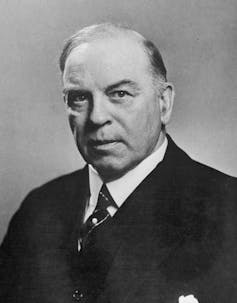
A black and white photo of a middle-aged white man
A portrait of William Lyon Mackenzie King in 1942.
(Dutch National Archives)

This transformation was driven by William Lyon Mackenzie King’s government, which took control of the economy in the form of a publicly funded and a directed supply-side industrial policy. Resources and labour were channelled to produce for the war effort and the core needs of the community.

Twenty-eight Crown corporations were established, factories multiplied, corporate taxes were doubled and excess profits were taxed, generating revenue for these investments.

Canada’s ‘Golden Age’

The decades that followed the Second World War from the 1940s through to the early 1970s is often referred to as the Canadian “Golden Age.”

It was a time of unprecedented prosperity for Canada, characterized by rapid and stable economic growth, rising living standards, improved health outcomes, education-based upward mobility and Canada’s most income-equal period.

The extraordinary debt-to-income ratio that existed at the end of the Second World War (109 per cent) shrank to a fraction (20 per cent) as the Canadian gross domestic product expanded, driven by progressive government supply-side policy.

Public programs were not cut during this period, but expanded as spending for health care, education and welfare grew. The debt rose again as economic growth slowed after Canadian corporate tax rates were reduced by more than 50 per cent between 1960 and 2020, while corporate prerogatives replaced industrial strategy.

The Carney promise

Only weeks after the April 28 federal election, the newly re-minted finance minister, Françoise-Philippe Champagne, indicated that wartime industrial policies were serving as at least a reference point for the Liberal government.

“When I look at 2025, it reminds me of 1945, where C.D. Howe kind of reinvented modern industrial Canada. It’s one of these moments in history where we’re really rebuilding the nation,” he said.

Champagne was referring to Canada’s wartime industry minister, C.D. Howe, who implemented the War Measures Act in 1939 and the War Appropriation Act to rapidly industrialize the Canadian economy. In Howe’s words: “If private industry cannot or will not do the job, then the state must step in. The need is too great to wait.”

Today, Canada’s current private for-profit sector is a notorious laggard when it comes to research, development and investment compared to its G20 and OECD counterparts. Canadian companies are currently holding $727 billion in cash deposits, a situation once called out by Prime Minister Mark Carney as “dead money.”

The collapse of Canada’s corporate-led free trade and deep-integration model with the U.S. has presented a window of opportunity to influence a state-led, national industrial policy.

Does Carney’s budget come to the rescue?

The 2025 budget includes several important investment plans, including the new Build Canada Homes agency, science research and development, clean technology manufacturing, transit and health-care infrastructure, and digital transformation programs.

However, the Canada Strong budget remains too small in scale and relies far too much on indirect incentives for private-sector investment. These measures may or may not materialize, given the tariff threats and profit opportunities south of the border.

The budget’s claims of generational increases in investment — much of which was announced before budget day — appear to be more optics than anything meaningful.

The only significant new corporate tax measure, the “productivity super-deduction,” is tied directly to investment spending in targeted industries, and is a model supported by many progressive economists.

Canada needs to meet the moment

It’s worth remembering that the Mackenzie King government raised corporate taxes to finance direct investment. The higher tax rate corporations paid during the Golden Age were used to fund targeted investments and the expansion of Canada’s care economy, which in turn contributed not only to the welfare of the Canadian population, but also productivity growth in the economy.

By contrast, the 2025 budget provides modest increases to total public investment, but does not meet the challenge of the moment, despite the exaggerated narrative of a generational investment in Canada’s future.

A greater scale of investment and conditionality imposed on the private sector would make Canada a leader in green energy, sustainable agriculture, green transportation, biotechnology and a resilient and digitized, high valuated economy. Canada is now embroiled in a full scale economic war and needs to respond accordingly.

The Conversation

Robert Chernomas is a Professor of Economics at the University of Manitoba and a member of Elbows Up: A Practical Program for Canadian Sovereignty. I am not affiliated with a political party or industry association but I am politically active.

ref. Why the 2025 federal budget won’t really make Canada strong – https://theconversation.com/why-the-2025-federal-budget-wont-really-make-canada-strong-268984

Zohran Mamdani’s win shows how multilingualism bridges divides in diverse democracies

Source: The Conversation – Canada – By Kashif Raza, Postdoctoral Fellow, Faculty of Education, University of British Columbia

When Zohran Mamdani campaigned for New York City mayor, he didn’t sound like a typical American politician, speaking only English at his rallies and public appearances.

Instead, he switched between Arabic, Bangla, English, Hindi, Luganda, Spanish and Urdu to connect with diverse communities. He also made appearances on transnational media outlets to discuss issues that crossed borders.

I am a post-doctoral fellow at the University of British Columbia, studying the integration patterns of immigrants and how they’re shaped by the intersection of language, ethnicity and migration.

For me, Mamdani’s story is more than a local success. It signals how politics is being reshaped by migration and multilingualism and how language itself has become a foundation of belonging in diverse democracies.

Multilingual politics

Mamdani’s campaign began with a simple but powerful line:

“It’s time to take back our power and unleash the public sector to build housing for the many.”

This message resonated across the city’s working-class neighbourhoods — taxi drivers, nurses, delivery workers and students, many of them immigrants trying to make ends meet. What made it even more effective was how he delivered it: not just in English, but in the many languages New Yorkers speak.

He repeated his call for affordability and fairness in Arabic, Bangla, Urdu-Hindi, and Spanish. His campaign videos and flyers mixed languages the way people do in everyday life, switching easily between English and the languages of home.

This was about more than translation; it was about recognition and connection with people.

New York is one of the most linguistically diverse cities in the world, with more than 800 languages spoken. Nearly 35 per cent of its residents are born outside the United States.

Mamdani understood that voters don’t leave their languages behind when they migrate. They use them to make sense of work, community and politics. By speaking to them in those languages, he showed that their voices mattered in shaping the city’s future.

Political integration

This approach reflects what scholars of migration linguistics — the study of how language and mobility shape one another in the process of migration, settlement and belonging — describe as multilingual political integration.

It is a way migrants connect identity to civic participation. Mamdani’s campaign turned that bridge into a political strategy: one that viewed multilingualism not as an obstacle to democracy, but as its living proof.

It also serves as a quiet reality check on the long-standing “melting pot” ideal in the United States, which assumes immigrants must shed their languages and traditions to blend into a single American identity.

A transnational campaign

Mamdani’s multilingual strategy also reflected the transnational reality of modern migration. His Urdu interview on Pakistan’s Geo News and his criticism of India’s Narendra Modi during conversations with Indian-origin voters in the U.S. blurred the line between domestic and global audiences.

These appearances were not campaign gimmicks; they acknowledged that diaspora communities are shaped by more than one national story.

Migration linguistics helps explain this dynamic. It studies how language practices move across borders and connect places of origin, settlement and diaspora. In Mamdani’s case, multilingual communication created what scholars call transnational publics — shared spaces of conversation that stretch from New York to Karachi and Delhi.

When a politician addresses issues such as Islamophobia, immigration or housing in multiple languages, they are not only appealing to voters at home. They are engaging with a wider world of shared experiences that migration has woven together.


Read more:
How Zohran Mamdani’s ‘talent for listening’ spurred him to victory in the New York mayoral election


Culture as communication

Language was only part of Mamdani’s strategy. His campaign also used cultural expression — food, music and festivals — as forms of communication.

From Iftar gatherings during Ramadan to Diwali celebrations and South Asian street fairs, these events became spaces of multilingual interaction where taste, sound, and ritual carried political meaning.

Migration linguistics views such practices as intercultural competence: the use of cultural forms to express belonging and solidarity.

Mamdani’s campaign showed that civic participation doesn’t only happen in speeches or debates; it also happens in shared meals, songs and celebrations that remind people they belong to the same city.

Lessons for Canada

Mamdani’s brand of of politics holds lessons for Canada. Since I wrote on this topic earlier this year, immigrant and racialized voters are already changing how campaigns are organized and how communities mobilize.


Read more:
How racialized voters are reshaping Canadian politics through digital networks


Canada’s largest cities, in particular Toronto and Vancouver, are among the most linguistically diverse in the world. Yet a lot of political outreach still assumes an English- or French-only audience.

Mamdani’s campaign suggests another path. By engaging multilingual voters through their languages, stories and digital networks, politicians can build deeper, more authentic relationships.

It’s time for Canadian politicians to move beyond teleprompters and translators and learn and use minority languages as a genuine way to connect with multilingual voters as they make up a significant portion of the electorate.

The Conversation

Kashif Raza receives funding from the Social Sciences and Humanities Research Council (SSHRC) of Canada.

ref. Zohran Mamdani’s win shows how multilingualism bridges divides in diverse democracies – https://theconversation.com/zohran-mamdanis-win-shows-how-multilingualism-bridges-divides-in-diverse-democracies-269232

Why we used to sleep in two segments

Source: Radio New Zealand

For most of human history, a continuous eight-hour snooze was not the norm.

Instead, people commonly slept in two shifts each night, often called a “first sleep” and “second sleep.” Each of these sleeps lasted several hours, separated by a gap of wakefulness for an hour or more in the middle of the night. Historical records from Europe, Africa, Asia and beyond describe how, after nightfall, families would go to bed early, then wake around midnight for a while before returning to sleep until dawn.

Breaking the night into two parts probably changed how time felt. The quiet interval gave nights a clear middle, which can make long winter evenings feel less continuous and easier to manage.

The midnight interval was not dead time; it was noticed time, which shapes how long nights are experienced. Some people would get up to tend to chores like stirring the fire or checking on animals. Others stayed in bed to pray or contemplate dreams they’d just had. Letters and diaries from pre-industrial times mention people using the quiet hours to read, write or even socialise quietly with family or neighbours. Many couples took advantage of this midnight wakefulness for intimacy.

Literature from as far back as ancient Greek poet Homer and Roman poet Virgil contains references to an “hour which terminates the first sleep,” indicating how commonplace the two-shift night was.

How we lost the ‘second sleep’

The disappearance of the second sleep happened over the past two centuries due to profound societal changes. Artificial lighting is one of them. In the 1700s and 1800s, first oil lamps, then gas lighting, and eventually electric light, began turning night into more usable waking time. Instead of going to bed shortly after sunset, people started staying up later into the evening under lamplight.

Biologically, bright light at night also shifted our internal clocks (our circadian rhythm) and made our bodies less inclined to wake after a few hours of sleep. Light timing matters. Ordinary “room” light before bedtime suppresses and delays melatonin, which pushes the onset of sleep later.

The Industrial Revolution transformed not just how people worked but how they slept. Factory schedules encouraged a single block of rest. By the early 20th century, the idea of eight uninterrupted hours had replaced the centuries-old rhythm of two sleeps.

In multi-week sleep studies that simulate long winter nights in darkness and remove clocks or evening light, people in lab studies often end up adopting two sleeps with a calm waking interval. A 2017 study of a Madagascan agricultural community without electricity found people still mostly slept in two segments, rising at about midnight.

Long, dark winters

Light sets our internal clock and influences how fast we feel time passing. When those cues fade, as in winter or under artificial lighting, we drift.

In winter, later and weaker morning light makes circadian alignment harder. Morning light is particularly important for regulating circadian rhythms because it contains a higher amount of blue light, which is the most effective wavelength for stimulating the body’s production of cortisol and suppressing melatonin.

In time-isolation labs and cave studies, people have lived for weeks without natural light or clocks, or even lived in constant darkness. Many people in these studies miscounted the passing of days, showing how easily time slips without light cues.

Similar distortions occur in the polar winter, where the absence of sunrise and sunset can make time feel suspended. People native to high latitudes, and long-term residents with stable routines, often cope better with polar light cycles than short-term visitors, but this varies by population and context. Residents adapt better when their community shares a regular daily schedule, for instance. And a 1993 study of Icelandic populations and their descendants who emigrated to Canada found these people showed unusually low winter seasonal affective disorder (SAD) rates. The study suggested genetics may help this population cope with the long Arctic winter.

Research from the Environmental Temporal Cognition Lab at Keele University, where I am the director, shows how strong this link between light, mood and time perception is. In 360-degree virtual reality, we matched UK and Sweden scenes for setting, light level cues, and time of day. Participants viewed six clips of about two minutes. They judged the two minute intervals as lasting longer in evening or low-light scenes compared with daytime or brighter scenes. The effect was strongest in those participants who reported low mood.

A new perspective on insomnia

Sleep clinicians note that brief awakenings are normal, often appearing at stage transitions, including near REM sleep, which is associated with vivid dreaming. What matters is how we respond.

The brain’s sense of duration is elastic: anxiety, boredom, or low light tend to make time stretch, while engagement and calm can compress it. Without that interval where you got up and did something or chatted with your partner, waking at 3am often makes time feel slow. In this context, attention focuses on time and the minutes that pass may seem longer.

Cognitive behavioural therapy for insomnia (CBT-I) advises people to leave bed after about 20 minutes awake, do a quiet activity in dim light such as reading, then return when sleepy.

Sleep experts also suggest covering the clock and letting go of time measurement when you’re struggling to sleep. A calm acceptance of wakefulness, paired with an understanding of how our minds perceive time, may be the surest way to rest again.

Darren Rhodes is a Lecturer in Cognitive Psychology and Environmental Temporal Cognition Lab Director, Keele University, Keele University.

– Published by EveningReport.nz and AsiaPacificReport.nz, see: MIL OSI in partnership with Radio New Zealand

Menace terroriste en France : sur TikTok, une propagande djihadiste à portée des jeunes

Source: The Conversation – France in French (3) – By Laurène Renaut, Maîtresse de conférence au Celsa, Sorbonne Université

Dix ans après les attentats de 2015, la menace terroriste, toujours vive, s’est transformée : elle émane d’individus de plus en plus jeunes, présents sur le territoire français, sans lien avec des organisations structurées. La propagande djihadiste sur les réseaux sociaux, très facile d’accès, permettrait un « auto-endoctrinement » rapide. Entretien avec Laurène Renaut, spécialiste des cercles djihadistes en ligne.


The Conversation : Dix ans après les attentats de 2015, comment évolue la menace terroriste en France ?

Laurène Renaut : Le procureur national antiterroriste [Olivier Christen] a souligné que la menace djihadiste reste élevée et qu’elle a même tendance à croître au regard du nombre de procédures pour des contentieux djihadistes ces dernières années. Mais cette menace a muté. Elle est aujourd’hui endogène, moins commandée de l’étranger et plutôt liée à des individus inspirés par la propagande djihadiste, sans contact avec des organisations terroristes. Par ailleurs, il y a une évolution des profils depuis fin 2023 avec un rajeunissement des candidats au djihad armé. En 2023, 15 jeunes de moins de 21 ans étaient impliqués dans des projets d’attentats, 19 en 2024 et 17 en 2025. Ce phénomène de rajeunissement est européen, et pas seulement français. La seconde mutation réside dans une forme d’autoradicalisation de ces jeunes qui ne vont pas forcément avoir besoin de contacts avec les organisations terroristes pour exprimer des velléités de passage à l’acte au contact de la propagande djihadiste en ligne.

Enfin, ce qui semble se dessiner, ce sont des formes de basculement très rapides, que l’on n’observait pas il y a quelques années. Lorsque j’ai commencé mon travail de thèse, fin 2017, la radicalisation s’inscrivait sur du long terme, avec de nombreuses étapes, un environnement familial, des rencontres, des échanges en ligne. Or là, depuis fin 2023 début 2024, le délai entre le moment où ces jeunes commencent à consommer de la propagande en ligne et le moment où certains décident de participer à des actions violentes semble de plus en plus court.

Comment arrivez-vous à ces conclusions ?

L. R. : Je m’appuie ici sur les données fournies par le parquet national antiterroriste ainsi que sur des échanges avec des acteurs de terrain et professionnels de la radicalisation. Mon travail, depuis huit ans, consiste à analyser l’évolution des djihadosphères (espaces numériques où y est promu le djihad armé), sur des réseaux comme Facebook, X ou TikTok. En enquêtant sur ces communautés numériques djihadistes, j’essaie de comprendre comment les partisans de l’Organisation de l’État islamique parviennent à communiquer ensemble, malgré la surveillance des plateformes. Comment ils et elles se reconnaissent et interagissent ? Quels moyens ils déploient pour mener le « djihad médiatique » qu’ils considèrent comme essentiel pour défendre leur cause ?

Quels sont les profils des jeunes radicalisés dont on parle ?

L. R. : On sait que la radicalisation, quelle qu’elle soit, est un phénomène multifactoriel. Il n’y pas donc pas de profil type, mais des individus aux parcours variés, des jeunes scolarisés comme en décrochage scolaire, d’autres qui ont des problématiques familiales, traumatiques, identitaires ou de santé mentale. On retrouve néanmoins un dénominateur commun : une connexion aux réseaux sociaux. Et il est possible de faire un lien entre cette hyperconnexion aux réseaux, où circulent les messages djihadistes, et la forme d’autoradicalisation observée. On n’a plus besoin de rencontrer un ami qui va nous orienter vers un prêche ou un recruteur : il est aujourd’hui relativement facile d’accéder à des contenus djihadistes en ligne, voire d’en être submergé.

Peut-on faire un lien entre le rajeunissement et la présence des jeunes sur les réseaux sociaux ?

L. R. : Les organisations terroristes ont toujours eu tendance à cibler des jeunes pour leur énergie, leur combativité, parce qu’ils sont des proies manipulables aussi, en manque de repères, sensibles aux injustices et, bien sûr, aujourd’hui familiers des codes de la culture numérique. On sait aussi que les jeux vidéo sont devenus des portes d’entrée pour les recruteurs. Sur Roblox, par exemple, il est possible de harponner ces jeunes ou de les faire endosser des rôles de combattants en les faisant participer à des reconstitutions de batailles menées par l’État islamique en zone irako-syrienne.

Ce qu’on appelle l’enfermement algorithmique, c’est-à-dire le fait de ne recevoir qu’un type de contenu sélectionné par l’algorithme, joue-t-il un rôle dans ces évolutions ?

L. R. : Oui certainement. Sur TikTok, c’est assez spectaculaire. Aujourd’hui, si j’y tape quelques mots clés, que je regarde trois minutes d’une vidéo labellisée État islamique et que je réitère ce comportement, en quelques heures on ne me propose plus que du contenu djihadiste. Ce n’était pas du tout le cas lorsque je faisais ma thèse sur Facebook. Là, [sur TikTok,] je n’ai pas besoin de chercher, les contenus djihadistes viennent à moi.

Les réseaux sociaux sont censés lutter activement contre les contenus de propagande terroriste. Ce n’est donc pas le cas ?

L. R. : Ce que j’observe, c’est que la durée de vie de certains contenus violents sur TikTok reste importante et que des centaines de profils appelants au djihad armé et suivis par de larges communautés parviennent à maintenir une activité en ligne. Les spécialistes de la modération mettent en évidence que les contenus de nature pédocriminelle ou terroriste sont actuellement les mieux nettoyés et bénéficient d’une attention particulière des plateformes, mais celles-ci n’en demeurent pas moins submergées, ce qui explique que de nombreux contenus passent sous les radars. Sans compter que les partisans de l’État islamique déploient une certaine créativité, et même un savoir-faire, pour faire savoir qu’ils sont « là » sans se faire voir. Quand je tape « ma vengeance » par exemple (titre d’un chant djihadiste qui rend hommage aux terroristes du 13 novembre 2015), il est tout à fait possible, encore aujourd’hui, de retrouver des extraits de ce chant particulièrement violent. S’il est toujours présent en ligne, comme d’autres contenus de propagande, c’est parce que les militants djihadistes trouvent des astuces pour recycler d’anciens contenus et déjouer les stratégies de détection des plateformes (langage codé, brouillage du son et camouflage des images par exemple, afin d’éviter une reconnaissance automatique).

Le contenu de la propagande djihadiste sur les réseaux sociaux a-t-il évolué depuis 2015 ?

L. R. : En 2015, l’Organisation de l’État islamique avait encore une force de frappe importante en termes de propagande numérique. Puis elle est défaite militairement en Syrie et en Irak, en 2017, et on observe une nette baisse de la production de propagande. Mais il y a eu une certaine détermination chez ses partisans à rester en ligne, comme si les espaces numériques étaient des prolongements du champ de bataille militaire. Ont alors émergé des tactiques de camouflage et des incitations à une forme de résistance ou de patience avec une vision de long terme du combat pour « la cause ». L’objectif pour ces cybermilitants était d’être à la fois visibles pour leur réseau et invisible des « surveillants », tapis dans l’ombre mais prêts à agir le moment opportun.

Puis on note un pic d’activité de propagande qui coïncide aux massacres perpétrés par le Hamas, le 7 octobre 2023, en Israël. Il faut préciser que l’Organisation de l’État islamique est ennemie du Hamas qu’elle considère comme un groupe de faux musulmans (ou apostats). Néanmoins, le 7-Octobre a été un moment d’euphorie collective dans les djihadosphères, avec la volonté pour l’État islamique de promouvoir ses militants comme les seuls « vrais moudjahidine » (combattants pour la foi).

Aujourd’hui, dans les djihadosphères, cohabitent des contenus ultraviolents (formats courts) que certains jeunes consomment de manière frénétique et des contenus théoriques qui nécessitent une plus grande accoutumance à l’idéologie djihadiste.

Quels sont les principaux contenus des échanges de djihadistes sur les réseaux que vous étudiez ?

L. R. : On trouve des vidéos violentes, mais de nombreux contenus ne sont pas explicitement ou visuellement violents. Ils visent à enseigner le comportement du « vrai musulman » et à condamner les « faux musulmans » à travers le takfir (acte de langage qui consiste à déclarer mécréant une personne ou un groupe de personnes). Dans sa conception salafiste djihadiste, cette accusation de mécréance équivaut à la fois à une excommunication de l’islam et à un permis de tuer – puisque le sang du mécréant est considéré comme licite.

La grande question, que l’on retrouve de manière obsessionnelle, c’est « Comment être un vrai musulman ? Comment pratiquer le takfir ? Et comment éviter d’en être la cible ? » Pour l’État islamique et ses partisans, il y a les « vrais musulmans » d’un côté et les « faux musulmans » (apostats) ou les non-musulmans (mécréants) de l’autre. Il n’y a pas de zone grise ni de troisième voie. La plupart des débats dans les djihadosphères portent donc sur les frontières de l’islamité (l’identité musulmane) : à quelles actions est-elle conditionnée et qu’est-ce qui entraîne sa suspension ?

« Est-ce que je pratique l’islam comme il le faut ? Si je fais telle prière, si je parle à telle personne (à mes parents ou à mes amis qui ne sont pas musulmans, par exemple), est-ce que je suis encore musulman ? » Telles sont, parmi d’autres, les sources de préoccupation des acteurs de ces djihadosphères, la question identitaire étant centrale chez les jeunes concernés.

Dans cette propagande, il y a un lien très fort entre le fait de se sentir marginalisé et l’appartenance au « vrai islam »…

L. R. : Effectivement, un autre concept majeur, connecté au concept de takfir, c’est celui d’étrangeté (ghurba). Dans la propagande djihadiste, le « vrai musulman » est considéré comme un « étranger » et désigné comme tel.

Ce concept, qui n’est pas présent dans le Coran, renvoie à un hadith (recueil des actes et des déclarations du prophète Muhammad), qui attribue ces paroles au prophète Muhammed : « L’islam a commencé étranger et il redeviendra étranger, heureux soient les étrangers. » Pour l’expliquer brièvement, si l’islam a commencé étranger, c’est qu’il a d’abord été, tout comme ses premiers adeptes, incompris. En effet, ceux qui adhèrent à cette religion à l’époque et qui ont suivi le prophète lors de l’Hégire sont perçus comme des marginaux ou des fous et sont même réprimés.

Mais progressivement le message de Muhammed s’étend, et l’islam devient la norme dans une grande partie du monde ; les musulmans cessant d’y être perçus comme étranges ou anormaux. Selon la tradition prophétique, c’est à ce moment-là, quand la nation musulmane grandit, que les « vrais croyants » se diluent dans une masse de mécréants et de « faux musulmans » corrompus.

Aujourd’hui, l’État islamique s’appuie sur ce hadith pour dire que si on se sent étranger à cette terre de mécréance, à l’Occident, à sa propre famille, c’est qu’on est certainement sur le chemin du véritable islam. Leurs propagandistes se nourrissent d’une littérature apocalyptique qui met sur le même plan ces « étrangers » et « la secte sauvée » (al-firqah an-najiyah), le groupe de croyants qui combattra les mécréants jusqu’au Jugement dernier et qui, seul parmi les 73 factions de l’islam, gagnera le paradis.

Leur message est clair : aujourd’hui les « vrais musulmans » sont en minorité, marginalisés et mis à l’épreuve mais eux seuls accéderont au paradis. Cette rhétorique de l’étrangeté est centrale dans le discours djihadiste en ligne. Sur TikTok, on lit beaucoup de messages du type : « Si tu te sens seul ou rejeté, si personne ne te comprend, c’est peut-être parce que tu es un étranger, un “vrai musulman” appelé ici à combattre. »

The Conversation

Laurène Renaut ne travaille pas, ne conseille pas, ne possède pas de parts, ne reçoit pas de fonds d’une organisation qui pourrait tirer profit de cet article, et n’a déclaré aucune autre affiliation que son organisme de recherche.

ref. Menace terroriste en France : sur TikTok, une propagande djihadiste à portée des jeunes – https://theconversation.com/menace-terroriste-en-france-sur-tiktok-une-propagande-djihadiste-a-portee-des-jeunes-269222

Menace terroriste en France : sur TikTok, la propagande djihadiste en quelques clics

Source: The Conversation – France in French (3) – By Laurène Renaut, Maîtresse de conférence au Celsa, Sorbonne Université

Dix ans après les attentats de 2015, la menace terroriste, toujours vive, s’est transformée : elle émane d’individus de plus en plus jeunes, présents sur le territoire français, sans lien avec des organisations structurées. La propagande djihadiste sur les réseaux sociaux, très facile d’accès, permettrait un « auto-endoctrinement » rapide. Entretien avec Laurène Renaut, spécialiste des cercles djihadistes en ligne.


The Conversation : Dix ans après les attentats de 2015, comment évolue la menace terroriste en France ?

Laurène Renaut : Le procureur national antiterroriste [Olivier Christen] a souligné que la menace djihadiste reste élevée et qu’elle a même tendance à croître au regard du nombre de procédures pour des contentieux djihadistes ces dernières années. Mais cette menace a muté. Elle est aujourd’hui endogène, moins commandée de l’étranger et plutôt liée à des individus inspirés par la propagande djihadiste, sans contact avec des organisations terroristes. Par ailleurs, il y a une évolution des profils depuis fin 2023 avec un rajeunissement des candidats au djihad armé. En 2023, 15 jeunes de moins de 21 ans étaient impliqués dans des projets d’attentats, 19 en 2024 et 17 en 2025. Ce phénomène de rajeunissement est européen, et pas seulement français. La seconde mutation réside dans une forme d’autoradicalisation de ces jeunes qui ne vont pas forcément avoir besoin de contacts avec les organisations terroristes pour exprimer des velléités de passage à l’acte au contact de la propagande djihadiste en ligne.

Enfin, ce qui semble se dessiner, ce sont des formes de basculement très rapides, que l’on n’observait pas il y a quelques années. Lorsque j’ai commencé mon travail de thèse, fin 2017, la radicalisation s’inscrivait sur du long terme, avec de nombreuses étapes, un environnement familial, des rencontres, des échanges en ligne. Or là, depuis fin 2023 début 2024, le délai entre le moment où ces jeunes commencent à consommer de la propagande en ligne et le moment où certains décident de participer à des actions violentes semble de plus en plus court.

Comment arrivez-vous à ces conclusions ?

L. R. : Je m’appuie ici sur les données fournies par le parquet national antiterroriste ainsi que sur des échanges avec des acteurs de terrain et professionnels de la radicalisation. Mon travail, depuis huit ans, consiste à analyser l’évolution des djihadosphères (espaces numériques où y est promu le djihad armé), sur des réseaux comme Facebook, X ou TikTok. En enquêtant sur ces communautés numériques djihadistes, j’essaie de comprendre comment les partisans de l’Organisation de l’État islamique parviennent à communiquer ensemble, malgré la surveillance des plateformes. Comment ils et elles se reconnaissent et interagissent ? Quels moyens ils déploient pour mener le « djihad médiatique » qu’ils considèrent comme essentiel pour défendre leur cause ?

Quels sont les profils des jeunes radicalisés dont on parle ?

L. R. : On sait que la radicalisation, quelle qu’elle soit, est un phénomène multifactoriel. Il n’y pas donc pas de profil type, mais des individus aux parcours variés, des jeunes scolarisés comme en décrochage scolaire, d’autres qui ont des problématiques familiales, traumatiques, identitaires ou de santé mentale. On retrouve néanmoins un dénominateur commun : une connexion aux réseaux sociaux. Et il est possible de faire un lien entre cette hyperconnexion aux réseaux, où circulent les messages djihadistes, et la forme d’autoradicalisation observée. On n’a plus besoin de rencontrer un ami qui va nous orienter vers un prêche ou un recruteur : il est aujourd’hui relativement facile d’accéder à des contenus djihadistes en ligne, voire d’en être submergé.

Peut-on faire un lien entre le rajeunissement et la présence des jeunes sur les réseaux sociaux ?

L. R. : Les organisations terroristes ont toujours eu tendance à cibler des jeunes pour leur énergie, leur combativité, parce qu’ils sont des proies manipulables aussi, en manque de repères, sensibles aux injustices et, bien sûr, aujourd’hui familiers des codes de la culture numérique. On sait aussi que les jeux vidéo sont devenus des portes d’entrée pour les recruteurs. Sur Roblox, par exemple, il est possible de harponner ces jeunes ou de les faire endosser des rôles de combattants en les faisant participer à des reconstitutions de batailles menées par l’État islamique en zone irako-syrienne.

Ce qu’on appelle l’enfermement algorithmique, c’est-à-dire le fait de ne recevoir qu’un type de contenu sélectionné par l’algorithme, joue-t-il un rôle dans ces évolutions ?

L. R. : Oui certainement. Sur TikTok, c’est assez spectaculaire. Aujourd’hui, si j’y tape quelques mots clés, que je regarde trois minutes d’une vidéo labellisée État islamique et que je réitère ce comportement, en quelques heures on ne me propose plus que du contenu djihadiste. Ce n’était pas du tout le cas lorsque je faisais ma thèse sur Facebook. Là, [sur TikTok,] je n’ai pas besoin de chercher, les contenus djihadistes viennent à moi.

Les réseaux sociaux sont censés lutter activement contre les contenus de propagande terroriste. Ce n’est donc pas le cas ?

L. R. : Ce que j’observe, c’est que la durée de vie de certains contenus violents sur TikTok reste importante et que des centaines de profils appelants au djihad armé et suivis par de larges communautés parviennent à maintenir une activité en ligne. Les spécialistes de la modération mettent en évidence que les contenus de nature pédocriminelle ou terroriste sont actuellement les mieux nettoyés et bénéficient d’une attention particulière des plateformes, mais celles-ci n’en demeurent pas moins submergées, ce qui explique que de nombreux contenus passent sous les radars. Sans compter que les partisans de l’État islamique déploient une certaine créativité, et même un savoir-faire, pour faire savoir qu’ils sont « là » sans se faire voir. Quand je tape « ma vengeance » par exemple (titre d’un chant djihadiste qui rend hommage aux terroristes du 13 novembre 2015), il est tout à fait possible, encore aujourd’hui, de retrouver des extraits de ce chant particulièrement violent. S’il est toujours présent en ligne, comme d’autres contenus de propagande, c’est parce que les militants djihadistes trouvent des astuces pour recycler d’anciens contenus et déjouer les stratégies de détection des plateformes (langage codé, brouillage du son et camouflage des images par exemple, afin d’éviter une reconnaissance automatique).

Le contenu de la propagande djihadiste sur les réseaux sociaux a-t-il évolué depuis 2015 ?

L. R. : En 2015, l’Organisation de l’État islamique avait encore une force de frappe importante en termes de propagande numérique. Puis elle est défaite militairement en Syrie et en Irak, en 2017, et on observe une nette baisse de la production de propagande. Mais il y a eu une certaine détermination chez ses partisans à rester en ligne, comme si les espaces numériques étaient des prolongements du champ de bataille militaire. Ont alors émergé des tactiques de camouflage et des incitations à une forme de résistance ou de patience avec une vision de long terme du combat pour « la cause ». L’objectif pour ces cybermilitants était d’être à la fois visibles pour leur réseau et invisible des « surveillants », tapis dans l’ombre mais prêts à agir le moment opportun.

Puis on note un pic d’activité de propagande qui coïncide aux massacres perpétrés par le Hamas, le 7 octobre 2023, en Israël. Il faut préciser que l’Organisation de l’État islamique est ennemie du Hamas qu’elle considère comme un groupe de faux musulmans (ou apostats). Néanmoins, le 7-Octobre a été un moment d’euphorie collective dans les djihadosphères, avec la volonté pour l’État islamique de promouvoir ses militants comme les seuls « vrais moudjahidine » (combattants pour la foi).

Aujourd’hui, dans les djihadosphères, cohabitent des contenus ultraviolents (formats courts) que certains jeunes consomment de manière frénétique et des contenus théoriques qui nécessitent une plus grande accoutumance à l’idéologie djihadiste.

Quels sont les principaux contenus des échanges de djihadistes sur les réseaux que vous étudiez ?

L. R. : On trouve des vidéos violentes, mais de nombreux contenus ne sont pas explicitement ou visuellement violents. Ils visent à enseigner le comportement du « vrai musulman » et à condamner les « faux musulmans » à travers le takfir (acte de langage qui consiste à déclarer mécréant une personne ou un groupe de personnes). Dans sa conception salafiste djihadiste, cette accusation de mécréance équivaut à la fois à une excommunication de l’islam et à un permis de tuer – puisque le sang du mécréant est considéré comme licite.

La grande question, que l’on retrouve de manière obsessionnelle, c’est « Comment être un vrai musulman ? Comment pratiquer le takfir ? Et comment éviter d’en être la cible ? » Pour l’État islamique et ses partisans, il y a les « vrais musulmans » d’un côté et les « faux musulmans » (apostats) ou les non-musulmans (mécréants) de l’autre. Il n’y a pas de zone grise ni de troisième voie. La plupart des débats dans les djihadosphères portent donc sur les frontières de l’islamité (l’identité musulmane) : à quelles actions est-elle conditionnée et qu’est-ce qui entraîne sa suspension ?

« Est-ce que je pratique l’islam comme il le faut ? Si je fais telle prière, si je parle à telle personne (à mes parents ou à mes amis qui ne sont pas musulmans, par exemple), est-ce que je suis encore musulman ? » Telles sont, parmi d’autres, les sources de préoccupation des acteurs de ces djihadosphères, la question identitaire étant centrale chez les jeunes concernés.

Dans cette propagande, il y a un lien très fort entre le fait de se sentir marginalisé et l’appartenance au « vrai islam »…

L. R. : Effectivement, un autre concept majeur, connecté au concept de takfir, c’est celui d’étrangeté (ghurba). Dans la propagande djihadiste, le « vrai musulman » est considéré comme un « étranger » et désigné comme tel.

Ce concept, qui n’est pas présent dans le Coran, renvoie à un hadith (recueil des actes et des déclarations du prophète Muhammad), qui attribue ces paroles au prophète Muhammed : « L’islam a commencé étranger et il redeviendra étranger, heureux soient les étrangers. » Pour l’expliquer brièvement, si l’islam a commencé étranger, c’est qu’il a d’abord été, tout comme ses premiers adeptes, incompris. En effet, ceux qui adhèrent à cette religion à l’époque et qui ont suivi le prophète lors de l’Hégire sont perçus comme des marginaux ou des fous et sont même réprimés.

Mais progressivement le message de Muhammed s’étend, et l’islam devient la norme dans une grande partie du monde ; les musulmans cessant d’y être perçus comme étranges ou anormaux. Selon la tradition prophétique, c’est à ce moment-là, quand la nation musulmane grandit, que les « vrais croyants » se diluent dans une masse de mécréants et de « faux musulmans » corrompus.

Aujourd’hui, l’État islamique s’appuie sur ce hadith pour dire que si on se sent étranger à cette terre de mécréance, à l’Occident, à sa propre famille, c’est qu’on est certainement sur le chemin du véritable islam. Leurs propagandistes se nourrissent d’une littérature apocalyptique qui met sur le même plan ces « étrangers » et « la secte sauvée » (al-firqah an-najiyah), le groupe de croyants qui combattra les mécréants jusqu’au Jugement dernier et qui, seul parmi les 73 factions de l’islam, gagnera le paradis.

Leur message est clair : aujourd’hui les « vrais musulmans » sont en minorité, marginalisés et mis à l’épreuve mais eux seuls accéderont au paradis. Cette rhétorique de l’étrangeté est centrale dans le discours djihadiste en ligne. Sur TikTok, on lit beaucoup de messages du type : « Si tu te sens seul ou rejeté, si personne ne te comprend, c’est peut-être parce que tu es un étranger, un “vrai musulman” appelé ici à combattre. »

The Conversation

Laurène Renaut ne travaille pas, ne conseille pas, ne possède pas de parts, ne reçoit pas de fonds d’une organisation qui pourrait tirer profit de cet article, et n’a déclaré aucune autre affiliation que son organisme de recherche.

ref. Menace terroriste en France : sur TikTok, la propagande djihadiste en quelques clics – https://theconversation.com/menace-terroriste-en-france-sur-tiktok-la-propagande-djihadiste-en-quelques-clics-269222