Threatening diversity, threatening growth: the business effects of Trump’s anti-DEI and anti-trans agendas

Source: The Conversation – France – By Matteo Winkler, Professeur associé en droit et fiscalité, HEC Paris Business School

Recent months have seen a dramatic shift in US policies on diversity, equity, and inclusion (DEI). These changes carry deep economic consequences. President Donald Trump’s executive orders aim to ban DEI initiatives in federal agencies and contractors, and private companies have felt pressure to weaken or drop their DEI programmes. Trump has framed what was once a corporate safeguard against discrimination as “illegal and immoral”, marking a stark reversal in legal and business norms. Federal judges have blocked some of Trump’s orders, or elements of them, and some legal processes are ongoing.

Transgender rights have become a lightning rod in this shifting landscape. The barrage of federal directives seeks to challenge – or outright eliminate – protections in areas ranging from health care to education to the military. Beyond the immediate harm to trans individuals, these policies pose threats to multinational companies that have long defended inclusive workplace values. Their leaders must now navigate a cultural minefield where staying silent risks public backlash, while openly supporting trans employees can invite legal and political complications. The business repercussions of this moral issue could affect everything from brand reputation to talent retention.

A weekly e-mail in English featuring expertise from scholars and researchers. It provides an introduction to the diversity of research coming out of the continent and considers some of the key issues facing European countries. Get the newsletter!

The economic imperative of DEI initiatives

There is a growing ensemble of research suggesting that DEI policies are not just nice-to-have but a corporate imperative. This year, the World Economic Forum reported that organizations that include DEI in their core business strategies improve performance, innovation and employee satisfaction. These findings are in line with other studies, which have consistently demonstrated that inclusive workplaces not only attract top talent but perform better financially and have higher returns on assets and net income.

With regard to people identifying as LGBTI+, a 2024 report by the Organization for Economic Co-operation and Development highlighted that inclusive policies enable LGBTI+ individuals to achieve their full employment and productivity potential, benefiting both their well-being and society at large. Moreover, according to Open for Business, a think tank whose mission is making a case for LGBTQ+ inclusion in private and public settings, companies with “larger LGBTQ+ workforce benefit from diverse perspectives but also foster environments where innovation and productivity thrive”. It has also been found that human rights violations against LGBTI+ people diminish economic output at the micro level, suggesting that inclusive societies are more likely to experience robust economic growth.


À lire aussi :
Business schools are facing challenges to their diversity commitments. They must reinforce them to train leaders effectively


Research has also shown that trans-inclusive business practices have long been associated with innovation, employee satisfaction and market competitiveness. Companies that provide gender-neutral bathroom access, introduce the inclusive use of pronouns and support employees’ gender transitions have been proven to foster relational authenticity in the workplace.

Discrimination and exclusion, by contrast, not only harm individuals but also impede economic growth by limiting the available talent pool and reducing overall productivity. In September 2024, the American Civil Liberties Union (ACLU) reported that “laws and policies designed to restrict or prevent access or supports for transgender and nonbinary people” endanger LGBTQ+ individuals and their allies, leading to increased fear, lack of safety and a rise in anti-LGBTQ+ violence. More generally, these laws and policies can also deter businesses from investing in regions perceived as discriminatory. Also in September, the Movement Advancement Project identified that the lack of legal protection against discrimination contributes to economic instability for LGBTQ+ families, which can lead to wage gaps, job insecurity and reduced access to benefits, ultimately contributing to reduced consumer spending and lower economic participation.

Language targeting trans rights and visibility

Despite the benefits of DEI initiatives, the current US administration has sought to enact several policies aimed at dismantling them, resulting in organizations, both public and private, to suspend funding for DEI and outreach programmes. In Trump’s executive orders, anything – policy, programme or initiative – related to or benefitting trans people in access to healthcare, academic research, scientific inquiry, school policies, personal safety, participation in sports, and military service is now rejected as “gender ideology extremism”.

Targeting sports, education and the military is functional to an ideological battle aimed at erasing spaces where trans people are most vulnerable. These spaces are also formative arenas in shaping national identity and the public perception of DEI initiatives. When they become politicized, they can also affect how businesses frame their values, manage risks and engage with their different stakeholders.


À lire aussi :
Anti-DEI guidance from Trump administration misinterprets the law and guts educators’ free speech rights


The anti-trans executive orders begin by redefining the term “sex” for interpretations of federal law. According to the text of “Defending Women from Gender Ideology Extremism and Restoring Biological Truth to Federal Government”, a person is either male or female, which is determined by their reproductive cells at conception – a definition in which biology takes precedence over individual rights and legal protections. “Keeping Men Out of Women’s Sports” weaponizes this “biological truth” by threatening to cut off federal funds to schools that allow trans athletes to participate in them. “Prioritizing Military Excellence and Readiness” equates being transgender with medical or physical incapacity despite no evidence suggesting that trans service members negatively impact military readiness. “Ending Radical Indoctrination in K-12 Schooling” seeks to prevent schools from teaching about gender identity, which would strip trans youth of critical support systems. And “Protecting Children from Chemical and Surgical Mutilation” describes gender-affirming healthcare as “destructive”.

The ripple effects of this anti-trans rhetoric extend into the private sector, compelling businesses to reevaluate their DEI strategies in fear of backlash or scrutiny. Even before the last US presidential election, companies such as Ford, Harley-Davidson and Lowe’s withdrew their participation in the Corporate Equality Index, a national benchmarking tool on corporate policies and practices related to LGBTQ+ workplace equality. In the wake of Trump’s anti-DEI and anti-trans orders, organizers of various Pride events in the US and Canada learned that some corporations, including longtime sponsors, had decided not to fund them. And according to the New York Times, some companies erased language and terms related to DEI from annual reports filed this year, including Dow Chemical, whose reference to LGBTQ+ employee resource groups disappeared from its public documents.

Navigating between inclusive values and anti-DEI pressure

Three patterns seem to be emerging on how companies are navigating the tension between values that are inclusive of LGBTI+ people and the growing pressure to scrub DEI commitments within the US context. For the moment, these patterns do not reflect formalized strategies but adaptive responses to an environment that has grown in complexity in a very short time. Some corporate actions reflect deliberate strategy aimed at protecting global consistency, while others appear more reactive, shaped by local market pressures.

The first pattern involves establishing a sort of internal firewall between US and international operations. Banco Santander provides a clear example of this approach. Thus far, it has maintained global DEI commitments such as tying executive bonuses to increased gender equality in leadership. This group stated that such targets would not be applied to countries where governmental policies target DEI. In this pattern, DEI programmes are maintained abroad but are dismantled in the US to minimize political exposure in the latter.

The second approach, observed at accounting firm Deloitte, is a cultural split between US operations and those overseas: while entities under the same global brand may still share data, practices, or strategic frameworks internally, they now adopt publicly distinct positions on DEI. Deloitte UK has remained vocal on its DEI commitments, highlighting the cultural and political fault lines that multinationals must now navigate.

The third approach is a retraction of DEI altogether. Target offers a striking example. In 2023, under increased political and consumer pressure, the company rolled back some of its LGBTQ+ inclusion efforts by reducing the number of Pride-related items for sale. In 2025, four days after Trump’s inauguration, Target announced it would “end its three-year DEI goals”, cease reporting to the Corporate Equality Index and “end a program focused on carrying more products from Black- or minority-owned businesses”, as reported by CNBC. The moves resulted in considerable public criticism, and more notably, coincided with a marked drop in foot traffic – “nearly 5 million fewer visits” over a four-week period – revealing reputational and financial risks associated with the abandoning of DEI policies. By contrast, bulk retailer Costco, which said three days after the inauguration that its shareholders voted against a proposal seen as unfriendly to the company’s DEI programmes, “saw nearly 7.7 million more visits” during that same stretch.


À lire aussi :
A boycott campaign fuels tension between Black shoppers and Black-owned brands – evoking the long struggle for ‘consumer citizenship’


In light of the evidence, it is clear that undermining DEI initiatives poses substantial risks – not just to human dignity, but to economic competitiveness. Businesses and policymakers must recognize that DEI is not merely a social or ethical imperative but a core strategy for growth and innovation. By fostering environments where all individuals can thrive, we unlock the full potential of our workforce and ensure sustainable economic growth.

Conversely, discriminatory policies contribute to social instability, brain drain and economic stagnation. In the United States, the rollback of DEI initiatives and the marginalization of transgender individuals threaten to erode the nation’s ability to uphold human rights and maintain business competitiveness. History demonstrates that exclusionary policies ultimately harm societies rather than strengthen them. The question remains whether the US can afford to sacrifice social stability and economic growth in pursuit of ideological battles. The evidence suggests that it cannot.

The Conversation

Matteo Winkler is a member of the Open for Business Academic Committee. He has received funding from the HEC Foundation.

Marcelle Laliberté is a member of Women in Aerospace Europe and HEC We&Men, and a contributor to the UN`s High Advisory Board on Governing AI for Humanity.

ref. Threatening diversity, threatening growth: the business effects of Trump’s anti-DEI and anti-trans agendas – https://theconversation.com/threatening-diversity-threatening-growth-the-business-effects-of-trumps-anti-dei-and-anti-trans-agendas-255040


Pope Francis and Laudato Si’: an ecological turning point for the Catholic Church

Source: The Conversation – France – By Bernard Laurent, Professeur, EM Lyon Business School

In Laudato Si’, Pope Francis called for a radical break with consumerist lifestyles. Ricardo Perna/Shutterstock

On May 24, 2015, Pope Francis signed his encyclical Laudato Si’ – “Praise be to you” in medieval Italian. This letter to Roman Catholic bishops was no half measure: it took many Catholics by surprise with its uncompromising conclusions and call for an in-depth transformation of our lifestyles. In France, it managed to bring together both conservative currents – such as the Courant pour une écologie humaine (Movement for a Human Ecology), created in 2013 – and more open-minded Catholic intellectuals such as Gaël Giraud, a Jesuit and author of Produire plus, polluer moins : l’impossible découplage ? (Produce more, Pollute Less: the Impossible Decoupling?).

The Pope was taking a cue from his predecessors. Benedict XVI, John Paul II and Paul VI had also expressed concern about the dramatic effects of an abusive exploitation of nature on humanity:

“Man is suddenly becoming aware that by an ill-considered exploitation of nature he risks destroying it and becoming in his turn the victim of this degradation.”

What does Pope Francis’s encyclical teach us? And how does it reflect the Catholic Church’s vision, and his own?


A weekly e-mail in English featuring expertise from scholars and researchers. It provides an introduction to the diversity of research coming out of the continent and considers some of the key issues facing European countries. Get the newsletter!


The “green” pope

In the text, Pope Francis describes a situation in which the environment is deteriorating rapidly:

“There is […] pollution that affects everyone, caused by transport, industrial fumes, substances which contribute to the acidification of soil and water, fertilizers, insecticides, fungicides, herbicides and agrotoxins in general.” (§-20)

Laudato Si’ was published by the Vatican on June 18, 2015, a few months prior to the Paris climate conference. For the “green” pope, the aim was to raise public awareness around the challenges of global warming by creating a relational approach that included God, human beings and the Earth. It was the first time an encyclical had been devoted wholly to ecology.

In it, the Pope voiced his concern about the effects of global warming:

“Warming has effects on the carbon cycle. It creates a vicious circle which aggravates the situation even more, affecting the availability of essential resources like drinking water, energy and agricultural production in warmer regions, and leading to the extinction of part of the planet’s biodiversity.” (§-24)

Criticizing a “technocratic paradigm”

Since Pope Leo XIII’s Rerum Novarum, the various social encyclicals have consistently rejected the liberal idea of a society solely regulated by the smooth functioning of the market. The French sociologist of religion Émile Poulat summed up the Church’s position perfectly in 1977 in his book Église contre bourgeoisie. Introduction au devenir du catholicisme actuel, in which he writes that the Church “never agreed to abandon the running of the world to the blind laws of economics.”

In 2015, Pope Francis rejected technical solutions that would not truly be useful, as well as the belief in the redeeming virtues of a self-regulating market. He accused “the technocratic paradigm” of dominating humankind by subordinating the economic and political spheres to its logic (§-101). His comments are reminiscent of the unjustly forgotten French Protestant philosopher Jacques Ellul and his idea of a limitless “self-propulsion” of technology, which has become the alpha and omega of our societies.

Jacques Ellul in his office
For Jacques Ellul, technology is anything but neutral since it represents genuine power driven by its own movement.
Wikimedia, CC BY-SA

The pope’s charge against the supposed virtues of the market was spectacular. Among others, he criticized the following:

  • overconsumption in developed countries:

“Since the market tends to promote extreme consumerism in an effort to sell its products, people can easily get caught up in a whirlwind of needless buying and spending.” (§-203);

  • the glorification of profit and a self-regulating market:

“Some circles maintain that current economics and technology will solve all environmental problems.” (§-109);

  • the hypertrophy of speculative finance:

“Politics must not be subject to the economy, nor should the economy be subject to the dictates of an efficiency-driven paradigm of technocracy.” (§-189);

  • the unequal distribution of wealth in the world:

“In fact, the deterioration of the environment and of society affects the most vulnerable people on the planet: […] the gravest effects of all attacks on the environment are suffered by the poorest.” (§-48);

  • the unequal levels of development between countries, leading Francis to speak of an “ecological debt” owed by rich countries to the least developed ones (§-51).

Social justice and shrinking growth

In Francis’s words, the goals of saving the planet and social justice go hand in hand. His approach is in keeping with the work of the [economist Louis-Joseph Lebret, a Dominican, who in 1941 founded the association Économie et humanisme. Father Lebret wanted to put the economy back at the service of humankind, and work with the least economically advanced countries by championing an approach based on the virtues of local communities and regional planning.

Pope Francis, for his part, is calling for a radical break with the consumerist lifestyles of rich countries, while focusing on the development of the poorest nations (§-93). In Laudato Si’, he also wrote that developed countries’ responses seemed insufficient because of the economic interests at stake (§-54).

This brings us back to the principle of the universal destination of goods – the organizing principle of property defended by the Catholic Church’s social doctrine, which demands that goods be distributed in such a way as to enable every human being to live in dignity.

In addition to encouraging the necessary technical adjustments and sober individual practices, Pope Francis is urging citizens in developed countries not to be content with half measures deemed largely insufficient. Instead, he is calling for people to make lifestyle changes in line with the logic of slowing growth. The aim is to enable developing countries to emerge from poverty, while sparing the environment.

“Given the insatiable and irresponsible growth produced over many decades, we need also to think of containing growth by setting some reasonable limits and even retracing our steps before it is too late. […] That is why the time has come to accept decreased growth in some parts of the world, in order to provide resources for other places to experience healthy growth.” (§ -193).

Nearly 10 years on, Laudato Si’ resonates fully with our concerns. In the United States, Vice President JD Vance and Secretary of State Marco Rubio, who both identify as Catholic, would be well advised to read it anew.

The Conversation

Bernard Laurent is a member of the CFTC and of the IRES Scientific Council

ref. Pope Francis and Laudato Si’: an ecological turning point for the Catholic Church – https://theconversation.com/pope-francis-and-laudato-si-an-ecological-turning-point-for-the-catholic-church-253977

Politique énergétique : ce que les experts préconisent pour les cinq ans à venir

Source: The Conversation – France in French (2) – By Mark Olsthoorn, Postdoctoral researcher in energy economics, Grenoble École de Management (GEM)

Le panel soutient la priorité vers la décarbonation de l’énergie. Wikimedia Commons, CC BY

La nomination de Nicolas Hulot comme ministre de la transition écologique et solidaire a créé de fortes attentes concernant les engagements d’Emmanuel Macron dans la lutte contre le changement climatique. En septembre dernier, Nicolas Hulot a présenté les grandes lignes de son programme.

Il prévoit de se focaliser sur l’efficacité énergétique des bâtiments, le lancement d’appels d’offres pour la production centralisée et décentralisée d’énergies renouvelables en visant une neutralité carbone d’ici 2050, tout en luttant contre la précarité énergétique. Pour réduire les émissions du secteur de l’énergie, le ministre prévoit d’étendre et d’augmenter le prix du carbone ainsi qu’une sortie de la production d’électricité à partir du charbon, en maintenant néanmoins une dépendance de la France au nucléaire. Dans cette perspective, l’interdiction de la production d’hydrocarbures en France d’ici à 2040 a été adoptée en décembre 2017.

En lien avec ce contexte, Grenoble École de Management a demandé à son panel du Baromètre du marché de l’énergie, d’identifier quelles devraient être les trois priorités de l’administration Macron en matière de politique énergétique.

L’efficacité énergétique d’abord

Ayant pu répondre selon une liste de dix mesures, le panel se montre très majoritairement d’accord sur la priorité qui doit être accordée à l’efficacité énergétique. De plus, les experts ne s’opposent pas à l’interdiction de l’exploitation des énergies fossiles domestiques. Dans une moindre mesure, le panel soutient la priorité vers la décarbonation de l’énergie et la décentralisation de la production.

Le panel présente une faible préoccupation pour les questions de sécurité d’approvisionnement et un faible enthousiasme pour la défense du nucléaire français. Concernant les besoins de réglementation pour réduire la part du nucléaire, accélérer la transformation digitale du secteur de l’énergie et garantir une énergie compétitive, les experts ont des visions très variées.

Transition énergétique propre et sûre : augmentation du sentiment d’urgence

Il y a un an, durant les élections présidentielles, nous avions posé les mêmes questions. La distribution des réponses est très proche de celle de l’époque. Les trois priorités qui sortent renforcées sont : efficacité énergétique, réduction des émissions de carbone et décentralisation, alors que la baisse de la production nucléaire et l’exploitation d’énergies fossiles locales reculent.

Les préoccupations concernant la sécurité d’approvisionnement augmentent légèrement, possiblement en lien avec les révélations récentes de cyberattaques et de cyberguerre. Cela conduit à une augmentation du sentiment d’urgence pour la mise en place d’une transition propre et sûre, et réduit les contraintes sur le coût de l’énergie.

L’on retiendra un renforcement du consensus des experts sur les priorités énergétiques. La part des experts qui mettent en priorité l’efficacité énergétique est ainsi passée de 61% en 2014 à 74% en 2016 et 80% aujourd’hui.


Le Baromètre du marché de l’énergie conduit par Grenoble École de Management interroge (de façon anonyme) une centaine de spécialistes sur ce que devraient être les priorités de la politique énergétique des cinq prochaines années. Ces résultats sont basés sur une enquête menée en décembre 2017 et comprenant 84 participants qualifiés dans le secteur de l’énergie opérant dans l’industrie, la science, et l’administration publique en France. L’intégralité de l’étude est à retrouver ici.

La datavisualisation de cet article a été réalisée par Diane Frances.

The Conversation

Olivier CATEURA a reçu entre 2003 et 2006 des financements publics de l’ANRT (Association Nationale Recherche Technologie) et privés de Electrabel (Engie) dans le cadre d’une Convention CIFRE (Thèse de doctorat) . Par ailleurs, il est membre-auditeur de l’IHEDN (Institut des Hautes Etudes de Défense Nationale).

Mark Olsthoorn ne travaille pas, ne conseille pas, ne possède pas de parts, ne reçoit pas de fonds d’une organisation qui pourrait tirer profit de cet article, et n’a déclaré aucune autre affiliation que son organisme de recherche.

ref. Politique énergétique : ce que les experts préconisent pour les cinq ans à venir – https://theconversation.com/politique-energetique-ce-que-les-experts-preconisent-pour-les-cinq-ans-a-venir-90771

Taille, longévité, PIB : l’humanité a stagné pendant la majeure partie de son histoire

Source: The Conversation – France in French (2) – By David de la Croix, Professeur d’économie, Université catholique de Louvain (UCLouvain)

Le constat selon lequel le niveau de vie a stagné jusqu’en 1820 est-il vraiment fiable ? Uroš Jovičić/Unsplash, CC BY

Mesurer la croissance économique n’est pas une tâche facile, en particulier concernant les périodes pour lesquelles nous disposons de peu d’informations. Après la Seconde Guerre mondiale, des comptes nationaux uniformisés ont été établis dans la plupart des pays. Ils fournissent différents moyens de mesurer la production globale – le produit intérieur brut (PIB) – soit en additionnant les valeurs ajoutées de tous les secteurs de production, soit en additionnant tous les revenus distribués par ces secteurs.

À partir d’un vaste ensemble d’études historiques, l’économiste britannique Angus Maddison a proposé en 2003 des données sur le PIB par habitant au cours des deux derniers siècles, et ajouté quelques estimations ponctuelles pour les périodes antérieures. De telles estimations sont souvent critiquées, car elles se basent sur des suppositions éclairées, fondées elles-mêmes sur des tendances historiques très souvent non quantifiables. Elles ont toutefois le grand mérite de fournir les meilleures données possible compte tenu de l’information disponible à un moment donné.

Dix ans plus tard, en 2013, les économistes Jutta Bolt et Jan Luiten van Zanden ont révisé et complété le travail de Maddison en poursuivant le « Maddison Project ». Le graphique ci-dessous présente leurs estimations de l’évolution du PIB par habitant pour quelques pays développés.

Au cours du dernier millénaire, le revenu par habitant dans les pays sélectionnés a été multiplié par 32, passant de 717 dollars par personne et par année autour de l’an 1000 à 23 086 dollars en 2010. Cela contraste fortement avec le millénaire précédent, qui n’a connu quasiment aucune progression.

Les courbes montrent que le PIB a commencé à grimper autour de l’année 1820 et que ce taux d’augmentation constante s’est maintenu au cours des deux derniers siècles. L’un des principaux défis de la théorie de la croissance économique consiste à comprendre cette transition entre stagnation et croissance, et plus spécifiquement d’identifier le(s) principal(aux) facteur(s) qui ont déclenché ce décollage.

Alors, le constat selon lequel le niveau de vie a stagné jusqu’en 1820 est-il vraiment fiable ? Cette question est particulièrement légitime, étant donné que l’humanité a connu d’importantes avancées technologiques – de la révolution néolithique (invention de l’agriculture) à l’invention de l’imprimerie à caractères mobiles – qui auraient pu accroître la productivité et le revenu par personne.

Deux faits corroborent l’idée qu’il y a bien eu une stagnation pendant la plus grande partie de l’histoire de l’humanité. Premièrement, les estimations de la longévité calculées sur des groupes spécifiques à travers le temps et l’espace ne montrent guère de variation avant 1700. En 2015, Omar Licandro et moi-même avons ainsi montré, en construisant une base de données répertoriant 300 000 personnes célèbres, qu’il n’y avait pas eu d’évolution de l’âge moyen au décès pendant la majeure partie de l’histoire humaine, confirmant l’existence d’une époque de stagnation malthusienne. En effet, si le niveau de vie avait augmenté régulièrement au cours de l’histoire, on aurait dû observer un accroissement de la longévité humaine, du moins jusqu’à un certain point.

Deuxièmement, la taille humaine calculée à partir des restes de squelettes existants ne montre pas non plus de progression. C’est ce qu’ont découvert la chercheuse en médecine évolutionniste Nikola Koepke et l’économiste Joerg Baten en 2005. La taille d’un adulte dépendant beaucoup de sa nutrition pendant sa jeunesse, cela indique qu’il n’y a pas eu d’amélioration systématique de la nutrition au fil du temps. Il faut attendre le XIXe siècle pour observer une évolution de la taille, comme en témoignent les données soigneusement récoltées par l’armée suédoise à propos de la taille de ses soldats.

Les trois mesures du niveau de vie proposées ici – PIB par habitant, taille et longévité – vont donc dans le même sens : celui d’une stagnation pendant la majeure partie de l’histoire de l’humanité. La croissance économique dont nous bénéficions, avec notamment ses effets positifs sur le niveau de vie mais aussi négatifs sur l’environnement, est donc un phénomène inédit et récent à l’échelle de l’histoire.


Ce billet fait partie d’une série de contributions issues du panel international sur le progrès social, une initiative universitaire internationale réunissant 300 chercheurs et universitaires – toutes sciences sociales et sciences humaines confondues – qui préparent un rapport sur les perspectives de progrès social pour le XXIe siècle. En partenariat avec The Conversation France, ces articles proposent un aperçu exclusif du contenu du rapport et des recherches de ses auteurs.

Les datavisualisations et la traduction de l’anglais ont été réalisées par Diane Frances.

The Conversation

David de la Croix receives funding from the French speaking community of Belgium (ARC project 15/19-063 on “family transformations, incentives and norms”).

ref. Taille, longévité, PIB : l’humanité a stagné pendant la majeure partie de son histoire – https://theconversation.com/taille-longevite-pib-lhumanite-a-stagne-pendant-la-majeure-partie-de-son-histoire-90433

70, 80 et 90 : dites-moi comment vous les prononcez, je vous dirai qui vous êtes

Source: The Conversation – France in French (2) – By Mathieu Avanzi, Linguiste et spécialiste des français régionaux, Université catholique de Louvain (UCLouvain)

La façon de prononcer ce chiffre peut en dire plus sur vous que vous ne le pensez. Andy Maguire/Flickr, CC BY-SA

En français, l’expression des adjectifs cardinaux 70, 80 et 90 du français n’est pas régulière, contrairement à ce que l’on peut observer dans la plupart des autres langues d’origine indo-européenne (notamment le latin, dont le français est une des langues « filles »). Alors que certaines formes relèvent du système décimal (où septante = 7*10, huitante/octante = 8*10, nonante = 9*10), d’autres relèvent du système vigésimal (où quatre-vingt = 4*20, quatre-vingt-dix = 4*20+10) et d’autres encore de la combinaison des deux systèmes (voir soixante-dix = 6*10+10).

Le système vigésimal

Les origines du système vigésimal sont largement débattues par les spécialistes (certains affirment que ce sont les Gaulois qui comptaient sur une base de vingt ; d’aucuns ont pourtant rappelé que le système était connu dans des civilisations antérieures aux Gaulois ; pour d’autres il pourrait s’agir d’une innovation gallo-romaine, qui ne doit rien aux civilisations antérieures), et il n’est pas possible de trancher en faveur de l’une ou de l’autre hypothèse.

Quant à l’évolution de la concurrence entre formes vigésimales et formes décimales dans l’histoire du français, elle est fort complexe. Disons pour faire simple que dans l’état actuel de nos connaissances, tout porte à croire que le système vigésimal était naguère bien plus répandu qu’il ne l’est aujourd’hui (on trouve dans des textes plus ou moins anciens les formes « trois vingts » pour 60, « trois vingt dix pour 70 », « sept vingt » pour 140, « quatorze vingt » pour 280, pour ne citer que les combinaisons les plus fréquentes. Un exemple historique est celui de l’hôpital des Quinze-Vingts à Paris, nommé ainsi par Louis IX car il s’agissait d’un hospice qui contenait à l’origine 300 lits.

On sait aussi que les formes en -ante ont connu leur période de gloire aux XVIe et XVIIe siècle (elles étaient moins fréquentes au cours des siècles précédents et suivants), mais que même à cette époque, elles n’ont jamais été plus fréquentes dans les textes que leurs concurrents relevant du système vigésimal.

Pour la période moderne, les données enregistrées par les auteurs de l’Atlas linguistique de la France, publié entre 1902 et 1910 et les données récoltées par les linguistes animant le blog Français de nos régions (récemment publiées dans l’Atlas du français de nos régions aux éditions Armand Colin) nous permettent de documenter avec un peu plus de précision l’évolution des formes à la fin du XIXe et au début du XXIe siècles.

Septante et nonante

Les dénominations des cardinaux 70 et 90 à la fin du XIXe siècle et au début du XXIe siècle.

Faites glisser les cartes pour passer entre la fin du XIXe siècle et le début du XXIe siècle.

La comparaison des deux cartes permet de montrer qu’au XXIe siècle, les formes septante et nonante ne sont quasiment plus employées en France (si ce n’est dans quelques villages localisés à la frontière avec la Suisse romande), mais qu’il n’en a pourtant pas toujours été ainsi. À la fin du XIXe siècle, le système décimal était (encore) le système de référence dans les dialectes parlés sur un large croissant à l’est du territoire, dont les pointes se situent en Belgique et dans l’extrême sud-ouest de l’Hexagone (l’existence d’attestations isolées dans les îles anglo-normandes et en Bretagne laisse même penser que le système décimal était jadis connu sur un territoire plus grand).

Huitante et octante

Les dénominations du cardinal 80 à la fin du e siècle et au début du XXIe siècle. Faites glisser les cartes pour passer entre les deux périodes.

Faites glisser les cartes pour passer entre la fin du e siècle et le début du XXIe siècle.

Quant aux dénominations du cardinal 80, les données révèlent que contrairement à un préjugé relativement bien ancré (qui trouve notamment ses origines dans de nombreux dictionnaires de référence, comme le Trésor de la Langue Française informatisé ou l’une des nombreuses éditions du Petit Larousse, la forme octante n’est employée par à peu près personne, que ce soit dans les dialectes de la fin du XIXe siècle ou dans les français régionaux du XXIe siècle. Les données montrent que ce sont plutôt les formes huitante et ses variantes qui sont le plus répandues après quatre-vingts, et ce peu importe l’époque. Cela étant dit, on constate comme c’était le cas pour 70 et 90 que les dénominations relevant du décimal de 80 ont aujourd’hui disparu en France et ne survivent qu’en Suisse (plus précisément dans les cantons de Vaud et de Fribourg, et en concurrence avec quatre-vingts dans le canton du Valais).

Le rôle de l’école

Suivant le programme des Instructions officielles de 1945 pour le calcul, l’arithmétique et la géométrie à l’école primaire, certains instituteurs ont préconisé l’apprentissage des formes septante, octante et nonante pour faciliter l’apprentissage du calcul aux petits Français (différents éléments nous laissent penser que cette pratique avait encore cours dans les années 1960.

De fait, tout porte à croire que si ces régionalismes ne sont aujourd’hui presque plus utilisés en France, mais qu’ils se maintiennent en Suisse et en Belgique, c’est en raison principalement de systèmes éducatifs autonomes et distincts (aujourd’hui, plus aucun petit Français n’apprend que 70 et 90 se disent septante et nonante, contrairement à ce qui se passe en Belgique ou en Suisse).

The Conversation

Mathieu Avanzi est actuellement employé par le Fonds National de la Recherche Scientifique.

ref. 70, 80 et 90 : dites-moi comment vous les prononcez, je vous dirai qui vous êtes – https://theconversation.com/70-80-et-90-dites-moi-comment-vous-les-prononcez-je-vous-dirai-qui-vous-etes-87387

Climat des affaires : optimisme record en Europe

Source: The Conversation – France in French (2) – By Philippe Dupuy, Professeur Associé au département Gestion, Droit et Finance, Grenoble École de Management (GEM)

Les niveaux enregistrés aussi bien en Europe qu’aux États-Unis permettent d’anticiper un maintien de la croissance économique sur des niveaux relativement importants. Pixabay, CC BY

Grenoble École de Management et l’association des Directeurs financiers et des contrôleurs de gestion (DFCG) recueillent chaque trimestre l’avis des responsables financiers français. Les résultats sont agrégés au niveau mondial par un réseau d’universités coordonnées par Duke University aux États-Unis. Pour le quatrième trimestre 2017, l’enquête s’est déroulée du 21 novembre au 7 décembre 2017.


Notre indicateur de climat des affaires s’inscrit, à nouveau, en hausse en Europe ce trimestre pour atteindre 66,9 contre 63,4 au trimestre précédent sur une échelle de zéro à cent. C’est le plus haut niveau que nous avons observé depuis l’origine de notre série en 2002. Le précédent point haut datait de décembre 2006 (66,3). Sur un an glissant, l’indicateur enregistre un bond de plus de 10 points (56,6 en décembre 2017). Il est essentiellement tiré par l’Allemagne (78,6) et la France (64,5) mais il est frappant de constater que pour la première fois depuis la crise de 2008, l’ensemble des pays pour lesquels nous avons des données dépasse le niveau de 55 et affiche un niveau d’optimisme compatible avec une croissance économique soutenue.

Néanmoins, certains pays restent à la traîne. C’est le cas du Royaume-Uni, qui ferme la marche avec un niveau d’optimisme de 58, soit près de 9 points en deçà de la moyenne de ses voisins européens. Nous observons cet écart défavorable à l’économie britannique depuis le vote du Brexit en juin 2016. Il est important néanmoins de noter que nous n’avons pas de données pour la Grèce pour ce trimestre, pays qui affiche généralement les plus bas niveaux d’optimisme selon notre indicateur.

Aux États-Unis, le climat des affaires reste encore très favorable à la croissance : il s’établit à 68,6 contre 65,9 au trimestre précédent. Ces niveaux restent cependant en deçà du point le plus élevé que nous observons sur l’ensemble de la série : 73,6 en mars 2004. Il est important de noter que les niveaux enregistrés aussi bien en Europe qu’aux États-Unis permettent d’anticiper un maintien de la croissance économique sur des niveaux relativement importants. Mais l’Europe a désormais rattrapé le retard cyclique de quelques trimestres régulièrement observé par le passé. La fermeture de cet écart pourrait indiquer un ralentissement de la progression des climats des affaires dans les deux zones pour les trimestres à venir.

Dans le reste du monde, le climat des affaires continue aussi de s’améliorer. En Amérique latine, nous enregistrons un optimisme moyen de 73 avec notamment 71 au Pérou et au Mexique. Au Brésil, le climat des affaires semble désormais stabilisé sur des niveaux permettant une accélération de la croissance (61). Seul point noir de notre tableau : l’Équateur, qui affiche un optimisme extrêmement faible à seulement 28.

En Asie, le climat moyen des affaires fait un bond de 6 points environ pour atteindre 66,0 contre 60,2 au trimestre précédent. L’ensemble des pays pour lesquels nous recueillons des données se situe au-dessus de 50, c’est-à-dire sur des niveaux favorables à une croissance de l’activité. Enfin, en Afrique, les indicateurs de climat des affaires continuent de s’améliorer pour atteindre 53 contre 52 au trimestre précédent.

Accélération de l’innovation

Pour ce trimestre, nous avons demandé aux responsables financiers des entreprises d’évaluer l’impact des innovations sur leur activité. Les résultats montrent que 52,4 % des entreprises en Europe observent une accélération du rythme des innovations depuis trois ans. C’est particulièrement le cas pour les grandes entreprises du secteur de la finance (75 %) et de la technologie (79 %). En revanche, lorsqu’il s’agit du commerce aux détails, l’accélération des innovations n’est perçue que par 25 % des entreprises. C’est en Allemagne que les entreprises ont très majoritairement répondu « oui » à cette question (82,6 %) et c’est d’ailleurs en Allemagne que l’effort d’adaptation apparaît comme le plus important. Ainsi, 94,7 % des entreprises d’outre-Rhin déclarent augmenter leurs investissements et 78,9 % les budgets de R&D pour faire face à cette accélération.

En France, la perception est bien plus mesurée puisque seules 37 % des entreprises semblent devoir faire face à une accélération des innovations. En réaction, en France, seules 76,5 % des entreprises augmentent les dépenses d’investissement et 52,9 % font un effort en termes de R&D. En comparaison, aux États-Unis, 66 % des entreprises constatent une accélération des innovations et répondent par plus d’investissement (76 %) et plus de R&D (46 %).

Néanmoins, de manière rassurante, nous n’observons pas d’emballement des comportements face à l’accélération des innovations. Ainsi, en Europe, peu d’entreprises cherchent à s’engager dans des projets plus risqués. Elles sont également peu nombreuses à réduire leur horizon de gestion, voire à changer leurs méthodes de travail. Ce n’est pas tout à fait le cas aux États-Unis où 63 % des entreprises déclarent gérer leurs opérations à plus court terme et 31 % indiquent choisir des projets plus risqués.

Équilibre vie professionnelle/vie personnelle

Pour ce trimestre, nous avons également interrogé les responsables financiers quant à l’équilibre entre leur vie professionnelle et leur vie personnelle. La majorité d’entre eux nous ont indiqué vouloir diminuer leur temps de travail, et ce d’ailleurs quel que soit le volume de celui-ci aujourd’hui. De manière surprenante, c’est en Europe continentale et dans certains pays d’Asie que le volume horaire quotidien semble le plus important, en particulier dans les grandes entreprises.

Par exemple en France, un responsable financier consacrerait selon nos observations 75 % de son temps « d’éveil » quotidien à l’activité professionnelle, soit environ 60 à 65 heures par semaines. Paradoxalement, dans la sphère anglo-américaine, ce temps professionnel n’occuperait que 66 % du temps d’éveil pour un total d’environ 55 heures par semaine à temps de sommeil égal. Pour combler cet écart, il faudrait qu’un responsable financier américain dorme 2h30 de moins que son équivalent français chaque jour ! C’est bien entendu la prise en compte du nombre de jours travaillés qui permet de rétablir la balance, les jours de congé étant plus nombreux en Europe continentale… Mais encore faut-il pouvoir les prendre !


L’enquête Duke University–Grenoble École de Management mesure chaque trimestre depuis plus de 20 ans le climat des affaires tel que perçu par les responsables financiers des entreprises à travers le monde. L’enquête est courte (environ 10 questions). Elle recueille plus de 1 200 réponses anonymes d’entreprises de tous secteurs et de toutes tailles. C’est désormais la plus grande enquête de ce type dans le monde. Une analyse détaillée par pays peut être envoyée à chaque participant.

Les datavisualisations de cet article ont été réalisées par Diane Frances.

The Conversation

Philippe Dupuy ne travaille pas, ne conseille pas, ne possède pas de parts, ne reçoit pas de fonds d’une organisation qui pourrait tirer profit de cet article, et n’a déclaré aucune autre affiliation que son organisme de recherche.

ref. Climat des affaires : optimisme record en Europe – https://theconversation.com/climat-des-affaires-optimisme-record-en-europe-89417

La pilule, première méthode de contraception en France, mais pas dans le monde

Source: The Conversation – France in French (2) – By Gilles Pison, Anthropologue et démographe, professeur au Muséum national d’histoire naturelle et chercheur associé à l’INED, Muséum national d’histoire naturelle (MNHN)

Pilule contraceptive Wikipedia, CC BY

Après le vote il y a 50 ans de la loi Neuwirth autorisant la contraception, la pilule est devenue très vite la première méthode contraceptive en France. Malgré la controverse sur les pilules de nouvelles générations en 2012 qui a entraîné son léger recul, cette méthode reste la plus courante : près d’une Française sur deux ne souhaitant pas être enceinte l’utilise. Est-ce aussi le cas dans les autres pays du monde ? Quelles méthodes sont utilisées ailleurs ?

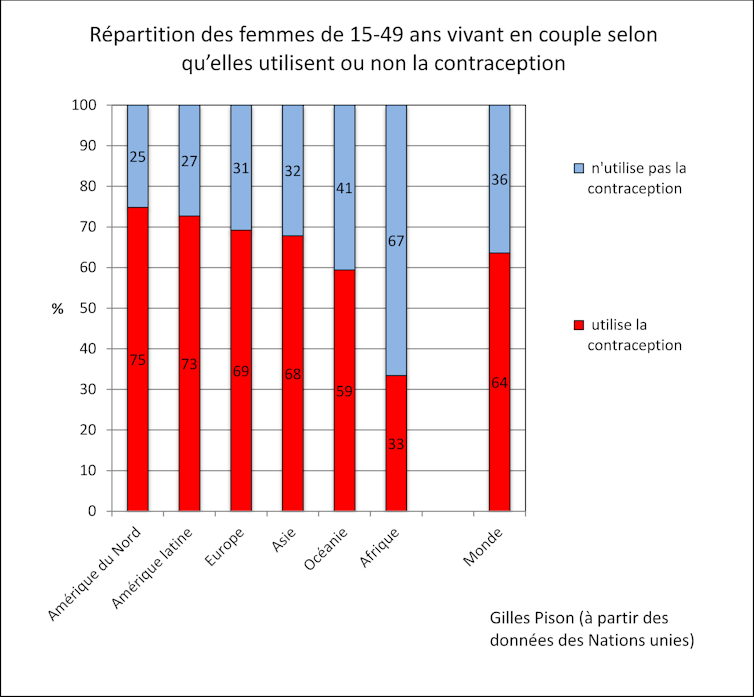
De nos jours, la plupart des couples ont le nombre d’enfants qu’ils veulent et quand ils le veulent. En 2015, près de deux sur trois dans le monde utilisent une méthode de contraception, comme le montre la figure ci-dessous. Le tiers restant soit s’apprête à avoir un enfant – la femme est enceinte – soit souhaite en avoir un prochainement, soit ne le souhaite pas mais ne se protège pas. La contraception est répandue presque partout dans le monde à l’exception de l’Afrique où elle n’est encore utilisée que par un tiers des femmes âgées de 15 à 49 ans mariées ou en union. Elle est beaucoup utilisée en Afrique du Nord et en Afrique australe, mais c’est en Afrique intertropicale qu’elle l’est peu, seulement une femme sur quatre y ayant recours.

La contraception dans le monde et les différents continents en 2015.
Gilles Pison à partir de données ONU, CC BY

Stérilisation : majoritaire dans le monde, mais en baisse

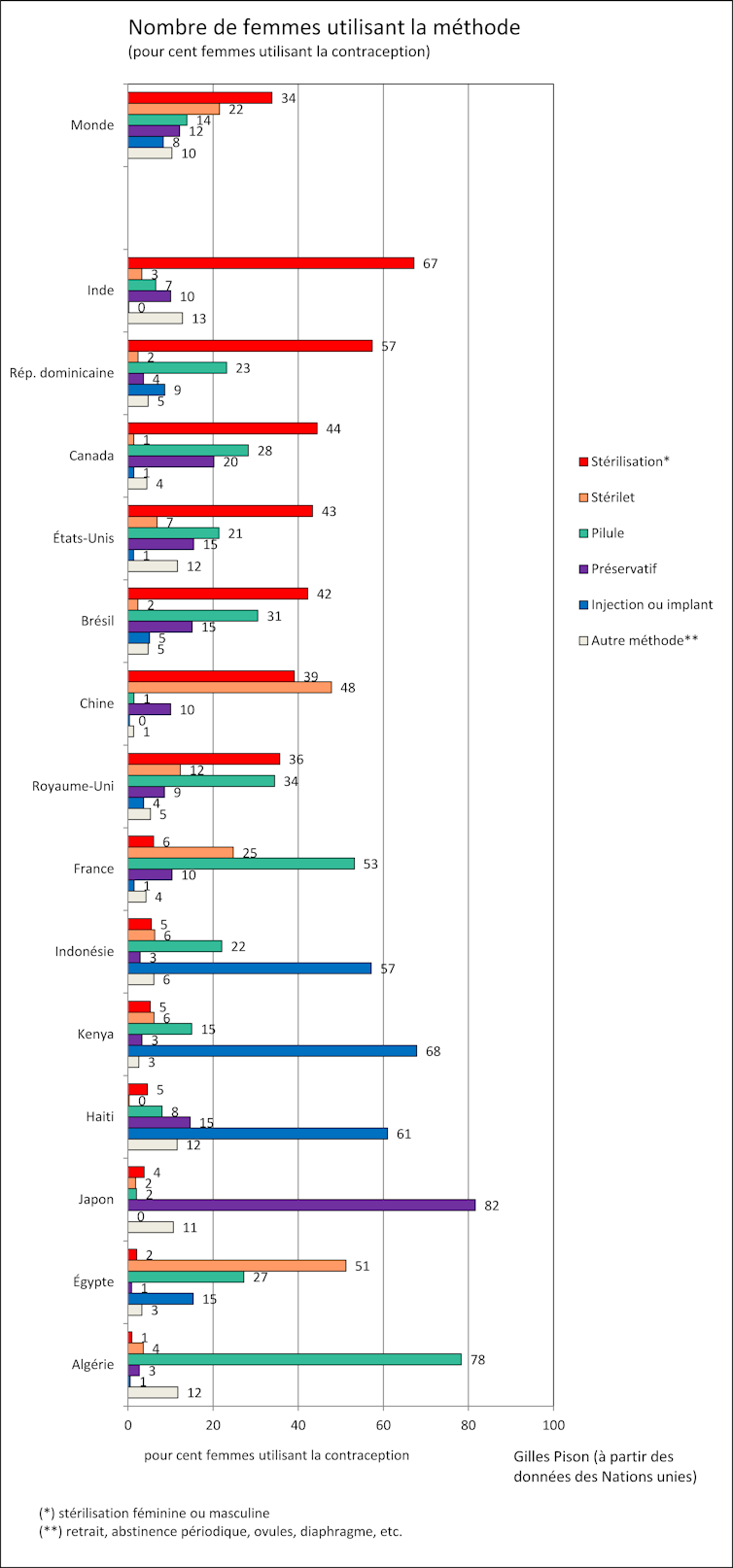
Les méthodes de contraception les plus utilisées dans le monde sont, par ordre d’importance, la stérilisation (dans 34 % des cas), le stérilet (22 %), la pilule contraceptive (14 %), le préservatif (12 %), et l’injection ou l’implant hormonal (8 %). Parmi les autres méthodes moins utilisées, on trouve le retrait et l’abstinence périodique.

La stérilisation a cependant un peu reculé au cours des vingt dernières années, à la fois du côté féminin et masculin – 33 % des femmes ne souhaitant pas être enceintes et se protégeant pour cela avaient recours à la stérilisation féminine en 1994, contre 30 % en 2015. La stérilisation masculine, beaucoup moins fréquente déjà il y a 20 ans, a encore diminué – 8 % de couples en 1994, contre 4 % en 2015. Le recul de la stérilisation s’est fait au profit principalement du préservatif, dont l’usage a été promu pour lutter contre l’épidémie de sida, et des méthodes hormonales, notamment l’injection, utilisée par 2 % des femmes en 1994 et 7 % en 2015. Ces évolutions reflètent pour partie l’évolution de la population d’utilisatrices à l’échelle mondiale, qui compte une part croissante de femmes d’Afrique subsaharienne, la population de cette région étant celle qui a augmenté le plus, et le recours à la contraception y étant à la hausse. Or l’injection hormonale et le préservatif sont des méthodes répandues en Afrique subsaharienne, contrairement à la stérilisation qui est peu pratiquée.

Des modes variables d’un pays à l’autre

D’un pays à l’autre les méthodes de contraception varient beaucoup, comme on peut le voir sur la figure ci-dessous.

Les méthodes de contraception dans le monde et dans une sélection de pays en 2015 (les pays sont classés par importance décroissante de la stérilisation).
Gilles Pison à partir de données ONU, CC BY

En France, la pilule domine, près de la moitié des femmes l’utilisant comme déjà mentionné. Viennent ensuite le stérilet, utilisé par un quart des femmes, puis le préservatif (10 %). La stérilisation ne concerne que 6 % des couples ne souhaitant pas avoir d’enfant – dans un cas sur cinq c’est l’homme qui est stérilisé, dans quatre cas sur cinq, c’est la femme. Les méthodes utilisées en France n’ont guère changé au cours des 20 dernières années mis à part l’importance accrue du préservatif en lien avec l’épidémie de sida, et un léger recul de la pilule au profit des autres méthodes depuis 2012.

En Inde, la stérilisation est la principale méthode de limitation des naissances. Elle est utilisée par les deux tiers des couples qui ne veulent pas d’enfants. La plupart du temps, c’est la femme qui est stérilisée, alors qu’il y a plusieurs dizaines d’années, seule la moitié des couples stérilisés était dans ce cas, l’homme étant stérilisé dans l’autre moitié des cas. La pilule et le stérilet sont très peu utilisés.

En Chine, la stérilisation est très utilisée, comme en Inde. Six fois sur sept, c’est la femme qui est stérilisée, et une fois sur sept, c’est l’homme. Mais les Chinoises utilisent encore plus le stérilet : un sur deux portés dans le monde l’est par une Chinoise. Par contre, elles utilisent très peu la pilule.

Au Brésil, la stérilisation est la première méthode, comme en Inde, et ce sont également les femmes qui sont stérilisées, beaucoup de maris refusant de l’être, comme dans presque tous les pays latins. La deuxième méthode est la pilule contraceptive. Le stérilet est pratiquement inconnu.

Et d’autres méthodes

En Égypte, contrairement à la situation en Inde, en Chine ou au Brésil, la stérilisation est peu fréquente et la principale méthode de contraception est le stérilet. La pilule est également utilisée, ainsi que l’injection. Comprenant des hormones proches de la progestérone, et répétée tous les trois mois, elle a une action analogue à la pilule contraceptive.

En Indonésie, comme en Égypte, la stérilisation est peu fréquente et la pilule relativement diffusée. Mais la méthode la plus fréquente est l’injection, utilisée par la moitié des femmes ne souhaitant pas être enceintes.

En Haïti la situation est similaire à celle de l’Indonésie avec une domination encore plus forte de l’injection : elle est utilisée par deux Haïtiennes ne souhaitant pas être enceintes sur trois.

Au Kenya, les méthodes hormonales autres que la pilule sont également utilisées par les deux tiers des femmes se protégeant, mais elles recourent à l’injection dans seulement deux cas sur trois, choisissant l’implant dans un cas sur trois. Petit bâtonnet implanté sous la peau et remplacé tous les trois ans, il contient des hormones proches de la progestérone qui diffusent de façon lente et continue dans le corps et ont une action analogue à celle de la pilule contraceptive.

En Algérie, presque toute la contraception repose sur la pilule, huit femmes ne souhaitant pas être enceintes sur dix l’utilisant, la plus forte proportion au monde. La proportion est très élevée aussi au Maroc où trois femmes sur quatre l’utilisent.

Au Japon, la méthode de contraception préférée est le préservatif : les Japonais en sont les plus gros consommateurs au monde. En revanche, la pilule n’est pratiquement pas utilisée, et le stérilet non plus. Ils sont considérés comme dangereux.

Cette revue de la situation dans quelques pays illustre combien les usages varient dans le monde en matière de contraception.

Les datavisualisations de cet article ont été réalisées par Marie Simon.

The Conversation

Gilles Pison ne travaille pas, ne conseille pas, ne possède pas de parts, ne reçoit pas de fonds d’une organisation qui pourrait tirer profit de cet article, et n’a déclaré aucune autre affiliation que son organisme de recherche.

ref. La pilule, première méthode de contraception en France, mais pas dans le monde – https://theconversation.com/la-pilule-premiere-methode-de-contraception-en-france-mais-pas-dans-le-monde-89207

Trump’s battle with elite universities overlooks where most students actually go to college

Source: The Conversation – USA (2) – By Amy Li, Associate Professor of Higher Education, Florida International University

There are nearly 20 million undergraduate college students in the United States. Anadolu/Getty Images

Headlines often mention the ongoing power struggle between President Donald Trump’s administration and private colleges such as Columbia University and Harvard University.

But such elite universities educate only a small portion of America’s total undergraduate population, which stood at 20 million in fall 2024.

As an associate professor of higher education, I have published research on policies that affect college access, retention and graduation. My work has examined data across different types of higher education institutions.

The Ivies and other elites

Less than 1% of American college students attend elite private colleges.

A small group of colleges, consisting of Ivy League schools and other highly selective universities known as “Ivy-Plus,” fit in this category.

The Ivy League consists of eight private schools that formed an athletic conference in the 1950s. The member universities are known for their academic excellence.

The Ivy-Plus are highly prestigious colleges located across the country with similar reputations for outstanding academics such as Stanford University, Duke University and the Massachusetts Institute of Technology.

These colleges have extremely competitive admissions, often accepting less than 10% of applicants.

They enroll students from high-income backgrounds more than any other type of institution. Students from upper-income families represent 60% to 70% of attendees at elite privates.

Elite private universities confer undergraduate and graduate degrees and focus on research.

Elite public colleges

Elite public colleges, such as the University of California, Berkeley, and the University of Virginia, are near the top of the U.S. News & World Report’s rankings. They also are often the flagship university in their state, such as the University of Michigan.

These colleges have highly selective admissions processes as well and often accept about 10% to 20% of applicants.

The largest portion of revenue at public universities, roughly 40%, comes from government sources that include federal, state and local government grants, contracts and appropriations, according to the National Center for Education Statistics.

Students from upper-income families constitute 50% to 55% of attendees at elite public colleges.

Like elite private colleges, elite public colleges confer undergraduate and graduate degrees and focus on research.

Community colleges

There are 1,024 community colleges in the U.S., serving 39% of undergraduate students.

These public, two-year colleges grant associate degrees and occasionally bachelor’s degrees. They also offer certificates, workforce training and noncredit courses to prepare students for college-level courses.

Community colleges have a strong teaching focus and a mission to serve their communities. They tend to guarantee admission to anyone who wants to enroll and offer lower tuition and fees.

Community colleges are also critical entry points for students from lower-income households and those who identify as racial or ethnic minorities or who are the first in their family to attend college.

Like other public institutions, community colleges depend heavily on state funding, as well as local property taxes.

Regional universities

Students with backpacks walk on campus during warm weather.
Roughly 70% of undergraduate students who attend public, four-year institutions enroll at regional public universities.
Newsday RM via Getty Images

Of all undergraduates who attend public, four-year institutions, roughly 70% enroll in regional institutions.

They include colleges in state-run systems such as the State University of New York and California State University.

There is wide variation in acceptance rates among regional public universities, but they tend to be moderately selective, accepting between half and 70% of applicants.

Regional public universities offer a wide range of academic programs mostly at the bachelor’s and master’s levels. They also depend heavily on state funding.

Small private colleges

Small, less selective private colleges often have acceptance rates of 60% or higher and enroll 3,000 or fewer students.

Their budgets depend primarily on tuition and fees.

Some of these types of colleges have suffered from enrollment declines since the early 2000s, exacerbated by the COVID-19 pandemic.

Many of these institutions lacked the large endowments that allowed elite privates to weather the financial challenges brought on by the pandemic.

A number of small private colleges, such as Eastern Nazarene College in Massachusetts, have closed or merged with other universities due to financial difficulties.

These small private colleges often offer academic programs at the bachelor’s and master’s levels.

Private for-profit

About 5% of students attend private for-profit colleges.

These colleges offer courses in convenient formats that may be attractive to older adult students, including those with full-time jobs.

For-profit college students disproportionately identify as older, Black and female. Students who attend these colleges are also more likely to be single parents.

In recent years, the federal government has cracked down on false promises some for-profit institutions made about their graduates’ job and earnings prospects and other outcomes.

The enforcement led to the closure of some colleges, such as ITT Technical Institute and Corinthian Colleges.

Minority-serving institutions

Students dressed in graduation regalia stand in rows.
Minority-serving institutions, including historically Black colleges and universities, have a mission to serve certain populations.
Andrew Caballero-Reynolds/AFP via Getty Images

Minority-serving institutions have a mission to serve certain student populations.

Minority-serving institutions include historically Black colleges and universities, or HBCUs, such as Morehouse College; Hispanic-serving institutions, or HSIs, such as Florida International University; Asian American, Native American and Pacific Islander-serving institutions, or AANAPISIs, such as North Seattle College; and tribal colleges and universities, or TCUs, such as Blackfeet Community College, which serve Native American students.

The federal government determines which colleges fit the criteria.

These are primarily two- and four-year colleges, but some grant graduate degrees.

The Conversation

Amy Li does not work for, consult, own shares in or receive funding from any company or organization that would benefit from this article, and has disclosed no relevant affiliations beyond their academic appointment.

ref. Trump’s battle with elite universities overlooks where most students actually go to college – https://theconversation.com/trumps-battle-with-elite-universities-overlooks-where-most-students-actually-go-to-college-254680

Taking intermittent quizzes reduces achievement gaps and enhances online learning, even in highly distracting environments

Source: The Conversation – USA (2) – By Jason C.K. Chan, Professor of Psychology, Iowa State University

More Americans are learning remotely. Drazen/E+ via Getty Images

Inserting brief quiz questions into an online lecture can boost learning and may reduce racial achievement gaps, even when students are tuning in remotely in a distracting environment.

That’s a main finding of our recent research published in Communications Psychology. With co-authors Dahwi Ahn, Hymnjyot Gill and Karl Szpunar, we present evidence that adding mini-quizzes into an online lecture in science, technology, engineering or mathematics – collectively known as STEM – can boost learning, especially for Black students.

In our study, we included over 700 students from two large public universities and five two-year community colleges across the U.S. and Canada. All the students watched a 20-minute video lecture on a STEM topic. Each lecture was divided into four 5-minute segments, and following each segment, the students either answered four brief quiz questions or viewed four slides reviewing the content they’d just seen.

This procedure was designed to mimic two kinds of instructions: those in which students must answer in-lecture questions and those in which the instructor regularly goes over recently covered content in class.

All students were tested on the lecture content both at the end of the lecture and a day later.

When Black students in our study watched a lecture without intermittent quizzes, they underperformed Asian, white and Latino students by about 17%. This achievement gap was reduced to a statistically nonsignificant 3% when students answered intermittent quiz questions. We believe this is because the intermittent quizzes help students stay engaged with the lecture.

To simulate the real-world environments that students face during online classes, we manipulated distractions by having some participants watch just the lecture; the rest watched the lecture with either distracting memes on the side or with TikTok videos playing next to it.

Surprisingly, the TikTok videos enhanced learning for students who received review slides. They performed about 8% better on the end-of-day tests than those who were not shown any memes or videos, and similar to the students who answered intermittent quiz questions. Our data further showed that this unexpected finding occurred because the TikTok videos encouraged participants to keep watching the lecture.

For educators interested in using these tactics, it is important to know that the intermittent quizzing intervention only works if students must answer the questions. This is different from asking questions in a class and waiting for a volunteer to answer. As many teachers know, most students never answer questions in class. If students’ minds are wandering, the requirement of answering questions at regular intervals brings students’ attention back to the lecture.

This intervention is also different from just giving students breaks during which they engage in other activities, such as doodling, answering brain teaser questions or playing a video game.

Why it matters

Online education has grown dramatically since the pandemic. Between 2004 and 2016, the percentage of college students enrolling in fully online degrees rose from 5% to 10%. But by 2022, that number nearly tripled to 27%.

Relative to in-person classes, online classes are often associated with lower student engagement and higher failure and withdrawal rates.

Research also finds that the racial achievement gaps documented in regular classroom learning are magnified in remote settings, likely due to unequal access to technology.

Our study therefore offers a scalable, cost-effective way for schools to increase the effectiveness of online education for all students.

What’s next?

We are now exploring how to further refine this intervention through experimental work among both university and community college students.

As opposed to observational studies, in which researchers track student behaviors and are subject to confounding and extraneous influences, our randomized-controlled study allows us to ascertain the effectiveness of the in-class intervention.

Our ongoing research examines the optimal timing and frequency of in-lecture quizzes. We want to ensure that very frequent quizzes will not hinder student engagement or learning.

The results of this study may help provide guidance to educators for optimal implementation of in-lecture quizzes.

The Research Brief is a short take on interesting academic work.

The Conversation

Jason C.K. Chan receives funding from the USA National Science Foundation.

Zohara Assadipour does not work for, consult, own shares in or receive funding from any company or organization that would benefit from this article, and has disclosed no relevant affiliations beyond their academic appointment.

ref. Taking intermittent quizzes reduces achievement gaps and enhances online learning, even in highly distracting environments – https://theconversation.com/taking-intermittent-quizzes-reduces-achievement-gaps-and-enhances-online-learning-even-in-highly-distracting-environments-254046

Where tomorrow’s scientists prefer to live − and where they’d rather not

Source: The Conversation – USA (2) – By Christopher P. Scheitle, Associate Professor of Sociology, West Virginia University

Many students have strong feelings about where they want to move after graduation. Tony Garcia/Stone via Getty Images

Graduate students interested in an academic career after graduation day have often been told they need to be open to moving somewhere they may not want to live. This advice is because of how hard it is to get a tenure-track professor position.

These days, this advice may be less relevant as graduate students are increasingly pursuing and ending up in careers outside of academia.

Where graduate students want to settle post-graduation has potential consequences for communities and states across the country that depend more and more on a steady stream of skilled workers to power their economies. Locations seen as undesirable may struggle to attract and retain the next generation of scientists, engineers, professors and other professions filled by today’s graduate students.

We are sociologists who are examining some of the factors that influence graduate students’ educational and career paths as part of a research project supported by the National Science Foundation. In March 2025 we distributed a survey to a sample of U.S.-based graduate students in five natural and social science disciplines: physics, chemistry, biology, psychology and sociology.

As part of our survey, we asked students to identify states they would prefer to live in and places where they would be unwilling to go. To some extent, our findings match some past anecdotes and evidence about the varying number of applications received for academic positions across different states or regions.

But little data has directly assessed students’ preferences, and our survey also provides some evidence that some states’ policies are having a negative impact on their ability to attract highly educated people.

Most preferred, most unwilling

For our study, we built our sample from the top 60 graduate programs for each of the five disciplines based on rankings from U.S. News and World Report. We received responses from nearly 2,000 students. Almost all of these students – 98%, specifically – are pursuing Ph.D.s in their respective fields.

As part of our survey, we asked students to identify locations where they would “prefer” to live and also those where they would be “unwilling” to live after finishing their graduate program. For each of these questions, we presented students with a list of all states along with the option of “outside of the United States.”

Just looking at the overall percentages, California tops the list of preferred places, with 49% of all survey-takers stating a preference to live there, followed by New York at 45% and Massachusetts with 41%.

On the other hand, Alabama was selected most often as a state students said they’d be unwilling to move to, with 58% declaring they wouldn’t want to live there. This was followed by Mississippi and Arkansas, both with just above 50% saying they’d be unwilling to move to either state.

Clusters of preference

While the two lists in many respects appear like inversions of one another, there are some exceptions to that. Looking beyond the overall percentages for each survey question, we used statistical analysis to identify underlying groups or clusters of states that are more similar to each other across both the “prefer” and “unwilling” questions.

One cluster, represented by California, New York and Massachusetts, is characterized by a very high level of preference and a low level of unwillingness. About 35% to 50% of students expressed a preference for living in these places, while only 5% to 10% said they would be unwilling to live in them. The response of “outside of the United States” is also in this category, which is noteworthy given recent concerns about the current generation of Ph.D. students looking to leave the country and efforts by other nations to recruit them.

A second cluster represents states where the preference levels are a bit lower, 20% to 30%, and the unwillingness levels are a bit higher, 7% to 15%. Still, these are states for which graduate students hold generally favorable opinions about living in after finishing their programs. This cluster includes states such as Colorado, Illinois, Pennsylvania, Maryland and New Jersey.

A third group of states represents locations for which the rate of preference is similar to the rate of unwillingness, in the range of 10% to 20%. This cluster includes states such as Minnesota, Delaware and Virginia.

The fourth and fifth clusters consist of states where the rate of unwillingness exceeds the rate of preference, with the size of the gap distinguishing the two clusters. In the fourth cluster, at least some students – 5% to 10% – express a preference for living in them, while around 30% to 40% say they are unwilling to live in them. This cluster includes Florida, Montana, South Carolina and Utah.

Almost no students express a preference for living in the states contained in the fifth cluster, while the highest percentages – 40% to 60% – express an unwillingness to live in them. This cluster includes Alabama, Kansas, Oklahoma and South Dakota.

Signs of current politics

Many factors influence our preferences for where we want to live, including family, weather and how urban, rural or suburban it is. The politics of a community can also influence our perceptions of a place’s desirability.

Indeed, political factors may be of particular concern to graduate students. In recent years, some states have taken a more hostile stance toward specific academic disciplines, institutions of higher education in general, or professions that are of interest to graduate students. While states such as Florida and Texas have been leading such efforts, many others have followed.

Interestingly, our statistical grouping of states finds that students’ unwillingness to live in states such as Texas, Florida, Georgia and Ohio is higher than we would expect given those states’ corresponding preference levels. For example, about 10% of students selected Texas as a place they would prefer to live in after graduation. Looking at other states with similar preference levels, we would expect about 10% to 20% of students to say they are unwilling to live in Texas. Instead, this percentage is actually 37%. Similarly, 5% of students say they would prefer to live in Florida. Other states with this preference rate have an unwillingness rate of around 35%, but Florida’s is 45%.

Although our data does not tell us for sure, these gaps could be a function of these states’ own policies or alignment with federal policies seen as hostile to graduate students and their future employers.

These findings suggest that communities and employers in some states might continue to face particularly steep hurdles in recruiting graduate students for employment once they finish their degrees.

The Conversation

Christopher P. Scheitle receives funding from the National Science Foundation and the John Templeton Foundation. This article is based on a study supported by the National Science Foundation (Award #2344563).

Katie Corcoran receives funding from the National Science Foundation, the John Templeton Foundation, and the Patient-Centered Outcomes Research Institute.

Taylor Remsburg receives funding from the National Science Foundation and the John Templeton Foundation as a research assistant. This article is based on a study supported by the National Science Foundation (Award #2344563).

ref. Where tomorrow’s scientists prefer to live − and where they’d rather not – https://theconversation.com/where-tomorrows-scientists-prefer-to-live-and-where-theyd-rather-not-254431