Radiografía de la primera ola de calor del 2025: ¿qué podemos esperar para el resto del verano?

Source: The Conversation – (in Spanish) – By Javier Martín Vide, Catedrático de Geografía Física, Universitat de Barcelona

Riccardo Cirillo/Shutterstock

La primera ola de calor del verano en España y en otros países de Europa occidental, como Portugal, Francia, Italia o Alemania, temprana en el calendario, batió récords de temperatura en el mes de junio en muchos lugares. En España, este pasado mes ha sido el junio más cálido desde 1961, en que comienza la contabilización de sus anomalías, al igual que en Europa occidental, donde ha supuesto el junio más cálido desde que se tienen registros.

Los 40 ºC se superaron con facilidad en la última semana del mes en amplios sectores de la mitad sur de la España peninsular, principalmente en Andalucía y Extremadura, y en otros lugares mucho más septentrionales, como en Orense (Galicia) o Gerona (Cataluña). Los valores extremos en los estados ibéricos fueron de 46,6 ºC, en Mora, a unos 100 km al este de Lisboa, y de 45,8 ºC, en El Granado, en
la provincia de Huelva.

Las noches han resultado insufribles, incompatibles con el descanso nocturno, en los centros de las ciudades mediterráneas y de la mitad sur de España y Portugal. El caso de Barcelona es muy significativo: en el barrio del Raval todas las noches de la última decena de junio fueron tórridas, es decir, con temperaturas mínimas de 25 ºC o superiores, y han continuado así hasta los primeros días de julio.

Las aguas del Mediterráneo muestran también unos valores exageradamente elevados para el momento del año. Son equivalentes a los récords de agosto de los últimos dos veranos. Y hay que pensar que la gran inercia térmica del agua prácticamente asegura que esta anomalía térmica marina durará todo el verano y hasta bien entrado el otoño. En este sentido podemos afirmar que el calor seguirá, al menos en las aguas marinas y en los espacios litorales e insulares.


Leer más:
El océano se sofoca


Toda Europa se calienta

También fuera de la península ibérica las temperaturas alcanzaron valores récord para el mes de junio, como en el norte de Alemania, en diversos lugares de Francia o en el Ártico noruego. Un potente anticiclón en altura con intrusión de aire del sur, sahariano, ha sido la causa de esta ola de calor temprana.

Gráficamente, el anticiclón supuso la tapadera de una enorme cúpula o domo de aire cálido, que ha cubierto la península ibérica y buena parte de Europa occidental. El persistente anticiclón ha ocurrido en los días con mayor insolación potencial, por ser los más largos del año y en los que el sol alcanza la mayor altura sobre el horizonte.

Es difícil saber si en el presente verano habrá más olas de calor. Las predicciones estacionales para el trimestre julio-agosto-septiembre indican que la probabilidad de que tenga una temperatura media superior a la normal es elevada, superior al 70 %, tanto en España como en gran parte de Europa. En los últimos veranos la ocurrencia de varias olas de calor en el sur de Europa ha sido la norma.

Efectos en la salud

El exceso de calor, diurno o nocturno, tiene una repercusión negativa en la salud humana. Los humanos somos animales homeotermos, de temperatura interna casi constante, entre 36,5 y 37 ºC. Cuando el exterior alcanza valores próximos o superiores, no nos sirve la vasodilatación cutánea, “ponernos rojos”, es decir, aumentar la sangre circulante por la periferia para desprender calor. Si el ambiente está a mayor temperatura, como el calor siempre se transfiere del cuerpo más caliente al de menor temperatura, el aire nos contagiará calor. Nos queda entonces un último mecanismo termorregulador para mantener la temperatura interna en sus límites: la sudoración.

No existe otro animal que tenga un número de glándulas sudoríparas ni una tasa de sudoración tan altos como los humanos. El sudor, formado por agua y sales minerales, al evaporarse desde la piel, produce, como toda evaporación, un enfriamiento. Naturalmente, habrá que reponer el agua bebiendo abundantemente, so pena de deshidratarnos.

Alimentos como el gazpacho, y las ensaladas nos aportan agua y sales. Igualmente, las frutas (melón, sandía, etc.) son recomendables y apetecibles en tiempo cálido.

Además de la deshidratación, los golpes de calor son efectos muy peligrosos del exceso de calor. Cuando la persona es incapaz de mantener su temperatura interna constante y se va elevando hasta alcanzar valores que superan los 40 ºC, se desvanece y requiere atención médica urgente. Cae en coma y los daños pueden ser irreversibles.

Durante esta última ola de calor, se han producido en varios países muertes por golpe de calor y otras, bastante más numerosas, también atribuibles a las altas temperaturas, aunque de forma indirecta, por agravamiento de enfermedades crónicas. En particular, las personas de edad avanzada y con enfermedades crónicas son muy vulnerables al calor, especialmente si están en condiciones de
pobreza energética. Es decir, si no disponen de un aparato de aire acondicionado. No descansan bien por la noche, se debilitan y aumenta su morbilidad: los ingresos hospitalarios, y también, desgraciadamente, su mortalidad. Es un problema de salud pública.


Leer más:
El calor excesivo perjudica seriamente la salud, ¿pero cómo?


Finalmente, aunque los países del sur de Europa son los expuestos con
mayor frecuencia e intensidad a valores muy altos de temperatura, la
adaptación al calor extremo debe ser también prioritaria en los países del centro y norte del continente, menos habituados a las olas de calor. La mayoría de los apartamentos y hasta los servicios públicos de estos países no disponen de aire acondicionado. Ni el modo de vida, ni la aclimatación al calor se corresponden con temperaturas exageradamente altas.

The Conversation

Javier Martín Vide no recibe salario, ni ejerce labores de consultoría, ni posee acciones, ni recibe financiación de ninguna compañía u organización que pueda obtener beneficio de este artículo, y ha declarado carecer de vínculos relevantes más allá del cargo académico citado.

ref. Radiografía de la primera ola de calor del 2025: ¿qué podemos esperar para el resto del verano? – https://theconversation.com/radiografia-de-la-primera-ola-de-calor-del-2025-que-podemos-esperar-para-el-resto-del-verano-260752

¿Por qué dejan de crecer los huesos?

Source: The Conversation – (in Spanish) – By José Miguel Robles Romero, Profesor Doctor de la Facultad de Enfermería, Universidad de Huelva

Pixel-Shot/Shutterstock

Este artículo forma parte de la sección The Conversation Júnior, en la que especialistas de las principales universidades y centros de investigación contestan a las dudas de jóvenes curiosos de entre 12 y 16 años. Podéis enviar vuestras preguntas a tcesjunior@theconversation.com


Pregunta formulada por Carlota, de 12 años, del IES Santos Isasa (Córdoba)


¿Te imaginas que nunca dejáramos de crecer? Seríamos gigantes de más de tres metros a los 80 años, con huesos largos como postes de luz y una espalda que no cabría en una silla. Nuestro peso corporal aumentaría más allá de lo que las articulaciones, el corazón o los pulmones podrían soportar, provocando serios problemas de salud.

En muchas especies animales (como ciertos peces, reptiles y anfibios), el crecimiento no se detiene del todo y continúa lentamente durante toda la vida. Pero en los humanos, eso sería insostenible.

Cuando somos pequeños, una de las frases que más escuchamos es: “¡Qué alto estás! ¡Cómo has crecido!”. Pero llega un momento, generalmente en la adolescencia, en que ya no nos lo dicen. Dejamos de ganar altura y, aunque cambie nuestro cuerpo en otros aspectos, los huesos ya no se alargan. ¿Por qué ocurre esto?

La respuesta a esta pregunta se encuentra en una combinación fascinante entre biología, hormonas y estructuras muy concretas de nuestro cuerpo llamadas placas de crecimiento.

Los huesos no siempre son duros

Aunque solemos imaginar los huesos como estructuras duras y sólidas, no siempre fueron así. Cuando estamos en el vientre materno, comienzan siendo cartílago: un tejido flexible parecido al que tenemos en la punta de la nariz o en las orejas. Con el tiempo, este cartílago se va transformando en hueso gracias a un proceso llamado osificación.

En los huesos largos –como el fémur (muslo) o el húmero (brazo)–, el crecimiento en longitud ocurre en unos lugares especiales llamados “placas epifisarias”, o “placas de crecimiento”. Son zonas de cartílago ubicadas cerca de los extremos de los huesos. Allí se produce un constante recambio celular: unas células llamadas condrocitos se multiplican, se organizan y, finalmente, se transforman en hueso nuevo, alargando la estructura.

Imágenes de condrocitos (células) al microscopio
Imágenes de condrocitos al microscopio.
Por Emmanuelm/Wikimedia Commons, CC BY

Es importante saber que los huesos son estructuras vivas. Que continuamente tienen células que mueren y otras que nacen para sustituirlas. Esta renovación ocurre durante toda la vida, no sólo cuando nos los rompemos. En cambio, el crecimiento solo ocurre durante la infancia y gran parte de la adolescencia.

El papel de las hormonas

Durante la niñez, varias hormonas regulan el crecimiento óseo, como la hormona del crecimiento (GH) y los factores de crecimiento similares a la insulina (IGF-1). Sin embargo, cuando llega la pubertad entran en juego otras hormonas: los estrógenos y la testosterona. Aunque se asocian respectivamente con las chicas y los chicos, ambos sexos producen las dos (en diferentes cantidades), y ambas influyen en el crecimiento de los huesos.

Estas hormonas estimulan primero un “estirón” muy evidente (el típico de la adolescencia), pero después provocan que las placas de crecimiento se cierren. Es decir, ese cartílago que permitía que el hueso se alargara desaparece y se transforma completamente en tejido óseo. Es el final del crecimiento humano.

¿A qué edad dejan de crecer los huesos?

La edad puede variar de una persona a otra. En general, las niñas tienden a alcanzar su altura adulta entre los 14 y 16 años, y los niños, entre los 16 y 18. Sin embargo, hay adolescentes que siguen creciendo hasta que sus placas de crecimiento se cierran por completo, algo que puede ocurrir hasta los 20 años en algunos casos.

¿Sabías que los médicos pueden saber si aún sigues creciendo? Lo averiguan observando una radiografía de la mano o la muñeca: si las placas de crecimiento son aún visibles, probablemente esa persona todavía no haya alcanzado su estatura definitiva. Cuando siguen estando activas, dichas placas son más claras que el resto del hueso, debido a que su densidad es menor

Además, se trata de estructuras muy delicadas. Si un niño o adolescente sufre una fractura cerca de una de las placas, puede alterarse su crecimiento óseo. Por eso es tan importante tratar adecuadamente cualquier lesión en edades de desarrollo. Afortunadamente, los avances en traumatología pediátrica permiten hoy intervenir de manera muy precisa para evitar o corregir tales problemas.

¿Se podrían “reabrir” las placas de crecimiento?

La ciencia actual no ha encontrado una forma segura de reactivar las placas de crecimiento una vez que se han cerrado. Por internet circulan algunos mitos sobre suplementos, hormonas o ejercicios milagrosos para seguir ganando altura después de la adolescencia, pero no tienen base científica. Incluso el uso de hormonas de crecimiento en adultos no aumenta la estatura, y su uso indebido puede causar graves problemas de salud.

¿Y si alguien no crece lo suficiente?

En algunos casos, ciertas personas tienen problemas para crecer debido a causas genéticas u hormonales o determinadas enfermedades. Algunos trastornos, como el déficit de hormona del crecimiento o el hipotiroidismo, pueden detectarse y tratarse con ayuda médica. Por eso es importante realizar controles pediátricos regulares y acudir al especialista si fuera necesario.

Pero debemos tener en cuenta que existen muchas variantes que son completamente normales. No todas las personas alcanzan la misma estatura, y eso no significa necesariamente un problema. La genética tiene un peso enorme: si tus padres son bajos, es muy probable que tú también lo seas. Y eso es completamente natural.

Crecer no es solo hacerse más alto

Aunque nuestros huesos dejen de alargarse, el cuerpo sigue cambiando a lo largo de la vida. La masa ósea, por ejemplo, alcanza su punto máximo entre los 20 y los 30 años, y luego empieza a disminuir lentamente. Por eso, una alimentación adecuada y el ejercicio físico son fundamentales para tener huesos fuertes durante toda la vida.

Además, crecer no es solo una cuestión física. En la adolescencia también se desarrollan el cerebro, las emociones, la personalidad, la autonomía… Así que, aunque dejes de crecer en centímetros, puedes haciéndolo en muchos otros aspectos.


El museo interactivo Parque de las Ciencias de Andalucía y su Unidad de Cultura Científica e Innovación colaboran en la sección The Conversation Júnior.


The Conversation

José Miguel Robles Romero no recibe salario, ni ejerce labores de consultoría, ni posee acciones, ni recibe financiación de ninguna compañía u organización que pueda obtener beneficio de este artículo, y ha declarado carecer de vínculos relevantes más allá del cargo académico citado.

ref. ¿Por qué dejan de crecer los huesos? – https://theconversation.com/por-que-dejan-de-crecer-los-huesos-258942

La satisfacción del cliente y su identificación con la marca, claves para la buena marcha del negocio

Source: The Conversation – (in Spanish) – By Juan Jose Blazquez-Resino, Profesor Titular de Universidad, Área de Comercialización e Investigación de Mercados, Universidad de Castilla-La Mancha

Standret/Shutterstock

¿Cómo hacer que los clientes sean fieles a las marcas de fast fashion o moda rápida?

Además de motivos concretos –como su rápida adaptación a las tendencias, la variedad de productos o los precios competitivos–, las estrategias comerciales de estas empresas van más allá de la satisfacción de los compradores y buscan una vinculación emocional para convertirlos en prescriptores de sus productos.

La moda rápida

La industria de la moda se ha convertido en uno de los principales motores de la economía mundial. Sus cifras globales de negocio lo confirman: si para 2024 se prevén ingresos por más de 770 000 millones de dólares, una tasa de crecimiento anual calculada de casi el 9 % entre 2024 y 2029 generaría un volumen de mercado de cerca de 1,2 billones de dólares en 2029. Además, se prevé que en 2029 la penetración de usuarios sea del 37,8 % (2 800 millones de personas), cuando en 2024 es del 33,3 % en 2024.

En general, el éxito de las empresas de moda rápida depende de su capacidad de adaptarse rápidamente a las nuevas tendencias para poder satisfacer las necesidades y deseos de sus clientes.

La lealtad de los clientes

Las elecciones de los consumidores van más allá de la satisfacción de necesidades prácticas. Las marcas son un medio de autoexpresión por el que las personas transmiten su identidad y el concepto que tienen de sí mismas. En consecuencia, la identificación del cliente con la marca implica que alinea sus atributos personales con los de la marca.

Por otra parte, las marcas (en general) necesitan de la fidelidad de los clientes para su éxito. Esta fidelidad se mide por cuestiones como el comportamiento de recompra –que se produce cuando las compras anteriores han sido satisfactorias, pero también cuentan los propios hábitos de consumo de los compradores– o la voluntad del cliente de recomendar el producto o la marca (el boca a boca). En este punto, hay que diferenciar entre las recomendaciones espontáneas (activas) y las pasivas, a instancias del interlocutor (“¿Dónde puedo encontrar una falda bonita a buen precio?”, por ejemplo).

No obstante, el sector de la moda rápida tiene una particularidad: esa identificación no parece tener un efecto significativo sobre su fidelidad a la marca. Esto puede deberse tanto a la importancia que tiene el precio para los consumidores de fast fashion, como a la presencia de numerosas opciones (Primark, Zara, H&M, Uniqlo, etc.) que ofrecen productos similares en diseño y precio.

¿Qué investigamos y cómo?

Hemos desarrollado un estudio sobre la fidelidad y la voluntad de recomendar, activa o pasivamente, una marca de moda rápida española. Con base en una muestra de 424 consumidores, recopilamos los datos mediante encuestas en línea.

Para participar era requisito indispensable haber comprado al menos un producto durante el año anterior en la tienda analizada. Encuestamos a 368 participantes. La proporción de mujeres y hombres fue de 70,4 y 29,6 % respectivamente. En cuanto al rango de edad, el 61,4 % tenía entre 18 y 24 años, el 24,5 %, entre 25 y 44, y el 14,1 % restante superaba los 45 años.

Nuestros resultados ponen de relieve cómo actúan la identificación y la satisfacción para generar fidelidad a la marca:

  1. La identificación influye en las recomendaciones pasivas.

  2. La satisfacción influye en las recomendaciones activas.

  3. Si el cliente se siente identificado, mejora su satisfacción con la marca.

  4. La satisfacción del cliente y la recomendación activa de marca son importantes para el comportamiento de compra repetida.

¿Qué implican estos hallazgos?

Los resultados evidencian que la identificación con la marca impacta sobre la satisfacción del cliente (el principal motor para la recomendación activa y la recompra). Por otra parte, esa identificación es el principal determinante de la recomendación pasiva. Tales sutilezas muestran la complejidad del comportamiento del consumidor de moda rápida. Por tanto, para las marcas:

  1. La optimización de las estrategias comerciales mejora la satisfacción de los clientes. Si mantener el foco en las tendencias de moda es adecuado, perfeccionar la experiencia en las tiendas y optimizar la gestión de quejas y devoluciones refuerzan la satisfacción y la fidelidad del cliente.

  2. La creación de relaciones efectivas es fundamental para que los clientes se identifiquen con la marca. Las campañas publicitarias con alto contenido emocional reafirman el sentido de pertenencia, y potencian la identificación y el compromiso a largo plazo, incluso antes de que se realice la compra.

  3. Las marcas alientan a los consumidores satisfechos a compartir sus experiencias de manera proactiva, tanto en tiendas físicas como en plataformas digitales. Cada vez son más habituales las aplicaciones de fidelización y el envío de correos electrónicos que invitan a compartir la experiencia de compra, lo que ayuda a promocionar la marca de una manera auténtica a través de las experiencias de los propios clientes.

En definitiva, la identificación del cliente con la marca es un componente esencial en la estrategia empresarial del sector de la moda rápida. La fidelización no depende solo de ofrecer productos atractivos: también influye la capacidad de las compañías para conectar emocionalmente con sus consumidores.

The Conversation

Las personas firmantes no son asalariadas, ni consultoras, ni poseen acciones, ni reciben financiación de ninguna compañía u organización que pueda obtener beneficio de este artículo, y han declarado carecer de vínculos relevantes más allá del cargo académico citado anteriormente.

ref. La satisfacción del cliente y su identificación con la marca, claves para la buena marcha del negocio – https://theconversation.com/la-satisfaccion-del-cliente-y-su-identificacion-con-la-marca-claves-para-la-buena-marcha-del-negocio-244897

¿Para qué viajar?

Source: The Conversation – (in Spanish) – By Rafael Cejudo Córdoba, Profesor Titular de Ética y Filosofía Política, Universidad de Córdoba

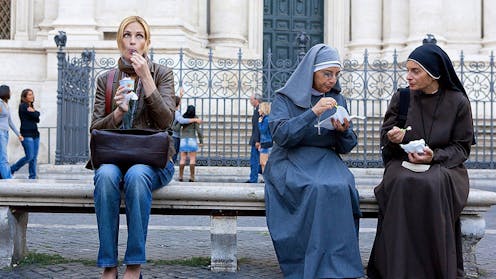
Fotograma de ‘Come, reza, ama’, una película en la que el personaje interpretado por Julia Roberts (a la izquierda) busca, a través del viaje, volver a sentir apetito por su vida. FilmAffinity

La “propensión a viajar” de un grupo mide la probabilidad de que sus miembros hagan turismo. Se puede definir como el porcentaje de población que viaja a otros países, o más en general, como el deseo que una persona tiene de hacer turismo.

En la actualidad esta propensión es más alta que nunca: 1 400 millones de turistas se movieron por el mundo el año pasado, 140 millones más que en 2023. Eso equivale aproximadamente a casi dos de cada diez habitantes del planeta. Europa es la región del mundo preferida. Concretamente, 747 millones de turistas la eligieron en 2024, mientras que a España llegaron 93,8 millones de viajeros.

Esto supone una riqueza extraordinaria. Con razón se dice frecuentemente que el turismo es “nuestro petróleo”. En Noruega este hidrocarburo y el gas equivalen al 20,5 % de su PNB, mientras que el turismo supone el 13,1 % del PIB español. Pero como el petróleo, la industria turística también tiene impactos medioambientales negativos muy importantes. Sabemos que entre 2009 y el comienzo de pandemia de covid, las emisiones contaminantes debidas al turismo crecieron un 3,5 % al año, lo cual es una tasa que dobla la del crecimiento del resto de emisiones.

Un hombre observa la esfinge sentado de espaldas a la cámara.
En Muerte en el Nilo un crimen interrumpe el crucero por Egipto de Hercules Poirot.
IMDB

Uno de los efectos negativos del turismo es saber que nuestra propia conducta contribuye a esos efectos negativos. Nosotros somos parcialmente responsables.
Y no solo porque consentimos actividades negativas para el entorno, sino porque directamente las causamos con nuestras elecciones y comportamientos de ocio.

Como en otras muchas situaciones, estamos ante un problema de acción colectiva. Por un lado, queremos cooperar porque eso nos beneficiaría a todos, aunque suponga actuar en contra de nuestros intereses inmediatos. Por otro, queremos hacerlo contando con que los demás, al menos la mayoría, también lo hacen, porque si no es así, nuestro esfuerzo será inútil y parecerá estúpido. No se trata de una cuestión de mero egoísmo personal; aunque nosotros sí hagamos lo correcto a pesar de todo, de nada servirá si los demás no lo hacen.

Tratándose de un problema como el descrito, la razón para viajar menos, o para viajar de otra manera, no es tanto disminuir el impacto negativo global sino rechazar la complicidad con el mismo… por sentido del deber o simplemente porque nos guste.

Viajar para descubrir

Montaigne, considerado el primer ensayista moderno, escribía en 1588 que viajar era positivo, al proporcionar novedades desconocidas: “como he dicho con frecuencia, no conozco mejor escuela para moldear la propia vida que mostrar continuamente la diversidad de tantas otras, sus opiniones y costumbres”.

El primer ensayista inglés, Bacon, afirmaba otro tanto en su ensayo titulado Viajar, publicado en 1625: “viajar es parte de la educación en los jóvenes, y parte de la experiencia en la madurez”.

Un grupo de mujeres pasean por una plaza en la que al fondo se ve el David de Miguel Ángel.
En Una habitación con vistas una joven visita Florencia en un viaje que puede cambiarle la vida.
IMDB

El mismo viaje, por tanto, es una experiencia diferente según la edad del que viaja. Pero Bacon va más allá de esta obviedad. Considerando la trayectoria vital de una misma persona, en su juventud viajar fue una forma de aprender, mientras que esos mismos viajes, mirados desde la cuesta abajo de la vida, son parte de su experiencia. Y si ya en la madurez se viaja de nuevo, viajar es haber viajado, porque se aprendió ya lo necesario para que el viaje sea una forma de ampliar y de probar la experiencia personal.

Ahora bien, cualquiera viaja como si fuera un joven ignorante e inexperto si desconoce el lugar al que va, especialmente su cultura característica. Dice Bacon que “aquel que viaja a un país antes de haberse iniciado en su idioma, va a la escuela, no a un viaje”.

Pero ¿qué aprendemos viajando?

En gran medida, viajamos para divertirnos. Si, por ejemplo, que hacemos turismo de riesgo o “Extreme Budget Travel” (intentar llegar lo más lejos posible gastando el mínimo), ¿qué queremos aprender con la aventura?

Lo que en el fondo quiere aprender el turista es cómo viviría si no fuera como es el resto del tiempo, si fuera alguien de otro lugar, con otras costumbres. Es decir, “cruzar la línea”, probar cómo sería librarse de las rutinas, normas y convenciones de nuestro día a día (sin riesgo, eso sí). Todo turismo es entonces cultural, en el sentido de ser una experiencia planificada de contacto con otra cultura, que puede ser más o menos genuina.

Un joven hace autoestop sentado en un sofá viejo al lado de una señal en la carretera.
Hacias rutas salvajes contaba la peripecia real de Christopher McCandless viajando por Alaska sin dinero y entrando en contacto con quienes se cruzaban en su camino.
FilmAffinity

Tal como advirtió Freud en 1930, la vida en sociedad es inevitable por sus ventajas, pero también implica renunciar a satisfacer nuestros deseos de manera instintiva o inmediata. Por eso el turismo es una actividad liberadora y muy gratificante; consiste en dejar en casa, al otro lado de la línea, tanto la mochila de problemas como las máscaras que nos ponemos.

La industria turística juega con la apariencia de que podemos librarnos, siquiera unos días, de ser quien somos. Esta emancipación de la vida cotidiana puede resultar genuina, y no tiene que ser muy cara, si cambiamos nuestra perspectiva desde el objeto del viaje (a dónde viajo) al sujeto del mismo (yo que viajo).

El objeto del viaje o el sujeto que viaja

El ensayo de Bacon trata de los jóvenes miembros de la nobleza que viajaban desde Inglaterra a Italia (el llamado “Grand Tour”). Su finalidad era visitar lugares donde pudieran contemplarse monumentos y panoramas inolvidables. Lo visitado, el objeto del viaje, era su razón de ser. El viaje turístico conserva esta noción de que hay que viajar a donde merezca la pena ir.

Por eso existe la idea de los “lugares que visitar antes de morir” que masifica y degrada los destinos turísticos más conocidos. Incluso cuando se considera que el itinerario seguido es tanto o más importante que el punto de llegada, seguimos en el modelo de que el valor del viaje está en el objeto, en los lugares recorridos, y no en el sujeto que viaja.

Tres mujeres hacen fotos en Barcelona con la Sagrada Familia al fondo.
En Vicky Cristina Barcelona, las dos primeras son turistas en la ciudad del título.
FilmAffinity

Esta otra posibilidad, la de enfocarse en el sujeto, surgió en el siglo XIX con el Romanticismo y su importancia de la interioridad personal. “He viajado mucho en Concord”, decía el filósofo norteamericano Henry Thoreau en 1854, quien vivió toda su vida en ese pueblo o muy cerca de él. Lo importante no era haber visitado lugares lejanos, sino haber visto el propio pueblo y a sus gentes con otra mirada, una que sea crítica y que desvele las costumbres como meras costumbres, lo que vale la pena y lo que no.

Ese tipo de viaje al que se refería Thoreau, por Concord o por los alrededores de su río Merrimack, es una forma enriquecedora de pasear. El paseo es uno de los lujos más baratos; una actividad y sobre todo una actitud (la del paseante o flâneur), que no es un mero viaje para pobres, sino para quienes se distancian de lo cotidiano observando críticamente su realidad cultural.


Leer más:
Estamos dejando de pasear por la ciudad


Walter Benjamin plasmó en cientos de páginas sus divagaciones por la ciudad de París. El paseante “va a hacer botánica al asfalto”, decía en El París de Baudelaire, pero no con una mente crítica y fría. Más bien al contrario, su característica es la empatía con la naturaleza (en el caso de Thoreau) o de la vibrante vida de la ciudad (en el de Benjamin). En este tipo de viaje no hay necesariamente un punto de llegada (el paseo es divagación), no hay ese “hemos hecho tal y tal pueblo”, ni tampoco aquel “conozco Viena pero no Budapest”.

Como decía Pessoa, regresando de Cascais a la capital portuguesa: “el tren se va parando, estamos en el Cais do Sodré. Llegué a Lisboa pero no a una conclusión”. Si aprendemos algo en nuestros paseos, es que casi todo sigue por aprender.

The Conversation

Rafael Cejudo Córdoba no recibe salario, ni ejerce labores de consultoría, ni posee acciones, ni recibe financiación de ninguna compañía u organización que pueda obtener beneficio de este artículo, y ha declarado carecer de vínculos relevantes más allá del cargo académico citado.

ref. ¿Para qué viajar? – https://theconversation.com/para-que-viajar-260841

The Bangladesh delta is under a dangerous level of strain, analysis reveals

Source: The Conversation – UK – By Md Sarwar Hossain, Senior Lecturer in Environmental Science & Sustainability, University of Glasgow

The Ganges delta in Bangladesh. Emre Akkoyun/Shutterstock

Bangladesh is known as the land of rivers and flooding, despite almost all of its water originating outside the territory. The fact that 80% of rivers that flow through Bangladesh have their sources in a neighbouring country, can make access to freshwater in Bangladesh fraught. And the country’s fast-growing cities and farms – and the warming global climate – are turning up the pressure.

In a recent analysis, my colleagues and I found that four out of the ten rivers that flow through Bangladesh have failed to meet a set of conditions known as their “safe operating space”, meaning that the flow of water in these rivers is below the minimum necessary to sustain the social-ecological systems that rely on them. These rivers included the Ganges and Old Brahmaputra, as well as Gorai and Halda.

This puts a safe and reliable food and water supply not to mention the livelihoods of millions of fishers, farmers and other people in the region, at risk.

Water flow on the remaining six rivers may be close to a dangerous state too, due to the construction of hydropower dams and reservoirs, as well as booming irrigated agriculture.


Get your news from actual experts, straight to your inbox. Sign up to our daily newsletter to receive all The Conversation UK’s latest coverage of news and research, from politics and business to the arts and sciences.


The concept of a safe operating space was devised by Stockholm University researchers in 2009 and typically assesses the Earth’s health as a whole by defining boundaries such as climate warming, water use and biodiversity loss which become dangerous to humanity once exceeded. A 2023 update to this research found that six of the nine defined planetary boundaries have been transgressed.

Since the Bangladesh delta is one of the world’s largest and most densely populated (home to around 170 million people), we thought it prudent to apply this thinking to the rivers here. We found that food, fisheries and the world’s largest intertidal mangrove forest, a haven for rich biodiversity, are all under strain from water demand in growing cities such as Dhaka.

The knock-on effects

During all seasons but winter, river flows in the Bangladesh delta have fallen over the past three decades.

An infographic depicting the relative health of five rivers in Bangladesh.
No river in the Bangladesh delta is within its safe operating space.
Kabir et al. (2024)

Our analysis highlights the limits of existing political solutions. The ability of the Ganges river to support life and society is severely strained, despite the Ganges water sharing treaty between India and Bangladesh, which was signed in 1996.

Rivers in Bangladesh have shaped the economy, environment and culture of South Asia since the dawn of human civilisation here. And humans are not the only species suffering. Hilsha (Tenualosa ilisha), related to the herring, is a fish popular for its flavour and delicate texture. It contributes 12% to national fish production in Bangladesh but has become extinct in the upper reaches of the Ganges due to the reduction of water flow.

Excessive water extraction upstream, primarily through the Farakka barrage, a dam just over the border in the Indian state of West Bengal, has also raised the salinity of the Gorai river. A healthy river flow maintains a liveable balance of salt and freshwater. As river flows have been restricted, salinity has crept up, particularly in coastal regions that are also beset by sea level rise. This damages freshwater fisheries, farm yields and threatens a population of freshwater dolphins in the Ganges.

Low river flows and increasing salinisation now threaten the destruction of the world’s largest mangrove forest, the loss of which would disrupt the regional climate of Bangladesh, India and Nepal. It would also release a lot of stored carbon to the atmosphere, accelerating climate change and the melting of snow and ice in the Himalayan mountain chain.

Resilience to climate change

Solving this problem is no simple task. It will require cooperation across national boundaries and international support to ensure fair treaties capable of managing the rivers sustainably, restoring their associated ecosystems and maintaining river flows within their safe operating spaces.

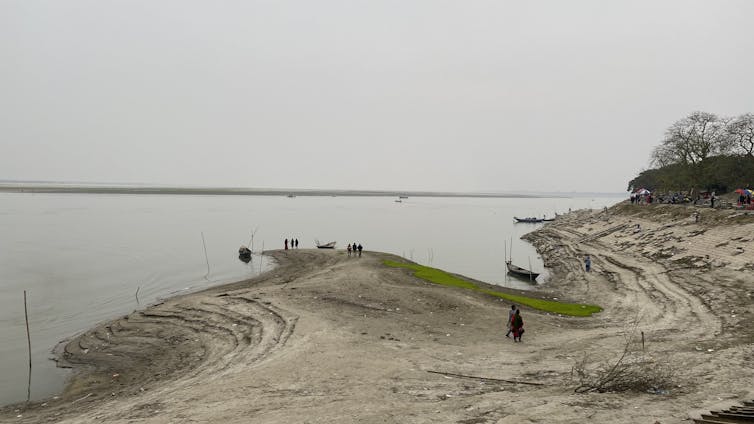
A dry river bank.
The mighty Ganges is running dry in some parts of Bangladesh during the hotter months.
Md Sarwar Hossain

This is particularly challenging in the Bangladesh delta, which contains rivers that drain many countries, including China, India, Nepal and Pakistan. The political regimes in each country might oppose transboundary negotiations, which could nevertheless resolve conflict over water which is needed to sustain nearly 700 million people.

There have been success stories, however. The Mekong river commission between Cambodia, Laos, Thailand and Vietnam is a useful template for bilateral and multilateral treaties with India and Nepal for the Ganges, and China and Bhutan for the Jamuna river.

Tax-based water sharing can help resolve conflicts and decide water allocation between countries in the river basin. The countries using more water would pay more tax and the revenue would be redistributed among the other countries who share rivers in the treaty. Additionally, water sharing should be based on the historical river flow disregarding existing infrastructure and projections of future changes.

Reducing deforestation, alternating land use and restoring wetlands could enhance resilience to flooding and drought and ensure water security in the Bangladesh delta. Ultimately, to secure a safe operating space for the rivers here is to secure a safe future for society too.


Don’t have time to read about climate change as much as you’d like?

Get a weekly roundup in your inbox instead. Every Wednesday, The Conversation’s environment editor writes Imagine, a short email that goes a little deeper into just one climate issue. Join the 45,000+ readers who’ve subscribed so far.


The Conversation

Md Sarwar Hossain does not work for, consult, own shares in or receive funding from any company or organisation that would benefit from this article, and has disclosed no relevant affiliations beyond their academic appointment.

ref. The Bangladesh delta is under a dangerous level of strain, analysis reveals – https://theconversation.com/the-bangladesh-delta-is-under-a-dangerous-level-of-strain-analysis-reveals-241097

Five unusual ways to make buildings greener (literally)

Source: The Conversation – UK – By Paul Dobraszczyk, Lecturer in Architecture, UCL

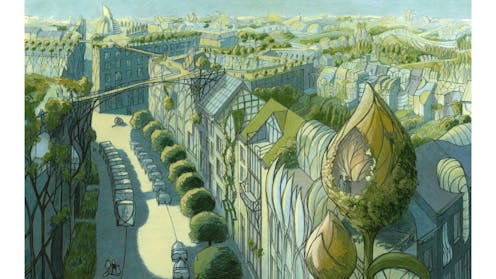
Belgian architect Luc Schuiten’s vision of ‘the Vegetal City’. Luc Schuiten

Buildings adorned with plants are an increasingly familiar sight in cities worldwide. These “green walls” are generally created using metal frames that support plastic plates, onto which pre-grown plants are inserted. These plants are able to survive without soil because they’re sustained by nutrient-packed rolls of felt and artificial sprinklers.

Some are fabulously rich tapestries of luxuriant vegetation, like French botanist Patrick Blanc’s coating of part of the Athenaeum hotel in London. Here, small shrubs sprout from an almost tropical green wall, with an abundance of mosses and ferns. In summer, butterflies peruse the flowers. All this next to Piccadilly, one of the busiest streets in central London.

Others are objects of ridicule: the sadly common outcome of poor design and a lack of maintenance (all green walls need careful planning and a great deal of care). If they’re not carefully tended, green walls will quickly turn into brown ones, with the plastic supports all too visible beneath the dying plants.

But there are many others ways of integrating plants into buildings beyond simply trying to grow them on walls. Here are five examples that straddle the mundane and the marvellous.

A wall with a metal grid and dying plants.
A wilted green wall in Tokyo, Japan.
Wikimedia Images, CC BY

Growing buildings

German architectural practice Baubotanik (a word that means “botanic building”) has taken the radical step of creating buildings that flout the conventional idea of architecture as static and inert. After all, plants grow – they are living organisms.

Baubotanik uses pre-grown trees to create multi-storey structures, with trees replacing the conventional steel girders of most tall buildings. Its Plane-Tree-Cube in Nagold, begun in 2012, is made of plane trees supported on a steel scaffold, with a built-in irrigation system to water the trees until they’re large enough for the steel to be removed.

A square-framed building composed of a metal lattice and growing plants.
Baubotanik’s Plan-Tree-Cube is intended to grow into a usable structure.
Baubotanik

It’ll probably be another ten years before this structure is ready to be used, but as what? It’s hard to imagine making a home in such an unruly structure, let alone plugging in your internet or other electrical appliances.

Building in trees

Baubotanik takes grafting, an age-old horticultural technique, and uses it to create structural frames for buildings. Grafting joins the tissue of plants so that they can grow together (it’s most commonly used in the cultivation of fruit trees).

As the architects themselves acknowledge, there are many interesting historical precedents, such as the Lindenbaum concentrated in a small region of rural Germany in northwestern Bavaria.

These are accessible platforms built into large lime (linden) trees to accommodate dancers in a yearly ritual known as the Tanzlinden (“dance linden”), which originated in the middle of the 17th century and still happen in early September.

In the surviving Lindenbaum in the small village of Peesten (one of around 12 that are still around), a stone stairwell spirals up to the wooden platform built inside the tree: dancing happens on this platform, while musicians provide accompaniment beneath.

A curved stone staircase leading into a structure obscured by a tree growing around it.
Lindenbaum in Peesten, Germany.
Wikimedia Images, CC BY

Weaving buildings

It’s possible to take this practice of integrating buildings and trees one step further and imagine whole cities redesigned in this way. This has been the lifelong preoccupation of Belgian architect Luc Schuiten, particularly in his speculative drawings of “vegetal cities”.

These are urban environments in which the branches of trees and the stems of climbing plants have become completely enmeshed with buildings made of steel and glass. One of his designs, called Habitarbres, imagines a house constructed within a living tree. The structure would flex as the tree grows, while hot-air pipes and other infrastructure would be embedded in the trunk. It’s an attempt to envisage how the infrastructure of our buildings – pipes, wire, cables and the like – can be accommodated in a living structure with its own vascular network.

An artist's sketch of a house built around the main body of a tree.
With Habitarbes, Schuiten proposes a house built within a living tree.
Luc Schuiten

It’s a speculative proposal, but perhaps not so different from a common building type normally associated with enterprising children, namely treehouses. Schuiten is merely taking a human desire – to live in a tree – and suggesting how it might be squared with our equally strong desire for comfort.

Architecture as compost

When plants die and decay they create the conditions for the next cycle of vegetal growth; they are sustainable in a way that the vast majority of our buildings are not. While there is a drive to recycle existing building materials (metals and plastics mostly), it’s another thing entirely to make buildings truly regenerative.

Martin Miller and Caroline O’Donnell’s “Primitive Hut” project from 2017 created a building that does just this. They made a wooden lattice structure to support the growth of four red maple saplings. Another lattice decomposed over time, providing food for the growing trees. Eventually the whole structure was overwhelmed by the trees.

A shed-like building composed of a lattice and trees.
Martin Miller and Caroline O’ Donnell’s ‘Primitive Hut’.
OMG!

In calling this a primitive hut, the architects questioned how western architectural thinking tends to see indigenous architecture as both an origin point and a model for more sustainable forms of construction. It asks whether the industrial technologies that dominate construction in the global north should be more informed by architects that have continued to build with natural and compostable materials for centuries.

Letting be

It’s worth remembering that we don’t have to design green buildings; given enough time, they will happen anyway.

Roof slates sandwiched together with moss.
Moss on the roof of the Sandringham estate’s visitors’ centre in Norfolk, eastern England.
Wikimedia Images, CC BY

The sloping roof of my house, directly below the window where I’m writing this article, is gradually acquiring its own green patina of lichen and moss. The roof is old and I’ve been told it needs to be replaced soon. A cloud of spores and seeds peppers this and every single roof every day with the prospect of new life.

Without any human intervention whatsoever, this process of vegetal succession can produce a complex ecosystem of not only plant but also animal life (from microbes to insects). That architects so rarely call such a surface “green” betrays something that’s deep-seated in ideas about green design. For it is precisely the absence of human control that allows vegetation to colonise a building; there is, in effect no design involved at all – unless, of course, we accept that plants have designs of their own.


Don’t have time to read about climate change as much as you’d like?

Get a weekly roundup in your inbox instead. Every Wednesday, The Conversation’s environment editor writes Imagine, a short email that goes a little deeper into just one climate issue. Join the 45,000+ readers who’ve subscribed so far.


The Conversation

Paul Dobraszczyk does not work for, consult, own shares in or receive funding from any company or organisation that would benefit from this article, and has disclosed no relevant affiliations beyond their academic appointment.

ref. Five unusual ways to make buildings greener (literally) – https://theconversation.com/five-unusual-ways-to-make-buildings-greener-literally-259721

Tackling the chaos at home might be the secret to a more successful work life

Source: The Conversation – UK – By Yasin Rofcanin, Professor of Management Strategy & Organisation, University of Bath

Maria Svetlychnaja/Shuttersotck

In a world of hybrid working and four-day weeks, most workers are asked to be agile, creative and strategic – not just at work but also at home. But what if the energy and focus workers invest into solving family life challenges could actually make them better at adapting and innovating in their jobs?

Our recent study suggests that managing household life – what we call “strategic renewal at home” – doesn’t just benefit family functioning. It also boosts employees’ ability to generate ideas, reshape their roles and respond effectively to change at work.

In short, proactively adapting and reorganising your home life could be a hidden asset for your career.

“Strategic renewal” is a concept long associated with business transformation – think of a company reinventing its operations to respond to shifts in the market. But we argue that this same concept can apply to people managing life at home.


Get your news from actual experts, straight to your inbox. Sign up to our daily newsletter to receive all The Conversation UK’s latest coverage of news and research, from politics and business to the arts and sciences.


Imagine a working parent who streamlines their childcare routine, redistributes chores with their partner or introduces a new system for managing family meals. These efforts – far from mundane – are proactive, forward-thinking moves to adapt to a changing environment. That’s strategic renewal, just in a different setting.

Our findings show that when people engage in this kind of domestic renewal, it creates powerful ripple effects, shaping how they think, feel and perform at work.

The hidden power of home life

We followed 147 dual-earning couples in the US over six weeks. Each week, employees reported how much they engaged in strategic renewal at home and at work. We also captured their experiences of “flow” at home (those rare, deeply focused and enjoyable moments).

For instance, when someone is completely absorbed in gardening, painting a room, or even following a complex recipe – activities that are both enjoyable and require focus – time seems to fly. We also captured their confidence in handling challenges (self-efficacy), and their partner’s view of how well they were managing work–family balance.

We uncovered several interesting points. Employees who took proactive steps to improve family routines felt more “in flow” at home.

These moments of flow built their confidence (self-efficacy), making them feel more capable of tackling future challenges – not just at home, but at work too. That confidence translated into more strategic renewal at work. Employees were more likely to change how they approached tasks, pitch ideas or redesign their roles.

Crucially, their partners also noticed. Employees high in self-efficacy were rated as better at balancing work and family, as well as being more effective in family life.

In other words, strategic behaviour at home doesn’t stay there – it travels with us. What happens at the breakfast table can spill over into the boardroom.

But not all environments are equal. The benefits of home-based strategic renewal were much stronger when the family was supportive of creativity. When people felt free to try new things, take risks and share ideas at home, the gains from their efforts were amplified.

This could be as simple as trying out a new meal, brainstorming weekend plans together or encouraging a partner to experiment with a new hobby. These activities reflect openness, curiosity and support for creative expression in everyday life.

The same was true at work. Employees who felt their organisations fostered a climate of creativity – valuing new ideas, experimentation and autonomy – were more likely to act on their confidence and engage in strategic behaviour.

We found a big takeaway for workers. Cultivating open, creative climates in both domains makes all the difference. Encouraging new ideas at home or at work doesn’t just make people feel good – it helps workers to be flexible and adaptive.

What employers can do

There’s a crucial lesson here for organisations too. The home is not a “black box” – some kind of impenetrable space that has no bearing on work. Instead, home life can play an active and meaningful role in shaping employees’ energy, confidence and creative capacity. Home can be a source of renewal, resilience and even innovation.

Forward-thinking companies should avoid treating home and work as separate silos. Instead, they can invest in developing self-efficacy in employees. This could be providing training, coaching and feedback that reinforces workers’ belief in their ability to handle challenges.

They should also encourage family-supportive leadership. Managers who ask about employees’ home life, support flexible arrangements and accommodate caring responsibilities help create the space for home-based renewal to thrive.

a surprised woman receiving a gift at her desk from her colleagues
Celebrating employees – for things beyond their professional achievements – is important.
La Famiglia/Shutterstock

And they should recognise “off-the-clock” moments. Celebrating life milestones, offering childcare support or simply acknowledging the mental load of home life all signal that organisations value the full person, not just the professional.

For decades, companies have looked inward for solutions to innovation and adaptability – to things like better tech, better processes and better metrics. But our study found leaders should instead look outward — toward employees’ lives beyond work.

When employees reorganise their domestic life, they’re demonstrating foresight, adaptability and leadership. These are precisely the qualities workplaces are looking for in a world of constant disruption.

When workplaces start seeing the home not just as a stressor but as a source of strength, they can open the door to smarter, more sustainable strategies for resilience, creativity and growth.

So the next time you redesign your morning routine, don’t think of it as just surviving the chaos. You might just be sharpening your edge for the workday ahead.

The Conversation

The authors do not work for, consult, own shares in or receive funding from any company or organisation that would benefit from this article, and have disclosed no relevant affiliations beyond their academic appointment.

ref. Tackling the chaos at home might be the secret to a more successful work life – https://theconversation.com/tackling-the-chaos-at-home-might-be-the-secret-to-a-more-successful-work-life-258487

Wimbledon’s electronic line-calling system shows we still can’t replace human judgment

Source: The Conversation – UK – By Feng Li, Chair of Information Management, Associate Dean for Research & Innovation, Bayes Business School, City St George’s, University of London

The Wimbledon tennis tournament in 2025 has brought us familiar doses of scorching sunshine and pouring rain, British hopes and despair, and the usual queues, strawberries and on-court stardust. One major difference with this year’s tournament, however, has been the notable absence of human line judges for the first time in 147 years.

In a bid to modernise, organisers have replaced all 300 line judges with the Hawk-Eye electronic line-calling (ELC) system powered by 18 high-speed cameras and supported by around 80 on-court assistants.

It has been sold as a leap forward but has already caused widespread controversy. In her fourth-round match against Britain’s Sonay Kartal, Anastasia Pavlyuchenkova was forced to replay a point she had clearly won, because ELC had failed to register that a ball had landed out. Furious, Pavlyuchenkova told the umpire: “You took the game away from me … they stole the game from me.”

British players Emma Raducanu and Jack Draper have also voiced concerns about the accuracy and reliability of the technology.

We have seen this before in business, government and elite sport (think VAR in football). Promising technologies fail, not necessarily because the systems are flawed – though some are – but because the institutions around them have not kept up. The belief that technology can neatly replace human judgement is seductive. It’s also deeply flawed.


Get your news from actual experts, straight to your inbox. Sign up to our daily newsletter to receive all The Conversation UK’s latest coverage of news and research, from politics and business to the arts and sciences.


Systems like Hawk-Eye at Wimbledon offer measurable gains in accuracy, but accuracy is not the same as legitimacy. People don’t just want correct decisions, they also want understandable and fair ones. When human line judges made mistakes, they were visible and open to appeal. When a machine fails, with no explanation and no route for redress, it breeds confusion and frustration.

Consider Formula 1. At the 2025 British Grand Prix in Silverstone, driver Oscar Piastri was handed a 10-second penalty by race stewards for erratic braking during a safety car restart. He called it inconsistent and harsh, and many fans agreed.

The key difference? We knew who made the call. There was someone to question, and a process to scrutinise. With machines, however, there’s no one to challenge. You can’t argue with a black box, or hold it to account.

Beyond performance

Technology is usually introduced to improve performance or reduce costs, but the full story is rarely made explicit. Wimbledon’s adoption of the new system was framed as a move towards greater accuracy and consistency, but it was also likely driven by the desire to speed up matches, cut costs, and reduce reliance on human labour.

Yet sport is not just about accuracy. It is entertainment. It thrives on emotion, tradition and theatre. For 147 years, line judges were part of Wimbledon’s identity. Their posture, uniforms, gestures, indeed even the drama of a close call, added to the spectacle. Removing them may have improved accuracy (and cut costs), but the atmosphere was also changed.

Tradition is often dismissed as nostalgia, but in institutions like Wimbledon, tradition is part of what makes the experience legitimate and enjoyable. When it’s stripped away with only a token explanation, players and audiences can lose trust, not just in the change, but in the institution itself. It is a cultural change, which is never easy.

One common solution is to combine human judgement with the technology especially during the transition period, but hybrids rarely work well in practice as responsibilities get blurred.

In business, this is known as the “hybrid trap”: bolting new technologies onto old systems without rethinking or redesigning either. Instead of the best of both worlds, the result is often confusion, duplication and failure.

Wimbledon did not seem to offer a formal challenge system or human override during matches. Although 80 former line judges were retained as on-court assistants, their role was not adjudicative. This might speed up play, but it leaves the system brittle. When something breaks, there is no immediate redress. We have seen this elsewhere.

What this tells us about AI

Wimbledon’s failure was a textbook case of poor tech adoption. Hawk-Eye did what it was designed to do, but the institution wasn’t ready, least of all the players, umpires and spectators.

The same pattern is playing out with artificial intelligence (AI) and other emerging technologies, from customer service bots to healthcare triage systems. These tools are being rolled out at speed, often with minimal oversight. When they hallucinate, embed bias or produce erratic results, there is rarely a clear route to appeal, and often no one to hold accountable.

The real problem is not just technical but institutional. Most organisations aren’t ready for what they’re adopting. Instead of transforming themselves to harness new technologies, they bolt them onto legacy systems and carry on as before. Key questions go unanswered: Who decides? Who benefits? Who is accountable when things go wrong? Without clear answers, new technologies don’t solve dysfunction, they entrench it. Sometimes, they hardwire it.

If we want technology to improve how the world works, we can’t just automate tasks, processes or jobs. We need to rethink and redesign the institutions these systems are meant to serve, using new capabilities these technologies make possible. Until then, even the best systems will continue to fall short, both quietly and occasionally spectacularly.

The Conversation

Feng Li does not work for, consult, own shares in or receive funding from any company or organisation that would benefit from this article, and has disclosed no relevant affiliations beyond their academic appointment.

ref. Wimbledon’s electronic line-calling system shows we still can’t replace human judgment – https://theconversation.com/wimbledons-electronic-line-calling-system-shows-we-still-cant-replace-human-judgment-260845

Superman wasn’t always so squeaky clean – in early comics he was a radical vigilante

Source: The Conversation – UK – By John Caro, Principal Lecturer, Film and Media, University of Portsmouth

Superman was the very first superhero. He debuted in Action Comics issue #1 which was released in June 1938. Over time, the character has been assigned multiple nicknames: “The Man of Steel”, “The Man of Tomorrow” and “The Big Blue Boy Scout”. However, in his first appearance in ravaged Depression-era America, the byline used to announce Superman’s debut was: “The Champion of the Oppressed”.

Created by the sons of Jewish immigrants, writer Jerry Siegel and artist Joe Shuster, Superman is an example of youthful male wish fulfilment: an all-powerful figure dressed like a circus strong man, who uses brawn to right wrongs. However, Siegel and Shuster’s initial version of the character was a more flawed character.

Appearing in a 1933 fanzine, Siegel’s prose story The Reign of the Superman with accompanying illustrations by Shuster, featured a reckless scientist whose hubris is punished when he creates the telepathic “super man” by experimenting on a drifter plucked from the poverty lines. Echoing Mary Shelley’s Frankenstein, the creator is dispatched by his creation.


Looking for something good? Cut through the noise with a carefully curated selection of the latest releases, live events and exhibitions, straight to your inbox every fortnight, on Fridays. Sign up here.


Siegel and Shuster had some early success selling stories to National Allied Publications, the forerunner of DC Comics. At this time, comic books were mainly collections of newspaper cartoons – the “funnies” – pasted together to create more portable anthologies. They featured the escapades of characters like Popeye and Little Orphan Annie.

Inspired by the heroic tales of derring do of pulp fiction adventurers such as Johnston McCulley’s Zorro (1919) and Philip Wylie’s 1930 science fiction novel Gladiator, Siegel and Shuster further developed their Superman character. They transformed him into a hero and added the now familiar cape and “S” logo.

Having no luck selling their superhero to the newspapers, they eventually sold the rights to Superman to DC Comics, where Superman achieved huge success. Within a year, there was a syndicated newspaper strip and a spin-off Superman comic book featuring the first superhero with their own exclusive title. Along with extensive merchandising, there was a 1940 radio show, followed by an animation series in 1941, with the inevitable live action serial in 1948.

In this early example of a property crossing multiple media platforms, Superman’s apparent appeal lay with the fantastical aspects, as he battled mad scientists, criminal masterminds and giant dinosaurs.

But in the early issues, Superman’s enemies were noticeably more earthbound and reflected the concerns of an audience reeling from the effects of the Great Depression. In an early story, War in Sante Monte, Superman confronts a corrupt Washington lobbyist, Alex Greer, who is bribing a greedy senator. It transpires that Greer represents an arms dealer who is profiteering by manipulating both sides in an overseas war.

In a later tale, Superman Battles Death Underground, our hero challenges the owner of a dangerous mine who is cutting corners with safety precautions.

In 1932 Siegel’s father, a tailor, died following the attempted robbery of the family shop – so it is no surprise that Superman had a low tolerance for crime and its causes. In the story Superman in the Slums, dated January 1939, the social commentary is plain. When teenager Frankie Marello is sentenced to reform school, Superman acknowledges the impact of the boy’s social environment:

It’s these slums – your poor living conditions – if there was only some way I could remedy it!

His solution is to raze the dilapidated buildings to the ground, forcing the authorities to replace them with modern cheap-rental apartments. In creating new construction work, here is Superman’s extreme version of President Franklin D. Roosevelt’s New Deal.

In the 1998 forward to Superman: The Action Comics Archives Volume 2, former DC Comics editor Paul Kupperberg comments this is a Superman “who fought (mainly) guys in suits out to screw over the little guy”. The form that the fight took is of interest, for this Superman has no time for niceties or due process, as he gleefully intimidates and bullies anyone who gets in his way.

A man caught beating his wife is thrown into a wall and warned that there is plenty more where that came from. The corrupt lobbyist is dangled over power cables until he reveals who he is working for. Any police officers that attempt to obstruct Superman’s personal quest for justice are brushed aside with annoyance.

Refining Superman

Through his appearances on mainstream radio and cinema, Superman softened and became more patient. In popular culture, concerns about the depression and social injustice shifted to efforts to encourage a national consensus as the United States moved to a war footing in the early 1940s.

Post-war, there were occasional returns to the more radical interpretations of Superman, but generally it is the clean cut, fantastical Big Blue Boy Scout perception of the character that has dominated.

The new Superman film appears to be maintaining that image. In the trailer, actor David Corenswet’s Superman tackles various super-villains and a destructive Kaiju (a Godzilla-like skyscraper-sized monster) – although there is the suggestion that behind them all is the corrupt industrialist, Lex Luthor.

The trailer for the latest Superman film.

Fittingly, it is in the pages of comic books that a more progressive, militant representation of Superman has emerged. In 2024 DC rebooted its familiar superheroes with its new grittier “Absolute” universe.

Jason Aaron and Rafa Sandoval’s Absolute Superman comic (2024) emphasises the character’s status as an isolated blue-collar immigrant from the doomed planet of Krypton. This is a youthful, less seasoned Superman who is quick to anger and less likely to pull his punches. Their interpretation is closer to Superman’s early vigilante roots, including a storyline where he liberates the workers in a Brazilian mine from the clutches of exploitative big business.

Perhaps – in the comic books at least – the Champion of the Oppressed has finally returned.


This article features references to books that have been included for editorial reasons, and may contain links to bookshop.org. If you click on one of the links and go on to buy something from bookshop.org The Conversation UK may earn a commission.

The Conversation

John Caro does not work for, consult, own shares in or receive funding from any company or organisation that would benefit from this article, and has disclosed no relevant affiliations beyond their academic appointment.

ref. Superman wasn’t always so squeaky clean – in early comics he was a radical vigilante – https://theconversation.com/superman-wasnt-always-so-squeaky-clean-in-early-comics-he-was-a-radical-vigilante-260721

The Salt Path scandal: defending a memoir’s ‘emotional truth’ is a high-risk strategy

Source: The Conversation – UK – By Robert Eaglestone, Professor of Contemporary Literature and Thought, Royal Holloway University of London

Raynor Winn, author of the award-winning memoir The Salt Path, which was recently adapted into a film, has been accused of “lies, deceit and desperation”. Writing in The Observer, reporter Chloe Hadjimatheou claims that Winn left out significant facts and invented parts of the story.

The Salt Path follows a transformative 630-mile trek along England’s South West Coast Path that Winn took with her terminally ill husband Moth after they lost their home and livelihood.

The Observer article claims that aspects of both the story of losing their home and Winn’s husband’s illness were fabricated. In a statement on her website, Winn has defended her memoir, calling the claims “grotesquely unfair” and “highly misleading”.

There’s a long list of memoirs which have been shown to be problematic. James Frey’s recovery memoir A Million Little Pieces (2003) was allegedly exaggerated. In 2006, he apologised for fabricating portions of the book. Worse, Binjamin Wilkomirski’s feted Holocaust survivor memoir Fragments: Memories of a Wartime Childhood (1995) was completely fake. Wilkomirski’s real name was Bruno Dössekker and he was not a Holocaust survivor, he had simply invented his “memories” of a death camp, though he seemed to believe they were true.

But, for readers, how much does this matter? Novelist D.H. Lawrence wrote that readers should: “Never trust the artist. Trust the tale.” As readers of The Salt Path, we fear for Raynor and Moth as they desperately try to escape drowning from a freak high tide at Portheras Cove. We are relieved when we hear that Moth’s terminal disease was “somehow, for a while, held at bay”.

The origin of the word fiction is from the Latin fingere, which means not to lie, but to fashion or form. All memoirs – indeed, all texts, from scientific articles to history books to bestselling novels – are “formed” or “shaped”. Writing doesn’t just fall from a tree, we make it, and it reveals the world by mediating the world.


Looking for something good? Cut through the noise with a carefully curated selection of the latest releases, live events and exhibitions, straight to your inbox every fortnight, on Fridays. Sign up here.


But this idea, that writing is a “shaping”, is why this case matters. Writing, done by oneself, or by a ghostwriter (or even by AI) has conventions, not-quite-rules that underlie its creation and reception. Some of these are in the text (the enemies eventually become lovers); some are outside the text itself (you really can judge a book by its cover). But most conventions are both inside and outside at the same time.

Works by historians have footnotes to sources, so you (and other historians) can check the claims. Each scientific article refers to many others, because each article is just one tiny piece of the whole puzzle on which a huge community of scientists are working, and the extensive references show how this piece fits (or doesn’t). Non-fiction follows conventions, while novelists can do whatever they want, of course, to challenge or obey the conventions (that’s one reason why novels are exciting).

Memoir has a particularly important convention, revealed most clearly by the historian Stefan Maechler’s report on Wilkomirski’s fraudulent memoir. Maechler argued that Wilkomirski broke what the French critic Philippe Lejeune called the “autobiographical pact”, a contract of truth between the author and the reader.

For Lejeune, however, this pact is not like a legal agreement. A memoir, unlike a scientific article, need only put forward the truth as it appeared to the author in that area of their life. While the information needs to be accurate to some degree, its level of verifiability is less than a legal document or work of history. Much more important for Lejeune is the harder-to-pin-down fidelity to meaning.

After all, many meaningful things – falling in love, for example, or grief – happen mostly inside us and are hard to verify. Even more, the developing overall shape of our life as it seems to us is not really a historical fact, but our own making of meaning. For Lejeune, in a memoir, this emotional truth is more significant than the verifiable truth.

Playing with ‘emotional truth’

The author of The Salt Path seems to have leaned into this idea. In her first statement after The Observer’s piece she claims that her book “lays bare the physical and spiritual journey Moth and I shared, an experience that transformed us completely and altered the course of our lives … This is the true story of our journey”. How, after all, could one verify a “spiritual journey”?

However, I don’t fully agree with Lejeune. Perhaps our inner and outer worlds are not as separate as he supposes. Our public actions, including sharing facts, show who we are as much as our words describing our inner journeys.

In a memoir, the verifiable truth and the emotional truth are linked by a kind of feedback loop. As readers, we allow some degree of playing with verifiable truth: dialogue is reconstructed, not recorded; we accept some level of dramatisation; we know it’s from one person’s perspective. But we also make a judgment about these things (there’s no fixed rule, no science to this judgment).

If there’s too much reconstruction, too much dramatisation, we begin to get suspicious about the emotional truth too: is this really how it felt for them? Was it honestly a spiritual journey? And, in turn, this makes us more suspicious of the verifiable claims. By contrast, the novelist’s pact with the reader admits they fake emotional truth, which somehow makes it not fake at all: that’s one reason why novels are complicated.

This is why defending a memoir’s “emotional truth” is a high-risk strategy. We know from our own lives that people who are unreliable in small (verifiable) things are often unreliable in large (emotional, meaningful) ones.

So, for readers, the facts behind The Salt Path matter less in themselves and more because each question points to a larger issue about the book’s meaning. When you call someone “fake”, you don’t really mean that “their factual claims are inaccurate”, but that they are somehow inauthentic, hollow or – it’s a teenager’s word, but still – phoney. Once the “autobiographical pact” looks broken in enough small details, the reader no longer trusts the teller or the tale.

In a lengthy statement published on her website in which she addresses the allegations in detail, Winn said that the suggestion that Moth’s illness was fabricated was an “utterly vile, unfair, and false suggestion” and added: “I can’t allow any more doubt to be cast on the validity of those memories, or the joy they have given so many.”


This article features references to books that have been included for editorial reasons, and may contain links to bookshop.org. If you click on one of the links and go on to buy something from bookshop.org The Conversation UK may earn a commission.

The Conversation

Robert Eaglestone does not work for, consult, own shares in or receive funding from any company or organisation that would benefit from this article, and has disclosed no relevant affiliations beyond their academic appointment.

ref. The Salt Path scandal: defending a memoir’s ‘emotional truth’ is a high-risk strategy – https://theconversation.com/the-salt-path-scandal-defending-a-memoirs-emotional-truth-is-a-high-risk-strategy-260937