We can learn a lot from Troy’s trash

Source: The Conversation – UK – By Stephan Blum, Research associate, Institute for Prehistory and Early History and Medieval Archaeology, University of Tübingen

Beneath the epic tales of heroes and gods, Troy’s true story is written in something far less glamorous – its rubbish.

When we think of Troy, we imagine epic battles, valiant deeds, cunning tricks and the wrath of gods. Thanks to Homer’s Iliad, the city is remembered as a stage for romance and heroism.

But long before Paris stole Helen and Achilles raged on the battlefield, the people of bronze age Troy lived ordinary lives – with extraordinary consequences. They built, cooked, stored, traded and, crucially, threw things away. And they did it right where they lived.

Today, waste is whisked away quickly – out of sight, out of mind. But in bronze age Troy (3000–1000BC), trash stayed close, often accumulating in domestic dumping grounds for generations.

Having spent more than 16 summers excavating and analysing the bronze age layers of Troy, I’ve learned to read the city’s history this waste.

Hundreds of thousands of animal bones from cattle, sheep, fish – even turtles – were found alongside vast quantities of pottery shards, ash, food scraps, and human waste. Sometimes, these layers were reused to level floors or build walls, showing how closely intertwined daily life and refuse management were.

Archaeology’s dirty secret

This wasn’t laziness or neglect, it was pure pragmatism. In a world without rubbish trucks or sanitation systems, managing refuse was neither chaotic nor careless, but a collective, spatially negotiated – and surprisingly strategic – effort.

The excavations I have worked on as part of the University of Tübingen’s Troy Project, which has been going on since 1988, have revealed just how deliberate these routines were. Where people chose to dump, or not to dump, speaks volumes about status, social roles, and community boundaries. Waste is the diary no one meant to write, yet it records the intimate rhythms of daily life with unfiltered clarity.

Far from a nuisance, Troy’s waste is an archaeologist’s treasure trove.

Over nearly 2,000 years, Troy ended up with 15 meters of built-up debris. Archaeologists can see nine major building phases in it, each made up of hundreds of thin layers, which formed as people lived their everyday lives. These layers act like snapshots, quietly recording how the city changed over time. Some capture hearth cleanings, others record the rebuilding of entire city quarters.

By analysing the layers and their ratios of bones to pottery, ash concentration, presence of storage jars, grinding stones, or production debris, specific spaces of activity become visible: kitchens, workshops, storage areas, rubbish pits. What appears chaotic turns out to be a carefully structured map of everyday routines – showing where meals were prepared, tools made, and discarded objects left behind.
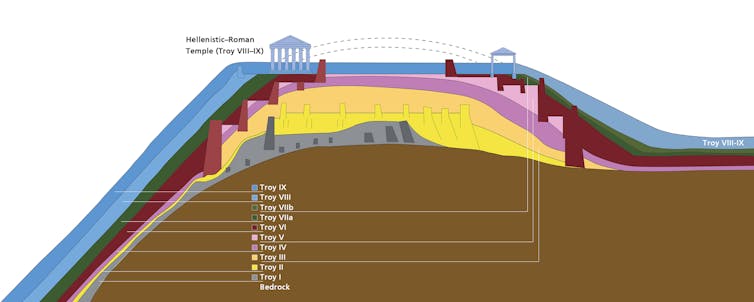
A schematic cross-section through the settlement mound of Troy, revealing centuries of construction, destruction, and renewal.
University of Tübingen/Frank Schweizer, CC BY-NC-SA

The story these remains tell is one of profound transformation. Troy began as a modest agrarian settlement, shaped by the steady rhythms of farming, herding, and small-scale craft. Over time, it grew into a thriving regional centre.

The archaeological record, rich in refuse, traces this long arc of change. Exotic imports fashioned from stones such as carnelian and lapis lazuli begin to appear, revealing distant trade connections. Specialised metalworking tools emerge alongside monumental architecture. some buildings stretched nearly 30 metres, signalling growing ambitions and expanding capabilities.

This rise unfolded gradually, reflected not just in grander buildings, but in shifting tools, trade, and how people dealt with what they left behind. Waste management became more organised, with designated areas for different types of waste. This reflects broader shifts in how the community structured space and managed its economy.

Yet this ascent was interrupted. By the mid-third millennium BC, signs that things were becoming smaller appear. Architecture simplifies, household inventories shrink, production debris declines suggesting economic slowdown or political instability.

Still, Troy endured. By the mid-second millennium BC, the city revived. Refined ceramics, luxury imports and evidence of social complexity marked a new chapter of recovery and reinvention. This splendid settlement later became the stage for Homer’s Trojan War where Greek warriors faced the daunting task of climbing towering mounds of debris built up over centuries just to reach the palaces.

A heap worth climbing

These insights allow us to see Troy not just as a city of walls and towers, but as a living organism shaped by daily routines, unspoken norms and social negotiation. The waste left behind is a remarkably honest archive of bronze age society – beneath myths, stones, and poetry.

Troy’s trash heaps are the bronze age’s search history. To know what mattered 4,500 years ago, don’t ask poets – ask the garbage. From broken tools to shared meals, from imported luxuries to scraps, this waste reveals the pulse of everyday life and society’s evolving structure.

Ironically, these mundane refuse layers preserved the bronze age world for us. Without them, we’d know far less about early Troy’s people. Their depth and composition trace changes in economy, technology, and social structure. From scraps to towers of pottery shards, waste archaeology is key to understanding early urban complexity.

So next time you picture Achilles storming Troy’s gates, remember: the heroes might have been divine, but their city smelled very human.

The Conversation

Stephan Blum does not work for, consult, own shares in or receive funding from any company or organisation that would benefit from this article, and has disclosed no relevant affiliations beyond their academic appointment.

ref. We can learn a lot from Troy’s trash – https://theconversation.com/we-can-learn-a-lot-from-troys-trash-260613

From raw garlic cloves to cayenne pepper: why ‘natural’ DIY skincare can leave you burnt, itchy – or worse

Source: The Conversation – UK – By Adam Taylor, Professor of Anatomy, Lancaster University

Krakenimages.com/Shutterstock

Scrolling through social media, it’s hard to miss influencers raiding the pantry for “natural” beauty fixes: baking-soda scrubs, garlic spot sticks, cayenne masks that promise to tighten pores and banish dullness.

The appeal is obvious. Why pay for a dermatologist-tested cream when everyday ingredients come with antimicrobial or exfoliating properties? Yet what looks sensible in a 30-second reel can translate into painful, sometimes dangerous, DIY disasters.

Just because it’s edible doesn’t mean it’s safe to put on your skin.


Get your news from actual experts, straight to your inbox. Sign up to our daily newsletter to receive all The Conversation UK’s latest coverage of news and research, from politics and business to the arts and sciences.


Garlic, chilli, turmeric and their spice-rack neighbours may contain potent bioactive compounds, but in raw form they are unrefined, unstable and frequently far too harsh for the delicate acid mantle that shields human skin.

Professional cosmetic chemists isolate biologically active plant compounds, purify them and blend them at precisely calibrated doses suited to the skin’s natural pH. A spoonful of cayenne or a pinch of bicarbonate of soda offers none of that control. Slapping pantry powders on your face risks chemical burns, rashes or long-term damage.

Concentration is the first stumbling block. A teaspoon of baking soda, for instance, has nothing in common with a safety-tested cleanser that might contain less than 1% sodium bicarbonate balanced by humectants (moisture-attracting ingerdients) and acids.

Likewise, a swipe of raw cayenne delivers an unpredictable hit of capsaicin, the fiery molecule that dermatologists use in nerve-pain creams, but only at strictly managed strengths.

Pure kitchen spices also arrive with their own microorganisms: they are agricultural products processed in bulk. Once mixed with water or oil to create a mask they can become bacterial broths, inviting infection rather than a healthy glow.

Baking soda: more alkaline than your skin can handle

Baking soda illustrates how quickly a “harmless” staple can upset skin chemistry. Celebrated online for mild antibacterial and antifungal properties, sodium bicarbonate is, in fact, highly alkaline.

Normal skin sits in the acidic range of 4.5 to 5.5. Apply a thick alkaline paste and the pH shoots upward, disrupting friendly microbes and triggering irritation and breakouts.

Studies in humans show a bicarbonate paste does not relieve psoriasis itch or redness. On babies, baking-soda soaks for nappy rash have caused hypokalaemic metabolic alkalosis (low potassium levels in the blood), leading to seizures and coma.

Some influencers say that the same paste that soothes burns is safe, but it can be dangerous. There are reports of baking soda causing severe skin damage – such as deep burns and even tissue death – when it was applied to broken or injured skin.

Even more alarming are posts touting it as a DIY cancer therapy, on the theory that it “neutralises” tumour acidity. High oral doses have disrupted heart rhythm and caused death.

Garlic: ancient remedy, modern irritant

Garlic’s folklore as a “natural antibiotic” fares no better. Raw cloves are loaded with sulphur compounds that behave like caustic chemicals. Direct application has produced allergic or irritant dermatitis and even third-degree burns on lips and eyelids.

Any scars may outlast the pimple they were supposed to heal.

Research on allicin, a natural compound in garlic, shows promise as an antimicrobial and heart-protective agent – potentially helping to lower blood pressure, reduce inflammation and prevent heart disease. But that study used purified extracts in lab conditions – not a clove rubbed straight onto skin.

Chilli peppers: capsaicin isn’t a beauty hack

Chillies present an even hotter hazard. Capsaicin is licensed for nerve-pain creams yet even pharmacists warn of burning, redness and swelling. Home kitchens, obviously, lack a pharmacist.

Cooks who handle chillies daily can develop Hunan hand, an intensely painful, burning dermatitis. Despite this, some beauty hacks still recommend cayenne masks for radiance. Airborne or topical capsaicin stings the eyes, triggering involuntary spasms and long exposure can cause lasting corneal injury.

Inhaling the dust provokes coughing fits and, over time, lung inflammation. Because capsaicin penetrates the skin, repeated use can damage peripheral nerve fibres – dulling your ability to feel heat or pain – and disrupt normal blood flow, which may lead to tissue irritation, delayed healing or increased sensitivity. It can also affect blood pressure, especially in people with underlying health issues.

A notorious example underscored the danger: a woman suffered agonising vaginal burns after unknowingly using a tampon contaminated with pepper spray that had leaked in her handbag. Even mustard powder can deliver second-degree burns when misapplied.

Spice rack roulette: staining, burning, dermatitis

Spices thought to be milder are hardly innocent. Cinnamon is a trendy lip-plumper, yet dermatologists document contact dermatitis and chemical burns. Ginger “glow” masks leave many users with red, irritated skin.

Clove oil, hyped as a spot cure, has produced caustic injuries. Saffron can cause allergic rashes, while turmeric’s curcumin, celebrated online for anti-inflammatory benefits, often delivers dermatitis and bright yellow staining that lingers for days.

Dermatologists recommend patch-testing any new skincare product, even “pure” essential oils, on the inner arm for 48 hours.

Powdered spices also wander: a cinnamon scrub can fill the air with irritant dust that settles in eyes or airways, leaving you sneezing and sore instead of glowing.

Respect your barrier

Dermatologists emphasise the importance of protecting the skin barrier: gentle, pH-balanced cleansers and moisturisers help maintain the acid mantle that defends against germs. Your doctor or pharmacist can guide you toward proven plant-based ingredients like niacinamide, aloe vera, or colloidal oatmeal, all of which offer skin benefits without the sting.

Next time an influencer urges you to “ditch chemicals” or promote “clean beauty” and scoop your skincare out of a spice jar, remember, everything is a chemical. Some belong on your dinner plate – very few belong on your face.

The Conversation

Adam Taylor does not work for, consult, own shares in or receive funding from any company or organisation that would benefit from this article, and has disclosed no relevant affiliations beyond their academic appointment.

ref. From raw garlic cloves to cayenne pepper: why ‘natural’ DIY skincare can leave you burnt, itchy – or worse – https://theconversation.com/from-raw-garlic-cloves-to-cayenne-pepper-why-natural-diy-skincare-can-leave-you-burnt-itchy-or-worse-260264

Donor-egg pregnancies may come with higher rates of serious complications – here’s what you need to know

Source: The Conversation – UK – By Catherine Meads, Professor of Health, Anglia Ruskin University

takasu/Shutterstock

More women than ever are carrying babies conceived with someone else’s egg – but few are told that this might carry greater health risks.

Pregnancies involving an embryo that doesn’t share the pregnant woman’s DNA are becoming more common. For many, it’s a path to parenthood that would otherwise be closed.

But emerging evidence suggests that these pregnancies may come with higher rates of complications, including pre-eclampsia, gestational diabetes and preterm birth, and that women are often not given the full picture before treatment.


Get your news from actual experts, straight to your inbox. Sign up to our daily newsletter to receive all The Conversation UK’s latest coverage of news and research, from politics and business to the arts and sciences.


As the fertility industry expands and diversifies, it’s time to ask whether patients are being adequately informed about the risks of carrying another woman’s egg – and whether more caution is needed in how these options are presented.

There are three situations in which a woman may carry another woman’s egg in her uterus.

The most common is when a woman cannot produce her own eggs but has a functioning uterus. In this case, donor eggs and in-vitro fertilisation (IVF) offer the only route to pregnancy.

The other two situations involve fertile women carrying a donated egg on behalf of someone else. This happens in cases of gestational surrogacy, where a surrogate carries a baby genetically unrelated to her, or in reciprocal IVF, also known as ROPA or co-IVF. In the latter, one woman in a same-sex couple (or a trans man) donates her egg to her partner, so that both have a biological connection to the child.

In IVF, fertilisation occurs outside the body and the resulting embryo is transferred into the uterus. But what happens when the egg in the uterus has no genetic similarity to the woman carrying it? Could this cause complications for her or the baby?

To answer that question, we need to compare outcomes in these situations to pregnancies where the egg shares approximately 50% of the mother’s DNA, either through natural conception or own-egg IVF. Early evidence suggests that having someone else’s egg in the uterus is associated with a higher risk of obstetric complications, including pre-eclampsia, gestational diabetes and preterm birth.

There are three key comparisons to make. First, donor-egg IVF v own-egg IVF. For infertile women using donor eggs, the most relevant comparison is IVF with their own eggs.

Second, gestational v traditional surrogacy. In gestational surrogacy, the surrogate carries a donor egg, while in traditional surrogacy, she uses her own. Outcomes can also be compared with the surrogate’s previous natural pregnancies.

Third, reciprocal IVF v own-egg IVF. In same-sex couples, reciprocal IVF can be compared to own-egg IVF to assess risks.

A review of 11 studies comparing donor-egg IVF to own-egg IVF found that donor-egg pregnancies had significantly higher rates of hypertensive disorders in the mother, as well as preterm birth and babies that were small for their gestational age.

A separate review focusing on pre-eclampsia in singleton IVF pregnancies found the condition occurred in 11.2% of donor-egg pregnancies, compared to 3.9% of own-egg pregnancies.

For women who can only become pregnant using a donor egg, these risks may be worth accepting. But it’s important that women are made aware of the potential complications, especially if carrying twins, which further increases risks.

Gestational surrogacy

With colleagues, I conducted a review of eight studies. The research suggests that gestational surrogacy (donor egg) is linked to higher rates of hypertensive disorders and gestational diabetes compared to traditional surrogacy (surrogate’s own egg) or previous natural pregnancies.

So why is gestational surrogacy often favoured by clinicians and intended parents alike? For some doctors, it can offer greater medical and ethical clarity; for some parents, it can reduce legal and emotional complications. A common assumption is that genetically related surrogates may be more likely to want to keep the baby – but research shows this is not the case. Surrogates rarely seek to retain custody, regardless of genetic connection.

Evidence on reciprocal IVF is even more limited. A 2022 study of 21 women who underwent reciprocal IVF found that hypertensive disorders occurred in 23.8%, compared to 12.9% of the 62 heterosexual women using their own egg, and gestational diabetes occurred in 9.5% v 1.6%.

The only study directly comparing reciprocal IVF to own-egg IVF in same-sex female couples is an unpublished conference abstract, which found a higher miscarriage rate (19% v 14%), but reported no maternal or infant outcomes.

Despite limited data, fertility companies often market gestational surrogacy and reciprocal IVF as reasonably safe options. However, much of the research comes from clinicians affiliated with fertility clinics.

Crucially, there is still no strong evidence showing that fertile women carrying another woman’s egg have better outcomes than infertile women undergoing the same. But a lack of evidence is not the same as evidence of safety.

In some cases, pregnancy using one’s own egg may still be possible. For example, fertile women in same-sex couples may only need sperm donation to conceive naturally, rather than going through IVF.

Women deserve full, unbiased information about the risks. That includes knowing that carrying someone else’s egg may increase the likelihood of pregnancy complications. They can then make informed decisions about whether the potential benefits outweigh the risks.

The Conversation

Catherine Meads does not work for, consult, own shares in or receive funding from any company or organisation that would benefit from this article, and has disclosed no relevant affiliations beyond their academic appointment.

ref. Donor-egg pregnancies may come with higher rates of serious complications – here’s what you need to know – https://theconversation.com/donor-egg-pregnancies-may-come-with-higher-rates-of-serious-complications-heres-what-you-need-to-know-259855

Horseflies and wasps and jellyfish – how to stay safe from stings and bites this summer

Source: The Conversation – UK – By Dan Baumgardt, Senior Lecturer, School of Physiology, Pharmacology and Neuroscience, University of Bristol

Anna Kuzmenko/Shutterstock

Despite the glorious arrival of summer, there’s definitely a sting in the season’s tail – quite literally. Even in the UK, it’s not just sunburn we need to watch out for. From nettles to jellyfish, summer brings a full cast of prickly, buzzing, biting villains.

My own back patio is armed with an arsenal of citronella candles and incense sticks to fend them off – not just a lifestyle choice, but a survival strategy for someone as jumpy as me around insects.

Let’s break down the main culprits.


Get your news from actual experts, straight to your inbox. Sign up to our daily newsletter to receive all The Conversation UK’s latest coverage of news and research, from politics and business to the arts and sciences.


Plant-based stings: nettles

First up, the humble but mighty common nettle, which thrives in hedgerows and gardens, often reaching impressive heights of up to two metres by midsummer. Their sting comes from tiny hairs called trichomes, which inject histamine and other irritants into the skin as a form of defence.

Histamine causes the classic signs of inflammation: redness, swelling, heat and pain – all of which are evident in the raised, red rash known as urticaria (or hives). Unsurprisingly, the Latin name for the nettle family is urtica, meaning “to sting.”

And what about that old remedy of rubbing a dock leaf on the sting? Honestly, good luck identifying one among the 200-plus species. While the sap might offer a mild soothing effect, there’s no strong evidence of an active compound that reduces symptoms.

If it works for you, great, but calamine lotion or over-the-counter antihistamines are far more reliable. And use some form of protection in the first place – if you’re clearing them from your garden, or foraging to make nettle pesto, wear gloves and proceed carefully.

Insects: bees, wasps and horseflies

As temperatures rise, so do the number of stinging insects like bees and wasps, not to mention the dreaded horseflies. While most don’t sting unless provoked (a mantra I repeat to myself regularly), when they do, it can be unpleasant.

Most stings cause local irritation – simple pain relief and antihistamines usually do the trick here. But sometimes, either the original sting or subsequent scratching can cause infections.

Cellulitis is a deeper skin infection that can spread quickly if untreated. While milder cases may clear up with oral antibiotics, some infections can be serious – even life threatening – and require hospital care.

If a sting site or the surrounding skin becomes red, warm, painful or swollen, seek urgent medical advice. And if you feel unwell with symptoms like fevers, chills or a racing heart, treat it as an emergency.

Insect stings can also trigger anaphylaxis, a life-threatening allergic reaction. In the UK, stings account for around ten deaths per year: a small, but very sobering figure. Always take anaphylactic symptoms like facial swelling, difficulty breathing or dizziness seriously – and call 999 immediately.

Ticks: small bites, big risks

Tick bites are also more common in summer, thanks to more exposed skin and time spent in tall grass or woodlands. Ticks are tiny – often smaller than a poppy seed – and can be easily missed until they become engorged with blood.

They’re usually harmless, but some ticks carry diseases like Lyme disease, a bacterial infection that can cause fatigue, joint pain and, if untreated, serious complications affecting the nervous system or heart.

Ticks can also spread tick-borne encephalitis, a viral infection that can lead to inflammation of the brain, though it’s very rare in the UK. Watch out for the telltale bullseye rash and flu-like symptoms after a bite – and seek urgent medical advice if they appear.

To remove a tick, use fine-tipped tweezers, gripping as close to the skin as possible and pulling steadily. Don’t twist. You want the whole tick out, legs and all. And don’t squeeze its body, as this can force potentially infected fluids into your bloodstream, raising the risk of conditions like Lyme disease, among others.

Marine stings: jellyfish and friends

And finally, the unexpected seaside sting. Coastal waters can play host to a range of jellyfish, from the mildly irritating to the impressively painful.

Most UK species cause minor rashes, but be wary of the lion’s mane and the occasional (though rare) portuguese men o’war – not technically a jellyfish, but still best avoided.

Even jellyfish washed up on shore can sting, sometimes for days. If stung, rinse the area with seawater (not fresh water), or soak in warm water. Avoid rubbing or using urine – yes, that scene in Friends is not medically sound. Peeing on a jellyfish sting can make things worse by triggering more venom release from stuck tentacles.

If tentacles are still stuck to the skin, use tweezers or the edge of a credit card to remove them gently. Don’t use your bare hand – you could end up stinging that too.

And like insect stings, jellyfish can rarely trigger anaphylactic shock. If someone shows symptoms, don’t hesitate to seek emergency help.

From the garden to the seaside, summer has plenty of sting — but being prepared can make all the difference. Whether it’s nettles, bees or ticks, the best approach is prevention (think gloves, repellent and awareness), followed by prompt treatment if needed.

Use calamine or antihistamines for rashes, and tweezers for tick or jellyfish tentacle removal. Keep a close eye out for signs of infection or allergic reaction and always seek medical advice if something doesn’t feel right.

The Conversation

Dan Baumgardt does not work for, consult, own shares in or receive funding from any company or organisation that would benefit from this article, and has disclosed no relevant affiliations beyond their academic appointment.

ref. Horseflies and wasps and jellyfish – how to stay safe from stings and bites this summer – https://theconversation.com/horseflies-and-wasps-and-jellyfish-how-to-stay-safe-from-stings-and-bites-this-summer-260670

Plant theft is often overlooked – that’s why it’s on the rise

Source: The Conversation – UK – By Jenni Cauvain, Senior Lecturer in Sociology, Nottingham Trent University

More than 180 plants were stolen from a well-loved public park in Nottingham called Arboretum in May 2025. This incident took place just days after volunteers had re-planted flowers and shrubs to repair damage from a previous theft in March. In April 2025, the nearby Forest Recreation Ground community garden was also targeted – roses and crops grown by volunteers were stolen, even a pond went missing.

Plant theft may seem trivial, but environmental and wildlife crime tend to be overlooked. This is precisely one of the reasons why it is on the rise. Research suggests an annual growth rate in environmental crime of 5%-7%, making it the third largest criminal sector in the world.

Globally, environmental crime has been valued at US$70-213 billion (£52-158 billion) annually. As with most crime, its true scale is difficult to estimate as it remains hidden. This is even more true for environmental crime that goes undetected.

Plant thefts in Nottingham where I am based are small in comparison, but they tell the same story of lucrative illicit opportunities for criminals where law enforcement and potential sanctions are low. It’s most likely that people steal local plants to sell on for profit.


Get your news from actual experts, straight to your inbox. Sign up to our daily newsletter to receive all The Conversation UK’s latest coverage of news and research, from politics and business to the arts and sciences.


Another reason for overlooking this growing trend in wildlife crime is that perpetrators, as well as much of society, may feel that this is a “victimless crime”. Where plants, animals, watercourses or soil are “the victim”, people don’t feel as strongly because our ethics and value systems generally prioritise fellow humans and do not recognise non-humans as victims.

People may be more likely to care about mammals such as elephants targeted in illegal ivory trade, but environmental crime permeates every community in the UK, as the recent Nottingham cases indicate.

Stolen benefits

As a researcher in environmental sociology, I believe wildlife crime and environmental damage should gain higher priority in terms of public attention, law enforcement and potential sanctions. Not only because of the intrinsic value that non-human nature has in its own right, but because of the value nature brings to us humans.

Parks and green spaces known as “green infrastructure” are central to our wellbeing in cities. They bring environmental and social benefits in terms of air quality, urban heat island effect, surface flooding, carbon storage, biodiversity and health.

After the COVID pandemic, the importance of accessing quality green spaces for our mental and physical wellbeing became even more apparent. Visits to parks can reduce loneliness and anxiety, as well as foster a sense of belonging and community.

This has the potential to benefit the public purse too. Nottingham is currently involved in a national green social prescribing test and learn programme to demonstrate the benefits of nature-based activity.

Public parks are often also significant in terms of cultural heritage. This is not a new discovery. Historically, public parks were introduced in cities to improve living conditions, quality of life and as educational resources. The Arboretum – the city centre park recently targeted by thieves – was the first such public park to open in Nottingham in 1845.

When valued green spaces are the victim of crime, this is not a mere aesthetic problem. Wider social and environmental harms are inflicted upon communities and nature that depend on open green spaces to thrive.

This matters in cities like Nottingham that suffer from high levels of deprivation and poor health outcomes. My own research has shown that while Nottingham is often celebrated for leadership in green initiatives, it suffers from deep-seated social inequality and deprivation that are long-term challenges.

Social inequality is associated with crime and disorder in urban areas that creates a vicious cycle when the crimes target community assets such as public parks. It is beyond doubt that public parks being ransacked will negatively impact the quality of life in Nottingham.

It is likely that these crimes get dismissed as a minor nuisance because “only plants” were stolen, but this attitude serves to mask the broader trend of growing environmental crime and the damage this brings to communities. Unfortunately, this will further contribute to the likelihood of such crimes spreading in future.


Don’t have time to read about climate change as much as you’d like?

Get a weekly roundup in your inbox instead. Every Wednesday, The Conversation’s environment editor writes Imagine, a short email that goes a little deeper into just one climate issue. Join the 45,000+ readers who’ve subscribed so far.


The Conversation

Jenni Cauvain does not work for, consult, own shares in or receive funding from any company or organisation that would benefit from this article, and has disclosed no relevant affiliations beyond their academic appointment.

ref. Plant theft is often overlooked – that’s why it’s on the rise – https://theconversation.com/plant-theft-is-often-overlooked-thats-why-its-on-the-rise-259334

Feeling confident and in control when they’re active boosts children’s wellbeing

Source: The Conversation – UK – By Michaela James, Research Officer at Medical School, Swansea University

Anna Kraynova/Shutterstock

The wellbeing of children is under the spotlight in the UK, after a 2025 report from Unicef ranked the UK at 21 out of 36 wealthy countries on child wellbeing. With growing concerns about mental health, rising screen time, and fewer chances to play – as well as the well-known links between physical activity and better mood – one solution seems obvious. Get kids moving more.

But our new research suggests that it’s not just about more activity. It’s about better experiences. Feeling safe, capable and free to choose matters is more important for children than just the number of minutes they spend running around.

Our findings from a national study of over 16,000 children aged seven to 11 across Wales found that while physical activity is clearly important, its benefits for mental health were more connected to how children felt while moving than to how much they moved.


Get your news from actual experts, straight to your inbox. Sign up to our daily newsletter to receive all The Conversation UK’s latest coverage of news and research, from politics and business to the arts and sciences.


We found that children who thought that they had control over how they were active, felt confident taking part in physical activity and believed they were good at it scored higher on wellbeing scales. These factors – autonomy, confidence and competence – were stronger predictors of wellbeing than more traditional measures like deprivation (normally we’d expect deprivation to positively or negatively affect wellbeing) or even total time spent being active.

We also found that children who felt safe where they lived, no matter how wealthy or deprived the area, were more likely to feel happy and well.

Yet too often, their chances to play and move are limited. Sometimes it’s because adults worry about safety, and so don’t permit children to roam or play in the potentially risky ways they might prefer. Other times, it’s because the places around them just aren’t built with children in mind.

Rethinking what we tell children

Interestingly, we found that knowledge of why activity is good for you – often taught in schools or health campaigns – was associated with lower wellbeing. This suggests that top-down, adult-led messaging that focuses on why physical activity leads to physical fitness or maintaining a healthy weight might be missing the mark.

For some children, it could even feel like pressure. Messaging from schools and organisations may be harmful if they focus on outcomes rather than experience.

The feeling of control or choice was strongly associated with better mental health and fewer behavioural issues. These findings echo what young people have previously told us: they want more opportunities to play, to choose how they move, and to enjoy being active without pressure.

Happy girl going down slide
Being able to choose how they are active matters for children’s wellbeing.
chomplearn/Shutterstock

That’s not to say movement doesn’t matter. Children who moved more and sat less generally felt better about themselves. Less sedentary time was consistently associated with better wellbeing and lower emotional and behavioural difficulties.

But again, it wasn’t just the behaviour — it was the feeling behind it that mattered. Our analysis showed that the most significant predictor of low emotional difficulties was feeling safe. For behavioural difficulties it is feelings of autonomy and competence that played a key role.

We also found that girls were more likely to report emotional difficulties (trouble controlling emotions or acting on feelings), while boys were more likely to experience behavioural ones (trouble controlling behaviour). This suggests a gendered difference in how wellbeing challenges show up.

This tells us that supporting wellbeing isn’t a one-size-fits-all solution. The more we can listen to and work with children to shape activity around their needs, the more likely we are to reach those who might otherwise miss out.

How we move matters

For schools and youth organisations, this means rethinking how physical activity is promoted. Rather than more sports, more drills and more rules, children need inclusive, safe spaces where they feel confident to participate and free to choose.

A simple solution to this could include longer breaks between lessons and more free time to play, or varied activities that cater to different interests and skill levels.

It also means listening to what children say they need. In our previous research during the pandemic, children consistently asked for more time, safer spaces and permission to be active in ways that feel good to them.

If we want to support children’s wellbeing, we must shift from performance to participation. It’s not just about how fast they can run or how long they can play. It’s about whether they feel safe, capable, and in control.

The Conversation

Michaela James receives funding from ADR Wales.

Mayara Silveira Bianchim receives funding from Cystic Fibrosis Trust.

ref. Feeling confident and in control when they’re active boosts children’s wellbeing – https://theconversation.com/feeling-confident-and-in-control-when-theyre-active-boosts-childrens-wellbeing-258327

‘Pig butchering’ scams have stolen billions from people around the world. Here’s what you need to know

Source: The Conversation – UK – By Bing Han, Lecturer in Economic Crime, University of Portsmouth

thanun vongsuravanich / Shutterstock

At the beginning of 2025, panic about fraud and human trafficking erupted on Chinese social media. It started when a Chinese actor called Wang Xing was tricked into travelling to Thailand for an audition, where he was abducted by criminals and taken to a scam centre in Myanmar.

Wang was reported missing and, within three days, the Thai police had located and returned him to Thailand. Details of the operation were not revealed, leading to speculation that withholding more information was part of a deal that led to Wang’s release.

Inside the compound, Wang’s head was shaved and he told the police he was forced to undergo the first phase of training on how to carry out scams.


Read more:
Scam Factories: the inside story of Southeast Asia’s brutal fraud compounds


One such scam is known as “pig butchering”. This type of scam began attracting attention in China around 2019, and is typically carried out by Chinese organised crime groups. Scammers establish fake romantic and trusting relationships with victims before luring them into fraudulent investments or other financial traps.

Pig-butchering scammers have stolen billions of dollars from victims worldwide. In one notable example from 2023, a banker from Kansas in the US called Shan Hanes embezzled US$47 million (£34.6 million) from his bank to cover his losses after falling victim to a pig butchering scam. Hanes was subsequently sentenced to more than 24 years in prison. So, what do we know about how pig butchering scams work?


Get your news from actual experts, straight to your inbox. Sign up to our daily newsletter to receive all The Conversation UK’s latest coverage of news and research, from politics and business to the arts and sciences.


A pig butchering scam consists of three stages: hunting, raising and killing. These stages correspond to scammers finding victims online, talking with them to build trust and then getting them to invest large amounts of money in fraudulent schemes.

There are some similarities between a pig butchering scam and a traditional romance scam. Scammers may, as in a traditional scam, approach their victims by posing as a possible romantic partner on a dating app or a friend on social media.

But the key difference lies in how the scam is executed. In a traditional romance scam, trust is based on the victim’s desire to maintain a romantic relationship with the scammer. Because of this, traditional romance scams can sometimes last for years.

Pig butchering scams, in comparison, generally take place over a shorter time frame. Rather than focusing on extracting money solely through emotional manipulation, they lean heavily on the victim’s desire to make money together with the scammer. They often involve just a few months of talking with the victim.

The scammers present themselves as financially successful and confident people with broad networks and attractive investment opportunities. Once a victim makes a small initial investment, scammers rapidly escalate the process and push them into making much larger financial commitments.

In one example from 2024, a woman in the US state of Connecticut called Jacqueline Crenshaw met a man on an online dating site. He was posing as a widower with two children and frequently spoke with Crenshaw over the phone. Within two months, they began discussing investing in cryptocurrency.

Crenshaw sent him US$40,000 (£29,500) initially and received screenshots from him showing supposedly huge profits from the cryptocurrency investment. The scammer soon encouraged Crenshaw to invest much more, which ultimately led to her losing nearly US$1 million (£738,000).

Organised crime groups

Pig butchering scams are typically run by highly organised criminal groups. These groups have management teams, provide training to new recruits and often hire people as models who occasionally interact with victims.

The Chinese government has taken several steps to combat fraud in recent years. It enacted the Anti-Telecom Fraud Law in 2022, which was designed specifically to prevent and punish the use of telecommunications and internet technologies to defraud individuals and organisations. It was introduced in response to the growing prevalence of pig butchering scams in China.

The Chinese Ministry of Public Security has also developed a mobile application called the National Anti-Fraud Center App. The app allows the public to report scams and access real-time risk alerts related to fraud. Alongside the work of other government departments, it has helped intercept 4.7 billion scam calls and 3.4 billion fraudulent text messages since the beginning of 2024.

The crackdown on fraud within China has made it more difficult for criminal groups to operate domestically, prompting many to relocate their bases abroad. South-east Asian countries – particularly Cambodia, Laos and Myanmar – have become a preferred destination for such groups.

Regions of northern Myanmar, such as Kokang and Wa State, have become breeding grounds for organised fraud over the past few years. Chinese is widely spoken in both of these areas and local customs closely resemble those in China.

This has been exacerbated by persistent corruption in border areas, poor governance and instability. The collapse of the illegal online gambling industry in south-east Asia following the pandemic has also led crime groups to search for new sources of revenue. These conditions have together facilitated the proliferation of large-scale fraudulent operations.

Organised fraud has evolved into a key pillar of the local economy in certain parts of south-east Asia. The profits generated from online scams are estimated to amount to 40% of the combined GDP of Cambodia, Laos and Myanmar.

Criminal leaders have established tightly controlled compounds that serve as hubs for online scams, with their primary activities centred on pig butchering. These compounds are frequently presented as “technology parks”, which helps recruit workers. However, many people are forced to work in the scam centres.

Pig butchering scams can inflict severe financial harm on victims. But are also closely tied to violent crime, human trafficking and other forms of organised criminal activity. They pose a growing threat to regional and global security.

The Conversation

Bing Han does not work for, consult, own shares in or receive funding from any company or organisation that would benefit from this article, and has disclosed no relevant affiliations beyond their academic appointment.

ref. ‘Pig butchering’ scams have stolen billions from people around the world. Here’s what you need to know – https://theconversation.com/pig-butchering-scams-have-stolen-billions-from-people-around-the-world-heres-what-you-need-to-know-252774

Katy Perry and her fellow space tourists weren’t exceptions – humanity has long cared about interplanetary style

Source: The Conversation – UK – By Berna Akcali Gur, Lecturer in Outer Space Law, Queen Mary University of London

When pop star Katy Perry and five other women made a much-publicised trip to the edge of space earlier this year, they faced sharp criticism across both social and traditional media, with sceptics questioning multiple aspects of the mission.

Much of the backlash centred on the emphasis the crew – which included broadcaster Gayle King and Jeff Bezos’s now-wife, journalist Lauren Sánchez – placed on glamour. Detractors saw their uniforms as at odds with the traditional image of astronauts as explorers, scientific pioneers and envoys of humankind venturing into space.

The flight suits were designed by New York fashion house Monse Maison’s co-founders, Fernando Garcia and Laura Kim. They also created Sánchez’s 2024 Met Gala look.

The celebrity crew were first revealed in a photo shared by Blue Origin on April 12, two days before the launch. The unveiling was followed by a series of pre-flight interviews that touched on topics such as makeup, lash extensions and hair styling.

In one such segment, Perry quipped that the crew “put ass in astronaut”. It’s the type of comment that, while playful, reinforced the criticism that the flight prioritised spectacle over substance.

Having previously conducted research on governance of space suit design and astronaut safety, I think much of the backlash targeting the crew’s emphasis on glamour is misplaced. Fashion and style has long played a role in space exploration, a defining feature of both science fiction and real-world missions.

The all-women crew of Blue Origin, in their own way, carried forward this tradition, reinforcing the enduring connection between style symbolism, and space travel.


Looking for something good? Cut through the noise with a carefully curated selection of the latest releases, live events and exhibitions, straight to your inbox every fortnight, on Fridays. Sign up here.


Space-faring nations spend millions getting both public and private companies to design suits for intravehicular activity (IVA suits) and extravehicular activities (EVA suits). The priority is not just functionality and safety, but also creating impressive designs.

High fashion house Prada is currently collaborating with Axiom Inc. to design suits for the forthcoming Artemis Mission, a lunar exploration mission led by Nasa. Another Nasa next-generation spacesuit features an exterior cover designed by Esther M. Marquis, who was enlisted for the project after showcasing her visionary spacesuit designs in For All Mankind, an Apple TV Sci-Fi series.


Read more:
For All Mankind: space drama’s alternate history constructs a better vision of Nasa


The European Space Agency (ESA), meanwhile, has contracted Maison Pierre Cardin to design the uniforms for training in its new lunar mission simulation facility, Luna, in Germany.

These and many other similar collaborations represent a continuation of the longstanding interplay between art, fashion and space technology. Science fiction books and movies have both influenced and been influenced by advancements developed for space travel.

Modern space fashion

Photos and videos from inside the International Space Station (ISS) reveal that their intravehicular activity (IVA) suits are designed for functionality and comfort rather than style.

It’s a sensible approach, as most crew stay there for extended periods to conduct scientific experiments. In contrast, two of the billionaires most associated with space tourism – Jeff Bezos and Richard Branson – take a different approach. In competing to promote their emerging space tourism ventures, their own trips to space have been carefully curated – with fashion playing a key role.

From launch to landing, Bezos’ own suborbital space travel with Blue Origin in 2021 lasted 11 minutes, while Branson’s travel in Virgin Galactic’s VSS Unity lasted approximately 90 minutes, with four minutes of experience of weightlessness. However, they ensured that their “look” as they walked to their spacecraft would remain entrenched in our memories.

Jimmy Fallon jokes about Bezos’s cowboy hat.

Branson entrusted sports brand Under Armour to make a statement with a dark blue jumpsuit. Nine days later, Bezos appeared on the flight platform sporting a cowboy hat with his light blue flight suit.

Branson’s crew won more fashion points with their sleek and streamlined suits – and he flew before Bezos – beating Blue Origin’s flight by nine days. Yet Bezos and his crew travelled to a higher altitude.

As of the date of this article, Blue Origin has flown 58 people into space, whereas Virgin Galactic have flown 61 passengers, including crew. Space suits are an integral part of the experience. No less than a picture-perfect design will be expected for the high price tag.

Elon Musk’s SpaceX, is the foremost private space enterprise of our time and arguably the one with the most political influence – although the effects of the recent fallout between SpaceX founder Elon Musk and the US president, Donald Trump, on the company remain uncertain.

SpaceX has also stepped up its design efforts before the first-ever commercial astronaut spacewalk during the Polaris Dawn spaceflight, it unveiled its new EVA suit, dubbed the “space tuxedo”.

SpaceX’s ‘space tuxedo’ suit reveal.

During spacewalks, EVA suits are essential for keeping humans alive, making them a vital piece of wearable technology. The space tux was designed by Hollywood costume designer, Jose Fernandez, who also designed the suits for Iron Man and Captain America (an interesting twist given the film version of Iron Man’s alter ego, Tony Stark was reportedly partly inspired by Musk).

Musk reportedly demanded both IVA and EVA suits to look “badass” while remaining practical. The mission was a success, as the four-member civilian team, led by billionaire Jared Isaacman, travelled further into space than any humans since the Apollo Missions to the moon.

As we continue to explore the cosmos, fashion will continue to play a role in how we present ourselves to the universe. Whether for scientific missions or private ventures, how we dress for space will reflect our identity and aspirations as a species. This phenomenon did not begin with these glamorous star-studded women embarking on space ventures in their signature bold styles, nor will it end with the scrutiny and negative publicity they have faced.

The Conversation

Berna Akcali Gur does not work for, consult, own shares in or receive funding from any company or organisation that would benefit from this article, and has disclosed no relevant affiliations beyond their academic appointment.

ref. Katy Perry and her fellow space tourists weren’t exceptions – humanity has long cared about interplanetary style – https://theconversation.com/katy-perry-and-her-fellow-space-tourists-werent-exceptions-humanity-has-long-cared-about-interplanetary-style-256937

The anatomy of a flash flood: Why the Texas flood was so deadly

Source: The Conversation – Canada – By Hossein Bonakdari, Associate Professor, Civil Engineering, L’Université d’Ottawa/University of Ottawa

Between July 3 and 6, Texas Hill Country experienced catastrophic flash flooding along the Guadalupe River system. The floods claimed at least 130 lives, with over 96 fatalities in Kerr County alone. More than 160 people were missing as of July 12, including children attending camps along the river.

Preliminary economic losses are estimated at US$18–22 billion, reflecting both residential and infrastructure damages.

Understanding the anatomy of this flash flood, and unravelling the complex interplay of meteorological, geomorphological and hydrological forces, forms the foundation for a comprehensive assessment of what happened. This information is vital to help prevent future similar tragedies from occurring.


Read more:
What is a flash flood? A civil engineer explains


Atmospheric conditions

The July 2025 flood event in central Texas was triggered by a rare and potent meteorological configuration.

Atmospheric anomalies are weather conditions that differ from what’s expected. Analysis of the July 2025 atmospheric anomalies reveals exceptional thermodynamic conditions that directly contributed to the flood’s severity.

The total precipitation over the core impact zone in the Hill Country during July 3 to 6 is estimated to have delivered more than 15 billion cubic metres of water — an extraordinary volume.

This deluge was supported by persistent temperature anomalies ranging from 5.4 to 6.9 degrees Celsius above the mean. Such elevated temperatures increased the atmosphere’s capacity to retain moisture.

At these anomaly levels, the air mass could store 35 to 50 per cent more water vapour than normal.

Simultaneously, specific humidity anomalies reflected a 60 to 70 per cent increase over July baselines for central Texas. Specific humidity, which quantifies the actual mass of water vapour per kilogram of air, provides a more direct metric of latent moisture available for precipitation.

The convergence of these extreme thermodynamic variables created an ideal environment for deep, moisture-laden convection, supporting prolonged intense rainfall.

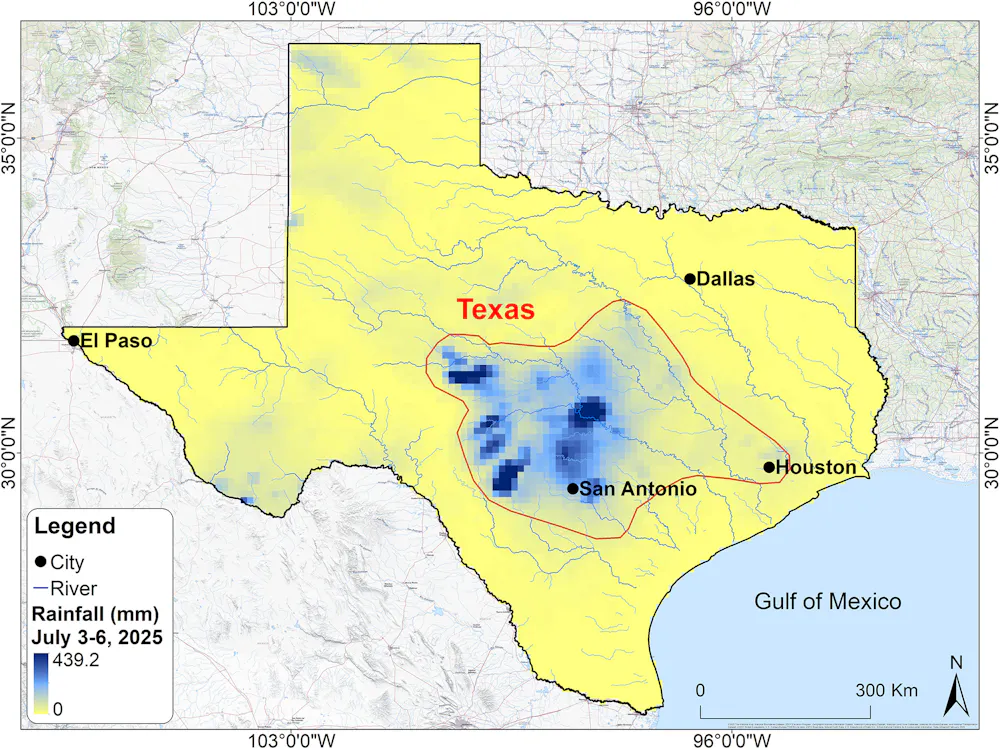
a map of Texas showing cumulative rainfall
This map of Texas highlights the core impact zone in Hill Country, where rainfall totals exceeded 430 millimetres, more than four times the regional July average.
(H. Bonakdari/GSMaP), CC BY

Terrain impacts

While meteorological extremes initiated the July 2025 flood event, the morphology of the Guadalupe River — its shape, behaviour and flows — was pivotal in transforming heavy rainfall into a catastrophic flash flood.

The upper basin’s physical geography, drainage configuration and valley structure contributed to the rapid concentration and propagation of floodwaters.

Known as “Flash Flood Alley,” the terrain of the upper Guadalupe River basin amplified the July 2025 flood through a combination of steep slopes, shallow soils and karstic geology.

These steep slopes limited infiltration and led to rapid soil saturation under intense rainfall. The predominance of karstic limestone — limestone that has been shaped by water creating plains and sinkholes — further reduced storage below the surface, resulting in minimal delay between rainfall and discharge.

Additionally, narrow valley sections created hydraulic bottlenecks, accelerating flow and increasing flood depth, particularly affecting residential areas and campsites.

a map of Texas showing the river's topography
A map showing the relationships between steep headwaters, tributary confluences and vulnerable downstream communities.
(H. Bonakdari/NASA), CC BY

In contrast, broader valleys allowed for the water to spread laterally; there was still destructive momentum due to upstream forcing. These geomorphic traits, compounded by the extreme atmospheric moisture, created an environment where floodwaters accumulated rapidly and struck with devastating force, especially along confluence zones and densely occupied riverfronts.

Excessive runoff

Prior to the July 2025 event, central Texas had already experienced elevated soil moisture conditions due to above-average rainfall during June and early July. Antecedent moisture indices that measure how wet the ground is before rainfall approached 90 to 100 per cent saturation, meaning that the ground was effectively primed for rapid runoff generation.

The region’s karst terrain — characterized by shallow, rocky soils — offered less than five per cent effective porosity, severely limiting absorption into the ground. Simultaneously, regional groundwater tables had risen underground, further reducing the ground’s capacity to absorb water.

This set the stage for an outsized response to the incoming deluge. When intense rainfall arrived, the ground was quickly and completely saturated, resulting in immediate and rapid surface runoff.

The time of concentration is how long it takes rainwater from the farthest part of a watershed to reach its outlet, like a river or stream. In central Texas Hill Country (known for its steep slopes and rocky, shallow soils), that time is just one to two hours. This means that heavy rain can lead to dangerous river rises very quickly.

Water flows fast down the slopes and through underground limestone channels, leaving little time for it to soak into the ground. As a result, rivers such as the Guadalupe can swell rapidly, rising several feet in a short time, which causes fast-moving flood impacts in narrow valleys and low-lying communities.

Multiple forces

The July floods in Texas were devastatingly deadly. A confluence of various meteorological and topographical factors were to blame.

An overheated atmosphere, saturated with water vapour, unleashed record-breaking rainfall. The unique terrain of Texas Hill Country funnelled that rain swiftly into the river system, while the region’s hydrology, already primed by previous storms, converted nearly all of it into runoff.

By understanding how these atmospheric, geographic and hydrological elements combined, we can better anticipate future risks in “Flash Flood Alley” and improve early warning systems to save lives.

The Conversation

Hossein Bonakdari does not work for, consult, own shares in or receive funding from any company or organisation that would benefit from this article, and has disclosed no relevant affiliations beyond their academic appointment.

ref. The anatomy of a flash flood: Why the Texas flood was so deadly – https://theconversation.com/the-anatomy-of-a-flash-flood-why-the-texas-flood-was-so-deadly-260695

A robot stole my internship: How Gen Z’s entry into the workplace is being affected by AI

Source: The Conversation – Canada – By Melise Panetta, Lecturer of Marketing in the Lazaridis School of Business and Economics, Wilfrid Laurier University

For years, the expression “the robot took my job” has brought to mind visions of machines replacing workers on factory floors. But Gen Z is facing a new challenge: the loss of internships and other entry-level positions to AI.

Internships and junior roles have historically provided a predictable ladder into the workforce by providing new workers with the experience and skills needed for long-term career development.

But as artificial intelligence (AI) spreads to every corner of the modern workplace, these roles are susceptible to being replaced by automation.

Entry-level roles traditionally involve low-complexity, high-frequency tasks such as data entry, scheduling or drafting reports — tasks that generative AI can do significantly cheaper and faster than a human. This almost certainly means fewer traditional bottom rungs on the career ladder.

We are already seeing the impact of this: entry-level jobs are becoming scarcer, with candidates competing against a 14 per cent hike in applications per role, according to LinkedIn.


No one’s 20s and 30s look the same. You might be saving for a mortgage or just struggling to pay rent. You could be swiping dating apps, or trying to understand childcare. No matter your current challenges, our Quarter Life series has articles to share in the group chat, or just to remind you that you’re not alone.

Read more from Quarter Life:


AI is changing the workplace

The integration of AI across industries is fundamentally reshaping the job market.

Nearly half of professionals worry AI will replace their jobs. There is good reason for this: by 2030, it’s estimated that nearly 30 per cent of work could be automated by generative AI.

Meanwhile, nearly two-thirds of executives say they are willing to use AI tools to drive up productivity at the expense of losing staff. Conversely, only one in three executives are willing to keep their staff at the expense of higher expected productivity.

It is also projected that declines in traditional entry-level or junior roles in sectors such as food services, customer service, sales and office support work could account for nearly 84 per cent of the occupational shifts expected by 2030.

Talent and entry-level role shortages in the future

Data on AI and the future of work also points to another potential problem: a talent shortage for certain skill sets. A 2024 report from Microsoft and LinkedIn found that leaders are concerned with shortages in areas such as cybersecurity, engineering and creative design.

Though this data might appear contradictory, it signals that in addition to fewer entry level positions being available, changes to job roles and skill sets are also on the horizon.

As a result, competition for entry-level roles is expected to increase, with greater value put on candidates who can use AI tools to improve their productivity and effectiveness.

Rather than simply eliminating jobs, many roles are evolving to require new capabilities. There is also growing demand for specialized talent where AI cannot yet fully augment human abilities.

AI literacy is the new entry requirement

As AI becomes more prevalent in the workforce, “entry-level” roles are no longer just about completing basic tasks, but about knowing how to work effectively with new technologies, including AI.

Employers are beginning to place immense value on AI literacy. Two-thirds of managers say they wouldn’t hire someone without AI skills and 71 per cent say they would prefer a less experienced candidate with AI skills over a more experienced one without them.

With fewer entry-level positions available, young workers will need to figure out how to stand out in a competitive job market. But despite these challenges, Gen Z may also be the best-positioned to adapt to these changes.

As digital natives, many Gen Z are already integrating AI tools into their work. A report from LinkedIn and Microsoft found 85 per cent are bringing AI tools like ChatGPT or Copilot into the workplace, indicating they are both comfortable and eager to make use of this technology.

This trend mirrors broader trends across the workforce. One report found 76 per cent of professionals believe they need AI-related skills to remain competitive. That same Microsoft and LinkedIn report found there has been a 160 per cent surge in learning courses for AI literacy.

This growing emphasis on AI skills is part of a wider shift toward “upskilling” — the process of enhancing skill sets to adapt to the changing conditions of the job market. Today, upskilling means leaning how to use AI to enhance, accelerate and strengthen your performance in the workplace.

A new kind of entry-level job

Since AI literacy is becoming a core career skill, being able to present yourself as a candidate with AI skills is important for standing out in a crowded entry-level job market. This includes knowing how to use AI tools, evaluate their outputs critically and apply them in a workplace context. It also means learning how to present AI skills on a resume and in interviews.

Employers also have a role to play in all this. If they want to attract and retain employees, they need to redesign entry-level roles. Instead of eliminating entry-level roles, they should refocus on higher-value activities that require critical thinking or creativity. These are the areas where humans outperform machines, and where AI can act as a support rather than a replacement.

But to make this work, employers need to re-evaluate their hiring practices to prioritize AI literacy and transferable skills over outdated experience requirements.

The future of work isn’t about humans being replaced by robots, but about learning how to use the technology to enhance skills and creating new entry points into the professional world.

The Conversation

Melise Panetta does not work for, consult, own shares in or receive funding from any company or organisation that would benefit from this article, and has disclosed no relevant affiliations beyond their academic appointment.

ref. A robot stole my internship: How Gen Z’s entry into the workplace is being affected by AI – https://theconversation.com/a-robot-stole-my-internship-how-gen-zs-entry-into-the-workplace-is-being-affected-by-ai-260381