Crise de la dette: les quatres leviers qui peuvent aider le Sénégal à éviter la restructuration

Source: The Conversation – in French – By Souleymane Gueye, Professor of Economics and Statistics, City College of San Francisco

Le Fonds monétaire international (FMI) a réévalué la dette du Sénégal à 132 % du PIB, entraînant une dégradation de sa note souveraine. Les discussions avec le FMI avancent lentement et le pays rencontre des difficultés pour lever des financements sur les marchés internationaux.

Malgré tout, la dette reste soutenable depuis 2024, mais elle place le Sénégal devant un dilemme : restructurer immédiatement ou poursuivre la stratégie actuelle, qui permet de rembourser les échéances sans accord avec le FMI et de maintenir son Plan de redressement économique et social.
.
En tant qu’économiste ayant étudié les relations entre le FMI et le Sénégal sur quarante ans, je ne préconise pas une restructuration de cette dette.

En dépit d’un besoin de financement de 5 800 milliards de F CFA pour 2025, il est préférable de poursuivre la trajectoire actuelle et le plan de redressement, tout en recherchant un accord avec le FMI, aligné sur la “Vision 2050”.

Qu’est-ce qu’une restructuration de la dette ?

Une restructuration de la dette est un « réaménagement négocié des obligations d’un État pour restaurer la soutenabilité de sa dette » . Elle intervient lorsque le pays n’est plus en mesure de payer ses dettes sans compromettre sa stabilité économique et sociale. Autrement dit, elle intervient en cas de défaut de paiement. Or, ce n’est pas la situation actuelle du Sénégal. Une restructuration vise surtout à alléger la pression financière et à redonner des marges budgétaires.


Read more:
Pourquoi la dernière dégradation de la note du Sénégal par Moody’s ne tient pas la route


Elle repose sur deux principes simples : un pays ne peut pas continuer à emprunter indéfiniment, et les créanciers ont parfois du mal à se coordonner entre eux.

Une restructuration peut prendre plusieurs formes :

  • réduction du principal (haircut) : le créancier accepte d’abandonner une partie de la somme due. C’est la solution la plus lourde, réservée aux situations de détresse sévère.

  • reprofilage : le pays paie tout, mais plus lentement et moins cher, parfois avec une période de grâce. Cela facilite l’ajustement budgétaire sans choc majeur.

  • rééchelonnement : report des échéances dans le temps, souvent sous l’égide du Club de Paris – un groupe informel de pays créanciers dont le rôle est coordonner la restructuration de la dette publique des États qui n’arrivent plus à rembourser leurs emprunts – ou de créanciers privés, avec des conditions financières assouplies.

  • cadre commun du G20 : restructuration globale et coordonnée entre tous les créanciers, visant à éviter les blocages, garantir la transparence et s’accompagner d’un programme macroéconomique avec le FMI.


Read more:
Sortir du piège de la dette : les alternatives au modèle FMI pour le Sénégal


Les implications économiques

Plusieurs études comme celle de l’économiste américain Barry Eichengreen montrent qu’une restructuration de la dette peut réduire fortement l’investissement privé, fragiliser les banques exposées aux titres publics et limiter l’accès du pays aux financements extérieurs. Elle augmente aussi les primes de risque et peut entraîner une crise de confiance.

Dans une économie comme celle du Sénégal, intégrée à l’Union économique et monétaire ouest-africaine (Uemoa) et sans politique monétaire indépendante, ces chocs sont très difficiles à absorber.

À long terme, une restructuration peut être utile si elle est bien pensée et accompagnée de réformes crédibles. Elle peut améliorer la structure de la dette, réduire les intérêts, libérer des marges pour les dépenses prioritaires et restaurer la confiance.

Mais ces avantages dépendent du maintien d’une dynamique de croissance non entravée par des ajustements trop brutaux. Ce qui est impossible à avoir avec le FMI.

Le Sénégal doit-il restructurer sa dette publique ?

Le Sénégal a un endettement très élevé, mais il reste soutenable selon le mode de calcul courant. On compare les dépenses obligatoires de l’État (salaires, transferts, dépenses de fonctionnement et d’investissement) à ses recettes. Puis, on vérifie si le service de la dette reste supportable. Selon ce calcul, basé sur la dernière loi de finances initiale, le Sénégal se situe dans la catégorie des pays à haut risque, mais pas en situation de défaut de paiement.

En revanche, les besoins de financement augmentent, et la confiance des marchés s’est affaiblie après la révélation des dettes cachées et l’absence d’accord avec le FMI.


Read more:
Sénégal : ce que révèle la dégradation de la note sur la dette cachée et les notations de crédit


Malgré ce contexte difficile, le Sénégal continue de payer sa dette, mais les taux d’intérêt très élevés aggravent le coût du service de la dette et réduisent les marges pour investir. Aujourd’hui, 16 % des recettes fiscales et 50 % des revenus de l’État servent à rembourser la dette, contre 25 % en moyenne en Afrique.

Cette situation peut-elle durer ? Une restructuration pourrait alléger la pression, car refuser d’y recourir expose le pays à un risque de crise de liquidité pouvant se transformer en crise financière et économique.

Ce contexte financier est très tendu, mais il reste, selon nous, soutenable. Il peut même s’améliorer si le pays exploite pleinement ses atouts. Le Sénégal dispose en effet d’un environnement prometteur qui peut éviter une restructuration immédiate de la dette.

Ces atouts tournent autour de ces facteurs :

  • Une population jeune, dynamique et entreprenante

  • Une stabilité politique et institutionnelle dans une région instable.

  • Une croissance potentielle solide (8 % -10 %), renforcée par le gaz, le pétrole et l’or.

  • Une administration fiscale et financière en constante amélioration grâce
    aux réformes récentes.

. Un potentiel enviable dans l’agrobusiness, les ressources halieutiques, les services et le numérique, et l’accès encore possible aux financements extérieurs confessionnels.

Eviter la restructuration du type FMI

Fort de ces atouts, le Sénégal doit éviter une restructuration encadrée par le FMI, car impliquant forcément un programme du FMI. Celui-ci est fondé sur des politiques bien connues :

• Une politique fiscale restrictive : forte réduction du déficit, diminution des dépenses publiques, élimination des subventions, hausse des impôts, licenciements administratifs,

• Une privatisation des entreprises publiques et para publiques,

• Une politique monétaire restrictive (augmentation du coût du crédit) si le pays dispose d’une politique monétaire autonome,

• Une libéralisation totale du secteur financier et du commerce extérieur.

Ces politiques risqueraient d’exacerber la contraction de l’activité économique au lieu de la résoudre car, du fait du régime de change fixe, le Sénégal ne dispose pas du levier monétaire et du taux de change pour atténuer les effets négatifs que ces mesures auraient sur l’activité économique.

Autrement dit, les déséquilibres budgétaires vont être rétablis au détriment d’une croissance économique endogène et inclusive, exacerbant les inégalités économiques et sociales, et la paupérisation des populations.

Entrer dans une restructuration maintenant créerait un cercle vicieux : une contraction de l’activité économique occasionnant une baisse des recettes et des difficultés à atteindre les objectifs du programme. Ce qui entraînera alors davantage d’austérité.

Il faudra donc tout faire pour éviter ce scénario et concevoir une autre stratégie pour desserrer la pression sur les finances publiques et mieux gérer la dette.

Une stratégie alternative

Éviter une restructuration immédiate ne veut pas dire rester passif. Il faut au contraire bâtir une stratégie solide autour de quatre leviers :

  • D’abord, privilégier une approche basée sur la transparence : terminer l’inventaire de la dette, publier tous les rapports et élaborer un plan de gestion conforme aux recommandations de la Cour des comptes. Cette approche devrait idéalement s’accompagner d’un accord formel avec le FMI pour valider le cadre macroéconomique proposé par le Sénégal et renforcer la transparence budgétaire, envoyant ainsi un signal fort de confiance aux marchés internationaux.

  • Le deuxième levier consiste à distinguer clairement la dette de l’État central de celle des entreprises publiques et des garanties souveraines.

Pour la dette centrale, le gouvernement sénégalais peut renégocier les maturités des Euro-obligations et prêts commerciaux à taux élevés sur le long terme sans une restructuration formelle. L’État doit chercher à convertir les prêts bilatéraux à court terme en financements concessionnels ou partenariats sectoriels, tout en privilégiant les financements auprès de partenaires bilatéraux et multilatéraux (Chine, Turquie, Inde, pays du Golfe).

Ce reprofilage partiel, conçu indépendamment du FMI, pourrait améliorer la liquidité et libérer des marges pour soutenir l’économie. L’État doit se concentrer sur les obligations à court terme (bons du Trésor et titres de moins de deux ans) pour refinancer, renégocier les taux ou prolonger les échéances, afin de ne pas déstabiliser le système bancaire de l’Uemoa.

  • Le troisième levier consiste à étaler l’ajustement fiscal sur plusieurs années, élargir l’assiette fiscale et engager une réforme axée sur l’équité. Le gouvernement doit aussi renforcer la gouvernance des régies financières et mettre en place une gestion efficace des revenus tirés du gaz, du pétrole et des autres ressources naturelles.

  • L’exploitation du gaz et du pétrole offre au Sénégal un levier supplémentaire : valoriser les revenus futurs pour négocier de meilleures conditions. La création d’un fonds de stabilisation et d’un cadre transparent d’exploitation de ces ressources peut réduire la charge de la dette et permettre d’investir dans la formation des jeunes, le capital humain et les services publics.


Read more:
Comment le Sénégal peut financer son économie sans s’endetter davantage


Que retenir ?

Tant que le FMI maintient ses conditions classiques ou retarde les négociations, le Sénégal ne devrait pas restructurer sa dette. La stratégie à suivre consiste à :

• Consolider graduellement les finances publiques en réduisant les dépenses de fonctionnement de l’État central et en fusionnant les directions et les agences publiques

• Préserver l’investissement public, relancer l’investissement privé et élaborer des mesures spécifiques de relance de la croissance economique;

• Négocier des conditions moins procycliques et contraignantes;

• Finaliser un programme avec le FMI basé sur la Vision 2050;

• Et n’envisager une restructuration qu’en dernier recours, dans un cadre structuré, repensé et adossé aux priorités économiques du gouvernement sénégalais et plus favorable.

Une dette bien analysée et bien gérée ne peut pas déboucher sur une défaillance économique. Au contraire, elle peut devenir un outil puissant de souveraineté pour favoriser le plein emploi, réduire la pauvreté et promouvoir la justice économique et sociale.

The Conversation

Souleymane Gueye receives funding from Monterey Institute of International Studies and the Fullbright foundation

ref. Crise de la dette: les quatres leviers qui peuvent aider le Sénégal à éviter la restructuration – https://theconversation.com/crise-de-la-dette-les-quatres-leviers-qui-peuvent-aider-le-senegal-a-eviter-la-restructuration-270177

Jane Austen shunned literary fame – but transformed the novel from the shadows

Source: The Conversation – UK – By Anna Walker, Senior Arts + Culture Editor, The Conversation

Portrait of a Young Lady by Adele Romany (early 19th century). Bonhams

Jane Austen’s Paper Trail is a podcast from The Conversation celebrating 250 years since the author’s birth. In each episode, we’ll be investigating a different aspect of Austen’s personality by interrogating one of her novels with leading researchers. Along the way, we’ll visit locations important to Austen to uncover a particular aspect of her life and the times she lived in. In episode 5, we look what kind of author Austen was, and what we can learn about her view of her profession through the pages of Northanger Abbey.

From a young age Jane Austen harboured lofty writerly ambitions. Her early works, known as juvenilia, are diverse in subject matter, reflecting her wide reading taste. As well as stories that parody some of her favourite novels, such as The History of Sir Charles Grandison by Samuel Richardson (1753), there are also witty takes on the essays of British politician Joseph Addison and writer Samuel Johnson, the author of the first English dictionary.

She even tried writing her own history of England. In this short text, 15-year-old Austen proudly declares herself a “partial, prejudiced and ignorant Historian”, eschewing dates and presenting information from historical fiction, such as Shakespeare’s plays, as fact.

Illustration of a Regency woman reading in a chair looking frightened
In Northanger Abbey, Catherine Morland loves gothic fiction.
Bentley Edition of Jane Austen’s Novels (1833)

Though she was always a writer, she wasn’t a published one until Sense and Sensibility appeared in 1811. By her death in 1817, Austen had published four of her six novels and earned nearly £700 – a modest fortune, but enough to grant a measure of independence to an unmarried woman otherwise reliant on her brothers.

Yet Austen’s grave in Winchester Cathedral, makes no mention that she was a writer. Publishing anonymously and disliking literary celebrity, she remained largely unknown as a writer in her lifetime despite occasional, reluctant contact with London’s literary circles.

Her fifth novel, Northanger Abbey – written in 1799 but published posthumously – clearly reveals her views on writing and reading books. It follows Catherine Morland, whose love of gothic fiction warps her sense of reality. It brims with Austen’s defence of the novel, dismissed at the time as frivolous women’s entertainment. It also reflects her juvenilia in its parody of gothic fiction – a genre Austen loved deeply, which is reflected in the bookshelves at her home in Chawton.

Louise Curran standing in front of a red brick house
Louise Curran at Jane Austen’s House, Hampshire.
Naomi Joseph, CC BY-SA

In the fifth episode of Jane Austen’s Paper Trail, Naomi Joseph visits Jane Austen’s House in Hampshire with Louise Curran, lecturer in 18th-century and Romantic literature. Curran is an expert in letter writing, the development of the novel and literary celebrity.

In the lovely red brick cottage where Austen wrote and revised all six of her novels, Curran explains why Austen shied away from the limelight: “You can sort of see it in the kind of writer she is, I guess. I think there is that tension for her really writing the kinds of novels that she wanted to write, that took, as she famously put it, those three and four families in a country village, and are involved with those sort of little matters.”

Later on, Anna Walker sits down with two more Austen experts – Kathryn Sutherland, emeritus professor of English at the University of Oxford, and Anthony Mandal, a lecturer in English literature at Cardiff University – to discover what Northanger Abbey reveals of Austen’s professional life.

As Mandal explains: “The decade [Austen] was publishing in was a heyday for women’s fiction. It was a period when women outnumbered men as novelists … but the reputation of the novel was really low. It was seen as this kind of distracting form of writing, and particularly of reading. It was a waste of time. It stopped you from being a dutiful daughter or wife or mother.”

Austen wasn’t convinced. Sutherland explains that the writer was “hugely ambitious for her own talent and she saw the novel as a moral force as well as a form of entertainment. And that’s essentially what Northanger Abbey is about … the power of the novel both to lead you into misinterpretation, but ultimately, if you become a good reader, to lead you into a wise judgement of the world around you.”

Listen to episode five of Jane Austen’s Paper Trail wherever you get your podcasts. And if you’re craving more Austen, check out our Jane Austen 250 page for more expert articles celebrating the anniversary.


Disclosure statement
Kathryn Sutherland, Louise Curran and Anthony Mandal do not work for, consult, own shares in or receive funding from any company or organisation that would benefit from this article, and has disclosed no relevant affiliations beyond their academic appointment.


Jane Austen’s Paper Trail is hosted by Anna Walker with reporting from Jane Wright and Naomi Joseph. Senior producer and sound designer is Eloise Stevens and the executive producer is Gemma Ware. Artwork by Alice Mason and Naomi Joseph.

Listen to The Conversation Weekly via any of the apps listed above, download it directly via our RSS feed or find out how else to listen here.

The Conversation

ref. Jane Austen shunned literary fame – but transformed the novel from the shadows – https://theconversation.com/jane-austen-shunned-literary-fame-but-transformed-the-novel-from-the-shadows-270590

‘Rage-baiting’ is the word of the year: but what does it mean?

Source: Radio New Zealand

This story was first published on 8 August, 2024

Trolling has been around for almost as long as the internet itself; think of the early days of YouTube clickbait titles, edgy memes posted to Facebook, and nihilistic Twitter threads, all deliberately designed to provoke and enrage the masses. It’s an online terrain most people are familiar with, and yet the rise of TikTok has allowed a new form of trolling to thrive.

Rage baiting, or rage farming, has a new wave of content creators and social media influencers not only inciting rage online – but profiting off viewers’ anger too.

At its core, rage baiting is a manipulative tactic used by content creators to elicit outrage from their viewers. The idea is that if you’re angry, you’re more likely to comment, share, react, and ultimately increase the online engagement of that video, which helps content creators drive more traffic to their channels and earn more revenue.

TikToker Ryan Gawlik does things like intentionally calling espresso "expresso" and biting into a whole KitKat bar because he knows internet audiences find that behaviour upsetting.

TikToker Ryan Gawlik does things like intentionally calling espresso “expresso” and biting into a whole KitKat bar because he knows internet audiences find that behaviour upsetting.

TikTok / Ry Williams

– Published by EveningReport.nz and AsiaPacificReport.nz, see: MIL OSI in partnership with Radio New Zealand

Ozempic-type drugs backed by WHO for treating obesity

Source: Radio New Zealand

The preparations Ozempic and Wegovy from Novo Nordisk are used to treat type 2 diabetes and as a slimming agent, photographed in Copenhagen, Thursday 23 March 2023.. (Photo: Ida Marie Odgaard/Ritzau Scanpix) (Photo by Ida Marie Odgaard / Ritzau Scanpix via AFP)

WHO guidelines said GLP-1 medications such as Ozempic or Wegovy could be used by adults as part of a comprehensive approach to obesity treatment. Photo: Ida Marie Odgaard / Ritzau Scanpix via AFP

The World Health Organization has released its first guidelines on the Ozempic-type drugs, conditionally recommending their use for long-term treatment of obesity.

To tackle what it said was a serious health challenge, its guidelines said Glucagon-Like Peptide-1 (GLP-1) medications such as Ozempic or Wegovy could be used by adults as part of a comprehensive approach. That included healthy diets, physical activity and support from health professionals.

Obesity was associated with 3.7 million deaths worldwide in 2024 and was major driver of diseases such as cardiovascular diseases and type 2 diabetes, it said.

“Our new guidance recognises that obesity is a chronic disease that can be treated with comprehensive and lifelong care,” WHO director general Dr Tedros Adhanom Ghebreyesus said.

The WHO also called for fair access to the drugs and said they should be made affordable for those who needed them.

Peter Shepherd, professor of molecular medicine and pathology at University of Auckland, said obesity affected between 20 percent and 30 percent of the New Zealand population and was major driver of health problems.

He told Morning Report the therapies weren’t without problems, but “nothing else has really worked”.

“Levels of obesity globally have continued to rise despite the best efforts of diet and exercise and behavioural programmes to do otherwise over the years.

“And now we for the first time are seeing a reduction in levels of obesity, in the US of all places, reductions in people eating at fast food, restaurants, etcetera. So these drugs really do work.”

Professor Peter Shepherd

University of Auckland profressor Peter Shepherd. Photo: University of Auckland

At a cost of $6000 a year in New Zealand, Shepherd said the drugs were out of reach for many people, but the price was likely to fall.

“These drugs are coming off patent as many biosimilars in the pipeline in China already, for example. So in the next few years, we’re going to see these prices come down even more.”

Australia’s medicines regulator has issued a safety warning over the potential risk of suicidal thoughts and behaviours when taking Ozempic-style drugs.

The Therapeutic Goods Administration said people using the medicines should tell their health professional if they experienced new or worsening depression but stressed there was enough evidence to conclude the drugs caused those changes.

Shepherd said there was limited evidence of risk of suicidal thoughts among those taking the drugs.

There were gastric side effects and “more worryingly” people seemed to be losing not just fat but muscle mass.

“Particularly for older people, loss of muscle is not a good idea. So these probably will need to be supplanted by different types of weight loss drugs going forward that don’t have these side effects”.

The drugs were originally designed for type 2 diabetes treatment but became known as a weight loss solution.

Sign up for Ngā Pitopito Kōrero, a daily newsletter curated by our editors and delivered straight to your inbox every weekday.

– Published by EveningReport.nz and AsiaPacificReport.nz, see: MIL OSI in partnership with Radio New Zealand

Oxford’s Word of the Year is utterly infuriating

Source: Radio New Zealand

You know that feeling when you read something online and it seems deliberately provocative, almost manufactured to create outrage? You may have just encountered “rage bait” – content deliberately designed to elicit anger in order to increase engagement.

And it has become so ubiquitous online that the Oxford Dictionary named “rage bait” as its Word of the Year on Sunday.

Use of the term has increased threefold this year, suggesting people know “they are being drawn ever more quickly into polarising debates and arguments as a response to social media algorithms and the addictive nature of outrage content,” the UK-based dictionary said in a statement.

Our lexicon is increasingly shaped by new technologies.

Our lexicon is increasingly shaped by new technologies.

Unsplash

The best books of 2025 so far

Almost every major dictionary has named a word that relates to the internet as their 2025 word of the year, highlighting the technology’s grip on daily life and the language we use to describe it.

Sometimes, rage bait can be relatively harmless – a recipe that contains disgusting food combinations or someone annoying their pet, partner or sibling. But it has also entered political discourse, with outrage used to boost politicians’ profiles and provoke a chain of reaction and counter-reaction.

Collins Dictionary chose “vibe coding,” a form of software development that uses artificial intelligence (AI) to turn natural language into computer code, and the Cambridge Dictionary settled on “parasocial,” referencing the relationships people form online with someone they don’t know, as their words of the year.

And last year Oxford chose “brain rot,” which “captured the mental drain of endless scrolling,” Casper Grathwohl, President of Oxford Languages, said in a statement.

Taken together, rage bait and brain rot “form a powerful cycle where outrage sparks engagement, algorithms amplify it, and constant exposure leaves us mentally exhausted,” Grathwohl said.

“These words don’t just define trends; they reveal how digital platforms are reshaping are thinking and behaviour,” he added.

Oxford Dictionary let the public choose its word of the year from a shortlist that also included “aura farming” and “biohack,” posting parody videos on its Instagram to convey the spirit of each word.

Aura farming, “the cultivation of an impressive, attractive, or charismatic persona … by presenting oneself in a way intended subtly to convey an air of confidence, coolness or mystique,” was portrayed as a cardigan-wearing, tote bag-carrying man, “always one matcha away from finishing (an) experimental screenplay.”

And biohack, “an attempt … to optimise one’s … health, longevity or wellbeing by altering one’s diet, exercise routine, or lifestyle, or by using other means such as drugs, supplements or technological devices,” was visualised as someone hooked up to a green IV drip and wearing an LED face mask, who had taken “27 phytonutrient-dense plants” by 6.34am.

Rage bait, meanwhile, slopped milk and sugar everywhere while he made a cup of tea, before picking his toenails and pouring the milk over himself.

– Published by EveningReport.nz and AsiaPacificReport.nz, see: MIL OSI in partnership with Radio New Zealand

Ces bulles invisibles qui propagent le cancer… et pourraient aider à le stopper

Source: The Conversation – in French – By Vahé Nerguizian, Professeur titulaire, École de technologie supérieure (ÉTS)

Des bulles invisibles transportent le cancer d’un organe à l’autre. Comprendre ces messagères microscopiques pourrait changer la lutte contre les métastases.

Empêcher un cancer de se propager dans le corps : voilà le défi que s’est donné notre équipe au Département de génie électrique de l’École de technologie supérieure (ÉTS). En collaboration avec la professeure Julia Burnier et des spécialistes en biologie de l’Institut de recherche du Centre universitaire de santé McGill, nous cherchons à comprendre comment les cancers se transforment en métastases, c’est-à-dire comment ils envahissent d’autres organes.

Depuis environ huit ans, mon équipe se penche sur les nanoparticules lipidiques, qui font une taille d’à peine une centaine de nanomètres et qui sont donc invisibles à l’œil nu. Nous cherchons d’abord à comprendre le chemin de la métastase. Ensuite, nous trouvons des façons différentes d’injecter les médicaments dans le corps.

Les nanoparticules lipidiques, comme les liposomes, se distinguent des approches classiques : elles permettent de délivrer les médicaments directement dans les cellules tumorales, ce qui accroît leur efficacité et réduit la toxicité, comparé aux chimiothérapies conventionnelles. Des chercheurs ont démontré que les liposomes ciblent mieux les tumeurs et diminuent les effets secondaires, tandis que d’autres ont observé que ces nanomédicaments améliorent la pénétration et la spécificité du traitement, notamment face aux métastases. Ces résultats confirment que les nanomédicaments peuvent rendre les traitements du cancer plus ciblés, plus efficaces et mieux tolérés.

De minuscules particules responsables de la propagation

Chaque cellule de notre corps, saine ou cancéreuse, libère de minuscules particules appelées vésicules extracellulaires. Ces petites bulles, faites de lipides et de protéines, transportent aussi de l’information génétique. Lorsqu’une cellule cancéreuse libère dans le sang ses vésicules et que ces dernières sont transférées à une cellule saine, elle peut en modifier l’ADN et la transformer à son tour en cellule cancéreuse. C’est ainsi que le cancer se propage vers d’autres organes comme le foie : ce mécanisme est à la base des métastases.

Le problème, c’est qu’il est long et difficile d’extraire et d’étudier ces vésicules naturelles. Pour accélérer la recherche, mon équipe produit donc des copies artificielles appelées liposomes grâce à de petits dispositifs, des micromélangeurs. En mélangeant différentes solutions – des lipides, des protéines, de l’eau et de l’éthanol – notre équipe de recherche crée des particules ressemblant aux vésicules naturelles. Notre défi consiste à comprendre quels sont les lipides et les protéines qui sont contenus dans les vésicules extracellulaires pour produire des liposomes.

Ces liposomes sont ensuite injectés dans des cellules cancéreuses hépatiques pour voir comment elles réagissent. Plus les cellules retiennent ces particules, plus cela prouve que les copies imitent bien la réalité.

Dans une expérience type, les liposomes sont fabriqués avec des paramètres précis afin de reproduire la taille et la charge des vésicules extracellulaires. Ils sont également rendus visibles en les colorant avec un marqueur fluorescent. Ces liposomes sont ensuite incubés avec des cellules cancéreuses, cultivées dans notre laboratoire. Il est ainsi possible de filmer et de mesurer, en temps réel et sans perturber les cellules, comment et à quelle vitesse les liposomes sont absorbés et exprimés par les cellules cancéreuses. Nos résultats montrent que plus les liposomes ressemblent aux vésicules naturelles en taille et en charge, plus ils sont efficacement absorbés. Cela permet de voir comment leur composition chimique et physique influence leur absorption par les cellules et leur rôle possible dans le développement des tumeurs.

Observer le comportement des liposomes

Notre objectif est de pouvoir comprendre comment ces vésicules extracellulaires sont transportées vers les cellules du foie pour y créer des métastases. Notre principal défi est de faire en sorte que ces liposomes puissent imiter vraiment les vésicules extracellulaires.

Nous obtenons actuellement un taux d’efficacité de 50 % pour l’encapsulation des protéines. Nous visons à le faire grimper à 90 %. Nous espérons ainsi expliquer la façon dont sont formées les métastases afin de les bloquer. Une fois la technique peaufinée, notre équipe mènera des tests sur les rats.

À long terme, ces travaux pourraient changer la donne pour de nombreux patients, en empêchant la formation de métastases et en augmentant leurs chances de survie. Notre but : comprendre et bloquer la formation des métastases.

Vers de nouveaux traitements

Notre équipe ne cherche pas seulement à comprendre le processus, mais aussi à développer de nouvelles armes contre le cancer. L’idée est d’utiliser ces liposomes comme de minuscules navettes capables de transporter des médicaments directement vers les cellules cancéreuses. Les diamètres des liposomes diffèrent en fonction de l’organe cancéreux à traiter. Par conséquent, il est très important de bien caractériser et comprendre les propriétés de ces liposomes.

Par exemple, des chercheurs testent actuellement l’encapsulation de curcuma, une molécule étudiée pour ses propriétés anticancéreuses. Notre équipe fait de même pour observer comment les cellules cancéreuses réagissent à ces liposomes. Le curcuma, et plus précisément la curcumine qu’il contient, aide à combattre le cancer en ralentissant la croissance des cellules tumorales et en favorisant leur destruction par le corps. Plusieurs études confirment ses effets anti-inflammatoires et antioxydants, ce qui peut renforcer l’action des traitements contre le cancer. Grâce à l’encapsulation dans des liposomes, nous améliorons la capacité du curcuma à atteindre et cibler les cellules malades.

Outre cette molécule, d’autres molécules comme le paclitaxel sont déjà utilisées dans des traitements anticancéreux sous forme liposomale. Le paclitaxel encapsulé améliore notamment la délivrance du médicament et sa tolérance.


Déjà des milliers d’abonnés à l’infolettre de La Conversation. Et vous ? Abonnez-vous aujourd’hui à notre infolettre pour mieux comprendre les grands enjeux contemporains.


Il existe aussi des stratégies innovantes utilisant des liposomes pour transporter de petits morceaux d’ADN ou des anticorps qui vont agir comme des messagers, aidant le corps à mieux détecter et combattre les cellules malades. Ces approches sont validées par plusieurs études scientifiques et sont déjà utilisées dans certains traitements du cancer, avec de nouveaux progrès chaque année pour améliorer leur efficacité et leur sécurité.

En reproduisant les vésicules naturelles du corps émanant des cellules cancéreuses par des liposomes, notre équipe espère percer le secret de la propagation du cancer et déterminer les approches efficaces pour la bloquer. Nos recherches ouvrent la voie à des traitements plus ciblés, capables d’empêcher la formation des métastases et d’améliorer les chances de survie des patients.

La Conversation Canada

Vahé Nerguizian a reçu des financements de CRSNG.

ref. Ces bulles invisibles qui propagent le cancer… et pourraient aider à le stopper – https://theconversation.com/ces-bulles-invisibles-qui-propagent-le-cancer-et-pourraient-aider-a-le-stopper-266453

Winter storms blanket the East, while the U.S. West is wondering: Where’s the snow?

Source: The Conversation – USA (2) – By Adrienne Marshall, Assistant Professor of Geology and Geological Engineering, Colorado School of Mines

Much of the West has seen a slow start to the 2026 snow season. Hyoung Chang/The Denver Post

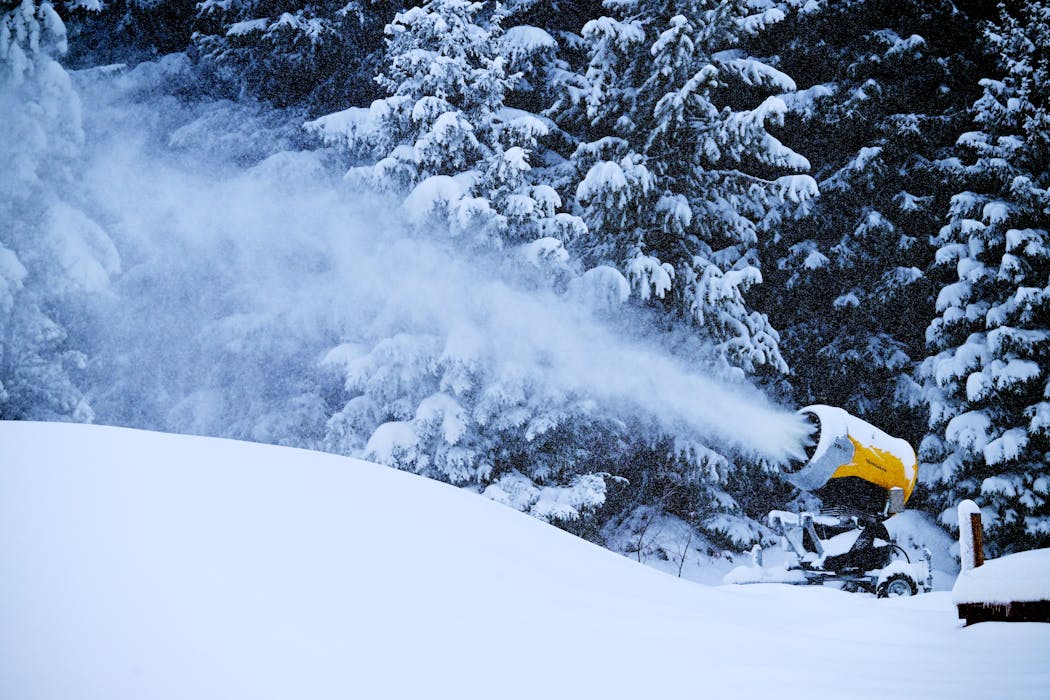
Ski season is here, but while the eastern half of the U.S. digs out from winter storms, the western U.S. snow season has been off to a very slow start.

The snowpack was far below normal across most of the West on Dec. 1, 2025. Denver didn’t see its first measurable snowfall until Nov. 29 – more than a month past normal, and its latest first-snow date on record.

But a late start to snow season isn’t necessarily reason to worry about the season ahead.

Adrienne Marshall, a hydrologist in Colorado who studies how snowfall is changing in the West, explains what forecasters are watching and how rising temperatures are affecting the future of the West’s beloved snow.

Weather map show precipitation outlook, with a strip across Colorado, Utah and up to Oregon in a band with equal chances of wetter or drier conditions.
The National Weather Service Climate Prediction Center’s seasonal outlook for January through March 2026 largely follows a typical La Niña pattern, with warmer and drier conditions to the south, and wetter and cooler conditions to the north.
NOAA

What are snow forecasters paying attention to right now?

It’s still early in the snow season, so there’s a lot of uncertainty in the forecasts. A late first snow doesn’t necessarily mean a low-snow year.

But there are some patterns that we know influence snowfall that forecasters are watching.

For example, the National Oceanic and Atmospheric Administration is forecasting La Niña conditions for this winter, possibly switching to neutral midway through. La Niña involves cooler-than-usual sea-surface temperatures in the Pacific Ocean along the equator west of South America. Cooler ocean temperatures in that region can influence weather patterns across the U.S., but so can several other factors.

La Niña – and its opposite, El Niño – don’t tell us what will happen for certain. Instead, they load the dice toward wetter or drier conditions, depending on where you are. La Niñas are generally associated with cooler, wetter conditions in the Pacific Northwest and a little bit warmer, drier conditions in the U.S. Southwest, but not always.

When we look at the consequences for snow, La Niña does tend to mean more snow in the Pacific Northwest and less in the Southwest, but, again, there’s a lot of variability.

A map show the snowpack in most of the West is more than 50% below normal.
Scientists often gauge snow conditions by snow-water equivalent, a measure of the amount of water stored in a snowpack. Most of the Western U.S. was far below normal on Nov. 30, 2025. Parts of the Southwest were above normal, but this early in the season, normal is very low to begin with in many of those areas.
USDA Natural Resources Conservation Service

Snow conditions also depend heavily on individual storms, and those are more random than the seasonal pattern indicated by La Niña.

If you look at NOAA’s seasonal outlook maps, most of Colorado and Utah are in the gap between the cooler and wetter pattern to the north and the warmer and drier pattern to the south expected during winter 2026. So, the outlook suggests roughly equal chances of more or less snow than normal and warmer or cooler weather across many major ski areas.

How is climate change affecting snowfall in the West?

In the West, snow measurements date back a century, so we can see some trends.

Starting in the 1920s, surveyors would go out into the mountains and measure the snowpack in March and April every year. Those records suggest snowfall has declined in most of the West. We also see evidence of more midwinter melting.

How much snow falls is driven by both temperature and precipitation, and temperature is warming

In the past few years, research has been able to directly attribute observed changes in the spring snowpack to human-caused climate change. Rising temperatures have led to decreases in snow, particularly in the Southwest. The effects of warming temperatures on overall precipitation are less clear, but the net effect in the western U.S. is a decrease in the spring snowpack.

When we look at climate change projections for the western U.S. in future years, we see with a high degree of confidence that we can expect less snow in warmer climates. In scenarios where the world produces more greenhouse gas emissions, that’s worse for snow seasons.

Should states be worried about water supplies?

This winter’s forecast isn’t extreme at this point, so the impact on the year’s water supplies is a pretty big question mark.

Snowpack – how much snow is on the ground in March or April – sums up the snowfall, minus the melt, for the year. The snowpack also affects water supplies for the rest of the year.

The West’s water infrastructure system was built assuming there would be a natural reservoir of snow in the mountains. California relies on the snowpack for about a third of its annual water supply.

However, rising temperatures are leading to earlier snowmelt in some areas. Evidence suggests that climate change is also expected to cause more rain-on-snow events at high elevations, which can cause very rapid snowmelt.

a man stands on a road that is flooded on both sides as far as the camera can see.  Trees are surrounded by flood water on one side.
When snow melts quickly, it can cause flooding. That happened in 2023 in California, when fast melting from a heavy snow season flooded wide areas of farmland and almond orchards covering what was once Tulare Lake.
Luis Sinco/Los Angeles Times via Getty Images

Both create challenges for water managers, who want to store as much snowmelt runoff as possible in reservoirs so it’s available through the summer, when states need it most for agriculture and for generating hydropower to meet high electricity demand. If the snow melts early, water resource managers face some tough decisions, because they also need to leave room in their reservoirs to manage flooding. Earlier snowmelt sometimes means they have to release stored water.

When we look at reservoir levels in the Colorado River basin, particularly the big reservoirs – Lake Powell and Lake Mead – we see a pattern of decline over time. They have had some very good snow and water years, and also particularly challenging ones, including a long-running drought. The long-term trends suggest an imbalance between supply and growing demand.

What else does snowfall affect, such as fire risk?

During low-snow years, the snowpack disappears sooner, and the soils dry out earlier in the year. That essentially leaves a longer summer dry period and more stress on trees.

There is evidence that we tend to have bigger fire seasons after low-snow winters. That can be because the forests are left with drier fuels, which sets the ecosystem up to burn. That’s obviously a major concern in the West.

Snow is also important to a lot of wildlife species that are adapted to it. One example is the wolverine, an endangered species that requires deep snow for denning over the winter.

What snow lessons should people take away from climate projections?

Overall, climate projections suggest our biggest snow years will be less snowy in anticipated warmer climates, and that very low snow years are expected to be more common.

But it’s important to remember that climate projections are based on scenarios of how much greenhouse gas might be emitted in the future – they are not predictions of the future. The world can still reduce its emissions to create a less risky scenario. In fact, while the most ambitious emissions reductions are looking less likely, the worst emissions scenarios are also less likely under current policies.

Understanding how choices can change climate projections can be empowering. Projections are saying: Here’s what we expect to happen if the world emits a lot of greenhouse gases, and here’s what we expect to happen if we emit fewer greenhouse gases based on recent trends.

The choices we make will affect our future snow seasons and the wider climate.

The Conversation

Adrienne Marshall receives funding from the National Science Foundation, the National Oceanic and Atmospheric Administration, the United States Geological Survey, the Colorado Department of Transportation, and the Alfred P. Sloan Foundation, and has received previous funding from the Carnegie Institution of Washington.

ref. Winter storms blanket the East, while the U.S. West is wondering: Where’s the snow? – https://theconversation.com/winter-storms-blanket-the-east-while-the-u-s-west-is-wondering-wheres-the-snow-270928

How unsustainable global supply chains exacerbate food insecurity

Source: The Conversation – UK – By Benjamin Selwyn, Professor of International Relations and International Development, Department of International Relations, University of Sussex

Fruit market in Belo Horizonte, Brazil. Antonio Salaverry/Shutterstock

While there is more than enough food produced to feed the world’s population, hunger and food insecurity persist.

In 2024, around 8% of people faced hunger, while about 28% were food insecure (without consistent access to safe and nutritious food).Global supply chains are important for feeding and nourishing people around the world.

In this vein, the World Bank funds projects that facilitate trade in food and trade of agricultural inputs such as agro-chemicals, both within and between countries and regions.

But my research shows how wealth and poverty are two sides of the same coin. Wealth and poverty can both result from the growth of convoluted and globalised food supply chains. While such supply chains can reward large-scale exporters of relatively high value products, they can undermine local food systems.

As export volumes increase, the expansion of food sectors into global supply chains actually reduces food security in significant ways. Conversely, establishing the right to food domestically represents a viable way to combat food insecurity.


Read more:
How to reduce the hidden environmental costs of supply chains


Brazil highlights how both issues play out. Despite being a major world food producer, food insecurity, and often hunger, in Brazil have been long-standing problems.

Following the election of the Workers’ Party in 2002, a decade of pro-poor policy – including the flagship fome zero (no hunger initiative), bolsa família (the family allowance grant) and rising minimum wages – reduced hunger and food insecurity. The country was removed from the Food and Agriculture Organization’s world hunger map in 2014.

However, Brazil was returned to the map in 2022 following COVID pandemic price spikes and the Bolsonaro government’s abandonment of much of the previous pro-poor policy agenda. Then, following the victory of the Workers’ Party in 2022, the reinstatement of pro-poor policies and consequent falls in levels of hunger, it was taken off the map again in 2025.

soybean crop growing in field
Brazil accounts for more than half of the world’s soybean trade​.
Alf Ribeiro/Shutterstock

This recent removal is good news, but food insecurity still stalks the country where 28 million Brazilians – predominantly women and children – still face food insecurity.

While social policy influences rates of food insecurity, so too do agricultural systems. This is where the differences between integration into high value global supply chains and attempts to formulate alternative food networks becomes apparent.

Brazil used to have a relatively diversified national economy. Since the 1990s, under governments of different political stripes, its integration into global supply chains has occurred through exporting a few primary products.

Brazil accounts for more than half of the world’s soybean trade. About 70% of that goes to China for use as animal feed. It is also the world’s second largest corn exporter, mostly for animal feed and biofuels.

Such exports have enriched Brazilian agribusiness, but they have undermined domestic food production. This is negatively affecting the food security of poorer communities. Between 2010 and 2022, soybean production increased by over 100% while rice production fell by 30%. The production of other basic food crops also fell.

Domestic food prices increased faster than general inflation, and low-income families have experienced food insecurity and have cut their food consumption.

The struggle for an alternative

But there are alternatives to this model. In 1993, the newly elected Workers’ Party mayoralty of Belo Horizonte declared the right to food for its 2.5 million population, and the city government’s duty to guarantee it. Its success influenced the formation of the national fome zero programme in the early 2000s.

Since then, with some variations depending on the party in power, the city mayoralty has dedicated 1-2% of its annual budget – less than US$10 million (£7.7 million) per year – to the scheme.

Long-term effects include a 25% reduction of people living in poverty, a marked increase in consumption of fruit and vegetables among the poor, and 75% fewer children under five being hospitalised for malnutrition than prior to the scheme.

The system encompasses production, distribution, and consumption. The local government’s Secretariat of Food Policy overseas and is responsible for implementing the right to food across the city. It facilitates local participation by small farmers and businesses, workers and consumers.

Objectives included using the city government’s purchasing power to stimulate local, agroecological food production, linked to consumers in ways that reduce prices while maintaining small farmer’s incomes.

Public restaurants, open to all, provide 20,000 healthy meals a day – organised by local chefs and nutritionists – for less than US$1 dollar per meal. Lunch (Brazilian’s main meal of the day) typically consists of rice, beans, meat, salads, fruit and juice.

Under the scheme meals from public restaurants are sold at cost price – the cost of food production, distribution and maintaining restaurants. Registered homeless people eat for free, and beneficiaries of the bolsa familia scheme get a 50% discount. Another 40 million meals are served to over 150,000 students a year under the scheme’s school meals programme. The city government partners with selected groceries to sell a range of products, often sourced locally, at 25% below market prices.

Under the scheme’s “straight from the field” programme, the city purchases food directly from producers for its public restaurants. The city provides inputs to low-income farmers and empowers them with secure land tenure. Local and regional family farms are encouraged to produce basic and other food crops for sale in the city through farmers and traditional markets.


Read more:
The right to food: activism and litigation are shifting the dial in South Africa


Global supply chains are designed and operate as systems of production and trade that reward profitable exports, rather than combatting food insecurity. They often direct resources away from where they are needed to where they are profitable.

When right-to-food systems are established to tackle food insecurity, as in Belo Horizonte, they must cater to their local context. Policies such as subsidised food consumption and production, plus coordinated distribution are all ingredients required for tackling food insecurity.


Don’t have time to read about climate change as much as you’d like?

Get a weekly roundup in your inbox instead. Every Wednesday, The Conversation’s environment editor writes Imagine, a short email that goes a little deeper into just one climate issue. Join the 47,000+ readers who’ve subscribed so far.


The Conversation

Benjamin Selwyn does not work for, consult, own shares in or receive funding from any company or organisation that would benefit from this article, and has disclosed no relevant affiliations beyond their academic appointment.

ref. How unsustainable global supply chains exacerbate food insecurity – https://theconversation.com/how-unsustainable-global-supply-chains-exacerbate-food-insecurity-269141

Why economic insecurity – not immigration – should be Labour’s top electoral priority

Source: The Conversation – UK – By Justin Robinson, Postdoctoral Research Fellow, Nuffield Politics Research Centre, University of Oxford

The autumn 2025 budget came at a crucial time for the Labour government. With their popularity at record lows, how Labour continues to manage the economy is key for its prospects at the next election.

The chancellor, Rachel Reeves, framed the budget around cutting the cost of living – with good reason. New research from my colleagues and I at the University of Oxford’s Nuffield Politics Research Centre (in collaboration with the Joseph Rowntree Foundation) reveals the prevalence of cost of living concerns among British voters.

Using a nationally representative survey of British adults in April 2025, our analysis shows that just over one-third of the population feel worried about their personal or household finances. This is an experience we call economic insecurity.

Economic insecurity refers to a person’s anxiety about the ability to cope with the financial pressures faced by them and their household. It reflects the balance of a person’s income and savings against the various demands on their finances, including housing costs, childcare costs and debts.

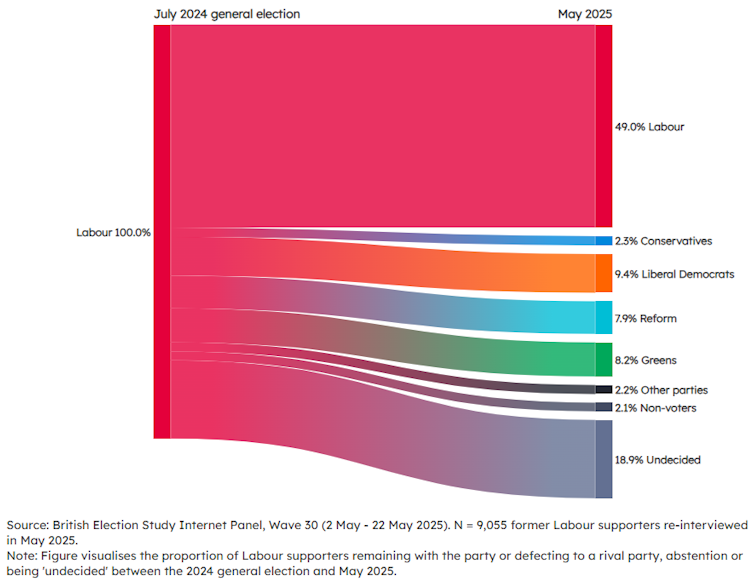
Our research argues that feelings of economic security are a key driver of Labour’s unprecedented decline in support since the last general election. Data from May 2025 reveals that only 49% of those voters who supported Labour in 2024 continued to support them. The largest proportions switched to “undecided”, the Liberal Democrats, the Greens and Reform UK.

a chart showing which other parties Labour's votes have gone to

Nuffield Politics Research Centre/Joseph Rowntree Foundation

Economic insecurity is key to explaining these losses. Our analysis tracks individuals over time, allowing us to understand whether they change their voting preferences if and when they become economically insecure.

We found that among 2024 Labour voters, moving from a state of economic security to insecurity increases the probability of switching to Reform (by 5.45 percentage points), to the Lib Dems (by 3.42 percentage points) and to “undecided” (by 4.15 percentage points). Such changes in economic insecurity – which occur among around 12.5% of Labour voters in our data – have damaging consequences for Labour.

Feelings of economic insecurity, we argue, serve as a signal of poor government performance. They are an indicator that the government has not delivered on its duties, which leads voters to abandon the party.

Furthermore, economic insecurity also makes people rate Labour’s handling of the economy more negatively. In other words, people translate their experiences of economic insecurity into wider judgements about Labour’s overall economic performance.

Our analysis of data from April 2025 shows that among the economically insecure, 44.2% evaluated Labour’s performance on the economy as “very bad”. Among the economically secure, it was only 26.5%. This matters because ratings of Labour’s economic management also influence how people vote. Improving economic security would help Labour’s reputation for managing the economy and boost its electoral prospects.

Does the budget help?

With that in mind, how far does the new budget go to address these concerns for voters?

The lifting of the two-child benefit cap will help ease economic pressure due to rising childcare costs, as well as lift an estimated 450,000 children out of poverty. Reducing the cost of energy bills will provide a boost to families, particularly those on low incomes. Increasing the minimum wage should have similar positive consequences.


Read more:
What the budget could mean for you – experts react to the chancellor’s announcement


However, feelings of insecurity are not limited to low-income households. Our previous research reveals that around one in four middle-income earners feel economically insecure.

Aspects of the budget do little to help this group. The freeze on tax thresholds will bring around 1 million more people into the higher tax rate. The freeze on student loan repayment thresholds will add to the economic difficulties faced by graduates.

Underlining these issues, the OBR estimates that real household disposable income will grow by only 0.25% per year from 2026 to 2030 – much lower than its average growth in the 2010s. With this slowdown, the economic insecurity felt by many voters may persist until the next election.

Economy v immigration

Once budget headlines have faded, Labour will once again face questions over whether it should prioritise the economy or immigration – the two key issues for the British electorate. Our research provides a possible answer.

We find that economic insecurity is a broader explanation for Labour’s vote losses than concerns about immigration. Becoming economically insecure leads voters to abandon Labour for Reform and the Lib Dems, as well as pushing voters to “undecided”. In contrast, becoming more opposed to immigration only leads Labour voters to Reform.

Addressing the issue of economic insecurity could stem the tide of Labour defections across the political spectrum. A hardline approach to immigration is likely to only appease the smaller group who are going to Reform (around 10% of 2024 Labour voters). It could also alienate former Labour voters who oppose this approach, potentially worsening Labour’s popularity overall.

Prioritising economic insecurity appears the most sensible political strategy for Labour, potentially leading to vote gains across the political spectrum. It would, of course, also arguably bring benefits to the population at large. The budget has taken steps to meet this goal, but may not go far enough to restore the economic positivity that Labour needs.

The Conversation

Justin Robinson does not work for, consult, own shares in or receive funding from any company or organisation that would benefit from this article, and has disclosed no relevant affiliations beyond their academic appointment.

ref. Why economic insecurity – not immigration – should be Labour’s top electoral priority – https://theconversation.com/why-economic-insecurity-not-immigration-should-be-labours-top-electoral-priority-270726

Youth Climate Corps: Young Canadians need more action and less tokenization

Source: The Conversation – Canada – By Lilian Barraclough, PhD Student, Social Practice and Transformational Change, University of Guelph

Youth engagement is critical in the fight for a just and sustainable future. And creating opportunities for young people is a vital part of a just transition away from fossil fuels.

The Canadian government’s 2025 federal budget has emphasized creating new opportunities for young people by establishing a Youth Climate Corps, providing employment placements in renewable energy, protecting biodiversity and retrofitting buildings. The government promised to invest $40 million over two years starting in 2026-27.

However, while the creation of the Youth Climate Corps is an encouraging step toward a more sustainable, equitable and resilient country, the 2025 budget simultaneously caters to the oil and gas industry, reducing requirements for urgent emissions reduction and increasing subsidies supporting oil and gas production.

Scientists have called for urgent and rapid cuts to fossil fuel production and emissions for decades in order to avoid the worst consequences of the climate crisis. While Prime Minister Mark Carney has declared that Canada remains on track to meet the emissions reductions targets set out in the Paris Climate Agreement, the expansion of oil and gas brings this into question.

One of the leading causes of climate grief and anxiety among young people is government inaction, in Canada and elsewhere, that has led to feelings of betrayal, anger and despair about climate change.

In our research, colleagues and I have found that young Canadians are experiencing intense emotions related to the climate crisis, and they often have little to no hope for the future, envisioning apocalyptic conditions for themselves and their children.

Eco-anxiety

Although I am now a researcher, I have been involved in environmental and climate action since I was a child. I have witnessed the never-ending cycle of false commitments and lack of follow-through on the climate crisis.

Climate grief refers to grief in response to the losses caused by climate change — of trees, animals, place, homes as well as more intangible elements of culture and connection. Climate or eco-anxiety is defined by the American Psychological Association as “a chronic fear of environmental doom.”

Young Canadians describe their grief in visceral, embodied ways, emphasizing how their concerns about climate change invade their daily lives, relationships and life choices.

In our research, politically active youth expressed anger, frustration and hopelessness at the state of inaction on the climate crisis.

As one participant told us:

“There are times youth lose hope, when you try to push for something and then you have government push back and they just don’t get it when it makes so much sense to you that our climate is changing and we need to do something about it. Why would you not listen? Why aren’t you doing this?”

Youth need genuine engagement

It’s critical to involve more young people in the sectors addressing climate change and create better employment opportunities while building capacity to respond to increasing pressures from the realities of the climate crisis. The Youth Climate Corps is an important step in that direction.

The challenge, however, is that when youth are left out of the decisions that truly influence Canada’s ability to reduce emissions, address biodiversity loss and adapt to the changes we face, it reinforces feelings of betrayal and grief.

Models of youth-adult partnership on climate action show that the most important outcomes come from positive, meaningful youth engagement. These models, when paired with the real-world experience of youth activists, make it clear that both youth and their adult counterparts — in this case government decision-makers — have a responsibility to ensure that climate action is implemented in an intentional, thorough and meaningful way.

When youth are engaged in climate decision-making but the impact on overall action to address the crisis is negligible, it can reinforce and exacerbate climate grief and anxiety.

I see many of my peers facing an impossible job market, forced to take under-paying jobs that don’t align with their values and desires for change. The Youth Climate Corps undoubtedly represents progress, but the recent federal budget investment is limited. It will create few jobs and likely won’t meet the demands of young Canadians.

Limited progress in green jobs for young people doesn’t make up for Canada’s failure to reduce emissions and hold the fossil fuel industry accountable, making young Canadians question whether the federal budget is really one of “generational investment.”

Without inclusive decision-making and concrete action, young people will continue to feel grief and anxiety over the climate crisis and its impact on their health, well-being, jobs and future prospects.

The Conversation

Lilian Barraclough receives funding from the Social Sciences and Humanities Research Council of Canada. She is the Co-Chair of the Board of Directors of the Youth Climate Lab and a regional representative for Ontario on the Young Greens Council of Canada and Youth Representative on the Green Party of Canada’s federal council.

ref. Youth Climate Corps: Young Canadians need more action and less tokenization – https://theconversation.com/youth-climate-corps-young-canadians-need-more-action-and-less-tokenization-270050