Deportation tactics from 4 US presidents have done little to reduce the undocumented immigrant population

Source: The Conversation – USA – By Kevin Johnson, Dean and Professor of Public Interest Law and Chicana/o Studies, University of California, Davis

Immigration and Customs Enforcement agents escort a detained immigrant into an elevator on June 17, 2025, in New York. AP Photo/Olga Fedorova

All modern U.S. presidents, both Republican and Democratic, have attempted to reduce the population of millions of undocumented immigrants. But their various strategies have not had significant results, with the population hovering around 11 million from 2005 to 2022.

President Donald Trump seeks to change that.

With harsh rhetoric that has sowed fear in immigrant communities, and policies that ignore immigrants’ due process rights, Trump has pursued deportation tactics that differ dramatically from those of any other modern U.S. president.

As a scholar who examines the history of U.S. immigration law and enforcement, I believe that it remains far from clear whether the Trump White House will significantly reduce the undocumented population. But even if the administration’s efforts fail, the fear and damage to the U.S. immigrant community will remain.

Presidents Bush and Obama

To increase deportations, in 2006 President George W. Bush began using workplace raids. Among these sweeps was the then-largest immigration workplace operation in U.S. history at a meat processing plant in Postville, Iowa in 2008.

U.S. Immigration and Customs Enforcement deployed 900 agents in Postville and arrested 398 employees, 98% of whom were Latino. They were chained together and arraigned in groups of 10 for felony criminal charges of aggravated identity theft, document fraud and use of stolen Social Security numbers. Some 300 were convicted, and 297 of them served jail sentences before being deported.

Several men seated on the ground are seen in a holding cell.
Men wait in a holding cell on June 21, 2006, in Nogales, Arizona.
Spencer Platt/Getty Images

In 2008, Bush also initiated Secure Communities, a policy that sought to deport noncitizens – both lawful permanent residents as well as undocumented immigrants – who had been arrested for crimes. Some 2 million immigrants were deported during Bush’s two terms in office.

The Obama administration limited Secure Communities to focus on the removal of noncitizens convicted of felonies. It deported a record 400,000 noncitizens in fiscal year 2013, which led detractors to refer to President Barack Obama as the “Deporter in Chief.”

Obama also targeted recent entrants and national security threats and pursued criminal prosecutions for illegal reentry to the U.S. Almost all of these policies built on Bush’s, although Obama virtually abandoned workplace raids.

Despite these enforcement measures, Obama also initiated Deferred Action for Childhood Arrivals, or DACA, in 2012. The policy provided relief from deportation and gave work authorization to more than 500,000 undocumented immigrants who came to the United States as children.

Obama deported about 3 million noncitizens, but the size of the undocumented population did not decrease dramatically.

The first Trump administration and Biden

Trump’s first administration broke new immigration enforcement ground in several ways.

He began his presidency by issuing what was called a “Muslim ban” to restrict the entry into the U.S. of noncitizens from predominantly Muslim nations.

Early in Trump’s first administration, federal agents expanded immigration operations to include raids at courthouses, which previously had been off-limits.

In 2017, Trump tried to rescind DACA, but the Supreme Court rejected Trump’s effort in 2020.

In 2019, Trump implemented the Remain in Mexico policy that for the first time forced noncitizens who came to the U.S. border seeking asylum to wait in Mexico while their claims were being decided. He also invoked Title 42 in 2020 to close U.S. borders during the COVID-19 pandemic.

Trump succeeded in reducing legal immigration numbers during his first term. However, there is no evidence that his enforcement policies reduced the size of the overall undocumented population.

President Joe Biden sought to relax – although not abandon – some immigration enforcement measures implemented during Trump’s first term.

His administration slowed construction of the border wall championed by Trump. Biden also stopped workplace raids in 2021, and in 2023, he ended Title 42.

In 2023, Biden sought to respond to migration surges in a measured fashion, by temporarily closing ports of entry and increasing arrests.

In attempting to enforce the borders, his administration at times pursued tough measures. Biden continued deportation efforts directed at criminal noncitizens. Immigrant rights groups criticized his administration when armed Border Patrol officers on horseback were videotaped chasing Haitian migrants on the U.S.-Mexico border.

As of 2022, the middle of the Biden’s term, an estimated 11 million undocumented immigrants lived in the U.S.

Several people holding signs and an American flag walk in a protest march.
Immigration-rights activists stage a rally outside President Barack Obama’s Democratic Congressional Campaign Committee fundraiser in Los Angeles, after the president signed a bill that tightened security at the Mexico border in August 2010.
Mark Ralston/AFP via Getty Images

A second chance

Since his second inauguration, Trump has pursued a mass deportation campaign through executive orders that are unprecedented in their scope.

In January 2025, he announced an expanded, expedited removal process for any noncitizen apprehended anywhere in the country – not just the border region, as had been U.S. practice since 1996.

In March, Trump issued a presidential proclamation to deport Venezuelan nationals who were members of the Tren de Aragua gang, designated a foreign terrorist organization by the State Department. In doing so, he invoked the Alien Enemies Act of 1798 – an act used three times in U.S. history during declared wars that empowers presidents to remove foreign nationals from countries at war with the U.S.

Declaring an “invasion” of migrants into the U.S. in June, Trump deployed the military to assist in immigration enforcement in Los Angeles.

Trump also sought to dramatically upend birthright citizenship, the Constitutional provision that guarantees citizenship to any person born in the U.S. He issued an executive order in January that would bar citizenship to people born in the U.S. to undocumented parents.

Several men in military gear stand watch on the steps of a building.
California National Guard members stand in formation during a protest in Los Angeles on June 14, 2025.
David Pashaee/Middle East Images/AFP via Getty Images

The birthright executive order has been challenged in federal court and is mostly likely working its way up to the Supreme Court.

Under the second Trump administration, immigration arrests are up, but actual deportation numbers are in flux.

ICE in June arrested the most people in a month in at least five years, roughly 30,000 immigrants. But deportations of noncitizens – roughly 18,000 – lagged behind those during the Obama administration’s record-setting year of 2013 in which more than 400,000 noncitizens were deported.

The gap between arrests and deportations shows the challenges the Trump administration faces in making good on his promised mass deportation campaign.

Undocumented immigrants often come to the U.S. to work or seek safety from natural disasters and mass violence.

These issues have not been seriously addressed by any modern U.S. president. Until it is, we can expect the undocumented population to remain in the millions.

The Conversation

Kevin Johnson does not work for, consult, own shares in or receive funding from any company or organization that would benefit from this article, and has disclosed no relevant affiliations beyond their academic appointment.

ref. Deportation tactics from 4 US presidents have done little to reduce the undocumented immigrant population – https://theconversation.com/deportation-tactics-from-4-us-presidents-have-done-little-to-reduce-the-undocumented-immigrant-population-261640

Faut-il jeter l’eau de la bouilloire entre chaque usage ? Voici ce que dit la science

Source: The Conversation – in French – By Faisal Hai, Professor and Head of School of Civil, Mining, Environmental and Architectural Engineering, University of Wollongong

La bouilloire est un appareil ménager indispensable dans de nombreux foyers. Comment ferait-on sans elle pour nos boissons chaudes ?

Mais peut-on réutiliser l’eau restée dans la bouilloire après la précédente utilisation ?

Bien que l’eau portée à ébullition soit désinfectée, vous avez peut-être entendu dire que faire bouillir l’eau plusieurs fois rendrait l’eau nocive et qu’il fallait donc vider la bouilloire à chaque nouvelle utilisation.

Ces affirmations s’appuient souvent sur l’idée que l’eau réchauffée entraînerait l’accumulation de substances prétendument dangereuses, notamment des métaux tels que l’arsenic ou des sels tels que les nitrates et le fluorure.

Ce n’est pas vrai. Pour comprendre pourquoi, examinons la composition de l’eau du robinet et ce qui se passe réellement lorsque nous la faisons bouillir.

Que contient l’eau du robinet ?

Prenons l’exemple de l’eau du robinet fournie par Sydney Water, le plus grand service public d’approvisionnement en eau d’Australie, qui alimente Sydney, les Blue Mountains et la région d’Illawarra.

D’après les données accessibles au public pour le trimestre janvier-mars 2025 pour la région d’Illawarra, voici les résultats moyens de la qualité de l’eau :

  • Le pH était légèrement alcalin.

  • La teneur en solides dissous totaux était suffisamment faible pour éviter l’entartrage des canalisations et des appareils électroménagers.

  • La teneur en fluorure était appropriée pour améliorer la santé dentaire.

  • Il s’agissait d’une eau « douce » avec une dureté totale inférieure à 40 mg de carbonate de calcium par litre.


Déjà des milliers d’abonnés à l’infolettre de La Conversation. Et vous ? Abonnez-vous gratuitement à notre infolettre pour mieux comprendre les grands enjeux contemporains.


L’eau contenait des traces de métaux tels que le fer et le plomb, des niveaux de magnésium suffisamment faibles pour ne pas être perceptibles au goût, et des niveaux de sodium nettement inférieurs à ceux des boissons gazeuses courantes.

Ces paramètres, ainsi que tous les autres paramètres de qualité surveillés, étaient bien inférieurs aux directives australiennes sur l’eau potable pendant cette période.

Même si vous utilisiez cette eau pour faire du thé, la faire bouillir à nouveau ne poserait aucun problème pour la santé. Voici pourquoi.


À lire aussi :
Voici comment éliminer certains polluants éternels de votre eau potable à domicile


Il est difficile de concentrer des niveaux aussi faibles de produits chimiques

Pour concentrer des substances dans l’eau, il faudrait évaporer une partie du liquide tout en conservant les produits chimiques. L’eau s’évapore à n’importe quelle température, mais la majorité de l’évaporation se produit au point d’ébullition, lorsque l’eau se transforme en vapeur.

Pendant l’ébullition, certains composés organiques volatils peuvent s’échapper dans l’air, mais la quantité de composés inorganiques (tels que les métaux et les sels) reste inchangée.

Même si porter l’eau à ébullition peut légèrement augmenter la concentration de certains composés inorganiques, les preuves montrent que ce n’est pas le cas dans des proportions suffisantes pour être dangereux.

Supposons que vous fassiez bouillir un litre d’eau du robinet dans une bouilloire le matin et que votre eau du robinet ait une teneur en fluorure de 1 mg par litre, ce qui est conforme aux directives australiennes.

Vous préparez une tasse de thé avec 200 ml d’eau bouillie. Vous préparez ensuite une autre tasse de thé dans l’après-midi en faisant bouillir à nouveau l’eau restante.

Dans les deux cas, si le chauffage a été arrêté peu après le début de l’ébullition, la perte d’eau par évaporation serait faible et la teneur en fluorure dans chaque tasse de thé serait similaire.

Mais supposons que lorsque vous préparez la deuxième tasse, vous laissez l’eau bouillir jusqu’à ce que 100 ml de l’eau contenue dans la bouilloire se soient évaporés. Même dans ce cas, la quantité de fluorure que vous consommeriez avec la deuxième tasse (0,23 mg) ne serait pas significativement plus élevée que celle que vous avez consommée avec la première tasse de thé (0,20 mg).

Il en va de même pour tous les autres minéraux ou substances organiques que l’eau du robinet pourrait contenir. Prenons l’exemple du plomb : l’eau fournie dans la région d’Illawarra, comme mentionné ci-dessus, avait une concentration en plomb inférieure à 0,0001 mg par litre. Pour atteindre une concentration en plomb dangereuse (0,01 mg par litre, selon les directives australiennes) dans une tasse d’eau, il faudrait faire bouillir environ 20 litres d’eau du robinet pour obtenir cette tasse de 200 ml.

Dans la pratique, cela est peu probable, car la plupart des bouilloires électriques sont conçues pour bouillir brièvement avant de s’éteindre automatiquement. Tant que votre eau est conforme aux normes de potabilité, vous ne pouvez pas vraiment la concentrer à des niveaux nocifs dans votre bouilloire.

Mais qu’en est-il du goût ?

Le fait que l’eau réchauffée affecte ou non le goût de vos boissons dépend entièrement des spécificités de votre approvisionnement en eau local et de vos préférences personnelles.

La légère modification de la concentration en minéraux, ou la perte d’oxygène dissous dans l’eau pendant l’ébullition peuvent affecter le goût de l’eau pour certaines personnes, bien qu’il existe de nombreux autres facteurs qui contribuent au goût de l’eau du robinet.

En conclusion, tant que l’eau contenue dans votre bouilloire était initialement conforme aux directives relatives à la potabilité de l’eau, elle restera potable même après avoir été bouillie à plusieurs reprises.

La Conversation Canada

Faisal Hai ne travaille pas, ne conseille pas, ne possède pas de parts, ne reçoit pas de fonds d’une organisation qui pourrait tirer profit de cet article, et n’a déclaré aucune autre affiliation que son organisme de recherche.

ref. Faut-il jeter l’eau de la bouilloire entre chaque usage ? Voici ce que dit la science – https://theconversation.com/faut-il-jeter-leau-de-la-bouilloire-entre-chaque-usage-voici-ce-que-dit-la-science-261839

Nana-Benz du Togo : comment les importations chinoises de tissus africains ont nui aux célèbres commerçantes

Source: The Conversation – in French – By Fidele B. Ebia, Postdoctoral fellow, Duke Africa Initiative, Duke University

La fabrication des tissus imprimés africains s’est déplacée vers la Chine au XXIe siècle. Bien qu’ils soient largement consommés dans les pays africains et symbolisent le continent, l’essor du « made in China » a porté un coup dur aux commerçantes africaines qui ont longtemps dominé la vente et la distritbution des ces tissus.

Pendant plusieurs décennies, Vlisco, le groupe textile néerlandais fondé en 1846 et dont les produits étaient fournis à l’Afrique de l’Ouest par des maisons de commerce européennes depuis la fin du XIXe siècle, a dominé la fabrication de ces tissus. Mais au cours des 25 dernières années, des dizaines d’usines chinoises ont commencé à fournir des tissus imprimés africains aux marchés d’Afrique de l’Ouest. Qingdao Phoenix Hitarget Ltd, Sanhe Linqing Textile Group et Waxhaux Ltd sont parmi les plus connues.

Nous avons mené une étude afin de déterminer comment l’essor des tissus fabriqués en Chine a affecté le commerce des tissus imprimés africains. Nous nous sommes concentrés sur le Togo. Bien que ce soit un petit pays avec une population de seulement 9,7 millions d’habitants, la capitale, Lomé, est la plaque tournante du commerce textile en Afrique de l’Ouest.

Nous avons mené plus de 100 entretiens avec des commerçants, des vendeurs de rue, des agents portuaires ou des courtiers, des représentants du gouvernement et des représentants d’entreprises manufacturières afin de comprendre comment leurs activités ont évolué.

Les textiles africains imprimés « Made in China » sont nettement moins chers et plus accessibles à une population plus large que les tissus Vlisco. Nos observations sur le célèbre marché Assigamé de Lomé ont révélé que les textiles africains imprimés chinois coûtent environ 9 000 CFA (16 dollars américains) pour six mètres, soit une tenue complète. Le wax hollandais (50 000 CFA ou 87 dollars américains) coûte plus de cinq fois plus cher.

Les données sont difficiles à obtenir, mais nos estimations suggèrent que 90 % des importations de ces tissus au port de Lomé en 2019 provenaient de Chine.

Un commerçant togolais résume ainsi l’attrait de ces produits :

Qui pourrait résister à un tissu qui ressemble au vrai Vlisco, mais qui coûte beaucoup moins cher ?

Notre étude montre comment l’arrivée des tissus fabriqués en Chine a fait perdre à Vlisco sa position dominante sur le marché. Elle a aussi brisé le monopole qu’avaient les commerçantes togolaises sur le commerce des tissus néerlandais.

Ces commerçantes, surnommés les Nana-Benz en raison des voitures de luxe qu’elles conduisaient, avaient, en dépit de leur petit nombre, un poids économique et politique énorme. Leur influence politique était telle qu’elles étaient les principaux soutiens du premier président du Togo, Sylvanus Olympio, lui-même ancien directeur de la United Africa Company, qui distribuait des tissus néerlandais.

En échange, Olympio et le général Gnassingbé Eyadéma, au pouvoir pendant de longues années, leur accordèrent des avantages politiques, tels que des impôts réduits, afin de soutenir leurs activités commerciales. Dans les années 1970, le commerce des tissus africains imprimés était considéré comme aussi important que l’industrie du phosphate, principal produit d’exportation.

Les Nana-Benz ont depuis été évincées, leur nombre passant de 50 à environ 20. De nouvelles commerçantes togolaises, connues sous le nom de Nanettes ou « petites Nanas », ont pris leur place. Si elles se sont taillé une place dans le commerce du textile avec la Chine, elles ont toutefois un statut économique et politique moins important. À leur tour, elles sont de plus en plus menacées par la concurrence chinoise, notamment dans le domaine du commerce et de la distribution.


Read more:
Wax : les femmes togolaises derrière le succès du tissu


La Chine supplante les Pays-Bas

Depuis l’époque coloniale, les femmes commerçantes africaines ont joué un rôle essentiel dans la vente en gros et la distribution de tissus néerlandais sur les marchés d’Afrique de l’Ouest. À partir des années 1950, lorsque de nombreux pays de la région ont accédé à l’indépendance, le Grand Marché de Lomé – ou Assigamé – est devenu la plaque tournante du commerce des tissus imprimés africains.

Alors que les pays voisins, comme le Ghana, limitaient les importations dans le cadre de leurs efforts pour promouvoir l’industrie locale, les commerçantes togolaises avaient obtenu des conditions très avantageuses : faibles taxes et accès direct au port de Lomé.

Les commerçantes togolaises connaissaient mieux les goûts de la clientèle majoritairement féminine d’Afrique de l’Ouest que les créateurs néerlandais, principalement masculins. Les Nana-Benz ont activement participé au processus de production et de création des textiles imprimés africains. Elles choisissaient les motifs, donnaient des noms aux tissus, et savaient exactement ce qui faisait vendre leurs tissus.

Ce commerce leur a permis d’acquérir une telle richesse qu’elles ont été surnommées les « Nana-Benz » en référence aux voitures qu’elles achetaient pour collecter et transporter leurs marchandises.

L’exclusivité des Nana-Benz sur le commerce et la vente au détail de tissus imprimés africains sur les marchés d’Afrique de l’Ouest a été remise en cause. Alors que Vlisco a réagi à la baisse de ses revenus (plus de 30 % au cours des cinq premières années du XXIe siècle) due à la concurrence chinoise, le rôle des commerçantes togolaises dans la chaîne d’approvisionnement des tissus néerlandais a été réduit.

Le monopole de Nana-Benz a été aussi sur le commerce et la distribution des tissus hollandais. Avec l’arrivée massive des tissus chinois, les ventes de Vlisco ont chuté de plus de 30 % au début du 21e siècle. Cette situation a affaibli le rôle des commerçantes togolaises dans la chaîne d’approvisionnement des tissus néerlandais.

Vlisco a ouvert plusieurs boutiques en Afrique occidentale et centrale, à commencer par Cotonou (2008), Lomé (2008) et Abidjan (2009). Les Nana-Benz qui ont survécu – environ 20 sur les 50 d’origine – sont devenues des revendeuses sous contrat. Elles doivent désormais respecter des règles strictes sur les prix et les ventes.

Si les nouveaux négociantes togolaises, connues sous le nom de Nanettes, sont impliquées dans l’approvisionnement en textiles en provenance de Chine, leur poids économique et politique est moindre. Elles sont environ 60 à exercer cette activité.

Anciennes vendeuses de textiles et d’autres petits articles dans la rue, les Nanettes ont commencé à se rendre en Chine au début des années 2000 pour s’approvisionner en textiles imprimés africains. Elles participent à la commande et au conseil pour la fabrication de textiles imprimés africains en Chine et à leur distribution en Afrique.

Si beaucoup de Nanettes commandent des marques chinoises courantes, certaines possèdent et commercialisent leurs propres marques. Parmi celles-ci figurent des modèles désormais bien connus à Lomé et en Afrique de l’Ouest, tels que « Femme de Caractère », « Binta », « Prestige », « Rebecca Wax », « GMG » et « Homeland ».

Contrairement à leurs prédécesseurs (les Nana-benz), les Nanettes se taillent une plus petite part du marché en vendant des tissus chinois moins chers. Bien que les volumes commercialisés soient importants, les marges sont plus faibles en raison du prix de vente final beaucoup plus bas que celui des tissus néerlandais.

Après s’être approvisionnées en tissus imprimés africains en Chine, les Nanettes vendent en gros à des commerçants locaux indépendants ou « vendeurs », ainsi qu’à des commerçants des pays voisins. Ces derniers divisent leurs stocks et les revendent par petites quantités aux vendeurs de rue.

Tous les tissus imprimés africains provenant de Chine arrivent en Afrique de l’Ouest sous forme de produits incomplets, c’est-à-dire sous forme de rouleaux de tissus de six ou douze mètres. Les tailleurs et couturières locaux confectionnent ensuite des vêtements selon les goûts des consommateurs. Certains créateurs de mode ont également ouvert des boutiques où ils vendent des vêtements prêt-à-porter confectionnés à partir de rouleaux de tissus imprimés africains et adaptés au goût local. Ainsi, même si le monopole des Nana-Benz s’est affrité, une partie de la valeur ajoutée est captée au niveau local.

Depuis la pandémie de COVID-19, les acteurs chinois se sont davantage impliqués dans les activités commerciales, et pas seulement dans la fabrication. Cette évolution pourrait marginaliser des acteurs locaux, déjà exclus de la fabrication, du commerce et de la distribution, qui constituent les maillons de la chaîne de valeur. Le maintien de leur rôle, qui consiste à adapter les produits à la culture et aux tendances locales et à relier l’économie formelle et informelle, est essentiel non seulement pour les commerçants togolais, mais aussi pour l’économie dans son ensemble.

The Conversation

Rory Horner bénéficie d’une bourse de la British Academy Mid-Career Fellowship. Il est également chercheur associé au département de géographie, gestion environnementale et études énergétiques de l’université de Johannesburg.

Fidele B. Ebia does not work for, consult, own shares in or receive funding from any company or organisation that would benefit from this article, and has disclosed no relevant affiliations beyond their academic appointment.

ref. Nana-Benz du Togo : comment les importations chinoises de tissus africains ont nui aux célèbres commerçantes – https://theconversation.com/nana-benz-du-togo-comment-les-importations-chinoises-de-tissus-africains-ont-nui-aux-celebres-commercantes-261813

Beijing’s ‘plausible deniability’ on arms supply is quickly becoming implausible – and could soon extend to Iran

Source: The Conversation – Global Perspectives – By Linggong Kong, Ph.D. Candidate in Political Science, Auburn University

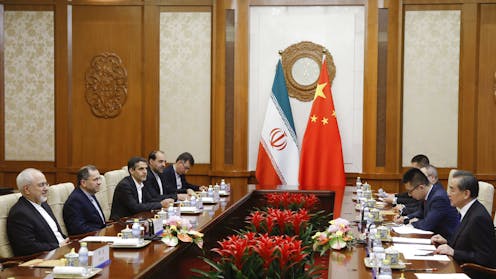
Could longtime allies have a closer relationship than meets the eye? Thomas Peter/Pool Photo via AP

China has long maintained that it does not supply arms to any party at war – a central tenet of its “noninterference” foreign policy. But in recent years, Beijing has repeatedly faced accusations of doing the opposite: providing direct military assistance to nations engaged in conflict, while publicly denying doing so and even adopting a position of diplomatic neutrality.

That has seemingly been the case for two of China’s closest allies: Russia in its war against Ukraine and Pakistan during its recent armed standoff with India in May.

Now, Beijing is facing scrutiny over alleged military links to Iran – a country engaged in a long-running shadow conflict with Israel that recently tipped into a short-lived hot war.

After the ceasefire that followed the 12-day war in the Middle East, China reportedly supplied batteries for surface-to-air missiles to Iran in exchange for oil. Such parts are a critical military need for Tehran after its air defense network was severely damaged by Israeli missiles.

The Chinese Embassy in Israel denied the reports, stating that China firmly opposes the proliferation of weapons of mass destruction and does not export arms to countries at war. But China’s Ministry of Foreign Affairs has yet to issue an official statement on the alleged transfer.

As an expert specializing in China’s grand strategy, I think it is highly possible that China would offer Iran military support while denying it publicly. Such plausible deniability would allow Beijing to assert military influence and showcase some of its hardware, while deflecting international criticism and preserving diplomatic flexibility.

But the tactic works only so far. As indirect evidence accumulates, as many suggest it is, such covert action may gradually develop into an open secret – leading to what scholars term “implausible deniability,” where denial is no longer credible even if it is still officially maintained.

Missiles are put on display.
An air-to-air missile on display at the 15th China International Aviation and Aerospace Exhibition in November 2024.
Shen Ling/VCG via Getty Images

China’s support for Russia’s war

Although Beijing has consistently said it is neutral in the Russia-Ukraine war that broke out in 2022, China has, in practice, quietly supported Russia. In part, that is because China shares the same strategic goal of challenging the Western-led international order.

Recently, Chinese Foreign Minister Wang Yi reportedly told European Union foreign policy chief Kaja Kallas that Beijing cannot afford to see Russia lose the war in Ukraine. He was said to have warned that a Russian defeat would likely bring the full force of U.S. strategic pressure to bear on China.

From Beijing’s perspective, Moscow plays a vital role in keeping the West preoccupied, offering China valuable strategic breathing room by diverting American attention and resources away from the Asia-Pacific region.

Beyond deepening trade relations that have become a lifeline for Moscow’s economy under Western sanctions, China has reportedly supplied Russia with large quantities of dual-use goods – goods that can be used for civilian and military purposes – to enhance both Moscow’s offensive and defensive capabilities, as well as to boost China’s military-industrial production. Beijing has also allegedly provided satellite imagery to assist Russia on the battlefield.

While the U.S. and Europe have repeatedly tried to call out China for aiding Russia militarily, Beijing has consistently denied such claims.

Most recently, on April 18, 2025, Ukraine formally accused China of directly supporting Russia and slapped sanctions on three Chinese-based firms that Kyiv said was involved in weapons production for the Russian war effort.

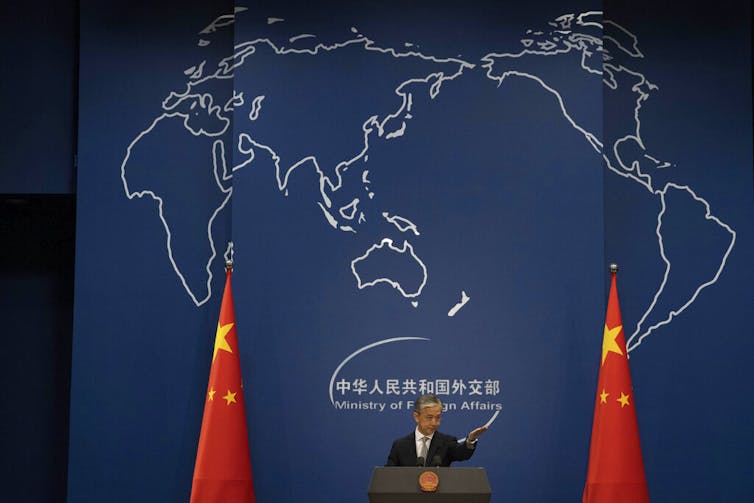
In what has become a common refrain, China’s Foreign Ministry rejected the Ukrainian accusation, reaffirming that China has never provided lethal weapons to any party in the conflict and reiterating its official stance of promoting a ceasefire and peace negotiations.

A man talks at a lectern.
A Chinese Foreign Ministry spokesperson gestures for questions during a daily briefing in Beijing in 2020.
AP Photo/Ng Han Guan

China’s quiet backing of Pakistan

Beijing has long presented itself as a neutral party in the India-Pakistan conflict, too, and has called for restraint on both sides and urged peaceful dialogue.

But in practice, China is allied with Pakistan. And the direct military support it has provided to Lahore appears driven by China’s desire to curb India’s regional influence, counterbalance the growing U.S.–India strategic partnership and protect the China–Pakistan Economic Corridor, a massive bilateral infrastructure project.

In the latest flare-up between India and Pakistan in May, Pakistan deployed Chinese-made J-10C fighter jets in combat for the first time, reportedly downing five Indian aircraft.

Pakistan’s air defense relied heavily on Chinese equipment during the short conflict, deploying Chinese-made surface-to-air missile systems, air-to-air missiles, advanced radar systems and drones for reconnaissance and strike operations. Overall, more than 80% of Pakistan’s military imports have come from China in the past five years.

In what would be a far more stark example of military support if proven true, the deputy chief of India’s army alleged that China had provided Pakistan with real-time intelligence on Indian troop movements during the conflict.

When asked to respond, a spokesperson for China’s Ministry of Foreign Affairs said they had no knowledge of the matter. They reaffirmed that China’s ties with Pakistan are not directed against any third party and reiterated Beijing’s long-standing position in favor of a peaceful resolution to any India–Pakistan dispute.

Extending ‘deniability’ to Iran?

Like with Russia and Pakistan, Iran has increasingly been seen as a partner to China.

In 2021, China and Iran signed a 25-year, US$400 billion comprehensive cooperation agreement that covered trade, energy and security, signaling the depth of their strategic relationship.

The accord was indicative of the strategic value Beijing places on Iran. From Beijing’s perspective, Tehran presents a counterbalance to the influence of the U.S. and its allies – especially Israel and Saudi Arabia – in the region and helps divert Western resources and attention away from China.

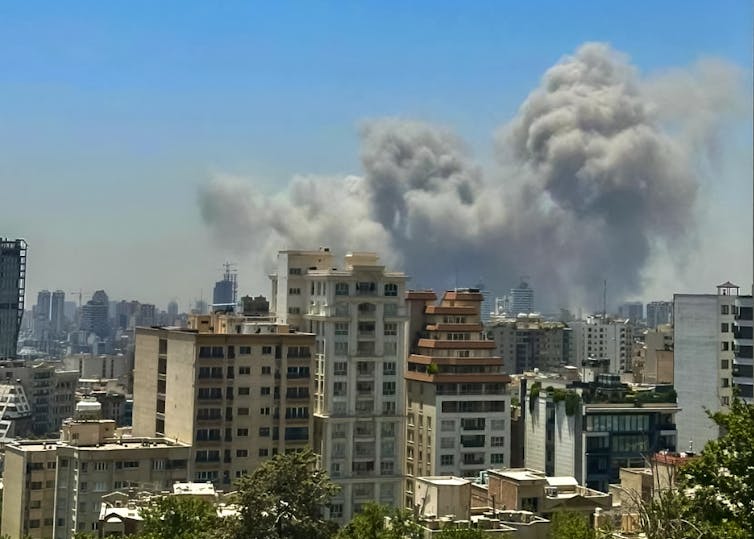
But recently, Tehran’s position in the region has become far weaker. Not only has its air defense infrastructure suffered badly in the confrontations with Israel, but its regional proxies and allies – Hamas, Hezbollah and the Assad regime in Syria – have either been devastated by Israel or collapsed altogether.

billowing smoke is seen over the top of buildings
Smoke rises over Tehran, Iran, following an Israeli strike on June 23, 2025.
Nikan/Middle East Images/AFP via Getty Images

Under these circumstances, it is strategically compelling for Beijing to provide support to Tehran in order to maintain regime stability.

Indeed, Beijing has frequently circumvented sanctions on Iranian energy, with an estimated 90% of Iran’s oil exports still going to China.

Although Beijing did not extend any substantive support to Iran during the 12-day war, reports have abounded since that Iran is looking to China as an alternative supplier of its defense needs. The thinking here is that Russia, Tehran’s traditional military partner, is no longer able to provide sufficient, quality defense equipment to Iran. Some influential social media posters in China have gone as far as advocating for direct military sales by Beijing.

If China does do this, I believe it is likely to follow the same playbook it has used elsewhere by denying involvement publicly while covertly providing assistance.

Doing so allows China to maintain diplomatic ties with Iran’s regional rivals, such as Israel and Saudi Arabia, while simultaneously benefiting from a turbulent Middle East that distracts Washington and grants Beijing strategic breathing room.

China’s use of plausible deniability reflects a broader strategic ambition. Namely, it wants to assert influence in key regional conflicts without triggering open backlash. By quietly supporting partners while maintaining a facade of neutrality, Beijing aims to undermine Western dominance, stretch U.S. strategic focus and secure its own interests – and all while avoiding the risks and responsibilities of open military alignment.

The Conversation

Linggong Kong does not work for, consult, own shares in or receive funding from any company or organization that would benefit from this article, and has disclosed no relevant affiliations beyond their academic appointment.

ref. Beijing’s ‘plausible deniability’ on arms supply is quickly becoming implausible – and could soon extend to Iran – https://theconversation.com/beijings-plausible-deniability-on-arms-supply-is-quickly-becoming-implausible-and-could-soon-extend-to-iran-261148

¿Qué significa el fracaso de las conversaciones de paz para la catástrofe humanitaria en Gaza?

Source: The Conversation – (in Spanish) – By Ali Mamouri, Research Fellow, Middle East Studies, Deakin University

Los esfuerzos por poner fin al implacable asedio de Gaza han sufrido un revés con el abrupto fin de las conversaciones de paz en Catar.

Tanto Estados Unidos como Israel han retirado sus equipos negociadores, acusando a Hamás de «falta de voluntad para alcanzar un alto el fuego».

El enviado especial del presidente estadounidense Donald Trump, Steve Witkoff, declaró que parece que Hamás nunca ha querido llegar a un acuerdo:

Aunque los mediadores han hecho un gran esfuerzo, Hamás no parece estar coordinado ni actuar de buena fe. Ahora consideraremos opciones alternativas para traer a los rehenes a casa e intentar crear un entorno más estable para la población de Gaza.

Este decepcionante desenlace coincide con el temor creciente a una hambruna generalizada en Gaza y con la decisión histórica de Francia de reconocer oficialmente al Estado palestino.

El presidente francés, Emmanuel Macron, afirma que no hay otra alternativa por el bien de la seguridad en Oriente Medio:

Fiel a su compromiso histórico con una paz justa y duradera en Oriente Medio, he decidido que Francia reconocerá al Estado de Palestina.

¿Qué significarán estos acontecimientos para el conflicto en Gaza y la seguridad general en Oriente Medio?

«Catástrofe humanitaria»

El fracaso de la tregua significa que no se vislumbra el fin del asedio israelí de Gaza, que ha devastado el territorio durante más de 21 meses.

Según la agencia de la ONU para los refugiados palestinos, la UNRWA, más de 100 personas, en su mayoría niños, han muerto de hambre. Uno de cada cinco niños de la ciudad de Gaza está desnutrido, y el número de casos aumenta cada día.

El comisionado general Philippe Lazzarini afirma que, con la escasa ayuda alimentaria que llega a Gaza:

Los habitantes de Gaza no son ni vivos ni muertos, son cadáveres andantes […] la mayoría de los niños que ven nuestros equipos están demacrados, débiles y corren un alto riesgo de morir si no reciben el tratamiento que necesitan urgentemente.

La ONU y más de 100 organizaciones humanitarias culpan al bloqueo israelí de casi toda la ayuda que llega al territorio por la falta de alimentos.

Lazzarini afirma que la UNRWA tiene 6 000 camiones con suministros de emergencia esperando en Jordania y Egipto. Insta a Israel, que sigue culpando a Hamás de los casos de malnutrición, a que permita la entrada de la ayuda humanitaria en Gaza.

Propuesta de acuerdo de alto el fuego

La última propuesta de alto el fuego estaba a punto de ser aceptada por ambas partes.

Incluía una tregua de 60 días, durante la cual Hamás liberaría a diez rehenes israelíes vivos. A cambio, Israel liberaría a varios prisioneros palestinos y aumentaría considerablemente la ayuda humanitaria a Gaza.

Durante el alto el fuego, ambas partes entablarían negociaciones para alcanzar una tregua duradera.

Aunque aún no se conocen los detalles concretos de los puntos conflictivos, las declaraciones anteriores de ambas partes sugieren que el desacuerdo se centra en lo que sucedería tras un alto el fuego temporal.

Según se informa, Israel pretende mantener una presencia militar permanente en Gaza para poder reanudar rápidamente las operaciones si fuera necesario. Por el contrario, Hamás exige una vía hacia el fin total de las hostilidades.

La falta de confianza mutua ha empañado drásticamente las negociaciones.

Desde la perspectiva de Israel, cualquier alto el fuego debe impedir que Hamás recupere el control de Gaza, ya que esto permitiría al grupo reconstruir su poder y lanzar potencialmente otro ataque transfronterizo.

Sin embargo, Hamás ha afirmado en repetidas ocasiones que está dispuesto a entregar el poder a cualquier otro grupo palestino que persiga un Estado palestino basado en las fronteras de 1967. Esto podría incluir a la Autoridad Nacional Palestina (ANP), que gobierna Cisjordania y reconoce desde hace tiempo a Israel.

Apoyo a un Estado palestino

Los líderes israelíes han apoyado ocasionalmente de boquilla un Estado palestino. Sin embargo, han descrito dicha entidad como «menos que un Estado», una formulación que no satisface ni las aspiraciones palestinas ni las normas jurídicas internacionales.

En respuesta al empeoramiento de la situación humanitaria, algunos países occidentales han dado pasos para reconocer plenamente un Estado palestino, considerándolo un paso hacia la resolución permanente de uno de los conflictos más prolongados de Oriente Medio.

El anuncio de Macron supone un avance importante.

Francia es ahora la potencia occidental más destacada en adoptar esta postura. Se suma así a más de 140 países, entre ellos más de una docena de Europa, que ya han reconocido la condición de Estado.

Aunque se trata de una medida simbólica, aumentará la presión diplomática sobre Israel en medio de la guerra y la crisis humanitaria que se vive en Gaza.

Sin embargo, el anuncio fue inmediatamente condenado por el primer ministro israelí, Benjamin Netanyahu, quien afirmó que el reconocimiento «recompensa el terrorismo» y “sería una plataforma de lanzamiento para aniquilar a Israel, no para vivir en paz junto a él”.

¿Anexionarse Gaza?

Un Estado palestino es inaceptable para Israel.

Recientemente se han presentado más pruebas en una reveladora entrevista televisiva del ex primer ministro israelí Ehud Barak, quien afirmó que Netanyahu había empoderado deliberadamente a Hamás para bloquear una solución de dos Estados.

En cambio, cada vez hay más pruebas de que Israel está intentando anexionarse la totalidad del territorio palestino y reubicar a los palestinos en países vecinos.

Dada la incertidumbre actual, parece poco probable que se alcance un nuevo alto el fuego en un futuro próximo, sobre todo porque sigue sin estar claro si la retirada de Estados Unidos de las conversaciones fue un cambio real de política o una mera táctica estratégica de negociación.

The Conversation

Ali Mamouri no recibe salario, ni ejerce labores de consultoría, ni posee acciones, ni recibe financiación de ninguna compañía u organización que pueda obtener beneficio de este artículo, y ha declarado carecer de vínculos relevantes más allá del cargo académico citado.

ref. ¿Qué significa el fracaso de las conversaciones de paz para la catástrofe humanitaria en Gaza? – https://theconversation.com/que-significa-el-fracaso-de-las-conversaciones-de-paz-para-la-catastrofe-humanitaria-en-gaza-261966

Ceasefire talks collapse – what does that mean for the humanitarian catastrophe in Gaza?

Source: The Conversation – Global Perspectives – By Ali Mamouri, Research Fellow, Middle East Studies, Deakin University

Efforts to end the relentless siege of Gaza have been set back by the abrupt end to peace talks in Qatar.

Both the United States and Israel have withdrawn their negotiating teams, accusing Hamas of a “lack of desire to reach a ceasefire”.

US President Donald Trump’s special envoy Steve Witkoff says it would appear Hamas never wanted a deal:

While the mediators have made a great effort, Hamas does not appear to be coordinated or acting in good faith. We will now consider alternative options to bring the hostages home and try to create a more stable environment for the people in Gaza

State Department spokesman Tommy Piggott reads Steve Witkoff’s statement on the collapse of the Gaza peace talks.

The disappointing development coincides with mounting fears of a widespread famine in Gaza and a historic decision by France to formally recognise a Palestinian state.

French President Emmanuel Macron says there is no alternative for the sake of security of the Middle East:

True to its historic commitment to a just and lasting peace in the Middle East, I have decided that France will recognise the State of Palestine

What will these developments mean for the conflict in Gaza and the broader security of the Middle East?

‘Humanitarian catastrophe’

The failure to reach a truce means there is no end in sight to the Israeli siege of Gaza which has devastated the territory for more than 21 months.

Amid mounting fears of mass starvation, Australian Prime Minister Anthony Albanese says Gaza is in the grip of a “humanitarian catastrophe”. He is urging Israel to comply immediately with its obligations under international law:

Israel’s denial of aid and the killing of civilians, including children, seeking access to water and food cannot be defended or ignored.

According to the United Nations Palestinian refugee agency UNRWA, more than 100 people – most of them children – have died of hunger. One in five children in Gaza City is malnourished, with the number of cases rising every day.

Commissioner-General Philippe Lazzarini says with little food aid entering Gaza, people are

neither dead nor alive, they are walking corpses […] most children our teams are seeing are emaciated, weak and at high risk of dying if they don’t get the treatment they urgently need.

The UN and more than 100 aid groups blame Israel’s blockade of almost all aid into the territory for the lack of food.

Lazzarini says UNRWA has 6,000 trucks of emergency supplies waiting in Jordan and Egypt. He is urging Israel – which continues to blame Hamas for cases of malnutrition – to allow the humanitarian assistance into Gaza.

Proposed ceasefire deal

The latest ceasefire proposal was reportedly close to being agreed by both parties.

It included a 60-day truce, during which time Hamas would release ten living Israeli hostages and the remains of 18 others. In exchange, Israel would release a number of Palestinian prisoners, and humanitarian aid to Gaza would be significantly increased.

During the ceasefire, both sides would engage in negotiations toward a lasting truce.

While specific details of the current sticking points remain unclear, previous statements from both parties suggest the disagreement centres on what would follow any temporary ceasefire.

Israel is reportedly seeking to maintain a permanent military presence in Gaza to allow for a rapid resumption of operations if needed. In contrast, Hamas is demanding a pathway toward a complete end to hostilities.

A lack of mutual trust has dramatically clouded the negotiations.

From Israel’s perspective, any ceasefire must not result in Hamas regaining control of Gaza, as this would allow the group to rebuild its power and potentially launch another cross-border attack.

However, Hamas has repeatedly said it is willing to hand over power to any other Palestinian group in pursuit of a Palestinian state based on the 1967 borders. This could include the Palestinian National Authority (PNA), which governs the West Bank and has long recognised Israel.

Support for a Palestinian state

Israeli leaders have occasionally paid lip service to a Palestinian state. But they have described such an entity as “less than a state” or a “state-minus” – a formulation that falls short of both Palestinian aspirations and international legal standards.

In response to the worsening humanitarian situation, some Western countries have moved to fully recognise a Palestinian state, viewing it as a step toward a permanent resolution of one of the longest-running conflicts in the Middle East.

Macron’s announcement France will officially recognise a full Palestinian state in September is a major development.

France is now the most prominent Western power to take this position. It follows more than 140 countries – including more than a dozen in Europe – that have already recognised statehood.

While largely symbolic, the move adds diplomatic pressure on Israel amid the ongoing war and aid crisis in Gaza.

However, the announcement was immediately condemned by Israeli Prime Minister Benjamin Netanyahu, who claimed recognition “rewards terror” and

risks creating another Iranian proxy, just as Gaza became. A Palestinian state in these conditions would be a launch pad to annihilate Israel – not to live in peace beside it.

Annexing Gaza?

A Palestinian state is unacceptable to Israel.

Further evidence was recently presented in a revealing TV interview by former Israeli Prime Minister Ehud Barak who stated Netanyahu had deliberately empowered Hamas in order to block a two-state solution.

Instead there is mounting evidence Israel is seeking to annex the entirety of Palestinian land and relocate Palestinians to neighbouring countries.

Given the current uncertainty, it appears unlikely a new ceasefire will be reached in the near future, especially as it remains unclear whether the US withdrawal from the negotiations was a genuine policy shift or merely a strategic negotiating tactic.

The Conversation

Ali Mamouri does not work for, consult, own shares in or receive funding from any company or organisation that would benefit from this article, and has disclosed no relevant affiliations beyond their academic appointment.

ref. Ceasefire talks collapse – what does that mean for the humanitarian catastrophe in Gaza? – https://theconversation.com/ceasefire-talks-collapse-what-does-that-mean-for-the-humanitarian-catastrophe-in-gaza-261942

3 reasons young people are more likely to believe conspiracy theories – and how we can help them discover the truth

Source: The Conversation – Global Perspectives – By Jean-Nicolas Bordeleau, Research Fellow, Jeff Bleich Centre for Democracy and Disruptive Technologies, Flinders University

Conspiracy theories are a widespread occurrence in today’s hyper connected and polarised world.

Events such as Brexit, the 2016 and 2020 United States presidential elections, and the COVID pandemic serve as potent reminders of how easily these narratives can infiltrate public discourse.

The consequences for society are significant, given a devotion to conspiracy theories can undermine key democratic norms and weaken citizens’ trust in critical institutions. As we know from the January 6 riot at the US Capitol, it can also motivate political violence.

But who is most likely to believe these conspiracies?

My new study with Daniel Stockemer of the University of Ottawa provides a clear and perhaps surprising answer. Published in Political Psychology, our research shows age is one of the most significant predictors of conspiracy beliefs, but not in the way many might assume.

People under 35 are consistently more likely to endorse conspiratorial ideas.

This conclusion is built on a solid foundation of evidence. First, we conducted a meta analysis, a “study of studies”, which synthesised the results of 191 peer-reviewed articles published between 2014 and 2024.

This massive dataset, which included over 374,000 participants, revealed a robust association between young age and belief in conspiracies.

To confirm this, we ran our own original multinational survey of more than 6,000 people across six diverse countries: Australia, Brazil, Canada, Germany, the US and South Africa.

The results were the same. In fact, age proved to be a more powerful predictor of conspiracy beliefs than any other demographic factor we measured, including a person’s gender, income, or level of education.

Why are young people more conspiratorial?

Having established conspiracy beliefs are more prevalent among younger people, we set out to understand why.

Our project tested several potential factors and found three key reasons why younger generations are more susceptible to conspiracy theories.

1. Political alienation

One of the most powerful drivers we identified is a deep sense of political disaffection among young people.

A majority of young people feel alienated from political systems run by politicians who are two or three generations older than them.

This under representation can lead to frustration and the feeling democracy isn’t working for them. In this context, conspiracy theories provide a simple, compelling explanation for this disconnect: the system isn’t just failing, it’s being secretly controlled and manipulated by nefarious actors.

2. Activist style of participation

The way young people choose to take part in politics also plays a significant role.

While they may be less likely to engage in traditional practices such as voting, they are often highly engaged in unconventional forms of participation, such as protests, boycotts and online campaigns.

These activist environments, particularly online, can become fertile ground for conspiracy theories to germinate and spread. They often rely on similar “us versus them” narratives that pit a “righteous” in-group against a “corrupt” establishment.

3. Low self-esteem

Finally, our research confirmed a crucial psychological link to self-esteem.

For individuals with lower perceptions of self worth, believing in a conspiracy theory – blaming external, hidden forces for their problems – can be a way of coping with feelings of powerlessness.

This is particularly relevant for young people. Research has long shown self esteem tends to be lower in youth, before steadily increasing with age.

What can be done?

Understanding these root causes is essential because it shows simply debunking false claims is not a sufficient solution.

To truly address the rise of conspiracy theories and limit their consequences, we must tackle the underlying issues that make these narratives so appealing in the first place.

Given the role played by political alienation, a critical step forward is to make our democracies more representative. This is best illustrated by the recent election of Labor Senator Charlotte Walker, who is barely 21.

By actively working to increase the presence of young people in our political institutions, we can help give them faith that the system can work for them, reducing the appeal of theories which claim it is hopelessly corrupt.

More inclusive democracy

This does not mean discouraging the passion of youth activism. Rather, it is about empowering young people with the tools to navigate today’s complex information landscape.

Promoting robust media and digital literacy education could help individuals critically evaluate the information they encounter in all circles, including online activist spaces.

The link to self-esteem also points to a broader societal responsibility.

By investing in the mental health and wellbeing of young people, we can help boost the psychological resilience and sense of agency that makes them less vulnerable to the simplistic blame games offered by conspiracy theories.

Ultimately, building a society that is resistant to misinformation is not about finding fault with a particular generation.

It is about creating a stronger, more inclusive democracy where all citizens, especially the young, feel represented, empowered, and secure.

The Conversation

Jean-Nicolas Bordeleau receives funding from Social Sciences and Humanities Research Council of Canada.

ref. 3 reasons young people are more likely to believe conspiracy theories – and how we can help them discover the truth – https://theconversation.com/3-reasons-young-people-are-more-likely-to-believe-conspiracy-theories-and-how-we-can-help-them-discover-the-truth-261074

Birds use hidden black and white feathers to make themselves more colourful

Source: The Conversation – Global Perspectives – By Simon Griffith, Professor of Avian Behavioural Ecology, Macquarie University

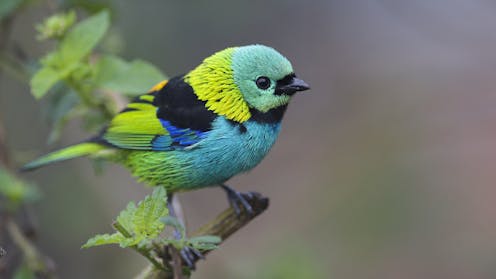
The green-headed tanager (_Tangara seledon_) has a hidden layer of plumage that is white underneath the orange feathers and black underneath the blue and green feathers. Daniel Field

Birds are perhaps the most colourful group of animals, bringing a splash of colour to the natural world around us every day. Indeed, exclusively black and white birds – such as magpies – are in the minority.

However, new research by a team from Princeton University in the United States has revealed a surprising trick in which birds use those boring black and white feathers to make their colours even more vivid.

A yellow and black bird sitting on a branch.
Male golden tanagers (Tangara arthus) have hidden layers of white which make their plumage brighter, while females have hidden layers of black which make their plumage darker.
Daniel Field

In the study, published today in Science Advances, Rosalyn Price-Waldman and her colleagues discovered that if coloured feathers are placed over a layer of either white or black underlying feathers, their colours are enhanced.

A particularly striking discovery was that in some species the different colour of males and females wasn’t due to the colour the two sexes put into the feathers, but rather in the amount of white or black in the layer underneath.

Why birds are so bright – and how they do it

Typically, male birds have more vivid colours than females. As Charles Darwin first explained, the most colourful males are more likely to attract mates and produce more offspring than those that aren’t as vivid. This process of “sexual selection” is the evolutionary force that has resulted in most of the colours we see in birds today.

Evolution is a process that rewards clever solutions in the competition among males to stand out in the crowd. Depositing a layer of black underneath patches of bright blue feathers has enabled males to produce that extra vibrancy that helps them in the competition for mates.

Close up of blue feathers against a black background.
The blue feathers of a red-necked tanager (Tangara cyanocephala) stand out against a black underlayer.
Rosalyn Price-Waldman

The reason the black layer works so well is that it absorbs all the light that passes through the top layer of coloured feathers. The colour we see is blue because those top feathers have a fine structure that scatters light in a particular way, and reflects light in the blue part of the spectrum.

The feathers appear particularly vivid blue because the light in other wavelengths is absorbed by the under-layer. If the under-layer was paler, some of the light in the other parts of the light spectrum would bounce back and the blue would not “pop out” as much.

Different tricks for different colours

Interestingly, in the new study, the researchers found that for yellow feathers the opposite trick works. Yellow feathers contain yellow pigments – carotenoids – and in this case they are enhanced if they have a white under-layer.

The white layer reflects light that passes through the yellow feathers, and this increases the brightness of these yellow patches, making them more striking in contrast to surrounding patches of colour.

Close up of red feathers over a white background.
The red feather tips of a scarlet-rumped tanager (Ramphocelus passerinii) are enhanced by the white feathers beneath them.
Rosalyn Price-Waldman

A surprisingly common technique

The authors focused most of their work on species of tanager, typically very colourful fruit-eating birds that are native to Central and South America.

However, once they had discovered what was happening in tanagers, they checked to see if it was occurring in other birds.

A bright blue bird perching on a twig.
The vivid blue colouring of the Australian splendid fairy wren (Malurus splendens) is enhanced by an underlayer of colourless feathers.
Robbie Goodall / Getty Images

This additional work revealed that the use of black and white underlying feathers to enhance colour is found in many other bird families, including the Australian fairy wrens which have such vivid blue colouration.

This widespread use of black and white across so many different species suggests birds have been enhancing the production of colour in this clever way for tens of millions of years, and that it is widely used across birds.

A bird with a black body and bright red head.
The color of the vibrant red crown of this red-capped manakin (Ceratopipra mentalis) is magnified by a hidden layer of white plumage.
Daniel Field

The study is important because it helps us to understand how complex traits such as colour can evolve in nature. It may also help us to improve the production of vibrant colours in our own architecture, art and fashion.

The Conversation

Simon Griffith receives funding from the Australian Research Council.

ref. Birds use hidden black and white feathers to make themselves more colourful – https://theconversation.com/birds-use-hidden-black-and-white-feathers-to-make-themselves-more-colourful-261567

As seas rise and fish decline, this Fijian village is finding new ways to adapt

Source: The Conversation – Global Perspectives – By Celia McMichael, Professor in Geography, The University of Melbourne

Celia McMichael, CC BY-NC-ND

In the village of Nagigi, Fiji, the ocean isn’t just a resource – it’s part of the community’s identity. But in recent years, villagers have seen the sea behave differently. Tides are pushing inland. Once abundant, fish are now harder to find. Sandy beaches and coconut trees have been washed away.

Like many coastal communities, including those across the Pacific Islands region, this village is now under real pressure from climate change and declining fish stocks. Methods of fishing are no longer guaranteed, while extreme weather and coastal erosion threaten homes and land. As one villager told us:

we can’t find fish easily, not compared to previous times […] some fish species we used to see before are no longer around.

When stories like this get publicity, they’re often framed as a story of loss. Pacific Islanders can be portrayed as passive victims of climate change.

But Nagigi’s experience isn’t just about vulnerability. As our new research shows, it’s about the actions people are taking to cope with the changes already here. In response to falling fish numbers and to diversify livelihoods, women leaders launched a new aquaculture project, and they have replanted mangroves to slow the advance of the sea.

Adaptation is uneven. Many people don’t want to or can’t leave their homes. But as climate change intensifies, change will be unavoidable. Nagigi’s experience points to the importance of communities working collectively to respond to threats.

Unwelcome change is here

The communities we focus on, Nagigi village (population 630) and Bia-I-Cake settlement (population 60), are located on Savusavu Bay in Vanua Levu, Fiji’s second largest island. Fishing and marine resources are central to their livelihoods and food security.

In 2021 and 2023, we ran group discussions (known as talanoa) and interviews to find out about changes seen and adaptations made.

Nagigi residents have noticed unwelcome changes in recent years. As one woman told us:

sometimes the sea is coming further onto the land, so there’s a lot of sea intrusion into the plantations, flooding even on land where it never used to be

house in fiji village with sea in foreground, climate change, rising seas.
Tides are pushing ashore in Nagigi, threatening infrastructure.
Celia McMichael, CC BY-NC-ND

In 2016, the devastating Tropical Cyclone Winston destroyed homes and forced some Nagigi residents to move inland to customary mataqali land owned by their clan.

As one resident said:

our relocation was smooth because […] we just moved to our own land, our mataqali land.

But some residents didn’t have access to this land, while others weren’t willing to move away from the coast. One man told us:

leave us here. I think if I don’t smell or hear the ocean for one day I would be devastated.

Adaptation is happening

One striking aspect of adaptation in Nagigi has been the leadership of women, particularly in the small Bia-I-Cake settlement.

In recent years, the Bia-I-Cake Women’s Cooperative has launched a small-scale aquaculture project to farm tilapia and carp to tackle falling fish stocks in the ocean, tackle rising food insecurity and create new livelihoods.

Women in the cooperative have built fish ponds, learned how to rear fish to a good size and began selling the fish, including by live streaming the sale. The project was supported by a small grant from the United Nations Development Programme and the Women’s Fund Fiji.

Recently, the cooperative’s women have moved into mangrove replanting to slow coastal erosion and built a greenhouse to farm new crops.

As one woman told us, these efforts show women “have the capacity to build a sustainable, secure and thriving community”.

The community’s responses draw on traditional social structures and values, such as respect for Vanua – the Fijian and Pacific concept of how land, sea, people, customs and spiritual beliefs are interconnected – as well as stewardship of natural resources and collective decision-making through clans and elders, both women and men.

Nagigi residents have moved to temporarily close some customary fishing grounds to give fish populations a chance to recover. The village is also considering declaring a locally-managed marine area (known as a tabu). This is a response to climate impacts as well as damage to reefs, pollution and overfishing.

For generations, village residents have protected local ecosystems which in turn support the village. But what is new is how these practices are being strengthened and formalised to respond to new challenges.

fish ponds, aquaculture.
A women’s cooperative have built aquaculture ponds to raise and sell fish.
Celia McMichael, CC BY-NC-ND

Adaptation is uneven

While adaptation is producing some successes, it is unevenly spread. Not everyone has access to customary land for relocation and not every household can afford to rebuild damaged homes.

What Nagigi teaches us, though, is the importance of local adaptation. Villagers have demonstrated how a community can anticipate risks, respond to change and threats, recover from damage and take advantage of new opportunities.

Small communities are not just passive sites of loss. They are collectives of strength, agency and ingenuity. As adaptation efforts scale up across the Pacific, it is important to recognise and support local initiatives such as those in Nagigi.

Sharing effective adaptation methods can give ideas and hope to other communities under real pressure from climate change and other threats.

Many communities are doing their best to adapt often undertaking community-led adaptation, even despite the limited access Pacific nations have to global climate finance.

Nagigi’s example shows unwelcome climatic and environmental changes are already arriving. But it’s also about finding ways to live well amid uncertainty and escalating risk by using place, tradition and community.

The authors acknowledge the support of the people of Nagigi and Bia-I-Cake, and especially the Bia-I-Cake Women’s Cooperative, for sharing their time and insights.

The Conversation

Celia McMichael receives funding from the Australian Research Council (ARC).

Merewalesi Yee does not work for, consult, own shares in or receive funding from any company or organisation that would benefit from this article, and has disclosed no relevant affiliations beyond their academic appointment.

ref. As seas rise and fish decline, this Fijian village is finding new ways to adapt – https://theconversation.com/as-seas-rise-and-fish-decline-this-fijian-village-is-finding-new-ways-to-adapt-261573

Is sleeping a lot actually bad for your health? A sleep scientist explains

Source: The Conversation – Global Perspectives – By Charlotte Gupta, Senior Postdoctoral Research Fellow, Appleton Institute, HealthWise Research Group, CQUniversity Australia

Walstrom, Susanne/Getty

We’re constantly being reminded by news articles and social media posts that we should be getting more sleep. You probably don’t need to hear it again – not sleeping enough is bad for your brain, heart and overall health, not to mention your skin and sex drive.

But what about sleeping “too much”? Recent reports that sleeping more than nine hours could be worse for your health than sleeping too little may have you throwing up your hands in despair.

It can be hard not to feel confused and worried. But how much sleep do we need? And what can sleeping a lot really tell us about our health? Let’s unpack the evidence.

Sleep is essential for our health

Along with nutrition and physical activity, sleep is an essential pillar of health.

During sleep, physiological processes occur that allow our bodies to function effectively when we are awake. These include processes involved in muscle recovery, memory consolidation and emotional regulation.

The Sleep Health Foundation – Australia’s leading not-for-profit organisation that provides evidence-based information on sleep health – recommends adults get seven to nine hours of sleep per night.

Some people are naturally short sleepers and can function well with less than seven hours.

However, for most of us, sleeping less than seven hours will have negative effects. These may be short term; for example, the day after a poor night’s sleep you might have less energy, worse mood, feel more stressed and find it harder to concentrate at work.

In the long term, not getting enough good quality sleep is a major risk factor for health problems. It’s linked to a higher risk of developing cardiovascular disease – such as heart attacks and stroke – metabolic disorders, including type 2 diabetes, poor mental health, such as depression and anxiety, cancer and death.

So, it’s clear that not getting enough sleep is bad for us. But what about too much sleep?

Could too much sleep be bad?

In a recent study, researchers reviewed the results of 79 other studies that followed people for at least one year and measured how sleep duration impacts the risk of poor health or dying to see if there was an overall trend.

They found people who slept for short durations – less than seven hours a night – had a 14% higher risk of dying in the study period, compared to those who slept between seven and eight hours. This is not surprising given the established health risks of poor sleep.

However, the researchers also found those who slept a lot – which they defined as more than nine hours a night – had a greater risk of dying: 34% higher than people who slept seven to eight hours.

This supports similar research from 2018, which combined results from 74 previous studies that followed the sleep and health of participants across time, ranging from one to 30 years. It found sleeping more than nine hours was associated with a 14% increased risk of dying in the study period.

Research has also shown sleeping too long (meaning more than required for your age) is linked to health problems such as depression, chronic pain, weight gain and metabolic disorders.

This may sound alarming. But it’s crucial to remember these studies have only found a link between sleeping too long and poor health – this doesn’t mean sleeping too long is the cause of health problems or death.


Read more:
If ‘correlation doesn’t imply causation’, how do scientists figure out why things happen?


So, what’s the link?

Multiple factors may influence the relationship between sleeping a lot and having poor health.

It’s common for people with chronic health problems to consistently sleep for long periods. Their bodies may need additional rest to support recovery, or they may spend more time in bed due to symptoms or medication side effects.

People with chronic health problems may also not be getting high quality sleep, and may stay in bed for longer to try and get some extra sleep.

Additionally, we know risk factors for poor health, such as smoking and being overweight, are also associated with poor sleep.

This means people may be sleeping more because of existing health problems or lifestyle behaviours, not that sleeping more is causing the poor health.

Put simply, sleeping may be a symptom of poor health, not the cause.

What’s the ideal amount?

The reasons some people sleep a little and others sleep a lot depend on individual differences – and we don’t yet fully understand these.

Our sleep needs can be related to age. Teenagers often want to sleep more and may physically need to, with sleep recommendations for teens being slightly higher than adults at eight to ten hours. Teens may also go to bed and wake up later.

Older adults may want to spend more time in bed. However, unless they have a sleep disorder, the amount they need to sleep will be the same as when they were younger.

But most adults will require seven to nine hours, so this is the healthy window to aim for.

It’s not just about how much sleep you get. Good quality sleep and a consistent bed time and wake time are just as important – if not more so – for your overall health.

The bottom line

Given many Australian adults are not receiving the recommended amount of sleep, we should focus on how to make sure we get enough sleep, rather than worrying we are getting too much.

To give yourself the best chance of a good night’s sleep, get sunlight and stay active during the day, and try to keep a regular sleep and wake time. In the hour before bed, avoid screens, do something relaxing, and make sure your sleep space is quiet, dark, and comfortable.

If you notice you are regularly sleeping much longer than usual, it could be your body’s way of telling you something else is going on. If you’re struggling with sleep or are concerned, speak with your GP. You can also explore the resources on the Sleep Health Foundation website.

The Conversation

The authors do not work for, consult, own shares in or receive funding from any company or organisation that would benefit from this article, and have disclosed no relevant affiliations beyond their academic appointment.

ref. Is sleeping a lot actually bad for your health? A sleep scientist explains – https://theconversation.com/is-sleeping-a-lot-actually-bad-for-your-health-a-sleep-scientist-explains-259991