Bougainville independence process enters ‘final leg’ amid lingering uncertainty

Source: Radio New Zealand

PNG Prime Minister James Marape and Bougainville President Ishmael Toroama at the Joint Supervisory Body meeting in Port Moresby this week. December 2025

PNG Prime Minister James Marape and Bougainville President Ishmael Toroama at the Joint Supervisory Body meeting in Port Moresby this week. Photo: Autonomous Bougainville Government

A crucial, final leg of the process to decide Bougainville’s future political status has begun, but uncertainty remains over how it will play out.

Representatives of Papua New Guinea and Bougainville held talks this week in Port Moresby over the future of the autonomous region’s political status, and agreed that the issue will be taken to the PNG national parliament by June next year for deliberations on a final decision.

This week’s meeting of the Joint Supervisory Body (JSB) was the latest in a series of discussions over implementation of the process following Bougainville’s 2019 independence referendum. The non-binding referendum resulted in an overwhelming vote for independence, but ultimately it is up to PNG’s parliament to decide whether to ratify the result.

Concerns in Bougainville that PNG’s leaders were dragging the chain on whether, and when, to ratify the result were allayed somewhat this week with the JSB’s resolution, as announced by PNG Prime Minister James Marape.

“We are in the final leg in which the referendum result will go to parliament. We put a clear roadmap for the first six months of next year,” Marape explained.

Speakers and clerks from both the PNG and Bougainville parliaments will establish a secessional order to map out the formal process ahead.

“The technical specifications of the secessional order as well as what happens on the floor of parliament will be defined properly in the next three months. We anticipate that before the first half of 2026 has lapsed, parliament – possibly in the second sitting – would receive and deliberate on the result,” Marape said.

PNG's Minister for Bougainville Affairs, Sir Puka Temu.

Sir Puka Temu Photo: RNZ Pacific / Johnny Blades

Nationwide consultations

This week’s JSB meeting was the first since a PNG Parliamentary Bipartisan Committee concluded nationwide consultations on Bougainville’s political future. The committee’s findings will assist with the MPs’ deliberations.

One of the Committee members, Sir Puka Temu, said there was a range of views on the issue, but noted people in other parts of PNG were open to the idea of Bougainvilleans becoming independent.

“When we went to Morobe, one of the biggest provinces in the country, the leaders came out and said ‘give them independence’. When we went to East New Britain, they said ‘give them independence but give us autonomy’,” he said, while adding that national leaders in PNG are sensitive about setting a precedent for other parts of the country wishing to break away.

Sir Puka said the two governments have been adhering the Melanesian Agreement reached between PNG and Bougainville in New Zealand in June this year, in which both governments resolved “to craft and pursue a clear political pathway forward” on the referendum result as part of the Bougainville Peace Agreement.

However, he admitted that questions remain about the exact method by which PNG’s parliament will decide on the ratification.

“And that’s where the secessional order designed by the two speakers may clarify whether we vote or not, and if we vote is it a simple majority or a two-thirds absolute majority like we do with constitutional amendments.”

Sir Puka also said questions remain about what follows the vote.

“If parliament says yes, how do we manage the process towards independence? Because Bougainville hasnt got the institutional capacity or economy capacity to be given independence straight away.”

Papua New Guinea Prime Minister James Marape, on the left, attended the swearing-in of the fifth Bougainville House of Representatives.

Papua New Guinea Prime Minister James Marape, on the left, attended the swearing-in of the fifth Bougainville House of Representatives in October 2025. Photo: NBC Bougainville – Maus Blong Sankamap

Lingering tensions

The latest talks took place amid lingering tensions between the Autonomous Bougainville Government (ABG) and PNG’s national government, with President Ishmael Toroama telling Marape and others at the meeting about his concern that JSB resolutions were being rendered irrelevant.

He cited the example of the channelling of Restoration and Development Funds intended for Bougainville – around 100 million kina a year (approx. NZ$40m) – through the MP representing the region in the PNG national parliament, rather than directly to the ABG.

“It is therefore deeply concerning that in this matter, though initiated by the ABG through the courts, the Regional Member for Bougainville and your state Minister has chosen to actively defend against the implementation of JSB-endorsed decisions on this funding,” Toroama said.

“His public statements that the JSB Resolutions does not change the law, reflects a total disregard for the sanctity and constitutionality of the JSB as the legitimate body from which the Prime Minister’s Commitment funds originate. Such actions risk undermining the JSB’s authority. This is very dangerous and has the potential to be perilous to the peace process and to the constitutionality of the JSB itself.”

Toroama even warned that if the JSB continued to be sidelined, it could imperil PNG national elections elections taking place in Bougainville in 2027.

“I will state here that whilst national MPs from Bougainville may want to use any and all state resources at their disposal in preparation for the 2027 elections, let me go on record here and plainly state that there may not be national elections on Bougainville in 2027.”

But the JSB talks this week resolved this funding issue, Sir Puka said, with Marape assuring that the funds would now be freed up to go direct to the ABG as agreed.

Sources close to the ABG also confirmed to RNZ Pacific that the leadership was satisfied with PNG’s response to the president’s concerns and the outcome of the JSB meeting, that PNG’s parliament will be ready to the ratification decision by June next year.

However, the question of whether PNG approves of Bougainville’s independence remains very much open. But for Bougainvilleans, the question shouldn’t be delayed any more.

The need for a decision to happen before the end of the current parliament was underlined by Sir Puka who admitted that as new, younger MPs enter parliament there will be less institutional memory of the Bougainville crisis, its civil war and all the relevant history leading up to the peace process. Even among the current batch of MPs, there are gaps in knowledge of the unique context of Bougainville.

Sir Puka said a booklet was being prepared as an educational tool to raise awareness among the MPs about Bougvinaille’s history, in order to ensure there is informed decision-making on the major question that the national parliament is to address.

– Published by EveningReport.nz and AsiaPacificReport.nz, see: MIL OSI in partnership with Radio New Zealand
Hope and hardship have driven Syrian refugee returns – but many head back to destroyed homes, land disputes

Source: The Conversation – Global Perspectives – By Sandra Joireman, Weinstein Chair of International Studies, Professor of Political Science, University of Richmond

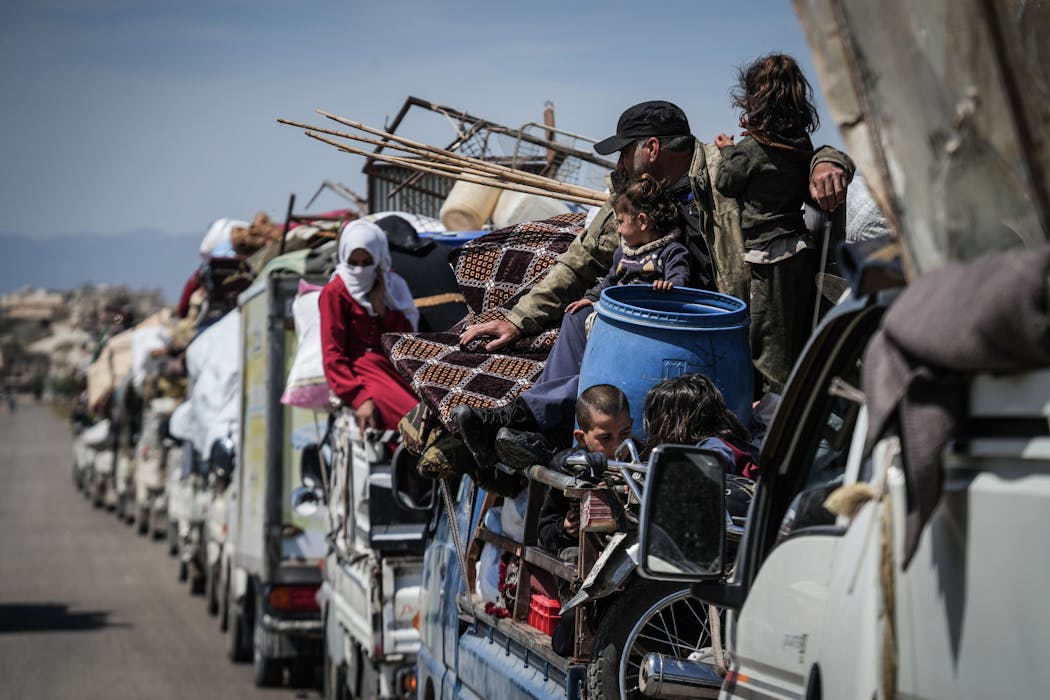
Displaced Syrian families form a return convoy to their destroyed village. Moawia Atrash/picture alliance via Getty Images

Some 1.5 million Syrian refugees have voluntarily returned to their home country over the past year.

That extraordinary figure represents nearly one-quarter of all Syrians who fled fighting during the 13-year civil war to live abroad. It is also a strikingly fast pace for a country where insecurity persists across broad regions.

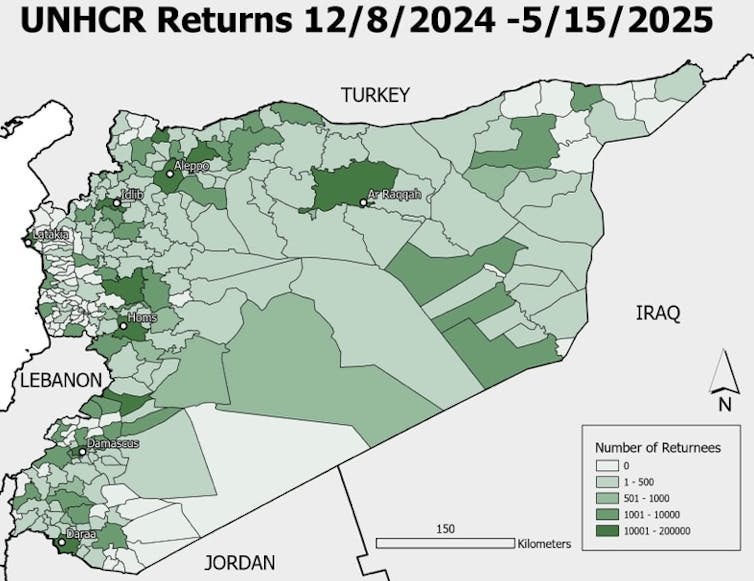
The scale and speed of these returns since the overthrow of Bashar Assad’s brutal regime on Dec. 8, 2024, raise important questions: Why are so many Syrians going back, and will these returns last? Moreover, what conditions are they returning to?

As an expert in property rights and post-conflict return migration, I have monitored the massive surge in refugee returns to Syria throughout 2024. While a combination of push-and-pull factors have driven the trend, the widespread destruction of property during the brutal civil war poses an ongoing obstacle to resettlement.

Where are Syria’s refugees?

By the time a rebel coalition led by Sunni Islamist organization Hayat Tahrir al-Sham overthrew the Assad government, Syria’s civil war had been going on for more than a decade. What began in 2011 as part of the Arab Spring protests quickly escalated into one of the most destructive conflicts of the 21st century.

Millions of Syrians were displaced internally, and about 6 million sought refuge abroad. The majority went to neighboring countries, including Turkey, Jordan and Lebanon, but a little over a million sought refuge in Europe.

Now, European countries are struggling to determine how they should respond to the changed environment in Syria. Germany and Austria have put a hold on processing asylum applications from Syrians. The international legal principle of non-refoulement prohibits states from returning refugees to unsafe environments where they would face persecution and violence.

But people can choose to return home on their own. And the fall of Assad altered refugees’ perceptions of safety and possibility.

Indeed, the U.N. refugee agency surveys conducted in January 2025 across Jordan, Lebanon, Iraq and Egypt found that 80% of Syrian refugees hoped to return home – up sharply from 57% the previous year. But hope and reality are not always aligned, and the factors motivating return are far more complex than the change in political authority.


Sandra F. Joireman, CC BY-SA

Why are people returning?

In most post-conflict settings, voluntary return begins only after security improves, schools reopen, basic infrastructure is restored and housing reconstruction is underway. Even then, people often return to their country but not their original communities, especially when local political control has shifted or reconstruction remains incomplete.

In present-day Syria, violence continues in several regions, governance is fragmented, and sectarian conflicts persist. Yet refugees are returning anyway.

A major factor is the deteriorating conditions in neighboring host countries. Most of those who came back to Syria in the early months after Assad’s fall came from neighboring states that have hosted large refugee populations for more than a decade and are now struggling with economic crises, political tensions and declining aid.

In Turkey, for example, Syrians have faced increasing deportations and growing structural barriers to integration, such as temporary status without the possibility of naturalization and strict local registration policies.

In Lebanon, meanwhile, recent violence and a steep drop in international assistance have left Syrian refugees unable to secure food, education and health care.

And in Jordan, international reductions in humanitarian support have made daily life more precarious for refugees.

In other words, many Syrians are not returning because their homeland has become safer, but because the places where they sought refuge have become more difficult.

We do not have data on the religious or ethnic makeup of returnees. But patterns from other post-conflict settings suggest that returnees are usually from the majority community aligned with the new dominant political actors. After the war in Kosovo, for instance, ethnic Albanians returned quickly, while Serb and Roma minorities returned in much smaller numbers due to insecurity and threats of reprisals.

If Syria follows this trajectory, Sunni Muslims may return in higher numbers, as the country’s president, Ahmed al-Sharaa, led the Sunni rebel coalition that overthrew Assad.

Syrian minority groups, including Alawites, Christians, Druze and Kurds, may avoid returning altogether. Violent incidents targeting minority communities have underscored ongoing instability. Recent attacks on the Alawite population have triggered new waves of displacement into Lebanon, while conflicts between Druze militias and the government in Sweida, in southern Syria, have led to more displacement within the country. These episodes illustrate that while pockets of the country may feel safe to some, instability persists.

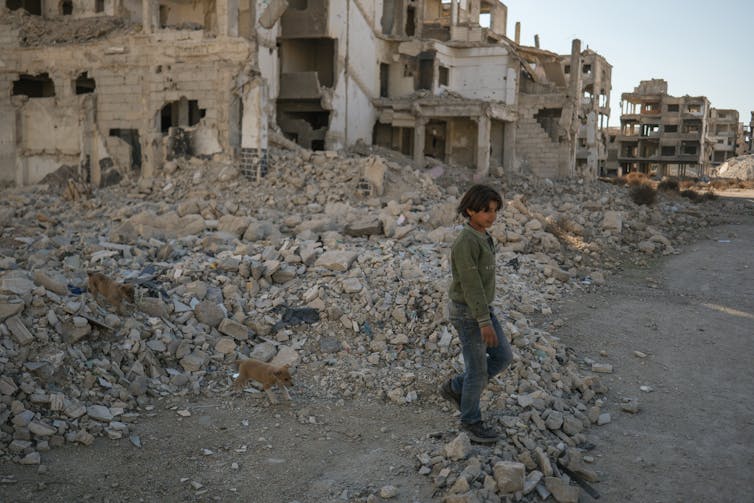
A child walks through rubble.
Thirteen years of civil war left much of Syria in ruin.
Ercin Erturk/Anadolu via Getty Images

Barriers to returns

One of the most significant obstacles facing refugees who wish to return is the condition of their homes and the status of their property rights.

The civil war caused widespread destruction of housing, businesses and public buildings.

Land administration systems, including registry offices and records, were damaged or destroyed. This matters because refugees’ return requires more than physical safety; people need somewhere to live and proof that the home they return to is legally theirs.

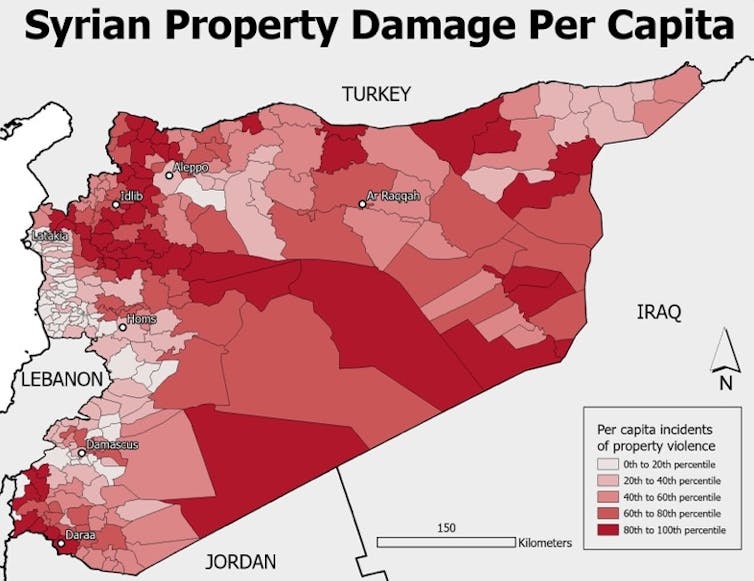
Analysis by the conflict-monitoring group ACLED of more than 140,000 qualitative reports of violent incidents between 2014 and 2025 shows that property-related destruction was more concentrated in inland provinces than in the coastal regions, with cities such as Aleppo, Idlib and Homs sustaining some of the heaviest damage.


Sandra F. Joireman, CC BY-SA

This has major implications for where return is feasible and where it will stall. With documentation lost, homes reoccupied and records destroyed, many Syrians risk returning to legal uncertainty or direct – and sometimes violent – conflict over land and housing.

Post-civil war reconstruction will require not only the rebuilding of physical infrastructure but also the restoration of land governance, including mechanisms for property verification, dispute resolution and compensation. Without all this, refugee returns will likely slow as people confront uncertainty about whether they can reclaim their homes.

Shaping Syria

Whether the wave of returns throughout 2025 continues or proves to be a temporary surge will depend on three main criteria: the security situation in Syria, reconstruction of houses and land administration systems, and the policies of the countries hosting Syrian refugees.

But ultimately, a year after the civil war ended, Syrians are returning because of a mixture of hope and hardship: hope that the fall of the Assad government has opened a path home, and hardship driven by declining support and safety in neighboring states.

Whether these returns will be safe, voluntary and sustainable are critical questions that will shape Syria’s recovery for years to come.

The Conversation

Sandra Joireman does not work for, consult, own shares in or receive funding from any company or organization that would benefit from this article, and has disclosed no relevant affiliations beyond their academic appointment.

ref. Hope and hardship have driven Syrian refugee returns – but many head back to destroyed homes, land disputes – https://theconversation.com/hope-and-hardship-have-driven-syrian-refugee-returns-but-many-head-back-to-destroyed-homes-land-disputes-269555

Congés payés : la France doit se mettre en règle avec l’UE, quelle conséquences pour les salariés ?

Source: The Conversation – in French – By Michel Miné, Professeur du Cnam, titulaire de la chaire Droit du travail et droits de la personne, Lise/Cnam/Cnrs, Conservatoire national des arts et métiers (CNAM)

Le droit de l’Union européenne oblige la France à revoir la façon dont elle considérait les congés payés jusqu’alors. Cela comporte des implications dans au moins trois domaines et conduira notamment à revenir sur une législation héritée du régime de Vichy.


Le droit international des droits de l’homme (Convention de l’Organisation internationale du travail n° 132 et Pacte de l’ONU de 1966, Charte sociale européenne) et le droit de l’Union européenne (Charte des droits fondamentaux) consacrent le droit aux congés payés comme un droit fondamental de la personne du travailleur. L’adjectif « fondamental » doit être pris au sérieux dans cette formulation.

La Cour de justice de l’Union européenne (CJUE) met en œuvre cette conception dans son interprétation de la directive du 4 novembre 2003 qui « fixe des prescriptions minimales de sécurité et de santé en matière d’aménagement du temps de travail ». Pour la Cour, « le droit au congé annuel payé de chaque travailleur doit être considéré comme un principe du droit social communautaire revêtant une importance particulière, auquel il ne saurait être dérogé » et « le travailleur doit normalement pouvoir bénéficier d’un repos effectif, dans un souci de protection efficace de sa sécurité et de sa santé ».

Sa jurisprudence, avec plus de 30 décisions portant sur les congés payés, permet des progrès de ce droit dans les différents États membres.

Cependant, l’intégration de ces progrès dans le droit français s’avère particulièrement lente du fait de l’inaction, voire du refus, des gouvernements successifs, pour en faire bénéficier les salariés. La loi Valls-El Khomri du 8 août 2016, qui a transformé l’architecture du droit du temps de travail constitue une illustration emblématique de ce refus.

Dans ce contexte, les juridictions nationales, dans le cadre du dialogue des juges, assurent la mise en œuvre de la jurisprudence européenne.

Mauvaise transposition

Les arrêts récents fortement médiatisés s’inscrivent dans une histoire qui a commencé au début de ce siècle. Ainsi, à titre d’illustration, ce sont des arrêts européens qui sont à l’origine de modification de la législation sur de nombreux points : l’acquisition de congés sans une période minimale de travail (CJUE 26 juin 2001), le congé maternité et les congés payés se cumulant sans se confondre (CJCE 18 mars 2004), etc.


À lire aussi :
Quand l’Union européenne améliore les droits sociaux : le cas des congés payés et de la maladie


Constatant dans certains États, dont la France, la mauvaise transposition du droit européen sur les congés payés, la Cour s’est fondée sur la Charte pour en imposer l’application (CJUE 6 novembre 2018, C-570/16 et C‑684/16). En cas d’impossibilité d’interpréter une législation nationale en conformité avec le droit européen, la juridiction nationale doit laisser la législation nationale inappliquée. La diffusion du droit européen via la jurisprudence nationale s’est alors intensifiée.

Ainsi en est-il du droit d’acquérir des congés payés pendant un arrêt de travail pour maladie. Selon la Cour de justice, la finalité du droit au congé annuel payé est, d’une part, de « permettre au travailleur de se reposer » et, d’autre part, de « disposer d’une période de détente et de loisirs ».

« La Charte des droits sociaux fondamentaux érige le droit à une période annuelle de congé payé en droit de l’homme reconnu à toute personne. »

Congés payés et arrêt maladie

Ainsi, le travailleur en sa qualité de travailleur a droit à une période de congés payés. Le droit à congés n’est pas subordonné à une prestation de travail préalable et un arrêt de travail pour maladie est sans incidence sur l’acquisition des droits à congés (arrêt rendu en grande chambre, 20 janvier 2009, C-350/06 et C-520/06).

Ce faisant la Cour pose une règle comparable à celle du Front populaire (loi du 20 juin 1936 et décret du 1er août 1936) considérant que le travailleur avait droit à la totalité de ses congés payés y compris en cas d’arrêt maladie.

En réaction à cette législation, le régime de Vichy avait subordonné le droit aux congés payés à un temps de « travail effectif » (décret du 13 avril 1940, loi du 31 juillet 1942). Cette législation a perduré jusqu’en 2024.

Pourtant, après la décision de la Cour de justice de 2009, la Cour de cassation, chaque année, à partir de 2013, demandait aux gouvernements successifs la mise en conformité du code du travail avec le droit européen. Sans succès.

Après plusieurs arrêts (Cour administrative d’appel de Versailles, du 17 juillet 2023, condamnation de la France pour non-transposition de la directive ; Cassation sociale, 13 septembre 2023, quatre arrêts), la loi n° 2024-364 du 22 avril 2024 prévoit la mise en conformité du droit français.

Mise en conformité partielle

Cependant, cette mise en conformité du droit national avec le droit européen demeure partielle. La discrimination persiste au regard de l’état de santé. Le salarié ayant subi un arrêt maladie ne trouvant pas (officiellement) sa cause dans sa situation de travail acquiert seulement deux jours de congés par mois, quand le salarié en arrêt de travail pour maladie professionnelle ou accident du travail ou sans arrêt acquiert deux jours et demi par mois. Des accords collectifs de branche et d’entreprise peuvent bien entendu mettre fin à cette discrimination.

La loi limite fortement les effets de la solution jurisprudentielle, notamment au regard de la rétroactivité, à la demande d’organisations patronales, ce qui a pour effet de complexifier le droit applicable en particulier en imposant des doubles compteurs de mesure du temps.

Ainsi, la jurisprudence européenne (depuis l’arrêt de 2009) et la jurisprudence nationale (depuis les arrêts de 2023) renouent avec les textes fondateurs de 1936 et la conception originelle des congés payés.

Le droit au report des jours de congés en cas de maladie pendant les congés payés est un second exemple. Selon la CJUE, « un travailleur qui est en congé de maladie durant une période de congé annuel fixée au préalable a le droit, à sa demande, et afin qu’il puisse bénéficier effectivement de son congé annuel, de prendre celui-ci à une autre époque que celle coïncidant avec la période de congé de maladie » (CJCE 10 septembre 2009, C‑277/08 ; CJUE 21 juin 2012, ANGED). Les congés payés et l’arrêt maladie ayant deux finalités différentes ne peuvent se confondre.

Mise en demeure de la France

Le Code du travail n’ayant pas été mis en conformité, la France a reçu, le 18 juin 2025, une lettre de mise en demeure de la Commission pour manquement aux règles de l’UE sur le temps de travail.

En application du droit européen, pour la Cour de cassation il convient de juger désormais que « le salarié en situation d’arrêt de travail pour cause de maladie survenue durant la période de congé annuel payé a le droit de bénéficier ultérieurement des jours de congé payé coïncidant avec la période d’arrêt de travail pour maladie » (Cassation sociale 10 septembre 2025, n° J 23-22.732).

Pour en bénéficier, le salarié doit avoir notifié un arrêt de travail pour maladie à l’employeur. Des questions pratiques se posent : cette règle est applicable aux cinq semaines de congés ; le régime du report restant à préciser.

Calcul des majorations des heures supplémentaires

Un autre exemple de la façon dont la diffusion du droit européen via la jurisprudence nationale s’est alors intensifiée concerne le droit au bénéfice des majorations pour heures supplémentaires. Selon le droit européen (CJUE 13 janvier 2022, C-514/20), afin de déterminer si le seuil des heures travaillées donnant droit à majoration pour heures supplémentaires est atteint, les heures correspondant à la période de congé annuel payé pris par le travailleur sont prises en compte en tant qu’heures de travail accomplies.

En application de cette règle, pour la Cour de cassation, l’assiette de calcul hebdomadaire des heures supplémentaires doit intégrer les périodes de congés payés. Les jours de congés payés, au cours d’une semaine, sont désormais pris en compte pour le calcul de la durée du travail lorsque le temps de travail est décompté à la semaine.

Public Sénat 2025.

Le salarié a alors droit à des majorations pour heures supplémentaires en cas de dépassement de la durée légale de 35 heures hebdomadaires (Cassation sociale 10 septembre 2025, n° 23-22.732).

La disposition contraire du Code du travail (article L. 3121-28), qui subordonne à l’accomplissement de plus de 35 heures hebdomadaires de « travail effectif » le déclenchement des majorations pour heures supplémentaires, est écartée. Des questions pratiques se posent : cette règle est applicable aux cinq semaines de congés et aux heures complémentaires des salariés à temps partiel (à défaut, une discrimination indirecte serait imposée aux salariés à temps partiel, en majorité des femmes).

La jurisprudence européenne apporte encore bien d’autres précisions en matière de congés payés. Ainsi, en cas d’arrêt maladie en cours d’année, si le travailleur a subi une baisse de ses revenus (indemnités/rémunération), il a droit lors de la prise de ses congés payés à l’intégralité de l’indemnité de congés payés, sans réduction, calculée comme s’il avait travaillé pendant toute la période de référence (CJUE 9 décembre 2021, C‑217/20).

Ce sujet des congés payés est emblématique des nombreux apports du droit européen du travail au droit national. Le droit du travail grâce à la jurisprudence nationale est progressivement mis en harmonie avec le droit européen, assurant aux salariés le bénéfice de leurs droits et aux employeurs la sécurité juridique.

The Conversation

Michel Miné est membre du RACSE (Réseau Académique de la Charte sociale européenne)

ref. Congés payés : la France doit se mettre en règle avec l’UE, quelle conséquences pour les salariés ? – https://theconversation.com/conges-payes-la-france-doit-se-mettre-en-regle-avec-lue-quelle-consequences-pour-les-salaries-269978

Should lynx and wolves be reintroduced to Britain and Ireland? Young people have mixed feelings

Source: The Conversation – UK – By Jonny Hanson, Environmental Social Scientist, Queen’s University Belfast

Bjorn H Stuedal/Shutterstock

There are many things people have love-hate relationships with in Britain and Ireland, from Brussels sprouts to cricket or sea swimming. Another item can now be added to this list: the reintroduction of lynx and wolves to the countryside.

Lynx and wolf reintroductions are ecologically feasible in parts of Great Britain and may be in parts of Ireland in the future. Such reintroductions may provide significant ecological benefits, especially through influencing deer numbers and behaviour.

However, no governments in either of the two islands or nations has yet approved any proposals to reintroduce the animals. And ultimately, it is human nature much more than nature that will shape the feasibility and viability of such proposals. That’s why it’s vital to understand how people think and feel about the idea.

As part of my ongoing research on the subject, I asked over 4,000 ten to 11-year-olds and over 1,000 16-year-olds in Northern Ireland about their attitudes to lynx, wolves and their potential return to the UK and the Republic of Ireland.

For political and ecological reasons, Northern Ireland appears the least likely part of either nation to see these happen in the future. But its unique geopolitical status means its population can provide insights into what British and Irish people think.

My research highlights the complexity of feeling among young people on this subject in four key ways.

man in bllue coat looks through binoculars
In his research, author Jonny Hanson searches for social solutions to carnivore coexistence.
Marty Stalker, CC BY-NC-ND

First, perspectives may vary. The strongest single result from the five main survey responses to proposed reintroductions was the “neither agree nor disagree” category across both species and age groups. This was chosen by approximately a fifth to a quarter of young people: 21% and 26% for lynx among children and teenagers, and 22% and 24% respectively for wolves.

This uncertainty is summarised by Freddie, a 16-year-old from rural County Antrim: “As a young farmer who keeps sheep and other livestock, I’d be pretty worried about bringing lynx and wolves back.”

Second, Little Red Riding Hood still has a lot to answer for, as there was less support for the return of wolves compared to lynx. In my survey, just under one-third (32%) of ten to 11-year-olds and just over one third (35%) of 16-year-olds “agreed” or “strongly agreed” with the idea of lynx reintroductions to parts of the UK and Republic of Ireland.

That figure was lower for wolf reintroductions, with 30% of ten to 11-year-olds and 31% of 16-year-olds supporting the idea.

young lynx in woods walking towards camera
Young people’s perspectives about the reintroduction of lynx vary.
Miroslav Srb/Shutterstock

These levels were notably lower than the range of 36-52% support among surveys of British adults that I outline in my recent book, and considerably lower than the 72% support for lynx reintroductions in a study from northern England and southern Scotland published earlier this year. As Clara, an 11-year-old from Belfast, said: “I would definitely encourage the reintroduction of lynx … with regards to wolves I am uncertain.”


Read more:
Farmers told me what they really think about reintroducing lynx and wolves to Britain and Ireland


Third, for many teenagers “lynx” is primarily known as a brand of deodorant. Despite the illegal release of four lynx into the Scottish Highlands in January of this year, there is still less awareness of the species than of wolves.

This was reflected in the survey results among both ten to 11- and 16-year-olds, with many more choosing “I don’t know” for lynx (29% and 25% respectively) than for wolves (19% and 17% respectively). Freddie continued: “I don’t actually know a lot about how these animals hunt, so I am not sure how much danger they would really be.”

Fourth, knowledge is not enough. Among the 16-year-olds, those who knew what nature restoration or, especially, rewilding were, were much more supportive of lynx and wolf reintroductions.

But among the ten to 11-year-olds, beliefs that lynx and wolves were “beautiful”, “good” or “scary” also linked to attitudes to their possible return. When it comes to coexisting with these species, as similar research from Germany has shown, feelings matter as well as facts.

Young people, like people of all ages, have complex attitudes about the return of these complex creatures because of our complex relationship with them. On any love-hate issue, and especially with something as socially complex as lynx and wolf reintroductions, treading carefully is a wise course of action. As Freddie wisely summed it up: “Overall, I’d need more information before I could make a proper judgement.”


Don’t have time to read about climate change as much as you’d like?

Get a weekly roundup in your inbox instead. Every Wednesday, The Conversation’s environment editor writes Imagine, a short email that goes a little deeper into just one climate issue. Join the 47,000+ readers who’ve subscribed so far.


The Conversation

Jonny Hanson has received research funding in the past from the Economic and Social Research Council, the University of Cambridge, the Snow Leopard Conservancy, the Co-op Foundation and the Nuffield Farming Scholarships Trust. He is an affiliate of the Snow Leopard Conservancy.

ref. Should lynx and wolves be reintroduced to Britain and Ireland? Young people have mixed feelings – https://theconversation.com/should-lynx-and-wolves-be-reintroduced-to-britain-and-ireland-young-people-have-mixed-feelings-269139

AFM-Téléthon : comment les patients et leurs proches ont révolutionné la recherche médicale

Source: The Conversation – in French – By Marie-Georges Fayn, Chercheuse associée, Université de Tours

Le Téléthon 2025 se tiendra les 5 et 6 décembre 2025. Née grâce à la détermination de parents d’enfants atteints de myopathie, l’association a su transformer l’épreuve de la maladie en une force génératrice d’entraide, de progrès scientifique et d’innovation sociale. Retour sur les raisons de ce succès, à la lumière des théories de l’empowerment.


Lorsqu’est créée, en 1958, l’Association française pour la myopathie (AFM), scientifiques et médecins n’ont que très peu de connaissances sur la maladie. Soutenue par une poignée de parents de patients, sa fondatrice Yolaine de Kepper, elle-même mère de quatre enfants atteints de myopathie de Duchenne, n’accepte pas la fatalité.

Elle décide de créer une structure pour faire connaître (et reconnaître) cette maladie, avec l’ambition de parvenir un jour à guérir les malades, dont la majorité mourait avant d’atteindre l’âge adulte. Les statuts initialement enregistrés au Journal officiel précisaient alors que l’objet de l’AFM était « [le] recensement des myopathes en France et en Belgique, [l’]obtention pour les malades atteints de myopathie des avantages du régime “longue durée” ; [la] création d’un centre spécialisé social et médical ».

Un peu moins de soixante-dix ans plus tard, devenue Association française contre les myopathies puis AFM-Téléthon, cette structure est une actrice incontournable de la recherche biomédicale, dont l’influence et l’expertise s’étendent bien au-delà de son périmètre initial.

L’analyse croisée des rapports institutionnels de l’association ainsi que de publications scientifiques ou issues de la société civile permet de mieux comprendre comment ce succès s’est construit, grâce à l’empowerment collectif.

De la révolte des familles à la naissance d’un mouvement

Sur son site Internet,l’AFM-Téléthon revendique un réseau de 68 délégations s’appuyant sur plus de 850 bénévoles afin d’accompagner quotidiennement les malades et leurs proches.

Le refus de la fatalité, la solidarité, la quête de solutions sont les valeurs fondatrices de ce collectif. En devenant membres de l’AFM, les parents sortent de leur isolement, s’entraident et mutualisent leurs expériences. Au fil du temps les réunions informelles se sont structurées ; l’association dispose aujourd’hui d’importants moyens d’accueil et d’information : groupes de paroles, lignes d’écoute, forums…

Le rapprochement de familles confrontées aux mêmes maux a permis de faire émerger une prise de conscience, une identité partagée, des liens de solidarité, un savoir et un pouvoir collectifs offrant une illustration concrète de l’empowerment communautaire. Ce terme d’empowerment est difficile à traduire en français, car il n’existe pas réellement d’équivalent capable de restituer à la fois sa dimension individuelle et sa dynamique collective, évolutive et transformative (même si des essais ont été tentés, tels qu’« empouvoirement », « pouvoir d’agir » ou « encapacitation », notamment).

Quand les patients deviennent partenaires de la recherche

Au début des années 1980, l’AFM réalise qu’aider ne suffit pas : il faut chercher à guérir. En 1981, elle crée son premier conseil scientifique, posant les bases d’une alliance entre familles, chercheurs et médecins. En 1982, sous la présidence de Bernard Barataud, elle adopte une devise ambitieuse, « Refuser, résister, guérir ».

Mais pour atteindre cet objectif, l’association a besoin d’argent, de beaucoup d’argent. En 1987, inspirée par le Jerry Lewis Show, l’AFM lance le Téléthon avec France 2. Un marathon de trente heures d’émission en direct qui mobilisent tout un pays : 180 millions de francs (soit l’équivalent de 27 millions d’euros) sont collectés dès la première édition. C’est un tournant historique – la société civile devient co-actrice de la recherche médicale.

L’association investit dans des laboratoires et des instituts (voir tableau plus bas) et les découvertes scientifiques majeures s’enchaînent :

Dans son rapport annuel et financier 2024, l’association revendique plus de 40 essais cliniques en cours ou en préparation pour 33 maladies différentes (muscle, peau, cœur, vision, foie…).

Ce contexte a permis à Laurence Tiennot-Herment, présidente de l’AFM, de déclarer lors du Téléthon 2024 :

« Aujourd’hui, nous avons des résultats concrets. C’est une révolution médicale collective. »

L’accompagnement au plus près des familles

Parallèlement au progrès scientifique, l’association poursuit sa mobilisation en faveur du soutien aux malades dans leur vie quotidienne en concevant un maillage au plus près des familles. L’AFM-Téléthon se prévaut de 120 référents parcours de santé qui interviennent non seulement à domicile, mais aussi à l’école et en entreprise, afin d’accompagner chaque étape du parcours de vie : diagnostic, scolarisation, emploi, démarches administratives.

Vecteurs d’empowerment individuel, ces professionnels favorisent l’expression des besoins, la prise d’autonomie et la construction de projets de vie adaptés à chaque situation. Leur accompagnement sur mesure aide les personnes à faire valoir leurs droits, à renforcer leur capacité d’agir et à devenir acteurs de leur parcours.

Ces dispositifs placent les personnes concernées au cœur des décisions qui les affectent. Des groupes d’intérêt par pathologie sont aussi constitués (Myopathies de Duchenne et de Becker, Amyotrophies spinales, Myasthénie, Dystrophie myotonique de Steinert, Dystrophie facio-scapulo-humérale, Maladies neuromusculaires non diagnostiquées, Myopathies inflammatoires, Myopathies des ceintures). Ils réunissent des personnes ayant développé une expertise approfondie de leur maladie. Ensemble, ils mobilisent leur intelligence collective pour co-produire des connaissances et développer les filières de santé ainsi que la recherche.

Mobilisant son énergie et ses ressources autour de deux stratégies complémentaires, l’AFM-Téléthon inscrit donc ses actions dans un empowerment collaboratif d’envergure : un axe scientifique, associant les familles à la production de connaissances fondamentales et au développement de programmes expérimentaux, et un axe social, fondé sur l’accompagnent à l’autonomie avec la co-conception de services (ouverture d’une ligne téléphonique « accueil familles » – 0 800 35 36 37 – accessible 7 jours sur 7 et 24 heures sur 24, création de lieux de répit) et de dispositifs de soutien en proximité (visites à domicile par les référents de parcours santé cités précédemment, cellule d’aide psychologique durant la pandémie).

De la science à la société

L’AFM-Téléthon porte une vision ambitieuse et volontariste de la santé. Ses plaidoyers inspirent les plans nationaux sur les maladies rares et promeuvent une recherche simplifiée, mieux financée et tournée vers l’innovation.

Ainsi, le programme de dépistage néonatal comprend désormais celui de l’amyotrophie spinale infantile (SMA) chez les nouveau-nés. Il s’agit d’une extension nationale du projet Depisma porté par l’AFM-Téléthon (le projet Depisma, projet-pilote de dépistage génétique à la naissance a été déployé par l’AFM-Téléthon dans les régions Nouvelle-Aquitaine et Grand-Est ; lancé en janvier 2023, il a permis de dépister la maladie sur quatre bébés et de la traiter).

Mais son influence dépasse largement le champ sanitaire : ses trente heures d’antenne et les milliers d’événements organisés dans plus de 15 000 communes ne sont pas seulement des temps de collecte : ils constituent un levier de transformation sociale. En offrant une tribune aux malades et à leurs proches, l’association a rendu visibles celles et ceux que la société tenait à distance.

L’association s’inscrit dans une tradition d’action axée sur la solidarité, l’accompagnement des familles et le soutien à la recherche, écartant toute prise de position partisane. Cette orientation stratégique lui permet de concentrer ses ressources sur son obligation de résultat (sauver la vie des enfants).

Par ailleurs, elle met son expertise scientifique et organisationnelle au service d’autres associations, notamment pour le développement de biomarqueurs, la structuration des filières ou la réponse à des appels d’offres. L’exemple de l’AFM-Téléthon illustre la manière dont un acteur majeur peut contribuer à renforcer un empowerment collectif, sans nécessairement investir le registre politique au sens strict comme ont choisi de le faire d’autres mouvements.


L’empowerment des patients. La révolution douce en santé, Presses de l’EHESP, octobre 2025.
DR

Pour approfondir :

The Conversation

Marie-Georges Fayn ne travaille pas, ne conseille pas, ne possède pas de parts, ne reçoit pas de fonds d’une organisation qui pourrait tirer profit de cet article, et n’a déclaré aucune autre affiliation que son organisme de recherche.

ref. AFM-Téléthon : comment les patients et leurs proches ont révolutionné la recherche médicale – https://theconversation.com/afm-telethon-comment-les-patients-et-leurs-proches-ont-revolutionne-la-recherche-medicale-268463

Kim Kardashian’s brain scan shows ‘low activity’ – a brain expert has questions

Source: Radio New Zealand

Discussing Kim Kardashian’s recent brain scan, her doctor pointed out “holes” that he said were related to “low activity”.

While this sounds incredibly sad and concerning, doctors and scientists have doubts about the technology used and its growing commercialisation.

I study brain health, including imaging the brain to look for early signs of disease. Here’s what I think about this technology, whether it can really find holes in our brains, and if should we be getting these scans to check our own.

Representation of the human brain.

There is no medical need for healthy people to have SPECT and MRI scans, says academic Sarah Hallewell.

Unsplash / Robina Weermeijer

– Published by EveningReport.nz and AsiaPacificReport.nz, see: MIL OSI in partnership with Radio New Zealand
Pops Mohamed mixed old and new to reinvent South African music

Source: The Conversation – Africa – By Gwen Ansell, Associate of the Gordon Institute for Business Science, University of Pretoria

Ismail Mohamed-Jan – better known by South African jazz fans as Pops Mohamed – has passed away at the age of 75. His life in music represented a struggle against narrow, oppressive definitions – of race, instrumental appropriateness and musical genre.

A few days before his death, a remastered version of his 2006 album Kalamazoo, Vol. 5 (A Dedication to Sipho Gumede) had been released on digital platforms ahead of an official launch.

Mohamed was born on 10 December 1949 in the working-class gold-mining town of Benoni in South Africa. By his mid-teens, the Group Areas Act – which divided urban areas into racially segregated zones during apartheid – had forced his family to move to Reiger Park (then called Stertonville).

The suburb was allocated to residents of mixed heritage: Mohamed’s father had Indian and Portuguese ancestry; his mother, Xhosa and Khoisan forebears.

Influences

Significantly for his musical development, Reiger Park was a stone’s throw from the Black residential area of Vosloorus and the remnants of the historic informal settlement of Kalamazoo, where people of all racial classifications had lived side by side. He told me in a radio interview about travelling in the area with his father:

I used to witness migrant workers from the East Rand Property Mines coming with traditional instruments to the shebeens (taverns) and playing their mbiras (thumb pianos) and their mouth bows … and at the same time you’d have jazz musicians playing Count Basie stuff on an old out-of-tune piano … and these traditional guys would be joining in, jamming on their instruments.

At home, Mohamed’s family played music from LM Radio – which defied apartheid by broadcasting from Mozambique – and Springbok Radio – the first commercial station in South Africa, owned by the state (“I got attracted to Cliff Richard and the Shadows”).

As he became more interested in music, but still at high school, he’d take trips to central Johannesburg, to Dorkay House and the Bantu Men’s Social Centre, both famous as cultural centres for Black artists and thinkers. There he found his first guitar teacher, whose name he remembered as Gilbert Strauss. He heard legends like saxophonist Kippie Moeketsi rehearsing.

His first teenage band was Les Valiants (The Valiants). And by the early 1970s he was with The Dynamics, influenced by the assertive Soweto Soul sound of groups such as The Cannibals and The Beaters (later Harari).

Partly to pay school fees and partly out of a sense of adventure, those teenage bands sometimes played in white clubs, enduring the bureaucracy of special permits and sometimes playing behind a curtain while white men mimed out front. Apartheid laws prohibited venues from allowing racial mixing.

Something musically very interesting, he suggested, was emerging at that time from “how we copied the Americans and couldn’t get it quite right”. He was teaching himself to play a Yamaha keyboard with a ‘disco’ pre-set, falling in love with the sounds of Timmy Thomas and Marvin Gaye. “But then I was also influenced by Kippie Moeketsi and those melodies”.

Challenging boundaries

Introduced by As-Shams label founder Rashid Vally to reedman Basil Manenberg Coetzee, and together with an old Dorkay House friend, bassist Sipho Gumede, that eclectic mix went down on record as the first album by the band Black Disco, which produced the popular hit Dark Clouds.

Mohamed wasn’t yet confident to call himself a jazzman, but:

Sipho and Basil told me: just play what your heart is telling you. They were my mentors.

The success of Dark Clouds led to a second album, this time with drummer Peter Morake, called Black Discovery/Night Express – until the officious white minority apartheid censors blue-pencilled the first two words.

And after that the Black Disco band, with shifting personnel, was very much in demand at more upmarket clubs in the coloured townships.

Already the music was challenging boundaries:

We were bridging between a Jo’burg and a Cape Town feel – but still keeping the funk alive … But it was always very important for us not to stay inside the classification.

He explained:

The regime divided us – people classified coloured (mixed race) had identity documents; Black people had the dompas (pass book). We didn’t accept that separation. Black Disco was our way of saying: we are with you.

With work precarious and earnings uncertain, Mohamed played across genres and in multiple bands. Playing pop covers with his band Children’s Society did not satisfy him, but it provided some income. And he scored an even more substantial hit with them in 1975 with the original song I’m A Married Man.

It had been Black Disco that established the politics of his music. And in the shadow of the anti-apartheid 1976 Soweto uprising, with drummer Monty Weber, he established the project Movement in the City – a name he said was code for fighting the system.

Traditional sounds

He began exploring traditional instruments too, fearing that this heritage would be taken away.

So he mastered various mouth-bows and whistles, berimbau, didgeridoo, a range of percussion and the Senegambian kora, a stringed instrument with a long neck. On the kora, his style was unique, combining West African motifs, South African idioms and his personal, plaintive, tuneful melodies. It became his favourite instrument, “telling me more about what’s happening in myself … about who I am”.

Mohamed had a prolific and diverse recording career from that time on, producing more than 20 albums. Five of them, titled Kalamazoo, revisited Khoisan and African jazz tunes. He established a close relationship with individual Indigenous Khoisan musicians, healers and their communities, taking frequent trips to visit and play music with them in the Kalahari Desert.

With former Earth Wind and Fire trumpeter Bruce Cassidy he recorded the duo set Timeless. He also toured Europe with the London Sound Collective and voice artist Zena Edwards. Sampling, he said to me, was “a nice way of educating young people about traditional sounds”.

He established a partnership with steelpan player and multi-instrumentalist Dave Reynolds: “We’re both committed to a South African musical identity,” Reynolds says, “and we both play instruments that we weren’t born to – Trinidadian pans and Senegambian kora – but were rather called to.”

Mohamed’s final video.

In late 2021, Mohamed was hospitalised, and his convalescence left him struggling to work for a period. He continued working. His most recent release, Kalamazoo 5, used digital remastering to extend the sound palette of earlier work.

It showed how, never content to stay within anybody else’s boxes, he held on to his mission of “taking the old and mixing it with the new. We’re not destroying the music: we’re giving it a way to live on.” Through his recordings, it will.

The Conversation

Gwen Ansell does not work for, consult, own shares in or receive funding from any company or organisation that would benefit from this article, and has disclosed no relevant affiliations beyond their academic appointment.

ref. Pops Mohamed mixed old and new to reinvent South African music – https://theconversation.com/pops-mohamed-mixed-old-and-new-to-reinvent-south-african-music-175710

Impossible translations: why we struggle to translate words when we don’t experience the concept

Source: The Conversation – Global Perspectives – By Mark W. Post, Senior Lecturer in Linguistics, University of Sydney

Wietse Jongsma/Unsplash

If you are fluent in any language other than English, you have probably noticed that some things are impossible to translate exactly.

A Japanese designer marvelling at an object’s shibui (a sort of simple yet timelessly elegant beauty) may feel stymied by English’s lack of a precisely equivalent term.

Danish hygge refers to such a unique flavour of coziness that entire books seem to have been needed to explain it.

Portuguese speakers may struggle to convey their saudade, a mixture of yearning, wistfulness and melancholy. Speakers of Welsh will have an even harder time translating their hiraeth, which can carry a further sense of longing after one’s specifically Celtic culture and traditions.

Imprisoned by language

The words of different languages can divide and package their speakers’ thoughts and experiences differently, and provide support for the theory of “linguistic relativity”.

Also known as the Sapir-Whorf hypothesis, this theory derives in part from the American linguist Edward Sapir’s 1929 claim that languages function to “index” their speakers’ “network of cultural patterns”: if Danish speakers experience hygge, then they should have a word to talk about it; if English speakers don’t, then we won’t.

The Welsh mountainside
Welsh hiraeth can imply a longing after specifically Celtic culture and traditions.
Mitchell Orr/Unsplash

Yet Sapir also went a step further, claiming language users “do not live in the objective world alone […] but are very much at the mercy” of their languages.

This stronger theory of “linguistic determinism” implies English speakers may be imprisoned by our language. In this, we actually cannot experience hygge – or at least, not in the same way that a Danish person might. The missing word implies a missing concept: an empty gap in our world of experience.

Competing theories

Few theories have proven as controversial. Sapir’s student Benjamin Lee Whorf famously claimed in 1940 that the Hopi language’s lack of verb tenses (past, present, future) indicated its speakers have a different “psychic experience” of time and the universe than Western physicists.

This was countered by a later study devoting nearly 400 pages to the language of time in Hopi, which included concepts such as “today”, “January” and – yes – discussions of actions happening in the present, past and future.

Even heard of “50 Inuit words for snow?” Whorf again.

Although the number he actually claimed was closer to seven, this was later said to be both too many and too few. (It depends on how you define a “word”.)

Four Inuit children.
Do in the Inuit really have 50 words for snow?
UC Berkeley, Department of Geography


Read more:
Do Inuit languages really have many words for snow? The most interesting finds from our study of 616 languages


More recently, the anthropological linguist Dan Everett claimed the Amazonian Pirahã language lacks “recursion”, or the capacity to put one sentence inside another (“{I trust {you’ll come {to realise that {my theory is better.}}}}”).

If true, this would suggest that Pirahã differs in the exact property that Noam Chomsky has argued to be the principal defining property of any human language.

Once again, Everett’s claims have been argued both to go too far and not far enough. The cycle would appear to be endless, such that two excellent recent books on the topic have adopted almost diametrically opposite perspectives – even down to the opposite wording of their titles!

Language as a comfortable house

There is truth in both perspectives.

At least some aspects of human languages must be identical or nearly so, since they are all used by members of the same human species, with the same sorts of bodies, brains and patterns of communication.

Yet recent increases in understanding of the world’s Indigenous languages have taught us two important additional lessons. First, there is far more diversity among the world’s languages than previously believed. Second, differences are often related to the patterns of culture and environment in which languages are traditionally spoken.

A scenic view of mountains with huts
In many Himalayan languages, expressions reflect the mountainous surroundings.
Mark Post

For example, in many Himalayan languages, an expression like “that house” comes in three flavours: “that-house-upward”, “that-house-downward” and “that-house-on-the-same-level” – a reflection of the mountainous area these speakers live in.

When their speakers migrate to lower-elevation regions, the system may shift from “upward/downward” to “upriver/downriver”. If there is no large enough river present then the distinction may disappear.

In Indigenous Aslian languages of peninsular Malaysia, there are large vocabularies referring to finely-distinguished natural odours. This is an index of the richly diverse foraging environment of their speakers.

Studies of small, tightly-knit communities like the Milang of northeastern India have revealed how languages can require speakers to mark their information source: whether a statement is the general knowledge of one’s social group, or is arrived at through a different type of source – such as hearsay, or deduction from evidence.

Speakers of languages with such “evidentiality” systems can learn to speak languages – like English – without them. Yet native language habits turn out to be hard to break. One recent study showed speakers of some languages with evidentiality add words like “reportedly” or “seemingly” into their statements more often than native English speakers.

Human languages may not be a prison their speakers cannot escape from. They may be more like comfortable houses one finds it difficult to leave. Although a word from another language can always be borrowed, its unique cultural meanings may always remain just a little bit out of reach.

The Conversation

Mark W. Post does not work for, consult, own shares in or receive funding from any company or organisation that would benefit from this article, and has disclosed no relevant affiliations beyond their academic appointment.

ref. Impossible translations: why we struggle to translate words when we don’t experience the concept – https://theconversation.com/impossible-translations-why-we-struggle-to-translate-words-when-we-dont-experience-the-concept-267521

Fairness for whom? The impact of Alberta’s trans-exclusionary sports law

Source: The Conversation – Canada – By Gio Dolcecore, Assistant Professor, Social Work, Mount Royal University

Alberta’s Fairness and Safety in Sport Act promises protection. We believe that it discriminates and decides who gets to belong in sport.

The act, which received royal assent in December 2024 and came into effect on Sept. 1, 2025, requires organizations like school divisions, post-secondary institutions and provincial sport bodies to create and implement policies for athlete eligibility, including limiting eligibility for female-only divisions to people assigned female at birth.

While framed by the province’s United Conservative Party government as a measure to protect competition and ensure athletes “are able to participate in the sports they love fairly, safely, and meaningfully,” the act bans transgender girls aged 12 years and older from participating in competitive sports for women.

As there is no consistent or conclusive scientific evidence to show that transgender athletes have an inherent advantage, the act appears to be part of an organized anti-trans backlash occurring across the country, and a broader targeting of transgender and gender-nonconforming athletes internationally.

Far from just a local or niche issue, the implementation of this act exposes inconsistencies in sport policy and raises urgent questions about how anti-trans politics are shaping access to sport.

The impact on youth

The Fairness and Safety in Sport Act empowers just about anyone to file a complaint related to an organizations’ eligibility determinations. Incidents like one in British Columbia in 2023
a man attending a girls’ track and field meet demanded that a nine-year-old cisgender girl with a pixie cut prove she was not a boy through documentation — demonstrate the impact of this type of gender policing.

The consequences fall on transgender and gender non-conforming youth. For them, being banned from participation brings not only the loss of athletic opportunities, but also heightened experiences of exclusion and stigma.

Teammates and coaches must also navigate fractured team dynamics and a school-based athletic culture that risks becoming less about belonging and more about surveillance. The policy undermines the very developmental and educational values that sport is meant to cultivate.

It also places heavy and often invisible demands on the people who support these children. Parents and caregivers are left to shoulder the emotional work of helping their children process the psychological repercussions of exclusion in ways that surpass the normal responsibilities of parenting.

Research consistently shows that parents of transgender and gender-diverse children face significantly elevated levels of stress compared to parents of non-transgender children. This is largely due to the chronic strain of stigma, discrimination and navigating hostile environments along with the emotional labour of advocating within schools, health care and peer groups.

The impact on society

The act also has implications for varsity athletics and broader sporting cultures at post-secondary institutions.

Universities across the province have been forced to create new internal policies and procedures to align with the act, which place incoming and existing athletes participating in women’s varsity sport under increased scrutiny.

An inconsistency emerges when Alberta athletes step onto fields, rinks and courts outside the province.

Since the national institution for post-secondary sport in Canada (U Sport) still allows transgender athletes to compete according to their gender identity, Alberta now risks excluding its own youth while requiring them to compete under different eligibility standards when facing athletes from other provinces.

In addition, implementing this act will eventually create financial strain for organizations. Administering exclusionary rules requires new systems of eligibility verification, monitoring and appeals — an administrative burden that smaller leagues in particular are ill-equipped to manage.

A 2024 statement by the Alberta 2SLGBTQI+ Chamber of Commerce even urged the government to reject this trans-exclusionary legislation on the basis that it would also reduce Alberta’s market share of tourism and 2SLGBTQI+ travel revenue.

Resistance is necessary

Public response so far to the Fairness and Safety in Sport Act has been mixed.

Since it’s provincial law, school districts and universities have complied, creating internal policies and processes to fulfil the requirements of the act even while its trans-exclusionary nature runs counter to many of their values and commitments to equity, diversity and inclusion.

Some, however, have taken action. One University of Lethbridge faculty member, for example, resigned from the Board of Governors after it was forced to accept the new act.

Egale Canada, a national 2SLGBTQI organization — which, along with Calgary-based non-profit support organization Skipping Stone — has launched legal action against the Alberta government, challenging the constitutionality of the province’s anti-trans laws, and released a statement condemning the Fairness and Safety in Sport Act.

On Nov. 17, the Alberta government tabled legislation that seeks to invoke the notwithstanding clause of the Charter of Rights and Freedoms to insulate its laws from legal challenges. Using the clause would prevent courts from striking down laws for being unconstitutional, and in this context specifically, overrides the Charter rights of gender-diverse people.

This action has spurred widespread condemnation, including from the Canadian Civil Liberties Association and the Alberta Medical Association. Albertans are also making their views heard through MLA recall petitions and public protests.

The human toll of the Fairness and Safety in Sport Act must be recognized and challenged. When people refuse to accept exclusion and the overriding of basic human rights in sport, it can become a space for play, belonging and personal growth.

The Conversation

The authors do not work for, consult, own shares in or receive funding from any company or organisation that would benefit from this article, and have disclosed no relevant affiliations beyond their academic appointment.

ref. Fairness for whom? The impact of Alberta’s trans-exclusionary sports law – https://theconversation.com/fairness-for-whom-the-impact-of-albertas-trans-exclusionary-sports-law-265565

Shots fired outside Sydney shopping centre, police swarm area

Source: Radio New Zealand

Images from the scene on Steer Road show officers setting up an exclusion area, with particular focus on a gym at the centre.

Images from the scene on Steer Road show officers setting up an exclusion area, with particular focus on a gym at the centre. Photo: ABC News

Police are on scene in Gregory Hills after a shooting outside a shopping centre.

Images from the scene on Steer Road show officers setting up an exclusion area, with particular focus on World Gym.

NSW police said in a statement officers were called to the area about 8:35am (Sydney time) after reports of shots fired.

“Officers attached to Camden Police Area Command attended and found a number of shots had been fired towards a man outside the gym,” the statement said.

“The man is believed to have left the scene immediately.”

There were no reports of injuries, police said.

More to come…

-ABC

– Published by EveningReport.nz and AsiaPacificReport.nz, see: MIL OSI in partnership with Radio New Zealand