The Victorian sportswomen who had to fight misogynistic abuse, just like the Lionesses

Source: The Conversation – UK – By Tarini Bhamburkar, Research Affiliate, University of Bristol

Much of England has been celebrating the Lionesses’ historic win at the Uefa European Women’s Championship – the first time a senior England football team has won a major championship abroad and retained a major trophy. However, not everyone was pleased.

Former footballer and manager Joey Barton took to X to express his underwhelm, writing: “Well done to the Lioness winning the Nonsense Pottery Trophy. Those penalties were borderline embarrassing again. Don’t ever ask for equal pay again. Youse are miles off it. 🐕💨”

Barton has faced a backlash for his outdated response to the historic win, with many pointing out that the Lionesses have won more cups for England than Barton – who has won zero with the senior team, having played only 17 minutes as a substitute for them.

Sadly, Barton is just one in a long line of men who have attacked sportswomen, while refusing to recognise that women have been excelling at sport for over a century. At the same time, there is a long line of women players and fans who have repeatedly called out such misogyny.


Looking for something good? Cut through the noise with a carefully curated selection of the latest releases, live events and exhibitions, straight to your inbox every fortnight, on Fridays. Sign up here.


I have spent the last year-and-a-half digging into newspaper archives where the stories of some of these women can be found. In their own words, these sportswomen and their fans detail their experiences as pioneers – and the attacks they faced along the way.

The earliest accounts of women engaging in sport in Britain show them playing tennis or croquet, or being adept at horse riding, in the 19th century. These were seen as permissible recreational activities for the “fairer sex”, but only if the practice of them remained noncompetitive.

But in the late Victorian age this changed, as women started playing many more sports – in some cases professionally. Women’s participation in athletics and competitive sports such as cricket was furiously debated – predominantly by men, who saw it as defying traditional gender roles. At the time, a woman wanting to be a professional sportswoman was widely seen as questionable and ungraceful.

The front page of Women's Penny Paper with the interview with Daisy Stanley.
The front page of Women’s Penny Paper with the interview with Daisy Stanley.
British Library, CC BY-NC-ND

There were, however, many female sports people and fans who were arguing against such ideas. I was particularly struck by one interview from 1890 with the remarkable Miss Daisy Stanley, captain of the Blue Eleven women’s cricket team.

The Original English Lady Cricketers are one of the earliest examples of paid, professional sportswomen who toured nationally between 1890 and 1892. They comprised 30 women divided into two teams: the Red XI and Blue XI.

Stanley’s interview was published on the front page of the weekly woman-edited newspaper, Women’s Penny Paper. As a progressive women’s newspaper, it was keen to profile a professional female player and inspire its women readers.

Throughout the interview, the unnamed lady journalist refers to her interviewee as “Captain Stanley” (rarely using any other term for her), asking significant questions about herself, her team and her ambitions. The article notes the enthusiasm for these women cricketers after their first public match in Liverpool against a local men’s side, where “visitors assembled in thousands”.

But the journalist laments the unserious treatment of the players at the hands of the “gentlemen” players, noting: “Whenever the game has been between ladies and gentlemen, the latter have … assumed broomsticks and treated their adversaries as weaker vessels.”

You can trace the thread from the attitudes to this pioneering cricket match in 1890 right up to Barton’s comments about the Lionesses in 2025.

Undaunted, the “tall and well-built” Captain Stanley, who looked “capable of much execution in the way of play”, rose through these afflictions. Before becoming a professional cricket player and playing regularly, she had considered the game impossible for girls to excel in – a view she reveals in the interview to have been “materially altered” by her experience of playing the game professionally.

Stanley is full of praise for ladies’ participation in sports, deeming that “there is not a more healthy … or beneficial game than cricket for our sex”.

In the wider society of the time, though, the possibilities – and benefits – of sports for women were being puzzled out socially and publicly through articles in periodicals. An article titled “Athletics for Ladies” in Cassell’s Family Magazine in 1896 lauded the benefits of women’s cautious “physical or muscular progress”, for example, but saw “football as a man’s game”.

The idea of women playing sports, let alone playing competitively, was both mocked and rebuked by swathes of the British media and public. But despite the ubiquitous pushback around them, women like Captain Stanley remained undeterred. In the interview in the Women’s Penny Paper, she mentions her thorough knowledge of the game, gives a shout-out to worthy team members and their skills, and celebrates her love of the sport.

Reflecting on having watched the paid professional Victorian women playing their cricket match so well, the impressed interviewer notes something that we would do well to remember today: “That here, as elsewhere, when women really take a thing in hand, they can and will carry it out thoroughly.”

The Lionesses have certainly done that, and we have the facts to back it up. After all, Chloe Kelly’s winning penalty kick on Sunday was reportedly faster than any shots on goal by the men this Premier League season. Try arguing with that.


Get your news from actual experts, straight to your inbox. Sign up to our daily newsletter to receive all The Conversation UK’s latest coverage of news and research, from politics and business to the arts and sciences.

The Conversation

Tarini Bhamburkar has received funding from the Royal Historical Society.

ref. The Victorian sportswomen who had to fight misogynistic abuse, just like the Lionesses – https://theconversation.com/the-victorian-sportswomen-who-had-to-fight-misogynistic-abuse-just-like-the-lionesses-261798

Enjoyed together, Red Dwarf and Jane Austen offer a lesson in immersive world building

Source: The Conversation – UK – By Emma Newport, Associate Professor in English Literature, University of Sussex

This year marks the 250th anniversary of Jane Austen’s birth. An Austen enthusiast might attend the birthday ball at the Alton Assembly Rooms in Hampshire or take an Austen-themed walking tour. They might dance at the Pump Rooms in Bath, a city with strong Austen connections, or in Utah, which has none.

These kinds of immersive events tend to surge in times of social and economic fragility. In part, this may be due to a particular form of nostalgia that psychologists have noted helps to mitigate loneliness and forge social connection.

During the pandemic, the Netflix show Bridgerton marked a revival of Austen-adjacent worlds. Fandoms that invite participation function like virtual realities, offering the kind of immersion we might expect from a headset and game console. But is this merely escapism, or do such immersible worlds offer ways of experiencing the present differently and more reflectively?

My first encounter with the immersive potential of Austen came through science fiction. In series seven of Red Dwarf (1997), characters are dispatched into the fictional Pride and Prejudice Land. It’s part of the newly arrived crew member Kristine Kochanski’s (Chloë Annett) favourite game, Jane Austen World – a virtual reality simulation she uses to civilise the other characters.


This article is part of a series commemorating the 250th anniversary of Jane Austen’s birth. Despite having published only six books, she is one of the best-known authors in history. These articles explore the legacy and life of this incredible writer.


Kryten, the service droid, breaks into this Regency idyll aboard a second world war tank and detonates a tea party, roaring “Dinner is served!” The absurdity left a strong impression on my younger self about Austen’s perceived delicacy, and the chaotic energies that surround her cultural afterlives.

Written by Robert Llewellyn (who also plays Kryten), the episode leans hard into domestic satire. Kryten’s female-coded role as cook, cleaner, carer and emotional manager puts him at odds with the interloper Kochanski, a middle-class, degree-educated white woman determined to instil gentility into the racially diverse group who occupy the lowest rung of the ship’s hierarchy.

Kryten’s unvoiced rage culminates in literal explosion, his head detonating when his labour goes unacknowledged. The episode becomes unexpectedly dense: an examination of gender, class, race and post-human servitude. Beneath the explosive humour is a serious comment on immersion and gendered emotional labour.

Austen’s world of tea tables and letter writing, here rendered virtual, is shown to be both seductive and suffocating. It is a place where emotion is both cultivated and dangerously suppressed.

Austen’s claustrophobic worlds

Returning to Austen’s writing at university, I carried my own Dwarf-inspired desire to explode Austen – and to join Mark Twain in a desire to “dig her up and beat her over the skull with her own shin-bone” when I had to read Pride and Prejudice (1813).

I mistakenly believed Austen’s novels offered an obsessive focus on narrow domesticity while ignoring war, revolution, poverty and the illiberal qualities of a supposedly enlightened age. However, in later life I came to realise that, like the confines of a mining ship in deep space, what Austen describes is less small than it is dense and claustrophobic.

A drawing of Jane Austen by her sister, Cassandra.
NPG

Austen’s writing is sharply attentive to the relationship between imaginative freedom and physical constraint, especially for women. Her characters frequently reflect on travel and distance. In Persuasion (1817), Anne Elliot remarks that men “live in the world” while women like herself “live in it only by hearing of it”. In Mansfield Park
(1814), Edmund Bertram jokes that his cousin Fanny Price will “be taking a trip into China” through her reading.

His remark is inflected by Austen including reference to British author Samuel Johnson and his collection The Idler (1760), which Edmund lists among the books he imagines Fanny to be transported by. In an essay from The Idler, Johnson dismisses travel writing as disappointing, failing in immersing the reader for it so often only describes “the face of the country”.

Edmund and Fanny’s conversation takes place in the country house’s East Room, which Austen researchers have described as the most prominent metaphor for Fanny’s “spiritual distance” from the rest of the household. The room is filled with castoffs: faded embroidery, unwanted books, bad portraits. Fanny, too, is a penniless castoff, taken in by wealthier relations but frequently overlooked.

When her uncle sends her back to her lower-class family for refusing a lucrative match, Fanny is punished for her autonomy. She cannot leave Mansfield Park at will, and her imagined departures, whether into books, ideas or “China” – where she might enter a form of narrative virtual reality – offer no protection from real-life threats. Fanny’s reading in the East Room is abruptly curtailed by Edmund’s needs and the encroaching domestic chaos of an amateur theatrical production.

Yet this constraint is part of Austen’s point. The grand estate of Mansfield Park is funded by a shadowy West Indian plantation and enslaved labour, an economic foundation that goes unspoken and unseen. Those who travel there do so off the page.

When Fanny raises the question of the plantation’s ethics, she is met with silence. Who and what is not seen – Fanny, the plantation and its workers, the real costs of luxury – become as significant as what is. Fanny’s room, stripped of wealth, stands in quiet opposition to the brutal source of Mansfield Park’s comforts.

Immersible worlds – whether a Regency ball in Bath, a role in a household play, or a journey into “China” – can be a form of forgetting as much as imagining. The cast at Mansfield throw themselves into Elizabeth Inchbald’s Lovers’ Vows (1798), a sexually suggestive play, with little reflection on how their roles might influence or be influenced by their desires. Fanny, unwilling to participate, sees these risks more clearly, as she does with the larger social problems to which her cousins remain wilfully unseeing.

In Austen’s novels, the immersive imagination is double-edged: it contains the risk of abstraction and of losing touch with the present, even as it offers solace and self-making. What Austen reminds us, then, is to interrogate our relationship with immersible worlds.

As technology brings us ever closer to the virtual realities experienced by the boys from the Dwarf – and as our lived reality is growing more precarious, impoverished and violent – immersible worlds await the careworn. Yet we must beware simply rehearsing the silences which Austen so carefully wrote around.


This article features references to books that have been included for editorial reasons, and may contain links to bookshop.org. If you click on one of the links and go on to buy something from bookshop.org The Conversation UK may earn a commission.

The Conversation

Emma Newport does not work for, consult, own shares in or receive funding from any company or organisation that would benefit from this article, and has disclosed no relevant affiliations beyond their academic appointment.

ref. Enjoyed together, Red Dwarf and Jane Austen offer a lesson in immersive world building – https://theconversation.com/enjoyed-together-red-dwarf-and-jane-austen-offer-a-lesson-in-immersive-world-building-259612

Technology could open up new ways to track prisoners

Source: The Conversation – UK – By Amin Al-Habaibeh, Professor of Intelligent Engineering Systems, Nottingham Trent University

Ankle bracelet monitoring technology could be taken a step further. Stock City/Shutterstock

Technology firms have apparently suggested placing tracking devices or a microchip under the skin of convicted criminals to monitor them in prison or when they come out, according to a recent report in the Guardian. Though the idea raises questions about human rights, the technology is certainly developing that could make such an initiative possible.

Electronic ankle bracelets are already widely used forms of this technology. They normally use a radio frequency connected to a base station, similar to your home WiFi, to ensure the device is within a specific range in or around the house. Others use GPS to monitor the location of the person. Such devices require regular charging, however.

Anyone can use commercial technology such as AirTags from Apple or the Samsung SmartTag that allow people or items to be tracked. The monitoring technology is integrated with mobile phone applications. This includes the use of other people’s phones in an encrypted network of communications.

In the UK, there are different types of technologies available that utilise GPS and other wireless systems to monitor individuals who are subject to movement restrictions because of a court order.

The technology was first introduced in the UK in 1999 and it is normally used as an alternative to custody or imprisonment. According to a UK government website, there are three types of tagging: curfew tags, location tags and alcohol tags. A curfew tag checks the location of the tagged person from a base unit (such as their home) within a specific time period.

If the base unit cannot communicate with the tagged person, it will send an alert to the related monitoring centre. Location tags have more flexibility as they monitor the location and provide information about areas that the person should not access or should visit such as rehabilitation appointments.

The third most common type are alcohol tags where the alcohol level is measured from the sweat of a person. The aim is to reduce violence or crimes related to intoxication of alcohol. In 2022, the UK government reported that approximately 97% of offenders’ with these tags stayed off alcohol.

In general, greater use of electronic tagging could lead to more prisoners being released early and so help reduce the pressure on prison facilities. This could have other social benefits such as avoiding any disruption of employment or family commitments.

However, limitations such as problems with the device signal or false alarms for breaching court orders have been observed in several studies. A 2019, study by the Scottish Government highlighted some of the strengths and weaknesses of these technologies. However, with the continuous development of monitoring technologies, such limitations are expected to be addressed with more effective applications in the future.

Hand with a section shown in X-ray with bones and a microchip visible
Chips could be implanted under the skin.
Alexa Mat/Shutterstock

Technology that involves implanting tags under the skin has been explored in in the past for applications such as proof of identity, contactless payment systems and the opening of secure doors.

One type of implant uses a radio frequency identification (RFID) tag and is about the size of a grain of rice. In theory, similar technology could be used with a base unit or distributed monitoring network to develop a tracking system to locate a person.

RFID tagging is used routinely in supermarkets to prevent theft. The tags are often attached to expensive items to prevent them from being taken from the store without payment.

However, human rights campaigners have called the proposals from the tech companies for microchip trackers and other devices “dystopian”. Forcing people to undergo invasive surgery to enable technology firms to gather what could become highly sensitive and personal data about them takes punishment a step beyond the temporary restriction of people’s freedom of movement.

Electronic monitoring technologies, with AI support, are advancing at rapid pace. In the future and globally, the technology is expected to play a vital role in enhancing public safety, supporting rehabilitation and minimising the cost to public funding. But questions also have to be answered about what role we want this kind of technology to play in our society.

The Conversation

Amin Al-Habaibeh receives funding from Innovate UK, The British Council, The Royal academy of Engineering, EPSRC, AHRC, and the European Commission.

ref. Technology could open up new ways to track prisoners – https://theconversation.com/technology-could-open-up-new-ways-to-track-prisoners-261625

Young carers face higher risks of depression, anxiety and lost futures – and most receive no support

Source: The Conversation – UK – By Aoife Bowman Grangel, PhD Candidate in Health Psychology, University of Limerick

Around 12% of teens are unpaid carers and it’s harming their prospects. Daisy Daisy/Shutterstock

In developed countries, around 12% of young people provide regular, unpaid care for a family member. It’s work that’s essential, often invisible – and potentially devastating to their mental health. As more families rely on these young carers, many are left without legal protections, recognition, or the support they urgently need.

Across Europe, informal carers now provide up to 80% of all long-term care. This figure is rising sharply due to ageing populations, an increase in chronic illness, and advances in medical technology. Between 2000 and 2050, the demand for unpaid care is expected to grow by 50% in Europe alone, with similar trends emerging in the US and Australia.

As adult carers struggle to meet rising demand, children, teenagers and young adults are stepping into the breach. These young carers often take on domestic, emotional, practical and personal care tasks that would challenge any adult. While some report growing resilience, maturity and empathy, the long-term toll on education, mental health and physical wellbeing is increasingly hard to ignore.

Lost opportunities, lasting consequences

Globally, young carers face significant restrictions on their education and career prospects. In both the UK and Germany, research shows that young adult carers are less likely to complete university, less likely to secure employment and more likely to experience long-term unemployment than their peers. These disadvantages aren’t just financial – they’re linked to increased rates of depression and anxiety later in life.

The social cost is high, too. Young carers are more likely to face bullying, isolation and limited opportunities for friendship or leisure. Chronic illness in the household can increase stress, leading to economic hardship, family breakdown and domestic conflict. Mental health is caught in the crossfire: many young carers experience psychological distress, depression and even self-harm.

Along with colleagues, I published a study that underscored the urgency of this issue. Our research showed that young carers in high-income countries are significantly more likely than their peers to experience poor mental health, including anxiety, depression and severe emotional distress.

Not all care is equal – and neither are its effects. The intensity, type and duration of caregiving matter greatly. Young carers who provide personal care, dedicate more hours each week, or have cared for a longer period are at the greatest risk of mental health difficulties.

Girls and young women are particularly vulnerable. They are overrepresented among young carers and are more likely to take on intensive or prolonged responsibilities. These disparities don’t end in childhood. As young adults, female carers tend to experience lower educational attainment and less workforce participation than their male counterparts – disadvantages that have ripple effects on their long-term mental and economic wellbeing.

Invisible and unsupported

Despite their growing numbers, young carers are often invisible to schools, healthcare providers and policymakers. Most European countries provide no formal recognition, rights or protections. Even though the European parliament addressed the issue in 2018 and 2022, young carers remain absent from key EU frameworks.

The UK is a notable exception, with specific rights and national interventions for young carers. But gaps remain. A 2016 report found that nearly one in three young carers identified by local authorities received no support at all.

In the US, the situation is worse: a lack of national data means young carers are missing entirely from most political conversations and care agendas.

Yet support makes a difference. Studies show that recognition and perceived support, whether from teachers, friends, professionals or government policies, can protect young carers’ mental health and improve their long-term outcomes. Support can take many forms: respite care, school accommodations, financial assistance, mentoring, or even a simple acknowledgement that their role matters.

Without intervention, the personal and societal costs are substantial: deteriorating mental health, lost educational and career opportunities and increased economic dependency in adulthood.

If we fail to support young carers, we fail an entire generation of quiet caregivers – and risk undermining the sustainability of our health and care systems for decades to come.


Get your news from actual experts, straight to your inbox. Sign up to our daily newsletter to receive all The Conversation UK’s latest coverage of news and research, from politics and business to the arts and sciences.

The Conversation

Aoife Bowman Grangel receives funding from the Irish Research Council.

ref. Young carers face higher risks of depression, anxiety and lost futures – and most receive no support – https://theconversation.com/young-carers-face-higher-risks-of-depression-anxiety-and-lost-futures-and-most-receive-no-support-260654

Why the US is letting China win on energy innovation

Source: The Conversation – UK – By Stephen Lezak, Programme Manager at the Smith School of Enterprise and the Environment, University of Oxford

The Heyuan Queyashan wind farm near the Chinese city of Heyuan, Guangdong province. maple90 / Shutterstock

During the cold war, the US and Soviet Union were locked in a desperate race to develop cutting‑edge technologies like long-range missiles and satellites. Fast forward to today and the frontiers of global technology have pivoted to AI and next‑generation energy.

In one domain, AI, the US has far outpaced any other nation – though China looks to be closing the gap. In the other, energy, it has just tied its shoelaces together. The reason isn’t technology, economics or, despite the government’s official line, even national security. Rather, it is politics.

Since returning to the White House in January, Donald Trump has handed out huge wins to the coal and oil and gas industries. This is no great surprise. Trump has long been supportive of the US fossil fuel industry and, since his reelection, has appointed several former industry lobbyists to top political positions.

According to the Trump administration, national security requires gutting support for renewable energy while performing political CPR on the dying coal industry.

The reality is that, since 2019, the US has produced more oil, gas and coal annually than Americans want to use, with the rest exported and sold overseas. It is currently one of the most prolific exporters of fossil fuels in the world.

In short, the US does not have an energy security problem. It does, however, have an energy cost problem combined with a growing climate change crisis. These issues will only be made worse by Trump’s enthusiasm for fossil fuels.

Over the past six months, the Trump administration has upended half a decade of green industrial policy. It has clawed back billions of US dollars in tax credits and grants that were supercharging American energy innovation.

Meanwhile, China has roared forward. Beijing has doubled down on wind, solar and next‑generation batteries, installing more wind and solar power in 2024 than the rest of the world combined. To China’s delight, the US has simply stopped competing to be the world’s clean energy powerhouse.

Roughly one-in-five lithium‑ion batteries, a key component in clean energy products, are made in China. Many of the newest high‑tech batteries are also being developed and patented there. While Trump repeats the tired mantra of “drill, baby, drill”, China is building factories, cornering the market for critical minerals such as lithium and nickel, and locking in export partners.

At the same time, household energy spending in the US is expected to increase by US$170 (£126) each year between now and 2035 as a result of Trump’s One Big Beautiful Bill Act. The bill, which includes sweeping changes to taxes, social security and more, will raise energy costs mainly because it strips away support for cheap and abundant renewables like wind and solar.

Household energy costs could go up even more as Trump threatens to make large‑scale clean energy development much more onerous by putting up bureaucratic hurdles. The administration recently issued a directive requiring the secretary of the interior to approve even routine activities for wind and solar projects connected to federal lands.

Meanwhile, climate change is hitting American communities harder with each passing year. As recent flooding in Texas and urban fires in California and Hawaii have shown, fewer Americans still have the luxury of ignoring climate change.

As the cost of these disasters mount – US$183 billion in 2024 – the grifting of the oil and gas industry will become an increasingly bitter pill for the nation to swallow.

China’s foresight

China, with its authoritarian government, is less susceptible to the petroleum-obsessed dogma fueling the Republican party. It does not have prominent leaders like US politician Marjorie Taylor Greene, who previously warned that Democrats are trying to “emasculate the way we drive” by advocating for electric vehicles. Rather, China’s leaders are seeing green – not in the environmental sense, but in a monetary one.

It is generally cheaper nowadays to build and operate renewable energy facilities than gas or coal power stations. According to a June 2025 report by Lazard, an asset management company, electricity from new large-scale solar farms costs up to US$78 per megawatt hour – and often much less. The same electricity from a newly built natural gas plants, by comparison, can cost as much as US$107 per megawatt hour.

Across the world, utilities are embracing clean energy, choosing lower costs for their customers while reducing pollution. China saw the writing on the wall decades ago, and its early investments are bearing a rich harvest. It now produces more than half of the world’s electric vehicles and the vast majority of its solar panels.

Wind turbines on top of green mountains.
The Heyuan Queyashan wind farm near the Chinese city of Heyuan, Guangdong province.
maple90 / Shutterstock

The US can still compete at the leading edge of the energy sector. American companies are developing innovative new approaches to geothermal, battery recycling and many other energy technologies.

But in the battle to become the world’s 21st-century energy manufacturing powerhouse, the US seems to have walked off the playing field.

In Trump’s telling, the US may have simply exited one race and reentered another. But the fossil fuel industry – financially, environmentally and ethically – is obviously a dead end.


Don’t have time to read about climate change as much as you’d like?

Get a weekly roundup in your inbox instead. Every Wednesday, The Conversation’s environment editor writes Imagine, a short email that goes a little deeper into just one climate issue. Join the 45,000+ readers who’ve subscribed so far.


The Conversation

Stephen Lezak does not work for, consult, own shares in or receive funding from any company or organisation that would benefit from this article, and has disclosed no relevant affiliations beyond their academic appointment.

ref. Why the US is letting China win on energy innovation – https://theconversation.com/why-the-us-is-letting-china-win-on-energy-innovation-261109

Suplemento cultural: con la maleta a cuestas

Source: The Conversation – (in Spanish) – By Claudia Lorenzo Rubiera, Editora de Cultura, The Conversation

Hacias rutas salvajes contaba la peripecia real de Christopher McCandless viajando por Alaska sin dinero y entrando en contacto con quienes se cruzaban en su camino. FilmAffinity

Este texto se publicó por primera vez en nuestro boletín Suplemento cultural, un resumen quincenal de la actualidad cultural y una selección de los mejores artículos de historia, literatura, cine, arte o música. Si quiere recibirlo, puede suscribirse aquí.


En una de esas ensoñaciones habituales de los seres humanos, mi pareja y yo estuvimos el otro día elucubrando con qué haríamos si tuviésemos la oportunidad de seguir cobrando nuestros sueldos actuales pero no tuviésemos que trabajar durante seis meses al año. Mi opción ganadora era la de largarnos a vivir a otro país, en otro continente, durante esa temporada. Y sé que es un sueño compartido con mucha gente: visitar un lugar al que nos apetece ir durante un tiempo extenso para poder mezclarnos con las costumbres y cultura locales.

Sin embargo, la mayoría tenemos unos días determinados de vacaciones al año y unas obligaciones que nos impiden conocer mundo de la forma en la que querríamos, así que nos limitamos a hacerlo de la forma en la que podemos. Por eso es tan interesante la pregunta que nos plantea Rafael Cejudo: ¿para qué viajamos? Es decir, a pesar de todos los problemas que genera el turismo, de los que somos conscientes y formamos parte, ¿por qué seguimos sometiéndonos a trayectos a veces incómodos, rápidos e imperfectos en espacios alejados de nuestro entorno habitual?

En esta época veraniega en el hemisferio norte, de operaciones salida y vuelos infinitos, es bueno plantearse la cuestión.

¿Quién decide qué leemos?

El dogma de la Inmaculada Concepción –que dice que la Virgen María, como madre de Jesucristo, fue concebida sin el pecado original– ha generado debates desde que se empezó a discutir allá por el Medievo.

Lo curioso es que, además de debates, provocó ríos de tinta. Literalmente. Los partidarios del dogma utilizaron todo su poder, y el poder de la imprenta, para toquetear y reescribir numerosos textos con el objetivo de que la gente no leyese la opinión de sus autores (normalmente críticos), sino la asunción (y celebración) de dicho dogma.

En su relato de este hecho, Anna Peirats remarca, de forma muy acertada, que “a menudo, lo que leemos no es lo que se escribió, sino lo que otros decidieron que debía leerse”.

De Joan (Didion) a John

Y un caso en el que precisamente sí leemos lo que se escribió, pero igual no deberíamos estar haciéndolo, es el que sobrevuela la última publicación (póstuma) de un texto de Joan Didion: Apuntes para John, que acaba de lanzarse en español.

El libro se compone de notas que Didion escribió para su marido, John Gregory Dunne, mientras ella asistía a la consulta de un psiquiatra para, entre otras cosas, intentar sobrellevar la situación de su hija Quintana, alcohólica y con problemas de salud mental.

Didion era una escritora precisa que nunca escondía su vida personal en sus textos pero que, cauta, siempre medía lo que revelaba. Entonces, ¿es ético que este libro, que recopila unos mensajes que iban dirigidos a un solo lector, y que estaba guardado en un cajón, sea de dominio público?

Ni una ni dos Españas, sino tres

El 18 de julio de 1936 comenzó en la península ibérica la guerra civil española, tras el levantamiento (que se había iniciado el día anterior en el Protectorado de Marruecos) de Franco y sus ejércitos. Lo que siguió (tres años de conflicto bélico y 36 de dictadura) es tan conocido como triste.

Y aunque no dejamos de hablar en España del poema de Antonio Machado que dice “Españolito que vienes / al mundo te guarde Dios. / Una de las dos Españas / ha de helarte el corazón”, lo cierto es que hubo un movimiento, una “tercera España”, que en los años 60 inició la reconciliación y abogó por superar las diferencias en aras del bien común del país.

Aunque no fue partícipe del evento que se describe en el artículo, una figura emblemática de esa corriente fue el periodista Manuel Chaves Nogales. Daniel Suberviola y nuestro antiguo director, Luis Felipe Torrente, dirigieron hace unos años un cortometraje documental sobre su figura, El hombre que estaba allí, que les recomiendo encarecidamente.

Tiempo de blockbuster

Hace 50 años se estrenó Tiburón, como bien se lleva contando en los medios desde hace unas semanas. La importancia de esta película de Steven Spielberg va más allá de lo cinematográfico o lo creativo. La distribución del filme –que se realizó a gran escala, de forma diferente al estreno paulatino que se seguía hasta entonces– y su rotundo éxito la convirtieron en el primer gran blockbuster del verano y en la pionera de un nuevo modelo de negocio.

Y por eso en época estival, cuando parece que el exterior llama sin cesar al ocio y la vida social, paradójicamente no dejan de estrenarse grandes artefactos cinematográficos que buscan atraer a las salas al mayor número de espectadores posible (independientemente de su calidad).

Elio, la nueva película de Pixar, es un ejemplo de ello. Codirigida por dos mujeres (que tomaron las riendas tras la marcha del primer director), nos sirve de excusa para recordar a todas esas pioneras de la animación que abrieron puertas (y ventanas, que también se necesitaba airear) y facilitaron que ahora en Disney existan proyectos encabezados por ellas.

Otra de las grandes esperanzas para la taquilla veraniega es la nueva entrega de Superman. En ella, el hombre de acero aparca su lado oscuro y vuelve a ser un ‘metahumano’ optimista y bondadoso. Como hay un Superman para cada tiempo, repasamos los orígenes del personaje y su adecuación a los tiempos que le ha tocado vivir. No en vano esta nueva encarnación no deja de insistir en el hecho de que es un alien en la Tierra y, por tanto, un inmigrante.

The Conversation

ref. Suplemento cultural: con la maleta a cuestas – https://theconversation.com/suplemento-cultural-con-la-maleta-a-cuestas-262360

Acquittement des hockeyeurs : le système judiciaire est inhospitalier aux victimes d’agression sexuelle. Il faut trouver d’autres façons de les soutenir

Source: The Conversation – in French – By Rachel Chagnon, Doyenne Faculté de science politique et de droit, spécialiste de l’analyse féministe du droit, droit à l’égalité et lutte aux violences sexospécifiques, Université du Québec à Montréal (UQAM)

Le 24 juillet, cinq joueurs de l’équipe junior de Hockey Canada ont été acquittés d’agression sexuelle.

Cette affaire, emblématique d’un scandale plus large sur la culture de silence au sein de l’organisation, a ravivé un profond malaise. Malgré #moiaussi et des réformes judiciaires, plusieurs ont l’impression que la justice échappe encore aux victimes.

Le jugement R. C. McLeod est tombé comme une onde de choc. Il marque la fin d’un procès très suivi, mais il s’inscrit surtout dans conversation sociale plus vaste : celle sur la capacité du système judiciaire à rendre justice aux victimes de violences à caractère sexuel (VACS). Pour plusieurs, la juge Maria Carroccia a échoué à démontrer que la justice peut agir équitablement à leur égard. Or, s’agit-il d’une « mauvaise » décision ou de la démonstration des limites structurelles du droit criminel dans son application actuelle ?

Juriste de formation, je m’intéresse depuis plusieurs années au traitement juridique des victimes de VACS et de violences conjugales par le système judiciaire. À titre de professeure à l’UQAM j’ai, avec d’autres collègues, documenté l’évolution du système de justice au cours des dernières années, particulièrement depuis la déferlante de #moiaussi en 2017.

Des réformes, mais peu de changements concrets

Historiquement, la justice canadienne n’a pas été très portée à défendre adéquatement ces victimes en particulier et les femmes en général. Des ouvrages comme Sexual Assault in Canada, un collectif dirigé par Elizabeth Sheehy, nous rappellent d’ailleurs à quel point les femmes reviennent de loin dans leur face à face avec le système judiciaire.

La défiance des personnes soutenant les victimes de VACS à l’égard du système a donc des racines profondes, bien alimentées par des décennies de sexisme ordinaire.

On tente pourtant depuis quelques années d’améliorer le système à l’égard des victimes. Dorénavant, le droit criminel encadre très strictement l’accès au passé sexuel des victimes, les victimes ont accès à un avocat, etc. Toutefois, plusieurs doutent des effets réels de ces mesures dans les salles d’audience.

On pourrait croire que la juge Carroccia leur donne raison. Sa décision, où elle indique que le témoignage de la plaignante n’était « ni crédible ni fiable », peut sembler très sévère. On peut même penser que les mesures mises en place afin de rendre la justice moins hostile aux victimes n’ont pas vraiment d’impact sur le sort qu’on finit par leur réserver.

On pourrait argumenter ici que la plaignante n’est pas une « vraie » victime, puisque sa version des faits n’a pas convaincu. Et c’est précisément là que se révèlent les limites du système. La juge n’a pas tranché quant à savoir si la plaignante a bel et bien été victime d’agression sexuelle. Elle a essentiellement statué sur la capacité de la plaignante à la convaincre de ce fait au-delà de tout doute raisonnable, c’est-à-dire à un seuil où aucun doute sérieux et rationnel ne subsiste quant à la culpabilité des accusés.

Cela dit, la décision de la juge n’a pas seulement comme impact d’acquitter cinq hommes d’agression sexuelle, elle remet aussi en cause le statut de victime de la plaignante et, de ce fait, peut potentiellement décourager d’autres victimes de porter plainte.

Une justice de gagnants et de perdants

Le système criminel repose sur un modèle contradictoire, où deux parties s’affrontent – la poursuite et la défense – chacune tentant de faire triompher sa version. Cela produit inévitablement des « gagnants » et des « perdants ».

Bien que les médias aient adopté un ton relativement nuancé dans leur couverture du procès, on constate rapidement que la plaignante est décriée pour « son manque de fiabilité », tandis que l’accent est mis sur la souffrance des accusés et les « dommages » qui leur avaient été faits. Ils ont gagné, donc, elle mentait. Les subtilités propres au droit criminel se perdent dans le résultat final qui, lui, tranche dans le vif. Finalement, ce ne sont pas les nuances apportées par la juge dans sa décision de près de 90 pages qui marquent les esprits, mais bien l’acquittement.

Et pourtant, la réalité est plus complexe. Ils étaient cinq et elle était seule. Comment prendre en compte les dynamiques de pouvoir dans ce qui peut paraître, de l’extérieur, un consentement librement donné ? Peut-être la plaignante voulait-elle vraiment passer une nuit avec cinq hommes. Peut-être les regrets sont-ils venus après coup. Mais il est tout aussi possible que ce qui est arrivé dans cette chambre d’hôtel n’ait pas été pas consensuel.

Pensons aussi au contexte particulier du hockey d’élite au Canada, marqué par une culture de hiérarchie, de virilité et de tolérance envers les écarts de conduite de ses joueurs. En 2018, Hockey Canada a versé trois millions de dollars à la plaignante à même un fonds secret, alimenté en partie par les cotisations des parents. Ce geste a d’ailleurs déclenché une profonde crise de confiance envers l’organisation.

Ce contexte, tout en zones d’ombre, tranche avec la clarté de la décision et laisse un malaise.

Repenser la justice pour ne pas perdre les victimes

On ne peut donc pas blâmer les victimes de VACS d’hésiter avant de s’engager dans un système qui risque de les stigmatiser une seconde fois et ce, malgré toutes les précautions prises pour tenter d’alléger leur parcours.

Le système est naturellement inhospitalier aux victimes. Pensons aux règles de preuve très strictes, aux contre-interrogatoires éprouvants, aux longues procédures publiques et à l’exigence du doute raisonnable, qui placent une lourde charge sur leurs épaules. À moins de trouver un autre système, il y a peu de choses à faire.

Changer n’est pas non plus une option si attrayante. Après plus de 500 ans d’existence, la justice criminelle, comme système de régulation des comportements sociaux, a fait ses preuves. Si aujourd’hui les sociétés libérales telles que la nôtre sont aussi sécuritaires, c’est entre autres grâce à elle.

Il nous faut donc sortir des sentiers battus et envisager d’autres façons de soutenir les victimes de VACS et de leur procurer un sentiment de justice. Soyons optimistes, plusieurs trouvent leur compte dans le système actuel et obtiennent ce qu’elles étaient venues y chercher. Mais il ne faut pas laisser les autres de côté. Des solutions existent. Trouvons-les.

La Conversation Canada

Rachel Chagnon a reçu des financements du Ministère de la Justice du Québec et du Conseil de recherches en sciences humaines du Canada

ref. Acquittement des hockeyeurs : le système judiciaire est inhospitalier aux victimes d’agression sexuelle. Il faut trouver d’autres façons de les soutenir – https://theconversation.com/acquittement-des-hockeyeurs-le-systeme-judiciaire-est-inhospitalier-aux-victimes-dagression-sexuelle-il-faut-trouver-dautres-facons-de-les-soutenir-262152

The treaty meant to control nuclear risks is under strain 80 years after the US bombings of Hiroshima and Nagasaki

Source: The Conversation – USA (2) – By Stephen Herzog, Professor of the Practice, Middlebury Institute of International Studies at Monterey, Middlebury

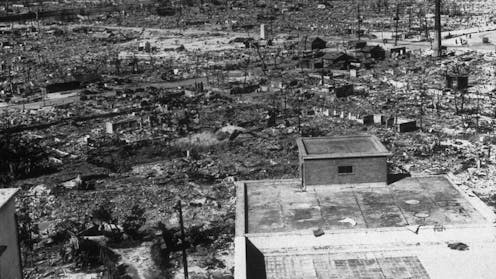
The city of Hiroshima was destroyed when the United States dropped atomic bomb “Little Boy” on Aug. 6, 1945. Hulton Archive/Getty Images

Eighty years ago – on Aug. 6 and 9, 1945 – the U.S. military dropped atomic bombs on Hiroshima and Nagasaki, Japan, thrusting humanity into a terrifying new age. In mere moments, tens of thousands of people perished in deaths whose descriptions often defy comprehension.

The blasts, fires and lingering radiation effects caused such tragedies that even today no one knows exactly how many people died. Estimates place the death toll at up to 140,000 in Hiroshima and over 70,000 in Nagasaki, but the true human costs may never be fully known.

The moral shock of the U.S. attacks reverberated far beyond Japan, searing itself into the conscience of global leaders and the public. It sparked a movement I and others continue to study: the efforts of the international community to ensure that such horrors are never repeated.

Two people in protective clothing, helmets and masks stand near blue barrels outside a building.
Inspectors from the International Atomic Energy Agency visit an Iraqi nuclear facility in 2003, seeking to ensure that the country did not use peaceful nuclear materials to develop weapons.
Ramzi Haidar/AFP via Getty Images

Racing toward the brink

The memories of Hiroshima and Nagasaki cast a long shadow over global efforts to contain nuclear arms. The 1968 Treaty on the Non-Proliferation of Nuclear Weapons, more commonly known as the Nuclear Nonproliferation Treaty, was a powerful, if imperfect, effort to prevent future nuclear catastrophe. Its creation reflected not just morality, but also the practical fears and self-interests of nations.

As the years passed, views of the bombings as justified acts began to shift. Harrowing firsthand accounts from Hibakusha – the survivors – reached wide audiences. One survivor, Setsuko Thurlow, described the sight of other victims:

“It was like a procession of ghosts. I say ‘ghosts’ because they simply did not look like human beings. Their hair was rising upwards, and they were covered with blood and dirt, and they were burned and blackened and swollen. Their skin and flesh were hanging, and parts of the bodies were missing. Some were carrying their own eyeballs.”

Nuclear dangers increased further with the advent of hydrogen bombs, or thermonuclear weapons, capable of destruction far greater than the atomic bombs dropped on Hiroshima and Nagasaki. What had once seemed a decisive end to a global war now looked like the onset of an era wherein no city or civilization would truly be safe.

These shifting perceptions shaped how nations viewed the nuclear age. In the decades following World War II, nuclear technology rapidly spread. By the early 1960s, the United States and the Soviet Union aimed thousands of nuclear warheads at one another.

Meanwhile, there were concerns that countries in East Asia, Europe and the Middle East would acquire the bomb. U.S. President John F. Kennedy even warned that “15 or 20 or 25 nations” might be able to develop nuclear weapons during the 1970s, resulting in the “greatest possible danger” to humanity – the prospect of its extinction. This warning, like much of the early nonproliferation rhetoric, drew its urgency from the legacies of Hiroshima and Nagasaki.

Perhaps the starkest indication of the gravity of the stakes emerged during the Cuban missile crisis of October 1962. For 13 days, the world teetered on the edge of nuclear annihilation until the Soviet Union withdrew its missiles from Cuba in exchange for the secret withdrawal of U.S. missiles from Turkey. During those long days, U.S. and Soviet leaders – and external observers – witnessed how quickly the risks of global destruction could escalate.

Two ships steam side by side with an aircraft flying overhead.
A Soviet freighter, center, is escorted out of Cuban waters by a U.S. Navy plane and the destroyer USS Barry during the 1962 Cuban missile crisis.
Underwood Archives/Getty Images

Crafting the grand bargain

In the wake of such “close calls” – moments where nuclear war was narrowly averted due to individual judgment or sheer luck – diplomacy accelerated.

Negotiations on a treaty to control nuclear proliferation continued at meetings of the Eighteen Nation Disarmament Committee in Geneva from 1965 to 1968. While the enduring horrors of Hiroshima and Nagasaki helped to drive the momentum, national interests largely shaped the talks.

There were three groups of negotiating parties. The United States was joined by its NATO allies Britain, Canada, Italy and France – which only observed. The Soviet Union led a communist bloc containing Bulgaria, Czechoslovakia, Poland and Romania. And there were nonaligned countries: Brazil; Burma, now known as Myanmar; Ethiopia; India; Mexico; Nigeria; Sweden, which only joined NATO in 2024; and the United Arab Republic, now known as Egypt.

For the superpowers, a treaty to limit the spread of the bomb was as much a strategic opportunity as a moral imperative.
Keeping the so-called “nuclear club” small would not only stabilize international tensions, but it would also cement Washington’s and Moscow’s global leadership and prestige.

U.S. leaders and their Soviet counterparts therefore sought to promote nonproliferation abroad. Perhaps just as important as ensuring nuclear forbearance among their adversaries was preventing a cascade of nuclear proliferation among allies that could embolden their friends and spiral out of control.

Standing apart from these Cold War blocs were the nonaligned countries. Many of them approached the atomic age through a humanitarian and moral lens. They demanded meaningful action toward nuclear disarmament to ensure that no other city would suffer the tragic fate of Hiroshima and Nagasaki.

The nonaligned countries refused to accept a two-tiered treaty merely codifying inequality between nuclear “haves” and “have-nots.” In exchange for agreeing to forgo the bomb, they demanded two crucial commitments that shaped the resulting treaty into what historians often describe as a “grand bargain.”

The nonaligned countries agreed in the treaty to permit the era’s existing nuclear powers – Britain, China, France, the Soviet Union (later Russia) and the United States – to temporarily maintain their arsenals while committing to future disarmament. But in exchange, they were promised peaceful nuclear technology for energy, medicine and development. And to reduce the risks of anyone turning peaceful nuclear materials into weapons, the treaty empowered the International Atomic Energy Agency to conduct inspections around the world.

People sit at a large table and sign documents.
U.S. President Lyndon B. Johnson, right, looks on as Secretary of State Dean Rusk signs the Nuclear Non-Proliferation Treaty on July 1, 1968.
Corbis via Getty Images

Legacies and limits

The treaty entered into force in 1970 and with, 191 member nations, is today among the world’s most universal accords. Yet, from the outset, its provisions faced limits. Nuclear-armed India, Israel and Pakistan have always rejected the treaty, and North Korea later withdrew to develop its own nuclear weapons.

In response to evolving challenges, such as the discovery of Iraq’s clandestine nuclear weapons program in the early 1990s, International Atomic Energy Agency safeguard efforts grew more stringent. Many countries agreed to accept nuclear facility inspections on shorter notice and involving more intrusive tools as part of the initiative to detect and deter the development of the world’s most powerful weapons. And the countries of the world extended the treaty indefinitely in 1995, reaffirming their commitment to nonproliferation.

The treaty represents a complex compromise between morality and pragmatism, between the painful memories of Hiroshima and Nagasaki and hard-edged geopolitics. Despite its many imperfections and its de facto promotion of nuclear inequality, the treaty is credited with limiting nuclear proliferation to just nine countries today. It has done so through civilian nuclear energy incentives and inspections that give countries confidence that their rivals are not building the bomb. Countries also put pressure on each other to obey the rules, such as when the international community condemned, sanctioned and isolated North Korea after it withdrew from the treaty and tested a nuclear weapon.

But the treaty continues to face serious challenges. Critics argue that its disarmament provisions remain vague and unfulfilled, with some scholars contending that nonnuclear countries should exit the treaty to encourage the great powers to disarm. Nuclear-armed countries continue to modernize – and in some cases, expand – their arsenals, eroding trust in the grand bargain.

Armed soldiers walk next to a barbed-wire fence.
Tensions between India and Pakistan can often carry veiled, or even explicit, threats of nuclear action.
Mukesh Gupta/AFP via Getty Images

The behavior of individual countries also points to strains on the treaty. Russia’s persistent nuclear threats during its war on Ukraine show how deeply possessors may still rely on these weapons as tools of coercive foreign policy. North Korea continues to wield its nuclear arsenal in ways that undermine international security. Iran might consider proliferation to deter future Israeli and U.S. strikes on its nuclear facilities.

Still, I would argue that declaring the treaty to be dead is simply premature. Critics have predicted its demise since the treaty’s inception in 1968. While many countries have growing frustrations with the existing system of nonproliferation, most of them still see more benefit in staying than walking away from the treaty.

The treaty may be embattled, but it remains intact. Worryingly, the world today appears far removed from the vision of avoiding nuclear catastrophe that Hiroshima and Nagasaki helped awaken. As nuclear dangers intensify and disarmament stalls, moral clarity risks fading into ritual remembrance.

I believe that for the sake of humanity’s future, the tragedies of the atomic bombings must remain a stark and unmistakable warning, not a precedent. Ultimately, the Nuclear Nonproliferation Treaty’s continued relevance depends on whether nations still believe that shared security begins with shared restraint.

The Conversation

Stephen Herzog does not work for, consult, own shares in or receive funding from any company or organization that would benefit from this article, and has disclosed no relevant affiliations beyond their academic appointment.

ref. The treaty meant to control nuclear risks is under strain 80 years after the US bombings of Hiroshima and Nagasaki – https://theconversation.com/the-treaty-meant-to-control-nuclear-risks-is-under-strain-80-years-after-the-us-bombings-of-hiroshima-and-nagasaki-262164

Trump’s new tariff regime has begun after months of chaos and uncertainty. But is his approach working?

Source: The Conversation – UK – By Conor O’Kane, Senior Lecturer in Economics, Bournemouth University

The beginning of August marks the latest deadline for US president Donald Trump’s “liberation day” tariff policy. This era of chaos and uncertainty began on April 2 and the situation remaims fluid. With the deadline for partners to secure a deal with Washington now passed, it’s a good time to take a broader view and consider if Trump’s trade gamble is paying off.

The objectives of the tariff policy include raising tax revenues, delivering lower prices for American consumers, and boosting American industry while creating manufacturing jobs. The president has also vowed to get better trade deals for the US to reduce its trade deficit and to face down China’s growing influence on the world stage.

But recently the US Federal Reserve voted to keep interest rates unchanged at 4.25% to 4.5%, despite pressure from Trump to lower them. In his monthly press briefing, Federal Reserve chair, Jerome Powell, said they were still in the early stages of understanding how the tariff policy would affect inflation, jobs and economic growth.

On tariffs, Powell did say that revenues had increased substantially to US$30 billion (£22.9 billion) a month. However, only a small portion of the tariffs are being absorbed by overseas exporters, with most of the cost being borne by US import companies. In comments that will concern the Trump administration, the Fed said the cost of the tariffs was beginning to show up in consumer prices.

The Fed expects inflation to increase to 3% by the end of the year, above its 2% target. US unemployment remains low, with Powell saying the economy is at or very close to full employment.

While Powell’s decision to hold interest rates probably irritated Trump, economic theory suggests that lowering them with the US economic cycle at full employment would be likely to increase inflation and the cost of living for US consumers. A survey by Bloomberg economists suggests that US GDP growth forecasts are lower since April 2025, specifically because of its tariff policy.

In terms of boosting US employment, the US administration can point to significant wins in the pharmaceutical sector. In July, British-Swedish drugmaker AstraZenica announced plans to spend US$50 billion expanding its US research and manufacturing facilities by 2030. The announcement follows a similar pledge from Swiss pharmaceuticals firm Roche in April to invest US$50 billion in the US over the next five years.

Tougher times for US manufacturing

The impact of tariffs on traditional US manufacturing industries is less positive. The Ford Motor Company has warned that its profits will see a sharp drop. This is largely down to a net tariff impact that the firm says will cost it US$2 billion this financial year. This is despite the company making nearly all of its vehicles in the US.

Firms such as Ford are seeing an increase in tariff-related costs for imports. This dents their profits as well as dividends to shareholders.

In recent months the US has announced major new trade agreements, including with the UK, Japan, South Korea and the EU. Talks on a trade deal with China continue. But rather than trade deals, these announcements should be thought of as frameworks for trade deals. No legally binding documents have been signed to date.


Read more:
European gloom over the Trump deal is misplaced. It’s probably the best the EU could have achieved


It will take many months before a clear picture emerges of how these bilateral deals will affect the US trade deficit overall. Meanwhile, in Washington, a federal appeals court will hear a case from two companies that are suing Trump over the use of his International Emergency Economic Powers Act (IEEPA) of 1977.

VOS Selections Inc, a wine and spirits importer, and Plastic Services and Products, a pipe and fittings company, are arguing that the president has “no authority to issue across-the-board worldwide tariffs without congressional approval”.

With so much in play, it is difficult to judge whether Trump’s tariff policy can be viewed as a success. Higher tariff revenues from imports as well as significant investments from the pharmaceutical industry can be seen as clear wins.

But increasing consumer costs through rising inflation, as well as tariff costs hurting US manufacturers, are clear negatives. While several framework trade deals have been announced, the real devil will of course be in the detail.

Perhaps the greatest impact of the tariff policy has been the uncertainty of this new approach to trade and diplomacy. The Trump administration views trade as a zero-sum game. If one side is winning, the other side must be losing.

This view of international trade harks back to mercantilism, an economic system that predates capitalism. Adam Smith and David Riccardo, the founders of capitalist theory, advocated for free trade. They argued that if countries focused on what they were good at making, then both sides could benefit – a so called positive-sum game.

This approach has dominated global trade since the post-war period. Since then, the US has become the largest and wealthiest economy in the world. By creating and the institutions of global trade (the IMF, World Bank and World Trade Organization), the US has advanced its interests – and American-based multinationals dominate, especially in areas such as technology.

But China and others now threaten this US domination, and Trump is tearing up the economic rulebook. But economic theory clearly positions tariffs as the wrong policy path for the US to assert and further its economic interests in the medium to long term. That’s why Trump’s course of action remains such a gamble.


Get your news from actual experts, straight to your inbox. Sign up to our daily newsletter to receive all The Conversation UK’s latest coverage of news and research, from politics and business to the arts and sciences.

The Conversation

Conor O’Kane does not work for, consult, own shares in or receive funding from any company or organisation that would benefit from this article, and has disclosed no relevant affiliations beyond their academic appointment.

ref. Trump’s new tariff regime has begun after months of chaos and uncertainty. But is his approach working? – https://theconversation.com/trumps-new-tariff-regime-has-begun-after-months-of-chaos-and-uncertainty-but-is-his-approach-working-262448

What will it take for China to arrest its declining birth rate?

Source: The Conversation – UK – By Ming Gao, Research Fellow of East Asia Studies, Lund University

China’s central government introduced a childcare subsidy on July 28 that will provide families with 3,000 yuan (around £312) a year for each child under the age of three. The announcement came days after plans were unveiled to roll out free preschool education across the country.

These developments mark a shift from previous years, when the government largely left the issue of addressing China’s declining birth rate to local authorities. Many of those efforts, which range from cash incentives to housing subsidies, have made little difference. By stepping in directly, Beijing has signalled that it sees the situation as urgent.

Fewer Chinese women are choosing to have children, and more young people are delaying or opting out of marriage. This has contributed to a situation where China’s population shrank for a third consecutive year in 2024. An ageing population and shrinking workforce pose long-term challenges for China’s economic growth, as well as its healthcare and pension systems.

Before the central government’s recent roll-out, regions in China had already been experimenting with policies to increase birth rates. These include one-time payouts for second or third children, monthly allowances and housing and job training subsidies.

One of the most eye-catching local policies came from Hohhot, the capital city of Inner Mongolia province. In March 2025, the authorities there began offering families up to 100,000 yuan (£10,400) for having a second and third child, paid annually until the children turn ten.

The authorities in some other cities, including eastern China’s Hangzhou, have offered childcare vouchers or subsidies for daycare. Policies like these have seen the number of births increase slightly in a few regions. But uptake is generally low and none have managed to change the national picture.

There are several reasons why incentive-based policies have not moved the needle. First, the subsidies are generally small – often equivalent to just a few hundred US dollars. This barely makes a dent in the cost of raising a child in urban China.

China ranks among the most expensive countries in the world for child-rearing, surpassing the US and Japan. In fact, a 2024 report by the Beijing-based YuWa Population Research Institute found that the average cost of raising a child in China until the age of 18 is 538,000 yuan (£59,275). This is more than 6.3 times as high as China’s GDP per capita.

The burden is so widely felt that people in China jokingly refer to children as tunjinshou, which translates to “gold-devouring beasts”.

Second, the incentives largely don’t address deeper issues. These include expensive housing, intense education pressures, childcare shortages and some workplaces that penalise women for taking time off. Many Chinese women fear being pushed out of their jobs simply for having kids.

Some local authorities have attempted to tackle the structural realities that make having and raising children in China difficult, and have enjoyed some success. In Tianmen, for example, parents of a third child can claim US$16,500 (£12,500) off a new home.

However, these policies are confined to specific districts and villages or are limited to select groups. Support remains fragmented and insufficient, while the prospects of scaling these piecemeal initiatives nationwide are slim.

Third, gender inequality in China is still deeply entrenched. Women carry most of the childcare and housework burden, with parental leave policies reflecting that imbalance. While mothers are allowed between 128 to 158 days of maternity leave, fathers receive only a handful – varying slightly by province. Despite public calls for equal parental leave, major legal changes seem far off.

These factors have together given rise to a situation where, as in east Asia more broadly, many young people in China simply are not interested in marrying or having children.

According to one online survey from 2022, around 90% of respondents in China said they wouldn’t consider having more children even if they were offered an annual subsidy of 12,000 yuan (£1,250) – far more than the recently announced 3,000 yuan subsidy.

Is Beijing too late?

The new measures show that Beijing is taking China’s declining birth rate seriously. But it might be too late. Fertility decline is hard to reverse, with research showing that social norms are difficult to snap back once they shift away from having children.

South Korea has spent decades offering its citizens generous subsidies, housing support and extended parental leave. Yet, despite a recent uptick, its birth rate has remained among the lowest in the world.

Projections by the UN paint a stark picture. China’s population is expected to drop by 204 million people between 2024 and 2054. It could lose 786 million people by the end of the century, returning its population to levels last seen in the 1950s.

Still, the recent announcements are significant. They are the first time the central government has directly used fiscal tools to encourage births, and reflect a consensus that lowering the cost of preschool education can help boost fertility. This sets a precedent and, if urgency keeps rising, the size and scope of support may increase as well.

However, if China hopes to turn things around, it will need more than cash. Parenting must be made truly viable and even desirable. Alongside financial aid and free preschool, families need time and labour support.

This also means confronting cultural expectations. Raising a child shouldn’t be seen as a woman’s job alone. A real cultural shift is needed – one that treats parenting as a shared responsibility.

My generation, which was born under the one-child policy, grew up in a time where siblings were heavily fined. I was one of them. But, just as fines didn’t stop all of those who wanted more children, cash rewards will not easily convince the many who don’t.


Get your news from actual experts, straight to your inbox. Sign up to our daily newsletter to receive all The Conversation UK’s latest coverage of news and research, from politics and business to the arts and sciences.

The Conversation

Ming Gao receives funding from the Swedish Research Council. This research was produced with support from the Swedish Research Council grant “Moved Apart” (nr. 2022-01864). Ming Gao is a member of Lund University Profile Area: Human Rights.

ref. What will it take for China to arrest its declining birth rate? – https://theconversation.com/what-will-it-take-for-china-to-arrest-its-declining-birth-rate-261717