
Storms in the Southern Ocean are producing more rain – and the consequences could be global

Source: The Conversation – Global Perspectives – By Steven Siems, Professor in Cloud Microphysics, Monash University

If you ever find yourself on Macquarie Island – a narrow, wind-lashed ridge halfway between Tasmania and Antarctica – the first thing you’ll notice is the wildlife. Elephant seals sprawl across dark beaches. King penguins march up mossy slopes. Albatrosses circle over vast, treeless uplands.

But look more closely and the island is changing. Slopes are becoming boggier. Iconic megaherbs such as Pleurophyllum and Stilbocarpa are retreating.

For years, scientists suspected the culprit was increasing rainfall. Our new research, published in Weather and Climate Dynamics, confirms this – and shows the story goes far beyond one remote UNESCO World Heritage site.

A major – but little observed – climate player

The Southern Ocean plays an enormous role in the global climate system.

It absorbs much of the excess heat trapped by greenhouse gases and a large share of the carbon dioxide emitted by human activity.

Storms in the Southern Ocean also influence weather patterns across Australia, New Zealand and the globe.

Yet it is also one of the least observed places on Earth.

With almost no land masses, only a handful of weather stations, and ubiquitous cloud cover, satellites and simulations struggle to capture what is actually happening there.

That makes Macquarie Island’s climate record from the Bureau of Meteorology and the Australian Antarctic Division exceptionally valuable, providing one of the very few long-term “ground truth” records anywhere in the Southern Ocean.

These high-quality records of the observed daily rainfall and meteorology date back more than 75 years and are commonly used to validate satellite products and numerical simulations.

Rising rainfall

Earlier work has found rainfall at Macquarie Island had risen sharply over recent decades, and ecologists documented waterlogging that harms native vegetation.

But no one has explained how the island’s weather patterns are changing, or directly compared the field observations to our best reconstructions of past weather to assess Southern Ocean climate trends.

To fill this gap, we analysed 45 years (1979–2023) of daily rainfall observations and compared them to a widely used reconstruction of earlier weather, known as the ERA5 reanalysis.

We wanted to understand the meteorology behind the increase in rainfall – that is, whether it was caused by more storms or more intense rainfall during storms. To do this we placed each day in the dataset into one of five synoptic regimes based on pressure, humidity, winds and temperature.

These regimes included low pressure systems, cold-air outbreaks and warm-air advection (the warm air that moves poleward ahead of a cold front).

Storms are producing more rain

Our analysis showed that annual rainfall on Macquarie Island has increased 28% since 1979 – around 260 millimetres per year.

The ERA5 reanalysis, in contrast, shows only an 8% increase — missing most of this change.

The storm track’s gradual move toward Antarctica is well established, and our results show how this larger change is shaping Macquarie Island’s weather today.

Crucially, we found that these changes are not causing the increase in rainfall, as one wet regime (warm air advection) was largely replacing another (low pressure).

Instead, storms now produce more rain when they occur.

A bunch of seals lying in green grass.
Elephant seals on Macquarie Island.
Kita Williams

Why does this matter beyond one island?

If the rainfall intensification we see at Macquarie Island reflects conditions across the Southern Ocean storm belt – as multiple lines of evidence indicate — the consequences are profound.

A wetter storm track means more fresh water entering the upper ocean. This strengthens the different layers in the oceans and reduces the amount of mixing that occurs. In turn, this alters the strength of ocean currents.

Our estimate suggests that in 2023 this additional precipitation equates to roughly 2,300 gigatonnes of additional freshwater per year across the high-latitude Southern Ocean – an order of magnitude greater than recent Antarctic meltwater contributions. And this difference continues to grow.

More rainfall will also affect the salinity of water on the ocean’s surface, which influences the movement of nutrients and carbon. As a result, this could change the productivity and chemistry of the Southern Ocean – one of the world’s most important carbon sinks – in still-uncertain ways.

This increase in rainfall requires a matching increase in evaporation, which cools the ocean, just like our bodies cool when our sweat evaporates. Over the cloudy Southern Ocean, this evaporation is the primary means of cooling the ocean.

Our analysis indicates the Southern Ocean may be cooling itself by 10–15% more than it did in 1979 – simply through the energy cost of evaporation that fuels the extra rainfall. This evaporation is spread over the broader Southern Ocean.

In effect, the Southern Ocean may be “sweating” more in response to climate change.

The next challenge

Macquarie Island is just one tiny speck of land in Earth’s stormiest ocean.

But its long-term rainfall record suggests the Southern Ocean – the engine room of global heat and carbon uptake – is changing faster and more dramatically than we thought.

The next challenge is to determine how far this signal extends across the storm track, and what it means for the climate system we all depend on.


The authors would like the acknowledge Andrew Prata, Yi Huang, Ariaan Purish and Peter May for their contribution to the research and this article.

The Conversation

Steven Siems receives funding from the Australian Research Council.

Zhaoyang Kong does not work for, consult, own shares in or receive funding from any company or organisation that would benefit from this article, and has disclosed no relevant affiliations beyond their academic appointment.

ref. Storms in the Southern Ocean are producing more rain – and the consequences could be global – https://theconversation.com/storms-in-the-southern-ocean-are-producing-more-rain-and-the-consequences-could-be-global-270880
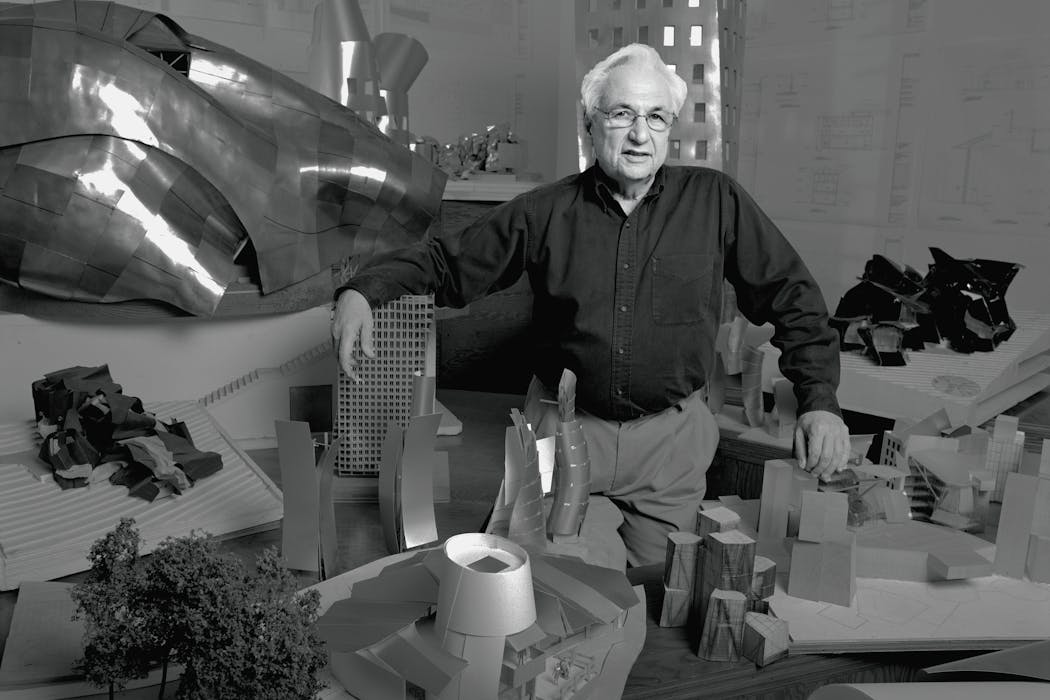
Frank Gehry, the architect of the unconventional, the accidental, and the inspiring, has died at 96

Source: The Conversation – Global Perspectives – By Michael J. Ostwald, Professor of Architectural Analytics, UNSW Sydney

Architect Frank Gehry poses with miniatures of his designs in Los Angeles in 1989.
Bonnie Schiffman/Getty Images

In April 2005, The Simpsons featured an episode where Marge, embarrassed by her hometown’s reputation for being uneducated and uncultured, invites a world-famous architect to design a new concert hall for the city.

The episode cuts to the architect, Frank Gehry (playing himself), outside his house in Santa Monica, receiving Marge’s letter. He is frustrated by the request and crumples the letter, throwing it to the ground. Looking down, the creased and ragged paper inspires him, and the episode cuts to a model of his concert hall for Springfield, which copies the shape of the crumpled letter.

By building Gehry’s design, the people of Springfield hoped to send a signal to the world that a new era of culture had arrived. As it often did, this episode of The Simpsons references a real-life phenomenon, which Gehry was credited with triggering, the “Bilbao effect”.

In 1991, the city of Bilbao in northern Spain sought to enhance its economic and cultural standing by establishing a major arts centre. Gehry was commissioned to design the Bilbao Guggenheim, proposing a 57-metre-high building, a spiralling vortex of titanium and glass, along the banks of the Nervión River.

Mist rises off the river in front of a brilliant glass  and metal building.
Guggenheim Museum, Avenida Abandoibarra, Bilbao, Spain.
Elizabeth Hanchett/Unsplash

Using software developed for aerospace industries, Gehry designed a striking, photogenic building, sharply contrasting with the city’s traditional stone and masonry streetscapes.

Finished in 1997, the response to Gehry’s building was overwhelming. Bilbao was transformed into an international tourist destination, revitalising the city and boosting its cultural credentials and economic prospects. As a result, many cities tried to reproduce the so-called “Bilbao effect” by combining iconic architecture and the arts to encourage a cultural renaissance.

Gehry, who has died at 96, leaves a powerful legacy, visible in many major cities, in the media, in galleries and in popular culture.

An architect’s life

Gehry was born Frank Owen Goldberg in Toronto, Canada, in 1929 and emigrated to Los Angeles in the late 1940s, where he changed his surname to Gehry. He studied architecture and urban planning and established a successful commercial practice in 1962.

It wasn’t until the late 1970s, when he began experimenting with alterations and additions to his own house, that he began to develop his signature approach to architecture. An approach that was both visionary and confronting.

The house looks like a work-in-progress.
Gehry and his son, Alejandro, in the yard in front of his self-designed home, Santa Monica, California, January 1980.
Susan Wood/Getty Images

In 1977, Gehry purchased a colonial bungalow on a typical suburban street in Santa Monica. Soon after, he began peeling back its cladding and exposing its structural frame. He added a jumble of plywood panels, corrugated metal walls, and chain-link fencing, giving the impression of a house in a perpetual state of demolition or reconstruction.

Its fragmented, unfinished expression offended the neighbours but also led to his being exhibited in the landmark 1988 Museum of Modern Art’s Deconstructivist Architecture show.

At this event, Gehry’s house was featured alongside a range of subversive, anti-establishment works, catapulting him to international fame.

The Walt Disney Concert Hall, Los Angeles, California, United States of America.
Tim Cheung/Unsplash

Unlike other architects featured in the exhibition – such as Coop Himmelblau, Rem Koolhaas and Daniel Libeskind – Gehry was not driven by a political or philosophical stance. Instead, he was interested in how people would react to the experience of architecture.

It was only after the Bilbao Guggenheim was completed that the world could see this vision.

Throughout the 2000s, Gehry completed a range of significant buildings, led by the Walt Disney Concert Hall (2003) in Los Angeles, which has a similar style to the Bilbao Guggenheim.

Gehry’s Museum of Pop Culture (2000) in Seattle is a composition of anodised purple, gold, silver and sky-blue forms, resembling the remnants of a smashed electric guitar.

A silver, pink and blue building.
Museum of Pop Culture, Seattle, Washington, United States of America.
Getty Images

The Marqués de Riscal Vineyard Hotel (2006) in Elciego, Spain, features steel ribbons in Burgundy-pink and Verdelho-gold. The Louis Vuitton Foundation (2014) in Paris has 12 large glass sails, swirling around an “iceberg” of concrete panels.

Gehry only completed one building in Australia, the Dr Chau Chak Wing Building (2014) in Sydney. Its design, an undulating form clad in custom-made bricks, was inspired by a crumpled brown paper bag. Marge Simpson would have approved.

Recognition and reflection

The highest global honour an architect can receive is the Pritzker Prize, often called the “Nobel prize for architecture”. Gehry was awarded this prize in 1989, with the jury praising his “controversial, but always arresting body of work” which was “iconoclastic, rambunctious and impermanent”.

While the Pritzker Prize is often regarded as a capstone for a career, most of Gehry’s major works were completed after the award.

A building of metalic ribbons.
Tempranillo vines surround the hotel at Marqués de Riscal winery, Elciego, Spain.
David Silverman/Getty Images

Gehry revelled in experimentation, taking artistic inspiration from complex natural forms and constructing them using advanced technology. Over the last three decades, his firm continued to produce architecture that was both strikingly sculptural and playfully whimsical.

He ultimately regretted appearing on The Simpsons, feeling it devalued the complex process he followed. His architecture was not random; an artist’s eye guided it, and a sculptor’s hand created it. It was not just any crumpled form, but the perfect one for each site and client.

He sometimes joked about completing his home in Santa Monica, even humorously ending his acceptance speech for the Pritzker Prize by saying he might use his prize money to do this. Today, on the corner of 22nd Street and Washington Avenue, partly shielded by trees, Gehry’s house remains forever a work in progress. Its uncompromising yet joyful presence has endured for almost 50 years.

The Conversation

Michael J. Ostwald does not work for, consult, own shares in or receive funding from any company or organisation that would benefit from this article, and has disclosed no relevant affiliations beyond their academic appointment.

ref. Frank Gehry, the architect of the unconventional, the accidental, and the inspiring, has died at 96 – https://theconversation.com/frank-gehry-the-architect-of-the-unconventional-the-accidental-and-the-inspiring-has-died-at-96-266250

Firefighter killed by falling tree during bushfire prevention work in New South Wales

Source: Radio New Zealand

The Bulahdelah fire has burnt through 3,400 hectares of the Myall Lakes National Park.

The Bulahdelah fire has burnt through 3,400 hectares of the Myall Lakes National Park. Photo: ABC News: Ross McLoughlin

A firefighter from the NSW National Parks and Wildlife Service (NPWS) has died after being crushed by a tree during bushfire prevention work north of Newcastle.

The Bulahdelah fire, which has destroyed four homes and is burning on both sides of the Pacific Highway between Crawford River and Nerong, has scorched more than 3,400 hectares of the Myall Lakes National Park.

Emergency service crews were called to a property on Little Nugra Road at Nerong, about 90 kilometres north of Newcastle, at about 10:45pm on Sunday after reports a man had been struck by a tree.

NSW Ambulance paramedics treated him, but he died at the scene.

NSW Premier Chris Minns confirmed the man who died was a NPWS firefighter.

Authorities have established a crime scene and WorkSafe has been notified.

ABC

– Published by EveningReport.nz and AsiaPacificReport.nz, see: MIL OSI in partnership with Radio New Zealand

Conjoined twin dies after separation surgery

Source: Radio New Zealand

Papua New Guinea conjoined twins.

Papua New Guinea conjoined twins. Photo: Supplied

Rare conjoined twins from Papua New Guinea had a seven-hour operation in Australia to surgically separate them on Sunday, but only one of the boys survived.

Tom and Sawong were rushed into emergency surgery at Sydney Children’s Hospital after Tom began to rapidly deteriorate.

The two-month-olds were medivacced from Port Moresby to Sydney on Thursday following medical advice that they undergo surgery as soon as possible.

A spokesperson for the family, Jurgen Ruh, said Sawong was in a stable condition and the parents were grieving the loss of his brother Tom.

“One body with two souls went into the operating theatre, and after seven hours of procedures we had two bodies and two souls,” Ruh said.

“Sadly we lost Tom but are happy to report that we still have two souls and Sawong has survived the operation.”

Ruh previously told RNZ Pacific the boys’ parents had been through a “rollercoaster” of emotions since the twins were born in a remote village in Morobe province on 9 October.

“They have accepted that they will lose Tom (the weaker twin) and there’s been many tears shed along the way,” he said previously.

The twins were fused at the lower abdomen but have their own limbs and genitals, however they share a single liver, bladder and parts of their gastrointestinal tract.

They also had spina bifida – a neural tube defect that affects the development of a newborn’s spine and spinal cord.

Tom had a congenital heart defect, only one kidney and malformed lungs.

– Published by EveningReport.nz and AsiaPacificReport.nz, see: MIL OSI in partnership with Radio New Zealand

For better brain health, it’s never too late to get active

Source: Radio New Zealand

Scientists have hailed the benefits of exercising early in life to lower the risk of your brain degenerating later. But new research suggests that even when you’re 45 or older, it’s not too late to try.

Having the highest levels of physical activity in midlife (45 to 64) and late life (65 to 88) was associated with a 41 percent and 45 percent lower risk of dementia, respectively, according to a study published in the journal JAMA Network Open on 19 November.

“This study shifts the conversation from ‘exercise is good for the brain’ to ‘there may be key windows when exercise matters most for brain health,'” says Dr Sanjula Singh, an instructor in neurology at Harvard Medical School.

A grey haired man is helped on an exercise machine.

Strength training a couple of times per week is recommended by the World Health Organisation.

Getty Images / Unsplash +

– Published by EveningReport.nz and AsiaPacificReport.nz, see: MIL OSI in partnership with Radio New Zealand

The sound effects that make horror films so scary

Source: Radio New Zealand

I was recently watching a scene from the 2025 film Weapons for a monograph I’m writing and noticed a familiar sound: a low, unsettling drone as a character walks down a hallway.

It’s the same kind of sound used in recent horror films such as Together. You can also hear it throughout the trailer forShelby Oaks (2025), where sound throbs like an invisible threat.

We never see what’s making this sound or where it comes from within the film’s world, which only makes it more disturbing.

Stephen Boyd, a young white man with wavy dark hair and a Roman tunic, stars as Messala in the 1959 film Ben-Hur.

In the 1959 film Ben-Hur, when Judah (Charlton Heston) declares to his friend Messala (Stephen Boyd), “I am against you,” a sharp orchestral shock of brass and strings announces their discord.

YouTube screenshot

– Published by EveningReport.nz and AsiaPacificReport.nz, see: MIL OSI in partnership with Radio New Zealand

Ukraine peace talks in Miami end with lingering questions over security guarantees and territory

Source: Radio New Zealand

By Max Saltman, Jennifer Hansler and Billy Stockwell, CNN

Ukraine's President Volodymyr Zelensky attends a joint press conference with Turkey's President following their meeting at the Presidential Complex in Ankara on November 19, 2025. Zelensky said he wants to reinvigorate frozen peace talks, which have faltered after several rounds of Russia-Ukraine talks in Istanbul this year failed to yield a breakthrough. Moscow has not agreed to a ceasefire and instead kept advancing on the front and bombarding Ukrainian cities. (Photo by Ozan KOSE / AFP)

Ukraine’s President Volodymyr Zelensky attends a joint press conference with Turkey’s President following their meeting at the Presidential Complex in Ankara on November 19, 2025 Photo: AFP

Talks between US and Ukrainian negotiators over a proposed peace deal with Russia ended in Miami this weekend, with few new developments and lingering questions over security guarantees and territorial issues, according to Ukrainian officials.

As the talks concluded, the Kremlin welcomed US President Donald Trump’s new security strategy, saying it dropped the language of past US administrations describing Russia as a threat.

The marathon Miami meeting began on Thursday between US special envoy Steve Witkoff, President Trump’s son-in-law Jared Kushner, and Ukrainian officials Rustem Umerov and Andriy Hnatov.

After three days of talks, “difficult issues remain,” Ukrainian Ambassador to the US Olga Stefanishyna said Saturday, “but both sides continue working to shape realistic and acceptable solutions.”

“The main challenges at this stage concern questions of territory and guarantees, and we are actively seeking optimal formats for addressing them,” Stefanishyna said. “More details will be provided once all information is compiled.”

Territory and security guarantees are long-standing sticking points for any possible deal. Ukraine maintains that a just end to the war would include reliable security guarantees and would not force it to surrender more territory to Russia.

As the meetings kicked off earlier this week, Russian President Vladimir Putin told reporters in India that his country intends to seize Ukraine’s eastern Donbas region by any means.

In this pool photograph distributed by the Russian state agency Sputnik, Russia's President Vladimir Putin, accompanied by Kremlin economic envoy Kirill Dmitriev and Kremlin aide Yuri Ushakov, meets with US special envoy Steve Witkoff and US President Donald Trump's son-in-law Jared Kushner at the Kremlin in Moscow on December 2, 2025. (Photo by Alexander KAZAKOV / POOL / AFP)

Russia’s President Vladimir Putin, accompanied by economic envoy Kirill Dmitriev and aide Yuri Ushakov, meets with US special envoy Steve Witkoff and US President Donald Trump’s son-in-law Jared Kushner at the Kremlin on December 2, 2025 Photo: AFP

Russia’s President Vladimir Putin, accompanied by economic envoy Kirill Dmitriev and aide Yuri Ushakov, meets with US special envoy Steve Witkoff and US President Donald Trump’s son-in-law Jared Kushner at the Kremlin on December 2, 2025

The Miami talks had been preceded by a visit to Moscow by Kushner and Witkoff. Trump said Wednesday the US delegation had a “very good meeting” with Putin, and that they believed the Russian president “would like to see the war ended” – though the talks failed to yield a breakthrough.

In a social media post on Saturday, Ukrainian President Volodymyr Zelensky said that he had a “long” and “constructive” phone conversation with Witkoff and Kushner, as well as his Ukrainian delegation in Miami.

“We covered many aspects and went through key points that could ensure an end to the bloodshed and eliminate the threat of a new Russian full-scale invasion,” Zelensky said. “We agreed on the next steps and formats for talks with the United States.”

Also discussed on the call was “the risk of Russia failing to honour its promises, as has happened repeatedly in the past,” he said.

Zelensky said that Hnatov and Umerov are expected to deliver him a “detailed in person report” on the negotiations.

“Not everything can be discussed over the phone,” Zelensky said. “So we need to work closely with our teams on ideas and proposals.”

Peace and its conditions will also be the subject of a meeting on Monday between Zelensky and French, British and German leaders in London.

The discussion will cover “the situation and the ongoing negotiations within the framework of the American mediation,” French President Emmanuel Macron said Saturday.

Kremlin welcomes removal of ‘threat’ label

Separately, the Kremlin has welcomed the new US national security strategy, released on Friday, which sets out the Trump administration’s realignment of US foreign policy and takes an an unprecedentedly confrontational posture toward Europe.

Spokesman Dmitry Peskov said the Trump administration’s document has dropped language describing Russia as a threat, state-owned news agency TASS reported.

“We considered this a positive step,” Peskov told the news agency.

“Overall, these messages are certainly in contrast with approaches of previous administrations.”

The strategy document says European nations regard Russia as “an existential threat,” but paints the US as having a significant role in diplomacy to re-establish “conditions of stability within Europe and strategic stability with Russia.”

A 2022 Biden-era national security strategy said Russia posed “an immediate threat to the free and open international system, recklessly flouting the basic laws of the international order today, as its brutal war of aggression against Ukraine has shown.”

The Trump administration’s new document also reiterates its push for “ending the perception, and preventing the reality, of NATO as a perpetually expanding alliance.”

-CNN

– Published by EveningReport.nz and AsiaPacificReport.nz, see: MIL OSI in partnership with Radio New Zealand

Possible ancient artifacts are found in a B.C. thrift shop — and archeology scholars are on the case

Source: The Conversation – Canada – By Cara Tremain, Assistant Professor, Archaeology, Simon Fraser University

An unusual email arrived in the inbox of a faculty member at the department of archeology at Simon Fraser University in the spring of 2024.

This email was from a thrift shop, Thrifty Boutique in Chilliwack, B.C. — unlike the many queries archeologists receive every year to authenticate objects that people have in their possession.

The shop wanted to determine whether items donated to the store (and initially put up for sale) were, in fact, ancient artifacts with historical significance. Shop employees relayed that a customer, who did not leave their name, stated the 11 rings and two medallions (though one may be a belt buckle) in the display case with a price tag of $30 were potentially ancient.

Thrifty Boutique wasn’t looking for a valuation of the objects, but rather guidance on their authenticity.

Eclectic collection

As archeology faculty, we analyzed these objects with Babara Hilden, director of Museum of Archaeology and Ethnology at Simon Fraser University, after the store arranged to bring the items to the museum.

Our initial visual analysis of the objects led us to suspect that, based on their shapes, designs and construction, they were ancient artifacts most likely from somewhere within the boundaries of what was once the Roman Empire. They may date to late antiquity (roughly the third to sixth or seventh century) and/or the medieval period.

The initial dating was based largely on the decorative motifs that adorn these objects. The smaller medallion appears to bear a Chi Rho (Christogram), which was popular in the late antiquity period. The larger medallion (or belt buckle) resembles comparable items from the Byzantine Period.

The disparities between the two objects, suggesting different time periods, make it unlikely they’re from the same hoard. We expect they were assembled into an eclectic collection by the unknown person (as of yet) who acquired them prior to their donation to Thrifty Boutique.


Read more:
Melsonby hoard: iron-age Yorkshire discovery reveals ancient Britons’ connections with Europe


With the exciting revelation that the objects may be authentic ancient artifacts, the thrift store offered to donate them to SFU’s archeology museum. The museum had to carefully consider whether it had the capacity and expertise to care for these objects in perpetuity, and ultimately decided to commit to their care and stewardship because of the potential for student learning.

Officially accepting and officially transferring these objects to the museum took more than a year. We grappled with the ethical implications of acquiring a collection without known provenance (history of ownership) and balanced this against the learning opportunities that it might offer our students.

Ethical and legal questions

Learning to investigate the journey of the donated objects is akin to the process of provenance research in museums.

In accepting items without known provenance, museums must consider the ethical implications of doing so. The Canadian Museums Association Ethics Guidelines state that “museums must guard against any direct or indirect participation in the illicit traffic in cultural and natural objects.”

When archeological artifacts have no clear provenance, it is difficult — if not impossible — to determine where they originally came from. It is possible such artifacts were illegally acquired through looting, even though the Canadian Property Import and Export Act exists to restrict the importation and exportation of such objects.


Read more:
HBC’s artworks and collections help us understand Canada’s origins — and can be auctioned off


We are keenly aware of the responsibility museums have to not entertain donations of illicitly acquired materials. However, in this situation, there is no clear information — as yet — about where these items came from and whether they are ancient artifacts or modern forgeries. Without knowing this, we cannot notify authorities nor facilitate returning them to their original source.

With a long history of ethical engagement with communities, including repatriation, the Museum of Archaeology and Ethnology is committed to continuing such work. This donation would be no different if we’re able to confirm our suspicions about their authenticity.

Archeological forgeries

Archeological forgeries, while not widely publicized, are perhaps more common than most realize — and they plague museum collections around the world.

Well-known examples of the archeological record being affected by inauthentic artifacts are the 1920s Glozel hoax in France and the fossil forgery known as Piltdown Man.

Other examples of the falsification of ancient remains include the Cardiff Giant and crystal skulls, popularized in one of the Indiana Jones movies.

Various scientific techniques can help determine authenticity, but it can sometimes prove impossible to be 100 per cent certain because of the level of skill involved in creating convincing forgeries.

Copies of ancient artefacts

Other copies of ancient artifacts exist for honest purposes, such as those created for the tourist market or even for artistic purposes. Museums full of replicas still attract visitors, because they are another means of engaging with the past, and we are confident that the donation therefore has a place within the museum whether the objects are authentic or not.

By working closely with the objects, students will learn how to become archeological detectives and engage with the process of museum research from start to finish. The information gathered from this process will help to determine where the objects may have been originally uncovered or manufactured, how old they might be and what their original significance may have been.

Object-based learning using museum collections demonstrates the value of hands-on engagement in an age of increasing concern about the impact of artificial intelligence on education.

New course designed to examine items

The new archeology course we have designed, which will run at SFU in September 2026, will also focus heavily on questions of ethics and provenance, including what the process would look like if the objects — if determined to be authentic — could one day be returned to their country of origin.

The students will also benefit from the wide-ranging expertise of our colleagues in the department of archeology at SFU, including access to various technologies and avenues of archeological science that might help us learn more about the objects.

This will involve techniques such as X-ray fluorescence, which can be used to investigate elemental compositions of materials and using 3D scanners and printers to create resources for further study and outreach.

Mentoring with museum professionals

Local museum professionals have also agreed to help mentor the students in exhibition development and public engagement, a bonus for many of our students who aspire to have careers in museums or cultural heritage.

Overall, the course will afford our students a rare opportunity to work with objects from a regional context not currently represented in the museum while simultaneously piecing together the story of these items far from their probable original home across the Atlantic.

We are excited to be part of their new emerging story at Simon Fraser, and can’t wait to learn more about their mysterious past.

The Conversation

Cara Tremain receives funding from the Social Sciences and Humanities Research Council of Canada

Sabrina C. Higgins receives funding from the Social Sciences and Humanities Research Council of Canada.

ref. Possible ancient artifacts are found in a B.C. thrift shop — and archeology scholars are on the case – https://theconversation.com/possible-ancient-artifacts-are-found-in-a-b-c-thrift-shop-and-archeology-scholars-are-on-the-case-267064

Apparent ancient artifacts are found in a B.C. thrift shop — and archeology faculty are on the case

Source: The Conversation – Canada – By Cara Tremain, Assistant Professor, Archaeology, Simon Fraser University

An unusual email arrived in the inbox of a faculty member at the department of archeology at Simon Fraser University in the spring of 2024.

This email was from a thrift shop, Thrifty Boutique in Chilliwack, B.C. — unlike the many queries archeologists receive every year to authenticate objects that people have in their possession.

The shop wanted to determine whether items donated to the store (and initially put up for sale) were, in fact, ancient artifacts with historical significance. Shop employees relayed that a customer, who did not leave their name, stated the 11 rings and two medallions (though one may be a belt buckle) in the display case with a price tag of $30 were potentially ancient.

Thrifty Boutique wasn’t looking for a valuation of the objects, but rather guidance on their authenticity.

Eclectic collection

As archeology faculty, we analyzed these objects with Babara Hilden, director of Museum of Archaeology and Ethnology at Simon Fraser University, after the store arranged to bring the items to the museum.

Our initial visual analysis of the objects led us to suspect that, based on their shapes, designs and construction, they were ancient artifacts most likely from somewhere within the boundaries of what was once the Roman Empire. They may date to late antiquity (roughly the third to sixth or seventh century) and/or the medieval period.

The initial dating was based largely on the decorative motifs that adorn these objects. The smaller medallion appears to bear a Chi Rho (Christogram), which was popular in the late antiquity period. The larger medallion (or belt buckle) resembles comparable items from the Byzantine Period.

The disparities between the two objects, suggesting different time periods, make it unlikely they’re from the same hoard. We expect they were assembled into an eclectic collection by the unknown person (as of yet) who acquired them prior to their donation to Thrifty Boutique.


Read more:
Melsonby hoard: iron-age Yorkshire discovery reveals ancient Britons’ connections with Europe


With the exciting revelation that the objects may be authentic ancient artifacts, the thrift store offered to donate them to SFU’s archeology museum. The museum had to carefully consider whether it had the capacity and expertise to care for these objects in perpetuity, and ultimately decided to commit to their care and stewardship because of the potential for student learning.

Officially accepting and officially transferring these objects to the museum took more than a year. We grappled with the ethical implications of acquiring a collection without known provenance (history of ownership) and balanced this against the learning opportunities that it might offer our students.

Ethical and legal questions

Learning to investigate the journey of the donated objects is akin to the process of provenance research in museums.

In accepting items without known provenance, museums must consider the ethical implications of doing so. The Canadian Museums Association Ethics Guidelines state that “museums must guard against any direct or indirect participation in the illicit traffic in cultural and natural objects.”

When archeological artifacts have no clear provenance, it is difficult — if not impossible — to determine where they originally came from. It is possible such artifacts were illegally acquired through looting, even though the Canadian Property Import and Export Act exists to restrict the importation and exportation of such objects.


Read more:
HBC’s artworks and collections help us understand Canada’s origins — and can be auctioned off


We are keenly aware of the responsibility museums have to not entertain donations of illicitly acquired materials. However, in this situation, there is no clear information — as yet — about where these items came from and whether they are ancient artifacts or modern forgeries. Without knowing this, we cannot notify authorities nor facilitate returning them to their original source.

With a long history of ethical engagement with communities, including repatriation, the Museum of Archaeology and Ethnology is committed to continuing such work. This donation would be no different if we’re able to confirm our suspicions about their authenticity.

Archeological forgeries

Archeological forgeries, while not widely publicized, are perhaps more common than most realize — and they plague museum collections around the world.

Well-known examples of the archeological record being affected by inauthentic artifacts are the 1920s Glozel hoax in France and the fossil forgery known as Piltdown Man.

Other examples of the falsification of ancient remains include the Cardiff Giant and crystal skulls, popularized in one of the Indiana Jones movies.

Various scientific techniques can help determine authenticity, but it can sometimes prove impossible to be 100 per cent certain because of the level of skill involved in creating convincing forgeries.

Copies of ancient artefacts

Other copies of ancient artifacts exist for honest purposes, such as those created for the tourist market or even for artistic purposes. Museums full of replicas still attract visitors, because they are another means of engaging with the past, and we are confident that the donation therefore has a place within the museum whether the objects are authentic or not.

By working closely with the objects, students will learn how to become archeological detectives and engage with the process of museum research from start to finish. The information gathered from this process will help to determine where the objects may have been originally uncovered or manufactured, how old they might be and what their original significance may have been.

Object-based learning using museum collections demonstrates the value of hands-on engagement in an age of increasing concern about the impact of artificial intelligence on education.

New course designed to examine items

The new archeology course we have designed, which will run at SFU in September 2026, will also focus heavily on questions of ethics and provenance, including what the process would look like if the objects — if determined to be authentic — could one day be returned to their country of origin.

The students will also benefit from the wide-ranging expertise of our colleagues in the department of archeology at SFU, including access to various technologies and avenues of archeological science that might help us learn more about the objects.

This will involve techniques such as X-ray fluorescence, which can be used to investigate elemental compositions of materials and using 3D scanners and printers to create resources for further study and outreach.

Mentoring with museum professionals

Local museum professionals have also agreed to help mentor the students in exhibition development and public engagement, a bonus for many of our students who aspire to have careers in museums or cultural heritage.

Overall, the course will afford our students a rare opportunity to work with objects from a regional context not currently represented in the museum while simultaneously piecing together the story of these items far from their probable original home across the Atlantic.

We are excited to be part of their new emerging story at Simon Fraser, and can’t wait to learn more about their mysterious past.

The Conversation

Cara Tremain receives funding from the Social Sciences and Humanities Research Council of Canada

Sabrina C. Higgins receives funding from the Social Sciences and Humanities Research Council of Canada.

ref. Apparent ancient artifacts are found in a B.C. thrift shop — and archeology faculty are on the case – https://theconversation.com/apparent-ancient-artifacts-are-found-in-a-b-c-thrift-shop-and-archeology-faculty-are-on-the-case-267064

AI is perpetuating unrealistic body ideals, objectification and a lack of diversity — especially for athletes

Source: The Conversation – Canada – By Delaney Thibodeau, Post-doctoral researcher, Faculty of Kinesiology & Physical Education, University of Toronto

What does it look like to have an “athletic body?” What does artificial intelligence think it looks like to have one?

A recent study we conducted at the University of Toronto analyzed appearance-related traits of AI-generated images of male and female athletes and non-athletes. We found that we’re being fed exaggerated — and likely impossible — body standards.

Even before AI, athletes have been pressured to look a certain way: thin, muscular and attractive. Coaches, opponents, spectators and the media shape how athletes think about their bodies.

But these pressures and body ideals have little to do with performance; they’re associated with the objectification of the body. And this phenomenon, unfortunately, is related to a negative body image, poor mental health and reduced sport-related performance.

Given the growing use of AI on social media, understanding just how AI depicts athlete and non-athlete bodies has become critical. What it shows, or doesn’t, as “normal” is widely viewed and may soon be normalized.

Lean, young, muscular — and mostly male

As researchers with expertise in body image, sport psychology and social media, we grounded our study in objectification and social media theories. We generated 300 images using different AI platforms to explore how male and female athlete and non-athlete bodies are depicted.

We documented demographics, levels of body fat and muscularity. We assessed clothing fit and type, facial attractiveness like having neat and shiny hair, symmetrical features or clear skin and body exposure in each image. Indicators of visible disabilities, like mobility devices, were also noted. We compared the characteristics of male versus female images as well as the characteristics of athlete and non-athlete images.

The AI-generated male images were frequently young (93.3 per cent), lean (68.4 per cent) and muscular (54.2 per cent). The images of females depicted youth (100 per cent), thinness (87.5 per cent) and revealing clothing (87.5 per cent).

The AI-generated images of athletes were lean (98.4 per cent), muscular (93.4 per cent) and dressed in tight (92.5 per cent) and revealing (100 per cent) exercise gear.

Non-athletes were shown wearing looser clothing and displaying more diversity of body sizes. Even when we asked for an image of just “an athlete,” 90 per cent of the generated images were male. No images showed visible disabilities, larger bodies, wrinkles or baldness.

These results reveal that generative AI perpetuates stereotypes of athletes, depicting them as only fitting into a narrow set of traits — lacking impairment, attractive, thin, muscular, exposed.

The findings of this research illustrate the ways in which three commonly used generative AI platforms — DALL-E, MidJourney and Stable Diffusion — reinforce problematic appearance ideals for all genders, athletes and non-athletes alike.

The real costs of distorted body ideals

Why is this a problem?

More than 4.6 billion people use social media and 71 per cent of social media images are generated by AI. That’s a lot of people repeatedly viewing images that foster self-objectification and the internalization of unrealistic body ideals.

They may then feel compelled to diet and over-exercise because they feel bad about themselves — their body does not look like AI-fabricated images. Alternatively, they may also do less physical activity or drop out of sports altogether.

Negative body image not only affects academic performance for young people but also sport-related performance. While staying active can promote a better body image, negative body image does the exact opposite. It exacerbates dropout and avoidance.

Given that approximately 27 per cent of Canadians over the age of 15 have at least one disability, the fact that none of the generated images included someone with a visible disability is also striking. In addition to not showing disabilities when it generates images, AI has also been reported to erase disabilities on images of real people.

People with body fat, wrinkles or baldness were also largely absent.

Addressing bias in the next generation of AI

These patterns reveal that AI isn’t realistic or creative in its representations. Instead, it pulls from the massive database of media available online, where the same harmful appearance ideals dominate. It’s recycling our prejudices and forms of discrimination and offering them back to us.

AI learns body ideals from the same biased society that has long fuelled body image pressure. This leads to a lack of diversity and a vortex of unreachable standards. AI-generated images present exaggerated, idealized bodies that ultimately limit the diversity of humans and the lowered body image satisfaction that ensues is related greater loneliness.

And so, as original creators of the visual content that trains AI systems, society has a responsibility to ensure these technologies do not perpetuate ableism, racism, fatphobia and ageism. Users of generative AI must be intentional in how image prompts are written, and critical in how they are interpreted.

We need to limit the sort of body standards we internalize through AI. As AI-generated images continue to populate our media landscape, we must be conscious of our exposure to it. Because at the end of the day, if we want AI to reflect reality rather than distort it, we have to insist on seeing, and valuing, every kind of body.

The Conversation

Catherine Sabiston receives funding from the Canada Research Chairs program

Delaney Thibodeau and Sasha Gollish do not work for, consult, own shares in or receive funding from any company or organisation that would benefit from this article, and have disclosed no relevant affiliations beyond their academic appointment.

ref. AI is perpetuating unrealistic body ideals, objectification and a lack of diversity — especially for athletes – https://theconversation.com/ai-is-perpetuating-unrealistic-body-ideals-objectification-and-a-lack-of-diversity-especially-for-athletes-268735