La société civile syrienne un an après la chute du régime Assad

Source: The Conversation – in French – By Léo Fourn, Docteur en sociologie, Institut de recherche pour le développement (IRD)

Le 8 décembre 2024 a refermé un demi-siècle de pouvoir autoritaire du clan Assad en Syrie, renversé par le groupe islamiste rebelle Hayat Tahrir al-Cham. Le pays émerge enfin d’une guerre civile qui l’a ravagé pendant quatorze ans. Une année s’est écoulée depuis ce basculement historique : assez pour esquisser les contours d’une transition politique encore fragile, mais déjà révélatrice de profondes recompositions au sein de la société civile. Entre cooptation, coopération et vigilance critique, les acteurs de la société civile syrienne jouent un rôle déterminant dans la reconstruction politique du pays.


En cette fin d’année 2025, de très nombreux rassemblements sont organisés en Syrie pour célébrer le premier anniversaire de la chute du régime dirigé par Bachar al-Assad le 8 décembre 2024.

La foule agite le nouveau drapeau officiel en scandant des chants révolutionnaires, tandis que les représentants du nouveau pouvoir paradent en héros libérateurs. Ces nouvelles autorités, dominées par Hayat Tahrir al-Cham (HTC) et son leader désigné président, Ahmad al-Charaa, tentent de mettre en œuvre un processus de transition politique et d’entamer la reconstruction d’un pays dévasté par plus d’une décennie de guerre. Les défis qu’elles affrontent sont énormes et leurs capacités très limitées. Le territoire national demeure divisé, le pouvoir central étant contesté par l’administration kurde autonome du Nord-Est, des groupes armés druzes et l’incursion de l’armée israélienne dans le Sud.

Dans ce contexte, quelle est la situation de ce que l’on appelle communément la « société civile syrienne », c’est-à-dire l’ensemble hétéroclite de groupes ni étatiques, ni partisans, ni militaires, mais engagés dans la défense de causes publiques ?

Cet article propose de dresser le bilan des changements vécus par cette société civile lors de la première année de la transition. La chute de l’ancien régime a bouleversé en profondeur les relations qui liaient l’État à la société. En l’absence d’opposition partisane solide, les organisations composant la société civile tiennent un rôle de premier plan, entre coopération et vigilance. Leur situation est donc révélatrice de l’orientation que prend la transition politique.

L’épanouissement de la société civile syrienne, de la révolution à la chute du régime

Avant 2011, le régime limitait drastiquement toute activité politique et toute action de la société civile hors de marges très restreintes, autorisant par exemple le travail des organisations caritatives et autres ONG parrainées par lui.

Le soulèvement qui démarre en 2011 va donner lieu à un épanouissement sans précédent de la société civile syrienne.

On l’observe d’abord dans la rue, lors des nombreuses manifestations demandant la chute du régime, davantage de liberté et de dignité. Puis par la multiplication des médias indépendants et la création de milliers d’organisations dédiées à la défense des droits humains ou à l’action humanitaire.

L’exil vécu par plus de 7 millions de Syriens produit une transnationalisation de cette société civile, dispersée entre la Syrie de l’intérieur et les pays de la diaspora. Des espaces comme la ville turque de Gaziantep et plus tard Berlin deviennent des centres majeurs de la mobilisation en exil. Ces organisations connaissent une professionnalisation de leurs activités, qui contribue à leur pérennité mais accroît également leur dépendance à l’égard des bailleurs internationaux. Elles tentent de s’unir en formant des coalitions afin d’augmenter leur influence, à l’exemple de la coalition la plus récente et la plus importante, Madaniya, qui regroupe plus de 200 organisations.

Lors des dernières années du conflit, ces organisations ont vu l’intérêt des bailleurs internationaux à leur endroit se réduire, ce qui a entraîné une baisse des financements. Ces financements ne vont pas s’accroître de sitôt, à la suite de la suspension de l’USAID par Donald Trump.

Mais la chute du régime va leur donner un nouveau souffle : elles peuvent enfin travailler dans l’ensemble du pays sans être réprimées. Les organisations agissant auparavant depuis les zones sous contrôle des rebelles et celles qui étaient installées en exil reviennent très rapidement ouvrir des bureaux à Damas. Après des années de fragmentation et de dispersion, on assiste alors à une relocalisation et une centralisation de la société civile dans la capitale syrienne.

Plusieurs réunions et événements publics sont organisés chaque semaine, par exemple au siège de la coalition Madaniya. Le 15 novembre, pour la première fois, une « Journée du Dialogue » est organisée par l’Union européenne à Damas, avec la participation d’ONG et du gouvernement syrien.

Les multiples facettes de la mobilisation de la société civile

Les domaines d’activité de ces organisations n’ont pas fondamentalement changé depuis la chute du régime, si ce n’est qu’elles ne luttent désormais plus dans ce but. Derrière le terme générique de « société civile » se cache en réalité une très grande diversité d’acteurs aux positionnements politiques multiples. L’usage de ce terme en Syrie fait toutefois principalement référence à des organisations pouvant être qualifiées de « libérales », c’est-à-dire favorables à une démocratie libérale. Leurs activités – qu’elles soient de nature humanitaire ou plus contestataire – sont pour la plupart des réponses aux exactions commises par l’ancien régime.

Elles comprennent un ensemble de mobilisations pour la justice dite transitionnelle, désormais mises en œuvre depuis le territoire syrien et plus seulement depuis les pays d’exil.

De la même façon, la cause du sort des victimes et plus particulièrement des personnes victimes de disparitions forcées fait l’objet d’une mobilisation constante. Elle a pris la forme des tentes de la vérité dressées temporairement dans plusieurs localités ou de soutien psychologique apporté aux proches et survivants.

Les besoins en matière d’aide humanitaire et de développement demeurent également massifs, la situation du pays restant fortement affectée par les conséquences de la guerre. Auparavant fragmentée entre les différentes zones d’influence au sein du territoire syrien et depuis les pays frontaliers, ce type d’aide peut désormais s’étendre à l’ensemble du territoire national. Mais elle souffre, comme les autres domaines, de la diminution des fonds internationaux, ce qui incite les organisations humanitaires à tenter de réduire la dépendance à l’aide en favorisant des programmes d’empowerment économique, particulièrement à destination de la jeunesse, en partenariat avec le secteur privé, comme le programme Dollani mis en œuvre par le Syrian Forum.

D’autres domaines ont gagné en importance lors de la dernière année. C’est le cas des groupes spécialisés dans le dialogue intercommunautaire et la « paix civile », à l’exemple de la plate-forme The Syrian Family.

Cette question du dialogue intercommunautaire, déjà centrale avant 2025, est effectivement au cœur des préoccupations actuelles du fait des massacres perpétrés sur la côte à l’égard de la communauté alaouite en mars et de la communauté druze dans le sud en juillet, sans oublier les tensions persistantes dans des espaces multiconfessionnels comme la ville de Homs.

De la même façon, le retour des réfugiés est devenu une question essentielle pour les organisations syriennes et internationales.

Enfin, il existe désormais à Damas un nouveau type d’organisation de la société civile qui était inexistant avant 2011, à savoir les centres de recherche indépendants et think tanks, qui fournissent des conseils au pouvoir et assurent des formations para-universitaires, comme le centre Jusoor.

La société civile face au nouveau pouvoir : entre coopération et méfiance

Le changement de régime a des conséquences majeures sur l’évolution des relations entre le pouvoir politique et la société civile.

Issus d’un mouvement militaire islamiste, les nouveaux dirigeants étaient a priori peu enclins à collaborer avec la société civile. Cependant, avant d’accéder au pouvoir en renversant Bachar Al-Assad, ce mouvement avait connu un processus de déradicalisation et d’ouverture relative vers d’autres composantes de la société syrienne.

La formation du nouveau gouvernement, le renouvellement et la création d’institutions étatiques ou encore les élections/nominations législatives partielles ont ainsi représenté des étapes permettant d’évaluer la position des dirigeants à l’égard des acteurs de la société civile. Nous pouvons observer trois modes de relations entre ces deux ensembles d’acteurs.

Le premier est la cooptation, qui a vu un certain nombre d’acteurs jusqu’alors engagés dans des organisations de la société civile intégrer des ministères ou des commissions formées par les nouvelles autorités. C’est le cas par exemple de la ministre des affaires sociales et du travail Hind Kabawat qui était à la fois active dans une ONG et dans l’opposition politique à Bachar.

C’est également le cas du ministre des situations d’urgence et de la gestion des catastrophes, Raed Saleh, auparavant responsable de la Défense civile syrienne, surnommée les Casques blancs. Cet exemple est particulièrement emblématique, puisque c’est presque l’ensemble de cette organisation qui a intégré le ministère.

Pour la plupart des individus et organisations de la société civile, la relation avec les autorités prend la forme d’une coopération dans le cadre de laquelle leur indépendance est maintenue. Les très faibles ressources dont dispose l’État ne lui permettent pas de mettre en œuvre une action publique répondant aux besoins de la population. Il n’a donc d’autre choix que de la déléguer aux organisations, qui tenaient déjà ce rôle avant la chute de l’ancien régime dans de multiples domaines, comme l’éducation et la santé. Elles collaborent également avec les ONG internationales et les organisations onusiennes et se rendent ainsi indispensables pour la reconstruction du pays.

Malgré cette coopération, de nombreux acteurs de la société civile restent méfiants à l’égard du nouveau pouvoir et exercent une forme de vigilance. Leurs craintes concernent les pratiques à dimension autoritaire qui demeurent très présentes. À titre d’exemple, plusieurs organisations se sont exprimées début octobre pour critiquer une circulaire du ministère des affaires sociales et du travail concernant la déclaration de l’origine des financements des ONG. Elles doivent effectivement désormais composer avec les exigences d’un État en restructuration.

Leurs responsables affirment disposer pour le moment de marges de liberté relativement larges, mais craignent que celles-ci se réduisent rapidement lorsque le pouvoir des dirigeants de l’État sera plus assuré. En ce sens, on peut considérer que les organisations de la société civile représentent toujours un contre-pouvoir, comme c’était dans le cas face à l’ancien régime.

The Conversation

Léo Fourn est chercheur postdoctorant à l’Institut de Recherche pour le Développement (IRD), membre du Centre Population & Développement (Ceped) et du projet LIVE-AR, financé par le Conseil Européen de la Recherche (ERC). Il a reçu pour cette recherche des financements de la Fondation Croix-Rouge française.

ref. La société civile syrienne un an après la chute du régime Assad – https://theconversation.com/la-societe-civile-syrienne-un-an-apres-la-chute-du-regime-assad-271324
Atteindre les objectifs climatiques améliorera aussi la santé publique

Source: The Conversation – in French – By Kévin Jean, Professeur junior en Santé et Changements Globaux, Université Paris Dauphine – PSL

Le 12 décembre 2015, 196 gouvernements adoptaient l’Accord de Paris, qui ambitionnait de réduire les émissions de gaz à effet de serre pour lutter contre le changement climatique. 10 ans plus tard, les mesures prises par les États restent insuffisantes pour atteindre les objectifs fixés. Un retard d’autant plus dommageable que les mesures permettant d’améliorer le climat ont aussi des bénéfices conséquents en matière de santé publique. Explications.


L’urgence climatique impose une transformation profonde de nos systèmes énergétiques, de notre économie et de nos modes de vie. Or, ces transformations sont largement présentées dans le débat public sous l’angle des coûts à payer : investissements publics et privés, possibles pertes d’emplois dans certains secteurs, ou tout simplement coût du changement. Or, la transition écologique en vue de l’atteinte de la neutralité carbone (qui, rappelons-le, constitue la condition physique à la stabilisation du climat) peut également représenter des bénéfices, et en particulier dans le domaine de la santé.

C’est pour documenter l’ampleur de ces bénéfices que nous avons effectué une revue systématique de la littérature scientifique récente, et synthétisé 58 études ayant modélisé l’impact sur la santé humaine de 125 scénarios atteignant la neutralité carbone en 2050.

Les résultats de nos travaux, parus dans la revue The Lancet Planetary Health, sont sans appel : en plus d’être indispensables pour limiter les changements climatiques, les mesures prises dans ces scénarios ont le potentiel d’offrir des gains importants et immédiats pour la santé des populations.

Un enjeu non seulement climatique, mais également de santé publique

Alors que 3,6 milliards de personnes vivent déjà dans des zones très sensibles au changement climatique, celui-ci pourrait causer environ 250 000 décès supplémentaires par an d’ici 2030 et engendrer entre 2 et 4 milliards de dollars de dommages sanitaires directs chaque année, selon les projections de l’Organisation mondiale de la Santé.

Il y a 10 ans, le 12 décembre 2015, 196 gouvernements ont adopté l’Accord de Paris, qui visait à réduire les émissions anthropiques de gaz à effet de serre (GES) afin de contenir l’élévation de la température moyenne de la planète en dessous de 2 °C par rapport aux niveaux préindustriels.

Malheureusement, les engagements nationaux actuels restent insuffisants pour atteindre ces objectifs. Ils placent actuellement nos sociétés sur une trajectoire de réchauffement de +2 à +3 °C d’ici la fin du siècle.

Or, les conséquences du changement climatique ont des effets sur la santé humaine. Ces derniers peuvent être directs, lorsqu’ils résultent de modifications des schémas climatiques, ou indirects, quand ils découlent de perturbations des écosystèmes, des systèmes alimentaires, des infrastructures ou des conditions sociales.

Les canicules relèvent par exemple de la première catégorie : à l’échelle européenne, on estime que sur les 2 300 décès dus à la chaleur survenus lors de la canicule de juin 2025, 1 500 sont directement attribuables au changement climatique.

En ce qui concerne les conséquences indirectes, on peut citer l’expansion des insectes vecteurs de certaines maladies, comme le moustique tigre (Aedes albopictus). Cet insecte propage notamment le virus chikungunya, à l’origine d’un nombre de cas autochtones sans précédent dans l’Hexagone en 2025.

Pourtant, si ces risques pour la santé sont de mieux en mieux décrits, leur connaissance ne suffit à l’évidence pas à impulser des mesures d’atténuation suffisantes.

Étant donné que la menace climatique, pourtant étayée scientifiquement, ne semble pas constituer un levier suffisant pour entraîner l’action, nous proposons d’adopter une autre approche, plus positive : expliquer les impacts, très souvent bénéfiques, que les politiques de réduction des gaz à effet de serre peuvent avoir sur la santé publique.

Les résultats de notre revue de la littérature scientifique sur ce sujet sont éloquents.

Des bénéfices sanitaires d’ampleur

Parmi 96 scénarios visant à atteindre la neutralité carbone comparés dans notre revue de littérature, 94 ont prédit que les politiques préconisées pour améliorer le climat auront aussi des impacts sanitaires favorables. Et ce, avant même que les effets des mesures d’atténuation prises ne modifient l’évolution du climat (laquelle devrait avoir elle aussi, à terme, des effets bénéfiques sur la santé).

Les études disponibles se concentrent principalement sur l’amélioration de trois déterminants de santé : l’alimentation, la qualité de l’air et l’activité physique.

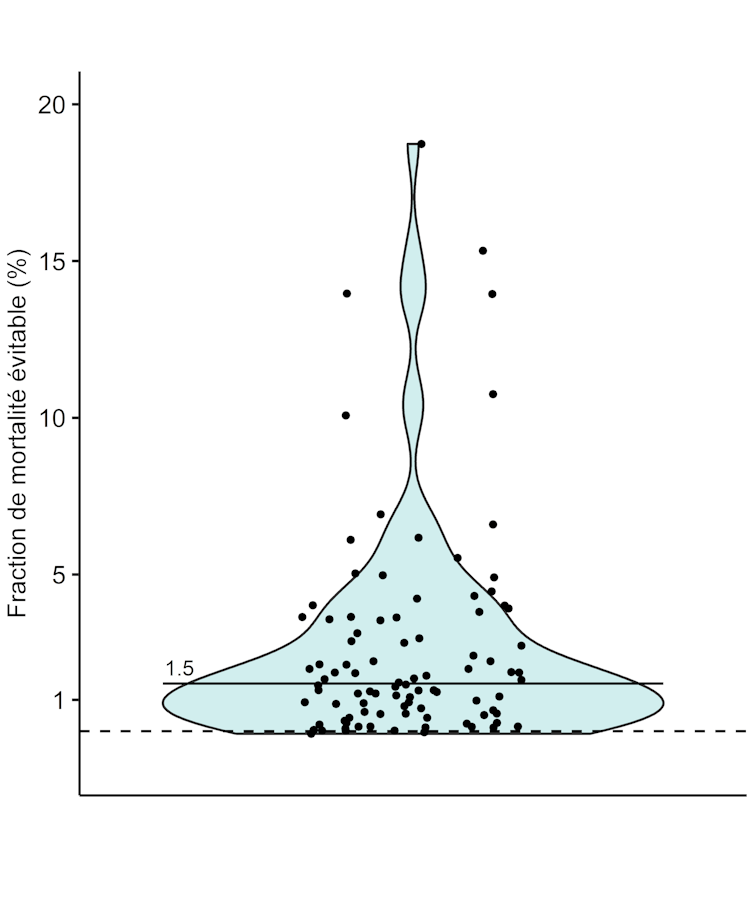
La moitié des scénarios anticipent une réduction de la mortalité de plus de 1,5 %, soit environ 10 000 décès par an en France. Pour donner un ordre d’idée, ce chiffre représente le nombre de décès annuels par suicide ou à cause du cancer du foie. Les accidents dus aux transports représentent quant à eux environ 2 500 décès par an. De plus, cette valeur de 1,5 % de réduction de la mortalité prématurée est très vraisemblablement à interpréter comme une sous-estimation des bénéfices sanitaires de politiques de neutralité carbone, car une grande partie des scénarios ne se sont intéressés qu’à la qualité de l’air, en négligeant l’alimentation et l’activité physique.

Fraction de mortalité évitable pour 96 scénarios de neutralité carbone à partir des 45 études présentant des impacts sanitaires comparable.
Moutet, L. et al (2025), The Lancet Planetary Health

Ces résultats sont cohérents avec ceux d’autres études établissant que l’adoption de régimes alimentaires plus sains, l’arrêt de la combustion d’énergie fossile et la pratique régulière d’une activité physique pourraient éviter respectivement 10, 5 et 4 millions de décès annuel dans le monde.

Ces co-bénéfices mèneraient à des améliorations de l’ordre de celles attendues à la suite de la mise en place de politiques de santé publique ambitieuses. Et ce, alors qu’ils ne font que découler de la mise en place de mesures visant à améliorer le climat, rappelons-le…

Trois caractéristiques intéressantes

Les co-bénéfices sanitaires auraient également trois caractéristiques particulièrement intéressantes :

1. Ils s’accompagnent de co-bénéfices économiques : onze des treize études ayant comparé les coûts de mise en œuvre des politiques climatiques avec leurs bénéfices sanitaires concluent que les gains économiques issus de la réduction de la mortalité dépassent les investissements initiaux. La diminution des maladies cardiovasculaires et respiratoires réduirait les pressions sur les systèmes de santé, entraînerait des gains de productivité et une baisse des arrêts maladie. Par ailleurs, d’autres bénéfices économiques apparaissent également, tels que la création d’emplois, l’amélioration de la résilience énergétique et l’augmentation des rendements agricoles.

2. Ils permettent une amélioration à court terme de la santé publique : comme mentionné précédemment, ces co-bénéfices permettent d’améliorer rapidement la santé humaine, car ils sont consécutifs à la mise en place des stratégies d’atténuation destinées à atteindre la neutralité carbone. Diminuer la pollution de l’air et promouvoir les modes de transport actifs ainsi qu’une alimentation de meilleure qualité se traduit par une amélioration immédiate des capacités cardiovasculaires, respiratoires et de la santé mentale, tout en diminuant l’incidence de certains cancers à plus long terme.

Nul besoin d’attendre d’avoir atteint la neutralité carbone, laquelle pourrait n’être atteinte qu’à moyen terme, voire à long terme (2030 à 2035 dans le meilleur des cas pour l’agriculture, 2050 pour l’industrie), étant donné la durée pendant laquelle persistent les gaz à effet de serre dans l’atmosphère (en particulier le CO2).

3. Ils ne nécessitent pas d’action coordonnée à l’échelle mondiale : les co-bénéfices sanitaires des politiques d’atténuation se manifestent indépendamment des efforts d’autres pays. Autrement dit, un pays qui adopte des mesures de réduction des émissions profite directement d’une amélioration de la santé de sa population, même si d’autres nations tardent à agir. Ce n’est pas le cas des bénéfices climatiques, puisque leur obtention nécessite que tous les pays participent. Cet aspect est crucial pour l’adhésion politique et citoyenne aux politiques climatiques.

Un appel à l’action pour une politique climatique et sanitaire conjointe

Prendre du retard dans la transition vers la neutralité carbone, ce n’est donc pas seulement payer un coût environnemental plus élevé : c’est aussi manquer l’opportunité d’améliorer la santé humaine.

Les politiques d’atténuation devraient être considérées non seulement comme une nécessité climatique, mais aussi comme un levier efficace de transformation de la santé publique. Plutôt que de voir la transition écologique comme un coût, les décideurs politiques et les acteurs économiques doivent la considérer comme un investissement dans la santé et le bien-être présent et futur des populations.

Cette perspective pourrait accélérer l’adoption de mesures ambitieuses et renforcer l’acceptabilité sociale et la mise en place de politiques climatiques cohérentes avec l’accord de Paris.

The Conversation

Kévin Jean est membre du conseil d’administration de l’association Science Citoyennes.

Laura Temime et Léo Moutet ne travaillent pas, ne conseillent pas, ne possèdent pas de parts, ne reçoivent pas de fonds d’une organisation qui pourrait tirer profit de cet article, et n’ont déclaré aucune autre affiliation que leur poste universitaire.

ref. Atteindre les objectifs climatiques améliorera aussi la santé publique – https://theconversation.com/atteindre-les-objectifs-climatiques-ameliorera-aussi-la-sante-publique-270826

Radiographie du soft power russe au Sénégal

Source: The Conversation – in French – By Ibrahima Dabo, Docteur en science politique (relations internationales, Russie), Université Paris-Panthéon-Assas

C’est avant tout via son soft power – médias, langue, culture, bourses pour les étudiants… – que la Russie renforce son implantation au Sénégal, même si les dimensions géopolitique, militaire, énergétique et économique des relations bilatérales sont également en progression.


Dans un contexte mondial marqué par une recomposition des alliances, le Sénégal cherche – tout spécialement depuis l’arrivée à la présidence en mars 2024 de Bassirou Diomaye Faye – à diversifier ses partenariats tout en préservant sa souveraineté. L’évolution des relations entre Dakar et Moscou reflète les mutations plus larges du rôle de la Russie en Afrique de l’Ouest.

Au niveau économique, la présence russe reste faible en Afrique en général, y compris au Sénégal. Et même si un accord de coopération militaire a été signé fin 2023 avec Dakar, c’est surtout à travers l’expansion de son soft power que Moscou s’impose, s’appuyant notamment sur ses instruments culturels et éducatifs tels que l’agence fédérale Rossotroudnitchestvo (« Coopération russe »), la Fondation Russkiy Mir (« Monde russe ») et sur ses médias internationaux Sputnik et RT.

Une présence économique très marginale

La Chambre de commerce et d’investissement d’Afrique, de Russie et d’Eurasie a été ouverte à Dakar en 2024, ce qui témoigne d’une volonté d’explorer de nouvelles opportunités de coopération. Mais malgré l’existence de perspectives de collaboration dans des secteurs stratégiques tels que l’énergie, les ressources naturelles, les infrastructures et l’agriculture, les échanges économiques entre les deux pays restent à ce stade limités.

Dans une interview accordée début 2025 à Dakartimes, l’ambassadeur de la Fédération de Russie à Dakar, Dimitri Kourakov, a indiqué que les échanges entre le Sénégal et la Russie étaient estimés à 850 milliards de FCFA (1,3 milliard d’euros) pour cette année, contre environ 700 milliards de FCFA pour l’année 2024 (1,07 milliard d’euros). Les exportations de la Russie vers le Sénégal sont principalement constituées de produits pétroliers, d’engrais et de blé.

Dans le transport urbain, la filiale du géant technologique russe Yandex, Yango est devenue indispensable pour de nombreux déplacements quotidiens à Dakar. L’arrivée de Yango a créé de nombreuses opportunités d’emploi pour les chauffeurs locaux. Il n’empêche : la Russie est un partenaire économique secondaire et ses relations économiques avec le Sénégal restent modestes.

La coopération militaire entre Dakar et Moscou

À ce jour, la coopération militaire entre le Sénégal et la Russie demeure quasiment inexistante comparée à celle que Dakar entretient avec la Turquie, la Chine ou avec ses partenaires traditionnels, notamment les États-Unis ou la France malgré le départ des troupes françaises. Un accord bilatéral relatif à la coopération militaro-technique a été signé le 14 septembre 2007 qui prévoit la fourniture d’armes et de matériel militaire, ainsi que le détachement de spécialistes pour aider à la mise en œuvre de programmes conjoints dans le domaine de la coopération militaro-technique.

Un pas significatif a été franchi lorsque le gouvernement russe a approuvé un projet d’accord de coopération militaire avec le Sénégal le 3 novembre 2023, conformément à un décret du gouvernement de la Fédération de Russie. Cet accord porte sur la formation militaire et la lutte contre le terrorisme. Force est de constater qu’il existe un intérêt mutuel en ce qui concerne la coopération militaro-technique.

Une coopération éducative et culturelle en pleine expansion

Durant l’époque soviétique, l’URSS offrait des bourses d’étude aux étudiants sénégalais. Plusieurs cadres sénégalais ont été formés dans les universités soviétiques. La chute de l’Union soviétique a mis un coup d’arrêt à la présence culturelle de Moscou au Sénégal.

À partir de 2012, la coopération éducative s’est imposée comme un pilier de la relation sénégalo-russe. Le nombre de bourses d’études offertes par la Russie au Sénégal a alors fortement augmenté. Moins de 20 bourses étaient offertes par an au début des années 2000. Ce chiffre n’a cessé de monter, s’élevant à 130 au titre de l’année académique 2026-2027. En Russie, les jeunes Sénégalais étudient dans des domaines variés tels que l’ingénierie, la médecine, les relations internationales ou encore l’agriculture.

L’éducation et la culture sont au cœur de la politique africaine de la Russie. À l’instar de modèles tels que l’Alliance française, le British Council, les Instituts Confucius ou les Maisons russes dans d’autres pays, la Russie mise pour le moment au Sénégal sur l’implantation d’une médiathèque. À Dakar, la fondation Innopraktika offre une médiathèque à l’Université Cheikh Anta Diop pour faire la promotion de la langue et de la culture russe au Sénégal. L’apprentissage de la langue russe et la formation pour les enseignants du russe avec des méthodes innovantes sont au cœur des actions de la Fondation Russkiy Mir au Sénégal.

Rossotroudnitchestvo soutient ces initiatives en fournissant des manuels et des ressources pédagogiques, facilitant ainsi l’enseignement du russe. Dans le cadre de la coopération éducative, l’Agence fédérale, en collaboration avec l’Université électronique d’État de Saint-Pétersbourg (LETI), a lancé au Sénégal la semaine russe des mathématiques, de la physique et de l’informatique.

S’y ajoute la coopération entre la Bibliothèque d’État russe et l’Université Cheikh Anta Diop de Dakar. Dans le domaine culturel, chaque année, une célébration de l’anniversaire du poète russe Alexandre Pouchkine est organisée à Dakar. Dans le cadre de la promotion de la culture russe, une association privée, non gouvernementale et apolitique, CCR Kalinka a été lancée en 2009. Ce Centre culturel russe a pour objectif de familiariser la société sénégalaise avec la culture russe et les « valeurs traditionnelles slaves ». La coopération cinématographique Sénégal-Russie s’impose aussi aujourd’hui comme un pilier du dialogue culturel entre Dakar et Moscou.

L’évolution de l’influence médiatique russe au Sénégal depuis le changement de régime

Les relations tendues entre Dakar et Paris, qui se sont récemment manifestées par la fin de plus de 60 ans de présence militaire française au Sénégal, constituent une aubaine pour la Russie, qui cherche à étendre sa zone d’influence en Afrique de l’Ouest, plus particulièrement au Sahel.

De plus en plus, les médias deviennent des acteurs incontournables de la diplomatie des États. Dans ce contexte, les organes russes d’information, tels que RT et Sputnik, jouent un rôle central dans la diffusion de narratifs souvent critiques à l’égard de l’Occident et séduisants pour une partie des opinions publiques africaines francophones.


À lire aussi :
RT et Sputnik : comment les médias internationaux russes se restructurent après leur interdiction dans les pays occidentaux


L’Afrique de l’Ouest est devenue un terrain stratégique pour Moscou dans sa guerre d’influence contre l’Occident. Depuis l’interdiction de RT et Sputnik dans l’espace européen, la Russie a recentré ses efforts médiatiques sur les pays africains où le rejet du néocolonialisme et la contestation de l’ordre occidental rencontrent un fort écho.

Au Sénégal, cette stratégie trouve un écho favorable avec l’arrivée au pouvoir de Bassirou Diomaye Faye, président de la « rupture », issu d’un parti souverainiste porté par un discours hostile au système néocolonial et à la Françafrique. Même si le régime n’a pas rompu avec les partenaires traditionnels, il affiche une réelle volonté de diversification de ses partenariats, notamment avec les pays arabes du Golfe et les BRICS.

RT dispose désormais d’un correspondant établi à Dakar, ce qui témoigne d’une stratégie de maillage territorial plus affirmée en Afrique de l’Ouest. Cette présence permet une meilleure couverture de l’actualité locale, et implique une meilleure compréhension des dynamiques politiques et sociales sénégalaises, ce qui laisse penser que RT est sur une trajectoire propice à l’accroissement de son influence.

Sputnik et RT veulent s’imposer comme des sources alternatives de narratifs favorables à la Russie en Afrique. Les contenus de RT dénonçant les bases militaires françaises en Afrique, le franc CFA, le néocolonialisme ou la Françafrique sont partagés par une partie de la jeunesse sénégalaise sur les réseaux sociaux pour légitimer son rejet de la présence française. Le discours souverainiste des nouvelles autorités du Sénégal et leur décision d’ordonner le retrait des troupes françaises sont salués par RT sur ses différentes plates-formes.

Il reste que l’influence directe des médias internationaux russes au Sénégal est très modeste en comparaison avec celle d’autres médias internationaux. Néanmoins, toutes les conditions semblent réunies pour une progression significative de la présence médiatique de la Russie au Sénégal.

Poursuivant la ligne déjà établie, les nouvelles autorités sénégalaises maintiennent une posture de neutralité au sujet de la guerre entre la Russie et l’Ukraine et encouragent les deux camps à parvenir à une issue pacifique. Le récent incident autour du navire Mersin à Dakar, présumé avoir un lien avec Moscou, remet au premier plan la question des conséquences pour le Sénégal du conflit russo-ukrainien.

The Conversation

Ibrahima Dabo ne travaille pas, ne conseille pas, ne possède pas de parts, ne reçoit pas de fonds d’une organisation qui pourrait tirer profit de cet article, et n’a déclaré aucune autre affiliation que son organisme de recherche.

ref. Radiographie du soft power russe au Sénégal – https://theconversation.com/radiographie-du-soft-power-russe-au-senegal-269986

US oil industry doesn’t see profit in Trump’s ‘pro-petroleum’ moves

Source: The Conversation – USA (2) – By Skip York, Nonresident Fellow in Energy and Global Oil, Baker Institute for Public Policy, Rice University

Expanding offshore drilling is one of President Donald Trump’s key policy goals for his second term. Mario Tama/Getty Images

As the Trump administration makes announcement after announcement about its efforts to promote the U.S. fossil fuel industry, the industry isn’t exactly jumping at new opportunities.

Some high-profile oil and gas industry leaders and organizations have objected to changes to long-standing government policy positions that give companies firm ground on which to make their plans.

And the financial picture around oil and gas drilling is moving against the Trump administration’s hopes. Though politicians may tout new opportunities to drill offshore or in Arctic Alaska, the commercial payoff is not clear and even unlikely.

Having worked in and studied the energy industry for decades, I’ve seen a number of discoveries that companies struggled to moved forward with because either the discovery was not large enough to be commercially profitable or the geology was too difficult to make development plausible. Market conditions are the prime drivers of U.S. energy investment – not moves by politicians seeking to seem supportive of the industry.

Market fundamentals trump policy announcements

The general decline in oil prices from 2022 through late 2025 has reduced the attractiveness of many drilling investments.

And opening the East and West coasts to drilling may sound significant, but these regions have unconfirmed reserves. That means a lot of subsurface work, such as seismic surveys, stratigraphic mapping and reservoir characterization – potentially taking years – would need to be done before any drilling would begin.

Offshore drilling also faces enormous opposition.

On the West Coast, California Gov. Gavin Newsom and California Attorney General Rob Bonta have made forceful statements against any new California offshore oil drilling. They have said any effort is economically unnecessary, environmentally reckless and “dead on arrival” politically in the state.

California local governments, environmental groups, business alliances and coastal communities also oppose drilling and have vowed to use legal and political tools to block them.

There is opposition on the East Coast, too. More than 250 East Coast local governments have passed resolutions against drilling.

Governors on both sides of the aisle, including Democrat Josh Stein of North Carolina and Republicans Brian Kemp of Georgia and Henry McMaster of South Carolina, have spoken out against drilling off their coasts.

Arctic drilling is even harder

Drilling for oil and gas in the Arctic National Wildlife Refuge and the Beaufort Sea off Prudhoe Bay in Alaska would be a massive undertaking. These projects require years of development and are subject to future reversals in federal policy – just as Trump has lifted long-standing drilling bans in those areas, at least for now.

In addition, Alaska is one of the most expensive and technically challenging places to drill. Specialized equipment, infrastructure for frozen landscapes, and risk mitigation for extreme weather drive costs far above other regions. These projects also face logistical challenges, such as pipelines running hundreds of miles through remote, icy terrain.

Natural gas from Alaska would likely be sold to Asian buyers, who increasingly have alternative sources of supply from Australia, Canada, Qatar and even the U.S. Gulf Coast. As production rises in those places, the entrance of Alaskan natural gas into the market raises the risk for global oversupply, which could depress prices and reduce profitability.

Despite political support from the Trump administration, the oil and gas companies would need financing to pay for the drilling. And those loans won’t come if the oil companies don’t have agreements with buyers for the petroleum products that are produced. Major oil companies have withdrawn from Alaska and signaled skepticism about attractive long-term returns.

A close-up of a person holding a pen and signing a piece of white paper.
President Donald Trump has signed several executive orders seeking to boost the oil and gas industry.
Shawn Thew-Pool/Getty Images

Trump has helped some

In the first 10 months of the second Trump administration, the president has signed at least 13 executive orders pertaining to the energy industry. Most of them focus on streamlining U.S. energy regulation and removing barriers to the development and procurement of domestic energy resources. However, the broad nature of some of these orders may fall short of establishing the stable regulatory environment necessary for the development of capital-intensive energy projects with long time horizons.

Those efforts have reversed the Biden administration’s go-slow approach to oil drilling, reducing – though not completely eliminating – the backlog of requests for onshore and offshore drilling permits that accumulated during Biden’s presidency.

Delays in permit approvals increase project costs, risk and uncertainty. Delays can increase the chances that a project ultimately is downsized – as happened with ConocoPhillips’ Willow project in Alaska – or canceled altogether. Longer timelines increase financing and carrying costs, because capital is tied up without generating revenue and developers must pay interest on the debt while waiting for approvals. Delays also lead to higher project costs, eroding project economics and sometimes preventing the project from turning a profit.

Investment follows economics, not politics

Unlike in some countries, such as with Saudi Arabia’s Aramco, Norway’s Equinor or China’s CHN Energy, the U.S. does not have a national oil or gas company. All of the major energy producers in the U.S. are privately owned and answer to shareholders, not the government.

Executive orders or political slogans may set a tone or direction, but they cannot override the fundamental requirement for profitability. Investments can’t be mandated by presidential decree: Projects must make economic sense. Without that, whether due to low prices, high costs, uncertain demand or changing regulations, companies will not proceed.

Even if federal policies open new areas for drilling or relieve some regulatory restrictions, companies will invest only if they see a clear path to profit over the long term.

With most energy investments costing large amounts of money over many years, the industry likely wants a sense of policy stability from the Trump administration. That could include lowering barriers to profitable investments by accelerating the approval process for supporting infrastructure, such as transmission power lines, pipelines, storage capacity and other logistics, rather than relying on sweeping announcements that lack market traction.

The Conversation

Skip York does not work for, consult, own shares in or receive funding from any company or organization that would benefit from this article, and has disclosed no relevant affiliations beyond their academic appointment.

ref. US oil industry doesn’t see profit in Trump’s ‘pro-petroleum’ moves – https://theconversation.com/us-oil-industry-doesnt-see-profit-in-trumps-pro-petroleum-moves-270518

You care about fairness at work – so why do you feel like a fake?

Source: The Conversation – USA (2) – By Meg Warren, Associate Professor of Management, Western Washington University

Most people care about fairness at work and want to support colleagues who face marginalization – for example, people of color, women and people with disabilities. Our research has found that 76% of employees want to be allies to co-workers who face additional challenges, and 84% value equity. That’s in line with a 2025 national survey that found 88% of employees supported employers offering training on how to be more inclusive.

So why doesn’t that support always turn into action?

Our new study in the Journal of Workplace Behavioral Health points to one reason: Some people may freeze with worry because they feel like a fake. Specifically, they feel like they don’t have the skills to effectively support their marginalized co-workers, even though they want to. Those feelings may block action, which makes people feel even more fraudulent – creating a loop that’s hard to break.

Together, we – Meg Warren, Michael T. Warren and John LaVelle – found that 1 in 5 people who want to support marginalized groups experience the impostor phenomenon even when they have the skills to be effective allies.

The impostor phenomenon, formerly called the “impostor syndrome,” is the feeling that you’re not good enough – even when there’s objective evidence that you are. Researchers have documented it across many workplace and professional settings, including in health care, technology, entrepreneurship, the C-suite and academia.

Importantly, these feelings are linked to significantly higher anxiety and feelings of depression among people who want to be allies. We found that men, leaders, younger employees and people of color were more likely to experience the impostor phenomenon in the context of allyship.

What the impostor phenomenon looks like for allies

Consider “James,” a senior project manager. For the past few years, his company has expected all managers to undergo diversity, equity and inclusion training and to support the company’s Black Employee Network. Earlier this year, however, the company publicly withdrew its commitment to DEI and removed all mentions of it from its website.

When his team asked for his thoughts, James felt lost. The facts he learned during the Black Employee Network meetings were unsettling and undeniable. Before, he regularly cited these during various meetings with his colleagues and senior leaders. Now, he felt pressured to act as if none of this mattered. He felt frustrated, at a loss for words and a complete fake – like he didn’t know how to support his colleagues anymore.

While “James” is a composite character drawn from many stories we’ve heard over the course of our research, his experience captures the bind that many would-be allies face.

When allies feel this way, they often compare themselves to an imagined “perfect ally,” thinking that if they can’t be outrageously heroic, they must be failures. They then deal with feelings of inadequacy by procrastinating or overpreparing before stepping up for others – to the point where they miss crucial opportunities where they could have made a difference.

People tend to feel like an impostor when they encounter a challenge that seems bigger than their ability to cope with it. So it’s not surprising that a lot of people feel this way about workplace equity. Inequity and bias play out in complex ways in organizations: The rules change rapidly, and people can receive mixed messages about what behaviors are appropriate, valued and rewarded. This can make allyship feel overwhelmingly challenging, even for those who are otherwise skilled.

Work culture also matters. In toxic organizational cultures or hypercompetitive environments, people feel pressure to hide their mistakes, they worry about colleagues sabotaging their efforts, and they see humility as a weakness. In such places – and especially when the would-be ally’s role is highly visible and entails heavy responsibility – people are vulnerable to impostor feelings.

Past criticism can add fuel, too. If you’ve been admonished for standing up for a colleague or have seen others be attacked – including by those who wish to maintain an unjust status quo – you might further feel pressure to only act in ways that are immune to criticism. That’s an impossible standard.

Consequences of feeling like an impostor: Feeling worse, doing worse

Leaders in particular are vulnerable to feeling like impostors on allyship. Many haven’t been properly trained on how to listen to and support co-workers who might be facing discrimination and are quietly suffering, yet are held responsible for solving complex issues around fairness that long predated them.

And when stuck in this uncomfortable space, people who feel like impostors are likely to become defensive and feel pressured to be a hero. To prove themselves, they may overcompensate in ways that backfire – for example, by loudly claiming support for disadvantaged workers without following up with useful action, or by swooping in to fix issues without respecting the preferences of the people involved.

Unfortunately, this not only affects their ability to be a supportive colleague, but it also likely harms their mental health. Indeed, the impostor phenomenon has been found to be linked to heightened anxiety and feelings of depression, both in our study and beyond.

So you might wonder: What if I opt out of all of this by not thinking about inequity at all? Our research suggests that this is a bad idea. People who are disengaged from issues of inequity, and who don’t invest in learning and growing as allies, experience lower self-confidence at work and have lower job satisfaction. Checking out of allyship could be bad for your professional well-being.

The good news is you don’t have to be stuck feeling this way. You can take low-risk, bite-sized actions that can pull you out of feeling fake and boost your confidence, all while improving your own professional success and mental health.

Research points to three simple ways forward. First, recognize and loudly celebrate the strengths of marginalized colleagues, which creates an uplifting work culture. Second, take concrete steps to build trust – for example, by giving proper credit to a disadvantaged colleague if their merit is wrongfully questioned. And finally, overcome your cynicism – which research shows invariably suppresses constructive action – and instead adamantly choose hope, even when it’s hard.

The Conversation

The authors do not work for, consult, own shares in or receive funding from any company or organization that would benefit from this article, and have disclosed no relevant affiliations beyond their academic appointment.

ref. You care about fairness at work – so why do you feel like a fake? – https://theconversation.com/you-care-about-fairness-at-work-so-why-do-you-feel-like-a-fake-271081

Sabrina Carpenter’s and Chapelle Roan’s sexy pop hits have roots in the bedroom ballads of Teddy Pendergrass and Philly soul

Source: The Conversation – USA (2) – By Jared Bahir Browsh, Assistant Teaching Professor of Critical Sports Studies, University of Colorado Boulder

Teddy Pendergrass was known for romantic R&B ballads like the 1978 hit “Close the Door.” Michael Putland via Getty Images

When Sabrina Carpenter’s provocative 2024 pop single “Bed Chem” plays on the radio, and I hear the lyrics

But I bet we’d have really good bed chem / How you pick me up, pull ‘em down, turn me ’round / Oh, it just makes sense / How you talk so sweet when you’re doing bad things

it reminds me of a song released 45 years earlier:

Let’s take a shower, said a shower together, yes / I’ll wash your body and you’ll wash mine, yeah / Rub me down in some, some hot oils, baby / And I’ll do the same thing to you
—“Turn Off the Lights” by Teddy Pendergrass

Growing up in Philadelphia in the 1990s, I listened to soul singer-turned-R&B sex symbol Teddy Pendergrass and other artists who defined the Sound of Philadelphia. Now, as a professor of ethnic studies, I teach students about the influence of Black artists on modern pop culture.

Pendergrass would have turned 75 this year. Although he died in 2010, he helped usher in an era of music that brought both disco and more mature, sensual music to the mainstream – and I see his influence in a number of pop and R&B hits today.

“Turn Off the Lights” by Teddy Pendergrass.

The Philadelphia sound

Theodore DeReese Pendergrass was born in South Carolina in 1950, but he grew up in North Philadelphia, where he sang and played drums in church and became an ordained minister at age 10.

He dropped out of Thomas Edison High School in the 11th grade to pursue a music career, and he recorded “Angel With Muddy Feet” in 1967. The song was not a commercial success, so he focused on playing drums for a number of local bands.

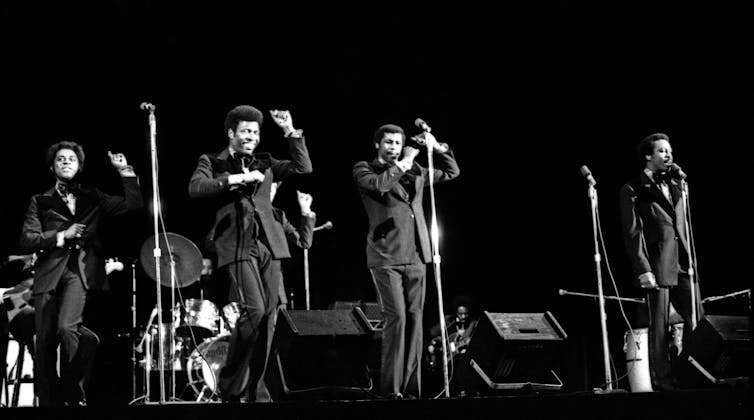
In 1970, Pendergrass was invited by Philly soul and R&B singer Harold Melvin to play drums with his group, the Blue Notes. During a performance, Pendergrass sang along, leading Melvin to invite him to take over as lead vocalist after John Atkins left the group. The following year, Harold Melvin and the Blue Notes signed a record deal with the newly created Philadelphia International Records, forging a partnership between Pendergrass and label founders and legendary producers Kenny Gamble and Leon Huff that would last over a decade.

Five male musicians dressed in dark suits perform on stage in front of microphones
Teddy Pendergrass (second from right) performs with Harold Melvin and the Blue Notes at the Greek Theatre in 1973 in Los Angeles.
Sherry Rayn Barnett /Michael Ochs Archives via Getty Images

Philadelphia International’s influence was felt throughout the music industry, with Gamble and Huff producing many of the hits performed by the label’s artists. Gamble and Huff blended soul and funk with complex horn and string arrangements to create the Philly soul sound.

This sound became key in the development of disco, smooth jazz and neo-soul. Slower, more intimate R&B and smooth jazz also formed the foundation for the “quiet storm” radio format that Pendergrass helped foster as a solo artist on stations like WDAS in Philadelphia.

Marvin Gaye’s 1973 album “Let’s Get It On” was Motown’s response to the emergence of Philly Soul, and helped popularize more explicitly sensual R&B and soul.

Harold Melvin and the Blue Notes had their first No. 1 hit with 1972’s “If You Don’t Know Me by Now.” While on the Philadelphia International label, the group recorded four gold records between 1972 and 1976. One of their biggest hits, “Don’t Leave Me This Way” in 1975, was not released until November 1976. It charted after R&B and disco singer Thelma Houston’s cover of the song hit No. 1 on the Billboard Hot 100 chart in 1977.

Going solo

Pendergrass left the Blue Notes in 1976 after disputes with Melvin over money, but he stayed on with Philadelphia International and began a solo career. His self-titled album was released in 1977, and the first single, “I Don’t Love You Anymore,” reached No. 5 on the R&B charts, helping to push the album into the top 20.

The following year, his “Life Is a Song Worth Singing” hit No. 1 on the Soul LP chart behind the sensual single “Close the Door.”

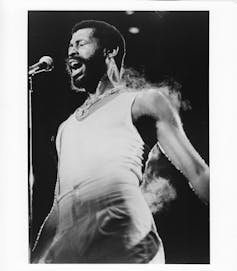
Black-and-white photo of singer wearing white undershirt singing in front of microphone, with steam coming off his body
R&B heartthrob Teddy Pendergrass performs on stage circa 1977.
Gilles Petard/Redferns via Getty Images

Pendergrass, with his stylish good looks, quickly became not just a heartthrob, but a top R&B artist with five consecutive platinum albums between 1977 and 1981. He was selling out concerts, and legendary producer Shep Gordon recognized that the vast majority of the attendees were women. This led to Pendergrass’ “Ladies Only” tour in 1978, which became a template for future soul and R&B tours by contemporaries like Luther Vandross and later artists like Ginuwine, whose tours were also marketed specifically to women.

The 1979 erotic hit “Turn Off the Lights” strengthened Pendergrass’ reputation as a sex symbol. While Marvin Gaye was dealing with both financial and personal issues, Pendergrass became the top performer of soul “bedroom ballads.”

Pendergrass and Gaye, along with other contemporaries like Barry White, Minnie Riperton and Donna Summer, included more explicitly erotic themes and lyrics than earlier artists.

For example, in Gaye’s “Let’s Get it On,” he implores to his lover:

“There’s nothin’ wrong with me / Lovin’ you, baby love, love / And givin’ yourself to me can never be wrong / If the love is true, oh baby.”

In “Close the Door,” Pendergrass similarly tells his lover:

“Close the door / Let me give you what you’ve been waiting for / Baby I got so much love to give / And I wanna give it all … to you …”

One challenge for the songwriters like Gamble and Huff was to balance the sensuality that fans loved with Federal Communication Commission rules regarding profane language. Songs like “Turn Down the Lights,” written by Gamble and Huff for Pendergrass, describe a detailed night of romance without language that would be considered obscene by the FCC.

Slow jams and sex positivity

R&B and soul slow jams by artists like Freddie Jackson and Vandross dominated bedroom music through the 1980s, although derivative genres like neo-soul and quiet storm continued to produce bedroom ballads like Gaye’s “Sexual Healing” in 1982.

Madonna and Cyndi Lauper helped bring a female perspective to more sex-positive pop music with songs including “Like a Virgin” and “She Bop.” Janet Jackson and Salt-N-Pepa did the same in R&B and hip-hop. Other groups embraced their sex symbol status through the 1990s, exemplified by TLC’s “Ain’t 2 Proud 2 Beg” and “Creep,” and Next’s “Too Close.” The artists of the 1980s and 1990s were also boosted by MTV, bringing a visual element to their sensual lyrics.

The emergence of new jack swing, a term coined in 1987 to define a new style that combined dance, hip-hop and R&B, ushered in higher-tempo erotic songs like “Do Me!” by Bel Biv Devoe along with slower bedroom ballads like “I’ll Make Love to You” by Philadelphia’s Boyz II Men.

Philly’s Boyz II Men carried the bedroom ballad tradition into the 1990s with “I’ll Make Love to You.”

Bedroom ballads with disco-synth makeover

Philadelphia International’s sound and sensual lyrics have reemerged in recent years through artists Sabrina Carpenter and Chapelle Roan, whose synth-pop and disco sound can be traced back to Gamble and Huff, and the label’s stable of artists.

Proto-disco songs like “The Love I Lost” and “Don’t Leave Me This Way” by Harold Melvin and the Blue Notes, and Pendergrass’ disco hit “Get Up, Get Down, Get Funky, Get Loose” – or his later synthesizer-heavy album “Joy” – would influence current synth-pop hits like Roan’s disco-influenced “Pink Pony Club” and Carpenter’s synth-pop “Manchild.”

Chapelle Roan’s campy, disco-influenced hit “Pink Pony Club.”

Carpenter in particular has seemingly struck that balance between mainstream success and sensual lyrics. Her past three albums have been certified platinum and embrace increasingly mature themes such as female arousal.

“Man’s Best Friend,” released in August 2025, sparked controversy with a sexually suggestive album cover that further cemented her Carpenter’s symbol image. This image is reinforced by her stage presence, like dancing in her underwear on “Saturday Night Live” and mature songs like “Tears,”

“Tears” by Sabrina Carpenter.

Pendergrass’ career was derailed when he lost control of his car on Lincoln Drive in the East Falls neighborhood of Philadelphia in 1982. The accident left him a tetraplegic. He later continued his music career, but the “Black Elvis” moved away from bedroom ballads.

Although Pendergrass’ meteoric rise was cut short, his influence is still seen and heard across music genres today, especially as empowered female artists utilize disco and synth-pop sounds while embracing their sexuality through their songs and performances.

Read more of our stories about Philadelphia, or sign up for our Philadelphia newsletter on Substack.

The Conversation

Jared Bahir Browsh does not work for, consult, own shares in or receive funding from any company or organization that would benefit from this article, and has disclosed no relevant affiliations beyond their academic appointment.

ref. Sabrina Carpenter’s and Chapelle Roan’s sexy pop hits have roots in the bedroom ballads of Teddy Pendergrass and Philly soul – https://theconversation.com/sabrina-carpenters-and-chapelle-roans-sexy-pop-hits-have-roots-in-the-bedroom-ballads-of-teddy-pendergrass-and-philly-soul-270035

Pope Leo XIV’s visits to Turkey and Lebanon were about religious diplomacy

Source: The Conversation – USA (3) – By Ramazan Kılınç, Professor of Political Science, Kennesaw State University

Pope Leo XIV and the Armenian patriarch of Constantinople, Archbishop Sahag II Mashalian, celebrate a liturgy in the Armenian Apostolic Cathedral of Istanbul, Turkey, on Nov. 30, 2025. Dilara Acikgoz/AP Photo

On his visit to Turkey and Lebanon between Nov. 27 and Dec. 2, 2025, Pope Leo XIV met with political and religious leaders, celebrated Mass and visited historical sites.

The trip marked the 1,700th anniversary of the Council of Nicaea, which resolved core doctrinal differences, with the aim of advancing Christian unity at the time.

The Vatican framed the visit to the two Muslim-majority countries as a gesture of interreligious dialogue, as well as support for local minority Christian communities.

Through interfaith dialogue and symbolic acts, religious leaders often act as diplomats to strengthen relationships with other faith groups as part of religious diplomacy.

Traditional diplomacy often prioritizes political and economic interests, whereas religious diplomacy builds on identities and values. But as a scholar of religion and politics, I have often seen how religious diplomacy complements conventional diplomatic tools – the pope’s visit being the most recent example.

Turkey and religious freedom

Lebanon and Turkey have a long history of Christianity, dating back to the early centuries of the religion. The Bible mentions Jesus visiting Tyre and Sidon, coastal cities in Lebanon. Many early Christian communities thrived in lands of modern-day Turkey, such as Ephesus, Antioch and Cappadocia.

Despite Turkey’s significance in the history of Christianity, today Christians constitute less than 0.5% of its population. These include diverse Christian communities, from Armenian Orthodox, Greek Orthodox and Syriac Orthodox to Roman Catholic and Protestant.

Turkey’s constitution guarantees religious freedom, but Christians face legal and administrative hurdles in matters such as building places of worship.

The pope’s visit did not directly confront these structural issues, but the trip itself drew international attention to the plight of Christians.

The pope met with Muslim leaders to foster dialogue. He visited Istanbul’s Blue Mosque, an architectural icon for Turkish Muslims. In a meeting with Turkish President Recep Tayyip Erdoğan, the pope emphasized Turkey’s role as “a bridge between East and West, Asia and Europe.”

Even the pro-government media, which does not usually support rights for religious minorities, highlighted Turkey’s responsibility to provide religious freedoms for its Christian minorities in its coverage of the trip.

Several people walking in a large dome-like structure with high ceilings. Some are dressed in black suits and a few in white robes.
Pope Leo at the Blue Mosque in Turkey.
AP Photo/Emrah Gurel

Challenges of Lebanese Christians

Christians make up about a third of the Lebanese population – the largest proportion of any country in the Middle East.

Maronite Catholics, an Eastern Catholic community that traces its roots to the fourth century, constitute the largest group among Lebanese Christians. They are followed by Greek Orthodox communities, concentrated in Beirut and Mount Lebanon. Other groups include Melkite Greek Catholics, Armenian Apostolic, Armenian Catholics, Syriac Orthodox, Syriac Catholics, Assyrians, Chaldean Catholics, Copts and various Protestant communities.

Christians in Lebanon enjoy constitutional protections and better political representation than Christians in other Middle Eastern countries. Lebanon’s confessional system allocates power among religious communities. The president must be a Maronite Christian, the prime minister must be a Sunni Muslim, the speaker of the parliament must be a Shia Muslim; parliament and cabinet seats are split equally between Christians and Muslims.

However, Christians are concerned with their decreasing population in Lebanon. They constituted over 50% of the population when Lebanon gained its independence from France in 1943. Over the years, many Christians left Lebanon because of economic pressures, the dominance of the Shia group Hezbollah and insecurity stemming from Israeli strikes.

The pope advised political leaders to prioritize cooperation over sectarian interests within its confessional political system. As a gesture, he joined Muslim leaders in Martyrs’ Square in Beirut and shared readings from both the Gospels and the Quran.

Moral boost

The pope’s visit provided a morale boost for Lebanese Christians. Many saw the pope’s presence as encouragement to stay in Lebanon despite all the concerns.

Yet, some expressed disappointment that the pope did not travel to southern Lebanon, where Christian villages have suffered from Israeli strikes.

However, the pope reiterated the Vatican’s support for a two-state solution to the Israeli-Palestinian conflict as the only way to resolve “the conflict they continually live.”

Religious diplomacy

Through his visits to Turkey and Lebanon, Pope Leo XIV intertwined religious teachings with cultural gestures to promote a message of peaceful coexistence.

By meeting Christian groups in Turkey and Lebanon, he offered moral support and visibility to minorities facing insecurity and emigration pressures. By meeting with Muslim leaders, he showcased the Vatican’s commitment to coexistence and dialogue with Islam.

It remains to be seen whether the pope’s religious diplomacy will lead to tangible policy outcomes. Yet, one thing is clear: Religious diplomacy serves as a valuable tool for encouraging dialogue and understanding as it did with the pope’s visit.

The Conversation

Ramazan Kılınç does not work for, consult, own shares in or receive funding from any company or organization that would benefit from this article, and has disclosed no relevant affiliations beyond their academic appointment.

ref. Pope Leo XIV’s visits to Turkey and Lebanon were about religious diplomacy – https://theconversation.com/pope-leo-xivs-visits-to-turkey-and-lebanon-were-about-religious-diplomacy-271208

Outside the West, the Kundalini tradition presents a model of the ‘divine feminine’ beyond binary gender

Source: The Conversation – USA (3) – By Anya Foxen, Associate Professor of Religious Studies, California Polytechnic State University

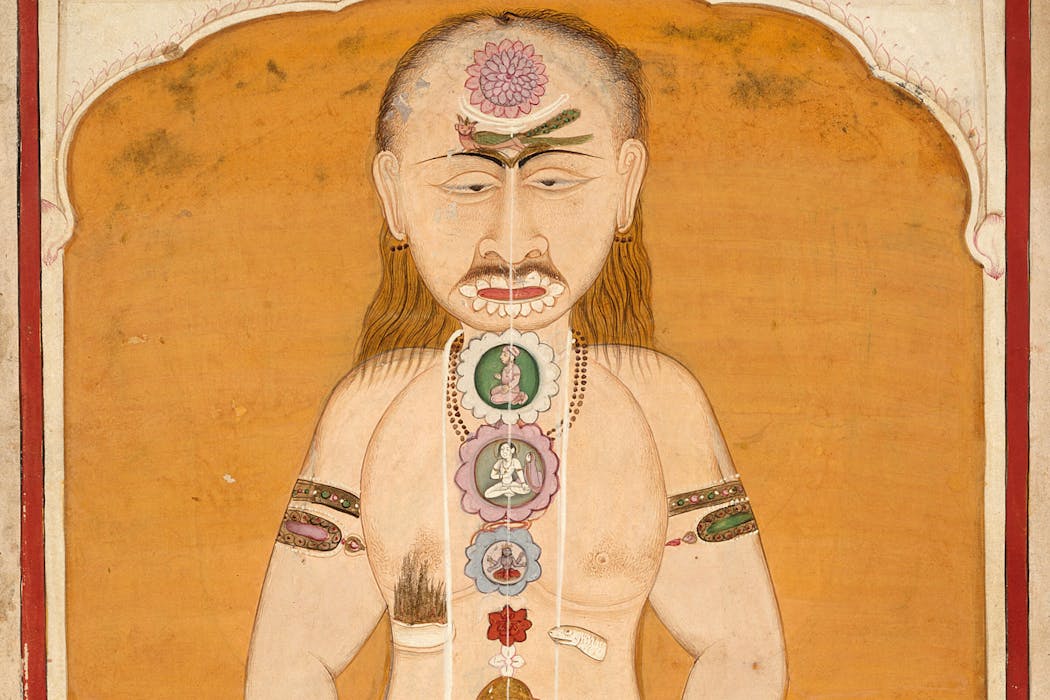
A piece of art shows the tantric tradition’s depiction of Kundalini and energy centers – or chakras. Tantrika painting/Wellcome Collection, CC BY

The notion of the divine feminine is a recurring motif in American pop culture, playing with the assumptions people make when referring to God – often the deity described in the Bible – as “He.”

Whether it’s Alanis Morissette’s iconic portrayal of God in the 1999 comedy “Dogma” or Ariana Grande’s titular declaration in her 2018 track “God is a Woman,” the effect is the same: a mixture of irreverence and empowerment. It dovetails, moreover, with a ubiquitous political slogan: “The future is female.”

But in a historical moment when society is bitterly contesting ideas about gender, we’d note that these notions still rely on a simplistic binary.

As two scholars who study the entangled history of spirituality and gender, we often observe an especially fraught version of this dynamic playing out among “spiritual but not religious” practitioners, often called spiritual seekers. To many such people, the divine feminine represents an escape from oppressive gender norms, and yet many stumble in trying to reconcile the idea with the embodied realities of biological sex.

An approach that escapes this dilemma is the centuries-old Kundalini tradition, which paints a model of the divine feminine beyond gender altogether.

The feminine Shakti

There are certainly examples of the feminine divine to be drawn from Christian and other Abrahamic religious traditions. Yet many seekers quickly find themselves reaching beyond these borders.

When they do, one of the first concepts they come across is Shakti, a divine feminine energy that manifests in the human body as the electrifying force of Kundalini. Both terms originate in South Asian religions – especially Hinduism – that fall under the broad umbrella of tantra.

Tantric cultural and spiritual traditions, which began to emerge in the early centuries of the Common Era, take a positive perspective on the material world in general and the human body in particular, as opposed to traditions that regard both as inherently illusory or sinful. In tantra, the material world and physical body are suffused by divine energy. This energy is called Shakti, and it is feminine.

Another key idea common to tantric traditions is that the universe is composed of two fundamental principles – or rather that it has two poles: a dynamic energy, which is female, balanced by an unchanging consciousness, which is male. As the great Goddess, Shakti goes by many names, including Durga, Kali and myriad others. The masculine principle is usually called Shiva, though this can vary as well.

Divinity beyond binaries

Tantric traditions span over a millennium in time and a subcontinent in space, so it should come as no surprise that they are incredibly diverse. However, most practices that enjoy global popularity today, especially those centered on the divine feminine energy of Kundalini, can be traced to a specific tradition called Kaula Tantra, which developed in the northeast of modern-day India near Kashmir.

An old painting of a many-armed religious figure.
A picture of tantric art from the 19th century.
Pictures From History/Universal Images Group via Getty Images

This tradition is distinctive by maintaining that while the cosmos is polar, it is also nondual, meaning that there is only one ultimate reality. So, the pairing of Shakti and Shiva, feminine and masculine, energy and consciousness, is best understood not as a binary but as the two sides of a Mobiüs strip, where one seamlessly flows into the other.

Take a strip of paper, twist it into a figure eight – also the symbol we use for infinity – and glue the back to the front. That’s the Kaula model of the universe.

In such a world, Shiva is Shakti. The masculine is the feminine. Both are divine, but even more than this, both are ultimate, because there is no difference between them. God is goddess, and both are nonbinary.

Awakening Kundalini

Kundalini yoga is a centuries-old practice quite different from the branded version popularized more recently by Yogi Bhajan. It involves using complex meditative and physical techniques to awaken and raise this energy from its usual resting place in the bottom of the torso.

In doing this, tradition says the practitioner experiences a radical transformation both of the body and of consciousness. Premodern texts describe Kundalini’s fiery energy burning through the tissues of the body, shooting up to the crown of the head, where the feminine Shakti unites with her masculine counterpart and all dissolves into oneness.

While some texts treat this ascent as equivalent to a sort of voluntary death, others describe how, once she has ascended, Kundalini returns to bathe the body in a cooling nectar of immortality, resulting in an embodied state of enlightenment and liberation.

According to this tradition, the body may appear the same but is now enlivened with a new consciousness that has transcended all dualities – including male and female.

Is the divine feminine female?

Human gender norms often prove difficult to shake, however. Though the energy of Kundalini is understood as feminine, Kundalini yoga in South Asia has been traditionally practiced by men. The reasons for this are perhaps almost entirely social, and yet they remain a powerful force.

Ironically, the very fact that Kundalini is often believed to be associated with womanhood has resulted in women being excluded – or at least deprioritized – from cultivating their own practice. Instead, they have historically become assistants or accessories to the enlightenment of men.

The fieldwork we present in our recent book on the topic bears this out. Among South Asian practitioners, the common attitude is that women embody the maternal principle, and this makes them extremely powerful. In them, the energy of Kundalini operates naturally. Men, on the other hand, need to be purified by a woman through ritual in order to effectively engage in Kundalini practice.

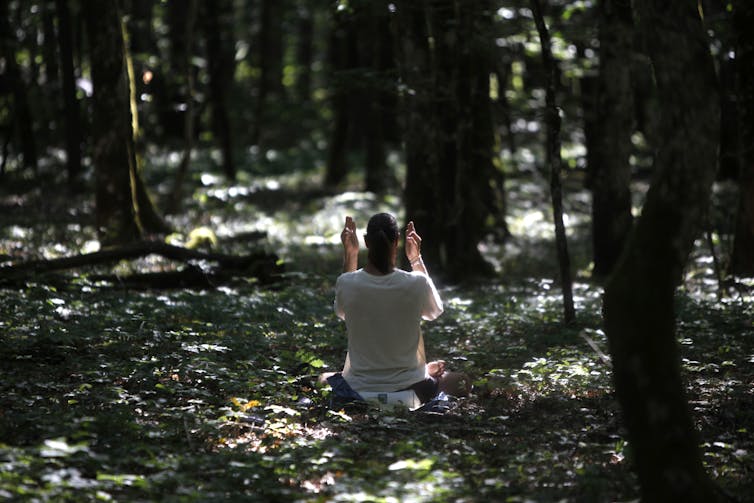
A woman meditates in the forest.
A woman meditates during festival for a modern, branded version of Kundalini yoga.
Godong/Universal Images Group via Getty Images

Such ideas are also common among Western practitioners, who tend to believe women have a more natural aptitude for Kundalini awakening. One of our subjects said this is because women have less ego. Another attributed it to female sexual fluids.

However, cultural difference plays a role, too. Western notions of the divine feminine are much more inclined to cling to the binary, resisting the idea that male and female bodies alike are ultimately woven from the same nondual reality.

Most striking, perhaps, one man who had spent a lifetime among seekers at spiritual retreats in the U.S. and South America told us of a long-held and common belief that only women were capable of Kundalini experience. It was, to him, an energy exclusive to the female body. He recounted having been shocked, only months prior, at encountering a copy of the 1967 classic “Kundalini: The Evolutionary Energy in Man,” authored by the decidedly male Gopi Krishna.

The broader point, however, is that the historical core of Kundalini practice has always been about transcending all dualities.

Thus, even as a goddess representing the ultimate “She,” Kundalini is best understood as nonbinary. Perhaps if we can wrap our heads around this idea, we can cultivate a more inclusive empowerment.

The Conversation

The authors do not work for, consult, own shares in or receive funding from any company or organization that would benefit from this article, and have disclosed no relevant affiliations beyond their academic appointment.

ref. Outside the West, the Kundalini tradition presents a model of the ‘divine feminine’ beyond binary gender – https://theconversation.com/outside-the-west-the-kundalini-tradition-presents-a-model-of-the-divine-feminine-beyond-binary-gender-263402

Fossil science owes a debt to indigenous knowledge: Lesotho missionary’s notes tell the story

Source: The Conversation – Africa (2) – By Julien Benoit, Associate professor in Vertebrate Palaeontology, University of the Witwatersrand

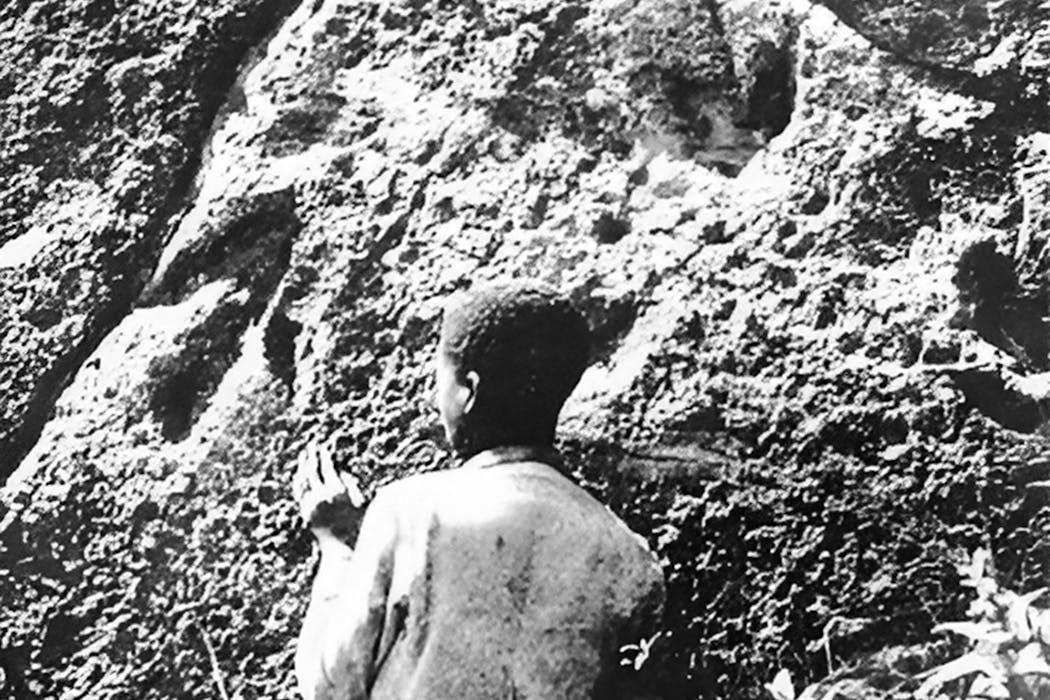
Dinosaur footprints at Morija, Lesotho, in 1906. The person standing in front of the rock slab covered with tridactyl fossil footprints is not identified. Photos courtesy of the Institut des Sciences de l’Evolution of the University of Montpellier, France , CC BY-NC-SA

For over a century, the scientific literature has credited western missionaries with “discovering” fossils in Lesotho, the small, mountainous country surrounded by South Africa.

The narrative typically begins with figures like the French missionary Hermann Dieterlen, who, in 1885, reported unusual “petrified bird tracks” near the settlement of Morija. This account implies that earth sciences like the study of rocks and fossils arrived in Lesotho from Europe.

In contrast, our research supports the notion that the local people recognised, interpreted and explained these fossils before missionaries arrived. Our research focus is on the dinosaur bones and tracks of Lesotho, its geomythology (cultural explanations of geological phenomena), and indigenous palaeontology.

Our recent study revisits the private archives of French missionary and self-taught palaeontologist Paul Ellenberger (1919–2016). He lived in Lesotho from 1953 to 1970 as part of a three-generation missionary family. During this period, he documented various fossils and published his findings in scientific literature. After returning to France, he earned a PhD in palaeontology in the mid-1970s. His contributions laid the foundation for the study of animal fossil tracks and traces in southern Africa.

His notes reveal that the Basotho and San people in Lesotho not only noticed fossils but also integrated them into their culture as geomyths.

This matters beyond Lesotho. Scientific history has often portrayed African indigenous communities as passive background figures. Fossils were deemed “discovered” only when Europeans documented them, despite what local people already knew.

Revisiting Ellenberger’s archives corrects this imbalance. His notes support that indigenous knowledge informed scientific discovery. As some sciences grapple with their colonial legacies, narratives like this offer a path forward.

Fossils in Lesotho

Lesotho is part of the southern African main Karoo Basin, one of the world’s richest continental fossil archives. It is a record of several major evolutionary and environmental transitions. This includes the rise of dinosaurs after the end-Permian mass extinction some 252 million years ago.

Both body fossils and trace fossils have been found in Lesotho and its surroundings. Erosion of fossil-rich rocks exposes numerous dinosaur, amphibian and reptile trackways, fish trails and burrows, alongside full or partial skeletons and plant remains. Thus, fossils are part of Lesotho’s rugged landscape.

For the Basotho, giant bones eroding from the hills are not mere curiosities; they are referred to the Kholumolumo. This was an enormous, all-devouring mythical creature whose thunderous footsteps echoed across the landscape, leaving footprints behind.

This folktale aligns closely with the fossil record: skeletons and trackways, mostly of dinosaurs, which are prevalent in the sky-high exposures of the Maloti (or the Drakensberg, as the mountain range is known in South Africa).


Read more:
Dinosaur tracksite in Lesotho: how a wrong turn led to an exciting find


The Kholumolumo myth serves as a cultural framework that preserves real observations of Lesotho’s fossil heritage over time. It’s an example of early citizen science – local people identifying recurring patterns in their environment and explaining them within their own cultural framework.

Ellenberger’s original archival materials reveal that this local knowledge was highly practical. When French palaeontologists arrived in 1955, they were guided to Maphutseng – now known for one of southern Africa’s richest dinosaur bone beds – by Samuel Motsoane. He was a local schoolteacher who had known the “stone bones” since childhood, in the 1930s.

The San and the fossil footprints

The Basotho and San were among the first in southern Africa to examine giant footprints preserved in stone and ponder: what walked here?

The indigenous San people, who followed a hunter-gatherer way of life before their culture disappeared from Lesotho, were masters in the interpretation of tracks. They could identify the size, behaviour and movement of living animals from a single footprint. Ellenberger believed they applied these skills to fossil tracks as well.


Read more:
Mysterious South African cave painting may have been inspired by fossils


His manuscripts describe rock art at Mokhali Cave that appears to depict a dinosaur footprint alongside bipedal creatures reminiscent of the three-toed dinosaur fossils preserved in nearby outcrops.

Ellenberger also noted that some San myths seemed to differentiate between the tracks of four-legged animals in the lowlands and those of two-legged animals higher in the mountains.

In southern Africa, fossil tracks of bipedal dinosaurs are found in higher rock layers only, where the rocks are younger. Lower rocks contain only quadrupedal trackways made by more primitive animals.

So the myths appear to demonstrate some level of understanding of the evolution of species.

Although this seems more speculative, his core observation remains valid: the San recognised patterns in the fossil record and integrated them into their worldview. They observed their land with precision long before formal palaeontology developed in the area.

Rethinking the narrative of ‘discoveries’

The diaries show that locals guided researchers to fossil sites. They recognised fossil bones and tracks as evidence of ancient animals, and preserved this understanding through stories that served as explanations.

Ellenberger himself valued this intellectual tradition: he spoke Sesotho fluently, collaborated with locals, and documented their insights respectfully. His notes credit half a dozen Basotho who discovered fossils of important scientific value.

His notes show that the roots of awareness and interpretation of fossils in southern Africa predate European expeditions and reach into the deep sense of place held by the people living among these fossils since generations. Their interpretations were not “quaint myths” but sophisticated observations shaped by centuries of engagement with the land.

Acknowledging this enriches the scientific record, broadens our understanding of early palaeontology, and honours the contributions of communities whose insights led to important discoveries. Ellenberger has left us an empowering and inspiring legacy for the new generation of southern African palaeontologists.

The Conversation

Julien Benoit receives funding from DSTI-NRF GENUS (Centre of Excellence in Palaeosciences) and African Origins Platform.

Emese M Bordy receives funding from DSTI-NRF GENUS (Centre of Excellence in Palaeosciences). www.genus.africa

Charles Helm does not work for, consult, own shares in or receive funding from any company or organisation that would benefit from this article, and has disclosed no relevant affiliations beyond their academic appointment.

ref. Fossil science owes a debt to indigenous knowledge: Lesotho missionary’s notes tell the story – https://theconversation.com/fossil-science-owes-a-debt-to-indigenous-knowledge-lesotho-missionarys-notes-tell-the-story-270431

Young, undocumented immigrants are finding it increasingly hard to attend college as South Carolina and other states restrict in-state tuition or ban them altogether

Source: The Conversation – USA (2) – By William McCorkle, Associate Professor of Education, College of Charleston

Students at Arizona State University protest against a Republican student group encouraging people to report undocumented immigrants in January 2025 . Ross D. Franklin/Associated Press

The Trump administration’s aggressive deportation policies have heightened stress among the country’s approximately 14 million immigrants who are living in the U.S. without legal authorization.

The sharp rise in dramatic arrests and deportations of immigrants over the past year has received widespread media attention.

A less publicized issue is that many young, undocumented immigrants are also finding it harder to apply to and stay in college.

As someone who researches teacher training and was a high school teacher in South Carolina, I have researched how restrictive education policies make it harder for immigrant students, particularly undocumented students, to receive a college degree.

A green expanse of grass and trees is seen with people sitting under a tree.
The University of South Carolina is the largest public university in the state.
Wikimedia, CC BY

Bumpy path to higher education for undocumented students

In 1982, the Supreme Court ruled that students could not be discriminated against based on their immigration status.

This ruling ensured that immigrant students could not be denied entrance to public K-12 schools.

The caveat is that the ruling did not extend to higher education.

In 1996, Congress approved the Illegal Immigration Reform and Responsibility Act, which made it harder for undocumented immigrants who are deported to reenter the U.S., among other changes to increase border security.

This law also said that states could not provide in-state tuition to undocumented students at public universities, unless they gave the same benefits to out-of-state American citizens.

Then, in the early 2000s, a bipartisan group of Texas representatives helped pass a bill that opened up in-state tuition to undocumented students. The bill based tuition and scholarships on specific residency requirements, such as graduating from high school in the state, allowing the bill to circumvent the 1996 federal law.

Also in the early 2000s, California, Illinois, Washington and New York also passed similar legislation that allows undocumented immigrants to receive in-state tuition – and in some cases, state scholarships – at state universities.

Even some conservative states, such as Utah, Oklahoma and Kansas, passed such legislation during the early 2000s that let undocumented immigrants pay in-state tuition at public universities and colleges.

The tide turns

But just a few years later, things began to shift.

In 2008, South Carolina became the first state to ban undocumented students from studying at public colleges and universities altogether.

Georgia and Alabama quickly followed suit with similar bans.

In 2012, after Congress created the Deferred Action for Childhood Arrivals program to allow immigrants who came to the U.S. as children to temporarily work, study and stay in the U.S., some schools in South Carolina briefly banned DACA students from attending public universities – despite the new federal law.

The schools reversed course the next year following a lawsuit by the American Civil Liberties Union of South Carolina, but still required DACA students to pay out-of-state tuition.

Until 2015, South Carolina even denied in-state tuition for some American citizens with undocumented parents. The state reversed the policy following a lawsuit.

The trend toward more restrictive policies toward undocumented students has continued during the Trump administration.

In February 2025, Florida passed a law that revoked in-state tuition for undocumented students. Florida still allows undocumented immigrants to enroll at public colleges and universities, as long as they pay full tuition.

And over the summer, the Department of Justice challenged Oklahoma’s and Texas’ in-state tuition policies, which had allowed all undocumented students to pay in-state tuition.

Both states quickly ended their policies.

Texas and Oklahoma still allow DACA recipients to attend public universities and pay in-state tuition rates.

As of 2025, 22 states and Washington D.C. allow undocumented students to pay in-state tuition. The remaining states, meanwhile, either do not have a state policy, require undocumented immigrants to pay out-of-state tuition, or bar them entirely from attending public universities.

A challenging environment

Overall, these shifts make it harder for many undocumented students to go to and stay in college.

The price of in-state tuition at public universities varies, but it typically offers in-state residents a much lower tuition rate than students coming from out of state. While the average in-state tuition at public colleges costs about US$11,610 for the 2024-25 school year, out-of-state students paid $30,780, on average, during this same time frame.

Undocumented students do not qualify for federal financial aid, so paying out-of-state tuition at a public university usually prevents immigrants from pursuing a college degree.

Some research shows that in-state tuition policies help reduce undocumented college students’ dropout rates by about 8%.

In-state tuition policies also increase college enrollment of noncitizen Latino students by 54%.

A blockade for students

I began teaching social studies at a high school in South Carolina in 2012, soon after many of these restrictions on immigrant students were enacted. I found that many educators and students were not aware of these restrictions until students applied to colleges or sought state licenses.

My students included DACA recipients who completed a two-year program in areas like cosmetology, only then to be told they would not be allowed to practice in the state.

My later research focused on DACA students who aspired to become educators but had to either stop pursuing that goal or go out of state to teach. Other immigrant students I surveyed in my research said they lost motivation in the high school classroom due to the restrictions to pursue higher education.

An aerial view shows a large group of people walking together on a track.
Students stage a walkout at a high school in Charlotte, N.C., on Nov. 18, 2025, protesting Border Patrol operations targeting undocumented immigrants.
John Moore/Getty Images

Carryover effects

Policies that make it easier for undocumented immigrants to attend college don’t just affect individual students and their families – they also have a positive effect on local economies.

Research from 2025 shows that when undocumented students can pay in-state tuition, they become more likely to have a job after graduation.

Another study from Clemson University and the nonprofit group Hispanic Alliance found that South Carolina could be losing up to $68 million a year in revenue due to the license policy for DACA recipients.

I have known undocumented people who are aspiring doctors and teachers and moved to other states since they could not study or receive professional licenses in South Carolina.

Restrictive education policies could mean that some of the most talented immigrant students will leave their respective states. However, the average undocumented immigrant student will not usually pursue or delay higher education if the tuition is not affordable.

I believe these policies will ultimately mean a less educated and productive society.

The Conversation

William McCorkle does not work for, consult, own shares in or receive funding from any company or organization that would benefit from this article, and has disclosed no relevant affiliations beyond their academic appointment.

ref. Young, undocumented immigrants are finding it increasingly hard to attend college as South Carolina and other states restrict in-state tuition or ban them altogether – https://theconversation.com/young-undocumented-immigrants-are-finding-it-increasingly-hard-to-attend-college-as-south-carolina-and-other-states-restrict-in-state-tuition-or-ban-them-altogether-267597