Un tourisme durable est-il possible ?

Source: The Conversation – in French – By Christine PETR, Professeur des Université en Marketing – Sciences de Gestion et du Management, Université Bretagne Sud (UBS)

Le surtourisme est d’autant moins une fatalité, que le secteur s’adapte sous l’influence des voyageurs. Une demande pour un autre tourisme, plus respectueux de l’environnement, moins intensif, émerge depuis quelques années. Cette « douce » pression amène le secteur à se métamorphoser. Trop lentement, estimeront certains. Profondément, rétorqueront les autres.


En raison des coûts environnementaux des déplacements des visiteurs et de pratiques peu respectueuses des lieux, des espaces sensibles, et des communautés locales, le tourisme est souvent pointé du doigt. Cette description est encore noircie par la médiatisation croissante des mouvements anti-touristiques d’habitants inquiets ou épuisés par la pression touristique de leurs lieux de vie. Penser que le tourisme n’a pas su évoluer serait pourtant réducteur. Bien au contraire, il y a une évolution croissante dans la prise en considération des enjeux de durabilité depuis la naissance du tourisme de masse.

Ce cadre intégrateur nommé « l’échelle de progression de la durabilité touristique » est l’occasion de rappeler que le tourisme n’est pas un phénomène déshumanisé. Le tourisme est le résultat d’une accumulation de pratiques individuelles de déplacement, d’attentes d’expériences et d’exploration, de désirs, de moments de détente et de rencontres, qui est portée par des voyageurs et des vacanciers, c’est-à-dire ce que nous sommes tous. Le tourisme est fait par les touristes (nous !), et comme les préoccupations des touristes évoluent (nous évoluons dans nos vies et dans nos aspirations !), le tourisme ne cesse de se réinventer, et cela en étant profondément engagé sur une trajectoire de durabilité (Figure 1).

L’échelle de progression de la durabilité touristique

Surtourisme, tourismophobie et recettes touristiques

Depuis les années 1950, l’industrie mondiale du tourisme connaît une forte croissance qui n’a été que provisoirement impactée par les épisodes de confinements et de restrictions de la Covid-19. Ces dynamiques d’expansion touristique nationales et internationales ont mis en lumière le phénomène de surtourisme, défini comme une affluence de touristes dépassant la capacité d’accueil d’une destination. Considéré en termes de vécu subjectif plus que de chiffres objectifs, ce sentiment de débordement engendre des impacts négatifs pour les habitants, les visiteurs et les écosystèmes locaux.

Les impacts négatifs d’une fréquentation non maîtrisée peuvent également engendrer une aversion pour le tourisme, appelée tourismophobie, qui est marquée par la crainte, l’hostilité et le rejet social, souvent liés à des pratiques touristiques de masse non durables.


À lire aussi :
Œnotourisme durable, quels défis pour la France ?


Parce que le tourisme est aussi une source de revenus économiques, de développements, d’échanges culturels et de pacification entre les peuples, il devenait urgent de repenser les pratiques touristiques pour limiter les effets délétères du développement du tourisme.

Un défi majeur et une priorité

Face aux enjeux environnementaux et aux menaces pesant sur les habitats naturels partagés par touristes et locaux, le tourisme durable apparaît comme un défi majeur et une priorité pour l’industrie contemporaine. Il repose notamment sur la consommation durable, définie comme « la consommation de biens et de services répondant aux besoins essentiels sans compromettre ceux des générations futures ».

Pour promouvoir l’adoption de comportements touristiques respectueux de l’environnement, il est important d’identifier combien les touristes sont motivés par les dimensions vertueuses de l’éthique et du durable. En effet, les préoccupations relatives à la santé de la planète et à l’assurance de délivrer un héritage de qualité pour les générations futures sont devenues essentielles. Les propositions touristiques qui proposent de s’engager et de se connecter à la nature sont celles désormais jugées à très forte valeur par les touristes car au-delà des bénéfices immédiats pour l’environnement, elles offrent des bénéfices individuels en termes de santé mentale et physique.

L’émergence du tourisme lent

Encore peu étudié par les chercheurs, le tourisme lent est une tendance touristique en émergence. Représentant une forme plus achevée que le tourisme durable, le tourisme lent permet de ralentir non seulement physiquement, mais aussi mentalement, et d’échapper au mode de vie pressé que les touristes adoptent avant de voyager.

Le flux temporel est une dimension importante de l’expérience touristique. La décélération chez les voyageurs fait référence à la recherche par les individus d’opportunités pour échapper au rythme trépidant de la vie et s’engager dans diverses formes de consommation lente que ce soit pour se déplacer, se nourrir et s’occuper. Des recherches internationales approfondies définissent l’expérience du tourisme lent comme « des vacances au cours desquelles les touristes prennent plus de temps et font preuve de plus de flexibilité pour, tout en cherchant l’harmonie avec la nature, les communautés locales, leurs habitants et leur culture, s’engager plus intensément et personnellement dans la découverte des offres touristiques ».


Abonnez-vous dès aujourd’hui !

Chaque lundi, recevez gratuitement des informations utiles pour votre carrière et tout ce qui concerne la vie de l’entreprise (stratégie, RH marketing, finance…).


L’élément au cœur de l’expérience du tourisme lent est la notion du rythme de la consommation. Un tourisme plus ralenti est alors perçu comme vertueux et suscite des sentiments positifs sachant qu’il faut que les contraintes environnementales soient faibles pour qu’il y ait intention de voyage ou de revisite.

Pour évaluer si une offre touristique s’inscrit dans la tendance du tourisme lent, les auteurs proposent un cadre théorique construit sur 6 continuums :

  • Flexibilité (de haute à basse),

  • Engagement social sur place (de riche à superficiel),

  • Consommation de la localité (de l’attachement au détachement),

  • Expérience concrète de la destination (de riche à superficielle),

  • Perceptions de la valeur (de haute à basse),

  • et Vivre le moment (de intensément à faiblement).

Outre l’apport théorique, ce cadre donne des consignes concrètes pour concevoir des offres touristiques du tourisme lent.

Le tourisme régénératif

En mettant l’accent sur la réparation, la restauration et la reconstruction, le tourisme régénératif marque un tournant stratégique pour le secteur du tourisme et constitue une réponse prometteuse pour transformer, reconsidérer et réduire les dommages environnementaux du tourisme conventionnel. Le tourisme régénératif offre à l’industrie un solide potentiel de transformation qui constitue une nouvelle étape vers la réflexion et le développement durable. Le tourisme régénérateur consiste à « proposer aux visiteurs des activités qui permettront aux destinations de guérir, tout en contrebalançant les impacts sociaux, économiques et environnementaux du tourisme ».

Du point de vue des prestataires touristiques, il existe cinq dimensions clés pour décrypter le tourisme régénérateur :

  • la durabilité,

  • l’harmonie avec les communautés,

  • la restauration des ressources,

  • la compensation carbone

  • les économies d’énergie.

Ces clés sont les leviers que les praticiens et les fournisseurs du tourisme doivent activer pour restaurer concrètement les destinations et façonner un avenir touristique durable.

Une source d’inspiration

Le tourisme régénérateur comprend deux dimensions essentielles du point de vue des consommateurs : la durabilité et la restauration. Le tourisme régénérateur est perçu comme une source d’inspiration et a un impact positif à la fois sur l’héritage personnel et sur la volonté des touristes de participer à nouveau. L’héritage personnel des touristes fait référence au sentiment de responsabilité qu’ils éprouvent à l’égard des générations futures et à leur désir de changer le monde en mieux et de laisser un impact durable sur ce monde qui aidera les générations futures et aura un effet positif durable sur la société.

France 24 – 2023.

En outre, les aspects moraux interviennent de la manière suivante : les touristes à la moralité élevée sont plus enclins à s’engager dans des activités de tourisme régénératif. Leur souci de « bien faire » pour les générations futures plutôt que pour eux-mêmes se traduit par un sens moral plus fort, qui les amène à s’attendre à un héritage personnel moins important et qui reflète leur nature altruiste.

Inversement, d’autres sont plus motivés pour « se montrer » et créer une image positive d’eux-mêmes sur le moment. Ces conclusions orientent sur la manière de promouvoir le tourisme régénérateur auprès de tous les touristes : insister pour les uns sur les avantages d’une cause altruiste et à long terme et, pour les autres, sur les avantages de la gratification instantanée et la communication de soi suite à cet engagement régénérateur qui est socialement valorisé. Quelle que soit la voie choisie, l’objectif final et sain de la transformation peut alors être atteint !

La prochaine étape : une vision circulaire et automotivante du tourisme

Signe d’une nouvelle phase d’évolution du tourisme, de futures recherches vont rapidement porter sur l’économie circulaire dans le secteur du tourisme et de l’hôtellerie. Il s’agit par exemple de la consommation d’aliments locaux aux hôtels et restaurants neutres en CO2. La gestion des déchets alimentaires dans le domaine du tourisme et de l’hôtellerie est aussi une voie de recherche prometteuse. Il faut aussi approfondir le rôle du tourisme dans la préservation et la régénération de la flore et de la faune locales en s’appuyant sur l’analyse internationale des situations reconnues de succès et de « best pratices ».

Enfin, l’analyse et la validation des indicateurs de « visites nettes zéro » dans les destinations est une piste importante, tout comme les recherches sur la signification personnelle et le pouvoir de développement et de transformation personnels que représentent, pour un individu, les pratiques de ces tourismes vertueux.

Qu’il soit durable, lent ou régénérateur, quels sont les bénéfices ressentis par l’individu voyageur lorsqu’il adopte ces pratiques durables, et comment faire en sorte que ces expériences touristiques soient l’ancrage et le ciment à partir duquel le voyageur ne désire plus autre chose que ces expériences plus vertes et plus vertueuses ?

The Conversation

Les auteurs ne travaillent pas, ne conseillent pas, ne possèdent pas de parts, ne reçoivent pas de fonds d’une organisation qui pourrait tirer profit de cet article, et n’ont déclaré aucune autre affiliation que leur organisme de recherche.

ref. Un tourisme durable est-il possible ? – https://theconversation.com/un-tourisme-durable-est-il-possible-260860

Can air conditioning really make you sick? A microbiologist explains

Source: The Conversation – UK – By Primrose Freestone, Senior Lecturer in Clinical Microbiology, University of Leicester

Symptoms of ‘sick building syndrome’ can develop in anyone who spends extended periods of time in air-conditioned environments. LightField Studios/ Shutterstock

Air conditioning can feel heaven-sent on hot summer days. It keeps temperatures comfortable and controls humidity, making indoor environments tolerable even on the most brutally warm days.

But some people avoid using air conditioning (AC) no matter how hot it gets outside, out of fear that it will make them sick. While this may sound far-fetched to some, as a microbiologist I can say this fear isn’t altogether unfounded.

If an air conditioning system malfunctions or isn’t properly maintained, it can become contaminated with infectious microbes. This can turn your AC unit into a potential source of numerous airborne infections – ranging from the common cold to pneumonia.

Sick buildings

“Sick building syndrome” is the general name for symptoms that can develop after spending extended periods of time in air-conditioned environments. Symptoms can include headaches, dizziness, congested or runny nose, persistent cough or wheeze, skin irritation or rashes, trouble focusing on work and tiredness.

The condition tends to occur in people who work in office settings, but can happen to anyone who spends extended periods of time in air-conditioned buildings such as hospitals. The symptoms of sick building syndrome tend to get worse the longer you’re in a particular building, and are alleviated after you leave.

A 2023 study from India compared 200 healthy adults who worked at least six-to-eight hours per day in an air-conditioned office with 200 healthy adults who didn’t work in AC. The AC group experienced more symptoms consistent with sick building syndrome over the two-year study period – particularly a higher prevalence of allergies. Importantly, clinical tests showed those who were exposed to AC had poorer lung function and were absent from work more often, compared with the non-AC group.

Other studies have confirmed that AC office workers have a higher prevalence of sick building syndrome than those who do not work in an air-conditioned environment.

It’s suspected that one cause of sick building syndrome is malfunctioning air conditioners. When an AC unit isn’t working properly, it can release allergens, chemicals and airborne microorganisms into the air that it would normally have trapped.

Malfunctioning air conditioners can also release chemical vapours from AC cleaning products or refrigerants into the building’s air. Chemicals such as benzene, formaldehyde and toluene are toxic and can irritate the respiratory system.

Poorly maintained air conditioning systems can also harbour bacterial pathogens which can cause serious infections.

Legionella pneumophila is the bacteria that causes Legionnaires’ disease – a lung infection contracted from inhaling droplets of water containing these bacteria. They tend to grow in water-rich environments such as hot tubs or air conditioning systems.

A man standing on a ladder repairs an air conditioning unit that's mounted to the wall.
AC units need to be properly sanitised and maintained to prevent the spread of infections.
Studio Romantic/ Shutterstock

A Legionella infection is most often caught in communal places such as hotels, hospitals or offices, where the bacteria have contaminated the water supply. Symptoms of Legionnaires’ disease are similar to pneumonia, causing coughing, shortness of breath, chest discomfort, fever and general flu-like symptoms. Symptoms usually begin to show between two and 14 days after being exposed to Legionella.

Legionella infections can be life-threatening and often require hospitalisation. Recovery can take several weeks.

Fungal and viral infections

The accumulation of dust and moisture inside air conditioning systems can also create the right conditions for other infectious microbes to grow.

For instance, research on hospital AC systems has found that fungi such as Aspergillus, Penicillium, Cladosporium and Rhizopusspecies commonly accumulate within the water-rich areas of hospital ventilation systems.

These fungal infections can be serious in vulnerable patients such as those who are immunocompromised, have had an organ transplant or are on dialysis – as well as babies who were born premature. For example, Aspergillus causes pneumonia, abscesses of the lungs, brain, liver, spleen, kidneys and skin, and can also infect burns and wounds.

Symptoms of fungal infections are mostly respiratory and include persistent wheeze or cough, fever, shortness of breath, tiredness and unexplained loss of weight.

Viral infections can also be caught from air conditioning. One case study revealed that children in a Chinese kindergarten class were infected with the norovirus pathogen from their AC system. This caused 20 students to experience the stomach flu.

While norovirus is usually transmitted through close contact with an infected person or after touching a contaminated surface, in this instance it was confirmed, unusually, that the virus was spread through the air – originating from the air conditioning unit in a class restroom. Several other cases of norovirus being spread this way have been reported.

However, air conditioners can also help stop the spread of airborne viruses. Research shows AC units that are regularly maintained and sanitised can reduce circulating levels of common viruses, including COVID.

Another reason AC may increase your risk of catching an infection is due to the way air conditioners control humidity levels. This makes inside air drier than outside air.

Spending extended periods of time in low-humidity environments can dry out the mucus membranes in your nose and throat. This can affect how well they prevent bacteria and fungi from getting in your body – and can leave you more vulnerable to developing a deep-tissue infection of the sinuses.

Air conditioners are designed to filter air contaminants, fungal spores, bacteria and viruses, preventing them from entering the air we breathe indoors. But this protective shield can be compromised if a system’s filter is old or dirty, or if the system isn’t cleaned. Ensuring good AC maintenance is essential in preventing air-conditioner-acquired infections.

The Conversation

Primrose Freestone does not work for, consult, own shares in or receive funding from any company or organisation that would benefit from this article, and has disclosed no relevant affiliations beyond their academic appointment.

ref. Can air conditioning really make you sick? A microbiologist explains – https://theconversation.com/can-air-conditioning-really-make-you-sick-a-microbiologist-explains-260648

Allotments are vanishing when the UK urgently needs more of them

Source: The Conversation – UK – By Elizabeth Nicholls, Senior Research Fellow in Ecology, University of Sussex

Few things are as satisfying as pulling a potato from the soil with your bare hands. But in Britain’s cities this small joy – and the many health and environmental benefits that come with it – is under threat.

Recent news that the Labour government has allowed eight allotment sites across the UK to be sold off since the 2024 general election has sparked fierce criticism. Former party leader Jeremy Corbyn, an allotment grower himself, declared it “the battle for the grass roots”. And he may have a point.

Writing in the Telegraph (not usually a friendly platform for left wingers) Corbyn outlined the health, environmental and social benefits of community growing. These notions aren’t hyperbole or romanticised – they’re backed by serious evidence. Allotments have been shown to improve diets, support mental health, boost biodiversity and make cities more sustainable.

And they matter most where green space is in short supply. One in eight people have no access to a garden (that figure rises to one in five in London). The most deprived communities are often hit hardest when these spaces disappear. With around 100,000 people currently on the waiting list for allotments, the demand is clear. It’s worth asking why the UK is cutting back, instead of creating more.

Growing your own food is good for you

People who grow their own food consume a whopping 70% more fruit and vegetables than the average person – an impressive health outcome in a nation struggling with obesity and poor diets. They also waste 95% less food, making home growing a powerful tool for both health and sustainability.

The benefits don’t end there. Studies show that older allotment growers are fitter than their peers, while spending time in community gardens is linked to better mental health and lower stress.

Urban wildlife hotspots

Allotments aren’t just good for people. They’re vital for wildlife too. A study of four UK cities found that allotments host more pollinators such as bees and hoverflies (and more species) than any other type of urban land, including nature reserves.

Allotments have lots of bee-food.
xlaura / shutterstock

At the University of Sussex, the ecologist Dave Goulson and I have demonstrated how crucial these insects are for urban food production. We worked directly with allotment growers, training them to collect data on pollinators. This had additional benefits: growers became more aware of insect diversity, they grew more bee-friendly flowers, and even took a more “inclusive” attitude towards pests like slugs. Their allotments became richer ecosystems.

The business case for allotments

The government says the decision to sell off allotments is necessary to raise funds. A spokesperson from the Ministry for Housing, Communities and Local Government said it should only happen “where it is clearly necessary and offers value for money”.

But evidence suggests these sites already do offer value – just not in ways easily measured by a sale price. In my own city of Brighton, researchers and the local allotment federation have put a figure on the benefits: allotments are worth at least £386k a year to the city in health, wellbeing and environmental gains (around £166 per plot) – even before counting the food grown. When food is factored in, the total rises to £1.1 million annually.

These figures might be modest compared to the potential commercial value of the land but they represent a long-term investment in social and environmental benefits that are hard to replicate in a business park or housing estate.

As Corbyn pointed out, losing these spaces doesn’t just cost us money. It cuts us off from how food is grown and our connection to nature. And in the longer run, that may be a much higher price.

Cities could easily grow more food

In Sheffield, allotments make up less than 2% of the city’s available green space, yet they already produce enough fruit and veg to meet the daily needs of 3% of the city. That figure could double if just a small portion of the remaining green space suitable for allotment growing was converted.

With huge waiting lists, public demand for allotments is clear. What’s needed now is political will, and an ability to reimagine cities not just as places to live and work, but as places to grow.

Because as Corbyn warned: once these spaces are lost, they’re rarely replaced.


Don’t have time to read about climate change as much as you’d like?

Get a weekly roundup in your inbox instead. Every Wednesday, The Conversation’s environment editor writes Imagine, a short email that goes a little deeper into just one climate issue. Join the 45,000+ readers who’ve subscribed so far.


The Conversation

Elizabeth Nicholls receives funding from UKRI and the Royal Society.

ref. Allotments are vanishing when the UK urgently needs more of them – https://theconversation.com/allotments-are-vanishing-when-the-uk-urgently-needs-more-of-them-262844

The key to a centenarian’s long life may be their superhuman ability to avoid disease – new research

Source: The Conversation – UK – By Karin Modig, Associate Professor, Epidemiology, Karolinska Institutet

Cenntenarians had lower rates of disease throughout their life overall. Lysenko Andrii/ Shutterstock

Humans may be living longer on average these days, but, even so, only a fraction of us will live to see our 100th birthday. Yet the reasons why only a select few will become centenarians still remains a mystery to scientists.

But the latest work published by myself and my colleagues has just uncovered one factor that may be key to the long lives that centenarians experience. My research team has found that people that live to 100 seem to possess the superhuman ability to avoid disease.

Centenarians are of such great interest to scientists because they may hold the key to understanding how we can live longer — and live longer in better health. Some questions researchers have long pondered is whether one of the keys to a centenarian’s resilience mainly lies in their ability to postpone major diseases, or whether they’re simply better at surviving them. Or, could it be that they avoid certain diseases altogether?

Understanding the answer to these questions would bring us at least one step closer to figuring out what specific factors contribute to longevity. So my colleagues and I set out to see if we could find the answers. In two recent studies, we analysed and compared long and shorter-lived people born in the same year.

The results from the two studies showed that centenarians not only suffer from fewer diseases overall throughout their lives, they also develop them more slowly. They’re also less likely to experience deadly conditions, such as major cardiovascular disease, compared to their shorter-lived peers.

The first study included 170,787 people born in Stockholm County, Sweden between 1912 and 1922. Using historical health data, residents were followed for 40 years – either from age 60 until their death, or up to age 100.

We calculated each participant’s risks of stroke, heart attack, hip fracture and various cancers, and compared those who survived to the age of 100 with their shorter-lived counterparts.

We found that centenarians not only had lower rates of disease in late-midlife, but they continued to have lower rates of disease throughout their life overall.

For example, at the age of 85, only 4% of those who lived to be centenarians had experienced a stroke. In comparison, around 10% of those who almost became centenarians – living to ages 90–99 – had experienced a stroke by age 85.

Moreover, despite living longer, their lifetime risk for most diseases never reached those of their shorter-lived peers. At the age of 100, 12.5% of centenarians had experienced a heart attack, compared to just over 24% among people who lived between the ages of 80 and 89. This suggests that centenarians delay – and in many cases even avoid – major age-related diseases, rather than simply surviving them more effectively.

One limitation of this study is that it only focused on analysing more serious diagnoses of major diseases. But what if the real key to longevity isn’t that centenarians avoid disease entirely – rather, it’s that they’re able to avoid developing serious diseases?

To explore this, we conducted a second study that included 40 different medical conditions. These conditions ranged from mild to severe – such as hypertension, heart failure, diabetes and heart attacks.

We looked at 274,108 participants who were born between 1920 and 1922 and who lived in Sweden. We followed participants for around 30 years – either from the age of 70 until their death or until they turned 100. A total of 4,330 people became centenarians – just 1.5% of the participants we looked at for the study.

An elderly woman has her heart checked by a female doctor who is using a stethoscope.
Centenarians were less likely to be diagnosed with cardiovascular disease.
Akkalak Aiempradit/ Shutterstock

Even after including a wider range of diseases and allowing participants to have more than one health condition in the analysis, our team came to the same conclusions as we did in the first study: centenarians developed fewer diseases – and their rate of disease accumulation was slower across their lifetime.

We also found that centenarians were more likely to have conditions limited to a single organ system. This is a sign of this group’s health and resilience, since diseases that affect one organ system are much easier to treat and manage in the long term.

For instance, while cardiovascular conditions were the most common diagnoses across all age groups, centenarians were less likely overall to be diagnosed compared to their short-lived companions. At the age of 80, around 8% of centenarians were diagnosed with cardiovascular disease. In comparison, more than 15% of people who died at the age of 85 had been diagnosed with cardiovascular disease by 80 years of age. The lower rates of cardiovascular disease appear to be central to the centenarians’ extended survival.

Centenarians also demonstrated greater resilience to neuropsychiatric conditions – such as depression and dementia – throughout life.

Although most centenarians eventually developed multiple health conditions, they did so much later in life than non-centenarians – usually around the age of 89. This was thanks to having fewer diseases and a slower rate of disease accumulation.

Notably, non-centenarians typically experienced a sharp increase in the number of health conditions they suffered with in the final years of their lives. But centenarians did not experience this same sharp decline in health – even from their 90s onward.

The secret to a long life?

The finding that centenarians manage to delay, and in some cases avoid, disease despite living longer is both intriguing and encouraging. It shows it’s possible to age more slowly than is typical – and challenges the common belief that a longer life inevitably comes with more disease.

Our findings suggest that exceptional longevity isn’t just about postponing illness but reflects a distinct pattern of ageing. But whether this is mainly due to genetics, lifestyle, environment or a combination of these factors remains unknown. The next step in our research will be to explore what factors predict living to 100 – and how such predictors operate during a person’s life.

Understanding the mechanisms behind healthy ageing in centenarians may offer valuable insights for promoting longer, healthier lives for all.

The Conversation

Karin Modig receives funding from Karolinska Institutet and Swedish Research Council for Health, Working Life and Welfare.

ref. The key to a centenarian’s long life may be their superhuman ability to avoid disease – new research – https://theconversation.com/the-key-to-a-centenarians-long-life-may-be-their-superhuman-ability-to-avoid-disease-new-research-262645

Why Jane Austen’s leading men are such enduringly popular heartthrobs

Source: The Conversation – UK – By Louise Curran, Lecturer in Eighteenth-Century and Romantic Literature, University of Birmingham

In Ang Lee’s adaptation of Sense and Sensibility (1995), the handsome cad Willoughby (played by Greg Wise) rescues Marianne (Kate Winslet) on horseback in the middle of a raging storm. Pathetic fallacy has rarely looked so good.

Marianne locks eyes with him and falls passionately in love. In Austen’s version, though, it is Marianne’s mother and sister who first register his attractions. “The eyes of both were fixed on him with an evident wonder and a secret admiration … his person, which was uncommonly handsome, received additional charms from his voice and expression.”

Willoughby has “exterior attractions” that the two women quickly notice. Once Marianne can master her own confusion, she rapidly constructs him in her mind as the ideal romantic protagonist.

“His person and air were equal to what her fancy had ever drawn for the hero of a favourite story … Her imagination was busy, her reflections were pleasant, and the pain of a sprained ankle was disregarded.”

Yet despite such auspicious beginnings, by the end of the novel Willoughby has proved to be feckless, shallow and passively cruel. The actual leading man turns out to be the respectable, yet taciturn, Colonel Brandon (played in the film by Alan Rickman).


This article is part of a series commemorating the 250th anniversary of Jane Austen’s birth. Despite having published only six books, she is one of the best-known authors in history. These articles explore the legacy and life of this incredible writer.


In his introduction to the 1895 edition of Sense and Sensibility, the poet and essayist Henry Austin Dobson remarked upon the shrewd realism at work in Austen’s ending: “Every one does not get a Bingley, or a Darcy (with a park); but a good many sensible girls like Elinor pair off contentedly with poor creatures like Edward Ferrars, while not a few enthusiasts like Marianne decline at last upon middle-aged colonels with flannel waistcoats.”

For many modern readers, Brandon remains a disappointing compromise when compared with Willoughby’s flagrant virility.

Austen’s heartthrobs

All of Austen’s leading men are rich, which certainly helps to intensify their charms. Fitzwilliam Darcy of Pride and Prejudice is the wealthiest man of Austen’s fiction.

Initially he draws local attention for his “fine, tall person, handsome features, noble mien, and the report, which was in general circulation within five minutes after his entrance, of his having ten thousand a year”, until he is quickly “discovered to be proud”.

One of the key debates of Pride and Prejudice (1813) concerns marriage for love versus convenience and financial security. Elizabeth Bennet’s pragmatic best friend Charlotte Lucas argues that the phrase “violently in love” is “so hackneyed, so doubtful, so indefinite” and “often applied to feelings which arise only from a half hour’s acquaintance”.

She eloquently expresses the problematic nature of infatuation and the fictional construction of the heroic ideal so prevalent in Regency culture.

Colin Firth’s infamous Pride and Prejudice wet shirt scene.

The phrase recurs right at the end of the novel, at the moment Elizabeth discloses her feelings for Darcy, producing a happiness in him that he “had probably never felt before; and he expressed himself on the occasion as sensibly and as warmly as a man violently in love can be supposed to do”.

The repeated phrase is a lovely touch, hesitating as it does between endorsing Darcy as a swoon-worthy leading man, burning with passion, and holding back from such excesses through the suggestion of a faint ridiculousness.

The 1995 BBC adaptation of Pride and Prejudice gave visual language to this conjunction of intrepid yet hesitant masculinity. Darcy (played memorably by Colin Firth) emerged from water like an Adonis in a wet shirt, only to face an embarrassed encounter with Elizabeth (Jennifer Ehle). Though usually handsome and always relatively rich, Austen’s leading men are also unconventional in that they can be awkward, mistaken, tongue-tied – even a bit dull.

When Darcy’s housekeeper at Pemberley describes him as “handsome”, this adjective, as Austen expert Janet Todd has noted, “extends over physical, social and moral qualities”. This conjunction of qualities shapes the leading men of Austen’s fiction not so much as suitors as familiar figures who come to be transformed by love.

Uncomfortable matches

Some aspects of this heroism might strike modern readers as odd, and they alert us to changing perceptions of the romantic hero since Austen’s time.

The age difference in Emma between Emma Woodhouse (21) and George Knightley (37) was not uncommon in the Regency era, when marriage was often predicated on women’s reproductive value and men’s financial security.

It can be uncomfortable for some readers when Knightley emphasises the fact that he was 16 years old when Emma was born (as he is cradling his baby niece). And when he jokes about having been in love with her since she was “13 at least”. Rather than suggesting anything dubious, this was intended to draw attention to the incremental steps the couple make from brother and sister-in-law to friends and then lovers.

Johnny Flynn’s Knightley has more youthful energy.

Recent adaptations of Emma seem uncomfortable with this age gap. Despite the fact that both Jeremy Northam and Johnny Flynn were in their mid-30s, and of similar age to Knightley in their respective versions (1996 and 2020), Flynn gives off a younger, more virile energy. He punches the air in joy when he realises Emma will marry him, in contrast to Northam’s emotional restraint.

Maria Edgeworth, a contemporary novelist and important influence on Austen, was struck by the way Austen’s leading men were supportive in private as much as in public.

In a letter, Edgeworth referenced the moment in Persuasion (1817) where Captain Wentworth shows his feelings for Anne by submitting to domestic chores: “The love and lover [are] admirably well drawn: don’t you see Captain Wentworth, or rather don’t you in her place feel him taking the boisterous child off her back as she kneels by the sick boy on the sofa?”

In figures such as Emma’s Mr Knightley, who represents the landed English class, and Persuasion’s Frederick Wentworth, a naval hero of the Napoleonic wars, Austen put emphasis on a new kind of domestic masculinity as a source of female desire and national pride.

Like Austen’s heroines, her leading men are not superlatively good. Their enduring appeal lies more in their capacity for self development and their acceptance of change and adaptation. Austen depicts love as the awakening of mutual esteem. It’s something to be worked on rather than something that magically arrives.


This article features references to books that have been included for editorial reasons, and may contain links to bookshop.org. If you click on one of the links and go on to buy something from bookshop.org The Conversation UK may earn a commission.

The Conversation

Louise Curran does not work for, consult, own shares in or receive funding from any company or organisation that would benefit from this article, and has disclosed no relevant affiliations beyond their academic appointment.

ref. Why Jane Austen’s leading men are such enduringly popular heartthrobs – https://theconversation.com/why-jane-austens-leading-men-are-such-enduringly-popular-heartthrobs-253578

Horror, beauty and reframing colonial histories – what to watch, see and read this week

Source: The Conversation – UK – By Jane Wright, Commissioning Editor, Arts & Culture, The Conversation

I do love a good, proper horror film that puts a bony, creepy hand of unease on your shoulder. With a strange mystery and growing sense of distrust at its heart, Weapons appears to be just that – and going by the trailer, it will scare the bejasus out of us too.

Critics are claiming director Zach Creggers is paying homage to Stephen King with his latest horror. It certainly feels very Stephen King-y. An ordinary teacher (the brilliant Julia Garner) comes to school one day to find her classroom completely empty and her pupils vanished. The distressed parents and assorted angry townsfolk immediately get all suspicious – why just her class? But the truth is altogether more strange and terrifying as we find out what happened to these children.

Psychology researcher Edward White describes the film as a psychological nightmare that serves a twisted exploration of human behaviour. White points to the concept of Social Identity Theory that posits the human brain is wired to divide the world into “us” (good people) and “them” (threats), and things tend to escalate when humans are afraid.

Perhaps real horror lies in the way ordinary people can turn to cruelty when fear is weaponised – while believing they are solidly in the right. But to say more would be to give things away, and we want you to enjoy Weapons without prejudice. The trailer alone will let you know how high you will jump.

Weapons is in cinemas now

Virtual Beauty, the big summer show at Somerset House features a fascinating collection of visual work by artists examining the connection between technology and beauty. The works focus on the way access to digital technology has literally reshaped the human face and form.

Who can forget the first smartphones that allowed us to flip the camera’s focus to ourselves, or the apps that followed, enabling us to reimagine ourselves as fairies, pets or even just drop-dead gorgeous. To me, it feels like a collective experience that has increasingly warped the way we look at each other and configure who we are, caught up in the whims of viral trends. If you’re in London, take this chance to see these thought-provoking show.

Virtual Beauty is on at Somerset House, London, until September 28 2025

Decolonising perspective, telling different stories

Reaching back more than two millennia, the British Museum’s Ancient India Living Traditions exhibition unites the sacred art of Hinduism, Buddhism and Jainism, exploring how the devotional art of these traditions spread to other parts of the Asian subcontinent. Revealing a rippling out along the Silk Road to east Asia and across the Indian ocean to south-east Asia, the exhibition showcases 180 objects (from its own collection and international loans) including sculptures, paintings, drawings and manuscripts – but crucially seeks to highlight their provenance.

Religious philosophy expert Ram Prasad explains that the complex history of India’s ancient multi-spiritual traditions requires skilled narration, and finds the museum is at least starting to acknowledge and respond to the post-colonial cultural reckoning that institutions can no longer ignore.

Ancient India Living Traditions is on at the British Museum, London, until October 19, 2025_

Y Wladfa in Patagonia is home to the famous Welsh community created almost two centuries ago in an effort to preserve Welsh language and culture. But in doing so, a small country that had been itself colonised became a coloniser, and the local Indigenous people that helped the incoming population adjust and adapt have since been marginalised and forgotten.

Now, a new digital exhibition commemorating 160 years since the first settlers arrived restores some balance in perspective. Problematising History: Indigenous perspectives on Welsh settlement in Patagonia presents the experience of the Indigenous Tehuelche people, challenging notions that the largely peaceful co-existence of the two populations was down to the benevolence of the Welsh.

Problematising History can be found on the National Library of Wales website here

By the mid 19th-century, as slavery was being abolished, romanticism had spread across Europe. Affecting every aspect of culture from art and literature and music to philosophy, science and politics, an idealised notion of human freedom lay at its centre. But rarely is this romantic freedom considered in the context of the slavery question.

Now The Trembling Hand, a new book by comparative literature expert Mathelinda Nabugodi is addressing that omission. Nabugodi explores how the proceeds of slavery underpinned literary works, and how received ideas about slavery permeated European culture in the late 18th and early 19th centuries, shaping public understanding.

But chiefly her book seeks to make the presence and contribution of black people visible in this history. Responding to calls to decolonise and diversify the curriculum, a new canon of black romantic writing is beginning to be taught. But, says Nabugodi, it is crucial that we examine the ideas of race and slavery that were baked into the traditional literary canon.

The Trembling Hand is out now

The Conversation

ref. Horror, beauty and reframing colonial histories – what to watch, see and read this week – https://theconversation.com/horror-beauty-and-reframing-colonial-histories-what-to-watch-see-and-read-this-week-262672

The UK needs a new electoral system – should it copy Scandinavia?

Source: The Conversation – UK – By Torbjörn Tännsjö, Professor of Practical Philosophy, Stockholm University

Calls for electoral reform are rising in the UK, where a majority of people are now in favour of a different system. It’s easy to see why. A voting system based on having one MP for one constituency, elected via one-person-one-vote, only works well when there are two political parties competing for a position in each constituency rather than multiple parties.

The two-party system invites an unsound party culture in which “entryism” – infiltrating a party to subvert it – is the only method left for people who want to take part in politics but who don’t feel attached to any party. The system also brings little incentive for the two main parties to develop particularly different stances on any issue because they are competing for the same electorate.

Is there an alternative? Of course, there is. Just look at the Scandinavian countries, where a representative method is used for electing parliaments.

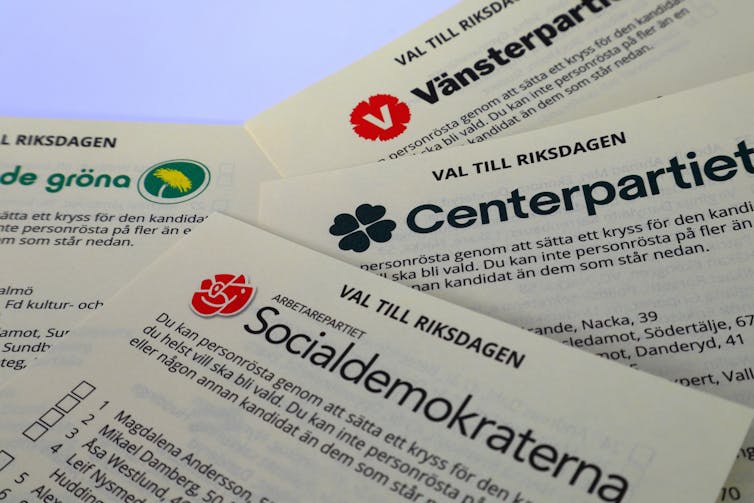
The parties present lists of candidates, and they are elected in groups to represent each constituency in proportion to how the electorate votes. For example, in Sweden there are 29 constituencies (valkretsar) and the total number of representatives to the parliament is 349. This means that the main parties gain proportionate representation in all constituencies.

There are also a few extra seats in the parliament given to the parties in order to rectify a remaining slight lack of proportionality. There is a 4% hurdle however, which means a slight distortion – in the interest of efficiency – of the idea of perfect proportionality.

This system means that, figuratively speaking, the people in Scandinavia rule themselves through their parliaments.


Read more:
Survey shows support for electoral reform now at 60% – so could it happen?


There are many positive aspects to such systems and hardly any principled drawbacks. At least this is the judgement I make as a philosopher. I leave the empirical matter to political scientists.

Democratic decision-making

To decide which system is, philosophically speaking, more desirable, we first need to define what it means for a collective of people to reach a decision in a democratic manner.

You could say that a collective decision made by a group has been made in a democratic manner if it has been reached by a mechanism guaranteeing that, if a majority exists in the group, then the collective decision is in accordance with this majority will. The standard mechanism is to rely on majority voting, of course.

We should also add that it is because the final decision is the will of the majority that it has prevailed.

What if no unique majority will exists because of a draw? In that case, it is left for the chairman to decide. Sometimes this happens – and it is a theoretical problem for majoritarian democratic decision-making – but in practice it is always possible to handle it.

Swedish ballot papers featuring lists of candidates for each party.
Shutterstock/Martin of Sweden

A democratic decision can only be reached if there are political agents such as voters or members of the parliament prepared (and allowed) to voice their opinions (in an appropriate manner).

The representative ideal

Once democratic decision-making has been defined, it is possible to articulate different ideals in terms of democracy. In each political ideology there is some room for democratic decision-making.

It is therefore possible to specify which decisions should, and which decisions should not, according to a certain political ideology, be taken in a democratic manner – as well as who should make those decisions. In some systems the president is democratically elected by the people directly, in other systems a prime minister is democratically elected by a parliament, and so forth.

The British parliament uses a democratic method of decision-making. The election of a representative in each constituency is also democratic – so long as only two candidates are in serious competition for the position. Either your candidate wins or your candidate loses because the majority want the other person to represent them.

The will of the majority is decisive. But when there are more than two candidates (and of course, in practice there are), a candidate lacking support from a majority can be – and often is – elected.

The representative model is different. The parliament reaches decisions through a democratic decision process but elections to that parliament are not democratic. Instead, they are proportionate, meaning candidates disliked by a majority can be elected. Even small parties get (proportionate) representation.

There is a democratic rationale behind a system of this kind, where representatives of the people gather, put forward proposals, discuss them, and have a vote. This is the idea that the decision the representatives reach will be the one those who are represented would also have reached, had they been able to gather in the same manner.

A proportionate system also guarantees representation for politically disliked minorities. They can enter the parliament even if no constituency exists where they are liked by a majority.

In parliament they can at least argue their case and, if it is a good one, gain support for it in the long run. This system is the best answer to Aristotle’s fear that a majority may come to oppress various minorities. It is not foolproof – but collective decision-making is a risky business in the first place.

Finally, the system meets the Platonist elitist objection that people aren’t good enough to rule themselves. In the proportionate system they rule themselves, but indirectly, and through trusted political experts. There is little reason to believe that the single individual who gets the upper hand in a single-member constituency is good enough to be your ruler.

So, my friendly advice to the people of the UK, at least from a philosophical perspective, is to adopt some version of the Scandinavian model.


Want more politics coverage from academic experts? Every week, we bring you informed analysis of developments in government and fact check the claims being made.

Sign up for our weekly politics newsletter, delivered every Friday.


The Conversation

Torbjörn Tännsjö does not work for, consult, own shares in or receive funding from any company or organisation that would benefit from this article, and has disclosed no relevant affiliations beyond their academic appointment.

ref. The UK needs a new electoral system – should it copy Scandinavia? – https://theconversation.com/the-uk-needs-a-new-electoral-system-should-it-copy-scandinavia-262670

Authoritarian rulers aren’t new – here’s what Herodotus, an early Greek historian, wrote about them

Source: The Conversation – USA (3) – By Debbie Felton, Professor of Classics, UMass Amherst

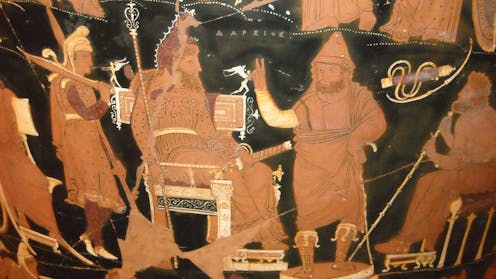
Darius I of Persia, center, and his court, from a vase painted between 340 and 320 B.C.E., on display at the National Archaeological Museum in Naples. Carlo Raso/ Flickr, CC BY-SA

No Kings” rallies. “Good Trouble” protests. “Rage against the Regime” uprisings. These events in the first seven months of President Donald Trump’s second term, along with public opinion polls, show that many Americans are concerned about Trump’s expansive use of executive power.

Views on this issue often have a partisan slant. Republicans express more concern about presidential power when Democrats control the White House, and vice versa.

But many in both parties prefer that U.S. political leaders work through established channels, rather than through unconventional actions that may pose challenges to the Constitution and the rule of law, such as mass firings and large-scale deportations.

A marble bust of a bearded man with name Herodotus inscribed in Greek at the base.
Greek historian and ethnographer Herodotus lived from about 484 B.C.E. to about 425 B.C.E.
Metropolitan Museum of Art/Wikimedia

As a professor of classics, I know that concerns about authoritarianism go back thousands of years. One early discussion appears in the work of the fifth-century B.C.E. Greek writer Herodotus, whose “History” – sometimes called “Histories” – is considered the first great prose narrative in Western literature.

In it, Herodotus analyzed the Persian invasion of Greece – the defining event of his time. To understand how Greece, a much smaller power, achieved a major victory over Persia, Herodotus explored the nature of effective leadership, which he saw as a critical factor in the conflict’s outcome.

A shocking upset

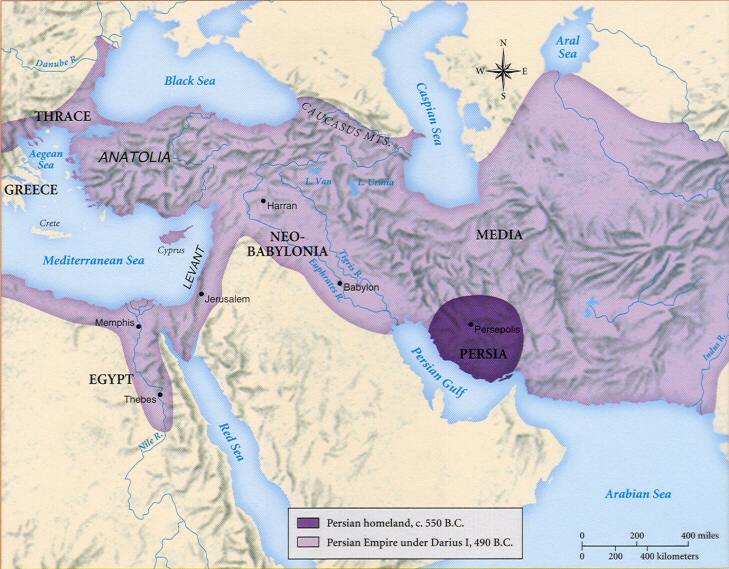
Persia was already a vast empire when it invaded Greece, a tiny country made up of independent city-states. The Persians expected a quick and easy victory.

Instead, the Greco-Persian Wars lasted over a decade, from 490 to 479 B.C.E. They ended with Greece defeating the Persians – a shocking upset. Consequently, Persia abandoned its westward expansion, while various Greek city-states formed a tenuous alliance that lasted nearly 50 years.

To explain this unexpected outcome, Herodotus described how Persian and Greek societies developed before this crucial conflict. In his view, the fact that many Greek city-states had representative governments enabled the Greek victory.

These systems allowed individuals to participate in discussing strategies and resulted in the Greeks uniting to fight for freedom. For example, when the Persian fleet was headed toward mainland Greece, the Athenian general Miltiades says, “Never before have we been in such extreme danger. If we give in to the Persians, we will suffer greatly under the tyrant Hippias.”

Herodotus tended to put his political philosophies into the mouths of historical figures such as Miltiades. He condensed his thoughts about government into what historians call the “Constitutional Debate,” a fictional conversation among three real characters: Persian noblemen named Otanes, Megabazus and Darius.

A scrap of dark brown fabric covered with Greek writing
A fragment from Herodotus’ ‘Histories,’ Book VIII, on papyrus, dated to the early second century C.E.
Sackler Library, Oxford/Wikimedia

Persia’s ascent

For centuries prior to invading Greece, Persia had been a small region inhabited by various ancient Iranian peoples and controlled by the neighboring kingdom of Media. Then, in 550 B.C.E., King Cyrus II of Persia overthrew the Medes and expanded Persian territory into what became the Achaemenid Empire.

Thanks to his effective leadership and tolerance for the customs of cultures he conquered, historians call him “Cyrus the Great.”

His son and successor, Cambyses, was less successful. He added Egypt to the Persian empire, but according to Herodotus, Cambyses acted erratically and cruelly. He desecrated the pharaoh’s tomb, mocked the Egyptians’ gods, and killed their sacred Apis bull. He also demanded that Persian judges change the laws so that he could marry his own sisters.

After Cambyses died childless, various factions vied for the Persian throne. Herodotus set his discussion about alternative political systems in this unstable period.

The case for democracy

Otanes, the first speaker in the Constitutional Debate, says “the time has passed for any one man among us to have absolute power.” He recommends that the Persian people themselves handle state affairs.

“How can monarchy continue to be our norm, when a monarch can do whatever he wants, with no accountability whatsoever?” Otanes asks. Even worse, a monarch “disrupts the laws,” as Cambyses did.

Otanes favors rule by the many, which he calls “isonomia,” meaning “equality under the law.” In this system, he explains, politicians are elected and held responsible for their behavior and make decisions transparently.

Today, unlike Otanes, Republican members of Congress appear reluctant to hold Trump responsible for anything or ensure transparency within the administration. Prominent Democrats, including U.S. Rep. Jamie Raskin and House Minority Leader Hakeem Jeffries, are challenging Trump administration actions that they view as lawless, such as freezing of funds authorized by Congress.

Do oligarchs know better?

Otanes’ fellow nobleman, Megabazus, agrees that the Persians should abolish monarchy, but he raises concerns about rule by the people.

“The masses are useless – there’s nothing more witless and violent than a crowd,” Megabazus asserts. He believes “commoners” don’t understand the intricacies of policymaking.

Instead, Megabazus suggests oligarchy, or “rule by a few.” Choose the best men in Persia and let them rule everyone else, he urges, because they “will naturally come up with the best ideas.”

But Megabazus doesn’t explain who would qualify as “the best men” or who would select them.

The U.S. has occasionally resembled an oligarchy, with small, elite groups holding most political power. For example, Article 1, Section 3 of the original Constitution provided for election of senators by state legislators, not directly by the people. Senators were not elected by popular vote until the 17th Amendment passed in 1913.

More recently, Trump has received millions of dollars in support from billionaire tech industry leaders such as Elon Musk, Mark Zuckerberg and Jeff Bezos, who hope to influence antitrust policy and deregulation. The Department of Government Efficiency, headed by Musk before he stepped down in May 2025, is now run by young men with virtually no government experience. DOGE’s cuts to programs such as humanitarian aid are wreaking havoc across the globe.

What about monarchy?

The third speaker, Darius, sees democracy and oligarchy as equally flawed. He points out that even well-intentioned oligarchs fight among themselves because “each wants his own opinion to prevail.” This leads to hatred and worse, much like the Trump-Musk relationship gone sour.

Rather, Darius asserts, “using good judgment, a monarch will be a flawless guardian of the people.” He argues that since Persia was freed by one man, King Cyrus II, Persians should maintain their traditional monarchy.

Darius doesn’t explain how to ensure a monarch’s good judgment. But his argument wins out. It had to, since in reality Darius became Persia’s next king. Kings, or shahs, ruled Persia – it became known as Iran in 1935 – until the Iranian Revolution of 1979 eliminated the monarchy and established the Islamic Republic of Iran.

Trump is not technically a monarch, but some believe he acts like one. He and his administration have ignored court orders, preempted the powers of Congress and sought to silence his critics by attacking protected free speech.

A crowd supports a long banner imprinted with the opening lines of the US Constitution.
Protesters carry a banner representing the preamble to the U.S. Constitution in downtown Los Angeles during an anti-Trump demonstration on June 14, 2025.
Mario Tama/Getty Images

Lessons from Herodotus

Herodotus himself was largely pro-democracy, but his Constitutional Debate doesn’t endorse one form of government. Instead, it highlights principles of good leadership. These include accountability, moderation and respect for “nomos,” a Greek term encompassing the concepts of custom and law.

Herodotus emphasizes: “Formerly great cities have become small, while small cities have become great.” Human fortune changes constantly, and Persia’s failure to conquer Greece is just one example.

History has seen the rise and fall of many world powers. Is the United States next? Herodotus viewed the Persian monarchy, whose kings believed their own authority was paramount, as the weakness that led to their astounding defeat in 479 B.C.E.

The Conversation

Debbie Felton is affiliated with the Democratic Party (registered to vote).

ref. Authoritarian rulers aren’t new – here’s what Herodotus, an early Greek historian, wrote about them – https://theconversation.com/authoritarian-rulers-arent-new-heres-what-herodotus-an-early-greek-historian-wrote-about-them-259127

Commerce Sénégal-Turquie : comment les Sénégalais ont bâti un pont entre Dakar et Istanbul

Source: The Conversation – in French – By Papa Sow, Senior Researcher, The Nordic Africa Institute

Le Premier ministre sénégalais Ousmane Sonko effectue une visite officielle en Turquie du 6 au 10 août 2025, un déplacement qui s’inscrit dans la continuité des liens anciens et croissants entre Dakar et Ankara. Ce voyage intervient, alors que la Turquie tente de maintenir une position forte en Afrique, avec sa “Politique d’ouverture vers l’Afrique”, adoptée en 1998.

En tant que chercheur sur les questions migratoires et géopolitiques, j’ai analysé, dans une récente étude, les formes d’agences, les réseaux sociaux et le commerce électronique transnational entre Dakar et Istanbul, ainsi que les personnes impliquées, notamment les migrants, les GP (Gratis Passengers ou gratuité partielle). Ces derniers sont des “expéditeurs” de fret ou “facteurs des airs”, qui utilisent leur franchise de bagages, pour transporter des colis hétéroclites entre Istanbul et Dakar. Cette activité est à tort ou à raison taxée de “clandestine”.

Mon étude met en lumière un commerce transnational actif et une migration circulaire et peu visible mais stratégique.

Les entretiens ont principalement porté sur les allers-retours des commerçants entre Dakar et Istanbul, les GP (essentiellement sénégalais) et autres hommes d’affaires sénégalais. Utilisant la puissance des réseaux sociaux tels que WhatsApp, TikTok et Facebook, ils commercent régulièrement avec la Turquie tout en résidant au Sénégal. Certains d’entre eux n’ont d’ailleurs jamais quitté le Sénégal.

Avec les tarifs préférentiels sur les billets d’avion, ils ont réussi à mettre en place un système de transport de colis payant fondé sur leur franchise de bagages. Contrairement aux passagers ordinaires qui ne peuvent dépasser les 46 kg autorisés, les GP peuvent transporter jusqu’à 100 kg par voyage, souvent avec des réductions de 50 % sur leurs tarifs grâce à des cartes de fidélité de compagnies aériennes.


Read more:
Comment l’Afrique de l’Ouest est devenue un terrain d’expansion pour la diplomatie turque


Origines de la coopération entre les deux pays

Les origines de la coopération entre Dakar et Istanbul remontent à 1900, année où un consulat honoraire fut ouvert à Dakar pour préserver les liens établis avec le Sénégal. Le premier ambassadeur de Turquie fut nommé au Sénégal en 1963. La première ambassade du Sénégal ouvrit en Turquie en 2006. Le Sénégal offre un potentiel considérable pour divers produits tels que le coton, les ressources halieutiques, les céréales, les fruits, les peaux, etc., qui sont tous exportés vers la Turquie.

En 2021, le volume des échanges commerciaux, industriels et d’investissements entre les deux pays a ainsi atteint plus de 540 millions de dollars US, contre plus de 91 millions de dollars américains en 2008. Cette coopération s’étend également à la défense, à la sécurité et à la culture. Une centaine d’entreprises turques sont déjà installées au Sénégal.

En 2017, l’État turc a régularisé plus de 1 400 Sénégalais vivant en Turquie. Le nombre de Sénégalais présents sur le sol turc varie selon les sources. On estime que plusieurs milliers de Sénégalais vivent ou transitent par le territoire turc. Depuis le milieu des années 2000, de nombreux commerçants et entrepreneurs sénégalais, notamment des femmes, effectuent des voyages d’affaires à Istanbul ou promeuvent les échanges commerciaux entre les deux pays.

En compétition avec le hub de Dubai, la nouvelle destination que constitue la Turquie a contribué non seulement à modifier un peu le paysage migratoire des Sénégalais vers l’Europe occidentale (qui demeurait la principale destination), mais a également permis à certains commerçants de se spécialiser dans les importations turques. Ces importations sont communément appelées au Sénégal, en langue Wolof, « bagaassu Turki » (produits turcs). Elles sont composées de cosmétiques, d’accessoires pour la maison, de vêtements et de divers produits technologiques.


Read more:
La Turquie, nouvel acteur majeur en Afrique ?


Les réseaux économiques transnationaux entre Istanbul et Dakar

Les commerçants interrogés ont déclaré avoir choisi Istanbul comme centre international d’approvisionnement en gros en raison du coût élevé des voyages vers la Chine et des problèmes de visas avec ce pays. À Istanbul, certains Sénégalais travaillent comme « expéditeurs » de fret, ou GP, en référence aux tarifs préférentiels des compagnies aériennes, et, par extension, comme transporteurs de colis hors taxes vers le Sénégal et d’autres pays africains.

Nous les distinguons des migrants kargo, qui transportent de grosses quantités de marchandises par bateau pour atteindre le Sénégal. Les GP, transportant de plus petites quantités, utilisent l’avion comme moyen de transport. Mais ils peuvent aussi souvent expédier le reste de leurs marchandises via le système Kargo.

Les GP ont également la possibilité de transporter des bagages supplémentaires, facturés comme fret. Dans ce contexte de transactions permanentes, ils effectuent régulièrement deux à trois allers-retours par mois entre Dakar et Istanbul.

Pistes de réflexion autour du phénomène

Premièrement, il serait intéressant de réaliser des études complètes sur le volume de marchandises et de produits expédiés du Sénégal vers la Turquie et inversement, mais aussi de dresser les profils et la cartographie des transporteurs et de connaître leurs revenus annuels. L’étude que j’ai menée n’a pas pu combler ce gap de statistiques. Les États sénégalais et turc seraient ainsi mieux à même de les soutenir en créant de nouveaux emplois.

Cela pourrait mettre en lumière le chiffre d’affaires global des commerçants turcs et sénégalais dans cette mobilité circulaire, mais aussi des nouveaux entrepreneurs émergents sur les réseaux sociaux qui commercent fréquemment sans jamais quitter le Sénégal.

Deuxièmement, le secteur du e-commerce développé par les entrepreneurs des réseaux sociaux est encore peu connu au Sénégal, mais il génère un nouveau marché. Ce créneau peu étudié, qualifié à tort ou à raison d’« informel », mérite une plus grande attention, car il a non seulement contribué à réduire le coût des marchandises sur les marchés locaux pour les consommateurs, mais a également permis de voir au Sénégal la distribution à grande échelle des produits turcs.

Troisièmement, les échanges qui tournent autour du bagaassu Turki sont diversement interprétés. Le mécontentement est visible parmi les artisans sénégalais qui accusent le bagaassu Turki d’avoir contribué à freiner la production textile et les savoir-faire créatifs locaux.

Plusieurs artisans sénégalais – cordonniers, bijoutiers, tailleurs – nous ont confié, par exemple, que les produits turcs – chaussures, sacs en cuir et vêtements surtout – constituent une sérieuse concurrence pour certains produits locaux. Les bagaassu Turki, plus élaborés et plus raffinés, se vendent facilement sur le marché sénégalais grâce à leurs prix abordables, contrairement aux produits locaux fabriqués à la main et nécessitant souvent de nombreuses heures de travail. Une telle doléance mérite également d’être prise au sérieux par les autorités sénégalaises.

Quatrièmement, la migration circulaire de courte durée – aller-retour – est souvent négligée dans les études sur les migrations, mais constitue une solution endogène pertinente entre pays riches et pays à faible revenu.

En favorisant cette forme de migration, au détriment de la migration de longue durée, susceptible de poser davantage de problèmes aux pays hôtes, il est tout à fait possible de redynamiser l’économie des pays à faible revenu grâce à la contribution des migrants. Cela passe par la mise en valeur de leur expertise et compétence, par des actions ciblées et inclusives favorisant l’accès à l’information en temps opportun et à la création d’emplois dans les pays d’origine.

À terme, une telle politique renforcera les capacités institutionnelles et améliorera les politiques migratoires, les cadres juridiques et les réglementations. Cela pourrait ainsi contribuer à faire de la mobilité des personnes et des biens entre les États une solution mutuellement avantageuse et à dissiper progressivement “l’heuristique de la peur” (décrit par le théoricien allemand Hans Jonas qui domine actuellement le débat politique sur les migrations internationales.

The Conversation

Papa Sow does not work for, consult, own shares in or receive funding from any company or organisation that would benefit from this article, and has disclosed no relevant affiliations beyond their academic appointment.

ref. Commerce Sénégal-Turquie : comment les Sénégalais ont bâti un pont entre Dakar et Istanbul – https://theconversation.com/commerce-senegal-turquie-comment-les-senegalais-ont-bati-un-pont-entre-dakar-et-istanbul-262814

Climat : ce que la décision historique de la Cour internationale de justice change pour l’Afrique

Source: The Conversation – in French – By Zunaida Moosa Wadiwala, PhD candidate in international climate law and litigation and Sessional Lecturer- University of the Witwatersrand, University of the Witwatersrand

_La Cour internationale de justice, la plus haute juridiction au monde, a rendu un avis consultatif le 23 juillet 2025. Elle y affirme que le changement climatique « met en péril toutes les formes de vie ». Cette décision fait suite à une recours porté devant la Cour par Vanuatu, un petit État insulaire du Pacifique Sud menacé par la montée des eaux. Cette initiative a été soutenue par 131 autres pays. Il s’agit du plus grand dossier jamais jugé par la Cour. L’avis définit les mesures que tous les gouvernements doivent prendre pour limiter les émissions de gaz à effet de serre et empêcher le réchauffement climatique. Zunaida Moosa Wadiwala, spécialiste du droit climatique, explique en quoi cet avis consultatif crée un précédent important en matière de responsabilité climatique mondiale.

Quelles sont les conclusions de la Cour internationale de justice ?

L’avis consultatif de la Cour a confirmé que les États ont l’obligation juridique, en vertu du droit international, de protéger le climat contre les changements climatiques causés par l’homme.

Le juge Dire Tladi, également premier juge sud-africain à siéger à la Cour internationale de justice, a qualifié cette affaire de l’une des plus importantes jamais portées devant la Cour. Il a souligné que le changement climatique est une crise existentielle qui menace potentiellement l’avenir de l’humanité.

À l’unanimité, la Cour a rendu un avis selon lequel les États ont l’obligation juridique contraignante de prévenir le réchauffement climatique. Ces obligations sont fondées sur les traités sur le climat, le droit international des droits de l’homme et le droit international coutumier. Elles s’appuient également sur des accords mondiaux visant à protéger des éléments spécifiques de l’environnement (tels que la Convention sur l’ozone, la Convention sur la biodiversité, la Convention sur la désertification et le droit de la mer des Nations unies).

L’avis consultatif précise que les gouvernements doivent prendre les mesures appropriées pour prévenir les dommages environnementaux. Ces mesures doivent se traduire par la mise en des programmes visant à adapter leur pays au changement climatique. Les États doivent également démontrer qu’ils réduisent leurs émissions de gaz à effet de serre.

La Cour a également déclaré que le non-respect de ces obligations constituait un acte illégal au vu du droit international. À ce titre, tout gouvernement responsable devra mettre fin à son comportement nuisible. Il devra également s’assurer de ne jamais répéter cet acte illégal et d’offrir des réparations intégrales pour le préjudice causé à toute personne lésée.

Cet avis consultatif devrait redéfinir le contentieux international en matière de climat et les politiques nationales.

S’agit-il d’une victoire pour les pays africains qui ont fourni des preuves ?

Oui. Le Kenya, le Ghana, le Madagascar, l’Afrique du Sud, le Cameroun, la Sierra Leone, Maurice, le Burkina Faso, et l’Égypte ont présenté des observations sur les dommages causés par le changement climatique. La Cour a accepté leurs arguments selon lesquels les pays en développement ont contribué de manière minime aux émissions mondiales de gaz à effet de serre, mais subissent les effets du changement climatique plus que les pays développés.

L’avis consultatif a également souligné qu’un environnement propre, sain et durable est nécessaire pour que les populations puissent jouir de leurs droits à l’accès à l’eau, à l’alimentation et au logement. Il s’agit là de questions clés qui ont été soulevées par les États africains.

La Cour a également répondu spécifiquement aux revendications des pays africains en affirmant que les pays développés doivent aider les pays en développement à s’adapter au changement climatique. Les pays développés sont tenus de fournir un soutien financier, de partager les nouvelles technologies d’adaptation et d’aider les pays vulnérables à renforcer leurs capacités pour faire face au réchauffement climatique.

La Cour a validé une approche fondée sur les droits, en particulier les droits à la vie, à la santé et à un environnement propre et durable. Elle a déclaré que les obligations en matière de changement climatique doivent s’appliquer erga omnes. Cela signifie qu’elles concernent tous les États, et qu’ils ont la responsabilité collective de les respecter. Cette décision donne raison aux demandes anciennes des pays africains pour plus de justice climatique, une reconnaissance juridique claire, et la reconnaissance de l’inégalité des impacts qu’elles subissent.

Cette décision aidera-t-elle les pays africains à réclamer des réparations pour les dommages climatiques qu’ils ont subis ?

Oui. Les pays africains disposent désormais d’outils pour demander réparation pour les dommages liés au climat. Ils devront établir un lien de causalité entre l’acte illégal d’un ou plusieurs États et les dommages subis. En d’autres termes, ils devront établir un lien de causalité clair, factuel et juridique, entre l’acte illégal et les préjudices.

L’une des difficultés pour faire respecter cette décision est que la Cour internationale de justice ne rend pas de jugements contraignants dans ses avis consultatifs. Ainsi, pour réclamer des réparations, les États africains devraient engager une procédure contentieuse devant la Cour contre les pays fortement émetteurs de gaz à effet de serre. Mais cela n’est possible que si ces pays acceptent la compétence de la Cour.

Étant donné la nature mondiale et cumulative des émissions, prouver qu’un dommage spécifique (inondations, glissements de terrain, sécheresses ou vagues de chaleur) est causé par un pays particulier ou est complexe.

Une autre option pour les pays touchés est de poursuivre en justice des entreprises de combustibles fossiles devant des tribunaux nationaux ou étrangers. L’avis de la Cour renforce les arguments fondés sur le droit des délits (responsabilité pour un acte causant un préjudice) ou sur des notions comme la nuisance (atteinte à l’usage ou à la jouissance d’un bien) et l’enrichissement indu (bénéfice obtenu au détriment d’autrui).

Qu’est-ce que cela signifie pour les pays africains qui continuent d’explorer et d’utiliser les combustibles fossiles ?

L’avis consultatif est très précis sur la manière dont les combustibles fossiles tels que le gaz, le pétrole et le charbon doivent être traités. Il indique que si un État poursuit l’extraction de combustibles fossiles et ne prend pas les mesures climatiques appropriées, il pourrait violer le droit international. Continuer à produire et à consommer des combustibles, octroyer des licences à des sociétés minières pour explorer des combustibles fossiles ou subventionner l’industrie des combustibles fossiles peut également constituer une violation du droit international.

Dans le contexte de la responsabilité des États, cela a de graves implications juridiques pour les 48 pays africains qui sont encore impliqués dans ces activités liées aux combustibles fossiles.

Cet avis consultatif place ces pays devant leurs responsabilités : ils ne peuvent plus demander la justice climatique sur la scène internationale tout en développant les énergies fossiles chez eux. Un État pourrait même être tenu responsable s’il n’impose pas des règles pour encadrer les émissions produites par les entreprises privées sur son territoire.

Il s’agit d’un progrès significatif. Jusqu’ici, par exemple, dans les affaires climatiques sud-africaines qui ont déjà été jugées, elles s’appuyaient principalement sur des questions de procédures, des arguments constitutionnels ou liés aux risques climatiques, comme le manque de consultation des communautés avant l’octroi de licences pour des mines de charbon ou l’impact sur le droit d’accès à l’eau.

Désormais, ce sont les activités liées aux combustibles fossiles elles-mêmes qui peuvent être remises en cause.

En Afrique du Sud, cette nouvelle orientation juridique s’aligne sur la loi sur le changement climatique adoptée en 2024. Cette loi prévoit une réduction progressive, puis une élimination des émissions de gaz à effet de serre d’origine humaine. Elle trace aussi la voie vers une économie sobre en carbone et capable de résister aux effets du changement climatique.

The Conversation

Zunaida Moosa Wadiwala does not work for, consult, own shares in or receive funding from any company or organisation that would benefit from this article, and has disclosed no relevant affiliations beyond their academic appointment.

ref. Climat : ce que la décision historique de la Cour internationale de justice change pour l’Afrique – https://theconversation.com/climat-ce-que-la-decision-historique-de-la-cour-internationale-de-justice-change-pour-lafrique-262638