2025’s extreme weather brought intense flash flooding, but no hurricane landfalls in the US – the jet stream is a big reason why

Source: The Conversation – USA (2) – By Shuang-Ye Wu, Professor of Geology and Environmental Geosciences, University of Dayton

The summer of 2025 brought unprecedented flash flooding across the U.S., with the central and eastern regions hit particularly hard. These storms claimed hundreds of lives across Texas, Kentucky and several other states and caused widespread destruction.

At the same time, every hurricane that formed, including the three powerful Category 5 storms, steered clear of the U.S. mainland.

Both scenarios were unusual – and they were largely directed by the polar jet stream.

What is a jet stream?

Jet streams are narrow bands of high-speed winds in the upper troposphere, around four to eight miles (seven to 13 kilometers) above the surface of the Earth, flowing west to east around the entire planet. They form where strong temperature contrasts exist.

Each hemisphere hosts two primary jet streams:

a globe showing the polar and subtropical jet streams in both the Northern and Southern Hemispheres.
The polar and subtropical jet streams in positions similar to much of summer 2025.
NOAA

The polar jet stream is typically found near 50 to 60 degrees latitude, across Canada in the Northern Hemisphere, where cold polar air meets warmer midlatitude air. It plays a major role in modulating weather systems in the midlatitudes, including the continental U.S. With winds up to 200 mph, it’s also the usual steering force that brings those bitter cold storms down from Canada.

The subtropical jet stream is typically closer to 30 degrees latitude, which in the Northern Hemisphere crosses Florida. It follows the boundary between tropical air masses and subtropical air masses. It’s generally the weaker and steadier of the two jet streams.

Illustration shows earth an air circulation cells above it.
A cross section of atmospheric circulations shows where the jet streams exist between large cells of rising and falling air, movements largely driven by solar heating in the tropics.
NOAA

These jet streams act like atmospheric conveyor belts, steering storm systems across continents.

Stronger (faster) jet streams can intensify storm systems, whereas weaker (slower) jet streams can stall storm systems, leading to prolonged rainfall and flooding.

2025’s intense summer of flooding

Most summers, the polar jet stream retreats northward into Canada and weakens considerably, leaving the continental U.S. with calmer weather. When rainstorms pop up, they’re typically caused by localized convection due to uneven heating of the land – picture afternoon pop-up thunderstorms.

During the summer of 2025, however, the polar jet stream shifted unusually far south and steered larger storm systems into the midlatitudes of the U.S. At the same time, the jet stream weakened, with two critical consequences.

First, instead of moving storms quickly eastward, the sluggish jet stream stalled storm systems in place, causing prolonged downpours and flash flooding.

Second, a weak jet stream tends to meander more dramatically. Its broad north-south swings in summer 2025 funneled humid air from the Gulf of Mexico deep into the interior, supplying storm systems with abundant moisture and intensifying rainfall.

Three people in a small boat on a river with a building behind them. The wall is torn off and debris is on the river banks.
Search-and-rescue crews look for survivors in Texas Hill Country after a devastating July 4, 2025, flash flood on the Guadalupe River swept through a girls’ camp, tearing walls off buildings.
Ronaldo Schemidt/AFP via Getty Images

This moisture surge was amplified by unusually warm conditions over the Atlantic and Gulf regions. A warmer ocean evaporates more water, and warmer air holds a greater amount of moisture. As a result, extraordinary levels of atmospheric moisture were directed into storm systems, fueling stronger convection and heavier precipitation.

Finally, the wavy jet stream became locked in place by persistent high-pressure systems, anchoring storm tracks over the same regions. This led to repeated episodes of heavy rainfall and catastrophic flooding across much of the continental U.S. The same behavior can leave other regions facing days of unrelenting heat waves.

The jet stream buffered US in hurricane season

The jet stream also played a role in the 2025 hurricane season.

Given its west-to-east wind direction, the southward dip of the jet stream – along with a weak high pressure system over the Atlantic – helped steer all five hurricanes away from the U.S. mainland.
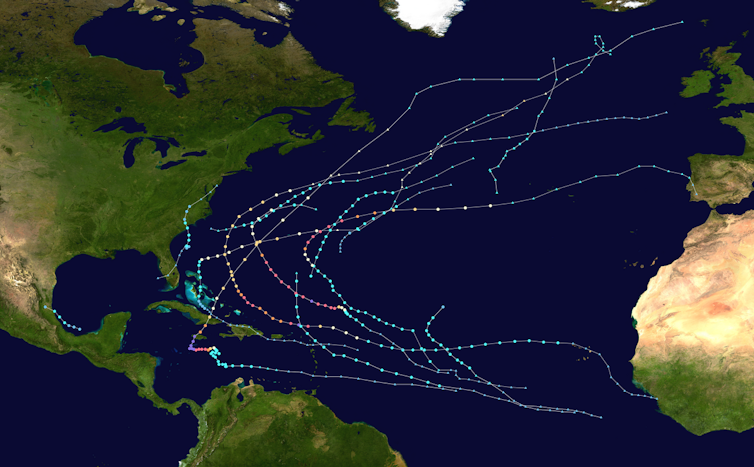
The 2025 Atlantic hurricane season’s storm tracks show how most of the storms steered clear of the U.S. mainland and veered off into the Atlantic.
Sandy14156/Wikimedia Commons

Most of the year’s 13 tropical storms and hurricanes veered off into the Atlantic before even reaching the Caribbean.

An animation shows the direction of steering winds over four days
Charts of high-level steering currents over five days, Oct. 23-27, 2025, show the influences that kept Hurricane Melissa (red dot) in place for several days. The strong curving winds in red are the jet stream, which would help steer Melissa northeastward toward the open Atlantic.
Cooperative Institute for Meteorological Satellite Studies/University of Wisconsin-Madison, CC BY-ND

Climate change plays a role in these shifts

So, how does climate change influence the jet stream?

The strength of jet streams is controlled by the temperature contrast between the equatorial and polar regions.

A higher temperature contrast leads to stronger jet streams. As the planet warms, the Arctic is heating up at more than twice the global average rate, and that is reducing the equator-to-pole temperature difference. As that temperature gradient weakens, jet streams lose their strength and become more prone to stalling.

A chart shows rising temperatures in the Arctic
The Arctic has been warming two times faster than the planetary average.
NOAA Arctic Report Card 2024

This increases the risk of persistent extreme rainfall events.

Weaker jet streams also meander more, producing larger waves and more erratic behavior. This increases the likelihood of unusual shifts, such as the southward swing of the jet stream in the summer of 2025.

A recent study found that amplified planetary waves in the jet streams, which can cause weather systems to stay in place for days or weeks, are occurring three times more frequently than in the 1950s.

What’s ahead?

As the global climate continues to warm, extreme weather events driven by erratic behavior of jet streams are expected to become more common. Combined with additional moisture that warmer oceans and air masses supply, these events will intensify, producing storms that are more frequent and more destructive to societies and ecosystems.

In the short term, the polar jet stream will be shaping the winter ahead. It is most powerful in winter, when it dips southward into the central and even southern U.S., driving frequent storm systems, blizzards and cold air outbreaks.

The Conversation

Shuang-Ye Wu does not work for, consult, own shares in or receive funding from any company or organization that would benefit from this article, and has disclosed no relevant affiliations beyond their academic appointment.

ref. 2025’s extreme weather brought intense flash flooding, but no hurricane landfalls in the US – the jet stream is a big reason why – https://theconversation.com/2025s-extreme-weather-brought-intense-flash-flooding-but-no-hurricane-landfalls-in-the-us-the-jet-stream-is-a-big-reason-why-270641

From truce in the trenches to cocktails at the consulate: How Christmas diplomacy seeks to exploit seasonal goodwill

Source: The Conversation – Global Perspectives – By Andrew Latham, Professor of Political Science, Macalester College

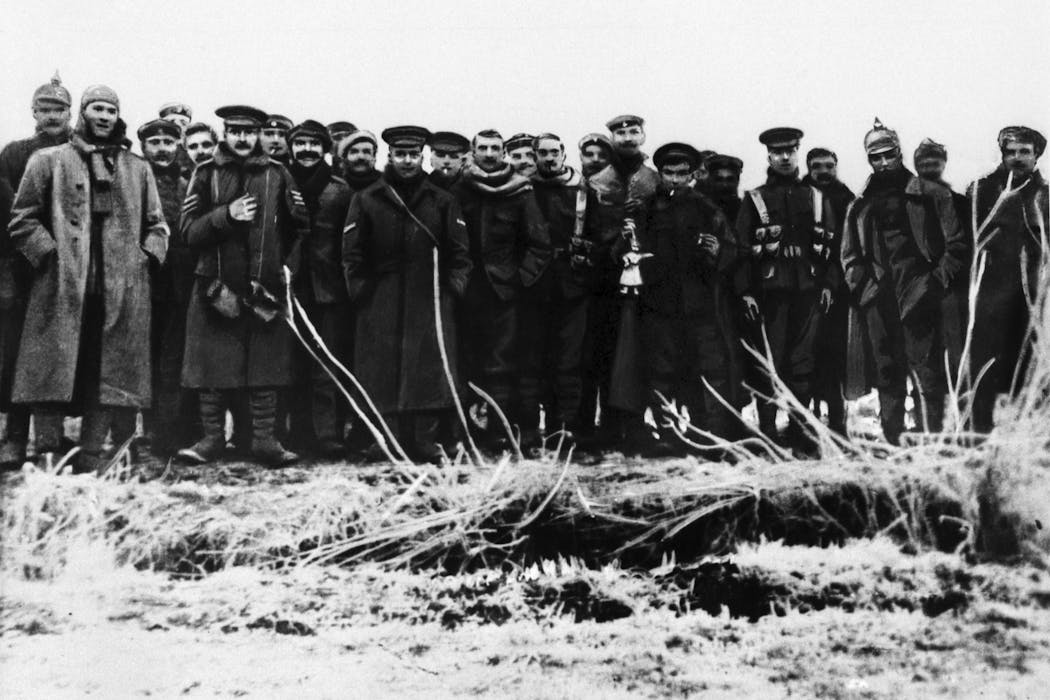
British and German troops observe a temporary truce on Christmas Day 1914. Daily Mirror/Mirrorpix via Getty Images

President Donald Trump is reportedly setting his sights on a Christmas peace deal in the Ukraine-Russia war.

The timing is apt. Every December, political leaders reach instinctively for the language of goodwill. Meanwhile, diplomats the world over use the season to host parties at which gift-giving and booze are used to help foster friendships.

The notion that the holiday season might bring a respite from conflict has deep roots in history. Medieval “Christmas peace” laws in northern Europe at one point punished crimes committed during the season with harsher penalties, enshrining in law a cultural sense of expectation for quiet and restraint.

Finland still reads the Declaration of Christmas Peace each Christmas Eve – a ceremonial reminder of an older hope that violence might briefly ebb.

Today’s “Christmas diplomacy” – that is, a range of statements and efforts to encourage peace and warm relations between nations — updates the tradition for statecraft.

Sometimes, such diplomacy really does open a window for talks. Sometimes it is a cultural reflex. Sometimes it is pure theater. And sometimes, the season’s distractions are exploited for war and violence rather than peace.

The most famous of them all

The Treaty of Ghent that ended the War of 1812 between the United States and Great Britain was signed on Christmas Eve. It was a signal that both sides were ready to convert seasonal sentiment into durable peace.

But the most famous example of the season interrupting conflict is the Christmas Truce of 1914. After months of fighting along parts of the Western Front in World War I, soldiers on opposing sides left the trenches to sing, retrieve the dead and share a moment of humanity before returning to the industrial warfare from which many of them would never return.

This act was repeated during the Battle of the Bulge in World War II, when a small number of American and German soldiers struck a temporary truce in the Hürtgen Forest during Christmas 1944.

People standing around drinking out of cocktail glasses.
Guests enjoy martinis and shots of vodka during a party at the Russian Embassy in Washington in 2007.
Getty Images for Russian Standard

A seasonal opening to dialogue?

More recently, governments and nongovernmental actors have leveraged the holidays to open the door for future peace negotiations.

In Northern Ireland, for example, the Provisional IRA repeatedly declared Christmas ceasefires, most notably in December 1974 when it announced a halt to operations from Dec. 22 through early January. While the truce ultimately collapsed, it reflected a recurring pattern during The Troubles in which Christmas provided a culturally resonant moment to signal openness to dialogue.

A similar logic was observed more recently in Colombia, where in 2022, the National Liberation Army (ELN) declared a unilateral Christmas ceasefire, explicitly tying the pause in hostilities to ongoing peace negotiations with the government.

In both cases, Christmas functioned not as a sentimental interruption to war, but as a strategic moment to legitimize restraint and probe whether diplomacy could bring an end to the underlying conflict.

But as with any temporary ceasefire, Christmas truces can be prone to violations. During the Vietnam War, warring parties in 1971 agreed to a 24-hour Christmas truce. A report from The New York Times the following day included allegations of 19 violations by the Vietcong and 170 by American and South Vietnamese forces.

The holidays can also serve as an opportunity to catch an enemy off guard.

Seven years before the short-lived 1971 Christmas truce, Vietcong fighters chose Christmas Eve to launch an attack on a hotel where U.S. officers were celebrating. Two Americans were killed and 28 were injured.

The Soviet Union launched its 1979 invasion of Afghanistan on Christmas Eve, and Israel’s 2008 Gaza operation began on Dec. 27. The logic here is that in late December, political bandwidth in national capitals is thin, diplomatic machinery moves more slowly and the opportunity for surprise is greater.

‘Tis the season for …

Christmas diplomacy can therefore be used to encourage peace – or war.

It can also be used to deepen existing bilateral friendships.

A well-known example is Norway’s annual donation of Christmas trees to the United Kingdom. The practice began in 1947, when Oslo sent a giant spruce to London’s Trafalgar Square as a thank-you for British support during World War II. It has since become a ritualized expression of common history, shared sacrifice and enduring alliance.

A man and women cut a red ribbon in front of a large tree.
Then foreign secretaries Ine Eriksen Soreide of Norway and Boris Johnson of the U.K. unveil the 2017 Christmas tree gifted by Norway.
Adrian Dennis/AFP via Getty Images

And embassies around the world host Christmas receptions that function as informal diplomatic spaces – occasions where tensions ease, conversations flow more freely and difficult issues can be broached in a more relaxed setting.

These practices do not resolve crises but lay important groundwork for goodwill and access.

Christmas diplomacy endures because it stands at the crossroads of culture, power and politics. The season brings with it a set of expectations about restraint and goodwill that leaders can invoke, diplomats can exploit and adversaries can either honor or abuse.

This article is part of a series explaining foreign policy terms commonly used but rarely explained.

The Conversation

Andrew Latham does not work for, consult, own shares in or receive funding from any company or organization that would benefit from this article, and has disclosed no relevant affiliations beyond their academic appointment.

ref. From truce in the trenches to cocktails at the consulate: How Christmas diplomacy seeks to exploit seasonal goodwill – https://theconversation.com/from-truce-in-the-trenches-to-cocktails-at-the-consulate-how-christmas-diplomacy-seeks-to-exploit-seasonal-goodwill-271478

Pourquoi les adultes demandent des jouets au Père Noël

Source: The Conversation – France (in French) – By Mathieu Alemany Oliver, Professeur en comportements et cultures de consommation – marketing, TBS Education

Au XVIII<sup>e</sup>&nbsp;siècle, la pensée des Lumières transforme l’enfance en une catégorie sociale à part, dont les jouets deviennent l’emblème. Stokkete/Shutterstock

À quelques jours du passage du Père Noël dans les foyers, la part des jouets vendus et destinés aux adultes ne cesse de progresser en France. Comment expliquer ce phénomène ? Que nous dit-il de notre époque ? Explication avec un détour historique de l’Antiquité à la révolution industrielle en passant par Léonard de Vinci.


Contrairement à une idée reçue, les jouets n’ont pas toujours été destinés aux enfants. La chercheuse Susan Stewart rappelle qu’au XVIIIe siècle, les poupées étaient des objets de luxe pour adultes.

La légitimation croissante du jouet chez l’adulte s’inscrit dans un contexte contemporain marqué par une crise de l’âge adulte et une polycrise.

Le grand gagnant de cet effritement de la frontière entre enfance et âge adulte, c’est bien le marketing. Pour fonctionner à plein régime, les marques ont besoin de notre enfant intérieur qui suit le principe de plaisir et se préoccupe peu du principe de réalité. Le jeu, l’imagination et la pensée magique, traditionnellement associés à l’enfance, sont les conditions mêmes d’existence du marketing, mais aussi les conditions d’acceptation par les consommateurs et consommatrices de leur existence finie.

Historiquement, les adultes avaient des jouets

Les jouets n’ont pas toujours été l’apanage des enfants. Leur exclusion progressive du monde adulte est directement liée à la construction progressive de l’enfance comme catégorie sociale distincte, à partir du XVIIIe siècle.

Poupée antique grecque en terre cuite (Fin Vᵉ siècle – début IVᵉ siècle avant Jésus-Christ).
Frank Tomio/Archäologische Sammlung der Universität Zürich

Dans l’Antiquité, une poupée articulée en terre cuite pouvait aussi bien divertir les enfants qu’accompagner l’adulte dans l’au-delà, en tant qu’objet funéraire. Plus tard, de la Renaissance au XVIIIe siècle, les objets mécaniques comme les tabatières à système, ou encore les automates comme le lion de Léonard de Vinci, étaient des jouets de prestige pour adultes. Exposés dans les cabinets de curiosité ou utilisés lors des réceptions, ces objets mécaniques servaient à amuser et émerveiller les personnes invitées, tout en affichant un statut social désirable.

Au XVIIIe siècle, la pensée des Lumières transforme l’enfance en une catégorie sociale à part, dont les jouets deviennent l’emblème. Comme le dira le bibliothécaire et historien Henry René d’Allemagne en 1902, « là où est l’enfant, là aussi est le jouet ». Ce statut particulier des enfants se traduit par une séparation physique avec les adultes : des vêtements spécifiques ou encore des espaces comme l’école, voire même une chambre, leur sont désormais réservés.

De leur côté, les adultes voient les pratiques ludiques stigmatisées. L’exception : s’inscrire dans une pratique à laquelle les enfants ne pourraient pas s’adonner, comme le collectionnisme, le modélisme, ou l’art. Il faut que le jouet de l’adulte soit l’objet d’une activité sérieuse qui nécessite de la technique et de la connaissance. L’adulte doit incarner l’idéal de raison, de travail et de maîtrise de soi.

Le jouet de l’enfant, lui, échappe à ces contraintes et aux exigences de productivité et de rationalité du monde adulte. Les enfants sont valorisés pour leur émotionnalité, son imagination débridée et son inutilité sociale temporaire.

Démocratisation des jouets auprès des classes moyennes

En démocratisant les jouets auprès des classes moyennes, la révolution industrielle de la fin XVIIIe au début du XIXe siècle renforce et institutionnalise l’association jouet-enfance.

Les plus belles poupées de Paris du Bon Marché à Noël en 1924, dans la droite ligne de la révolution industrielle.
Gallica

Les grands magasins, soutenus par les manufactures de jouets comme le fabricant de jouets mécaniques Fernand Martin, armés de catalogues d’étrennes, transforment Noël en une fête commerciale à destination des enfants. Apparaissent des rayons dédiés aux jouets d’enfants, comme le note Émile Zola.

La ou le « kidult », antithèse de l’adulte des Lumières

Environ cent cinquante ans plus tard, en 2025, les magasins français de jeux et jouets King Jouet ouvrent des magasins éphémères, rebaptisés King’Dultes. Ceux-ci s’adressent aux « kidults », un mot-valise proposé dans les années 1950 et repris par le marketing pour segmenter ces adultes attirés par des produits et activités traditionnellement réservés aux enfants.

Le néologisme « kidult », proposé dans les années 1950 par l’industrie audiovisuelle états-unienne, désigne d’abord les adultes qui regardent des émissions pour enfants.

Le terme est de nouveau utilisé dans les années 1970-1980 pour parler des adultes qui profitent des avantages de l’âge adulte tout en refusant de l’embrasser pleinement. Ces derniers et dernières rejettent les responsabilités et les obligations traditionnellement associées, tout comme le sérieux qui caractérise l’adulte moderne depuis les Lumières.

Repenser l’enfance et l’âge adulte

La médiatisation et la légitimation grandissantes de la figure du ou de la « kidult » reflète une crise plus large de la modernité, où les sociétés occidentales, devenues méfiantes envers les autorités et les grands récits, voient se dissoudre les repères traditionnels. Selon le philosophe Jean-François Lyotard ou le sociologue Zygmunt Bauman, nous sommes entrés dans une nouvelle ère appelée respectivement postmodernité, ou modernité liquide. Celle-ci affaiblirait les constructions intellectuelles et sociales binaires telles que le genre et amène à repenser des concepts comme la famille, le travail, la vérité, ou encore… l’enfant et l’adulte.

Symbole de ce changement de paradigme, Le Syndrome de Peter Pan du psychanalyste Dan Kiley, ou l’enfant qui ne veut pas grandir, connaît en 1983 un vif succès. Il y est question des difficultés de certains jeunes hommes à endosser le rôle moderne et prédéfini de l’adulte.

Le syndrome de Peter Pan fait référence à un garçon, un adolescent ou un adulte, refusant de grandir.
Photology1971/Shutterstock

Plus récemment, de nombreux chercheurs et chercheuses ont appelé à une réévaluation de la notion d’âge adulte. Compte tenu du temps nécessaire à la maturation cérébrale, du report du mariage et de la parentalité (quand ces étapes-là surviennent), de la poursuite d’études supérieures, ainsi que des difficultés croissantes d’accès au logement, l’autonomie sociale, économique et émotionnelle arrive plus tardivement qu’auparavant.

Ce que nous comprenons comme l’âge adulte dans nos sociétés occidentales ne commence plus qu’à partir de 25-30 ans. Dans ce contexte, le professeur de psychologie Jeffrey Arnett propose d’ajouter une phase de vie intermédiaire, « l’âge adulte émergent », située entre l’adolescence et l’âge adulte traditionnel. Cette théorie, sans faire l’unanimité, souligne néanmoins la difficulté actuelle à définir ce que nos sociétés entendent par âge adulte.

L’enfance comme refuge symbolique dans une ère de crise

Si la visibilité croissante des kidults s’explique en partie par cette érosion de l’âge adulte, elle s’explique également par la recherche d’un refuge symbolique dans un contexte de polycrise. Cette ère de modernité liquide est celle d’une ère de l’incertitude et du risque.

Parce que l’enfance s’est construite, siècle après siècle, en opposition à l’âge adulte, c’est naturellement vers elle que l’on se tourne quand le quotidien, associé à la vie d’adulte, devient trop pesant. L’enfance est réconfortante, car elle est symboliquement restée à l’écart du monde productiviste.

Elle est un refuge symbolique, dans lequel nous sommes tous et toutes autorisées à jouer sous une forme païdique, c’est-à-dire de manière libre, spontanée, pour le simple plaisir de jouer. Sans règle. Sans but. Sans compétition. Il s’agit d’un monde qui n’existe plus dans nos économies de marché où tout est quantifié, jusqu’à la course à pied qui se pare aujourd’hui d’objets connectés et s’apparente plus à une répétition de la vie active qu’à la course sans but de l’enfant.

The Conversation

Mathieu Alemany Oliver ne travaille pas, ne conseille pas, ne possède pas de parts, ne reçoit pas de fonds d’une organisation qui pourrait tirer profit de cet article, et n’a déclaré aucune autre affiliation que son organisme de recherche.

ref. Pourquoi les adultes demandent des jouets au Père Noël – https://theconversation.com/pourquoi-les-adultes-demandent-des-jouets-au-pere-noel-265605

As DOJ begins to release Epstein files, his many victims deserve more attention than the powerful men in his ‘client list’

Source: The Conversation – USA – By Stephanie A. (Sam) Martin, Frank and Bethine Church Endowed Chair of Public Affairs, Boise State University

Passage of the Epstein Files Transparency Act, backed by many of Epstein’s alleged victims and family members, led the DOJ to begin releasing some of the Epstein files. AP Photo/J. Scott Applewhite

The U.S. Department of Justice has made a partial release of documents from what’s become known collectively as the “Jeffrey Epstein files,” with more to follow at an unspecified time. On a special part of its website that the department titled “Epstein Library,” it lists documents such as court records and records released in response to Freedom of Information Act requests to the government.

Their release was ordered by Congress in bipartisan legislation passed in November 2025. The deadline imposed by Congress was Dec. 19, 2025, and the Department of Justice met it with the partial release of documents in its possession with eight hours to spare.

Those files will be read, dissected and discussed by politicians and the public and reported on by the news media. It will be the latest eruption in a story that has slipped in and out of the headlines for years, but in a very particular way. Most news articles ask a specific question – which powerful men might be on “the list”? Journalists and the public are watching to see what those documents will reveal beyond names we already know, and whether a long-rumored client list will finally materialize.

Headlines in the past have focused on unidentified elites and who may be exposed or embarrassed, rather than on the people whose suffering made the case newsworthy in the first place: the girls and young women Epstein abused and trafficked.

a screenshot of a website that says epstein library
The Justice Department began posting Epstein files late Friday afternoon.
Screenshot of DOJ website

Alongside that, there has been a stream of survivor-centered reporting. Some outlets, including CNN, have regularly featured Epstein survivors and their attorneys reacting to new developments. Those segments are a reminder that another story is available, one that treats the women at the center of the case as sources of understanding, not just as evidence of someone else’s fall from grace.

These coexisting storylines reveal a deeper problem. After the #MeToo movement peaked, the public conversation about sexual violence and the news has clearly shifted. More survivors now speak publicly under their own names, and some outlets have adapted.

Yet long-standing conventions about what counts as news – conflict, scandal, elite people and dramatic turns in a case – still shape which aspects of sexual violence make it into headlines and which stay on the margins.

That tension raises a question: In a case where the law largely permits naming victims of sexual violence, and where some survivors are explicitly asking to be seen, why do journalistic practices so often withhold names or treat victims as secondary to the story?

A “CBS Evening News” story from Dec. 12, 2025, teases the photos revealed by House Democrats of famous men with Jeffrey Epstein.

What the law allows – and why newsrooms rarely do it

The U.S. Supreme Court has repeatedly held that government generally may not punish news organizations for publishing truthful information drawn from public records, even when that information is a rape victim’s name.

When states tried in the 1970s and 1980s to penalize outlets that identified victims using names that had already appeared in court documents or police reports, the court said those punishments violated the First Amendment.

Newsrooms responded by tightening restraint, not loosening it. Under pressure from feminist activists, victim advocates and their own staff, many organizations adopted policies against identifying victims of sexual assault, especially without consent.

Journalism ethics codes now urge reporters to “minimize harm,” be cautious about naming victims of sex crimes, and consider the risk of retraumatization and stigma.

In other words, U.S. law permits what newsroom ethics codes discourage.

How anonymity became the norm and #MeToo complicated it

Anti-rape culture protesters gathered in a crowd.
The anti-rape movement in the U.S. forced newsrooms to revisit assumptions about whose voices should lead a story.
Cory Clark/NurPhoto via Getty Images

For much of the 20th century, rape victims were routinely named in U.S. news coverage – a reflection of unequal gender norms. Victims’ reputations were treated as public property, while men accused of sexual violence were portrayed sympathetically and in detail.

By the 1970s and 1980s, feminist movements drew attention to underreporting and intense stigma. Activists built rape crisis centers and hotlines, documented how rarely sexual assault cases led to prosecution, and argued that if a woman feared seeing her name in the paper, she might never report at all.

Lawmakers passed “rape shield laws” that limited the use of a victim’s sexual history in court. Some states went further by barring publication of victims’ names.

In response to these laws, as well as feminist pressure, most newsrooms by the 1980s moved toward a default rule of not naming victims.

More recently, the #MeToo movement added a turn. Survivors in workplaces, politics and entertainment chose to speak publicly, often under their own names, about serial abuse and institutional cover-ups. Their accounts forced newsrooms to revisit assumptions about whose voices should lead a story.

Yet #MeToo also unfolded within existing journalistic conventions. Investigations tended to focus on high-profile men, spectacular falls from power and moments of reckoning, leaving less space for the quieter, ongoing realities of recovery, legal limbo and community response.

The unintended effects of keeping survivors faceless

There are good reasons for policies against naming victims.

Survivors may face harassment, employment discrimination or danger from abusers if they are identified. For minors, there are additional concerns about long-term digital evidence. In communities where sexual violence carries intense social stigma, anonymity can be a lifeline.

But research on media framing suggests that naming patterns matter. When coverage focuses on the alleged perpetrator as a complex individual – someone with a name, a career and a backstory – while referring to “a victim” or “accusers” in the singular, audiences are more likely to empathize with the suspect and scrutinize the victim’s behavior.

In high-profile cases like Epstein’s, that dynamic intensifies. The powerful men connected to him are named, dissected and speculated about. The survivors, unless they work hard to step forward, remain a blurred mass in the background. Anonymity meant to protect actually flattens their experience. Different stories of grooming, coercion and survival get reduced to a single faceless category.

A window into what we think is ‘news’

That flattening is part of what makes the current moment in the Epstein story so revealing. The suspense is less about whether more victims will be heard and more about what being named will do to influential men. It becomes a story about whose names count as news.

Carefully anonymizing survivors while breathlessly chasing a client list of powerful men unintentionally sends a message about who matters most.

The Epstein scandal, in that framing, is not primarily about what was done to girls and young women over many years, but about who among the elite might be embarrassed, implicated or exposed.

A more survivor-centered journalistic approach would start from a different set of questions, including wondering which survivors have chosen to speak on the record and why, and how news outlets can protect anonymity, when it is asked for, but still convey a victim’s individuality.

Those questions are not only about ethics. They are about news judgment. They ask editors and reporters to consider whether the most important part of a story like Epstein’s is the next famous name to drop or the ongoing lives of the people whose abuse made that name newsworthy at all.

This is an update to a story originally published on Dec. 15, 2025, to reflect the release of documents by the U.S. Department of Justice on Dec. 19.

The Conversation

Stephanie A. (Sam) Martin does not work for, consult, own shares in or receive funding from any company or organization that would benefit from this article, and has disclosed no relevant affiliations beyond their academic appointment.

ref. As DOJ begins to release Epstein files, his many victims deserve more attention than the powerful men in his ‘client list’ – https://theconversation.com/as-doj-begins-to-release-epstein-files-his-many-victims-deserve-more-attention-than-the-powerful-men-in-his-client-list-272414

How to reduce gift-giving stress with your kids – a child psychologist’s tips for making magic and avoiding tears

Source: The Conversation – USA (2) – By Angela J. Narayan, Associate Professor, Clinical Child Psychology Ph.D. program, University of Denver

’Tis the season … for gift-buying stress. Photo by Ryan Miller/Invision/AP

As a child, I loved being the center of attention. So it was a problem when my baby brother was born a day before my birthday. For years, I would beg my parents for a birthday gift “one day early.” My laid-back brother remembers thinking, “I don’t care about presents. Just give her mine!”

As an associate professor and child psychologist at the University of Denver who studies child development and parenting, I’ve come to learn about these types of challenges associated with gift giving. The holidays, while a magical time, can also be stressful. Society places an expectation on parents to buy gifts, regardless of their financial circumstances, and children themselves often feel a variety of complex emotions.

How children react to getting presents is partially linked to temperament, which is the variety of ways that children experience, perceive and interact with the world. Temperament is the precursor to personality – some people are introverts, while others are extroverts. Temperament is partially heritable. That means an introverted parent who feels social pressure to buy many gifts for their shy and easily overwhelmed child may be inadvertently causing stress.

Faced with this holiday conundrum, I’m often asked questions like “Is there a magic number of gifts to give my kids?” or “What gifts will hold my child’s attention the longest?”

While there isn’t an easy answer to either question, these tips and tricks can help parents be more thoughtful and intentional about gift giving, especially for children who are young.

The age rule

Young children cannot focus on a lot of things at once. A good rule of thumb is that a 1-year-old can focus only on one thing at a time. A 2-year-old can maybe focus on two things at most, and a 3-year-old maybe three things, and so on. Stop at five. Very few children actually need more than five gifts, so feel free to go lower.

The attention rule

I have often searched for the magical gift that will keep my children occupied for hours, and so far I haven’t found it. What I have found is that my children – ages 5 and 7 – get excited about the things that I get excited about. So I try to buy things that I think are fun. Ask yourself what you would like to play with if you got to be a child again. I bet your children would be eager to join you in those things.

The games rule

Card and board games are great gifts, often inexpensive, fun for many ages – excepting babies, of course – and capable of holding attention for a long time. Plus, they usually don’t take up much storage space. I love giving my kids games that are not only fun but also teach them helpful skills.

Collaborative games for preschoolers and early school-age children like the Fairy Game and Outfoxed teach problem-solving, teamwork and early reasoning skills. Games for elementary-age children, such as Sorry and Battleship, teach kids how to manage difficult situations, like not always being in the lead, being a good sport even if you’re behind, and losing gracefully.

Timeless card games like Uno and Memory, and newer ones like Sleeping Queens and Exploding Kittens, are great for using working memory, thinking flexibly, persisting and strategizing. Most importantly, playing games together supports positive family time, which is an excellent antidote to stress, bad moods or boredom.

The pressure rule

Imagine the holiday experience through the eyes of each of your children. Some children relish receiving gifts, like I did. Others, however, may feel self-conscious, overwhelmed by the sensory overload – all the textures, commotion and bright colors, not to mention people staring at them. The elements of surprise combined with the unspoken social pressure to be gracious and well regulated are challenging for any young child.

We expect small children to contain their excitement, delay gratification and react positively to the surprise. And then come up with a polite response. These are all complex requests, rarely directly or explicitly taught. It’s no wonder that many children show negative emotions, have tantrums, or even just say, “I’m tired!” during holiday celebrations.

That’s why beyond the precise nature of “the perfect gift,” we shouldn’t lose sight of what we should be doing. And that is investing in togetherness and helping kids learn skills like being patient and taking turns, strengthening memory capacities, planning ahead, not giving up, and that being a team player will pay off later. These skills pave the way for longer sustained attention, focus and concentration, as well as confidence.

My 7-year-old is becoming a skillful chess player because we have taught him the rules and strategy and helped him practice. Maybe this is the real magical gift – not the purchase itself, but the decision to invest in time with your child early.

The Conversation

Angela J. Narayan receives funding from the National Academy of Medicine and the American Psychological Association.

ref. How to reduce gift-giving stress with your kids – a child psychologist’s tips for making magic and avoiding tears – https://theconversation.com/how-to-reduce-gift-giving-stress-with-your-kids-a-child-psychologists-tips-for-making-magic-and-avoiding-tears-272201

Saturn’s icy moon Enceladus is an attractive target in the search for life – new research

Source: The Conversation – UK – By Flynn Ames, PhD candidate, Meteorology, University of Reading

A small, icy moon of Saturn called Enceladus is one of the prime targets in the search for life elsewhere in the solar system. A new study strengthens the case for Enceladus being a habitable world.

The data for those new research findings comes from the Cassini spacecraft, which orbited Saturn from 2004-2017. In 2005, Cassini discovered geyser-like plumes of water vapour and ice grains erupting continuously out of cracks in Enceladus’ icy shell.

In the latest study, Nozair Khawaja, from the Free University of Berlin, and his team set out to re-analyse a Cassini sample of material from Enceladus’ south pole.

Most analyses of solid particles from Enceladus’ plumes had been done on Saturn’s E-ring. The E-ring is an outer diffuse ring in the majestic ring system that surrounds the planet. It is continuously replenished with material from Enceladus’ plumes. But this material is not fresh – and exposure to radiation in space can alter its characteristics.

The younger material analysed by Khawaja and colleagues was sampled by Cassini during a particularly fast flyby over Enceladus’ south pole. The use of freshly ejected plume material guaranteed the removal of any possible interference from radiation.

So what do these and other analyses of plume samples tell us about Enceladus? Early Cassini samples were found to contain sodium salts, suggesting the plumes are fed by an underground liquid water ocean in contact with a rocky bottom. Later observations of Enceladus’ “wobble” (slight shifts in its rotation) relative to Saturn demonstrated that its icy exterior shell is probably completely detached from the rocky core below.

This means that Enceladus’ underground ocean (sandwiched between the ice and rock) is global, extending across the entire moon. The ocean is likely sustained by tidal flexing, where the varying gravitational tug of Saturn on Enceladus stretches and squeezes it, causing Enceladus to heat up and preventing the ocean from freezing and preventing the ocean from freezing.

The ability to (albeit, indirectly) sample the ocean has permitted a more comprehensive investigation of Enceladus’ habitability – that is, whether Enceladus contains the necessary ingredients for life as we know it (namely a suitable energy source and mix of chemical elements).

Sampling the plumes

Analysis of Cassini’s plume samples was made possible by a technique called “mass spectrometry”. The process began with the high velocity impact between Cassini (flying at speeds of kilometres per second) and the solid plume material it collected.

This broke up the material smaller, charged fragments. After impact, an instrument exposed the fragments to an electric field which moved them towards a detector.

The timing of impact of the chemical fragments with the detector was then used to determine their mass and charge. Scientists could then “piece the jigsaw” back together to figure out the identity of the molecules that the fragments once formed.

When attempting to determine habitability, there are certain molecules to look out for in the data. Organics are simply molecules that contain carbon. Because life on Earth is fundamentally carbon-based, detecting carbon-bearing molecules of any form is a good start.

Organics have been detected with confidence in plume material, including “amines”, which can be precursors to amino acids (which in turn, can be precursors to proteins). Much larger “macromolecules” have also been seen. But their exact identity is currently uncertain owing to the limitations of the Cassini instrumentation.

Carbon is one of the “CHNOPS” elements (carbon, hydrogen, nitrogen, oxygen, phosphorus, and sulphur) which form the majority of atoms within living organisms on Earth. Apart from sulphur, these have all been detected with confidence in plume material.

Mass spectrometry can also indicate the types of energy sources available within an ocean. Photosynthesis, the primary energy source for life on Earth, is unlikely to be viable within Enceladus because its ocean is buried under kilometres of ice. Photosynthesis requires light and the ocean is almost certainly dark.

Luckily, there are other ways that life can extract energy from its environment. In the late 1970s, vast ecosystems were discovered at Earth’s ocean depths, around hydrothermal vents – fissures on the ocean floor from which hot water rich in minerals emerges.

The microbes surviving around hydrothermal vents are forms of “chemosynthetic” life. They use the various substances found in hydrothermal waters to perform chemical reactions to get the energy they need.

It appears that ingredients for some chemosynthetic pathways such as carbon dioxide and hydrogen are available in sufficient quantities within Enceladus’ ocean to theoretically make it a viable energy source.

In fact, the amount of hydrogen in plume material is so large that it would require a present-day source in Enceladus’ ocean to explain it, most likely hydrothermal vents.

Recent study

Of course, we need to be careful in using plume material to infer what is inside the ocean. Processes during the formation of the plume (as it travels through the ice into space), may either dilute or concentrate certain substances. The harsh radiation could also cause chemicals within the plumes to react, leaving the material unrepresentative of the ocean it came from.

By analysing the freshly ejected plume material, the latest study removes that problem. Owing to the higher speed, samples obtained during this flyby should have fragmented in a way that would allow more types of molecules to become visible in the data.

And the samples collected did include new substances, as well as some that were already known, confirming that they came from within Enceladus, not from radiative alteration. Some of the newly detected substances further hint at a hydrothermal origin.

With knowledge of Enceladus’ potential habitability, the European Space Agency is planning a mission, launching in the 2040s, that will perform flybys of Enceladus, and possibly even orbit and land on its surface.

With an upgraded suite of instruments, the mission will aim to look for evidence of life within plume material. If life resides around hydrothermal systems at Enceladus’ depths, its journey to the ocean top and out into space may be long and arduous.

Yet recent work by Fabian Klenner from the University of Washington and colleagues, showed that even a single bacterial cell within an ice grain could be detectable via mass spectrometry. Thus the hope remains that if life resides within Enceladus, the evidence of it may be floating in space waiting for us to come and see it.

The Conversation

Flynn Ames has previously received funding from STFC

ref. Saturn’s icy moon Enceladus is an attractive target in the search for life – new research – https://theconversation.com/saturns-icy-moon-enceladus-is-an-attractive-target-in-the-search-for-life-new-research-270694

How to deal with worry this Christmas

Source: The Conversation – UK – By Robin Bailey, Assistant professor, University of Cambridge

Nicoleta Ionescu/Shutterstock

Christmas can be hard. For some people, it increases loneliness, grief, hopelessness and family tension, and the festive season has a way of turning ordinary concerns into urgent ones. Not because something terrible is guaranteed to happen, but because more is often at stake: money, time, family dynamics, travel and expectations.

A large study found a small but consistent dip in people’s wellbeing in the run-up to Christmas. One psychological process that often shows up under this pressure is worry.

It helps to separate worry from anxiety, because although they feel similar, they are not the same. Worry is mostly a thought process, often taking the form of “what if” questions such as “what if I don’t make everyone happy?” or “what if the cooking goes wrong?”. It tends to be negative and focused on the future.

Stressed woman surrounded by Christmas baking
Christmas can feel like a lot but there are ways to cope with the worry.
Marian Weyo/Shutterstock

Anxiety, by contrast, is the body’s threat system revving up. People may experience it as tension, dread, a racing heart or a churning stomach. But there is another part of worry that is particularly important. The issue is rarely the first “what if” thought. It is what happens next.

A psychological approach called metacognitive therapy focuses on the beliefs people hold about worrying itself. These beliefs can quietly determine whether worry passes quickly or turns into a long spiral.

Some beliefs sound reassuring or even helpful. Research has identified positive beliefs such as “worrying helps me prepare”, “worrying stops bad things from happening”, or “worrying shows I care”.


Read more:
Christmas can be stressful for many people – here’s what can help you get through the festive season


Others are more openly distressing. Negative beliefs include thoughts such as “my worrying is uncontrollable” or “my worrying is dangerous”.

Together, these beliefs can keep worry going by making it feel urgent, important and impossible to step away from.

When worry feels urgent and uncontrollable, people often try to manage it in ways that backfire: answering one “what if” with another, seeking repeated reassurance, misusing alcohol, or trying to block thoughts altogether.

Interrupting the worry pattern

One way to interrupt this pattern is to catch worry early and picture it as a text message.

A worry thought arrives like a message on your phone: What if the dinner goes wrong? What if they spoil things? What if they are disappointed with the gift?

You did not choose for the message to arrive. Thoughts often appear automatically. But the message contains a link and invites you to click on it. Clicking the link leads to prolonged worrying, rising anxiety and attempts to solve unsolvable problems at 2am.

The key point is this: you may not control which messages arrive, but you can learn not to click every link. That is the most controllable part of worry.

A technique designed to do this is called “worry postponement”, and it is more evidence based than it sounds. Studies and reviews show that postponing worry, or confining it to a specific time window, can reduce overall worry levels.

The idea is simple. You are postponing engagement with worry, not pretending it is not there. Pick a daily “worry slot” that is not just before bed. Five to ten minutes is enough.

When a worry message arrives outside that window, do something small but deliberate: notice it, name it as worry, and postpone it. For example: “That’s a worry message. I’ll deal with it at 7.30pm.” If it returns later, do the same again: notice, name, postpone.

When 7.30pm arrives, you can engage with the worry if you choose, but only for the agreed time.

Many people forget to use the slot at all, or find that after a day of postponing worry they feel less motivated to start worrying. Evidence suggests that learning to control your response to worry reduces its power.

Man looks sad while sitting alone at a Christmas dinner table
Worrying is not a form of problem-solving.
Drazen Zigic/Shutterstock

Another helpful step is questioning beliefs about the usefulness of worry.

Worry often masquerades as protection. It can feel like it prevents disappointment, shows how much you care, or keeps bad things from happening.

One study found that over 90% of people’s worries, as logged day to day, did not come true.

Even when the issue is real, such as money or a difficult family situation, worry is not the same as dealing with the problem. Studies suggest that getting stuck in worry can make people less clear, less confident and more anxious than approaching the issue in a practical, step-by-step way:

  1. If the task is preparation, planning works better than worrying.

  2. If the task is avoiding conflict, setting a boundary is more effective than worrying.

  3. If the task is showing care, actions matter more than worry.

Reframing these beliefs as another kind of scam message can make worry feel less convincing and less worth clicking on.

Christmas can be a difficult time, with heightened pressures and expectations. Learning not to click every worry link can make it more manageable. It is a skill for life, not just for Christmas.

The Conversation

Robin Bailey does not work for, consult, own shares in or receive funding from any company or organisation that would benefit from this article, and has disclosed no relevant affiliations beyond their academic appointment.

ref. How to deal with worry this Christmas – https://theconversation.com/how-to-deal-with-worry-this-christmas-272146

Why you should spend more time with a dog this Christmas

Source: The Conversation – UK – By Panagiota Tragantzopoulou, Visiting Lecturer, University of Westminster

Bogdan Sonjachnyj/Shutterstock

As daylight shortens and routines slow down, many people experience a
dip in mood and motivation. The run-up to Christmas is marketed as joyful, but for a large number of households it brings family strain and a surprising amount of loneliness. Against this backdrop, it’s no wonder the idea of welcoming a dog into the home feels appealing.

One of the most consistent findings in human–animal studies is that dogs often act as emotional stabilisers. In my 2025 study, pet owners described a sense of companionship that feels different from human relationships. They talked about dogs as warm presences that offer routine, purpose and a steady emotional tone at home.

Many participants said that when a dog is present, expressing emotions becomes easier – whether that is joy, frustration or sadness. Simply having another living being nearby, responding without judgment, can make difficult moments feel more manageable.

These needs often intensify during winter. For many people, this period makes them think about who isn’t present as much as who is. Although a dog cannot replace human relationships, a companion animal can make emotional fluctuations less dramatic. For someone dealing with a difficult December, a dog can provide steadiness during what can otherwise be an emotionally uneven month.

This helps explain the growing popularity of initiatives such as animal-assisted therapy programmes and puppy yoga sessions, where participants interact with dogs that are not their own. Research suggests that even brief contact with unfamiliar or therapy dogs can reduce stress and improve mood, indicating that the psychological benefits of canine interaction do not depend on ownership.

Some studies also suggest that dogs may be particularly effective in buffering stress compared with other companion animals, possibly because of their responsiveness to human social cues. Although these experiences are not a substitute for long-term companionship, they may offer moments of calm, connection and routine.

For people unable or unwilling to commit to dog ownership, lighter forms of contact, such as fostering for a local shelter, walking a friend’s dog or volunteering with rescue organisations, may still provide psychological benefits.

Dogs and social support

During the COVID lockdowns, people who felt strongly bonded to their dogs often reported higher levels of perceived social support. While the dog wasn’t solving practical problems, this relationship appeared to soften feelings of isolation at a time when normal social life was disrupted.

Although the circumstances were very specific, this finding has wider relevance. Many people spend long stretches at home over the Christmas period, sometimes largely alone or without regular social contact. In such situations, having a dog nearby can offer a sense of companionship during what might otherwise be extended periods indoors.

Research shows that dog owners often experience short social encounters while out walking: brief greetings from neighbours, light conversation with other dog owners, or acknowledgement from passersby. These interactions are usually quick, but they can help maintain a sense of belonging during winter, when daylight is short and social activity naturally slows.

Not every owner will have the same experience, and caring for a dog requires time, energy and resources. Even so, for some households, the presence of a dog can make the winter months feel less isolating than they might otherwise be.

Small terrier dog in living room decorated for Christmas
Better company than bickering relatives?
Eva Blanco/Shutterstock

Everyday connection

The emotional benefits of companion animals may be particularly relevant for older
adults, many of whom live alone. Loneliness in later life is associated with higher risks of depression, cognitive decline and cardiovascular disease. Here, companion animals can play a modest but important role. Everyday routines such as feeding, grooming and going outdoors with a dog provide structure to the day and encourage gentle physical activity.

Even short outings can increase light exposure and offer low-pressure
opportunities for social contact – two elements known to support wellbeing in later life. Exposure to natural daylight plays a key role in regulating circadian rhythms, which influence sleep, mood and energy levels.

Outdoor light is more intense than typical indoor lighting, even on overcast days, and is more effective at signalling to the brain when to be alert and when to rest. In adults, reduced daylight exposure is associated with sleep disruption and lower mood, particularly during winter months when days are shorter.

Being greeted at the door or having a dog settle beside the armchair does not replace human company, but it can provide a daily sense of being noticed and needed. Some studies suggest that interacting with a familiar dog can help regulate stress and promote feelings of calm. While these effects should not be overstated, they help explain why many older adults describe their animals as central to their emotional wellbeing.

But research also indicates there is an important caveat: emotional benefits are most likely to grow out of stable, long-term relationships. When dogs are adopted impulsively, that foundation may never develop.

Puppies require training, patience – and early-morning wake-ups. Adult dogs may come with behavioural histories that take time to understand. And all dogs bring financial responsibilities, from vet bills to insurance and food, that continue long after decorations are packed away. These realities are often overlooked in the excitement of December.

But for those prepared to take on the responsibility, a dog can offer far more than a fleeting festive moment. It can provide years of connection and companionship long after the Christmas lights fade.

The Conversation

Panagiota Tragantzopoulou does not work for, consult, own shares in or receive funding from any company or organisation that would benefit from this article, and has disclosed no relevant affiliations beyond their academic appointment.

ref. Why you should spend more time with a dog this Christmas – https://theconversation.com/why-you-should-spend-more-time-with-a-dog-this-christmas-272090

English classes are being targeted by anti-immigration protesters – but they’ve been politicised for years

Source: The Conversation – UK – By Katy Highet, Lecturer in English Language & TESOL, University of the West of Scotland

New Africa/Shutterstock

Just as the protests outside asylum hotels of summer 2025 faded from headlines, some anti-immigration groups turned their attention to another target: English classes.

On November 24, a protest was organised outside a primary school in Glasgow, in opposition to an Esol (English for speakers of other languages) class being delivered for parents of children at the school. Holding placards reading “protect our kids”, protesters claimed that these classes presented a danger to children at the school.

The protest was widely publicised by Spartan Child Protection Team, a self-styled vigilante “paedophile hunter” group. Just three weeks earlier, the group circulated complaints online regarding an Esol class taking place in a community learning centre next to a primary school in Renfrew. In response, Renfrewshire Council shut down the classes.

Other anti-immigration groups across Scotland have followed suit, raising “safeguarding concerns” around Esol classes – specifically, the presence of migrant adults in proximity to schools.

Glasgow City Council took a strong stance in response to “social media speculation around family learning opportunities” and the protest at Dalmarnock primary school. They defended the importance of the classes for the school community, refused to tolerate “racism or bigotry of any kind” and labelled the campaign as “misguided and toxic”

“We will also not tolerate strangers and vigilante groups coming into our schools claiming to keep children safe when they have a clear hidden agenda to incite fear and alarm by spreading misinformation and inciting violence which is bigotry fuelled and inflamed,” a council spokesperson said in a statement to the media.

Also this month, the Reform mayor of Greater Lincolnshire, Andrea Jenkyns, received legal approval for her plans to withdraw Esol funding. She has said she wants to redirect the budget for such language courses to “Lincolnshire people”.

These examples are part of a pattern over the last 15 years of Esol education becoming politicised as part of the wider discussion on migration.

Politicising language education

Under David Cameron’s Conservative government, increasing emphasis was placed on English language acquisition as an indicator of “integration”. At the same time, however, funding for Esol was slashed, with cuts of up to 32% from 2009-11.

Additionally, Cameron’s policies were widely criticised by politicians and Muslim community groups. Critics argued that the policies stigmatised Muslim women as susceptible to radicalisation, by suggesting that the English language classes could be used to fight extremism.

Echoes of the Cameron-era policies are evident under the current government. Labour’s May 2025 white paper on restoring control over the immigration system emphasises English language skills for integration. It lays out a series of proposals to increase English language requirements for visa holders and permanent residency.

Researchers and teachers in the field of language and migration have argued that such policies take a one-sided approach to integration. The responsibility of acquiring high level English proficiency is placed wholly onto migrants, without any meaningful plans to provide the resources needed to meet the huge demand for Esol.

With decades of cuts, waiting lists for Esol have skyrocketed for public-sector funded college courses across the country. Community organisations, faith groups and migrant support charities have attempted to pick up the slack through casual, often volunteer-led English classes.

Community centres and schools are popular sites for both formal and informal Esol classes, providing easily accessible classes for migrant parents and helping them to connect with the local community.

A struggling sector

As a sector that has been severely underfunded for years, Esol is already struggling. Esol teachers have been battling against the effects of funding cuts – overwork, burnout – for over a decade.

The instructors I have interviewed in my ongoing research are concerned that attempts to further reduce Esol provision will have damaging consequences for migrants. For newcomers, Esol is a source of community, a means to access vital support and a tool to find stable, decent work.

They were also increasingly worried about the impact of the current political climate on the sector and – more importantly – on their students. With Esol taking a progressively more central place within polarised and hostile immigration debates, many felt a duty to defend Esol, and to defend migrants, refugees and asylum seekers.

For some, this meant taking inspiration from the successes of the Glasgow Campaign to Welcome Refugees from the early 2000s, when Glasgow became the first dispersal city for refugees in Scotland, in a government scheme that saw thousands of asylum seekers relocated to cities outside of London.

The campaign – led by political activists, many of whom were Esol teachers themselves – fought to unite the local community at a time of rising tensions, and to campaign for better services and resources for all.

In response to the recent attacks on Esol, some are organising to protect Esol provision and to refuse attempts by anti-immigration groups to divide communities. With initiatives such as Educators for All, Esol teachers are taking a stand to reject “racist campaigns that have targeted schools across Scotland”.

The Conversation

Katy Highet receives funding from the Carnegie Trust. She is affiliated with Stand up to Racism Sotland as a member of the steering committee.

ref. English classes are being targeted by anti-immigration protesters – but they’ve been politicised for years – https://theconversation.com/english-classes-are-being-targeted-by-anti-immigration-protesters-but-theyve-been-politicised-for-years-270872

Did Charles Dickens see A Christmas Carol as an anti-slavery story?

Source: The Conversation – UK – By Lucy Whitehead, Leverhulme Early Career Research Fellow, Royal Holloway, University of London

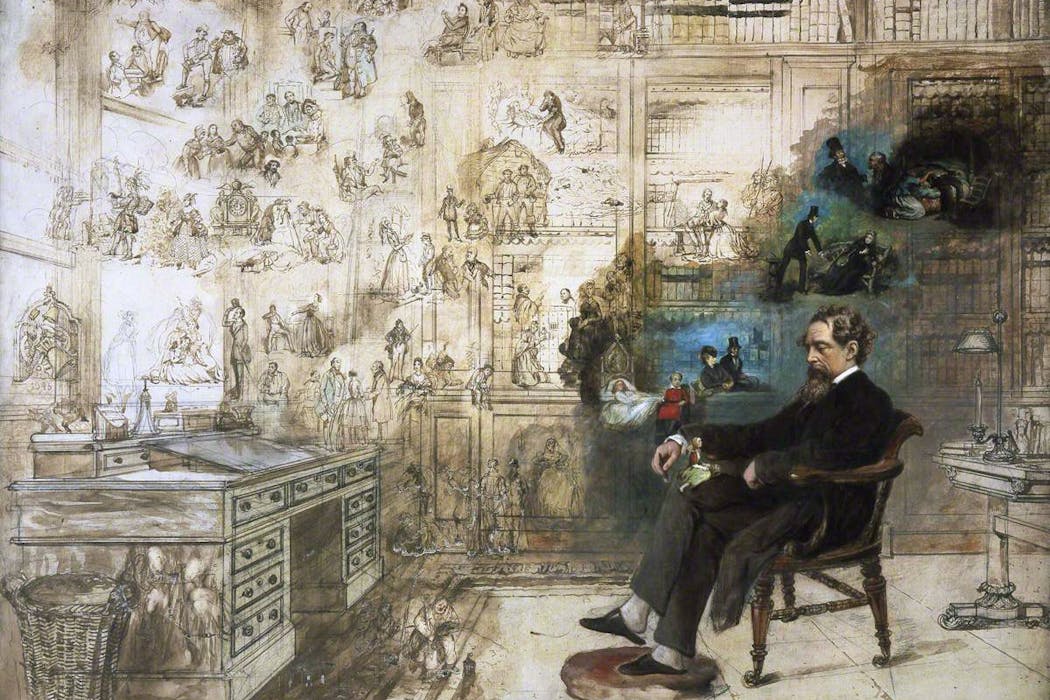
Dickens’s Dream by Robert William Buss (1875). Charles Dickens Museum

A Christmas Carol is usually read as a Victorian morality tale about capitalism and compassion. Yet an autographed script written by Charles Dickens during the American Civil War raises the possibility he may also have understood the story as speaking to the cause of ending slavery in the US.

First published in the UK on December 19 1843, the novella is famous for its advocacy of a reformed relationship between the Victorian capitalist Scrooge and the workers whose labour he profits from, epitomised by his downtrodden clerk, Bob Cratchit. The story has inspired countless adaptations in theatre, television and film.

However, a slip of blue paper held in Harvard’s Houghton Library shows how Dickens may have also seen the story through the lens of American slavery. As my current research in the library’s collections shows, on March 7 1864, Dickens wrote out and autographed A Christmas Carol’s most famous line so that it could be sold in aid of the anti-slavery side in the ongoing American civil war (1861–65).

The closing sentence – “And so, as Tiny Tim observed, God Bless Us, Every One!” – is usually associated with Victorian families united in the Christmas snow. However, Dickens’ contribution to a set of celebrity autographs being collected for sale at the 1864 New York Metropolitan Fair enlisted his novella in the cause of supporting the Union army’s goal of ending slavery in the US.

The New York fair was one of several events held across the Union states to raise funds for the US Sanitary Commission, a philanthropic organisation which promoted the health, welfare and convalescence of Union soldiers. We don’t know how much the autograph collection to which Dickens contributed ultimately sold for. But records show the collection, gathered by the wife of the US ambassador to Britain, Abigail Brooks Adams, was valued at US$1,000 – approximately US$20,000 (£14,500) in today’s money.

Dickens had been an international celebrity since the 1830s, and was well accustomed to requests for autographs. In 19th-century terms, this often meant a copied-out passage from one of his novels as well as a signature.

What survives of these autographs, written for fans in Britain and America, suggests that the passage he typically used was the death of Little Nell in The Old Curiosity Shop (1841). His unusual choice of the final line from A Christmas Carol therefore seems deliberate for this specific context.

In my ongoing research, I theorise this choice may have been designed to remind people that the message of A Christmas Carol also applied to enslaved black people in the US and show his support for them.

While there are no direct references to slavery in A Christmas Carol, there are good reasons to think it was on Dickens’s mind at the time he was writing the novella.

The two works he was publishing immediately before it – the travel book American Notes (1842) and serialised novel Martin Chuzzlewit (1843–44) – both make vivid reference to the inhumanities of slavery. They had been inspired by the five-month tour that Dickens made of the US in 1842.

There is a long cultural history of ghosts in chains like the ones that weigh down Scrooge’s partner, Jacob Marley, in A Christmas Carol. But at the time Dickens was writing it, he also had a more immediate reference point for the image of people burdened by irons.

In American Notes’s chapter on slavery, he quotes from multiple American newspaper descriptions of escaped enslaved people loaded with iron rings, chains and weights – including a 12-year-old boy with a “chain dog-collar around his neck”.

In A Christmas Carol, Marley attributes his chain, made of “cash-boxes … ledgers … and heavy purses”, to his heartless pursuit of business profit in life. Marley warns Scrooge that he too is a “captive, bound and double-ironed”, suggesting that exploitation for money will ultimately fetter the exploiter as well as the exploited.

Two recent adaptations of A Christmas Carol have suggested that Scrooge and Marley’s business is at least partly built on the trade in enslaved people. Jon Clinch’s 2019 novel Marley makes the link direct, while Steven Knight’s television series of the same year implies it.

For example, Stephen Graham’s Marley tells Guy Pearce’s Scrooge: “Look at these chains Ebenezer … Each link is a man or woman or child who died in our workshops”, mentioning locations not only in “London, Birmingham, Manchester”, but also “Batavia … Mauritius, the Bay of Honduras”. Slavery was present in the last three locations until at least the 1830s.

While Dickens opposed slavery, he was far from immune to racism. Notoriously, his support for the brutal British colonial response to an uprising of Jamaican plantation workers in 1865 contrasted with his career-long advocacy against the deprivations of the British working classes.

In Zadie Smith’s historical novel The Fraud (2023), the character of Dickens suggests that Brits should be turning their attention from the compensation given by the British government to slave owners in the British Empire to problems closer to home. Such a portrayal is supported by Dickens’s mockery of Mrs Jellyby in Bleak House (1853) for her “telescopic philanthropy”, which centres on Africans in the fictional “Borrioboola-Gha” rather than the people in her immediate vicinity.

If Dickens did intend to use the final line of A Christmas Carol to support the anti-slavery cause in the American Civil War, this would allow us to rethink how he may have seen the relationship between exploitation and inhumanity at home and abroad. It suggests that, in at least some circumstances, he was able to see these causes in connection rather than competition.


Looking for something good? Cut through the noise with a carefully curated selection of the latest releases, live events and exhibitions, straight to your inbox every fortnight, on Fridays. Sign up here.


This article features references to books that have been included for editorial reasons, and may contain links to bookshop.org. If you click on one of the links and go on to buy something from bookshop.org The Conversation UK may earn a commission.

The Conversation

Lucy Whitehead does not work for, consult, own shares in or receive funding from any company or organisation that would benefit from this article, and has disclosed no relevant affiliations beyond their academic appointment.

ref. Did Charles Dickens see A Christmas Carol as an anti-slavery story? – https://theconversation.com/did-charles-dickens-see-a-christmas-carol-as-an-anti-slavery-story-272292