Huntington’s disease (HD) has long been impossible to cure, but new research is finally giving fresh hope. HD is a progressive, hereditary brain disease that affects movement, cognition and emotions. Doctors often diagnose HD when people show clear movement problems, typically around 30-50 years of age, after which patients live about 15-20 years.
The global prevalence of HD is about five per 100,000 people. While it is not as prevalent as Alzheimer’s disease, the disease starts much earlier in life, often when people are still in work and raising families.
Sadly, there is no cure. But a couple new research papers, by our team and others, suggests this may be about to change.
The causes of HD long remained a mystery since it was discovered in the 19th century. But in 1993, researchers uncovered that HD is caused by repetitive expansions of three DNA letters (C, A and G) in the Huntingtin (HTT) gene, resulting in the production of a mutant huntingtin protein.
This gene normally has a section that repeats the letters CAG over and over. In healthy people, the repeat is lower than 35. Repeat lengths greater than 39 will result in HD. The more repeats you have, the earlier symptoms usually start. In addition to your inherited CAG length, this sequence tends to continually expand in certain cells over a person’s lifetime, known as somatic expansion.
At the time, in 1993, the discovery generated lots of excitement. First, you could identify which relatives in a family with a history of the disease would develop it. Those of us working in HD clinics at the time were highly concerned about the ethical and mental health issues this also raised. There was a big need for counselling, for example. Second, it was thought, somewhat mistakenly, that very quickly there would be a treatment.
Many studies have investigated people with the HD gene expansion 15 years before onset and some even as far as 25 years before onset. Even before the onset of movement problems, changes in cognition, mood and the brain have been found.
In particular, the brain changes start in a part called the striatum, which helps control movement. Here, certain nerve cells (called GABAergic medium spiny neurons) die off. As HD gets worse, damage spreads to other areas like the cortex, which are important for cognition, and white matter, which connects brain regions.
Progress at last
Only recently has there been some promising results in the treatment of HD by clinical researchers Sarah Tabrizi and Edward Wild at University College London. Although, the research is still waiting to be peer reviewed and published, the results have been reported in a press release by uniQure, a US biotechnology company.
In this trial, a gene therapy, AMT-130, that reduces the production of the toxic mutant huntingtin protein was given to 29 HD patients with a definitive clinical diagnosis, between the ages of 25 and 65. The results showed slower cognitive decline on standard neuropsychological tests, particularly in processing speed and reading ability. Most significantly for doctors, cerebrospinal fluid levels of a protein called neurofilament light, a general marker for neurodegeneration, were reduced after three years follow-up, even below baseline levels.
This indicates that the therapy may actively protect brain cells from damage rather than simply masking symptoms. It is hoped that, in future, it will be possible to provide safe and effective treatments at earlier stages of the disease. Hopefully, people with the HD gene expansion will have improved cognition and emotion and reduced motor symptoms, which will improve quality of life and may even extend their lifespan.
This was a motivation for our new work, a collaboration between UCL and the University of Cambridge, for the HD- Young Adult Study. The study recruited 131 people: 64 with the HD gene expansion and 67 controls, long before predicted disease onset, approximately 24 years. The study gathered in-depth information about participants’ cognition, mood and behaviour, alongside brain scans and tests of blood and other fluids that can show how healthy their brain cells are.
At this early stage, we noted some increases in markers of neurodegeneration with limited effects on brain volume and cognition. Given that the striatal circuits are disrupted early in HD, we wanted to determine whether cognitive flexibility, how easily people can swap between different approaches and perspectives, a function that relies on this circuitry, was affected at this very early stage in those with HD gene expansion.
Indeed, we showed some mild early disruption to cognitive flexibility, which was associated with alterations in the connectivity in these circuits. This cohort was also followed up about 4.5 years later, where changes in many measures became more apparent.
Importantly, in collaboration with the University of Glasgow, we showed that somatic expansion, how the CAG sequence tends to continually expand in certain cells over a person’s lifetime, can give crucial information. This study was the first to show in living humans the faster this somatic expansion, the faster the disease progresses. This can explain why some people who have identical inherited CAG length in the Huntingtin gene can still have different onset of the disease.
Cognitive deficits were apparent at this time, although they were in a specific cognitive process. Our findings reveal early sustained attention deficits in people with expanded CAG sequences, which are associated with changes in brain circuits in the inferior frontal gyrus (involved in attention) well before movement was affected.
Intriguingly, this brain area is also linked to the inability of people with ADHD, to focus their attention, as we discovered in an earlier study. This suggests that this disruption in sustained attention in HD may reflect a neurodevelopmental process rather than a neurodegenerative one at this early stage of the disease.
These findings suggest that there is a treatment window, potentially decades before motor symptoms are present, where those with the HD gene expansion are functioning normally despite having detectable measures of subtle early neurodegeneration.
Identifying these early markers of disease is essential for future clinical trials in order to determine whether a treatment is having any effect and preserving the quality of life. In addition, as drugs that slow the worsening of the disease rather than treat the symptoms, are approved by the regulatory bodies for HD, they could be implemented at an early stage to improve quality of life and wellbeing.
We hope that these now rapid advances in the understanding and treatment of HD will, in the near future, bring great benefits to patients.
Barbara Jacquelyn Sahakian receives funding from the Wellcome Trust. Her research work is conducted within the NIHR Cambridge Biomedical Research Centre (BRC) Mental Health and Neurodegeneration Themes. She is a co-inventor of the Cambridge Neuropsychological Test Automated Battery (CANTAB).
Christelle Langley receives funding from the Wellcome Trust. Her research work is conducted within the NIHR Cambridge Biomedical Research Centre (BRC) Mental Health and Neurodegeneration Themes.
We were standing by a large white board in one of the prison’s educational areas, debriefing how our study on hope had gone when the man slipped into the room without a sound. Like the other participants he was over 60, and serving a life sentence. He had grey hair, and was very tall and slim.
He slowly picked up a chair before slamming it down. I invited him to join us, but he stayed still while the others watched. Then he dragged the chair across the floor with a piercing scrape. I could hear my own pulse.
As I began to speak I noticed he was crying. At first, it sounded like a whisper of sobs, but then it got louder. He rose abruptly, and came up close to me. I wrote in my fieldwork notes from that day:
My heart is racing. He asks, towering over me: ‘How dare you ask us about hope.’ The alarm blares. Guards escort him out. The others sit in stunned silence, eyes locked on us, waiting for a reaction.
In the months that followed, I would meet many other men for whom hope was not necessarily a lifeline as is so commonly assumed, but a burden that they had to carry, sometimes painfully.
The Insights section is committed to high-quality longform journalism. Our editors work with academics from many different backgrounds who are tackling a wide range of societal and scientific challenges.
Hope is not a soft word in prison. It shapes how people cope with their sentence and it determines whether – and how – they engage with staff and other prisoners. It shapes whether they commit to vocational and educational activities, and it sustains connections with people on the outside.
For older life-sentenced prisoners specifically, hope becomes interlinked with accelerated ageing, with bullying from younger prisoners, and with the fear of release into an unknown world.
My project (In search of Hope: the case of elderly life-sentenced prisoners) began in August 2022. We were investigating how the “right to hope” – as defined by Judge Ann Power-Forde in her concurring opinion to the European Court of Human Rights judgment Vinter and others v the UK (2013)– translates behind prison walls for older people serving life sentences, many of whom face slim prospects of release due to their advanced age and the length of their prison sentence.
The research was carried out across three English prisons over 12 months by myself and research associate, Helen Gair, with a small team of research assistants. We conducted fieldwork in a Category A prison (reserved for people presenting the highest levels of risk), a Category C (mid-security level prison, often aimed at training and resettlement), and a Category D (open prison or the last stage before release).
Each facility had its own smell and sound. The spatial layout and daily rhythm varied too. For instance, the high security site was an old red brick Victorian building, and the wings were arranged in a half panopticon (circular) design. Outside the main block, guard dogs were walked on a strip of green that ran along a ten-metre-high wall. Inside it was loud; lockdowns were frequent, and it smelled of sweat and mould.
In the open prison, the smell of cannabis drifted through the grounds. Men greeted us in grey tracksuits, often carrying disposable cups of tea. There were ducks and a pond and a RAF plane on display.
In the Category C prison, we often got lost. The alphabetical alignment of buildings made little sense to us. We had our own set of keys which meant we could move around independently. However, rusty locks slowed us down often, and every gate and door had to be opened and closed behind us.
Men aged 50 and above and serving life sentences were invited to participate. We collected diaries, completed ethnographic prison observations, and ran one-to-one interviews with each participant.
Additionally, interviews were conducted with prison staff, both working in frontline and office-based roles, to get a sense of how those who work closest to ageing life-sentenced prisoners perceived hope and whether prison practices preserved or restrained it. Overall, we wanted to find out how hope was experienced by prisoners and how it was handled as a prison practice.
Idealised hope v prison reality
In the 2010s, a case was brought before the European Court of Human Rights by Jeremy Bamber, Douglas Vinter and Peter Moor. They had each been convicted of murder in the UK and been given whole-life orders – the most severe form of life sentence.
This means that by law, they were sentenced to spend the rest of their lives in prison with no minimum term set for parole or release. Only a small percentage of people get such severe sentences: Myra Hindley and the Yorkshire Ripper Peter Sutcliffe being two examples.
On July 9, 2013, the human rights court ruled that whole-life orders which do not include any prospect of release or review would amount to inhuman or degrading treatment, contrary to Article 3 of the European Convention on Human Rights. The notion of a “right to hope” was first mentioned by Judge Ann Power-Forde’s concurring judgment:
… Even those who commit the most abhorrent and egregious of acts … nevertheless retain their essential humanity and carry within themselves the capacity to change. Long and deserved though their prison sentences may be, they retain the right to hope that, someday, they may have atoned for the wrongs which they have committed. They ought not to be deprived entirely of such hope. To deny them the experience of hope would be to deny a fundamental aspect of their humanity and to do that would be degrading.
The right to hope is thus vested in a possibility of release and review. What this means is that there must be a realistic possibility that any prisoner sentenced to life imprisonment be considered, at some point in time, for release or that the justification for their continued detention needs to be reviewed.
But how does the right to hope account for the fact of ageing in prison?
The rapid and global “greying” of the prison population indeed complicates the human rights jurisprudencial understanding of a right to hope. As of March 2025, there were 87,919 people in prison in England and Wales, with nearly one in five (18%) aged 50 or older, according to the Ministry of Justice.
Compounding matters, life-sentenced prisoners now make up around 10% of the sentenced population, and this group is ageing rapidly. Almost a third of “lifers” are over 50. As a result, old, life-sentenced prisoners are the fastest-growing subgroup in the system.
This phenomenon combined with the current overcrowding crisis produces a range of managerial and ethical challenges: bed spaces are tied up for decades, healthcare and social care demands are on a steep rise, and the pressures on ill-equipped prison staff increase.
The myth of prison release
One important finding from our project is that parole and the possibility of release during a prisoner’s life span becomes somewhat of a myth for those serving life sentences at an advanced age. Usually, life-sentenced prisoners are given a minimum tariff, which is a period when they are not eligible for parole. This legal principle does not account for age however. Dean, 62 , was a life-sentenced prisoner at the Category A prison who had served six years. He told us how unrealistic parole felt in light of his age:
I will be 80 years old before my first parole hearing and in all honesty I don’t know if I will reach that milestone. Although my health is reasonable, I’m on all kinds of medication to keep me going but incarceration has a way of dragging you down so I am not optimistic.
Trevor was 73 when we interviewed him in the Category C prison and had been inside for 27 years. He was sat in a wheelchair and had an elastic band wrapped around his middle finger and thumb. He explained to us that it helped him hold a pen.
He described years of postponed parole hearings, medical delays, and transfers to lower security prisons being denied because his health needs could not be met in open prison conditions. He asked us simply:
If you were in my situation would you live in hope or would you resign yourself to your future?
The experience of no longer believing in release is supported by official data that shows that few prisoners sentenced to life get released during their lifetime.
One in five lifers are now beyond their tariff, often by several years with age-related barriers to parole contributing to prolonged incarceration. What we noticed during fieldwork was that older prisoners often struggled to access or complete accredited programmes because of mobility issues and cognitive impairment, but also due to managerial prioritisation of younger prisoners or those convicted of shorter sentences.
Rising deaths in England and Wales among older prisoners further underscores the illusory prospect of release.
Nearly nine in ten of the 192 deaths from natural causes in the year 2025 involved older prisoners and the number of people in prison requiring palliative care continues to grow.
From 2016 to 2020, hospitals recorded 190 admissions of older male prisoners with a palliative care diagnosis. In roughly 40% of those cases, cancer was the main condition on entry. The charity, Inquest, reported in 2020 that many of the deaths in prison were neither inevitable nor unforeseeable, pointing instead to systemic failings in healthcare provision, communication, emergency intervention, and medication management.
Building on this, academic scholars Philippa Tomczak and Ròisìn Mulgrew argued that classifying deaths in custody as “natural” obscure the ways in which prison environments contribute to deaths that might otherwise have been avoided.
Additionally, research has repeatedly linked self-harm and suicide patterns to experiences of hopelessness and social isolation. The participants in our study similarly tied the removal of hope to suicides, citing examples they had witnessed in prison.
In his prison diary, a participant with thick rectangular glasses called Ian, 65, who had served 33 years of his life sentence and was now held in a Category C prison, wrote:
With the absent (sic) of hope you have despair. I have known prisoners who have committed suicide, they had no hope or expectations only misery and despair.
So there appears to be a contradiction between the legal possibility of release and its practical improbability in the context of old and ageing, life-sentenced prisoners.
The fear of release
Beyond the practical improbability of release, many participants described how much they feared the world they would hypothetically re-enter one day. Several participants in their 60s and 70s reflected on how they no longer recognised the world outside.
For them, the time spent in prison combined with their physical and cognitive decline has institutionalised them. They felt they could not fare alone outside prison rules and environments. One man named Roy, who had spent decades in various Category A prisons wrote in his diary:
I have no hope of, or real wish to leave prison, where I am now completely institutionalised, I have no responsibilities other than abiding by prison rules, and few expenses.
Another frail-looking man named Russell, 68, described in his diary (which he completed from his Category C cell) how the very idea of a future had become hollow: “It’s difficult really because like I say, I haven’t got any hope of getting out of prison as far as I’m concerned. That is it. I’m in prison and that’s as far as it will go.”
Practical matters such as technological advances and housing also made the very thought of release overwhelming. Gary, 63, who had served 24 years, wrote poignantly about his fears of release, saying: “Release frightens me because of the label that has been firmly given to me and that brings its own problems. Where will I live? How will I live?”
A 73-year-old participant named Kevin, who was transferred during the project from a Category C to an open prison, spoke about how, after 21 years in prison, things will have changed too much on the outside for him to deal with. As he stood on the doorstep of freedom, he worried about getting his head around new technology and accessing simple things like his pension. He said: “Technology has moved on at a phenomenal pace, seems very scary to me … I should stay here in prison where everything is regulated and structured rather than going out to something that is quite alien to me.”
These feelings are exacerbated by the erosion of social networks, the death of family and friends, and the disappearance of any meaningful horizon. Social isolation means that the world they would be reintegrating into has become alien and they will have to navigate it mostly alone. Kevin added:
People that I used to call friends no longer want to know me or have died. One thing for sure that I can [say] is true, you certainly find out who your true friends are … when you come to prison and especially if you come to prison for a long time.
This sense of destroyed horizons, where release holds no promise and the outside world has become even more terrifying than the cell, has been dramatised in popular culture.
In The Shawshank Redemption (1994) the character Brooks, released after 50 years inside, finds himself unable to cope with the pace and impersonality of the modern world. His suicide becomes a haunting metaphor for the crushing effect of institutionalisation that hollows out the self and the possibility of meaningful social reintegration.
When hoping becomes harmful
Other prisoners we spoke to seemingly decided it was more beneficial for them to give up on hope altogether. Some – like Barry -– wondered if giving up on hope of release would be less torturous.
Barry was 65 when we spoke to him and has spent over four decades in prison on a life sentence. He’s tall and slim. When he walked in, we noticed he had a limp and used a cane. The first time we met, he sat with his hands clasped, speaking in a measured voice that occasionally broke into a laugh, not from humour but more from what I felt like was exhaustion. Though parole is technically available to him, he has come to see the pursuit of release not as hopeful but as harmful.
Over years of disappointments, Barry wondered if living with no hope would be less painful and felt it had become “pointless” to hope. He wrote in his diary:
Hope is when I want something to happen or something to be true … I often ask myself would it be kinder to live with no hope and just live with a ‘wait and see’ kind of attitude.
Indeed, every parole hearing postponed, every dashed expectation had eroded the value of hoping. Ultimately, giving up on hope is captured as something that eventually preserves mental health. As Barry added:
An empty case of hope is healthy, I say that because of the amount of men I have seen become ill; disappointment becomes despair, becomes depression, becomes mental ill health … then when you stop hoping, you start to recover and you no longer feel hopeless, as you are not hoping for anything. So hope is a paradox, it can disappoint or make you feel there is a real possibility of things to come.
He recalled reading about an American woman sentenced to life without parole who had begged for the death penalty instead. Her explanation (“I don’t just want to be alive, I want to be able to live”) resonated with him so powerfully that he said it, “almost knocked me off my chair”. He recognised in her plea the same cruel paradox he faced: that to prolong his existence in hopeless conditions was no life at all. His conclusion was irrevocable:
I understand more than most the need for hope, but all the years that I have been in prison and all the hopes I have had destroyed, I see hope as an enemy.
But then Barry equally admitted that he still hoped, no matter what. His hope was like a human natural reflex, over which he had no control, it just happened. He said: “We all hope … I hope I’ll get out on my next parole.”
What then, is hope in prison? Is it cruel and torturous or is it a human feature that brings relief and drive?
Recalibrating hope
We found hope meant different things to different people. It is not just about release. Some needed detailed plans, others focused on the day to day. Sometimes hope shifted towards modest goals that are tied to imagined places outside prison: a quiet retirement, a chance to study, to garden.
Terry was 65 and had served 38 years in category A prison. He told us that all he hoped for was “a quiet life in retirement”, while Russell, who was about the same age but had served over 12 years and was in a Category C when he wrote his diary, said that he hoped to, “… someday be released and to live the remaining years I have left in a small bungalow with a small garden in a village miles away from my old area of England. Have a pet cat.”
Others cast their hopes in more detailed and concrete plans about what the future would look like. Carl, 60, who enjoyed cooking and working out, for example, said he hoped to move in with his daughter and grandchildren for a while in an area where his ambition is to build his own house. He added: “I designed and roughly costed the development plan that helped to reinforce the hope that these plans were achievable.”
In the moment
But other participants recalibrated hope to more immediate aspirations set in the present, and in day-to-day encounters.
Barry said: “My hope is that I continue to live in the moment … You know, cause right now I’m in this office with you two guys, it’s calm. It’s nice. It’s peaceful. It’s a nice moment. But I’m not gonna think about what it’s gonna be like at 4pm because I might walk out that door and straight into a prison riot.”
Russell agreed, adding: “Looking for the future, I just go from one day to the next. It’s no good planning too far ahead.”
This shift of hope raises questions about how prisons shape and even limit the ways people can access and imagine their futures.
Another participant, Craig, who was 66 and had only served just over five years in the Category A prison when we met him wrote: “… you personalise hope to suit the circumstances.”
For the institution and those working in prison, these attitudes towards hope could be perceived as successful because prisoners sentenced to the longest sentences demonstrated a commitment to live a crime-free life, set in the present moment, focused on small menial things that will not raise any risk for management.
But when hope becomes so short-termist and bland, we are able to capture a shift in the very logic of imprisonment – one which is less about nourishing transformation aimed at resocialisation, and more about the life-long containment of decaying and dying bodies.
Hope matters
This article opened with a man telling my colleagues and I: “How dare you ask us about hope?” That moment has echoed throughout this study, both as an outburst that shows how prison research can be fraught with complexity but can also propel further and deeper reflection on humanitarian ideals such as hope.
When people in prison speak of the cruelty and fallacy of hope, you begin to wonder how much beauty and promise hope really holds in spaces of high control and constraint.
When transposed to prisons, hope no longer seems to be attached to an open horizon, evocative of lightness and liberty found anew. Instead, it represents dissociation from the outside world, and the cause of frustration, mistrust and a sense of abandonment.
Hope in prison exposes a disconnect between abstract legal humanitarian ideals and the empirical realities of ageing while incarcerated for long periods of time. And this claim could probably be extended to other settings of heightened regulation and tight monitoring, such as care homes, immigration detention centres, or even youth justice facilities.
The decision to depart from hope’s conventional, perhaps slightly romanticised meaning, and to recalibrate it towards real, daily conditions could nonetheless illustrate new ways for how older life-sentenced prisoners (and others under constraint) regain agency and keep going.
Ultimately, hope matters – not only for the people I met and interviewed – but also for broader society.
Imprisonment marked by hopelessness is linked to deteriorating mental and physical health, increasing pressure on prison healthcare and, upon release, on community health and social care services.
This is exacerbated for older prisoners released after decades inside. Hope is not a sentimental indulgence, but a condition that shapes whether imprisonment prepares people to live safely beyond prison or releases them with profound unmet needs. Regimes that erode hope risk merely displacing, rather than resolving, social harm.
To hear about new Insights articles, join the hundreds of thousands of people who value The Conversation’s evidence-based news. Subscribe to our newsletter.
Marion Vannier receives funding from the UK Research and Innovation Future Leader Fellowship.
Source: The Conversation – UK – By Leonie Fleischmann, Senior Lecturer in International Politics, City St George’s, University of London
Progress towards achieving Donald Trump’s 20-point peace plan for Gaza is stalling. Israeli strikes across the territory on January 9 killed 13 Palestinians, with new raids days later claiming three more lives. The situation has now reached a critical juncture, with both Israel and Hamas reportedly preparing for a resumption in fighting.
The first phase of the US-brokered ceasefire, which came into effect in October, has mostly been completed. Israel’s military has withdrawn to the eastern half of the Gaza Strip, as required by the agreement. And dozens of Israeli hostages, living and dead, have been exchanged with hundreds of Palestinian prisoners.
However, some elements still need to be finalised. This includes the return of the remaining Israeli hostage, Ran Gvili, whose remains are still unaccounted for. And while humanitarian aid has been allowed into Gaza, the southern Rafah border crossing has yet to be opened fully.
This is restricting the flow of goods at a time when the inhabitants of Gaza face an acute humanitarian crisis. Harsh weather conditions, limited shelter, severe food shortages and continued military actions continue to exacerbate the situation. The UN said on January 12 that at least 1.1 million people in Gaza still urgently need assistance.
Advancement towards a permanent end to the war and the reconstruction of Gaza is thus urgent. However, later phases of the peace plan will need to address thorny issues such as Gaza’s post-war governance, Palestinian calls for a state and Israel’s demand that Hamas disarms. The potential for the negotiations to derail are high.
Trump is reportedly set to announce the Gaza “peace board”, which will be formed of global leaders to administer his post-war plan for the territory. Nickolay Mladenov, a Bulgarian diplomat and former UN envoy to the Middle East, has been named as the board’s director general.
But any progress towards realising Trump’s vision for Gaza, and permanently ending Israeli military action, hinges on the issue of the disarmament of Hamas.
The Israeli prime minister, Benjamin Netanyahu, has conditioned any progress in the peace plan on the demilitarisation of the Gaza Strip. This requires Hamas to relinquish all of its arms and hand over its governance of Gaza. These are non-negotiable demands from Israel for maintaining the ceasefire.
Hamas has said it will dissolve its existing government in Gaza once a committee of Palestinian technocrats takes over the territory. This committee will be headed by Ali Shaath, who previously served as the Palestinian Authority’s deputy transportation minister in the West Bank, and also includes Gaza chamber of commerce chairman Ayad Abu Ramadan.
But Hamas has so far publicly rejected giving up its arms. Some reports suggest that Hamas is ready to discuss “freezing or storing” its arsenal, while others have reported that Hamas would be willing to decommission its short- and long-range missiles. However, the group is not willing to give up its small arms and light weapons.
This is because Hamas believes it has a right to armed resistance as long as Israel is occupying Palestinian territory, with complete disarmament representing what the New York Times calls an “existential unravelling”. Unless resolved, the issue of disarmament will most likely lead to a resumption in fighting in the near future.
Plans for renewed hostilities
According to an unnamed Israeli official interviewed by the Wall Street Journal, if Hamas “doesn’t willingly give up its weapons, Israel would force it to do so”. Trump, following a meeting with Netanyahu at his Mar-a-Lago resort in December, has also said “there will be hell to pay” if Hamas does not agree to disarm.
But contrary to these directives, reports suggest that Hamas is focusing on rebuilding the infrastructure that was destroyed in Gaza during the past two years of war. This includes rebuilding its military capabilities and maze of tunnels, as well as replenishing its cash reserves through revenues generated by taxing goods and services coming into Gaza.
In early January, the Israel National News media network reported that Israeli intelligence has identified three main channels through which Hamas is attempting to rebuild its military capabilities. The first channel is the local production of weaponry, second is cooperation with the Iranian “axis of resistance” to leverage aid channels for military purposes, and third is using drones from Egypt to transfer weapons.
Further evidence of this is limited. However, Hamas was quick to reassert its power in Gaza after the ceasefire. And the New York Times reported in December that more than half of the group’s underground tunnel network is still intact and at least 20,000 Hamas fighters remain. This highlights the potential capacity for the group to reengage in fighting.
Expecting Hamas to refuse full disarmament, Israel has now reportedly drawn up plans to launch a renewed intensive military operation in Gaza in the spring. The focus of this operation would be on Gaza City, which remains largely under the control of Hamas.
Unless both sides engage in some pragmatism, or significant pressure is imposed on them to show restraint, the resumption of fighting seems inevitable. It will once again be the 2 million inhabitants of the Gaza Strip, who have already faced unimaginable loss and destruction and are struggling through a harsh winter, that will suffer.
Leonie Fleischmann does not work for, consult, own shares in or receive funding from any company or organisation that would benefit from this article, and has disclosed no relevant affiliations beyond their academic appointment.
Urology departments in England and Wales have reported seeing an increase in the number of 16- to 24-year-olds being admitted for bladder inflammation associated with ketamine use.
This appears to coincide with an increase in ketamine use – with the number of adults and teens entering treatment for ketamine abuse last year jumping substantially compared to even just a few years previously.
Ketamine abuse can have many affects on the bladder, causing frequent urination, night-time urination, sudden urges, leakage, inflammation, pain in the bladder or lower back and blood in the urine. These symptoms can be severe, make daily life very difficult and may even be permanent in some cases.
But a growing number of people are now using ketamine recreationally. It acts as a dissociative drug, causing users to feel detached from themselves and their surroundings. It can produce hallucinogenic, stimulant and pain-relieving effects, which last one to two hours.
Users typically snort or smoke powdered ketamine, or inject liquid ketamine or mix it into drinks in order to experience the drug’s effects. Snorting usually produces stronger effects and more noticeable symptoms than swallowing it.
Ketamine users can develop tolerance to the drug quickly, needing higher doses to get the same effects. This is probably due to the body and brain adapting to become more efficient at breaking down the drug. Frequent users often need to take twice the amount of occasional users to get the same effect.
The first recorded cases of ketamine affecting the bladder were reported in Canada in 2007, where nine people who used ketamine recreationally had severe bladder problems and blood in their urine. Later, a bigger study in Hong Kong found the same issues in 59 people who had used ketamine for more than three months.
Ketamine, as with any other drug, is metabolised in the body where it’s broken down and excreted in urine.
When ketamine is broken down, it turns into chemicals that can seriously harm the bladder. When these by-products stay in contact with the urinary tract for a long time, they irritate and damage the tissue.
The bladder is damaged first, because it holds urine the longest. Later, the ureters (tubes connecting the kidney to the bladder) and the kidneys can also be affected.
Over time, the bladder can shrink and become stiff, causing strong urinary symptoms. The ureters can become narrow and bent, sometimes described as looking like a “walking stick.” This can lead to backed-up urine in the kidneys (hydronephrosis).
Ketamine also increases oxidative stress, which damages cells and causes bladder cells to die. This breaks the protective bladder lining, making it leaky and overly sensitive.
All these changes can make the bladder overactive, extremely sensitive and painful, often causing severe urges to urinate and incontinence.
In the first stage, the bladder becomes inflamed. This can often be reversed by stopping ketamine and taking certain medication – such as anti-inflammatory drugs, pain relievers or prescription drugs that reduce bladder urgency and help the bladder lining heal.
In the second stage, the bladder can shrink or become stiff. In this stage, treatment is similar to stage one, but a bladder wash may also be required. This is where a catheter is used to put liquid medication directly into the bladder. The drug coats the bladder’s inner lining, helping to restore its protective layer and reduce inflammation.
Botulinum toxin injections may also be used to relax the bladder and reduce pain and urgency. Stopping ketamine remains essential to prevent further damage.
In the final stage, permanent damage occurs to the bladder and kidneys. Over time, if the kidneys are affected, it can lead to kidney failure. Dialysis (a treatment where waste products and excess fluid are filtered from the blood) or even surgery may be required to repair kidney function and the urinary system.
Although ketamine has been a class B drug since 2014, it’s unfortunately affordable and accessible – costing as little as £3 per gram in some parts of the UK. Raising awareness about the risks of ketamine use is essential to prevent these serious health problems.
Heba Ghazal does not work for, consult, own shares in or receive funding from any company or organisation that would benefit from this article, and has disclosed no relevant affiliations beyond their academic appointment.
The woolly rhino, Coelodonta antiquitatis, would have been an impressive sight to the ancient people who painted images of them on cave walls and carved figurines of them out of bone, antler, ivory and wood.
The sadly now extinct rhino lived on the steppes and tundra of Europe and Asia, living alongside people for thousands of years. And a new study of woolly rhino DNA, extracted from the stomach of a wolf challenges a long held belief about species at risk of extinction.
The species, which evolved in the middle of the Pleistocene era, approximately half a million years ago, weighed up to three tonnes. It was similar in size to the two largest rhino species alive today, the white rhino of southern and eastern Africa and the one-horned rhino of India.
The woolly rhino was well adapted to live in ice age conditions. It had a thick layer of fat below the skin, a warm, woolly fleece and small ears and tail to minimise heat loss. It also had a shoulder hump to store fat, to help it survive through periods of food scarcity, and a horn that, in exceptional cases, could grow to 1.6 metres in length.
Abrasions on horns have led biologists to suspect that the rhino used its front horn (the species had two horns, like most species of rhino alive today) to sweep aside snow so it could access the grass and shrubs on which it fed.
At their peak, woolly rhinos could be found from the Iberian peninsula in the west to northeastern Siberia in the east. If it was cold, and there was grass to eat, they seemed to do well. But by around 14,000 years ago, they were gone.
Woolly rhinos were a victim of a changing climate, which made their habitat steadily vanish. The mammoth steppes they lived on were replaced by first a shrubbier habitat and eventually forest. They were also occasionally hunted by people, and that didn’t help them. A lack of good habitat, with a helping hand from the most efficient predator to have ever evolved, signed their death knell.
When a species experiences a long period of decline before eventually disappearing, scientists expect to detect signs its impending doom in its genome. As populations shrink, genetic diversity is lost from a population and inbreeding increases. This means that the last animals to be born are likely to have parents who were closely related.
As a species heads towards extinction, animals in the final few cohorts typically become ever more inbred. Because the woolly rhino’s extinction was thought to be a long, drawn-out affair, scientists assumed that individuals living 15,000 years ago would start to show genetic signatures of inbreeding. The findings of a recent paper from a team by led by Solveig Guðjónsdóttir are consequently quite a surprise.
The woolly rhino sample came from the frozen remains of an ice age wolf discovered in permafrost near the village of Tumat in north-eastern Siberia. When the ancient wolf was autopsied, the researchers identified a small fragment of preserved tissue in its stomach.
The team Guðjónsdóttir led skilfully sequenced the remains of a 14,400-year woolly rhino found in the stomach of the wolf pup. Both the wolf and rhino died just a few centuries before the woolly giant disappeared.
A healthy adult woolly rhino would have been too big for a pack of wolves to take down and kill, so it seems probable that the remains were either scavenged, or from a baby. Regardless of the source of the meal, analysis of the genome revealed that the woolly rhino was not inbred.
The genetic diversity of an individual can also be used to estimate the population size of breeding individuals using a statistical method called Pairwise Sequentially Markovian Coalescent modelling (PSMC). PSMC models compare differences between genome sequences on the two strands of DNA each individual has, one from each parent.
The model uses this information to estimate the distribution of times since each bit of the sequence shared a common ancestor. The greater the difference between the two strands of DNA, the greater the genetic difference between the parents, and the larger the population size would have been.
As part of the study, the researchers analysed two older woolly rhino genomes that had already been published and compared them to the new specimen. Their analysis showed that although the population of woolly rhinos had declined since its peak, it was still sufficiently large to maintain genetic diversity.
Guðjónsdóttir’s paper is important for two reasons. First, it is a wonderful demonstration of how DNA retrieved from the most unlikely of sources can tells us about population declines from millennia ago.
Second, it shows we might need a little bit more research into how population declines of long extinct animals might influence the statistics that geneticists frequently use, and we might need to revisit our current understanding. The woolly rhinos range certainly contracted as the world warmed, and its population size shrank, but it might not have died out as genetically impoverished relic.
Maybe the woolly rhino held onto its genomic diversity for much longer than we think it should have. So, we should keep checking the stomach contents of long-dead predators found in the permafrost, however unpleasant that task might sound.
Timothy Neal Coulson does not work for, consult, own shares in or receive funding from any company or organisation that would benefit from this article, and has disclosed no relevant affiliations beyond their academic appointment.
Source: The Conversation – USA – By Konstantin Zhukov, Assistant Professor of Economics, Indiana University; Institute for Humane Studies
Neither of these men — US President Donald Trump, left, and Russian President Vladimir Putin — likes being held accountable by the press.Contributor/Getty Images
In its story about the search at Hannah Natanson’s home, at which FBI agents said they were searching for materials related to a federal government employee, Washington Post reporter Perry Stein wrote that “it is highly unusual and aggressive for law enforcement to conduct a search on a reporter’s home.”
And Jameel Jaffer, director of the Knight First Amendment Institute at Columbia University, told The New York Times the raid was “intensely concerning,” and could have a chilling effect “on legitimate journalistic activity.”
While the United States remains institutionally far removed from countries like Russia, the Trump administration has taken troubling early steps toward autocracy by threatening – and in some cases implementing – restrictions on free speech and independent media.
Trump sued the New York Times in 2025 for $15 billion for what he called ‘malicious’ articles; a judge threw out the case. Jakub Porzycki/NurPhoto via Getty Images
Public ignorance, free speech and independent media
Ignorance about what public officials do exists in every political system.
In democracies, citizens often remain uninformed because learning about politics takes time and effort, while one vote rarely changes an election. American economist Anthony Downs called this “rational ignorance,” and it is made worse by complex laws and bureaucracy that few people fully understand.
As a result, voters often lack the information needed to monitor politicians or hold them accountable, giving officials more room to act in their own interest.
Free speech and independent media are essential for breaking this cycle. They allow citizens, journalists and opposition leaders to expose corruption and criticize those in power.
Open debate helps people share grievances and organize collective action, from protests to campaigns.
Independent media also act as watchdogs, investigating wrongdoing and raising the political cost of abuse – making it harder for leaders to get away with corruption or incompetence.
When free speech and independent journalism disappear, citizens are less likely to learn about government corruption or failures. Ignorance becomes the regime’s ally – it keeps people isolated and uninformed. By censoring information, autocrats create an information vacuum that prevents citizens from making informed choices or organizing protests.
At the same time, the Kremlin built a vast propaganda machine to shape public opinion. This control over information helped protect the regime during crises. As I noted in a recent article, many Russians were unaware of Putin’s responsibility for military failures in 2022. State media used propaganda to shift blame to the military leadership – preserving Putin’s popularity even as the war faltered.
The threat to independent media in the US
While the United States remains far from an autocracy, the Trump administration has taken steps that echo the behavior of authoritarian regimes.
Consider the use of lawsuits to intimidate journalists. In Singapore, former Prime Minister Lee Kuan Yew and his son, Lee Hsien Loong, routinely used civil defamation suits to silence reporters who exposed government repression or corruption. These tactics discouraged criticism and encouraged self-censorship.
In Singapore, former Prime Minister Lee Kuan Yew, left, and his son, Lee Hsien Loong, routinely used civil defamation suits to silence reporters who exposed government repression or corruption. Roslan Rahman/AFP via Getty Images
President Donald Trump has taken a similar approach, seeking US$15 billion from The New York Times for publication of several allegedly “malicious” articles, and $10 billion from The Wall Street Journal. The latter suit concerns a story about a letter Trump reportedly signed in Jeffrey Epstein’s birthday book.
Although the show was later reinstated, the episode revealed how the administration could use the autocratic technique of bureaucratic pressure to suppress speech it disagreed with. Combined with efforts to prosecute the president’s perceived enemies through the Justice Department, such actions inevitably encourage media self-censorship and deepen public ignorance.
The threat to free speech
Autocrats often invoke “national security” to pass laws restricting free speech. Russia’s “foreign agents” law, passed in 2012, forced nongovernmental organizations with foreign funding to label themselves as such, becoming a tool for silencing dissenting advocacy groups. Its 2022 revision broadened the definition, letting the Kremlin target anyone who criticized the government.
Similar laws have appeared in Hungary, Georgia and Kyrgyzstan. Russia also uses vague “terrorist” and “extremist” designations to punish those who protest and dissent, all under the guise of “national security.”
The latter move is especially troubling, pushing the United States closer to the behavior characteristic of autocratic governments. The vagueness of the designation threatens to suppress free expression and opposition to the Trump administration.
Antifa is not an organization but a “decentralized collection of individual activists,” as scholar Stanislav Vysotsky describes it. The scope of those falling under the antifa label is widened by its identification with broad ideas, described in a national security memorandum issued by the Trump administration in the fall of 2025, like anti-Americanism, anti-capitalism, and anti-Christianity. This gives the government leeway to prosecute an unprecedented number of individuals for their speech.
As scholar Melinda Haas writes, the memorandum “pushes the limits of presidential authority by targeting individuals and groups as potential domestic terrorists based on their beliefs rather than their actions.”
Konstantin Zhukov does not work for, consult, own shares in or receive funding from any company or organization that would benefit from this article, and has disclosed no relevant affiliations beyond their academic appointment.
Source: The Conversation – Canada – By Gisèle Yasmeen, JW McConnell Professor of Practice, Max Bell School of Public Policy, McGill University
The Milan Urban Food Policy Pact recently renewed global commitments to sustainable and equitable urban food systems. The pact has been signed by 330 cities around the world that have pledged to improve food production and distribution and to reduce waste.
Street foods and vendors are an essential component of the urban foodscape, providing affordable nutrition and critical income for many city residents. However, vendors are frequently met with hostility from municipal authorities who cite traffic and public health concerns.
Addressing these issues requires the political will and investment to change our food systems for the better and make them more sustainable into the future.
Street food vendors
Many cities around the world feature vibrant street food scenes that provide livelihoods for vendors and high-quality, varied and delicious food for their customers. Scholars and advocates have argued that street foods are an essential part of the urban food system and often a healthier alternative to highly processed fast foods.
In many cities, waste pickers collect, sort and sell discarded materials like plastic, metal and paper for recycling or reuse. While waste pickers are more common in the cities of low and middle-income countries, they are also a feature of urban areas in wealthy countries.
Food loss and waste is responsible for eight to 10 per cent of greenhouse gas emissions. Much of this due to poor storage, poor supply chains, last-kilometre logistics, overly restrictive regulations and wasteful practices by wealthy consumers. A 2020 study estimated that nearly 60 per cent of all plastic collected for recycling was undertaken by informal waste pickers.
Much of this plastic is related to food and beverage packaging discarded in urban areas. The United Nations Environment Program recommends that the estimated 20 million waste pickers around the world become an integral part of municipal waste management.
Improved waste management, particularly in the cities of the Global South, requires significant investments in infrastructure. But waste management systems should not simply mimic the models of the Global North.
A review of approaches and outcomes around the world for integrating waste pickers into municipal waste management systems provided several recommendations. However, a barrier remains due to stigmatization of these livelihoods.
As the world continues to urbanize, more of us will rely on the vital roles played by street vendors and waste pickers. Inclusive policy and planning to recognize the contributions of these two livelihoods is essential to achieving a sustainable urban food future for all.
Gisèle Yasmeen has consulted for the World Bank to produce background papers that have, in part, fed into this work with permission.
Julian Tayarah and Umme Salma do not work for, consult, own shares in or receive funding from any company or organisation that would benefit from this article, and have disclosed no relevant affiliations beyond their academic appointment.
Source: The Conversation – Canada – By Julian Barling, Distinguished Professor and Borden Chair of Leadership, Smith School of Business, Queen’s University, Ontario
Management is often painted as a discipline of strategy, efficiency and resource allocation. Leadership, in this view, is largely about positioning people effectively — much like moving pieces on a chessboard — and success is won by promotions and annual bonuses.
This understanding is also reflected in how leadership roles are typically described and evaluated. Job status and responsibility are often inferred from the number of direct reports a manager oversees, with larger teams signalling greater prestige and organizational importance.
More than three decades ago, however, management scholar Henry Mintzberg challenged the main conceptions of managerial work. He argued that the role of managers goes beyond planning and control, and instead involves dealing with information, making decisions and managing relationships.
Despite this longstanding critique, the image of management and leadership as a largely technical and hierarchical activity remains influential, particularly as organizations undergo changes. One such change is “delayering” — a flattening of organizational structures by removing layers of middle management.
While these changes may reduce administrative costs, doing so leaves little to no time for leaders to foster complex relationships among employees or their own peers.
Leading relationships, not people
As it turns out, leading relationships, not people, is more complex than we first think.
Consider a simple example of a leader who oversees eight employees. This leader is not merely supervising eight units of work, but is overseeing up to 28 different dyadic relationships — relationships between two employees, or between a leader and an employee.
The nature of dyadic relationships dramatically increases the cognitive and emotional complexity and workload inherent in leadership roles.
Once the broader network of workplace relationships — including coalitions and alliances — is considered, the complexity moves far beyond leader-employee pairs. Leaders manage interpersonal relationships and political dynamics, not just individuals, along with the provision of resources and task co-ordination.
Leaders should encourage friends at work
Workplace relationship complexity is further intensified by what are known as “multiplex relationships.” These are relationships in which people share both instrumental and emotional ties with each other.
These relationships involve co-workers who support each other professionally while also serving as sources of genuine friendship and support. Such relationships are widespread in organizations and have been shown to be associated with higher work performance than either instrumental or social relationships alone.
These relationships are beneficial because employees are more willing to share complex and important information with peers who they trust.
An important caveat remains: the maximum number of multiplex ties for enhanced organizational performance is between five and seven. Beyond this point, the competing demands that make up emotional and instrumental relationships place further emotional and cognitive burdens on managers leading these relationships.
Given their prevalence and potential benefits for employee job performance, leaders need to pay more, not less, attention to relationships between employees. Leaders can play a role in shaping positive workplace dynamics within teams and across organizations.
Leaders who are better at fostering relationships inside and outside of organizations are more likely to improve their reputations and improve group performance than those who micromanage interactions within and between teams.
This requires a change in mindset. Management has long been framed as the act of managing people. Increasingly, it needs to be better understood as the work of leading relationships.
Ironically, delayering provides an opportunity to rethink and replace “management” with “leadership.” But leaders will only encourage and build multiplex relationships among their teams when they have received the training and resources to succeed in this new environment.
Yet, organizations have traditionally failed their leaders when it comes to training and development. Far too many people still get placed in leadership positions before they receive the training and development to enable them to succeed.
The new workplace reality demands that organizations support leaders not only to manage environments that reward individual performance, but in settings where complex and often messy relationships are central to leadership effectiveness.
Julian Barling receives funding from the Social Sciences and Humanities Council of Canada.
Kaylee Somerville receives funding from the Social Sciences and Humanities Council of Canada.
The wellbeing benefits of nature are often linked to forests or habitats that support diverse pollinators. Spending time in green spaces reduces stress and anxiety, for example.
By contrast, the benefits of the ocean are more commonly associated with fishing, exciting creatures such as whales and dolphins, or adventure watersports, rather than as a living system that directly supports human wellbeing. Yet growing scientific evidence shows that marine biodiversity is fundamental to the health of people, animals and the planet.
The “one health” concept (a term now widely used by the World Health Organization) captures this connection by recognising that human health, animal health and environmental health are inseparable. Our new paper in the journal BioScience applies this idea to seagrass meadows for the first time. We argue that healthy coastal ecosystems such as seagrass meadows are not optional extras, but essential infrastructure for resilient societies.
Coastal seas host some of the most biologically rich ecosystems on Earth. Kelp forests, oyster reefs, saltmarshes and seagrass meadows form the foundation of complex food webs that support fisheries, regulate water quality and protect shorelines. These habitats influence everything from food security and livelihoods to exposure to pollution and disease.
Take seagrass meadows as one example. These underwater flowering plants stabilise sediments, reduce wave energy and filter nutrients from coastal waters. The benefits ultimately reduce coastal flooding and make the environment cleaner. They also support young fish and invertebrates that later populate offshore fisheries.
Seagrass and water quality exist in a delicate balance. When the quality becomes too poor the seagrass becomes less abundant, and it’s then less able to act as a filter. This further exacerbates the water quality problems with implications for fish and other wildife.
Similar patterns are seen when kelp forests collapse or shellfish reefs are lost. This is why we need better recognition for the important roles these habitats play.
Marine biodiversity also helps regulate the Earth’s climate. Coastal habitats such as seagrass capture and store carbon and can reduce the negative effects of storms and flooding.
While saving these ecosystems can’t replace the need to cut greenhouse gas emissions, their loss can accelerate climate impacts at local and regional scales increasing risks to coastal communities.
Despite their importance, many marine ecosystems have been severely degraded. Pollution, overfishing, coastal development and warming seas have reduced biodiversity along coastlines around the globe.
These losses are rarely visible to the public as they’re hard to see. This is because these losses occur underwater and gradually. Yet their consequences are increasingly felt through declining fisheries, poorer water quality and greater vulnerability to extreme weather. These factors all ultimately affect our health and wellbeing.
Our new paper argues that restoring marine biodiversity requires a shift in how success is measured. Conservation and restoration efforts are often judged by the amount of hectares of habitat planting planted or short-term project outcomes. While these metrics are easy to calculate, they can obscure the real goal: the recovery of ecological function and long-term resilience.
A collaborative approach
This is where the one health perspective becomes particularly valuable. By linking environmental condition to human and animal health, it encourages collaboration across disciplines that rarely interact. Coastal management, public health, fisheries policy and climate adaptation are often treated separately yet they all depend on the same underlying ecosystems.
Examples from around the world show that biodiversity can do miraculous things, such as seagrass meadows trapping pathogens, reducing harmful bacteria in coastal waters that kills corals and contaminates seafood. That’s nature directly buffering human and animal health.
We also know that when habitat is degraded and lost, it displaces associated wildife. This can lead to greater interactions between wild and farmed animals. In the case of seagrass loss, typically we know that geese become displaced to farmland to graze. This has the potential to increase interactions with farmed animals and could enhance spread of diseases such as bird flu.
Recovery of our ocean habitats and the wildlife, plants and microbes that live there is possible. Where water quality improves and physical disturbance is reduced, marine habitats can rebound, bringing measurable benefits for biodiversity fisheries and coastal protection.
Importantly, the benefits then extend to people – cleaner water, a more affable environment and better, more abundant food. However restoration of these habitats alone cannot compensate for ongoing damage. Protecting what remains is consistently more effective and less costly than rebuilding ecosystems after they collapse.
Marine biodiversity may feel distant from everyday life but it quietly supports many of the systems that societies depend on. Recognising oceans and coasts as part of our shared health system rather than as separate from it could transform how we manage and value the marine environment. In a changing climate, this shift may prove essential not only for nature but for our own resilience.
Don’t have time to read about climate change as much as you’d like?
The authors do not work for, consult, own shares in or receive funding from any company or organisation that would benefit from this article, and have disclosed no relevant affiliations beyond their academic appointment.
Manifestants à Téhéran, 10 janvier 2026. Fourni par l’auteur
Près de la moitié des Iraniens ne sont pas des Perses. Si les habitants des régions périphériques — Kurdistan, Baloutchistan, Azerbaïdjan… — soutiennent le mouvement de contestation, ils redoutent également un éventuel retour de la monarchie Pahlavi, qui ne leur a pas laissé que de bons souvenirs…
Lorsque les manifestations actuelles en Iran ont commencé au Grand Bazar de Téhéran le 28 décembre 2025, le gouvernement les a d’abord considérées comme gérables et temporaires.
Les marchands des bazars ont toujours fait partie des groupes sociaux les plus conservateurs du pays, profondément ancrés dans la structure économique de l’État et étroitement liés au pouvoir politique. Le gouvernement estimait donc que leurs protestations n’étaient pas de nature révolutionnaire et qu’il ne s’agissait que d’une campagne de pression de courte durée visant à stabiliser une monnaie, le rial, en chute libre et à freiner l’inflation — deux phénomènes menaçant directement les moyens de subsistance des commerçants.
Lors de sa première réaction publique au mouvement du bazar, le guide suprême iranien Ali Khamenei a ouvertement admis que les commerçants avaient des raisons d’être mécontents. C’était la première fois qu’il reconnaissait la légitimité d’une manifestation contestataire. Rappelant l’alliance historique entre l’État et le bazar, il a indiqué que le gouvernement considérait que les troubles étaient maîtrisables.
Les autorités n’avaient pas prévu ce qui allait se passer ensuite : les manifestations se sont étendues à plus de 25 provinces et constituent désormais un risque direct pour la survie du régime, lequel a réagi par une répression violente au cours de laquelle plus de 6 000 personnes auraient déjà été tuées.
Spécialiste des groupes ethniques iraniens, j’ai observé la façon dont ces groupes minoritaires, malgré leurs doutes quant à l’issue du mouvement et quant aux projets de certaines figures centrales de l’opposition, se sont joints à la contestation.
Les minorités ethniques se joignent à la manifestation
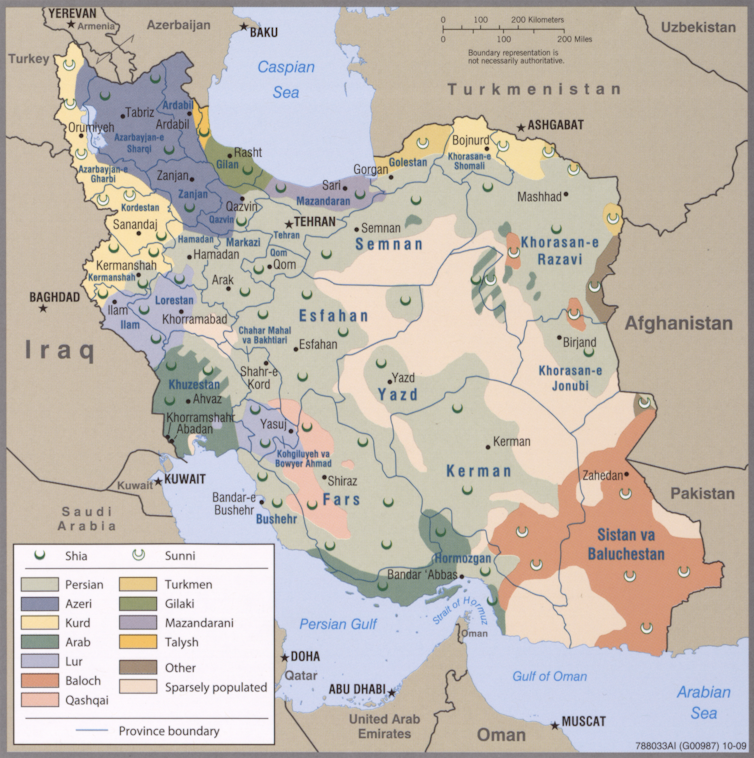
L’Iran est un pays d’environ 93 millions d’habitants dont l’État moderne s’est construit autour d’une identité nationale centralisée, ce qui masque une importante diversité ethnique. La majorité perse représente 51 % de la population ; 24 % des habitants du pays s’identifient comme Azéris ; le nombre de Kurdes est estimé à entre 7 et 15 millions de personnes, soit environ 8 à 17 % de la population totale. Enfin, les minorités arabe et baloutche constituent respectivement 3 % et 2 % des Iraniens.
Carte de la répartition des groupes ethniques en Iran. Wikimedia
Depuis le lancement du projet de construction nationale par la monarchie Pahlavi en 1925, les gouvernements successifs, qu’ils aient relevé de la monarchie ou de la République islamique qui l’a renversée en 1979, ont toujours considéré la diversité ethnique comme un défi sécuritaire et ont réprimé à plusieurs reprises des revendications en faveur de l’inclusion politique, des droits linguistiques et de la gouvernance locale.
Dans les manifestations actuelles, les régions où les minorités sont présentes en nombre se sont au départ moins mobilisées que lors de la dernière vague importante de manifestations : celle de 2022-2023, conduite sous le slogan « Femme, vie, liberté », déclenchée par la mort d’une Kurde iranienne nommée Jina Mahsa Amini.
Les Kurdes ont commencé à se joindre aux manifestations actuelles le 3 janvier, dans la petite ville de Malekshahi (province d’Ilam). S’est ensuivie une violente descente des forces de sécurité contre des manifestants blessés à l’intérieur de l’hôpital d’Ilam, qui a provoqué l’indignation au-delà de la communauté locale et attiré l’attention internationale.
Depuis, les manifestations se sont poursuivies à Ilam. Dans la province voisine de Kermanshah, en particulier dans la région pauvre de Daradrezh, elles ont éclaté en raison de la précarité économique et de la discrimination politique dont les Kurdes sont victimes.
Une approche stratégique de la protestation
Les communautés d’Ilam et de Kermanshah continuent de subir une exclusion fondée sur leur identité kurde. Et ce, malgré le fait qu’elles partagent leur foi chiite avec le pouvoir en place à Téhéran — un facteur qui leur a historiquement permis d’avoir un meilleur accès au gouvernement que la population kurde sunnite.
À la suite du meurtre de plusieurs manifestants à Ilam et Kermanshah, les partis politiques kurdes ont publié une déclaration commune appelant à une grève dans toute la région.
Il convient de souligner que les dirigeants kurdes n’ont pas appelé à manifester, mais uniquement à faire grève. Lors du soulèvement « Femme, vie, liberté », le gouvernement avait traité les villes kurdes comme des zones rebelles, qualifiant les manifestations de « menace pour l’intégrité territoriale de l’Iran » et utilisant cette justification pour procéder à des massacres et à des exécutions massives.
En optant cette fois-ci pour des grèves, les dirigeants kurdes ont cherché à manifester leur solidarité avec le mouvement qui touche l’ensemble du pays tout en réduisant le risque de subir un nouveau massacre.
Téhéran, 10 janvier 2026. Fourni par l’auteur, CC BY
L’appel a été suivi : presque toutes les villes kurdes se sont retrouvées à l’arrêt.
Le Baloutchistan, dans le sud-est de l’Iran, a rapidement suivi le Kurdistan. Après les prières du vendredi 9 janvier, des manifestations ont éclaté, également motivées par la marginalisation ethnique et religieuse que la région subit depuis longtemps.
L’Azerbaïdjan iranien, une région située dans le nord-ouest du pays, s’est joint à la contestation plus tard et plus prudemment. Cette manifestation tardive et modeste reflète la position favorable dont jouissent actuellement les Azerbaïdjanais au sein des institutions politiques, militaires et économiques iraniennes. Historiquement, du XVIe siècle à 1925, les Turcs azéris chiites ont dominé l’État iranien, l’azéri étant la langue de la cour.
La période de la monarchie Pahlavi a marqué une rupture : la langue azerbaïdjanaise a été interdite et l’autonomie locale réduite. Mais depuis 1979, la République islamique a partiellement restauré l’influence azerbaïdjanaise, autorisant les religieux à s’adresser à leurs fidèles dans leur langue maternelle et intégrant des personnes d’origine azerbaïdjanaise dans le gouvernement central à Téhéran. L’actuel guide suprême, Ali Khamenei, est d’ailleurs d’origine azerbaïdjanaise.
Une longue histoire de répressions
Des mouvements politiques de nature ethnique ont vu le jour dans tout l’Iran immédiatement après la révolution de 1979, que de nombreux groupes minoritaires avaient soutenue dans l’espoir d’obtenir une plus grande inclusion et des droits plus étendus.
Mais ces mouvements ont été rapidement réprimés : la République islamique a écrasé les soulèvements dans l’Azerbaïdjan iranien, le Baloutchistan, le Khouzestan et d’autres régions périphériques.
Le Kurdistan a été l’exception : la résistance, les affrontements militaires et les violences étatiques, y compris les massacres, s’y sont poursuivis pendant plusieurs années.
Cette répression et l’impact de la guerre Iran-Irak, durant laquelle la mobilisation nationale a éclipsé les griefs internes, ont étouffé les revendications des minorités ethniques tout au long des années 1980. Celles-ci ont refait surface dans les années 1990, notamment sous l’impulsion d’un renouveau culturel et de la formation d’identités transfrontalières après l’effondrement de l’Union soviétique. Au Kurdistan iranien, la lutte armée a largement évolué en une lutte civile, tandis que de l’autre côté de la frontière, au Kurdistan irakien, les forces peshmergas ont conservé leurs armes et leur entraînement militaire. Le gouvernement iranien a considéré ce réveil comme une menace stratégique et a réagi en décentralisant les autorités sécuritaires et militaires afin de pouvoir réprimer rapidement les manifestations sans attendre l’approbation de Téhéran.
Les revendications divergentes des manifestants
Ces précédents expliquent pourquoi les manifestations actuelles en Iran ont été, du moins au début, plus centralisées que les soulèvements précédents. Les régions où vivent des minorités ethniques ne sont pas indifférentes au changement, mais leurs habitants sont sceptiques quant à l’issue du mouvement.
Depuis plus de quatre décennies, les revendications des minorités ethniques sont qualifiées par la République islamique de séparatistes ou de « terroristes » et ont donné lieu à de nombreuses arrestations et exécutions. Cette rhétorique a également influencé les principaux groupes d’opposition dominés par les Perses — couvrant tout le spectre idéologique, de la gauche à la droite, et opérant principalement en exil — qui perçoivent les exigences des minorités ethniques comme une menace pour l’intégrité territoriale de l’Iran.
La crainte d’un retour du chah
Reza Pahlavi, le fils exilé du dernier chah d’Iran, se positionne comme le leader de l’opposition et une figure de transition. Ce qui ne va pas sans inquiéter les communautés ethniques.
Le bureau de Pahlavi a publié une feuille de route pour un gouvernement de transition qui contraste fortement avec ses déclarations publiques selon lesquelles il ne cherche pas à monopoliser le pouvoir. Ce document présente Pahlavi comme un leader doté d’une autorité extraordinaire. Dans la pratique, la concentration du pouvoir qu’il propose sous sa direction ressemble fortement à l’autorité actuellement exercée par le guide suprême iranien.
Reza Pahlavi, le fils du défunt souverain iranien Mohammad Reza Pahlavi, a vu son soutien augmenter parmi les manifestants, comme ceux que l’on voit ici en Allemagne le 12 janvier 2026. John Macdougall/AFP
Pour les groupes ethniques minoritaires, cette perspective est particulièrement préoccupante. La feuille de route qualifie leurs revendications de menaces pour la sécurité nationale, reprenant ainsi les discours étatiques traditionnels plutôt que de s’en éloigner. Cette position explicite a renforcé le scepticisme dans les régions périphériques à l’égard du système qui pourrait venir remplacer la République islamique si celle-ci venait à chuter.
Contrairement à l’ayatollah Khomeini en 1979, dont la vision révolutionnaire était délibérément vague quant au statut futur des groupes ethniques, le projet actuel des dirigeants de l’opposition dépeint un ordre politique centralisé qui exclut l’inclusion ethnique et le partage du pouvoir.
Pour les communautés dont les langues ont été interdites et dont les régions ont été systématiquement sous-développées pendant la monarchie, la résurgence des slogans monarchistes dans les villes centrales renforce la crainte qu’un changement de pouvoir aboutisse à une nouvelle marginalisation des régions périphériques du pays.
Le mouvement de contestation peut-il ignorer les sentiments des régions provinciales ?
Les manifestations actuelles révèlent donc plus qu’une simple résistance à un régime autoritaire. Elles mettent en évidence une division fondamentale sur la signification du changement politique et sur ceux à qui il profitera.
Dans un pays aussi divers sur le plan ethnique que l’Iran, où des millions de personnes appartiennent à des communautés ethniques non persanes, un ordre politique durable ne peut être fondé sur un pouvoir centralisé dominé par une seule identité ethnique.
Toute transition future, qu’elle passe par une réforme du système actuel ou par un changement de régime, aura plus de chances de réussir si elle s’inscrit dans un cadre politique qui reconnaît et intègre les revendications de toutes les régions et communautés. Sans cette inclusion, la confiance dans le processus de changement restera difficile à gagner et les espoirs d’un avenir meilleur s’amenuiseront.
Shukriya Bradost est affiliée au Middle East Institute.