Erratic behavior and unpredictability is having a moment in foreign policy circles. In the White House and elsewhere, it is seemingly being viewed as a strategic asset rather than a weakness.
But it is far from a new strategy. Wild threats, sudden policy reversals and intentionally confusing language have long been used to keep adversaries off balance and gain leverage.
In fact, the concept has its own name in international relations: “madman theory.” As outlined by Cold War strategists Daniel Ellsberg and Thomas Schelling, it holds that projecting a readiness to take extreme action can shape an opponent’s calculations by heightening fears of escalation.
While the theory was meant to be explanatory, in the sense that observers used it to explain apparently irrational behavior, it has sometimes been used in a prescriptive way, as an approach consciously adopted by leaders.
The 3 conditions for madman success
The madman theory has historical roots going back to Machiavelli, but it is most closely associated with Richard Nixon, who, as incoming president, reportedly used the term to explain his approach to trying to force North Vietnam’s surrender in the Vietnam War.
Historians see evidence of the theory’s limited applicability in episodes such as Nixon’s 1969 placing of the U.S. military on nuclear alert, which appeared to have reinforced Soviet caution even if it did not bring about an end of the Vietnam War.
President Richard Nixon is closely associated with the ‘madman theory.’ Bettmann/Getty Images
The theory was more applicable in Nixon’s era because of three background conditions that were in place.
The first was information scarcity. During the Cold War, signals traveled more slowly than they do today and through narrow channels. Messages were filtered by professional diplomats, intelligence analysts and military officers.
Ambiguity could be sustained. A country’s leader could appear possibly unhinged without being instantly decoded, contextualized or publicly dissected. “Madman” signaling depended on this controlled opacity.
The second condition was a stable adversary with a shared notion of risk. Nixon’s gambit worked, when it worked at all, because Soviet leaders were deeply conservative risk managers operating inside a rigid hierarchy. They feared miscalculation because they believed it could lead to the Soviet Union’s fall — or at least their fall within it.
The third condition was credibility built through restraint elsewhere. The madman pose only works if it is exceptional. Nixon appeared dangerous to adversaries precisely because the American system normally appeared controlled. His apparent erratic behavior was exceptional in a context of bureaucratic orderliness.
But the world of those three conditions is gone.
Threats today are tweeted, clipped, reframed, leaked, mocked and talked about in real time. Unpredictability doesn’t have time to breathe public fear into existence. Rather, it can devolve into noise.
And nations such as Iran, Russia and China operate in a world they already regard as unstable and unjust. Volatility does not frighten them; it is the environment they expect. In such conditions, apparent irrationality can invite probing, hedging or reciprocal escalation.
Meanwhile, erratic behavior is no longer exceptional or unexpected.
Many a madman would struggle today
Unpredictability only works if it’s strategic rather than designed on the fly. Trump has blustered, contradicted himself publicly, ramped-up rhetorically and then backed down, mostly without receiving obvious concessions.
The more this happens, the more predictability he creates about unpredictability.
And once unpredictability becomes expected, it loses its coercive force.
This dynamic is evident in Trump’s handling of both Iran and Greenland. In the Iranian case, pressure — including military strikes — has been applied without clearly defining where escalation would end.
With Greenland, coercive threats aimed at an ally only strained NATO without producing compliance.
In neither instance did unpredictability translate into durable leverage. Instead, it generated uncertainty about objectives and limits.
A bigger problem for any leader wishing to adopt a madman strategy is that today’s international order and media ecosystem are more inured to volatility. Threats no longer freeze opponents into caution.
Friendly nations hedge their bets. For example, faced with U.S. threats over tariffs, India strengthened ties with China.
Meanwhile, enemies test boundaries. Russia, for example, has treated Trump’s ambiguous signaling on Ukraine as little more than a green-light for it to continue its campaign to conquer the Donbas region.
Does the madman have a future?
There are still limited circumstances in which ambiguity can serve a strategic purpose.
Limited uncertainty about specific responses can reinforce deterrence by keeping adversaries cautious. U.S. strategic ambiguity toward Taiwan, for example, leaves it unclear whether Washington would intervene militarily in the case of an attack by Beijing, discouraging the locking of any side into automatic escalation.
That part of the madman approach remains effective. But what no longer works is volatility untethered from clear objectives and visible limits.
The madman theory was built for a rigid, rule-bound world. It is least effective precisely where today’s politics feels most chaotic.
Andrew Latham does not work for, consult, own shares in or receive funding from any company or organization that would benefit from this article, and has disclosed no relevant affiliations beyond their academic appointment.
Ask people how Stonehenge was built and you’ll hear stories of sledges, ropes, boats and sheer human determination to haul stones from across Britain to Salisbury Plain, in south-west England. Others might mention giants, wizards, or alien assistance to explain the transport of Stonehenge’s stones, which come from as far as Wales and Scotland.
But what if nature itself did the heavy lifting in transporting Stonehenge’s megaliths? In this scenario, vast glaciers that once covered Britain carried the bluestones and the Altar Stone to southern England as “glacial erratics”, or rocks moved by ice, leaving them conveniently behind on Salisbury Plain for the builders of Stonehenge.
This idea, known as the glacial transport theory, often appears in documentaries and online discussions. But it has never been tested with modern geological techniques.
Our new study, published today in Communications Earth and Environment, provides the first clear evidence glacial material never reached the area. This demonstrates the stones did not arrive through natural ice movement.
While previous research had cast doubt on the glacial transport theory, our study goes further and applies cutting-edge mineral fingerprinting to trace the stones’ true origins.
However, near Stonehenge, these tell-tale clues are either missing or ambiguous. And because the southern reach of ice sheets remains unclear, the glacial transport idea is open to debate.
So, if no big and obvious clues are present, could we look for tiny ones instead?
If glaciers had carried the stones all the way from Wales or Scotland, they would also have left behind millions of microscopic mineral grains, such as zircon and apatite, from those regions.
When both minerals form, they trap small amounts of radioactive uranium – which, at a known rate, will decay into lead. By measuring the ratios of both elements using a technique called U–Pb dating, we can measure the age of each zircon and apatite grain.
Because Britain’s rocks have very different ages from place to place, a mineral’s age can indicate its source. This means that if glaciers had carried stones to Stonehenge, the rivers of Salisbury Plain, which gather zircon and apatite from across a wide area, should still contain a clear mineral fingerprint of that journey.
Searching for tiny clues
To find out, we got our feet wet and collected sand from the rivers surrounding Stonehenge. What we discovered was striking.
Despite analysing more than seven hundred zircon and apatite grains, we found virtually no mineral ages that matched the bluestone sources in Wales or the Altar Stone’s Scottish source.
Zircon is exceptionally tough: grains can survive being weathered, washed into a river, buried in rocks, and recycled again millions of years later. As such, zircon crystals from Salisbury Plain rivers span an enormous stretch of geological time, covering half the age of the Earth, from around 2.8 billion years ago to 300 million years ago.
However, the vast majority fell within a tight band, spanning between 1.7 and 1.1 billion years old. Intriguingly, Salisbury River zircon ages match those from the Thanet Formation, a blanket of loosely compacted sand that covered much of southern England millions of years ago before being eroded.
This means zircon in river sand today is the leftovers from ancient blankets of sedimentary rocks, not freshly delivered sand from glaciers during the last Ice Age 26,000 to 20,000 years ago.
Apatite tells a different story. All grains are about 60 million years old, at a time when southern England was a shallow, subtropical sea. This age doesn’t match any potential source rocks in Britain.
Instead, apatite ages reflect the squeezing and uplifting caused by distant mountain-building in the European Alps, causing fluids to move through the chalk and “reset” apatite’s uranium-lead clock. In other words, the heating and chemical changes erased the mineral’s previous radioactive signature and started the clock ticking again.
Much like zircon, apatite isn’t a visitor brought in by glaciers but is local and has been sitting on Salisbury Plain for tens of millions of years.
A new piece of the Stonehenge story
Stonehenge sits at the crossroads of myth, ancient engineering and deep-time geology.
The ages of microscopic grains in river sand have now added a new piece to its story. This gives us further evidence the monument’s most exotic stones did not arrive by chance but were instead deliberately selected and transported.
Anthony Clarke receives funding from the Australian Research Council.
Chris Kirkland does not work for, consult, own shares in or receive funding from any company or organisation that would benefit from this article, and has disclosed no relevant affiliations beyond their academic appointment.
Source: The Conversation – UK – By Andrew Gawthorpe, Lecturer in History and International Studies, Leiden University
Another US citizen has allegedly been killed by immigration agents in Minnesota, raising tensions between state and federal governments. The actions of the federal agencies involved has drawn fierce criticism not only from former Democratic presidents Barack Obama and Bill Clinton, but also America’s powerful pro-gun lobby, the National Rifle Association (NRA).
If you were to think it unusual that the people named in the previous sentence appear to be on the same side over this issue, you’d be right. But these aren’t usual times in America.
Video footage taken at the scene reportedly shows agents of the US Customs and Border Protection (CBP) – working with the Immigration and Customs Enforcement Agency (ICE) in Minnesota to detain people they suspect of being illegal migrants – tackling 37-year-old nurse, Alex Pretti.
The footage reportedly shows they wrestled him to the ground, beat him and apparently removed a handgun from a holster he was wearing, before firing ten shots at him.
Since his killing a lot of attention has focused on his gun. Carrying a handgun, whether openly or holstered, is legal in Minnesota, and Pretti had a license for his gun. So he was perfectly within his rights to be carrying it. And there is nothing to suggest from the footage that he attempted to draw it or use it while being tackled by the ICE agents.
Of course, in the United States, the right to keep and bear arms – the second amendment – is a pretty big deal to a lot of people, especially conservatives. So when various figures in the Trump regime suggested that CBP agents had been justified in shooting Pretti because he was carrying a holstered weapon, they provoked outrage from gun rights activists. And, significantly, many of these people are usually on the same page as the White House about pretty much anything.
First there was FBI director Kash Patel, who told Fox News: “You cannot bring a firearm loaded with multiple magazines to any sort of protest that you want.” Dead wrong, replied the Minnesota Gun Owners Caucus and the group Gun Owners of America – you’re legally entitled to bring a gun to a protest.
Then a Trump-appointed district attorney waded in, arguing: “If you approach law enforcement with a gun, there is a high likelihood they will be legally justified in shooting you.”
This drew a rebuke from the NRA, one of the most prolific and important right-wing groups in America and a big donor to Trump’s campaigns, which replied that: “This sentiment … is dangerous and wrong. Responsible public voices should be awaiting a full investigation, not making generalizations and demonizing law-abiding citizens.”
The problem that the Trump regime has is that it appears from abundant video evidence that Pretti was not handling his gun irresponsibly. He wasn’t waving it around, he wasn’t threatening anyone, in fact he wasn’t even touching it. He didn’t approach the federal agents – they appeared to pile on him. And he was disarmed of his holstered weapon by one of them before he was killed.
Second amendment vs tyrannical government
The reason that this touches such a raw nerve, even with many people who usually support Trump’s agenda, is that this cuts to the core of what the second amendment is about. In the eyes of the right, the amendment’s whole legitimacy rests on the idea that it allows the populace to arm in order to protect itself against a tyrannical government.
This means that Pretti was doing exactly what second amendment advocates say they need guns for. And while some gun rights advocates may have been willing to keep quiet while federal agents were trampling on the rights of migrants and brown-skinned citizens, the murder of Pretti is a bridge too far.
That’s not to say that the gun lobby is turning on the Trump administration – at least, not yet. But it is notable that ICE’s outrages (and those of the related Customs and Border Protection Agency) are becoming so hard to ignore that they’re increasingly drawing opposition not just from the left but also from traditionally right-wing groups.
The NRA is not about to flip and start fundraising for the next Democratic party presidential candidate. But its willingness to call out the regime is unusual to say the least. And it increases pressure on Trump to change course and damages the credibility of key people in the regime among conservatives.
The whole sequence of events also reveals something more concerning – the fact that more and more people in America on both left and right are carrying weapons. The idea of arming for self-defense has been quietly gaining ground in left-wing circles for around a decade.
Gun clubs have sprung up to serve LGBTQ+ people, black people, white liberals – anyone who fears they might one day be a target of violence from the Trump-ified federal authorities or right-wing militia. Nearly one-third of self-identified liberals now live in a gun-owning household.
And while it’s hard to find fault with their fears, this is another reason why America’s knife-edge politics is so terrifying. What happens when things fall apart in a country in which hatred and fear have driven so many people to arm themselves?
Let’s hope that Alex Pretti’s death serves as a reminder of the importance of stepping back from the brink rather than pushing the country closer to it.
Le Service de l’immigration et des douanes des États-Unis, ou ICE, est l’une des agences fédérales favorites de Donald Trump, qui en a très largement augmenté le budget alors même qu’il réduisait celui de bien d’autres administrations. Chargée avant tout d’arrêter et d’expulser les supposés millions de clandestins se trouvant sur le territoire national, elle recrute des milliers d’agents, qui sont rapidement formés et quasi immédiatement envoyés sur le terrain. Très critiquée pour ses méthodes violentes, l’organisation est plus que jamais sous le feu des projecteurs actuellement, après deux arrestations à Minneapolis (Minnesota) qui ont provoqué la mort des personnes interpellées. L’administration Trump fait bloc autour du Service, tandis que le Parti démocrate et de très nombreux simples citoyens la dénoncent et, souvent, réclament sa dissolution immédiate.
L’Immigration and Customs Enforcement (ICE), agence fédérale américaine chargée de l’application des lois sur l’immigration et les douanes, a été officiellement créée le 1er mars 2003, dans le cadre d’une vaste réorganisation gouvernementale consécutive aux attentats du 11 septembre 2001. Son instauration résulte directement du Homeland Security Act de 2002, signé par le président George W. Bush, qui visait à renforcer la sécurité intérieure des États-Unis en consolidant plusieurs agences fédérales sous l’égide du nouveau Département de la Sécurité intérieure (DHS).
L’ICE a absorbé les fonctions de l’ancien Immigration and Naturalization Service (INS) et de l’United States Customs Service, deux entités dissoutes pour permettre une gestion plus centralisée et plus efficace des questions migratoires et douanières, dans un contexte marqué par la lutte contre le terrorisme et la criminalité transnationale.
Sa création est donc indissociable des bouleversements politiques et sécuritaires provoqués par les attaques du 11 septembre 2001, qui ont conduit les autorités américaines à repenser en profondeur leur approche de la sécurité nationale, en intégrant notamment une dimension plus répressive et plus préventive à la gestion des flux migratoires et des échanges commerciaux. L’ICE a été conçue pour jouer un rôle clé dans cette stratégie, en combinant des pouvoirs civils et pénaux afin de mieux protéger le territoire national contre les menaces extérieures, qu’elles soient terroristes, criminelles ou liées à l’immigration illégale.
Explosion budgétaire sous la seconde présidence Trump
Sous Bush puis sous son successeur Barack Obama, l’agence se consacre essentiellement à la lutte contre le terrorisme et contre les gangs transnationaux, même si elle procède déjà à de nombreuses expulsions de sans-papiers. Ses capacités seront accrues lors du premier mandat Trump, et Joe Biden ne les réduira pas : lors de sa dernière année à la Maison Blanche, 274 000 personnes seront expulsées, soit un peu plus que lors de l’année la plus « productive » en la matière du premier mandat Trump. Mais c’est le retour de Donald Trump à la Maison Blanche en janvier 2025 qui marquera un véritable tournant majeur pour l’ICE, avec une augmentation spectaculaire de ses moyens financiers.
En juillet 2025, le Congrès, à majorité républicaine, a adopté la loi dite « One Big Beautiful Bill Act », qui a alloué environ 75 milliards de dollars (plus de 63 milliards d’euros) supplémentaires à l’ICE sur plusieurs années, dont une grande partie disponible jusqu’en 2029. Sur ce montant, 45 milliards (soit quelque 37,8 milliards d’euros) sont destinés à l’expansion massive des capacités de détention (visant potentiellement à la création de plus de 100 000 places supplémentaires), et environ 30 milliards (environ 25,2 milliards d’euros) à l’intensification des opérations d’arrestation, de traque et d’expulsion.
Ajoutés au budget annuel classique d’environ 10 milliards de dollars, environ 8,4 milliards d’euros, (maintien pour l’exercice fiscal 2026), ces fonds portent le budget effectif de l’agence à des niveaux inédits, souvent estimés autour de 28 milliards à 30 milliards de dollars (de 23,5 milliards à 25,2 milliards d’euros) par an en 2025-2026, soit près du triple du budget d’avant 2025.
Post de l’ICE sur X, reprenant une esthétique bien connu de l’appel à s’engager (le dessin d’origine, montrant l’Oncle Sam invitant les jeunes Américains à rejoindre l’armée avec le slogan « I want you for U.S. Army » datait de 1917, en pleine Première Guerre mondiale). Le texte dit : « Pas de limite d’âge. Prime à la signature de 50 000 $. Défendre la patrie. Qu’attendez-vous ? Répondez à l’appel pour servir au sein de l’ICE. » @Icegov/X
Depuis le début du second mandat de Donald Trump, l’ICE s’est imposée comme l’une des institutions fédérales les plus sujettes à controverse, en raison notamment de pratiques opérationnelles fréquemment dénoncées pour leur caractère excessif, voire abusif.
Cette polarisation a atteint son paroxysme en janvier 2026, lorsque l’agence s’est retrouvée au centre d’une crise sociopolitique majeure à Minneapolis (Minnesota), ses agents ayant abattu deux personnes dans le courant de ce mois. Cette séquence, encore loin d’être achevée au moment où ces lignes sont écrites, a catalysé les tensions latentes, accumulées depuis plusieurs années, concernant tant les modalités d’intervention de l’ICE que la légitimité même de son mandat institutionnel.
Petit rappel des faits : le 7 janvier dernier, Renée Nicole Good, une mère de famille américaine de 37 ans, a été tuée par balles par un agent de l’ICE lors d’une opération de contrôle de l’immigration dans la métropole du Minnesota. Les circonstances de sa mort, rapidement appuyées par des vidéos tournées par des témoins diffusées sur les réseaux sociaux, ont révélé une scène d’une grande violence : alors que Good se trouvait dans son véhicule, garé en travers de la route depuis seulement quelques minutes, un agent de l’ICE a fait usage de son arme à feu, la touchant à quatre reprises, dont deux balles dans la poitrine et une à la tête.
Le 24 janvier 2026, dans la même ville, des agents de l’ICE tuaient Alex Pretti, un infirmier américain venu filmer une de leurs opérations. Pretti a reçu plusieurs balles dans le corps alors qu’il se trouvait au sol, immobilisé et ne présentant aucun danger, le pistolet qu’il portait – légalement – sur sa personne lui ayant été retiré, sans qu’il n’ait d’ailleurs cherché à s’en saisir.
L’impact de ces deux événements a été immédiat et profond, tant sur le plan local que national. Minneapolis, déjà marquée par la mort de George Floyd en 2020 et les mouvements de protestation contre les violences policières qui avaient suivi, est devenue une nouvelle fois l’épicentre d’une mobilisation citoyenne massive.
Le maire de Minneapolis Jacob Frey ainsi que le gouverneur du Minnesota Tim Walz, tous deux démocrates (Walz était le colistier de Kamala Harris à la dernière présidentielle), ont rapidement condamné les actions de l’ICE, exigeant le retrait immédiat des agents fédéraux de leur État et dénonçant « le chaos, les perturbations et les traumatismes » infligés à la communauté locale. Ces prises de position ont mis en lumière les tensions persistantes entre les autorités locales, souvent démocrates et favorables à une approche plus humaniste de l’immigration, et le gouvernement fédéral, dont la politique migratoire s’est durcie sous l’administration Trump, spécialement depuis son retour au pouvoir en 2025.
La mort d’Alex Pretti a suscité les mêmes réactions, encore plus fortes peut-être du fait de la répétition à court terme, dans la même ville, d’une scène similaire à celle du décès de Renée Good : les protestations massives consécutives à la tragédie du 7 janvier n’avaient donc pas suffi à empêcher un bis repetita.
Sur le plan politique, l’affaire a également révélé les profondes divisions qui traversent la société américaine. Alors que des enquêtes fédérales et locales ont été ouvertes pour éclaircir les circonstances exactes de la mort de Renée Good, les réactions des responsables politiques ont été plus que contrastées.
Dans le camp d’en face, la condamnation des méthodes de l’ICE et du soutien systématique que lui offrent les responsables républicains, qu’il s’agisse de Trump, de Vance, ou encore de la secrétaire à la sécurité intérieure Kristi Noem, a été tout aussi unanime. De Bernie Sanders à Bill Clinton et Barack Obama, en passant par le leader des démocrates au Congrès Hakeem Jeffries, les leaders démocrates ont tous fait part de leur consternation et de leur dégoût, dans des termes très vifs.
L’ICE et au-delà : illustration d’une société plus polarisée que jamais
Cette polarisation des discours a alimenté une crise de confiance envers les institutions fédérales, déjà fragilisées par des années de controverses autour des pratiques de l’ICE.
En effet, les morts de Renée Good et d’Alex Pretti ont relancé le débat sur la légitimité même de l’ICE en tant qu’institution. Des appels à sa dissolution, portés par des mouvements militants et des élus locaux, se sont multipliés, tandis que des sondages réalisés dans les jours suivant l’incident ont révélé une désapprobation majoritaire de l’action de l’agence parmi la population américaine. Plus de 50 % des personnes interrogées ont jugé les méthodes de l’ICE « trop énergiques », et une majorité a exprimé une forte désapprobation de son fonctionnement, soulignant un fossé croissant entre les objectifs affichés de sécurité nationale et les réalités vécues par les communautés directement affectées par ses opérations.
En définitive, l’affaire de Minneapolis s’inscrit dans une trajectoire historique plus large. L’ICE, née dans le sillage des attentats du 11-Septembre, est devenue le symbole d’une approche sécuritaire de l’immigration, souvent au détriment des droits humains et de la cohésion sociale. Les événements de janvier 2026, en révélant les excès et les dangers d’une telle politique, ont non seulement ravivé les mémoires des violences passées, mais ont aussi posé avec une acuité nouvelle la question de l’équilibre entre sécurité et liberté dans une démocratie libérale.
Frédérique Sandretto ne travaille pas, ne conseille pas, ne possède pas de parts, ne reçoit pas de fonds d’une organisation qui pourrait tirer profit de cet article, et n’a déclaré aucune autre affiliation que son organisme de recherche.
Ontario’s Bill 33, passed in November 2025, could change how post-secondary admissions decisions are made, as well as how student fees are managed and what campus services they fund.
Each year, tens of thousands of university and college applicants come from communities that are historically underrepresented in higher education.
These policy changes could shape who gains access to programs, supports and opportunities for success.
The provincial government says Bill 33, which it termed the Supporting Children and Students Act, will make education more transparent and consistent. The law affects school boards, colleges and universities.
For us as scholars whose combined expertise spans strategic planning, equity, anti-oppressive forms of education and learning accessibility, the bill’s reach into admissions raises serious concerns about equity and student rights.
Discussion of ‘merit’
A section of the bill “requires colleges of applied arts and technology and publicly assisted universities to assess applicants based on merit and to publish the criteria and process to be used for assessment into programs of study.”
Greater transparency in admissions is positive. But if merit is defined too narrowly, it could block diverse pathways to post-secondary admissions that recognize different kinds of achievement, leaving out students from marginalized communities.
If merit is defined too narrowly, it could block diverse pathways to post-secondary admissions. (Saforrest/Wikimedia Commons), CC BY-SA
Studies in professional and medical education show that relying only on grades can miss other signs of potential, like life experience, community work and meeting the needs of society.
Bill 33 doesn’t explain what “merit” means. Without a clear definition, admissions could end up favouring students who already have advantages. New rules will soon define how merit is measured, and these rules will be very important. If they don’t protect equity-focused pathways, the law could make existing gaps even worse.
Student fees and risk to campus services
Fair admissions are only part of the story. Bill 33 also changes how student fees are handled. These changes could harm students from marginalized communities.
Student groups have raised strong concerns about how Bill 33 could affect ancillary fees and the services they fund.
According to the Ontario Undergraduate Student Alliance, “ancillary fees are democratically approved by students, for students.” These are extra student fees that fund essential services such as food banks, wellness centres, accessibility programs, cultural programs, transportation and safety programs. These services could be at risk if the province gains more control over how fees are defined and charged.
In 2019, student groups successfully challenged Ontario’s Student Choice Initiativ. Through this measure, the province tried to limit ancillary fees but the court ruled it didn’t have the legal authority to do so at the time. Bill 33 responds to that ruling by changing the law itself, giving the province clear authority to regulate student fees.
The Canadian Federation of Students in Ontario has warned that focusing on fee oversight may distract from deeper problems in higher education, including chronic underfunding and high tuition costs.
Could weaken student-led supports, harm equity
Under Bill 33, the government can decide which fees can be charged and under what rules. Most universities clearly list how ancillary fees are used. For example, at McMaster University, these fees help fund transit passes, wellness services, career supports and refugee student programs.
How fees are managed is closely linked to the government’s broader oversight of universities, linking financial decisions to questions of accountability, governance and whose voices are heard in decision-making.
Student groups have long played a key role in raising equity concerns and ensuring local needs are addressed. If more decisions are made at the provincial level, student voices could carry less weight unless students are clearly included in new rules and decision-making processes.
Looking ahead: Equity is not automatic
As universities begin to apply Bill 33, students and faculty may notice changes in how admissions decisions are explained, how student fees are handled and how transparency rules are used.
While the law may seem neutral, its real impact will depend on how it is put into practice and whose experiences are considered.
Ensuring equitable access to higher education requires careful planning, enough funding and meaningful input from students, faculty and communities most affected by these changes.
Equity will not happen by chance. It will depend on the choices universities and policymakers make now, and on whose voices are heard in those decisions.
The authors do not work for, consult, own shares in or receive funding from any company or organisation that would benefit from this article, and have disclosed no relevant affiliations beyond their academic appointment.
Source: The Conversation – in French – By Yves Santamaria, Historien, Maître de conférence émérite, Sciences Po Grenoble – Université Grenoble Alpes
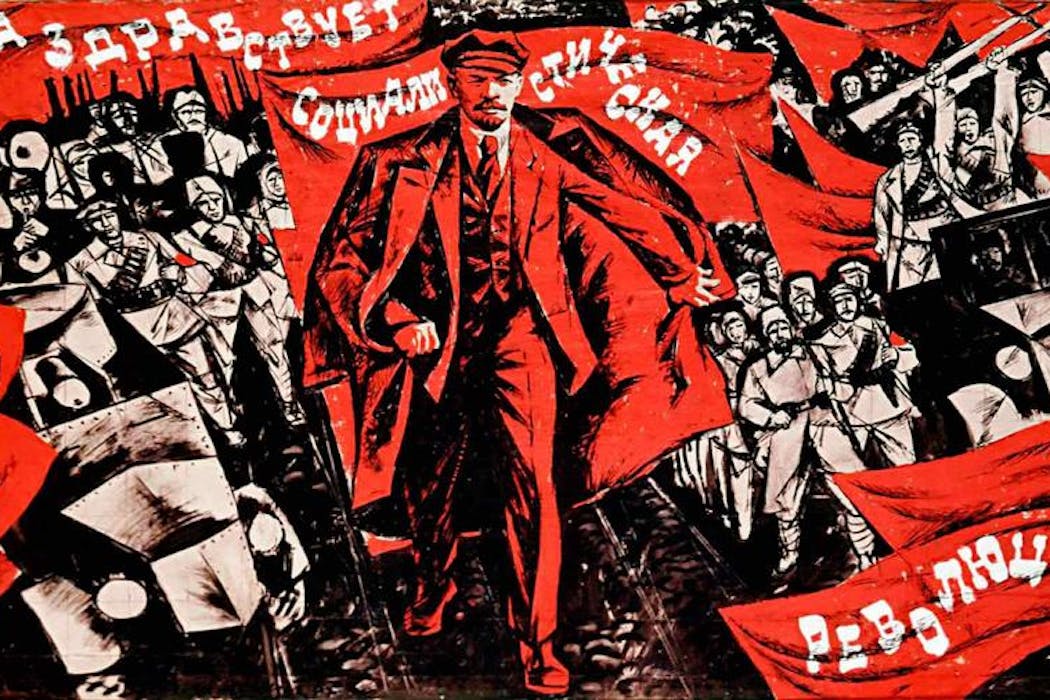
Affiche de propagande soviétique, Lénine au premier plan.
Il y a cinquante ans, en février 1976, le Parti communiste français (PCF) abandonnait officiellement le projet de « dictature du prolétariat ». Que recouvrait réellement cette notion dans la doctrine et la pratique communistes, et comment a-t-elle été interprétée au fil du temps ?
On peut distinguer chez les partisans de la dictature du prolétariat plusieurs versions se démarquant à des degrés divers de l’ordre démocratique libéral/représentatif.
« La dictature du prolétariat est une lutte opiniâtre, sanglante et non sanglante, violente et pacifique, militaire et économique, pédagogique et administrative, contre les forces et les traditions de la vieille société. »
Dans sa mouture la plus rassurante, le terme « dictature » est revendiqué en tant que système provisoire visant à écarter le chaos après la mise à bas de l’ordre ancien et s’oppose donc – selon une nomenclature antique – à la « tyrannie ». Elle se présente également, du fait de la référence prolétarienne, comme une alternative progressiste à la « dictature de la bourgeoisie »
Paternités
La paternité de la formule semble pouvoir être attribuée au socialiste français Auguste Blanqui (1805-1881). Croyant à la nécessité d’un petit groupe organisé de révolutionnaires, il se plaçait dans la continuité de figures, telles que Jean-Paul Marat (1743-1793) ou Gracchus Babeuf (1760-1797). Il s’agissait dans l’esprit de ces derniers de suspendre pour un temps – selon leur interprétation du modèle romain – les droits fondamentaux afin de briser la résistance des ennemis de la Révolution.
Karl Marx (1818-1883) recueille cet héritage en affichant sa volonté de le dépasser de façon dialectique. En fait, il récuse toute prétention d’une minorité à se substituer aux masses révolutionnaires. Selon la narration historique qu’il développe :
« La lutte des classes conduit nécessairement à la dictature du prolétariat [qui] elle-même ne constitue que la transition à l’abolition de toutes les classes et à une société sans classes. »
L’idée d’un accaparement éventuel du pouvoir est selon lui balayée vu que les communistes « ne forment pas un parti distinct opposé aux autres partis ouvriers » et « n’ont point d’intérêts qui les séparent de l’ensemble du prolétariat ».
Une postérité socialiste
Même si Marx n’a guère développé son idée, l’expression a connu une belle postérité dans les rangs socialistes. En France, le concept de « dictature du prolétariat » est notamment assumé par Jules Guesde (1845-1922) alors même que son courant tire profit de son insertion dans le jeu parlementaire. Souhaitant désamorcer la contradiction entre le slogan et la défense des valeurs républicaines, Jean Jaurès (1859-1914) préconise l’abandon de cette perspective. Sans pour autant renoncer à la violence ou au projet communiste, il franchit le pas en 1901 :
« Une minorité révolutionnaire, si intelligente, si énergique qu’elle soit, ne suffit pas, du moins dans les sociétés modernes, à accomplir la révolution. Il y faut le concours, l’adhésion de la majorité, de l’immense majorité. »
Pour autant, la « dictature du prolétariat » ne disparaîtra que progressivement de la rhétorique socialiste. À preuve, son usage par Léon Blum (1872-1950) à l’occasion de la fracture de la social-démocratie française consécutive à la révolution russe de 1917. Devant les militants réunis à Tours en décembre 1920, il affirme n’avoir peur « ni du mot ni de la chose » : le Parti socialiste est prêt à exercer sa dictature au nom du prolétariat en vertu, précise-t-il, « d’une fiction à laquelle nous acquiesçons tous ». Son refus d’adhérer à l’Internationale communiste repose sur son hostilité à l’organisation centralisée, hiérarchisée et militarisée des bolcheviks :
« Dictature d’un parti, oui, dictature d’une classe, oui, dictature de quelques individus, connus ou inconnus, cela, non. »
De la théorie à la pratique
Si la dictature du prolétariat autorisait l’exercice d’une violence sans bornes contre la « bourgeoisie », à compter de novembre 1917, son champ d’application allait connaître une inflation considérable.
Après les mesures adoptées par les bolcheviks russes contre les membres de l’appareil d’État et les couches possédantes, vint rapidement le tour de l’ensemble des diverses fractions politiques et sociologiques de la société. Ouvriers grévistes ou paysans rétifs face à l’extorsion de leur grain, tous les récalcitrants furent englobés sous l’appellation « contre-révolutionnaire » et à ce titre devenaient la cible d’un appareil répressif performant : dès le 23 novembre, tous les individus suspectés de sabotage, de spéculation et d’accaparement étaient susceptibles d’être arrêtés sur le champ comme « ennemis du peuple ».
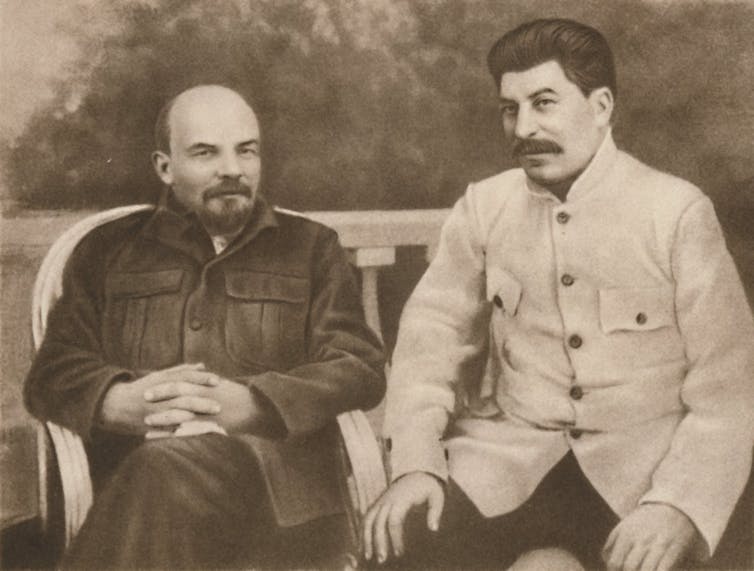
Lénine et Staline à Gorki près de Moscou.
Après le renversement du tsarisme (mars 1917), le Gouvernement provisoire avait engagé un processus électoral devant déboucher sur la mise en place de nouvelles institutions. Défavorables aux bolcheviks, les résultats des élections à l’Assemblée constituante furent appréciés en ces termes par ceux qui, depuis mars 1918, se désignaient comme « communistes », notamment Lénine :
« Le prolétariat doit d’abord renverser la bourgeoisie et conquérir pour lui le pouvoir politique ; ce pouvoir politique, c’est-à-dire la dictature prolétarienne, il doit ensuite s’en servir comme d’un moyen pour s’attirer la sympathie de la majorité des travailleurs. »
En définitive, le pouvoir soviétique et la dictature du prolétariat constituaient aux yeux de Lénine et de ses camarades une forme plus élevée d’expression démocratique qu’un Parlement.
En foi de quoi, le 6 janvier 1918, les travaux de l’Assemblée sont interrompus manu militari par les bolcheviks. Seule la guerre civile peut alors ouvrir une issue à la crise. La « Terreur rouge » s’inscrit dès lors dans un processus d’une implacable « rationalité ». Elle représente désormais, aux yeux de ses promoteurs comme des anticommunistes de tous bords, la manifestation concrète de la dictature du prolétariat.
Après la victoire du Parti communiste, son secrétaire général Staline (1879-1953) inscrit en 1924 cette politique dans la durée :
« Il faut considérer la dictature du prolétariat, le passage du capitalisme au communisme, non comme une période éphémère d’actes et de décrets “éminemment révolutionnaires” mais comme toute une époque historique remplie de guerres civiles et de conflits extérieurs, d’un opiniâtre travail d’organisation et d’édification économique, d’offensives et de retraites, de victoires et de défaites. »
L’Espagne, banc d’essai de la « démocratie populaire »
Pour autant, le réalisme stalinien s’attachait à établir une distinction entre l’essentiel (la souveraineté et l’indépendance du Parti communiste) et les infinies conjonctures se dévoilant au cours de la « période historique ». C’est ainsi que, en 1936, dans le cadre de la guerre civile espagnole (1936-1939), se fit jour un autre modèle de transition adapté à la conjoncture locale : la « démocratie populaire ». Cette politique illustre le tournant advenu à la suite de la victoire de Hitler en 1933 : il s’agissait d’élargir les alliances avec les forces susceptibles de s’opposer au nazisme.
D’où la promotion « d’un type spécifique de république, avec une authentique démocratie populaire. Il ne s’agira pas encore d’un État soviétique, mais bien d’un État antifasciste, de gauche, auquel participera le secteur authentiquement de gauche de la bourgeoisie ». Staline ratifie cette ligne dans une lettre au socialiste espagnol Largo Caballero (1869-1946) dans laquelle il recommande pour l’Espagne une voie parlementaire au socialisme pour « empêcher que les ennemis de l’Espagne voient en elle une république communiste ». Telle fut également la stratégie développée après 1945 en Europe de l’Est.
La paille des mots…
En Extrême-Orient l’affirmation de la dictature du prolétariat revint rapidement au premier plan, sitôt assurée l’hégémonie du parti communiste vis-à-vis de ses concurrents, un temps présentés comme partenaires au sein de « fronts nationaux » visant le départ des Japonais ou des Européens. La taxinomie n’était d’ailleurs pas toujours fidèle à la formulation canonique. La constitution de la Corée du Nord définit ainsi le régime en place comme une « dictature de la démocratie du peuple ». Si la Chine post-maoïste recourt encore à la marque déposée « dictature du prolétariat », le Vietnam l’a jetée par-dessus bord en 1992. Mais après tout Staline l’avait déjà évacuée en 1936 dans une Constitution présentée par lui comme « la plus démocratique du monde », quelques mois avant le déclenchement de la grande terreur (700 000 assassinats…).
En Europe, l’expression fit brièvement l’actualité dans la seconde moitié des années 1970, au cours d’un intermède dit « eurocommuniste » où les partis communistes espagnol, français et italien affichèrent une prise de distance avec l’URSS. Dans une situation internationale marquée par l’extension maximale du système communiste (Sud-Vietnam, Angola, Mozambique, Éthiopie…), les trois PC furent alors écartelés entre leurs liens avec un communisme soviétique triomphant et des conjonctures jugées porteuses dans le cadre national : mort de Franco en Espagne, alliance avec les socialistes en France, rapprochement avec la démocratie chrétienne en Italie.
C’est de cette période que date, lors du XXIIe congrès du Parti communiste français (PCF) (février 1976), l’annonce unilatérale par son secrétaire général Georges Marchais (1920-1997) de l’abandon par le PCF de la notion de dictature du prolétariat. L’aspect emblématique de la déclaration n’échappa à personne : l’objectif figurait en 1919 parmi les 21 conditions de l’adhésion à l’Internationale communiste. Cette atteinte à l’identité du Parti fut partiellement compensée par diverses campagnes visant à flatter la clientèle populaire, telles que la dénonciation de la pornographie, de la drogue et de l’immigration incontrôlée. Elle fut insuffisante à éviter, dès l’année suivante, un décrochage électoral par rapport à un Parti socialiste en phase ascendante. Le désamour entre la France et son Parti communiste relevait d’un processus difficile à enrayer par la seule dédiabolisation. Et la querelle parut bientôt relever du sexe des anges devant un déclin bientôt précipité par l’effondrement du système soviétique.
Yves Santamaria ne travaille pas, ne conseille pas, ne possède pas de parts, ne reçoit pas de fonds d’une organisation qui pourrait tirer profit de cet article, et n’a déclaré aucune autre affiliation que son organisme de recherche.
Le Service de l’immigration et des douanes des États-Unis, ou ICE, est l’une des agences fédérales favorites de Donald Trump, qui en a très largement augmenté le budget alors même qu’il réduisait celui de bien d’autres administrations. Chargée avant tout d’arrêter et d’expulser les supposés millions de clandestins se trouvant sur le territoire national, elle recrute des milliers d’agents, qui sont rapidement formés et quasi immédiatement envoyés sur le terrain. Très critiquée pour ses méthodes violentes, l’organisation est plus que jamais sous le feu des projecteurs actuellement, après deux arrestations à Minneapolis (Minnesota) qui ont provoqué la mort des personnes interpellées. L’administration Trump fait bloc autour du Service, tandis que le Parti démocrate et de très nombreux simples citoyens la dénoncent et, souvent, réclament sa dissolution immédiate.
L’Immigration and Customs Enforcement (ICE), agence fédérale américaine chargée de l’application des lois sur l’immigration et les douanes, a été officiellement créée le 1er mars 2003, dans le cadre d’une vaste réorganisation gouvernementale consécutive aux attentats du 11 septembre 2001. Son instauration résulte directement du Homeland Security Act de 2002, signé par le président George W. Bush, qui visait à renforcer la sécurité intérieure des États-Unis en consolidant plusieurs agences fédérales sous l’égide du nouveau Département de la Sécurité intérieure (DHS).
L’ICE a absorbé les fonctions de l’ancien Immigration and Naturalization Service (INS) et de l’United States Customs Service, deux entités dissoutes pour permettre une gestion plus centralisée et plus efficace des questions migratoires et douanières, dans un contexte marqué par la lutte contre le terrorisme et la criminalité transnationale.
Sa création est donc indissociable des bouleversements politiques et sécuritaires provoqués par les attaques du 11 septembre 2001, qui ont conduit les autorités américaines à repenser en profondeur leur approche de la sécurité nationale, en intégrant notamment une dimension plus répressive et plus préventive à la gestion des flux migratoires et des échanges commerciaux. L’ICE a été conçue pour jouer un rôle clé dans cette stratégie, en combinant des pouvoirs civils et pénaux afin de mieux protéger le territoire national contre les menaces extérieures, qu’elles soient terroristes, criminelles ou liées à l’immigration illégale.
Explosion budgétaire sous la seconde présidence Trump
Sous Bush puis sous son successeur Barack Obama, l’agence se consacre essentiellement à la lutte contre le terrorisme et contre les gangs transnationaux, même si elle procède déjà à de nombreuses expulsions de sans-papiers. Ses capacités seront accrues lors du premier mandat Trump, et Joe Biden ne les réduira pas : lors de sa dernière année à la Maison Blanche, 274 000 personnes seront expulsées, soit un peu plus que lors de l’année la plus « productive » en la matière du premier mandat Trump. Mais c’est le retour de Donald Trump à la Maison Blanche en janvier 2025 qui marquera un véritable tournant majeur pour l’ICE, avec une augmentation spectaculaire de ses moyens financiers.
En juillet 2025, le Congrès, à majorité républicaine, a adopté la loi dite « One Big Beautiful Bill Act », qui a alloué environ 75 milliards de dollars (plus de 63 milliards d’euros) supplémentaires à l’ICE sur plusieurs années, dont une grande partie disponible jusqu’en 2029. Sur ce montant, 45 milliards (soit quelque 37,8 milliards d’euros) sont destinés à l’expansion massive des capacités de détention (visant potentiellement à la création de plus de 100 000 places supplémentaires), et environ 30 milliards (environ 25,2 milliards d’euros) à l’intensification des opérations d’arrestation, de traque et d’expulsion.
Ajoutés au budget annuel classique d’environ 10 milliards de dollars, environ 8,4 milliards d’euros, (maintien pour l’exercice fiscal 2026), ces fonds portent le budget effectif de l’agence à des niveaux inédits, souvent estimés autour de 28 milliards à 30 milliards de dollars (de 23,5 milliards à 25,2 milliards d’euros) par an en 2025-2026, soit près du triple du budget d’avant 2025.
Post de l’ICE sur X, reprenant une esthétique bien connu de l’appel à s’engager (le dessin d’origine, montrant l’Oncle Sam invitant les jeunes Américains à rejoindre l’armée avec le slogan « I want you for U.S. Army » datait de 1917, en pleine Première Guerre mondiale). Le texte dit : « Pas de limite d’âge. Prime à la signature de 50 000 $. Défendre la patrie. Qu’attendez-vous ? Répondez à l’appel pour servir au sein de l’ICE. » @Icegov/X
Depuis le début du second mandat de Donald Trump, l’ICE s’est imposée comme l’une des institutions fédérales les plus sujettes à controverse, en raison notamment de pratiques opérationnelles fréquemment dénoncées pour leur caractère excessif, voire abusif.
Cette polarisation a atteint son paroxysme en janvier 2026, lorsque l’agence s’est retrouvée au centre d’une crise sociopolitique majeure à Minneapolis (Minnesota), ses agents ayant abattu deux personnes dans le courant de ce mois. Cette séquence, encore loin d’être achevée au moment où ces lignes sont écrites, a catalysé les tensions latentes, accumulées depuis plusieurs années, concernant tant les modalités d’intervention de l’ICE que la légitimité même de son mandat institutionnel.
Petit rappel des faits : le 7 janvier dernier, Renée Nicole Good, une mère de famille américaine de 37 ans, a été tuée par balles par un agent de l’ICE lors d’une opération de contrôle de l’immigration dans la métropole du Minnesota. Les circonstances de sa mort, rapidement appuyées par des vidéos tournées par des témoins diffusées sur les réseaux sociaux, ont révélé une scène d’une grande violence : alors que Good se trouvait dans son véhicule, garé en travers de la route depuis seulement quelques minutes, un agent de l’ICE a fait usage de son arme à feu, la touchant à quatre reprises, dont deux balles dans la poitrine et une à la tête.
Le 24 janvier 2026, dans la même ville, des agents de l’ICE tuaient Alex Pretti, un infirmier américain venu filmer une de leurs opérations. Pretti a reçu plusieurs balles dans le corps alors qu’il se trouvait au sol, immobilisé et ne présentant aucun danger, le pistolet qu’il portait – légalement – sur sa personne lui ayant été retiré, sans qu’il n’ait d’ailleurs cherché à s’en saisir.
L’impact de ces deux événements a été immédiat et profond, tant sur le plan local que national. Minneapolis, déjà marquée par la mort de George Floyd en 2020 et les mouvements de protestation contre les violences policières qui avaient suivi, est devenue une nouvelle fois l’épicentre d’une mobilisation citoyenne massive.
Le maire de Minneapolis Jacob Frey ainsi que le gouverneur du Minnesota Tim Walz, tous deux démocrates (Walz était le colistier de Kamala Harris à la dernière présidentielle), ont rapidement condamné les actions de l’ICE, exigeant le retrait immédiat des agents fédéraux de leur État et dénonçant « le chaos, les perturbations et les traumatismes » infligés à la communauté locale. Ces prises de position ont mis en lumière les tensions persistantes entre les autorités locales, souvent démocrates et favorables à une approche plus humaniste de l’immigration, et le gouvernement fédéral, dont la politique migratoire s’est durcie sous l’administration Trump, spécialement depuis son retour au pouvoir en 2025.
La mort d’Alex Pretti a suscité les mêmes réactions, encore plus fortes peut-être du fait de la répétition à court terme, dans la même ville, d’une scène similaire à celle du décès de Renée Good : les protestations massives consécutives à la tragédie du 7 janvier n’avaient donc pas suffi à empêcher un bis repetita.
Sur le plan politique, l’affaire a également révélé les profondes divisions qui traversent la société américaine. Alors que des enquêtes fédérales et locales ont été ouvertes pour éclaircir les circonstances exactes de la mort de Renée Good, les réactions des responsables politiques ont été plus que contrastées.
Dans le camp d’en face, la condamnation des méthodes de l’ICE et du soutien systématique que lui offrent les responsables républicains, qu’il s’agisse de Trump, de Vance, ou encore de la secrétaire à la sécurité intérieure Kristi Noem, a été tout aussi unanime. De Bernie Sanders à Bill Clinton et Barack Obama, en passant par le leader des démocrates au Congrès Hakeem Jeffries, les leaders démocrates ont tous fait part de leur consternation et de leur dégoût, dans des termes très vifs.
L’ICE et au-delà : illustration d’une société plus polarisée que jamais
Cette polarisation des discours a alimenté une crise de confiance envers les institutions fédérales, déjà fragilisées par des années de controverses autour des pratiques de l’ICE.
En effet, les morts de Renée Good et d’Alex Pretti ont relancé le débat sur la légitimité même de l’ICE en tant qu’institution. Des appels à sa dissolution, portés par des mouvements militants et des élus locaux, se sont multipliés, tandis que des sondages réalisés dans les jours suivant l’incident ont révélé une désapprobation majoritaire de l’action de l’agence parmi la population américaine. Plus de 50 % des personnes interrogées ont jugé les méthodes de l’ICE « trop énergiques », et une majorité a exprimé une forte désapprobation de son fonctionnement, soulignant un fossé croissant entre les objectifs affichés de sécurité nationale et les réalités vécues par les communautés directement affectées par ses opérations.
En définitive, l’affaire de Minneapolis s’inscrit dans une trajectoire historique plus large. L’ICE, née dans le sillage des attentats du 11-Septembre, est devenue le symbole d’une approche sécuritaire de l’immigration, souvent au détriment des droits humains et de la cohésion sociale. Les événements de janvier 2026, en révélant les excès et les dangers d’une telle politique, ont non seulement ravivé les mémoires des violences passées, mais ont aussi posé avec une acuité nouvelle la question de l’équilibre entre sécurité et liberté dans une démocratie libérale.
Frédérique Sandretto ne travaille pas, ne conseille pas, ne possède pas de parts, ne reçoit pas de fonds d’une organisation qui pourrait tirer profit de cet article, et n’a déclaré aucune autre affiliation que son organisme de recherche.
L’entreprise de prêt-à-porter C&A a fermé 24 magasins en 2025 en France et licencié des centaines de salariés.ArturBogacki/Shutterstock
Le secteur français de la distribution est secoué par l’arrivée de plateformes telles que Temu et Shein, l’augmentation des droits de douane ou des plans de licenciements massifs. Après l’âge d’or à la fin du XXᵉ siècle, il doit combiner diminution de son empreinte carbone, rentabilité économique et confiance des consommateurs. Alors quels nouveaux modèles d’affaires pour rester viable ?
Les acteurs historiques de la distribution tels qu’Auchan, Boulanger, Carrefour, Décathlon, Fnac-Darty, Idkids ou Leroy Merlin, nés avec des magasins et convertis au numérique, sont dans une situation délicate. Ces entreprises traditionnelles doivent remettre en cause ce qu’elles ont mis des décennies à construire.
Elles cohabitent dorénavant avec des acteurs au modèle d’affaires décriés comme Shein ou Temu. Autres concurrents : les nouveaux acteurs au modèle d’affaires conçu dès l’origine sur des bases de la durabilité comme Asphalte dans le textile ou Le Fourgon dans l’alimentaire.
Le secteur de la distribution est particulièrement concerné par cette remise en question compte tenu du nombre d’emplois que ses entreprises représentent : 1,9 million d’emplois en France en 2025, ce qui en fait le premier secteur employeur.
Alors, comment répondre à des injonctions en apparence contradictoires ? Comment garantir une préservation du pouvoir d’achat tout en améliorant l’écoresponsabilité des produits ? Baisser l’empreinte-carbone des produits tout en préservant leur chiffre d’affaires ? Respecter les normes environnementales et sociales tout en apparaissant compétitifs face à des acteurs comme Shein ou Temu qui peuvent aisément contourner l’ensemble de ces normes ? Augmenter la qualité tout en proposant des prix attractifs ?
« Faire l’autruche » ou survivre
La littérature en management précise qu’une tension est paradoxale dès lors qu’elle est causée par des éléments contradictoires, mais interdépendants, qui sont intégrés dans les processus organisationnels. Par exemple, faire plus de chiffre d’affaires et moins d’empreinte carbone simultanément représente une tension paradoxale. Au regard de la complexité des prises de décisions, certains acteurs peuvent volontairement « faire l’autruche » en reportant des décisions essentielles.
Comme nous l’avons montré dans une recherche récente publiée dans la revue Journal of Retailing, l’évolution vers des modèles d’affaires durables peut souvent mener à une impression « d’indécidabilité » – qui ne peut être démontrée – de ses dirigeants. Ces nouveaux business model génèrent du capital économique, tout en maintenant ou régénérant le capital environnemental et social.
Nous avons étudié pendant sept ans trois distributeurs européens ayant choisi de mettre en œuvre un modèle d’affaires durable. Notre recherche met en lumière les trois étapes clés susceptibles de garantir la mise en œuvre de ces modèles économiques :
dépasser les tensions ;
engager les actionnaires et les dirigeants ;
travailler avec davantage de parties prenantes.
Dépasser les tensions
Avant de vouloir devenir une entreprise au modèle d’affaires durable, les organisations traditionnelles doivent accepter d’intégrer de multiples initiatives à petite échelle qui s’intègrent à leur modèle d’affaires original. Il s’agit par exemple de la proposition de produits de seconde vie et/ou de services de location. Carrefour s’est associé à l’entreprise Cash Converters pour installer des corners dédiés à l’occasion dans ses hypermarchés.
« Comme faire concorder cette évolution avec notre modèle historique depuis soixante-cinq ans ? Quand un produit neuf ramène plus au mètre carré que la circularité, pourquoi changer ? », témoigne un responsable seconde vie des produits d’une entreprise interviewée.
Ces initiatives génèrent des tensions, donnant parfois l’impression aux parties prenantes d’être des pansements, ou patchs, sur le modèle d’affaire initial.
« On réfléchit à supprimer des catégories de produits, mais si ça concerne trop le chiffre ou la rémunération des employés, ça ne va pas trop marcher. Nous devons chercher des arbitrages pour mettre la direction de l’entreprise face à cette contradiction », souligne un responsable stratégie offre d’une autre entreprise.
Engagement des actionnaires et des dirigeants
Seules certaines tensions peuvent être gérées par les managers dans leurs activités quotidiennes ou par l’équipe en charge de la responsabilité sociale et environnementale. D’autres vont subsister dans l’entreprise. Elles restent paradoxales tant que les dirigeants ne font pas des choix clairs, engageant l’entreprise vers une transformation profonde du modèle d’affaires.
La non-gestion de ces tensions paradoxales entraîne des critiques majeures, soit en interne par les collaborateurs, soit en externe par les consommateurs ou par les organisations non gouvernementales. Ces dernières peuvent remettre en cause certaines décisions, mais aussi l’absence de décisions dans un contexte d’urgence climatique.
« Si on communique sur la durabilité, on se fait taper dessus. Si on ne communique pas, on se fait taper dessus. Si on communique partiellement, on se fait taper dessus », rappelle un directeur général interviewé.
L’engagement formel des actionnaires et dirigeants apparaît comme essentiel. Les prises de décisions fortes en termes d’attribution des ressources – création de nouvelles fonctions comme le leader Planet – et les nouvelles mesures de la performance – pourcentage sur le chiffre d’affaires « durable », seconde vie, location ou réparation – sont nécessaires pour avancer vers la mise en œuvre d’un modèle d’affaires plus durable.
Travailler avec davantage d’acteurs
La mise en œuvre des principes de durabilité ne se fait à la seule échelle de l’organisation. Les distributeurs ont besoin dans une troisième étape de restructurer de manière importante leur écosystème. Ce dernier correspond à tous les acteurs avec lesquels l’entreprise choisit de collaborer plus ou moins directement.
Leroy Merlin a créé Home Index, un indicateur qui évalue l’impact environnemental et social d’un produit tout au long de son cycle de vie. marinissim/Shutterstock
Les actions à l’échelle de l’écosystème impliquent de renouveler les relations avec les parties prenantes historiques – consommateurs, fournisseurs, pouvoirs publics – et d’en initier de nouvelles avec de nouveaux acteurs – chercheurs, acteurs de l’économie sociale et solidaire, concurrents, citoyens. C’est ainsi que l’enseigne de bricolage Leroy Merlin, en lançant son Home Index, utilise son poids dans le secteur en proposant un indicateur d’impact clair pour les consommateurs.
Guillaume Do Vale est membre de de la chaire TREND(S)
Transformation of Retailing Ecosystems & New market Dynamics for Sustainability.
Cette recherche a été menée dans le cadre de la chaire industrielle TREND(S) – Transformation of Retailing Ecosystems & New market Dynamics for Sustainability – dont elle est la fondatrice et directrice scientifique.
Xavier Lecocq est membre de la chaire TREND(S) – Transformation of Retailing Ecosystems & New market Dynamics for Sustainability.
Quels sont les impacts de la suppression d’un impôt au-delà des personnes et des agents économiques concernés ? Les Suédois ont aboli l’impôt sur la fortune en 2007. Ce faisant, c’est toute la vision de la société partagée jusque-là qui pourrait avoir été ébranlée. Car la fiscalité n’est pas qu’une affaire économique. Elle a aussi un rôle social, voire individuel.
Pendant une grande partie du XXe siècle, la Suède jouissait à juste titre de la réputation d’être l’un des pays les plus égalitaires d’Europe. Pourtant, au cours des deux dernières décennies, elle s’est transformée en ce que le journaliste et auteur Andreas Cervenka qualifie de « paradis pour les super-riches ».
Aujourd’hui, la Suède affiche l’un des ratios de milliardaires en dollars les plus élevés au monde et abrite de nombreuses start-up « licornes », valorisées à au moins un milliard de dollars américains (850 millions d’euros), dont la plateforme de paiement Klarna et le service de streaming audio Spotify
La suppression de l’impôt sur la fortune (förmögenhetsskatten) il y a vingt ans s’inscrit pleinement dans cette évolution, tout comme, la même année, l’instauration de généreuses déductions fiscales pour les travaux domestiques et la rénovation des logements. Vingt ans plus tard, le nombre de foyers suédois qui emploient du personnel de ménage est devenu l’un des signes révélateurs d’un pays de plus en plus fracturé socialement.
Cette évolution s’est accompagnée d’un recul progressif de l’État-providence. Beaucoup des personnes que j’ai interrogées regrettent que la Suède n’ait plus de projet collectif visant à construire une société plus cohésive.
« Nous, les retraités, voyons la destruction de ce que nous avons bâti, de ce qui a commencé quand nous étions de très jeunes enfants », explique Kjerstin, 74 ans.
« Je suis née après la fin de la guerre et j’ai contribué à construire cette société tout au long de ma vie, avec mes concitoyens. Mais avec la baisse des impôts et le démantèlement de notre sécurité sociale… aujourd’hui, nous ne construisons plus rien ensemble. »
Le coefficient de Gini de la Suède, l’indicateur le plus couramment utilisé pour mesurer les inégalités, a atteint 0,3 ces dernières années (0 correspondant à une égalité totale et 1 à une inégalité totale), contre environ 0,2 dans les années 1980. L’Union européenne dans son ensemble se situe à 0,29. « Il y a désormais 42 milliardaires en Suède – c’est une hausse considérable », m’a confié Bengt, 70 ans.
« D’où viennent-ils ? Ce n’était pas un pays où l’on pouvait devenir aussi riche aussi facilement. »
Mais, comme d’autres retraités que j’ai rencontrés, Bengt reconnaît aussi la part de responsabilité de sa génération dans cette évolution.
« J’appartiens à une génération qui se souvient de la manière dont nous avons construit la Suède comme un État-providence, mais tellement de choses ont changé. Le problème, c’est que nous n’avons pas protesté. Nous n’avons pas réalisé que nous devenions ce pays de riches. »
À l’opposé de l’American Dream
L’impôt sur la fortune a été instauré en Suède en 1911. Son montant était alors calculé à partir d’une combinaison du patrimoine et des revenus. À la même période, les premières pierres de l’État-providence suédois étaient posées, notamment via l’introduction de la retraite publique en 1913.
Le terme utilisé pour désigner ce modèle, folkhemmet (« la maison du peuple »), renvoyait à l’idée d’un confort et d’une sécurité garantis à tous de manière égale. Il constituait, à bien des égards, l’exact opposé idéologique du rêve américain : non pas la recherche de l’exceptionnel, mais celle de niveaux de vie décents pour tous et de services universels.
Après la Seconde Guerre mondiale, l’impôt sur la fortune – désormais dissocié de l’impôt sur le revenu – a de nouveau été relevé par étapes, jusqu’à atteindre dans les années 1980 un niveau historiquement élevé, avec un taux marginal de 4 % pour les patrimoines les plus importants, même si la charge fiscale réelle reste difficile à établir en raison de règles d’exonération complexes. Malgré cela, les recettes totales générées par cet impôt sont restées relativement modestes. Rapportées au PIB annuel de la Suède, elles n’ont jamais dépassé 0,4 % sur l’ensemble de la période d’après-guerre.
À la fin des années 1980, les vents politiques commencent toutefois à tourner en Suède, dans le sillage d’un mouvement plus large de privatisation des services publics et de dérégulation des marchés financiers observé dans plusieurs pays européens, dont le Royaume-Uni sous Margaret Thatcher, ainsi qu’aux États-Unis.
L’un des reproches récurrents adressés à l’impôt sur la fortune en Suède était alors son caractère régressif : il taxait surtout le patrimoine des classes moyennes, principalement constitué de logements et d’actifs financiers, tout en épargnant les plus grandes fortunes, notamment celles détenues par des propriétaires de grands groupes ou des dirigeants occupant des postes élevés dans des entreprises cotées. Une autre critique tenace était que cet impôt encourageait l’optimisation fiscale, en particulier sous la forme de fuites de capitaux vers des paradis fiscaux offshore.
Si l’existence d’un impôt sur la fortune pouvait sembler incarner l’engagement du pays en faveur de l’égalité socioéconomique, les personnes que j’ai interrogées disent ne pas y avoir vraiment prêté attention avant son abolition en 2006 par le gouvernement de droite alors en place, après la suppression, un an plus tôt, des droits de succession par le précédent gouvernement social-démocrate.
« Quand l’impôt sur la fortune a été supprimé, raconte Marianne, 77 ans, je ne pensais pas que l’on faisait un cadeau aux millionnaires, parce que… nous n’avions pas de riches aristocrates possédant tout. La suppression de l’impôt sur la fortune et des droits de succession semblait être une mesure pratique, pas vraiment politique. »
Marianne, comme les autres retraités à qui j’ai parlé, racontent tous une histoire dans laquelle l’État-providence a été construit par un effort collectif, plutôt que comme un projet à la Robin des Bois consistant à prendre aux riches pour donner aux pauvres. Cette vision de l’État-providence suédois comme l’œuvre d’égaux, issus à l’origine d’une population majoritairement rurale et pauvre, a sans doute détourné ces retraités des questions liées à l’accumulation des richesses.
Si la Suède continue de taxer la propriété et différentes formes de revenus du capital, avec le recul, nombre de mes interlocuteurs âgés considèrent aujourd’hui que la suppression de l’impôt sur la fortune, intervenue « alors qu’ils en étaient les témoins directs », a constitué une étape décisive dans la transformation de la société suédoise, l’éloignant du modèle social-démocrate de l’État-providence pour l’orienter vers autre chose : un pays de milliardaires à la fragmentation sociale accrue.
« Je pense à mes enfants, à mes deux filles qui travaillent et ont de jeunes familles, m’a confié Jan, 72 ans. Quand elles étaient enfants, l’État-providence s’occupait d’elles : elles allaient dans de bonnes écoles, avaient accès au football, au théâtre, au dentiste…, mais aujourd’hui, je crains que la société ne se dégrade pour elles. »
Comme d’autres personnes interrogées, Jan exprime des regrets quant à son propre rôle dans cette évolution.
« Je pense maintenant que c’est en partie de ma faute, dit-il. Nous sommes devenus paresseux et complaisants, convaincus que l’État-providence suédois était solide, nous ne nous sommes pas inquiétés de la suppression de l’impôt sur la fortune, nous pensions que cela ne changerait rien… mais je crois que ça a changé beaucoup de choses. »
« Une société plus humaine »
Mes recherches suggèrent que les effets de l’existence – ou de l’absence – d’un impôt sur la fortune ne se limitent pas aux recettes fiscales ou à la redistribution des richesses. Ils ont des répercussions sociales plus larges et peuvent être constitutifs de la manière dont les individus se représentent la société.
En Suède du moins, la question aujourd’hui n’est pas seulement de savoir si l’impôt sur la fortune fonctionne ou non, mais aussi quel type de société il dessine : celle du folkhemmet, ou celle d’un paradis pour les riches.
« L’impôt allait de soi quand j’ai grandi dans les années 1950, se souvient Kjerstin. Je me rappelle avoir pensé, alors que j’étais en deuxième année de primaire, que je serais toujours prise en charge, que je n’aurais jamais à m’inquiéter. »
Revenant sur le sentiment que la vie en Suède est aujourd’hui très différente, elle ajoute :
« Désormais, les gens ne veulent plus payer d’impôts – parfois même moi, je n’ai plus envie d’en payer. Tout le monde réfléchit à ce qu’il reçoit en retour et à la manière de s’enrichir, au lieu de penser à construire quelque chose ensemble. »
« Je ne pense pas qu’on puisse dire : “Je paie tant d’impôts, donc je devrais récupérer exactement la même chose.” Il faut plutôt prendre en compte le fait que l’on vit dans une société plus humaine, où chacun sait, dès le CE1, qu’il sera pris en charge. »
Les noms des personnes interrogées ont été modifiés.
Miranda Sheild Johansson a reçu des financements de UK Research And Innovation.
Source: The Conversation – in French – By Catherine Wynne, Associate Dean for Research and Enterprise, Faculty of Arts, Social Sciences and Education, University of Hull
Le rôle de Bundle, tenu dans la série par Mia McKenna-Bruce, rappelle celui d’Adler dans *Un mystère en Bohème*, de Sir Arthur Conan Doyle.Simon Ridgway/Netflix
Netflix revisite les Sept Cadrans en déplaçant le regard : l’intrigue policière devient un prisme pour interroger la guerre, l’ordre social et l’impensé impérial de la Grande-Bretagne des années 1920. Une relecture ambitieuse qui montre combien Agatha Christie reste une autrice de son temps – et du nôtre.
Nous sommes en 1925 et l’action se déroule à Chimneys, la demeure aristocratique anglaise de la famille Caterham. Mais Lady Caterham (Helena Bonham Carter), désargentée, a été contrainte de la louer à l’industriel Sir Oswald Coote (Mark Lewis Jones).
À l’intérieur, la réception bat son plein. Misanthrope et réduite au rôle de simple invitée chez elle, Lady Caterham glisse à sa fille, Lady Eileen « Bundle » Brent (Mia McKenna Bruce), que l’assemblée réunit « l’industrie, l’aristocratie et la diplomatie (le Foreign Office).
Les Sept Cadrans, d’Agatha Christie, publié en 1929, est aujourd’hui adapté en une minisérie Netflix de trois épisodes, écrite par Chris Chibnall et réalisée par Chris Sweeney. Cette nouvelle version s’appuie sur l’énigme des sept cadrans non seulement pour divertir, mais aussi pour interroger le monde politique et impérial que les romans de Christie laissent souvent en arrière-plan.
Au cours de la réception, de jeunes fonctionnaires du Foreign Office jouent un tour à l’un de leurs collègues en disposant huit réveils dans sa chambre, programmés pour sonner à 11 h 15 le lendemain matin. La raison ? Leur camarade est réputé pour faire la grasse matinée.
Lorsqu’un des réveils disparaît, avant d’être retrouvé par Bundle sur la pelouse, tandis que les sept autres sont soigneusement disposés sur la cheminée de la chambre, la jeune femme est perplexe. Et puis on découvre un mort – évidemment.
Malgré l’idée que la victime aurait été fragilisée par le stress lié à son travail – écho contemporain à la hausse rapide des troubles de santé mentale chez les jeunes hommes –, Bundle rejette la thèse du suicide. Sa certitude se renforce lorsqu’elle tombe plus tard sur un autre jeune homme mort, dont les derniers mots sont « sept cadrans ». Mais à quoi fait-il réellement référence ? Bundle entend bien le découvrir.
La bande-annonce de la série.
En suivant une silhouette qu’elle ne parvient pas à identifier, elle se retrouve à Scotland Yard, face à l’inspecteur Battle (Martin Freeman, habitué des enquêtes pour avoir incarné Watson dans la série Sherlock de la BBC). Bundle fait écho à Irene Adler, héroïne d’Arthur Conan Doyle dans Un scandale en Bohême (1891). Dans la nouvelle, Adler suit Holmes déguisé jusqu’à Baker Street et devient la seule personne à avoir jamais réussi à le déjouer.
À l’image d’Adler, l’intrépide Bundle s’impose comme une figure féministe avant l’heure. McKenna Bruce est remarquable, habitant le rôle avec une assurance éclatante. Dans le roman de Christie, Bundle est incapable de tenir en place. Dans la série, elle saute par la fenêtre d’un étage de Chimneys pour échapper à une demande en mariage formulée par un député ennuyeux et plus âgé, George Lomax (Alex Macqueen), et atterrit dans le jardin, où Kettle examine des indices. Son choix est fait.
Ce que Netflix ajoute à l’œuvre originale de Christie
La série adopte une forme de thriller plus directe que dans le roman de Christie. Dans l’introduction à l’édition anglaise de 2026 de référence, dotée d’une nouvelle couverture et d’un nouveau design signés Netflix, Val McDermid avance que Christie évolue sur le terrain du pastiche de thriller, en détournant les thrillers virils à la John Buchan qui dominaient les années 1910 et 1920. Elle se rapproche aussi de Jane Austen par son regard ironique sur l’aristocratie, les nouveaux riches et les jeunes hommes et femmes désœuvrés.
La série fait écho à la critique des structures sociales rigides des années 1920, dont Agatha Christie est coutumière. Lady Caterham, incarnée par Helena Bonham Carter, remarque que Lady Coote ne devrait pas remercier les domestiques ; Sir Oswald Coote affirme, lui, que la distinction sociale peut s’acheter. Mais la série va plus loin encore. Christie évitait toute référence directe à la Première Guerre mondiale, écrivant dans la décennie qui a suivi sa fin. Pendant le conflit, elle avait travaillé à la distribution de médicaments pour le Voluntary Aid Detachment de la Croix-Rouge britannique à Torquay, où elle a acquis sa connaissance des poisons. À l’inverse, dans la série, la guerre est pleinement intégrée à l’intrigue.
Bundle a perdu son frère pendant le conflit, et le lien qui l’unit aux jeunes hommes du Foreign Office est une camaraderie forgée par la guerre. Ce sont, d’une certaine manière, des survivants. La vie, dit-elle, est « bien trop courte ». Son frère disparu, Tommy, servait aux côtés de Gerry Wade (Corey Mylchreest), du Foreign Office, qui a rapatrié son corps.
Au point culminant de la série, Lady Caterham, interprétée avec une force saisissante par Helena Bonham Carter, décrit la guerre comme un « abattoir », dénué de toute « gloire ». À la manière de Miss Havisham, elle vit recluse dans une maison où un seau recueille l’eau qui goutte d’un toit qui fuit et où le valet n’est même plus payé. Et, comme le découvre Bundle – conformément aux codes du thriller – personne n’est réellement ce qu’il paraît être.
Mais la dénonciation la plus glaçante des empires européens et des structures sociales qui les soutiennent est portée par le Dr Cyril Matip (Nyasha Hatendi), brillant inventeur camerounais que Lomax tente d’attirer au service de la Grande-Bretagne en l’invitant dans sa demeure de campagne.
Lorsque Lomax organise une chasse au faisan pour divertir son invité, Matip refuse d’y prendre part : il a vu ce que les armes peuvent faire. Pendant ce temps, le regard de Bundle s’attarde sur un faisan abattu dans l’herbe. À table, Matip décrit les ravages de la guerre et la défiance qu’elle a fait naître chez lui à l’égard des Européens. Il a vu comment « des Africains ont combattu d’autres Africains pour des Européens blancs ».
En hommage à l’œuvre la plus célèbre de Christie, le Crime de l’Orient-Express, le dénouement se joue à bord d’un train. Mais tout n’est pas encore terminé. Le dernier secret – celui des Sept Cadrans – reste à révéler. Les Sept Cadrans d’Agatha Christie actualise l’œuvre de l’autrice, et le fait avec brio.
Catherine Wynne ne travaille pas, ne conseille pas, ne possède pas de parts, ne reçoit pas de fonds d’une organisation qui pourrait tirer profit de cet article, et n’a déclaré aucune autre affiliation que son organisme de recherche.