Las reacciones a ‘Torrente, presidente’: ¿vivimos una crisis de la ironía?

Source: The Conversation – (in Spanish) – By Marcos Jiménez González, Profesor de Estética y Teoría de las Artes, Universidad de Zaragoza
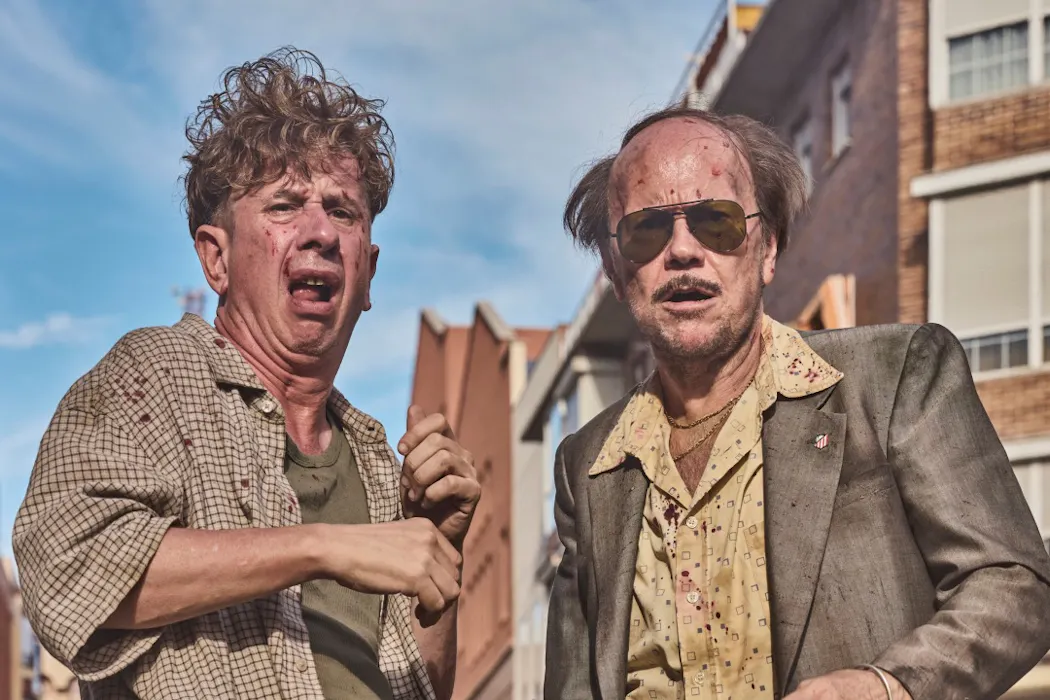
Gabino Diego y Santiago Segura en una imagen de _Torrente, presidente_. Sony Pictures

El pasado 13 de marzo aterrizó en las salas españolas Torrente, presidente, de Santiago Segura, doce años después de su anterior entrega.

Un hombre señala un cartel con un personaje interpretado por él mismo.
Santiago Segura en la premiere de Torrente presidente.
Sony Pictures Spain

La película llegó a los cines sin haber tenido pase de prensa ni haber lanzado el tráiler. Su estreno estaba pensado, de acuerdo con las palabras de Segura, para los fans de la saga y para que nada ni nadie les estropeara la experiencia de verla por primera vez, así como los cameos, los chistes… Explicó en una entrevista que quería evocar algo parecido a lo que él había sentido al ver por sorpresa a Sean Connery como Ricardo Corazón de León en Robin Hood, príncipe de los ladrones (1991).

El filme cuenta la historia de ascenso y caída de José Luis Torrente Galván en su empeño por liderar el partido político Nox (parodia del actual Vox), lo que lleva la caricatura a un extremo que no había sido explorado en las películas anteriores. Hasta la quinta entrega, su protagonista era moralmente despreciable y encarnaba un estereotipo de español arcaico, racista, machista y homófobo. Sin embargo, más allá del hedor franquista, no estaba asociado a ningún partido político concreto del momento: retrataba una realidad deformada, irónica, que conjuga muy bien con la tradición esperpéntica española.

No obstante, la sexta entrega ha generado una controversia que en las otras cinco era anecdótica: el retrato crítico de una sociedad chusca a través de un personaje despreciable y ambiguo, que había funcionado de manera extraordinaria en las películas anteriores, ahora suscita una necesidad imperiosa de situarlo políticamente. Pero ¿por qué esta sensación es más general hoy que hace veintiocho años?

Cambios sociales

En primer lugar, José Luis Torrente no ha evolucionado, pero la sociedad española sí lo ha hecho. La opacidad irónica propiamente posmoderna de 1998 no es igual que la transparencia metamoderna de 2026. Y eso se nota tanto en el personaje como en su acogida por parte del público.

Un hombre gordo posa delante de una mesa con la bandera de España y un póster de una mujer desnuda en la pared.
Imagen de la primera entrega de la serie sobre Torrente: Torrente, el brazo tonto de la ley.
IMDB

La impronta irónica con la que está hecha la película, propia de la ficción estadounidense de los años noventa –de la que un buen ejemplo sería Homer Simpson–, no se sostiene de un modo tan evidente en la narrativa actual. La independencia entre la moral y la estética no está tan clara y la crítica social de un estereotipo mediante la ironía precisa ahora de explicaciones, representaciones más transparentes y literales.

Santiago Segura ha tenido que aclarar en varias ocasiones que Torrente es un personaje de ficción, que no tiene nada que ver con él. Dicha explicación se ha hecho más frecuente con el paso de los años. A pesar de que parece una obviedad, hay espectadores incapaces de establecer esta distancia entre el autor y el personaje; cuestión aún más compleja si además se requiere captar la distancia propia de su característica ironía.

Se pierde la ironía

Con esto se llega a la segunda razón por la que el protagonista, en su sexta entrega, resulta controvertido: el tambaleo del ejercicio irónico hace que un personaje que se presenta como no ejemplar pueda llegar a serlo, dependiendo del contexto. Esta ha sido una de las grandes sorpresas de Torrente, presidente.

En Imitación y experiencia, así como en Universal concreto, el filósofo español Javier Gomá explica este fenómeno detenidamente. En la tradición narrativa hay personajes que pueden considerarse modelos a seguir y que aúnan distintos valores sociales, expresando, en definitiva, una manera de deber-ser. Son casos como los de Aquiles, Sigfrido, Frodo Bolsón o Harry Potter, entre otros.

Por otro lado, existen personajes que no han sido pensados para ser imitados ni tomados como referencia. Estos nacieron con las formas de narración modernas y gozan de cierto éxito en la actualidad. Don Quijote, Hamlet, Fausto o Raskólnikov son algunos de los prototipos que Gomá considera excepcionales, cuya actitud no es ni imitable ni generalizable.

El conflicto surge cuando el espectador invierte la función original de estos perfiles. Sobre todo, cuando un carácter excepcional se convierte en un modelo universal. Si esto ocurre se cae en el mimetismo o en la mala imitación, la cual conduce a recrear modelos no beneficiosos ni social ni moralmente, elevando lo vulgar a lo ejemplar.

Algo así ocurre con Torrente en su concepción literal: lejos de recibirse como el extraordinario ejercicio irónico que es, se convierte en un referente excepcional, moral y político, lo que anula las posibilidades de la ironía y abre el camino a la imitación.

Torrente distorsionado

Quizá el problema descrito ya se palpaba en 1998 con Torrente, el brazo tonto de la ley. Sin embargo, ahora parece el tema fundamental de su estreno. Torrente, presidente está resultando un éxito de taquilla. Por eso, los conflictos explicados van ligados a unas líneas políticas que conciben la película desde dos perspectivas igualmente distorsionadas.

Por un lado, los distintos movimientos políticos y sociales surgidos durante los últimos años (MeToo,
Black Lives Matter, etc.) hacen que personajes que en los años noventa parecían fanfarrones y campechanos a pesar de sus faltas no gocen de la misma consideración ahora por parte de algunos sectores de la izquierda. Por otro, parte de la derecha cae en el mimetismo y en la confusión entre el autor y el personaje, algo que Santiago Segura ha rechazado en multitud de ocasiones.

La ironía original queda así desplazada, en crisis. La sociedad, dividida y retratada en la película, se expone a sí misma en la interpretación viciada de una saga que pretende mantenerse en la ironía posmoderna de los años noventa, pero a la que ahora le resulta imposible hacerlo.


¿Quiere recibir más artículos como este? Suscríbase a Suplemento Cultural y reciba la actualidad cultural y una selección de los mejores artículos de historia, literatura, cine, arte o música, seleccionados por nuestra editora de Cultura Claudia Lorenzo.


The Conversation

Marcos Jiménez González no recibe salario, ni ejerce labores de consultoría, ni posee acciones, ni recibe financiación de ninguna compañía u organización que pueda obtener beneficio de este artículo, y ha declarado carecer de vínculos relevantes más allá del cargo académico citado.

ref. Las reacciones a ‘Torrente, presidente’: ¿vivimos una crisis de la ironía? – https://theconversation.com/las-reacciones-a-torrente-presidente-vivimos-una-crisis-de-la-ironia-279006
¿Hay alguna forma de soñar lo que nos apetezca siempre que queramos?

Source: The Conversation – (in Spanish) – By Raúl Quevedo-Blasco, Doctor en Psicología. Laboratorio del Sueño y Promoción de la Salud (Centro de Investigación Mente, Cerebro y Comportamiento-CIMCYC), Universidad de Granada

Master1305/Shutterstock

Este artículo forma parte de la sección The Conversation Júnior, en la que especialistas de las principales universidades y centros de investigación contestan a las dudas de jóvenes curios@s de entre 12 y 16 años. Podéis enviar vuestras preguntas a tcesjunior@theconversation.com


Pregunta formulada por Alberto, de 14 años. IES La Madraza, Granada.


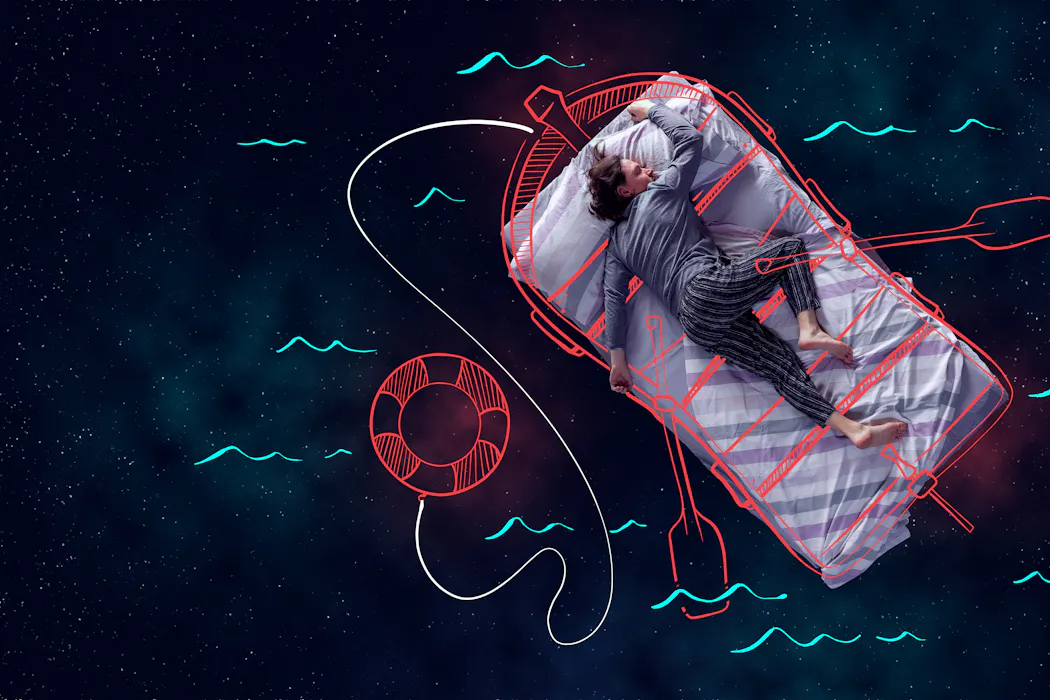
La idea de poder soñar exactamente lo que nos apetezca, en el momento que queramos, resulta muy atractiva. Imaginar que podemos “elegir” nuestros sueños como si fueran una película antes de dormir es algo que mucha gente se ha planteado alguna vez.

Sin embargo, y siendo realistas, no existe actualmente una forma de tener un control absoluto y constante sobre los sueños. El cerebro, cuando dormimos por la noche, funciona de manera en gran parte automática y sigue procesos que no dependen completamente de nuestra voluntad consciente.

Aun así, esto no significa que no se pueda influir de algún modo: existen técnicas que, con práctica, pueden aumentar significativamente las probabilidades de dirigir o moldear de alguna manera el contenido de nuestras “aventuras” bajo las sábanas.

Trucos para antes o después de dormir

Para empezar, una de las herramientas más útiles es llevar un diario de sueños. Consiste en anotar todo lo que recuerdes justo al despertar, aunque sean fragmentos o sensaciones vagas. Este hábito mejora la memoria onírica (o capacidad de recordar los sueños) y hace que el cerebro preste más atención a esas imágenes o historias. Con el tiempo, también ayuda a identificar patrones o elementos recurrentes (personas, lugares, situaciones extrañas) que pueden servir como señales de que estás soñando.

También puede ayudar la denominada incubación de sueños. Consiste en centrarte intensamente en una idea, imagen o situación antes de dormir. Por ejemplo, puedes imaginar con detalle que estás en una playa, que hablas con una persona concreta o que te tomas un helado gigante. Cuanto más vívida y repetida sea esa visualización, más probabilidades hay de que aparezca en el sueño. Aunque no es una garantía de que suceda, claro.

Tú llevas las riendas

Uno de los fenómenos más estudiados en este fascinante ámbito de nuestra mente es el sueño lúcido, o sea, cuando alguien es consciente de que está soñando mientras el sueño ocurre. En algunos casos, esa consciencia permite intervenir en el desarrollo del sueño: cambiar escenarios, tomar decisiones voluntarias o incluso alterar las reglas “físicas” del mundo onírico, como volar o atravesar paredes. Aunque no todas las personas experimentan sueños lúcidos de forma natural, muchas pueden aprender a tenerlos con entrenamiento.

Una técnica para conseguirlo son los “chequeos de realidad”. Durante el día, varias veces, te detienes y te preguntas si estás soñando. Quizá te parezca extraño, pero al repetirlo con frecuencia se convierte en un hábito mental que puede trasladarse al sueño. Cuando eso ocurre, puedes darte cuenta de que lo que estás viviendo no es real, lo que desencadena un sueño lúcido. Algunos ejemplos de chequeos incluyen mirar un texto dos veces (en los sueños suele cambiar), observar tus manos o intentar atravesar un objeto con un dedo.

El momento del sueño también es importante. Los sueños más intensos y narrativos (reales o elaborados) ocurren durante una fase denominada sueño REM, que se repite varias veces a lo largo de la noche, y con mayor frecuencia en el último tercio. Aquí se encuentra una de las principales diferencias entre los “terrores nocturnos” y las “pesadillas”. Los primeros aparecen en sueño no REM (concretamente, en las fases de sueño profundo), mientras que las pesadillas ocurren en fase REM.

Registro de sueño en el Laboratorio del Sueño y Promoción de la Salud de la Universidad de Granada.
CIMCYC / UGR

Dormir bien, mantener horarios regulares y evitar interrupciones bruscas ayuda a recordar mejor los sueños y aumenta las posibilidades de tener experiencias más vívidas.

Cuando dormimos, el cerebro es incontrolable

De todos modos, hay que ser realista: es imposible garantizar que cada noche soñarás exactamente lo que quieres, como si eligieras una película en una plataforma, ni mantener un control total de principio a fin. Incluso las personas con mucha experiencia en sueños lúcidos no lo consiguen siempre, y a veces los sueños pueden volverse inestables o cambiar de forma inesperada.

El cerebro sigue generando contenido de manera espontánea, y esa es precisamente una de las características fundamentales de esas experiencias oníricas que tanto nos intrigan.


El museo interactivo Parque de las Ciencias de Andalucía y su Unidad de Cultura Científica e Innovación colaboran en la sección The Conversation Júnior.


The Conversation

Raúl Quevedo-Blasco no recibe salario, ni ejerce labores de consultoría, ni posee acciones, ni recibe financiación de ninguna compañía u organización que pueda obtener beneficio de este artículo, y ha declarado carecer de vínculos relevantes más allá del cargo académico citado.

ref. ¿Hay alguna forma de soñar lo que nos apetezca siempre que queramos? – https://theconversation.com/hay-alguna-forma-de-sonar-lo-que-nos-apetezca-siempre-que-queramos-279045

Mosquitoes carrying malaria are evolving more quickly than insecticides can kill them – researchers pinpoint how

Source: The Conversation – USA – By Jacob A Tennessen, Research Scientist in Immunology and Infectious Diseases, Harvard University

_Anopheles darlingi_, a key carrier of malaria, is rapidly evolving resistance to insecticides. Romuald Carinci and Pascal Gaborit/Duchemin lab/Institut Pasteur de la Guyane, CC BY-SA

The fight against infectious disease is a race against evolution. Bacteria become resistant to antibiotics. Viruses adapt to spread more quickly. Diseases transmitted by insects present another evolutionary front: Insects themselves can evolve resistance to the poisons that people use to kill them.

In particular, the mosquito-borne disease malaria kills over 600,000 people annually. Since World War II, people have battled malaria with insecticides – chemical weapons intended to kill Anopheles mosquitoes infected with the Plasmodium parasites that cause the disease.

However, mosquitoes are quickly evolving counterstrategies that make these insecticides ineffective, putting millions of people at greater risk of deadly infection. My colleagues and I have newly published research showing how.

Insecticide resistance threatens public health

As an evolutionary geneticist, I study natural selection – the basis for adaptive evolution. Genetic variants that best promote survival can replace less advantageous versions, causing species to change. Anopheles mosquitoes are frustratingly adept at evolving.

In the mid-1990s, most African Anopheles were susceptible to pyrethroids, a popular type of insecticide originally derived from chrysanthemums. Anopheles control relies on two pyrethroid-based methods: insecticide-treated bed nets to protect sleepers, and indoor residual spraying of insecticide against the walls of homes. These two methods alone likely prevented over a half-billion cases of malaria between 2000 and 2015.

However, mosquitoes today from Ghana to Malawi are often able to survive insecticide concentrations 10 times the previously lethal dose. Along with Anopheles control efforts, agriculture also inadvertently exposes mosquitoes to pyrethroids and contributes to insecticide resistance.

In some African locales, Anopheles is already showing resistance to all four main classes of insecticide used for malaria control.

Close-up of mosquito on human skin with abdomen engorged with blood, a droplet extruding at its end
Anopheles mosquitoes are found all over the world.
Jim Gathany/CDC

Adaptation in Latin American mosquitoes

Anopheles mosquitoes and the malaria-causing Plasmodium also occur outside Africa, where insecticide resistance is less well-researched.

In much of South America, the main malaria vector is Anopheles darlingi. This mosquito species has diverged evolutionarily from the African vectors so extensively that it might be a different genus, Nyssorhynchus. Along with colleagues from eight countries, I analyzed over 1,000 Anopheles darlingi genomes to understand its genetic diversity, including any recent changes due to human activity. My collaborators collected these mosquitoes at 16 locations ranging from the Atlantic coast of Brazil to the Pacific side of the Andes in Colombia.

We found that, like its African counterparts, Anopheles darlingi shows extremely high genetic diversity – more than 20 times that of humans – indicating that very large populations of this insect exist. A species with such a vast gene pool is well poised to adapt to new challenges. The right mutation giving it the advantage it needs is more likely to pop up when there are so many individuals. And once that mutation starts to spread, it’s protected by numbers since it won’t be wiped out if a few mosquitoes die by chance.

In contrast, bald eagles in the contiguous U.S. were never able to evolve resistance against the insecticide DDT and approached extinction. Evolution is more efficient among millions of insects than mere thousands of birds. And indeed, we saw signals of adaptive evolution in the resistance-related genes of Anopheles darlingi occurring over the past few decades.

Mosquitoes evolve to detoxify poisons

Insecticides like pyrethroids and DDT share the same molecular target: channels in nerve cells that can open and close. When open, the nerve cell stimulates other cells. These insecticides force the channels to remain open and continuously fire, causing paralysis and death. However, insects can evolve resistance by changing the shape of the channel itself.

Earlier genetic scans performed by other researchers had not detected this type of resistance in Anopheles darlingi, and neither did ours. Instead, we found that resistance is evolving in another way: a group of genes encoding enzymes that break down toxic compounds. High activity of these enzymes, called P450, frequently underlies resistance to insecticides in other mosquitoes. The same cluster of P450 genes has changed independently at least seven times across South America since insecticide use began in the mid-20th century.

In French Guiana, a different set of P450 genes exhibits a similar evolutionary pattern, cementing the clear connection between these enzymes and adaptation. Moreover, when we exposed mosquitoes to pyrethroids in sealed bottles, differences among the P450 genes of individual mosquitoes were linked to the length of time they stayed alive.

Insecticide-heavy campaigns against malaria have been only sporadic in South America and may not be the main driver behind this evolution. Instead, it’s possible that mosquitoes are being exposed indirectly to agricultural insecticides. Intriguingly, we saw the strongest signs of evolution in places where farming is prevalent.

Diagram comparing Mendelian inheritance (50% chance of inheritance leads to slower spread) with gene drive inheritance (nearly 100% inheritance leads to rapid spread)
Gene drives can help a malaria-fighting mutation spread more quickly through a mosquito population than it would by chance alone.
Naidoo et al./Gene Therapy, CC BY-SA

Toward more sophisticated vector control

Despite new vaccines and other recent advances against malaria, mosquito control remains essential for reducing disease.

Some countries are launching trials of gene drives to control malaria, which involve forcing a genetic modification into a mosquito population to reduce their numbers or their tolerance for Plasmodium. Such prospects are exciting, though the relentless adaptability of mosquitoes could be an obstacle.

I and others are revising methods to efficiently test for emerging insecticide resistance. Genome-scale sequencing remains important to detect new or unexpected evolutionary responses. The risk of adaptation is highest under a continuous, strong selection pressure, so minimizing, switching and staggering pesticides can help thwart resistance.

Success in the fight against evolving resistance will require a coordinated effort of monitoring, and reacting accordingly. Unlike evolution, humans can think ahead.

The Conversation

Jacob A Tennessen receives funding from the National Institutes of Health via Harvard T.H. Chan School of Public Health and the Broad Institute.

ref. Mosquitoes carrying malaria are evolving more quickly than insecticides can kill them – researchers pinpoint how – https://theconversation.com/mosquitoes-carrying-malaria-are-evolving-more-quickly-than-insecticides-can-kill-them-researchers-pinpoint-how-275391

How the war in Iran is already affecting UK farmers and food production

Source: The Conversation – UK – By Caroline Flanagan, Head of School, Agriculture, Anglia Ruskin University

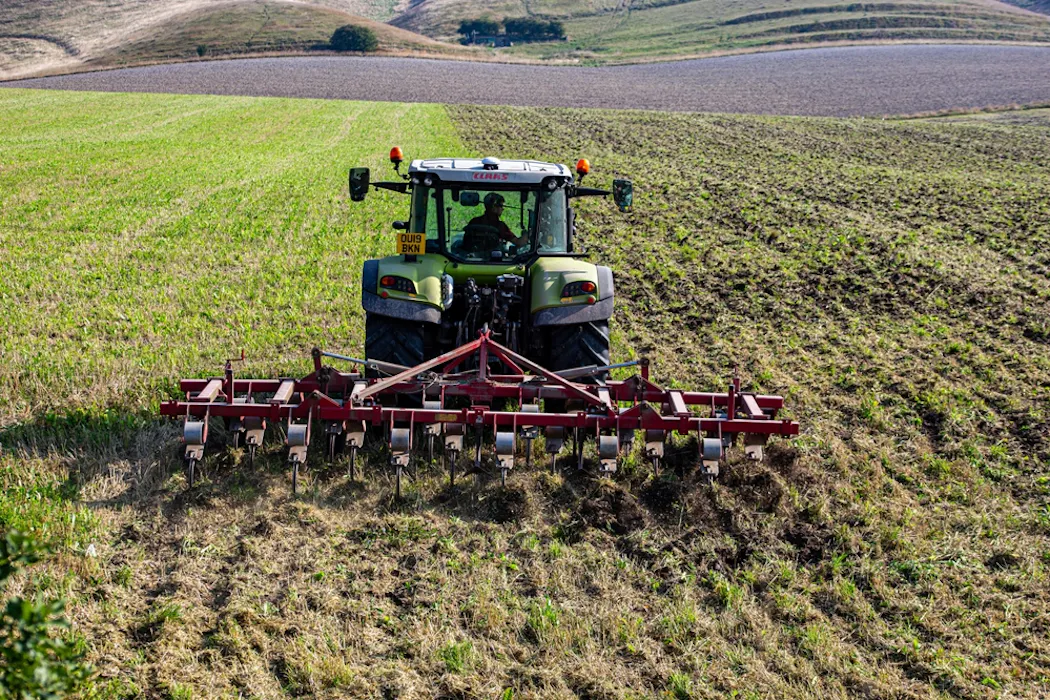
The price of red diesel used by farmers is rising fast. Mark I Walker/Shutterstock

The conflict in Iran and the disruption to the strait of Hormuz are already starting to affect UK farmers. The closure of this vital shipping route threatens supplies of two essential agricultural necessities: fuel and fertiliser.

The immediate impact on farmers has been a sharp increase in the cost of red diesel – the rebated fuel widely used in agriculture – which has already risen by approximately 60%, far outpacing increases seen at retail fuel pumps for car owners.

Concerns for farmers include the cost of fertiliser, particularly nitrogen. As the key nutrient driving growth in two key crop groups grown extensively in the UK, cereals and oilseeds, nitrogen is essential for achieving high yields. A wheat crop may require over 200kg per hectare during the growing season, depending on soil conditions, weather, and yield expectations.

The UK imports around 60% of its nitrogen fertiliser. Although much of this supply does not originate directly from the Middle East, global market dynamics mean prices are highly sensitive to disruptions. Around one-third of the global fertiliser trade passes through the strait of Hormuz, contributing to price increases of approximately £50 per tonne, compared to early 2025, and is expected to rise more if the conflict continues.

UK fertiliser traders are finding prices are changing so fast that they can’t update their daily lists. The NFU president Tom Bradshaw has raised concerns about farmers not being given a confirmed price until stocks are delivered.

While most farmers buy fertiliser in bulk ahead of the growing season, the longer-term outlook is already a concern.

Much will depend on the duration of Middle Eastern tensions and whether the strait reopens in time for fertiliser purchasing decisions this autumn, ready for next year’s crops.

Unlike the 2022 fuel price shock following the invasion of Ukraine – which was partially offset by higher commodity prices – current market conditions offer little expectation of improved crop prices.

Difficult calculations

Farmers are, therefore, being forced into difficult calculations: weighing the cost of nitrogen against likely crop prices, reassessing how to balance the crop’s agrochemical inputs, including fertiliser, and awaiting clarity on the future of Environmental Land Management Schemes (Elms). Elms are government schemes in England aimed at supporting farmers to make environmentally beneficial changes to their land.


Read more:
How the Iran war could create a ‘fertiliser shock’ – an often ignored global risk to food prices and farming


Even before the current conflict started, industry bodies such as the National Farmers’ Union had raised concerns about the viability of arable farming under sustained cost pressures.

The government has also acknowledged these challenges, commissioning the Competition and Markets Authority (CMA) to investigate supply issues affecting fertiliser and agricultural fuel. The CMA has said it will monitor price rises caused by the current international conditions. In response to the crisis, the UK government has just announced proposals to support more varied types of fertiliser.

All these factors raise broader concerns for the UK, where food self-sufficiency stands at around 62% – a potentially precarious position in an increasingly uncertain global landscape.

Farming landscape

UK crops are currently looking generally robust, after a strong autumn with ideal conditions for sowing winter crops and a favourable start to spring. Early signs point to a promising 2026 harvest.

But optimism is tempered by ongoing economic pressure. Farm gate prices (the price if a customer bought direct from a farmer) remain stubbornly low, as UK farmers compete with imports produced under lower environmental and regulatory standards

Simultaneously, the transition away from legacy EU support payments has left a significant income gap. Replacement schemes under the Environmental Land Management Schemes were paused in 2025 and are only expected to resume later this year, creating further uncertainty.

The Department for Environment, Food and Rural Affairs (Defra) latest figures forecast average arable farm income fell to £17,000 in the year to February 2026 – the lowest level since 2004–05. The drop reflects a mix of difficult seasonal conditions and global oversupply in key crops such as cereals and oilseeds. Dairy farm income was much higher at £224,000 for the same period.

Fertiliser shortages are set to hit farmers around the world.

The industry is rapidly embracing innovation and the government is backing farmers with measures to strengthen fertiliser supply resilience. Together with rising costs, these shifts have helped drive a 50% reduction in nitrogen use over the past four decades.

Precision agriculture (which uses technology to refine decisions) has boosted efficiency further, enabling farmers to tailor fertiliser use to the needs of specific fields.

There are other potential innovations that could help. Tesco for example, is working with farmers and manufacturers to develop lower-carbon fertilisers made from food waste, algae, poultry manure, and industrial by-products.

Global fertiliser markets may be volatile, but in the short term shoppers are unlikely to see that uncertainty reflected in everyday food prices. A 2022 Sustain report, found that farmers often receive less than 1% of the profit from supermarket sales, meaning their tiny share leaves little room for fertiliser costs to influence the final price on the shelf. For now, any rise or fall in the price of bread, flour, cakes or biscuits is far more likely to come from supermarket pricing tactics or broader supply‑chain pressures than from shifts in global fertiliser markets.

That’s not to say fertiliser costs never filter through – a prolonged conflict could still nudge prices up for shoppers. Crops respond dramatically to fertiliser levels, so even modest reductions in nitrogen use can produce disproportionately large declines in yield. All that could translate into thousands of tonnes of lost crops, which would make food more expensive in the future.

The Conversation

The authors do not work for, consult, own shares in or receive funding from any company or organisation that would benefit from this article, and have disclosed no relevant affiliations beyond their academic appointment.

ref. How the war in Iran is already affecting UK farmers and food production – https://theconversation.com/how-the-war-in-iran-is-already-affecting-uk-farmers-and-food-production-279032

Could this energy crisis be worse for the global economy than COVID?

Source: The Conversation – UK – By Adi Imsirovic, Lecturer in Energy Systems, University of Oxford

Alex_An_Der/Shutterstock

Despite reports of negotiations between the US and the Iranian regime, the Strait of Hormuz remains effectively closed to most oil tankers, with only a small number of vessels being allowed to pass. The result is a loss of roughly 11 million barrels per day (mbd) of oil and petroleum liquids to the global market. This represents just over 10% of global supply.

At first glance, a 10% disruption may not sound catastrophic. But in oil markets, even a 10% imbalance between supply and demand can have very large economic effects.

To understand the scale of the disruption, it is useful to compare it with the height of the COVID pandemic in 2020. During global lockdowns, empty roads, grounded aircraft and deserted bus and railway stations became normal as travel and economic activity collapsed. At that time, global oil demand fell by about 8mbd, the largest demand shock in history.

Today’s situation is the opposite. Instead of a collapse in demand, the world is experiencing a large supply shock. But the impact on everyday life could end up looking similar: reduced travel, higher transport costs, slower economic activity and pressure on household budgets.

The reason is that both oil supply and oil demand are very inflexible in the short term. People still need to drive to work, goods still need to be transported and aircraft still need fuel. When supply falls suddenly, prices must rise significantly to force demand down.

For now, the release of emergency oil stocks is helping to cushion the initial impact, particularly in developed economies. Members of the International Energy Agency (IEA) are required to hold emergency stocks equivalent to at least 90 days of oil consumption, and several countries also maintain strategic petroleum reserves.


Read more:
These are shaky times for oil markets. An expert explains what a prolonged war will mean for prices


Countries such as the US, China and Japan can therefore offset supply disruptions for a limited period. However, these reserves are not a long-term solution. If the conflict continues for months rather than weeks, stockpiles will be depleted.

The situation is much more serious for developing countries. Many countries in Asia, Africa and South America hold very limited commercial reserves and are much more vulnerable to supply disruptions and price spikes. For these economies, elevated oil prices quickly translate into higher food prices, inflation and economic instability.

The first shortages would probably appear not in petrol, but in diesel and jet fuel. Gulf oil producers are major exporters of middle distillates, and their crude oil grades produce large quantities of diesel and jet fuel when refined.

airbus a380 coming in to land at heathrow airport in london over trees and landing lights.
Jet fuel could be one of the first commodities to be hit.
Benjamin_Barbe/Shutterstock

Diesel is particularly important because it fuels trucks, ships, construction equipment and agricultural machinery. So a diesel shortage affects food supply, construction, mining and global trade – not just transport. Petrol shortages would follow as crude oil supply tightens further, and eventually shortages would spread across all petroleum products.

Oil is not just used for transport fuel. It is also a key input into petrochemicals for the production of plastics, fertilisers, chemicals, synthetic materials and many industrial processes. This means the effects of a major oil supply disruption spread across the entire economy.

Shortages or price increases could affect everything from food production and packaging to electronics, construction materials and clothing. The economic effects of an oil shock are therefore much broader than simply higher petrol prices.

Protectionism could make everything worse

One of the biggest risks during a supply crisis is export restrictions and protectionism. Governments often try to protect domestic consumers by freezing prices and banning exports of fuel or crude oil, but this usually makes the global shortage worse.

Government price freezes only discourage production and supply, and encourage consumers to keep burning fuel. Protectionism is even worse. There are already signs of this happening – some countries (China, for example) are restricting exports of petroleum products such as diesel and jet fuel. When countries hoard fuel, global markets become tighter and prices rise even further.

The biggest risk would be if the US restricted oil exports in order to protect domestic consumers. The US is now the world’s largest oil producer, producing more than 20mbd of oil and petroleum liquids. But it is also one of the world’s largest consumers. However, it still exports significant volumes, particularly to Europe.

The US has banned oil exports before. In 1975, following the Arab oil embargo (when in 1973 Arab states refused to supply oil to countries, including the US, that had supported Israel in the Yom Kippur war), the US banned exports of crude oil. The ban was lifted only in 2015. If such a ban were introduced today, it would be likely to cause major supply shortages and price increases, especially in Europe.

If the Strait of Hormuz remains closed for a prolonged period, or if the conflict escalates further, global losses of exports from the Persian Gulf could approach the 20mbd of oil and petroleum products.

Under these circumstances, the economic and social effects could be severe. Transport could become more expensive and less frequent, air travel would be severely curtailed, inflation would rise and economic growth would slow significantly. In extreme scenarios, the disruption to daily economic life could resemble the COVID period (and probably worse). But this time it would be caused by a shortage of energy.

For now, markets are relying on emergency stock releases and hopes of a geopolitical de-escalation. But if not, the world economy could face an unprecedented energy shock, with far-reaching and unpredictable consequences.

The Conversation

Adi Imsirovic does not work for, consult, own shares in or receive funding from any company or organisation that would benefit from this article, and has disclosed no relevant affiliations beyond their academic appointment.

ref. Could this energy crisis be worse for the global economy than COVID? – https://theconversation.com/could-this-energy-crisis-be-worse-for-the-global-economy-than-covid-279284

Muere Biruté Galdikas, la última de la trilogía de primatólogas que cambió el destino de los grandes simios

Source: The Conversation – (in Spanish) – By Sara Alvarez Solas, Directora de Desarrollo Académico Internacional, UNIR – Universidad Internacional de La Rioja

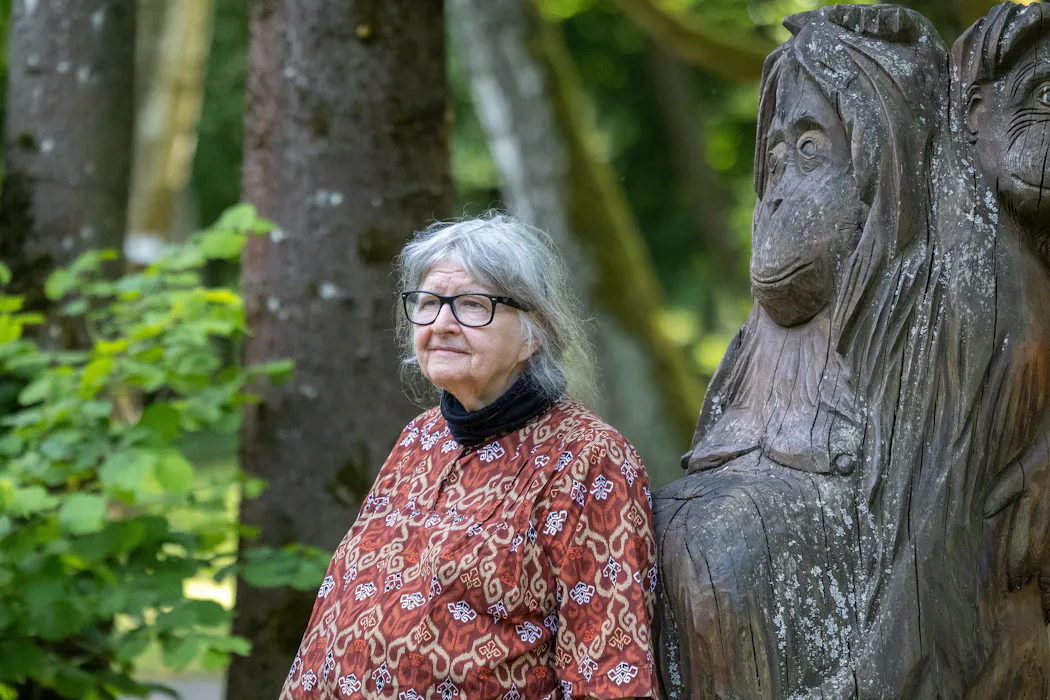
Biruté Galdikas (1946-2026). Algimantas Barzdzius/Shutterstock

El paleoantropólogo británico Louis Leakey (1903-1972) impulsó a tres mujeres que se convirtieron en referentes mundiales en primatología. Grandes científicas, grandes luchadoras por los derechos de los animales y grandes inspiradoras para muchos de nosotros, que intentaremos seguir su legado para cambiar el mundo.

Estas tres mujeres fueron Dian Fosey (1932-1985), quien se desvivió por los gorilas y perdió la vida en esa lucha; Jane Goodall, gran inspiración y luchadora por la conservación de los chimpancés a quien despedimos hace tan solo unos meses; y Biruté Marija Filomena Galdikas, que desarrolló una formidable labor por la conservación de los orangutanes.

Cincuenta y cinco años dedicada a los orangutanes

Aunque quizá algo menos conocida en la cultura popular, Biruté Galdikas fue un gran referente en la ciencia y un pilar fundamental para los orangutanes, a cuya conservación dedicó más de 55 años. Con casi 80 años, murió el 24 de marzo rodeada de sus seres queridos en Los Ángeles, California.

Orangután macho en la reserva de Tanjung Puting, Borneo.
Wikimedia Commons., CC BY-SA

Galdikas fundó Camp Leakey en 1971, en la reserva de Tanjung Puting, en Borneo (Indonesia), donde desarrolló gran parte de sus investigaciones.

Su trabajo, dedicado al estudio de los orangutanes en libertad, cambió el curso de la conservación de estos animales. Nos mostró, a través de sus ojos, todo lo que había aprendido observando su comportamiento, alimentación, reproducción y estructura social durante décadas.

Así, nos enseñó que los orangutanes son más sociales de lo que se pensaba, documentando su comportamiento de forrajeo y su uso de herramientas. Además, describió sus largos ciclos de desarrollo, con una larga infancia y una baja tasa reproductiva, lo que los hace especialmente vulnerables.

El campamento sigue siendo hoy un centro clave de investigación y rehabilitación de orangutanes y un refugio para individuos rescatados del comercio ilegal.

Activista por los derechos de los animales

Pero Biruté Galdikas no solo fue una gran investigadora, sino que también se convirtió en la voz de estos primates ante el mundo.

Destaca su lucha ante la pérdida de hábitat a causa de la palma africana, demostrando que la educación ambiental es una de las principales herramientas para cambiar el destino de las especies en peligro.

Sus iniciativas para la rehabilitación y protección de orangutanes fueron avaladas por muchas instituciones y reconocidas con muchos premios, como el Tyler Prize for Environmental Achievement, el PETA Humanitarian Award, el United Nations Global 500 Roll of Honour, el Leakey Prize, el Golden Ark Award, el Premio Sierra Club Chico Mendes, el Premio Indonesia´s Hero of the Earth, etcétera.

Reflejos del Edén

Presidenta Honorífica del Proyecto Gran Simio, escribió Reflejos del Edén, entre muchas otros libros. En él, cuenta sus primeros 20 años en Borneo, a la sombra de los orangutanes, y destaca no solo la importancia de la conservación, sino también la conexión entre humanos y naturaleza.

px Birute Galdikas en la presentación de su libro, en 2012.
Wikimedia Commons., CC BY-SA

Biruté Galdikas ha demostrado que la investigación es clave para la conservación del hábitat de estos majestuosos animales.

Nos abrió los ojos para mostrarnos que, a través de la empatía y el conocimiento podemos invitar a la acción para forjar la coexistencia entre humanos y orangutanes. Con sus acciones de educación ambiental nos recordó que es urgente nuestra implicación para conservar una especie altamente amenazada por la caza furtiva y la destrucción de su hábitat, principalmente, debido a la expansión de la palma africana.

Entre todos podemos marcar la diferencia. Las pequeñas acciones hacen el cambio, y nosotros podemos cambiar nuestras costumbres e inclinarlas hacia las buenas prácticas. Juntos, podemos ayudar a que perdure la misión de una gran mujer, o mejor dicho, de tres grandes mujeres que nos han pasado el testigo.

The Conversation

Sara Alvarez Solas no recibe salario, ni ejerce labores de consultoría, ni posee acciones, ni recibe financiación de ninguna compañía u organización que pueda obtener beneficio de este artículo, y ha declarado carecer de vínculos relevantes más allá del cargo académico citado.

ref. Muere Biruté Galdikas, la última de la trilogía de primatólogas que cambió el destino de los grandes simios – https://theconversation.com/muere-birute-galdikas-la-ultima-de-la-trilogia-de-primatologas-que-cambio-el-destino-de-los-grandes-simios-279270

El ADN de un cementerio islámico medieval en Ibiza revela una isla conectada con África

Source: The Conversation – (in Spanish) – By Ricardo Rodriguez Varela, Research in Molecular Archaeology, Department of Archaeology and Classical Studies, Stockholm University, Stockholm University

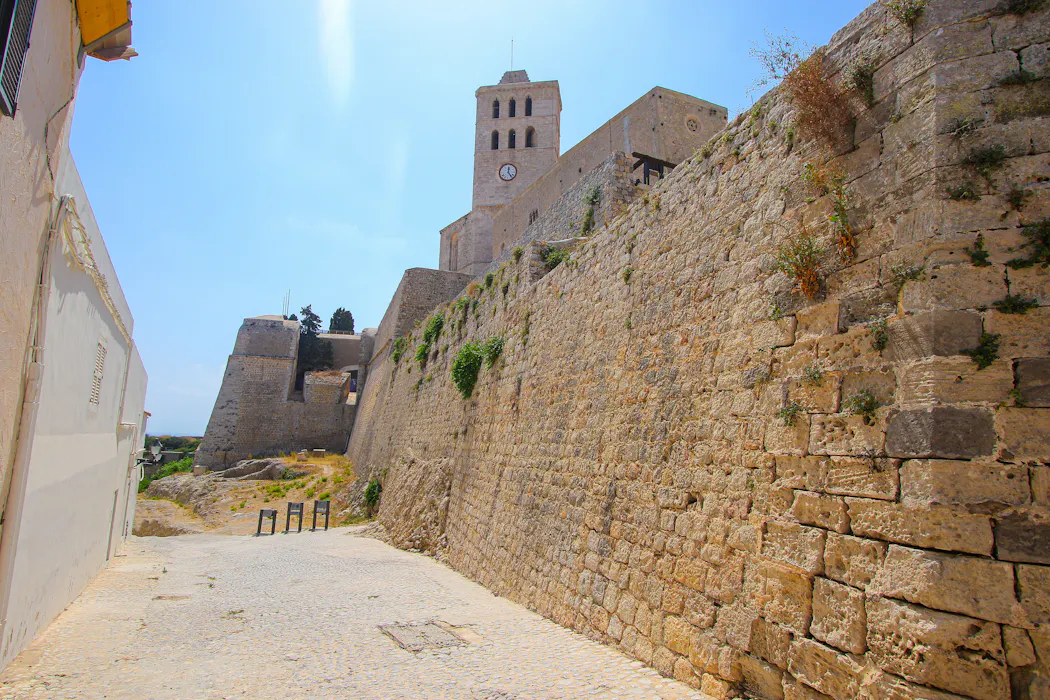
Muro defensivo que rodea el Castillo de Eivissa en Dalt Vila, el casco antiguo de Ibiza. Alexandre.ROSA/Shutterstock

Cuando pensamos en la Ibiza medieval, solemos imaginar una pequeña isla en el extremo de Europa. Sin embargo, nuevas evidencias genéticas muestran una realidad muy distinta. Lejos de estar aislada, Ibiza formaba parte de las redes políticas, comerciales y militares del mundo islámico medieval, con conexiones que alcanzaban no solo el norte de África, sino también regiones del África subsahariana.

Las fuentes históricas ya apuntaban en esa dirección. Sabemos que al-Ándalus y el Magreb estuvieron conectados durante siglos por rutas marítimas, intercambios comerciales, movimientos militares y desplazamientos de población. También sabemos que esas redes enlazaban con las rutas transaharianas que llegaban hasta el Sahel y África occidental. Lo que no sabíamos con tanta claridad era hasta qué punto esas conexiones se reflejaban en las personas que vivieron y murieron en lugares concretos como Ibiza.

Relatos desde la tumba

En un estudio publicado en Nature Communications, analizamos el ADN de 13 individuos enterrados en un cementerio islámico de Ibiza entre los siglos X y XII. Combinando datos genéticos, arqueológicos e históricos, reconstruimos patrones de movilidad, mezcla genética y enfermedad en esta comunidad insular medieval.

Ibiza se incorporó al mundo islámico en el año 902, en el marco de la expansión omeya desde Córdoba. Todo indica que aquella integración no fue solo un cambio político: también implicó una profunda reorganización social y la llegada de nuevas poblaciones. A partir de entonces, la isla pasó a formar parte de las redes que unían al-Ándalus, el norte de África y el Mediterráneo occidental.

Los resultados genéticos reflejan esa integración. Las personas analizadas presentan ascendencias relacionadas con Europa, el norte de África y el África subsahariana, a menudo, combinadas en un mismo individuo. Este patrón no concuerda con la hipótesis de una única migración. Más bien apunta a un proceso continuado de movilidad e interacción entre distintas regiones del mundo islámico.

Mapa de los terrotorios musulmanes mediterráneos y transmediterrános en la península ibérica (a). Plan de la excavación en la calle Bartomeu Vicent Ramon, Ibiza, correspondiente al cementerio de Madina Yabisa. Las etiquetas de los enterramientos estudiados aparecen en rojo.
R. R. Varela et al.

Siglo X, tiempo de mestizaje

Al estimar cuándo se mezclaron esas ascendencias, observamos que los componentes genéticos europeos y norteafricanos se combinaron solo unas pocas generaciones antes de la vida de estos individuos. En promedio, esta mezcla parece haberse iniciado poco después de la incorporación de Ibiza al mundo islámico a comienzos del siglo X.

Es decir, la diversidad genética de la isla no fue el resultado de un proceso lento de siglos, sino de una transformación relativamente rápida que, probablemente, ocurrió en Ibiza mismo o en otras regiones del al-Ándalus.

Desde el África subsahariana

Dos individuos resultan especialmente reveladores. Ambos presentan ascendencia subsahariana clara, pero procedente de regiones distintas. Uno muestra afinidades genéticas con poblaciones de Senegambia, en África occidental; mientras que el otro se relaciona más estrechamente con poblaciones del área del Chad, en África central.

Gracias al uso de bases de datos genómicas africanas modernas, hemos podido identificar estos vínculos con una precisión inédita en contextos europeos medievales.

Estos hallazgos encajan bien con el contexto histórico. Ambos individuos datan del periodo almorávide, una etapa en la que las Baleares quedaron integradas en una red política y militar que conectaba el Magreb, al-Ándalus y regiones más meridionales del África occidental. Las fuentes árabes describen precisamente esas rutas de intercambio, comercio y movilidad. El ADN aporta ahora una evidencia biológica directa de que esas conexiones también implicaron desplazamientos humanos.

Ricardo Rodríguez Varela en el laboratorio de ADN antiguo del Centre for Palaeogenetics (Estocolmo).
David Díaz del Molino.

Más allá de la ascendencia

Otro resultado importante del estudio es que religión e identidad cultural no pueden reducirse al origen genético. Uno de los individuos enterrados según el rito islámico presenta muy poca ascendencia norteafricana. Esto recuerda que, en la Iberia medieval, la pertenencia a una comunidad dependía también de la conversión, la lengua, la educación, las normas jurídicas o la integración social, y no solo de la ascendencia biológica.

La investigación no se limita al ADN humano. Así mismo analizamos patógenos antiguos presentes en los restos y detectamos varias infecciones virales, entre ellas el virus de la hepatitis B y el parvovirus B19.

Lepra sin señales de exclusión

De forma especialmente relevante, uno de los individuos portaba Mycobacterium leprae, la bacteria responsable de la lepra. A pesar de ello, fue enterrado siguiendo las prácticas funerarias islámicas habituales y sin señales evidentes de exclusión. Si la enfermedad ya se había manifestado en vida, este hallazgo sugiere que la lepra no implicaba necesariamente estigmatización o segregación en esta comunidad.

En conjunto, los datos apuntan a una sociedad formada por varias fases de movilidad, contacto y mestizaje. La Ibiza medieval, lejos de ser un lugar periférico, formaba parte de un mundo interconectado que unía la península ibérica, el norte de África y el África subsahariana.

En este contexto, el ADN antiguo no sustituye a la arqueología ni a las fuentes escritas. Pero añade una nueva línea de evidencia que permite medir la movilidad humana del pasado y comprender mejor cómo se formaron las sociedades medievales.

The Conversation

Anders Götherström recibe fondos de Vetenskapsrådet (research grant VR2019-00849).

Ricardo Rodriguez Varela no recibe salario, ni ejerce labores de consultoría, ni posee acciones, ni recibe financiación de ninguna compañía u organización que pueda obtener beneficio de este artículo, y ha declarado carecer de vínculos relevantes más allá del cargo académico citado.

ref. El ADN de un cementerio islámico medieval en Ibiza revela una isla conectada con África – https://theconversation.com/el-adn-de-un-cementerio-islamico-medieval-en-ibiza-revela-una-isla-conectada-con-africa-278586

Meta y Google, declaradas culpables de provocar adicción: ¿un precedente a seguir en Europa y España?

Source: The Conversation – (in Spanish) – By Francesc Feliu Pamplona, Profesor experto en litigación administrativa y responsabilidad sanitaria, Universitat de Barcelona

Jack_the_sparow/Shutterstock

Un jurado de Los Ángeles ha marcado un antes y un después. Una histórica sentencia del pasado 25 de marzo de 2026 condena a a Google –propietaria de YouTube– y a Meta –matriz de Instagram, Facebook y WhatsApp– a indemnizar con tres millones de dólares a una joven por los daños causados por el “diseño adictivo” de sus plataformas. No es solo una noticia de alcance internacional; es un espejo en el que Europa y, concretamente España, podrían seguir su ejemplo.

El diseño, encontrado “culpable”

El veredicto es revolucionario por su enfoque: no juzga el contenido, sino la arquitectura misma de la adicción. Y ante esta nueva frontera de la responsabilidad digital, la pregunta es ineludible: ¿contamos en nuestro ordenamiento con las herramientas para seguir ese camino? La respuesta es un sí rotundo.

Esta sentencia abre la puerta a la exigencia de responsabilidades en España, que ya cuenta con un arsenal jurídico preparado para proteger a los usuarios de algoritmos manipuladores.

En Europa, la IA bajo sospecha

El primer gran pilar para construir un caso similar en Europa ya está en pie. El reciente Reglamento de Inteligencia Artificial de la UE, una normativa pionera a nivel mundial, establece líneas rojas muy claras. Tal y como se ha debatido en el seno del Parlamento europeo, la ley prohíbe explícitamente aquellos sistemas de IA que utilicen técnicas subliminales que trascienden la conciencia humana para alterar el comportamiento de una persona de manera que le cause un perjuicio.

Su artículo 5 establece las “prácticas de inteligencia artificial prohibidas”, y ahí se incluyen los sistemas de IA que:

  • Tengan como objetivo o efecto alterar de manera sustancial el comportamiento humano con la probabilidad de causar perjuicios considerables.

  • Utilicen componentes subliminales (estímulos que trascienden la percepción humana) u otras técnicas manipulativas o engañosas que perjudiquen la autonomía y la capacidad de elección de las personas.

¿Acaso no es esta una descripción precisa de los algoritmos de diseño adictivo?

Mecanismos como el scroll infinito, la reproducción automática por defecto o el sistema de notificaciones constantes no son meras funcionalidades; son técnicas de ingeniería conductual diseñadas para capturar y retener nuestra atención, a menudo, explotando vulnerabilidades psicológicas que se acentúan cuando los usuarios, además, son menores de edad.

Actúan en un plano que escapa al control consciente del usuario, generando patrones de uso compulsivo. La nueva normativa europea, por tanto, no solo los regula, sino que los podría considerar directamente ilegales, abriendo una vía directa para reclamar contra quienes los diseñan y despliegan.

Arsenal jurídico español: un abordaje integral

Más allá de la normativa europea de futuro, la legislación española vigente ofrece un completo abanico de instrumentos para hacer frente a este desafío.

De forma sorprendentemente premonitoria, nuestro ordenamiento ya reconoce las adicciones “sin sustancia”. El artículo 2 de la Ley 1/2016, de atención integral de adicciones y drogodependencias, considera como adicciones comportamentales “las conductas excesivas en el uso de las tecnologías digitales y sus nuevas aplicaciones y, en particular, las relacionadas con el uso de las redes sociales y los videojuegos”.

La ley no solo lo reconoce, sino que en su artículo 51 insta a las administraciones a desarrollar medidas para prevenir los riesgos de su uso excesivo. Esto proporciona una base legal sólida para argumentar que el diseño que fomenta activamente estas conductas es, en sí mismo, una práctica ilícita.

Protección reforzada de los menores

El caso de Los Ángeles se centró en los daños sufridos por una joven que se volvió adicta durante su infancia. En España, la Ley Orgánica 8/2021, de protección integral a la infancia y la adolescencia frente a la violencia, establece, en su artículo 46, el deber de las administraciones de fomentar “entornos digitales seguros” y de colaborar con el sector privado para proteger a los menores de contenidos y contactos nocivos. Un diseño que genera adicción es, por definición, un entorno digital inseguro para un menor.

Por otra parte, la Ley Orgánica 3/2018, de Protección de Datos Personales y garantía de los derechos digitales, es otra pieza clave, ya que los algoritmos adictivos se nutren de la ingente cantidad de datos personales que recopilan para crear perfiles conductuales ultrapersonalizados. Esta práctica choca frontalmente con la exigencia de un consentimiento libre e informado.

¿Puede considerarse “libre” un consentimiento prestado en una interfaz diseñada para manipular la voluntad del usuario? La respuesta “parece” negativa.

La responsabilidad de las plataformas: del diseño defectuoso al delito

El argumento central en el caso estadounidense –la responsabilidad por el diseño y no por el contenido– es la llave maestra que también podría abrir las puertas de los tribunales en España, pues es un precedente de suma importancia.

En este país y en Europa también tenemos normativa encamina a la protección de los usuarios frente a esas empresas multinacionales.

La Ley de servicios digitales (DSA) europea impone a las plataformas de muy gran tamaño la obligación de evaluar y mitigar los “riesgos sistémicos”, entre los que se incluyen los efectos negativos para la salud mental.

Esto va más allá de la mera moderación de contenidos. Un diseño adictivo es un riesgo sistémico inherente a la propia estructura del servicio. Esto permite superar el tradicional “puerto seguro” del artículo 16 de la Ley 34/2002, de 11 de julio, ya que la plataforma no actúa como un mero intermediario, sino como el arquitecto activo de un entorno perjudicial.

En la misma línea, la reciente Directiva 2024/2853 del Parlamento Europeo y del Consejo, de 23 de octubre de 2024, sobre responsabilidad por productos defectuosos, que incluye el software y la IA, ofrece otra vía prometedora. Un algoritmo o una plataforma digital pueden ser considerados un “producto”. Si su diseño intrínseco causa un daño demostrado (como la adicción y los problemas de salud mental derivados), podría ser calificado como “defectuoso”, generando una responsabilidad civil directa para su desarrollador.

La vía penal, en los casos más graves

Un diseño algorítmico que, de forma deliberada y con conocimiento de sus efectos, cause un deterioro grave de la salud psíquica de una persona, especialmente si es vulnerable como un menor, podría ser analizado bajo el prisma de los delitos que atentan contra la integridad moral (art. 173 a 177 del Código Penal español).

Ahora bien, hace falta voluntad política y también valentía para enfrentarse judicialmente a estas empresas multinacionales. España y Europa no solo pueden, sino que deben tomar nota de que sí se puede.

The Conversation

Francesc Feliu Pamplona no recibe salario, ni ejerce labores de consultoría, ni posee acciones, ni recibe financiación de ninguna compañía u organización que pueda obtener beneficio de este artículo, y ha declarado carecer de vínculos relevantes más allá del cargo académico citado.

ref. Meta y Google, declaradas culpables de provocar adicción: ¿un precedente a seguir en Europa y España? – https://theconversation.com/meta-y-google-declaradas-culpables-de-provocar-adiccion-un-precedente-a-seguir-en-europa-y-espana-279356

Land animals evolved from ocean ancestors – new study unravels the genetics behind the transition

Source: The Conversation – UK – By Jialin Wei, PhD Candidate in Biological Science, University of Bristol

Mikael Damkier/Shutterstock

The transition from water to land is a question that still intrigues scientists. Those ancient organisms would have needed to adapt to several new challenges to life out of water. So, how did they do it?

In a 2025 study, my colleagues and I tried to understand the genetic basis of adapting to life on land by comparing the genetic material of 150 living animals. We discovered that some adaptations to land are universal, while others are found only in a few lineages.

Animal life started in water over 600 million years ago. Around 500 million years ago animals began their journey from water to land. Known as the Cambrian period, this is one of the biggest evolutionary shifts in Earth’s history, that paved the way for all modern land-based ecosystems.

Although green plants transitioned to land just once around 500 million years ago, animals colonised land at multiple points in time independently. This makes animal life on land a striking example of “convergent evolution” – the process in which different lineages evolve solutions to the same problem. Each of these “jumps” onto land opened up new habitats and had a dramatic effect on the atmosphere and water cycle. This in turn created the modern ecosystems we live in.

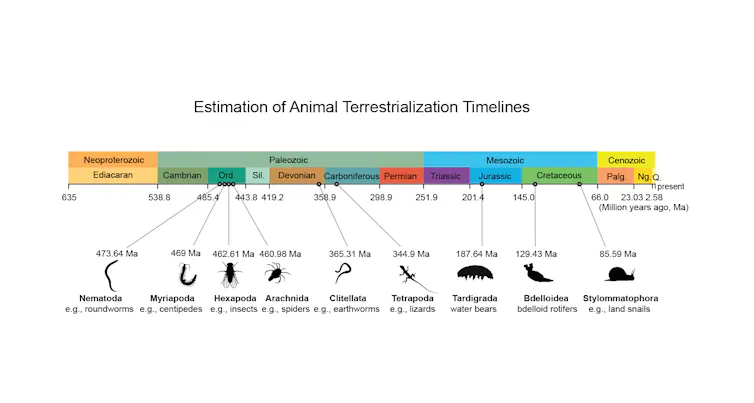
Colour coded timeline of when different animal lineages evolved a more land based lifestyle.
Estimation of animal terrestrial evolution timelines. Timeline dates are posterior means (weighted averages representing the most likely timing).
Jialin Wei, CC BY-NC-ND

In our Nature paper, my colleagues and I explored these habitat transitions from a genetic perspective. First, we compared the genomes of more than 150 species across the animal kingdom to identify which genes are shared by different lineages. Then, using the evolutionary tree of animals, we mapped which branches of the tree those genes emerged or were lost in.

We found that most transitions to land were accompanied by a large gene turnover, with many gene gains and reductions happening at the same time. The ability of genomes to gain and lose genes played a key role in animal adaptation to new habitats.

Making the leap

This discovery led us to ask what these genes do and wonder why some were retained while others disappeared. Using analytical techniques and powerful computer tools, we found that genes repeatedly gained across distantly related landbased lineages were involved in functions related to dehydration. They were also often related to stress response (such as temperature, UV radiation, contaminants found on land, and toxic compounds from plants). The genes that were lost or diminished were often linked to regeneration, diet and biological clocks such as day and night cycles.

Life’s move from water to land profoundly reshaped the planet itself. As life ventured onto land, it changed Earth’s cycles, removing CO₂ from and increasing the amount of oxygen in the atmosphere. Land-based life also weathered rocks, which made them release more minerals like calcium into the ecosystem.

These findings suggest that genetic changes drove shifts in biological functions, which in turn became key drivers of the transition from water to land.

Some animals still need humid surroundings to thrive. For example, earthworms live in moist soil. In contrast, insects and mammals can live entirely on dry land. Interestingly, we found that semi-terrestrial species (mostly tiny invertebrates) tend to share more adaptations. For example, functions related to blood circulation and nutrient absorption that help them survive in soil.

Fully land-based animals seemed to evolve a wider diversity of adaptation strategies. We discovered gene innovations specific to certain lineages, such as genes for shell formation and mucus secretion in land snails and innate immunity genes in land vertebrates. Land-based animals evolved more reinforced and specialised barrier defences for life on land. These distinct traits reveal the unique evolutionary histories shaped by ecology, physiology and chance.

Our study also sheds light on when these transitions happens. We identified three major waves of water to land transitions over the past 500 million years, during the Ordovician (485–443 million years ago), Devonian–Carboniferous (419–298 million years ago) and Cretaceous periods (145–66 million years ago). These waves began with early land arthropods, such as insects, and ended with land snails like those found in our gardens.

These periods were probably triggered by dramatic ecological and geological shifts. For example the rise of early land plants and the creation of seasonal habitats that created new environments and opportunities for land-based animals.

Previous research has mostly focused on specific land animal lineages. However, our study brings these transitions together, offering the first comprehensive view of how and when animals conquered the land.

This study offers a glimpse into what might happen if we could replay the tape of life: some genetic changes seem inevitable, appearing again and again, as life adapts to land, while others are rare. Our research shows how evolution continuously finds new solutions to the challenges of life on Earth.

The Conversation

Jialin Wei is supported by University of Bristol-China Scholarship Council joint-funded Scholarship.

ref. Land animals evolved from ocean ancestors – new study unravels the genetics behind the transition – https://theconversation.com/land-animals-evolved-from-ocean-ancestors-new-study-unravels-the-genetics-behind-the-transition-278609

Wolf Worm by T. Kingfisher – a brilliantly creepy, skin-crawling work of southern gothic fiction

Source: The Conversation – UK – By Daniel Cook, Professor of English Literature, University of Dundee

Wolf Worm by T. Kingfisher begins innocently enough: Sonia Wilson, an anxious young scientific illustrator, has been hired to draw the vast insect collection of the reclusive entomologist (insect expert) Dr Halder at his North Carolina manor house.

Something’s not quite right from the off. No one meets her on her arrival and she wonders whether her new employer really expects her to walk ten miles from the train station to his house? Old Halder is not one for practical details, the tight-lipped locals warn her. Harmlessly eccentric or maddeningly distracted? Intrigue surrounds the doctor.

T. Kingfisher is known for slow-burn books that offer rich rewards, and Wolf Worm is no different. The ominous signs come early. Weeds lurk in the corners of the unkempt garden and swarms of insects appear in the oddest of places throughout the house – bugs get into everything, Mrs Kent the housekeeper reveals matter of factly.

Sonia feels as though she has fallen into the kind of fairy tale where a wicked fairy demands she spins her watercolour illustrations into gold. Really, she has fallen into a creepy-crawly horror novel. Her days and nights are filled with delirious bouts of sleep, imperfect drawings, and scientific discovery. All the while, the mysterious Dr Halder works largely off the page.

When he does appear, Halder’s speeches are eerie and unsettling. “Do you know why it is called a screw-worm?” he asks his guest. Sonia provides a logical explantion: that the spiral ridge merely resembles a screw. But this induces an unpleasant leer from the doctor, who goes on to describe in grim detail the action of the burrowing ridges that anchor themselves into living flesh and are nearly impossible to remove. Dr Halder then casually taps a jar filled with hundreds of dead parasitic screw-worms, letting us know the insect horrors surrounding Sonia are far from hypothetical.

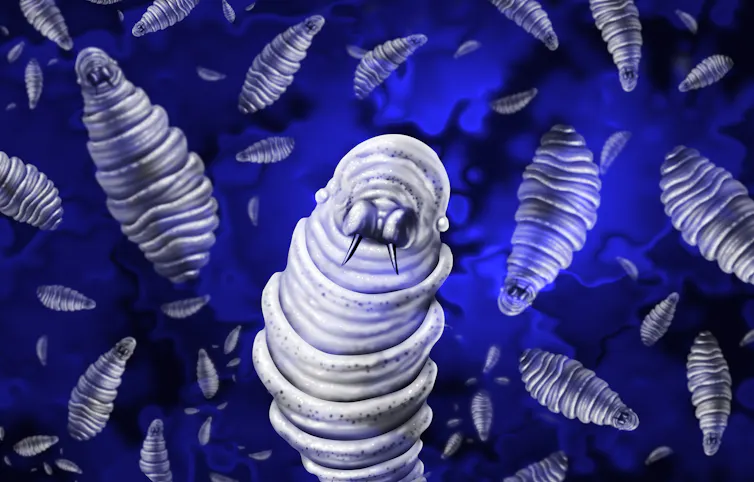
Screwworm parasite, a flesh-eating larvae.
Light Spring/Shutterstock

As with any other astute protagonist in a gothic novel, Sonia is consistently aware that something about her situation is “off” (a word she frequently uses). Animals behave strangely throughout. People avoid answering questions. Like Dracula’s Jonathan Harker, a late-Victorian gothic counterpart whose words she inadvertently borrows, she can barely suppress her shudders.

In a neat turn on the overly curious protagonist trope, Sonia’s knowledge of entomology develops as she works on her illustrations for her employer. As that knowledge grows, so does her discomfort.

The house and its environs steadily grow equally uncomfortable and these settings overwhelm the lead character in wholly novel ways. She habitually rationalises her experiences. For instance, if you hear a horrible sound in the woods and you don’t know what it is, she reasons, then it is probably a fox. Something is certainly making a noise in the basement: is it a disturbed prisoner? No, it’s more likely a tortured creature of some kind, she convinces herself.

It becomes harder to spin explanations, however, when she finds human remains. Like the more ghoulish doctors of 19th-century literature, such as Dr K in Robert Louis Stevenson’s The Body Snatcher or the eponymous vivisectionist in HG Wells’s The Island of Doctor Moreau, or even the real-life pioneer of anatomy studies Robert Knox, the entomologist has extended his studies to include the flesh of living subjects. And the results are truly gruesome.

Wolf Worm represents the best kind of neo-Victorian gothic: disturbing in its scope but never gratuitous, intimate and personal but always refusing to let the reader settle. For those who love historical fiction with a focus on science and artistry, and set in big creepy houses, this book will leave your skin crawling till the very end.

This article features references to books that have been included for editorial reasons, and may contain links to bookshop.org; if you click on one of the links and go on to buy something, The Conversation UK may earn a commission.

The Conversation

Daniel Cook does not work for, consult, own shares in or receive funding from any company or organisation that would benefit from this article, and has disclosed no relevant affiliations beyond their academic appointment.

ref. Wolf Worm by T. Kingfisher – a brilliantly creepy, skin-crawling work of southern gothic fiction – https://theconversation.com/wolf-worm-by-t-kingfisher-a-brilliantly-creepy-skin-crawling-work-of-southern-gothic-fiction-279165