Trump hikes global tariffs to 15% as the fallout from Supreme Court loss continues

Source: The Conversation – Global Perspectives – By Felicity Deane, Professor of Trade Law and Taxation, Queensland University of Technology

US President Donald Trump has announced the United States will increase baseline tariffs on imports from all countries to 15%, as the fallout continues from a seismic Supreme Court ruling on Friday.

Trump had imposed sweeping “reciprocal tariffs” last year under an emergency powers act, but the court ruled this law did not authorise him to do so.

Speaking in the wake of the ruling on Friday, Trump admonished the justices of the Supreme Court. He called the Democratic justices who ruled against the tariffs a “disgrace to the nation”.

He also said he felt “ashamed” of members of the court he considered conservative who had voted against his use of emergency powers.

Trump’s statement was riddled with insults and inaccuracies. However, he admitted he had tried to “make things simple” by using the emergency powers act. He went on to say he does have other options, but those options would take more time. This was one part of his speech that was indeed accurate.

With the clock already ticking on his landmark trade agenda, and the multi-billion dollar question of refunds looming, what might Trump do next? Here’s what could now be in store for both Australia and the world.


Read more:
Supreme Court rules against Trump’s emergency tariffs – but leaves key questions unanswered


Scrambling for alternatives

The new 15% rate is an increase on the 10% global baseline tariff enacted shortly after the ruling using a different law, and will hit some Australian exports.

This part of the law has never been used. However, it appears to clearly allow the president to impose tariffs of up to 15%, and for a period of no more than 150 days.

But Trump said during this five-month period, his administration would investigate the use of yet another law, section 301 of the Trade Act of 1974.

This section does allow the president to impose tariffs in response to foreign countries who violate US rights under international trade agreements, or that burden or restrict US commerce in “unjustifiable”, “unreasonable” or “discriminatory” ways. However, it requires some steps to be followed.

The process for using this law is detailed and cannot be subverted. It would likely take either years or vast amounts of resources to introduce tariffs that were anywhere near the “Liberation Day” tariffs.

If nothing else, it requires consultations with the countries upon whose goods those tariffs will be imposed.

Section 301 has previously been used to impose tariffs on China, following an investigation by the United States Trade Representative in 2018.

Another option

Another avenue for the president to bypass Congress is a specific section of a different law, Section 232 of the Trade Expansion Act of 1962, that applies to a particular sector of the economy.

This is the power used to impose tariffs on steel and aluminium in the first Trump administration in 2018.

However, it can’t be used to recreate sweeping tariffs on all foreign imports. This provision is generally product-specific and requires an investigation into the national security threat.

Its use to impose steel and aluminium tariffs has been challenged by multiple trading partners at the World Trade Organization. A panel of experts ruled the US had used a special national security exception erroneously.

However, despite this violation, Trump has suggested that he isn’t bound by international law.

The question of refunds

The Supreme Court’s ruling on Friday means all tariffs introduced under the International Emergency Economic Powers Act (IEEPA) were unlawfully collected.

If all collected duties are refunded, it’s estimated the total repayment could reach approximately US$175 billion (A$247 billion).

Much to the president’s frustration, there was no clarity within the Supreme Court’s ruling on the process for refunds of illegally collected tariffs.

That silence, which prompted Trump to refer to the decision as “terrible” and “defective”, was likely because this would be handled by other courts.

Back in December, the US Court of International Trade stated it would have the authority to order reliquidation and refunds of the sweeping tariffs if the Supreme Court ultimately ruled them unlawful.

Many large companies had already anticipated this ruling, and acted to get on the front foot. For example, in late November, large retailer Costco sued the Trump administration to secure a full refund of tariffs in the event the Supreme Court deemed them unlawful.

In late December, faced with an avalanche of similar cases, the Court of International Trade temporarily halted all cases where companies were claiming relief from IEEPA tariffs ahead of the Supreme Court’s ruling.

Refunds may not be straightforward

Some importers have argued that because the tariff payments were itemised, receiving refunds should not be messy.

But the process for refunds may not be as straightforward as it should be. Trump suggested they could be “in court for the next five years”.

What does this all mean for Australia?

Australia’s previous 10% rate was much lower than many other nations, but now at 15% the playing field has been levelled – at least for the next 150 days.

Australian exporters don’t pay these tariffs directly themselves, but may be pressured to absorb some of the cost, and it makes their imports less competitive in the US market.

However, not all Australian exporters are in the same position. The proclamation issued by the White House listed some exceptions, including beef, critical minerals, energy products and pharmaceuticals.

At Friday’s press conference, Trump said “great certainty” had been brought back to the United States and the world. In truth, the uncertainty is far from over.

The Conversation

Felicity Deane does not work for, consult, own shares in or receive funding from any company or organisation that would benefit from this article, and has disclosed no relevant affiliations beyond their academic appointment.

ref. Trump hikes global tariffs to 15% as the fallout from Supreme Court loss continues – https://theconversation.com/trump-hikes-global-tariffs-to-15-as-the-fallout-from-supreme-court-loss-continues-273105
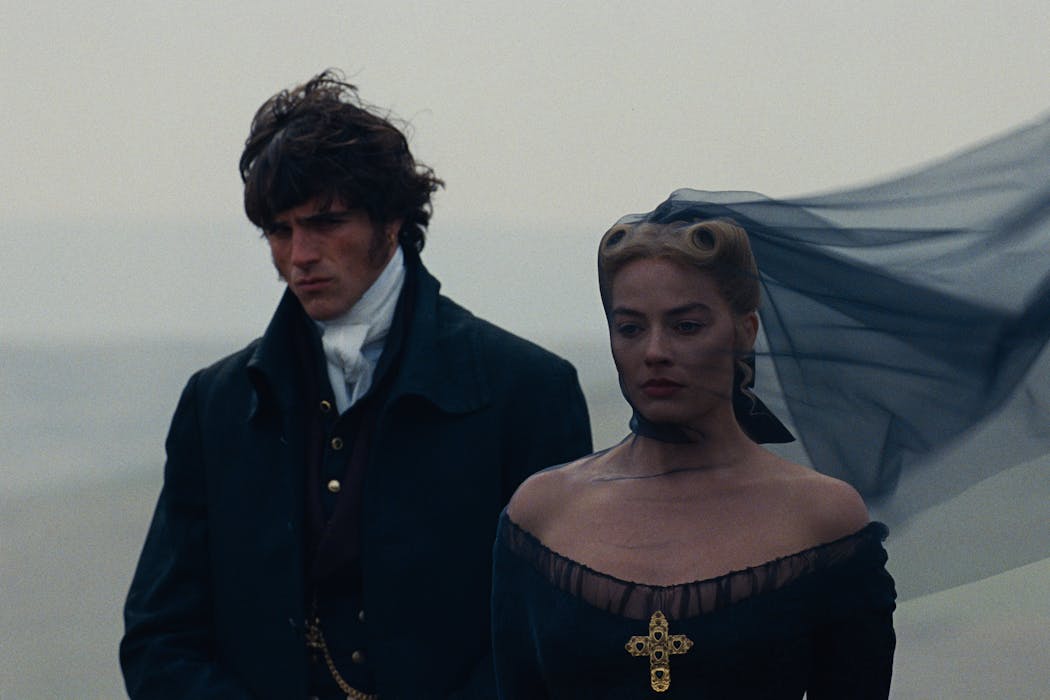
Wuthering Heights looks lush – but it’s a bad film and a worse adaptation

Source: The Conversation – Global Perspectives – By Benjamin D. Muir, Casual Academic, School of Humanities and Communication Arts, Western Sydney University

Photo Courtesy Warner Bros. Pictures

Emily Brontë died of tuberculosis 177 years ago, yet this adaptation is still the worst thing that has ever happened to her.

This is how one Letterbox’d user described writer-director Emerald Fennell’s film adaptation of Brontë’s classic tale.

Reviews for the film are mixed at best. While some critics have praised the visuals, detractors return to the same argument: it is not a good adaptation.

Good adaptations take advantage of the affordances the cinematic medium provides, so some changes are permissible. Fennell goes well beyond this, altering essential characters, relationships and themes to the point that the film feels like erotic fan-fiction with a Hollywood budget.

To synopsise, Brontë’s story is a tragedy of intergenerational trauma. It follows Heathcliff, an abused serial abuser, and Catherine, an intergenerational manipulator. The pair’s toxic relationship – and mutual revenge on everyone they knew (beyond the grave in Catherine’s case) – wreaks havoc.

Visually loud, emotionally mute

Given its tagline “the greatest love story ever told”, Fennell’s film was destined to make some changes.

The frame narrative of the novel is missing. The novel is told through housekeeper Nelly Dean, who is recounting it to Heathcliff’s tenant, Lockwood. The film, meanwhile, starts in Catherine’s childhood and ends at her death.

This also means Fennell stops short of the final act of the novel. In doing so, she omits an entire generation of important characters on whom the original Catherine and Heathcliff – two traumatised, irredeemable wrecking balls – foist their damage.

The interpersonal dynamics that underpin Brontë’s story are warped into a vacuous caricature, missing the point with virtuosic flair. And make no mistake: there is flair. The visual design is bombastic, pointedly anachronistic, and utterly at odds with the novel’s gloomy Gothic countenance.

Film still: A woman and man sit in a lavish blue room adorned with Medusa heads and pearls, smiling and laughing while holding drinks.
The opulent, richly saturated sets veer sharply from Brontë’s bleak, wind-swept moors.
Photo Courtesy Warner Bros. Pictures

Brontë’s perpetually grey and haunted moors are swapped for technicolour highlights, elaborate outfits and, at times, saturated tangerine sunsets. It watches like Sofia Coppola attempting Edgar Allan Poe – or a Charli XCX clip (guess who wrote the original soundtrack). This is an odd liberty for a film named after the story’s original setting – the stormy Wuthering Heights estate.

As pioneering Gothic theorists Sanda Gilbert and Susan Gubar write, the Heights in the novel are blanketed by “a general air of sour hatred” that manifests as “continual, aimless violence”.

In the Gothic, setting functions as a haunted presence that reflects the characters’ aberrant psychological states. The past haunts, even when there are no ghosts.

Fennell’s version retains the melodrama, but not the foreboding, hate and malice. And despite the explicit sexuality (none of which appears in the novel beyond euphemism), her take on the story feels oddly toothless. Neutered, even. It trades Gothic for vaudeville.

The erasure of Hindley and Heathcliff

To say the film lacks the novel’s social commentary is an understatement.

From the opening scene, the changes to the source material are clear. We see a young Catherine witnessing a hanged man with an erection – and this tone remains for the entire runtime.

Hindley – Catherine’s brother who forces Heathcliff into servitude, and is arguably the lynchpin of Heathcliff’s revenge – is also entirely absent from the film.

Literary critic Terry Eagleton notes how it is Hindley’s inherited status that enables his abuse of Heathcliff. It is Heathcliff’s lack of wealth, status and property that sees Catherine wed the wealthy Edgar Linton; and, as theorist Arnold Kettle argues, it is Heathcliff’s weaponisation of wealth and inheritance that finally serves as his vehicle for revenge.

To remove these factors is to remove the novel’s entire moral framework.

In the film, Heathcliff’s grievances shrink to Catherine choosing to marry Edgar Linton. This is as close as the film comes to the novel’s treatment of classism, racism and intergenerational trauma.

Likewise, ending on Catherine’s death erases the consequences of the deuteragonists’ manipulations – namely the suffering of their respective children and servants.

The casting of Jacob Elordi as Heathcliff has its own controversy. In the novel, Heathcliff’s ambiguous racial identity, within the context of Georgian England, shapes almost every interaction he has.

Even though it’s not clear what his racial identity is (some scholars point to hints that suggest he may have escaped from slavery), his character is defined by “othering”. This is something Elordi’s Heathcliff is at no risk of believably experiencing.

The film flattens the novel’s broader account of how trauma replicates across generations, and how systemic marginalisation can both attract and beget abuse.

Film still: A brooding man wearing a Georgian-style three-piece suit, with his arm outstretched on an antique sofa.
Jacob Elordi’s casting sidesteps the racialised marginalisation central to Heathcliff’s character.
Photo Courtesy Warner Bros. Pictures

On abuse – perhaps Fennell’s strangest departure from the source material is reframing Heathcliff’s treatment of Isabella (Edgar Linton’s sister and later Heathcliff’s wife) as a consensual BDSM dynamic.

Brontë’s Heathcliff terrorises Isabella physically and emotionally, and implicitly sexually, until she flees with their son.

The switch from repressed, complex desire in the novel to explicit sex scenes (absent from the book), and the rewriting of abuse as kink, seems to cater to audiences raised on post-50 Shades Of Grey erotica rather than Victorian Gothic.

Literary classics for a Tiktok generation

Like 2020’s colourful Austen adaptation, Emma (well received as a film, but criticised as an adaptation), Fennell’s Wuthering Heights signals a trend towards the “tiktokification” of literary adaptations.

Hollywood has long taken liberties with books, but this recent wave feels engineered for clips, reels and virality, rather than the necessary sacrifices of adaptation.

We know it’s possible to have adaptations with both flair and substance. Consider Baz Luhrmann. The Oscar-nominated Romeo + Juliet (1996) is just as visually bombastic, yet the extent of verbatim Shakespeare retains a dedication to the source that Fennell’s film lacks.

So what does it have to offer? Virality. Even this article contributes to the internet firestorm that will ensure Wuthering Heights’ commercial success. It will ragebait critics far longer than such a limp effort deserves – and we are all its victims.

The Conversation

Benjamin D. Muir does not work for, consult, own shares in or receive funding from any company or organisation that would benefit from this article, and has disclosed no relevant affiliations beyond their academic appointment.

ref. Wuthering Heights looks lush – but it’s a bad film and a worse adaptation – https://theconversation.com/wuthering-heights-looks-lush-but-its-a-bad-film-and-a-worse-adaptation-276179

Is AI really ‘intelligent’? This philosopher says yes

Source: The Conversation – Global Perspectives – By Jane Goodall, Emeritus Professor, Writing and Society Research Centre, Western Sydney University

Reconstruction of the ancient Antikythera mechanism, WA Museum, Boola Bardip. Chris Olszewski, via Wikimedia Commons, CC BY-SA

Anyone who engages in serious dialogue with a Large Language Model (LLM) may get the impression they are interacting with an intelligence. But many experts in the field argue the impression is just that. In philosopher Daniel Dennett’s words, such systems display “competence without comprehension”.

The hype about Artificial General Intelligence (AGI) from big corporations and their celebrity spokespersons has prompted a backlash, in which scepticism turns to cynicism, often tinged with paranoia about how “stochastic parrots” may start to control our lives.

“Intelligence” itself has become an overheated topic, one that calls for less assertiveness, more cool thinking, and refreshed attempts at a starting point.


Review: What is Intelligence: Lessons from AI about Evolution, Computing, and Minds – Blaise Agüera y Arcus (MIT Press)


What Is Intelligence? by Google luminary Blaise Agüera y Arcus is the first book in a new series from MIT in collaboration with Antikythera, a think tank focused on “planetary-scale computation as a philosophical, technological, and geopolitical force”. A foreword from series editor Benjamin Bratton makes the bold claim that “computation is a technology to think with” and that the building blocks of our reality are themselves computational.

Blaise Agüera y Arcas.
Cmichel67, via Wikimedia Commons, CC BY-SA

Research on intelligence has a chequered history, tainted by eugenics, statistical manipulation and a banal obsession with metrics. Agüera y Arcas counters this by opening up the topic as wide as it can go. A physics graduate with a background in computational neuroscience, he is something of a polymath. He draws explanatory frameworks from microbiology, philosophy, linguistics, cybernetics, neuroscience and industrial history.

His book presents almost as a sequence of foundation lectures in these areas. Its release has been accompanied by dozens of online talks and interviews, in which Agüera y Arcas presents the case that we are up for a seismic shift in how we think about intelligence – biological and artificial.

“Few mainstream authors claim that AI is ‘real’ intelligence,” he writes. “I do.”

Could the nerds be right?

The fundamental case against the “I” in AI is that intelligence is organic, derived from sensory interaction with a physical environment. Agüera y Arcas turns the tables with the premise that computation is the substrate for intelligence in all life forms.

The claim builds on an apparently crude proposition: prediction is the fundamental principle behind intelligence and “may be the whole story”.

What he means by prediction here is something much more radical than what we see with autocorrect. He explains it in biological terms as a process of pattern development. Single cells like bacteria predict sequences of events that may influence their capacity for survival. The synaptic learning rules in single neurons give rise to local sequence prediction.

Agüera y Arcas recounts how his journey into the enigmatic terrain of AI reached a turning point with his counterintuitive recognition that “the nerds were right”: in computation, bigger really was better and might actually be the key to moving from Artificial Narrow Intelligence (ANI) – the kind that can play chess – to Artificial General Intelligence (AGI), which can participate in a philosophical discussion.

Setting aside his contempt for the apparently simplistic dedication to scaling up, Agüera y Arcas returned to the biology lab for a reassessment of what was observable in living systems. If every form of life is an aggregation of cooperative parts, he reasoned, the evolution of cells into organs and organisms may be a matter of predictive modelling.

A central tenet of What is Intelligence? is that every form of life is an aggregation of cooperative parts. Links proliferate through patterns that enable increasingly complex functions. When Agüera y Arcas says the brain is computational, it’s not a metaphor: it is not that brains are like computers, they are computers.

Correlations between biological and mechanical forms of intelligence are his deep and abiding interest. What is Intelligence? follows What is Life?, a shorter book in which Agüera y Arcas lays the groundwork for this larger, more ambitious publication.

The two questions remain interwoven, if not fused, in his analysis, which draws on the foundational work of physicist Ewin Schrödinger, mathematicians Alan Turing, John von Neumann and Norbert Weiner, and microbiologist Lynn Margulis.

Alan Turing, one of the originators of modern thinking about artificial intelligence.
Public domain, via Wikimedia Commons

These are the originators of modern thinking about artificial intelligence, and the quest for origins runs through all Agüera y Arcas’ lines of enquiry.

It is worth noting that Antikythera, the publishing series launched with this book, is named after an ancient device found in a shipwreck off the coast of Greece, which has been called the original analog computer.

Computation was discovered as much as it was invented, Bratton says in his foreword. This might apply to the Antikythera. If it is indeed the first computer, it was literally discovered at the bottom of an ocean.

But it corroborates Bratton’s statement in another sense. As a device for tracking astronomical phenomena, the Antikythera testifies to computation as an aspect of how the universe works.

Getting specific about origins

Agüera y Arcas wants to get more specific about origins. How does pattern emerge from randomness? How does code emerge from an unorganised soup of molecules?

In approaching these questions, he takes his cue from Turing and von Neumann, whose experiments anticipated the discovery of the molecular structure of DNA in 1953. The 1936 Turing machine established a minimalist prototype for computational function with the simple components of a coded tape and a read/write head. Von Neumann brought in a focus on embodied computation, where the components of the machine or body are part of what is written.

This is where Agüera y Arcas situates his work. His breakthrough came from adopting a programming language, devised in 1993, called “Brainfuck”. With just eight command symbols, Brainfuck set the parameters for a controlled experiment, in which Agüera y Arcas and his team used 64 byte tapes coded with “junk” drawn from a soup of code and data.

In the experiment, two tapes are selected at random, joined end to end, and run to test for interaction patterns. Then it’s rinse and repeat. The tapes are returned to the soup, and two more are run.

At first, nothing much shows up amidst the randomness. But after a million or so repeats (not massive in computing terms) the magic starts to happen. Loops appear. Patterns emerge. At around the five million mark, the non-functional code or “Turing gas” transforms itself into a “computorium” of replicating code.

In lectures, Agüera y Arcas shows a screenshot of this on his laptop: a vertical line down the centre of the field of data marks the “phase transition”. The image is reproduced on the cover of his book, as an emblem of the paradigm shift he is tracking.

If the transition to replicating code is indeed an expression of what is happening in the development of life forms, the theory of natural selection may lose its claim to primacy as the explanatory model for evolution. Richard Dawkins enthusiasts, hang on to your hats.

Agüera y Arcas does not engage in a polemical critique of Dawkins, but his book brings Margulis, an early adversary of Dawkins, into the centre of the arena. The pair faced off in a public debate in Oxford in 2009, where Dawkins’ popularised concept of the “selfish gene” came under pressure from Margulis’ theory of symbiogenesis, literally genesis through combination or fusion.

The Dawkins account is based on a Darwinian view of natural selection through competitive advantage; Margulis was drawing on research into the formation of microorganisms through combinations of mitochondria and chloroplasts, once independent life forms.

It was survival of the fittest versus a vision of biological complexity generated through endosymbiosis, a relationship in which one organism lives inside another, potentially resulting in a new life form – or, as Agüera y Arcas sees it, an impetus towards “fit” understood as pattern completion, rather than “fitness” understood as advantage.

Microbiologist Lynn Margulis was an early adversary of Richard Dawkins’ theory of the ‘selfish gene’.
Wikimedia Commons, CC BY

Prediction and function

Agüera y Arcas’ central concepts are prediction and function, which work together to explain intelligence as the development of functional complexity through predictive pattern completion.

He is erasing a familiar conceptual boundary here: intelligence does not prompt function, it is function.

Intelligence, he argues, is a property of systems rather than beings, and function is its primary indicator. A rock does not function, but a kidney does. This is demonstrated simply by cutting them in half. The rock becomes two rocks, but the kidney is no longer a kidney.

So does a kidney have intelligence? Or an amoeba? Or a leaf? These questions are opened up, along with the question of whether Large Language Models have intelligence, which may a better way to frame it than asking whether they are intelligent.

Agüera y Arcas is not alone in taking an affirmative position. Influential biologist Michael Levin runs a research laboratory at Tufts University, where he and his team study the functional correlations between natural organisms and synthetic or chimeric life forms in search of “intelligence behaviour in unfamiliar guises”.

Their declared goal is to develop modes of communication with truly diverse intelligences, including cells, tissues, organs, synthetic living constructs, robots and software-based AIs.

Such an approach steers a course between the stochastic parrots view and biologist Rupert Sheldrake’s theory of “morphic resonance,” which proposes that organic form is a manifestation of memory, resonating through generations as genetic heritage. Agüera y Arcas avoids both Sheldrake’s intuitive and telepathic orientations, and the hard-headed constraints of mechanistic determinism.

The thesis presented in What is Intelligence? is unfamiliar rather than intrinsically difficult. Much of the explanation is easy enough for the general reader to follow, though Agüera y Arcas has a tendency to veer into more the technical and abstract terrain of programming, as if addressing an insider audience. The extensive glossary does not include standard programming terms, such as logic gates, gradients, weights and backpropagation.

At over 600 pages, What is Intelligence? is a marathon read and it is encumbered by tangential excursions. I’m not sure why Agüera y Arcas needs to go into the history of industrialisation, or anthropological studies of the Pirahā people of the Amazon. This is a book for dipping into rather than swallowing whole.

But its ideas are important. They may well be part of a major transformation in our thinking about where human intelligence sits in the rapidly evolving environment of AI.

The Conversation

Jane Goodall does not work for, consult, own shares in or receive funding from any company or organisation that would benefit from this article, and has disclosed no relevant affiliations beyond their academic appointment.

ref. Is AI really ‘intelligent’? This philosopher says yes – https://theconversation.com/is-ai-really-intelligent-this-philosopher-says-yes-271721

Government has halted controversial policy of destroying court records, investigation reveals

Source: The Conversation – UK – By Brian Thornton, Senior Lecturer in Journalism, University of Winchester

Alexander Supertramp/Shutterstock

A controversial policy of destroying recordings of trials after seven years is to be abandoned, the Ministry of Justice (MoJ) has disclosed.

The policy, affecting courts in England and Wales, had been heavily criticised by lawyers and miscarriage of justice campaigners, who said the destruction of court records makes challenging a conviction almost impossible.

They point to cases like Omar Benguit – now the subject of a BBC Panorama investigation – where vital court records were erased.

Benguit’s legal team claim the transcripts from his three trials would have provided invaluable evidence for an appeal – but all were destroyed before they could be examined.

As a journalism lecturer carrying out research into court reporting, as well as miscarriages of justice, I was keen to investigate, and requested more information from the MoJ through Freedom of Information requests.

In its responses to me, the MoJ publicly disclosed for the first time that trial records will now be kept for at least as long as the prison sentence – and possibly indefinitely.


The Insights section is committed to high-quality longform journalism. Our editors work with academics from many different backgrounds who are tackling a wide range of societal and scientific challenges.


An MoJ spokesperson said: “This updated policy safeguards continued access to court records for the purpose of appeals, reviews or any other legal proceedings that may arise during the entire period of the sentence.

“Retaining records for the full length of the sentence preserves judicial integrity, and protects the rights of all parties concerned.”

Campaigners who fought for years to halt the policy of destroying court records have welcomed the announcement. Jon Robins, a lecturer at Brighton University and co-organiser of the Open Justice Charter, told me:

This is a sensible result – and a surprising and belated victory for our campaign. We pointed out more than a decade ago that there was no possible justification for such a draconian destruction policy, ever since our courts were dragged into the digital era and began recording proceedings – other than closing off the prospect of challenges from those claiming to be wrongly convicted.

The unnecessary loss of court documents – especially, court transcripts and the audio recordings of court proceedings – has often proved an insurmountable barrier in the investigation of miscarriage of justice cases.

The official guidance for how long records should be retained is set out in the crown court’s Record Retention and Disposition Schedule (RRDS). This currently states that the recordings of crown court trials should be “kept for seven years and then destroyed”.

The MoJ confirmed to me that this policy has now been scrapped. It stated that “effective from October 9 2023 onwards”, staff had been instructed to apply the following retention periods for crown court audio recordings:

  • One year for not-guilty verdicts;
  • Seven years for non-custodial sentences;
  • At least seven years or the sentence length for custodial sentences (whichever is longer);
  • And 99 years for life imprisonment.

The MoJ said it will officially publish this updated guidance in the new RRDS later this year.

End of a ‘reckless’ policy

For many years, the policy of destroying recordings of trials attracted a great deal of public criticism.

In January 2016, a letter was sent to the then secretary of state for justice, Michael Gove, urging him to change the policy. The letter – signed by 35 lawyers, academics and campaigners – said: “In this digital age, it is both reckless and irresponsible to systematically destroy the record of court proceedings.”

A pile of papers next to scraps from destroyed documents
The change in policy is a win for campaigners against miscarriages of justice.
Pawel Kacperek/Shutterstock

In October 2016, Jerry Buting, the American attorney whose defence of Steven Avery featured in the Netflix docuseries Making A Murderer, told The Justice Gap that destroying recordings of court proceedings was “absolutely ludicrous”, adding: “Digital recordings take virtually no space. There is no excuse for the courts to not store forever – at least as long as the defendant is alive.”

A later campaign called Open Justice Charter (OJC) also highlighted the destruction of court records as a key failing in the justice system, stating: “No recordings of criminal court proceedings should be destroyed until at least seven years after the end of the prison term and any post-release licence period imposed.”

What was heard by the jury?

The key concern for those criticising the policy was what they saw as the deleterious affect it was having on those trying to challenge a conviction.

The way the appeal system works is that if a prisoner wants to challenge their conviction, they need to apply to the Criminal Cases Review Commission (CCRC) in order to be allowed to take their case to the Court of Appeal.


Read more:
The miscarriage of justice watchdog is failing at its only job – here’s how to fix it


The CCRC will not refer the case unless there is “fresh evidence” – something new which the original jury did not hear. And so, for someone who believes they have been wrongly convicted, their starting point will be to identify exactly what was heard by the jury.

For the prisoner and their legal team, this means getting access to the transcriptions of the trial. Without these, they risk submitting an application based on evidence that is not considered new, or omitting evidence that could be highly significant.

Some applications to the CCRC may come many years – even decades – after trials have happened, meaning that not even the prisoner will be able to fully remember what happened in court. For example, one miscarriage of justice victim, Peter Sullivan, was freed 38 years after a jury wrongly convicted him.

Leading legal figures such as Michael Mansfield KC, who acted for the Hillsborough families, has argued that the destruction of records hugely disadvantages those seeking justice. He told The Guardian: “Equally important is access to the record of proceedings and case documentation, without which injustice can be washed away.”

Emily Bolton, who founded Appeal, the charity and law practice dedicated to challenging wrongful convictions, also described the destruction of court records as “a complete roadblock to investigating miscarriages of justice”. She added: “What is the British system afraid of? It’s a public trial, and there should be an accessible record of it.”

More groundbreaking than it first appears

Despite all of this, the MoJ took years to revise the policy. In response to my FoI requests, it explained the decision had nothing to do with the criticism it had received:

The change from ‘seven years to seven years or the life of the sentence’ was driven by new legislation (at the time) called The Parole Board Rules 2019. Those revisions were of particular importance so as to ensure that audio records remain accessible for the entire duration of a custodial sentence, particularly when the sentence exceeds seven years.

But a close analysis of the MoJ’s responses to the FoI requests reveals something intriguing – that the change may be far more groundbreaking than it first appears.

While the MoJ may be reluctant to spell it out explicitly, it appears that the official policy has quietly moved from a position of court records being routinely destroyed, to one where they will now be retained indefinitely. And the reason for this is not legal or political – but purely down to technology.

The destruction of court records was really a legacy of the analogue age; a time when stenographers quietly tapped away in court and any recordings were kept on physical tapes.

In 2012, all of that was swept away when proceedings in crown courts began to be recorded by the Digital Audio Recording Transcription and Storage (Darts) system, meaning there was no longer any need to physically store recordings on tape, and therefore no logistical reason to destroy them.

So, while the new policy dictates that records will be retained for at least as long as the prison sentence, the new technology has essentially removed the need or justification for ever deleting any more court records. The MoJ came very close to admitting this to me when it said: “Crown court audio recordings are retained within HMCTS Digital Audio Recording Transcription and Storage system. To date, none of these court audio recordings have been deleted.”

If the Darts system had been storing recordings since 2012, and the MoJ policy was to destroy recordings after seven years, then they should have started erasing cases since 2019.

Significant costs

While the change is very significant and should dramatically improve access to court records, one critical barrier remains.

While the audio recording of the trial may now exist, it is not possible – except in very limited circumstances – to listen to it, so it must be professionally transcribed. And this can prove to be very – even prohibitively – expensive.

In 2023, MP Sarah Olney revealed that a rape victim had been charged £7,500 for a transcript of her assailant’s trial. And former government minister David Davis told parliament in 2024 he had been quoted £100,000 for a transcript of the Lucy Letby trial at Manchester Crown Court.

Many victims, particularly those who suffered sexual violence, are now calling for transcriptions of trials to be made free. This new campaign echoes an argument that miscarriage of justice campaigners like Bolton were making a decade ago. She said in 2016:

In this country, the system was privatised, and now profit-driven transcription firms hold justice to ransom, demanding thousands of pounds to provide sections of transcript of a trial. Neither the Legal Aid system nor individual prisoners or their families can afford this, and so the recordings languish unreviewed, and the system goes unaudited.

Robins told me: “The next step for accountability in our courts is to make the audio recordings or transcripts of proceedings available at an accessible price. In an era when there are free AI transcription services, these costs make no sense.”

The decision by the MoJ to stop destroying recordings of trials means that court records will now be available – as long as someone can afford them. It brings to mind the quip by 19th-century judge James Mathew, who said that “in England, justice is open to all – like the Ritz Hotel”.


For you: more from our Insights series:

To hear about new Insights articles, join the hundreds of thousands of people who value The Conversation’s evidence-based news. Subscribe to our newsletter.

The Conversation

Brian Thornton does not work for, consult, own shares in or receive funding from any company or organisation that would benefit from this article, and has disclosed no relevant affiliations beyond their academic appointment.

ref. Government has halted controversial policy of destroying court records, investigation reveals – https://theconversation.com/government-has-halted-controversial-policy-of-destroying-court-records-investigation-reveals-276418

How AI resurrects racist stereotypes and disinformation — and why fact-checking isn’t enough

Source: The Conversation – Canada – By Nadiya N. Ali, Assistant Professor, Sociology, Trent University

By any measure, 2025 is the year artificial intelligence (AI) rapidly shifted the way we work, interact with each other and engage with the world at large. It has also made undeniable the enduring reality of racism and the limits of fact-checking in an age of disinformation.

Thanks to algorithmic systems, narratives that tap into deep-seated fears and anxieties travel farther and faster than ever before. They circle the globe before fact-checkers can even flag a problematic post.

In the second half of the year, another technological disruption emerged with OpenAI’s Sora, a lifelike video-generation software. Nothing, seemingly, was immune, including politics.

Sora hit the political landscape with particular vigour during the longest federal government shutdown in United States history. The 43-day impasse generated significant pressure and public controversy, particularly around uncertainty and delays that could affect the Supplemental Nutrition Assistance Program (SNAP).

Digital blackface and the policing of Black poverty

At the height of the anxiety over the effects of the shutdown on SNAP benefits, which serves roughly 42 million Americans, a slew of short videos of Black women accosting social service employees or unleashing their frustration on livestream audiences caught the attention of the online sphere.

The SNAP suspension was ultimately blocked by the courts. It was also quickly revealed that the circulating clips were AI-generated.

What is most striking about these videos is how deliberately the caricature of the “Black welfare queen” was staged. In one video, the speaker declares, “I need SNAP to buy an iPhone.” In another, “I only eat steak, I need my funds.” And in a clip with children in the background, the woman insists, “I need to do my nails.”

Each expression of illicit use of funds is a shorthand for the alleged irresponsibility and moral failing that has long been intertwined with the racist trope of the “Black welfare queen.” One X user aptly dubbed these videos nothing short of “digital blackface.”

In the words of Black feminist writers Moya Bailey and Trudy, these videos traffic in “misogynoir” — a term developed to capture the “ways anti-Blackness and misogyny combine to malign Black women.” Bailey and Trudy note that representations of Black women as undeserving, burdensome to the public purse and inherently fraudulent are entrenched rather than exceptional.

Even clips “clearly labeled with a Sora watermark nabbed nearly 500,000 views on TikTok alone,” journalist Joe Wilkins observed. Wilkins goes on to explain that even when viewers were told the clips were AI-generated, some insisted, [“But that is what is happening.” Some argued that even if the videos were technically “fake,” they still “highlight genuine SNAP…issues.”

These comments expose the limits of fact-checking as an antidote to disinformation, especially when dealing with charged tropes. Once a harmful framing is revived and thrust into the collective ether, Ctrl+Alt+Delete becomes ineffective.

What requires attention, then, is not only how we grapple with the new terrain of AI-driven disinformation, but that we critically ask why certain representations hold mass resonance.

Why do particular images and narratives travel so well?

From settled fraud case to viral spectacle

Another case of digital blackface that captured public attention centred on the Minnesota Somali “Black fraud alert” saga. While still rooted in the same anti-Blackness that animated the “Black welfare queen” caricatures, this incident included Islamophobia and rising anti-immigrant sentiments.

The case traced back to a 2022 COVID-era malpractice scheme, which already led to arrests and convictions had. The scheme was led by Aimee Marie Bock, a white woman, and involved a network of Minnesotans, many of whom happened to be of Somali descent.

In December of 2025, U.S. President Donald Trump resurrected the settled case, weaponizing it and tethering it to his longstanding disdain for “third-world countries” and people from “shithole countries.” This rhetoric also folded into his hostility toward political opponents Minnesota Governor Tim Walz and Congresswoman Ilhan Omar.

What followed was not a serious discussion of fraud or of policy safeguards. Instead, the episode reinvigorated debates about white nationalism, racialized citizenship and racial eugenics.

Trump’s call to deport Somalis through ICE, declaring “I don’t want them in our country,” made this logic explicit. That most Minnesota Somalis hold U.S. citizenship, consistent with the 84 per cent citizenship rate, did little to disrupt the racist story being circulated.

Soon after the president’s comments, AI amplified the content. An AI-generated video circulated widely, animating the “Somali pirate” trope. It depicted Black men, presumed to be Somali, as migrants plotting to steal from taxpayers. In it we hear: “We don’t need to be pirates anymore. I found a better way. Government-funded daycare. We must go to Minnesota.”

This reference to child care echoed back to a viral video produced by a right-wing commentator claiming to expose another chapter in the “Somali fraud scandal,” this time targeting Somali-run child-care centres. The video prompted a statewide investigation, which ultimately found that all but one of the named centres were operating normally, with no clear evidence of fraud.

The “Black welfare queen” trope and the “Somali pirate” frame may seem to name different crises and different subjects, yet both draw from the same anti-Black racial grammar. In each case, Blackness is rendered fraudulent, criminal and morally deficient, cast as both a personal failing and national burden.

Why these ideas travel even when they’re false

These instances of digital blackface succeeded because misogynoir and anti-Blackness remain readily available discursive resources. AI merely accelerates their movement. The refusal of audiences to course-correct when fact-checked underscores how intuitive and pre-assembled racist and xenophobic scripts already are.

In both the SNAP-themed misogynoiric videos and the AI-generated “Somali pirate” content, nuance and factual accuracy were beside the point. What is at work instead is a broader political project tied to racial capitalism’s eugenicist logics.

As Black radical scholar Cedric Robinson argues, racism is not incidental to capitalism but foundational to the inequalities it requires. Poverty is misdirected as evidence of personal and community failings rather than the result of massive structural inequity. And when attached to the racialized poor, especially when Black, Muslim and immigrant, this logic crystallizes into “common sense.”

What is at stake with AI-enabled digital blackface is not only the amplification of racism, but the architecture of political life. In this climate, sober analysis and nuance recede, displaced by the numbing anxiety that structures contemporary public discourse.

The Conversation

Nadiya N. Ali has received funding from The Social Sciences and Humanities Research Council of Canada.

ref. How AI resurrects racist stereotypes and disinformation — and why fact-checking isn’t enough – https://theconversation.com/how-ai-resurrects-racist-stereotypes-and-disinformation-and-why-fact-checking-isnt-enough-270000

Canada’s ethnic and racial wage gap rivals it’s gender gap — but gets a fraction of the policy attention

Source: The Conversation – Canada – By Reza Hasmath, Professor in Political Science, University of Alberta

Canada has spent decades confronting the gender pay gap, enacting legislation and building public awareness around the fact that women earn about 84 cents for every dollar men make. That gap persists because of systemic barriers, and is wider for women who face multiple forms of discrimination.

Yet an equally significant wage penalty for ethnic and racial minorities rarely commands the same attention, and has not prompted a comparable policy response.

Racialized men earn just 78 cents for every dollar non-racialized men earn. Racialized women face a double penalty, earning only 59 cents. Post-COVID pandemic data shows this wage gap remains largely unchanged.

Both injustices are real and well-documented. So why has gender-based pay equity produced dedicated legislative tools, while ethnic and racial wage penalties continue to be addressed unevenly?

As an expert in public policy and ethnic studies, I see the answer lying not in the severity of the problem, but in the mechanisms that bring gender and ethno-racial wage discrepancies to light.

A century of feminist momentum

Progress on gender pay equity has been largely driven by sustained, organized activism. By the time wage discrimination entered mainstream political debate in the 1960s and 1970s, women’s groups had built national coalitions, testified before commissions and established gender inequality as an object of state intervention.

This momentum translated into policy. The 1977 Canadian Human Rights Act defined wage discrimination solely through a gender lens, making it discriminatory “for an employer to establish or maintain differences in wages between male and female employees.”

Ethnicity and race were absent from this definition — a gap that labour organizations and anti-racism advocates have long pushed to change.

The 1995 Employment Equity Act requires federally regulated employers to track representation and remove barriers for four designated groups: women, Indigenous Peoples, persons with disabilities and members of visible minorities. But it stopped short of requiring employers to correct wage disparities for ethno-racialized workers.

Gender pay equity later received its own legislative tool: the 2018 Pay Equity Act, which obliges federally regulated employers to proactively assess and remedy gender-based wage gaps for work of equal value.

While this framework has strengthened accountability, significant gaps remain, especially for women who experience intersecting forms of discrimination.

The legislative landscape is beginning to shift, but at a snail’s pace. The Employment Equity Act Review Task Force has recommended expanding designated groups to include Black workers and 2SLGBTQ+ workers. If implemented, these changes would mark the first major update to Canada’s equity regime in decades.

A delayed start for ethno-racial equity advocacy

While feminist organizations were building national advocacy networks in the mid-20th century, ethno-racialized communities faced a different political landscape.

Until the mid-1960s, Canada’s immigration system restricted non-European immigration, forcing many ethno-racialized communities to fight first for the right to be in Canada.

Because of these structural barriers, research on ethno-racial earnings disparities emerged far later. Economists began documenting the “colour of money” in Canadian labour markets only in the 1990s — decades after gender wage gaps had become a staple of academic research, public policy and media coverage.

Subsequent studies have shown persistent earnings penalties for ethno-racialized workers, with Black, West Asian and South Asian workers facing some of the steepest disadvantages.

In recent years, the federal government has introduced new institutional mechanisms, including Canada’s Anti‑Racism Strategy. Such initiatives have expanded data collection and supported community-based research, but they remain policy frameworks rather than enforceable tools because they lack binding obligations and compliance mechanisms.

The ‘visible minority’ problem

One of the challenges in achieving pay equity is the lack of categorical clarity in the term “visible minority,” a label frequently used by the Canadian government.

“Visible minority” functions as a bureaucratic catch-all. The last census recorded more than 450 distinct ethnic and cultural origins. Within this umbrella, labour market outcomes vary dramatically.

For example, university-educated Japanese Canadians often earn more than white Canadians, while those of Latin American ancestry earn 32 per cent less. Statistics Canada data shows that, even after controlling for education, Black male graduates earn 11 to 13 per cent less than non-racialized peers, while West Asian and Arab female graduates earn 15 to 16 per cent less.

Such variation makes collective advocacy more difficult. When some subgroups are advantaged, political attention can wane because the problem appears inconsistent.

Advocacy is most effective when it spotlights the worst-affected groups: Black Canadians, West Asian Canadians and Latin American Canadians. Organizations such as the Black Legal Action Centre and the Canadian Arab Institute demonstrate that targeted, community-specific advocacy is both possible and necessary.

Precarity as a silencer

Another reason the ethno-racial wage penalty is also muted by labour market precarity. Many ethno-racialized workers are overrepresented in temporary, low-wage or insecure forms of employment, including temporary foreign worker programs, non-unionized contract work and short-term service roles.

Research has repeatedly shown that newcomers and ethno-racialized workers face higher rates of job insecurity and lower access to employment protections.

For workers on conditional permits or pathways to permanent residency, speaking out about wage discrimination can risk contract termination or loss of status.

Under Canadian law, employers are required to measure ethno-racial representation but are not obligated to ensure ethno-racial pay equity. In effect, ethno-racialized workers are counted, but their wages remain unprotected.

Laws reflect which inequalities we care about

The ethnic and racial wage disparity in Canada is not inevitable; it is political. If sustained activism and legislation can tackle the gender pay gap from a policy perspective, the same tools can address ethno-racial wage penalties.

Community organizations have long pushed for this. Unions such as the Canadian Union of Public Employees explicitly frame discriminatory wage structures as a form of racism that must be confronted through collective bargaining and organizing.

The Canadian Labour Congress has called for stronger enforcement mechanisms, better data and explicit recognition of ethno-racial pay inequity in federal law.

These three shifts would make a meaningful difference:

  1. Move beyond “visible minority” categories and require wage reporting for specific groups most affected by disparities.

  2. Extend pay equity obligations to include ethnic and racial wage gaps, with the same proactive assessment and compliance mechanisms used for gender.

  3. Link wage equity to broader conversations about immigration, economic justice and Canada’s stated commitment to multiculturalism.

If fair and equitable pay is truly a Canadian value, attention to wage inequality cannot stop at gender. Both the gender gap and the ethnic and racial wage gap are products of systemic barriers.

Addressing these gaps requires extending equity measures to all sectors where ethnic or racial background continues to influence opportunity and compensation.

The Conversation

Reza Hasmath does not work for, consult, own shares in or receive funding from any company or organisation that would benefit from this article, and has disclosed no relevant affiliations beyond their academic appointment.

ref. Canada’s ethnic and racial wage gap rivals it’s gender gap — but gets a fraction of the policy attention – https://theconversation.com/canadas-ethnic-and-racial-wage-gap-rivals-its-gender-gap-but-gets-a-fraction-of-the-policy-attention-275296

What can whale films tell us about Marineland’s threatened belugas and dolphins?

Source: The Conversation – Canada – By Matthew I. Thompson, Assistant Professor, Faculty of Media, Art, and Performance, University of Regina

The fate of 30 captive beluga whales and four dolphins hangs in the balance as Marineland in Niagara Falls awaits final approval for an export permit from the Canadian government. Marineland has threatened to euthanize the whales, as they can no longer afford to feed and house them since shuttering the park.

Marineland closed to the public in 2024 after years of declining ticket sales. An initial attempt to sell the whales to an amusement park in China was blocked by Canada’s Fisheries Minister, Joanne Thompson, in order to protect the whales from performing in captivity.

A more humane solution for many is The Whale Sanctuary Project, a 100-acre enclosed parcel of coastal waters in Nova Scotia. The sanctuary is not yet complete, however, and Marineland is pressing the federal government to allow them to export their whales to amusement parks in the United States.


Read more:
Marineland’s decline raises questions about the future of zoo tourism


My research examines how environmental politics get transformed into Hollywood movies. Captive whales and dolphins inspired the Save the Whales movement of the 1970s and 80s, which found itself expressed in films like The Day of the Dolphin and Orca. While these films were very sympathetic towards whales, their star cetaceans were captive orcas and dolphins.

The crisis at Marineland is emblematic of human-cetacean relations in the last hundred years. Whether capturing them on film, containing them in amusement parks or subjecting them to scientific experiments, our curiosity about whales and dolphins has compelled us to fetch them out of the ocean. The irony is that, once we have gotten a good look, we recognize their right to be free in an environment they are no longer equipped for.

Free Willy

The best example of this irony comes from the 1993 film Free Willy. In it, a young boy befriends, and then leads to freedom, a captive orca named Willy. A surprise hit at the box office, once the film was released many audience members wanted to know whether the whale who played Willy had also been set free.

Keiko, as that whale was known, was held in captivity in an under-resourced aquarium in Mexico City at the time. Like the belugas and dolphins at Marineland, Keiko was suffering some of the mental and physical afflictions associated with living in a poorly maintained tank. Since 2019, 19 belugas, one dolphin and one orca have died at Marineland.

Pressure from fans of the film led to the creation of the Free Willy-Keiko Foundation, and a plan to release Keiko back into the wild was developed.

Unfortunately for Keiko, and captive whales everywhere, once a cetacean has spent a significant amount of time in captivity, they are rarely able to survive reintroduction to the wild.

Millions of dollars were spent flying Keiko, first to Oregon, where he was taught to catch and eat live fish again, and then to Iceland where he was slowly introduced to a wild pod of orcas.

Keiko died of pneumonia in a Norwegian fjord only 18 months after his full release.

Keiko’s story highlights the problem faced by the belugas and dolphins at Marineland. Films and amusement parks expose millions of people to the intelligence, charisma and ineffability of cetaceans. This exposure transformed toothed-whales in the popular imagination from “wolves of the sea” to a “mind in the waters.” What were once thought of as dangerous gluttons who decimated commercial fish stocks became intelligent and benevolent friends.

Once this transformation has taken place in the popular imagination, the captive whales that inspired it are no longer congruent with the dominant opinion that intelligent and social creatures should not be taken from their families and held in small tanks.

What do the whales want?

The belugas and dolphins at Marineland are, from one perspective, victims of a law designed to protect them. Bill S-203, nicknamed the “Free Willy bill,” banned keeping captive whales and dolphins in Canada after passing into law in 2019. The whales at Marineland were grandfathered in, but further breeding was prohibited.

The ban on breeding means Marineland has to keep the male and female belugas separate from each other. According to one former trainer at the park, once the males were secluded from their female companions, they began aggressively raking each other with their teeth, leaving scars visible on their skin.


Read more:
The fate of Marineland’s belugas expose the ethical cracks in Canadian animal law


In 2021, Ontario’s Animal Welfare Service concluded an investigation into the park, declaring that all the marine mammals there were in distress due to poor water quality. Marineland has made efforts to improve the life-support systems since 2021, and the whale deaths at the park have not been linked to water quality. That being said, even when cetaceans are well cared for in captivity, they live shorter lives than their wild counterparts.

An ideal plan for the whales at Marineland would be made in consultation with them. Unfortunately, despite many imaginative attempts (some of which I detail in my forthcoming book), an interspecies communication breakthrough with cetaceans has yet to occur.

In the 1986 film Star Trek IV: The Voyage Home the crew of the Starship Enterprise is tasked with travelling back in time to collect a pair of captive humpback whales, as cetaceans are extinct in their present. Before beaming the animals up, however, Spock takes a swim with them to ask their permission. When Captain Kirk asks why he jumped into the whale tank, Spock replies:

“Admiral, If we were to assume that these whales are ours to do with as we please, we would be as guilty as those who caused their extinction.”

The Conversation

Matthew I. Thompson receives funding from the Social Sciences and Humanities Research Council of Canada.

ref. What can whale films tell us about Marineland’s threatened belugas and dolphins? – https://theconversation.com/what-can-whale-films-tell-us-about-marinelands-threatened-belugas-and-dolphins-274944

Three ways Canada can navigate an increasingly erratic and belligerent United States

Source: The Conversation – Canada – By Charles Conteh, Professor of Public Policy and Administration, Department of Political Science, Brock University

The United States Supreme Court recently struck down President Donald Trump’s sweeping global tariffs imposed under the country’s International Emergency Economic Powers Act. The court stated that the law, intended for national emergencies, does not grant the government the authority to impose tariffs.

In early 2025, Trump invoked the act to impose tariffs on Canada, along with Mexico and China, claiming the countries failed to stop illicit drug trafficking into the United States.

The ruling is the latest episode in a political dust-up between Canada and its neighbour to the south which recently involved the Gordie Howe International Bridge linking Ontario and Michigan.

More than steel or stone, the bridge is a symbol of a shared destiny that both respects and transcends differences. Despite their historical, institutional and political differences, Canada and the United States have bonded economically as neighbours, generating shared prosperity over the past two centuries.

In 2023, I wrote a book chapter Canada and the United States: A Symbiotic Relationship or Complex Entanglement? In that chapter, I posed a question: What if the United States becomes more aggressive and even less open to working co-operatively with Canada? To answer that question, Canada can draw lessons from its centuries-long coexistence with an often-erratic neighbour to successfully navigate the economic volatility of the present era.

While the recent Supreme Court ruling presents a setback for Trump, it is unlikely to stop him from using U.S. economic and military might as leverage against Canada and other countries. As Canada navigates this belligerent U.S. government, a lingering question is whether this history of interwoven reciprocity is deteriorating into a complex entanglement of vulnerability.

Two neighbours, different worlds

In the book chapter, I describe the Canada-U.S. relationship as a complex picture of deep interdependence, marked by significant power imbalances, and the creative ways Canada has learned to adapt and prosper.

The economic and political interests of the two countries have diverged and converged in undulating waves over the past 200 years. The two economies are inextricably intertwined across a range of sectors, from natural resources and agriculture to advanced manufacturing. Around 70 per cent of Canadian exports go to the U.S., and the share of Canada’s merchandise imports from south of the border was around 59 per cent in 2025.

But for Canada, the relationship is more than just economic interdependence. The U.S. has a population of about 342 million and a gross domestic product about 10 times larger than Canada’s. That sets the stage for an asymmetrical relationship whose threads are woven into the fabric of trade and geopolitics.

For Canada, this can sometimes feel like vulnerability. And that vulnerability is increasingly being exploited by the U.S., creating a general feeling of existential crisis and entrapment.

Nevertheless, Canada can draw from its centuries-long experience to navigate the current headwinds. While the smaller of the two neighbours, it is not entirely dependent on the U.S. for influencing global events or harnessing international opportunities.

Canada has been, and still is, an influential power on the international stage. As a G7 nation, Canada is one of the key pillars in the scaffolding of the global economy. This global standing and international influence give it some room to manoeuvre.

Navigating an existential crossroads

First, in the international arena, Canada must diversify economically and geopolitically to build strategic resilience. Prime Minister Mark Carney is already moving on this front by agreeing to ease mutual tariffs with China. With negotiations to renew the Canada-U.S.-Mexico Agreement (CUSMA) slated for this year, a diversified trading economy will give Canada much greater leverage to navigate the vulnerabilities of asymmetry.

Second, Canada should draw from its record of championing a rules-based order. In recent years, the country has had to skilfully navigate the crossroads of projecting and defending its global and liberal-democratic values during periods of U.S. flirtations with populism, isolationism and anti-international rhetoric. As a middle power, it derives its strength from the rule of law and by presenting a united front with like-minded nations. A wider set of partners means more buffers against trade policy whiplashes and geopolitical shocks from the U.S.

Third, domestically, loosening inter-provincial trade flows, updating anachronistic regulatory frameworks and pursuing digital data sovereignty strategies should be high priorities to fire the full engine of the economy.

Similarly, as I’ve previously argued, Canada should use its comparative advantages in natural resources to create a strong, well-connected critical minerals supply chain. This would give it significant strategic leverage in the global economy as the world shifts to electrification and renewable energy.

Over the past two centuries, Canada has mastered the complex dance of asymmetry. However, the current crisis takes on an existential proportion that will require new agility, courage and decisiveness. It is an inflection point that will mark a consequential shift for the next generation.

Canada’s nimbleness and agility in navigating this political moment could be an model for other countries that must manoeuvre a world where the old rules no longer apply. It can serve as an example for small and middle powers who must navigate a world where great powers are increasingly belligerent.

The Conversation

Charles Conteh receives funding from the Social Sciences and Humanities Research Council of Canada.

ref. Three ways Canada can navigate an increasingly erratic and belligerent United States – https://theconversation.com/three-ways-canada-can-navigate-an-increasingly-erratic-and-belligerent-united-states-276035

Why Stephen Colbert is right about the ‘equal time’ rule, despite warnings from the FCC

Source: The Conversation – USA – By Seth Ashley, Professor of Communication, Boise State University

CBS says it warned Stephen Colbert that an interview with a politician could trigger an FCC rule requiring broadcasters to give political candidates equal access to the airwaves. The Late Show With Stephen Colbert/YouTube

Talk show host Stephen Colbert made headlines on Feb. 17, 2026, when he wrapped a network statement in a dog-waste bag and tossed it in the trash.

He did it live, while on air.

The move came after CBS lawyers reportedly told him he could not broadcast a scheduled interview with Democratic Texas Senate candidate James Talarico on his show, Late Night with Stephen Colbert. According to Colbert, the network warned him that broadcasting the interview could trigger the Federal Communications Commission’s equal time rule, which requires broadcasters to allow political candidates equal access to the nation’s airwaves.

CBS said it gave Colbert “legal guidance” that airing the segment could raise equal time concerns and suggested other options.

Colbert countered that in decades of late-night television, he could not find a single example of the rule being enforced against a talk show interview. He ultimately posted his Talarico interview on YouTube instead, where broadcasting rules don’t apply.

As a media scholar, I believe Colbert is right about the law. Congress has deliberately protected editorial discretion to prevent equal time rules from chilling political speech. And the FCC has extended this privilege to shows like his.

To understand why, you have to go back to 1959 and to a forgotten fight over the role of broadcasting in a democratic society.

Amending ‘equal time’

Because the airwaves have been viewed as a scarce public resource, radio and television broadcasting have been regulated to balance the First Amendment rights of the press with public interest obligations. That includes the need to provide reasonable access to the airwaves for candidates for office – so citizens can hear what they have to say, whether in the form of paid advertising or unpaid news coverage.

After first appearing in the Radio Act of 1927, the equal time provision was codified in Section 315 of the Communications Act of 1934.

That law created the FCC and still governs the use of the nation’s airwaves today. It requires broadcast licensees to provide “equal opportunities” to legally qualified candidates in a given election if they allow one candidate to “use” their facilities. The requirement was intended to prevent broadcasters from favoring one candidate over another and to foster robust political debate that would serve the public interest.

But the statute did not clearly define what counted as a “use.”

That ambiguity was a known issue, but it came to a head in 1959, when Lar Daly, a fringe Chicago mayoral candidate, filed a complaint with the FCC. He argued that if stations aired news clips of his opponents – including the incumbent mayor – as part of their routine coverage, he was entitled to equal time on air.

A man holding a placard and wearing a hat speaks for another man in a black and white photo.
Sen. Charles Percy, R-Ill., left, talks with Lar Daly, who protests the lack of equal time on television.
AP Photo/Paul Cannon

The FCC agreed. And it created a ruling that meant even routine news coverage of a candidate could trigger equal time obligations.

Broadcasters immediately warned that the decision would make political journalism nearly impossible. If every news interview or campaign clip required providing comparable time to every rival – including minor or fringe candidates – stations would either have to book everyone or drastically scale back political coverage.

NBC president Robert Sarnoff issued a thinly veiled threat in a message that was not lost on politicians who would be affected by the change: “Unless the gag is lifted during the current session of the Congress, a major curtailment of television and radio political coverage in 1960 is inevitable.”

Later that year, Congress stepped in and amended Section 315 to create explicit exemptions for “bona fide” newscasts, news interviews, news documentaries and on-the-spot coverage of news events. As my colleague Tim P. Vos and I note in our research on the history of the amendment, Congress rejected calls to repeal equal time altogether.

Instead, lawmakers preserved the rule for candidate-sponsored advertising while shielding news programming. Persuaded by broadcasters, lawmakers determined that professional journalism, guided by norms of balance and fairness, would best serve democratic discourse.

In signing the 1959 legislation, President Dwight D. Eisenhower highlighted the “continuing obligation of broadcasters to operate in the public interest and to afford reasonable opportunity for the discussion of conflicting views on important public issues.”

Eisenhower concluded by appealing to the good intentions of the nation’s broadcasters: “There is no doubt in my mind that the American radio and television stations can be relied upon to carry out fairly and honestly the provisions of this Act without abuse or partiality to any individual, group, or party.”

The talk show exemption

Over the decades, the FCC has interpreted the 1959 exemptions broadly.

Programs ranging from Meet the Press to The Jerry Springer Show to The Tonight Show and other interview-based broadcasts have been treated as “bona fide news interviews,” even when hosted by comedians. That’s why Colbert’s claim that there is no enforcement history against late-night talk shows is accurate.

It’s important to remember that equal time still applies in other contexts. If a candidate purchases or receives airtime for an advertisement, opponents are entitled to comparable access.

Equal time also applies to non-exempt entertainment programming, such as Saturday Night Live. Donald Trump’s hosting gig on SNL in November 2015 triggered an equal time request from four opposing primary candidates. And NBC obliged by providing a comparable amount of airtime for their campaign messages.

A man in suit in tie speaks in front of a microphone.
Federal Communications Commission chairman Brendan Carr testifies before Congress in Washington on Jan. 14, 2026.
AP Photo/Jose Luis Magana

FCC Chairman Brendan Carr recently signaled he was considering eliminating the talk-show exemption, arguing that some programs are “motivated by partisan purposes.”

As of now, no legal change has occurred. And it seems to me that CBS has acted out of caution, responding to political and regulatory pressure rather than to an actual rule change. That makes this episode unusual: The equal time rule was perhaps applied indirectly, through corporate self-censorship, not through direct FCC enforcement.

Why this moment matters

Either way, the Colbert incident highlights the growing restrictions on editorial independence during the second Trump administration – either imposed by government threat or corporate fear.

Whether through direct regulatory intervention or indirect corporate influence, this incident and others like it show an increased willingness to interfere with the editorial independence of media producers.

The dispute is part of what some critics view as an ongoing effort by the Trump administration to silence criticism. Trump is no fan of Colbert and has targeted comedians before.

CBS already announced in 2025 that Colbert’s show will be canceled in May 2026, leading many to suggest CBS was trying to appease Trump and his FCC, particularly ahead of a then-pending merger that required FCC approval.

The 1959 amendment that created the equal time exemption aimed to preserve editorial independence and protect free expression by limiting equal time claims and ensuring vibrant political discourse. The decision reflected a judgment that professional editorial discretion, not mandatory equivalence, best served citizens.

If the FCC alters the exemption, it would represent a major shift in U.S. media policy and would almost certainly face legal challenges. The government has an important role to play in promoting free expression and protecting free speech, but this is a good time to be wary of efforts to alter regulations to control content.

The Conversation

Seth Ashley does not work for, consult, own shares in or receive funding from any company or organization that would benefit from this article, and has disclosed no relevant affiliations beyond their academic appointment.

ref. Why Stephen Colbert is right about the ‘equal time’ rule, despite warnings from the FCC – https://theconversation.com/why-stephen-colbert-is-right-about-the-equal-time-rule-despite-warnings-from-the-fcc-276559

La Stratégie de sécurité nationale des États-Unis : 2022 contre 2025, continuités et ruptures

Source: The Conversation – France in French (3) – By Olivier Sueur, Enseigne la compétition stratégique mondiale et les enjeux transatlantiques, Sciences Po

Aux États-Unis, chaque président a l’obligation de publier une Stratégie de sécurité nationale (National Security Strategy, NSS). Celle que l’administration Trump a rendue publique en novembre 2025 – un texte ouvertement partisan et centré sur les intérêts de Washington conformément à la doctrine « America First » – a heurté de front de nombreux responsables européens, qui se remémorent avec une certaine nostalgie l’époque de Joe Biden. Or, la comparaison de la NSS « Made in Trump » avec celle de l’administration Biden montre qu’il existe entre les deux documents plus de continuité qu’on le croit, même si une distinction majeure apparaît sur la question de l’idéologie sous-jacente.


La Stratégie de sécurité nationale des États-Unis publiée en novembre 2025 par l’administration Trump a déjà fait couler beaucoup d’encre, allant jusqu’à parler à propos de la relation à l’Europe d’un « divorce consommé, en attendant la séparation des biens ». Or, sa version précédente, publiée en octobre 2022 par l’administration Biden, constituait déjà une rupture sur bien des points : l’article que j’y avais consacré en janvier 2023 s’intitulait « Prendre acte de la fin d’un monde ».

Naturellement, le ton joue beaucoup : le document de l’administration de Joe Biden – « le bon » – était bien plus lissé et, soyons francs, plus aimable que celui de l’administration de Donald Trump – « la brute ». Néanmoins, si l’on cherche à dépasser la forme et à analyser le fond, ruptures et continuités s’affichent sous des couleurs nettement plus nuancées.

Des visions géopolitiques en réalité très proches

Les deux présidents démocrate et républicain, avec leurs administrations, font preuve d’une très grande continuité quant à, d’une part, la fin de la mondialisation économique et du libre-échange et, d’autre part, la priorisation des intérêts états-uniens à l’échelle mondiale.

La NSS 2022 était porteuse d’une virulente charge à l’encontre du bilan de la mondialisation des échanges économiques des trente dernières années et en tirait les conséquences : selon Jake Sullivan, conseiller à la Sécurité nationale de Joe Biden tout au long du mandat de celui-ci, « l’accès au marché a été pendant trente ans l’orthodoxie de toute politique commerciale : cela ne correspond plus aux enjeux actuels ».

L’enjeu clé est à présent la sécurité des chaînes d’approvisionnement, qui implique pour un certain nombre de produits stratégiques un découplage entre la Chine et les États-Unis : la sécurité économique redevient partie intégrante de la sécurité nationale.

Sur le plan domestique, le message était le grand retour de l’État dans l’économie avec la promotion d’« une stratégie industrielle et d’innovation moderne », la valorisation des investissements publics stratégiques et l’utilisation de la commande publique sur les marchés critiques afin de préserver la primauté technologique. La NSS 2025 ne dit pas autre chose en soulignant que « la sécurité économique est fondamentale pour la sécurité nationale » et reprend chaque sous-thème. La continuité est ici parfaite.

La priorisation géographique entre les deux NSS est également remarquable de continuité : 1) affirmation de la primauté de l’Indopacifique sur l’Europe ; 2) importance accordée aux Amériques, passées de la dernière place d’intérêt en 2015, derrière l’Afrique, à la troisième en 2022 et à la première en 2025.

Le premier point implique une concentration des efforts de Washington sur la Chine, et donc que le continent européen fasse enfin l’effort de prendre en charge sa propre sécurité afin de rétablir un équilibre stratégique vis-à-vis de la Russie. Le deuxième point se manifeste dans la NSS 2022 par la remontée des Amériques à la troisième place, devant le Moyen-Orient, et dans la NSS 2025 l’affirmation d’un « corollaire Trump à la doctrine Monroe », consistant à dénier à des compétiteurs extérieurs aux Amériques la possibilité d’y positionner des forces ou des capacités ou bien d’y contrôler des actifs critiques (tels que des ports sur le canal de Panama).

Dissensions idéologiques

Les deux présidents divergent sur deux points de clivage idéologique, à savoir la conception de la démocratie et le système international, y compris les questions climatiques.

La NSS 2022 avait réaffirmé le soutien sans ambiguïté des États-Unis à la démocratie et aux droits humains de par le monde, en introduisant néanmoins une nuance dans leurs relations internationales : sur le fondement du vote par 141 États de la résolution de l’ONU condamnant l’agression russe de l’Ukraine en mars 2022, l’administration Biden se montrait ouverte au partenariat avec tout État soutenant un ordre international fondé sur des règles telles que définies dans la Charte des Nations unies, sans préjuger de son régime politique.

La NSS 2025, au contraire, ne revendique rien de semblable : elle affirme avec force qu’elle se concentre sur les seuls intérêts nationaux essentiels des États-Unis (« America First »), proclame une « prédisposition au non-interventionnisme » et revendique un « réalisme adaptatif » (« Flexible Realism ») fondé sur l’absence de changement de régime politique, preuve en étant donnée avec le Venezuela, où le système chaviste n’a pas été renversé après l’enlèvement par les États-Unis de Nicolas Maduro.

De plus, la NSS 2025 redéfinit la compréhension même de la notion de démocratie autour d’une conception civilisationnelle aux contours très américains (liberté d’expression à la « sauce US », liberté religieuse et de conscience).

Second point de divergence : la NSS 2022 avait réaffirmé l’attachement de Washington au système des Nations unies, citées à huit reprises, et faisait de l’Union européenne (UE) un partenaire de choix dans un cadre bilatéral UE-États-Unis. C’est l’exact inverse dans la NSS 2025 : non seulement les Nations unies ne sont pas mentionnées une seule fois, mais les organisations internationales sont dénoncées comme érodant la souveraineté américaine.

En revanche, la primauté des nations est mise en exergue, et présentée comme antagoniste aux organisations transnationales. De plus, la notion d’allié est redéfinie à l’aune de l’adhésion aux principes démocratiques tels qu’exposés plsu haut. Cette évolution s’exprime plus particulièrement à l’égard de l’Europe.

La NSS 2025 et l’Europe

La partie de la NSS 2025 consacrée à l’Europe a été vivement critiquée dans les médias du Vieux Continent pour sa tonalité méprisante ; or le sujet n’est pas là. En effet, l’administration Trump opère une distinction fondamentale entre, d’une part, des nations qu’il convient de discriminer selon leur alignement avec la vision américaine de la démocratie et, d’autre part, l’UE, qu’il convient de détruire car elle constitue un contre-pouvoir nuisible. En d’autres termes, elle ne s’en prend pas à l’Europe en tant qu’entité géographique, mais à l’Union européenne en tant qu’organisation supranationale, les États-Unis se réservant ensuite le droit de juger de la qualité de la relation à établir avec chaque gouvernement européen en fonction de sa trajectoire idéologique propre.

La NSS 2025 exprime donc un solide consensus bipartisan sur les enjeux stratégiques auxquels sont confrontés les États-Unis et les réponses opérationnelles à y apporter, s’inscrivant ainsi dans la continuité du texte publié par l’administration Biden en 2022. Mais elle souligne aussi une divergence fondamentale sur les valeurs à mobiliser pour y faire face. C’est précisément ce que le secrétaire d’État Marco Rubio a rappelé dans son intervention lors de la conférence de Munich du 14 février 2026.

The Conversation

Olivier Sueur est chercheur associé au sein de l’Institut d’études de géopolitique appliquée (IEGA).

ref. La Stratégie de sécurité nationale des États-Unis : 2022 contre 2025, continuités et ruptures – https://theconversation.com/la-strategie-de-securite-nationale-des-etats-unis-2022-contre-2025-continuites-et-ruptures-276223