El papel de los hongos en el desarrollo de la civilización parece no tener fin. Lejos de ser unos simples organismos que aparecen en primavera o en otoño y que muchos recolectan para comérselos, el potencial de estos seres vivos va mucho más allá.
Pero quizá ignoremos que una de sus propiedades más fascinantes podría ayudar a reducir el consumo energético de las grandes ciudades, además de ser una solución a la contaminación lumínica.
Setas y hongos, al rescate
No cabe duda de que el reino Fungi es un continuo de sorpresas, con propiedades y características que los hacen únicos en muchos aspectos.
Estos seres vivos pueden vivir en cualquier hábitat del planeta (ya sean desiertos, cumbres heladas o el mismo océano). Son capaces de destruir contaminantes como petróleo o residuos nucleares. Incluso, son una fuente de proteína sostenible.
Las ciudades cada vez son más grandes para atender a la población que sigue creciendo. Tenemos cada vez edificios más altos, además de extensiones mucho mayores dedicadas a vivienda, lugares de ocio o producción de alimentos, sin dejar de lado el transporte.
Todas estas nuevas infraestructuras que se van creando necesitan energía para poder funcionar: ascensores, iluminación, calefacción… electricidad, al fin y al cabo, que debe generarse, utilizarse y pagarse.
Su precio, en muchas ocasiones, está sometido a los altibajos políticos y situaciones de conflictos armados, como se ha visto en la reciente guerra de Ucrania.
Además, a los inherentes problemas de contaminantes que todos conocemos, se suma un tipo de contaminación a la que no suele prestarse mucha atención: la contaminación lumínica.
Seguramente, si mencionamos a las luciérnagas, vengan a nuestra cabeza pequeños insectos voladores que emiten luz en las noches de verano. Aunque parezca extraño, esta propiedad luminosa en la naturaleza es más común de lo que pensamos.
Este fenómeno llamado bioluminiscencia es mucho más frecuente en las profundidades del mar, donde hay organismos que viven ajenos a la luz del Sol.
En respuesta, muchos peces abisales, invertebrados y ciertas algas son capaces de emitir luz para atraer presas, comunicarse, defenderse o atraer parejas.
El mecanismo se basa en una serie de reacciones químicas mediante las cuales unos compuestos llamados luciferina y luciferasa interaccionan para producir luz en presencia de oxígeno.
Y, aunque sea evidente que el curioso nombre de estas moléculas proviene de Lucifer, lejos de asemejarlo a una naturaleza demoníaca, en latín significa “portador de luz”.
Más importante aún, los estudios que realizó Robert Boyle con hongos bioluminiscentes en el siglo XVII demostraron que, en ausencia de oxígeno, estos dejan de emitir luz, lo que permitió identificar el papel del oxígeno en dicho fenómeno.
Los géneros principales con esta capacidad son Armillaria, Omphalotus y Mycena. Prácticamente, todos ellos se desarrollan sobre madera y, curiosamente, Armillaria y Omphalotus son especies parásitas.
Ciudades del futuro bioiluminadas
Basándose en estas propiedades luminiscentes de ciertos hongos y su facilidad para crecer sobre madera, algunos investigadores proponen una innovadora solución al consumo energético.
Un equipo de los Laboratorios Federales Suizos de Ciencia y Tecnología de Materiales (EMPA), en conjunto con investigadores de la Escuela Politécnica Federal de Lausana (EPFL), ha conseguido crear madera luminiscente que brilla en la oscuridad.
El hallazgo ha sido posible gracias a técnicas de biotecnología que introducen el micelio –parte vegetativa y viva– de hongos como Desarmillaria tabescens y Panellus stripticus en madera. Luego, estos son cultivados bajo condiciones de humedad y temperatura para su desarrollo.
Muestras de madera cultivadas con micelio del hongo Desarmillaria tabescens. EMPA., CC BY
Una vez el hongo se establece en la madera y crece, al entrar en contacto con el oxígeno del aire, emite la ya conocida luz verdosa, resultado de la reacción entre la luciferina y la luciferasa.
Madera que brilla sin electricidad
Por este medio, se ha conseguido madera que brilla de manera autónoma durante 10 días, llegando en algunos casos a 90, lo cual es un avance considerable para reducir el consumo energético.
Aunque por el momento se encuentra en una fase experimental, la creación de senderos y mobiliario urbano que se base en esta tecnología, en conjunto con la luz LED, podría ser el sistema de iluminación de las próximas ciudades del futuro.
Una vez más, los hongos se postulan como la solución a problemas modernos. Sin ellos, nuestra vida sería, probablemente, más complicada.
Sergio Fuentes Antón no recibe salario, ni ejerce labores de consultoría, ni posee acciones, ni recibe financiación de ninguna compañía u organización que pueda obtener beneficio de este artículo, y ha declarado carecer de vínculos relevantes más allá del cargo académico citado.
Piense en un día de verano sofocante. Ahora imagine esa situación para una embarazada de ocho meses. El calor no es solo una incomodidad: para muchas mujeres, puede ser el desencadenante de un parto que llega demasiado pronto. Un bebé prematuro –nacido antes de las 37 semanas de gestación– se enfrenta a un riesgo significativamente mayor de mortalidad y a complicaciones de salud que pueden acompañarle durante toda la vida.
Durante décadas, las investigaciones han documentado la relación entre la exposición al calor y los partos prematuros. Sin embargo, la mayoría de los estudios se habían limitado a una sola ciudad o país, empleando métodos distintos y obteniendo resultados difíciles de comparar.
¿Cuántos partos prematuros se deben realmente al calor en distintas partes del mundo? ¿Son todas las embarazadas igual de vulnerables? Nuestro nuevo estudio, publicado en Environment International, ofrece las respuestas más completas hasta la fecha.
Un análisis de 36 millones de nacimientos en 13 países
Hemos analizado 36,6 millones de nacimientos ocurridos durante el verano en 250 ciudades de 13 países (Australia, Brasil, Canadá, Chile, Ecuador, Estonia, Israel, Italia, Japón, Paraguay, España, Suiza y Estados Unidos) entre 1979 y 2019. Es el análisis multicéntrico más extenso realizado sobre este tema hasta el momento.
Para estimar la relación entre la temperatura y el riesgo de parto prematuro utilizamos modelos estadísticos de vanguardia que permiten capturar efectos retardados y no lineales de la exposición al calor en los días previos al parto.
El resultado es claro: el calor aumenta el riesgo de parto prematuro de forma lineal a medida que aumentan las temperaturas. En días de calor moderado, dicho riesgo se incrementa un 2,8 %. En días de calor extremo, el aumento llega al 3,8 %.
855 partos prematuros por millón de nacimientos
Traducir estos riesgos relativos a cifras concretas permite entender mejor la magnitud del problema. Estimamos que el 1,41 % de todos los partos prematuros ocurridos durante el verano son atribuibles al calor. En términos absolutos, eso equivale a 855 partos prematuros por cada millón de nacimientos.
La magnitud es comparable a la de otros factores bien establecidos. Por ejemplo, supera ampliamente la contribución del tabaquismo materno en países de renta baja y media, y se aproxima a la del paludismo. No es un efecto menor: el calor es ya un factor de riesgo ambiental de primer orden para la salud reproductiva.
Las diferencias entre países son también reveladoras. Paraguay registra la carga más alta, con 1 347 partos prematuros por millón, mientras que Suiza presenta la más baja, con 628. España se sitúa en valores intermedios-altos, con 1 080 por millón. Esta variabilidad sugiere que el clima, el nivel de desarrollo socioeconómico y la capacidad de adaptación de cada país modulan significativamente la vulnerabilidad de las embarazadas.
No todas las embarazadas corren el mismo riesgo
Uno de los hallazgos más relevantes de nuestro estudio apunta a que el calor podría no afectar por igual a todas las mujeres. Las madres jóvenes, con menor nivel educativo, en situación de vulnerabilidad socioeconómica y sin pareja podrían presentar un mayor riesgo de parto prematuro inducido por el calor. Los fetos femeninos también parecen ser más susceptibles que los masculinos. Sin embargo, la mayoría de estos análisis de subgrupos no alcanzaron significación estadística, por lo que se necesita más investigación para confirmarlo.
Detrás de estas diferencias hay mecanismos concretos. Las personas en situación de desventaja económica tienen más probabilidades de vivir en zonas especialmente calurosas, el denominado efecto isla de calor urbana, de trabajar en exteriores y de carecer de acceso a aire acondicionado u otros medios de protección frente al calor. La desigualdad social y la desigualdad climática se solapan, y las embarazadas más vulnerables pagan el precio más alto.
El calor adelanta el parto incluso en embarazos a término
Quizás el hallazgo más sorprendente de nuestra investigación es que el efecto del calor no se limita a los partos prematuros. También hemos observado un aumento significativo del riesgo de parto en embarazos que se considerarían clínicamente normales, entre las semanas 37 y 42. En concreto, el calor extremo incrementa el riesgo de parto en la semana 37-38 en un 3,66 %, y en embarazos de 39 semanas o más en un 2,97 %.
Esto implica que el calor puede actuar como desencadenante del parto en fetos que, en otras circunstancias, habrían seguido desarrollándose con normalidad. La ventana gestacional más sensible se extiende desde la semana 31 hasta la 40, lo que abarca tanto los partos prematuros tardíos como los tempranos a término.
¿Por qué ocurre esto?
Los mecanismos biológicos son múltiples. El calor puede elevar la temperatura corporal materna y desencadenar contracciones uterinas. La deshidratación que produce el calor altera el equilibrio electrolítico y reduce el flujo sanguíneo hacia la placenta. Además, favorece procesos inflamatorios y de estrés oxidativo que pueden comprometer el desarrollo fetal y acelerar la maduración del cuello uterino.
Las embarazadas son especialmente vulnerables porque su cuerpo ya genera más calor de lo normal debido al crecimiento fetal y, al mismo tiempo, tiene una capacidad reducida para disipar ese calor por el aumento de peso.
Una amenaza que crecerá con el calentamiento global
Estos resultados adquieren una dimensión especialmente preocupante en el contexto del cambio climático. Las olas de calor serán más frecuentes, más intensas y más largas en las próximas décadas. Si no actuamos, la carga de partos prematuros atribuibles a las altas temperaturas no hará más que crecer, erosionando décadas de avances en salud neonatal e infantil.
La respuesta requiere actuar en varios frentes. En el ámbito clínico, los sistemas de salud deben incorporar el calor como factor de riesgo en el seguimiento del embarazo, especialmente en mujeres socialmente vulnerables. En el ámbito urbano, es urgente desarrollar estrategias de adaptación –zonas verdes, refugios climáticos, sistemas de alerta temprana– que protejan a las embarazadas durante los episodios de calor extremo. Y en el ámbito político, estos datos deben trasladarse a objetivos ambiciosos de reducción de emisiones.
El calor extremo ya no es solo un problema de confort. Es un problema de salud pública, de equidad social y de justicia climática. Y las embarazadas están en primera línea.
Dominic Royé esta financiado por el programa Ramón y Cajal (RYC2023-042824-I) y la GAIN-Xunta de Galicia.
Ana M Vicedo-Cabrera recibe fondos de Swiss National Foundation, Mobiliar Cooperative, Wellcome Trust, Federal Office of the Environment (Switzerland).
Coral Salvador recibió fondos de la Xunta de Galicia y, actualmente, recibe fondos del Fondo Nacional Suizo para la Investigación Científica (Swiss National Science Foundation, SNSF)
Aurelio Tobias y Carmen Íñiguez no reciben salarios, ni ejercen labores de consultoría, ni poseen acciones, ni reciben financiación de ninguna compañía u organización que pueda obtener beneficio de este artículo, y han declarado carecer de vínculos relevantes más allá del puesto académico citado.
Tan solo una semana después de que el crucero MV Hondius irrumpiera en la agenda pública, el 8 de mayo se completaba la secuenciación del genoma viral a partir de la muestra obtenida del paciente caso 7, uno de los pasajeros desembarcados en Santa Elena para regresar en avión a Suiza. Y el análisis genético confirmaba lo que ya habían apuntado las pruebas de sangre y suero: presencia de ARN de hantavirus.
Pese al empeño de la OMS en subrayar que la situación no era comparable a la crisis del coronavirus, que el riesgo epidémico seguía siendo bajo y que no existían indicios de hallarnos ante el inicio de un brote de gran escala, comenzaron las declaraciones políticas altisonantes. También hubo discrepancias entre administraciones. Incluso se escucharon críticas enfurecidas a la repatriación de los pasajeros. Nada nuevo: en tiempos de crisis sanitaria, suele ser la crisis política la que monopoliza el protagonismo y desplaza la explicación científica que, con precaución y calma, salva vidas precisamente por la prudencia con la que opera.
¿Por qué el brote actual de hantavirus no es comparable, ni en mecanismo ni en escala, a la transmisión del SARS-CoV-2? ¿Qué valor aportaba el análisis de la secuencia genética del virus?
La secuenciación genómica fue realizada conjuntamente por el Instituto de Virología Médica de la Universidad de Zúrich y el Centro Nacional Suizo de Referencia para Infecciones Virales Emergentes. En la tarde del 9 de mayo, la secuencia se hacía pública en la base de datos abierta Pathoplexus. La disponibilidad inmediata de los datos, el acceso abierto y la facilidad de uso permitieron que investigadores y profesionales de salud pública pudieran compartir, examinar y actuar en función de la información genómica del virus. Aquí subyace la primera gran diferencia respecto a la crisis de 2020: la secuencia confirmaba desde el principio que no nos encontrábamos ante algo nuevo.
La transmisión del hantavirus tiene su origen en los roedores. La infección puede producirse por inhalación de partículas procedentes de la orina, las heces o la saliva de animales infectados. El análisis genómico confirmó, sin lugar a dudas, que se trataba de un hantavirus, pero también de un tipo específico: la variante Andes, el único virus de este tipo del que se ha documentado transmisión de persona a persona en Argentina y Chile.
La transmisión de persona a persona es un fenómeno poco frecuente, pero ocurre. Es probable, además, que intervengan fenómenos de superpropagación. Es decir, personas que, por razones todavía no del todo claras, transmiten el virus a un número elevado de individuos por vía respiratoria.
La estructura del hantavirus está formada por tres segmentos de ARN. El análisis genómico del brote actual demuestra que la secuencia comparte una identidad superior al 98 % con secuencias previas del hantavirus Andes conocidas desde hace años. Dos de los segmentos proceden de aislados obtenidos en 2018 y un tercero de un aislado de 1997. Son, por tanto, secuencias conocidas.
Una identidad del 98 % entre secuencias sugiere que son casi idénticas, aunque no completamente idénticas. La cuestión relevante es si esas diferencias reflejan un proceso de mutación activa del virus. Al fin y al cabo, fue la elevada tasa de mutación del SARS-CoV-2 la que permitió la rápida aparición de variantes, algunas de ellas especialmente letales.
Si se compara la secuencia del brote actual con sus homólogas de 2018 —secuencias casi idénticas—, una estimación preliminar sugiere una tasa de acumulación de aproximadamente entre 10 y 19 mutaciones puntuales por año. Este rango se sitúa por debajo de las estimaciones descritas para SARS-CoV-2. De los tres segmentos de ARN, el denominado segmento L es el más variable, al acumular el mayor número de diferencias respecto al aislado de 2018: 82 mutaciones.
Sin embargo, la mayoría son variantes sinónimas, es decir, que han experimentado cambios en la secuencia de nucleótidos que no alteran el aminoácido de la proteína resultante. Así, la proteína codificada por el virus aislado del paciente caso 7 resulta idéntica en un 99,8 % a la proteína descrita en 2018. Sobre un total de 2 153 aminoácidos, ambas proteínas sólo difieren en cuatro posiciones.
Un análisis de las relaciones evolutivas entre hantavirus relacionados muestra, además, que dos de esas cuatro diferencias aparecen también en otros hantavirus pertenecientes a la variante Andes.
Con la publicación de cinco secuencias adicionales la semana pasada, el análisis genético confirma una identidad viral del 99,9 % entre todos los afectados. Este hallazgo descarta múltiples exposiciones ambientales independientes y refuerza la hipótesis de una transmisión de persona a persona ocurrida en el propio crucero, probablemente favorecida por eventos sociales de alta densidad.
En conjunto, los datos no apuntan a la emergencia de un virus nuevo, sino a la evolución de un linaje viral ya descrito previamente. Las diferencias observadas se mantienen dentro de rangos compatibles con la evolución esperable de este tipo de virus y encajan con la circulación de una variante concreta ya conocida: la variante Andes. No se han registrado muertes desde el 2 de mayo, fecha en la que se notificó por primera vez el brote a la OMS. Los once casos confirmados corresponden a pasajeros o miembros de la tripulación del buque.
Existen razones de tipo psicológico que explican que el miedo llegue antes que los datos. Pero prácticamente toda la información procedente del análisis de la secuencias genómica del virus estaba disponible el día del desembarco de más de 120 personas en Tenerife. Una información, un conocimiento y un saber experto que deberían haber contribuido a la calma y no lo hicieron.
La pandemia de 2020 nos dejó lecciones que todavía no parece que hayamos aprendido. Y que se resumen con el espíritu del conocimiento al que se refirió Marie Curie:
“Nada en la vida debe ser temido, solo comprendido. Es el momento de comprender más para temer menos.”
José Vicente Die Ramón recibe fondos del Ministerio de Ciencia, Innovación y Universidades y de la Junta de Andalucía.
JVD es miembro de la Sociedad Española de Genética y de la Sociedad Española de Bioinformática y Biología Computacional.
Source: The Conversation – (in Spanish) – By Juan Alfonso Revenga Frauca, Director experto, Grado de Nutrición Humana y Dietética, Universidad Internacional de Valencia; Universidad San Jorge
Una de las aplicaciones típicas de la ciencia es la de poner a prueba afirmaciones extraordinarias, separar el grano de la paja y corregir errores. Pero no siempre lo consigue. A veces ocurre lo contrario: es la “ciencia” la que genera descontextualizaciones y emite medias verdades que, repetidas a lo largo de generaciones, terminan por adquirir apariencia de certeza. No porque sean verdad, sino porque suenan bien, resultan “de toda la vida” y se vinculan a algún nombre eminente (criterio de autoridad).
En dietética y salud sucede con frecuencia. No me refiero a bulos recientes nacidos en redes sociales, sino a frases históricas, incluso académicas, convertidas falsamente en dogmas.
1. Palabra de Hipócrates… ¿o no?
Uno de los ejemplos más conocidos es la frase atribuida a Hipócrates: “que tu alimento sea tu medicina y tu medicina tu alimento”. Siempre que se menciona se vincula con su autoría, cuando en realidad no hay base firme para adjudicársela. A pesar de haber señalado su dudoso origen hace años, la frase sigue estando viva en artículos y discursos de nuevo cuño. Probablemente porque está envuelta en una gruesa capa de aparente sabiduría.
2. ¿Somos lo que comemos?
Algo parecido ocurre con “somos lo que comemos”. Hoy suele emplearse como una verdad dietética rotunda, pero su motivación original no era fisiológica, sino filosófica. La frase formaba parte de una reflexión sobre la importancia de la dimensión material del ser humano emitida por el filósofo alemán Ludwig Feuerbach (1804-1872) para rebatir los postulados de quienes solo daban importancia al alma o la mente.
Con ella, Feuerbach reivindicaba la justicia social en un planteamiento político y antropológico, no como una recomendación sobre los estilos de vida.
El problema es que la explicación de la supuesta equivocación decimal también parece ser falsa. Es decir, no solo se difundió una idea incorrecta sobre las espinacas, sino que además se popularizó una explicación de su procedencia que también era falsa.
4. Zanahorias y radares
Otro clásico moderno es la afirmación de que comer zanahorias mejora la visión nocturna. Las zanahorias son fuente de vitamina A, un nutriente que participa en la función visual. Pero eso no las convierte en un recurso pseudomilagroso para ver en la oscuridad.
La popularización de esta idea estuvo muy vinculada a la propaganda británica de la Segunda Guerra Mundial para justificar los éxitos nocturnos de los pilotos de la Royal Air Force (RAF) y de las defensas antiaéreas británicas frente a la Luftwaffe alemana. Para esconder la verdadera razón (que contaban con el radar) se dejó correr el mito de que los pilotos y los militares encargados de la defensa antiaérea seguían una dieta especialmente rica en zanahorias.
La recomendación de beber dos litros de agua al día (u ocho vasos) se debe a un caso evidente de “media verdad”. El origen de este consejo suele vincularse a antiguas recomendaciones (1945) sobre la necesidad diaria de hidratación, que se concretaron en unos 2,5 litros de agua. Pero se suele omitir un detalle clave: en esas mismas recomendaciones se afirma que la mayor parte de esa hidratación se obtiene con la ingesta de alimentos. Hoy también sabemos, tal y como ya apuntaban aquellos consejos, que en condiciones normales, la sed suele ser la mejor guía para beber (excepciones aparte).
Repite, que algo queda
Muchos de estos casos comparten mecanismos. Son frases breves, más o menos concretas, que suenan razonables y tienen una apariencia “elevada”. Algunas llevan la firma prestigiosa de un autor célebre, y otras se presentan con el respaldo difuso de “la ciencia”, aunque, en realidad, ese respaldo sea mucho menos sólido de lo que parece. En todos los casos, la repetición desempeña un papel decisivo: cuanto más se repite una frase, más familiar; y cuanto más familiar, más verdadera parece.
Hay otro factor importante: muchos de estos mensajes son útiles para cierta industria alimentaria y favorecer cierto contexto alimentario. Sirven para vender productos, persuadir y construir hábitos. Corregirlos exigiría dedicación, conocimiento y tiempo. Sin embargo, mantenerlos vivos solo requiere repetir una frase breve, de por sí bien asentada.
Y podrían añadirse más ejemplos: la cita amputada “in vino veritas”, que simplemente expresa la capacidad de las bebidas alcohólicas para soltar la lengua (la cita completa, atribuida a Plinio el Viejo, es “in vino veritas, in aqua sanitas”, que viene a recomendar que para una mejor salud es preferible escoger agua); el dogma mercantilista de que haya que comer cinco veces al día, carente de cuerpo de evidencia suficiente que lo respalde; o la idea de que un vaso de leche ayuda a dormir por su alto contenido en triptófano (que, en realidad, no hace sino exprimir los defectos de un nutricionismo galopante).
No siempre estamos ante una mentira completa: a veces basta con exagerar, pillar el rábano por las hojas y, por supuesto, convertir en latiguillo el consejo.
La ciencia no solo tiene que enfrentarse a los bulos que circulan fuera de ella. También debe vigilar aquellos que, por presunto prestigio o por inercia, acaban instalándose en su interior.
Juan Alfonso Revenga Frauca no recibe salario, ni ejerce labores de consultoría, ni posee acciones, ni recibe financiación de ninguna compañía u organización que pueda obtener beneficio de este artículo, y ha declarado carecer de vínculos relevantes más allá del cargo académico citado.
Source: The Conversation – (in Spanish) – By Verónica Fernández, Profesora y Directora Centro de Educación en Virtudes y Valores en la UFV, Universidad Francisco de Vitoria
Pocas profesiones concentran tantas expectativas y exigencias como la docente. Sobre maestros y profesores de primaria y secundaria convergen demandas sociales, políticas y familiares. Mientras debatimos y se investiga sobre educación (su calidad, sus objetivos, sus carencias y sus necesarias mejoras), las conclusiones de todos estos debates recaen en quienes día a día acuden a las aulas y tienen la misión de enseñar. Por eso conviene que nos preguntemos: ¿les estamos dejando hacerlo? ¿Tienen los docentes suficiente libertad, tiempo y capacidad para tomar decisiones y enseñar como les gustaría? Seis expertas en el tema analizan esta cuestión.
Verónica Fernández
Universidad Francisco de Vitoria
Formalmente, sobre el papel, los docentes tienen reconocida por ley su autonomía pedagógica. Participan en las decisiones pedagógicas y organizativas a través del claustro, los órganos de coordinación docente y los equipos docentes. Pero esto no significa que cada profesor disponga de un margen amplio, estable y bien sostenido para decidir cómo educar en su aula. Su libertad cotidiana –en la explicación, la metodología o la organización de actividades– está muy condicionada por currículos, programaciones, criterios de evaluación, burocracia, inspección, cultura del centro, presión familiar y falta de tiempo compartido para deliberar con otros.
En España, el 64 % de los docentes de secundaria señala el exceso de trabajo administrativo como una fuente importante de estrés; el 58 %, los cambios curriculares o de programa; y el 57 %, las exigencias cambiantes de las administraciones educativas. No son datos menores: muestran que la autonomía pedagógica puede quedar vaciada si el profesor dedica demasiada energía a cumplir requerimientos externos y demasiado poca a pensar, preparar, adaptar y evaluar con sentido educativo.
Por eso, no se trata de pedir “más autonomía” sin más. La autonomía docente debería entenderse como una competencia profesional. No como libertad individual desvinculada, sino como capacidad responsable para tomar buenas decisiones pedagógicas en contextos concretos. Requiere juicio prudente, conocimiento didáctico, responsabilidad ante el aprendizaje de los alumnos y pertenencia a un proyecto educativo común que haga crecer al alumno. Dar libertad sin formación, acompañamiento ni condiciones puede derivar en abandono. También aquí hay margen de mejora: solo el 15 % de los docentes noveles en España tiene un mentor asignado, frente al 26 % de media OCDE.
La respuesta, por tanto, sería: los docentes tienen autonomía de ejecución en sus clases, pero necesitan más autonomía profesional real, colegiada y sostenida. Menos burocracia, más confianza, mejor formación y más tiempo para deliberar. No se trata de elegir entre control o libertad, sino de lograr una profesionalidad responsable.
Berta Milán y Ana Lledó Boyer
Universidad Miguel Hernández
Hablar de autonomía docente sin hablar de las condiciones en que se ejerce es hablar en el vacío. La “agencia” del profesorado, entendida en el ámbito académico como su capacidad y libertad para tomar decisiones sobre el ejercicio de su profesión, no es una propiedad individual –algo que se tiene o no se tiene– sino un logro que aparece o se bloquea según el entorno lo fomente o lo desincentive.
Un docente puede tener, sobre el papel, plena libertad para diseñar su programación; pero si dedica una parte creciente de su jornada a cumplimentar formularios, gestionar la coordinación con empresas en el marco de la formación dual, vigilar el uso de la inteligencia artificial entre su alumnado, implementar nuevas metodologías activas sin formación ni tiempo para hacerlo con garantías, y justificar cada decisión pedagógica ante una burocracia que desconfía de su criterio, esa libertad formal se convierte en una ficción.
No se trata de responsabilidades menores: cada una de ellas exigiría, por sí sola, dedicación, reflexión y aprendizaje sostenido. Sumadas sin que desaparezca ninguna de las anteriores, suponen una intensificación del trabajo de la que ya se alertaba en los años ochenta.
Cuando un profesional acumula responsabilidades sin los recursos ni el reconocimiento necesarios para afrontarlas, la percepción de su eficacia y la confianza en la propia capacidad para enseñar bien se resienten de forma medible. Y un docente con baja autoeficacia tiende a reducir su implicación, su creatividad pedagógica y su disposición a asumir nuevos retos. Reducir la carga burocrática no es, por tanto, una concesión baladí, ni una reivindicación vacía: es una condición para que el sistema educativo funcione.
Eligia Rodríguez Rivero
Universidad de La Laguna
La teoría de la autodeterminación y la pirámide de Maslow nos dicen que la motivación profesional de los docentes se sostiene cuando se satisfacen tres necesidades psicológicas: autonomía (decidir sobre la práctica), competencia (sentirse eficaz) y vinculación (entablar relaciones de manera significativa). Visto así, decidir sobre la propia práctica docente requiere de un tiempo y unos espacios que cada vez se reducen más, sean coordinaciones de equipos educativos, reuniones de departamentos, seminarios de formación o encuentros de trabajo. ¿Puede haber autonomía sin las condiciones para reflexionar, investigar y actuar?
Cuando pensamos en los docentes dentro de sus aulas, podemos tener la sensación de que disfrutan de autonomía en su manera de transmitir conocimientos o diseñar las situaciones de aprendizaje. Pero es sólo una ilusión: les falta la capacidad de decidir de manera realmente independiente, más allá de las decisiones del claustro, que se toman de manera colegiada. Si un docente considera que para un estudiante con necesidades especiales el mejor método de aprendizaje de la lectura es “Escritura sin lágrimas”, por poner un ejemplo, pero en la reunión de coordinación de ciclo se decide seguir con el método habitual, este será el método que se adopte.
La profesión docente es fuertemente normativa y está sujeta a múltiples documentos con diferentes rangos legales. Por ejemplo, en España tenemos la Ley de Educación y decretos específicos de los currículos, decretos de atención a la diversidad. Y hay órdenes de evaluación, promoción y titulación, resoluciones e instrucciones cada comienzo de curso.
Cada nuevo periodo escolar, los maestros y profesores se ven sorprendidos por las decisiones que se toman tanto en el centro educativo en el que trabajan y como por las administraciones educativas. Teniendo esto en cuenta, los docentes demuestran resiliencia y adaptación al cambio, con una autonomía de equilibristas. La cuestión crítica es: ¿podrán sostener ese equilibrio en un contexto sacudido por la complejidad y la crisis?
Beatriz Peña Acuña
Universidad de Huelva
La autonomía del profesorado en España resulta, en la práctica, insuficiente. Aunque existe un marco normativo y ciertos márgenes de decisión, la pesada carga administrativa y la disparidad curricular entre comunidades impiden que esa autonomía se despliegue con eficacia. La capacidad de los profesionales para asumir decisiones y transformar su contexto educativo depende también del modelo de liderazgo que se establezca en la cultura organizativa del centro. En algunos casos, los equipos directivos favorecen una participación amplia de los distintos agentes; en otros, la estructura funciona de manera más jerárquica, ejerciendo un mayor control, del mismo modo que ocurre en cualquier organización no educativa.
La ley española y los currículos autonómicos ofrecen oportunidades para la iniciativa profesional, pero esa libertad se ve constreñida por normativas, criterios evaluativos y trámites que consumen tiempo docente y frenan la innovación pedagógica. Informes diversos señalan, además, que la gestión burocrática es una de las principales fuentes de desgaste para el profesorado.
Para reforzar la autonomía propondría intervenir en tres ámbitos. Primero, reducir y simplificar los procedimientos administrativos para devolver horas al trabajo en el aula y atenuar las diferencias territoriales. Segundo, promover culturas profesionales colaborativas –comunidades de aprendizaje, equipos docentes y liderazgo compartido– que faciliten la toma conjunta de decisiones curriculares y la difusión de buenas prácticas. Tercero, reorientar los sistemas de evaluación hacia la mejora continua, evitando que actúen como controles rígidos que desincentivan la experimentación.
La formación del profesorado debe ser práctica y permanente: una formación inicial más conectada con la realidad del aula, mentorazgo para quienes se incorporan, desarrollo profesional centrado en el diseño curricular y la evaluación formativa, y capacitación en liderazgo pedagógico. También es esencial dotar a los centros de tiempo y recursos para colaborar e innovar.
En síntesis, la autonomía es deseable pero hoy está limitada; aumentarla exige menos trámites, evaluación orientada a la mejora, apoyo institucional y una formación docente orientada a la práctica y al liderazgo compartido.
Marta Camarero Figuerola
Universitat Rovira i Virgili
La educación actual está cada vez más marcada por una cultura de rendición de cuentas, en la que proliferan aplicativos, informes y evaluaciones externas que consumen buena parte del tiempo y energía de los docentes. Esta realidad no solo incrementa la carga administrativa, sino que reduce los espacios dedicados a la reflexión pedagógica, la innovación y el trabajo colaborativo entre profesorado. Si bien es cierto que los docentes disponen de cierto margen para decidir cómo enseñar y gestionar el aula, esa autonomía se ve condicionada y reducida por una fuerte presión curricular, administrativa y burocrática.
Fortalecer la autonomía docente exige apostar por una formación inicial y permanente de calidad. La formación inicial resulta clave para construir una identidad profesional basada en el pensamiento crítico, la reflexión pedagógica y el liderazgo educativo. Los docentes necesitan herramientas para tomar decisiones fundamentadas, interpretar evidencias y desenvolverse en contextos educativos cada vez más complejos e inciertos.
Todo esto pone en duda las posibilidades reales del desarrollo profesional docente y su autonomía para garantizar una educación de calidad. Por ello, cada vez resulta más necesario dejar de tratar a los docentes como ejecutores de políticas educativas y reconocerlos como lo que son: líderes pedagógicos y agentes de transformación y mejora educativa.
Las personas firmantes no son asalariadas, ni consultoras, ni poseen acciones, ni reciben financiación de ninguna compañía u organización que pueda obtener beneficio de este artículo, y han declarado carecer de vínculos relevantes más allá del cargo académico citado anteriormente.
En doce días he respondido más de ochenta veces a las mismas preguntas sobre el brote del crucero MV Hondius. He dibujado más de veinte infografías para televisiones, radios y pódcasts. Y he comprendido que algo ha cambiado, definitivamente, en lo que la sociedad espera de los científicos.
El hantavirus dejó de ser una palabra desconocida o remota. Aprendimos que se asocia a roedores, regiones australes o manuales de enfermedades infecciosas, y ocupó titulares, tertulias, informativos, redes sociales y conversaciones familiares. Cuando cuento que he atendido 82 entrevistas en esos doce días, lo digo y todavía no me lo creo del todo.
Como inmunólogo y divulgador, lo viví desde un lugar poco habitual: no desde la distancia tranquila del despacho, sino desde el centro mismo de la demanda informativa. Pedí permiso a los estudiantes para contestar el teléfono durante las clases –sabían que era RTVE, Telecinco, Antena 3, el ABC, la COPE o la SER– y les daba igual. Pero cuando el lunes llegué después de haber concedido una entrevista a Jordi Wild en su pódcast The Wild Project –un espacio que quizá muchos académicos no consideran prioritario–, varios estudiantes exclamaron entusiastas: “¡Enhorabuena profesor, le ha entrevistado Jordi Wild!”
Entonces me di cuenta de que yo también era viejo. Este formato llega a una audiencia más joven y masiva que las televisiones convencionales: en once días supera las 800 000 reproducciones.
La pizarra de la cocina
El segundo o tercer día comprendí que las palabras no bastaban. Cada entrevista repetía la misma escena: el periodista preguntaba si el hantavirus era contagioso, yo respondía que sí pero con matices, mencionaba que requería contacto íntimo, y veía en la cara del presentador la duda de qué significaba exactamente “íntimo” en un contexto de salud pública.
Decidí dibujarlo. Una noche, en la cocina de mi casa de Sevilla, abrí un programa de diseño y, con ayuda de un par de herramientas de inteligencia artificial generativa, dibujé las seis situaciones de contacto íntimo que sí suponen riesgo de contagio del virus Andes en el contexto de un crucero: compartir camarote, compartir cama, tener un contacto íntimo o muy cercano, cuidar al enfermo sin protección, manipular ropa o fluidos contaminados o procurar atención sanitaria sin EPI adecuado.
La frase de cierre se escribía sola: “No es cruzarse en un pasillo o compartir brevemente un espacio.”
Esquema de 6 contactos humanos de riesgo. Elaboración propia
A la mañana siguiente, esa imagen estaba en tres platós de televisión. Para el final del segundo día, había sido reproducida por una agencia de noticias internacional. Y al cabo de la semana, era ya el referente visual que la mayoría de los españoles asociaba a su entendimiento del riesgo de contagio.
Acabé preparando más de veinte infografías sobre cuestiones que cambiaban casi a diario: qué diferencia había entre las cepas americanas y euroasiáticas, los contactos humanos de riesgo, por qué algunos pacientes empeoraban bruscamente o por qué la palabra “letal” no debía confundirse con “pandémico”.
Hubo un día en que no pude comer. Varios días dormí apenas tres horas. Y de esas 82 entrevistas, solo una me ofreció remuneración. Las demás ni lo insinuaron. Yo tampoco lo pedí. No porque el esfuerzo fuera pequeño –fue desmesurado–, sino porque entendí que, en ese momento, estaba realizando un servicio público. Pero este es otro melón que tenemos que abordar en algún momento: el valor relativo que le dan a la ciencia (y a los científicos) los medios de comunicación.
La ciencia en directo no tiene red
Uno de los aprendizajes más duros de estos días es que la ciencia, cuando entra en directo, pierde la esencia de su espacio natural. La ciencia necesita datos, contraste, revisión, prudencia y tiempo. Esto colisiona con lo que nos demandan: la televisión necesita claridad inmediata. La radio necesita frases comprensibles. Las redes sociales necesitan síntesis. Los medios digitales necesitan titulares. Y la ciudadanía necesita respuestas.
El problema es que, en una crisis sanitaria, no siempre hay respuestas sencillas o completas: ¿por qué un país exige una PCR confirmatoria y otro acepta una primera prueba? ¿Por qué unas cuarentenas son obligatorias y otras recomendadas? ¿Cuál es el día cero de una exposición? ¿Qué hacemos con personas que estuvieron en contacto con un caso antes de saber que era un caso? ¿Qué pasa si aparecen síntomas durante la repatriación? ¿Hay que aislar a todos, a algunos o a nadie?
Estas preguntas pueden parecer sencillas cuando se formulan en un plató. No lo son. Combinan biología, salud pública, derecho sanitario, logística internacional, capacidad hospitalaria, criterios de laboratorio, diplomacia y percepción social del riesgo.
Si a esto sumamos que algunos periodistas –afortunadamente los menos– intentan manipular al entrevistado para obtener la respuesta que buscan y tensan aún más el a veces bochornoso desentendimiento entre administraciones, el científico se encuentra en un terreno que no es el suyo.
La otra cadena de transmisión: el miedo
En una zoonosis hay una cadena de transmisión biológica, pero también una cadena de transmisión emocional. El miedo se transmite. La sospecha se transmite. Los bulos se transmiten. La crispación política se transmite. Y, a veces, lo hacen más rápido que el propio virus.
Durante estos días tuve que desmentir ideas absurdas, como que el hantavirus pudiera transmitirse por insectos o que un barco fondeado supusiera un riesgo para la población general por la llegada de roedores nadadores. Algunas de esas afirmaciones no nacían de la ciudadanía anónima, sino de espacios de responsabilidad pública. Cuando la desinformación se reviste de autoridad, el daño se multiplica.
En una intervención en TVE señalé precisamente el riesgo de que los bulos saltaran al terreno político y aumentaran innecesariamente la alarma social. La escena tuvo además un punto humano: tuve que abandonar el programa porque llegaba tarde a clase. Silvia Intxaurrondo, la conductora del programa, lo convirtió en un pequeño homenaje a la docencia y a la divulgación científica. Resume bien estos días: del plató al aula, de la alarma mediática a la obligación cotidiana de seguir enseñando.
He atendido a medios de todas las orientaciones ideológicas. Lo he hecho deliberadamente. En una crisis sanitaria, el científico no puede comunicar solo en espacios afines: hay que hablar allí donde está la ciudadanía. En general, me he sentido querido, buscado y respetado. También ha habido momentos incómodos. Algún entrevistador me trató con modos inadecuados. Y algunas productoras tienen “enganchado” al invitado a la videoconferencia demasiado tiempo antes de tu participación –lo que llaman “estar prevenido”–, sin entender que eso te resta minutos de sueño, de estudio, de comer o de ir al baño.
La comunicación científica no debería ser una prueba de resistencia personal. Pero muchas veces lo es.
La infografía como vacuna contra el ruido
En estos doce días comprobé de nuevo algo que ya había aprendido durante la pandemia: una buena imagen puede explicar en segundos lo que una entrevista tarda varios minutos en ordenar. Por eso preparé más de veinte infografías. No eran adornos. Eran herramientas de precisión comunicativa.
La divulgación visual no simplifica la ciencia si se hace bien. La vuelve accesible. Y en una crisis, hacer accesible la información no es un lujo: es una intervención de salud pública.
No me quejo de haber hecho 82 entrevistas. Las hice porque creo que había que hacerlas. Me preocupa más que hayamos normalizado que esta disponibilidad extrema de los científicos se sostenga sobre voluntarismo, vocación y sacrificio personal. La sociedad necesita expertos disponibles, sí. Pero también necesita cuidar a quienes sostienen esa conversación pública.
Alfredo Corell Almuzara no recibe salario, ni ejerce labores de consultoría, ni posee acciones, ni recibe financiación de ninguna compañía u organización que pueda obtener beneficio de este artículo, y ha declarado carecer de vínculos relevantes más allá del cargo académico citado.
A menudo damos por sentado que la forma en que respondemos a un comentario grosero dice algo definitivo sobre nosotros: nuestra personalidad, nuestra cultura, incluso el idioma que hablamos. Si alguien reacciona con calma, suponemos que es una persona paciente. Si responde con brusquedad, podríamos pensar que tiene mal genio.
Pero nuestra investigación sugiere que hay algo más inmediato en juego. En momentos de tensión, interactúan varios factores, y cómo nos sentimos “en ese momento” a menudo determina nuestra respuesta tanto como –y a veces más que– quiénes somos en general.
En nuestro estudio de 2025, publicado en Journal of Pragmatics, exploramos cómo las personas bilingües responden a la descortesía en el lugar de trabajo. Nuestros hallazgos cuestionan una suposición común: que los rasgos estables, como la inteligencia emocional, pueden predecir de forma fiable cómo gestionarán las personas las interacciones difíciles.
En cambio, descubrimos que el estado de ánimo momentáneo tiene un efecto medible en cómo respondemos a la grosería, mientras que los rasgos estables influyen más en la decisión de interactuar. La inteligencia emocional, como rasgo general, no predijo estas respuestas de la forma que cabría esperar.
Trabajamos con 104 personas bilingües en español e inglés. Los participantes completaron primero un cuestionario para medir la inteligencia emocional. A continuación, se les indujo un estado de ánimo positivo o negativo mediante vídeos diseñados para provocar respuestas emocionales. Por último, respondieron a diez situaciones laborales que implicaban descortesía, tanto en español (su lengua materna) como en inglés (su segunda lengua).
Las situaciones incluían críticas directas, comentarios sarcásticos y formas más sutiles de descortesía, como no dar las gracias por un regalo o no ofrecer comentarios tras una presentación.
Este diseño nos permitió plantear tres preguntas clave:
¿Influye la inteligencia emocional en cómo respondemos a la descortesía?
¿Influye nuestro estado de ánimo actual en nuestras elecciones lingüísticas?
¿Reaccionamos de forma diferente en nuestra lengua materna y en nuestra segunda lengua?
Inteligencia emocional: menos decisiva de lo esperado
Una hipótesis central era que las personas con mayor inteligencia emocional manejarían la descortesía de forma más constructiva. Eso no ocurrió. No hubo correlaciones significativas entre las puntuaciones generales de inteligencia emocional y los tipos de respuestas que dieron los participantes.
¿A qué podría deberse? Nuestros resultados apuntan a una distinción importante: la inteligencia emocional no es lo mismo que la moralidad, el carácter o la adhesión a las normas sociales. Ante la grosería, es posible que los participantes se guiaran menos por su capacidad para procesar emociones y más por sus códigos morales personales.
Esto quedó claramente de manifiesto en los comentarios de los participantes con puntuaciones más bajas en inteligencia emocional que optaron por no responder en absoluto a la grosería. Sus respuestas incluían afirmaciones como:
“Mejor no responder que decir algo de lo que me arrepienta”
“No querría rebajarme a su nivel y ser sarcástico”
En otras palabras, alguien que pudiera sentir ira y careciera de las herramientas para regularla podría, aun así, optar por la moderación debido a sus valores. Desde una perspectiva sociocognitiva, la inteligencia emocional puede influir en cómo las personas evalúan internamente la ofensa, pero las normas sociales y la ética personal parecen prevalecer a la hora de decidir lo que realmente dicen.
Esto se hace eco de hallazgos anteriores que indican que, en situaciones de conflicto, la cultura y las normas suelen prevalecer sobre los rasgos emocionales, y la inteligencia emocional actúa únicamente como mediadora.
Aunque la inteligencia emocional general no predijo las respuestas, sí lo hizo una faceta concreta: la sociabilidad. Este rasgo está relacionado con la confianza en la interacción social y la asertividad.
Los participantes menos sociables eran más propensos a permanecer en silencio ante una falta de educación, mientras que los más sociables tendían a responder, a menudo de forma asertiva. Optar por no responder puede ser una forma de lidiar con la grosería: puede significar que la persona se sintió ofendida pero decidió no mostrarlo, o que no quería expresar sus sentimientos abiertamente.
Este hallazgo cuestiona la idea de que nuestras respuestas a la descortesía son un simple “ojo por ojo” recíproco. En cambio, la agencia personal puede influir a la hora de decidir si interactuamos o no.
Mientras que los rasgos de personalidad eran predictores débiles, el estado de ánimo resultó ser un factor poderoso. Los participantes con un estado de ánimo negativo protagonizaron contraataques más ofensivos, mientras que aquellos con un estado de ánimo positivo mostraron una mayor aceptación de la descortesía.
Pero la historia es más sutil de lo que parece a primera vista. Aunque las personas con un estado de ánimo negativo respondían de forma ofensiva con mayor frecuencia, las respuestas ofensivas de quienes tenían un estado de ánimo positivo eran a veces más directas, contundentes y con un lenguaje más duro. Esto sugiere que el buen humor puede reducir la preocupación por las expectativas sociales, lo que conduce a menos arrebatos, pero más severos.
Estos patrones concuerdan con investigaciones psicológicas que muestran que el estado de ánimo afecta al cuidado con el que procesamos las normas sociales. Los estados de ánimo negativos pueden desencadenar un procesamiento más restringido y socialmente consciente, mientras que los estados de ánimo positivos pueden conducir a una adhesión menos estricta a las normas.
No hay diferencias entre idiomas
Uno de los resultados más sorprendentes fue lo que no ocurrió. Esperábamos que los participantes fueran más tolerantes con la falta de cortesía en inglés –su segunda lengua–, partiendo de la base de que una segunda lengua conlleva menos carga emocional. En cambio, las respuestas fueron sorprendentemente similares en ambos idiomas.
Esto puede deberse a:
Transferencia pragmática: los participantes aplicaron los mismos patrones de respuesta social de su lengua materna a su segunda lengua
Alto dominio del inglés: todos los participantes tenían un nivel de dominio del inglés de intermedio alto o superior
La influencia de las creencias personales y la identidad social, que prevalecen sobre las diferencias lingüísticas.
En resumen, cuando las personas se sienten ofendidas, parecen recurrir al mismo conjunto de herramientas pragmáticas, independientemente del idioma que utilicen.
Nuestro estudio tiene claras implicaciones para la comunicación en el lugar de trabajo.
Las recientes conversaciones sobre el bienestar y la salud mental han fomentado la transparencia sobre el estado de ánimo en entornos profesionales. Y esta franqueza no es un asunto trivial: nuestro estado de ánimo afecta realmente a cómo nos comunicamos bajo estrés. Una mañana tensa, una reunión desastrosa o preocupaciones personales pueden hacernos más propensos a responder con dureza a un compañero. Un buen día, sin embargo, puede hacernos más tolerantes o, en ocasiones, más directos.
Para el aprendizaje de idiomas y la comunicación intercultural, los hallazgos son igualmente importantes. Enseñar normas pragmáticas o culturales en una segunda lengua puede no ser suficiente. Comprender cómo interactúan las emociones, la personalidad y las normas sociales es clave para gestionar los conflictos entre idiomas.
El título de nuestro estudio, “Cómo somos frente a cómo nos sentimos”, resume su mensaje principal. Ante una grosería, cómo nos sentimos en ese momento puede importar más que la personalidad. La inteligencia emocional no predijo las reacciones de forma directa. Es probable que el estado de ánimo y la sociabilidad se combinaran con la moral personal y las normas sociales para dar forma a lo que los participantes dijeron realmente.
En la vida cotidiana, esto significa que nuestra respuesta seca a un correo electrónico descortés puede que no diga mucho sobre nuestro carácter, pero sí dice mucho sobre si nos hemos saltado el almuerzo, hemos dormido mal o hemos tenido un trayecto al trabajo frustrante.
Las personas firmantes no son asalariadas, ni consultoras, ni poseen acciones, ni reciben financiación de ninguna compañía u organización que pueda obtener beneficio de este artículo, y han declarado carecer de vínculos relevantes más allá del cargo académico citado anteriormente.
Source: The Conversation – (in Spanish) – By David Jiménez Castaño, Profesor permanente laboral de la Facultad de Filosofía de la Universidad de Salamanca, Universidad de Salamanca
Protesta en Minneapolis, Minnesota, Estados Unidos, en enero de 2026, tras la muerte de Renee Good, tiroteada por agentes del ICE. Alejandro Díaz Manrique
Aunque vivió entre 1483 y 1546, el burgalés Francisco de Vitoria es reconocido como uno de los precursores de la teoría de los derechos humanos y de las relaciones internacionales. Aprovechando que en este 2026 celebramos el quinto centenario de la fundación de la Escuela de Salamanca, el movimiento intelectual que él mismo puso en marcha gracias a su docencia en la universidad del río Tormes, queremos recuperar una tesis central de su pensamiento: el ius communicationes o derecho a la comunicación.
Este principio aparece por primera vez en su Relección sobre los indios de 1539 y será clave para justificar la presencia española en América. Además, también es de gran utilidad para analizar casos tan actuales como el cierre del estrecho de Ormuz, la regularización de inmigrantes aprobada en España o la política arancelaria del gobierno de Donald Trump.
El alcance global de la sociabilidad natural del ser humano
Para nuestro autor, el ser humano es una criatura que, debido a su frágil condición natural, viene al mundo en desventaja respecto a otros animales. Sin embargo, el hecho de estar dotado de razón y lenguaje le confiere una dignidad superior al del resto de criaturas y una oportunidad única para superar dichas carencias a través de la cooperación con sus semejantes.
Los individuos se agrupan así en sociedades en las que, intercambiando el fruto de su trabajo, pueden cubrir sus necesidades básicas y prestarse ayuda recíprocamente. Esto va más allá de la mera satisfacción egoísta de necesidades materiales: gracias a la palabra, la convivencia y el reconocimiento mutuo se crea una amistad natural entre los habitantes de una misma república.
Ahora bien, esta simpatía natural que siente el ser humano hacia sus semejantes, ese respeto hacia la dignidad de sus iguales, no se agota dentro de las fronteras nacionales en las que desarrolla su vida. Nos agrupamos en repúblicas para hacer que la prestación del mutuo socorro sea más práctica y eficiente, pero la amicitia desborda estos límites y se extiende por todo el orbe. Así lo señalaba Vitoria en su Relección sobre el poder civil de 1528.
En este sentido, se puede afirmar que la humanidad es una y que el carácter global de nuestra especie condiciona las relaciones entre individuos y entre pueblos.
Relación del ius communicationis con el derecho natural y de gentes
La ley natural es aquella con la que Dios hace que la naturaleza siga su voluntad. Determina que el sol salga todos los días o que los seres vivos nazcan, crezcan, se reproduzcan y mueran.
Ahora bien, Dios habla a cada criatura de acuerdo con su propia esencia, algo que, en el caso del ser humano, implica su racionalidad. Así, aquellas personas que se toman la molestia de reflexionar al actuar saben que tienen que procurar su propia conservación, pero sin hacer a los demás lo que no les gustaría que les hicieran a ellos.
Esto último vuelve a poner de relieve la sociabilidad natural del hombre y demuestra que esta ley natural es un antecedente claro de nuestros actuales derechos humanos. Para Vitoria, la ley natural debe aplicarse en cada país a través de la ley civil que ordena la convivencia entre los miembros de una misma sociedad.
Mientras que el derecho natural atañe a todos los hombres y mujeres, el derecho de gentes rige las relaciones entre los pueblos. Es decir, como no existe una sociedad de naciones, estas deben coordinarse sin la oportunidad de acudir a ningún poder superior. Por tanto, las normas que, de acuerdo con la ley natural, pueden garantizar la pacífica coexistencia entre naciones deben componen el derecho de gentes.
En este sentido, el ius communicationis, el derecho a la libre comunicación, sería un derecho de gentes porque garantiza eficientemente la ayuda mutua entre toda la humanidad.
Sobre el derecho a la libre circulación de las personas
Una primera formulación del ius communicationis permite la libre circulación de personas. A juicio de Vitoria, cualquier individuo puede moverse por el mundo siempre y cuando no viole las leyes civiles de la sociedad receptora.
Y no solo eso. La nación que los recibe está también obligada a hospedar a los viajeros y, en caso de causa motivada, albergarlos y protegerlos. Aquí entrarían, por ejemplo, situaciones que dieran pie a la solicitud de asilo político o la acogida de personas sin recursos.
Incluso si no se diera ninguno de los casos anteriores, Vitoria asegura que cualquiera que resida largo tiempo en una sociedad receptora –o sus descendientes– tendría derecho a que se le concediese la ciudadanía. Lo más interesante es que ningún gobernante podría impedir esta libre circulación de personas; el que lo hiciese se convertiría en tirano y podría ser sancionado por la comunidad internacional.
Así, el pensamiento de Vitoria colisiona con el trato que el gobierno de Trump está dando a los inmigrantes en territorio estadounidense y, sobre todo, el comportamiento del ICE. También contradice a aquellos que en España criminalizan a los inmigrantes, proponen excluirlos de las coberturas y ayudas sociales o se oponen a la acogida de menores. En cambio, la regularización de quienes demuestran tener arraigo en otro país que no es el suyo y haber contribuido al desarrollo económico encajaría con su propuesta.
Si la humanidad es una y todos tenemos la obligación de socorrer a nuestros iguales, negarle ayuda al prójimo sería contrariar la voluntad de Dios.
Sobre el derecho a la libre circulación de las ideas y las cosas
Pero no solo aseguramos nuestra supervivencia y la del resto de la humanidad permitiendo que las personas transiten entre naciones. El libre comercio de mercancías e ideas también contribuye a ello.
Gracias al comercio, las sociedades tienen acceso a bienes desconocidos o que escasean en su territorio. Lo mismo sucede con el intercambio de conocimientos. Vitoria piensa fundamentalmente en la libre predicación del Evangelio en América por parte de los españoles, pero su tesis puede hacerse extensiva a otros casos. Tampoco en esta situación pueden los gobiernos impedirle a sus ciudadanos que comercien con extranjeros o reciban las ideas que estos quieran transmitirles pacíficamente. Si lo hiciesen se estarían oponiendo al derecho natural y de gentes y podrían ser coaccionados por el resto de naciones para que cesaran en su actitud.
Relacionar la actualidad con lo que se ha señalado hace un momento no es complicado. Resuena en las prácticas arancelarias que dificultan el libre comercio entre Estados Unidos y el resto de los países o en el cierre del estrecho de Ormuz por parte de Trump e Irán. También en el control de internet que ejercen algunos Estados.
De hecho, algunos estudiosos creen que el ius communicationis de Vitoria podría ser útil todavía para reglar internacionalmente el flujo de información en la red o para legislar una futura colonización del espacio.
No está mal para alguien que elaboró estos pensamientos hace cinco siglos.
Este artículo surge de la colaboración con la Fundación Ignacio Larramendi, institución centrada en desarrollar proyectos relacionados con el pensamiento, la ciencia y la cultura en Iberoamérica con el objetivo de ponerlos a disposición de todo el público.
David Jiménez Castaño recibe fondos del Ministerio de Ciencia, Innovación y Universidades a través de un proyecto de investigación del programa Generación de Conocimiento.
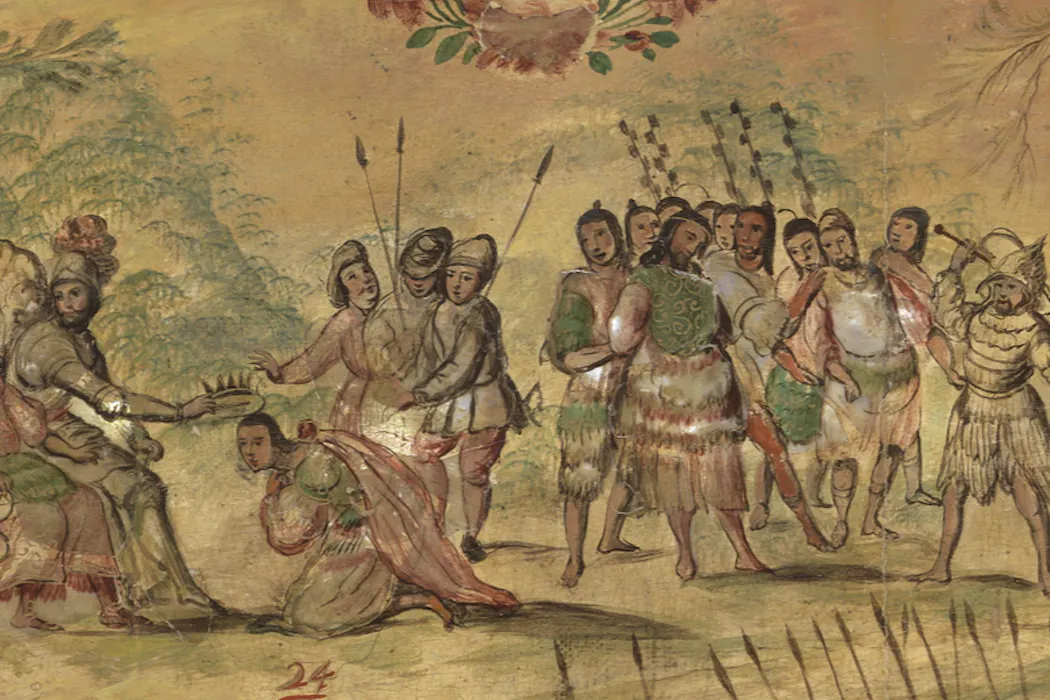
Detalle de la tabla 13 de la serie de pinturas sobre la conquista española de México, obra de los artistas novohispanos Juan González y Miguel González, pintada en 1698. El detalle representa la coronación de Ixtlilxochitl II como tlatoani de Texcoco en 1520, tras la detención del anterior tlatoani, Cacamatzin.Wikimedia Commons
Este año se celebra el quinto centenario del inicio de la docencia de Francisco de Vitoria como catedrático de prima de Teología en la Universidad de Salamanca y, por consiguiente, la conmemoración del inicio de la Escuela de Salamanca. El dominico impartió varias relecciones que habrían de convertirse en la piedra angular del debate sobre la presencia de los castellanos en América.
La relectio (lección que se repetía para profundizar con mayor reflexión en una materia) fue un método habitual en la práctica docente de Vitoria. Las relecciones relacionadas con los asuntos de las Indias fueron cuatro: la Relectio prior de Indis recenter inventis (Relección primera de los indios últimamente descubiertos), conocida abreviadamente como Relectio de Indis (Sobre los indios), fue pronunciada originalmente en 1539, aunque algunas fuentes la sitúan un año antes.
En ese mismo curso pronunció la Relectio posterior de iure belli Hispanorum in barbaros (Relección segunda de los indios o del derecho de guerra de los españoles a los bárbaros), a la que siguieron De temperatia (Sobre la templanza) y Relectio de magia (Sobre la magia). Sus discípulos recopilaron las notas y apuntes para publicar póstumamente estas lecciones, un texto que dio lugar a una primera edición editada en 1557 por el impresor Jacques Boyer en Lyon.
La recepción historiográfica de Francisco de Vitoria (1483-1546) se ha inclinado a consolidar una imagen hagiográfica, que lo presenta como defensor de los indígenas y fundador del derecho internacional, en disputa con la figura de Hugo Grocio. Esta circunstancia, sin embargo, resulta no solo limitante y reduccionista, sino que tampoco obedece a una lectura minuciosa de los textos recogidos por sus discípulos.
La aproximación dominante a su obra continúa siendo, en gran medida, conservadora y acrítica. Y así, favorece un discurso que omite deliberadamente los mecanismos jurídicos y teológicos que encierran las relecciones de Vitoria para dar luz verde a la ocupación y dominio de las Indias.
Deber de intervenir, derecho de llegar
Una de las omisiones más llamativas en los estudios sobre la colonización en Vitoria es la exclusión sistemática de De temperatia, lección que no puede ir separada de De Indis, porque ambas están íntimamente relacionadas.
En De temperatia se abordan los sacrificios humanos y la antropofagia. El argumento central es que dichas prácticas violaban el derecho natural al atentar contra la vida y la dignidad humanas. Por tanto, los estados cristianos tenían el derecho y el deber de “caridad” de intervenir para proteger a las víctimas inocentes. Este razonamiento constituye uno de los títulos de dominación más firmes del entramado discursivo de Vitoria; es, sin duda, la llave maestra que permitió modular y legitimar el régimen virreinal. Su persistente omisión en los análisis dedicados a su obra no es inocente: suprime la arquitectura argumentativa más eficaz sobre la que descansa la justificación de la colonización.
La tesis de Vitoria en la que se consideraba que había que proteger a la gente de los sacrificios humanos y la antropofagia se utilizó para investir a los colonizadores de autoridad para gobernar sobre los indígenas. Wikimedia Commons
El segundo dispositivo discursivo central en su obra es el ius communicationis, el derecho a viajar y comerciar que el dominico esgrimió para legitimar la llegada y presencia castellana en América. Según esto, si las poblaciones originarias se oponían, violaban el derecho natural, lo que a su vez legitimaba la guerra justa. Este binomio y la articulación de ambas tesis –intervención castellana para impedir los sacrificios y el derecho que otorgaba el ius communicationis– construyó una coherente justificación colonial para las ambiciones de la monarquía hispánica.
Llama la atención que esta lectura esté ausente de las celebraciones de Vitoria, más centradas en auparlo como fundador del Derecho internacional por ser responsable de De Indis. Aquí afirmaba que los dueños legítimos de sus tierras eran los naturales y que ni el papa ni el emperador tenían derecho universal sobre América, una tesis revolucionaria para la época, desde luego.
De temperatia y De ius communicationis, así como De magia posterior, una de las relecciones menos conocida, sirvieron de bloque monolítico para luchar contra los sacrificios rituales, la antropofagia y la extirpación de las idolatrías. Llama la atención que estos tres textos continúen vivos en la actualidad en el espejismo imperial del imaginario español.
Cómo definía a los indígenas
El elemento más revelador de la argumentación vitoriana, y el que mejor ilustra su función colonial efectiva, es el uso que hace de las categorías jurídicas de amens y miser. El término amens, proveniente del latin a-mens, designaba en el derecho romano y medieval a quien carecía de capacidad racional suficiente para gobernarse a sí mismo. Era el equivalente a la interdicción civil por enfermedad mental. El amens no podía celebrar contratos, administrar sus bienes, ni tomar decisiones jurídicamente válidas sin la intermediación de un tutor.
Aztecas tocando diferentes tambores en una imagen del Códice florentino. Wikimedia Commons
Lo que Vitoria realiza con este concepto es de una eficacia jurídica notable: coloca a los indígenas en el límite de esa categoría sin declararlos formalmente amentes. En la “cuestión cuarta” de De Indis señala que los bárbaros “no son amentes, sino que a su modo tienen el uso de la razón”, para afirmar luego, en el “Tercer título legítimo”, que “distan muy poco de los niños, por lo cual no son aptos para constituir o administrar una república legítima”. La argucia conceptual es precisa al situarlos en esa zona liminal y produce el mismo efecto jurídico que la amentia plena, justificando que otros los gobiernen.
Frente a este paradigma, el miser designa al hombre desamparado, cuya vulnerabilidad no remite a la ausencia de razón, sino a una situación circunstancial de desamparo. Para Bartolomé de las Casas, el indígena era racional y se hallaba en estado de miseria a causa de la violencia colonial, no por defecto de sus naturales. La tutela que se deriva del estatuto de miser es, por tanto, provisional y exige reparación. Si el indígena es amens, la tutela es indefinida e irremediable.
Esta distinción estructura el núcleo del debate sobre su naturaleza en la primera modernidad colonial. En la práctica, predominó la lógica de Vitoria. Sin embargo, la legislación adoptó el lenguaje más compasivo del miser, que convertía a las poblaciones indígenas en personae miserabile. La distancia entre el lenguaje compasivo y la función colonial real es, en última instancia, el terreno que una lectura crítica de Vitoria está obligada a cartografiar.
Este artículo surge de la colaboración con la Fundación Ignacio Larramendi, institución centrada en desarrollar proyectos relacionados con el pensamiento, la ciencia y la cultura en Iberoamérica con el objetivo de ponerlos a disposición de todo el público.
Casi todo el mundo ha vivido la misma situación: una partida de Monopoly que empieza como entretenimiento familiar y termina con un jugador acumulando propiedades, dinero y poder mientras el resto cae lentamente en la bancarrota. Aunque solemos pensar que todo depende de la suerte de los dados, las matemáticas y las finanzas cuentan una historia muy distinta.
El Monopoly no es simplemente un juego de azar. Es un modelo simplificado de cómo funciona realmente la inversión y la acumulación de riqueza.
El tablero no es tan aleatorio como parece
La mayoría de los jugadores asume que todas las casillas tienen la misma probabilidad de ser visitadas. Pero eso es falso.
Las reglas del juego generan zonas mucho más transitadas que otras. La principal razón es la cárcel, que funciona como un auténtico atractor probabilístico (el estado al que tiende a evolucionar un sistema a lo largo del tiempo, basándose en la probabilidad). Es decir, a la cárcel se puede llegar de muchas formas: cayendo en la casilla correspondiente, sacando tres dobles seguidos o mediante cartas de “Suerte” y “Caja de comunidad”. Esto provoca que las casillas situadas a continuación reciban muchas más visitas que otras partes del tablero.
Además, no todos los resultados de los dados son igual de probables. Al lanzar dos dados, el 7 es la suma que más aparece, seguido del 6 y el 8. Eso hace que determinadas calles tengan una frecuencia de paso mucho mayor.
Como puede observarse, las calles naranjas y rojas –situadas justo después de la cárcel– concentran una parte muy importante del tráfico del tablero.
La razón es puramente matemática. Con dos dados existen 36 combinaciones posibles. El número 7 puede obtenerse de seis maneras distintas (1+6, 2+5, 3+4, etcétera), mientras que el 2 y el 12 solo tienen una combinación posible. Por eso el 7 aparece mucho más veces durante una partida.
Esta distribución de probabilidades tiene enormes consecuencias estratégicas. Los jugadores que salen de la cárcel suelen avanzar entre 6 y 10 casillas, lo que convierte determinadas zonas del tablero en auténticas autopistas de tráfico.
Aplicando el concepto de rentabilidad
Desde el punto de vista económico, una propiedad vale según el dinero que puede generar. Esto parece obvio, pero muchos jugadores cometen el mismo error que muchos inversores en la vida real: confundir precio con rentabilidad.
Las propiedades más caras no siempre son las mejores inversiones. Algunas calles baratas generan proporcionalmente mucho más dinero porque reciben más visitas y permiten recuperar antes la inversión inicial.
Aquí surge un concepto clave de las finanzas: la rentabilidad, que mide cuánto beneficio produce una inversión en relación con el dinero invertido. Y cuando este criterio se aplica al Monopoly, aparecen resultados sorprendentes.
Como se puede observar, algunas propiedades más caras y, por tanto, con mayores ingresos (como las del grupo verde), ofrecen rentabilidades brutas incluso inferiores al 100 %. Mientras, otros grupos de propiedades más baratas y, por consiguiente, con menos ingresos, ofrecen rentabilidades brutas mucho más altas, hasta por encima del 150 %.
El valor esperado
Sin embargo, la rentabilidad por sí sola no basta. Una propiedad puede generar alquileres enormes, pero si casi nadie cae en ella el beneficio real será pequeño. Lo importante es combinar dos elementos:
Cuánto dinero genera la casilla.
Con qué frecuencia recibe visitas.
En finanzas, esto se conoce como valor esperado. En términos simples:
Ingreso esperado = probabilidad de visita × dinero generado
Este mismo principio se utiliza para valorar inversiones reales, como viviendas de alquiler, centros comerciales o autopistas de peaje.
Cuando se aplica al Monopoly, las conclusiones son claras: las propiedades más valiosas no son necesariamente las más caras, sino las que generan más flujo de caja de forma constante.
El grupo de color más rentable por turno es el de color naranja y la calle Serrano es la casilla más rentable de todo el tablero. Este grupo va seguido de los de color azul claro, azul oscuro y rojo. Por ello, si quiere tener más probabilidades de éxito, debería priorizar la compra de estas propiedades en tu partida.
La rentabilidad marginal
Otro elemento decisivo es saber cuándo construir casas y hoteles. Aquí entra en juego otro concepto económico: la rentabilidad marginal. Es decir, cuánto beneficio adicional genera cada nueva inversión (en el caso del Monopoly, construir una casa adicional).
Los cálculos muestran que la tercera casa suele ser el punto óptimo. A partir de ahí, seguir construyendo sigue aumentando los ingresos, pero cada nueva casa aporta, proporcionalmente, menos rentabilidad que la anterior.
Por eso, muchos jugadores experimentados prefieren extender grupos de tres casas antes que construir hoteles rápidamente.
La escasez también importa
El Monopoly incorpora otra idea económica fundamental: la escasez de recursos. En el juego solo existen 32 casas y 12 hoteles. Eso significa que un jugador puede construir no solo para ganar más dinero, sino también para impedir que los demás crezcan.
Muchos jugadores expertos mantienen varias propiedades con tres o cuatro casas, sin transformarlas en hoteles, para bloquear el mercado inmobiliario del tablero.
Este mecanismo se parece mucho a lo que ocurre en algunos mercados reales: controlar un recurso escaso no solo aumenta beneficios, también limita las oportunidades de los competidores.
¿Cómo ganar al Monopoly?
Aunque el azar influye, los jugadores que mejor entienden estos principios económicos suelen tener más ventaja que el resto. Las estrategias de juego más eficaces suelen ser:
Comprar propiedades desde el principio para controlar el mayor número posible de activos.
Conseguir monopolios o grupos completos de color lo antes posible.
Priorizar las calles con mayor rentabilidad esperada, especialmente las naranjas y rojas.
Mantener liquidez suficiente, hipotecando propiedades poco útiles para seguir invirtiendo.
En fases avanzadas, permanecer en la cárcel puede ser una buena estrategia para evitar caer en monopolios rivales.
Una lección económica disfrazada de juego
Cuando se analiza en profundidad, el Monopoly se parece mucho menos a un juego de azar y mucho más a una simulación simplificada de la economía real: premia a quienes entienden la importancia de la liquidez, la inversión temprana, el flujo de caja y la gestión estratégica de recursos.
Y quizá esa sea la verdadera razón por la que siempre gana la misma persona en casa: no tiene más suerte, simplemente piensa como un inversor.
Álvaro Melón Izco no recibe salario, ni ejerce labores de consultoría, ni posee acciones, ni recibe financiación de ninguna compañía u organización que pueda obtener beneficio de este artículo, y ha declarado carecer de vínculos relevantes más allá del cargo académico citado.
























.jpg)


