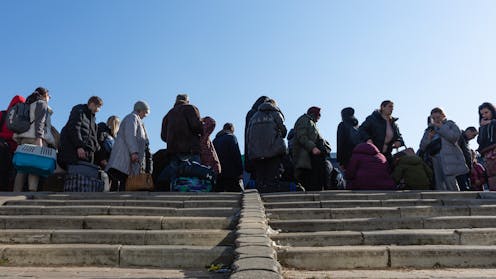
Refugiados ucranianos esperan en Shehyni, Ucrania, para cruzar a Medyka, Polonia, el 14 de marzo de 2022.DBrownPhotos/Shutterstock
El testimonio de Theodor, un joven ucraniano que recalca haber cruzado la frontera “legalmente” desde Ucrania a Polonia, condensa una de las tensiones que atraviesan la experiencia del exilio: la necesidad de justificarse, de probar constantemente la legitimidad de la propia presencia.
La frase no es casual ni aislada; responde a un clima enrarecido en Polonia, donde la solidaridad inicial hacia los refugiados ucranianos ha ido dejando paso a la sospecha y al cansancio de muchos polacos.
Léna Georgeault, directora del Grado en Relaciones Internacionales de la Universidad Villanueva, pudo tomarle el pulso a muchos ucranianos que viven en Polonia y que sienten que la solidaridad del principio ha ido dando paso a un cierto recelo en el país de acogida.
La profesora reconstruyó con detalle algunas trayectorias. Theodor, Natalia u Oksana son rostros concretos de un fenómeno masivo: más de un millón de ucranianos en Polonia, según cifras oficiales, aunque probablemente sean más.
Huir con lo puesto
Sus historias no son homogéneas. Mientras algunos llegaron con becas y redes de apoyo institucional, otros huyeron con lo puesto, cargando el trauma de la guerra y enfrentándose a una burocracia incierta. Ese contraste revela la fractura entre quienes viven el exilio como oportunidad y quienes lo sufren como condena.
El telón de fondo es una guerra que, tras más de tres años, ha dejado de percibirse como temporal. La idea inicial de un conflicto breve se ha desvanecido, y con ella el optimismo de muchos refugiados. Para algunos, como Natalia, el deseo de volver a Ucrania se mantiene intacto; para otros, como Ivan, la certeza de que su hija, que estudia en la Universidad de Breslavia, no quiera volver erosiona los lazos con el país de origen. Esta tensión entre retorno e integración es uno de los dilemas centrales de toda diáspora.
Pero la dificultad no proviene solo de Ucrania. Polonia, país de acogida, atraviesa sus propios límites. Algunas organizaciones civiles intentan cubrir vacíos básicos –alojamiento, asesoría legal, espacios comunitarios–, mientras la política oficial oscila entre el humanitarismo y la instrumentalización.
El viraje es evidente: la llegada al poder del nacionalista Karol Nawrocki ha reconfigurado el relato, transformando la acogida de refugiados de gesto solidario en respuesta demográfica. En este marco, los ucranianos son bienvenidos si producen, si estudian, si trabajan; quienes no encajan en esa lógica quedan relegados.
La sospecha hacia los ucranianos rusoparlantes, vistos como una “quinta columna”, refleja hasta qué punto la guerra ha reconfigurado identidades y desatado nuevas exclusiones. Aquí la paradoja es evidente: mientras en el frente combaten miles de ucranianos cuya lengua materna es el ruso, en el exilio esa misma característica se vuelve motivo de sospecha.
La solidaridad parece haber pasado de largo
Las olas de solidaridad de los primeros meses de la invasión de Ucrania por parte de Rusia han pasado de largo mientras continuaban los ataques armados y los verbales entre mandatarios.
Los refugiados saben que el destino de Ucrania depende en buena medida de la ayuda occidental. Sin embargo, expresan frustración ante la lentitud y tibieza de Europa y Estados Unidos. Trump acaba de dar un giro enorme en su política y le ha mostrado a Zelensky su apoyo para que recupere los territorios ocupados por Rusia. Esto, cuando hace unos meses dio la vuelta al mundo el choque entre ambos mandatarios.
Para jóvenes como Theodor, estudiante, la realidad de las negociaciones, presupuestos y cálculos políticos resulta insoportable. La exigencia es clara: frente a Rusia, cualquier ambigüedad equivale a ceder terreno.
Lo que emerge del reportaje es un mosaico de incertidumbre. La solidaridad espontánea del inicio ha dado paso a la incomodidad y la fatiga; el sueño del retorno convive con la integración irreversible; la identidad ucraniana se afirma, pero a costa de fracturas internas. Y, sobre todo, se impone la sensación de estar en suspenso, atrapados entre un pasado perdido y un futuro que no llega.
En medio de esa incertidumbre, y como nos recuerda la profesora Léna Georgeault, los ucranianos siguen pagando en exilio y en sangre el precio de sostener a un país en guerra.
On Sept. 25, the Donald Trump administration in the United States again extended the TikTok ban-or-divest law, possibly for the last time. The latest extension to the law, which was passed in 2024 by the Joe Biden administration, includes a deal to transfer TikTok to American owners as a condition required to avoid a ban.
Canada should be watching closely, because anxieties about foreign manipulation and social media exist north of the border, too. These range from bans on TikTok and concerns about Beijing-linked surveillance to efforts like Bill C-18 aimed at safeguarding domestic news sources.
What happens in the Canadian information environment has always been shaped by the U.S., a dependence that is even more precarious now that American politics has turned hostile to Canada.
ABC News covers the executive order that brought into effect U.S. ownership of TikTok.
TikTok concerns
TikTok is not the only digital media platform susceptible to worries about hostile influence. All major platforms introduce the same vulnerabilities. If the policy objective is to enhance the security of democracy, then a focus on TikTok is too narrow and divestment as a solution accomplishes little (especially because it appears China will retain control of the algorithm).
Worries about TikTok come down to two big fears. The first is that it functions as a spying machine, feeding data to the Chinese government. The spying concern isn’t just about espionage, learning about sensitive infrastructure and activities, but also personal — the software itself might be unsafe and can be used to track individuals.
The second fear, more vivid in the public and political imagination, is that TikTok functions as an influence machine. Its algorithm can be tweaked to push propaganda, sway opinion, censor views or even meddle in elections.
Such worries reached a fever pitch in America in 2023, when Osama bin Laden’s “Letter to America” suddenly went viral on TikTok. Lawmakers seized on this as evidence that TikTok could amplify extremist content, reinforcing fears that the platform can be weaponized.
These worries aren’t merely speculative. Investigations have shown that topics sensitive to China, such as Tiananmen Square and Tibet, are harder to find or conspicuously absent on TikTok compared to other platforms.
Social media is also used as a tool for influence by hostile groups, corporations and governments, and concerns about ownership are often a proxy for deeper anxieties about the platforms themselves.
As users, we know little about how our feeds work, what’s shaping them, what they might look if they were built differently and how they are affecting us.
There is a rational basis to be mistrustful, and this cuts both ways. It’s not just the fear that we could be manipulated without realizing it; it’s also the temptation to see our opponents as manipulated, too, as if every disagreement might be product of someone rigging the system.
Users know little about how TikTok feeds work, what’s shaping them or what they might look if they were built differently. (Solen Feyissa/Unsplash), CC BY
Manipulated anxieties
Fear of TikTok as an influence machine continues to play a substantial role in politics, as “Washington has said that TikTok’s ownership by ByteDance makes it beholden to the Chinese government.”
U.S. Vice President JD Vance remarked that the executive order would “ensure that the algorithm is not being used as a propaganda tool by a foreign government… the American businesspeople … will make the determination about what’s actually happening with TikTok.”
Meanwhile, Trump ostensibly joked that he’d make TikTok “100 per cent MAGA” before adding “everyone’s going to be treated fairly.” And Israeli Prime Minister Benjamin Netanyahu told an audience of content creators that “weapons change over time… the most important one is social media,” stressing the importance of divestment of TikTok to U.S. owners.
One implication of these comments is that divestment doesn’t change the threat of manipulation — it just changes who’s doing the manipulating. Divestment is framed as resisting foreign propaganda, but at the same time domestic manipulation is legitimized as politics as usual.
Collective dependence
This is a squandered opportunity for the U.S. By treating TikTok as a weapon to be seized, leaders have passed up the chance to model a more enduring form of soft power: building open, transparent, trustworthy information systems that others would want to emulate. Instead, what is gained is a temporary and possibly illusory sharp power advantage, at the expense of an enduring source of legitimacy.
The bigger problem is that the normalization of social media as a weapon is, to borrow a fear familiar to Trump, riggable. We know that social media can be manipulated, and yet we rely on it more and more as a source of news. And even if we ourselves don’t, we are influenced indirectly by those who do.
This collective dependence makes the platforms more powerful and their vulnerabilities more dangerous.
Social media platforms have become a primary source of information. (Shawn/Unsplash), CC BY
Protecting the public sphere
Canada has already had its own TikTok moment: the Online News Act (C-18), which required platforms to pay news outlets for sharing their content. This was intended to strengthen Canadian journalism, but in response, Meta banned news on its platforms (Facebook, Instagram) in Canada in August 2023, leading to an 85 per cent drop in engagement. Instead of strengthening Canadian journalism, Bill C-18 risks making it more fragile.
If we’re serious about protecting the public sphere from manipulation, what matters is the outsized power the platforms have, and the extent to which that power can be bought, sold or stolen. This power includes the surveillance power to know what we will like, the algorithmic power to curate our information diet and control of platform incentives, rules and features that affect who gains influence.
Bargaining with this power, as Canada tried with Bill C-18 — and as the U.S. is now doing with China and TikTok — only concedes to it. If we want to protect democratic information systems, we need to focus on reducing the vulnerabilities in our relationship with media platforms and support domestic journalism that can compete for influence.
The biggest challenge is to make platforms less riggable, and thus less weaponizable, if only for the reason that motivated the TikTok ban: we don’t want our adversaries, foreign or domestic, to have power over us.
Andrew Buzzell does not work for, consult, own shares in or receive funding from any company or organisation that would benefit from this article, and has disclosed no relevant affiliations beyond their academic appointment.
Notre démocratie est en crise, comment la réinventer ? Que nous enseignent ceux qui, au cours des âges, furent ses concepteurs ? Suite de notre série consacrée aux philosophes et à la démocratie avec l’Américain John Dewey (1859-1952). En plaçant l’idée d’« enquête » au cœur de la vie publique démocratique et en éliminant l’idée de « vérité absolue », il propose un modèle coopératif, orienté vers la recherche commune de solutions et admettant sa propre faillibilité.
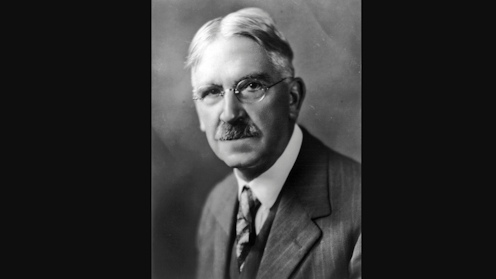
John Dewey (1859-1952) est à la fois l’un des fondateurs du pragmatisme américain – aux côtés de Charles Sanders Peirce et William James – et le grand artisan d’une pédagogie nouvelle, active et expérimentale. Dès la fondation, en 1896, de son école expérimentale à Chicago, il s’est imposé comme l’une des figures majeures de la vie intellectuelle américaine.
Dans The Public and its Problems (1927), Dewey regrettait que « le nouvel âge des relations humaines ne dispose d’aucun mécanisme politique digne de lui ». Ce diagnostic, formulé il y a près d’un siècle, conserve aujourd’hui une résonance troublante. Les démocraties contemporaines, confrontées à des mutations techniques, sociales et économiques d’une ampleur inédite peinent à en saisir les dynamiques profondes et à y répondre de manière appropriée.
À la crise ancienne de la représentation est, en effet, venue s’associer une crise inédite de l’espace public. Tandis que la défiance envers les élus se généralise, les conditions mêmes du débat public se trouvent radicalement transformées par la révolution numérique.
Si les promesses initiales étaient immenses – savoir collaboratif avec Wikipédia, inclusion financière par le paiement mobile, accès élargi aux soins via la télémédecine, démocratisation culturelle et accélération scientifique –, les désillusions n’en sont que plus saisissantes : manipulation de l’opinion à grande échelle, instrumentalisation des réseaux sociaux par les régimes autoritaires, prolifération des récits complotistes et des infox, démultipliées par le recours à l’intelligence artificielle.
Face à ces symptômes, il serait réducteur d’évoquer une « crise de la vérité ». Ce qui vacille, ce ne sont pas tant les vérités elles-mêmes que les procédures et les médiations permettant leur élaboration collective. La vérité, loin d’avoir disparu, est menacée par des pratiques déréglées de la certitude et du doute, qui minent les conditions d’une délibération démocratique féconde.
C’est dans ce contexte que la pensée politique de John Dewey, et plus particulièrement sa conception expérimentale de la démocratie, mérite d’être réinterrogée. En plaçant l’idée d’« enquête » au cœur de la vie publique, en substituant à la notion de « vérité absolue » celle d’« assertibilité garantie », il propose un modèle coopératif, orienté vers la recherche commune de solutions et admettant sa propre faillibilité.
Une telle approche, attentive aux conditions concrètes de la connaissance partagée, offre aujourd’hui une piste féconde pour affronter les pathologies de l’espace public.
Connaître est agir
Dewey propose une réflexion forte, avertie des tentations dogmatiques de l’être humain, autrement dit, de sa propension à se ruer sur toutes les certitudes susceptibles de l’apaiser face aux périls, réels ou imaginés, qui le guettent. En ce sens, son pragmatisme est un formidable remède contre tout dogmatisme. C’est un appel à toujours remettre sur le métier la recherche du savoir, et non un quelconque congé donné au savoir.
Sa perspective est profondément marquée par un naturalisme inspiré de certaines des dimensions de l’œuvre de Darwin. Dewey envisage le développement de la connaissance en tant que processus humain d’adaptation aux conditions qui l’environnent, processus dont l’objectif est la restructuration active de ces conditions. La pensée n’est plus, comme pour la tradition, un processus dont la vigueur tient à la distance qu’elle met entre elle et le monde, mais elle se conçoit comme le produit d’une interaction entre un organisme et son environnement.
Dewey a appliqué cette conception de la connaissance à la notion d’enquête. C’est ce qui explique l’intensité de son rapport au réel. Il ne s’agit pas de s’inventer de faux problèmes, mais de partir d’une difficulté qui bloque le progrès et de trouver un moyen satisfaisant de la surmonter.
Politique de l’enquête
Dans ce contexte, Dewey distingue trois étapes. L’enquête débute par l’expérience d’une situation problématique, c’est-à-dire une situation qui met en échec nos manières habituelles d’agir et de réagir. C’est en réponse à cette inadaptation que la pensée se met en mouvement et vient nourrir le processus.
La deuxième étape consiste à isoler les données qui définissent les paramètres en vertu desquels la restructuration de la situation initiale va pouvoir s’engager. La troisième étape consiste en un moment de réflexion qui correspond à l’intégration des éléments cognitifs du processus de l’enquête (idées, présuppositions, théories, etc.) à titre d’hypothèses susceptibles d’expliquer la formation de la situation initiale. Le test ultime du résultat de l’enquête n’est nul autre que l’action elle-même. Si la restructuration de la situation antérieure permet de libérer l’activité, alors les éléments cognitifs peuvent être tenus pour « vrais » à titre provisoire.
Cette approche vaut, selon Dewey, aussi bien pour les enquêtes engagées pour résoudre des problèmes de la vie ordinaire que pour des enquêtes scientifiques. La différence entre les deux ne tient qu’au degré de précision plus grand qui peut être requis pour pratiquer les niveaux de contrôle plus élevés qu’appellent des problèmes scientifiques.
L’enquête placée au cœur de cette forme de vie qu’est la démocratie est ainsi ancrée dans une exigence forte d’objectivité. La « dissolution des repères de la certitude » qui caractérise, comme l’écrivait Claude Lefort, la logique démocratique, est ici déjà assumée non comme un obstacle, mais bien comme une condition de la vie démocratique et des formes de coopération qu’elle appelle. La communauté citoyenne constate un problème. Elle s’efforce de le résoudre. C’est l’horizon même de toute coopération.
Ouverture à la diversité des savoirs
Il en résulte que le savoir ne saurait être la chasse gardée de savants retranchés dans un langage hyperformalisé, détaché des pratiques concrètes et des réalités vécues.
La figure du spectateur, si prégnante dans certaines théories de la connaissance (et si caractéristique des illusions dont se berce le technocrate), trahit pour Dewey un désir de domination : en excluant les non-initiés du champ du savoir, elle opère une disqualification implicite des formes d’intelligence issues de la pratique. Ce dispositif, pour lui, n’est pas seulement épistémologique : il est politique. Il fonctionne comme une justification implicite d’un ordre social inégal, dans lequel le monopole de la connaissance devient l’outil d’un pouvoir de classe. Renverser cette hiérarchie des savoirs, c’est ainsi remettre en cause les mécanismes mêmes d’une organisation économique et légale qui permet à une minorité de s’arroger le contrôle de la connaissance, en la mettant au service d’intérêts privés, plutôt que de l’orienter vers un usage partagé et démocratique.
Dewey défend une répartition plus équitable des éléments de compréhension liés aux activités sociales et au travail. Ce rééquilibrage doit rendre possible une participation plus large, plus libre, à l’usage et aux bénéfices du savoir, mais il impose aussi aux croyances ordinaires de se mettre à l’épreuve du réel, en entrant dans le processus de l’enquête et en acceptant ses exigences.
En repartant des pratiques concrètes, des problèmes réels, Dewey donne consistance à une théorie de la connaissance fondée sur la coopération, la réflexivité et la capacité d’invention collective qui, pour lui, doit figurer au cœur de toute démocratie digne de ce nom.
Démocratie et connaissances
La société humaine, telle que l’envisage Dewey, n’est pas une simple juxtaposition d’individus, mais une forme d’association fondée sur l’action conjointe, et sur la conscience, partagée, des effets que cette action produit. C’est en reconnaissant la contribution spécifique de chacun que peut émerger un intérêt commun, entendu comme la préoccupation collective pour l’action et pour l’efficacité des coopérations engagées.
Mais cet intérêt commun reste vulnérable. Lorsqu’un mode d’organisation économique exerce un pouvoir oppressif sans contrepartie, ou lorsque les institutions deviennent sourdes aux dynamiques sociales, l’équilibre se rompt. Dans de telles situations, le défi n’est évidemment pas d’ajuster les individus à l’ordre existant, mais de repenser les formes mêmes de l’association.
Selon cette perspective, les concepts, les théories et les propositions politiques sont appréhendés comme des instruments d’enquête, soumis à la vérification, à l’observation, à la révision. Cela signifie, par exemple, que les politiques publiques doivent être considérées comme des hypothèses de travail, susceptibles d’ajustements constants selon les effets qu’elles produisent. Ce n’est qu’à ces conditions que les sciences sociales pourront contribuer au déploiement d’un dispositif de connaissance apte à guider l’action démocratique.
La démocratie, ainsi comprise, tire sa force de sa capacité à organiser la discussion publique autour des besoins vécus, des déséquilibres ressentis, des tensions expérimentées. Elle repose sur la possibilité pour chacun de s’exprimer, de tester ses croyances, d’évaluer les savoirs produits par d’autres et de juger de leur pertinence face aux problèmes communs. La disponibilité de la connaissance, sa maniabilité dans l’espace public, constitue dès lors un enjeu démocratique fondamental.
À rebours de toute philosophie relativiste, Dewey montre que la « vérité » dont une démocratie peut se nourrir, doit s’élaborer dans le cadre d’une enquête ouverte, partagée, ancrée dans l’expérience.
« Aucune faculté innée de l’esprit, écrit-il dans « le Public et ses problèmes », ne peut pallier l’absence de faits. Tant que le secret, le préjugé, la partialité, les faux rapports et la propagande ne seront pas remplacés par l’enquête et la publicité, nous n’aurons aucun moyen de savoir combien l’intelligence existante des masses pourrait être apte au jugement de politique sociale. »
Une enquête démocratique ne peut s’accommoder d’un public fantôme ni d’un espace public fragmenté, polarisé, déconnecté des pratiques réelles et des problèmes concrets. Elle exige que la société prenne une part active à sa propre compréhension, qu’elle se découvre elle-même par la confrontation aux obstacles qui entravent sa capacité à se constituer en tant que public. C’est en partant des déséquilibres tels que cette collectivité les expérimente que peut s’élaborer une conscience commune minimale et s’armer notre capacité à les surmonter.
Ainsi, la connaissance, dont le public est à la fois le moteur et la finalité, peut être dite véritablement démocratique. Elle ne cherche pas à imposer une vérité depuis les hauteurs d’un savoir institué, mais fait advenir une intelligence collective, capable d’inventer les formes d’une association toujours à réajuster. À l’heure où les pathologies de l’espace public se nourrissent de la disqualification de la parole profane, des effets délétères de la fragmentation algorithmique et de la confiscation de l’autorité cognitive, la pensée de Dewey trace ainsi une voie précieuse : celle d’une démocratie de l’enquête, ouverte, inclusive, rigoureuse, résolument orientée vers l’émancipation et la répartition équitable des libertés d’agir individuelles.
Patrick Savidan ne travaille pas, ne conseille pas, ne possède pas de parts, ne reçoit pas de fonds d’une organisation qui pourrait tirer profit de cet article, et n’a déclaré aucune autre affiliation que son organisme de recherche.
L’armée israélienne a intercepté plusieurs navires de la flottille Global Sumud qui vise à acheminer de l’aide à Gaza. Un certain nombre de personnes se trouvant à bord ont été interpellées, y compris Greta Thunberg.
Ces interceptions ont eu lieu en mer Méditerranée, à 70-80 milles marins au large des côtes de Gaza. Il s’agit d’eaux internationales où le droit international reconnaît la liberté de navigation en haute mer pour tous les navires.
Israël a justifié cette opération en affirmant que la flottille tentait de forcer un « blocus maritime légal » interdisant l’entrée de navires étrangers à Gaza, et ajouté que la flottille était organisée par le Hamas – une accusation que les organisateurs de la flottille réfutent.
Que sont les flottilles d’aide humanitaire à Gaza ?
La flottille mondiale Sumud était au départ composée de plus de 40 bateaux transportant de l’aide humanitaire (nourriture, fournitures médicales et autres articles essentiels), ainsi que plusieurs centaines de parlementaires, d’avocats et de militants provenant de dizaines de pays.
La flottille a quitté l’Espagne à la fin du mois d’août et a traversé la mer en direction de l’est, faisant escale en Tunisie, en Italie et en Grèce. En cours de route, les gouvernements italien et espagnol ont déployé des escortes navales pour assurer la sécurité du convoi.
« Global Sumud » constitue l’occurrence la plus récente d’un mouvement qui existe depuis plus de 15 ans et qui vise à contester le blocus imposé par Israël à la bande de Gaza depuis 2007.
En mai dernier, le navire Conscience, qui transportait des militants et de l’aide humanitaire à destination de Gaza, a été touché par des explosions au large des côtes de Malte.
En juin, Israël a intercepté le Madleen avec Greta Thunberg et d’autres militants à son bord, puis en juillet le Handala.
Dès 2010, une première flottille emmenant de l’aide humanitaire et des centaines de militants avait tenté de se rendre à Gaza avec à son bord de l’aide humanitaire et des centaines de militants. Des commandos israéliens ont abordé l’un des navires qui la composaient, le Mavi Marmara, battant pavillon turc, ce qui a donné lieu à une violente confrontation qui s’est soldée par la mort de dix militants. Ces décès ont suscité une condamnation généralisée et ont tendu les relations entre Israël et la Turquie pendant des années.
Le blocus maritime de Gaza est-il légal ?
Le droit international relatif aux actions des navires de la flottille et à la capacité d’intervention d’Israël est complexe. Voilà près de 20 ans qu’Israël impose depuis divers types de blocus à la bande de Gaza.
La base juridique des blocus et leur conformité avec le droit international, en particulier le droit de la mer, ont fait l’objet de multiples controverses, comme l’a souligné une enquête de l’ONU menée à la suite de l’incident du Mavi Marmara.
Bien que les relations juridiques entre Israël et Gaza aient varié au cours de cette période, Israël est désormais considéré comme une puissance occupante à Gaza en vertu du droit international.
La codification des rôles des puissances occupantes, établie par la quatrième Convention de Genève en 1949, a été inspirée des obligations juridiques assumées par les puissances alliées en Allemagne et au Japon après la Seconde Guerre mondiale. La Convention de Genève définit un cadre juridique clair pour les puissances occupantes.
Au cours des dernières décennies, Israël a été à la fois une puissance occupante de jure (reconnue par la loi) et de facto en Palestine.
En tant que puissance occupante, Israël contrôle tous les accès à Gaza, que ce soit par voie terrestre, aérienne ou maritime. Les camions d’aide humanitaire ne sont autorisés à entrer à Gaza que sous contrôle strict. Les largages d’aide humanitaire effectués par les forces aériennes de pays tiers au cours de ces derniers mois n’ont également été autorisés que sous le contrôle strict d’Israël.
La quantité d’aide arrivée par voie maritime depuis le début de la guerre est très faible, car Israël a sévèrement restreint l’accès maritime à Gaza. Les États-Unis ont construit une jetée flottante au large des côtes pour acheminer l’aide en 2024, mais elle a rapidement été abandonnée en raison de problèmes météorologiques, sécuritaires et techniques.
Toutefois, cet épisode a montré qu’Israël était prêt à autoriser l’acheminement d’aide par la voie maritime provenant de son plus proche allié, les États-Unis. Cette exception au blocus n’a pas été appliquée aux autres acteurs humanitaires.
L’interception de navires en eaux internationales
Bien que l’acheminement d’aide par voie maritime soit actuellement complexe sur le plan juridique, Israël ne dispose que d’une capacité limitée pour perturber les flottilles. La liberté de navigation se trouve au cœur du droit de la mer. À ce titre, la flottille est en droit de naviguer sans entrave en Méditerranée.
Tout harcèlement et toute interception de la flottille dans les eaux internationales de la Méditerranée constituent donc des violations flagrantes du droit international.
Le lieu où les forces israéliennes interceptent et abordent les navires de la flottille est à cet égard déterminant.
Israël peut certainement exercer un contrôle sur les 12 milles marins d’eaux territoriales au large des côtes de Gaza. La fermeture de ces eaux territoriales aux navires étrangers serait justifiée en vertu du droit international en tant que mesure de sécurité, ainsi que pour garantir la sécurité des navires neutres en raison de la guerre en cours.
Mais les organisateurs de la flottille ont déclaré que leurs navires avaient été interceptés à une distance située entre 70 et 80 milles marins des côtes, soit bien avant le début des eaux territoriales de Gaza.
La décision de réaliser cette interception à cet endroit a sans doute été prise pour des raisons opérationnelles. Plus la flottille s’approchait des côtes de Gaza, plus il devenait difficile pour les militaires israéliens d’intercepter chaque navire la composant, augmentant ainsi la possibilité qu’au moins l’un d’eux atteigne les côtes.
Des dizaines de militants à bord des navires auraient été arrêtés et seront placés en détention dans le port israélien d’Ashdod. Ils seront ensuite probablement rapidement expulsés.
Ces personnes bénéficient de protections en vertu du droit international relatif aux droits de l’homme, notamment l’accès à des diplomates étrangers exerçant une protection consulaire pour leurs citoyens.
Donald Rothwell a reçu des financements de l’Australian Research Council.
Source: The Conversation – in French – By Sylvain Kahn, Professeur agrégé d’histoire, docteur en géographie, européaniste au Centre d’histoire de Sciences Po, Sciences Po
Sous l’administration Trump, la relation transatlantique a basculé d’un partenariat asymétrique vers une domination stratégique. L’historien Sylvain Kahn propose dans son dernier livre L’Atlantisme est mort ? Vive l’Europe !, qui vient de paraître aux éditions de l’Aube, le concept d’« emprisme » pour désigner cette emprise subtile mais dangereuse des États-Unis sur l’Europe.
Depuis quatre-vingts ans, l’Europe a entretenu avec les États-Unis une relation asymétrique mais coopérative. Cette asymétrie, longtemps acceptée comme le prix de la stabilité et de la protection, s’est transformée sous l’administration Trump. Ce qui relevait d’une interdépendance stratégique déséquilibrée est devenu une emprise : un lien dont on ne peut se défaire, utilisé pour exercer une pression, tout en étant nié par ceux qui en sont les victimes.
Pour qualifier cette mutation, je propose le concept d’« emprisme » : une emprise consentie, dans laquelle les Européens, tout en se croyant partenaires, deviennent tributaires d’une puissance qui les domine sans qu’ils en aient pleinement conscience.
De l’asymétrie à l’emprisme
L’« emprisme » désigne une forme de domination subtile mais profonde. Il ne s’agit pas simplement d’influence ou de soft power, mais d’une subordination stratégique intériorisée. Les Européens justifient cette dépendance au nom du réalisme, de la sécurité ou de la stabilité économique, sans voir qu’elle les affaiblit structurellement.
Dans la vision trumpienne, les Européens ne sont plus des alliés, mais des profiteurs. Le marché commun leur a permis de devenir la première zone de consommation mondiale, de renforcer la compétitivité de leurs entreprises, y compris sur le marché états-unien. Pendant ce temps, avec l’OTAN, ils auraient laissé Washington assumer les coûts de la défense collective. Résultat : selon Trump, les États-Unis, parce qu’ils sont forts, généreux et nobles, se font « avoir » par leurs alliés.
Ce récit justifie un basculement : les alliés deviennent des ressources à exploiter. Il ne s’agit plus de coopération, mais d’extraction.
L’Ukraine comme levier de pression
La guerre en Ukraine illustre parfaitement cette logique. Alors que l’Union européenne s’est mobilisée pour soutenir Kiev, cette solidarité est devenue une vulnérabilité exploitée par Washington.
Lorsque l’administration Trump a suspendu l’accès des Ukrainiens au renseignement américain, l’armée ukrainienne est devenue aveugle. Les Européens, eux aussi dépendants de ces données, se sont retrouvés borgnes. Ce n’était pas un simple ajustement tactique, mais un signal stratégique : l’autonomie européenne est conditionnelle.
En juillet 2025, l’UE a accepté un accord commercial profondément déséquilibré, imposant 15 % de droits de douane sur ses produits, sans réciprocité. Cet accord, dit de Turnberry, a été négocié dans une propriété privée de Donald Trump en Écosse – un symbole fort de la personnalisation et de la brutalisation des relations internationales.
Dans le même temps, les États-Unis ont cessé de livrer directement des armes à l’Ukraine. Ce sont désormais les Européens qui achètent ces armements américains pour les livrer eux-mêmes à Kiev. Ce n’est plus un partenariat, mais une délégation contrainte.
De partenaires à tributaires
Dans la logique du mouvement MAGA, désormais majoritaire au sein du parti républicain, l’Europe n’est plus un partenaire. Elle est, au mieux, un client, au pire, un tributaire. Le terme « emprisme » désigne cette situation où les Européens acceptent leur infériorisation sans la nommer.
Ce consentement repose sur deux illusions : l’idée que cette dépendance est la moins mauvaise option ; et la croyance qu’elle est temporaire.
Or, de nombreux acteurs européens – dirigeants politiques, entrepreneurs et industriels – ont soutenu l’accord de Turnberry ainsi que l’intensification des achats d’armement américain. En 2025, l’Europe a accepté un marché pervers : payer son alignement politique, commercial et budgétaire en échange d’une protection incertaine.
C’est une logique quasi mafieuse des relations internationales, fondée sur l’intimidation, la brutalisation et l’infériorisation des « partenaires ». À l’image de Don Corleone dans le film mythique Le Parrain de Francis Coppola, Trump prétend imposer aux Européens une protection américaine aléatoire en échange d’un prix arbitraire et fixé unilatéralement par les États-Unis. S’ils refusent, il leur promet « l’enfer », comme il l’a dit expressément lors de son discours du 23 septembre à l’ONU.
Emprisme et impérialisme : deux logiques de domination
Il est essentiel de distinguer l’« emprisme » d’autres formes de domination. Contrairement à la Russie, dont l’impérialisme repose sur la violence militaire, les États-Unis sous Trump n’utilisent pas la force directe. Quand Trump menace d’annexer le Groenland, il exerce une pression, mais ne mobilise pas de troupes. Il agit par coercition économique, chantage commercial et pression politique.
Parce que les Européens en sont partiellement conscients, et qu’ils débattent du degré de pression acceptable, cette emprise est d’autant plus insidieuse. Elle est systémique, normalisée et donc difficile à contester.
Le régime de Poutine, lui, repose sur la violence comme principe de gouvernement – contre sa propre société comme contre ses voisins. L’invasion de l’Ukraine en est l’aboutissement. Les deux systèmes exercent une domination, mais selon des logiques différentes : l’impérialisme russe est brutal et direct ; l’emprisme américain est accepté, contraint, et nié.
Sortir du déni
Ce qui rend l’emprisme particulièrement dangereux, c’est le déni qui l’accompagne. Les Européens continuent de parler de partenariat transatlantique, de valeurs partagées, d’alignement stratégique. Mais la réalité est celle d’une coercition consentie.
Ce déni n’est pas seulement rhétorique : il oriente les politiques. Les dirigeants européens justifient des concessions commerciales, des achats d’armement et des alignements diplomatiques comme des compromis raisonnables. Ils espèrent que Trump passera, que l’ancien équilibre reviendra.
Mais l’emprisme n’est pas une parenthèse. C’est une transformation structurelle de la relation transatlantique. Et tant que l’Europe ne la nomme pas, elle continuera de s’affaiblir – stratégiquement, économiquement, politiquement.
Nommer l’emprisme pour y résister
L’Europe doit ouvrir les yeux. Le lien transatlantique, autrefois protecteur, est devenu un instrument de domination. Le concept d’« emprisme » permet de nommer cette réalité – et nommer, c’est déjà résister.
La question est désormais claire : l’Europe veut-elle rester un sujet passif de la stratégie américaine, ou redevenir un acteur stratégique autonome ? De cette réponse dépendra sa place dans le monde de demain.
Sylvain Kahn ne travaille pas, ne conseille pas, ne possède pas de parts, ne reçoit pas de fonds d’une organisation qui pourrait tirer profit de cet article, et n’a déclaré aucune autre affiliation que son organisme de recherche.
Qui suis-je ? Pesant 60 kilos, mon œil est un hublot et j’avale beaucoup d’eau. Deux indices supplémentaires : j’affiche des programmes et je bats du tambour. Découvrez tout ce que vous ne vous êtes jamais demandé sur votre machine à laver. Et bien plus.
À propos du lave-linge, certains ont affirmé qu’il était une invention plus importante qu’Internet et la meilleure illustration qui soit de l’effet pernicieux des tarifs douaniers de Trump. D’autres ont recommandé de l’utiliser moins fréquemment. En portant par exemple sept fois un pyjama ou un soutien-gorge avant de les laver. Devenu la vedette des équipements domestiques auprès d’analystes autant qu’aux yeux des ménages, la machine à laver est un objet du quotidien, dans les pays les plus riches du moins, qui en dit long sur nos modes de vie et sur l’économie contemporaine.
Avant d’appuyer sur « marche »
Il convient de se rappeler que je n’ai pas toujours existé.
Et de ne surtout pas idéaliser le lavage du linge à la main à l’image des femmes au lavoir ou au bord d’un ruisseau de la peinture romantique. Porter de l’eau, la faire chauffer, frotter le linge, puis le rincer à l’eau claire, enfin le tordre pour l’essorer, toutes ces étapes n’étaient qu’une longue et épuisante corvée.
L’invention et la diffusion de la machine à laver ont été une bénédiction. Hans Rosling, médecin et statisticien suédois, se souvient de sa grand-mère qui, ayant toute sa vie fait la lessive pour ses sept enfants, assiste à la fois médusée et émerveillée au premier lavage en machine. « C’était pour elle un miracle » se rappelle Hans Rosling. Les boomers se souviennent aussi sans doute de la Mère Denis, une lavandière bretonne enrôlée pour faire la publicité à la télé d’une machine à laver.
J’ai transformé la vie quotidienne, mais j’ai aussi changé la société et son économie.
Plus qu’Internet, même aux yeux d’Ha-Joon Chang, un économiste anglais original. En soulageant les femmes d’une grande partie de leur temps consacré à la lessive, le lave-linge a permis leur entrée en force sur le marché du travail. D’un point de vue économique, plus de salariés signifie davantage de production et donc plus de croissance mesurée par le PIB. D’un point de vue social aussi, le salariat féminin s’est également révélé un facteur majeur de transformation, notamment en rendant les femmes financièrement moins dépendantes et en poussant l’éducation des filles. Sans parler pour les femmes restant au foyer de bénéficier de plus de temps pour s’adonner à autre chose qu’à la corvée de lessive. Lire des livres à leurs enfants ou pour elles-mêmes comme le mentionne Hans Rosling.
Naturellement, tous ces effets ne peuvent être attribués au seul lave-linge. Le temps libre qu’il a libéré n’excède pas une journée par semaine et un lave-linge sans eau courante ni électricité est inutile. Par ailleurs, Ha-Joon Chang comparait les conséquences de l’invention de la machine à laver à celles d’Internet il y a plus de quinze ans de cela. L’usage de cette infrastructure de réseaux permettant de relier les ordinateurs s’est depuis considérablement amplifié et diversifié. Pas sûr que le lave-linge dépasse par ses conséquences économiques et sociales la box. Plus de neuf ménages sur 10 disposent de ces équipements.
Le programme éco sert d’ailleurs de référence pour l’affichage des performances sur l’étiquette. Lisez-les attentivement avant de choisir votre lave-linge. Si vous achetez le moins cher chez Miele (plus de mille euros tout de même) vous apprendrez que pour une charge de 8 kg, il consomme par cycle 48 litres et 0,4 kWh, chauffe à 35 °C maximum et tourne 3 heures 39. Sauf arthrose des genoux, optez pour un chargement frontal. Contrairement aux modèles qui se chargent par le haut, ils fonctionnent sans que la cuve soit pleine. Ils utilisent donc moins d’eau du robinet, qu’il faut ensuite à chauffer.
Aux États-Unis comme en Europe, les obligations réglementaires imposées aux constructeurs ont rendu le lave-linge considérablement plus performant. En trente ans, la consommation d’eau et d’électricité a été divisée par trois. Le linge sorti du tambour n’est pas pour autant plus sale !
Et le consommateur n’en sort pas perdant en payant plus cher. Aux dépenses d’usage qui baissent s’ajoute la diminution de la facture pour l’achat du lave-linge qui représente environ le tiers du coût total. La réglementation se traduit en effet par une baisse de son prix moyen. L’adoption annoncée à l’avance d’un nouveau standard, plus exigeant, aboutit à l’apparition de nouveaux modèles sur le marché mais elle entraîne aussi une baisse du prix des modèles anciens. Les fabricants veulent encore en vendre, à tout le moins écouler leurs stocks. En outre, la réglementation tend à réduire les possibilités de différenciation entre les modèles concurrents. Produits plus homogènes égale moins de marge et donc prix plus bas.
Une touche sobriété controversée
Je fais uniquement ce que l’on me commande de faire.
Pour réduire votre empreinte écologique, vous pouvez aussi laver moins fréquemment votre linge. Cette affirmation banale est devenue le sujet d’une violente polémique. Au début de 2025, l’ADEME publie le guide pratique « Comment faire le ménage de façon plus écologique ». Ce alors même que montent de virulentes critiques contre les politiques d’environnement et les agences publiques, jugées toutes deux inutiles et coûteuses principalement par la droite et son extrême.
La fréquence de lavage va devenir en quelques jours une actualité médiatique et politique sur la base d’une infographie publiée dans Le Parisien et reprise partout. Elle liste des recommandations de l’ADEME très pointues : porter 7 fois un soutien-gorge et un pyjama avant de le laver, on l’a déjà dit ; mais aussi 15 à 30 fois pour un jean ou encore 1 à 3 fois pour un vêtement de sport. Cette infographie n’est pourtant pas dans le guide de l’ADEME ! Celui-ci se contente d’établir trois catégories en citant des exemples de vêtements qui doivent être lavés après avoir été portés une seule fois, plusieurs fois et plusieurs semaines. D’où vient alors l’infographie du « Parisien » avec la légende « source Ademe » ? Mystère. Peut-être d’une autre réalisée en 2023 « en partenariat avec l’Ademe » par un media numérique de France Télévisions. Cette liste comporte toutefois trois différences. Petit jeu : à vous de les trouver.
Ouf ! Ne pas confondre en effet un certain paternalisme de l’intervention publique et des lois restrictives de liberté.
Un autre programme éco
J’ai l’honneur d’avoir un article rien que sur moi dans la plus prestigieuse revue d’économie au monde.
L’obsession de Donald Trump pour fixer des tarifs douaniers hors norme ne date pas du Liberation Day d’avril dernier. Rappelez-vous, il brandissait un tableau présentant les nouvelles taxes à l’import en provenance d’une vingtaine de pays, soi-disant en réponse à leurs barrières aux produits américains. Lors de son premier mandat, il avait déjà annoncé la couleur par une taxe de 20 % sur les lave-linge. Sur d’autres produits également mais c’est la machine à laver qui a retenu l’attention d’un trio d’économistes américains pour étudier sous toutes les coutures les effets de sa taxation. Leurs résultats, parus en juillet 2020 dans l’American Economic Review, servent aujourd’hui de référence pour illustrer les effets des restrictions aux importations sur la relocalisation de la production et sur les prix.
C’est pas sorcier – 2017.
Une des prouesses des auteurs est d’avoir su tracer finement les mouvements du lave-linge de leur pays de production jusqu’aux consommateurs américains. Les flux d’importation proviennent initialement du Mexique et de la Corée. Puis ils se tarissent, remplacés par des importations venues de Chine, elles-mêmes chassées ensuite par des importations en provenance du Vietnam et de Thaïlande. Cette partie de saute-mouton résulte d’une série de restrictions des États-Unis qui ont dans cet ordre affecté les importations de lave-linge. À mesure que certains pays étaient bannis, d’autres prenaient le relais. On retrouve toutefois les mêmes entreprises à la manœuvre : Samsung et LG Electronics. Les deux firmes coréennes ont su réallouer leur capacité de production pour s’adapter aux diktats américains.
Première leçon : les restrictions ciblées sur un pays échouent à stopper significativement les importations. Les multinationales, implantées ailleurs, s’en jouent aisément.
Cette leçon apprise, les États-Unis ont imposé une taxe de 20 % sur toutes les importations de lave-linge début 2018 à l’arrivée au pouvoir de Donald Trump. Tous les pays sont désormais logés à la même enseigne. La question de recherche porte alors sur les effets-prix. Leur élucidation est un travail compliqué car les variations de prix peuvent s’expliquer par d’autres facteurs, par exemple une évolution du coût de l’acier ou du transport maritime.
Notre trio de chercheurs réussit à établir que la taxe a causé une hausse du prix d’achat du lave-linge aux États-Unis de 12 %. Les producteurs ont donc su répercuter 60 % du montant de la taxe sur le dos des consommateurs. En réalité, ils ont fait mieux que cela car ils en ont profité pour augmenter d’environ 12 % aussi le prix des sèche-linge qui pourtant n’étaient pas taxés ! Lave-linge et sèche-linge sont des produits très complémentaires, souvent achetés ensemble, fabriqués par les mêmes entreprises, avec des modèles qui vont souvent par paire. Bref, la baisse d’une marge ici peut être rattrapée et même plus que compensée par une hausse à côté. Bien joué !
Seconde leçon : les consommateurs sont les grands perdants.
Les auteurs ont également observé que la production sur le sol américain pourtant non taxée avait suivi la hausse des prix. La concentration du marché rendant la concurrence imparfaite, les fabricants locaux ont pu relever leur marge. Une opportunité dont Samsung et LG Electronics se sont eux-mêmes saisis. En effet, dès qu’elles ont vu venir sous l’administration Obama la première salve de mesures protectionnistes contre leurs lave-linge, elles ont construit une usine, l’une en Caroline du Sud, l’autre dans le Tennessee. Troisième leçon, les producteurs du territoire protégé sont les grands gagnants.
Quatrième leçon l’emploi local créé par les tarifs revient très cher. 1800 personnes ont été embauchées dans les usines. En rapportant ce chiffre au surcoût des consommateurs qui ont dû acheter leur lave-linge et sèche-linge plus cher, la facture s’élève à près d’un million de dollars par an par emploi créé.
A contrario, demandez-vous si vous avez vraiment besoin d’un lave-linge connecté, avec de l’IA et qui parle. Vérifiez que le modèle de votre choix est bien équipé d’un filtre pour les microplastiques (700 000 microfibres rejetées par cycle de lavage) mais n’en profitez pas pour autant à acheter plus de vêtements synthétiques. Sachez que la lessive en poudre est meilleure pour l’éclat du blanc et la lessive liquide pour préserver les couleurs. Ne surdosez pas la lessive et évitez la demi-charge. Enfin, pour plus de conseils reportez-vous au guide d’achat de lave-linge de « Que Choisir » et faites éventuellement appel à un « coach en écologie d’intérieur » .
François Lévêque ne travaille pas, ne conseille pas, ne possède pas de parts, ne reçoit pas de fonds d’une organisation qui pourrait tirer profit de cet article, et n’a déclaré aucune autre affiliation que son organisme de recherche.
L’université de la Sorbonne, fondée à Paris en 1253 et mondialement connue comme symbole de l’éducation, de la science et de la culture, vient d’annoncer qu’à partir de 2026, elle cessera de soumettre des données au classement Times Higher Education (THE). Elle rejoint ainsi un mouvement croissant d’universités qui remettent en question la valeur et la méthodologie de ces classements controversés.
Les organismes de classement combinent divers indicateurs censés mesurer la qualité. Parmi ceux-ci figurent le nombre de publications scientifiques, les enquêtes de réputation, les financements reçus et même le nombre de prix Nobel passés par l’établissement.
Nathalie Drach-Temam, présidente de la Sorbonne, a déclaré que
les données utilisées pour évaluer les performances de chaque université ne sont ni ouvertes ni transparentes
et que
la reproductibilité des résultats obtenus ne peut être garantie.
Cette critique rejoint des inquiétudes plus larges: le manque de rigueur scientifique des systèmes de classement qui prétendent évaluer les performances complexes des institutions à l’aide de mesures simplifiées.
Le problème est que le grand public considère que les classements sont un indicateur de qualité. Par conséquent, les classements ont une influence considérable sur le marché, que ce soit dans le choix d’un lieu d’études ou dans des investissements financiers.
Le retrait de la Sorbonne s’inscrit dans une démarche plus large. L’université est signataire de l’Accord sur la réforme de l’évaluation de la recherche, soutenu par plus de 700 organismes à travers le monde, et de la Déclaration de Barcelone, approuvée par près de 200 universités. Ces textes défendent des pratiques scientifiques ouvertes : rendre accessibles à tous les données, méthodes et ressources, et éviter de recourir aux classements pour juger la recherche.
La Sorbonne rejoint une liste croissante d’institutions de renom qui abandonnent les classements. Columbia University, l’université d’Utrecht et plusieurs instituts indiens ont choisi de ne plus participer aux principaux systèmes de classement. Aux États-Unis, 17 facultés de médecine et de droit, dont Yale et Harvard, se sont retirées des classements spécifiques à leur discipline.
Il existe cinq grandes sociétés de classement et au moins 20 autres plus petites. À celles-ci s’ajoute un nombre similaire de classements par discipline et par région. Ensemble, ils pèsent près d’un milliard de dollars. Leurs classements sont accessibles gratuitement.
Le secteur des classements cible de plus en plus les pays africains. L’industrie de classement considère le continent comme un nouveau marché à un moment où elle perd de son influence auprès des institutions prestigieuses du Nord.
On assiste ainsi à une augmentation rapide du nombre d’événements organisés par les organismes de classement sur le continent. Pour séduire ce public, ils multiplient les événements prestigieux et coûteux en Afrique, réunissant recteurs, universitaires et consultants.
Premièrement, les indicateurs des classements se concentrent sur les résultats de la recherche. Ils ne mesurent pas la capacité de cette recherche à résoudre les problèmes locaux. Deuxièmement, les classements ne tiennent pas compte du rôle de l’université. Ils ignorent sa mission de formation de citoyens critiques et de contribution au bien public.
La décision prise par la Sorbonne reflète une opinion de plus en plus partagée selon laquelle l’industrie des classements n’est pas scientifique. Il s’agit aussi d’un mauvais outil pour mesurer la qualité. Pourtant, nombreux sont les recteurs qui ne veulent pas prendre le risque de s’en retirer.
Or si les classements sont peut-être de piètres indicateurs de la qualité réelle, ils sont en revanche très efficaces pour influencer l’opinion publique. Et même si une université choisit de ne pas participer en refusant de donner ses données, l’industrie continue de la classer. Elle le fait alors en utilisant seulement les données publiques limitées dont elle dispose.
L’industrie du classement
Les classements eux-mêmes sont disponibles gratuitement. L’industrie du classement tire l’essentiel de ses revenus de la revente des données fournies par les universités. Celles-ci soumettent gratuitement des données institutionnelles détaillées aux sociétés de classement, qui procèdent ensuite à leur “repackaging” et les revendent aux institutions, aux gouvernements et aux entreprises.
Ces données incluent les revenus de l’institution. Elles contiennent souvent aussi les coordonnées du personnel et des étudiants. Elles servent à réaliser des « enquêtes de réputation ». Dans le cas des classements QS, la « réputation » compte en effet pour plus de 40 % de la note finale.
Ce modèle économique a créé ce que l’on peut décrire comme une opération sophistiquée de collecte de données, déguisée en évaluation académique.
Critiques croissantes
La recherche académique a largement documenté les problèmes liés aux méthodologies de classement. Parmi ceux-ci, on peut citer :
l’utilisation d’indicateurs indirects qui ne reflètent pas fidèlement la qualité des établissements. Par exemple, de nombreux classements universitaires ne prennent pas du tout en compte la qualité de l’enseignement. Et quand ils le font, ils utilisent des critères indirects comme le revenu, le ratio enseignants/étudiants ou la réputation académique.
Des indices composites qui combinent des mesures sans rapport entre elles : les indicateurs collectés sont simplement additionnés, même s’ils n’ont aucun rapport entre eux. Nos étudiants sont régulièrement mis en garde contre les dangers de l’utilisation de mesures composites dans la recherche, et pourtant, c’est là le cœur même de l’industrie des classements.
Des systèmes de pondération arbitraires qui modifient radicalement les résultats. Si la réputation compte pour 20 % et les revenus pour 10 %, on obtient un certain ordre d’universités. Si l’on inverse ces pondérations, le classement change entièrement. Mais la qualité réelle des institutions, elle, ne varie pas.
Les classements ont tendance à favoriser les universités axées sur la recherche, tout en ignorant la qualité de l’enseignement, l’engagement communautaire et la pertinence locale.
La plupart des systèmes de classement accordent une importance particulière aux publications en anglais. Cela renforce les hiérarchies académiques existantes au lieu de fournir une évaluation pertinente de la qualité.
De plus, bon nombre des sociétés de classement refusent de divulguer les détails précis de leur méthodologie. Il est donc impossible de vérifier leurs affirmations ou de comprendre sur quelle base les établissements sont réellement évalués.
Les chercheurs affirment que les classements ont connu un grand succès parce qu’ils correspondent à l’idée d’un marché de l’enseignement supérieur où les établissements se font concurrence pour gagner des parts de marché. Cela a conduit les universités à privilégier les indicateurs qui améliorent leur classement plutôt que les activités qui servent au mieux leurs étudiants et leurs communautés.
L’accent mis sur les résultats quantifiables a créé ce que les chercheurs appellent « l’isomorphisme coercitif », c’est-à-dire la pression exercée sur toutes les universités pour qu’elles adoptent des structures et des priorités similaires, indépendamment de leurs missions spécifiques ou de leur contexte local.
Des recherches montrent que la course aux classements influence l’affectation des ressources, la planification stratégique, et même le choix des étudiants qui postulent. Certaines universités ont changé d’orientation en délaissant la qualité de l’enseignement pour se concentrer sur les résultats de la recherche, uniquement pour mieux figurer dans les classements. D’autres se sont même livrées à des « manipulations » en falsifiant leurs données pour améliorer leur position.
Perspectives d’avenir
Participer à des systèmes de classement aux méthodes défaillantes est une contradiction en soi : les universités sont fondées sur les principes de la recherche scientifique, pourtant, elles soutiennent une industrie dont les méthodes ne passeraient pas les standards élémentaires d’évaluation par les pairs.
Pour les universités qui continuent d’y participer, la décision de la Sorbonne soulève une question délicate : quelles sont leurs priorités institutionnelles et leurs engagements en matière d’intégrité scientifique ?
Sioux McKenna does not work for, consult, own shares in or receive funding from any company or organisation that would benefit from this article, and has disclosed no relevant affiliations beyond their academic appointment.
This roundup of The Conversation’s climate coverage was first published in our award-winning weekly climate action newsletter, Imagine.
You could tell me that China still gets most of its electricity from coal and is building more new coal power plants than anywhere else in the world. And you’d be right.
You could also tell me that China (with a sixth of the world’s population) is installing about half of the world’s new renewable energy. And you’d be right too.
In fact, you could read academic experts making all of the above points on The Conversation. It’s OK to feel confused: China really is a key driver of both emissions and solutions.
The world’s largest emitter is also the single most important country in determining how much the climate will breakdown and whether the world will do enough to stop it.
So what should we make of China and its role in global climate policy?
China’s president Xi Jinping speaks at Cop21 in 2015, the UN climate summit that lead to the Paris agreement. Frederic Legrand – COMEO / shutterstock
Imagine a negotiating hall in Belem, Brazil, six weeks from now: it’s the Cop30 climate summit. Officials are murmuring to each other, translators are whispering into their headsets, and people are crowding around one delegation in particular. It isn’t the US or the EU drawing the crowd: it’s China.
Until relatively recently, this would have seemed an outlandish suggestion. But over the past few years many academics from around the world have made the same point: China is increasingly becoming a world leader in climate diplomacy.
For decades, many assumed such leadership would come from the US or Europe. But as US commitment has wavered, and Europe seems preoccupied by other matters, expectations are shifting eastward.
Yixian Sun, an associate professor of international development at the University of Bath, says it’s time for China to step up. He says that: “As an emerging superpower with advantages in clean technologies and a leadership that recently reaffirmed their commitment to climate action, the country is well positioned.”
Shannon Gibson, who researches the dynamics of UN climate negotiations at the University of Southern California, says that China already is stepping up. In her analysis, the country “seems to be happily filling the climate power vacuum created by the US exit [from the Paris agreement]”.
Beijing, she writes, is using leadership on climate change as part of a “broader strategy of gaining influence and economic power by supporting economic growth and cooperation in developing countries”.
Whether China is engaging in climate diplomacy reluctantly, enthusiastically or strategically, something is clearly shifting. There was a nice illustration of this at the last UN climate summit, Cop29 in Baku, Azerbaijan, last year.
At the time, Lucia Green-Weiskel of Trinity College in the US reported on a spat over whether China should provide funds to help poorer countries adapt to climate change at a level comparable to other big emitters. The dispute, she noted, “almost shut down the entire conference”.
Previously, only UN-listed “developed countries” were expected to pay. However, the draft agreement called on “all actors” to scale up financing. This would have included China, which is a major emitter today but only industrialised recently (so has little historical responsibility for climate change) and remains poorer per capita than other big emitters.
In the end, a compromise was reached. Green-Weiskel says the final agreement “excluded China from the heavier expectations placed on richer nations”.
China recently pledged to cut its greenhouse gas emissions by 7%–10% by 2035, as part of its commitments under the Paris agreement.
Most analysts were underwhelmed, arguing that Beijing should be more ambitious. But Myles Allen and Kai Jiang of the University of Oxford say it’s worth taking pledges like this seriously as “Beijing has form in only promising what it plans to deliver”. They note that, for instance, China looks set to deliver on a promise to peak its emissions this decade “barely 50 years after it began to industrialise in earnest”.
For them: “China’s targets aren’t just slogans or aspirations – they are statements of intent, grounded in what the country believes it can deliver. And where China goes, others will follow.” That’s because even fairly modest revisions to China’s targets can shift expectations and put pressure on other big emitters to do more.
We can’t simply assert that China is a goodie or a baddie when it comes to global climate change policy. This is complex stuff with lots of moving parts, and you can easily change perceptions simply by emphasising coal power over new solar, or vice versa.
Some will say any leadership is better than a vacuum. And China does seem more serious about addressing climate change than many western governments. But others might feel uneasy: are we ready for a global climate order in which it’s Beijing calling the shots, not Washington or Brussels?
Post-carbon
Welcome back to post-carbon after a couple weeks off. It can be hard to explain to the layperson how a decision made at Cop30 will actually affect them. So this week, we want to know if you’ve directly noticed any big global climate policy affecting your day to day life, for better or for worse. Please share any examples that spring to mind.
At a Bristol social club, a psychic medium scans the room, inviting the spirit world into a space more often used for drinking and darts. The medium is talking to a small audience, mostly women.
She says she is giving them messages from their loved ones who have died. She says she is mentally communicating with a very young child in the spirit world. A teenager raises her hand – “Could it be my baby? I lost a baby last year” – and begins to sob.
A hush falls. Strangers cry. The medium comforts her and tells her that her lost baby is well, growing up in the spirit world and looked after. The girl, though still sobbing quietly, seems relieved and grateful.
Through 16 interviews, a survey of 84 people and formal observations at psychic nights, we found that for attendees, these events blur boundaries between sacred and secular, grief and humour, scepticism and belief.
Measuring the popularity of pub psychic nights is difficult. Many are advertised locally, with little digital trace. There is no central record of how many take place, and few appear on national ticketing platforms. But proxies such as Google search data suggest these events are increasing in popularity: the past eight years have seen a +600% increase in Google searches for “psychic night near me” in the UK.
These nights, which often take place on weekday evenings in working men’s clubs, pubs and local function rooms, hold spiritual, social and emotional meaning. This is particularly the case for working-class and otherwise marginalised women.
In all the psychic nights we researched, audiences were at least 95% female, with people attending with friends or family, and ranging from teenagers to retirement age. A large number of those we interviewed identified as working-class. They told us that the pub was an accessible, welcoming, and safe venue. Many were repeat attendees – our survey data showed that the median number of events attended was ten.
A typical psychic night begins with the audience getting a drink and finding a seat (usually in small groups around pub tables), and the medium introducing themselves and their work.
Long gone are the days when physical mediumship (such as moving tables or glasses to communicate with spirit) dominated the scene, as in the Victorian era. Today, mental mediumship (mental communication between the medium and the spirit world) is most common.
There are usually one or two mediums working at each event, relaying poignant, and sometimes funny, messages from spirit to audience. A medium will ask an audience member, “Do you recognise someone in spirit who died of a heart complaint, could be a grandparent, they loved eating mints”, for example, in an attempt to connect the spirit to the living.
What follows is usually a message of hope, such as: “You’ve been through a difficult time, but brighter days are coming.” Often, messages are ended with the phrase, “I’ll leave their love with you”, before the medium moves to another audience member. Not everyone gets a reading at each event, but many will.
Psychic nights offer participants the chance to engage in spiritual experimentation without committing to institutional religion. There is no requirement to believe in a specific doctrine, to know ritual practices or to attend regularly. You buy a ticket (usually between £5 and £25), order a drink and listen.
Most people we surveyed were not affiliated with any institutional religion. Most actively distanced themselves from organised religion altogether, with 57% stating that religion was not so or not at all important in their lives.
Why people turn to psychic nights
While psychic nights can be entertaining, they are rarely “just entertainment”.
Many who attend pub psychic nights are dealing with loss and grief. Others have questions about what happens when you die, and whether communication with the dead is possible. Some are just along for the laugh.
Many of our participants had longstanding interests in spirit communication and the paranormal (on the rise in Britain and globally), often dating back to childhood stories, family traditions or exposure to ghosts and spirits in popular culture. Some were introduced to psychic nights by friends or family and attended with them; others saw events advertised on social media or in their local pub and were curious. Most described the experience as meaningful, some described it as life-changing.
Mediums, often (although not exclusively) women, encourage audience members to take time for themselves, assert boundaries with partners or children or trust their instincts. In some cases, these messages provide a sense of agency, helping people make difficult life decisions or come to terms with loss. For working-class women especially, these nights offer a space where emotional labour is validated, grief is acknowledged and hope is offered.
Yet, there are risks. Psychic nights operate outside formal institutional frameworks. There is no standard safeguarding, no required aftercare for anyone who might be upset by a message, and limited regulation. Mediums and psychics that are connected to Spiritualist Churches are trained and accredited. They are not allowed to offer health advice or make predictions for the future, though in our observation, not all who operate in pubs or clubs follow this.
We witnessed distressing moments, such as the teenage girl crying over her lost baby, a sister informed that her brother who had violently taken his own life had a message for her, a male medium telling a woman she was being followed by a sex demon. The emotional intensity of these events can be profound, and the lack of support structures raises ethical questions about vulnerability and responsibility.
Still, many participants described feeling “hooked”, because the nights helped them manage grief and the uncertainty of modern life. Our findings suggest that pub psychic nights are becoming a meaningful feature of contemporary British spirituality.
At a time when established forms of Christian affiliation are in decline, these events create opportunities to ask existential questions – about life, death, love and the hereafter – outside the boundaries of formal religious institutions and long-term commitment.
Josh Bullock received funding from The International Research Network for the Study of Science and Belief in Society (INSBS) based at the University Of Birmingham to fund the study, “Weekday Worldviews: The Patrons, Promise and Payoff of Psychic Nights in England”.
Caroline Starkey received funding from The International Research Network for the Study of Science and Belief in Society (INSBS) based at the University Of Birmingham to fund the study, “Weekday Worldviews: The Patrons, Promise and Payoff of Psychic Nights in England”.
Elon Musk’s Tesla Roadster, with Earth in background.wikipedia, CC BY-SA
Beyond the race for scientific, commercial and military purposes, there is another space race of a more curious sort. A race to be the first to send various objects up there. But why?
In December 2024, Buddhist monks from Japan attempted unsuccessfully to send a small temple on board a satellite into orbit. The rocket did make it more than 110km from Earth, making it the first time the Dainichi Nyorai (the Buddha of the Cosmos) and the mandala were transported into outer space. The monks hope to try again in the future.
The space temple is only about the size of a medium Amazon delivery box, and covered in protective gold tinted foil. Buddha sits in a special compartment on top. The idea is that, with a growing number of Japanese people living outside of Japan, prayers for departed loved ones could be beamed up to the Buddha as he passes overhead.
Yet it may simply be an evolutionary trait of a sort which was genuinely useful in the past but has spilled over into more curious modern preferences, such as expecting more of a first born child or voting for the first candidate on the list.
What’s more, through what the biologist Ernst Mayr called the “founder effect”, first movers exercise a disproportionate influence on what happens later on.
Mayr’s original idea was about population genetics and how founders of a population of organisms can restrict later diversity. But the idea has since been applied more broadly to explain why those who arrive or act first tend to have a disproportionate influence on later agents.
Seen in that light, it makes perfect sense that people want to be the first to send something into space. But the choice of objects sent is not always so obvious. Or rather, there is a sliding scale that runs from understandable to downright odd.
Immortality, nostalgia and aliens
At the understandable end of the scale, we have the remains of humans, pets and even dinosaurs. Not large pieces, just bits of hair or ashes.
A company called Celestis has been sending ashes and DNA into space since 1994. In 1997, it sent the fragmentary cremated remains of 24 people, including Star Trek creator Gene Roddenbery, on what was called the “Founders Flight”. It was the first memorial flight into space.
Five years later, the remains unintentionally de-orbited. Yet even with this accidental burn-up, relatives may feel that their loved ones have achieved an immortality of sorts. After all, they were the first.
Something similar applies to pets. A failed launch in January 2024 included more of Gene Roddenberry and partial remains of a dog called Indica-Noodle Fabiano.
Memorialising the dead in space is particularly popular. Even the Apollo 15 mission left a fallen astronauts memorial plaque at Hadley Rille on the Moon in 1971.
Similarly, we have, on several occasions, sent dinosaur bones temporarily into orbit. Inclusion of a T.rex fragment on a 2014 NASA Orion flight was justified “as a reminder of how much life Earth had seen during its existence”.
This reveals a deeper, more emotional reason for why we want to send stuff to space. Coupled with the quest of being first, such items can be proxies for immortality.
They can also be born out of nostalgia. Why else would we want past life on Earth to leave a continuing trace?
Other items are harder to understand. In December, a company called beingAI is planning on having a nickel disk delivered to the Moon. The disk will be imprinted with a digital image of a trainee AI Buddhist priest called Emi Jido.
But what’s the point of having religious messages in space when there’s no-one there to read them? This reveals yet another intention: we hope that eventually a message will travel far enough to reach another life form.
Making a mark
Similarly, there is little obvious sense in the transmission of Poetica Vaginal, a weak signal of converted vaginal contractions transmitted in the direction of the Eridanis constellation by the Massachusetts Institute of Technology in 1986. The US Air Force, which was in control of the ground facility, quickly intervened before a stronger transmission could be sent.
And it is frankly odd that an invitation to a performance of Klingon opera was sent to Arcturus in the Boötes constellation in 2010, with the invitation written in Klingon (a fictional language from Star Trek). Rather than a representative message from our culture, this came close to cosmic misinformation.
In the best-known case of strange objects sent to space, Elon Musk launched his cherry-red Tesla Roadster sports car in 2018, complete with a mannequin in the driver’s seat, and David Bowie’s Space Oddity blaring on the car radio. Currently, it is around 248 million km from Earth.
These things may reveal yet another reason for why we send stuff to space that is less about immortality, nostalgia, communicating with aliens, or being first. Objects which appear pointless in their own right are still a statement of intent. It is like someone putting a towel on a deckchair that you are not ready to use, but will return to later.
Space infrastructure will ultimately depend on mining the asteroid belt between Mars and Jupiter. And the orbit of Musk’s Roadster crosses and recrosses the orbit of Mars as it travels around the Sun.
Indeed, we know that the Moon, Mars and some little distance beyond could be important parts of humanity’s near future. Not just for science, commerce and military applications, but also for our civilisation as a whole.
We haven’t quite figured out what we are going to do with all of this space, and how we will eventually fill it with our humanity. The curious objects that we send can also be seen as a statement of intent to use the locations where they end up, even if the use remains unspecified.
Tony Milligan received funding from the European Research Council (ERC) under the European Union’s Horizon 2020 research and innovation programme (Grant agreement No. 856543).