COP30 : Comment éviter que le plastique ne devienne le radeau de secours de l’industrie pétrolière ?

Source: The Conversation – in French – By Marie-France Dignac, Directrice de recherches sur la biologie des sols, INRAE, Inrae

Issus à 99 % du pétrole, les plastiques alimentent la crise écologique et climatique tout au long de leur cycle de vie. Derrière l’image trop familière des déchets qui polluent les rivières puis les océans, la production et le recyclage des plastiques sont aussi source d’émissions considérables de gaz à effet de serre, de quoi compromettre les efforts mondiaux de réduction des émissions. Surtout, les plastiques, un débouché du pétrole, entretiennent la dépendance de l’économie aux énergies fossiles. Le risque serait qu’ils deviennent la planche de salut des industriels de la pétrochimie à l’occasion de la COP30 sur le climat, qui se déroulera du 10 au 21 novembre 2025, à Belem, au Brésil.


À partir du 10 novembre 2025, la COP30 sur le climat réunira les États membres de l’Organisation des Nations unies (ONU) au cœur de la forêt amazonienne, au Brésil. Il s’agit d’un rendez-vous majeur du multilatéralisme, où l’on espère que les ambitions régulièrement formulées par les États vont enfin se concrétiser.

Le contexte international n’est pas forcément au beau fixe pour cela. Face à des pays qui nient la science, ou qui se soucient peu de l’environnement et de la santé humaine et refusent de comprendre que leurs propres économies en paieront le prix à long terme, les pays engagés dans la transition vers une économie moins polluante et moins dépendante des énergies fossiles peinent à se faire entendre. Les négociations en vue d’un traité contre la pollution plastique, qui n’ont toujours pas abouti à un texte, en fournissent un exemple éloquent.

Les preuves scientifiques sont pourtant très claires quant aux impacts de la production de plastiques sur la perte de biodiversité et la pollution à l’échelle planétaire. D’autant plus que ces impacts sont en réalité bien plus larges : les plastiques impactent la santé humaine et exacerbent le dépassement de toutes les autres limites planétaires. En cela, ils aggravent la crise écologique et climatique déjà en cours.


À lire aussi :
Jusqu’à quand pourrons-nous dépasser les limites planétaires ?


Pas de plastique sans pétrole

L’impact climatique du secteur de la pétrochimie est moins souvent mis en avant que celui des secteurs de l’énergie et des transports, plus proches des consommateurs. Il fait pourtant figure d’éléphant dans la pièce : entre 4 et 8 % de la production de pétrole est aujourd’hui utilisée pour fabriquer des produits plastique. Près de 99 % de ces produits sont fabriqués à partir de pétrole.

Depuis l’extraction et le transport des combustibles fossiles, jusqu’à la fabrication, l’utilisation et l’élimination des plastiques, ces matériaux génèrent des émissions qui contribuent au réchauffement climatique. Les plastiques sont ainsi directement responsables de 3,5 % des émissions globales de gaz à effet de serre, dont la plupart sont générées lors de leur production.

Le recyclage des plastiques, souvent mis en avant par ces industriels, n’a rien d’une solution miracle. Toutes les technologies de traitement des déchets plastiques sont émettrices de gaz à effet de serre :

Dans un scénario de statu quo, si la production et l’utilisation de plastiques continuent d’augmenter au rythme actuel (soit un doublement de la quantité de plastiques produits tous les 20 ans), les émissions de gaz à effet de serre provenant des plastiques pourraient représenter de 10 à 13 % du budget carbone total (c’est-à-dire, la quantité de gaz à effet de serre que l’on peut encore se permettre d’émettre tout en restant sous la barre d’une hausse de +1,5 °C à l’horizon 2050).

Des impacts indirects à large échelle

Et encore, les chiffres qui précèdent ne tiennent pas compte du fait que les plastiques participent directement à la mondialisation de l’économie. Ils permettent de transporter les biens et denrées sur de très longues distances et de ce fait favorisent une économie basée sur une production loin des zones de consommation, fortement émettrice de gaz à effet de serre.

La pollution plastique se retrouve dans les rivières, les océans ou sur terre, sous différentes tailles (macro, micro ou nanoplastiques), et peut persister pendant des siècles. Selon l’OCDE, environ 22 % des déchets plastiques finissent dans l’environnement, dont une grande partie dans l’océan, nuisant à la vie marine.

Les aliments, l’eau et l’air sont ainsi contaminés et les microplastiques finissent, à travers la chaîne alimentaire, également dans notre corps. Les preuves scientifiques de l’impact des plastiques sur la santé humaine sont de plus en plus solides.

Mais ce n’est pas tout. Les plastiques agissent également indirectement sur le réchauffement climatique. En effet, les débris plastiques en mer modifient les cycles du carbone et des nutriments. En agissant sur les processus microbiens, ils diminuent la productivité en nutriments à la surface de l’océan. Résultat : les « pompes à carbone » de l’océan, qui ont permis de piéger environ 31 % des émissions anthropiques de CO2 entre 1994 et 2007, fonctionnent moins bien.

Par ailleurs, une méta-analyse récente a montré que la présence de microplastiques dans l’eau ou dans les sols pourrait diminuer la photosynthèse, et donc limiter la production de biomasse carbonée. Avec des impacts sur la sécurité alimentaire, mais aussi sur les puits de carbone naturels et le climat.


À lire aussi :
Que sont les « puits de carbone » et comment peuvent-ils contribuer à la neutralité carbone en France ?


Les leçons du traité contre la pollution plastique

Reconnaissant tous ces dangers des plastiques pour la santé humaine et la santé de l’environnement, un comité intergouvernemental de négociation (CIN) a été créé en mars 2022 afin d’élaborer un instrument international juridiquement contraignant pour mettre fin à la pollution plastique dans tous les environnements. Et ceci, en tenant compte de l’ensemble du cycle de vie des plastiques.

La deuxième partie de la cinquième réunion de ce comité (CIN-5.2) s’est tenue à Genève, du 5 au 14 août 2025. Les négociations étaient basées sur le projet de texte du président du CIN proposé à la fin de la première partie du CIN-5 à Busan, en 2024.

À l’occasion de la reprise des négociations en vue d’un traité contre la pollution plastique, à Genève, en août 2025, une installation artistique de Benjamin Von Wong (Le Fardeau du penseur) pour sensibiliser au problème du plastique a envahi la place des Nations où trône l’emblématique Broken Chair.
Florian Fussstetter/UNEP, CC BY-NC-ND

Plusieurs éléments de ce projet de texte peuvent avoir une réelle efficacité pour mettre fin à la pollution plastique. Il s’agit notamment :

  • de réduire la production de plastique (article 6),

  • d’interdire les produits plastique et les substances chimiques dangereuses pour les humains ou pour l’environnement (article 3),

  • de concevoir des produits en plastique moins polluants (article 5),

  • de limiter les fuites vers l’environnement (article 7)

  • et enfin de protéger la santé humaine (article 19).

Mais de nombreux pays font pression pour que ces mesures soient rejetées : les mêmes désaccords politiques qui avaient bloqué les négociations précédentes se sont reproduits à Genève.

Une coalition de pays qui ont tout intérêt à ne pas réduire la production de pétrole

Presque tous les plastiques sont fabriqués à partir de combustibles fossiles, c’est pourquoi les pays qui refusent de prendre des mesures ambitieuses – notamment l’Arabie saoudite, la Russie et l’Iran – sont essentiellement des pays producteurs de pétrole ou dotés d’industries pétrochimiques puissantes.

Les intérêts économiques en jeu sont donc importants. Ce groupe de pays partage les mêmes idées – nommé pour cela le « like-minded group » – et refuse d’inclure de tels objectifs. Ils privilégient un accord visant à gérer les déchets, sans réduire leur production.


À lire aussi :
Comment échapper à la malédiction de la rente fossile ?


Mais ce faisant, ils dénigrent tous les modèles scientifiques sur l’évolution de la pollution plastique, qui montrent qu’il est nécessaire de réduire la quantité de plastique produite chaque année afin de réduire la pollution par les plastiques tout au long de leur cycle de vie. On a également pu noter la forte présence des lobbies des entreprises pétrolières et des fabricants de plastiques, qui ne cesse d’augmenter au fil des négociations.

Le manque de consensus à la fin des négociations du CIN-5.2 peut être vu comme un échec des négociations.

Toutefois, le rejet massif du texte faible proposé le 13 août a aussi montré qu’une grande majorité de pays ne sont pas prêts à accepter un traité vidé de sa substance.

De nombreux pays ont souligné que ce texte ne permettrait pas d’atteindre les objectifs pourtant fixés dans le mandat à l’origine de ces négociations, et ont appelé à des mesures ambitieuses en accord avec la science, notamment une réduction de la production de plastique et une régulation des produits et substances chimiques dangereux, pour protéger la santé humaine et de l’environnement. La majorité des pays s’est aussi déclarée favorable à la poursuite des discussions.

Le multilatéralisme a montré à Genève la capacité des pays à construire une coalition forte et ambitieuse, rassemblant près de 120 pays (les 75 pays de la Coalition de haute ambition (HAC) et leurs alliés) et basant ses positions sur les faits scientifiques.

Acter l’abandon des énergies fossiles décidé lors des dernières COP

Espérons que ces avancées se concrétisent avec la poursuite des discussions sur le traité contre la pollution plastique, et qu’elles soient prises en compte dans les négociations climatiques lors de la COP30. La production de plastique ne doit pas menacer les efforts réalisés par les États pour limiter le recours aux énergies fossiles dans les autres secteurs.

Comme il a été reconnu lors des dernières COP sur le climat, notamment la COP28 en 2023, le monde doit s’organiser pour sortir progressivement des énergies fossiles.

D’importants efforts de recherche ont été consacrés à cette transition dans les secteurs de l’énergie et des transports, qui utilisent la majeure partie des ressources fossiles pour produire de la chaleur, de l’électricité et des carburants. Les énergies renouvelables remplacent ainsi peu à peu les produits pétroliers dans le mix électrique, ainsi que dans le secteur des transports.

D’autres secteurs, par exemple l’industrie lourde, doivent se réinventer : en effet, ils sont davantage dépendants aux produits pétroliers dans leurs processus industriels mêmes.

À cet égard, la pétrochimie souffre d’un problème de fond : elle contribue à maintenir à un niveau élevé la demande en pétrole, qui constitue un intrant de ses procédés industriels. Les produits pétrochimiques devraient ainsi représenter plus d’un tiers de la croissance de la demande mondiale de pétrole d’ici 2030, et près de la moitié de celle-ci d’ici 2050.

Les plastiques ne doivent pas devenir le radeau de secours de l’industrie pétrolière. En plus de contribuer aux émissions globales de gaz à effet de serre, ils détruisent les sols, empoisonnent les eaux et nuisent aux organismes vivants, y compris les humains. Sur les sept milliards de tonnes de déchets plastiques générés dans le monde depuis l’invention de ce matériau, moins de 10 % ont été recyclés, et cinq milliards de tonnes se sont accumulés dans la nature.

Les industriels de la pétrochimie, de l’extraction des énergies fossiles et leurs alliés cherchent une fois de plus à déplacer le problème : la production de plastiques pose un problème sanitaire, écologique, et climatique majeur. Réduire la production de plastiques constitue un levier incontournable pour maîtriser leurs impacts sur la planète.

The Conversation

Marie-France Dignac a reçu des financements de l’Agence de la Transition Ecologique (ADEME) et de l’Agence Nationale de la Recherche (ANR).

Jean-François Ghiglione a reçu des financements de l’Agence nationale de la recherche (ANR), de l’ADEME, de l’OFB et de l’Agence de l’eau

– ref. COP30 : Comment éviter que le plastique ne devienne le radeau de secours de l’industrie pétrolière ? – https://theconversation.com/cop30-comment-eviter-que-le-plastique-ne-devienne-le-radeau-de-secours-de-lindustrie-petroliere-265912


Comment le plastique est devenu incontournable dans l’industrie agroalimentaire

Source: The Conversation – in French – By Mathieu Baudrin,, Sociologue sciences et des technologies, Direction Sciences sociales, économie et société, Anses, Agence nationale de sécurité sanitaire de l’alimentation, de l’environnement et du travail (Anses)

Des serres agricoles aux bouteilles d’eau, en passant par la recette du pain de mie, le plastique a transformé en profondeur toute l’industrie agroalimentaire. Face au problème grandissant de la pollution plastique, on peut s’inspirer, à travers l’approche des « métabolismes urbains », de ce qui était fait au début du XXe siècle.


La production massive de plastiques est devenue un marqueur de la seconde moitié du XXe siècle, souvent dénommée « l’âge des plastiques ». Leur introduction dans les chaînes de valeur de l’agroalimentaire date des années 1930. Elle procédait de deux dynamiques.

  • La première est l’essor de l’industrie pétrolière et de l’automobile : les plastiques étant un co-produit du craquage du pétrole, les compagnies pétrochimiques recherchent activement à étendre le marché des plastiques, qui se prêtent à tous les usages comme leur nom l’indique.

  • La seconde est l’intensification de l’agriculture, au lendemain de la Deuxième Guerre mondiale, pour faire face à une démographie galopante.

Le recours aux matières plastiques, progressif mais massif, a profondément modifié les pratiques alimentaires et agricoles, sans parler des aliments eux-mêmes.

Aujourd’hui, les impacts sanitaires et environnementaux des plastiques, en particulier sous leur forme micro et nanoparticulaires, sont avérés. La gestion (dont notamment le recyclage) des déchets plastiques n’est pas la seule en cause : c’est bien l’existence même des plastiques qui est en jeu.

Mais les mesures de réduction ou d’interdiction de l’usage de matières plastiques dans l’industrie agroalimentaire, du champ jusqu’au domicile des consommateurs, ne sauraient être appliquées sans une réflexion globale sur les pratiques actuelles de production, de distribution et de consommation des denrées alimentaires.

Un antifongique ajouté au pain de mie pour lui éviter de moisir dans son emballage

L’emballage des aliments fut le premier et reste le principal usage des plastiques dans l’agroalimentaire. Il correspond à un moment historique de changement dans la façon de stocker et de transporter les aliments, notamment grâce à la réfrigération.

C’est également un moment de reconfiguration des circuits de distribution avec le développement des supermarchés. Les plastiques deviennent alors incontournables et contribuent à structurer le marché alimentaire mondial tel que nous le connaissons aujourd’hui.

En effet, les emballages permettent d’allonger la durée de conservation des aliments et, surtout, facilitent la consommation nomade d’aliments et de boissons.

Si la bouteille en verre a permis la marchandisation de l’eau en lui attribuant une marque et des qualités, c’est bien l’invention de la bouteille d’eau en polyethylene terephthalate (PET) qui, à la fin des années 1970, a répandu son usage à l’échelle mondiale.

Les plastiques modifient jusqu’aux aliments eux-mêmes. C’est le cas du pain de mie commercialisé en sachets plastiques. Dès 1937, la firme Dupont lance un projet de recherche et développement (R&D) qui débouche sur l’ajout de « mycoban », un antifongique, à la farine utilisée pour réduire le risque de moisissure.

Les plastiques ont donc profondément changé nos manières de manger et même la nature de ce que l’on mange. Ils ont favorisé les aliments transformés par une foule d’intermédiaires et contribué à creuser le fossé entre les producteurs et les consommateurs de viande ou poisson conditionnés, surgelés, ou emballés.

Comment sortir de l’« agriplastique » ?

En amont des supermarchés, les pratiques agricoles ont, à leur tour, été transformées par les plastiques. D’abord introduits dans les années 1950 comme substituts au verre dans les serres horticoles, ils se sont généralisés depuis les années 1970 pour les cultures maraîchères sous tunnels et l’ensilage du foin.

En Europe, l’expansion des plastiques a été facilitée par la politique agricole commune (PAC). Lancée en 1962 par la Communauté économique européenne (CEE), celle-ci était au départ destinée à encourager l’agriculture intensive et productiviste.

Or, les tunnels de plastique permettent justement de cultiver et de produire des fruits ou légumes dans des terrains peu propices, d’étendre les saisons de production et de réduire les pesticides. Depuis, les surfaces recouvertes par des serres ou tunnels en plastique en Espagne et en France n’ont cessé d’augmenter.

Mais cette plastification de certaines cultures s’accompagne aussi de mutations socioprofessionnelles. Dans les vastes plaines recouvertes de tunnels plastifiés abritant des cultures de fraises (ou autres) à haute valeur ajoutée, on fait appel à une main-d’œuvre souvent étrangère, saisonnière et bon marché. Celle-ci travaille dans des conditions difficiles.

Les plastiques ont ainsi envahi les pratiques de production et les circuits de distribution des denrées alimentaires. Le mot « agriplastique » témoigne de l’enchevêtrement d’éléments humains, économiques et techniques, dont la dynamique tend à se renforcer avec le temps. Cela aboutit, après plusieurs décennies, à ce que nous pourrions qualifier de verrou sociotechnique.

Que faire pour se libérer de cette omniprésence des plastiques dans l’agroalimentaire ? Les plastiques étant constitutifs des chaînes de valeurs décrites, il serait naïf de penser qu’on pourrait conserver cette organisation marchande tout en éliminant les matières plastiques.

Ce constat ne doit pas pour autant pousser les décideurs à l’inaction. Il invite plutôt à une réflexion d’envergure sur une possible réorganisation des chaînes de valeur agroalimentaires. Afin d’initier cette réflexion, nous proposons de revenir sur quelques leçons de l’histoire.

Le plastique et l’invention du déchet

Au début du XXe siècle, l’économie des flux de denrées alimentaires entre populations rurales et urbaines fonctionnait en boucles quasi fermées. Les matières rejetées par les uns étaient utilisées, par exemple sous forme d’engrais, par les autres.

Dans ce contexte, la notion même de déchets n’existe pas encore, puisque rien n’est ni mis au rebut ni traité comme déchet ultime (c’est-à-dire, un déchet qui ne peut plus être traité davantage dans les conditions technicoéconomiques du moment).

Les fèces humaines sont alors vues comme des engrais agricoles, les chiffons peuvent devenir du papier, les carcasses d’animaux de travail sont réutilisées pour fabriquer des colles et autres produits du quotidien.


À lire aussi :
L’histoire peu connue du compost en France : de la chasse à l’engrais à la chasse au déchet


La rupture de ces « métabolismes urbains », tels que décrits par Sabine Barles, correspond historiquement à l’avènement de la chimie de synthèse. Se met alors en place un complexe industriel qui produit à la fois des engrais, des produits phytopharmaceutiques et des plastiques, trois catégories de produits constitutifs des chaînes de valeurs agricoles actuelles.

Il n’est certes ni envisageable – ni même souhaitable – de reproduire à l’identique les métabolismes urbains du début du XXe siècle. Ils reposaient largement sur la mobilisation d’une main-d’œuvre nombreuse sous-payée vivant dans la misère, par exemple les chiffonniers.

En revanche, on peut retenir l’idée d’une approche systémique, globale et métabolique au lieu de se contenter de chercher un matériau de substitution aux plastiques qui soulèvera, à son tour, des difficultés similaires. Il s’agit donc de repenser, avec les acteurs concernés, l’ensemble des filières agroalimentaires pour viser la sobriété plastique.


Cet article s’appuie sur le rapport d’expertise « Plastiques utilisés en agriculture et pour l’alimentation » Inrae/CNRS, publié en mai 2025.

The Conversation

Baptiste Monsaingeon a reçu des financements de l’ANR pour divers projets de recherche publique liés aux déchets et aux plastiques.

Bernadette Bensaude-Vincent et Mathieu Baudrin, ne travaillent pas, ne conseillent pas, ne possèdent pas de parts, ne reçoivent pas de fonds d’une organisation qui pourrait tirer profit de cet article, et n’ont déclaré aucune autre affiliation que leur poste universitaire.

– ref. Comment le plastique est devenu incontournable dans l’industrie agroalimentaire – https://theconversation.com/comment-le-plastique-est-devenu-incontournable-dans-lindustrie-agroalimentaire-265125

Las chicas perciben menos que los chicos los sesgos de género de la IA

Source: The Conversation – (in Spanish) – By Lourdes López Pérez, Jefa de Sección de Divulgación Científica. Área de especialización: educación y comunicación social de la ciencia, Parque de las Ciencias

larisa Stefanjuk/Shutterstock

La emergencia de la inteligencia artificial generativa y su capacidad para replicar algunas de las funciones cognitivas superiores exclusivas del ser humano nos hace olvidar que es una tecnología construida socialmente y que, lejos de ser objetiva o neutral, refleja los sesgos y prejuicios de sus creadores. Así, perpetúa e, incluso, amplía desigualdades en grupos históricamente discriminados.

En una sociedad caracterizada por la polarización, que parece sustentarse en certezas incuestionables, ¿es la juventud consciente de esas desviaciones? En un estudio reciente realizado por el Parque de las Ciencias de Andalucía y la Universidad de Granada, hemos analizado la influencia del género, la edad y el nivel educativo en la percepción del alumnado de educación secundaria sobre las posibles desigualdades generadas por la IA.

Las chicas perciben menos sesgos

De modo general, la investigación concluye que los estudiantes tienen una percepción media-alta de los sesgos implícitos en la inteligencia artificial. Sin embargo, esta percepción es menor en las chicas que en los chicos cuando nos centramos en prejuicios de género y etnia.

El nivel educativo es otro factor relevante: el alumnado de bachillerato tiene menor conciencia de los sesgos de género, de procedencia, generacionales, económicos y por diversidad funcional que sus compañeros de educación secundaria y formación profesional.

Es necesaria mayor concienciación

Estos resultados, obtenidos a través de cuestionarios a 440 estudiantes de educación secundaria, bachillerato y formación profesional, evidencian la importancia de abordar la evaluación crítica y ética de la IA como una de las principales competencias de la alfabetización en esta tecnología emergente.

El impacto transformador de esta tecnología en la sociedad y en la propia educación suscita un replanteamiento de los métodos de enseñanza y aprendizaje actuales, ya que la formación en inteligencia artificial no es actualmente una materia obligatoria en el sistema educativo formal.

¿Se ignora la dimensión ética de la IA?

Investigaciones recientes apuntan que la información que la juventud tiene sobre la inteligencia artificial procede, en muchos casos, de los medios de comunicación y las series de ficción. El predominio de esta fuente de información genera concepciones poco realistas. Todo ello favorece la ignorancia de la dimensión ética de la IA.

Otros estudios demuestran que la concienciación social y ética de los jóvenes sobre la aplicación de la inteligencia artificial es limitada. La pérdida de empleo es el aspecto que más les preocupa, mucho más que los posibles sesgos discriminatorios y de control que podría conllevar la tecnología.

Asimismo, personas expertas en investigación educativa inciden en el desinterés del alumnado preuniversitario sobre las consideraciones éticas de la IA y muestran, a través de estudios empíricos, la percepción positiva de la juventud sobre la inteligencia artificial, un desarrollo tecnológico al que definen como imparcial y justo.

Formación temprana, la mejor medicina

Frente a estas actitudes, existe una corriente académica amplia focalizada en la implementación eficaz, ética y segura de la IA en la educación. Entre los retos de futuro identificados por la investigación educativa, están la falta de comprensión y conciencia del alumnado sobre las cuestiones éticas asociadas a la IA y el desconocimiento del profesorado sobre los sesgos y el funcionamiento de los algoritmos.

A esto se suma que los docentes, aunque están preocupados por el impacto pernicioso de la IA en la juventud, carecen de formación para educar sobre sus aspectos éticos.

El potencial de la IA para mejorar la educación

La IA se utiliza ampliamente en diferentes ámbitos sociales. La educación no es una excepción. Un informe realizado por la UNESCO aporta pruebas sobre su potencial para mejorar la educación mediante la automatización de tareas como la evaluación, la personalización del aprendizaje o la aplicación de la realidad aumentada, la realidad virtual, los chatbots o la gamificación.

Los futuros distópicos y las visiones pesimistas se disuelven con un presente protagonizado por la formación en la dimensión técnica, humana y ética de la inteligencia artificial desde la infancia.

Todo tiene una sombra de vaguedad y error, como aseguraba Bertrand Russell, y la IA no va a estar exenta de ello. La clave está en seguir investigando sobre sus potencialidades y limitaciones y, sobre todo, en educar de forma inclusiva y equitativa a la juventud para que afronte con espíritu crítico los desafíos que nos depara el futuro.

The Conversation

Las personas firmantes no son asalariadas, ni consultoras, ni poseen acciones, ni reciben financiación de ninguna compañía u organización que pueda obtener beneficio de este artículo, y han declarado carecer de vínculos relevantes más allá del cargo académico citado anteriormente.

– ref. Las chicas perciben menos que los chicos los sesgos de género de la IA – https://theconversation.com/las-chicas-perciben-menos-que-los-chicos-los-sesgos-de-genero-de-la-ia-254936

Child famine has reached the highest level in Gaza, with tens of thousands of kids affected – new study

Source: The Conversation – Global Perspectives – By Michael Toole, Associate Principal Research Fellow, Burnet Institute

More than 54,000 children aged under five in Gaza are suffering acute malnutrition, including more than 12,800 who are severely malnourished, according to a study published in The Lancet on Wednesday.

When more than 15% of the population experiences acute malnutrition, the World Health Organization classifies this as “very high” – its most severe category. In August, the overall rate of acute malnutrition among study participants in Gaza was 15.8%.

Rafah consistently had the highest acute malnutrition rate, across the 20-month study period to August 2025, reaching 32% of children in December 2024.

Acutely malnourished children are at higher risk of severe infections and premature death. If malnutrition becomes long term, the child may develop stunting (shortness for their age) and subsequent cognitive impairment.

A child with severe acute malnutrition is also up to 11 times more likely than a healthy child to die of common childhood illnesses such as pneumonia, the single largest infectious cause of death in children worldwide.

How was the study conducted?

The researchers assessed 219,783 children aged 6–59 months for acute malnutrition – also known as wasting – which reflects recent weight loss. This study size accounts for around 64% of children in Gaza in that age group.

It was conducted in 16 UN health centres and 78 medical points established in school shelters and tent encampments across the five local areas of Gaza.

According to the WHO, the gold standard of assessing the nutritional status of a child is to measure their weight (using standard hanging scales) and their height or length. It also recommends measuring arm circumference to detect acute malnutrition in community screening settings, as numerous studies have demonstrated this is an accurate way of detecting acute malnutrition.

The Lancet study measured the children’s height and weight, as well as their mid-upper arm circumference using a standard measuring tape developed by UNICEF.

However, a number of researchers have recommended increasing the diagnostic threshold, which is currently 125 mm, which would mean more children meet the threshold for malnutrition.

The researchers in Gaza calculated what is called the Z-score for each assessed child, as is standard practice. This is the number of standard deviations above or below the median of the WHO reference population. A Z-score between -2 and -3 represents moderate acute malnutrition and a Z-score of less than -3 is severe acute malnutrition.

What did the researchers find?

The monthly prevalence of acute malnutrition ranged from 5% to 7% between January and June 2024.

After around four months of severe aid restrictions, between September 2024 and mid-January 2025, the prevalence increased from 8.8% to 14.3%. The highest prevalence was seen in Rafah (32.2%).

After a six-week ceasefire and a substantial increase in the number of aid trucks entering Gaza, by March 2025, the prevalence of wasting had declined to 5.5%.

However, an 11-week blockade occurred from March to May 2025 and severely restricted entry of food, water, medicines, fuel and other essentials. By early August 2025, 15.8% of screened children were acutely malnourished, including 3.7% who were severely wasted. This equates to more than 54,600 children in need of treatment using ready-to-use therapeutic food – a paste containing high quantities of calories and other nutrients.

Boys were more likely to be malnourished than girls, which was consistent with the pre-war period. Studies across the globe have found malnutrition rates are usually higher in boys than girls.

Was the study well conducted?

This was a longitudinal (conducted over time, in this case 20 months) cross-sectional study, which means the researchers took their measurements at certain intervals (in this case, monthly).

The authors provide extensive details of the numbers of children included, in which local area, what kind of facility (a fixed medical centre or medical point), as well as age and sex.

Two-thirds of the participants were in Khan Younis and Middle governorates, with relatively low numbers in North Gaza and Rafah, which were highly affected by military activities.

The analysis was thorough, preceded by a data cleansing process which excluded values that were implausible. Standard statistical tests were applied to the data.

The paper was peer reviewed before publication.

What do the findings mean?

The Integrated Food Security Phase Classification, known as the IPC scale, defines famine as a situation in which at least one in five households has an extreme lack of food and faces starvation and destitution, resulting in extremely critical levels of acute malnutrition and death. The IPC uses the same classification of acute malnutrition as the WHO.

The IPC scale defines five phases of food insecurity. Famine (phase 5) is the highest phase of the scale, and is classified when an area has 20% of households facing extreme food shortage and 30% of children are acutely malnourished.

In late August 2025, the IPC released its fifth report on Gaza. It found for the period July 1 to August 15 2025, there was famine (phase 5) for the Gaza governorate and emergency (phase 4) for Deir al-Balah and Khan Younis. It was unable to adequately assess North Gaza because of insecurity.

The food insecurity situation in Gaza is among the worst in the world, comparable with the current situation in Sudan, Yemen and Haiti. It is a man-made disaster and can be reversed by urgent human action.

The Lancet study found spikes in acute malnutrition coincided with aid blockades. A ceasefire and a complete opening to international aid are fundamental to a resolution of the food crisis.

The Conversation

Michael Toole receives funding from the National Health and Medical Research Council..

– ref. Child famine has reached the highest level in Gaza, with tens of thousands of kids affected – new study – https://theconversation.com/child-famine-has-reached-the-highest-level-in-gaza-with-tens-of-thousands-of-kids-affected-new-study-266988

Trump on a coin? When Julius Caesar tried that, the Roman republic crumbled soon after

Source: The Conversation – Global Perspectives – By Peter Edwell, Associate Professor in Ancient History, Macquarie University

A proposed one dollar coin featuring US President Donald Trump is causing ructions across the political divide. It’s also provoking discussion in the world of ancient Roman numismatics (coin studies).

The proposed coin depicts Trump in profile on one side (the obverse). On the other side (the reverse) the president raises his fist in defiance accompanied by the words “fight, fight, fight”.

While only a draft proposal, the coin could be minted in 2026 to mark 250 years since the US declaration of independence. But an old law prohibits the “likeness of any living person” from being “placed upon any of the bonds, securities, notes, fractional or postal currency of the United States.”

More than 2,000 years ago, the depiction of living figures on Roman coins caused similar ructions.

It came at a time when the Roman republic was in trouble. The republic would crumble altogether soon after, ushering in the long period of Rome being led by emperor-kings who saw themselves as almost akin to gods.

Perhaps the American republic is at a similar stage.

Sulla’s image on a coin

Rome was said to be founded by the mythical king Romulus, who killed his own twin (Remus). The fledgling state was led by seven kings before it became a republic in about 509 BCE.

By the late second century BCE it was led by Roman general and politician Gaius Marius. Marius and his later rival, Lucius Cornelius Sulla Felix, broke many of the republic’s long-held conventions. They also fought Rome’s first major civil war.

In 88 BCE, while consul, Sulla marched an army on Rome to defend the city from “tyrants” (by which he meant the faction of Marius, who had ousted him). After Sulla won the civil war that followed, he held the dictatorship from 82-79 BCE. Dictatorships were only to be held for six months in times of emergency. Sulla claimed the emergency was ongoing.

As part of this he ordered a list (known as proscriptions) of enemies drawn up. Hundreds or even thousands were killed and had property confiscated.

In the same year a silver coin (called a denarius) was minted in Sulla’s name. One side featured Sulla himself riding in a four-horse chariot.

Coin Denarius, L. SVLLA IMP, Ancient Roman Republic, 82 BC
In 82 BCE a silver coin (known as a denarius) was minted in Sulla’s name.
The Conversation/Museums Victoria Copyright Museums Victoria / CC BY (Licensed as Attribution 4.0 International), CC BY

This was the first time a living person was depicted on a Roman coin. Up to this point only gods and mythological figures had that honour.

It was highly unusual.

Caesar’s challenge to the old republic

Sulla was the first but he wouldn’t be the last leader of the Roman republic to have his image on a coin.

In 44 BCE Julius Caesar went a step further. Only months before his assassination, coins appeared with Caesar’s bust dominating their obverses. Some included the words dict perpetuo meaning “dictator for life”.

By this time, Caesar and many before him, including Marius and Sulla, had broken the mould of the old republic.

Early in 44 BCE, Caesar took the dictatorship for life.

From 46-44 BCE he held the consulship, which was only meant to be held for a one-year term at a time. (Sulla held the dictatorship three years running, which partly set the scene for Caesar’s later emergence and the final breakdown of the republic.)

For many at the time, it seemed Caesar was moving the republic in the direction of monarchy. In January 44 BCE, when a throng hailed him as “rex” (king) Caesar responded, “I am Caesar and no king”. His very name was by now more powerful.

The coins of 44 BCE containing a profile bust of Caesar were an important part of his public program, and part of his challenge to republican convention.

Sulla paved the way 40 years before.

The parallels with Trump are hard to miss

Some emphasise that Caesar did not directly order his image to be placed on coins. Those wanting to curry favour read the room and Caesar did not object.

A similar scenario appears to be playing out with the coin design bearing Trump’s image.

The parallels with Trump are hard to miss. Trump has signed more than 200 executive orders in less than nine months. His predecessor Joe Biden issued 162 in his entire presidency.

Trump’s deployment of federal troops to US cities under emergency decrees provokes cries of tyranny. Sulla’s march on Rome and the proscriptions that followed drew a similar response.

The possibility of a one dollar coin depicting Donald Trump on both sides echoes the coins of Sulla and Caesar.

They might not technically break the law but they would break convention. In the process they also symbolise a notable shift in the US from democracy to autocracy.

When the “no kings!” demonstrations took place in the US earlier this year, they reminded us of a key motivation for the declaration of independence.

A coin celebrating its 250-year anniversary may well symbolise its journey to demise.

The Conversation

Peter Edwell receives funding from the Australian Research Council.

– ref. Trump on a coin? When Julius Caesar tried that, the Roman republic crumbled soon after – https://theconversation.com/trump-on-a-coin-when-julius-caesar-tried-that-the-roman-republic-crumbled-soon-after-266887

Renewables have now passed coal globally – and growth is fastest in countries like Bhutan and Nepal

Source: The Conversation – Global Perspectives – By Reihana Mohideen, Principal Advisor, Just Energy Transition and Health, Nossal Institute for Global Health, The University of Melbourne

Commuters pass a new solar array in the Maldives. Ishara S. Kodikara/Getty

For the first time, renewables have toppled coal as the world’s leading source of electricity, in keeping with International Energy Agency projections for this historic shift.

But progress is uneven. The shift away from fossil fuels has slowed in the United States and the European Union – but accelerated sharply in developing nations.

China attracts headlines for the sheer scale of its shift. But many smaller nations are now taking up clean energy, electric vehicles and battery storage at remarkable speed, driven by governments, businesses and individuals.

Importantly, these moves often aren’t about climate change. Reasons range from cutting dependence on expensive fossil fuels and international market volatility to reducing reliance on unreliable power grids to finding ways to boost livelihoods.

Pakistan’s enormous solar boom is partly a response to spiking power prices and grid unreliability. Meanwhile Pacific nations see clean energy as a way to slash the crippling cost of importing diesel and expand electricity access.

My research has given me insight into the paths four countries in South Asia have taken to seize the benefits of clean technology, each shaped by unique pressures and opportunities. All are moving rapidly, blending necessity with ambition. Their stories show the clean energy path isn’t one-size-fits-all.

Bhutan: from hydropower giant to diversified energy

The landlocked Himalayan kingdom of Bhutan has long relied on hydroelectricity. But the country faces a persistent challenge: seasonal variability.

Most of Bhutan’s plants are run-of-the-river, meaning they don’t have large dams. As a result, power generation drops sharply during dry winter months when river flows are low, particularly between January and April.

At the same time, rapid industrialisation has driven up demand for power, outstripping winter capacity. Climate change is expected to worsen this variability.

During these months, Bhutan shifts from its role as clean-energy exporter to an importer, buying electricity from India. But imports aren’t a long-term solution.

To secure reliable supply year-round, Bhutan’s government is diversifying energy sources. To that end, up to 300 megawatts of solar is expected to be installed, potentially as soon as next year. Bhutan’s first utility-scale solar farm is under construction.

Over time, Bhutan will blend hydro with solar, wind and biomass to create a more balanced clean energy mix.

silhouette of two workers inside large tunnel, dimly lit.
Bhutan has long relied on hydroelectricity. But authorities are moving to find new sources of power as demand surges and river flows become less reliable.
Kuni Takahashi/Getty

Nepal: electric cars in Kathmandu

Nepal has long imported all its petrol from India. But when India launched an unofficial blockade in 2015, vital supplies and fuel tankers stopped coming. Fuel prices surged. People queued for days at petrol stations, while black-market prices soared and public transport collapsed. Households, already enduring many hours of daily blackouts, faced even worse conditions.

The crisis exposed Nepal’s deep vulnerability. The mountainous nation makes its own electricity, largely through hydropower. But it had to import petrol.

In 2018, authorities launched an ambitious program to shift to electric vehicles and free the nation from dependence on imports. Electric vehicles would charge on domestic hydropower and reduce Kathmandu’s well-known air pollution. The plan called for electric vehicles to reach 90% share of new commuter vehicle sales (including popular two-wheelers) by 2030.

This year, the electric vehicle share for new four-wheel vehicles reached 76%, jumping rapidly in just the past year. Exemptions and incentives have supported this growth. As electric vehicles surge, new charging station and maintenance businesses have emerged.

It’s not all smooth sailing. A protest movement recently overthrew Nepal’s government, creating uncertainty. Analysts warn stable government policy and infrastructure investment will be essential.

people at trade show in Nepal looking at electric vehicles.
Electric vehicles are soaring in popularity in Nepal. Pictured: the opening of an event by Chinese carmaker BYD in Kathmandu in February 2025.
Chinese News Service/Getty

Sri Lanka: innovation emerging from crisis

Between 2022 and 2023, a serious economic crisis hit Sri Lanka. Citizens reeled from severe energy shocks, such as fuel shortages, 12-hour blackouts and punishing electricity price hikes of over 140%. Half a million people were disconnected from the grid as they were unable to pay.

The crisis showed how fragile the island nation’s energy system was. Authorities looked for better options. Hydroelectricity has long been a mainstay, but solar and wind are growing rapidly.

Sri Lanka runs on about 50% renewables, with hydro the largest contributor by far. By 2030, the goal is to reach 70% renewable energy.

While renewables offer cheap power, they have to be coupled with energy storage and new systems to integrate them into the grid.

In response, universities, international partners and companies have worked to integrate renewable energy in the grid, developing artificial intelligence-based systems to improve reliability and supply to consumers. For instance, they can reduce voltage fluctuations associated with high uptake of rooftop solar. Importantly, some of these projects have a gender focus, prioritising women-led small enterprises and training for women engineers.

The crisis may prove a turning point by exposing vulnerabilities and pushing Sri Lanka to adopt new energy solutions.

barriers outside closed petrol station in Sri Lanka.
After a severe energy crisis gripped Sri Lanka, authorities began looking for ways to reduce reliance on imported fossil fuels. Pictured: a closed service station in Colombo in late 2022 with a sign warning of no petrol.
Ishara S. Kodikara/Getty

Maldives: bringing solar to diesel-dependent islands

Few countries are more vulnerable to fossil fuel dependence than the Maldives. Spread across 1,000 islands, the nation relies on imported diesel for power generation, with high transport costs and exposure to oil price swings.

In 2014, Maldivian authorities launched the Preparing Outer Islands for Sustainable Energy Development project as part of a plan to reach net-zero by 2030. The project focuses on around 160 poorer islands further from the capital, progressively replacing a reliance on diesel generators with solar arrays, battery storage and upgraded power grids.

Women’s economic empowerment is a priority, as women-led enterprises run solar systems and utilities train female operations officers. The Maldives government released a 2030 roadmap, which has a welcome focus on the “just energy transition” – ensuring communities benefit equitably.

For the Maldives, renewables are more than an environmental choice — they are a lifeline for economic survival and resilience.

Lessons from the margins

While these energy transitions rarely make global headlines, Bhutan, Nepal, Sri Lanka and the Maldives show how smaller economies are finding their own pathways to cleaner, more resilient energy.

Their reasons to act stem from different crises, from blockades to economic upheaval. But each nation is working to turn challenge into opportunity.

The Conversation

Reihana Mohideen has previously consulted for the POISED project in the Maldives.

– ref. Renewables have now passed coal globally – and growth is fastest in countries like Bhutan and Nepal – https://theconversation.com/renewables-have-now-passed-coal-globally-and-growth-is-fastest-in-countries-like-bhutan-and-nepal-263047

Twenty-five years of data shows how link between identity and views on Scottish independence has grown stronger

Source: The Conversation – UK – By John Curtice, Professor of Politics, University of Strathclyde and Senior Research Fellow, National Centre for Social Research

Shoppers on Edinburgh’s famous Victoria Street. Shutterstock/Ssisabal

When the Labour government established the Scottish parliament in 1999, it hoped the new institution would demonstrate that Scotland’s distinctive needs and aspirations could be addressed within the framework of the UK. Consequently, the theory went, support for independence would melt away.

However, the project was not without its risks. As a symbol of Scotland’s distinctiveness, the parliament might foster people’s sense of Scottish identity rather than the British identity that helps bind the four parts of the UK together.

And by creating a space in which policy issues are discussed separately from Westminster – and sometimes different solutions implemented – the balance of public opinion north of the border might diverge from that in the rest of the UK, making it more difficult to keep the union together.

Ever since the parliament first met on July 1 1999, the Scottish Social Attitudes (SSA) survey has been charting the evolution of public opinion north of the border. Together with the British Social Attitudes (BSA) survey, it also provides a means of comparing the trend of public opinion on the two sides of the border.

A report published on October 9 by the Scottish Centre for Social Research and based on the 25 years of data collected by SSA shows that public opinion and identities in Scotland have not diverged from those elsewhere in the UK. Nevertheless, support for independence is higher now than 25 years ago. This is because some of the features of the country’s attitudinal landscape that were already distinctive to Scotland have come to be more closely aligned with whether people are for or against independence.

Consider national identity, for example. Acknowledgement of a British identity has always tended to play second fiddle to feeling Scottish. In 1999, two-thirds of SSA respondents said they were either “Scottish, not British” or “more Scottish than British”. Just 22% indicated they were “equally Scottish and British”, while only 7% stated they were either “British, not Scottish” or “more British than Scottish”.

The figures are little different in the latest survey conducted last autumn. Nearly three in five (59%) said they were wholly or predominantly Scottish, 22% (again) stated they were equally Scottish and British, while only one in ten (10%) claimed to be wholly or predominantly British.

It is often claimed that public opinion in Scotland is more leftwing than in England. The social attitudes data confirm this – though the gap is small and has not widened.

Both the Scottish and British surveys have regularly asked a suite of questions designed to ascertain people’s attitudes towards inequality and what the government should do about it. This produces a scale from 0 to 100, in which the higher the score, the more tolerant of inequality – and therefore more rightwing – somebody appears to be.

In 2000, the average score in Scotland was, at 34, just four points less than the equivalent figure for England (38). In our latest survey, the scores are 33 and 35 respectively.

Similar analysis of attitudes towards tax and spend shows that, while in any particular year, people in Scotland have usually been a little more likely to back more government spending and the taxes needed to fund it, the gap has not widened. Rather, attitudes have moved in parallel. When people in England have shifted away from tax and spend (or vice-versa), typically much the same shift has occurred north of the border.

Why the rise in support for independence?

Yet despite the absence of divergence in identity and policy preferences, support for Scottish independence is markedly higher now than when the Scottish Parliament was created. In 1999, just 27% said Scotland should become independent. As many as 59% backed having a devolved parliament, while just one in ten (10%) thought Scotland should not have any kind of parliament of its own.

Now, support for independence stands at 47%, while 41% back the devolved parliament and 9% do not want any kind of separate institution. Despite the 2014 vote against independence, the period before and after that ballot witnessed a sharp increase in support that has subsequently largely been sustained.

How has it been possible for independence to be more popular now even though the attitudes and identities of people in Scotland are no more distinctive now than in 1999? The answer lies in how some of the ways in which Scots’ attitudes and identities were already distinctive have become more closely aligned with their constitutional preferences.

People’s views on how Scotland should be governed have always reflected to some degree whether they feel Scottish or British. In 1999, only 6% of those who felt wholly or predominantly British said Scotland should become independent. In contrast, 44% of those who said they were “Scottish, not British” wanted Scotland to leave the UK.

Now, however, the link between people’s sense of national identity and their constitutional preference is much stronger. Support for independence among those who feel wholly or predominantly British is, at 14%, only eight points higher now than 25 years ago. In contrast, among those who say they are “Scottish, not British”, 74% now support independence, an increase of 30 points.

In 2000, those on the left on our scale (38%) were 15 points more likely than those on the right (23%) to say they supported independence. Now the gap is 34 points; 64% of those on the left are in favour, but only 30% of those on the right.

Public opinion and national identity in Scotland have not significantly diverged from the rest of the UK during the devolution years. Nevertheless, within Scotland, the constitutional debate has become more polarised.

No longer is it simply about how much sovereignty the country should have. Rather, it has become more strongly embedded in differences of identity and disagreements about the proper direction of public policy. That polarisation seems unlikely to make it any easier to find a lasting settlement to Scotland’s continuing constitutional debate any time soon.

The Conversation

John Curtice is currently in receipt of funding from the Economic and Social Research Council (ESRC) and has previously received funding from a range of government and charitable sources. The Scottish Social Attitudes survey is funded each year on a modular basis. This has included funding from both the Scottish and the UK governments, while the survey is currently in receipt of funding from the ESRC.

– ref. Twenty-five years of data shows how link between identity and views on Scottish independence has grown stronger – https://theconversation.com/twenty-five-years-of-data-shows-how-link-between-identity-and-views-on-scottish-independence-has-grown-stronger-266963

How voice training can help teachers improve wellbeing in the classroom

Source: The Conversation – UK – By Claire Oakley, Researcher and Lecturer in Psychology, University of Essex

PeopleImages/Shutterstock

Teachers use their voices in the classroom to build enthusiasm, convey knowledge and defuse tensions.

A warm, encouraging voice boosts pupils’ motivation, reduces anxiety and improves connections with teachers and classroom dynamics. Controlling or harsh tones can unknowingly create stress for pupils, erode trust and lead to disengagement.

But teachers are also stressed, and stress can affect the way we speak. Being stressed affects the control we have over our speech. We tend to speak at a higher pitch with more variation, which can induce vocal strain.

Further, listeners can perceive the speaker’s stress from their speech. That perceived stress has the potential to influence the emotions of the listener, too, which in a school can negatively shape a classroom’s atmosphere.

Few teachers are trained in how to use their voice effectively. Neither are teachers trained in how to protect their voice to ensure career longevity and prevent voice-related illness. Providing voice awareness training for teachers could help reduce the impact of stress and overuse on teachers’ voices and transform communication within the classroom.

Supportive classrooms

It has long been known that children learn more and participate better in supportive and engaging classroom atmospheres. The way teachers speak can affect their pupils’ wellbeing, engagement and self-esteem.

Teachers can create these environments by using a tone or style of voice that demonstrates their interest in their pupils. Vocal delivery affects cooperation, and emerging evidence suggests that it has an influence on how pupils learn.

Pupils are less likely to engage in thinking about concepts and problem solving after hearing a harsh-sounding voice. Instead, they rely more on simple repetition, which is less effective for long-term learning. Together, these studies suggest that teachers can create supportive, optimal learning environments through a nuanced use of voice in the classroom.

After hearing harsh, controlling-sounding voices, pupils have reported heightened negative emotions and feeling disconnected from teachers. Listeners take less than a quarter of a second to detect harsh voices, suggesting specialised brain mechanisms for processing threat-inducing voices.

Listening to supportive-sounding voices, which are often soft, warm and slower-paced, enhances wellbeing, increasing feelings of self-esteem and competence.

Adult talking to child in school corridor
How teachers speak can encourage children to express themselves.
Rido/Shutterstock

Research has found that showing an interest in others through voice cues changes the way listeners disclose information. This means that teachers using a supportive tone of voice could help pupils talk to them about important or difficult issues, such as bullying.

Vocal training

One of us (Silke Paulmann) has carried out research to evaluate the vocal awareness training offered by a teacher training organisation. After training, the teachers spoke in a less monotone voice, increasing their pitch and volume range, and at a slower pace. They used softer ways of speaking, demonstrating that vocal awareness training can alter teachers’ speech patterns.

Teachers are also at risk of voice problems. In a 2018 study, 30% of teachers surveyed reported voice problems, such as hoarseness, a sign of vocal strain or fatigue, or voice loss. In general, teachers are more likely to develop voice disorders compared with the general population.

However, unlike actors or singers, who also rely extensively on their voices, teachers do not typically receive vocal training. Voice training helps prevent long-term voice damage or strain. Proactively addressing teacher voice health could reduce missed work days due to voice-related issues and help improve teacher wellbeing, as they often occur together.

The vocal training we evaluated included techniques to help the trainee teachers master vocal delivery, as well as tips and tricks around voice health. The training emphasised how harsh and sharp-sounding voices can negatively affect students’ wellbeing.

It focused on how classroom communications benefit from soft, warm-sounding tones, creating a supportive and motivating classroom environment. Comparisons of the teachers’ voices before and after training indicated that their vocal quality improved.

Incorporating even short voice awareness training into teacher education and professional development could better equip educators to create supportive, engaging learning environments, protect their vocal health and support their wellbeing. Currently, though, the availability of voice awareness training for teachers is sparse.

Vocal awareness training can improve teachers’ vocal delivery, enhancing classroom communication and engagement. As education systems focus on both teacher and student wellbeing, incorporating such training into teacher development programmes is a crucial step forward.

The Conversation

In future work, Claire Oakley will collaborate with Mario Education (https://marioeducation.com/) as part of an evaluation project.

Silke Paulmann receives funding from the University of Essex Impact Fund and work on motivational prosody has previously been funded by the Leverhulme Trust. She collaborates with Mario Education (https://marioeducation.com) and 5Voices (https://the5voices.com) on projects related to teacher voice use.

– ref. How voice training can help teachers improve wellbeing in the classroom – https://theconversation.com/how-voice-training-can-help-teachers-improve-wellbeing-in-the-classroom-249771

Metal-organic frameworks: Nobel-winning tiny ‘sponge crystals’ with an astonishing amount of inner space

Source: The Conversation – USA – By Stavroula Alina Kampouri, Assistant Professor of Chemical and Biomolecular Engineering and Chemistry, Rice University

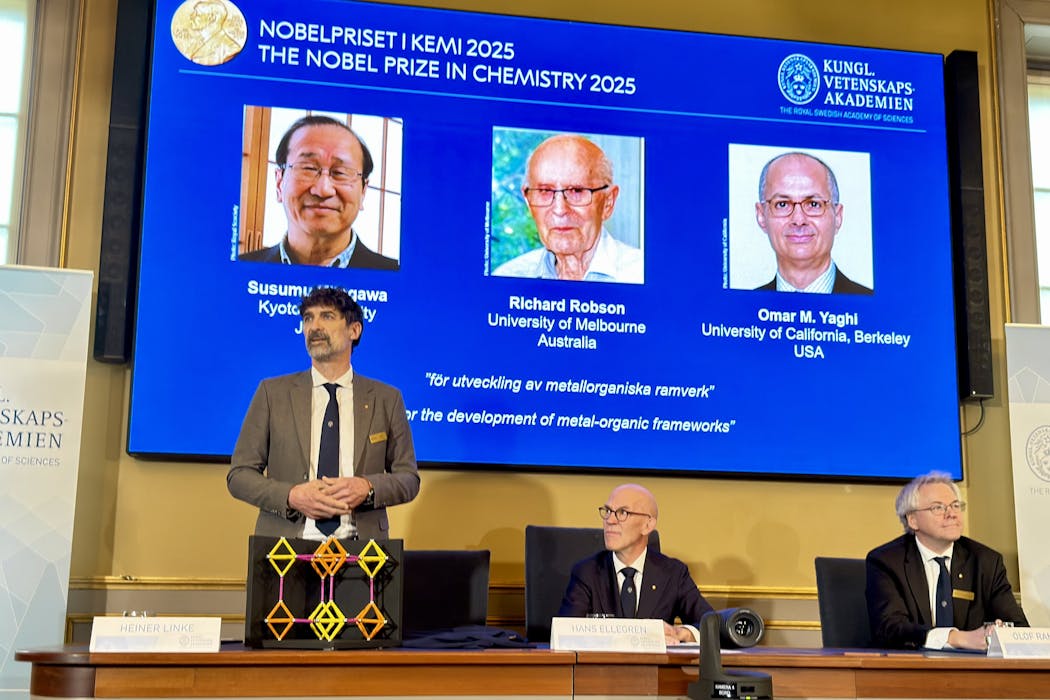
Three chemists will share the Nobel Prize for their work on metal-organic frameworks. Jonathan Nackstrand/AFP via Getty Images

The 2025 Nobel Prize in chemistry was awarded to Richard Robson, Susumu Kitagawa and Omar Yaghi on Oct. 8, 2025, for the development of metal-organic frameworks, or MOFs, which are tunable crystal structures with extremely high porosity. These are a class of materials that have truly changed the way scientists design and think about matter, inspiring progress in various applications.

I’m a MOF scientist and for many of us in the field, this recognition feels both historic and deeply personal. MOFs are not just elegant crystals you’d admire under a microscope; they’re an entire universe of structures, each like a miniature city of tunnels and rooms waiting to be filled. They’ve been my scientific home since I first stepped into research, and they still feel a little bit like magic to me.

So, what exactly are MOFs?

Metal-organic frameworks are like crystalline scaffolds built from two ingredients: metals that act like connective joints and organic – that is, carbon-based – molecules that behave as bridges to link those joints in a repeating pattern. The result is a highly ordered, porous framework – a kind of molecular architecture that’s both sturdy and full of empty space.

A model constructed out of metal bars and spheres, showing a cubic structure with smaller molecule models in the center.
Metal-organic frameworks, shown in this model, can trap smaller molecules inside their larger frame.
Jonathan Nackstrand/AFP via Getty Images

These frameworks are so porous, like sponges with tiny voids, that it’s almost impossible to picture them. One gram of a MOF has so many pores that it can expose as much internal surface area as a soccer field. It’s astonishing that a handful of powder could hide an entire landscape of surface within it.

That enormous surface area is one of the unique things that make MOFs so powerful, and it comes from the nanoscale pores – tiny molecular rooms that can trap, separate, transform or transport gases, ions and other molecules. In a way, MOFs are like molecular hotels with countless doors, each programmed to admit only certain guests.

Why scientists love them

What fascinates me most about metal-organic frameworks is their limitless design space. Just by glancing at the periodic table, every metal could, in principle, serve as a cornerstone, and countless organic molecules can act as bridges connecting them. Even using the same combination can produce entirely different architectures.

Chemist Omar Farha compares metal-organic frameworks to Lego sets that you can build and customize.

So far, scientists have synthesized over 90,000 MOFs, and computational chemists have predicted hundreds of thousands more. Few material families offer this much versatility.

I like to think of MOFs as puzzles or Lego sets, but on the atomic scale. You can replace a single piece, or change its color or shape, and end up with a material that behaves completely differently.

Add a new “decoration” – what chemists call a functional group – and the framework suddenly recognizes a new molecule. Stretch the organic bridges, and the same architecture inflates like a balloon, giving what we call isoreticular MOFs. These have the same structure, but bigger pores. In short, MOFs can come in almost every imaginable shape, size and texture.

Pushing the boundaries of these materials

Beyond their scientific elegance, MOFs are incredibly promising for real-world technologies. Different structures and functionalities lead to different properties and, therefore, different uses.

Some MOFs act as molecular sieves, selectively capturing carbon dioxide from industrial exhaust or even directly from air. Others clean polluted water by removing heavy metals, dyes or “forever chemicals.”

Certain MOFs can also carry drugs or imaging agents inside the body for medical applications. In the energy world, they function as electrodes or electrolytes that make batteries safer and more efficient. And many serve as catalysts, accelerating chemical reactions that transform one molecule into another.

When I began my Ph.D., my senior colleagues warned me that MOFs might be too delicate – beautiful crystals that would crumble at the first hint of air or moisture. And indeed, some of the early frameworks were fragile curiosities, admired more for their elegance than their endurance. But that perception has changed dramatically.

A diagram of molecules arranged in a cube structure, with empty space in each cube.
Metal-organic frameworks, like MOF-5 shown here, have metal components, organic ‘linkers’ and a cavity which can allow in gases.
Tony Boehle/Wikimedia Commons, CC BY-SA

Many MOFs are now remarkably robust. The material I first worked on was a titanium-based metal-organic framework named MIL-125. It was first reported by Gérard Férey, one of the foundational figures in the MOF and porous framework community who sadly died in 2017. MIL-125 was not only stable, it was practically indestructible in my lab. After synthesizing two grams of it, I stored it on my bench in an open vial and used that same batch for every catalytic experiment throughout my Ph.D. No glovebox, no desiccator – just a jar of yellow powder sitting happily on my bench.

That experience taught me something important: While stability can be a legitimate concern, MOFs have grown up. Thanks to smart chemistry, we have materials that can withstand water, heat and repeated use. Since their foundation, researchers around the world have introduced new properties to these materials – from electrical conductivity to light responsiveness – and, crucially, made major progress in scaling up MOF synthesis for industrial applications.

Scaling is the key step in bridging the gap between fundamental discovery and large-scale deployment. Researchers are no longer content with studying MOFs in milligrams – we’re often planning for grams, kilograms and beyond.

Some startups are turning these advances into real technologies – from storing gases more safely, to pulling clean water straight from desert air, to building more energy-efficient air conditioners. What once felt like science fiction – powders that breathe, trap and transform molecules – is now science fact.

Despite these advances, researchers will need to continue improving the stability and scalability of MOFs to fully realize these materials’ potential in the real world.

A Nobel moment that honors creativity

The 2025 Nobel Prize in chemistry goes beyond honoring three remarkable scientists – it celebrates an entire community: a generation of chemists and engineers who transformed a single idea into a thriving field. The pioneering visions of Richard Robson, Susumu Kitagawa and Omar Yaghi laid the foundations for a vibrant discipline that has grown to encompass everything from gas storage and catalysis to energy and environmental technologies.

When I attended my first MOF conference as a second-year Ph.D. student, I listened in awe to many of the pioneers of this field, some of whom are now Nobel laureates. Back then, MOFs felt like magical sponges, and that sense of wonder never left me. It led me to continue my research on conductive MOFs: materials that can carry electricity. Now, in my own research group, we study how these frameworks can make batteries safer and more efficient, and how they can capture waste gases and turn them into useful chemicals using sunlight.

For me, this Nobel Prize celebrates more than a discovery, it celebrates a philosophy: Chemistry is creative, we can design and engineer matter with imagination, and sometimes emptiness can be the very essence of a material.

The Conversation

Stavroula (Alina) Kampouri receives research funding from the American Chemical Society Petroleum Research Fund (ACS PRF) and other public research agencies.

– ref. Metal-organic frameworks: Nobel-winning tiny ‘sponge crystals’ with an astonishing amount of inner space – https://theconversation.com/metal-organic-frameworks-nobel-winning-tiny-sponge-crystals-with-an-astonishing-amount-of-inner-space-267089

Toronto Blue Jays: Amid Canada-U.S. tensions, ‘Canada’s team’ is excelling at America’s pastime

Source: The Conversation – Canada – By Noah Eliot Vanderhoeven, PhD Candidate, Political Science, Western University

Amid threats from United States President Donald Trump to make Canada the 51st state, the Toronto Blue Jays’ season started with protocols aimed at avoiding booing during the American national anthem and the removal of someone wearing a “Canada is not for sale hat” at the ballpark.

Nonetheless, the Blue Jays are being heavily marketed as “Canada’s team” as they advance to the American League championship after beating the New York Yankees, America’s most storied baseball team.

Why do the Blue Jays frame themselves as not just Toronto’s team, but Canada’s? And is their current post-season run their biggest and most important opportunity in years to fully establish themselves as representing all of Canada?

Truly Canada’s team?

The Jays serving as Canada’s team may make sense since they’re the only Canadian team currently playing in Major League Baseball (MLB). But to some Canadians, positioning the Jays as the nation’s team may not sit well.

After all, for baseball fans in Québec, memories of the now-defunct Montreal Expos still loom large.

For fans closer to the Windsor-Detroit border, the Detroit Tigers are a more proximate and accessible team.

Finally, some British Columbia MLB enthusiasts — despite the trips Blue Jays fans make to take over T-Mobile Park when the Blue Jays play the Seattle Mariners — still opt to support the Mariners since the team is so much closer than the Blue Jays are in Toronto.

What all this means is that to some Canadian baseball fans, the Blue Jays aren’t really Canada’s team — they’re just Toronto’s.

Huge market

It’s unsurprising that the Toronto Blue Jays organization, owned by Rogers Communications — “proud owner of Canada’s team” — is intent on framing the squad this way because it provides a substantial financial boon. The Jays benefit greatly from being Canada’s team by compelling baseball fans from across the country to attend their games, and most importantly, to watch them on television.

Despite playing north of the border and earning revenues in the weaker Canadian dollar, the Jays operate in one of MLB’s largest markets — Toronto — and can also market to fans across the country. That gives them the largest geographical market in professional baseball — an entire nation.

This massive audience contributes to equally massive television ratings, even at a time when most MLB teams are struggling for regional television revenues. Being “Canada’s team” has also allowed the Blue Jays to spend competitively over the past 10 years and operate a Top 5 payroll, as they have in 2025, alongside other teams in huge markets like Los Angeles and New York.

Cross-border trash-talking

In the midst of the series against the Yankees, Prime Minister Mark Carney met with Trump to discuss trade, tariffs and security. Intitial reports suggested the meeting, held just days after Trump made yet another veiled annexation threat, went well.

But the ongoing backdrop of tense relations between the U.S. and Canada is perhaps echoed by some of the commentary about both teams.

Early in the season, the Yankees’ play-by-play man, Michael Kay, called Toronto “not a first-place team” despite the Blue Jays having just passed the Yankees for first place in the American League East.

In September, Jays colour-commentator and former catcher, Buck Martinez, said that the Yankees were “not a good team.”

Also in September, a Baltimore Orioles television analyst, Brian Roberts, questioned how well Canadians understood baseball, leading to the Blue Jays themselves defending the baseball intelligence of their fans.

There was even a popular hoax online about Trump not inviting the Blue Jays to the White House should they win the World Series — an invite he’s extended to many championship teams in American sports leagues.

Stoking Canadian nationalism

Ultimately, the Blue Jays bested the Yankees and are advancing to the American League championship series. Blue Jays players and their manager, John Schneider, have spoken of the intense atmosphere Blue Jays fans create for their opponents and how the team draws on the support of the entire nation of Canada.

The Jays’ success so far in the post-season in this current political moment — as Trump is once again making veiled threats about making Canada the 51st state during tense trade negotiations — presents the Blue Jays with perhaps their best opportunity to fulfil their role as Canada’s team.

In a season defined by rivalry, politics and national pride, the Blue Jays are proving that even America’s pastime can become a canvas for Canadian nationalism.

The Conversation

Noah Eliot Vanderhoeven does not work for, consult, own shares in or receive funding from any company or organisation that would benefit from this article, and has disclosed no relevant affiliations beyond their academic appointment.

– ref. Toronto Blue Jays: Amid Canada-U.S. tensions, ‘Canada’s team’ is excelling at America’s pastime – https://theconversation.com/toronto-blue-jays-amid-canada-u-s-tensions-canadas-team-is-excelling-at-americas-pastime-266882