100 million African children are not in school. What’s driving the trend and how to reverse it

Source: The Conversation – Africa – By Moses Ngware, Senior Research Scientist, African Population and Health Research Center

Many countries across Africa have embraced universal basic education policies in recent decades. But recent data has revealed that more than 100 million children and adolescents remain out of school, out of a total potential population of 469 million. The latest statistics suggest that after some years of progress, the situation is deteriorating. Education and youth empowerment scholar Moses Ngware and his co-researchers recently carried out an analysis of trends going back 25 years. Their main findings are set out below.

What are the school attendance trends in Africa across all age groups?

In 2000, the number of out-of-school children in primary school, lower secondary and upper secondary was above 100 million. It was down to about 90 million in 2014, and then up again to 100 million by 2025.

Viewed against Africa’s high population growth of above 2.5%, these absolute numbers suggest that school participation is not keeping pace.

Nevertheless, between 2000 and 2024, the proportion of out-of-school children and adolescents declined at all education levels. It fell from 37% to 20% for primary schools; from 47% to 35% for lower secondary and from 56% to 47% for upper secondary school-age children. This is despite the absolute numbers of out-of-school children remaining high.

Countries that showed greatest improvement included Côte d’Ivoire, Ethiopia, Guinea, Madagascar and Mozambique. Improvements were driven by at least two main factors. First, targeted policy responses that enabled them to achieve good coverage in a short time. Second, a strong political will combined with a multi-sectoral approach. The approaches included combining conditional cash transfers for households, food supplies, expanding access to schools and implementing universal education policies that reduce cost of schooling for households.

On the other hand, there are countries that made little or no progress. They include Angola, Cape Verde, Lesotho, South Sudan and Zimbabwe. The main drivers of the low progress are:

  • political instability, as seen in South Sudan

  • poor economic performance, as witnessed in Zimbabwe

  • the high opportunity cost of schooling, as seen in Lesotho, where boys drop out due to poverty related coping mechanisms, including herding cattle, with only one in every five boys completing grade 12.

What are the notable changes in recent years?

In the past five years, we have seen a steady increase in absolute numbers of out-of-school children and adolescents from 95 million to 100 million, with an average of about 1 million children either not transitioning from primary to secondary school or leaving school or not joining school at all.

There are two main drivers of such a trend. First, finance – the fizzling effect of the universal basic education subsidies of the early 2000s. These subsidies made basic education affordable to many households. Of the 42 African countries with free education in their policies, only three were in a position to offer free schooling in 2025. Donor funding of education by multilateral organisations has also been reduced, with education aid in Africa declining by 7% in 2024. Second, the negative impact of COVID-19, with about 10 million who left school due to the lockdowns never to return, for various reasons, including forced marriages among girls and child labour for boys.

Across all the schooling levels, higher than before rates of out-of-school children and adolescents were observed in the Sahel region, in Central African Republic, Chad, Mauritania and northern Nigeria. These countries or regions are characterised by politically motivated violence, harsh climatic changes and a history of low school participation.

Why is school completion important for societies?

The main benefits to societies of school completion include transition to decent work, girls’ empowerment, and improved health outcomes. An additional year of schooling increases an individual’s lifetime earnings by about 10% on average, with a potential to increase an individual’s purchasing power. Such benefits can also trickle down to households through providing household financial stability and enhanced family support.

For girls, school completion is critical for participation in decision making at societal level. Research shows that a woman’s power to make decisions, such as education for her children or where to invest, increases with education attainment. This has a bearing on economic independence and gender equity within the society.

Furthermore, and related to these two benefits, children of mothers who have completed secondary education have a 45% lower under-3 mortality rate. This implies that such children have about half the risk of death before age 3 compared to those born to mothers with no education.

What are the gender dynamics?

By 2025, the proportion of males that were out of school, at 51%, was only slightly higher than that of females. However, the out-of-school female rate was on the rise – up by two percentage points in 10 years.

If this growth continues, then the proportion of out-of-school females will overtake that of males in the coming years. This will compound the vulnerabilities disadvantaged girls face in their schooling journey and transition to work.

In addition, the gains made in the last three decades in closing gender gaps in education will be eroded. Eroding the gains made in education has severe consequences, especially for girls. For instance, we are likely to see an increase in females getting married much earlier, and child bearing among adolescents may also increase.

What lessons can we learn from the better-placed countries?

There are a number of important lessons to be learnt from countries that have lowered the number of out-of-school children and adolescents.

First, Algeria, Ghana, Kenya and Rwanda have relied on a strong national policy framework backed by political good will, high-level central coordination and donor-partner support.

Second is the importance of targeted social support such as school feeding and conditional cash transfers. Close evaluations using hard data are needed.

Third is the elimination of significant direct fees or levies at basic education level, with timely financial disbursements and school supplies.

Fourth is the lesson that affirmative action for vulnerable populations is an invaluable investment. These populations include disadvantaged girls, children from remote rural areas, children with disabilities, and children from poor households.

Finally, there are other interventions that can add value depending on the context. These include reducing travel distance through expanding infrastructure, and flexible school entry, such as late entry to improve participation. Another is catch-up programmes, which means accelerating progression to recover lost time and learning.

The Conversation

Moses Ngware receives funding from.

African Population and Health Research Center (APHRC)

ref. 100 million African children are not in school. What’s driving the trend and how to reverse it – https://theconversation.com/100-million-african-children-are-not-in-school-whats-driving-the-trend-and-how-to-reverse-it-280637

Better-designed homes could cut three major child diseases by up to 44% – Tanzania trial

Source: The Conversation – Africa (2) – By Steve Lindsay, Emeritus professor, Durham University

Malaria, diarrhoea and pneumonia are preventable childhood diseases that are major causes of death in young children. They’re transmitted largely in and around the home, where children spend most of their time.

For example, around 80% of malaria transmission in Africa occurs when people are bitten by malarial mosquitoes indoors at night. Diarrhoea results usually from food and water that’s been contaminated by faeces. It can also be spread through poor hygiene. Pneumonia is spread through overcrowding and poor ventilation, and is exacerbated by indoor air pollution.


Read more:
Africa needs 50 million new homes, but building is bad for the environment: how to finance ‘green’ solutions


We are an international group of specialists from different fields including architecture, communications, global health, medical anthropology, public health entomology, engineering and statistics.

To see if it might be possible for a newly designed house to help prevent malaria, pneumonia and diarrhoea in children, one of us (Danish architect Jakob Knudsen) came up with a new design. We called it the Star home.

This house costs 24% less in materials than a conventional single-storey cement-block house. It also uses 73% less concrete, and generates 57% less embodied carbon (the amount of carbon emissions released from the time raw materials are turned into building materials for the house to the end of the home’s life). Our analysis revealed a fourfold return on investment over 50 years once health, water, cooling and energy savings are accounted for.

The features of the Star home are:

  • Double-storey buildings. Bedrooms are positioned on the upper floor, away from mosquitoes, which are most abundant at ground level.
  • Cross-ventilation, where air passes across the room. We increased ventilation inside the home by using walls made of shade net, instead of solid walls. These also cooled sleeping areas and deterred mosquitoes from entering the room.

  • Mosquito screens on doors and windows. These screens keep malaria mosquitoes and flies out.

  • Self-closing doors. These minimise the entry of mosquitoes and flies.

  • Clean water harvesting, improved pit latrines and improved cooking stoves.

We put the Star home through a three year, peer-reviewed trial to see if it could reduce malaria, diarrhoea and pneumonia among children.

Our findings were startling: After three years, children living in the Star homes had 44% less clinical malaria, 30% less diarrhoea and 18% less pneumonia than those living in traditional houses.


Read more:
Nigeria has Africa’s highest malaria death rate – progress is being made, but it’s not enough


Because they were protected from three serious illnesses, their overall health improved and the children grew taller than children living in traditional houses.

Our study also demonstrated that the new, comfortable Star house has a lower carbon footprint than the cement-block houses that are currently built in sub-Saharan Africa. Put simply, we used less energy to build a Star home than is used in building a typical cement house constructed in a village.


Read more:
Health risks at home: a study in six African countries shows how healthy housing saves children’s lives


We also found that passive cooling in the Star home made the home more comfortable in hot weather even though it did not have air conditioning, which consumes energy.

Our study demonstrates that small improvements in design are likely to make a major health impact on the lives of children in Africa.

The ground work

We first set about understanding how the pathogens causing the three diseases spread in and around the home.

Malaria: How mosquitoes enter houses has been the subject of research for decades.
Research shows that they find people mainly by smell. From far away, they follow the carbon dioxide humans breathe out, and when they get closer, they are guided by smells produced by bacteria on human skin.

Diarrhoea: Houses with a regular supply of clean water, clean food preparation areas, fly-proof latrines and kitchens can help reduce the spread of this disease.

Pneumonia: This is spread through air-borne pathogens and is made worse by smoke-filled kitchens which damage the lungs.

We then developed the Star homes and tested whether they were healthier by carrying out a randomised controlled trial in southern Tanzania, an area with high levels of malaria.

In the trials, we recruited children under 13 years of age and randomly allocated them to 110 Star homes and 513 traditional mud and thatched-roof houses.

These children were followed weekly for signs of illness for three years and the data from the clinical trial were analysed.

Africa’s housing boom: a chance to build healthier homes

Africa’s population is the most rapidly expanding in the world, with the current population of 1.5 billion people expected to increase to 2.7-3.7 billion by 2070.

Hundreds of millions of new homes will need to be constructed soon.

There has never been a better time to build healthier homes on the continent. Improvements in rural housing are increasing at a fast pace.


Read more:
Building Zambian homes with local materials delivers benefits that imports don’t: study


Governments can take a number of steps to help. For example, they can facilitate the construction of better rural homes by assuring ownership rights (titles). These are essential for homeowners who want to apply for loans to carry out healthy home improvements. Governments could also reduce import taxes on fly screening, and provide advice and support for the construction of healthy homes.

We hope that this study will stimulate further innovation by people working in the built environment who could collaborate with local communities to construct healthier homes for rural people in low- and middle-income countries. Simple improvements in housing can have profound impacts on improving public health.

(About our team: Salum Mshamu, a Tanzanian scientist, carried out trials on the Star home as part of his PhD studies at Oxford University. Jakob Knudsen has been designing healthy and cooler homes in the tropics, particularly in Tanzania, for over 30 years. Lorenz von Seidlein is a paediatric clinician who has studied the epidemiology and control of childhood infections, principally malaria, in different parts of the tropics. Steve Lindsay has over 40 years of experience working on the control of mosquitoes and flies, including running clinical trials of housing interventions.)

The Conversation

Emeritus Professor Steve Lindsay receives funding from Hanako Foundation, Singapore, BBSRC GCRF Network Grant (BB/R00532X/1) and Sir Halley Stewart Trust.

The Royal Danish Academy / Jakob Brandtberg Knudsen receives funding from Hanako Foundation for the Star Homes Project

The Star Homes project has been funded by the Hanako Foundation, Singapore.

Salum Ahmed Mshamu does not work for, consult, own shares in or receive funding from any company or organisation that would benefit from this article, and has disclosed no relevant affiliations beyond their academic appointment.

ref. Better-designed homes could cut three major child diseases by up to 44% – Tanzania trial – https://theconversation.com/better-designed-homes-could-cut-three-major-child-diseases-by-up-to-44-tanzania-trial-281890

King’s speech: much-needed water industry reforms do not go far enough

Source: The Conversation – UK – By Alex Ford, Professor of Biology, University of Portsmouth

JU.STOCKER/Shutterstock

Water bills are rising, public anger over sewage pollution has not abated, and the government has now set out a major overhaul of water regulation in the king’s speech.

The proposed water reform bill signals a shift in emphasis. Rather than focusing solely on water companies, the legislation aims to address pollution more broadly, including contributions from agriculture and industry. This wider lens has long been missing from water policy and is, in principle, a welcome change.

The bill also promises a more unified regulatory system. The financial regulator Ofwat, the Drinking Water Inspectorate and the water-related arms of the Environment Agency and Natural England would be brought together under a single regulatory umbrella. The intention is to end the fragmented oversight that has characterised the sector for decades.

These proposals follow the recommendations of the Independent Water Commission, as outlined in the 2025 Cunliffe review which critiqued England’s privatised water industry, and Labour’s white paper. Yet despite the language of reform, the vision looks less like a radical reset and more like a reboot of privatisation.

The Clean Water Now coalition – a group of over 40 environmental groups – has put forward proposals that include three main asks: to fix the system, stop the polluters and restore nature.

Public opinion polling consistently shows strong support for bringing water back into public ownership. Labour’s white paper, however, places clear emphasis on “making water a more attractive and reliable sector for investors seeking stable and fair returns”. It is this focus that will worry campaigners, as it suggests continuity with an economic model widely blamed for underinvestment, rising bills and environmental harm.


Read more:
No wonder England’s water needs cleaning up – most sewage discharges aren’t even classified as pollution incidents


The government also promises more joined‑up and longer‑term regional planning for water. Solutions don’t just involve tightening regulations and enforcement within the water industry. Everything from agricultural fertilisers, road runoff and chemical factory waste can contribute to pollution. Preventing the release of contaminants is vital, before pollution reaches the water treatment system.

But some of the most pressing challenges appear to receive surprisingly little attention. Climate change, for example, is mentioned only once in the government’s 53‑page white paper, in a brief statement about “future‑proofing” the regulatory framework against emerging pressures.

That omission matters. Changing rainfall patterns are already increasing sewage discharges, placing additional strain on ageing infrastructure. Periods of low river flow and drought make pollution events more damaging, not less, because contaminants are more concentrated in a smaller volume of water. Water scarcity, meanwhile, will intensify demand for water and competition between households, agriculture and industry. Clean water is becoming even more valuable as a commodity.

Ignored warning signs

Ofwat reports from more than 20 years ago warned that climate change would require long‑term planning and major infrastructure investment. The Ofwat annual reports for 2007-08 states: “We have also started to develop guidance for companies to assess the robustness of their infrastructure to extreme events so that they can take best account of the challenges of climate change in planning and delivering services to consumers.” The industry failed to respond and the regulator failed to regulate.

After three decades without a single new reservoir being built, the government is now legislating for several over the coming years – a tacit admission that those warnings were ignored.

The government argues that a new, integrated regulator will provide greater stability, transparency and a clearer view of both economic and environmental performance. That ambition will only be realised if transparency is actively safeguarded.

Decisions about whether revenue is directed towards shareholder returns, infrastructure investment or environmental protection will increasingly sit within a single body. This makes scrutiny of that internal decision-making crucial.

The reforms promise coherence and long‑term thinking. Whether they deliver genuine environmental improvement – or simply a more streamlined version of the status quo – will depend on how robustly the new system is designed, and whose interests it ultimately serves.

The Conversation

Alex Ford has received funding from UKRI research councils, EU, charities and industrial partners including the water industry.

ref. King’s speech: much-needed water industry reforms do not go far enough – https://theconversation.com/kings-speech-much-needed-water-industry-reforms-do-not-go-far-enough-282866

Detroit’s water affordability crisis is tied to the uneven distribution of stormwater management costs – a fraught history explains why

Source: The Conversation – USA (2) – By Nicole Van Lier, Assistant Professor of Urban and Environmental Studies, Loyola Marymount University

Workers repair a water pipeline that dates back to the 1930s. In the coming years, utility bills in Detroit are likely to rise to pay for upgrades to aging infrastructure. Jim West/UCG/Universal Images Group via Getty Images

Beginning in July 2026, Detroiters will be paying higher water and sewer bills.

That’s because The Great Lakes Water Authority, or GLWA, voted unanimously on Feb. 25, 2026, to increase water rates by 5.8% and sewer rates by 4.26% for its customers. GLWA raised rates by similar amounts in 2025.

Residents at GLWA’s last rate hearing spoke of their difficulty keeping up with utility bills. For low-income customers across the GLWA system, rate increases aggravate a deeply entrenched water affordability crisis.

In the coming years, utility bills will likely continue to rise, driven by maintenance costs to upgrade infrastructure nearing the end of its life cycle.

Utility bills are the primary source of revenue for public water and wastewater systems. Yet both the Detroit Water and Sewerage Department, or DWSD, and GLWA are caught in what utility experts call an affordability gap. That is, the discrepancy between what it costs to maintain essential infrastructure and what ratepayers can reasonably afford.

Utilities across the country are facing down a similar contradiction. For DWSD customers, the gap is wider still because they carry a greater burden for water quality improvements that benefit the wider metropolitan region.

I am a political ecologist at Loyola Marymount University, specializing in the politics of resource management in the Great Lakes.

While water affordability is a long-standing concern for communities within the GLWA system and across Michigan, the crisis remains the most acute in Detroit. Taking a look at the fraught history of wastewater management helps to explain why.

Who pays to keep waterways clean?

Since the late 1990s, water bills in Detroit have risen by 400%.

At $87.54 per month, DWSD’s average residential water bill can consume up to 25% of disposable income for households living below the poverty line. The U.S. Environmental Protection Agency sets an affordability threshold of 4.5% of disposable income to cover water bills.

About three-quarters of a DWSD residential water bill pays for wastewater and stormwater treatment. These revenues also help to maintain Detroit’s wastewater treatment plant, which serves the city and 76 suburban communities.

My research, which combined archival research and interviews with state regulators, Detroit city staff, DWSD and GLWA representatives and grassroots water affordability advocates, documents how Detroit’s water affordability crisis involves a less visible form of environmental injustice. This term often describes uneven exposure to pollution or other environmental harms. Detroit’s case raises a different question: Who pays to keep local waterways clean?

Regionalizing Detroit’s wastewater system

Detroit’s wastewater treatment plant is the largest single-site treatment facility in the country. While suburban communities own and operate local sewer systems, they are connected by a regional sewer network that stretches across 944 square miles of Wayne, Oakland and Macomb counties. This network conveys raw sewage to the treatment plant in Detroit.

The wastewater system was not initially designed to serve the metropolitan region, however. It was expanded through the 1950s-70s to help suburban communities address new state wastewater mandates.

Truck stuck in flooded highway
Water bills generate revenue for much-needed infrastructure repairs as climate change increases the frequency and intensity of storms.
Photo by Matthew Hatcher/SOPA Images/LightRocket via Getty Images

The postwar period is well known for its economic boom, but it also ushered in important social, political and environmental shifts.

Following World War II, for example, local waterways were slick with both industrial and municipal wastes. Polluted waters posed a threat to the safety of people’s drinking water and to Detroit’s water-intensive industrial manufacturers.

In response, Michigan revamped its water pollution law in 1949, requiring cities, towns and villages to install wastewater treatment. Some suburbanizing communities resisted these mandates. They argued their tax bases, then only a few thousand residents, were insufficient to finance such costly infrastructure.

Meanwhile, civil rights organizers in Detroit and across the nation struck down racist segregation laws through the 1960s. Black families began moving into historically white neighborhoods. Following Detroit’s turbulent summer of 1967, demand for suburban housing in all-white communities skyrocketed. More than 40,000 white residents left Detroit for the suburbs that year, a figure that doubled in 1968.

This phenomenon, known as white flight, not only spurred suburbanization but left the tri-county area largely segregated by race and class.

The convergence of stricter water quality laws, suburban growth and white flight also had implications for the wastewater system and its management.

By the late 1950s, Michigan’s Department of Public Health had begun denying sewer permits to developers building in places with insufficient wastewater treatment. Permit denials helped to enforce the state’s wastewater mandates. They became known as “construction bans” for the way they slowed suburban growth.

The quickest way to resolve these “bans” was to route suburban sewage to Detroit. By 1974, DWSD provided wastewater treatment to more than 70 suburban communities across a deeply segregated service area.

Protests march with signs
In 2014, demonstrators gathered to protest the city’s widespread water shutoffs, which left thousands of Detroit residents without water due to unpaid bills.
Photo by Joshua Lott/Getty Images

An uneven burden for improving public infrastructure

Regionalizing the wastewater system opened DWSD to suburban political and economic pressure – just as Detroit was becoming a majority-Black city under its first Black mayor, Coleman Young.

In 1975, DWSD hiked sewer rates for both city and suburban customers to finance upgrades for state and federal water quality regulations.

Suburban officials challenged the rate hikes in court, alleging DWSD was attempting to “fleece” the suburbs. While these and future allegations went unsubstantiated, they entrenched long-standing anti-Black stereotypes into the politics of public infrastructure management.

In addition to ongoing rate disputes, suburban politicians introduced “takeover bills” in the state Legislature. The goal was to transfer control of DWSD’s infrastructure to a new regional authority. Both tactics persisted through the 1980s and ’90s, forcing DWSD to make compromises that shifted more costs onto Detroit ratepayers.

A prime example is the 1999 rate settlement agreement that resolved a decade of suburban rate disputes over DWSD’s stormwater charges. Known as “the 83/17 split,” the agreement assigned 83% of stormwater improvement costs to Detroit, while suburban customers shared the remaining 17%, divided 76 ways.

The rates under dispute were introduced to meet new state regulations targeting combined sewer overflows. These overflows occur when pipes release raw sewage and stormwater into waterways during heavy rain. Suburban officials argued for a reduced share of improvement costs. They pointed out many of their sewer systems already separated storm and sanitary pipes, reducing the occurrences of combined sewer overflows. Yet state-mandated improvements required expanding shared infrastructure, not simply combined sewer overflow outlets in Detroit.

GLWA’s own wastewater master plan documents suburban stormwater entering regional sewers long after the 83/17 split was established. Suburban sprawl also paved over vast stretches of land, funneling more runoff into the system.

Nevertheless, the settlement reduced the suburban share of combined sewer overflow improvement costs to 17%. DWSD was ordered to set aside US$10.6 million to reimburse suburban customers for previous stormwater charges above the 17% threshold.

For the past 25 years, Detroiters have borne the bulk of stormwater upgrades – a capital program that has exceeded $1.5 billion.

The approximately 680,000 residents of Detroit have borne these costs despite accounting for only 23% of GLWA’s 2.9 million wastewater customers.

A push toward water affordability

The 83/17 split remains in place today. It was grandfathered into GLWA’s 40-year lease agreement with DWSD that took effect in 2016.

While DWSD continues to provide local water and sewer service to city residents, the lease transferred fiscal and operational control of regional water and wastewater infrastructure to GLWA. This means cost-sharing for stormwater improvements will continue to be structured by the 83/17 split for decades to come – unless GLWA consents to renegotiating the deal.

In 2016, Detroit’s blue ribbon panel on water affordability recommended that DWSD revisit how cost is allocated across all users of the system.

DWSD initiated discussions with GLWA in 2020 and 2021 to revisit the terms of the 83/17 split. GLWA officials concluded, however, that existing legal agreements and contracts made the 83/17 split “logistically challenging” to renegotiate. As long as the 83/17 split remains in place, protecting local waterways from combined sewer overflows will continue to exacerbate the water affordability crisis in Detroit.

Since 2014, 170,000 Detroiters have been met with water shutoffs for unpaid bills. Shutoffs, in turn, have triggered housing abandonment and foreclosures. They have also increased residents’ exposure to waterborne illnesses, affected mental health and threatened family stability.

This is an especially pressing concern now, with state funding for DWSD’s low-income “lifeline rate” program recently exhausted and urban flooding worsening as storms grow more frequent and severe. While DWSD plans to reopen applications to the lifeline plan later this year, the program can support only about 5,000 residents. This is down from almost 30,000 residents it supported in previous years and far below the level of need with 31.5% of Detroiters living below the poverty line.

Organizations such as the People’s Water Board Coalition have spent two decades building coalitions across Michigan to push for a statewide water affordability plan. A statewide plan that pegs water bills to household income could create a more stable and more equitable revenue source for critical wastewater infrastructure in Detroit.

The Conversation

Nicole Van Lier’s research received funding from the Social Sciences and Humanities Research Council of Canada (SSHRC) and the Fulbright Canada Foundation. During her fieldwork, Nicole was a member of the People’s Water Board Coalition.

ref. Detroit’s water affordability crisis is tied to the uneven distribution of stormwater management costs – a fraught history explains why – https://theconversation.com/detroits-water-affordability-crisis-is-tied-to-the-uneven-distribution-of-stormwater-management-costs-a-fraught-history-explains-why-277157

Why Pennsylvania’s low-income residents are feeling the squeeze as gas prices rise

Source: The Conversation – USA (2) – By Hannah Wiseman, Professor of Law, Penn State

Pennsylvania consistently ranks among states with the highest gas prices. eyecrave productions/iStock via Getty Images Plus

When gas prices rise, not everyone feels the pain equally. For low-income and rural Pennsylvanians, a trip to the gas station can mean choosing between a full tank and groceries. Many factors, such as crude oil costs, distribution and marketing, and to some extent Pennsylvania gas taxes all add up to keep Pennsylvania’s gas prices higher than average.

Pittsburgh gas prices are among the highest in Pennsylvania due to higher urban demand, refinery maintenance issues in the Midwest and supply shortages.

Currently, the average gas price in the U.S. is $4.50. In Pennsylvania, the average is $4.66, and in Pittsburgh it’s $4.91.

To understand why, and what – if anything – can be done about high gas prices, The Conversation U.S. spoke with Hannah Wiseman, an energy and environmental law scholar whose work focuses on how regulation is designed. She explains who gets hit hardest by high gas prices and why relief is so hard to come by.

How do rising gas prices hit low-income Pennsylvanians differently than middle- or upper-income residents?

Low-income people typically have a limited monthly budget, with fewer or no savings to draw from. Each essential expense is a portion of an individual’s or family’s fixed budget, and when an essential expense rises, it eats up more of this fixed budget. For the costs of fuel and electricity, this is called the “energy burden” – the percentage of someone’s income that goes to energy costs. The higher the cost of energy, the more this impacts people’s ability to pay for other essential goods, such as food, medicine and medical care.

Pennsylvania consistently ranks among states with the highest gas prices. What regional conditions make Pennsylvania expensive?

Like any other good, the cost of gas is influenced by the cost of the raw product from which gasoline is refined, crude oil, the costs of operating the facilities that transport and distribute gas, and the amount of retail competition.

As the U.S. Energy Information Administration explains, distance from supply – refineries, ports and pipelines – usually means higher prices. This type of infrastructure is scarcer in the mid-Atlantic region, including Pennsylvania. And some rural areas have fewer gas stations, which can result in less retail competition.

Gasoline prices tend to be lowest in Gulf Coast states, such as Texas, with a current average of $4.01, and Louisiana, with a current average of $3.99, where there are many crude oil refineries and oil pipelines.

A landscape scene featuring two silos and farmland.
Due to lack of public transit, rural Pennsylvania residents rely on their personal vehicles to get to work.
aimintang/E+ collection via Getty

How does the lack of reliable public transit in rural areas deepen the inequality issue?

Rural areas tend to have less public transportation – making personal vehicles essential – and people have to drive to their jobs to make ends meet. So when gas prices go up, rural residents often have no option but to fill up their tank at a high cost and potentially forgo other essentials.

Rural populations also have a substantial percentage of individuals defined as the “working poor.” These are low-income individuals for whom getting to work is essential. They are already saddled with high energy burdens, which rise with higher gas prices, and they live in rural areas with few affordable options for getting to work.

Are there existing state or federal programs that help low-income residents offset fuel costs?

Low-income support tends to come from states. Most government programs support home heating costs and utility bill payments for low-income residents; programs are more limited for gasoline. In California during the 2022 spike in gasoline prices the state sent checks to low-income families. Currently, Pennsylvania has no formal legislation in place to assist low-income families with gasoline costs.

Most electric-vehicle owners can no longer rely on the $7,500 federal tax credit for owning one.
UCG/Universal Images Group via Getty Images

Electric vehicles remain out of reach for many low-income families. Does the green energy transition risk widening the equity gap?

Many U.S. residents cannot buy electric vehicles, largely because of tariffs on the import of affordable electric vehicles from countries such as China.

Additionally, the H.R. 1 Act erased the $7,500 tax credit for buying electric vehicles. This limited access to EVs widens the gap – wealthier families with electric vehicles can plug in their vehicles and avoid high gas prices, while lower-income individuals lack this option.

What can be done about high gas prices for low-income Pennsylvanians?

Pausing gasoline taxes, which is currently being debated by Pennsylvania state legislators, can reduce prices, but it also lowers revenues needed for public programs.

Direct rebates from the state to low-income individuals offer more value. However, Pennsylvania lawmakers are not presently considering direct rebates.

Read more of our stories about Pittsburgh and Pennsylvania.

The Conversation

Hannah Wiseman is a member of the Center for Progressive Reform. Her research on renewable resources, carbon sequestration, hydrogen, and energy/land use connections has received funding from the Sloan Foundation, Arnold Ventures, the Center for Rural Pennsylvania, the U.S. Department of Energy, and the National Science Foundation.

ref. Why Pennsylvania’s low-income residents are feeling the squeeze as gas prices rise – https://theconversation.com/why-pennsylvanias-low-income-residents-are-feeling-the-squeeze-as-gas-prices-rise-282469

Most people don’t know what they don’t know, but think they do – correcting your metaknowledge can make you a better teacher and learner

Source: The Conversation – USA – By Thomas Blanchard, Research Associate in Cognitive Science, Tufts University

The ability to say ‘I know that I know nothing’ could be considered a sign of wisdom. Nicolas-André Monsiau/Pushkin Museum of Fine Arts via Wikimedia Commons

Do you know what the Apple logo looks like?

Chances are, you think you do. It’s ubiquitous and iconic. How could you not know it?

But when tested, it turns out very few people can remember all the features of the logo. One study of 85 people found that only about half could pick the correct logo out of a lineup of similar ones. And only one person could correctly draw it.

This isn’t an isolated example. A classic study from 1979 found that people similarly couldn’t draw a penny accurately or pick out a correctly drawn penny from incorrect ones.

People aren’t just bad at remembering things they see all the time, but also in actually knowing how they work. In a 2006 study, many people made significant errors when drawing a bicycle, like putting the chain around the front wheel as well as the back wheel. More than just a forgotten detail, putting the chain around both wheels shows a deeper misunderstanding of how a bicycle works. A bicycle with a chain around both wheels wouldn’t be able to turn.

Illustration of bike with different components labeled
Do you truly know how a bicycle works?
Al2/Grandiose via Wikimedia Commons, CC BY-SA

It turns out people’s knowledge of how the world works is often fragmented and sketchy at best. They systematically overestimate their understanding of everyday devices and natural phenomena. People will tend to give themselves high ratings on how well they understand something, such as how bicycles or zippers work. But when they’re asked to actually explain the mechanics of these objects, their ratings of their understanding typically drop.

Just like how your knowledge of the world around you is imperfect, your knowledge about your own knowledge – also called metaknowledge – is often flawed. My field of cognitive science has been uncovering various gaps in human metaknowledge for decades.

If people are systematically overconfident about how well they understand things, why don’t they notice when they don’t understand something? And what can people do to better recognize the limits of their own knowledge?

Why you think you know more than you do

Researchers have identified several factors behind people’s overconfidence in their knowledge.

One is that people confuse environmental support with understanding: The information is out in the world but not actually in your head. With a bicycle or a zipper, all of the parts are visible to you, and you may confuse this transparency for an internal understanding of how they work. But until you go to use that knowledge by attempting to explain how they work, you may not recognize that you don’t understand how those parts interact.

A second factor is confusing different levels of analysis. People can often describe how something works at a very high level. You know that the engine of a car makes the car go, and the brakes slow and stop the vehicle. But confidence in your high-level understanding of the car may bias you to think you also have a good grasp of the finer details, like how the engine pistons and brake pads work.

Additionally, people can be blind to the ways their knowledge shapes their own perception. In one study, researchers had participants tap out the tune to a popular song. On average, the tappers thought listeners would be able to identify the song about 50% of the time. But when listeners had to identify the tapped song, they actually could identify it only 2.5% of the time. The tappers didn’t realize how much their knowledge was making identifying the song seem easy to them.

A teacher talks to a student before a chalkboard wall filled with equations, chemical structures and graphs
Intellectual humility can help you see your expert blind spot.
Vitaly Gariev/Unsplash, CC BY-SA

This disconnect has consequences beyond whether someone else can understand your Morse code version of a song. When teaching people, whether in formal classroom settings or through casual mentorship, you can sometimes have an expert blind spot: the inability to recognize the difficulties beginners face when learning something you have expertise in.

Building expertise often involves internalizing knowledge to the point where it becomes invisible to you. You draw on knowledge you don’t realize you have, making it hard to relate to learners who lack this knowledge – and, of course, hard for learners to relate to your teaching. You might have experienced this when you’ve gotten partway through explaining something, only to realize you’ve been using jargon you forgot isn’t common knowledge and lost your listener.

How to address metaknowledge failures

Your metaknowledge can fail in two directions: You can think you know more than you do, and you can be blind to how much you’re relying on knowledge you do have. Each calls for a different response to correct it.

When you’re overconfident in your knowledge, the remedy is using that knowledge. You’ll quickly realize how much you actually understand and dial down your confidence. Challenging yourself to actually try to walk through how something works is a great exercise in intellectual humility – that is, recognizing that you may be wrong – and can keep you from getting out over your skis.

Building a greater appreciation for what you know is more difficult. You can’t simply unlearn what you’ve internalized. But what this challenge shows is that, to some extent, knowing a subject and knowing how to teach it are two separate skills. Some experts are great teachers, but not simply by virtue of being experts. Recognizing that you have to approach teaching with humility, and that your expertise doesn’t automatically make you a skilled teacher, can go a long way toward making you a better teacher and mentor.

These aren’t easy and quick fixes to failures of metaknowledge. Both require ongoing intellectual humility and a willingness to distrust your own confidence. But acknowledging the fallibility of your own metaknowledge is a good place to start.

The Conversation

Thomas Blanchard does not work for, consult, own shares in or receive funding from any company or organization that would benefit from this article, and has disclosed no relevant affiliations beyond their academic appointment.

ref. Most people don’t know what they don’t know, but think they do – correcting your metaknowledge can make you a better teacher and learner – https://theconversation.com/most-people-dont-know-what-they-dont-know-but-think-they-do-correcting-your-metaknowledge-can-make-you-a-better-teacher-and-learner-280905

Falling space debris poses an escalating risk as spacecraft get stronger and more heat resistant

Source: The Conversation – USA – By Matthew Ray, Professor of Chemistry, University of Wisconsin-Stout

Not all space debris burns up in the atmosphere before it makes it back to Earth. PaulFleet/iStock via Getty Images

When it comes to space debris, what goes up is coming down more often – and not safely.

When spacecraft launch, some components, including nonreusable rocket boosters, are jettisoned to decrease weight, leaving them to intentionally burn up as they reenter the atmosphere. Satellites also enter the atmosphere at the end of their life, supposedly burning up. But in many cases, they are not doing so as predicted.

Debris from partially burned-up spacecraft components and satellites reentering Earth’s atmosphere can pose a risk to people and structures on the ground. The surge in launches, driven largely by private players such as SpaceX, is turning a once-remote risk into a growing threat.

Our materials research group at the University of Wisconsin-Stout is studying the materials that allow reentry debris to survive. We look for ways to safely modify their exceptional heat-resistant qualities to make them safer for atmospheric reentry.

Debris landing on Earth

Reentry debris has fallen on both private and public property around the world multiple times since 2021. Some of the most notable events involve pieces from SpaceX Dragon’s carbon fiber trunk, which stays attached to the crewed capsule until just hours before its reentry. These trunks are larger than a 15-passenger van and used for storage.

Trunk debris from the Crew 7 mission to the International Space Station has landed in North Carolina, and fragments from the Crew 1 mission landed in New South Wales, Australia. Similarly, debris from the Axiom 3 mission landed in Saskatchewan, Canada.

A large piece of space debris from a SpaceX Dragon capsule was found by a campsite groundskeeper in North Carolina in 2025.

In addition to trunk debris, carbon fiber components that hold pressurized gases to adjust a spacecraft’s orientation also make up a lot of recovered reentry debris. Some of these most recent recoveries have been in Australia, Argentina and Poland.

Most of the debris that reenters the atmosphere burns up, so why are these pieces making it down to Earth’s surface?

Atmospheric reentry

Satellites such as SpaceX’s Starlink reside in low Earth orbit, typically between 190 and 1,240 miles (300 and 2000 kilometers) above the Earth’s surface. To stay there, they need to move really fast, at about 17,000 miles (27,000 km) per hour. To reach this speed, a rocket with a million pounds of fuel had to accelerate it, and part of this energy is still contained within the satellite’s momentum.

As an object in orbit drifts down, closer to Earth’s upper atmosphere, it starts to collide with air molecules, slowing the object down. The amount of heat generated from this interaction rapidly consumes the satellite, melting metal at over 3,000 degrees Fahrenheit (1,600 degrees Celsius).

More launches

Countries around the world have been launching items into space since the 1950s, so why is reentry a concern now?

Starting in the 1960s, about 100 objects were launched into space every year – or at least that was the case until 2016. Since then, the number has been increasing exponentially. In 2016, 200 objects launched. But in 2025, that number was 4,500, meaning 20% of all objects launched into space since the 1950s were launched last year.

Most of these launches came from companies in the United States, such as SpaceX and Rocket Labs. Companies like these, along with those outside of the U.S., have plans for large satellite constellations composed of hundreds of thousands to a million satellites.

The more objects and payloads launched, the more reentry events occur. Satellite operators are required to remove their decommissioned satellites from orbit after 25 years to comply with regulations set in place by international committees. Groups across the world, including the Federal Communications Commission in the U.S., have pushed to shorten the deorbit window to five years. Because of these guidelines, the full influx of reentry debris events from these recent launches will not be felt for another 10 or more years.

The objects launched and policy decisions made today will have a lasting effect on future safety.

Carbon fiber

As the world has progressed technologically, efficiency for launching items into space has too.

Satellites and spacecraft are becoming lighter, stronger and more heat resistant because of materials such as carbon fiber-reinforced plastics and new metals. These strong materials are sought after because they’re lightweight, but they can also cause deorbiting debris to withstand reentry temperatures.

Carbon fiber, once used exclusively in space technology, is now found in common items such as bicycle frames and racing car bodies. It is still the gold standard for fabricating high-strength, low-weight materials for spacecraft components such as rocket fuselages, interstaging – the protective housing found between the rocket stages – and pressure vessels that experience extreme temperatures and high mechanical stress and strain.

Simple metals such as aluminum and steel melt and burn away, while complex materials such as carbon fiber, which is manufactured at up to 5,000 F (3,000 C), burn away unpredictably, changing the way jettisoned components break up upon reentry.

Since the early 2000s, a majority of recovered space debris contains either carbon fiber-reinforced plastic sections or metal components wrapped with carbon fiber. The carbon fiber can act as an unintentional heat shield for heavier, more harmful debris.

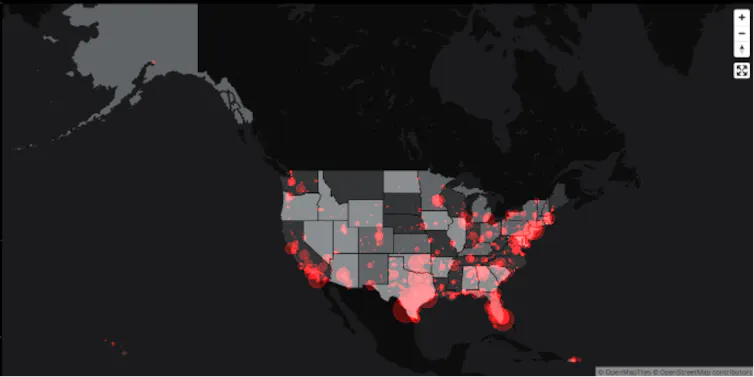
A map showing the world with dots spread across the U.S., South America, the coasts of southern Africa, Australia and Southeast Asia.
This map shows locations where confirmed space debris has been recovered. With the increase in launches, the European Space Agency predicts that future space debris could fall practically anywhere across the world.
European Space Agency

Design For demise

Design for demise is a major area of research focused on mitigating the risk of reentry debris. Instead of relying on controlled and meticulously timed deorbits that send components that survive reentry into the ocean at the end of their lives, spacecraft components are engineered to ensure they completely disintegrate while deorbiting through the atmosphere.

Design for demise can take many forms. These range from changing to more heat-susceptible materials to relocating harder-to-burn components to areas of the spacecraft that will be hotter during reentry, or using linkages that break apart at high temperatures to separate structures into smaller components to help them burn up.

With so much focus historically on spacecraft being made from the lightest, strongest and most heat-resistant materials available, it may seem counterintuitive to intentionally make some materials weaker. The key is making materials smarter, so they maintain their strength during their mission but weaken under the heat of reentry.

The Conversation

Matthew Ray’s lab is developing and working toward patenting a system to decrease risk from future carbon fiber based reentry debris.

Reese Hufnagel conducts research on space debris and is developing ways to make future carbon composites safer for use in orbit.

ref. Falling space debris poses an escalating risk as spacecraft get stronger and more heat resistant – https://theconversation.com/falling-space-debris-poses-an-escalating-risk-as-spacecraft-get-stronger-and-more-heat-resistant-279077

Why Trump’s call to pull 5,000 US troops from Germany will hurt America

Source: The Conversation – USA – By Michael A. Allen, Professor of Political Science, Boise State University

The propeller of a ‘raisin bomber’ airplane from World War II is seen in Frankfurt, Germany, in June 2020. AP Photo/Michael Probst

President Donald Trump announced on May 1, 2026, that the United States will withdraw 5,000 U.S. troops from Germany – personnel who had been deployed there as a response to Russia’s invasion of Ukraine.

Germany-U.S. tensions started after the U.S. invasion of Iran. German Chancellor Friedrich Merz refused to support Trump’s war and stated that Iran had humiliated Washington’s leadership by closing the Strait of Hormuz. Trump followed the initial U.S. troop withdrawal announcement with threats to pull more armed forces.

U.S. troops will depart Germany over the next six to 12 months, leaving about 31,000 troops in the country.

The Trump administration’s decision to withdraw personnel comes after weeks of mounting tensions between the U.S. and NATO members. The United Kingdom and Portugal have restricted Washington’s ability to use its bases in those countries for certain activities related to the Iran war.

Trump also threatened to withdraw U.S. troops from Spain and Italy over their opposition to the war and refusal to help the U.S.

“Why shouldn’t I?” Trump said on April 30, 2026, referring to possible U.S. troop withdrawal from the two European countries. “Italy has not been of any help. Spain has been horrible. Absolutely.”

These remarks suggest the Trump administration views U.S. troop withdrawal as punishment for noncompliant European allies. But the reality is more complicated. Although this proposed 5,000-troop reduction is less than 15% of current U.S. forces in Germany, its logic and consequences speak to broader issues of power projection.

As experts in international relations, foreign policy and security cooperation, we have studied the relationship between U.S. military deployments and their host countries for years. While U.S. deployments contribute to the security of the host state, having troops based in Europe and other countries provides the U.S. with significant flexibility for pursuing its own foreign policy goals.

US deployment levels

Europe has historically been one of the regions with the highest concentrations of U.S. military personnel deployed overseas.

Since the end of the Cold War, for example, Italy has hosted between 20,000 and 40,000 personnel, and Spain between 2,000 and 7,000 personnel. Germany has regularly hosted the largest deployments. At the end of the Cold War, the U.S. maintained approximately 227,000 military personnel in Germany. Though Europe remains a significant location for basing U.S. troops, this number fell dramatically in the 1990s, hovering between 50,000 and 75,000 for most years since then.

US power projection

Historians and policymakers often explained U.S. deployments to Europe as a means of deterring the Soviet Union during the Cold War.

Nobel laureate Thomas Schelling described the logic in 1966: Even a small deployment in West Berlin served as a trip wire, ensuring that Soviet incursions would trigger a much larger military response from the U.S. and its European allies.

But a closer look at U.S. foreign policy challenges this view. While U.S. troops stationed in Europe were meant to defend Europe, their utility has extended far beyond that.

U.S. military bases and deployments provide the U.S. with greater flexibility and opportunities to pursue its foreign policy goals. By forward positioning military personnel and assets, the U.S. can reduce response times during crises, as well as the costs of moving its military resources into strategic positions.

A military plane lands on a runway.
A U.S. military aircraft lands at Incirlik Air Base in Adana, Turkey, as part of the operations against ISIS on Aug. 10, 2015.
Volkan Kasik/Anadolu Agency/Getty Images

Foreign deployments can convince countries not to attack countries that host them. During the Cold War, for example, the U.S. deployed nuclear weapons to Incirlik Air Base in Turkey, a NATO ally. Turkey’s close proximity to the Soviet Union increased the U.S.’s ability to challenge its superpower rival with these weapons.

These missiles were famously later withdrawn during the Cuban missile crisis in 1962, giving the U.S. something to bargain with in persuading the Soviets to remove their missiles from Cuba.

Larger military engagements, such as the Vietnam War or the wars in Iraq and Afghanistan, have typically relied on U.S. military facilities in allied states that are closer to the conflict. During the Vietnam War, U.S. bases in Germany, Japan and the Philippines were used as staging areas through which U.S. personnel and equipment moved on their way in or out of Southeast Asia.

U.S. facilities in Germany, such as Ramstein Air Base and Landstuhl Regional Medical Center, have been integral to combat operations, satellite control of drones and treating U.S. personnel wounded in combat. Landstuhl has admitted over 97,000 wounded soldiers since its founding in 1953 and has already treated service members injured during the ongoing Iran war.

Further, military equipment such as radar and interceptor missiles often have limited ranges. Deploying this equipment closer to rival countries can increase the chance of successfully intercepting and destroying incoming missiles.

Humanitarian benefits

Beyond warfare, U.S. humanitarian relief and disaster response operations often benefit from U.S. bases.

For instance, after a large earthquake struck Japan in 2011, U.S. personnel and facilities located in and around Japan enabled the rapid mobilization of relief operations.

A military transport plane takes off from a runway.
A U.S. Air Force C-17 Globemaster transport plane takes off from Ramstein Air Base in Germany on June 23, 2025.
Boris Roessler/Picture Alliance via Getty Images

In 2004, a powerful earthquake in the Indian Ocean triggered large tsunamis, affecting millions of people in nearby countries. U.S. personnel stationed at Yokota Air Base near Tokyo provided relief and supplies to people throughout Southeast Asia and as far as eastern Africa.

Similarly, after an earthquake in Turkey in 2023, U.S. medical personnel relocated from Germany to Incirlik Air Base to help provide relief.

Beyond their humanitarian benefits, these missions can increase favorable views of the U.S. More positive public views of America may also make foreign governments more likely to support U.S. foreign policy goals.

Lower costs for the US

Host states often make direct and indirect contributions to the costs of hosting and sustaining U.S. personnel. These can range from direct financial transfers to construction, tax reductions and subsidies. Japan and South Korea increased the amount they pay to host U.S. troops after Trump demanded they do so in 2019.

U.S. equipment – from tanks and trucks to planes and ships – also often relies on a host country’s infrastructure to operate and move within the host country. Germany, for example, paid over US$1 billion for construction costs and the stationing of U.S. troops in Germany during the 2010s.

Not all countries that host U.S. troops invest as much in their infrastructure as Germany does, and having those troops elsewhere could prove far more costly than having them in Germany.

The Conversation

Michael A. Allen received grant research funding from the Department of Defense’s Minerva Initiative, the US Army Research Laboratory, and the US Army Research Office from 2017 to 2021.

Carla Martinez Machain has received funding from the Department of Defense’s Minerva Initiative, the US Army Research Laboratory, and the US Army Research Office.

Michael E. Flynn has received funding from the Department of Defense’s Minerva Initiative, the US Army Research Laboratory, and the US Army Research Office.

ref. Why Trump’s call to pull 5,000 US troops from Germany will hurt America – https://theconversation.com/why-trumps-call-to-pull-5-000-us-troops-from-germany-will-hurt-america-282116

We tested the new World Cup ball – this is what you need to know about how it will fly, dip and swerve

Source: The Conversation – USA (2) – By John Eric Goff, Professor of Physics, University of Lynchburg

Small variations in the ball can influence how it behaves once it leaves the foot. Robbie Jay Barratt/AMA/Getty Images

Every four years, the men’s World Cup delivers some certainties. The pitch dimensions are tightly regulated, offside is signaled with a flag, and referees end the match with a blast of a whistle. But one key piece of equipment is changed on purpose: the ball.

Adidas, which has supplied World Cup soccer balls since 1970, introduces a new match ball for every tournament, and with that comes fresh aerodynamic calculations for players. How will it fly through the air, weave and dip?

For the past 20 years, my engineering colleagues in Japan and England and I have put the new balls through their paces, investigating soccer ball aerodynamics. Our work begins by putting balls in wind tunnels to measure drag, side and lift forces. We use the measurements from these tests in trajectory simulations that tell us how the ball will behave in a real-game setting.

Putting the 2026 World Cup ball through the wind tunnel test.

That may all sound a little academic, and we do produce an academic paper on our findings. But what our data indicates could mean the difference between a goal or a miss for strikers, a save or a blunder for goalkeepers, and jubilation or heartache for fans.

At the World Cup, the ball is the most important piece of equipment in the biggest tournament of the world’s most popular sport.

This year’s ball, the Trionda, is especially interesting. When FIFA and Adidas unveiled it in fall 2025, the first thing many people noticed was the color and the paneling.

An orange ball and a black and white ball are under a trophy.
Earlier World Cup balls used many panels; modern balls use far fewer.
Manfred Rehm/picture alliance via Getty Images

The ball’s red, blue and green graphics correspond to the three host countries, with maple leaf, star and eagle motifs representing Canada, the United States and Mexico. And for the first time in men’s World Cup history, matches will be played with a four-panel ball.

But with so few panels, has Adidas made the ball too smooth? That is the trap engineers fell into with the Jabulani ball used at the 2010 World Cup in South Africa that became notorious for sudden dips and swerves, which made goalkeepers’ lives far trickier.

You do not want the World Cup ball to feel like the start of a science experiment once it is in the air. And if it behaves strangely, players and goalkeepers notice immediately.

The evolution of soccer balls

World Cup balls have come a long way over the decades. If you go back to 1930, the ball looked very different. The first World Cup final used two different leather balls: Argentina’s Tiento in the first half and Uruguay’s T-Model in the second. Both were hand-sewn, multipaneled balls, inflated through a bladder opening that had to be tied off and tucked back beneath the laces. In damp conditions, the leather absorbed water, making the ball heavier and less predictable in play.

A ball nestles in the top of a goal.
Uruguayan keeper Enrique Ballestrero fails to save a shot from Argentina’s Carlos Peucelle in the final of the first World Cup.
Keystone/Getty Images

By 1994 – when the United States last hosted the men’s tournament – the official ball, Adidas’ Questra, had evolved into a foam-based design. The modern World Cup ball is no longer just stitched leather. It is an engineered aerodynamic surface.

Trionda pushes that evolution further. It has only four panels, the fewest in men’s World Cup history, which have been thermally bonded – melded together using heat and adhesive.

Fewer panels might suggest less total seam length and therefore a smoother ball. And smoothness matters because the thin boundary layer of air clinging to the ball determines where the flow separates, how large a wake forms, and how much drag the ball experiences.

The Trionda has intentionally deep seams, three pronounced grooves on each panel and fine surface texturing.

But will these textures and grooves do the trick? To find that out, my colleagues and I measured the ball’s seam geometry and overall aerodynamic behavior. We compared it with Trionda’s four predecessors: 2022’s Al Rihla, 2018’s Telstar 18, the Brazuca used in 2014 and the Jabulani in 2010.

What the measurements show

In our wind tunnel tests at the
University of Tsukuba, we measured
something called the drag coefficient, which is a way of describing how much air resistance a ball experiences as it moves.

Using this data, we gained insights into how the airflow changes around the ball after it is kicked. The tests helped identify the drag crisis, the speed range in which changes in the boundary layer and flow separation produce a sharp change in drag, which can alter the ball’s acceleration, trajectory and range.

A ball is seen suspended.
The Trionda soccer ball prepares for the wind tunnel.
Goff/Hong/Liu/Asai

We found that the Trionda is effectively rougher than those predecessors.

Trionda reaches its drag crisis at a lower speed, at about 27 mph (43 kph). That is below the roughly 31-40 mph (50-65 kph) range for Al Rihla, Telstar 18 and Brazuca, and far below Jabulani’s roughly 49-60 mph (79-97 kph) range, depending on orientation.

Why does all that matter? Because a ball can feel ordinary off the boot and still behave differently in flight. When the drag crisis occurs in the middle of game-relevant speeds, small changes in launch speed, orientation or spin can shift the ball from one aerodynamic regime to another.

That was Jabulani’s problem. Once kicked with little spin, it had a tendency to slow down too much as it passed through its critical-speed range.

Trionda does not look like that kind of ball. It has a more steady and consistent drag coefficient in the range of speeds associated with corner kicks and free kicks.

But there is a trade-off. Our measurements also showed that once Trionda enters the higher-speed, turbulent-flow regime, its drag coefficients are somewhat larger than those of Brazuca, Telstar 18 and Al Rihla.

In plain language, that suggests a hard-hit long ball may lose a little range.

In our simulations, the difference is not huge. But it is large enough that players may notice long kicks coming up a few meters short.

It is also important to note that we tested a nonspinning ball. As such, our results do not provide a prediction of every pass, clearance or free kick fans will see this summer. Balls in flight often spin due to off-center kicks. That, along with altitude, humidity, temperature and air pressure all influence how a ball flies through the air once kicked.

A ball mounted on a rod.
Close-up of the Trionda ball during wind tunnel testing.
Goff/Hong/Liu/Asai

The big test yet to come

Fewer panels and more texturing aren’t the only differences with the new ball.

Trionda also carries technology that has little to do with its flight and a great deal to do with officiating. Like Al Rihla, Trionda includes “connected-ball technology” that lets computers know when the ball is kicked, helping with offside decisions.

But the architecture has changed. In 2022, the measurement unit was suspended at the center of the ball. With Trionda, it sits in a specially created layer inside one panel, with counterbalancing weights in the other three panels. The chip sends data to the video assistant referee, or VAR, system and the tournament’s semi-automated offside system.

That tweak will help referees, but will the new ball in general help or hinder players?

The evidence from our tests suggests that the ball won’t be behaving in a way that leads to baffling and erratic flight.

But the more intriguing possibilities are subtler and outside the scope of our tests. Will the grooves on Trionda help players generate more backspin on the ball, generating more lift and possibly offsetting Trionda’s somewhat larger high-speed drag coefficient?

That is why I keep studying World Cup balls both in the lab and through their behavior in play. Every four years, a new design offers a fresh way to watch physics enter the game, not in theory, but in the movement of an object in which every player on the soccer field must place their trust.

The Conversation

John Eric Goff currently works as a visitor in the Department of Physics at the University of Puget Sound in Tacoma, Washington. Following the conclusion on 30 June of that one-year appointment, he will start on 1 July as Professor of Engineering Practice in the Weldon School of Biomedical Engineering and the School of Mechanical Engineering at Purdue University.

ref. We tested the new World Cup ball – this is what you need to know about how it will fly, dip and swerve – https://theconversation.com/we-tested-the-new-world-cup-ball-this-is-what-you-need-to-know-about-how-it-will-fly-dip-and-swerve-280781

Immigrant patients often choose doctors with a shared cultural background – what they are seeking isn’t sameness but connection

Source: The Conversation – USA (3) – By Yasamine Salkar, Clinical Assistant Professor of Health Administration, Georgia State University

Patients seek clinical interactions where they feel heard. Evgeniia Siiankovskaia/Moment via Getty Images

At a recent dental appointment, I was unexpectedly seen by a new provider in my longtime dentist’s practice. Early in the visit, he realized we were both Iranian American. Like me, he had been born and raised in the United States. We were both fluent English speakers and fully accustomed to navigating American medical settings.

After we briefly discussed how the war in Iran was affecting our families there, something shifted. The exchange was short, but deeply human. I left feeling an immediate sense of connection, trust and familiarity with a provider I had only just met.

That experience helped me better understand something I had long observed among immigrant families – that immigrant patients often seek out healthcare providers from similar backgrounds. What they are often seeking goes beyond a shared language or cultural familiarity.

I am a health administration professor and lawyer who studies how people navigate health systems. In my work, and through conversations with immigrant families, including my own, I have seen how subtle interactions in clinical settings can shape whether patients feel confident or dismissed and unsure about returning for care. For some, choosing a doctor with a similar background represents their best attempt to feel more understood.

The fact that many patients actively seek out providers who share aspects of their cultural background, even when doing so may require additional effort or limit their options, illustrates that it is not a minor preference, but a meaningful part of how people experience care.

Beyond a shared language

Immigrants make up a growing share of patients in the U.S., accounting for about 15% of the population.

Large national studies suggest that patients often seek providers with whom they share a cultural background. That choice is especially pronounced among racial and ethnic minority patients, those who speak a language other than English at home and those with public insurance.

Even as the U.S. physician workforce becomes more diverse, many patients still report difficulty finding providers who share their cultural or linguistic background. At the same time, some evidence suggests the number of foreign-born physicians may also be declining. In my view, that makes the effort to find such providers all the more noteworthy.

Busy health care waiting room with a doctor discussing treatment plans with mother and daughter and a desk in the background.
Healthcare providers can do a lot to support patients’ sense of trust in their care.
Dragos Condrea/iStock via Getty Images

A shared language may seem like the most obvious explanation for why immigrants seek out doctors from similar backgrounds. And in many cases, it does matter. When patients and clinicians speak the same language, communication improves and medical errors decline, especially for patients who are not fluent in English.

But language alone does not explain experiences like my own.

Narrative research on immigrant patients describes broader issues. For example, a patient might raise a concern about a persistent symptom, only to feel too quickly dismissed, or hear an explanation delivered in a simplified way that does not match their level of knowledge or experience.

These moments can be subtle, but as they accumulate over time, they may contribute to a sense that medical care feels transactional or dismissive rather than responsive to patients’ concerns. Even patients who are fully fluent in English and comfortable navigating the health system may come to expect not to be fully heard.

That expectation can shape where people feel comfortable seeking care.

Why shared background can matter

Sharing a background, whether through race, ethnicity, language or cultural experience, can sometimes help create a sense of connection – especially at the start of a relationship.

But research suggests the relationship is more nuanced than simply matching patients and doctors by identity. The way a doctor communicates, as well as whether they listen carefully, take concerns seriously and involve patients in decisions, also plays a central role.

In one study that examined physician-patient relationships across racial and ethnic groups, patients who felt personally similar to their physician – for example, in how the physician communicated, approached decisions or seemed to understand their concerns – were more likely to trust their doctor, feel satisfied with their care and follow medical advice.

Research on patient-centered care has similarly found that patients value interactions where they feel respected, understood and able to communicate openly.

Together, these studies suggest that while shared backgrounds can sometimes help create trust, communication and interpersonal connection may matter just as much.

More research is needed to understand how much these experiences reflect differences in communication itself versus connection spurred by a common background. But for immigrant patients, it may not be the shared identity itself that matters most, but the expectation that it will help them feel more easily understood. When patients consistently struggle to find that experience, shared background can become one of its few visible signals.

Understanding why immigrant patients make these choices ultimately reveals something more universal: Trust in medicine is shaped not only by clinical expertise, but by everyday human interaction. And patients value this quality so highly that they actively seek out providers who they believe will offer that sense of understanding and connection.

The Conversation

Yasamine Salkar does not work for, consult, own shares in or receive funding from any company or organization that would benefit from this article, and has disclosed no relevant affiliations beyond their academic appointment.

ref. Immigrant patients often choose doctors with a shared cultural background – what they are seeking isn’t sameness but connection – https://theconversation.com/immigrant-patients-often-choose-doctors-with-a-shared-cultural-background-what-they-are-seeking-isnt-sameness-but-connection-271676