Welcome to post-growth Europe – can anyone accept this new political reality?

Source: The Conversation – UK – By Peter Bloom, Professor of Management, University of Essex

TSViPhoto/Shutterstock

Across much of Europe, the engines of economic growth are sputtering. In its latest global outlook, the International Monetary Fund (IMF) sharply downgraded its forecasts for the UK and Europe, warning that the continent faces persistent economic bumps in the road.

Globally, the World Bank recently said this decade is likely to be the weakest for growth since the 1960s. “Outside of Asia, the developing world is becoming a development-free zone,” the bank’s chief economist warned.

The UK economy went into reverse in April 2025, shrinking by 0.3%. The announcement came a day after the UK chancellor, Rachel Reeves, delivered her spending review to the House of Commons with a speech that mentioned the word “growth” nine times – including promising “a Growth Mission Fund to expedite local projects that are important for growth”:

I said that we wanted growth in all parts of Britain – and, Mr Speaker, I meant it.

Across Europe, a long-term economic forecast to 2040 predicted annual growth of just 0.9% over the next 15 years – down from 1.3% in the decade before COVID. And this forecast was in December 2024, before Donald Trump’s aggressive tariff policies had reignited trade tensions between the US and Europe (and pretty much everywhere else in the world).

Even before Trump’s tariffs, the reality was clear to many economic experts. “Europe’s tragedy”, as one columnist put it, is that it is “deeply uncompetitive, with poor productivity, lagging in technology and AI, and suffering from regulatory overload”. In his 2024 report on European (un)competitiveness, Mario Draghi – former president of the European Central Bank (and then, briefly, Italy’s prime minister) – warned that without radical policy overhauls and investment, Europe faces “a slow agony” of relative decline.

To date, the typical response of electorates has been to blame the policymakers and replace their governments at the first opportunity. Meanwhile, politicians of all shades whisper sweet nothings about how they alone know how to find new sources of growth – most commonly, from the magic AI tree. Because growth, with its widely accepted power to deliver greater productivity and prosperity, remains a key pillar in European politics, upheld by all parties as the benchmark of credibility, progress and control.

But what if the sobering truth is that growth is no longer reliably attainable – across Europe at least? Not just this year or this decade but, in any meaningful sense, ever?


The Insights section is committed to high-quality longform journalism. Our editors work with academics from many different backgrounds who are tackling a wide range of societal and scientific challenges.


For a continent like Europe – with limited land and no more empires to exploit, ageing populations, major climate concerns and electorates demanding ever-stricter barriers to immigration – the conditions that once underpinned steady economic expansion may no longer exist. And in the UK more than most European countries, these issues are compounded by high levels of long-term sickness, early retirement and economic inactivity among working-age adults.

As the European Parliament suggested back in 2023, the time may be coming when we are forced to look “beyond growth” – not because we want to, but because there is no other realistic option for many European nations.

But will the public ever accept this new reality? As an expert in how public policy can be used to transform economies and societies, my question is not whether a world without growth is morally superior or more sustainable (though it may be both). Rather, I’m exploring if it’s ever possible for political parties to be honest about a “post-growth world” and still get elected – or will voters simply turn to the next leader who promises they know the secret of perpetual growth, however sketchy the evidence?
A street sign showing an arrow going back on itself, pointing to Europe/
Which way is the right way?
Pixelvario/Shutterstock

What drives growth?

To understand why Europe in particular is having such a hard time generating economic growth, first we need to understand what drives it – and why some countries are better placed than others in terms of productivity (the ability to keep their economy growing).

Economists have a relatively straightforward answer. At its core, growth comes from two factors: labour and capital (machinery, technology and the like). So, for your economy to grow, you either need more people working (to make more stuff), or the same amount of workers need to become more productive – by using better machines, tools and technologies.

The first issue is labour. Europe’s working-age population is, for the most part, shrinking fast. Thanks to decades of declining birth rates (linked with rising life expectancy and higher incomes), along with increasing resistance to immigration, many European countries face declines in their working population. “”). Rural and urban regions of Europe alike are experiencing structural ageing and depopulation trends that make traditional economic growth ever harder to achieve.

Historically, population growth has gone hand-in-hand with economic expansion. In the postwar years, countries such as France, Germany and the UK experienced booming birth rates and major waves of immigration. That expanding labour force fuelled industrial production, consumer demand and economic growth.

Why does economic growth matter? Video: Bank of England.

Ageing populations not only reduce the size of the active labour force, they place more pressure on health and other public services, as well as pension systems. Some regions have attempted to compensate with more liberal migration policies, but public resistance to immigration is strong – reflected in increased support for rightwing and populist parties that advocate for stricter immigration controls.

While the UK’s median age is now over 40, it has a birthrate advantage over countries such as Germany and Italy, thanks largely to the influx of immigrants from its former colonies in the second half of the 20th century. But whether this translates into meaningful and sustainable growth depends heavily on labour market participation and the quality of investment – particularly in productivity-enhancing sectors like green technology, infrastructure and education – all of which remain uncertain.

If Europe can’t rely on more workers, then to achieve growth, its existing workers must become more productive. And here, we arrive at the second half of the equation: capital. The usual hope is that investments in new technologies – particularly AI as it drives a new wave of automation – will make up the difference.

In January, the UK’s prime minister, Keir Starmer, called AI “the defining opportunity of our generation” while announcing he had agreed to take forward all 50 recommendations set out in an independent AI action plan. Not to be outdone, the European Commission unveiled its AI continent action plan in April.

But Europe is also falling behind in the global race to harness the economic potential of AI, trailing both the US and China. The US, in particular, has surged ahead in developing and deploying AI tools across sectors such as healthcare, finance, manufacturing and logistics, while China has leveraged its huge state-supported, open-source industrial policy to scale its digital economy.

Keir Starmer announces the UK’s AI action plan. Video: BBC.

Despite the EU’s concerted efforts to enhance its digital competitiveness, a 2024 McKinsey report found that US corporations invested around €700 billion more in capital expenditure and R&D, in 2022 alone than their European counterparts, underscoring the continent’s investment gap. And where AI is adopted, it tends to concentrate gains in a few superstar companies or cities.

In fact, this disconnect between firm-level innovation and national growth is one of the defining features of the current era. Tech clusters in cities like Paris, Amsterdam and Stockholm may generate unicorn startups and record-breaking valuations, but they’re not enough to move the needle on GDP growth across Europe as a whole. The gains are often too narrow, the spillovers too weak and the social returns too uneven.

Yet admitting this publicly remains politically taboo. Can any European leader look their citizens in the eye and say: “We’re living in a post-growth world”? Or rather, can they say it and still hope to win another election?

The human need for growth

To be human is to grow – physically, psychologically, financially; in the richness of our relationships, imagination and ambitions. Few people would be happy with the prospect of being consigned to do the same job for the same money for the rest of their lives – as the collapse of the Soviet Union demonstrated. Which makes the prospect of selling a post-growth future to people sound almost inhuman.

Even those who care little about money and success usually strive to create better futures for themselves, their families and communities. When that sense of opportunity and forward motion is absent or frustrated, it can lead to malaise, disillusionment and in extreme cases, despair.

The health consequences of long-term economic decline are increasingly described as “diseases of despair”rising rates of suicide, substance abuse and alcohol-related deaths concentrated in struggling communities. Recessions reliably fuel psychological distress and demand for mental healthcare, as seen during the eurozone crisis when Greece experienced surging levels of depression and declining self-rated health, particularly among the unemployed – with job loss, insecurity and austerity all contributing to emotional suffering and social fragmentation.

These trends don’t just affect the vulnerable; even those who appear relatively secure often experience “anticipatory anxiety” – a persistent fear of losing their foothold and slipping into instability. In communities, both rural and urban, that are wrestling with long-term decline, “left-behind” residents often describe a deep sense of abandonment by governments and society more generally – prompting calls for recovery strategies that address despair not merely as a mental health issue, but as a wider economic and social condition.

The belief in opportunity and upward mobility – long embodied in US culture by “the American dream” – has historically served as a powerful psychological buffer, fostering resilience and purpose even amid systemic barriers. However, as inequality widens and while career opportunities for many appear to narrow, research shows the gap between aspiration and reality can lead to disillusionment, chronic stress and increased psychological distress – particularly among marginalised groups. These feelings are only intensified in the age of social media, where constant exposure to curated success stories fuels social comparison and deepens the sense of falling behind.

For younger people in the UK and many parts of Europe, the fact that so much capital is tied up in housing means opportunity depends less on effort or merit and more on whether their parents own property – meaning they could pass some of its value down to their children.

‘Deaths of Despair and the Future of Capitalism’, a discussion hosted by LSE Online.

Stagnation also manifests in more subtle but no less damaging ways. Take infrastructure. In many countries, the true cost of flatlining growth has been absorbed not through dramatic collapse but quiet decay.

Across the UK, more than 1.5 million children are learning in crumbling school buildings, with some forced into makeshift classrooms for years after being evacuated due to safety concerns. In healthcare, the total NHS repair backlog has reached £13.8 billion, leading to hundreds of critical incidents – from leaking roofs to collapsing ceilings – and the loss of vital clinical time.

Meanwhile, neglected government buildings across the country are affecting everything from prison safety to courtroom access, with thousands of cases disrupted due to structural failures and fire safety risks. These are not headlines but lived realities – the hidden toll of underinvestment, quietly hollowing out the state behind a veneer of functionality.

Without economic growth, governments face a stark dilemma: to raise revenues through higher taxes, or make further rounds of spending cuts. Either path has deep social and political implications – especially for inequality. The question becomes not just how to balance the books but how to do so fairly – and whether the public might support a post-growth agenda framed explicitly around reducing inequality, even if it also means paying more taxes.

In fact, public attitudes suggest there is already widespread support for reducing inequality. According to the Equality Trust, 76% of UK adults agree that large wealth gaps give some people too much political power.

Research by the Sutton Trust finds younger people especially attuned to these disparities: only 21% of 18 to 24-year-olds believe everyone has the same chance to succeed and 57% say it’s harder for their generation to get ahead. Most believe that coming from a wealthy family (75%) and knowing the right people (84%) are key to getting on in life.

In a post-growth world, higher taxes would not only mean wealthier individuals and corporations contributing a relatively greater share, but the wider public shifting consumption patterns, spending less on private goods and more collectively through the state. But the recent example of France shows how challenging this tightope is to walk.

In September 2024, its former prime minister, Michel Barnier, signalled plans for targeted tax increases on the wealthy, arguing these were essential to stabilise the country’s strained public finances. While politically sensitive, his proposals for tax increases on wealthy individuals and large firms initially passed without widespread public unrest or protests.

However, his broader austerity package – encompassing €40 billion (£34.5 billion) in spending cuts alongside €20 billion in tax hikes – drew vocal opposition from both left‑wing lawmakers and the far right, and contributed to parliament toppling his minority government in December 2024.

In the UK, the pressure on government finances (heightened both by Brexit and COVID) has seen a combination of “stealth” tax rises – notably, the ongoing freeze on income tax thresholds, which quietly drags more earners into higher tax bands – and more visible increases, such as the rise in employer National Insurance contributions. At the same time, the UK government moved to cut benefits in its spring statement, increasing financial pressure on lower-income households.

Such measures surely mark the early signs of a deeper financial reckoning that post-growth realities will force into the open: how to sustain public services when traditional assumptions about economic expansion can no longer be relied upon.

For the traditional parties, the political heat is on. Regions most left behind by structural economic shifts are increasingly drawn to populist and anti-establishment movements. Electoral outcomes have shown a significant shift, with far-right parties such as France’s National Rally and Germany’s Alternative for Germany (AfD) making substantial gains in the 2024 European parliament elections, reflecting a broader trend of rising support for populist and anti-establishment parties across the continent.

Voters are expressing growing dissatisfaction not only with the economy, but democracy itself. This sentiment has manifested through declining trust in political institutions, as evidenced by a Forsa survey in Germany where only 16% of respondents expressed confidence in their government and 54% indicated they didn’t trust any party to solve the country’s problems.

This brings us to the central dilemma: can any European politician successfully lead a national conversation which admits the economic assumptions of the past no longer hold? Or is attempting such honesty in politics inevitably a path to self-destruction, no matter how urgently the conversation is needed?

Facing up to a new economic reality

For much of the postwar era, economic life in advanced democracies has rested on a set of familiar expectations: that hard work would translate into rising incomes, that home ownership would be broadly attainable and that each generation would surpass the prosperity of the one before it.

However, a growing body of evidence suggests these pillars of economic life are eroding. Younger generations are already struggling to match their parents’ earnings, with lower rates of home ownership and greater financial precarity becoming the norm in many parts of Europe.

Incomes for millennials and generation Z have largely stagnated relative to previous cohorts, even as their living costs – particularly for housing, education and healthcare – have risen sharply. Rates of intergenerational income mobility have slowed significantly across much of Europe and North America since the 1970s. Many young people now face the prospect not just of static living standards, but of downward mobility.

Effectively communicating the realities of a post-growth economy – including the need to account for future generations’ growing sense of alienation and declining faith in democracy – requires more than just sound policy. It demands a serious political effort to reframe expectations and rebuild trust.

History shows this is sometimes possible. When the National Health Service was founded in 1948, the UK government faced fierce resistance from parts of the medical profession and concerns among the public about cost and state control. Yet Clement Attlee’s Labour government persisted, linking the creation of the NHS to the shared sacrifices of the war and a compelling moral vision of universal care.

While taxes did rise to fund the service, the promise of a fairer, healthier society helped secure enduring public support – but admittedly, in the wake of the massive shock to the system that was the second world war.

In 1946, Prime Minister Clement Attlee asked the UK public to help ‘renew Britain’. Video: British Pathé.

Psychological research offers further insight into how such messages can be received. People are more receptive to change when it is framed not as loss but as contribution – to fairness, to community, to shared resilience. This underlines why the immediate postwar period was such a politically fruitful time to launch the NHS. The COVID pandemic briefly offered a sense of unifying purpose and the chance to rethink the status quo – but that window quickly closed, leaving most of the old structures intact and largely unquestioned.

A society’s ability to flourish without meaningful national growth – and its citizens’ capacity to remain content or even hopeful in the absence of economic expansion – ultimately depends on whether any political party can credibly redefine success without relying on promises of ever-increasing wealth and prosperity. And instead, offer a plausible narrative about ways to satisfy our very human needs for personal development and social enrichment in this new economic reality.

The challenge will be not only to find new economic models, but to build new sources of collective meaning. This moment demands not just economic adaptation but a political and cultural reckoning.

If the idea of building this new consensus seems overly optimistic, studies of the “spiral of silence” suggest that people often underestimate how widely their views are shared. A recent report on climate action found that while most people supported stronger green policies, they wrongly assumed they were in the minority. Making shared values visible – and naming them – can be key to unlocking political momentum.

So far, no mainstream European party has dared articulate a vision of prosperity that doesn’t rely on reviving growth. But with democratic trust eroding, authoritarian populism on the rise and the climate crisis accelerating, now may be the moment to begin that long-overdue conversation – if anyone is willing to listen.

Welcome to Europe’s first ‘post-growth’ nation

I’m imagining a European country in a decade’s time. One that no longer positions itself as a global tech powerhouse or financial centre, but the first major country to declare itself a “post-growth nation”.

This shift didn’t come from idealism or ecological fervour, but from the hard reality that after years of economic stagnation, demographic change and mounting environmental stress, the pursuit of economic growth no longer offered a credible path forward.

What followed wasn’t a revolution, but a reckoning – a response to political chaos, collapsing public services and widening inequality that sparked a broad coalition of younger voters, climate activists, disillusioned centrists and exhausted frontline workers to rally around a new, pragmatic vision for the future.

At the heart of this movement was a shift in language and priorities, as the government moved away from promises of endless economic expansion and instead committed to wellbeing, resilience and equality – aligning itself with a growing international conversation about moving beyond GDP, already gaining traction in European policy circles and initiatives such as the EU-funded “post-growth deal”.

But this transformation was also the result of years of political drift and public disillusionment, ultimately catalysed by electoral reform that broke the two-party hold and enabled a new alliance, shaped by grassroots organisers, policy innovators and a generation ready to reimagine what national success could mean.

Taxes were higher, particularly on land, wealth and carbon. But in return, public services were transformed. Healthcare, education, transport, broadband and energy were guaranteed as universal rights, not privatised commodities. Work changed: the standard week was shortened to 30 hours and the state incentivised jobs in care, education, maintenance and ecological restoration. People had less disposable income – but fewer costs, too.

Consumption patterns shifted. Hyper-consumption declined. Repair shops and sharing platforms flourished. The housing market was restructured around long-term security rather than speculative returns. A large-scale public housing programme replaced buy-to-let investment as the dominant model. Wealth inequality narrowed and cities began to densify as car use fell and public space was reclaimed.

For the younger generation, post-growth life was less about climbing the income ladder and more about stability, time and relationships. For older generations, there were guarantees: pensions remained, care systems were rebuilt and housing protections were strengthened. A new sense of intergenerational reciprocity emerged – not perfectly, but more visibly than before.

Politically, the transition had its risks. There was backlash – some of the wealthy left. But many stayed. And over time, the narrative shifted. This European country began to be seen not as a laggard but as a laboratory for 21st-century governance – a place where ecological realism and social solidarity shaped policy, not just quarterly targets.

The transition was uneven and not without pain. Jobs were lost in sectors no longer considered sustainable. Supply chains were restructured. International competitiveness suffered in some areas. But the political narrative – carefully crafted and widely debated – made the case that resilience and equity were more important than temporary growth.

While some countries mocked it, others quietly began to study it. Some cities – especially in the Nordics, Iberia and Benelux – followed suit, drawing from the growing body of research on post-growth urban planning and non-GDP-based prosperity metrics.


Read more:
Beyond GDP: changing how we measure progress is key to tackling a world in crisis – three leading experts


This was not a retreat from ambition but a redefinition of it. The shift was rooted in a growing body of academic and policy work arguing that a planned, democratic transition away from growth-centric models is not only compatible with social progress but essential to preventing environmental and societal collapse.

The country’s post-growth transition helped it sidestep deeper political fragmentation by replacing austerity with heavy investment in community resilience, care infrastructure and participatory democracy – from local budgeting to citizen-led planning. A new civic culture took root: slower and more deliberative but less polarised, as politics shifted from abstract promises of growth to open debates about real-world trade-offs.

Internationally, the country traded some geopolitical power for moral authority, focusing less on economic competition and more on global cooperation around climate, tax justice and digital governance – earning new relevance among smaller nations pursuing their own post-growth paths.

So is this all just a social and economic fantasy? Arguably, the real fantasy is believing that countries in Europe – and the parties that compete to run them – can continue with their current insistence on “growth at all costs” (whether or not they actually believe it).

The alternative – embracing a post-growth reality – would offer the world something we haven’t seen in a long time: honesty in politics, a commitment to reducing inequality and a belief that a fairer, more sustainable future is still possible. Not because it was easy, but because it was the only option left.


For you: more from our Insights series:

To hear about new Insights articles, join the hundreds of thousands of people who value The Conversation’s evidence-based news. Subscribe to our newsletter.

The Conversation

Peter Bloom does not work for, consult, own shares in or receive funding from any company or organisation that would benefit from this article, and has disclosed no relevant affiliations beyond their academic appointment. His latest book is Capitalism Reloaded: The Rise of the Authoritarian-Financial Complex (Bristol University Press).

ref. Welcome to post-growth Europe – can anyone accept this new political reality? – https://theconversation.com/welcome-to-post-growth-europe-can-anyone-accept-this-new-political-reality-257420


Undersea cables are vulnerable to sabotage – but this takes skill and specialist equipment

Source: The Conversation – UK – By John Aitken, Associate, RAND Europe, RAND Europe

Countries have come to rely on a network of cables and pipes under the sea for their energy and communications. So it has been worrying to read headlines about communications cables being cut and, in one case, an undersea gas pipeline being blown up..

Critical undersea infrastructure (CUI) as these connections are known, supports about US$9 trillion (£6.6 trillion) worth of trade per day. A coordinated attack on this network could undoubtedly have devastating consequences.

But, as a former submarine commander who researches maritime security, I believe that attacking and disrupting the network is not as easy as some reports might make it appear. Deliberately snagging a pipeline with a dragging anchor in relatively shallow waters can cause a lot of damage, but it is fairly indiscriminate trick with a shelf life, since the damage can be repaired, and deniability becomes increasingly difficult.

Targeting the cable networks in deeper waters require more sophisticated methods, which are much more challenging to carry out.

A hostile state wishing to attack this network first needs to locate the cables they wish to target. The majority of the newer commercial cables are very clearly charted, but their positions are not exact.


Get your news from actual experts, straight to your inbox. Sign up to our daily newsletter to receive all The Conversation UK’s latest coverage of news and research, from politics and business to the arts and sciences.


Cables and pipelines, even the heaviest ones, will drift somewhat as they are laid, and the deeper the water they sit in, the greater the distance they may drift.

Those newer cables are often buried in a shallow trench to protect them, which
makes locating and accessing them more challenging. Older cables were laid in slightly less exact navigational times, some before the GPS network was
available for civilian use. They are not in pristine or predictable patterns.

The positions of cables used by the military are generally not advertised at all, for reasons of security. Locating the target cable requires a detailed
understanding of the topography and features of the seabed. That sort of picture can only be built up by survey and reconnaissance.

Accurately surveying the seabed takes time and significant effort. And to get certainty of the picture, the survey or reconnaissance operation needs to be conducted in overlapping rows. This is painstaking work which is conditional upon the state of the sea.

Specialist equipment

Identifying a cable against the seabed or in the trench in which it lies requires a sonar resolution of something in the order of one or two metres, requiring specialist equipment.

In 2024, several submarine telecommunications cables were disrupted in the Baltic Sea. Although there had been suspicions about ships dragging their anchors to damage the cables, authorities were not able to confirm this. The damage has not been conclusively attributed to a third party.

There have been fears about “hybrid warfare”: deniable actions taken another nation that are enough to cause disruption, but are not enough to be an attributable act of war.

In 2017, the UK chief of the defence staff said that Russia posed a threat to undersea cables. Russia has spent considerable money, time and effort in developing the
platforms and capabilities that could target undersea infrastructure, if the country so wished.

An organisation called the Main Directorate of Deep-Sea Research (GUGI) operates deep-diving nuclear submarines, as well as a survey ship that is equipped with a deep diving submersible capable of operating at 6,000 metres.

Russian navy

The Russian navy also operates survey vessels such as the Akademik Vladimirsky. The precise sensors that the ship is equipped with are unknown – but in a 2012 research expedition to the South Pole it deployed a proton magnetometer, which can be used to discover metallic objects on the seabed such as pipelines.

However, there is no suggestion that these survey vessels have been involved in disrupting undersea infrastructure. Nevertheless, operations by such vessels do not go unobserved by the west. Indicators and warnings of their deployments can be gained from imagery, and western submarines are capable of tracking and observing their patrols.

The threat posed to Europe’s critical undersea infrastructure is real, and the consequences of a successful attack could be catastrophic. But this is a difficult business in a very challenging environment.

The most acute threat is in the littoral (shore zone), where cables make landfall and in the shallows around those landing places. Protecting these chokepoints should be a top priority.

That, in turn, requires adequate numbers of attack submarines capable of
monitoring and, if necessary, deterring or disrupting hostile activity. Vigilance,
investment, and realism – not alarmism – will be the foundation of a credible undersea defence.

The Conversation

John Aitken does not work for, consult, own shares in or receive funding from any company or organisation that would benefit from this article, and has disclosed no relevant affiliations beyond their academic appointment.

ref. Undersea cables are vulnerable to sabotage – but this takes skill and specialist equipment – https://theconversation.com/undersea-cables-are-vulnerable-to-sabotage-but-this-takes-skill-and-specialist-equipment-259417

How often should you really be washing your bedding? A microbiologist explains

Source: The Conversation – UK – By Primrose Freestone, Senior Lecturer in Clinical Microbiology, University of Leicester

Andrey_Popov/Shutterstock

Most of us spend around a third of our lives in bed. Sleep isn’t just downtime; it’s essential for normal brain function and overall health. And while we often focus on how many hours we’re getting, the quality of our sleep environment matters too. A clean, welcoming bed with crisp sheets, soft pillowcases and fresh blankets not only feels good, it also supports better rest.

But how often should we really be washing our bed linens?

According to a 2022 YouGov poll, just 28% of Brits wash their sheets once a week. A surprising number admitted to leaving it much longer, with some stretching to eight weeks or more between washes. So what’s the science-backed guidance?

Let’s break down what’s actually happening in your bed every night – and why regular washing is more than just a question of cleanliness.


Get your news from actual experts, straight to your inbox. Sign up to our daily newsletter to receive all The Conversation UK’s latest coverage of news and research, from politics and business to the arts and sciences.


Each night, as we sleep, we shed hundreds of thousands of skin cells, excrete oils from our sebaceous glands, and sweat up to half a pint of fluid – even if we’ve showered just before bed. Our skin hosts millions of bacteria and fungi, many of which are transferred onto sheets, pillows and duvets as we move during the night.

That fresh sweat may be odourless, but bacteria on our skin, particularly staphylococci, break it down into smelly byproducts. This is often why you wake up with body odour, even if you went to bed clean.

But it’s not just about microbes. During the day, our hair and bodies collect pollutants, dust, pollen and allergens, which can also transfer to our bedding. These can trigger allergies, affect breathing, and contribute to poor air quality in the bedroom.

Dust mites, fungi and other unseen bedfellows

The flakes of skin we shed every night become food for dust mites – microscopic creatures that thrive in warm, damp bedding and mattresses. The mites themselves aren’t dangerous, but their faecal droppings are potent allergens that can aggravate eczema, asthma and allergic rhinitis.

Fungi also find your bed appealing. Some species, like aspergillus fumigatus, have been detected in used bed pillows and can cause serious lung infections, particularly in people with weakened immune systems.

If you sleep with pets, the microbial party gets even livelier. Animals introduce extra hair, dander, dirt and sometimes faecal traces into your sheets and blankets, increasing the frequency at which you should be washing them.


Read more:
There are benefits to sharing a bed with your pet — as long as you’re scrupulously clean


So, how often should you wash your bedding?

Sheets and pillowcases

  • When: Weekly, or every three to four days if you’ve been ill, sweat heavily, or share your bed with pets.

  • Why: To remove sweat, oils, microbes, allergens and dead skin cells.

  • How: Wash at 60°C or higher with detergent to kill bacteria and dust mites. For deeper sanitisation, tumble dry or iron. To target dust mites inside pillows, freeze for at least 8 hours.

Mattresses

  • When: Vacuum at least weekly and air the mattress every few days.

  • Why: Sweat increases moisture levels, creating a breeding ground for mites.

  • Tips: Use a plastic or allergen-proof mattress protector and replace the mattress every seven years to maintain hygiene and support.

Pillow interiors

Blankets and duvet covers

  • When: Every two weeks, or more often if pets sleep on them.

  • Why: They trap skin cells, sweat and allergens.

  • How: Wash at 60°C or as high as the care label allows. Some guidance recommends treating these like towels: regular and hot washes keep them hygienic.

Duvets

  • When: Every three to four months, depending on usage and whether pets or children share your bed.

  • Why: Even with a cover, body oils and mites eventually seep into the filling.

  • How: Check the label: many duvets are machine-washable, others may require professional cleaning.

Your bed may look clean – but it’s teeming with microbes, allergens, mites and irritants that build up fast. Washing your bedding isn’t just about keeping things fresh; it’s a matter of health.

Regular laundering removes the biological soup of sweat, skin, dust and microbes, which helps to reduce allergic reactions, prevent infections and keep odours at bay. And as research continues to show the profound effect of sleep on everything from heart health to mental clarity, a hygienic sleep environment is a small but powerful investment in your wellbeing.

So go ahead – strip the bed. Wash those sheets. Freeze your pillows. Your microbes (and your sinuses) will thank you.

Sweet dreams – and happy laundering.

The Conversation

Primrose Freestone does not work for, consult, own shares in or receive funding from any company or organisation that would benefit from this article, and has disclosed no relevant affiliations beyond their academic appointment.

ref. How often should you really be washing your bedding? A microbiologist explains – https://theconversation.com/how-often-should-you-really-be-washing-your-bedding-a-microbiologist-explains-256516

Parting by Sebastian Haffner: the forgotten German novel of the early 1930s that’s become a bestseller

Source: The Conversation – UK – By Andrea Hammel, Professor of German, Aberystwyth University

Sebastian Haffner and his novel, Abschied (Parting). Wiki Commons/Canva, CC BY

Abschied (Parting) by Sebastian Haffner (1907-1999) is dominating the bestseller charts in Germany. It has been published posthumously, over 25 years after his death, after the manuscript was found in a drawer.

The novel is a love story between Raimund, a young non-Jewish German student of law from Berlin, and Teddy, a young Jewish woman from Vienna. Raimund and Teddy meet on August 31 1930 in Berlin and the novel covers the time they spend in Berlin and Paris together.

Abschied was written between October 18 and November 23 1932, just before the Nazi takeover. It reads in the breathless, immediate manner in which it was clearly conceived. It also gives a personal insight into the zeitgeist of the final months of the Weimar Republic.

Haffner was born Raimund Pretzel in Berlin, where he trained as a lawyer. He disagreed with the Nazi regime and emigrated to London in 1938. There, in order to protect his family in Germany from potential Nazi retribution he changed his name.


Looking for something good? Cut through the noise with a carefully curated selection of the latest releases, live events and exhibitions, straight to your inbox every fortnight, on Fridays. Sign up here.


It is estimated that around 80,000 German-speaking refugees from Nazism lived in the UK by September 1939. Most of these refugees were Jewish, but there was also a sizeable number who, like Haffner, had fled for political reasons. Many politically committed exiles arrived soon after 1933 but this was not the case for Haffner. In the 1930s he was busy being a young man in Berlin, training as a lawyer and enjoying himself.

Haffner’s father was an educationalist who had a library with 10,000 volumes. As a young man Haffner liked reading, and toyed with the idea of becoming a writer and journalist, but his father advised him to study law and aim for a career in the civil service. Political developments in Germany made this option increasingly unpalatable. Initially Haffner found it difficult to see a way out. As he wrote in Defying Hitler: “Daily life […] made it difficult to see the situation clearly.”

In the book he also describes how he and other Germans acquiesced to the new regime. Haffner was disgusted with his own reaction to the SA (the Nazi party’s private army) entering the library of the court building where he was a pupil, asking those present whether they were Aryan and throwing out Jewish members of the court.

When questioned by an SA man, Haffner replied that he was indeed Aryan and felt immediately ashamed: “A moment too late I felt the shame, the defeat. I had said, ‘Yes’. […] What a humiliation to have answered the unjustified question whether I was Aryan so easily, even if the fact was of no importance to me.” Haffner never really took up his career as a lawyer, because it would have meant upholding Nazi laws and Nazi justice. Instead he started working as a journalist and writer, first in Germany and after his escape in 1938 in the UK.

Life in the UK

Soon after his arrival in the UK, Haffner finished a book titled Defying Hitler (1939). The memoir was both autobiographical and a political history of the period – but after the outbreak of the second world war it was considered not polemical enough, and was dismissed as an unsuitable explanation for the rise of Nazism at the time. But the intermingling of private and public history is of great interest to readers in the 21st century. Defying Hitler was published posthumously in German (2000) and in English (2003) and became a bestseller in both languages.

After Defying Hitler, Haffner turned to writing another book, Germany: Jekyll and Hyde (1940). It was more clearly anti-Nazi and focused on his journalism – during the war, he worked for the Foreign Office on anti-Nazi propaganda and he was later employed by The Observer as a political journalist. The book was a success, and Winston Churchill is said to have told his cabinet to read it.

The handwritten manuscript for Abschied, which was never published in Haffner’s lifetime, was found in a drawer by his son Oliver Pretzel, some time after his father’s death.

The German critic Volker Weidemann who wrote the epilogue to Parting toys with the idea that it was never published because its focus on the love story was considered a bit too trivial for such a great writer. Thanks to his work for The Observer after 1941, Haffner was a well-regarded political journalist and historical biographer. He became the paper’s German correspondent in 1954, and was well known for his column in West Germany’s Stern magazine and for his biographies, including one on Churchill (1967).

The perspective of a young non-Jewish German living a relatively ordinary life in the early 1930s makes Abschied a fascinating read. Academics have been exploring everyday life under Nazi rule for nearly half a century now, but it seems that modern readers are still keen to learn about it today.

Perhaps the novel resonates with so many German readers because we live in a time where many struggle with the inevitable continuation of everyday life while politics is becoming ever more extraordinary.

The Conversation

Andrea Hammel does not work for, consult, own shares in or receive funding from any company or organisation that would benefit from this article, and has disclosed no relevant affiliations beyond their academic appointment.

ref. Parting by Sebastian Haffner: the forgotten German novel of the early 1930s that’s become a bestseller – https://theconversation.com/parting-by-sebastian-haffner-the-forgotten-german-novel-of-the-early-1930s-thats-become-a-bestseller-260154

Why snappy dogs, scratchy cats, and hungry worms were part of a medieval woman’s vision of the afterlife

Source: The Conversation – UK – By Diane Watt, Professor of English, University of Surrey

Detail from The Mouth of Hell in The Hours of Catherine of Cleves (1440). The Morgan Library & Museum

The afterlife is not typically associated with aggressive pets and insatiable worms. But these are exactly the creatures that appeared to an unnamed woman recluse living in Winchester, England, over the course of three nights in the summer of 1422. The woman was an anchoress. That means she had chosen – and subsequently vowed – to live in solitary confinement within a small cell attached to a church for the rest of her life.

The recluse wrote a vivid account of her vision and sent it to her confessor and a circle of influential churchmen. Her letter, known today as A Revelation of Purgatory, makes her one of the earliest known women writers in the English language.

Despite deserving this accolade, the Winchester recluse did not appear alongside her more famous contemporaries or near contemporaries, Julian of Norwich (1342 – after 1416) and Margery Kempe (circa  1373 – after 1438), in the British Library’s hugely successful recent exhibition, Medieval Women: In Their Own Words. One likely reason for this is that the manuscript copy of the full account of the vision was not available for display at the time. That situation has now changed.


Looking for something good? Cut through the noise with a carefully curated selection of the latest releases, live events and exhibitions, straight to your inbox every fortnight, on Fridays. Sign up here.


The British Library has just announced the purchase of five medieval manuscripts from Longleat House in Wiltshire. One of these manuscripts contains the complete surviving version of the recluse’s letter, which, although referred to in an incomplete version elsewhere as “a revelation recently shown to a holy woman”, is untitled in this particular manuscript. This may be another reason for this woman’s writing having been overlooked until very recently. This exciting purchase will hopefully now give the Winchester recluse and her writing the attention they deserve.

Painting of angels feeding souls through a purgatorial furnace
Angels feeding souls through a purgatorial furnace in the 15th century manuscript Très Riches Heures du Duc de Berry.
Wikimedia Commons

In her vivid, technicolor visions, the recluse watched a dead friend, a nun named Margaret, ushered to the forefront of purgatory by a cat and dog that she had adored and pampered when she was alive.

Transformed into vicious satanic minions, Margaret’s former pets joined the many devils responsible for doling out her punishments. They tore endlessly at her flesh and bit and scratched her relentlessly. They did so to remind her that, as a nun, she had broken her vows by keeping them as her companions in her nunnery and by devoting too much love and attention to them.

In Margaret’s heart, too, a voracious little worm had taken up residence – a so-called “worm of conscience” – that was intent on consuming her from the inside out as part of her torment.


Read more:
Cats in the middle ages: what medieval manuscripts teach us about our ancestors’ pets


So deeply troubling was this vision of her friend’s suffering that the Winchester recluse immediately summoned her young maid, and the two women started to pray for the nun’s soul. On the very next day the recluse decided there was nothing for it but to document her visions of Margaret’s fate. She not only detailed all she had seen, but also stipulated which prayers, and how many, should be said on behalf of poor Margaret to deliver her from her suffering and help her reach the gates of heaven.

The recluse’s letter is very specific about the date of these visions: they took place on St Lawrence’s day, August 10 1322, which fell on a Sunday that year. There was – and still is – a small church dedicated to this saint very close to the cathedral in Winchester (the so-called Mother Church of Winchester).

As an anchoress, the author would almost certainly have occupied a cell attached to a church somewhere in Winchester. This would also have allowed her the time and the space for contemplation, study and writing.


Read more:
Dogs in the middle ages: what medieval writing tells us about our ancestors’ pets


As has been argued in a recent blog and podcast for the University of Surrey’s Mapping Medieval Women Writers project, it is quite possible that the Church of St Lawrence was the location of her cell, where she experienced her visions, and where she wrote down her account of them.

This manuscript now permanently joins an unparalleled collection of medieval women’s writing in England held in the British Library. It includes not only The Book of Margery Kempe, manuscripts of both the short and long texts of Julian of Norwich’s Revelations, but also the Lais and Fables of Marie de France, the Boke of Saints Albans attributed to Juliana Berners, and the letters of the 15th-century Norfolk gentlewoman Margaret Paston and other female family members.

As such, the work of this unnamed Winchester anchoress now takes up its rightful place alongside the writing of her hitherto better-known literary sisters.

The Conversation

Diane Watt has received funding from the AHRC, British Academy and Leverhulme Trust.

Liz Herbert McAvoy received funding for an associated project from the Leverhulme Trust.

Amy Louise Morgan does not work for, consult, own shares in or receive funding from any company or organisation that would benefit from this article, and has disclosed no relevant affiliations beyond their academic appointment.

ref. Why snappy dogs, scratchy cats, and hungry worms were part of a medieval woman’s vision of the afterlife – https://theconversation.com/why-snappy-dogs-scratchy-cats-and-hungry-worms-were-part-of-a-medieval-womans-vision-of-the-afterlife-259409

Overuse of riprap to prevent riverbank erosion is harming B.C. rivers

Source: The Conversation – Canada – By Charlotte Milne, PhD Candidate, Institute for Resources, Environment and Sustainability, University of British Columbia

Every spring, melting snow and heavy rainfall brings a higher risk of flooding and riverbank erosion to parts of Canada. Bank erosion is responsible for a significant portion of annual flood damage in Canada, with estimates suggesting the costs could grow as high as $13.6 billion anually by the end of the century.

In British Columbia, erosion is primarily managed by “hardening” riverbanks with large rocks called riprap. These rocks are so prevalent along B.C. rivers that you might think they are part of the natural environment, but they are not.

Hardened riverbanks offer temporary protection from river movement, but riprap can lead to degraded rivers. Erosion is a natural process that helps maintain healthy and diverse river habitat. However, as societies expand, there is more demand to control river movement and prevent erosion.

Through my work as a river scientist and flood risk researcher in New Zealand and Canada, I have witnessed the sometimes devastating impacts of river erosion and have also seen just how lifeless rivers can become when overly restricted.

Of course we need to protect people, property and infrastructure from riverbank erosion. But current erosion management is hurting B.C. rivers.

The problem with riprap

Riprap is essential for stabilizing riverbanks when infrastructure and property are at immediate risk. The rocks are often laid down as “temporary” erosion prevention before or during floods.

The problem is, if you harden one area with riprap, that bank transfers the erosion-hungry current elsewhere, driving the need for further riprap to be installed.

The exact impact that riprap is having on B.C. waterways requires more research, but professionals working in the province’s rivers are already seeing the damage.

During a workshop I led with colleagues from Resilient Waters and Watershed Watch, we found that in a group of 83 river and flood management professionals, 53 had witnessed adverse impacts from riprap use in the province’s Lower Mainland region.

It is now estimated that more than half of the gravel sections of the Fraser River have been hardened through riprap. To date, there has been limited consideration of the environmental consequences of such widespread bank hardening.

Riprap can bury the shallow spawning habitats preferred by many fish. It can prevent the “undercutting” of banks, a process that creates important spaces that salmon species prefer for shelter.

In addition, riprap causes water temperatures to rise as rocks trap heat from sunlight that would normally be shaded by riparian vegetation. That lack of vegetation also means less wood and debris in the rivers, which would normally add essential habitat complexity that is preferred by many fish species.

Riprap also acts as a potential migration barrier for salmon and other species trying to navigate the riverbanks. Finally, as riprap lessens available habitat for indigenous species, it can offer preferential habitat for invasive ones instead.

Given the potential for environmental harm, there have been calls to limit riprap use in British Columbia. Experts have suggested it should only be used in essential cases, ideally in river systems that are already heavily impacted by humans.

Bioengineering, revegetation alternatives

The good news is that there are bank-stabilizing alternatives to riprap.

Bioengineering involves using vegetation to create or support engineered structures. For example, live tree cuttings can be woven together to create wattles or brush mattresses. This process creates living tree walls and coverings that grow and strengthen over time.

Revegetation is another approach, using riparian planting to strengthen riverbanks with root systems. In some cases, this can be as simple as laying down seeds at the right time of year, often with other erosion control options like mulch terraces.

The key to the success of bioengineering and revegetation efforts is that they need to be done proactively. Unlike riprap, which can be installed as an emergency response measure, vegetation needs time to grow.

Next steps for B.C.

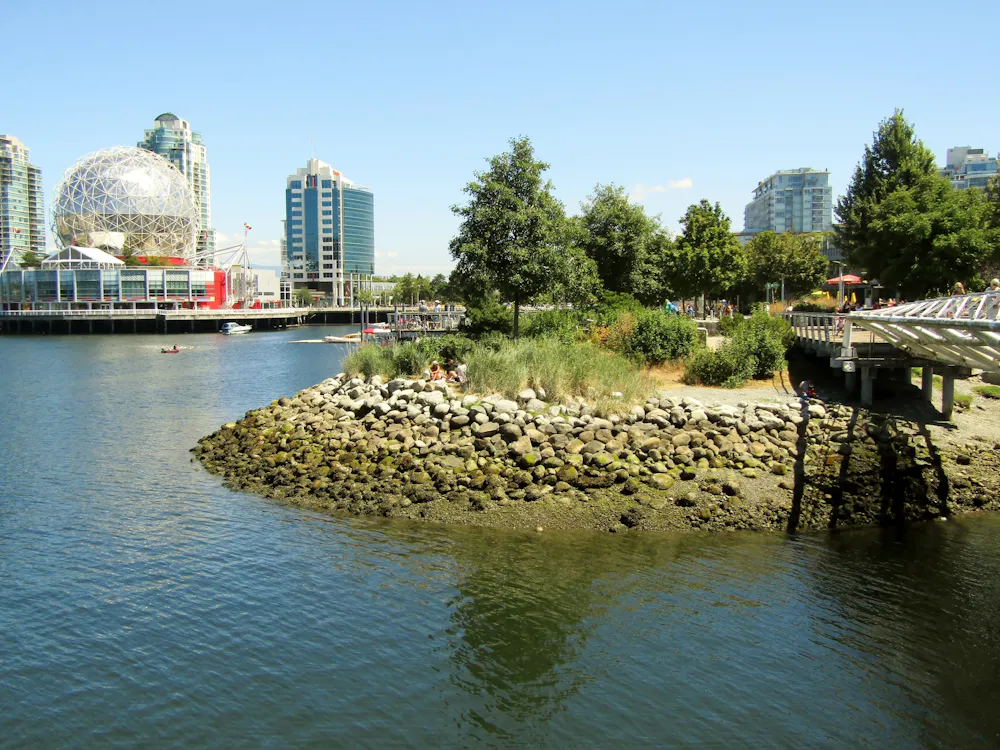
boulders along a shoreline near some trees. Buildings are seen in the background
Riprap along part of Vancouver’s False Creek in July 2020. Given the potential for environmental harm, there have been calls to limit riprap use in British Columbia.
(Shutterstock)

Is it possible to move on from our over-reliance on riprap in B.C.?

During our workshop, experts discussed what needs to happen to support environmentally friendly bank stabilization options.

First off, we need to be talking about the overuse of riprap more. Currently, decision-makers and property-owners are often unaware of the potential harm that riprap can have on our rivers, or that alternatives exist. While many alternatives won’t be appropriate in extreme erosion cases, for the province’s smaller and healthier rivers, they would be ideal.

For this to happen, the bank-stabilization regulation process in B.C. needs to change. Currently it is hard to receive consent or funding to undertake bank strengthening activities outside of emergency riprap installation.

The B.C. government needs to adapt local guidelines and regulations to allow wider use of alternative methods, prioritizing proactive bank strengthening. They can draw on findings from elsewhere in Canada where alternative bank-stabilization options are already being tested.

Shifting away from a dependence on riprap won’t be easy, but in a province that relies on healthy rivers and fish, it should be a priority.

As one workshop attendee put it: “We don’t want to see sterile kilometres of riprap.”

The Conversation

Charlotte Milne receives funding from the Social Sciences and Humanities Research Council of Canada and the Public Scholars Initiative at UBC. The research mentioned in this article received funding from UBC’s Sustainability Scholars Program and support from Resilient Waters and the Watershed Watch Salmon Society.

ref. Overuse of riprap to prevent riverbank erosion is harming B.C. rivers – https://theconversation.com/overuse-of-riprap-to-prevent-riverbank-erosion-is-harming-b-c-rivers-255283

Cumbre 2025: los BRICS abrazan el multilateralismo y piden reformas en las organizaciones globales

Source: The Conversation – (in Spanish) – By Ulf Thoene, Profesor Asociado de Ética Empresarial y Organizacional, Universidad de La Sabana

Banderas de los países que integran el grupo de los BRICS. https://www.shutterstock.com/es/image-photo/photo-flags-brics-membership-concept-summit-2353838495

La cumbre número 17 de los BRICS, que acaba de celebrarse en Río de Janeiro (6 y 7 de julio de 2025), representa un momento crucial para los países emergentes que se han constituido en bloque alternativo al G7, el cual reúne los siete países con mayor peso político, económico y militar a escala global.

El grupo de los BRICS, creado por Brasil, Rusia, India, China y Sudáfrica, cuenta ahora con 10 miembros plenos –dado que persisten dudas sobre la membresía plena de Arabia Saudita, que no ha ratificado su pertenencia– y 10 países socios de diversas regiones del mundo.

BRICS, una fuerza geopolítica global

La Declaración de Río subraya la intención de los BRICS de ir más allá de una plataforma de coordinación económica para convertirse en una fuerza significativa en la geopolítica global. Además, aborda los nuevos y complejos desafíos de seguridad y reafirma su compromiso con un orden mundial multipolar.

Ante los conflictos globales crecientes y la instauración de nuevas políticas comerciales, más proteccionistas (especialmente de EE. UU.), la cumbre resalta la creciente ambición del bloque y su disposición para lograr consensos.

Ausencias destacadas

Ya la cumbre BRICS 2024 (celebrada en Kazán, Rusia) marcó un precedente por su alta participación y una declaración detallada en apoyo del multilateralismo, la cooperación económica y financiera, y los movimientos migratorios entre sus países miembros. Ahora, la presidencia de Brasil prioriza la gobernanza global inclusiva y la colaboración entre naciones en desarrollo.

Sin embargo, han faltado a esta cita dos líderes destacados de los países BRICS: el presidente ruso Vladímir Putin y el presidente chino Xi Jinping. Putin, sobre quien pesa una orden de detención de la Corte Penal Internacional, decidió no asistir por temor a que su avión pudiera ser interceptado. La ausencia de Xi probablemente sea deliberada: Rusia y China dominan el bloque y el líder chino podría haber sido reacio a liderar el encuentro sin la presencia de Putin.

La seguridad como eje central

La Declaración de Río resalta el creciente compromiso de los BRICS con la geopolítica y la seguridad global, una tendencia que ha ido ganando fuerza desde la cumbre de 2022, celebrada en Pekín (China).

Aunque el conflicto en Ucrania recibe menos atención este año, el Medio Oriente y África son preocupaciones principales. Por ello, el presidente brasileño, Luiz Inácio Lula Da Silva, ha propuesto en esta cumbre la reforma del Consejo de Seguridad de Naciones Unidas.

Además, se ha abordado la cuestión del terrorismo con una condena explícita de los ataques en Jammu y Cachemira del pasado abril. La declaración también señala los conflictos en Sudán, Siria y Haití, y hace un llamamiento a la paz y a mantener la acción humanitaria en las zonas en conflicto.

Objetivos económicos y disputas comerciales

A pesar del énfasis puesto en la seguridad global, la misión central de BRICS sigue siendo la coordinación económica y la reforma multilateral. La declaración respalda el desarrollo sostenible, las iniciativas climáticas, la digitalización, la inteligencia artificial, el desarrollo de la ciberseguridad y los programas de desarrollo y ayuda internacional del New Development Bank (NBD).

Sobre el cambio climático, prioridad brasileña, los BRICS rechazan el mecanismo de ajuste de carbono en fronteras aplicado por la UE, al que califican de proteccionista (Artículo 88 de la Declaración de Río).

La declaración expresa la preocupación de los miembros del grupo por las medidas arancelarias unilaterales, que perturban el comercio y contravienen las reglas de la Organización Mundial del Comercio. En cuanto a la discusión sobre la reducción de la dependencia del dólar, los BRICS proponen un sistema de pago propio para disminuir la dependencia de los sistemas financieros occidentales.


Leer más:
New Development Bank, ¿un banco liderado por China para el nuevo orden mundial?


Multipolaridad y gobernanza global

Los BRICS abrazan el multilateralismo y piden reformas para “apoyar las aspiraciones legítimas de los países emergentes y en desarrollo de África, Asia y América Latina, incluyendo los países BRICS, a desempeñar un papel mayor en los asuntos internacionales” y que, en particular, el Consejo de Seguridad de las Naciones Unidas sea “más democrático, representativo, eficaz y eficiente” (Artículo 6).

Este enfoque se alinea con sus críticas a las instituciones nacidas de los Acuerdos de Bretton Woods, como el Banco Mundial y el Fondo Monetario Internacional (FMI), a las que reclama un proceso de reforma para “hacerlas más ágiles, eficaces, confiables, inclusivas, adecuadas a su finalidad, imparciales, responsables y representativas, reforzando su legitimidad” (Artículo 10). Además, defiende iniciativas propias, como el New Development Bank: “reconocemos y apoyamos su creciente papel como un agente robusto y estratégico de desarrollo y modernización en el Sur Global” (Artículo 46).

El presidente brasileño, Lula da Silva, señaló en su intervención que, con el multilateralismo bajo amenaza, está en juego la autonomía de las naciones en desarrollo. .

Desafíos y prioridades estratégicas

Fortalecer instituciones como el New Development Bank y fomentar la cooperación Sur-Sur será crucial para mantener la relevancia de BRICS. Además, su expansión a 20 países, incluyendo miembros plenos como Egipto, Etiopía, Irán, los Emiratos Árabes Unidos e Indonesia, fortalece su influencia global. El bloque representa ya cerca del 50 % de la población mundial, casi el 40 % de su economía en 2023 y más de dos quintas partes de la producción global de petróleo. Sin embargo, este crecimiento complica la construcción de consensos y plantea desafíos sobre la soberanía de los países miembros.

En un mundo volátil, moldeado por guerras comerciales y conflictos regionales, los BRICS enfrentan un equilibrio delicado. El bloque debe tranquilizar a socios occidentales escépticos, como el presidente estadounidense Donald Trump, quien lo ha criticado vehementemente en su red social, Truth Social.

The Conversation

Ulf Thoene no recibe salario, ni ejerce labores de consultoría, ni posee acciones, ni recibe financiación de ninguna compañía u organización que pueda obtener beneficio de este artículo, y ha declarado carecer de vínculos relevantes más allá del cargo académico citado.

ref. Cumbre 2025: los BRICS abrazan el multilateralismo y piden reformas en las organizaciones globales – https://theconversation.com/cumbre-2025-los-brics-abrazan-el-multilateralismo-y-piden-reformas-en-las-organizaciones-globales-260573

Lilo & Stitch: With love, a bereaved child feels safe enough to grieve and grow

Source: The Conversation – Canada – By Elena Merenda, Associate Head of Early Childhood Studies, University of Guelph-Humber

Lilo’s story offers a meaningful glimpse into how grief shows up in children through their emotions and actions. (Disney)

This story contains spoilers about Lilo & Stitch.

At first glance, Disney’s Lilo & Stitch, set in Hawaii, seems like a playful, heartwarming film about an alien’s misadventures and a young girl’s search for connection and friendship. But there’s a deeper story — one about childhood grief in the life of the main character, Lilo, and how she navigates the loss of her parents.

Lilo’s story offers a meaningful glimpse into how grief shows up in children through their emotions and actions.

Grief in childhood is often misunderstood and overlooked. A common misconception is that children don’t grieve because they’re too young to understand loss. But just because children don’t express grief the way adults do, it doesn’t mean they aren’t grieving.

As an early child educator who teaches families and post-secondary students about children’s grief, I often say this: anyone who is capable of loving is capable of grieving — and children are deeply capable of love.

Children express grief through behaviours

Lilo’s grief is never directly named in the film, but it’s everywhere — she lashes out, isolates herself and clings tightly to Stitch. These behaviours mirror how many children express grief through actions rather than words.

Research from the National Child Traumatic Stress Network notes that young children often grieve through behaviour — aggression, regression, somatic complaints or withdrawal. This is tied to their stage of cognitive development.

As the theory of cognitive development by renowned psychologist Jean Piaget outlines, children aged two to seven think concretely and egocentrically, making abstract concepts like death hard to understand.

In one scene, Lilo insists on feeding a sandwich to her pet fish Pudge, believing he controls the weather — an imaginative ritual that helps her feel a sense of control in a world that feels uncertain and unstable. In multiple scenes she refuses to listen to her sister Nani, reflecting how grief often shows up through routines, symbolic actions or emotional withdrawal.

Grief can make children feel ‘different’

The Canadian Alliance for Children’s Grief estimates that one in 14 children in Canada will lose a parent or sibling before age 18. Yet despite how common it is, childhood grief is often overlooked — especially in schools, where emotional pain may go unnoticed.

A dog-like character has his tongue out and teeth bared while smiling.
Feeling ‘different’ may go unnoticed in schools.
(Disney)

In Lilo & Stitch, we see this reality through Lilo. She knows she doesn’t fit in and asks her sister why no one likes her. Her classmates tease her for being “weird” and emotionally reactive. In one scene, she tries to share a handmade bracelet during dance class, only to be mocked and excluded. The moment may seem small but it reveals a deeper truth: grief can make children feel isolated, overwhelmed and fundamentally different from their peers.

Research confirms this. Studies in the Journal of School Psychology show that bereaved children often describe themselves as “not normal” or “different,” especially when their peers haven’t experienced a similar loss. Without safe, validating spaces to process their grief, these feelings can lead to loneliness, behavioural struggles and low self-esteem.

Grief grows with us

Grief in childhood isn’t a single moment — it evolves and deepens over time. As children grow, so does their understanding of what they’ve lost. They often revisit their grief at new developmental stages, carrying it in different ways.

Lilo & Stitch reflects this beautifully. Lilo doesn’t talk much about her parents’ death, but we see her grief in the routines she clings to — like listening to Elvis or sharing old family photos. These aren’t just quirks; they’re ways she keeps her parents close.

This reflects what grief researchers call the continuing bonds theory, which emphasizes that maintaining emotional connections to the deceased can support healthy adaptation. Grief isn’t something children “get over.” It’s something they learn to carry — with support, connection and love.

Healing doesn’t mean Lilo returns to who she was before her parents’ deaths. Her grief remains, but she begins to rebuild her world with Stitch, Nani and her new ‘ohana (family).

They don’t replace what was lost, but they become a space where grief and love can coexist.

One of the film’s most memorable lines captures this truth:

“This is my family. I found it, all on my own. It’s little and broken but still good. Yeah… still good.”

Connection is the path to healing

Just as grief is rooted in love, healing is rooted in connection.

Lilo’s healing comes from presence. Despite the chaos he brings, Stitch stays. Nani, overwhelmed and unsure, keeps showing up.

Their love and steady, unconditional presence allow Lilo to begin feeling safe enough to grieve and grow.

‘Lilo & Stitch’ trailer.

This reflects what attachment research tells us: strong, secure relationships are among the most powerful protective factors for children navigating loss. When a child feels emotionally safe with a caregiver, they’re better able to regulate emotions, build resilience and integrate the pain of loss into their development. In bereavement, the presence of a stable, responsive adult can determine whether a child’s grief becomes traumatic — or transformative.

In Lilo & Stitch, connection becomes both the container for Lilo’s grief and the bridge to her healing. The film gently reminds us: love may be the reason we grieve, but it’s also the most powerful way through it.

How caregivers can support a grieving child

1. Maintain routine and consistency.

In times of grief, structure helps children feel safe. Predictable routines — like mealtimes, bedtime rituals and daily rhythms — offer a sense of stability when everything else feels uncertain

2. Normalize and validate emotions.

Help your child name what they’re feeling and let them know it’s OK. Say things like, “It’s OK to feel that way,” or “Whatever you feel is welcome here.” Validation helps reduce shame and gives children permission to process their grief openly.

3. Answer questions honestly.

Children need truthful, age-appropriate information about what has happened. Avoid euphemisms like “went to sleep” or “passed away,” which can cause confusion. Instead, use clear, simple language: “Their body stopped working and they died.” Honesty builds trust and supports children’s cognitive and emotional development as they process the permanence of death.

4. Seek support.

Grief can feel overwhelming — for children and their parents or caregivers. Reach out to school counsellors, grief therapists or local support groups, because support can reduce isolation, support expression and improve coping in grieving families.

The Conversation

Elena Merenda does not work for, consult, own shares in or receive funding from any company or organisation that would benefit from this article, and has disclosed no relevant affiliations beyond their academic appointment.

ref. Lilo & Stitch: With love, a bereaved child feels safe enough to grieve and grow – https://theconversation.com/lilo-and-stitch-with-love-a-bereaved-child-feels-safe-enough-to-grieve-and-grow-259873

Why are we so obsessed with bringing back the woolly mammoth?

Source: The Conversation – Canada – By Rebecca Woods, Associate Professor, Institute for the History & Philosophy of Science & Technology, University of Toronto

A photograph of a steppe mammoth on display at the Australian Museum in Sydney. (Unsplash/April Pethybridge), CC BY

In just the last several months, de-extinction — bringing back extinct species by recreating them or organisms that resemble them — has moved closer from science fiction to science fact. Colossal Biosciences — an American for-profit de-extinction startup headed by geneticists George Church and Beth Shapiro — announced two major achievements almost back-to-back.

In the first, scientists spliced part of the woolly mammoth’s genome into mice to create “woolly mice,” incredibly cute pom-pom like rodents sporting coats that express the genes of long-extinct woolly mammoths.

Reuters reports on the woolly mice developed by Colossal Biosciences.

Just a few weeks later, Colossal announced an even bigger achievement, claiming to have brought back the dire wolf, a contemporary of the woolly mammoth who, like their Ice Age proboscidean co-travellers, last roamed the Earth roughly 10,000 years ago.


Read more:
Colossal Bioscience’s attempt to de-extinct the dire wolf is a dangerously deceptive publicity stunt


Mammoth popularity

Woolly mammoths are at the forefront of these controversial de-extinction efforts. Despite a deep bench of more recently extinct species — the dodo, the moa, passenger pigeons, the bucardo, quagga, thylacine, aurochs and a whole host of others — readily available to take centre stage in de-extinction efforts, woolly mammoths figure prominently in de-extinction stories, both scientific and popular.

Woolly mammoths featured prominently in the imagery of Revive & Restore, a “genetic rescue” conglomerate of scientists and futurists headed by tech-guru Steward Brand; in 2021, Colossal “established ownership” over woolly mammoth revival. Colossal’s own logo visualizes CRISP-R, the gene-splicing technology that facilitates de-extinction, and the signature spiralled tusks of Mammuthus primigenius.

In popular culture, woolly mammoths have been a source of fascination for the last several centuries. Thomas Jefferson famously held out hope that live mammoths would be found beyond the frontier of American colonialism in the late-1700s, while early excavations of American mastodons were major events in the early 1800s. American painter Charles Willson Peale captured the first such excavation in oils, and later capitalized on that mastadon’s skeleton in his Philadelphia museum.

More recently, Manny the mammoth featured in the ongoing Ice Age animated film franchise, first launched in 2002.

Climate icons

At the same time, woolly mammoths have also become an emblem of the contemporary climate crisis. During the recent wave of defacing famous artwork in order to draw attention to the climate crisis, environmental activists painted the (fortunately artificial) tusks of the Royal B.C. Museum’s woolly mammoth model bright pink.

In a 2023 publicity stunt, the Australian cultured-meat startup, Vow, unveiled a mammoth meatball produced out of the woolly mammoth’s genome with sheep DNA as filler. Not for sale, the mammoth meatball was scorched before an audience at the Dutch science museum, Nemo.

The stunt was intended to call attention, again, to the plight of the Earth’s climate, the unsustainability of industrialized food systems and the potential for lab-grown meat to square this particular circle.

Model animals

For a creature that no human being has ever seen live and in the flesh, woolly mammoths certainly get a lot of media exposure. How did this long-extinct species become the emblem of contemporary extinction and de-extinction?

People have been interacting with the remains of woolly mammoths for hundreds of years. Dig a hole deep enough almost anywhere in the northern hemisphere, and you are apt to come across the bones or maybe the tusks of extinct mammoths or mastodons.

In early modern Europe, mammoth fossils were famously interpreted as the bones of unicorns and giants before being recognized as belonging to elephant-like creatures around 1700. Only around 1800 were mammoths recognized as a distinct and extinct species of proboscidea.

Elsewhere in Arctic regions, especially Siberia, Indigenous Peoples were familiar with mammoth remains preserved by permafrost. As rivers and their tributaries surged during annual thaws, whole carcasses of mammoths (and woolly rhinos) were sometimes exposed.

Local peoples who came across these remains, apparently recently dead but belonging to creatures they never saw walking the Earth’s surface, surmised that they were great burrowing rodent-like animals that tunnelled through the ground and perished if they accidentally came into contact with atmosphere.


Read more:
Ancient DNA suggests woolly mammoths roamed the Earth more recently than previously thought


Around the Arctic, including in Alaska, permafrost prevented the fossilization of mammoth tusks as well as bodies, and this ice ivory was — and remains — an important element of Arctic economies, carved locally and exchanged into historically regional, and now global, markets.

Continued relevance

Despite their association with the distant past, woolly mammoths have long resonated with modern human cultures as their fossilized or preserved body parts entered economic practices and knowledge systems alike. But as the extinction of once numerous species like the passenger pigeon, the American bison and African elephant began to loom over the late 19th century, woolly mammoths took on new meanings in the context of modern extinction and emergent understandings of human evolution.

a mural of woolly mammoths
A mural by by paleoartist Charles R. Knight depicting wooly mammoths, displayed at the American Museum of Natural History.
(United States Geological Survey)

Revolutions in geology, archeology, paleontology and related disciplines were changing long-held assumptions about the origin of humankind.

Narratives of the rise of “man the hunter” arose in natural history institutions such as the American Museum of Natural History and the Field Museum in Chicago. These origin stories were explicitly connected to the presumed extinction of woolly mammoths and their evolutionary relatives, the mastodons.

These led to some of the most powerful expressions of mammoths in visual form, like the frescoes and paintings produced by renowned paleoartist Charles R. Knight.

At the same time, cave paintings in France, Spain and elsewhere came to light in the early 20th century. For example, the 40,000-year-old frescoes at Rouffignac, France clearly depicting woolly mammoths were interpreted as further evidence of this deep and powerful historical connection.

It is this connection — the association of the rise of modern humankind with the decline and extinction of the woolly mammoth — that feeds today’s continued fascination. Notions of human complicity in extinction stories have long been embedded in modern scientific understandings of woolly mammoths. It is no accident that woolly mammoths are so central to de-extinction projects and climate activism alike.

The Conversation

Rebecca Woods received funding from the Social Sciences and Humanities Research Council of Canada.

ref. Why are we so obsessed with bringing back the woolly mammoth? – https://theconversation.com/why-are-we-so-obsessed-with-bringing-back-the-woolly-mammoth-253432

À quand des déchets plastiques biodégradables, à composter chez soi ?

Source: The Conversation – France (in French) – By Jules Bellon, Doctorant en science des matériaux, UniLaSalle

Et si, au lieu de les trier pour les recycler, on pouvait simplement jeter ses emballages plastiques au compost, avec nos déchets organiques ? Les plastiques biodégradables semblent la meilleure solution pour réduire la pollution produite par ces matériaux. La biodégradabilité de ces matériaux doit cependant encore être améliorée dans ces conditions.


Ils sont partout, et rien ne semble les arrêter. Les plastiques ont envahi notre quotidien, nos paysages… et même nos organismes. Depuis les années 1950, la production de ce matériau à la fois pratique, polyvalent et bon marché a explosé. Aujourd’hui, tous les secteurs y ont recours : emballages, vêtements, objets du quotidien, instruments de musique, dispositifs médicaux… jusqu’aux cœurs artificiels, dont certaines parties sont désormais faites de plastique.

Face à cette omniprésence, le recyclage tente de limiter l’impact environnemental, mais il reste insuffisant. Le plastique s’accumule dans les océans en d’immenses plaques flottantes à la dérive, mais aussi de façon invisible sous forme de micro – et nanoparticules que nous ingérons en mangeant, en buvant, ou en respirant.

Contre cette pollution massive, il existe des leviers d’action, parfois méconnus, qui méritent toute notre attention. Parmi eux : les plastiques biodégradables, à condition de leur offrir des conditions de fin de vie réellement adaptées.


Du lundi au vendredi + le dimanche, recevez gratuitement les analyses et décryptages de nos experts pour un autre regard sur l’actualité. Abonnez-vous dès aujourd’hui !


Des matériaux qui se dégradent rapidement

À l’image de la cigarette, le meilleur plastique est sans doute celui qu’on ne consomme pas. Mais dans certains cas, il reste difficile de s’en passer complètement. Prenons un exemple courant : les barquettes de viande en supermarché. Leur emballage plastique protège les aliments des contaminations microbiennes et prolonge leur durée de conservation, limitant ainsi le gaspillage alimentaire.

C’est dans ce contexte que les plastiques biodégradables prennent tout leur sens. Bien qu’ils soient souvent issus de ressources renouvelables – végétales ou microbiennes – ce n’est pas toujours le cas : un plastique peut être biodégradable sans être biosourcé, et inversement. Pour les plastiques biosourcés, leurs constituants élémentaires peuvent être extraits, par exemple, de l’amidon contenu dans les grains de blé. D’autres, comme les polyhydroxyalcanoates (PHAs), sont synthétisés directement par certaines bactéries en tant que réserves d’énergie. Ces polymères sont déjà utilisés aujourd’hui pour la fabrication de pailles ou de vaisselle à usage unique.

Contrairement aux plastiques conventionnels, qui peuvent persister pendant des siècles dans l’environnement, ces matériaux sont conçus pour se biodégrader plus rapidement. Ils ont la capacité de se décomposer en éléments naturels (eau, dioxyde de carbone, biomasse) sous l’action de micro-organismes, à condition que les bonnes conditions de température, d’humidité et d’aération soient réunies. Comme tous les plastiques, ils sont constitués de chaînes de molécules attachées entre elles. Mais dans les plastiques biodégradables, ces liaisons chimiques sont plus fragiles, notamment les liaisons dites esters ou glycosidiques. Cela les rend accessibles à des micro-organismes capables de les dégrader, en les utilisant comme source de carbone et d’énergie. Dans les bonnes conditions, ce processus permet d’éviter la formation de micro – ou nanoparticules persistantes.

En comparaison, les plastiques conventionnels ne sont pour l’instant recyclés qu’en faible proportion. Et contrairement au verre ou au métal, leur recyclage ne peut être répété indéfiniment : à chaque cycle, leurs propriétés mécaniques se détériorent et il est donc nécessaire d’ajouter à la matière recyclée du plastique neuf. L’incinération, autre option, reste coûteuse et génère des émissions polluantes, malgré les dispositifs de récupération d’énergie.

Améliorer la filière comme alternative au recyclage

Une fois dégradés par les micro-organismes, ces plastiques sont transformés en composés simples, comme du dioxyde de carbone ou de l’eau, et permettent aux bactéries de se multiplier. Ils ne nourrissent pas directement les plantes, car ils sont le plus souvent dépourvus des éléments minéraux nécessaires à leur nutrition. En revanche, une fois dégradés, ils peuvent malgré tout réintégrer le cycle biologique des sols en soutenant l’activité microbienne.

Leur biodégradabilité peut même être améliorée en ajoutant certains constituants organiques dans leur composition. Ce peut-être par exemple des déchets provenant de l’industrie agroalimentaire, comme de la poudre de pelures d’orange ou de bananes, après une étape de séchage et de broyage. En plus d’accélérer le processus de biodégradation, cela permet de valoriser économiquement ces biodéchets, qui finissent souvent en décharge et polluent les sols et les cours d’eau environnants.

Cette capacité à disparaître a cependant un coût : les plastiques biodégradables présentent souvent des propriétés mécaniques plus limitées, encore variables selon les formulations. Par exemple, les sacs en plastique biodégradables peuvent avoir une plus faible résistance à la traction, les rendant plus susceptibles de se rompre sous le poids de leur contenu. Ils sont également, pour l’instant, plus coûteux à produire que leurs équivalents conventionnels. Toutefois, le développement de filières industrielles dédiées et la mise en place d’unités de production à grande échelle pourraient, à terme, permettre de réduire ces coûts grâce à des économies d’échelle.

Le compostage domestique des plastiques : (presque) que des avantages

Mais attention : pour qu’un plastique biodégradable se décompose réellement, certaines conditions doivent être réunies. Cela nécessite une température et une humidité suffisantes, ainsi qu’une population microbienne capable de rompre les liaisons chimiques spécifiques du matériau. Or, tous les environnements naturels ne remplissent pas ces critères. C’est pourquoi il est essentiel de leur assurer une fin de vie appropriée – par exemple, dans un tas de compost, milieu riche en bactéries et en champignons. On distingue alors deux types de compostage : le compostage centralisé (ou industriel) et le compostage domestique.

Le compostage industriel repose sur la collecte des biodéchets, leur transport et leur traitement dans des installations spécifiques. Ce modèle exige des infrastructures coûteuses, du personnel qualifié, une logistique importante, et génère une empreinte carbone liée au transport. En France, cette filière reste encore en développement. Si elle devait devenir un canal privilégié pour les plastiques biodégradables, elle nécessiterait un effort de structuration conséquent.

À l’inverse, le compostage domestique permet d’éviter en grande partie ces contraintes. Depuis janvier 2024, le tri des biodéchets à la source est devenu obligatoire pour les ménages. Les emballages à usage unique portant une certification de compostabilité domestique (comme la norme NF T51-800) peuvent donc être ajoutés aux déchets alimentaires dans un bac à compost familial.

La dégradation des plastiques biodégradables est certes plus lente en compostage domestique qu’en compostage industriel, en raison de températures plus basses et de conditions moins contrôlées. Pourtant, ce mode de traitement local, sans coûts de collecte ni de transport, présente un réel potentiel dans une logique d’économie circulaire. Pour que cette filière décentralisée puisse se développer de manière crédible, accessible et efficace, il reste toutefois essentiel d’améliorer la biodégradabilité des plastiques, en particulier celle des principaux polymères utilisés dans les formulations.

Améliorer le processus et sensibiliser par l’action individuelle

Plusieurs pistes émergent pour relever ce défi, comme le développement de biocomposites intégrant des coproduits organiques, ou encore des stratégies d’enrichissement biologique du milieu de compostage. Par exemple, des souches microbiennes spécifiques ou des additifs naturels (comme le lait écrémé) peuvent stimuler l’activité microbienne et accélérer la biodégradation. Ces approches pourraient donner lieu à la commercialisation de nouveaux « activateurs de compost », utilisables aussi bien par les ménages que par les collectivités ou entreprises assurant la gestion de composteurs dits communautaires – une autre voie prometteuse pour un compostage décentralisé, à l’échelle des quartiers ou des communes.

Enfin, au-delà de l’aspect technique, ce modèle a une vertu éducative : en participant à la dégradation des emballages, les consommateurs prennent conscience de leur impact environnemental. Cette prise de conscience peut les inciter à réduire leur production de déchets, à privilégier le vrac ou à adopter des contenants réutilisables. Et c’est ainsi que se met en marche, peu à peu, un véritable cercle vertueux.

The Conversation

Jules Bellon a reçu un financement de la Région Normandie (RIN50: 22 E01400 – 00123402) afin de mener ses travaux de recherche.

Feriel Bacoup et Gattin Richard ne travaillent pas, ne conseillent pas, ne possèdent pas de parts, ne reçoivent pas de fonds d’une organisation qui pourrait tirer profit de cet article, et n’ont déclaré aucune autre affiliation que leur poste universitaire.

ref. À quand des déchets plastiques biodégradables, à composter chez soi ? – https://theconversation.com/a-quand-des-dechets-plastiques-biodegradables-a-composter-chez-soi-257914