Returning to the office isn’t the answer to Canada’s productivity problem — and it will add pressure to urban housing

Source: The Conversation – Canada – By Dilara Baysal, Research Fellow in Sociology, Concordia University

As companies face pressure to increase productivity, many are calling workers back to the office — even though there is limited evidence that return-to-office policies actually improve innovation or performance.

In cities like Toronto and Vancouver, where many major companies are headquartered, this is putting pressure on people to live near expensive downtown areas.

As of April 2025, average one-bedroom rents were $2,317 in Toronto and $2,536 in Vancouver, with North Vancouver even higher at $2,680. If return-to-office policies continue, more workers may be forced into these pricey city centres, adding pressure to already overheated housing markets.

Since early 2025, return-to-office policies have added to Canada’s housing stress. The Royal Bank of Canada, for instance, now requires staff in the office four days a week, and Amazon ended remote work in January. While rents haven’t jumped yet, similar policies in the U.S. have already pushed up demand, and may be a sign of what’s to come.

In Washington, D.C., rents rose 3.3 per cent after federal employees were called back to offices. Cities like New York and San Francisco also saw rent increases linked to companies like JPMorgan Chase, Meta and Salesforce reversed remote work policies.

The myth of office productivity

According to the Bank of Canada, Canada’s economy is being negatively affected by low productivity. Low productivity slows Canada’s economic growth and keeps wages low. It also makes inflation worse because supply can’t keep up with demand. A productive economy meets demand more easily, keeping prices stable.

In response, many companies are pushing return-to-office as the answer. RBC CEO Dave McKay endorsed a return to the office back in 2023, saying that “the absence of working together” has hurt innovation and productivity.

At Google, under mounting pressure to compete in artificial intelligence, co-founder Sergey Brin also pushed for full-time office work, calling a 60-hour week the “sweet spot” for productivity.

But recent research shows the story isn’t so simple. A University of Chicago working paper found that strict return-to-office rules can cause senior staff to leave, which hurts innovation.


Read more:
Working one day a week in person might be the key to happier, more productive employees


Another study of 48,000 knowledge workers in India found that hybrid setups — where some people are in the office and others work from home — can make it harder to share ideas and work together.

Meanwhile, a Stanford-led study found that working in the office just two days a week kept productivity strong and cut employee turnover by 33 per cent.
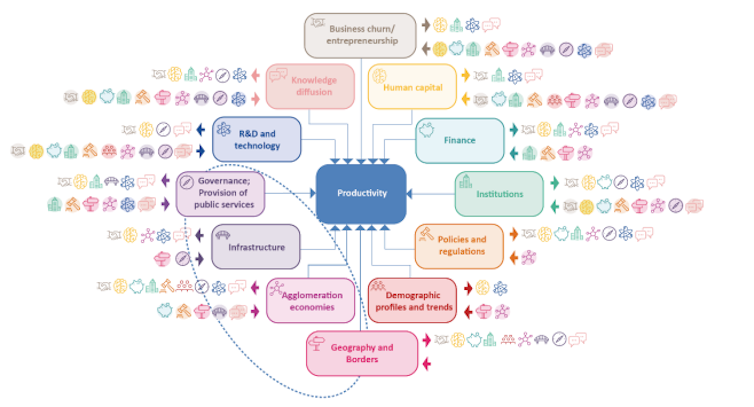
A mind map with productivity in the centre and different determinants of productivity branching out from it, including: entrepreneurship, human capital, finance, institutions, policies/regulations, demographic profiles and trends, infrastructure, governan
The determinants of productivity and their underlying factors. These determinants connect across industries, businesses and places.
(Organization for Economic Co-operation and Development), CC BY

Where people live matters more

Return-to-office mandates also aren’t a guaranteed way to boost productivity. A 2023 study supported by housing organizations across Canada found that affordable, well-located housing helps people find better jobs and specialize in their work.

But when housing costs are high and commutes are long, productivity drops, especially for lower-income workers. Long commutes and high living costs create stress, limit mobility and cause people to miss out on job opportunities.

Studies show that investing in technology and training workers matters much more. Research from the Canadian Research Data Centre Network finds that workplace training improves productivity in most sectors.

A recent report from the Canada Mortgage and Housing Corporation also shows that high housing costs make it harder for many people to live in big cities, which ultimately reduces diversity in the workforce and weakens the economy.

Affordable housing could boost productivity

Housing in Canada is often viewed in two ways. One treats it as a commodity, where prices follow supply and demand. In this view, policies focus on increasing supply and offering market incentives. The other sees housing as a public need and a basic right, and calls for government action to ensure affordability and stability.


Read more:
Housing is both a human right and a profitable asset, and that’s the problem


In practice, market forces can undermine policies designed to meet housing needs and ensure affordability. In Toronto, for example, developers resisted inclusionary zoning rules that require or encourage developers to include a certain percentage of affordable housing units within new residential developments. Instead, they delayed projects or chose to build high-end condos in different zones.

This tension between housing as a commodity and housing as a public good is central to Canada’s current housing strategy. Prime Minister Mark Carney’s government has pledged to build 500,000 new homes annually by 2035 using tools like public lands, modular housing and tax incentives.

While this supply-focused strategy targets long-term housing needs, it must also account for today’s complex economic realities such as inflation, increasing unemployment and economic stagnation due to lagging productiviy.

Without tackling affordability and access directly, building more homes alone won’t be enough.
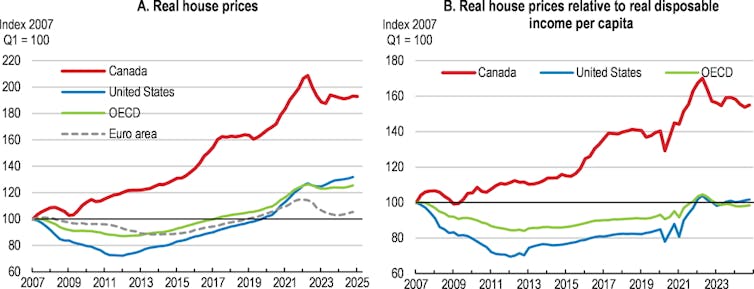
Two line graphs showing how housing has increased since 2004 in Canada
Rising home prices and rents have played a major role in driving inflation. In Canada’s Consumer Price Index, shelter makes up about 29 per cent of overall household spending.
(Organization for Economic Co-operation and Development), CC BY

The real foundation of a productive economy

Return-to-office policies often focus too much on one thing: how much each worker produces. But that narrow view of productivity ignores what really supports good work: access to affordable housing, time for training and flexibility to relocate for better job opportunities.

To address productivity challenges, companies should invest in job-specific training, digital skills and ongoing learning to help employees adapt to new tools and processes, and the should offer more flexibility. What workers need most are affordable homes, shorter commutes and real opportunities to grow — not added stress and rising costs.

The Conversation

Dilara Baysal does not work for, consult, own shares in or receive funding from any company or organisation that would benefit from this article, and has disclosed no relevant affiliations beyond their academic appointment.

ref. Returning to the office isn’t the answer to Canada’s productivity problem — and it will add pressure to urban housing – https://theconversation.com/returning-to-the-office-isnt-the-answer-to-canadas-productivity-problem-and-it-will-add-pressure-to-urban-housing-260395

International students’ stories are vital in shaping Canada’s future

Source: The Conversation – Canada – By Emilda Thavaratnam, PhD student, Leadership and Higher Education, University of Toronto

Over the past decade, international students have navigated a complex and challenging landscape shaped by neoliberal policies.

Neoliberal economic and political ideology upholds entrepreneurship, individualism, free trade, open markets, minimal government intervention and reduced public services for citizens.


Read more:
What exactly is neoliberalism?


Neoliberal governance has transformed higher education into a mechanism for economic growth, shifting the burden of funding onto students.

As my doctoral research examines, international students in Ontario’s colleges of applied arts and technology face barriers related to neoliberal restructuring. Drawing on interviews with students and front-line staff, my study examines experiences across five key themes: pre-arrival, housing insecurity, pandemic survival, precarious labour and future aspirations.

Through these challenges, the resilience and drive of international students to build community reveal powerful forms of everyday resistance.

This has been seen through their front-line work during the pandemic, their persistent pursuit of education and their collective efforts to challenge marginalization. Their stories are vital in shaping Canada’s social, economic and educational fabric.

Shifts towards neoliberal education

Since the late 1970s, higher education in Ontario and elsewhere has experienced significant changes. In the province, public funding per student has steadily declined, shifting the cost onto students, with higher educational institutions adopting models of privatization and corporatization to survive.

Though higher education continues to serve the public good, these changes reflect a broader adaptation to the new economic realities driven by market principles.

As David Harvey, a scholar of urban and political economy, explains, neoliberal approaches hold that economic growth and prosperity occur when markets are allowed to operate with minimal government regulation. Over time, these approaches have shaped policies and practices globally across various sectors, including education, media, corporations and international institutions such as the International Monetary Fund.

Neoliberal policies are presented as naturally occurring or unavoidable; however, this framing prioritizes market principles over social protections and often masks the deeper political and social dynamics.

Education as a product serving the job market

Neoliberal values have reshaped the purpose and practice of higher education. The problem with this market-driven approach is it often prioritizes individual gain and profit over social equity and the public good. This shift aligns learning with market-oriented approaches.

Scholars concerned with the adverse effects of neoliberal education policy highlight how education is often treated as a product designed to serve economic interests, with measurable outcomes and links to the job market becoming the primary focus.

This shift is evident when policymakers and institutions prioritize competition, performance, metrics and individual achievement — often at the expense of collaboration, critical thinking and shared goals.

COVID-19 pandemic

The COVID-19 pandemic highlighted the effects of neoliberal ideology in higher education, revealing both the precarity of post-secondary finance and living conditions for many international students.


Read more:
The pandemic exposed the vulnerability of international students in Canada


When colleges and universities faced pandemic closures and uncertain enrolment, international students came under scrutiny as learners who pay high fees. They contribute more than $21 billion annually to the Canadian economy and pay an average of five times more than domestic students.

It also became clear that international students make significant contributions to Canada by working on the front lines in sectors such as health care, long-term care and food supply chains.

At the same time, this situation revealed broader tendencies rooted in the neoliberal market logic.

During the pandemic, the federal government acknowledged how it has positioned international students as a flexible, commodified labour resource integral to the Canadian economy and essential services. For example, in April 2020, Immigration, Refugees and Citizenship Canada announced it would “temporarily lift the 20 hour per week work restriction on study permit holders working off-campus during their academic session, provided they are working in an essential service or function.”

While international student contributions are vital, this framing begs deeper questions around the protection of international students’ labour rights, student well-being and potential exploitation.

Housing, food insecurity, high tuition

Before the pandemic, many international students struggled with housing, food insecurity and tuition payments due to work restrictions and financial constraints.

With the current cap in place as of 2024, it’s ironic that international students have been treated as both “essential” and “disposable” simultaneously.

Despite facing housing insecurity, food shortages and inaccessible health care, international students have continued to demonstrate their resilience and resistance. Their efforts extend beyond individual acts of survival.

Post-pandemic protest

International students have also organized petitions, protests and advocacy campaigns to challenge unjust policies.

For example, in November 2022, hundreds of students (domestic and international) rallied at the Ontario legislature in Toronto under the banner “Need or Greed.” A coalition of student associations representing 120,000 students united to protest.

The protests were partly a response to unfair and unpredictable jumps in already high tuition fees for international students: the average undergraduate international tuition fees in Ontario rose from about $35,000 to just under $50,000 between 2018 and 2025. The coalition urged the provincial government and Colleges Ontario to freeze tuition for international students.

Following these efforts, nationwide protests erupted in August 2024 when 70,000 international student graduates faced possible deportation due to tightened immigration rules. Students set up encampments outside the Prince Edward Island legislative assembly for three months to protest the 25 per cent cut in permanent resident nominations, which left many students in limbo.

A notable aspect of this activism was the solidarity shown from labour organizations and people across the country. Laura Walton, president of the Ontario Federation of Labour, joined the protests in solidarity, stating: “Your right is our fight.

The Naujawaan Support Network, an advocacy group for youth and international students based in Brampton, Ont., issued a statement declaring:“International students are not the cause of the crisis, but we are being made into scapegoats.


Read more:
International students cap falsely blames them for Canada’s housing and health-care woes


Power of collective organizing

Collective organizing and calls for action are powerful acts of resistance that transcend the neoliberal ideology of individualism. Through petitions and protests, international students demonstrate a profound commitment to their education and aspirations.

As Canada continues to welcome international students, and post-secondary institutions, governments and public sector organizations navigate turbulent economic times, it’s essential to uphold the rights of international students.

It’s also essential to provide the support necessary for them to succeed and affirm their value as vital members of the community.

International students’ resilience offers a valuable lesson about the human capacity to reframe challenges and persist. Students and citizens across the country have a role in celebrating their contributions and building bridges to foster more resilient communities.

The Conversation

Emilda Thavaratnam does not work for, consult, own shares in or receive funding from any company or organisation that would benefit from this article, and has disclosed no relevant affiliations beyond their academic appointment.

ref. International students’ stories are vital in shaping Canada’s future – https://theconversation.com/international-students-stories-are-vital-in-shaping-canadas-future-258271

Gene-edited pigs may soon enter the Canadian market, but questions about their impact remain

Source: The Conversation – Canada – By Gwendolyn Blue, Professor, University of Calgary

The Canadian government is currently considering approving the entry of gene-edited pigs into the food system.

Using CRISPR gene-editing technology, genetic changes can be created precisely and efficiently without introducing foreign genetic material. If approved, these pigs would be the first gene-edited food animals available for sale in Canadian markets. My research examines how including the public in decision-making around emerging applications of genomics can help mitigate potential harms.

These pigs are resistant to porcine reproductive and respiratory syndrome (PRRS), a horrible and sometimes fatal disease that affects pigs worldwide. PRRS has significant economic, food security and animal welfare implications.


Read more:
What is gene editing and how could it shape our future?


The United States Food and Drug Administration recently greenlit the commercial production of gene-edited pigs. Will the Canadian government follow suit?

AquAdvantage and EnviroPig

In 2016, Canada approved the first transgenic animal for human consumption — an Atlantic salmon called AquAdvantage salmon that contains DNA from other species of fish.

This approval came more than 25 years after the genetically modified fish was created by scientists at Memorial University in Newfoundland. The approval and commercialization of AquAdvantage salmon faced strong public opposition on both sides of the border, including protests, supermarket boycotts and court battles. In 2024, the company that produced AquAdvantage salmon announced that it was shutting down its operations.


Read more:
The science and politics of genetically engineered salmon: 5 questions answered


In 2012, the Canadian government approved the manufacture of a transgenic pig known by its trade name, EnviroPig. Created by scientists at the University of Guelph, EnviroPigs released less phosphorus than conventionally bred pigs.

EnviroPig did not make it to market; the same year, the University of Guelph ended the EnviroPig project. Funding for the project had been suspended, in part because of consumer concerns.

Government regulation

Some researchers argue that government regulation of gene-edited animals should be less restrictive than for transgenic techniques. Gene editing introduces genetic changes that can occur with conventional animal breeding that is not subject to regulation. Gene-edited crops in Canada are treated the same as conventionally bred crops.

Others insist that stringent government regulation is necessary for gene editing to identify potential problems and ensure that laws keep up with industry and scientific ambition. Regulation plays a vital role in minimizing risk, encouraging public involvement and building trust.

Social science research has, for decades, demonstrated that resistance to biotechnology is not because of the public’s lack of knowledge, as is often argued by biotechnology proponents. Public resistance to biotechnology is better understood as a rejection of potential harms imposed by governments and industry without public input and consent.

Ethical, moral, cultural and political concerns

At present, little opportunity exists for public engagement in Canadian assessments of gene-edited animals.

Similar to the U.S., Canada does not have specific gene technology regulation. Rather, the federal government relies on pre-existing environmental and food safety legislation. Canadian regulatory agencies use a risk, novelty and product-based approach to assess animal biotechnology. From a regulatory standpoint, distinctions between technical processes — like transgenic modification versus gene editing — are less important than the safety of the final product.

The Canadian government has recently updated its federal environmental and health regulations. This includes introducing mandatory public consultations for animals (vertebrates, specifically) created using biotechnology.

Even with these changes, there’s still room for improvement. Public engagement is limited to consultations conducted within a short time frame. Interested parties are invited to provide scientific information about potential risks of animal biotechnology to human health or the environment, but comments that address ethical, moral, cultural or political concerns are not taken into consideration.

More broadly, regulatory and academic debates about the gene editing of animals are largely informed by scientists and industry proponents with considerably less input from the public, Indigenous communities and social sciences and humanities researchers.

Consulting the public

From a social standpoint, the process by which gene editing is assessed matters as much as the safety of the final product. Inclusive public engagement is essential to ensure that the production of gene-edited food animals aligns with societal needs and values.

Reactions to gene technologies are based on underlying values and beliefs, and sustained opportunities for public reflection and deliberation are vital for responsible innovation.

Important questions should be addressed: Who will reap the benefits of gene-editing techniques? Who will bear the costs and harms? What are the potential implications, including hard-to-anticipate social and political changes? How should decision-making proceed to ensure that Canadians have sufficient opportunities for input?

Currently, for the gene-edited pigs, members of the public can submit comments to the government until July 20, 2025.

Public reactions to previous biotech food animals in Canada — including AquAdvantage salmon and the EnviroPig — show that lack of inclusive engagement can contribute to the rejection of animal biotechnology.

The Conversation

Gwendolyn Blue receives funding from the Social Sciences and Humanities Research Council. She is a member of Gene Editing for Food Security and Environmental Sustainability, a multi-university consortium based at McGill University, and funded by the Natural Sciences and Engineering Research Council of Canada.

ref. Gene-edited pigs may soon enter the Canadian market, but questions about their impact remain – https://theconversation.com/gene-edited-pigs-may-soon-enter-the-canadian-market-but-questions-about-their-impact-remain-260627

El aumento de temperaturas hace estragos en los insectos acuáticos: así lo hemos estudiado

Source: The Conversation – (in Spanish) – By Viktor Baranov, Investigador Ramon y Cajal, en ambito de Ecologia y Paleontologia de insectos y cambio global, Estación Biológica de Doñana (EBD-CSIC)

Especie del género Chironomus pertenece a la familia Chironomidae Viktor Varananov, CC BY

Si se mantiene el ritmo actual de emisión de gases, la temperatura media global aumentará 2 °C hacia mediados de siglo, provocando fenómenos meteorológicos extremos más frecuentes, el ascenso del nivel del mar y olas de calor prolongadas.

El calentamiento global también amenaza los beneficios de la naturaleza, conocidos como “servicios ecosistémicos”: disponibilidad de agua, pesca, recreación y valores estéticos y culturales.

Estos servicios que sostienen nuestras vidas dependen completamente del agua dulce, cuyos ecosistemas, incluida su fauna, están siendo perjudicados por los efectos del cambio climático.

Y de entre todos los animales de agua dulce en riesgo, los insectos acuáticos son especialmente vulnerables. En la Lista Roja de la biodiversidad española, cuatro especies de insectos acuáticos están en peligro crítico de extinción. Se trata del escarabajo Cybister vulneratus y tres plecópteros, moscas de las piedras: Leuctra bidula, Nemoura rifensis y Protonemura gevi. Este último, un insecto cavernícola, es endémico de España, lo que significa que no vive en ningún otro lugar.

Agentes invisibles pero imprescindibles

Los insectos acuáticos son esenciales para el buen funcionamiento de ríos y lagos. No obstante, en una investigación que llevamos a cabo en el año 2020 mostramos cómo un aumento de solo 1.8 °C en la temperatura media anual podía reducir en hasta un 82 % la abundancia de especies sensibles en apenas 42 años. Un fenómeno que ha ocurrido incluso en reservas naturales con escasa intervención humana.

En otro trabajo en el que se analizaron poblaciones de mosquitos no picadores en una reserva de Alemania central, detectamos una fuerte disminución en su capacidad de dispersión y reproducción tras un aumento de 1 °C durante un periodo de ocho años. Además, hemos documentado una tendencia general al menor tamaño corporal en insectos acuáticos en climas cálidos.

Las anteriores observaciones nos llevaron a una pregunta central: ¿cómo influye el aumento de temperatura en el crecimiento, tamaño y supervivencia de estos insectos?


Leer más:
El cambio climático provoca la desaparición global de insectos: algunas zonas agrícolas muestran un descenso del 63 %


Un experimento controlado

El tamaño corporal es una variable clave en la biología. No sólo permite anticipar la capacidad de supervivencia y reproducción de este grupo de animales, sino también comprender cómo interaccionan con el calor para poder prever el futuro de los ecosistemas acuáticos.


Leer más:
¿Por qué ahora impactan menos insectos en el parabrisas del coche?


Con el fin de responder nuestra pregunta, realizamos un experimento con mosquitos no picadores, ya que son buenos modelos para estudiar los efectos del cambio ambiental en la fauna de agua dulce. Para ello, los criamos en tanques de prueba, recintos experimentales que simulan ecosistemas con ciertas variables controladas, conocidos como mesocosmos.

Diseñamos dos grupos principales: uno mantenido a 20 °C y otro a 30 °C, dentro de los cuales establecimos subgrupos con diferentes niveles de oxígeno disuelto, desde valores normales, un rango 100 %, 75 % y 50 % de saturación, hasta la mitad del nivel habitual.

El oxígeno como factor clave

Los resultados de nuestro ensayo fueron rotundos: los mosquitos no picadores se hicieron hasta un un 8-10 % más pequeños en ambientes cálidos con bajo oxígeno. Esto indica que el calor no es el único factor que causa el encogimiento.

El factor determinante parece ser la disminución del oxígeno disuelto, y su causa es fisiológica. A mayor temperatura, el metabolismo aumenta y los insectos necesitan más oxígeno. Pero el oxígeno se disuelve peor en agua caliente, generando un desequilibrio entre una mayor demanda y una menos disponibilidad. Y este desajuste limita el crecimiento de los insectos.

Desarrollo más rápido, pero menos sostenible

En la mayoría de los tanques de prueba, los mosquitos completaron siete u ocho generaciones, con una duración promedio de 18,5 días por generación. En condiciones de más calor y menos oxígeno, este tiempo se redujo a entre 17,3 y 13,4 días. Sin embargo, en esos mismos entornos las tasas de mortalidad aumentaron.

Después de 120 días, dejaron de emerger adultos en los tanques de prueba cálidos con bajo oxígeno, poniendo en evidencia que la alta mortalidad y la baja reproducción impidieron la continuidad de la población.

A tiempo de salvar a los mosquitos acuáticos

Nuestro estudio es un paso importante para una comprensión del declive de los insectos. La doble pérdida, tanto en número como en tamaño, ayuda a explicar la drástica disminución de insectos acuáticos en entornos afectados por el calentamiento. Esto representa una amenaza para funciones esenciales del ecosistema: mantener el agua limpia, reciclar nutrientes y sustentar la pesca recreativa e industrial.

La buena noticia es que hay formas de evitar este escenario tan pesimista. Ya que la baja concentración de oxígeno parece ser el factor decisivo, podemos aplicar soluciones basadas en él.


Leer más:
¿Qué ocurriría en la naturaleza si desaparecieran los insectos?


Invertir en lo invisible

Además de reducir las emisiones de gases, es posible crear bancos naturales de arena o grava, disminuir la contaminación en ríos y proteger tramos de agua con buena oxigenación. Son acciones que, además de mejorar la calidad del agua, ofrecen condiciones más favorables para la fauna de agua dulce.

Los insectos acuáticos no suelen ser protagonistas en los debates sobre cambio climático, pero son fundamentales para el funcionamiento de los ecosistemas de agua dulce, que son, a su vez, esenciales para la vida humana. Protegerlos no implica solo conservar biodiversidad, sino garantizar la salud de los ríos, los lagos y nuestras propias comunidades.

The Conversation

Viktor Baranov recibe fondos de Agencia Estatal de Investigación y Consejo Superior de Investigaciones Científicas

ref. El aumento de temperaturas hace estragos en los insectos acuáticos: así lo hemos estudiado – https://theconversation.com/el-aumento-de-temperaturas-hace-estragos-en-los-insectos-acuaticos-asi-lo-hemos-estudiado-259772

Radiografía de la primera ola de calor del 2025: ¿qué podemos esperar para el resto del verano?

Source: The Conversation – (in Spanish) – By Javier Martín Vide, Catedrático de Geografía Física, Universitat de Barcelona

Riccardo Cirillo/Shutterstock

La primera ola de calor del verano en España y en otros países de Europa occidental, como Portugal, Francia, Italia o Alemania, temprana en el calendario, batió récords de temperatura en el mes de junio en muchos lugares. En España, este pasado mes ha sido el junio más cálido desde 1961, en que comienza la contabilización de sus anomalías, al igual que en Europa occidental, donde ha supuesto el junio más cálido desde que se tienen registros.

Los 40 ºC se superaron con facilidad en la última semana del mes en amplios sectores de la mitad sur de la España peninsular, principalmente en Andalucía y Extremadura, y en otros lugares mucho más septentrionales, como en Orense (Galicia) o Gerona (Cataluña). Los valores extremos en los estados ibéricos fueron de 46,6 ºC, en Mora, a unos 100 km al este de Lisboa, y de 45,8 ºC, en El Granado, en
la provincia de Huelva.

Las noches han resultado insufribles, incompatibles con el descanso nocturno, en los centros de las ciudades mediterráneas y de la mitad sur de España y Portugal. El caso de Barcelona es muy significativo: en el barrio del Raval todas las noches de la última decena de junio fueron tórridas, es decir, con temperaturas mínimas de 25 ºC o superiores, y han continuado así hasta los primeros días de julio.

Las aguas del Mediterráneo muestran también unos valores exageradamente elevados para el momento del año. Son equivalentes a los récords de agosto de los últimos dos veranos. Y hay que pensar que la gran inercia térmica del agua prácticamente asegura que esta anomalía térmica marina durará todo el verano y hasta bien entrado el otoño. En este sentido podemos afirmar que el calor seguirá, al menos en las aguas marinas y en los espacios litorales e insulares.


Leer más:
El océano se sofoca


Toda Europa se calienta

También fuera de la península ibérica las temperaturas alcanzaron valores récord para el mes de junio, como en el norte de Alemania, en diversos lugares de Francia o en el Ártico noruego. Un potente anticiclón en altura con intrusión de aire del sur, sahariano, ha sido la causa de esta ola de calor temprana.

Gráficamente, el anticiclón supuso la tapadera de una enorme cúpula o domo de aire cálido, que ha cubierto la península ibérica y buena parte de Europa occidental. El persistente anticiclón ha ocurrido en los días con mayor insolación potencial, por ser los más largos del año y en los que el sol alcanza la mayor altura sobre el horizonte.

Es difícil saber si en el presente verano habrá más olas de calor. Las predicciones estacionales para el trimestre julio-agosto-septiembre indican que la probabilidad de que tenga una temperatura media superior a la normal es elevada, superior al 70 %, tanto en España como en gran parte de Europa. En los últimos veranos la ocurrencia de varias olas de calor en el sur de Europa ha sido la norma.

Efectos en la salud

El exceso de calor, diurno o nocturno, tiene una repercusión negativa en la salud humana. Los humanos somos animales homeotermos, de temperatura interna casi constante, entre 36,5 y 37 ºC. Cuando el exterior alcanza valores próximos o superiores, no nos sirve la vasodilatación cutánea, “ponernos rojos”, es decir, aumentar la sangre circulante por la periferia para desprender calor. Si el ambiente está a mayor temperatura, como el calor siempre se transfiere del cuerpo más caliente al de menor temperatura, el aire nos contagiará calor. Nos queda entonces un último mecanismo termorregulador para mantener la temperatura interna en sus límites: la sudoración.

No existe otro animal que tenga un número de glándulas sudoríparas ni una tasa de sudoración tan altos como los humanos. El sudor, formado por agua y sales minerales, al evaporarse desde la piel, produce, como toda evaporación, un enfriamiento. Naturalmente, habrá que reponer el agua bebiendo abundantemente, so pena de deshidratarnos.

Alimentos como el gazpacho, y las ensaladas nos aportan agua y sales. Igualmente, las frutas (melón, sandía, etc.) son recomendables y apetecibles en tiempo cálido.

Además de la deshidratación, los golpes de calor son efectos muy peligrosos del exceso de calor. Cuando la persona es incapaz de mantener su temperatura interna constante y se va elevando hasta alcanzar valores que superan los 40 ºC, se desvanece y requiere atención médica urgente. Cae en coma y los daños pueden ser irreversibles.

Durante esta última ola de calor, se han producido en varios países muertes por golpe de calor y otras, bastante más numerosas, también atribuibles a las altas temperaturas, aunque de forma indirecta, por agravamiento de enfermedades crónicas. En particular, las personas de edad avanzada y con enfermedades crónicas son muy vulnerables al calor, especialmente si están en condiciones de
pobreza energética. Es decir, si no disponen de un aparato de aire acondicionado. No descansan bien por la noche, se debilitan y aumenta su morbilidad: los ingresos hospitalarios, y también, desgraciadamente, su mortalidad. Es un problema de salud pública.


Leer más:
El calor excesivo perjudica seriamente la salud, ¿pero cómo?


Finalmente, aunque los países del sur de Europa son los expuestos con
mayor frecuencia e intensidad a valores muy altos de temperatura, la
adaptación al calor extremo debe ser también prioritaria en los países del centro y norte del continente, menos habituados a las olas de calor. La mayoría de los apartamentos y hasta los servicios públicos de estos países no disponen de aire acondicionado. Ni el modo de vida, ni la aclimatación al calor se corresponden con temperaturas exageradamente altas.

The Conversation

Javier Martín Vide no recibe salario, ni ejerce labores de consultoría, ni posee acciones, ni recibe financiación de ninguna compañía u organización que pueda obtener beneficio de este artículo, y ha declarado carecer de vínculos relevantes más allá del cargo académico citado.

ref. Radiografía de la primera ola de calor del 2025: ¿qué podemos esperar para el resto del verano? – https://theconversation.com/radiografia-de-la-primera-ola-de-calor-del-2025-que-podemos-esperar-para-el-resto-del-verano-260752

¿Por qué dejan de crecer los huesos?

Source: The Conversation – (in Spanish) – By José Miguel Robles Romero, Profesor Doctor de la Facultad de Enfermería, Universidad de Huelva

Pixel-Shot/Shutterstock

Este artículo forma parte de la sección The Conversation Júnior, en la que especialistas de las principales universidades y centros de investigación contestan a las dudas de jóvenes curiosos de entre 12 y 16 años. Podéis enviar vuestras preguntas a tcesjunior@theconversation.com


Pregunta formulada por Carlota, de 12 años, del IES Santos Isasa (Córdoba)


¿Te imaginas que nunca dejáramos de crecer? Seríamos gigantes de más de tres metros a los 80 años, con huesos largos como postes de luz y una espalda que no cabría en una silla. Nuestro peso corporal aumentaría más allá de lo que las articulaciones, el corazón o los pulmones podrían soportar, provocando serios problemas de salud.

En muchas especies animales (como ciertos peces, reptiles y anfibios), el crecimiento no se detiene del todo y continúa lentamente durante toda la vida. Pero en los humanos, eso sería insostenible.

Cuando somos pequeños, una de las frases que más escuchamos es: “¡Qué alto estás! ¡Cómo has crecido!”. Pero llega un momento, generalmente en la adolescencia, en que ya no nos lo dicen. Dejamos de ganar altura y, aunque cambie nuestro cuerpo en otros aspectos, los huesos ya no se alargan. ¿Por qué ocurre esto?

La respuesta a esta pregunta se encuentra en una combinación fascinante entre biología, hormonas y estructuras muy concretas de nuestro cuerpo llamadas placas de crecimiento.

Los huesos no siempre son duros

Aunque solemos imaginar los huesos como estructuras duras y sólidas, no siempre fueron así. Cuando estamos en el vientre materno, comienzan siendo cartílago: un tejido flexible parecido al que tenemos en la punta de la nariz o en las orejas. Con el tiempo, este cartílago se va transformando en hueso gracias a un proceso llamado osificación.

En los huesos largos –como el fémur (muslo) o el húmero (brazo)–, el crecimiento en longitud ocurre en unos lugares especiales llamados “placas epifisarias”, o “placas de crecimiento”. Son zonas de cartílago ubicadas cerca de los extremos de los huesos. Allí se produce un constante recambio celular: unas células llamadas condrocitos se multiplican, se organizan y, finalmente, se transforman en hueso nuevo, alargando la estructura.

Imágenes de condrocitos (células) al microscopio
Imágenes de condrocitos al microscopio.
Por Emmanuelm/Wikimedia Commons, CC BY

Es importante saber que los huesos son estructuras vivas. Que continuamente tienen células que mueren y otras que nacen para sustituirlas. Esta renovación ocurre durante toda la vida, no sólo cuando nos los rompemos. En cambio, el crecimiento solo ocurre durante la infancia y gran parte de la adolescencia.

El papel de las hormonas

Durante la niñez, varias hormonas regulan el crecimiento óseo, como la hormona del crecimiento (GH) y los factores de crecimiento similares a la insulina (IGF-1). Sin embargo, cuando llega la pubertad entran en juego otras hormonas: los estrógenos y la testosterona. Aunque se asocian respectivamente con las chicas y los chicos, ambos sexos producen las dos (en diferentes cantidades), y ambas influyen en el crecimiento de los huesos.

Estas hormonas estimulan primero un “estirón” muy evidente (el típico de la adolescencia), pero después provocan que las placas de crecimiento se cierren. Es decir, ese cartílago que permitía que el hueso se alargara desaparece y se transforma completamente en tejido óseo. Es el final del crecimiento humano.

¿A qué edad dejan de crecer los huesos?

La edad puede variar de una persona a otra. En general, las niñas tienden a alcanzar su altura adulta entre los 14 y 16 años, y los niños, entre los 16 y 18. Sin embargo, hay adolescentes que siguen creciendo hasta que sus placas de crecimiento se cierran por completo, algo que puede ocurrir hasta los 20 años en algunos casos.

¿Sabías que los médicos pueden saber si aún sigues creciendo? Lo averiguan observando una radiografía de la mano o la muñeca: si las placas de crecimiento son aún visibles, probablemente esa persona todavía no haya alcanzado su estatura definitiva. Cuando siguen estando activas, dichas placas son más claras que el resto del hueso, debido a que su densidad es menor

Además, se trata de estructuras muy delicadas. Si un niño o adolescente sufre una fractura cerca de una de las placas, puede alterarse su crecimiento óseo. Por eso es tan importante tratar adecuadamente cualquier lesión en edades de desarrollo. Afortunadamente, los avances en traumatología pediátrica permiten hoy intervenir de manera muy precisa para evitar o corregir tales problemas.

¿Se podrían “reabrir” las placas de crecimiento?

La ciencia actual no ha encontrado una forma segura de reactivar las placas de crecimiento una vez que se han cerrado. Por internet circulan algunos mitos sobre suplementos, hormonas o ejercicios milagrosos para seguir ganando altura después de la adolescencia, pero no tienen base científica. Incluso el uso de hormonas de crecimiento en adultos no aumenta la estatura, y su uso indebido puede causar graves problemas de salud.

¿Y si alguien no crece lo suficiente?

En algunos casos, ciertas personas tienen problemas para crecer debido a causas genéticas u hormonales o determinadas enfermedades. Algunos trastornos, como el déficit de hormona del crecimiento o el hipotiroidismo, pueden detectarse y tratarse con ayuda médica. Por eso es importante realizar controles pediátricos regulares y acudir al especialista si fuera necesario.

Pero debemos tener en cuenta que existen muchas variantes que son completamente normales. No todas las personas alcanzan la misma estatura, y eso no significa necesariamente un problema. La genética tiene un peso enorme: si tus padres son bajos, es muy probable que tú también lo seas. Y eso es completamente natural.

Crecer no es solo hacerse más alto

Aunque nuestros huesos dejen de alargarse, el cuerpo sigue cambiando a lo largo de la vida. La masa ósea, por ejemplo, alcanza su punto máximo entre los 20 y los 30 años, y luego empieza a disminuir lentamente. Por eso, una alimentación adecuada y el ejercicio físico son fundamentales para tener huesos fuertes durante toda la vida.

Además, crecer no es solo una cuestión física. En la adolescencia también se desarrollan el cerebro, las emociones, la personalidad, la autonomía… Así que, aunque dejes de crecer en centímetros, puedes haciéndolo en muchos otros aspectos.


El museo interactivo Parque de las Ciencias de Andalucía y su Unidad de Cultura Científica e Innovación colaboran en la sección The Conversation Júnior.


The Conversation

José Miguel Robles Romero no recibe salario, ni ejerce labores de consultoría, ni posee acciones, ni recibe financiación de ninguna compañía u organización que pueda obtener beneficio de este artículo, y ha declarado carecer de vínculos relevantes más allá del cargo académico citado.

ref. ¿Por qué dejan de crecer los huesos? – https://theconversation.com/por-que-dejan-de-crecer-los-huesos-258942

La satisfacción del cliente y su identificación con la marca, claves para la buena marcha del negocio

Source: The Conversation – (in Spanish) – By Juan Jose Blazquez-Resino, Profesor Titular de Universidad, Área de Comercialización e Investigación de Mercados, Universidad de Castilla-La Mancha

Standret/Shutterstock

¿Cómo hacer que los clientes sean fieles a las marcas de fast fashion o moda rápida?

Además de motivos concretos –como su rápida adaptación a las tendencias, la variedad de productos o los precios competitivos–, las estrategias comerciales de estas empresas van más allá de la satisfacción de los compradores y buscan una vinculación emocional para convertirlos en prescriptores de sus productos.

La moda rápida

La industria de la moda se ha convertido en uno de los principales motores de la economía mundial. Sus cifras globales de negocio lo confirman: si para 2024 se prevén ingresos por más de 770 000 millones de dólares, una tasa de crecimiento anual calculada de casi el 9 % entre 2024 y 2029 generaría un volumen de mercado de cerca de 1,2 billones de dólares en 2029. Además, se prevé que en 2029 la penetración de usuarios sea del 37,8 % (2 800 millones de personas), cuando en 2024 es del 33,3 % en 2024.

En general, el éxito de las empresas de moda rápida depende de su capacidad de adaptarse rápidamente a las nuevas tendencias para poder satisfacer las necesidades y deseos de sus clientes.

La lealtad de los clientes

Las elecciones de los consumidores van más allá de la satisfacción de necesidades prácticas. Las marcas son un medio de autoexpresión por el que las personas transmiten su identidad y el concepto que tienen de sí mismas. En consecuencia, la identificación del cliente con la marca implica que alinea sus atributos personales con los de la marca.

Por otra parte, las marcas (en general) necesitan de la fidelidad de los clientes para su éxito. Esta fidelidad se mide por cuestiones como el comportamiento de recompra –que se produce cuando las compras anteriores han sido satisfactorias, pero también cuentan los propios hábitos de consumo de los compradores– o la voluntad del cliente de recomendar el producto o la marca (el boca a boca). En este punto, hay que diferenciar entre las recomendaciones espontáneas (activas) y las pasivas, a instancias del interlocutor (“¿Dónde puedo encontrar una falda bonita a buen precio?”, por ejemplo).

No obstante, el sector de la moda rápida tiene una particularidad: esa identificación no parece tener un efecto significativo sobre su fidelidad a la marca. Esto puede deberse tanto a la importancia que tiene el precio para los consumidores de fast fashion, como a la presencia de numerosas opciones (Primark, Zara, H&M, Uniqlo, etc.) que ofrecen productos similares en diseño y precio.

¿Qué investigamos y cómo?

Hemos desarrollado un estudio sobre la fidelidad y la voluntad de recomendar, activa o pasivamente, una marca de moda rápida española. Con base en una muestra de 424 consumidores, recopilamos los datos mediante encuestas en línea.

Para participar era requisito indispensable haber comprado al menos un producto durante el año anterior en la tienda analizada. Encuestamos a 368 participantes. La proporción de mujeres y hombres fue de 70,4 y 29,6 % respectivamente. En cuanto al rango de edad, el 61,4 % tenía entre 18 y 24 años, el 24,5 %, entre 25 y 44, y el 14,1 % restante superaba los 45 años.

Nuestros resultados ponen de relieve cómo actúan la identificación y la satisfacción para generar fidelidad a la marca:

  1. La identificación influye en las recomendaciones pasivas.

  2. La satisfacción influye en las recomendaciones activas.

  3. Si el cliente se siente identificado, mejora su satisfacción con la marca.

  4. La satisfacción del cliente y la recomendación activa de marca son importantes para el comportamiento de compra repetida.

¿Qué implican estos hallazgos?

Los resultados evidencian que la identificación con la marca impacta sobre la satisfacción del cliente (el principal motor para la recomendación activa y la recompra). Por otra parte, esa identificación es el principal determinante de la recomendación pasiva. Tales sutilezas muestran la complejidad del comportamiento del consumidor de moda rápida. Por tanto, para las marcas:

  1. La optimización de las estrategias comerciales mejora la satisfacción de los clientes. Si mantener el foco en las tendencias de moda es adecuado, perfeccionar la experiencia en las tiendas y optimizar la gestión de quejas y devoluciones refuerzan la satisfacción y la fidelidad del cliente.

  2. La creación de relaciones efectivas es fundamental para que los clientes se identifiquen con la marca. Las campañas publicitarias con alto contenido emocional reafirman el sentido de pertenencia, y potencian la identificación y el compromiso a largo plazo, incluso antes de que se realice la compra.

  3. Las marcas alientan a los consumidores satisfechos a compartir sus experiencias de manera proactiva, tanto en tiendas físicas como en plataformas digitales. Cada vez son más habituales las aplicaciones de fidelización y el envío de correos electrónicos que invitan a compartir la experiencia de compra, lo que ayuda a promocionar la marca de una manera auténtica a través de las experiencias de los propios clientes.

En definitiva, la identificación del cliente con la marca es un componente esencial en la estrategia empresarial del sector de la moda rápida. La fidelización no depende solo de ofrecer productos atractivos: también influye la capacidad de las compañías para conectar emocionalmente con sus consumidores.

The Conversation

Las personas firmantes no son asalariadas, ni consultoras, ni poseen acciones, ni reciben financiación de ninguna compañía u organización que pueda obtener beneficio de este artículo, y han declarado carecer de vínculos relevantes más allá del cargo académico citado anteriormente.

ref. La satisfacción del cliente y su identificación con la marca, claves para la buena marcha del negocio – https://theconversation.com/la-satisfaccion-del-cliente-y-su-identificacion-con-la-marca-claves-para-la-buena-marcha-del-negocio-244897

¿Para qué viajar?

Source: The Conversation – (in Spanish) – By Rafael Cejudo Córdoba, Profesor Titular de Ética y Filosofía Política, Universidad de Córdoba

Fotograma de ‘Come, reza, ama’, una película en la que el personaje interpretado por Julia Roberts (a la izquierda) busca, a través del viaje, volver a sentir apetito por su vida. FilmAffinity

La “propensión a viajar” de un grupo mide la probabilidad de que sus miembros hagan turismo. Se puede definir como el porcentaje de población que viaja a otros países, o más en general, como el deseo que una persona tiene de hacer turismo.

En la actualidad esta propensión es más alta que nunca: 1 400 millones de turistas se movieron por el mundo el año pasado, 140 millones más que en 2023. Eso equivale aproximadamente a casi dos de cada diez habitantes del planeta. Europa es la región del mundo preferida. Concretamente, 747 millones de turistas la eligieron en 2024, mientras que a España llegaron 93,8 millones de viajeros.

Esto supone una riqueza extraordinaria. Con razón se dice frecuentemente que el turismo es “nuestro petróleo”. En Noruega este hidrocarburo y el gas equivalen al 20,5 % de su PNB, mientras que el turismo supone el 13,1 % del PIB español. Pero como el petróleo, la industria turística también tiene impactos medioambientales negativos muy importantes. Sabemos que entre 2009 y el comienzo de pandemia de covid, las emisiones contaminantes debidas al turismo crecieron un 3,5 % al año, lo cual es una tasa que dobla la del crecimiento del resto de emisiones.

Un hombre observa la esfinge sentado de espaldas a la cámara.
En Muerte en el Nilo un crimen interrumpe el crucero por Egipto de Hercules Poirot.
IMDB

Uno de los efectos negativos del turismo es saber que nuestra propia conducta contribuye a esos efectos negativos. Nosotros somos parcialmente responsables.
Y no solo porque consentimos actividades negativas para el entorno, sino porque directamente las causamos con nuestras elecciones y comportamientos de ocio.

Como en otras muchas situaciones, estamos ante un problema de acción colectiva. Por un lado, queremos cooperar porque eso nos beneficiaría a todos, aunque suponga actuar en contra de nuestros intereses inmediatos. Por otro, queremos hacerlo contando con que los demás, al menos la mayoría, también lo hacen, porque si no es así, nuestro esfuerzo será inútil y parecerá estúpido. No se trata de una cuestión de mero egoísmo personal; aunque nosotros sí hagamos lo correcto a pesar de todo, de nada servirá si los demás no lo hacen.

Tratándose de un problema como el descrito, la razón para viajar menos, o para viajar de otra manera, no es tanto disminuir el impacto negativo global sino rechazar la complicidad con el mismo… por sentido del deber o simplemente porque nos guste.

Viajar para descubrir

Montaigne, considerado el primer ensayista moderno, escribía en 1588 que viajar era positivo, al proporcionar novedades desconocidas: “como he dicho con frecuencia, no conozco mejor escuela para moldear la propia vida que mostrar continuamente la diversidad de tantas otras, sus opiniones y costumbres”.

El primer ensayista inglés, Bacon, afirmaba otro tanto en su ensayo titulado Viajar, publicado en 1625: “viajar es parte de la educación en los jóvenes, y parte de la experiencia en la madurez”.

Un grupo de mujeres pasean por una plaza en la que al fondo se ve el David de Miguel Ángel.
En Una habitación con vistas una joven visita Florencia en un viaje que puede cambiarle la vida.
IMDB

El mismo viaje, por tanto, es una experiencia diferente según la edad del que viaja. Pero Bacon va más allá de esta obviedad. Considerando la trayectoria vital de una misma persona, en su juventud viajar fue una forma de aprender, mientras que esos mismos viajes, mirados desde la cuesta abajo de la vida, son parte de su experiencia. Y si ya en la madurez se viaja de nuevo, viajar es haber viajado, porque se aprendió ya lo necesario para que el viaje sea una forma de ampliar y de probar la experiencia personal.

Ahora bien, cualquiera viaja como si fuera un joven ignorante e inexperto si desconoce el lugar al que va, especialmente su cultura característica. Dice Bacon que “aquel que viaja a un país antes de haberse iniciado en su idioma, va a la escuela, no a un viaje”.

Pero ¿qué aprendemos viajando?

En gran medida, viajamos para divertirnos. Si, por ejemplo, que hacemos turismo de riesgo o “Extreme Budget Travel” (intentar llegar lo más lejos posible gastando el mínimo), ¿qué queremos aprender con la aventura?

Lo que en el fondo quiere aprender el turista es cómo viviría si no fuera como es el resto del tiempo, si fuera alguien de otro lugar, con otras costumbres. Es decir, “cruzar la línea”, probar cómo sería librarse de las rutinas, normas y convenciones de nuestro día a día (sin riesgo, eso sí). Todo turismo es entonces cultural, en el sentido de ser una experiencia planificada de contacto con otra cultura, que puede ser más o menos genuina.

Un joven hace autoestop sentado en un sofá viejo al lado de una señal en la carretera.
Hacias rutas salvajes contaba la peripecia real de Christopher McCandless viajando por Alaska sin dinero y entrando en contacto con quienes se cruzaban en su camino.
FilmAffinity

Tal como advirtió Freud en 1930, la vida en sociedad es inevitable por sus ventajas, pero también implica renunciar a satisfacer nuestros deseos de manera instintiva o inmediata. Por eso el turismo es una actividad liberadora y muy gratificante; consiste en dejar en casa, al otro lado de la línea, tanto la mochila de problemas como las máscaras que nos ponemos.

La industria turística juega con la apariencia de que podemos librarnos, siquiera unos días, de ser quien somos. Esta emancipación de la vida cotidiana puede resultar genuina, y no tiene que ser muy cara, si cambiamos nuestra perspectiva desde el objeto del viaje (a dónde viajo) al sujeto del mismo (yo que viajo).

El objeto del viaje o el sujeto que viaja

El ensayo de Bacon trata de los jóvenes miembros de la nobleza que viajaban desde Inglaterra a Italia (el llamado “Grand Tour”). Su finalidad era visitar lugares donde pudieran contemplarse monumentos y panoramas inolvidables. Lo visitado, el objeto del viaje, era su razón de ser. El viaje turístico conserva esta noción de que hay que viajar a donde merezca la pena ir.

Por eso existe la idea de los “lugares que visitar antes de morir” que masifica y degrada los destinos turísticos más conocidos. Incluso cuando se considera que el itinerario seguido es tanto o más importante que el punto de llegada, seguimos en el modelo de que el valor del viaje está en el objeto, en los lugares recorridos, y no en el sujeto que viaja.

Tres mujeres hacen fotos en Barcelona con la Sagrada Familia al fondo.
En Vicky Cristina Barcelona, las dos primeras son turistas en la ciudad del título.
FilmAffinity

Esta otra posibilidad, la de enfocarse en el sujeto, surgió en el siglo XIX con el Romanticismo y su importancia de la interioridad personal. “He viajado mucho en Concord”, decía el filósofo norteamericano Henry Thoreau en 1854, quien vivió toda su vida en ese pueblo o muy cerca de él. Lo importante no era haber visitado lugares lejanos, sino haber visto el propio pueblo y a sus gentes con otra mirada, una que sea crítica y que desvele las costumbres como meras costumbres, lo que vale la pena y lo que no.

Ese tipo de viaje al que se refería Thoreau, por Concord o por los alrededores de su río Merrimack, es una forma enriquecedora de pasear. El paseo es uno de los lujos más baratos; una actividad y sobre todo una actitud (la del paseante o flâneur), que no es un mero viaje para pobres, sino para quienes se distancian de lo cotidiano observando críticamente su realidad cultural.


Leer más:
Estamos dejando de pasear por la ciudad


Walter Benjamin plasmó en cientos de páginas sus divagaciones por la ciudad de París. El paseante “va a hacer botánica al asfalto”, decía en El París de Baudelaire, pero no con una mente crítica y fría. Más bien al contrario, su característica es la empatía con la naturaleza (en el caso de Thoreau) o de la vibrante vida de la ciudad (en el de Benjamin). En este tipo de viaje no hay necesariamente un punto de llegada (el paseo es divagación), no hay ese “hemos hecho tal y tal pueblo”, ni tampoco aquel “conozco Viena pero no Budapest”.

Como decía Pessoa, regresando de Cascais a la capital portuguesa: “el tren se va parando, estamos en el Cais do Sodré. Llegué a Lisboa pero no a una conclusión”. Si aprendemos algo en nuestros paseos, es que casi todo sigue por aprender.

The Conversation

Rafael Cejudo Córdoba no recibe salario, ni ejerce labores de consultoría, ni posee acciones, ni recibe financiación de ninguna compañía u organización que pueda obtener beneficio de este artículo, y ha declarado carecer de vínculos relevantes más allá del cargo académico citado.

ref. ¿Para qué viajar? – https://theconversation.com/para-que-viajar-260841

The Bangladesh delta is under a dangerous level of strain, analysis reveals

Source: The Conversation – UK – By Md Sarwar Hossain, Senior Lecturer in Environmental Science & Sustainability, University of Glasgow

The Ganges delta in Bangladesh. Emre Akkoyun/Shutterstock

Bangladesh is known as the land of rivers and flooding, despite almost all of its water originating outside the territory. The fact that 80% of rivers that flow through Bangladesh have their sources in a neighbouring country, can make access to freshwater in Bangladesh fraught. And the country’s fast-growing cities and farms – and the warming global climate – are turning up the pressure.

In a recent analysis, my colleagues and I found that four out of the ten rivers that flow through Bangladesh have failed to meet a set of conditions known as their “safe operating space”, meaning that the flow of water in these rivers is below the minimum necessary to sustain the social-ecological systems that rely on them. These rivers included the Ganges and Old Brahmaputra, as well as Gorai and Halda.

This puts a safe and reliable food and water supply not to mention the livelihoods of millions of fishers, farmers and other people in the region, at risk.

Water flow on the remaining six rivers may be close to a dangerous state too, due to the construction of hydropower dams and reservoirs, as well as booming irrigated agriculture.


Get your news from actual experts, straight to your inbox. Sign up to our daily newsletter to receive all The Conversation UK’s latest coverage of news and research, from politics and business to the arts and sciences.


The concept of a safe operating space was devised by Stockholm University researchers in 2009 and typically assesses the Earth’s health as a whole by defining boundaries such as climate warming, water use and biodiversity loss which become dangerous to humanity once exceeded. A 2023 update to this research found that six of the nine defined planetary boundaries have been transgressed.

Since the Bangladesh delta is one of the world’s largest and most densely populated (home to around 170 million people), we thought it prudent to apply this thinking to the rivers here. We found that food, fisheries and the world’s largest intertidal mangrove forest, a haven for rich biodiversity, are all under strain from water demand in growing cities such as Dhaka.

The knock-on effects

During all seasons but winter, river flows in the Bangladesh delta have fallen over the past three decades.

An infographic depicting the relative health of five rivers in Bangladesh.
No river in the Bangladesh delta is within its safe operating space.
Kabir et al. (2024)

Our analysis highlights the limits of existing political solutions. The ability of the Ganges river to support life and society is severely strained, despite the Ganges water sharing treaty between India and Bangladesh, which was signed in 1996.

Rivers in Bangladesh have shaped the economy, environment and culture of South Asia since the dawn of human civilisation here. And humans are not the only species suffering. Hilsha (Tenualosa ilisha), related to the herring, is a fish popular for its flavour and delicate texture. It contributes 12% to national fish production in Bangladesh but has become extinct in the upper reaches of the Ganges due to the reduction of water flow.

Excessive water extraction upstream, primarily through the Farakka barrage, a dam just over the border in the Indian state of West Bengal, has also raised the salinity of the Gorai river. A healthy river flow maintains a liveable balance of salt and freshwater. As river flows have been restricted, salinity has crept up, particularly in coastal regions that are also beset by sea level rise. This damages freshwater fisheries, farm yields and threatens a population of freshwater dolphins in the Ganges.

Low river flows and increasing salinisation now threaten the destruction of the world’s largest mangrove forest, the loss of which would disrupt the regional climate of Bangladesh, India and Nepal. It would also release a lot of stored carbon to the atmosphere, accelerating climate change and the melting of snow and ice in the Himalayan mountain chain.

Resilience to climate change

Solving this problem is no simple task. It will require cooperation across national boundaries and international support to ensure fair treaties capable of managing the rivers sustainably, restoring their associated ecosystems and maintaining river flows within their safe operating spaces.

A dry river bank.
The mighty Ganges is running dry in some parts of Bangladesh during the hotter months.
Md Sarwar Hossain

This is particularly challenging in the Bangladesh delta, which contains rivers that drain many countries, including China, India, Nepal and Pakistan. The political regimes in each country might oppose transboundary negotiations, which could nevertheless resolve conflict over water which is needed to sustain nearly 700 million people.

There have been success stories, however. The Mekong river commission between Cambodia, Laos, Thailand and Vietnam is a useful template for bilateral and multilateral treaties with India and Nepal for the Ganges, and China and Bhutan for the Jamuna river.

Tax-based water sharing can help resolve conflicts and decide water allocation between countries in the river basin. The countries using more water would pay more tax and the revenue would be redistributed among the other countries who share rivers in the treaty. Additionally, water sharing should be based on the historical river flow disregarding existing infrastructure and projections of future changes.

Reducing deforestation, alternating land use and restoring wetlands could enhance resilience to flooding and drought and ensure water security in the Bangladesh delta. Ultimately, to secure a safe operating space for the rivers here is to secure a safe future for society too.


Don’t have time to read about climate change as much as you’d like?

Get a weekly roundup in your inbox instead. Every Wednesday, The Conversation’s environment editor writes Imagine, a short email that goes a little deeper into just one climate issue. Join the 45,000+ readers who’ve subscribed so far.


The Conversation

Md Sarwar Hossain does not work for, consult, own shares in or receive funding from any company or organisation that would benefit from this article, and has disclosed no relevant affiliations beyond their academic appointment.

ref. The Bangladesh delta is under a dangerous level of strain, analysis reveals – https://theconversation.com/the-bangladesh-delta-is-under-a-dangerous-level-of-strain-analysis-reveals-241097

Five unusual ways to make buildings greener (literally)

Source: The Conversation – UK – By Paul Dobraszczyk, Lecturer in Architecture, UCL

Belgian architect Luc Schuiten’s vision of ‘the Vegetal City’. Luc Schuiten

Buildings adorned with plants are an increasingly familiar sight in cities worldwide. These “green walls” are generally created using metal frames that support plastic plates, onto which pre-grown plants are inserted. These plants are able to survive without soil because they’re sustained by nutrient-packed rolls of felt and artificial sprinklers.

Some are fabulously rich tapestries of luxuriant vegetation, like French botanist Patrick Blanc’s coating of part of the Athenaeum hotel in London. Here, small shrubs sprout from an almost tropical green wall, with an abundance of mosses and ferns. In summer, butterflies peruse the flowers. All this next to Piccadilly, one of the busiest streets in central London.

Others are objects of ridicule: the sadly common outcome of poor design and a lack of maintenance (all green walls need careful planning and a great deal of care). If they’re not carefully tended, green walls will quickly turn into brown ones, with the plastic supports all too visible beneath the dying plants.

But there are many others ways of integrating plants into buildings beyond simply trying to grow them on walls. Here are five examples that straddle the mundane and the marvellous.

A wall with a metal grid and dying plants.
A wilted green wall in Tokyo, Japan.
Wikimedia Images, CC BY

Growing buildings

German architectural practice Baubotanik (a word that means “botanic building”) has taken the radical step of creating buildings that flout the conventional idea of architecture as static and inert. After all, plants grow – they are living organisms.

Baubotanik uses pre-grown trees to create multi-storey structures, with trees replacing the conventional steel girders of most tall buildings. Its Plane-Tree-Cube in Nagold, begun in 2012, is made of plane trees supported on a steel scaffold, with a built-in irrigation system to water the trees until they’re large enough for the steel to be removed.

A square-framed building composed of a metal lattice and growing plants.
Baubotanik’s Plan-Tree-Cube is intended to grow into a usable structure.
Baubotanik

It’ll probably be another ten years before this structure is ready to be used, but as what? It’s hard to imagine making a home in such an unruly structure, let alone plugging in your internet or other electrical appliances.

Building in trees

Baubotanik takes grafting, an age-old horticultural technique, and uses it to create structural frames for buildings. Grafting joins the tissue of plants so that they can grow together (it’s most commonly used in the cultivation of fruit trees).

As the architects themselves acknowledge, there are many interesting historical precedents, such as the Lindenbaum concentrated in a small region of rural Germany in northwestern Bavaria.

These are accessible platforms built into large lime (linden) trees to accommodate dancers in a yearly ritual known as the Tanzlinden (“dance linden”), which originated in the middle of the 17th century and still happen in early September.

In the surviving Lindenbaum in the small village of Peesten (one of around 12 that are still around), a stone stairwell spirals up to the wooden platform built inside the tree: dancing happens on this platform, while musicians provide accompaniment beneath.

A curved stone staircase leading into a structure obscured by a tree growing around it.
Lindenbaum in Peesten, Germany.
Wikimedia Images, CC BY

Weaving buildings

It’s possible to take this practice of integrating buildings and trees one step further and imagine whole cities redesigned in this way. This has been the lifelong preoccupation of Belgian architect Luc Schuiten, particularly in his speculative drawings of “vegetal cities”.

These are urban environments in which the branches of trees and the stems of climbing plants have become completely enmeshed with buildings made of steel and glass. One of his designs, called Habitarbres, imagines a house constructed within a living tree. The structure would flex as the tree grows, while hot-air pipes and other infrastructure would be embedded in the trunk. It’s an attempt to envisage how the infrastructure of our buildings – pipes, wire, cables and the like – can be accommodated in a living structure with its own vascular network.

An artist's sketch of a house built around the main body of a tree.
With Habitarbes, Schuiten proposes a house built within a living tree.
Luc Schuiten

It’s a speculative proposal, but perhaps not so different from a common building type normally associated with enterprising children, namely treehouses. Schuiten is merely taking a human desire – to live in a tree – and suggesting how it might be squared with our equally strong desire for comfort.

Architecture as compost

When plants die and decay they create the conditions for the next cycle of vegetal growth; they are sustainable in a way that the vast majority of our buildings are not. While there is a drive to recycle existing building materials (metals and plastics mostly), it’s another thing entirely to make buildings truly regenerative.

Martin Miller and Caroline O’Donnell’s “Primitive Hut” project from 2017 created a building that does just this. They made a wooden lattice structure to support the growth of four red maple saplings. Another lattice decomposed over time, providing food for the growing trees. Eventually the whole structure was overwhelmed by the trees.

A shed-like building composed of a lattice and trees.
Martin Miller and Caroline O’ Donnell’s ‘Primitive Hut’.
OMG!

In calling this a primitive hut, the architects questioned how western architectural thinking tends to see indigenous architecture as both an origin point and a model for more sustainable forms of construction. It asks whether the industrial technologies that dominate construction in the global north should be more informed by architects that have continued to build with natural and compostable materials for centuries.

Letting be

It’s worth remembering that we don’t have to design green buildings; given enough time, they will happen anyway.

Roof slates sandwiched together with moss.
Moss on the roof of the Sandringham estate’s visitors’ centre in Norfolk, eastern England.
Wikimedia Images, CC BY

The sloping roof of my house, directly below the window where I’m writing this article, is gradually acquiring its own green patina of lichen and moss. The roof is old and I’ve been told it needs to be replaced soon. A cloud of spores and seeds peppers this and every single roof every day with the prospect of new life.

Without any human intervention whatsoever, this process of vegetal succession can produce a complex ecosystem of not only plant but also animal life (from microbes to insects). That architects so rarely call such a surface “green” betrays something that’s deep-seated in ideas about green design. For it is precisely the absence of human control that allows vegetation to colonise a building; there is, in effect no design involved at all – unless, of course, we accept that plants have designs of their own.


Don’t have time to read about climate change as much as you’d like?

Get a weekly roundup in your inbox instead. Every Wednesday, The Conversation’s environment editor writes Imagine, a short email that goes a little deeper into just one climate issue. Join the 45,000+ readers who’ve subscribed so far.


The Conversation

Paul Dobraszczyk does not work for, consult, own shares in or receive funding from any company or organisation that would benefit from this article, and has disclosed no relevant affiliations beyond their academic appointment.

ref. Five unusual ways to make buildings greener (literally) – https://theconversation.com/five-unusual-ways-to-make-buildings-greener-literally-259721