Source: The Conversation – USA (3) – By Güneş Murat Tezcür, Professor and Director of the School of Politics and Global Studies, Arizona State University
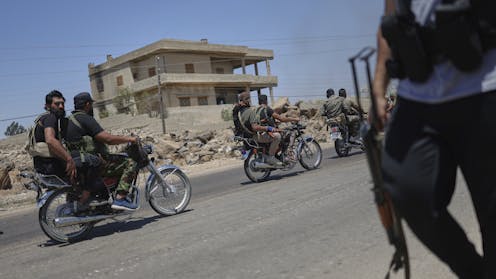
Bedouin fighters at Mazraa village on the outskirts of Sweida city, during clashes in southern Syria on July 18, 2025. AP Photo/Ghaith Alsayed
In July 2025, clashes between the Druze religious minority and Sunni Arabs backed by government-affiliated forces led to hundreds of deaths in Sweida province in southern Syria. Israel later launched dozens of airstrikes in support of the Druze.
This eruption of violence was an eerie reminder of what had unfolded in March 2025 when supporters of the fallen regime led by Bashar Assad, an Alawite, targeted security units. In retaliation, militias affiliated with the newly formed government in Damascus carried out indiscriminate killings of Alawites.
While exact figures remain difficult to verify, more than 1,300 individuals, most of them Alawites, lost their lives. In some cases, entire families were summarily executed.
The violence in Sweida also bore a sectarian dimension, pitting members of a religious minority against armed groups aligned with the country’s Sunni majority.
The persistent violence targeting the Alawites and, to a more limited extent, the Druze, starkly contrasts with these trends. As a scholar of religious minorities and the Middle East, I argue that the current political situation reflects their historical persecution and marginalization.
History of the Alawites
The Alawites emerged as a distinct religious community in the 10th century in the region of the Latakia coastal mountains, which today make up northwestern Syria.
Although their beliefs have some commonalities with Shiite Islam, the Alawites maintain their own unique religious leadership and rituals. Under the Ottoman regime in the late 19th century, they benefited from reforms such as the expansion of educational opportunities and economic modernization, while gaining geographical and social mobility.
After Hafez Assad, the father of Bashar, came to power in a coup in 1970, he drew upon his Alawite base to reinforce his regime. Consequently, Alawites became disproportionately represented in the officer corps and intelligence services.
Prior to the civil war, which began in 2011, their population was estimated at around 2 million, constituting roughly 10% of Syria’s population. During the civil war, Alawite young men fighting for the regime suffered heavy casualties. However, most Alawites remained in Syria, while Sunni Arabs and Kurds were disproportionately displaced or became refugees.
Members of the Alawite minority gather outside the Russian air base in Hmeimim, near Latakia in Syria’s coastal region, on March 11, 2025, as they seek refuge there after violence and retaliatory killings in the area. AP Photo/Omar Albam
Among Syria’s minorities, two key factors make the Alawites most vulnerable to mass violence in post-Assad Syria. The first factor is that, like the Druze, Alawites have their own distinct beliefs that deviate from Sunni Islam. Their religious practices and teachings are often described as “esoteric” and remain mostly inaccessible to outsiders.
These groups are often treated as heretics who split from Islam and whose beliefs and rituals are deemed beyond the pale of acceptance. For instance, according to Alawite beliefs, Ali, the son-in-law of Prophet Muhammad, is a divine manifestation of God, which challenges the idea of strict monotheism central to Sunni Islam.
From the perspective of Sunni orthodoxy, these groups’ beliefs have been a source of suspicion and disdain. A series of fatwas by prominent Sunni clerics from the 14th to the 19th century declared Alawites heretics.
Resentment against the Alawites
The second factor contributing to the Alawites’ vulnerability is the widespread perception that they were the main beneficiaries of the Assad regime, which engaged in mass murder against its own citizens. Although power remained narrowly concentrated under Assad, many Alawites occupied key positions in the security apparatus as well as the government.
In today’s political landscape where the central government remains weak and its control over various armed groups is limited, religious stigmatization and political resentment create fertile ground for mass violence targeting the Alawites.
While many Sunni Muslims in Syria also perceive the Druze as heretics, they maintained a greater degree of distance from the Assad regime and were less integrated into its security apparatus.
Nonetheless, in recent months the situation deteriorated rapidly in the Druze heartland. The Druze militias and local Bedouin tribes engaged in heavy fighting in July 2025. Unlike the Alawites, the Druze received direct military assistance from Israel, which has its small but influential Druze population. This further complicates peaceful coexistence among religious groups in post-Assad Syria.
A sober future
Sunni Arab identity is central to the newly formed government in Damascus, which can come at the expense of religious and ethnic pluralism. However, it has incentives to rein in arbitrary violence against the Alawites and Druze. Projecting itself as a source of order and national unity helps the government internationally, both diplomatically and economically.
Internally, however, the new government remains fractured and lacks effective control over vast swaths of territory. While it pays lip service to transitional justice, it is also cautious about being perceived as overly lenient toward individuals associated with the Assad regime and its crimes. Meanwhile, Alawite and Druze demands for regional autonomy continue to stoke popular Sunni resentments and risk triggering further cycles of instability and violence.
I believe that in a post-Assad Syria defined by fractured governance and episodic retribution, the Alawites as well as Druze are likely to face deepening marginalization.
Güneş Murat Tezcür does not work for, consult, own shares in or receive funding from any company or organization that would benefit from this article, and has disclosed no relevant affiliations beyond their academic appointment.
The same article reports that 73 per cent of those surveyed insisted that “Swift’s music is a driving force of their support of her.” But the abundant discourse surrounding Taylor Swift in the popular press, academia and online seems to be about everything but her songs.
At this moment, Swift resides at the very apex of modern celebrity culture. Ironically, this makes it especially tricky to engage with Swift as a musician, which is the very basis of her fame.
As a musicologist, music critic and musician who studies and teaches popular music, there are ways to examine the musical meaning of pop songs. These approaches provide useful insights; after all, wasn’t it the music that drew audiences to Swift in the first place?
In his book There’s Nothing Like This, Kevin Evers, senior editor of the Harvard Business Review, regards Swift as a “strategic genius.” He examines how she identifies and exploits untapped markets, making creative and marketing pivots at key moments while protecting her image as a self-made, authentic singer-songwriter.
Evers focuses on non-musical elements when discussing Swift’s songs. He claims that Swift’s fans interpret her lyrics in a manner akin to the literary analysis of complex poems. Swift’s songs intrigue fans, Evers insists, primarily because they offer insight into her personal life, romantic travails and struggles with fame.
Of course, words are an important element of pop songs, and for many fans, the words of a song constitute its “about-ness.” But a pop song is a sonic object, not simply a delivery system for words.
Lyrical discourse analysis
Song lyrics are not poems, although they may be “like poetry,” as musicologist Dai Griffiths has argued. He points out that when we insist on thinking of lyrics as poetry, we lose a systematic understanding of how words function in songs. The placement and sound of words, and how they relate to the music, are key elements of a song’s musical structure and sense.
It is this discussion of the musical sense and meaning of Swift’s songs that is largely neglected.
The academic study of classical music offers a wealth of analytic methodologies; there are ways to examine the musical meaning of pop songs that do not over-analyze the song. These include looking at elements like form, orchestration, melody, harmony and rhythm.
A song creates space: its formal layout and the rhythm of musical phrases provide the space for words — what Griffiths calls the “verbal space” — which have their own rhythms and structures and work within but also push against the boundaries of this space.
Form and space
Consider Swift’s chart-topping 2014 single, “Shake it Off,” re-released as “Shake it Off (Taylor’s Version)” in 2023. This song, while popular, was criticized for its repetitiveness and lack of emotional depth.
“Shake it Off” doesn’t seem to have much lyrical content: the verses are short, rounded off with simple slant rhymes, and much of the created space seems to be filled with repetition: “I’m just gonna shake, shake, shake, shake, shake/Shake it off, shake it off.”
Likewise, the song is built musically on some very basic and limited material, namely three chords, a short, unvaried drum loop and a spare bass line provided by a baritone saxophone.
The lyric video to “Shake it Off (Taylor’s version).”
The lyrics touch lightly on Swift’s response to fame and her critics, but it is their syllabic density that contributes to the song’s development and momentum. This gradually and sytematically increases over the first two verses and pre-chorus, until arriving at the chorus, where the space is filled almost completely.
The density of the music also increases in the choruses, with a thicker bass part, added vocals and a brass fanfare.
While “Shake it Off” is repetitive with little harmonic and melodic variety, it is also quite subtly counterbalanced with a variety of sounds, textures and densities. These move the song forward and importantly, help mark off the song’s formal sections.
These compositional and production details contribute to the song’s overall meaning. But how the words participate in the unfolding of the song-as-music, or the creation and shaping of the musical space, is also meaningful. The thrust of the lyrics emphasize Swift’s detachment from gossip and criticism: “I never miss a beat/I’m lightnin’ on my feet” and “But I keep cruisin’/Can’t stop, won’t stop groovin’”.
These lyrics are reinforced by the propulsive musical momentum of the song created by the gradual thickening of the text and music. Even with this thickening, the song still remains quite light, emphasizing the lyrical claims of detachment and distance from negativity.
The chorus, by contrast, with its deeply resonant bass, layers of background vocals and added brass, is musically the heaviest part of the song, underwriting Swift’s assertive claim that she will “shake off” the lies and gossip that plague her as a celebrity pop star.
Understanding Swift’s success
Collecting some musical information about Swift’s songs is not an abstract or intellectual activity; rather, it is essential information if we want to better understand Swift and her success in terms of her song writing.
I’m not making an argument here for or against Swift’s music; I’m neither a “Swiftie” nor a detractor. Nor have I offered anything like a comprehensive or definitive analysis of a song in this short article.
But I do think we should be curious and better understand Swift’s success, especially the popularity of her music across generations and demographics. How her songs are actually put together — how they work as music, in tandem with words, to tell stories — is an essential part of that understanding.
Alexander Carpenter does not work for, consult, own shares in or receive funding from any company or organisation that would benefit from this article, and has disclosed no relevant affiliations beyond their academic appointment.
Source: The Conversation – Canada – By Sean Spence, Security Risk Management Pracitioner & Researcher, Royal Military College of Canada
In April 2025, a man drove an SUV through a crowd of people attending a Filipino cultural festival in Vancouver, killing 11 people and injuring dozens more. In response, the British Columbia government immediately commissioned an inquiry to examine the systemic causes of the incident and whether any lessons could be learned from the tragedy.
The commission came up with six recommendations based on gaps in the current municipal application and approval system for public events across the province.
One key recommendation was that all public events should be required to complete a risk assessment. This isn’t currently happening across the province. The absence of such analysis poses a risk for public safety.
Another recommendation was the creation of local knowledge capacity to support event organizers, particularly for small and rural events, where the expertise to conduct a basic security risk assessment is lacking.
These factors, combined with emerging security risks, meant that the tragedy at the Lapu Lapu festival could be considered a foreseeable event given the risk realities associated with modern mass gatherings.
The inquiry report highlighted how B.C. is lagging behind other international jurisdictions in terms of legislative pro-activeness in securing public events. This policy deficiency is actually a Canada-wide problem; the country is woefully behind other western nations when it comes to securing public events.
Relatively speaking, research suggests Canada’s Charter of Rights and Freedoms hinders its security services from being able to detect and investigate terrorism-related offences given the greater importance placed on individual rights compared to Australia, where there is no such Charter equivalent.
Given these facts, it would seem plausible that Canada would be at greater risk for security threats at public events — including terrorist attacks, active shooters, etc. — than Australia.
When I compared the data between both countries in my research, it suggested Australia has more public event regulation than Canada.
It was quantitatively shown that Australian officials require risk assessments and other proactive measures from event organizers, including for risk mitigation, while Canadian officials are mostly concerned with reactive security response plans — in other words, determining how organizers would respond to attacks after they occurred.
An analysis of event application documents in both countries reveal that Australian municipalities disproportionately emphasize “risk management” in approving events compared to Canadian municipalities.
Three ways the B.C. report falls short
The B.C. report missed out on examining several important elements.
Firstly, it did not take a holistic, deep dive into just how vulnerable public events are to myriad security threats — like active shooters, crowd crushing and terrorist attacks — but instead focused solely on the hostile vehicle threat.
It also failed to consider the urgency of governments to adopt policy changes in the face of emerging threats on public spaces, like drone attacks.
Secondly, the report made no mention of the need for law enforcement to develop stronger ties to share intelligence with event organizers as a proactive measure to protect mass gathering events from violence. The Hamas attacks at a music festival in Israel in October 2023 highlight the worst outcome of such failures.
Lastly, there was no call for action or recommendation for the federal government to play a greater role in providing guidance to the industry and lower levels of government.
National security is a federal issue as well as the regulation of airspace for drones. In countries such as the United Kingdom, Australia and the United States, the national government provides guidance on protecting public spaces. There is no such policy leadership in Canada.
Source: The Conversation – France in French (3) – By Morgane Dujmovic, Chargée de recherche CNRS, Géographe et politiste spécialiste des frontières et migrations, Centre national de la recherche scientifique (CNRS)
Cet article est le troisième d’une série en quatre volets consacrée à un travail de recherche mené à bord de l’Ocean Viking, navire de sauvetage de l’ONG SOS Méditerranée. Morgane Dujmovic, géographe et politiste, a recueilli les récits de 110 personnes secourues en Méditerranée centrale pour mieux comprendre leur parcours. Dans cet article, elle revient sur leur parcours en mer. Le dernier épisode est ici. Une version immersive de cette série existe également.
Les dangers de la Libye ne sont généralement découverts que lorsque les personnes en migration y entrent avec l’espoir de trouver une vie décente et du travail.
Périr en Libye ou prendre la mer
« Mon tout premier jour à Tripoli, j’ai su que j’avais pris la pire décision de ma vie. En Libye, ce n’est pas facile de rentrer, mais c’est moins facile encore de sortir ! »,
explique Koné, lors de notre rencontre à Ancône (Italie, côte adriatique).
En effet, rares sont les personnes qui parviennent à transiter moins d’un mois en Libye. La plupart de celles et ceux que nous avons rencontrés sur l’Ocean Viking (OV) (57,9 %) y ont totalisé entre un et six mois. Certaines s’y sont retrouvées piégées plus de deux ans – jusqu’à sept années cumulées, pour un participant soudanais.
Dans le panorama statistique offert par l’enquête, on voit se dessiner des routes et des configurations migratoires différentes, les longs séjours subis en Libye concernant surtout les personnes des pays les plus pauvres et déchirés par des guerres.
On voit surtout que les femmes sont bloquées plus durablement en Libye : celles que nous avons rencontrées y ont passé en moyenne quinze mois et demi, contre huit mois et demi pour les hommes. On peut y voir l’effet des mécanismes de contrainte et de violence qui s’appliquent spécifiquement aux femmes en migration en Méditerranée, comme l’a parfaitement décrit la géographe Camille Schmoll dans son ouvrage les Damnées de la mer (2022).
Dans les conditions de survie qui ont été rapportées, la décision de prendre la mer malgré les risques de la traversée peut se résumer ainsi : préférer le risque de mourir maintenant plutôt que la certitude de perdre la vie à petit feu.
« Sept mois » : l’expérience de la Libye de Mohamad
Traduction : Amine Boudani et Rafik Arfaoui. Fourni par l’auteur
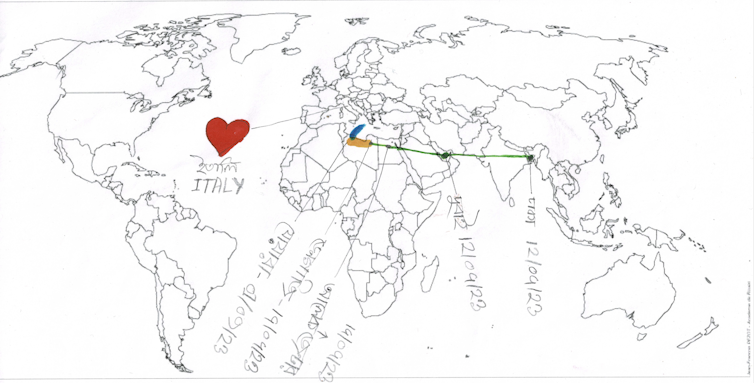
Sur sa carte, Mohamad a bien montré ce glissement. On y voit les violences cumulatives qu’il a rencontrées sur son parcours de l’est à l’ouest de la côte libyenne : la captivité à Tobruk chez un « marchand d’humains », l’enfermement et le vol à Benghazi, le racisme et la xénophobie à Ajdabiya, les mauvais traitements à Zouara, d’où il a finalement réussi à fuir par la mer.
Son illustration montre, de droite à gauche, l’enchaînement de faits qui l’a conduit de l’enfermement au bateau.
Pour parvenir à prendre la mer, il faut toutefois réunir une somme d’argent considérable. Les personnes participantes mentionnent des emprunts à leur famille de 2 000, 6 000, voire 10 000 dollars, pour s’acheter une place sur un bateau. Celle-ci est parfois obtenue à la suite de travaux forcés depuis les prisons plus ou moins officielles, ou contre la promesse d’être celui qui conduira le bateau.
Lorsque les tentatives se heurtent à des interceptions suivies de refoulements vers la Libye, il faut rajouter à la somme initiale :
« Ils m’ont escroqué d’abord 2 000 dollars, puis 3 000 et, la troisième fois, j’ai payé 5 000 dollars. »
Game house, pièce issue d’un atelier cartographique sur le pont de l’OV. Alisha Vaya/SOS Méditerranée, Fourni par l’auteur
Des personnes participantes à l’étude ont également décrit leurs conditions de vie dans la game house (les bâtiments collectifs où les personnes ayant payé leur traversée attendent le signal du départ). Ces séjours durent de plusieurs jours à plusieurs semaines, avec des approvisionnements et modalités variables selon les circuits et les montants payés pour arriver là. Mais toutes témoignent d’une même découverte à leur première tentative de traversée : celle de la nature des embarcations, impropres à la navigation et surchargées. Comme l’a expliqué Koné, à ce stade, il est généralement trop tard pour faire demi-tour :
« On a démarré d’une plage à côté de Tripoli, à 4 heures du matin, on nous a fait courir sur l’eau : “Go, go !” C’était trop tard pour changer d’avis. »
Perte de repères dans la nuit de la mer
Le départ depuis les plages libyennes se fait souvent de nuit, et ce n’est qu’au matin qu’on découvre l’immensité de la mer. L’enquête par questionnaire a justement permis d’étudier les perceptions des personnes placées sur ces embarcations en détresse au cours des scènes de sauvetage. Le premier résultat qui interpelle est leur perte de repères au moment où elles sont secourues.
L’un des participants a ainsi mentionné « la simple joie d’avoir trouvé quelque chose dans l’eau », en se remémorant sa première impression à la vue de l’Ocean Viking à l’horizon. D’autres participants ont décrit à quel point leurs perceptions étaient troublées par les conditions de navigation ou par la nature même des embarcations, comme cette personne bangladaise qui avait pris la mer dans la cale d’un bateau en bois :
« J’étais à l’intérieur du bateau en bois, je ne pouvais rien voir ou entendre. Je ne croyais pas que c’était un sauvetage jusqu’à ce que je sorte et voie avec mes propres yeux. »
Charlie, le SAR Team Leader qui a coordonné ce sauvetage, se souvient de sa propre stupéfaction à la découverte des 68 personnes à bord, sur une embarcation prévue pour 20 :
« À mesure qu’on les transférait sur nos RHIB (bateaux semi-rigides), d’autres sortaient de dessous le pont, cachés. »
En m’appuyant sur le questionnaire, les ateliers cartographiques et des entretiens ciblés, j’ai tenté de reconstituer l’espace-temps de ce sauvetage avec les personnes secourues et des membres de l’équipage.
« Sur le terrain : Quand les cartes racontent l’exil », avec Morgane Dujmovic, The Conversation France, 2025.
« Ils retournaient droit vers Tripoli ! »
Jérôme, le coordinateur adjoint de la recherche des secours à bord (ou Deputy SARCo) de l’OV, a confirmé le cas d’une embarcation « extrêmement surchargée », comme l’indique le rapport final de sauvetage :
« Là, ils étaient chargés ! L’alerte nous annonçait 55 personnes à bord, et nous on en a trouvé 68, parce qu’il y a ceux qui étaient sous le pont, cachés ! »
Dans le poste de commande de l’OV, écran de veille à l’appui, nous avons retracé les positions du bateau au fil de sa recherche. Ce matin-là, l’alerte avait été donnée par Alarm Phone, une ligne téléphonique citoyenne qui opère en continu depuis les deux rives de la Méditerranée, notamment pour relayer et suivre les cas de détresse.
« On a reçu une position à 6 h 19. On a tenté d’appeler Tripoli plusieurs fois, ça ne répondait pas. On a dit : “On y va quand même, on est très inquiets.” On a lancé le mail officiel disant qu’on y allait. »
Une fois ces démarches accomplies auprès des centres de coordination et de sauvetage en mer, l’OV s’est dirigé vers la position donnée, dans les eaux internationales au large de la ville libyenne de Zouara.
Peu de temps après, nos radios réglées sur le canal de veille ont grésillé :
« On réveille tout le monde en général quand on arrive dans les dix milles, c’est la distance avec laquelle on peut les trouver avec les jumelles. Et à 6 heures, il commence à y avoir les premières lueurs de l’aube. »
La recherche de l’embarcation en détresse s’est toutefois compliquée :
« Avec les premières données, le point de départ et la deuxième position, on avait une indication sur la vitesse : on pensait qu’ils faisaient 5 nœuds. Donc on s’est dit qu’on allait les trouver à cette position. Sauf qu’une fois arrivés, on a commencé à s’arracher les yeux : ils n’étaient pas à la position ! »
Reconstitution d’un cas de détresse en mer dans le poste de commande. Morgane Dujmovic, Fourni par l’auteur
Les calculs opérés dans cette phase de recherche doivent en effet intégrer des facteurs multiples, parmi lesquels les différentes positions reçues (quand il y en a), mais aussi la présence ou l’absence d’un moteur fonctionnel et, enfin, les conditions météorologiques et maritimes, comme l’a expliqué Jérôme :
« Ce que je pense, c’est qu’ils ont dû se perdre et se dérouter : en ayant la mer, le vent dans la figure, tu ne sais pas où tu vas. Je pense qu’ils ne voyaient rien de ce qu’ils faisaient. Ils étaient en train de lutter avec tout ça. »
Confirmant les hypothèses de Jérôme, beaucoup des personnes secourues ce jour-là sont arrivées sur le pont de l’OV en souffrant de déshydratation et de mal de mer :
« Comme on l’a vu sur les photos, ils avaient vraiment beaucoup de houle et de vent qui leur arrivait dans la figure. Plus tu vas vers le large, plus tu subis la mer. »
Devant les zooms et dézooms opérés par Jérôme à l’écran, je comprends en images les implications d’un cas de détresse en mer au large de la Libye :
« En plus, là, le vent suffisait à les faire dériver : ils retournaient droit vers Tripoli ! »
« Ces bateaux ne devraient même pas exister »
Malgré les difficultés décrites pour ce sauvetage, il correspond à une opération « à faible risque ». Des événements plus critiques sont régulièrement rapportés par les équipages et par les personnes secourues.
Au fil du temps, les équipes de sauvetage ont notamment vu la qualité des embarcations se dégrader, comme l’explique Jérôme :
« Il y a eu les “wooden boats” (bateaux en bois), puis les “rubber boats” (bateaux pneumatiques). Maintenant, les pires c’est les “iron boats” (bateaux en métal). »
En 2023, des embarcations en métal soudées à la hâte ont commencé à faire leur apparition au large de la Tunisie. Pour les marins aguerris qui forment les équipes de sauvetage, comme Charlie, l’existence même de telles embarcations en pleine mer est difficilement concevable :
« Ces bateaux ne devraient même pas exister. Ils ont des structures extrêmement faibles. Ils sont faits à la main, mal et vite faits ; ce sont juste des plaques en métal, soudées. Ils n’ont pas de stabilité. Ce sont comme des cercueils flottants. »
Pour ces professionnels de la mer, l’inquiétude est réelle : « Il faut que nous soyons préparés à ça. » D’une part, les bords acérés des bateaux en métal peuvent abîmer les bateaux semi-rigides (RHIB) de l’ONG, avec le risque de compromettre l’ensemble de l’opération de sauvetage – comme cela s’est produit en septembre 2023, à l’issue d’une patrouille sur la route tunisienne. Les RHIB avaient alors été protégés « avec les moyens du bord », à l’aide des tapis trouvés sur le navire alors qu’il était en opération en mer.
D’autre part, chaque nouveau type d’embarcation implique des techniques très spécifiques. L’approche et le positionnement des bateaux semi-rigides autour de l’embarcation en détresse (ou « danse des RHIB »), les modes de communication propices au maintien du calme, les soins d’urgence durant le transfert vers le bateau-mère : tout cela est étudié avec minutie afin d’anticiper un maximum de scénarios.
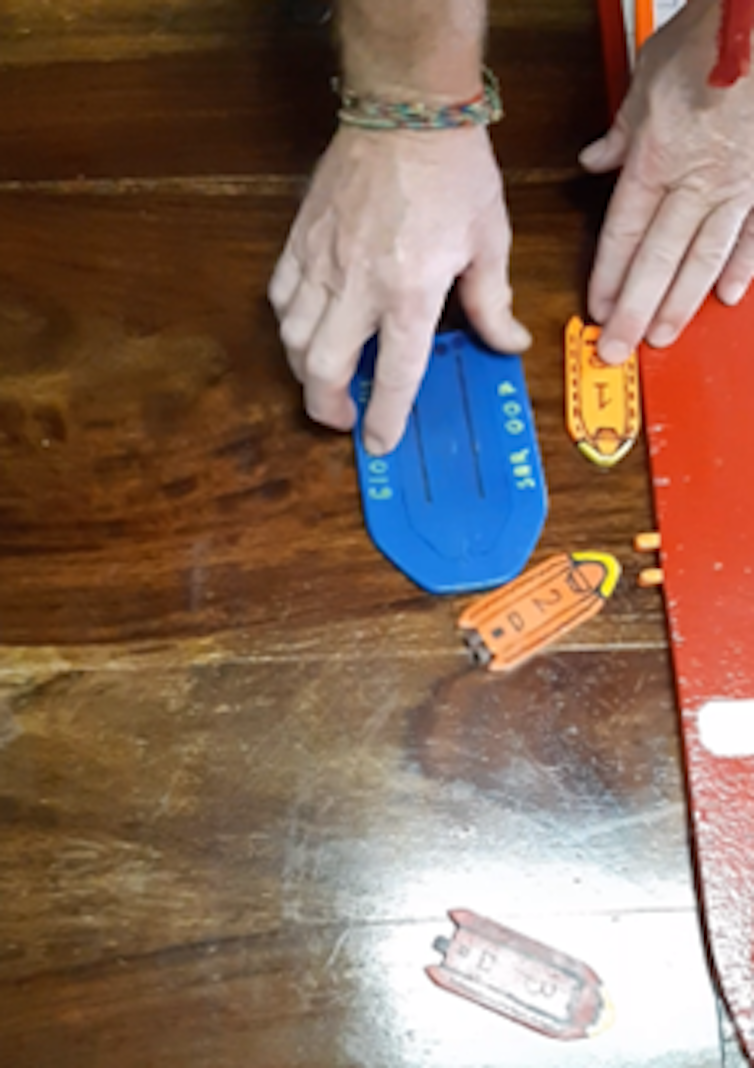
Dans la salle de repos de l’équipage, face à la maquette construite par les anciens de SOS Méditerranée pour s’entraîner aux simulations, Charlie m’a longuement expliqué les techniques développées pour approcher chaque type d’embarcation en détresse, selon qu’elles sont en fibres de verre, en bois, en pneumatique ou en métal.
Dans le dernier cas, celui d’un bateau en métal, Charlie a insisté sur les implications critiques d’un sauvetage qui tournerait mal :
« Les bateaux en métal peuvent chavirer à tout moment et couler rapidement, à pic. Dans ce cas, la scène ressemblerait à ça : un massive MOB ! »,
c’est-à-dire un « Man Over Board » (« homme à la mer ») de grande ampleur, impliquant le passage par-dessus bord d’un nombre important de personnes. C’est ce que sont venus illustrer les petits objets bleus dispersés sur sa maquette.
Simulation d’un « massive MOB » avec un bateau en métal. Morgane Dujmovic, Fourni par l’auteur
Se noyer plutôt qu’être capturé
Une autre donnée a rendu les activités de sauvetage de plus en plus ingérables au fil du temps : les activités des milices et « garde-côtes libyens » dans la SRR (Search and Rescue Region) libyenne, c’est-à-dire la région libyenne de recherche et sauvetage en mer créée en 2018 avec le support de l’Union européenne.
Deux autorités y sont chargées de la surveillance côtière : la garde côtière libyenne (LCG) dépendant du ministère de la défense, et l’administration générale de la sécurité côtière (GACS), rattachée au ministère de l’intérieur.
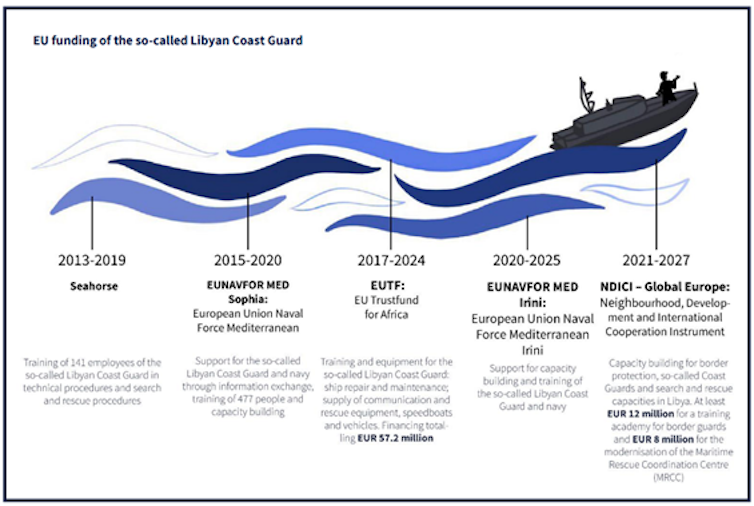
Les multiples agissements illégaux et violents rapportés au sujet des acteurs libyens en mer ont justifié l’emploi de plus en plus courant de guillemets pour les désigner, ou de l’expression « so-called Libyan Coast Guard ». Pourtant, ces groupes reçoivent un soutien abondant de l’Union européenne et de plusieurs de ses États membres.
À bord de l’OV, les témoignages ne tarissent pas sur les manœuvres périlleuses des « garde-côtes libyens » visant explicitement à faire échouer les sauvetages, comme l’a soulevé Charlie :
« Je les ai vus faire des manœuvres folles, essayer de rendre le sauvetage aussi dur que possible, en nous empêchant de secourir, en criant, en hurlant. »
Plusieurs microscènes de ce type ont été reconstituées :
« Ils conduisent le plus près et le plus rapidement possible pour créer des vagues. Ils se mettent sur notre route, interfèrent, près du bateau-mère. »
Quand les acteurs libyens sont sur scène, l’explosion d’émotions liées à l’arrivée des secours peut se transformer en scène de panique et affecter les chances de réussite du sauvetage.
Ce sont 31,4 % des personnes participantes à l’étude qui ont ainsi exprimé une perception négative à la vue d’un navire à l’horizon, associée à la peur d’être interceptées et refoulées par les acteurs libyens en mer :
« Au loin, nous ne savions pas si c’était un bateau de sauvetage ou les garde-côtes libyens. C’était un stress énorme à bord, les gens criaient et les enfants pleuraient. Nous étions prêts à sauter. »
En effet, la présence des autorités libyennes est souvent perçue comme un danger plus grand que le risque de noyade, comme l’a résumé l’un des participants :
« Pour moi, le danger ce n’est pas la mer, ce sont les autorités libyennes. »
Ce positionnement s’explique aisément pour les personnes qui ont déjà expérimenté une ou plusieurs interceptions. Certaines des personnes participantes à l’étude ont mentionné des violences exercées au cours de leur refoulement vers la Libye, telles que des coups, des menaces armées, des vols d’argent, des privations d’eau et de nourriture, voire des actes mortels :
« La première fois que j’ai pris la mer, les Libyens ont tiré sur le moteur, le carburant a brûlé et explosé et les gens près de moi sont morts. »
En outre, la proximité des « garde-côtes libyens » avec des milices ou réseaux mafieux est notoire. L’un des répondants à l’étude a décrit en ces termes l’administration générale de la sécurité côtière (GACS) :
« Il y a toujours un risque que le GACS, un groupe armé avec des masques, vous mette en prison. »
Les interceptions sont généralement suivies de périodes de détention arbitraire en Libye, dans les conditions inhumaines détaillées précédemment (voir la partie 2 de cette série) :
« J’ai essayé de traverser quatre fois mais j’ai été attrapée et mise en prison avec mon enfant ; j’ai beaucoup souffert. »
Reconstitution d’une interférence des acteurs libyens (en bleu) à proximité du bateau-mère (en rouge). Morgane Dujmovic, Fourni par l’auteur
Ces faits rapportés par les équipages et personnes secourues sont largement étayés par les organisations internationales, humanitaires ou les collectifs associatifs qui suivent la situation en Méditerranée centrale. Dans son rapport de mission d’enquête de 2021, le Conseil des droits de l’homme des Nations unies laisse peu de doutes quant à la chaîne de causalité qui relie les interceptions en mer et la traite des personnes migrantes en Libye :
« Les garde-côtes libyens procèdent […] à l’interception de l’embarcation dans des conditions violentes ou périlleuses, qui se soldent parfois par des morts. […] Les garde-côtes libyens confisquent les effets personnels des migrants à bord. Une fois débarqués, les migrants sont soit transférés dans des centres de détention, soit portés disparus, et il semblerait que certains soient vendus à des trafiquants. […] Depuis que des bateaux sont refoulés en Méditerranée, les autorités libyennes ont été averties du caractère généralisé et systématique des interceptions périlleuses effectuées en mer et des violences commises dans les centres de détention. Plutôt que d’enquêter sur ces cas et de remédier à ces pratiques, les autorités libyennes ont continué à intercepter les migrants et à les placer en détention. »
En croisant ces scènes de sauvetage maritime avec le vaste système d’exploitation organisé depuis les lieux de détention en Libye, on comprend que l’interception en mer par les « garde-côtes libyens » relève d’une stratégie de capture, et que la Méditerranée centrale est devenue le lieu d’un corps à corps pour la sauvegarde de la vie et de la dignité humaine.
Morgane Dujmovic ne travaille pas, ne conseille pas, ne possède pas de parts, ne reçoit pas de fonds d’une organisation qui pourrait tirer profit de cet article, et n’a déclaré aucune autre affiliation que son organisme de recherche.
Source: The Conversation – France in French (3) – By Morgane Dujmovic, Chargée de recherche CNRS, Géographe et politiste spécialiste des frontières et migrations, Centre national de la recherche scientifique (CNRS)
Les parcours de migration des personnes recueillies à bord sont très variés, certains se résumant à quelques jours, d’autres s’étalant sur plusieurs années. Morgane Dujmovic, Fourni par l’auteur
Cet article est le deuxième d’une série en quatre volets consacrée à un travail de recherche mené à bord de l’Ocean Viking, navire de sauvetage de l’ONG SOS Méditerranée. Morgane Dujmovic, géographe et politiste, a recueilli les récits de 110 personnes secourues en Méditerranée centrale pour mieux comprendre leur parcours. Ce deuxième épisode restitue les périls rencontrés avant de prendre la mer. L’épisode 3 est ici. Une version immersive de cette série existe également.
Vingt-et-une esquisses individuelles ont été fabriquées sur l’Ocean Viking (OV) au cours de ces recherches. Elles racontent des fragments de voyages, trajectoires plus ou moins fluides ou heurtées depuis le Bangladesh, le Pakistan, la Syrie, la Palestine et l’Égypte. Les parcours sont parfois très onéreux, mais rapides et organisés, comme ceux de certaines personnes bangladaises de Dacca à Zouara (Libye), en passant par Dubaï, en seulement quelques jours. D’autres s’étendent et se tissent sur plusieurs années, s’adaptant aux rencontres, aux ressources, aux dangers, et aux multiples guerres et violences dans les pays traversés.
« De Dacca à Zouara » (série de 10 esquisses individuelles sur les parcours du Bangladesh). Morgane Dujmovic, Fourni par l’auteur « De la Syrie à Zouara » (série de 11 esquisses individuelles sur les parcours du Moyen-Orient). Morgane Dujmovic, Fourni par l’auteur
Parmi 69 personnes ayant participé à l’étude, 37,6 % avaient quitté leur pays d’origine la même année, mais 21,7 % voyageaient depuis plus de cinq ans – et 11,5 %, depuis plus de dix ans. Les parcours les plus longs débutent dans des pays aussi divers que le Nigeria, le Soudan, l’Érythrée et l’Éthiopie. Dans 60 % des cas étudiés, ils commencent en Syrie.
2011, 2012, 2013, 2014, 2015… L’étalement régulier des dates de départ recueillies à travers l’enquête met en évidence la perpétuation des conflits qui suscitent les raisons de migrer :
« J’ai fui l’armée de Syrie. J’ai vécu trois années de prison et de torture, vu des scènes terribles. J’avais 18 ans, je n’avais pas l’âge de vivre ou voir de telles choses. »
Les motivations à poursuivre ces longs voyages sont souvent faites d’ambitions personnelles « pour une vie meilleure », comme le fait de « pouvoir étudier » ou « d’aider la famille » restée au pays, comme l’a expliqué un jeune Égyptien :
« Je suis le seul garçon de ma famille. Mes parents sont âgés et ils sont inquiets que je n’y arrive pas. »
L’étude auprès des personnes secourues a aussi permis de dresser un panorama des soutiens reçus et des dangers rencontrés en cours de route. Au même niveau que les ressources financières issues d’économies personnelles ou de sommes prêtées le plus souvent par la famille, près de 60 % des personnes répondantes ont mentionné l’importance de ressources immatérielles, telles que « les conseils d’amis », « le soutien psychologique du mari », « des informations et un soutien émotionnel d’une nièce ».
Les informations reçues de proches paraissent cruciales à certaines étapes du voyage : comme l’a expliqué l’un des répondants, elles relèvent d’une forme de soutien moral pour « survivre en Libye ». À l’inverse, une autre personne participante a confié qu’il lui avait été essentiel, « pour tenir bon », de cacher à sa famille les réalités de son quotidien libyen. Car c’est bien là que sont rencontrées la plupart des difficultés : sur les 136 situations de danger décrites dans l’étude, 50 % sont localisées en Libye – contre 35,3 % en mer, 8,8 % dans le pays d’origine et 5,9 % à d’autres frontières, le long des parcours migratoires.
Il est précisé que ces réponses ne reflètent pas une image exhaustive de l’ensemble des dangers en migration : elles traduisent les perceptions d’un échantillon limité de personnes secourues au large de la Libye et sont à restituer dans le contexte d’une collecte de données réalisée en pleine mer.
« Sur le terrain : Quand les cartes racontent l’exil », avec Morgane Dujmovic, The Conversation France, 2025.
Raconter la Libye
Les atrocités qui ciblent les personnes en migration en Libye sont désormais bien documentées. Elles apparaissent dans une multitude de documents – des rapports d’ONG (SOS Humanity, 2024), documentaires vidéos (Creta 2021) et témoignages directs de personnes concernées par les faits (Kaba 2019).
Les résultats d’une mission d’enquête indépendante du Conseil des droits de l’homme des Nations unies, publiés en 2021, ont permis de qualifier ces réalités de crimes contre l’humanité :
« Il existe des motifs raisonnables de croire que les actes de meurtre, de réduction en esclavage, de torture, d’emprisonnement, de viol, de persécution et autres actes inhumains commis contre les migrants font partie d’une attaque systématique et généralisée dirigée contre cette population, en application d’une politique d’État. En tant que tels, ces actes peuvent constituer des crimes contre l’humanité. »
Avec l’étude réalisée à bord de l’OV, les personnes participantes ont pu définir, avec leurs propres mots, la nature des dangers qu’elles y ont vécus. Leurs réponses ont ensuite été codées et regroupées en catégories permettant d’établir une typologie spatialisée issue de ces récits. Les citations associées aux données traduisent des expériences subjectives, incarnées, retravaillées par les émotions, mais assez convergentes et nombreuses pour reconstituer ce qu’il se joue en Libye.
Les mécanismes de violences rapportés sont systémiques : enfermements punitifs assortis de torture, traitements inhumains et dégradants, violences raciales et sexuelles dont on est victime et/ou témoin.
« Durant la première période que j’ai passée en Libye, j’ai été emprisonné six fois, torturé, frappé. Je ne peux même pas me rappeler des détails exacts. »
Ces violences impliquent des acteurs plus ou moins institutionnalisés : garde-côtes, gardiens de prison, mafias, milices et patrons, dont les rôles tendent à se chevaucher. Elles se produisent sur l’ensemble du territoire : Benghazi, Misrata, Sabratha, Syrte, Tripoli, Zaouïa, Zouara, pour les villes les plus citées dans l’enquête, mais aussi dans le désert et dans des lieux de détention de localisation inconnue.
Omniprésente, la perspective d’enfermements violents et arbitraires génère une présomption de racisme généralisé envers les étrangers :
« Le racisme que j’ai vécu en tant qu’Égyptien est juste inimaginable : kidnapping, vol, emprisonnement. »
Les personnes noires se sentent particulièrement visées par les attaques ciblées. Parmi celles qui en ont témoigné, un Éthiopien resté bloqué quatre années en Libye a décrit un sentiment de terreur permanent, lié aux multiples arrestations racistes dont il a été victime :
« Les gens se font kidnapper en Libye. Ils nous attrapent et nous mettent en prison car nous n’avons pas de papiers, puis nous devons payer plus de 1 000 dollars pour être relâchés. Cela m’est arrivé quatre fois, pendant deux semaines, puis un mois, puis deux mois et finalement pendant un an. Tout cela à cause de ma couleur, parce que je suis noir. Cela a duré si longtemps que mon esprit est trop stressé, à cause de la peur. »
Ce que confirme le rapport du Conseil des droits de l’homme de l’ONU :
« Il s’avère aussi que les migrants venant d’Afrique subsaharienne, qui représentent la majeure partie des détenus, sont traités plus durement que les autres, ce qui laisse penser qu’ils font l’objet d’un traitement discriminatoire. »
Cependant, les risques de kidnapping et rançonnage semblent n’épargner aucune personne exilée sur le sol libyen. Koné, par exemple, les a assimilés à une pratique généralisée et systémique :
« Il y a un business que font pas mal de Libyens : on te fait monter dans un taxi, qui te vend à ceux qui te mettent en prison. Puis on demande une rançon à ta famille pour te faire sortir. Si la rançon n’est pas payée, on te fait travailler gratuitement. Finalement, en Libye, tu es comme une marchandise, on te laisse rentrer pour faire le travail. »
Plusieurs personnes participantes à l’étude ont été prises dans ces mailles et leurs analyses a posteriori convergent sur un point : l’expérience libyenne s’apparente en fait à un vaste système d’exploitation par le travail forcé. Les faits rapportés correspondent, selon les définitions de l’Organisation internationale du travail (OIT), à la pratique de « traite des personnes » ou « esclavage moderne » et sont encore confirmés dans le rapport onusien :
« Bien que la détention des migrants soit fondée dans le droit interne libyen, les migrants sont détenus pour des durées indéterminées sans moyen de faire contrôler la légalité de leur détention, et la seule façon pour eux de s’échapper est de verser de fortes sommes d’argent aux gardiens, ou de se livrer à un travail forcé ou d’accorder des faveurs sexuelles à l’intérieur ou à l’extérieur du centre de détention pour le compte de particuliers. »
En définitive, à propos de la détention en Libye, c’est le sentiment de honte que Koné se remémore le plus péniblement :
« J’ai pitié de moi, de mon histoire, mais encore plus des gens qui sont allés en prison. Si ta famille n’a pas de quoi payer la rançon, elle doit faire des dettes, donc c’est un problème que tu mets sur ta famille. Il y en a qui sont devenus fous à cause de ça. »
L’apport des ateliers : le geste et le langage cartographiques pour témoigner
Si les bilans des périodes passées en Libye sont toujours amers, souvent effroyables, et parfois indicibles, l’étude a mis en évidence une volonté assez forte de témoigner de ce qu’il s’y passe, non seulement auprès du grand public, mais aussi pour celles et ceux qui pourraient entreprendre le même parcours :
« Je voudrais dire qu’en Libye, il y a beaucoup de femmes comme moi qui sont dans une situation très difficile » ; « Je n’ai pas grand-chose à dire, si ce n’est que tellement de gens souffrent encore plus que moi en Libye » ; « Je ne conseille à personne de venir par cette route ».
Pour accompagner ces récits, les ateliers cartographiques à bord de l’OV fonctionnaient comme une proposition, une occasion de se raconter sans avoir à poser des mots sur les expériences traumatiques. Conçu comme un mode d’expression, le processus cartographique reposait sur des exercices de spatialisation en plusieurs étapes.
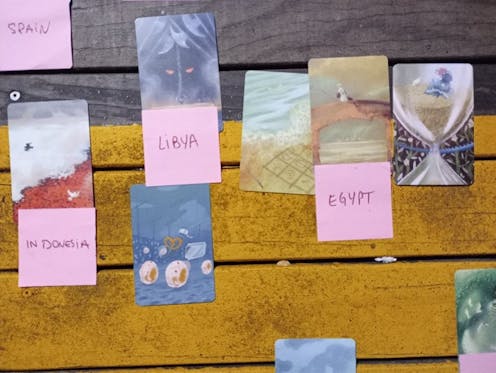
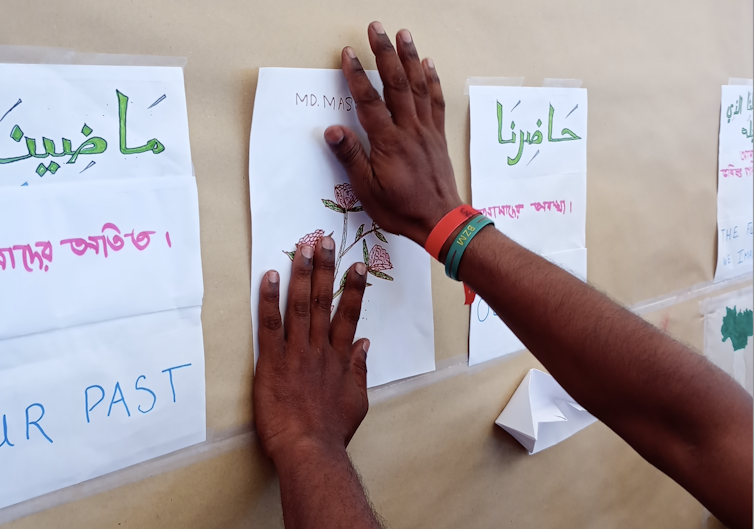
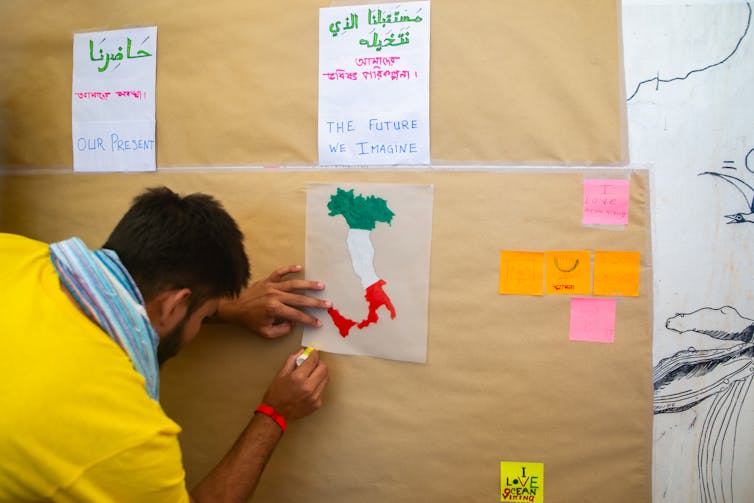
Dans un premier temps, les mappings collectifs organisés sur le pont de l’OV ont permis de faire émerger les principaux thèmes que les personnes participantes elles-mêmes souhaitaient aborder, en fonction de trois séquences – « Notre passé », « Notre présent » et « Le futur que nous imaginons ».
Mon rôle consistait ici à instaurer un cadre d’expression idoine, aiguiller vers des techniques graphiques accessibles et permettre le partage des créations via l’affichage progressif sur le pont.
Mapping collectif sur le pont de l’OV. Alisha Vaya/SOS Méditerranée, Fourni par l’auteur Mapping collectif sur le pont de l’OV. Alisha Vaya/SOS Méditerranée, Fourni par l’auteur
Des ateliers ont également été proposés par petits groupes ou de façon individualisée dans les containers, espaces plus propices à la confidentialité des récits intimes.
L’une des consignes suggérées consistait à représenter les zones de danger ressenties sur l’ensemble du parcours migratoire – d’où la Libye ressortait immanquablement. C’est à partir de ces cheminements personnels qu’un second exercice a pu être amené, pour celles et ceux qui le souhaitaient : décrire l’expérience du danger à l’échelle libyenne, en s’appuyant sur les lieux déjà évoqués.
Les personnes participantes étaient ensuite encouragées à compléter leurs esquisses par des illustrations personnelles et des légendes narratives dans leurs langues d’origine, traduites a posteriori en français.
« Un an et demi » : l’expérience de la Libye d’Ahmed
Traduction : Amine Boudani et Rafik Arfaoui. Fourni par l’auteur
Sur sa carte, Ahmed, originaire de Syrie, dépeint « l’insécurité » à Tripoli, « les mauvais traitements et le prélèvement d’argent de force » à Benghazi, « le non-respect des droits » à Zouara.
Son illustration représente une scène de criminalité ordinaire et généralisée : « le Libyen » qui tire sur « les étrangers » évoque la violence collective qu’Ahmed spatialise dans « toute la Libye ».
Cette méthode cartographique sensible et participative a servi de langage pour livrer des récits difficiles à mettre en mots. Par-delà ce que ces gestes dessinés peuvent faciliter pour les personnes qui partagent leur histoire, ils permettent à celles et ceux qui découvrent ces violences de les recueillir, de les recevoir et de les restituer, en les replaçant dans l’écheveau complexe des repères spatio-temporels.
Morgane Dujmovic ne travaille pas, ne conseille pas, ne possède pas de parts, ne reçoit pas de fonds d’une organisation qui pourrait tirer profit de cet article, et n’a déclaré aucune autre affiliation que son organisme de recherche.
Source: The Conversation – France in French (3) – By Morgane Dujmovic, Chargée de recherche CNRS, Géographe et politiste spécialiste des frontières et migrations, Centre national de la recherche scientifique (CNRS)
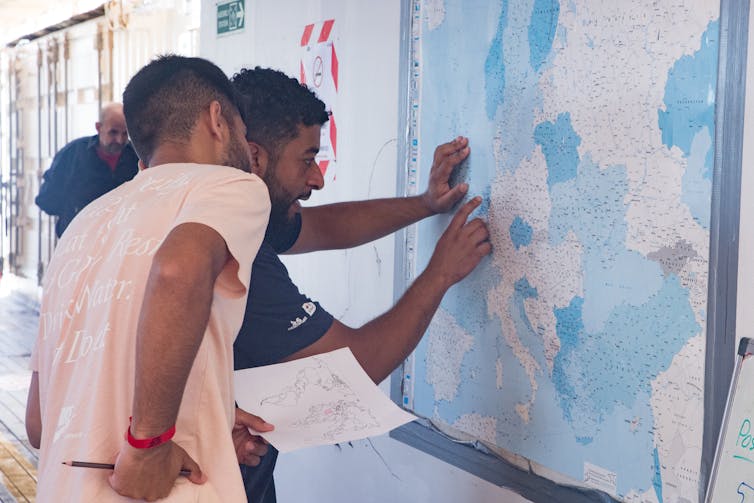
Atelier sur le pont de l’_Ocean Viking_. Morgane Dujmovic, Fourni par l’auteur
Cet article est le premier d’une série en quatre volets consacrée à un travail de recherche mené à bord de l’Ocean Viking, navire de sauvetage de l’ONG SOS Méditerranée. Morgane Dujmovic, géographe et politiste, a recueilli les récits de 110 personnes secourues en Méditerranée centrale pour mieux comprendre leur parcours. Ce premier épisode revient sur la méthodologie employée. L’épisode 2 est ici. Une version immersive de cette série existe également.
« Nous étions prêts à sauter. Nous avions tellement peur que les Libyens arrivent ! »
Je lis ces mots d’un jeune homme syrien dans le tableau de données. Ils sont issus de l’étude que j’ai coordonnée, de l’été 2023 à l’été 2024, à bord de l’Ocean Viking, le navire civil de recherche et sauvetage en mer de SOS Méditerranée. Ces mots ne sont pas isolés. Parmi les 110 personnes rescapées qui se sont exprimées via l’enquête par questionnaire déployée à bord, près d’un tiers ont décrit une peur semblable à la vue d’un navire à l’horizon : non pas la peur du naufrage imminent ou de la noyade, mais celle d’être interceptées par les forces libyennes et renvoyées en Libye.
Ces mots résonnent avec ceux de Shakir, un Bangladais que j’ai connu sur l’OV (surnom donné à l’Ocean Viking) :
« Tes ateliers nous ont rafraîchi l’esprit. Depuis la Libye et la mer, nous nous sentions perdus. Maintenant, nous comprenons le chemin parcouru. »
Portrait de Shakir. Morgane Dujmovic, Fourni par l’auteur
Sur le pont de l’OV et dans les containers servant d’abri jusqu’au débarquement en Italie, j’ai proposé des ateliers participatifs de cartographie sensible. Une soixantaine de personnes s’en sont emparées, en retraçant les étapes, les lieux et les temporalités de leurs voyages par des cartes dessinées. Si je développe des méthodes de recherche créatives et collaboratives pour encourager l’expression des savoirs qui se construisent en migration, je n’avais pas anticipé que ces gestes et tracés puissent aussi contribuer à « rafraîchir l’esprit », se réapproprier des repères ou valoriser « le chemin parcouru ».
Ces mots résonnent aussi avec ceux de Koné, un Ivoirien rencontré à Ancône (Italie), une semaine après avoir été débarqué par une autre ONG de sauvetage :
« Le pire n’est pas la mer, crois-moi, c’est le désert ! Quand tu pars sur l’eau, c’est la nuit et tu ne vois pas autour : c’est seulement quand le jour se lève que tu vois les vagues. Dans le désert, on te met à cinquante sur un pick-up prévu pour dix : si tu tombes, tu restes là. Dans l’eau, tu meurs d’un coup, alors que, dans le désert, tu meurs à petit feu. »
Portrait de Koné. Morgane Dujmovic, Fourni par l’auteur
Tous ces mots m’ont amenée à reformuler mes hypothèses sur les frontières et leurs dangers. Pourquoi prendre le risque de la traversée en mer, à l’issue incertaine ? Que perçoit-on du sauvetage, depuis une embarcation en détresse ? Comment vit-on les journées à bord d’un navire d’ONG ? Que projette-t-on dans l’arrivée en Europe, et après ? Si les sauvetages et naufrages font assez souvent la une des médias, les perceptions des personnes rescapées sont rarement étudiées ; elles nous parviennent le plus souvent à travers le filtre des autorités, journalistes ou ONG. Recueillir ces vécus, permettre aux personnes exilées de se raconter : c’était là l’objet de ma mission de recherche embarquée.
« Sur le terrain : Quand les cartes racontent l’exil », avec Morgane Dujmovic, The Conversation France, 2025.
Une recherche embarquée
À bord de l’OV, j’occupe le « 25e siège », habituellement réservé à des personnalités. Ma présence a quelque chose d’inédit : c’est la première mission SAR (Search and Rescue) qui accueille une chercheuse extérieure à une ONG. Pour le Département des opés de SOS Méditerranée, c’est l’occasion d’amener à bord une méthodologie de sciences sociales, nourrie par un regard distancié, pour tenter d’améliorer la réponse opérationnelle à partir des priorités exprimées par les personnes secourues.
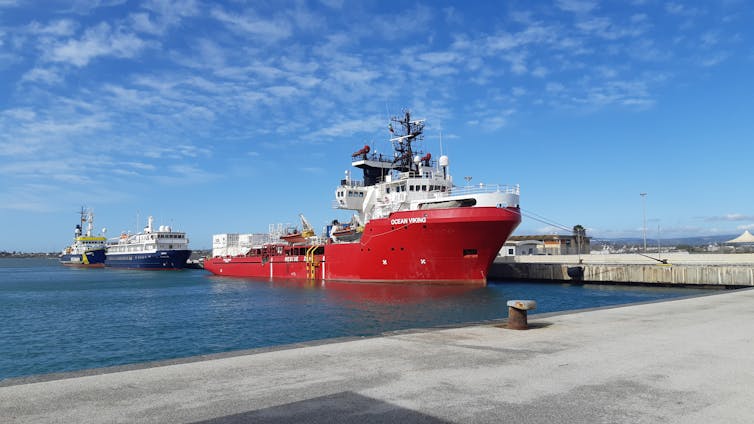
L’Ocean Viking à Syracuse (Italie). Morgane Dujmovic, Fourni par l’auteur
Côté navire, plusieurs membres de l’équipage expriment leur soutien pour ce travail, destiné à enrichir leurs pratiques, comme la compréhension de parcours d’exil auxquels ils sont confrontés depuis des années. C’est le cas de Charlie, l’un des anciens de l’ONG, impliqué depuis une dizaine d’années dans le perfectionnement des techniques d’approche et de secours des embarcations en détresse. En tant que SAR Team Leader, il coordonne les équipes des RHIBs (Rigid-Hulled Inflatable Boats), les bateaux semi-rigides d’intervention mis à l’eau depuis l’OV pour réaliser les sauvetages :
« Ce travail est vraiment utile, car nous cherchons constamment à nous améliorer. Mais la chose dont je suis vraiment curieux, c’est ce qu’il se passe avant. Je parle avec eux parfois, mais je voudrais en savoir plus sur eux. »
Quant à moi, si je travaille depuis quinze ans avec des personnes exilées, c’est la première fois que j’écris sur les frontières en étant moi-même dans la frontière – un sentiment d’immersion amplifié par l’horizon de la mer et par le quotidien confiné à bord de l’OV.
Navigation vers la zone d’opérations. Morgane Dujmovic, Fourni par l’auteur
L’étude est déployée au fil de cinq rotations, missions en zone de recherche et sauvetage de six semaines chacune. L’ensemble du crew (équipes de sauvetage, de protection, de logistique et de communication) a été formé à la méthodologie d’enquête.
Issu d’un dialogue entre objectifs scientifiques et opérationnels, le protocole de recherche articule des méthodes quantitatives et qualitatives. Un questionnaire est élaboré autour de trois thèmes :
le sauvetage en mer (ou rescue),
la prise en charge sur le bateau-mère (ou post-rescue),
les projets et parcours de migration, du pays de départ jusqu’aux lieux d’installation imaginés en Europe.
Ma présence à bord permet d’affiner le questionnaire initial, pour parvenir à une version stabilisée à partir des retours de personnes secourues et de membres de l’équipage. Les données statistiques sont complétées, d’autre part, par des méthodes plus qualitatives que je déploie habituellement sur terre, aux frontières franco-italiennes, franco-espagnoles ou dans les Balkans, avec le projet La CartoMobile.
Ces ateliers itinérants visent la co-construction de savoirs expérientiels sur les frontières, en proposant aux personnes qui les franchissent des outils de cartographie sensible et participative pour se raconter.
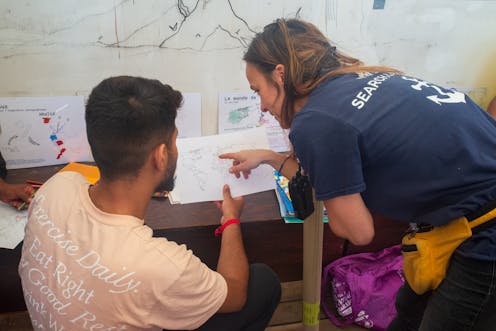
Ateliers cartographiques sur le pont de l’OV. Alisha Vaya/SOS Méditerranée, Fourni par l’auteur
Pour transférer ces méthodes en mer, j’apporte à bord de l’OV des cartes dessinées avec d’autres personnes exilées, dispose du matériel de création, aménage un espace. Dans ce laboratoire improvisé, je cherche à générer un espace-temps propice à la réflexion, pour faire émerger des savoirs mis en silence et les porter auprès du grand public. L’invitation à participer se veut accessible : l’atelier est guidé et ne nécessite pas de compétences linguistiques ou graphiques particulières ; le résultat esthétique importe moins que l’interaction vécue au cours du processus cartographique.
Ces enjeux scientifiques et éthiques rejoignent bien les préoccupations opérationnelles : durant les journées de navigation et jusqu’au débarquement dans un port italien, il faut combler l’attente, redonner le moral. Sur le pont de l’OV, la cartographie trouve progressivement sa place parmi les activités post-rescue dont certaines, à dimension psychosociale, visent à revaloriser la dignité des personnes rescapées et les préparer à la suite de leur parcours en Europe. Les mappings collectifs où s’affichent textes et dessins deviennent un langage et un geste partagé, entre membres de l’équipage et personnes secourues invitées à l’atelier.
Mapping collectif sur le pont de l’OV. Alisha Vaya/SOS Méditerranée et Morgane Dujmovic, Fourni par l’auteur
Morgane Dujmovic ne travaille pas, ne conseille pas, ne possède pas de parts, ne reçoit pas de fonds d’une organisation qui pourrait tirer profit de cet article, et n’a déclaré aucune autre affiliation que son organisme de recherche.
In a binary star system, two stars orbit around each other. ESO/L. Calçada, CC BY
Stars are the fundamental building blocks of our universe. Most stars host planets, like our Sun hosts our solar system, and if you look more broadly, groups of stars make up huge structures such as clusters and galaxies. So before astrophysicists can attempt to understand these large-scale structures, we first need to understand basic properties of stars, such as their mass, radius and temperature.
But measuring these basic properties has proved exceedingly difficult. This is because stars are quite literally at astronomical distances. If our Sun were a basketball on the East Coast of the U.S., then the closest star, Proxima, would be an orange in Hawaii. Even the world’s largest telescopes cannot resolve an orange in Hawaii. Measuring radii and masses of stars appears to be out of scientists’ reach.
Enter binary stars. Binaries are systems of two stars revolving around a mutual center of mass. Their motion is governed by Kepler’s harmonic law, which connects three important quantities: the sizes of each orbit, the time it takes for them to orbit, called the orbital period, and the total mass of the system.
I’m an astronomer, and my research team has been working on advancing our theoretical understanding and modeling approaches to binary stars and multiple stellar systems. For the past two decades we’ve also been pioneering the use of artificial intelligence in interpreting observations of these cornerstone celestial objects.
Measuring stellar masses
Astronomers can measure orbital size and period of a binary system easily enough from observations, so with those two pieces they can calculate the total mass of the system. Kepler’s harmonic law acts as a scale to weigh celestial bodies.
Binary stars orbit around each other, and in eclipsing binary stars, one passes in front of the other, relative to the telescope lens. Merikanto/Wikimedia Commons, CC BY-SA
Think of a playground seesaw. If the two kids weigh about the same, they’ll have to sit at about the same distance from the midpoint. If, however, one child is bigger, he or she will have to sit closer, and the smaller kid farther from the midpoint.
It’s the same with stars: The more massive the star in a binary pair, the closer to the center it is and the slower it revolves about the center. When astronomers measure the speeds at which the stars move, they can also tell how large the stars’ orbits are, and as a result, what they must weigh.
Measuring stellar radii
Kepler’s harmonic law, unfortunately, tells astronomers nothing about the radii of stars. For those, astronomers rely on another serendipitous feature of Mother Nature.
Binary star orbits are oriented randomly. Sometimes, it happens that a telescope’s line of sight aligns with the plane a binary star system orbits on. This fortuitous alignment means the stars eclipse one another as they revolve about the center. The shapes of these eclipses allow astronomers to find out the stars’ radii using straightforward geometry. These systems are called eclipsing binary stars.
By taking measurements from an eclipsing binary star system, astronomers can measure the radii of the stars.
More than half of all Sun-like stars are found in binaries, and eclipsing binaries account for about 1% to 2% of all stars. That may sound low, but the universe is vast, so there are lots and lots of eclipsing systems out there – hundreds of millions in our galaxy alone.
By observing eclipsing binaries, astronomers can measure not only the masses and radii of stars but also how hot and how bright they are.
Complex problems require complex computing
Even with eclipsing binaries, measuring the properties of stars is no easy task. Stars are deformed as they rotate and pull on each other in a binary system. They interact, they irradiate one another, they can have spots and magnetic fields, and they can be tilted this way or that.
To study them, astronomers use complex models that have many knobs and switches. As an input, the models take parameters – for example, a star’s shape and size, its orbital properties, or how much light it emits – to predict how an observer would see such an eclipsing binary system.
Computer models take time. Computing model predictions typically takes a few minutes. To be sure that we can trust them, we need to try lots of parameter combinations – typically tens of millions.
This many combinations requires hundreds of millions of minutes of compute time, just to determine basic properties of stars. That amounts to over 200 years of computer time.
Computers linked in a cluster can compute faster, but even using a computer cluster, it takes three or more weeks to “solve,” or determine all the parameters for, a single binary. This challenge explains why there are only about 300 stars for which astronomers have accurate measurements of their fundamental parameters.
The models used to solve these systems have already been heavily optimized and can’t go much faster than they already do. So, researchers need an entirely new approach to reducing computing time.
First, we computed a huge database of predictions about a hypothetical binary star – using the features that astronomers can readily observe – where we varied the hypothetical binary star’s properties. We are talking hundreds of millions of parameter combinations. Then, we compared these results to the actual observations to see which ones best match up. AI and neural networks are ideally suited for this task.
In a nutshell, neural networks are mappings. They map a certain known input to a given output. In our case, they map the properties of eclipsing binaries to the expected predictions. Neural networks emulate the model of a binary but without having to account for all the complexity of the physical model.
Neural networks detect patterns and use their training to predict an output, based on an input.
We train the neural network by showing it each prediction from our database, along with the set of properties used to generate it. Once fully trained, the neural network will be able to accurately predict what astronomers should observe from the given properties of a binary system.
Compared to a few minutes of runtime for the physical model, a neural network uses artificial intelligence to get the same result within a tiny fraction of a second.
Reaping the benefits
A tiny fraction of a second works out to about a millionfold runtime reduction. This brings the time down from weeks on a supercomputer to mere minutes on a single laptop. It also means that we can analyze hundreds of thousands of binary systems in a couple of weeks on a computer cluster.
This reduction means we can obtain fundamental properties – stellar masses, radii, temperatures and luminosities – for every eclipsing binary star ever observed within a month or two. The big challenge remaining is to show that AI results really give the same results as the physical model.
This task is the crux of my team’s new paper. In it we’ve shown that, indeed, the AI-driven model yields the same results as the physical model across over 99% of parameter combinations. This result means the AI’s performance is robust. Our next step? Deploy the AI on all observed eclipsing binaries.
Best of all? While we applied this methodology to binaries, the basic principle applies to any complex physical model out there. Similar AI models are already speeding up many real-world applications, from weather forecasting to stock market analysis.
Andrej Prša receives funding from the National Aeronautics and Space Administration.
Ozzy Osbourne’s death is not just the passing of another rock star. It marks the end of an era – the fading of a figure who helped shape an entire music genre and subculture.
Both as a member of Black Sabbath and as a solo artist, Osbourne’s legacy lies not only in music history but how we understand performance, rebellion, and the expressive power of sound itself.
Osbourne’s life was a testament to reinvention, grit, and the power of artistic authenticity – going from a working-class kid in Aston to the biggest name in heavy metal, writing the soundtrack to so many people’s lives. His distinctive voice, theatrical presence, and sheer will and determination shaped heavy metal music – inspiring generations of musicians and fans.
Looking for something good? Cut through the noise with a carefully curated selection of the latest releases, live events and exhibitions, straight to your inbox every fortnight, on Fridays. Sign up here.
When Black Sabbath emerged in the early 1970s, they played a role in making rock music more menacing, grittier and heavier. The Birmingham band didn’t just turn up the amplifiers and played louder guitars – they introduced a new aesthetic. They were known for their doomy riffs and lyrics about war, madness and the occult. Osbourne, with his uncanny voice and stage presence, was at the front and centre.
This sound was destined to become the blueprint for heavy metal. But Osbourne’s contribution went beyond his voice. He gave the genre its face, theatricality – and above all, its spirit of defiance.
Heavy metal music has existed in tension with mainstream culture ever since its emergence in the UK in the late 1960s. It has been regarded as too aggressive, too loud, too weird. But Osbourne’s presence forced metal into the public discourse – whether through moral panics in the 1970s and ’80s, or through his television appearances in the 2000s. The Osbournes, a reality show following the family which aired on MTV, was a huge hit in the US and around the world, making Ozzy famous to a whole new audience.
Throughout his long career, Osbourne helped shift heavy metal from the margins into the mainstream, without ever diluting its transgressive edge.
A symbol of inspiration
Osbourne’s stage persona carved out space for other artists to follow. His willingness to be ridiculous, to speak openly about his addictions, health struggles and family dysfunction made him oddly relatable. It is that relatability that allowed Osbourne to be metal’s court jester and elder statesman in one.
Over time, bands like Slipknot, Ghost, Sleep Token, as well as more introspective bands like Deftones or Gojira, owe much to the groundwork Osbourne and Black Sabbath laid: a template for authenticity, theatricality, and emotional openness wrapped in spectacle and distortion. They helped define the core rhythms, riffs, themes and aesthetics that generations of metal bands followed.
But Osbourne’s cultural influence cannot be measured only in record sales (although those were plenty), Grammy wins, or his induction into the US Rock and Roll Hall of Fame. His influence lies in how his image, sound and attitude reshaped music scenes across continents.
In countries where metal is censored or underground, Osbourne was a symbol of resistance. In places where metal was accepted, he was the genre’s most unpredictable ambassador.
The Prince of Darkness, as he was known, may have left the stage but his legacy will live on. His music is still looped on Tiktok videos, and memes still make rounds on social media.
Young metal-heads will continue to emulate his style and irreverence. As long as people pick up guitars and look for a way to scream back at the world, Ozzy will be there – in spirit, in sound, and in spectacle.
Douglas Schulz does not work for, consult, own shares in or receive funding from any company or organisation that would benefit from this article, and has disclosed no relevant affiliations beyond their academic appointment.
The main reading room is seen at the Library of Congress on June 13, 2025, in Washington. Kevin Carter/Getty Images
Carla Hayden, the 14th librarian of Congress, who has held the position since 2016, received an unexpected email on May 8, 2025.
“Carla, on behalf of President Donald J. Trump, I am writing to inform you that your position as the Librarian of Congress is terminated effective immediately. Thank you for your service,” wrote Trent Morse, deputy director of presidential personnel at the White House.
Democratic politicians sharply criticized Hayden’s termination, saying the firing was unjust. It was actually about Trump punishing civil servants “who don’t bend to his every will,” New York Sen. Chuck Schumer said.
An information science scholar, I have written extensively about the history of libraries and archives, including the Library of Congress. To fully understand the role Hayden played for the past nine years, I think it is important to understand what the Library of Congress does, and the overlooked and underappreciated role it has played in American life.
Carla Hayden, the recently fired librarian of Congress, attends an event in March 2025 in Washington. Shannon Finney/Getty Images
The Library of Congress’ work
The Library of Congress is an agency that was first established, by an act of Congress, in 1800. The act provided for “the purchase of such books as may be necessary for the use of Congress at the said city of Washington, and for fitting up a suitable apartment for containing them.” Its chief librarian is appointed by the president and confirmed by the Senate.
The library has six buildings in Washington that hold a print and online collection of nearly 26 million books, as well as more than 136 million other items, including manuscripts, maps, sheet music and prints and photographs.
The library is the property of the American people. Anyone over the age of 16 with a government-issued photo identification can enter its buildings and read or view its materials on-site. The Library of Congress was partially designed as a research institution to suit the needs of members of Congress, and only Congress members can borrow items from the library and take them home.
The Library of Congress has an annual budget of about US$900 million, with a staff of 3,263. In 2024, the library’s staff helped acquire 1,437,832 million new items, issue nearly 69,000 library cards and answer more than 764,000 reference requests, among other tasks.
The library’s deep roots
The library has evolved alongside the U.S. itself. Five years before the Constitutional Convention of 1787, future president James Madison called for a library to provide materials to help inform Congress and its members. In 1800, President John Adams signed a bill that established the institution, which began with a $5,000 government appropriation, equivalent to more than $127,000 today.
The library’s first collection included 152 works in 740 volumes imported from England. It occupied a space in a Washington Senate office that measured just 22 feet by 34 feet.
Tragedy struck again in 1851, with a fire that incinerated two-thirds of the library’s 55,000 volumes, including most of Jefferson’s personal collection.
Spofford also successfully lobbied Congress to pass the Copyright Act of 1870, which stipulated that any party registering a work for copyright needed to deposit two copies of that work with the library.
A growing place in American life
As its collections burgeoned in both scale and scope in the latter part of the 19th century, the library assumed an increasingly visible role and became known by some as “the nation’s library.” By 1900, it had nearly 1 million printed books and other materials.
The opening of a new library building in 1897, offering services to blind people with a designated reading room containing 500 raised character – or braille – books and music items, epitomized the library’s new status.
President Theodore Roosevelt said in 1901 that the library was “the one national library of the United States” and that was “a unique opportunity to render to the libraries of this country – to American scholarship – service of the highest importance.”
The library’s work, and global approach, continued to grow during the 20th century.
It continued to add remarkable items to its collection, including a Gutenberg Bible, the first book printed in Europe from movable metal type, a kind of printing technology, in 1455.
Documenting the evolution of democracy, the library also assumed stewardship of 23 presidents’ official papers, from George Washington to Calvin Coolidge, during this time frame.
A public service
While primarily designated a research institution for Congress, the library has also catered to a diverse range of patrons, including by mail and telephone.
As one Science Digest writer noted in 1960, reference staff members fielded questions ranging from “What was the color of a mastodon’s eye?” to “How many words are there in the English language?” and “Could you suggest a name for twins?”
The library’s register of copyrights received similarly diverse and even humorous inquiries. One older woman seeking to publish her poetry wrote in 1954 to request “a poetic license” to ensure her work conformed to the law.
In the late 20th century, the library focused on a new democratic national and international mission, as it embraced a new role. Daniel Boorstin, the librarian from 1975 to 1987, termed that role a “multimedia encyclopedia.”
As the library marks its 225th year, it continues to represent, as David Mearns, chief of the library’s manuscript division, said in 1947, “the American story.”
The Thomas Jefferson Building of the Library of Congress is seen on June 11, 2025, in Washington. Kevin Carter/Getty Images
A library for all
Following Hayden’s dismissal, Trump appointed Deputy Attorney General Todd Blanche, his former personal lawyer, as acting librarian of Congress.
Hayden has contended that her dismissal, which occurred alongside other firings of top civil servants, including the national archivist, represents a broad threat to people’s right to easily access free information.
“Democracies are not to be taken for granted,” Hayden said in June. She explained in an interview with CBS that she never had a problem with a presidential administration and is not sure why she was dismissed.
“And the institutions that support democracy should not be taken for granted,” Hayden added.
In her final annual report as librarian, Hayden characterized the institution as “truly, a library for all.” So far, even without her leadership, it remains just that.
Alex H. Poole does not work for, consult, own shares in or receive funding from any company or organization that would benefit from this article, and has disclosed no relevant affiliations beyond their academic appointment.
When summer turns up the heat, cities can start to feel like an oven, as buildings and pavement trap the sun’s warmth and vehicles and air conditioners release more heat into the air.
There are some proven steps that cities can take to help cool the air – planting trees that provide shade and moisture, for example, or creating cool roofs that reflect solar energy away from the neighborhood rather than absorbing it.
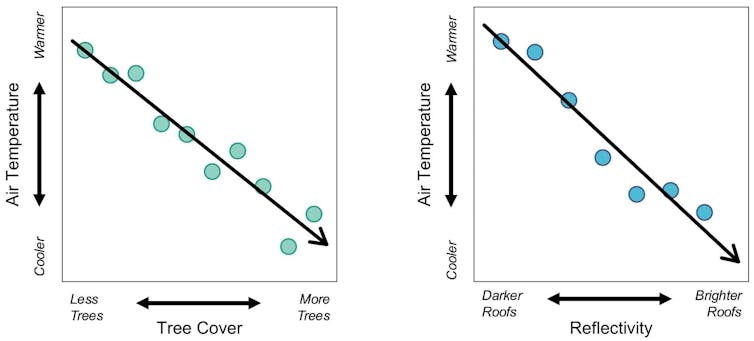
Urban trees offer a natural defense against rising temperatures. They cast shade and release water vapor through their leaves, a process akin to human sweating. That cools the surrounding air and reduces afternoon heat.
Adding trees to city streets, parks and residential yards can make a meaningful difference in how hot a neighborhood feels, with blocks that have tree canopies nearly 3 F (1.7 C) cooler than blocks without trees.
Comparing maps of New York’s vegetation and temperature shows the cooling effect of parks and neighborhoods with more trees. In the map on the left, lighter colors are areas with fewer trees. Light areas in the map on the right are hotter. NASA/USGS Landsat
But planting trees isn’t always simple.
In hot, dry cities, trees often require irrigation to survive, which can strain already limited water resources. Trees must survive for decades to grow large enough to provide shade and release enough water vapor to reduce air temperatures.
Most challenging of all, dense urban neighborhoods where heat is most intense are often too packed with buildings and roads to grow more trees.
How cool roofs can help on hot days
Another option is “cool roofs.” Coating rooftops with reflective paint or using light-colored materials allows buildings to reflect more sunlight back into the atmosphere rather than absorbing it as heat.
These roofs can lower the temperature inside an apartment building without air conditioning by about 2 to 6 F (1 to 3.3 C), and can cut peak cooling demand by as much as 27% in air-conditioned buildings, one study found. They can also provide immediate relief by reducing outdoor temperatures in densely populated areas. The maintenance costs are also lower than expanding urban forests.
Two workers apply a white coating to the roof of a row home in Philadelphia. AP Photo/Matt Rourke
However, like trees, cool roofs come with limits. Cool roofs work better on flat roofs than sloped roofs with shingles, as flat roofs are often covered by heat-trapping rubber and are exposed to more direct sunlight over the course of an afternoon.
Cities also have a finite number of rooftops that can be retrofitted. And in cities that already have many light-colored roofs, a few more might help lower cooling costs in those buildings, but they won’t do much more for the neighborhood.
By weighing the trade-offs of both strategies, cities can design location-specific plans to beat the heat.
Choosing the right mix of cooling solutions
Many cities around the world have taken steps to adapt to extreme heat, with tree planting and cool roof programs that implement reflectivity requirements or incentivize cool roof adoption.
In a recent study, we analyzed Boston’s potential to lower heat in vulnerable neighborhoods across the city. The results demonstrate how a balanced, budget-conscious strategy could deliver significant cooling benefits.
For example, we found that planting trees can cool the air 35% more than installing cool roofs in places where trees can actually be planted.
However, many of the best places for new trees in Boston aren’t in the neighborhoods that need help. In these neighborhoods, we found that reflective roofs were the better choice.
By investing less than 1% of the city’s annual operating budget, about US$34 million, in 2,500 new trees and 3,000 cool roofs targeting the most at-risk areas, we found that Boston could reduce heat exposure for nearly 80,000 residents. The results would reduce summertime afternoon air temperatures by over 1 F (0.6 C) in those neighborhoods.
Not every city will benefit from the same mix. Boston’s urban landscape includes many flat, black rooftops that reflect only about 12% of sunlight, making cool roofs that reflect over 65% of sunlight an especially effective intervention. Boston also has a relatively moist growing season that supports a thriving urban tree canopy, making both solutions viable.
In places with fewer flat, dark rooftops suitable for cool roof conversion, tree planting may offer more value. Conversely, in cities with little room left for new trees or where extreme heat and drought limit tree survival, cool roofs may be the better bet.
Phoenix, for example, already has many light-colored roofs. Trees might be an option there, but they will require irrigation.
Getting the solutions where people need them
Adding shade along sidewalks can do double-duty by giving pedestrians a place to get out of the sun and cooling buildings. In New York City, for example, street trees account for an estimated 25% of the entire urban forest.
Cool roofs can be more difficult for a government to implement because they require working with building owners. That often means cities need to provide incentives. Louisville, Kentucky, for example, offers rebates of up to $2,000 for homeowners who install reflective roofing materials, and up to $5,000 for commercial businesses with flat roofs that use reflective coatings.
In Boston, planting trees, left, and increasing roof reflectivity, right, were both found to be effective ways to cool urban areas. Ian Smith et al. 2025
Efforts like these can help spread cool roof benefits across densely populated neighborhoods that need cooling help most.
As climate change drives more frequent and intense urban heat, cities have powerful tools for lowering the temperature. With some attention to what already exists and what’s feasible, they can find the right budget-conscious strategy that will deliver cooling benefits for everyone.
Lucy Hutyra has received funding from the U.S. federal government and foundations including the World Resources Institute and Burroughs Wellcome Fund for her scholarship on urban climate and mitigation strategies. She was a recipient of a 2023 MacArthur Fellowship for her work in this area.
Ian Smith does not work for, consult, own shares in or receive funding from any company or organization that would benefit from this article, and has disclosed no relevant affiliations beyond their academic appointment.