Pourquoi la hausse du prix des mémoires vives informatiques est une menace pour l’économie européenne

Source: The Conversation – France (in French) – By Julien Pillot, Enseignant-Chercheur en Economie, INSEEC Grande École

Les mémoires vives de type RAM sont des composants essentiels des produits électroniques et informatiques. Leur prix a fortement augmenté ces dernières semaines. Pour certains d’entre-eux, le prix a même été multiplié par quatre ou cinq en quelques semaines. Comment expliquer cette évolution ? Quel impact cela pourrait-il avoir sur le prix des ordinateurs, mais aussi sur l’inflation ou sur le développement de l’intelligence artificielle ? Les économies européennes seront-elles atteintes ? Julien Pillot répond à nos questions.


The Conversation : Pourquoi assiste-t-on depuis quelques semaines à une forte hausse du prix des mémoires vives ?

Julien Pillot : La hausse des prix concerne certains types de mémoires vives (RAM), qui constituent un ensemble beaucoup plus large. C’est l’évolution du prix de la DDR5 et la HBM3 qui inquiète de nombreux analystes actuellement. Pour comprendre les évolutions en cours, il faut avoir en tête que ces formats de mémoire vive sont essentiels à deux usages : la DDR5 est utilisée pour faire fonctionner l’ensemble de nos équipements informatiques et électroniques grand public, à des fins notamment de bureautique ou de gaming, quand la HBM est destinée aux supercalculateurs, essentiellement à des fins d’entraînement des intelligences artificielles (IA). Or, sur ce dernier point, nous observons une accélération sensible de la demande, en lien avec le vif engouement pour l’IA depuis deux ans et la construction de centres de données qui va de pair. Cette pression très forte de la demande explique le phénomène, suivant les canons de l’économie : quand la demande augmente et que l’offre ne suit pas, le prix croît. C’est d’autant plus vrai que cette croissance ne pouvait être que très imparfaitement anticipée, et que le secteur des composants informatiques connaît très souvent des cycles de surproduction/sous-production plus ou moins courts.

*Quel impact cela peut-il avoir ?

J. P. : L’augmentation des coûts de fourniture est une chose, mais il y a également un risque que les délais de production s’allongent, et que les prix des produits finis augmentent pour le grand public. Pour bien comprendre ce qui se passe, il faut avoir en tête que la production est principalement le fait de trois entreprises : les Coréens SK Hynix et Samsung d’une part, et l’Américain Micron d’autre part. Cet oligopole très concentré réalise près de 93 % de la production mondiale. Pour faire face à la croissance de la demande, ils doivent puiser dans leurs stocks, mais surtout augmenter leur capacité de production, ce qui veut dire très concrètement construire de nouveaux sites ou agrandir les sites existants. Outre que créer de nouvelles unités de production prend du temps, cela représente aussi un important investissement.

Ces acteurs sont donc placés devant un dilemme : la hausse de la demande sera-t-elle suffisamment durable pour justifier ces investissements ? Rien ne serait pire pour ces acteurs que de se retrouver, à terme, avec des surcapacités de production qui, non seulement s’avèreraient difficiles à amortir, mais en outre pourraient créer un choc déflationniste sur leur production, comme cela s’est vu en 2022-2023 avec le ralentissement de la demande. C’est un cas classique en économie industrielle qui explique aussi pourquoi les trois géants de la mémoire vive limitent leurs plans d’expansion.

Cet accroissement de la demande n’était-il pas du tout prévisible ?

J. P. : L’accélération exponentielle, depuis 2023-2024, et l’avènement de ChatGPT ont surpris beaucoup de monde. Cet « effet blast » a eu pour principale conséquence le fléchage d’une quantité colossale de fonds vers le développement de l’IA et, par conséquent, vers les composants critiques des architectures essentielles à leur entraînement. Ce qui explique autant la valorisation record d’une entreprise comme Nvidia qui fournit les GPU [processeurs graphiques], que la hausse de la demande, et donc des prix, de la mémoire vive.

Ce mouvement a été d’autant plus fort que, dans le même temps, les autres véhicules d’investissement, comme la blockchain ou le métavers, marquaient une pause, voire s’effondreraient.

Si la situation à court terme est favorable aux producteurs de RAM qui bénéficient à plein de l’effet-prix qui résulte de l’accélération de la demande (SK Hynix, le fournisseur de Nvidia, aurait même déjà écoulé la totalité de sa production prévue pour 2026), elle nécessite néanmoins de pouvoir offrir au marché ce qu’il demande, car une pénurie durable ne profite à personne. Raison pour laquelle ils ont réagi.

De quelle façon ?

J. P. : En adaptant leur outil de production. Ils se sont focalisés sur la production des mémoires vives les plus demandées, quitte à en délaisser d’autres. Mais à un moment, on arrive au bout des capacités d’adaptation des acteurs, ce qui explique les goulets d’étranglement, par exemple sur les DDR5, les producteurs favorisant les mémoires HBM qui offrent de meilleures marges. Mais, retour de bâton, le goulet d’étranglement sur la DDR5 est tel que les producteurs envisagent désormais de la privilégier. Il faut dire que les perspectives de profits sont très alléchantes.


À lire aussi :
Pourquoi la bulle de l’IA ne devrait pas éclater… malgré des inquiétudes légitimes


Cela veut-il dire que les biens électroniques et informatiques vont voir leur prix s’envoler à court terme ?

J. P. : C’est très très difficile à dire, car répondre à cette question revient à poser un problème avec beaucoup d’inconnues. Certains analystes tablent sur une augmentation de 20 % du prix des smartphones, mais ces conclusions me paraissent prématurées. Les facteurs d’incertitude sont bien trop nombreux pour être si catégorique.

L’impact va, en effet, dépendre des décisions prises par les entreprises, et des marges de manœuvre dont elles disposent… Nous avons déjà évoqué le dilemme qui concerne les producteurs de RAM. Leurs arbitrages à court terme seront déterminants dans les mécanismes de fixation des prix pour les différents types de RAM. Les autres inconnues concernent la demande, notamment celle qui émane des acteurs de l’électronique grand public.

À court terme, et à périmètre constant (stabilité de la demande et des prix des autres composants), la hausse du prix des mémoires vives augmente leurs coûts de production. Quant aux goulets d’étranglement, ils peuvent ralentir les cadences de livraison des composants, et donc allonger les délais de production et/ou réduire les quantités de produits finis produites. Avec des répercussions évidentes sur leur trésorerie.

Pour savoir l’impact sur le consommateur final, tout va dépendre de la capacité autant que la volonté des entreprises à répercuter ou non cette hausse sur leurs clients. Chaque entreprise va prendre sa décision en fonction de sa situation concurrentielle et financière propre, en arbitrant entre sa trésorerie et le risque de perdre des parts de marché. Une entreprise en position de force peut décider de répercuter la hausse. Une autre confrontée à une forte concurrence sera tentée de maintenir les prix actuels aussi longtemps que possible, et donc de rogner ses marges.

Autre facteur qui va jouer : l’évolution des prix des autres composants. Les produits électroniques sont complexes. Ils sont l’assemblage d’un tas de composants dont les prix varient indépendamment les uns des autres. Il est possible que, tandis que le prix de la RAM augmente, celui d’autres éléments baisse, ce qui peut permettre à un assembleur de faire une péréquation.

Enfin, la hauteur de gamme des produits finis va également jouer un rôle très important dans les arbitrages des producteurs. Sur les produits bas de gamme, il est probable que les producteurs soient peu incités à répercuter la hausse des coûts, car le consommateur est très sensible au prix. À l’inverse, pour du haut de gamme, l’entreprise retrouve des marges de manœuvre, car le prix n’est pas le critère de choix déterminant. Une entreprise, comme Samsung, qui couvre toutes les gammes de produits peut également jouer une péréquation en acceptant de réduire ses marges sur les produits d’entrée de gamme, et de « se rattraper » – au moins en partie – sur les produits haut de gamme.

Sans même évoquer les impacts imputables aux décisions de politique commerciale, ou d’éventuels chocs exogènes tels que celui qui avait frappé la production de disques durs en 2011-2012, tous ces éléments mis bout à bout font qu’il est déjà très difficile d’avoir une vue d’ensemble des répercussions macro-économiques de la hausse du prix, tant l’impact global dépend d’une infinité de décisions micro locales.

Ces mémoires vives sont utilisées pour les modèles d’IA. Faut-il craindre, dès lors, que cela pèse sur les entreprises du secteur alors que de nombreuses personnes évoquent une bulle financière ? En renchérissant les coûts de production de l’IA, la hausse du prix des mémoires vives ne va-t-elle pas déstabiliser l’équilibre financier des entreprises les plus fragiles du secteur ?

J. P. : Tout va dépendre des arbitrages des acteurs, et notamment des producteurs de mémoire vive. Vont-ils continuer ou non à favoriser la production des mémoires vives pour l’IA, les fameuses HBM ? Il pourrait aussi y avoir une bascule à moyen terme qui aboutirait à un ralentissement du rythme de développement de l’IA, le temps de digérer les investissements colossaux réalisés jusqu’ici. Pour quelles raisons ? Des pressions venant de la société ou des actionnaires. Ces derniers voient bien que la croissance de l’IA consomme beaucoup de cash, et s’inquiètent de perspectives de monétisation qui sont soit plus lointaines, soit moins importantes que celles promises par les acteurs de la tech.

Boursorama, 2025.

Certains investisseurs pourraient bien être tentés de pousser les entreprises à se réorienter vers des projets moins gourmands en capacité de calcul, qui nécessitent moins d’énergie et de cash. À moins que ce ne soit les dirigeants d’entreprise eux-mêmes qui fassent ce choix par volonté à la fois de préserver leur trésorerie et de trouver des modèles peut-être plus frugaux, plus spécialisés et mieux adaptés aux besoins réels des acteurs du marché. Dans un cas comme dans l’autre, cela aurait un effet sur la demande de RAM. Cela ne reste qu’un scénario. En revanche, il me semble raisonnable d’estimer que tôt ou tard les gros argentiers de l’IA vont réclamer des éléments de preuve d’un possible retour sur investissement, ce qui poussera les entreprises spécialisées à chercher à réduire leurs coûts.

Deux Coréens, un États-unien, quel impact pourrait avoir l’absence de l’Europe dans cette technologie ?

J. P. : Les Européens se retrouvent encore une fois dans une extrême dépendance pour des biens d’une importance cruciale, stratégique et même vitale. Nous ne sommes pas complètement absents de l’industrie des semi-conducteurs – l’Europe compte même deux champions, avec ASML pour la fabrication d’équipements, et STMicroelectronics pour la fabrication de puces –, mais pour ce qui concerne la mémoire vive, nos entreprises sont totalement dépendantes des exportations de la Corée du Sud ou des États-Unis, deux pays avec lesquels il vaut mieux avoir de bonnes relations. Le déficit commercial européen pour les semi-conducteurs atteint 10 milliards à 20 milliards de dollars (entre 8,5 milliards et 17 milliards d’euros) par an !

Nous commençons à prendre conscience de nos dépendances multiples. L’European Chips Act (ECA) a été une première réaction qui vise à couvrir 20 % de la production mondiale de semi-conducteurs. Une entreprise comme STMicroelectronics est bien placée, mais elle est absente du segment des mémoires vives. Il faudrait maintenant élargir le champ de l’ECA à ces composantes vitales de l’économie numérique. Le plus vite sera le mieux, car, vous l’aurez compris, ces composants électroniques ont acquis une dimension critique pour l’ensemble de l’économie qui se numérise à marche accélérée.

Propos recueillis par Christophe Bys.

The Conversation

Julien Pillot ne travaille pas, ne conseille pas, ne possède pas de parts, ne reçoit pas de fonds d’une organisation qui pourrait tirer profit de cet article, et n’a déclaré aucune autre affiliation que son organisme de recherche.

ref. Pourquoi la hausse du prix des mémoires vives informatiques est une menace pour l’économie européenne – https://theconversation.com/pourquoi-la-hausse-du-prix-des-memoires-vives-informatiques-est-une-menace-pour-leconomie-europeenne-272389

What the hyperproduction of AI slop is doing to science

Source: The Conversation – Global Perspectives – By Vitomir Kovanovic, Associate Professor and Associate Director of the Centre for Change and Complexity in Learning (C3L), Education Futures, University of South Australia

ChatGPT, CC BY

Over the past three years, generative artificial intelligence (AI) has had a profound impact on society. AI’s impact on human writing, in particular, has been enormous.

The large language models that power AI tools such as ChatGPT are trained on a wide variety of textual data, and they can now produce complex and high-quality texts of their own.

Most importantly, the widespread use of AI tools has resulted in hyperproduction of so-called “AI slop”: low-quality AI-generated outputs produced with minimal or even no human effort.

Much has been said about what AI writing means for education, work, and culture. But what about science? Does AI improve academic writing, or does it merely produce “scientific AI slop”?

According to a new study by researchers from UC Berkeley and Cornell University, published in Science, the slop is winning.

Generative AI boosts academic productivity

The researchers analysed abstracts from more than a million preprint articles (publicly available articles yet to undergo peer review) released between 2018 and 2024.

They examined whether use of AI is linked to higher academic productivity, manuscript quality and use of more diverse literature.

The number of preprints an author produced was a measure of their productivity, while eventual publication in a journal was a measure of an article’s quality.

The study found that when an author started using AI, the number of preprints they produced increased dramatically. Depending on the preprint platform, the overall number of articles an author published per month after adopting AI increased between 36.2% and 59.8%.

The increase was biggest among non-native English speakers, and especially for Asian authors, where it ranged from 43% to 89.3%. For authors from English-speaking institutions and with “Caucasian” names, the increase was more modest, in the range of 23.7% to 46.2%.

These results suggest AI was often used by non-native speakers to improve their written English.

What about the article quality?

The study found articles written with AI used more complex language on average than those written without AI.

However, among articles written without AI, ones that used more complex language were more likely to be published.

This suggests that more complex and high-quality writing is perceived as having greater scientific merit.

However, when it comes to articles written with AI support, this relationship was reversed – the more complex the language, the less likely the article was to be published. This suggests that AI-generated complex language was used to hide the low quality of the scholarly work.

AI increased the variety of academic sources

The study also looked at the differences in article downloads originating from Google and Microsoft search platforms.

Microsoft’s Bing search engine introduced an AI-powered Bing Chat feature in February 2023. This allowed the researchers to compare what kind of articles were recommended by AI-enhanced search versus regular search engine.

Interestingly, Bing users were exposed to a greater variety of sources than Google users, and also to more recent publications. This is likely caused by a technique used by Bing Chat called retrieval-augmented generation, which combines search results with AI prompting.

In any case, fears that AI search would be “stuck” recommending old, widely used sources was not justified.

Moving forward

AI has had significant impact on scientific writing and academic publishing. It has become an integral part of academic writing for many scientists, especially for non-native speakers and it is here to stay.

As AI is becoming embedded in many applications such as word processors, email apps, and spreadsheets, it will be soon impossible not to use AI whether we like it or not.

Most importantly for science, AI is challenging the use of complex high-quality language as the indicator of scholarly merit. Quick screening and evaluation of articles based on language quality is increasingly unreliable and better methods are urgently needed.

As complex language is increasingly used to cover up weak scholarly contributions, critical and in-depth evaluations of study methodologies and contributions during peer review are essential.

One approach is to “fight fire with fire” and use AI review tools, such as the one recently published by Andrew Ng at Stanford. Given the ever-growing number of manuscript submissions and already high workload of academic journal editors, such approaches might be the only viable option.

The Conversation

Vitomir Kovanovic does not work for, consult, own shares in or receive funding from any company or organisation that would benefit from this article, and has disclosed no relevant affiliations beyond their academic appointment.

ref. What the hyperproduction of AI slop is doing to science – https://theconversation.com/what-the-hyperproduction-of-ai-slop-is-doing-to-science-272250

Revolutionary rap: Nigerian star Falz has kept protest music alive

Source: The Conversation – Africa – By Paul Onanuga, Lecturer, Federal University, Oye Ekiti

Nigerian rapper, actor and social media star Falz released his sixth studio album, The Feast, in 2025.

Few Nigerian popular musicians have shown as much versatility and staying power as the man behind the #ElloBae and #WehDoneSir social media trends. For over a decade now, Falz has been marrying musical skills and social activism with digital savvy and comedy.

His rise to global prominence was solidified with his 2018 song This is Nigeria. But it began in 2014 with Marry Me off his debut album Wazup Guy.

As a young artist known for his video skits, he created an online challenge ahead of releasing the song Ello Bae (Hello Babe). In it he tries to romance a woman who appreciates him and his ambition, but is looking for a man with money. It remains a common hashtag when TikTokers post about love and money.

In 2017 he released Wehdone Sir (Well Done, Sir), a witty takedown of people with fake glamour lifestyles. #WehDoneSir is still used on social media to satirise pretentious individuals.

Falz would become known for his unique blend of hip-hop and Afropop, but what really made him stand out was his skill at infusing humour into his socially conscious, often revolutionary, songs.

It’s often argued that Falz is a natural heir to Fela Anikulapo-Kuti. He was the Nigerian music legend and activist who helped create the Afrobeat movement (a precursor to today’s Afrobeats).

Like Fela, Falz packs his music with playfulness and satire while also stirring public consciousness with activist lyrics. Both call for action against the oppressive political class. In 2020, when young Nigerians took to the streets to demand an end to police corruption, Fela and Falz were both part of the inventory of #EndSARS protest songs.

As a scholar of Nigerian hip-hop, I have published papers on Fela and Falz and how they have shaped protest music that responds to social challenges in Nigeria.

So, who is Falz, and how has he spread his message – and come to be the political voice of his generation, as Fela was to his?

Who is Falz?

Falz (real name Folarin Falana) was born in 1990 in Mushin, Lagos. He is the son of a respected human rights lawyer and activist father, Femi Falana, and lawyer mother, Funmi Falana. In fact, his father was Fela’s lawyer, defending him against charges brought by the state.

Falz also qualified as a lawyer, but chose instead to pursue his interests in music and acting. These multiple skills feed into his productions on diverse levels. Beyond his songs, he is also very active on Instagram and Tik-Tok, where he establishes trends, especially around his songs and films.

His character in Ello Bae, for instance, struggles with English, using big formal words in unexpected ways, finding comedy in his faux Yoruba inflections. It would be a trademark of the #ElloBaeChallenge and would enjoy renewed public attention when Falz was cast in the TV series Jenifa’s Diary playing a similar character.

In 2016, Falz won best new international act at the BET Awards in the US. Numerous other awards would follow. His albums have received commercial and critical success. His roles in movies have further solidified his status as a multitalented entertainer.

Activism

Falz does not shy away from living the talk. He took part in the 2020 #EndSARS protests and his work repeatedly tries to steer the government towards addressing socio-economic challenges.

Soon after the protests, he released Moral Instruction. On the album, the track Johnny depicts the everyday experiences of Nigerians. This is Nigeria, a localised version of US rapper Childish Gambino’s This is America, depicts Nigeria as a country struggling with corruption, lawlessness and social injustice. A stark contrast to its potential. The video reflects a breakdown in law and order, corrupt officials, and the struggles of young people facing limited opportunities and resorting to crime.

Falz has used his platform as a celebrity and his background as a lawyer to call for social justice and for young people to make a difference.

Fela and Falz

There have been a number of pretend heirs to Fela’s throne of musical consciousness. Many of these have either not lived up to the hype or have fizzled out.

However, many popular Nigerian artists leverage Fela’s ethos through sampling his beats and lyrics. This is evident in Falz’s musicography too.

My study on the lyrical and thematic connections between Fela and Falz songs compares a number of tracks. Fela’s No Agreement and Falz’s Talk, for example, both draw attention to social inequality and systemic challenges in Nigeria.

Fela’s song was produced in the context of a military regime while Falz’s was within a democratic dispensation. But both speak of a crisis of leadership in Nigeria, as is the case in many postcolonial societies. What particularly links Fela and Falz is that both are unrelenting in their revolutionary struggles and determination to ensure an equitable Nigerian society.

Religious leaders are not spared criticism. Echoing Fela’s Coffin for Head of State (1980), Falz’s Amen (2019) points to the deceptive practices and complicity of religious leaders in poor political leadership and endemic poverty. Both critique the double standards that have become normal in the country.

Falz’s Follow Follow (2019) addresses current realities in Nigerian society – a lack of personal conviction and independent thought and the mindless following of social media trends. Integrating lyrics from Fela’s Zombie (1976), the song is about asserting one’s identity. It also rehashes Fela’s Follow Follow, mocking those who allow themselves to be led blindly by others.

To make sure his advocacy resonates, Falz co-opts his listeners through a call-and-response strategy. A phrase is sung and the next phrase answers it. This way, along with catchy lyrics, the audience become active participants.

This also echoes the traditional Yoruba chant-and-refrain rendition used by musicians, poets and bards to engage their audience. Its possible nod to the indigenous is also at the heart of his faux Yoruba accent, a style that downplays his prestigious upbringing and connects him to ordinary people, much like Pidgin did for Fela.

But echoes of Fela don’t in any way take away from the creative force of Falz’s work. Rather they reinforce his critique of how the postcolonial Nigerian state has failed to live up to its promise.

Into the future

While Fela was unrepentantly anticolonial, Falz is sublimely hybridised. His mixture of talents and views creates a pulsating pan-African consciousness that’s able to exist in a global contemporary world view.

His lyrics and videography are aimed at the masses – especially young people – who have the most to gain from positive social change. In this way Falz can be said to represent a generational conscience. He uses his empowering songs to motivate his fans to take their destinies in their own hands.

The Conversation

Paul Onanuga does not work for, consult, own shares in or receive funding from any company or organisation that would benefit from this article, and has disclosed no relevant affiliations beyond their academic appointment.

ref. Revolutionary rap: Nigerian star Falz has kept protest music alive – https://theconversation.com/revolutionary-rap-nigerian-star-falz-has-kept-protest-music-alive-266529

Dispatches from a year of global conflict and uncertainty

Source: The Conversation – UK – By Jonathan Este, Senior International Affairs Editor, Associate Editor, The Conversation

This newsletter was first published in The Conversation UK’s World Affairs Briefing email. Sign up to receive weekly analysis of the latest developments in international relations, direct to your inbox.


Volodymyr Zelensky says there will almost certainly be no ceasefire in Ukraine before Christmas. This means the war is more than likely to stretch on into a fifth year to the dismay of everyone – barring, perhaps Vladimir Putin, for whom the war seems to be a means to a number of different ends.

Whatever the Russian president wants to gain immediately – prestige, territory, a pliant government in Kyiv, access to eastern Ukraine’s considerable resources – the war also appears to be fulfilling a number of Putin’s long-term foreign policy aims: it is driving a wedge between the US and Europe and exposing big divisions within Europe itself.

At present it looks as if we’re witnessing another of the diplomatic loops that have characterised much of the year as Donald Trump has tried to make good on his pledge to end the war. The latest deal is still being thrashed out between negotiators from the US, Ukraine and its European allies. But it’s far from clear that whatever the joint talks produce will receive buy-in from the US president, whose position – as we have seen all year – can change overnight depending on whom he talks to.

What’s more clear is that Putin will almost certainly reject the plan outright. How this will play in the White House is anyone’s guess. While the US president has shown that he is susceptible to the Russian leader’s blandishments, he has also displayed a short fuse when he thinks Putin isn’t taking him seriously enough.

Looking back on the year, it’s clear that – in the sphere of international relations – pretty much all roads lead back to Donald Trump. Most of the big international stories we’ve covered have featured the US president as a key player. So it makes sense to begin a review of the past year in international affairs with the return of Trump to the White House.

Donald Trump: a politician of consequence

After Trump was elected for a second term in November 2024, James Cooper of York St John University referred to the president as an “international disruptor”. Cooper predicted that Trump’s unconventional style might yield results via the “madman theory”, which holds that his unpredictability could prove to be an effective foreign policy approach. Quite how effective remains to be seen.


Read more:
History will remember Donald Trump as a highly consequential president


Cooper also predicted that Ukraine and America’s Nato allies might find Trump’s foreign policy outlook a major concern. And so it has proved. The US has halted military aid to Ukraine, leaving Kyiv scrambling to secure reliable support from its European allies which – as we’ve seen, are struggling to secure the funds. And America’s Nato allies in Europe learned last month, when the US released its 2025 national security strategy, that they can no longer rely on the US for security in the way that they have in the eight decades since the end of the second world war.

The strategy makes for sobering reading if you live in Europe, writes Andrew Gawthorpe, a lecturer in history and international studies at Leiden University. The 33-page public document is harshly critical of what it sees as Europe’s weakness, saying the continent risks “civilizational erasure” thanks to migration.

Gawthorpe notes that Russia has welcomed the strategy as “largely consistent” and predicts that America’s allies in Asia and Europe may have to face the prospect that Trump may prefer to align the US in a “grand bargain” with Russia and China.


Read more:
What the US national security strategy tells us about how Trump views the world


Ukraine conflict: no end in sight

Despite nearly ten months elapsing, it’s hard to forget the now-notorious White House meeting at which Trump and his vice-president, J.D. Vance, lambasted Zelensky for not being grateful for the help the US had given Ukraine. All diplomatic niceties abandoned, the Americans rounded on the Ukrainian president, accusing him of “gambling with world war three” and demanding: “You either make a deal or we are out.”

ISW map showing the state of the conflict in Ukraine, December 16.
The state of the conflict in Ukraine, December 16, 2025.
Institute for the Study of War

Stefan Wolff and Tetyana Malyarenko reported at the time that the real issue was Trump’s desire for US firms to exploit Ukraine’s considerable mineral reserves (many of Trump’s peace deals are also business deals, as we noted in a separate article last month).

Wolff, of the University of Birmingham, and Malyarenko, of the University of Odesa, have been contributing to our coverage of the conflict between Russia and Ukraine and its geopolitical implications for more than a decade. For them, the US national security strategy was confirmation of something they have suspected for a while: that Europe will be left struggling to keep Ukraine in the fight as the continent re-arms itself in the face of the very real prospect that Putin doesn’t want to stop at Ukraine.


Read more:
New US national security strategy adds to Ukraine’s woes and exacerbates Europe’s dilemmas


Our coverage of the Ukraine conflict has also been informed by Frank Ledwidge, formerly of UK military intelligence, now an expert in military strategy at the University of Portsmouth. Ledwidge is a regular visitor to Ukraine and in August contributed this vivid piece of reportage from Kharkiv, Ukraine’s “unbreakable” eastern capital.


Read more:
Kharkiv: what I saw in Ukraine’s ‘unbreakable’ eastern capital


The tragedy of Palestine

This was the year that many western countries came off the sidelines and formally declared their recognition of Palestinian statehood. These declarations, by the UK, France, Australia and Canada, were largely symbolic. As things stand the prospect of a two-state solution remains as remote as ever. The (very tenuous) ceasefire in Gaza has not progressed further than a cessation of the wholesale killing of Palestinian civilians in the enclave.

And as Leonie Fleischmann, an expert in the Israeli-Palestinian conflict at City St Georges, University of London, reports, illegal Israeli settlements have multiplied to such an extent that they threaten to cut the West Bank in two, which – as Israel’s far-right finance minister Bezalel Smotrich noted – “buries the idea of a Palestinian state”.


Read more:
Israel’s plan for massive new West Bank settlement would make a Palestinian state impossible


In Gaza meanwhile, and despite the ceasefire, the violence continues – albeit on a smaller scale, at present. Within days of the ceasefire being signed, and notwithstanding a stipulation that Hamas must disarm and disband, the militant Palestinian group was already regrouping.

Tahani Mustafa, formerly a Palestine analyst for the international crisis group and now a lecturer in international relations at King’s College London, used her considerably range of contacts on the ground in Gaza to bring us this report.


Read more:
Hamas turns to executions as it tries to establish a monopoly on force in Gaza


What 2026 may hold for the people of Gaza remains uncertain. There’s been little or no progress on establishing a framework for governance in the enclave and at present Israel’s strategy seems to be to encourage as many Gaza residents as possible to leave via the Rafah crossing into Egypt.

Whether we will see the beginnings of the realisation of the Trump blueprint for the redevelopment of much of Gaza into commercial and tourism property, sometimes called the “Trump riviera”, may become clearer next year.


Read more:
Donald Trump’s vision for Gaza’s future: what a leaked plan tells us about US regional strategy


What is clear, though, is that whatever Israeli and its allies plan to do in Gaza, it will be critical to secure the support and cooperation of the Gulf states, without which any plan for the future of the region will be a non-starter.

Scott Lucas, a Middle East expert at the Clinton Institute, University College Dublin, has been contributing to our coverage of the region for more than a decade. As the Gaza ceasefire was announced in October, he answered our questions and underlined the vital role played by other powers in the Middle East.


Read more:
Israel and Hamas agree ceasefire deal – what we know so far: expert Q&A


Civil war in Sudan

The bitter conflict in Sudan has often been eclipsed this year by the wars in Ukraine and Gaza, and it’s significant that it is not among the wars the US president claims to have solved in his eleven months in power. But the regular reports of wholesale slaughter of civilians, mass rape and other war crimes have been no less terrible for that.

The conflict is often reported as an ethnic clash: Arab militias from the country’s northern provinces fighting against African groups from Sudan’s west and south. But Justin Willis of Durham University and Willow Berridge of Newcastle University – both experts in the history of the Sudan conflict – believe it’s more complicated than that and has much to do with international meddling.


Read more:
Why has Sudan descended into mass slaughter? The answer goes far beyond simple ethnic conflict


But when you strip away the geopolitics, as ever, it is innocent civilians who are left to bear the lion’s share of the suffering, as is clear from this harrowing report based on interviews with refugees flooding south to escape the violence.


Read more:
‘I have to talk about it so that the world can know what happened to women and girls in Sudan’ – rape and terror sparks mass migration


We’re going to take a two week break over the holiday season. The next world affairs update will be on January 8 2026. Many thanks for your support over the year.


Sign up to receive our weekly World Affairs Briefing newsletter from The Conversation UK. Every Thursday we’ll bring you expert analysis of the big stories in international relations.


The Conversation

ref. Dispatches from a year of global conflict and uncertainty – https://theconversation.com/dispatches-from-a-year-of-global-conflict-and-uncertainty-272295

Universities’ work towards Indigenous identity policies signals difficult conversations

Source: The Conversation – Canada – By Frank Deer, Professor, Faculty of Education, University of Manitoba

In recent years, members of the Canadian public have witnessed the misrepresentation of Indigenous identities.

Recently, we learned that University of Guelph professor emeritus Thomas King is not Indigenous. The highly regarded author of literary works such as The Inconvenient Indian: A Curious Account of Native People in North America and The Back of the Turtle captured the imagination of readers interested in Indigenous experiences.

Both non-Indigenous readers, either less or more familiar with Indigenous lives, and Indigenous readers trusted and respected King. Many of us revered him.

In King, we had a source of literary representation that informed knowledge of the Indigenous experience, and inspired curiosity about who Indigenous people are — and how we might understand “their” or “our” knowledge, histories and experiences.

King’s situation is yet another in a queue of high-profile individuals such as Buffy Sainte-Marie, Carrie Bourassa and Vianne Timmons who have made dubious claims about Indigenous identities.


Read more:
Thomas King: As we learn another ‘hero’ is non-Indigenous, let’s not ignore a broader cultural problem


Some Canadian universities have begun to develop policies to address erroneous claims to indigeneity. Some have already been affected by the fallout of such cases, while others wish to mitigate potential problems of misrepresentation.

Our respective research interests are in Indigenous education related to Indigenous identity and languages and interdisciplinary research related to intersectional justice, decolonization and equity.

We are both “Status Indian,” who consider ourselves to have connections to our respective communities, in Kanienkeha’ka (Frank) and Wendat (Annie) territories. In our own cases, and many others, these connections are also made complicated by migration, work/life changes and relationships.

Universities address Indigenous identity

Many universities are attempting to develop appropriate policies for Indigenous identity verification that will address and possibly prevent false claims to Indigenous identity.

For example, community consultations at the University of Manitoba and working groups at the University of Winnipeg have provided some valuable input into the problem of false claims of Indigenous identity and potential approaches to address them.

The University of Montréal is also in the process of developing a policy on Indigenous self-declaration, although it has not yet been formally adopted.

While there are many aspects to take into consideration, policies may vary from one institution or community to another. Yet across contexts, policy development about Indigenous identity will often lead to difficult conversations.

Indentity is personal and complex

As such policies emerge, it ought to be acknowledged that Indigenous identity is profoundly personal and complex. For instance, some Indigenous people may lack connections due to the Sixties Scoop phenomenon.


Read more:
How journalists tell Buffy Sainte-Marie’s story matters — explained by a ’60s Scoop survivor


Viewing the complexities that may exist when considering an individual’s Indigenous identity as “challenges” might adversely affect our orientations toward the exercise.

Fundamentally, the constituent elements of one’s Indigenous identity ought to be treated charitably. This approach should not be understood as a dismissal of the problems experienced when one misrepresents their identity as being Indigenous. The concern here is the impact that such dialogue has upon Indigenous people and Peoples at large.

Rights of individuals, nations

We acknowledge the prevailing notion that claims of Indigenous identity ought to be consistent with the rights of nations: this has become an important concern for how Indigenous Peoples understand membership in their communities.

The current prevailing view among many is that some sort of national affiliation is central to any personal declaration to Indigenous identity.

Many academics have expressed confidence in the notion that Indigenous communities are in the best positions to determine how Indigenous identity may be understood in their respective communal or national contexts.

It is also important to include the rights of individuals in the conversation on Indigenous identity. This reflects what is contained in Article 33 of the United Nations Declaration on the Rights of Indigenous Peoples which affirms Indigenous peoples’ right to define their own identity and membership based on their customs and traditions.

Although connections to Indigenous communities are regarded as essential to claims of Indigenous identity, many Indigenous people may not be connected to their community.

Thus, claims to indigeneity made by those without such apparent connections must be considered carefully.

Non-material harms of false claims

While prospective policies around Indigenous identity are developed to regulate situations that would lead a person to make a false claim for material benefits — like access to funding or Indigenous-specific hiring — we believe that non-material impacts, such as community well-being and trust, should also be considered.

False declarations unquestionably impact the person and, sometimes, the reputation of the institution. These also also harm other groups like Indigenous academics, and wider research communities, through division and the erosion of confidence.

Impacts of misrepresentation

Although the Tribal Alliance Against Frauds highlighted the dubiousness of King’s claims to indigeneity, King has owned up publicly to his misrepresentation.

In an essay in The Globe and Mail, King shared what he had learned of his non-Cherokee ancestry, family stories shared about his darker skin, as well as the impacts that his misrepresentation has had on others.

Perhaps we can be charitable to a man who has learned about himself, set the record straight and contributed to a difficult conversation.

The Conversation

Frank Deer receives funding from the Social Sciences and Humanities Research Council of Canada.

Annie Pullen Sansfaçon receives funding from the Canada Research Chair Program. She is member of the National Indigenous University Senior Leaders’ Association (NIUSLA)

ref. Universities’ work towards Indigenous identity policies signals difficult conversations – https://theconversation.com/universities-work-towards-indigenous-identity-policies-signals-difficult-conversations-271074

Battleship Potemkin at 100: how the Soviet film redrew the boundaries of cinema

Source: The Conversation – Global Perspectives – By Alexander Howard, Senior Lecturer, Discipline of English and Writing, University of Sydney

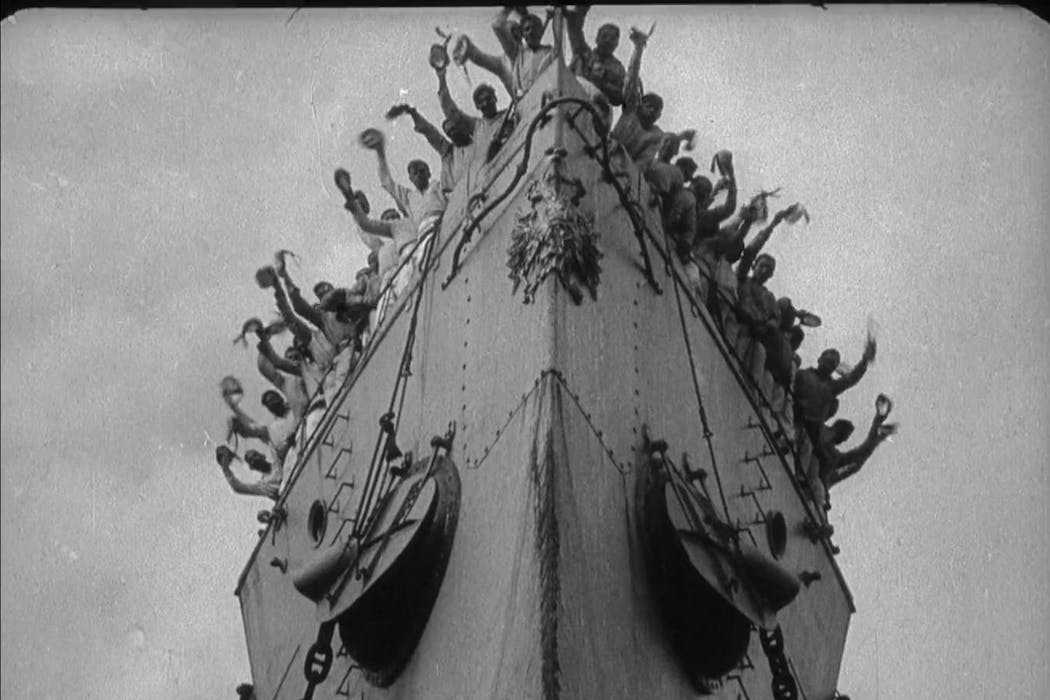
IMDB

People crowd together in the sun. All smiles and waves. Joyous.

Pandemonium erupts. Panic hits like a shockwave as those assembled swivel and bolt, spilling down a seemingly infinite flight of steps.

Armed men appear at the crest, advancing with mechanical precision. We are pulled into the chaos, carried with the writhing mass as it surges downward. Images sear themselves on the retina. A child crushed underfoot. A mother cut down mid-stride.

An infant’s steel-framed pram rattling free, gathering speed as it hurtles downward. A woman’s glasses splinter, skewing across her bloodied face as her mouth stretches open in a soundless scream.

I’ve just described one of the most famous sequences in the history of film: the massacre of unarmed civilians on the steps of Odessa. Instantly recognisable and endlessly quoted, it is the centrepiece of Sergei Eisenstein’s masterpiece, Battleship Potemkin, which turns 100 this month.

A new front for cinema

Battleship Potemkin redrew the boundaries of cinema, both aesthetically and politically.

It is a dramatised retelling of a 1905 mutiny in the Black Sea Fleet of the Imperial Russian Navy – a key cresting point in the wave of profound social and political unrest that swept across the empire that year.

The first Russian revolution saw workers, peasants and soldiers rise up against their masters, driven by deep frustration with poverty, autocracy and military defeat.

Although the tsar remained in power, the discord forced him to concede limited reforms that fell far short of what had demanded.

The impetus for the historical mutiny on the Potemkin was a protest over rotten food rations. Eisenstein emphasises this in his film, lingering on stomach-churning close-ups of maggots crawling over spoiled meat.

When the sailors refuse to eat the putrid rations, they are accused of insubordination and lined up before a firing squad. The men refuse to gun down their comrades and the crew rises up, raising the red flag of international solidarity as they symbolically nail their colours to the mast.

A sailor called Vakulinchuk, who helped lead the uprising, is killed in the struggle. Sailing to Odessa, the crew lays his body out for public mourning and the mood in the city becomes increasingly volatile. Support for the sailors swells, and the authorities respond with lethal force, sending in troops and prompting the slaughter on the Odessa Steps.

The Potemkin fires on the city’s opera house in retaliation, where military leaders have gathered. Soon after, a squadron of loyal warships approaches to crush the revolt. The mutineers brace for battle, but the sailors on the other boats choose not to fire. They cheer the rebels and allow the Potemkin to pass in an act of comradeship.

At this point Eisenstein departs from the historical record: in reality, the 1905 mutiny was thwarted and the revolution suppressed.

Political myth-making

Battleship Potemkin was commissioned by the Soviet State to commemorate the 20th anniversary of the revolution.

The new Bolshevik administration viewed cinema as a powerful tool for shaping public consciousness and Eisenstein – then in his late 20s and gaining attention for his radical theatre work – was tasked with creating a film that would celebrate the origins of Soviet power.

Eisenstein initially planned a sprawling multi-part film canvasing the revolution’s major events, but faced production constraints. He turned instead to the Potemkin, a story which allowed him to depict oppression, collective struggle and the forging of revolutionary unity in a distilled form.

The finished piece was less a literal history lesson than a highly stylised piece of political myth-making.

When Potemkin was presented at Moscow’s Bolshoi Theatre in December 1925 the invited spectators, a mix of communist dignitaries and veterans of the abortive 1905 mutiny, punctuated the screening with bursts of wild applause – none more ecstatic than when the battleship’s crew unfurl the red flag, hand-tinted a vivid red on the black and white film.

Celebrated – and banned

Battleship Potemkin was a global sensation. Filmmakers and critics hailed it as truly groundbreaking. Charlie Chaplin declared it “the best film in the world”.

Yet its impact also made it feared. Governments recognised the volatile political charge running through its images. In Germany it was heavily cut, and in Britain it was banned. Even so, prints continued to circulate, and the film’s reputation only grew.

Eisenstein’s growing international status did little to protect him at home. As the 1920s gave way to the 1930s, the tides of Stalinist cultural policy began to turn sharply against him. Eisenstein’s approach was profoundly out of step with the new aesthetic of Socialist Realism, which demanded clear narratives, heroic characters and unambiguous political messaging.

Where his signature technique, montage, was dynamic and dialectical, Socialist Realism insisted on straightforward storytelling and easily digestible moral lessons. As a result, Eisenstein found himself accused of obscurity, excess and political unreliability.

Several of his projects were halted; others were taken out of his hands altogether. Those he did complete were admired, but none matched the impact of Battleship Potemkin.

A century on, its vision of oppression, courage and collective resistance still crackles with an energy that reminds us why cinema matters.

The Conversation

Alexander Howard does not work for, consult, own shares in or receive funding from any company or organisation that would benefit from this article, and has disclosed no relevant affiliations beyond their academic appointment.

ref. Battleship Potemkin at 100: how the Soviet film redrew the boundaries of cinema – https://theconversation.com/battleship-potemkin-at-100-how-the-soviet-film-redrew-the-boundaries-of-cinema-267433

Trump tariffs and warming India-China ties have silenced the Quad partnership … for now

Source: The Conversation – Global Perspectives – By Hyeran Jo, Associate Professor of Political Science, Texas A&M University

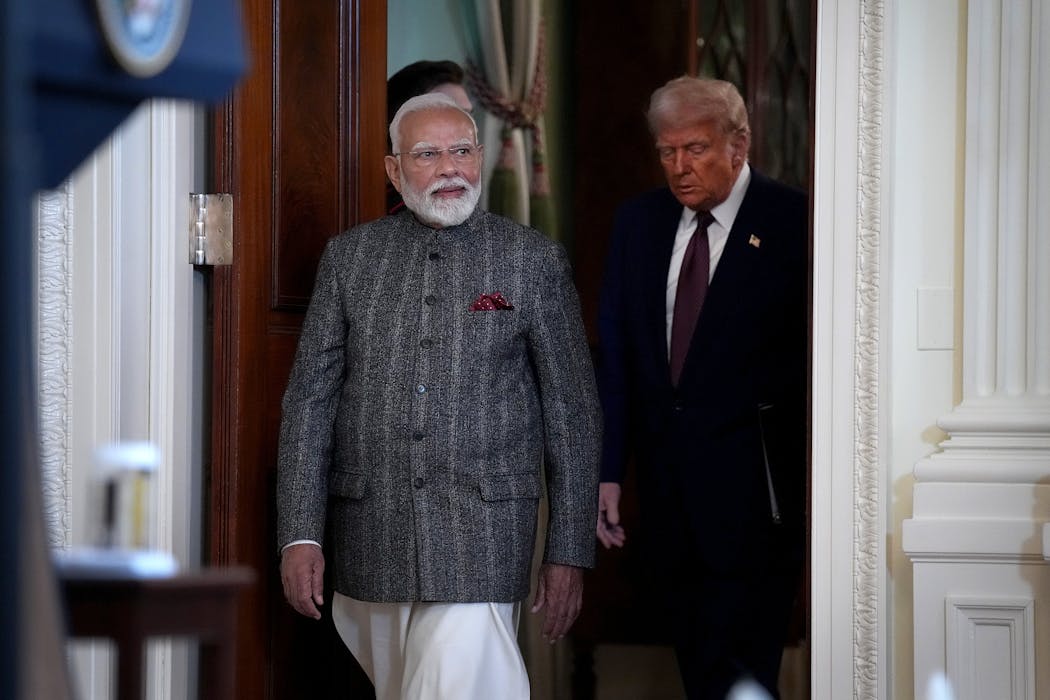
When one diplomatic dance ends, Prime Minister Narendra Modi and President Donald Trump have sought partners elsewhere. Andrew Harnik/Getty Images

When leaders of “the Quad” last met in September 2024, host and then-President Joe Biden declared the partnership between the United States, India, Australia and Japan to be “more strategically aligned than ever before.”

“The Quad is here to stay,” trumpeted Indian Prime Minister Narendra Modi.

Fast-forward a little over a year, however, and the tune has changed.

Leaders of the Quad were due to hold their latest summit in November 2025, with India hosting. But the month came and went, and no event was held. A future date has yet to be announced.

Why the silence? As experts of international institutions and the geopolitics and geoeconomics of the Indo-Pacific, we believe the answers can be found in the calculus of the two largest members involved: India and the U.S.

For the Trump administration, the domestic dividends of the Quad are not immediately obvious. Meanwhile, New Delhi is more concerned about how to position itself amid the great power competition between China and the U.S.

The result is paralysis for the Quad, for now.

The evolution of the Quad

The Quadrilateral Security Dialogue, to give the Quad its full name, began life in 2004.

The Quad 1.0 focused on humanitarian disaster assistance and cooperation after the Indian Ocean tsunami. In 2007, under the vision of then-Japanese Prime Minister Shinzo Abe, the Quad was recast as a platform to promote a free and prosperous Indo-Pacific, with an eye toward maritime security and economic cooperation.

Since then, the Quad has seen many fits and starts. Australia withdrew from the partnership in 2008 when it prioritized trade relations with China. India, too, has at times been tepid about the Quad’s continuation, partly due to its legacy of nonalignment and concerns over managing relations with Beijing.

The Quad 2.0 came to life in 2017 as the four core members coalesced around a shared sentiment of countering China’s rising power.

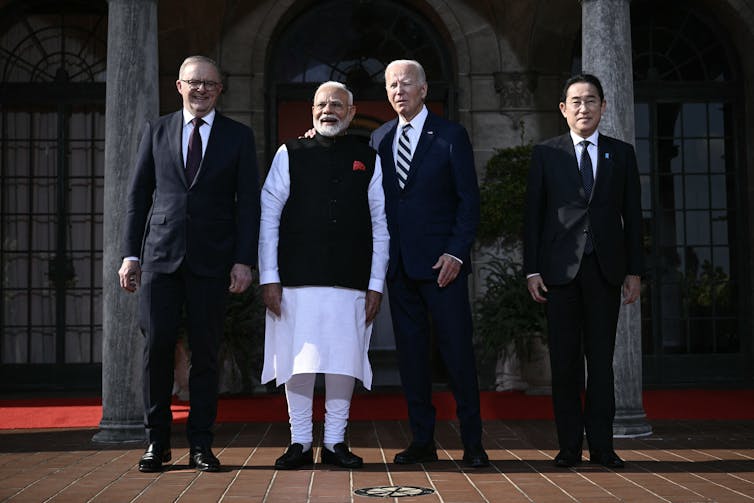
Four men stand for a photo
President Joe Biden participates in a 2024 Quad summit with prime ministers Anthony Albanese of Australia and Narendra Modi of India and Fumio Kishida of Japan.
Brendan Smialowski/AFP via Getty Images

Despite its name, the Quadrilateral Security Dialogue has increasingly gravitated toward nonsecurity agendas, from global health to maritime domain awareness and critical technologies.

Yet even as this emerging Quad 3.0 has foregrounded cooperation around the slogan “development, stability and prosperity,” it is over trade and tariffs that the two largest members of the Quad are not seeing eye to eye.

The eagle and elephant tussle over tariffs

On Aug. 1, 2025, Washington imposed a 25% reciprocal tariff on Indian goods over long-standing trade frictions, notably over access to India’s agricultural market. It was followed by an additional 25% punitive duty for New Delhi’s continued purchases of Russian oil.

The combined 50% U.S. tariff was accompanied by another move that upset New Delhi: new U.S. restrictions on H-1B visas. Some 70% of all holders of the U.S. visas, designed for temporary skilled workers, are Indian nationals.

The rift between New Delhi and Washington widened with India’s decision to attend a meeting in Rio de Janeiro in September of the so-called BRICS nations. That was interpreted as an “anti-U.S.” summit by Washington given its composition of largely Global South nations and other countryies antagonistic to the West, including Russia and China.

As a key member of the BRICS grouping, India’s attendance should have come as no real surprise. Even so, and despite Modi’s decision not to attend personally, the U.S. took umbrage, with U.S. Secretary of Commerce Howard Lutnick criticizing India’s BRICS membership and accusing New Delhi of having “rubbed the United States the wrong way.”

Lutnick’s comments are indicative of the cooling ties between New Delhi and Washington. Since the end of the Cold War, India has been seen by Washington as a democratic ally and a vital U.S. partner in the Indo-Pacific. The two countries have shared strategic and defense partnerships – a foundational aspect of the Quad.

And despite recent tensions, the factors underpinning U.S.-India relations remain constant. The U.S. is India’s largest trading partner, with bilateral trade reaching US$131.84 billion in the 2024-25 fiscal year.

This gives New Delhi not only economic leverage over the U.S. but also a strategic rationale to continue its cooperation with Washington.

A countering ‘Dragon-Elephant’ tango?

Yet at the same time, India appears to be increasingly tilting toward China, both economically and in geopolitics.

Modi visited China during the Shanghai Cooperation Organization summit meeting in August and framed the two countries as development partners, not rivals. This has been interpreted as a rapprochement between China and India after decades of border skirmishes and maritime friction.

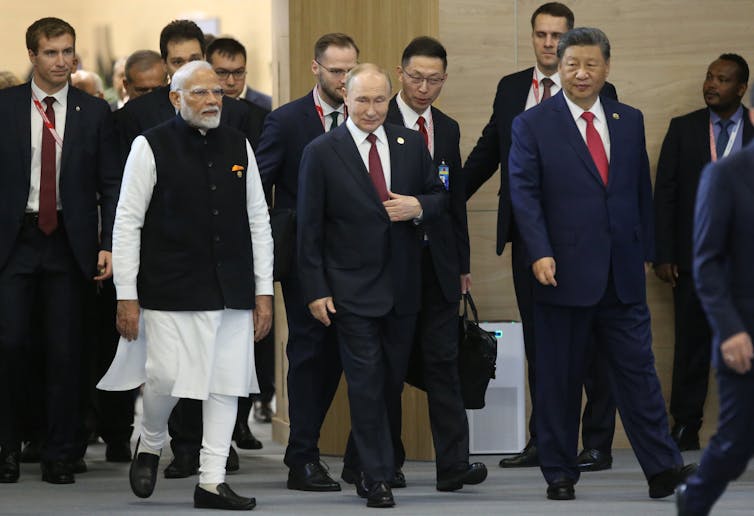
A group of men walk together.
Indian Prime Minister Narendra Modi, Russian President Vladimir Putin and China’s Xi Jinping attend the BRICS leaders summit on Oct. 23, 2024.
Contributor/Getty Images

Earlier this year, Chinese leader Xi Jinping used the term “Dragon-Elephant Tango” to promote a vision of India-China ties based on “mutual achievement.”

Despite the U.S. surpassing China as India’s biggest trading partner in 2021-22, investment ties between New Delhi and Beijing have grown steadily between 2005 and 2025, with only some intermittent friction.

However, what can appear as a tilt toward Beijing is better understood through structural roots in India’s economic realities as well as the country’s long-standing commitment to nonalignment.

The relationship between India and China is marked by significant economic interdependence rather than political convergence. India’s imports are largely coming from China, especially in the areas of machinery, electronics and other intermediate goods.

Yet for all of the convergence, areas of bilateral tensions remain. India’s growing trade deficit with China and Beijing’s ironclad relationship with Pakistan – along with unresolved border issues – limit how far New Delhi is willing to align with Beijing strategically.

Nevertheless, India-China relations are no doubt warming, especially in the wake of Trump’s tariffs. Indicative of that shift were India’s exports to China, which surged by 90% in November to $2.2 billion.

Broader sources of Indian-US tension

It isn’t just the warming China-India relationship that has thrown a wrench into the Quad’s works. The Trump administration’s growing embrace of India’s archrival Pakistan has also soured U.S.-India ties.

Trump’s claim to have mediated an end to the brief Pakistan-India war in May and his subsequent invitation of Pakistan’s army chief to the White House were met with anger in India.

That dispute was mirrored by the one over Russian oil, which had precipitated some of Trump’s tariffs on India. Modi’s government has walked a tightrope between the U.S. and Russia, wanting to keep open the possibility of good relations with Russian President Vladimir Putin, while managing tensions with the U.S. That’s why Putin’s visit to India in December held such symbolic value.

The Modi government stopped short of explicit long-term commitments to new Russian oil purchases and did not chart any new defense deals. In that, as with the issue over Washington’s embrace of Pakistan, India has sought to balance competing camps, creating space to maintain an open door with the U.S. without abandoning India’s strategic autonomy on what nations it does business with.

Optimism amid paralysis

So, how does all this diplomatic tangoing affect the Quad?

The result, it appears, is paralysis at this juncture. But it is important to point out that neither country wants to pronounce the Quad dead. The latest National Security Strategy of the United States explicitly mentions the Quad as part of efforts to “win the economic future” in Asia.

And both nations continue to reaffirm their commitment to the partnership – betting that political conditions will stabilize and that global trends may turn in their favor.

So there are still reasons for guarded optimism. Recent progress in trade negotiations and gradual reductions in Russian oil imports could ease Washington’s skepticism over India.

And for their part, Japan and Australia are trying to keep the momentum going – Japan with its naval and coast guard capabilities and Australia with infrastructure and health initiatives.

If a mutually acceptable trade deal with the U.S. can emerge, and New Delhi can craft an agenda for the Quad framework that is acceptable to the current U.S. administration, a leaders summit could still materialize in 2026.

But the louder the tariff wars between India and the U.S. become, the slimmer the chance for a stronger Quad in the near term.

The Conversation

Hyeran Jo receives funding from the Carnegie Corporation of New York (G-PS-24-62004, Small State Statecraft and Realignment). The statements made and views expressed are solely the responsibility of the author.

Yoon Jung Choi does not receive funding from any organization related to this article. The statements made and views expressed are solely the responsibility of the author.

ref. Trump tariffs and warming India-China ties have silenced the Quad partnership … for now – https://theconversation.com/trump-tariffs-and-warming-india-china-ties-have-silenced-the-quad-partnership-for-now-270606

Sudan’s civil war: A visual guide to the brutal conflict

Source: The Conversation – Global Perspectives – By Christopher Tounsel, Associate Professor of History, University of Washington

Mahmoud Hjaj/Anadolu Agency via Getty, Ebrahim Hamid, Getty, Hussein Malla/Getty, Anadolu/Getty, The Conversation

Sudan’s brutal civil war has dragged on for more than 2½ years, displacing millions and killing in excess of 150,000 people – making it among the most deadly conflicts in the world today.

As of December 2025, the paramilitary Rapid Support Forces appear to be making gains, seizing a key oil field in central Sudan and forcing the retreat of the Sudanese Armed Forces in key cities in the country’s west.

But fighting has ebbed and flowed throughout the war, with parts of the country changing hands a number of times. It has left a complicated picture of a nation mired in violence. Here’s a visual guide to help understand what is going on and the toll it has taken on the Sudanese population.

What military forces are involved?

Men holding guns and in army gear sit on trucks
Sudanese army soldiers take part in a military parade.
Ebrahim Hamid, Getty

The two main warring parties are the Sudanese Armed Forces (SAF) and the Rapid Support Forces (RSF).

The SAF is the nation’s official military. Prior to the civil war, it was responsible with enforcing the border, protecting the country from foreign entities and maintaining internal security. As of April 2023, the SAF had an estimated force of up to 200,000 people.

Men in military gard stand in a group.
Members of a Rapid Support Forces unit stand on their vehicle during a military-backed rally.
Hussein Malla/Getty

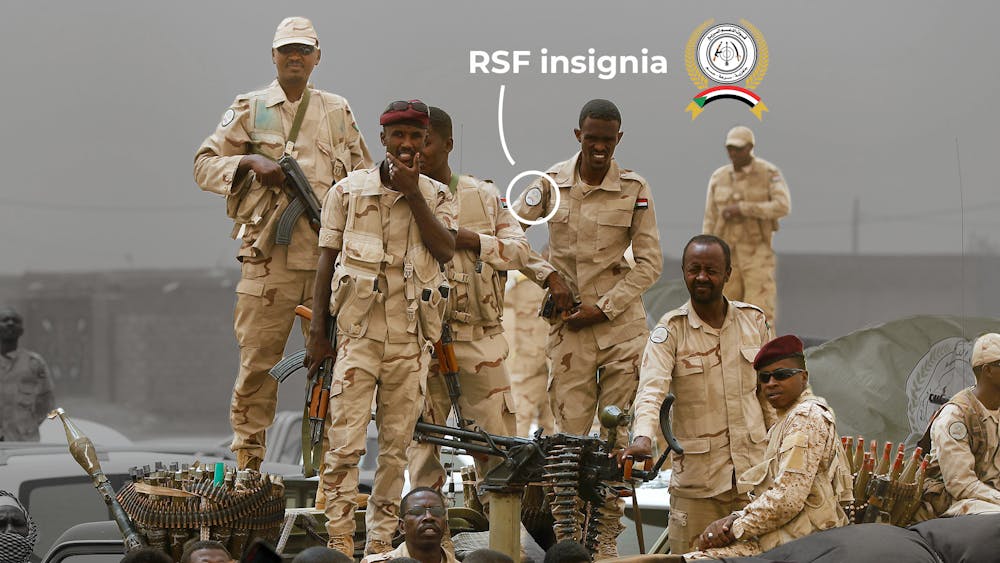
The paramilitary RSF is a semi-autonomous organization that was created in 2013 to confront rebel groups. Its origins lie in the feared Janjaweed militia that gained international notoriety for its scorched-earth tactics, extrajudicial killings and sexual assaults during a campaign in Darfur between 2003 and 2005.

Rebranding as the RSF, the paramilitary force evolved to become President Omar al-Bashir’s personal security force before al-Bashir’s ouster in 2019.

After that, the RSF and the SAF worked together to stage a 2021 coup against Prime Minister Abdalla Hamdok in 2021. But a power struggle emerged between the leaders of the RSF and SAF amid disagreements over the future direction of the country and whether the RSF would be incorporated into the army.

By the outbreak of the civil war in 2023, the RSF had amassed around 100,000 troops.

Various other armed groups have lent their support to the RSF and SAF during the conflict, including the rebel Sudan People’s Liberation Movement-North, which supports the RSF, and the army-aligned Justice and Equality Movement

Who are the main leaders?

A man in army fatigues stands.
Abdel Fattah al-Burhan visits the Al-Afadh refugee camp in Al Dabbah, Northern State, on Nov. 8, 2025.
Anadolu/Getty

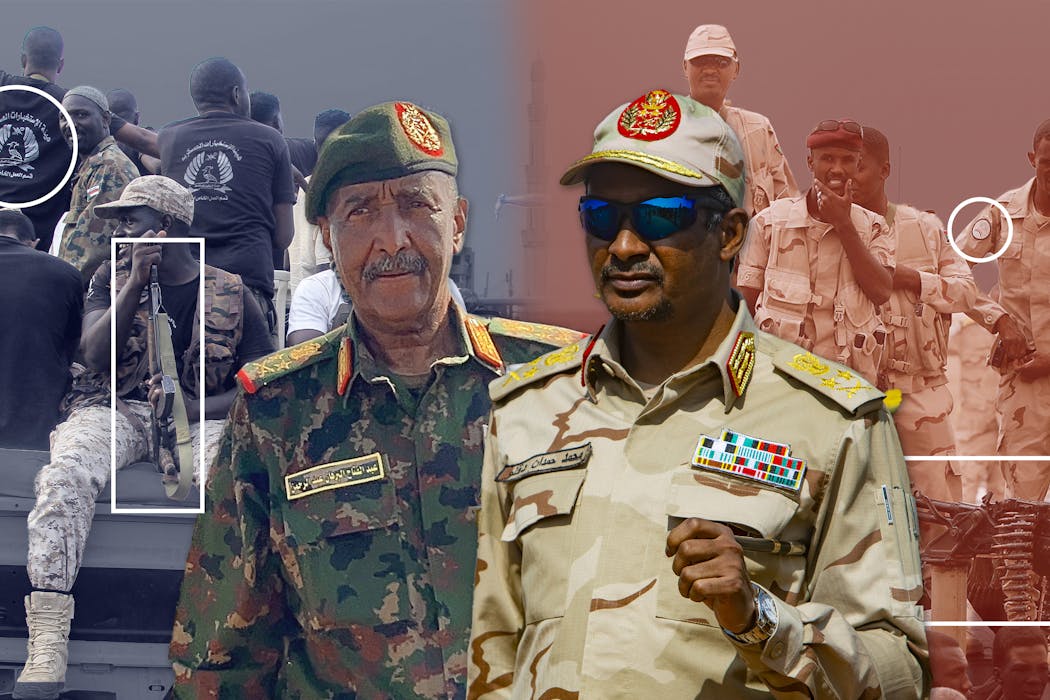
The SAF is led by General Abdel Fattah al-Burhan, the nation’s top military commander and de facto head of state. The longtime soldier rose to the rank of regional commander in 2008 and was promoted a decade later to the position of army chief of staff.

Following Bashir’s 2019 ouster, Burhan was appointed to lead the Transitional Military Council and its successor civilian-military entity known as the Sovereign Council. As leader of the Sovereign Council, Burhan occupied the nation’s highest office.

His reputation has been marred by his own military’s attacks on civilians in Darfur in the early 2000s and, more recently, his reliance on support from Islamist groups.

A man in military uniform and sunglasses.
Mohamed Hamdan Dagalo attends a military graduation ceremony of special forces in Khartoum.
Mahmoud Hjaj/Anadolu Agency via Getty

The RSF leader, Mohamed Hamdan Dagalo, also known as “Hemedti,” was Burhan’s second-in-command.

Born to a poor family that settled in Darfur, Hemedti was part of the Janjaweed militia that President Bashir deployed to crush non-Arab resistance in the country’s west. Becoming leader of the Janjaweed before going on to head the RSF, Hemedti acquired a reputation as a ruthless commander whose brutal methods disturbed some fellow officers.

Where are the weapons, funding coming from?

Graphic of guns and bombs fuelling the Sudan conflict
A few of the verified weapons imported and seen being used by both sides of the war.
Amnesty International – New weapons fuelling the Sudan conflict

While the fighting has largely been contained to within Sudan’s boundaries, it is being fueled from outside the country.

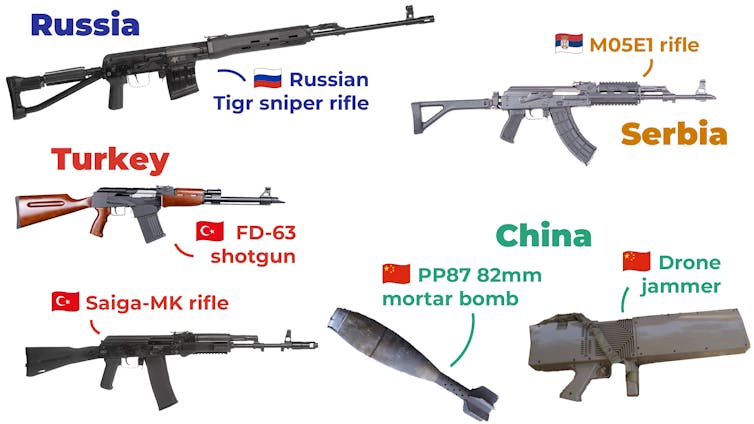
Amnesty International has reported that despite a decades-old arms embargo by the United Nations Security Council, recently manufactured weapons and equipment from China, Russia, Turkey and the United Arab Emirates have been used by both sides in the conflict.

The Sudanese government has accused the UAE of providing military assistance to the RSF, which in turn has been accused of using the UAE for illegal gold trafficking.

In addition to providing military assistance, the UAE has been accused of providing economic support for the RSF. In January 2025, the Biden administration sanctioned seven UAE-based companies funding Hemedti.

Saudi Arabia, which sees Sudan as an ally to counter Iran’s regional influence, has provided financial support to the SAF. In October 2025, the SAF-backed government announced that Saudi Arabia planned to invest an additional US$50 billion into Sudan, on top of the $35 billion it has already invested.

Egypt, allied with Burhan in a dispute with Ethiopia over the Grand Ethiopian Renaissance Dam, has supplied the SAF with warplanes and pilots.

Meanwhile, Iran and Russia have each extended support for the Sudanese government. It is believed that Iran, which renewed diplomatic ties with Sudan in October 2023, has provided the SAF with attack drones, while Russia has provided Sudan’s government with diplomatic and military support.

What areas are controlled by whom?

As of December 2025, the RSF and SAF control different halves of the country split along a roughly north-south axis. The SAF controls a little more than half of the country.

The SAF has a stronghold in the nation’s capital Khartoum. In the east, the army controls the city of Port Sudan on the Red Sea coast. The SAF also controls approximately three-quarters of the Sudanese border with Egypt to the north.

Strategically, the areas under SAF control provide the advantages of access to the Red Sea – a crucial transport hub through which 12% of the world’s maritime trade passes – as well as the historic demographic and administrative epicenter of Khartoum, situated at the confluence of the Blue and White Niles, and the livestock-rich Kassala state.

In all, Sudanese researcher Jihad Mashamoun estimates that as of November 2025, the SAF controlled 60% of the country.

Meanwhile, the RSF has consolidated control over Darfur – the massive western region that has been a hub for gold mining and trafficking routes – and the regional capital of el-Fasher, an economic hub connecting routes to Libya to the north, the Nile to the east and Chad to the west.

As researcher Bravin Onditi has noted, el-Fasher’s fall to the RSF in late October eliminated the SAF’s last stronghold in Darfur from which it could assert authority in western Sudan.

Outside of Darfur, the RSF controls most the country’s oil fields, many of the goldfields in central and southwest Sudan, and splits control over important grazing lands with the SAF.

What has been the toll on Sudan’s citizens?

One of the war’s distinguishing horrors has been repeated incidents of civilian killings.

Both sides have been accused of war crimes that include targeted attacks on civilians, medical centers and food systems. Mass killings in Khartoum, Darfur, Kordofan, Gezira, Sennar and White Nile states reflect the general scope of slaughter that has swept the country.

In some instances, this violence has taken on a decidedly ethnic dimension. Human Rights Watch reports that from late April to early November 2023, the RSF and its allied militias systematically sought to remove — including by murder — ethnic Masalit people from El Geneina, capital of West Darfur.

In October 2025, following the RAF’s siege of el-Fasher, the world watched in horror as satellite images of “clusters” consistent with bodies and blood-red discoloration could be seen on the ground. The U.N. Security Council held an emergency meeting condemning the RSF’s killing of nearly 500 people in el-Fasher’s Saudi Maternity Hospital.

More than 9.5 million people are classified as internally displaced, having fled violence. The International Organization for Migration reports that North and South Darfur states host the largest number of internally displaced people, followed by Central and East Darfur states.

Meanwhile, over 4 million have fled to the neighboring countries of Egypt, South Sudan and Chad.

Image sources:

FD-63 – Dağlıoğlu Silah,
Saiga MK .223, Kalashnikov Group,
Tigr DMR, Kalashnikov Group,
M05E1, Zastava Arms,
PP87 82MM mortar bomb, Amnesty International,
CKJ-G7 drone jammer, Amnesty International,
Streit Gladiator, Streit Group,
Terrier LT-79, Streit Group,
INKAS Titan-S, INKAS Armored Vehicles

The Conversation

Christopher Tounsel does not work for, consult, own shares in or receive funding from any company or organization that would benefit from this article, and has disclosed no relevant affiliations beyond their academic appointment.

ref. Sudan’s civil war: A visual guide to the brutal conflict – https://theconversation.com/sudans-civil-war-a-visual-guide-to-the-brutal-conflict-271429

Le cadeau sous le sapin : ce qu’il dit de notre lien avec nos chiens

Source: The Conversation – in French – By Sandra Friedrich, Doctorante, Santé et société, Université du Québec à Montréal (UQAM)

Chaque année, des millions de chiens, en Occident, trouveront un cadeau sous le sapin. Geste anodin ? Pas tant que ça. Ce rituel révèle non seulement la profondeur du lien qui nous unit à eux, mais aussi notre tendance à prêter à leurs comportements un sens humain.

Ces liens se construisent dans le quotidien : repas, promenades, moments de repos offrent au chien une base sécurisante, favorisent l’attachement et améliorent sa capacité à gérer le stress. Les rituels transforment l’ordinaire en moments porteurs de sens : le cadeau sous le sapin, les jeux du dimanche, les salutations au retour du travail.

Certains chercheurs voient dans la participation active des chiens une preuve de leur subjectivité, car ils anticipent et initient ces activités. L’enthousiasme du chien, ses bonds ou le battement de sa queue font partie intégrante du moment que les humains interprètent comme porteurs de signification.

Nos travaux, menés dans le cadre du doctorat interdisciplinaire santé et société de l’Uqam sous la direction de la professeure Johanne Saint-Charles, montre que ces rituels constituent des moments investis affectivement. Ils participant à ce que nous appelons l’« épaisseur temporelle » du lien : tout ce qui a été vécu ensemble et qui continue de nourrir le présent.

Rituels quotidiens et célébrations annuelles créent une histoire commune, des repères et des attentes réciproques. Si les humains offrent un cadeau à leur chien ou le photographient avec le père Noël, c’est qu’il occupe une place suffisamment importante pour mériter ce geste : il est reconnu comme membre à part entière de la famille.

Mais cette lecture est-elle anthropomorphique ? Quand l’humain voit le chien « participer activement », perçoit-il une vraie intention ou projette-t-il ses propres catégories mentales ? Quand on parle d’un « langage partagé » à propos de ces rituels domestiques, décrit-on une vraie réciprocité ou projette-t-on du sens sur des comportements canins ?

Repenser l’anthropomorphisme

On entend souvent que l’anthropomorphisme – cette tendance à attribuer des motivations, des pensées ou des émotions humaines aux animaux – constituerait une erreur à éviter absolument. La réalité est plus nuancée.


À lire aussi :
Le dégriffage des chats leur génère une douleur à vie. Il est temps de l’interdire


L’anthropomorphisme est un trait quasi universel, mais il peut varier chez ceux et celles qui ont des animaux de compagnie. Les sciences du comportement animal reconnaissent chez le chien des capacités socio-cognitives réelles : lecture des émotions humaines, suivi du regard, mémoire des événements passés… Les recherches ont largement documenté la capacité des chiens à ressentir des émotions primaires perceptibles à travers leurs comportements, à manifester des préférences et à exprimer des attentes. Ces capacités créent les conditions d’une communication humain-chien fonctionnelle.

Le chien produit des expressions lisibles (postures, regards, vocalisations) et les humains les interprètent à travers leurs propres schémas cognitifs. Il en résulte une co-construction de la communication entre espèces : le chien émet, l’humain décode, et la relation se tisse. Mais le risque demeure de sur-interpréter, de plaquer sur l’animal une intériorité calquée sur la nôtre.

Il est peu probable qu’un chien soit jaloux (au sens humain du terme) du cadeau du chat ou qu’il sache qu’il a été sage cette année. S’il déchire frénétiquement le papier d’emballage, cela ne veut pas forcément dire qu’il éprouve de la reconnaissance, mais cela ne signifie pas non plus qu’il ne ressent rien. Dans l’atmosphère festive, ce qui compte pour lui, c’est peut-être l’odeur de la friandise, l’excitation ambiante ou le temps passé avec son humain.


À lire aussi :
La race d’un chien influence sa personnalité – mais son propriétaire aussi


Vers un anthropomorphisme relationnel

L’anthropomorphisme opère donc dans une zone grise. Il s’ancre dans des signaux expressifs réels, mais les interprète via des cadres humains qui peuvent excéder ce que le chien exprime véritablement. Comme dispositif relationnel, il rend le comportement canin intelligible, fluidifie la communication quotidienne et renforce le lien affectif, tout en comportant le risque d’attribuer au chien des états mentaux qu’il ne possède peut-être pas.

Des chercheurs ont mis en place un modèle pour expliquer comment l’anthropomorphisme fonctionne : en utilisant les connaissances humaines comme guide par défaut, une personne peut interpréter les comportements de son chien, prédire ses réactions pour coordonner leurs interactions et combler son besoin de connexion sociale. En ce sens, c’est un outil cognitif permettant le dialogue humain‑chien.

L’anthropomorphisme ne se limite pas à un processus mental : il repose sur l’interaction et transforme la nature même de la relation. Cet anthropomorphisme consiste à traiter le chien comme un interlocuteur doté d’une vie intérieure, sans présumer qu’elle soit identique à la nôtre. En lui attribuant une subjectivité, l’humain positionne le chien comme un partenaire avec lequel il construit quelque chose et non comme un objet sur lequel il agit. Cette posture favorise une attention accrue aux signaux canins et une relation plus riche.

C’est précisément cette double posture, traiter le chien comme un interlocuteur tout en reconnaissant son altérité, que nous avons observée chez les personnes entretenant des relations significatives avec leur chien. Et c’est dans cette posture que les rituels, y compris celui du cadeau de Noël, prennent tout leur sens. Non pas parce que le chien comprendrait la signification de la fête, mais parce que le geste traduit la place qu’il occupe dans la vie de son humain.

Pour le chien, le moment du cadeau représente une expérience riche : stimulation olfactive, interaction ludique, attention exclusive de son humain. Pour ce dernier, c’est l’occasion de réaffirmer un lien. Le rituel partagé n’exige pas une compréhension commune de sa signification. Il suffit qu’il soit vécu ensemble.

Routines et rituels forment la trame matérielle et symbolique de la cohabitation, où le chien n’est pas seulement intégré au quotidien, mais reconnu comme partenaire relationnel à part entière. Ce que les humains disent, font et croient au sujet de leur chien façonne concrètement la relation. Reconnaître une forme d’esprit chez l’animal n’est pas une illusion sentimentale. C’est une construction relationnelle qui permet d’entretenir un lien affectif, moral et pratique avec un être non humain. Le chien y participe : par ses réponses, ses réactions, sa personnalité propre, il contribue à cette relation construite ensemble.

Alors que des millions de personnes magasinent des cadeaux pour leur chien et partagent avec lui une relation qui structure profondément leur quotidien, les cadres institutionnels peinent encore à saisir cette réalité. Interdictions dans les logements locatifs, restrictions d’accès à certains espaces publics : le chien reste souvent un impensé administratif. La relation humain-chien n’est pourtant pas un à-côté de l’existence, mais l’une de ses trames essentielles. Ce décalage entre inclusion affective et invisibilité structurelle constitue l’un des paradoxes de la société québécoise contemporaine.

Pas de cadeau sous le sapin ? Cela ne veut pas dire que vous ne l’aimez pas : vos rituels quotidiens valent tous les cadeaux du monde.

La Conversation Canada

Sandra Friedrich ne travaille pas, ne conseille pas, ne possède pas de parts, ne reçoit pas de fonds d’une organisation qui pourrait tirer profit de cet article, et n’a déclaré aucune autre affiliation que son organisme de recherche.

ref. Le cadeau sous le sapin : ce qu’il dit de notre lien avec nos chiens – https://theconversation.com/le-cadeau-sous-le-sapin-ce-quil-dit-de-notre-lien-avec-nos-chiens-271585

After Canada legalized cannabis, police caught more drunk drivers

Source: The Conversation – Canada – By Michael J. Armstrong, Associate Professor, Operations Research, Brock University

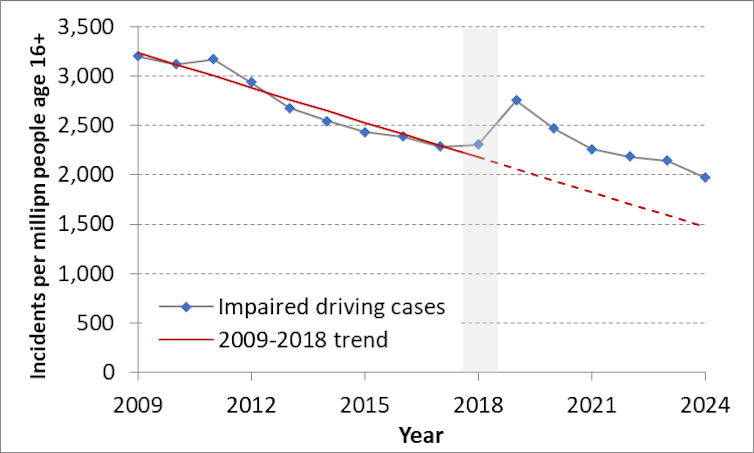
When Canada legalized cannabis in October 2018, there were many concerns about its potential impacts. One of them involved cannabis-impaired driving.

Before legalization, police were already catching more drug-impaired drivers each year. So, people naturally worried that more stoned drivers would appear on the road after legalization.

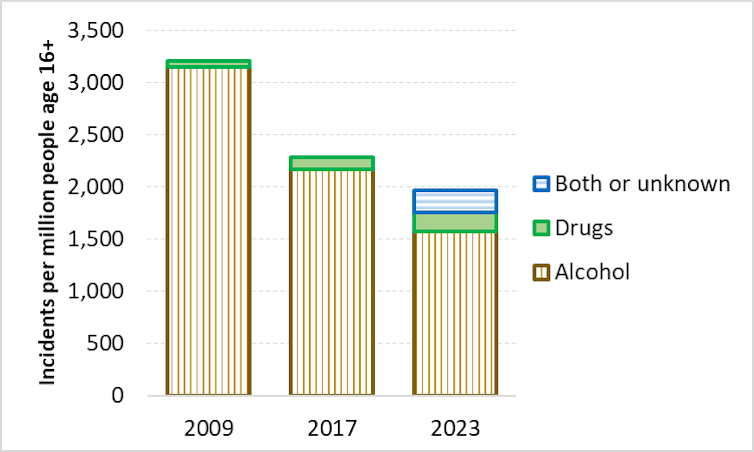
To lower that risk, the federal government updated its driving laws. Impairment by alcohol or drugs separately was already illegal. In December 2018, Canada also banned impairment by combinations of alcohol and drugs, or by unspecified substances.


Read more:
Cannabis-impaired driving: Here’s what we know about the risks of weed behind the wheel


The government likewise helped police to better enforce those laws. For example, it gave them more power to obtain breath and blood samples from drivers. And it funded more training to help them recognize symptoms of drug impairment.

However, it was unclear how much impaired driving would really increase due to legalizing cannabis.

For example, drivers injured in collisions often test positive for cannabis, but also for other drugs. Cannabis consumers claim they are driving less often after use. And police say that drivers’ symptoms more often imply impairment by stimulants or narcotics than by cannabis.

Given this uncertainty, I decided to dig into the police data.

Police-reported impairment

My research analyzed the annual rates of impaired driving cases that police investigated between 2009 and 2023. The reporting covered four substance categories: alcohol, drugs, drugs-and-alcohol combined and unknown substances.

Note that “drugs” includes cannabis but also other chemicals like opioids and amphetamines. Publicly available data unfortunately don’t name the drugs involved.

I first estimated the trends in alcohol and drug impairment up until 2018. I then calculated how much rates changed from 2019 onward.

I also checked several potential explanations for those changes. Those included the level of legalized cannabis sales and the share of adults consuming cannabis in each province. I also considered each province’s number of police trained in drug recognition and their degree of COVID-19 pandemic restrictions.

The data showed that during the 15-year study period, alcohol remained the most common impairment category. But its share of all cases dropped from 98 per cent in 2009 to 95 per cent in 2017 and to just 80 per cent in 2023.

Up until 2018, the total impairment rate also fell each year.

This line chart shows how Canada's impaired driving rates were decreasing from 2009 until 2018, jumped higher in 2019, and then resumed their downward trend from 2020 onward.
Canadian average police-reported impaired driving incidents per million population aged 16+, comparing actual rates to the 2009-2018 trend.
Statistics Canada, CC BY

More drinks and drugs

But in 2019, rates jumped substantially. As a result, police reported 31 per cent more impairment cases during 2019-23 than the 2009-18 trend had projected.

The impairment increases varied between provinces. For example, there was no significant change in Québec and Saskatchewan. But rates doubled in British Columbia and Newfoundland.

Percentage-wise, the drugs category saw the most growth. It averaged 42 per cent higher during 2019-23 than had been projected.

But alcohol impairment rose too. It averaged 17 per cent above its previous trend.

And when counting drivers, alcohol’s growth was larger. The increase in drinking drivers caught by police was four times the increase in drugged drivers.

The new offenses for impairment by drugs and alcohol combined, or by unspecified substances, also contributed to the higher rate.

So, police clearly found more impaired drivers after 2018. But was that because more impaired drivers were on the road? Because police got better at catching them? Or both?

This bar chart shows that overall impairment rates were lower in 2023 than in 2009, but with an increasing proportion due to drugs or drugs and alcohol combined.
Canadian average police-reported impairment rates in 2009, 2017, and 2023, broken down by substance category.
Statistics Canada, CC BY

Constables, COVID and cannabis

My analysis showed the impairment changes were correlated most strongly with the number of police trained in drug recognition. Not surprisingly, when provinces gave police more training, they caught more impaired drivers.

The restrictions that provinces imposed during the COVID-19 pandemic showed the second biggest correlations with impairment. But interestingly, alcohol and drugs diverged: when provinces tightened restrictions, they got less impairment from alcohol but more from drugs.

Presumably, lockdowns meant fewer bars open, and so fewer people driving home drunk. But perhaps lockdowns also meant more laid-off workers using drugs at home before going grocery shopping.


Read more:
Alcohol sales changed subtly after Canada legalized cannabis


Alcohol impairment showed no relationship with the numbers of Canadians consuming cannabis or the amount of cannabis legally sold. That’s not surprising. Canadians didn’t suddenly replace their cabernet with cannabis after legalization.

But it was surprising that drug impairment likewise showed no relationship with cannabis consumer numbers. And it was only weakly correlated with legal sales.

This might imply that most drug impairment came from chemicals other than cannabis. Or perhaps most legal cannabis purchases simply replaced existing illegal ones, rather than adding to total usage.

Consuming responsibly

Overall, Canadian police reported noticeably more drug-impaired and alcohol-impaired driving after 2018. But the growth seemed related mostly to enhanced enforcement and pandemic disruptions, rather than to legalized cannabis. And fortunately, the long-term decline in impaired driving resumed in 2020.

All road users benefit from that continuing decline. And we each play a role in maintaining it. Whether your preferred intoxicant is booze, weed or something else, please consume responsibly. And use designated drivers or public transit to get home.

After all, flashing coloured lights look much nicer on a tree standing in your home than on a police car pulling you over.

The Conversation

Michael J. Armstrong does not work for, consult, own shares in or receive funding from any company or organisation that would benefit from this article, and has disclosed no relevant affiliations beyond their academic appointment.

ref. After Canada legalized cannabis, police caught more drunk drivers – https://theconversation.com/after-canada-legalized-cannabis-police-caught-more-drunk-drivers-272244