Beijing’s ‘plausible deniability’ on arms supply is quickly becoming implausible – and could soon extend to Iran

Source: The Conversation – Global Perspectives – By Linggong Kong, Ph.D. Candidate in Political Science, Auburn University
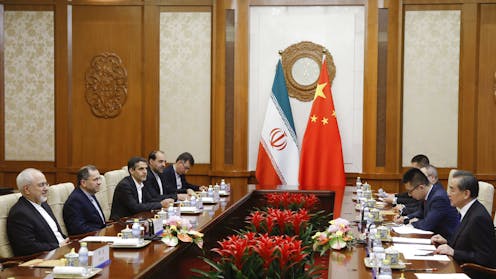
Could longtime allies have a closer relationship than meets the eye? Thomas Peter/Pool Photo via AP

China has long maintained that it does not supply arms to any party at war – a central tenet of its “noninterference” foreign policy. But in recent years, Beijing has repeatedly faced accusations of doing the opposite: providing direct military assistance to nations engaged in conflict, while publicly denying doing so and even adopting a position of diplomatic neutrality.

That has seemingly been the case for two of China’s closest allies: Russia in its war against Ukraine and Pakistan during its recent armed standoff with India in May.

Now, Beijing is facing scrutiny over alleged military links to Iran – a country engaged in a long-running shadow conflict with Israel that recently tipped into a short-lived hot war.

After the ceasefire that followed the 12-day war in the Middle East, China reportedly supplied batteries for surface-to-air missiles to Iran in exchange for oil. Such parts are a critical military need for Tehran after its air defense network was severely damaged by Israeli missiles.

The Chinese Embassy in Israel denied the reports, stating that China firmly opposes the proliferation of weapons of mass destruction and does not export arms to countries at war. But China’s Ministry of Foreign Affairs has yet to issue an official statement on the alleged transfer.

As an expert specializing in China’s grand strategy, I think it is highly possible that China would offer Iran military support while denying it publicly. Such plausible deniability would allow Beijing to assert military influence and showcase some of its hardware, while deflecting international criticism and preserving diplomatic flexibility.

But the tactic works only so far. As indirect evidence accumulates, as many suggest it is, such covert action may gradually develop into an open secret – leading to what scholars term “implausible deniability,” where denial is no longer credible even if it is still officially maintained.

Missiles are put on display.
An air-to-air missile on display at the 15th China International Aviation and Aerospace Exhibition in November 2024.
Shen Ling/VCG via Getty Images

China’s support for Russia’s war

Although Beijing has consistently said it is neutral in the Russia-Ukraine war that broke out in 2022, China has, in practice, quietly supported Russia. In part, that is because China shares the same strategic goal of challenging the Western-led international order.

Recently, Chinese Foreign Minister Wang Yi reportedly told European Union foreign policy chief Kaja Kallas that Beijing cannot afford to see Russia lose the war in Ukraine. He was said to have warned that a Russian defeat would likely bring the full force of U.S. strategic pressure to bear on China.

From Beijing’s perspective, Moscow plays a vital role in keeping the West preoccupied, offering China valuable strategic breathing room by diverting American attention and resources away from the Asia-Pacific region.

Beyond deepening trade relations that have become a lifeline for Moscow’s economy under Western sanctions, China has reportedly supplied Russia with large quantities of dual-use goods – goods that can be used for civilian and military purposes – to enhance both Moscow’s offensive and defensive capabilities, as well as to boost China’s military-industrial production. Beijing has also allegedly provided satellite imagery to assist Russia on the battlefield.

While the U.S. and Europe have repeatedly tried to call out China for aiding Russia militarily, Beijing has consistently denied such claims.

Most recently, on April 18, 2025, Ukraine formally accused China of directly supporting Russia and slapped sanctions on three Chinese-based firms that Kyiv said was involved in weapons production for the Russian war effort.

In what has become a common refrain, China’s Foreign Ministry rejected the Ukrainian accusation, reaffirming that China has never provided lethal weapons to any party in the conflict and reiterating its official stance of promoting a ceasefire and peace negotiations.
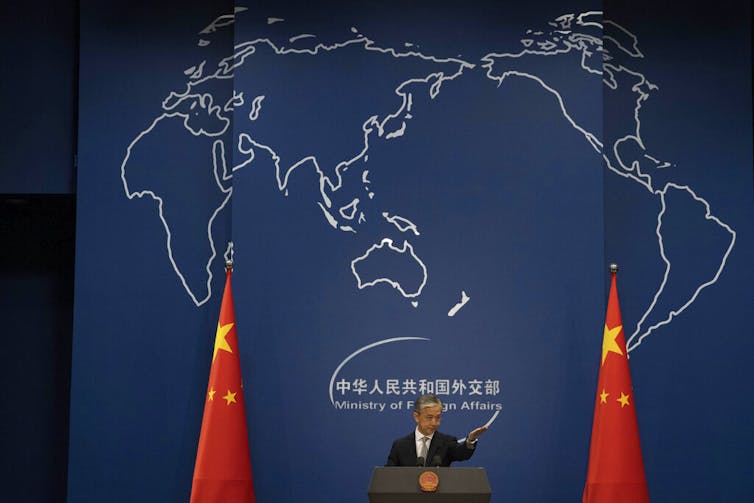
A man talks at a lectern.
A Chinese Foreign Ministry spokesperson gestures for questions during a daily briefing in Beijing in 2020.
AP Photo/Ng Han Guan

China’s quiet backing of Pakistan

Beijing has long presented itself as a neutral party in the India-Pakistan conflict, too, and has called for restraint on both sides and urged peaceful dialogue.

But in practice, China is allied with Pakistan. And the direct military support it has provided to Lahore appears driven by China’s desire to curb India’s regional influence, counterbalance the growing U.S.–India strategic partnership and protect the China–Pakistan Economic Corridor, a massive bilateral infrastructure project.

In the latest flare-up between India and Pakistan in May, Pakistan deployed Chinese-made J-10C fighter jets in combat for the first time, reportedly downing five Indian aircraft.

Pakistan’s air defense relied heavily on Chinese equipment during the short conflict, deploying Chinese-made surface-to-air missile systems, air-to-air missiles, advanced radar systems and drones for reconnaissance and strike operations. Overall, more than 80% of Pakistan’s military imports have come from China in the past five years.

In what would be a far more stark example of military support if proven true, the deputy chief of India’s army alleged that China had provided Pakistan with real-time intelligence on Indian troop movements during the conflict.

When asked to respond, a spokesperson for China’s Ministry of Foreign Affairs said they had no knowledge of the matter. They reaffirmed that China’s ties with Pakistan are not directed against any third party and reiterated Beijing’s long-standing position in favor of a peaceful resolution to any India–Pakistan dispute.

Extending ‘deniability’ to Iran?

Like with Russia and Pakistan, Iran has increasingly been seen as a partner to China.

In 2021, China and Iran signed a 25-year, US$400 billion comprehensive cooperation agreement that covered trade, energy and security, signaling the depth of their strategic relationship.

The accord was indicative of the strategic value Beijing places on Iran. From Beijing’s perspective, Tehran presents a counterbalance to the influence of the U.S. and its allies – especially Israel and Saudi Arabia – in the region and helps divert Western resources and attention away from China.

But recently, Tehran’s position in the region has become far weaker. Not only has its air defense infrastructure suffered badly in the confrontations with Israel, but its regional proxies and allies – Hamas, Hezbollah and the Assad regime in Syria – have either been devastated by Israel or collapsed altogether.
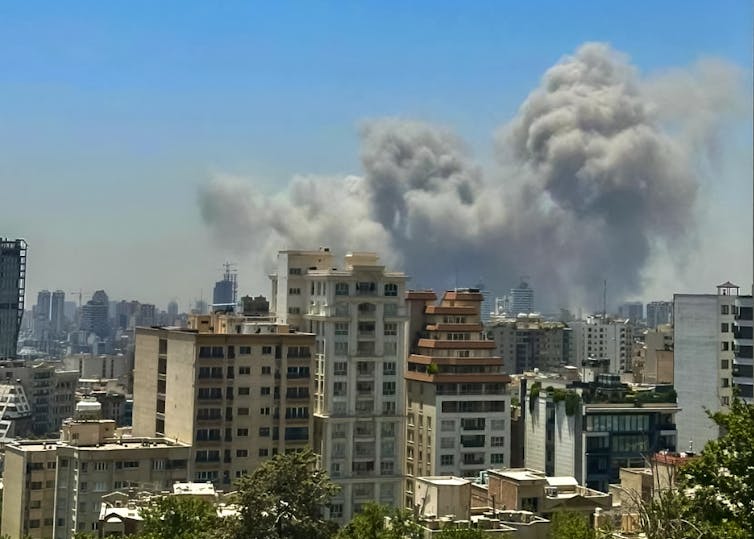
billowing smoke is seen over the top of buildings
Smoke rises over Tehran, Iran, following an Israeli strike on June 23, 2025.
Nikan/Middle East Images/AFP via Getty Images

Under these circumstances, it is strategically compelling for Beijing to provide support to Tehran in order to maintain regime stability.

Indeed, Beijing has frequently circumvented sanctions on Iranian energy, with an estimated 90% of Iran’s oil exports still going to China.

Although Beijing did not extend any substantive support to Iran during the 12-day war, reports have abounded since that Iran is looking to China as an alternative supplier of its defense needs. The thinking here is that Russia, Tehran’s traditional military partner, is no longer able to provide sufficient, quality defense equipment to Iran. Some influential social media posters in China have gone as far as advocating for direct military sales by Beijing.

If China does do this, I believe it is likely to follow the same playbook it has used elsewhere by denying involvement publicly while covertly providing assistance.

Doing so allows China to maintain diplomatic ties with Iran’s regional rivals, such as Israel and Saudi Arabia, while simultaneously benefiting from a turbulent Middle East that distracts Washington and grants Beijing strategic breathing room.

China’s use of plausible deniability reflects a broader strategic ambition. Namely, it wants to assert influence in key regional conflicts without triggering open backlash. By quietly supporting partners while maintaining a facade of neutrality, Beijing aims to undermine Western dominance, stretch U.S. strategic focus and secure its own interests – and all while avoiding the risks and responsibilities of open military alignment.

The Conversation

Linggong Kong does not work for, consult, own shares in or receive funding from any company or organization that would benefit from this article, and has disclosed no relevant affiliations beyond their academic appointment.

ref. Beijing’s ‘plausible deniability’ on arms supply is quickly becoming implausible – and could soon extend to Iran – https://theconversation.com/beijings-plausible-deniability-on-arms-supply-is-quickly-becoming-implausible-and-could-soon-extend-to-iran-261148

¿Qué significa el fracaso de las conversaciones de paz para la catástrofe humanitaria en Gaza?

Source: The Conversation – (in Spanish) – By Ali Mamouri, Research Fellow, Middle East Studies, Deakin University

Los esfuerzos por poner fin al implacable asedio de Gaza han sufrido un revés con el abrupto fin de las conversaciones de paz en Catar.

Tanto Estados Unidos como Israel han retirado sus equipos negociadores, acusando a Hamás de «falta de voluntad para alcanzar un alto el fuego».

El enviado especial del presidente estadounidense Donald Trump, Steve Witkoff, declaró que parece que Hamás nunca ha querido llegar a un acuerdo:

Aunque los mediadores han hecho un gran esfuerzo, Hamás no parece estar coordinado ni actuar de buena fe. Ahora consideraremos opciones alternativas para traer a los rehenes a casa e intentar crear un entorno más estable para la población de Gaza.

Este decepcionante desenlace coincide con el temor creciente a una hambruna generalizada en Gaza y con la decisión histórica de Francia de reconocer oficialmente al Estado palestino.

El presidente francés, Emmanuel Macron, afirma que no hay otra alternativa por el bien de la seguridad en Oriente Medio:

Fiel a su compromiso histórico con una paz justa y duradera en Oriente Medio, he decidido que Francia reconocerá al Estado de Palestina.

¿Qué significarán estos acontecimientos para el conflicto en Gaza y la seguridad general en Oriente Medio?

«Catástrofe humanitaria»

El fracaso de la tregua significa que no se vislumbra el fin del asedio israelí de Gaza, que ha devastado el territorio durante más de 21 meses.

Según la agencia de la ONU para los refugiados palestinos, la UNRWA, más de 100 personas, en su mayoría niños, han muerto de hambre. Uno de cada cinco niños de la ciudad de Gaza está desnutrido, y el número de casos aumenta cada día.

El comisionado general Philippe Lazzarini afirma que, con la escasa ayuda alimentaria que llega a Gaza:

Los habitantes de Gaza no son ni vivos ni muertos, son cadáveres andantes […] la mayoría de los niños que ven nuestros equipos están demacrados, débiles y corren un alto riesgo de morir si no reciben el tratamiento que necesitan urgentemente.

La ONU y más de 100 organizaciones humanitarias culpan al bloqueo israelí de casi toda la ayuda que llega al territorio por la falta de alimentos.

Lazzarini afirma que la UNRWA tiene 6 000 camiones con suministros de emergencia esperando en Jordania y Egipto. Insta a Israel, que sigue culpando a Hamás de los casos de malnutrición, a que permita la entrada de la ayuda humanitaria en Gaza.

Propuesta de acuerdo de alto el fuego

La última propuesta de alto el fuego estaba a punto de ser aceptada por ambas partes.

Incluía una tregua de 60 días, durante la cual Hamás liberaría a diez rehenes israelíes vivos. A cambio, Israel liberaría a varios prisioneros palestinos y aumentaría considerablemente la ayuda humanitaria a Gaza.

Durante el alto el fuego, ambas partes entablarían negociaciones para alcanzar una tregua duradera.

Aunque aún no se conocen los detalles concretos de los puntos conflictivos, las declaraciones anteriores de ambas partes sugieren que el desacuerdo se centra en lo que sucedería tras un alto el fuego temporal.

Según se informa, Israel pretende mantener una presencia militar permanente en Gaza para poder reanudar rápidamente las operaciones si fuera necesario. Por el contrario, Hamás exige una vía hacia el fin total de las hostilidades.

La falta de confianza mutua ha empañado drásticamente las negociaciones.

Desde la perspectiva de Israel, cualquier alto el fuego debe impedir que Hamás recupere el control de Gaza, ya que esto permitiría al grupo reconstruir su poder y lanzar potencialmente otro ataque transfronterizo.

Sin embargo, Hamás ha afirmado en repetidas ocasiones que está dispuesto a entregar el poder a cualquier otro grupo palestino que persiga un Estado palestino basado en las fronteras de 1967. Esto podría incluir a la Autoridad Nacional Palestina (ANP), que gobierna Cisjordania y reconoce desde hace tiempo a Israel.

Apoyo a un Estado palestino

Los líderes israelíes han apoyado ocasionalmente de boquilla un Estado palestino. Sin embargo, han descrito dicha entidad como «menos que un Estado», una formulación que no satisface ni las aspiraciones palestinas ni las normas jurídicas internacionales.

En respuesta al empeoramiento de la situación humanitaria, algunos países occidentales han dado pasos para reconocer plenamente un Estado palestino, considerándolo un paso hacia la resolución permanente de uno de los conflictos más prolongados de Oriente Medio.

El anuncio de Macron supone un avance importante.

Francia es ahora la potencia occidental más destacada en adoptar esta postura. Se suma así a más de 140 países, entre ellos más de una docena de Europa, que ya han reconocido la condición de Estado.

Aunque se trata de una medida simbólica, aumentará la presión diplomática sobre Israel en medio de la guerra y la crisis humanitaria que se vive en Gaza.

Sin embargo, el anuncio fue inmediatamente condenado por el primer ministro israelí, Benjamin Netanyahu, quien afirmó que el reconocimiento «recompensa el terrorismo» y “sería una plataforma de lanzamiento para aniquilar a Israel, no para vivir en paz junto a él”.

¿Anexionarse Gaza?

Un Estado palestino es inaceptable para Israel.

Recientemente se han presentado más pruebas en una reveladora entrevista televisiva del ex primer ministro israelí Ehud Barak, quien afirmó que Netanyahu había empoderado deliberadamente a Hamás para bloquear una solución de dos Estados.

En cambio, cada vez hay más pruebas de que Israel está intentando anexionarse la totalidad del territorio palestino y reubicar a los palestinos en países vecinos.

Dada la incertidumbre actual, parece poco probable que se alcance un nuevo alto el fuego en un futuro próximo, sobre todo porque sigue sin estar claro si la retirada de Estados Unidos de las conversaciones fue un cambio real de política o una mera táctica estratégica de negociación.

The Conversation

Ali Mamouri no recibe salario, ni ejerce labores de consultoría, ni posee acciones, ni recibe financiación de ninguna compañía u organización que pueda obtener beneficio de este artículo, y ha declarado carecer de vínculos relevantes más allá del cargo académico citado.

ref. ¿Qué significa el fracaso de las conversaciones de paz para la catástrofe humanitaria en Gaza? – https://theconversation.com/que-significa-el-fracaso-de-las-conversaciones-de-paz-para-la-catastrofe-humanitaria-en-gaza-261966

Ceasefire talks collapse – what does that mean for the humanitarian catastrophe in Gaza?

Source: The Conversation – Global Perspectives – By Ali Mamouri, Research Fellow, Middle East Studies, Deakin University

Efforts to end the relentless siege of Gaza have been set back by the abrupt end to peace talks in Qatar.

Both the United States and Israel have withdrawn their negotiating teams, accusing Hamas of a “lack of desire to reach a ceasefire”.

US President Donald Trump’s special envoy Steve Witkoff says it would appear Hamas never wanted a deal:

While the mediators have made a great effort, Hamas does not appear to be coordinated or acting in good faith. We will now consider alternative options to bring the hostages home and try to create a more stable environment for the people in Gaza

State Department spokesman Tommy Piggott reads Steve Witkoff’s statement on the collapse of the Gaza peace talks.

The disappointing development coincides with mounting fears of a widespread famine in Gaza and a historic decision by France to formally recognise a Palestinian state.

French President Emmanuel Macron says there is no alternative for the sake of security of the Middle East:

True to its historic commitment to a just and lasting peace in the Middle East, I have decided that France will recognise the State of Palestine

What will these developments mean for the conflict in Gaza and the broader security of the Middle East?

‘Humanitarian catastrophe’

The failure to reach a truce means there is no end in sight to the Israeli siege of Gaza which has devastated the territory for more than 21 months.

Amid mounting fears of mass starvation, Australian Prime Minister Anthony Albanese says Gaza is in the grip of a “humanitarian catastrophe”. He is urging Israel to comply immediately with its obligations under international law:

Israel’s denial of aid and the killing of civilians, including children, seeking access to water and food cannot be defended or ignored.

According to the United Nations Palestinian refugee agency UNRWA, more than 100 people – most of them children – have died of hunger. One in five children in Gaza City is malnourished, with the number of cases rising every day.

Commissioner-General Philippe Lazzarini says with little food aid entering Gaza, people are

neither dead nor alive, they are walking corpses […] most children our teams are seeing are emaciated, weak and at high risk of dying if they don’t get the treatment they urgently need.

The UN and more than 100 aid groups blame Israel’s blockade of almost all aid into the territory for the lack of food.

Lazzarini says UNRWA has 6,000 trucks of emergency supplies waiting in Jordan and Egypt. He is urging Israel – which continues to blame Hamas for cases of malnutrition – to allow the humanitarian assistance into Gaza.

Proposed ceasefire deal

The latest ceasefire proposal was reportedly close to being agreed by both parties.

It included a 60-day truce, during which time Hamas would release ten living Israeli hostages and the remains of 18 others. In exchange, Israel would release a number of Palestinian prisoners, and humanitarian aid to Gaza would be significantly increased.

During the ceasefire, both sides would engage in negotiations toward a lasting truce.

While specific details of the current sticking points remain unclear, previous statements from both parties suggest the disagreement centres on what would follow any temporary ceasefire.

Israel is reportedly seeking to maintain a permanent military presence in Gaza to allow for a rapid resumption of operations if needed. In contrast, Hamas is demanding a pathway toward a complete end to hostilities.

A lack of mutual trust has dramatically clouded the negotiations.

From Israel’s perspective, any ceasefire must not result in Hamas regaining control of Gaza, as this would allow the group to rebuild its power and potentially launch another cross-border attack.

However, Hamas has repeatedly said it is willing to hand over power to any other Palestinian group in pursuit of a Palestinian state based on the 1967 borders. This could include the Palestinian National Authority (PNA), which governs the West Bank and has long recognised Israel.

Support for a Palestinian state

Israeli leaders have occasionally paid lip service to a Palestinian state. But they have described such an entity as “less than a state” or a “state-minus” – a formulation that falls short of both Palestinian aspirations and international legal standards.

In response to the worsening humanitarian situation, some Western countries have moved to fully recognise a Palestinian state, viewing it as a step toward a permanent resolution of one of the longest-running conflicts in the Middle East.

Macron’s announcement France will officially recognise a full Palestinian state in September is a major development.

France is now the most prominent Western power to take this position. It follows more than 140 countries – including more than a dozen in Europe – that have already recognised statehood.

While largely symbolic, the move adds diplomatic pressure on Israel amid the ongoing war and aid crisis in Gaza.

However, the announcement was immediately condemned by Israeli Prime Minister Benjamin Netanyahu, who claimed recognition “rewards terror” and

risks creating another Iranian proxy, just as Gaza became. A Palestinian state in these conditions would be a launch pad to annihilate Israel – not to live in peace beside it.

Annexing Gaza?

A Palestinian state is unacceptable to Israel.

Further evidence was recently presented in a revealing TV interview by former Israeli Prime Minister Ehud Barak who stated Netanyahu had deliberately empowered Hamas in order to block a two-state solution.

Instead there is mounting evidence Israel is seeking to annex the entirety of Palestinian land and relocate Palestinians to neighbouring countries.

Given the current uncertainty, it appears unlikely a new ceasefire will be reached in the near future, especially as it remains unclear whether the US withdrawal from the negotiations was a genuine policy shift or merely a strategic negotiating tactic.

The Conversation

Ali Mamouri does not work for, consult, own shares in or receive funding from any company or organisation that would benefit from this article, and has disclosed no relevant affiliations beyond their academic appointment.

ref. Ceasefire talks collapse – what does that mean for the humanitarian catastrophe in Gaza? – https://theconversation.com/ceasefire-talks-collapse-what-does-that-mean-for-the-humanitarian-catastrophe-in-gaza-261942

3 reasons young people are more likely to believe conspiracy theories – and how we can help them discover the truth

Source: The Conversation – Global Perspectives – By Jean-Nicolas Bordeleau, Research Fellow, Jeff Bleich Centre for Democracy and Disruptive Technologies, Flinders University

Conspiracy theories are a widespread occurrence in today’s hyper connected and polarised world.

Events such as Brexit, the 2016 and 2020 United States presidential elections, and the COVID pandemic serve as potent reminders of how easily these narratives can infiltrate public discourse.

The consequences for society are significant, given a devotion to conspiracy theories can undermine key democratic norms and weaken citizens’ trust in critical institutions. As we know from the January 6 riot at the US Capitol, it can also motivate political violence.

But who is most likely to believe these conspiracies?

My new study with Daniel Stockemer of the University of Ottawa provides a clear and perhaps surprising answer. Published in Political Psychology, our research shows age is one of the most significant predictors of conspiracy beliefs, but not in the way many might assume.

People under 35 are consistently more likely to endorse conspiratorial ideas.

This conclusion is built on a solid foundation of evidence. First, we conducted a meta analysis, a “study of studies”, which synthesised the results of 191 peer-reviewed articles published between 2014 and 2024.

This massive dataset, which included over 374,000 participants, revealed a robust association between young age and belief in conspiracies.

To confirm this, we ran our own original multinational survey of more than 6,000 people across six diverse countries: Australia, Brazil, Canada, Germany, the US and South Africa.

The results were the same. In fact, age proved to be a more powerful predictor of conspiracy beliefs than any other demographic factor we measured, including a person’s gender, income, or level of education.

Why are young people more conspiratorial?

Having established conspiracy beliefs are more prevalent among younger people, we set out to understand why.

Our project tested several potential factors and found three key reasons why younger generations are more susceptible to conspiracy theories.

1. Political alienation

One of the most powerful drivers we identified is a deep sense of political disaffection among young people.

A majority of young people feel alienated from political systems run by politicians who are two or three generations older than them.

This under representation can lead to frustration and the feeling democracy isn’t working for them. In this context, conspiracy theories provide a simple, compelling explanation for this disconnect: the system isn’t just failing, it’s being secretly controlled and manipulated by nefarious actors.

2. Activist style of participation

The way young people choose to take part in politics also plays a significant role.

While they may be less likely to engage in traditional practices such as voting, they are often highly engaged in unconventional forms of participation, such as protests, boycotts and online campaigns.

These activist environments, particularly online, can become fertile ground for conspiracy theories to germinate and spread. They often rely on similar “us versus them” narratives that pit a “righteous” in-group against a “corrupt” establishment.

3. Low self-esteem

Finally, our research confirmed a crucial psychological link to self-esteem.

For individuals with lower perceptions of self worth, believing in a conspiracy theory – blaming external, hidden forces for their problems – can be a way of coping with feelings of powerlessness.

This is particularly relevant for young people. Research has long shown self esteem tends to be lower in youth, before steadily increasing with age.

What can be done?

Understanding these root causes is essential because it shows simply debunking false claims is not a sufficient solution.

To truly address the rise of conspiracy theories and limit their consequences, we must tackle the underlying issues that make these narratives so appealing in the first place.

Given the role played by political alienation, a critical step forward is to make our democracies more representative. This is best illustrated by the recent election of Labor Senator Charlotte Walker, who is barely 21.

By actively working to increase the presence of young people in our political institutions, we can help give them faith that the system can work for them, reducing the appeal of theories which claim it is hopelessly corrupt.

More inclusive democracy

This does not mean discouraging the passion of youth activism. Rather, it is about empowering young people with the tools to navigate today’s complex information landscape.

Promoting robust media and digital literacy education could help individuals critically evaluate the information they encounter in all circles, including online activist spaces.

The link to self-esteem also points to a broader societal responsibility.

By investing in the mental health and wellbeing of young people, we can help boost the psychological resilience and sense of agency that makes them less vulnerable to the simplistic blame games offered by conspiracy theories.

Ultimately, building a society that is resistant to misinformation is not about finding fault with a particular generation.

It is about creating a stronger, more inclusive democracy where all citizens, especially the young, feel represented, empowered, and secure.

The Conversation

Jean-Nicolas Bordeleau receives funding from Social Sciences and Humanities Research Council of Canada.

ref. 3 reasons young people are more likely to believe conspiracy theories – and how we can help them discover the truth – https://theconversation.com/3-reasons-young-people-are-more-likely-to-believe-conspiracy-theories-and-how-we-can-help-them-discover-the-truth-261074

Birds use hidden black and white feathers to make themselves more colourful

Source: The Conversation – Global Perspectives – By Simon Griffith, Professor of Avian Behavioural Ecology, Macquarie University

The green-headed tanager (_Tangara seledon_) has a hidden layer of plumage that is white underneath the orange feathers and black underneath the blue and green feathers. Daniel Field

Birds are perhaps the most colourful group of animals, bringing a splash of colour to the natural world around us every day. Indeed, exclusively black and white birds – such as magpies – are in the minority.

However, new research by a team from Princeton University in the United States has revealed a surprising trick in which birds use those boring black and white feathers to make their colours even more vivid.

A yellow and black bird sitting on a branch.
Male golden tanagers (Tangara arthus) have hidden layers of white which make their plumage brighter, while females have hidden layers of black which make their plumage darker.
Daniel Field

In the study, published today in Science Advances, Rosalyn Price-Waldman and her colleagues discovered that if coloured feathers are placed over a layer of either white or black underlying feathers, their colours are enhanced.

A particularly striking discovery was that in some species the different colour of males and females wasn’t due to the colour the two sexes put into the feathers, but rather in the amount of white or black in the layer underneath.

Why birds are so bright – and how they do it

Typically, male birds have more vivid colours than females. As Charles Darwin first explained, the most colourful males are more likely to attract mates and produce more offspring than those that aren’t as vivid. This process of “sexual selection” is the evolutionary force that has resulted in most of the colours we see in birds today.

Evolution is a process that rewards clever solutions in the competition among males to stand out in the crowd. Depositing a layer of black underneath patches of bright blue feathers has enabled males to produce that extra vibrancy that helps them in the competition for mates.

Close up of blue feathers against a black background.
The blue feathers of a red-necked tanager (Tangara cyanocephala) stand out against a black underlayer.
Rosalyn Price-Waldman

The reason the black layer works so well is that it absorbs all the light that passes through the top layer of coloured feathers. The colour we see is blue because those top feathers have a fine structure that scatters light in a particular way, and reflects light in the blue part of the spectrum.

The feathers appear particularly vivid blue because the light in other wavelengths is absorbed by the under-layer. If the under-layer was paler, some of the light in the other parts of the light spectrum would bounce back and the blue would not “pop out” as much.

Different tricks for different colours

Interestingly, in the new study, the researchers found that for yellow feathers the opposite trick works. Yellow feathers contain yellow pigments – carotenoids – and in this case they are enhanced if they have a white under-layer.

The white layer reflects light that passes through the yellow feathers, and this increases the brightness of these yellow patches, making them more striking in contrast to surrounding patches of colour.

Close up of red feathers over a white background.
The red feather tips of a scarlet-rumped tanager (Ramphocelus passerinii) are enhanced by the white feathers beneath them.
Rosalyn Price-Waldman

A surprisingly common technique

The authors focused most of their work on species of tanager, typically very colourful fruit-eating birds that are native to Central and South America.

However, once they had discovered what was happening in tanagers, they checked to see if it was occurring in other birds.

A bright blue bird perching on a twig.
The vivid blue colouring of the Australian splendid fairy wren (Malurus splendens) is enhanced by an underlayer of colourless feathers.
Robbie Goodall / Getty Images

This additional work revealed that the use of black and white underlying feathers to enhance colour is found in many other bird families, including the Australian fairy wrens which have such vivid blue colouration.

This widespread use of black and white across so many different species suggests birds have been enhancing the production of colour in this clever way for tens of millions of years, and that it is widely used across birds.

A bird with a black body and bright red head.
The color of the vibrant red crown of this red-capped manakin (Ceratopipra mentalis) is magnified by a hidden layer of white plumage.
Daniel Field

The study is important because it helps us to understand how complex traits such as colour can evolve in nature. It may also help us to improve the production of vibrant colours in our own architecture, art and fashion.

The Conversation

Simon Griffith receives funding from the Australian Research Council.

ref. Birds use hidden black and white feathers to make themselves more colourful – https://theconversation.com/birds-use-hidden-black-and-white-feathers-to-make-themselves-more-colourful-261567

As seas rise and fish decline, this Fijian village is finding new ways to adapt

Source: The Conversation – Global Perspectives – By Celia McMichael, Professor in Geography, The University of Melbourne

Celia McMichael, CC BY-NC-ND

In the village of Nagigi, Fiji, the ocean isn’t just a resource – it’s part of the community’s identity. But in recent years, villagers have seen the sea behave differently. Tides are pushing inland. Once abundant, fish are now harder to find. Sandy beaches and coconut trees have been washed away.

Like many coastal communities, including those across the Pacific Islands region, this village is now under real pressure from climate change and declining fish stocks. Methods of fishing are no longer guaranteed, while extreme weather and coastal erosion threaten homes and land. As one villager told us:

we can’t find fish easily, not compared to previous times […] some fish species we used to see before are no longer around.

When stories like this get publicity, they’re often framed as a story of loss. Pacific Islanders can be portrayed as passive victims of climate change.

But Nagigi’s experience isn’t just about vulnerability. As our new research shows, it’s about the actions people are taking to cope with the changes already here. In response to falling fish numbers and to diversify livelihoods, women leaders launched a new aquaculture project, and they have replanted mangroves to slow the advance of the sea.

Adaptation is uneven. Many people don’t want to or can’t leave their homes. But as climate change intensifies, change will be unavoidable. Nagigi’s experience points to the importance of communities working collectively to respond to threats.

Unwelcome change is here

The communities we focus on, Nagigi village (population 630) and Bia-I-Cake settlement (population 60), are located on Savusavu Bay in Vanua Levu, Fiji’s second largest island. Fishing and marine resources are central to their livelihoods and food security.

In 2021 and 2023, we ran group discussions (known as talanoa) and interviews to find out about changes seen and adaptations made.

Nagigi residents have noticed unwelcome changes in recent years. As one woman told us:

sometimes the sea is coming further onto the land, so there’s a lot of sea intrusion into the plantations, flooding even on land where it never used to be

house in fiji village with sea in foreground, climate change, rising seas.
Tides are pushing ashore in Nagigi, threatening infrastructure.
Celia McMichael, CC BY-NC-ND

In 2016, the devastating Tropical Cyclone Winston destroyed homes and forced some Nagigi residents to move inland to customary mataqali land owned by their clan.

As one resident said:

our relocation was smooth because […] we just moved to our own land, our mataqali land.

But some residents didn’t have access to this land, while others weren’t willing to move away from the coast. One man told us:

leave us here. I think if I don’t smell or hear the ocean for one day I would be devastated.

Adaptation is happening

One striking aspect of adaptation in Nagigi has been the leadership of women, particularly in the small Bia-I-Cake settlement.

In recent years, the Bia-I-Cake Women’s Cooperative has launched a small-scale aquaculture project to farm tilapia and carp to tackle falling fish stocks in the ocean, tackle rising food insecurity and create new livelihoods.

Women in the cooperative have built fish ponds, learned how to rear fish to a good size and began selling the fish, including by live streaming the sale. The project was supported by a small grant from the United Nations Development Programme and the Women’s Fund Fiji.

Recently, the cooperative’s women have moved into mangrove replanting to slow coastal erosion and built a greenhouse to farm new crops.

As one woman told us, these efforts show women “have the capacity to build a sustainable, secure and thriving community”.

The community’s responses draw on traditional social structures and values, such as respect for Vanua – the Fijian and Pacific concept of how land, sea, people, customs and spiritual beliefs are interconnected – as well as stewardship of natural resources and collective decision-making through clans and elders, both women and men.

Nagigi residents have moved to temporarily close some customary fishing grounds to give fish populations a chance to recover. The village is also considering declaring a locally-managed marine area (known as a tabu). This is a response to climate impacts as well as damage to reefs, pollution and overfishing.

For generations, village residents have protected local ecosystems which in turn support the village. But what is new is how these practices are being strengthened and formalised to respond to new challenges.

fish ponds, aquaculture.
A women’s cooperative have built aquaculture ponds to raise and sell fish.
Celia McMichael, CC BY-NC-ND

Adaptation is uneven

While adaptation is producing some successes, it is unevenly spread. Not everyone has access to customary land for relocation and not every household can afford to rebuild damaged homes.

What Nagigi teaches us, though, is the importance of local adaptation. Villagers have demonstrated how a community can anticipate risks, respond to change and threats, recover from damage and take advantage of new opportunities.

Small communities are not just passive sites of loss. They are collectives of strength, agency and ingenuity. As adaptation efforts scale up across the Pacific, it is important to recognise and support local initiatives such as those in Nagigi.

Sharing effective adaptation methods can give ideas and hope to other communities under real pressure from climate change and other threats.

Many communities are doing their best to adapt often undertaking community-led adaptation, even despite the limited access Pacific nations have to global climate finance.

Nagigi’s example shows unwelcome climatic and environmental changes are already arriving. But it’s also about finding ways to live well amid uncertainty and escalating risk by using place, tradition and community.

The authors acknowledge the support of the people of Nagigi and Bia-I-Cake, and especially the Bia-I-Cake Women’s Cooperative, for sharing their time and insights.

The Conversation

Celia McMichael receives funding from the Australian Research Council (ARC).

Merewalesi Yee does not work for, consult, own shares in or receive funding from any company or organisation that would benefit from this article, and has disclosed no relevant affiliations beyond their academic appointment.

ref. As seas rise and fish decline, this Fijian village is finding new ways to adapt – https://theconversation.com/as-seas-rise-and-fish-decline-this-fijian-village-is-finding-new-ways-to-adapt-261573

Is sleeping a lot actually bad for your health? A sleep scientist explains

Source: The Conversation – Global Perspectives – By Charlotte Gupta, Senior Postdoctoral Research Fellow, Appleton Institute, HealthWise Research Group, CQUniversity Australia

Walstrom, Susanne/Getty

We’re constantly being reminded by news articles and social media posts that we should be getting more sleep. You probably don’t need to hear it again – not sleeping enough is bad for your brain, heart and overall health, not to mention your skin and sex drive.

But what about sleeping “too much”? Recent reports that sleeping more than nine hours could be worse for your health than sleeping too little may have you throwing up your hands in despair.

It can be hard not to feel confused and worried. But how much sleep do we need? And what can sleeping a lot really tell us about our health? Let’s unpack the evidence.

Sleep is essential for our health

Along with nutrition and physical activity, sleep is an essential pillar of health.

During sleep, physiological processes occur that allow our bodies to function effectively when we are awake. These include processes involved in muscle recovery, memory consolidation and emotional regulation.

The Sleep Health Foundation – Australia’s leading not-for-profit organisation that provides evidence-based information on sleep health – recommends adults get seven to nine hours of sleep per night.

Some people are naturally short sleepers and can function well with less than seven hours.

However, for most of us, sleeping less than seven hours will have negative effects. These may be short term; for example, the day after a poor night’s sleep you might have less energy, worse mood, feel more stressed and find it harder to concentrate at work.

In the long term, not getting enough good quality sleep is a major risk factor for health problems. It’s linked to a higher risk of developing cardiovascular disease – such as heart attacks and stroke – metabolic disorders, including type 2 diabetes, poor mental health, such as depression and anxiety, cancer and death.

So, it’s clear that not getting enough sleep is bad for us. But what about too much sleep?

Could too much sleep be bad?

In a recent study, researchers reviewed the results of 79 other studies that followed people for at least one year and measured how sleep duration impacts the risk of poor health or dying to see if there was an overall trend.

They found people who slept for short durations – less than seven hours a night – had a 14% higher risk of dying in the study period, compared to those who slept between seven and eight hours. This is not surprising given the established health risks of poor sleep.

However, the researchers also found those who slept a lot – which they defined as more than nine hours a night – had a greater risk of dying: 34% higher than people who slept seven to eight hours.

This supports similar research from 2018, which combined results from 74 previous studies that followed the sleep and health of participants across time, ranging from one to 30 years. It found sleeping more than nine hours was associated with a 14% increased risk of dying in the study period.

Research has also shown sleeping too long (meaning more than required for your age) is linked to health problems such as depression, chronic pain, weight gain and metabolic disorders.

This may sound alarming. But it’s crucial to remember these studies have only found a link between sleeping too long and poor health – this doesn’t mean sleeping too long is the cause of health problems or death.


Read more:
If ‘correlation doesn’t imply causation’, how do scientists figure out why things happen?


So, what’s the link?

Multiple factors may influence the relationship between sleeping a lot and having poor health.

It’s common for people with chronic health problems to consistently sleep for long periods. Their bodies may need additional rest to support recovery, or they may spend more time in bed due to symptoms or medication side effects.

People with chronic health problems may also not be getting high quality sleep, and may stay in bed for longer to try and get some extra sleep.

Additionally, we know risk factors for poor health, such as smoking and being overweight, are also associated with poor sleep.

This means people may be sleeping more because of existing health problems or lifestyle behaviours, not that sleeping more is causing the poor health.

Put simply, sleeping may be a symptom of poor health, not the cause.

What’s the ideal amount?

The reasons some people sleep a little and others sleep a lot depend on individual differences – and we don’t yet fully understand these.

Our sleep needs can be related to age. Teenagers often want to sleep more and may physically need to, with sleep recommendations for teens being slightly higher than adults at eight to ten hours. Teens may also go to bed and wake up later.

Older adults may want to spend more time in bed. However, unless they have a sleep disorder, the amount they need to sleep will be the same as when they were younger.

But most adults will require seven to nine hours, so this is the healthy window to aim for.

It’s not just about how much sleep you get. Good quality sleep and a consistent bed time and wake time are just as important – if not more so – for your overall health.

The bottom line

Given many Australian adults are not receiving the recommended amount of sleep, we should focus on how to make sure we get enough sleep, rather than worrying we are getting too much.

To give yourself the best chance of a good night’s sleep, get sunlight and stay active during the day, and try to keep a regular sleep and wake time. In the hour before bed, avoid screens, do something relaxing, and make sure your sleep space is quiet, dark, and comfortable.

If you notice you are regularly sleeping much longer than usual, it could be your body’s way of telling you something else is going on. If you’re struggling with sleep or are concerned, speak with your GP. You can also explore the resources on the Sleep Health Foundation website.

The Conversation

The authors do not work for, consult, own shares in or receive funding from any company or organisation that would benefit from this article, and have disclosed no relevant affiliations beyond their academic appointment.

ref. Is sleeping a lot actually bad for your health? A sleep scientist explains – https://theconversation.com/is-sleeping-a-lot-actually-bad-for-your-health-a-sleep-scientist-explains-259991

Kazuo Ishiguro said he won the Nobel Prize for making people cry – 20 years later, Never Let Me Go should make us angry

Source: The Conversation – Global Perspectives – By Matthew Taft, Course Coordinator in English and Theatre Studies, The University of Melbourne

Keira Knightley, Carey Mulligan and Andrew Garfield in the film adaptation of Never Let Me Go (2010) IMDB

Our cultural touchstone series looks at works that have had a lasting influence.


Kazuo Ishiguro’s Never Let Me Go was published 20 years ago. Since then, the Japanese-born English writer has been awarded the Nobel Prize in 2017 and knighted for services to literature in 2018.

Never Let Me Go has been translated into over 50 languages. It has been adapted into a film, two stage plays, and a ten-part Japanese television series. A critical and commercial success, the novel has been reissued in an anniversary edition with a fresh introduction from the author.

A spate of reappraisals has accompanied this anniversary: “An impossibly sad novel […] it made me cry several times […] sadness spilled off every page.” “No matter how many times I read it,” one critic wrote, “Never Let Me Go breaks my heart all over again.”

These brief excerpts are clear: the novel pulls us into a morass of sadness that never lets us go. “I’ve usually been praised for producing stuff that makes people cry,” Ishiguro has said. “They gave me a Nobel prize for it.”

Strange and familiar

I want to reconsider the emotional charge of Never Let Me Go.

The deluge of tears attested to by critics hinges on the relationship Ishiguro meticulously crafts between narrator and reader. This is initiated in the novel’s first lines. Ishiguro places us in an alternative 1990s England. His opening gambit will be familiar to novel readers:

My name is Kathy H. I’m thirty-one years old, and I’ve been a carer now for over eleven years. That sounds long enough, I know, but actually they want me to go on for another eight months […] My donors have always tended to do much better than expected.

Within a few pages, the narration slips into Kathy’s recollections of her idyllic 1970s youth at a boarding school called Hailsham. We are immersed in a childhood world of friendship and exclusion, jealousy and love. This is a recognisable world. Ishiguro’s first-person narration affords the reader vicarious access to Kathy’s interior tangle of emotion, desire and reflection, such that we can recognise something of ourselves in her.

Yet something is amiss in her narration. Flat and rather affectless, it is a decidedly less curious, less passionate and more tempered mode of narration than we might expect. The threadbare texture frays the narrative world. What are we to make of the opaque references to “carer”, “they” and “donors”?

This uncanny tension between the strange and the familiar simmers until a third of the way through the novel, when a “guardian” at Hailsham reveals the students’ futures:

Your lives are set out for you. You’ll become adults, then before you’re old, before you’re even middle-aged, you’ll start to donate your vital organs. That’s what each of you was created to do.

Good liberals

Kathy is a clone, condemned to death so her organs can be harvested for “normals”. That this heartless system “reduces the most hardened critics to tears” comes as no surprise. After all, Ishiguro has evoked the familiar genre of the 19th-century boarding-school bildungsroman to encourage us to believe that this is a form of subjectivity we can share. This bildung – the German word for “formation” – is not an integration into society but rather a dismemberment by society.

That this does not provoke anger, in readers and characters alike, does come as a surprise. For if the proclamation of the students’ fates is not distressing enough, Ishiguro forces us to confront the clones’ response or, rather, the lack thereof. There are no incandescent flashes of fury or even mild expressions of dismay.

Instead, the clones are “pretty relieved” when the speech stops. Knowledge of their impending death passes them like a ship in the night, inciting “surprisingly little discussion”. In this disconcerting silence, the relation between reader and clone is mediated through another genre: science fiction.

The bildungsroman and science fiction, identification and misidentification, intimacy and estrangement – these are the tools of Ishiguro’s trade. He manipulates them, and us, with precision. There is intimacy as we recognise that the students’ everyday lives – reading novels, creating art, playing sport – are much like our own. There is estrangement as we realise that the clones are willingly cooperating in their own deaths. They will “donate” and “complete” in the narrative’s chilling terms.

In other words, we cry because the clones are just like us, but our anger towards the machinery of donation is blunted because the clones are not yet us, in that their complicity eerily lacks our instinct for self-preservation.

Confident that we will take ourselves as the measuring stick, Ishiguro compels us to adopt a position of superiority characterised by a paternalistic ethos of sympathy and care. In this way, he persuades us to read as good liberals. We acknowledge the humanity of the clones and embrace the diversity of our common condition. At the same time, we are complacent in the knowledge that we are almost the same, but not quite. We are insulated by a disavowed difference.

An abstract formal equality, evacuated of concrete historical content, is precisely what is expressed when the same critics who praise the novel’s melancholic tone claim that Ishiguro shows us “what it is to be human” or that he enlivens this otherwise “meaningless cliche”.

Kazuo Ishiguro in Stockholm to receive the Nobel Prize in Literature, December 2017.
Frankie Fouganthin, via Wikimedia Commons, CC BY-SA

Beyond liberal sentiments

Is Ishiguro doing anything more than offering a banal endorsement of common humanity? It seems to me that he is, and in doing so he is summoning our liberal sentiments only to turn them against us.

The mechanism he uses is as old as the novel form itself: the romance plot. Romance leads to the happily-ever-after of marriage: a perfect union in which each person completes the other.

Not long after we learn that Kathy and her friends are clones destined to die, we become privy to a rumour: students who can prove they are “properly in love” are eligible for a “deferral” of their donations. To fast-forward through the novel’s tangled romance plot to the denouement, Kathy and Tommy – a fellow clone – track down Hailsham’s former administrator to plead their case. Not only is their request for deferral rejected, but the possibility of deferral is dispelled as a pernicious rumour.

The allure of romance has been a lure, a cold steel trap in the guise of a warm embrace. Ishiguro dangles the promise of romance only to expose its sinister echoes in the donation system.

The “completion” of romance is macabrely inverted. Completion through matrimonial union with an ideal other is transformed into the “donation” of organs, which completes an unknown “normal”, whose life can continue as a result of the clone’s death.

Cover of the first edition of Never Let Me Go (2005)

Ishiguro positions us so that we are unwittingly aligned with the “normal” population, whose “overwhelming concern was that their own children, their spouses, their parents, their friends, did not die from cancer, motor neuron disease, heart disease”.

What we want the clones to do (resist their fates) and the means of doing so (romance) are revealed as responsible for the donation system. If we want Kathy and Tommy to live because they love each other – and we do because Ishiguro has compelled us to care for them – then we are endorsing the logic that designates them as disposable in the first place.

The anger Ishiguro has deliberately blunted returns, redoubled. Our care is transformed into complicity. We, rather than the clones, are the targets of Ishiguro’s ire.

Translating this into political terms, Ishiguro is giving aesthetic form to neoliberalism’s eclipse of liberalism. It is no coincidence that Never Let Me Go takes place in England between the 1970s and 1990s, the exact period of neoliberalism’s emergence and consolidation.

But this is no simple transition. Never Let Me Go implies that liberalism is the ghost in the neoliberal machine. The novel is a representation of a vicious neoliberal class system, where those who can afford replacement parts can substantiate the fantasy of liberal individualism, while those who can’t serve as replacement parts.

In this sense, Ishiguro can be read as posing a series of incisive questions, not simply offering the platitude that we are all human. What are the costs of love? Why is there a trade-off between caring for those close to us and caring for those who are distant? How do our claims of shared humanity pave the way for domination? Why do we assume that our way of life is superior because it is predicated on liberal principles? How do we break from a callous system in which we too are complicit?

Twenty years on, these questions are as relevant as ever. To begin answering them, perhaps we have to wipe the tears from our eyes and turn to anger.

The Conversation

Matthew Taft does not work for, consult, own shares in or receive funding from any company or organisation that would benefit from this article, and has disclosed no relevant affiliations beyond their academic appointment.

ref. Kazuo Ishiguro said he won the Nobel Prize for making people cry – 20 years later, Never Let Me Go should make us angry – https://theconversation.com/kazuo-ishiguro-said-he-won-the-nobel-prize-for-making-people-cry-20-years-later-never-let-me-go-should-make-us-angry-259282

High-profile sex assault cases — and their verdicts — have consequences for survivors seeking help

Source: The Conversation – Canada – By Lisa Boucher, Assistant Professor, Gender & Social Justice, Trent University

Five former Canada world junior hockey players have been acquitted of sexually assaulting a woman in a hotel room in 2018 after Ontario Superior Court Justice Maria Carroccia said the Crown failed to prove its case and that the victim’s evidence was neither credible nor reliable.

The shocking outcome highlights the inadequacies and harms of the legal system and formal institutions in responding to sexual assault that advocates, researchers and victim/survivors have long pointed to.

If we truly want to address sexual violence, then challenging rape myths — in the courts, in the media and elsewhere — is an essential part of this work.

Sexual violence — a type of gender-based violence — is a persistent problem in Canada and across the globe, with high rates of sexual assault and other forms of sexual violence. Statistics Canada has found that approximately 4.7 million women in Canada have been sexually assaulted since the age of 15. Reporting remains low, however, and victims/survivors face a multitude of barriers to care and justice.

Barriers to reporting and seeking help include factors like service gaps, not knowing where to go for help, inaccessibility and shame and stigma. Attitudes surrounding sexual violence can also impact survivors’ decisions to disclose. They can also influence the responses survivors receive when they reach out for support.

Supportive vs. unsupportive reactions

The majority of victims/survivors never report or seek help through formal channels. Instead, they’re more likely to disclose to informal support systems, like friends and family.

When a disclosure of violence is met with a supportive reaction, victim/survivors can experience improved well-being. Positive reactions can also lead to additional help-seeking by affirming the victims/survivors’ need for care, and offering information about services and resources.

In contrast, unsupportive responses can hinder a victim/survivor’s recovery. Such responses might involve blaming the victim, taking control of decision-making or priorizing the well-being of the person or entity receiving the information over the victim/survivor’s.

Negative reactions can silence the victim/survivor, encourage self-blame and deter them from seeking help. And when victims/survivors anticipate negative reactions to a disclosure of violence, they are less likely to talk about it, alert authorities or seek help.

Additionally, while most victims/survivors seek help through informal channels, most people are unprepared to hear about it. High levels of misinformation about sexual violence — or rape myths — also increase the likelihood that victims/survivors will receive unsupportive responses.

The persistence of rape myths

Rape myths are pervasive false beliefs about sexual assault. They minimize the seriousness of sexual violence and shift blame from individual perpetrators and root causes onto victims or survivors.

Common rape myths include ideas that rape is rare and committed by strangers, that victims/survivors lie, that certain clothing or behaviour invites sexual assault and that it is only rape if it involves physical force and active resistance.

Despite decades of research refuting rape myths, they persist. And they continue to influence perceptions of sexual violence, victims and perpetrators.

Rape myth acceptance is linked to higher rates of sexual assault and lower reporting and convictionrates. Because rape myths are often internalized, they also decrease the likelihood that victims/survivors will identify their experience as violence.


Read more:
Rape myths can affect jurors’ perceptions of sexual assault, and that needs to change


Rape myths and media

One powerful way that rape myths circulate is through media. This includes traditional forms of media and social media. The pervasiveness of media in our lives makes it difficult to avoid exposure to false and harmful ideas about sexual violence.

High-profile cases in the media — like the Jian Ghomeshi, Harvey Weinstein and Hockey Canada trials — expose the public to details and discourses about sexual violence. The intensity of coverage can have harmful effects on victims/survivors.

For instance, in a study about experiences with seeking help and reporting sexual assault, researchers found interview participants were negatively affected by rape myths circulating during the Brett Kavanaugh confirmation hearings for a position on the United States Supreme Court.


Read more:
Trauma 101 in the aftermath of the Ford-Kavanaugh saga


Interviewees reported an increase in victim-blaming reactions from friends, family and professionals. They also described intense feelings like grief and anger, and reflected on barriers to reporting sexual violence.

Sexual assault centres in Ontario have reported spikes in calls to their crisis/support lines in response to the Hockey Canada sexual assault trial.

This is further evidence that coverage of sexual violence can be stressful and retraumatizing for victims/survivors. Service providers have noted that some of the calls include concerns about the hurdles and attitudes sexual assault victims face when they report.

Challenging rape myths, victim-blaming

There are signs of growing awareness of sexual violence, spurred in large part by survivor-led movements like the #MeToo movement. Nonetheless, rape myths continue to influence understandings of, and responses to, this type of violence.

Challenging rape myths is therefore a critical anti-violence strategy. This requires ongoing education, for the public and for professionals.

It also requires commitments from institutions, like the courts and media, to take an active role in stopping the spread of misinformation about sexual violence, and challenging it whenever possible.

The Conversation

Lisa Boucher has previously received funding from the Social Sciences and Humanities Research Council of Canada and Women and Gender Equality Canada.

ref. High-profile sex assault cases — and their verdicts — have consequences for survivors seeking help – https://theconversation.com/high-profile-sex-assault-cases-and-their-verdicts-have-consequences-for-survivors-seeking-help-260668

Hockey Canada sex assault verdict: Sports culture should have also been on trial

Source: The Conversation – Canada – By Laura Misener, Professor & Director, School of Kinesiology, Western University

The verdict is in on the sexual assault trial of five former members of Canada’s 2018 world junior hockey team — all five have been acquitted.

Each player was accused of sexually assaulting a woman in a hotel room. Today, Justice Maria Carroccia stated that the Crown did not prove its case beyond a reasonable doubt.

The trial has captured the world’s attention and sparked polarized public debates about consent, hockey culture and the role of sport in socializing young men.

Elite athletes often operate within environments where their talent grants them special status and access to resources — monetary and otherwise — that bolster a sense of entitlement. In some instances, sport organizations exacerbate this sentiment by protecting their star performers instead of addressing misconduct, which was reflected in this case.

For example, an abusive national vaulting coach for New Zealand Athletics was finally banned for 10 years, but only after years of unchecked abuse of his female athletes, including “inappropriate sexual references.” This highlights how misconduct can go on unrestrained for so long.


Read more:
With another case of abuse in elite sport, why are we still waiting to protect NZ’s sportswomen from harm?


The culture of exceptionalism

As researchers with expertise in sport culture and sexual and gender-based violence, we’re reflecting on what the Hockey Canada trial reveals about the institutional and cultural practices within sport.

The formal and informal rules of men’s sport validate misogyny and reinforce systemic patterns of sexual entitlement and inadequate accountability. We offer some perspectives on how these troubling patterns of violence in sport can be reformed.

The Hockey Canada sexual assault trial has become a focal point for questioning how elite sporting environments shield athletes from accountability. This may be especially true in hockey.

In their book about toxic hockey culture, authors Evan Moore and Jashmina Shaw argue that hockey operates within “a bubble composed mostly of boys and men who are white, cis-het, straight and upper-class. And those who play often become coaches and teach the same values to the next generation.”

This closely knit community thrives on conformity and creates conditions that are ripe for the pervasive misogyny against women and systemic silence around issues of consent. The book _Skating on Thin Ice: Professional Hockey, Rape Culture and Violence against Women_, written by criminal justice scholars and sports reporters, demonstrates how endemic sexism, heavy alcohol use, abusive peers and the sexual objectification of women are buttressed by broader social factors. These factor uphold and reproduce toxic hockey culture, including patriarchal beliefs.

Male-dominated sporting cultures also emphasize a particular type of masculinity that focuses on dominance, physical intimidation and winning at all costs. This can blur the boundaries between acceptable competitive behaviour and problematic aggression.

Vulnerability in sports

Within the realm of professional sport, athletes also become commodified and objectified through media coverage, sponsorship deals and public scrutiny. This commodification can contribute to a culture where athletes may internalize the idea that their bodies are public property, further eroding their sense of autonomy and understanding of consent, especially in relation to others beyond the sport context.

Questioning or circumventing institutionally sanctioned behaviours is not easy, and it’s well-documented that many elite athletes struggle with mental health issues including depression, anxiety and substance misuse resulting from the pressure to align with the dominant culture.

But what often gets forgotten is how the hyper-masculine culture of sports creates significant barriers to seeking help. Young male athletes are socialized to comply with peer cultures that equate vulnerability with weakness. Yet they face intense pressures around family expectations, sponsorship deals and team success that demands they maintain appearances of strength and control.

This cycle of suppressed vulnerability and untreated distress enables toxic sporting masculinity to flourish, forcing organizations like Hockey Canada to confront their role in perpetuating these harmful dynamics.

The need for structural, cultural reform

Sports organizations have significant financial and reputational investment in athletes. This can create an inherent conflict when misconducts arise, problematically prompting sports organizations to use their power and resources to prioritize damage control over justice.

We saw this in the Hockey Canada sexual assault trial, where each hockey player had his own legal counsel, a stark illustration of institutional power and the extent to which sports organizations will go to shield their members from accountability. The deeply entrenched networks within sport prioritize self-preservation over addressing misconduct

Effectively responding to these issues requires addressing the systemic factors that perpetuate sexual and gender-based violence in sport. The sport ecosystem in Canada needs radical change, including who trains and mentors young men in hockey and how organizations investigate complaints.

It requires going beyond individual accountability, participating in consent workshops or issuing policy documents. These actions alone are insufficient to shift the cultural needle.

In 2022, Hockey Canada released a comprehensive action plan to address systemic issues in hockey that features discussions of accountability, governance, education and training and independent sport safety structures.

Community organizations like the Ontario Coalition of Rape Crisis Centres also issued a series of recommendations in 2022 that remain germane:

  • Work with athletes and sports organizations to address sexual violence in sports culture;
  • Support the development and growth of male allies programs within community-based sexual assault support centres; and
  • Support those who have been harmed.

In addition to these excellent suggestions, Hockey Canada and other allied hockey organizations must be willing to restructure the current hierarchical structure of power that governs not just hockey, but also the players and all the other agencies involved, including coaches, sponsors, trainers, legal teams, media and PR representatives.

These organizational changes are possible, as evidenced by the efforts of Bayne Pettinger, an agent who has led efforts to create space for queer hockey players in Hockey Canada and the National Hockey League.

Two men in suits sit behind a conference table. The man on the left sits behind a name plate that says 'Scott Smith' and the man on the right sits behind a name place that says 'Brian Cairo'
Scott Smith, who stepped down from his role as Hockey Canada’s President and CEO, left, and Hockey Canada Chief Financial Officer Brian Cairo appear at a standing committee in July 2022 looking into how Hockey Canada handled allegations of sexual assault and a subsequent lawsuit.
THE CANADIAN PRESS/Sean Kilpatrick

Sport’s moral reckoning

However, the cultural norms of power in sport extend beyond the playing field to shape attitudes toward consent and sexual conduct.

Until sport organizations address the foundational cultural elements that enable misconduct — toxic masculinity, institutional protection and erosion of consent culture — meaningful change will remain elusive.

Within hockey environments, in particular, the objectification of women and the institutional silence surrounding sexual violence have become normalized aspects of the sport’s culture, creating conditions where misconduct can flourish unchecked.

The events examined in this most recent trial are not isolated incidents but symptoms of deeper systemic failures within elite sport.

Only through comprehensive cultural transformation can we ensure that sport environments are spaces of genuine safety, respect and accountability for all participants.

The Conversation

Laura Misener receives funding from Social Sciences and Humanities Research Council of Canada

Treena Orchard receives funding from Western University for a Teaching Innovation Grant, however, those funds were not used in the creation of this article.

ref. Hockey Canada sex assault verdict: Sports culture should have also been on trial – https://theconversation.com/hockey-canada-sex-assault-verdict-sports-culture-should-have-also-been-on-trial-260662