Guêpes au pique-nique : les conseils d’un scientifique pour manger sans danger

Source: The Conversation – in French – By Seirian Sumner, Professor of Behavioural Ecology, UCL

Les guêpes commencent à avoir envie de confiture une fois que les larves de la colonie se transforment en nymphes. (victoras/Shutterstock)

C’est l’été dans l’hémisphère nord, synonyme de soleil, de mer… et de guêpes.

Nous sommes nombreux à avoir appris à craindre les guêpes, considérées comme des insectes agressifs dont le seul but est de nous gâcher la vie. Mais avec la perte irréversible de la biodiversité, il est essentiel d’apprendre à coexister avec tous les organismes, même les guêpes. Elles sont d’importants pollinisateurs et prédateurs d’insectes.

Une certaine connaissance de leur histoire naturelle peut vous aider à manger en toute sécurité à proximité des guêpes.

Les guêpes qui visitent généralement vos pique-niques sont souvent des guêpes jaunes communes (Vespula vulgaris) et les guêpes allemandes (Vespula germanica). Elles semblent apparaître de nulle part. Que faire ?

1. Restez immobile, sinon elles vous prendront pour un prédateur

Leur odorat développé (toutes les guêpes rencontrées lors des pique-niques sont des femelles) les a guidées jusqu’à votre table, mais elles utilisent désormais des repères visuels – vous et votre environnement – pour localiser la nourriture dans votre assiette. Gardez la bouche fermée et évitez de respirer fortement afin de limiter les émissions de dioxyde de carbone, que les guêpes interprètent comme un signal d’alarme indiquant la présence d’un prédateur. De même, si vous commencez à agiter les bras et à crier, vous vous comportez comme un prédateur (principalement des blaireaux au Royaume-Uni), ce qui peut déclencher une attaque défensive.

2. Observez ce qu’elle mange

Il s’agit d’une guêpe ouvrière, en quête de nourriture pour nourrir les larves dans le nid de sa mère, fait de papier mâché. Regardez si elle découpe un morceau de jambon, prélève un peu de confiture ou boit une boisson sucrée. Cela vous donnera une idée de ce que vous pouvez lui proposer. Elle est si concentrée sur sa tâche qu’elle ne remarquera même pas que vous l’observez.

3. Offrez-lui une friandise pour qu’elle ne vous dérange pas

Avant même que vous ne vous en rendiez compte, elle s’envolera avec la mâchoire pleine de confiture ou un morceau de jambon. Elle pourra s’éloigner de votre table en zigzaguant, signe qu’elle est en train de mémoriser le chemin du retour, pour pouvoir revenir. Une fois ses repères fixés, elle volera droit et vite. Si vous la suivez, elle pourrait même vous conduire jusqu’à son nid. Mais au lieu de cela, profitez-en pour préparer une petite portion de nourriture à lui offrir, car elle reviendra sûrement.

Votre offrande doit correspondre à ce qu’elle a déjà récolté dans votre assiette. Vous pouvez la placer un peu plus loin pour l’éloigner discrètement du reste de votre nourriture. Si vous lui laissez sa part, vous pourrez, vous aussi, profiter de votre dîner en toute tranquillité.

Déplacez progressivement votre offrande pour maintenir une certaine distance. Donner à manger aux guêpes est une technique éprouvée dans de nombreuses régions du monde, que ce soit pour localiser un nid comestible ou pour éloigner les guêpes des clients d’un restaurant en plein air.

Guêpe sur un gâteau recouvert de glaçage et de vermicelles
Les guêpes de votre pique-nique tournent-elles autour des aliments sucrés ?
(hecke61/Shutterstock)

Heureusement, vos compagnons de pique-nique ne risquent pas d’attirer tout un essaim : les guêpes sociales sont de piètres recruteuses. En effet, la nourriture des guêpes (insectes, charognes) est généralement une ressource dispersée et éphémère. Une chenille ne signifie pas forcément qu’il y en a plusieurs à proximité.

Cela contraste avec les abeilles mellifères, qui ont évolué en développant un système de communication très efficace : la danse frétillante, qui permet de recruter d’autres butineuses pour un champ de fleurs.

Cependant, vous pouvez croiser plusieurs guêpes par hasard, surtout si le nid est proche. Les guêpes sont attirées par les sources de nourriture lorsqu’elles voient d’autres guêpes déjà présentes. Mais si la table devient trop encombrée, cela peut aussi les dissuader.


Déjà des milliers d’abonnés à l’infolettre de La Conversation. Et vous ? Abonnez-vous gratuitement à notre infolettre pour mieux comprendre les grands enjeux contemporains.


L’évolution du régime alimentaire des guêpes

Vous savez peut-être déjà que les guêpes raffolent de sucre à la fin de l’été. Mais pourquoi préfèrent-elles les protéines au début de la saison ? Cela dépend de ce qui se passe au sein de la colonie, et ce comportement évolue au fil des semaines.

Les larves de guêpes sont carnivores. Ensemble, les ouvrières en élèvent des milliers. Si votre guêpe veut du jambon ou une autre source de protéines lors de votre pique-nique, cela veut dire que la colonie regorge de larves affamées. Ce comportement est typique du début ou du milieu de l’été, jusqu’à environ la fin août.

C’est une bonne nouvelle : vous contribuez à nourrir des armées de minuscules prédateurs, qui réguleront bientôt les populations de mouches, de chenilles, de pucerons et d’araignées.

Une caractéristique distinctive de la guêpe adulte est son minuscule pétiole (de la « taille d’une guêpe »). Cette fine constriction entre son thorax et son abdomen a évolué pour permettre à ses ancêtres de plier leur abdomen, comme un yogi, afin de parasiter ou de paralyser leurs proies.

Deux guêpes coupant une tranche de jambon
Ces guêpes ne mangeront pas le jambon elles-mêmes.
(Franz H/Shutterstock)

La petite taille des ouvrières limite leur régime alimentaire à des aliments principalement liquides. Elles sont comme des serveuses : elles collectent de la nourriture pour les autres sans pouvoir en profiter elles-mêmes. Les larves les récompensent avec une sécrétion sucrée, qu’elles complètent avec du nectar de fleurs. Cela suffit à leur alimentation pendant la majeure partie de la saison.

Alliez science et pique-nique

À la fin de l’été, la plupart des larves sont devenues des nymphes, et n’ont pas besoin d’être nourries. Par conséquent, les sécrétions sucrées qu’elles fournissaient aux ouvrières diminuent également.

Les ouvrières doivent alors trouver d’autres sources de sucre, dans les fleurs ou sur votre table, si vous avez des scones à la confiture ou une limonade sucrée. Si votre guêpe semble obsédée par les produits sucrés, c’est probablement que sa colonie arrive en fin de vie.

La période de l’année est un bon indice du type de nourriture que préfèrent les guêpes, mais d’autres facteurs jouent un rôle : le climat, la disponibilité des proies, la concurrence et encore la taille de la colonie. Cela signifie que le passage du salé au sucré peut varier d’une année à l’autre.

Nous aimerions que vous nous aidiez à collecter des données pour mieux comprendre ce phénomène : faut-il offrir du jambon ou de la confiture à vos guêpes ? Pour participer, indiquez ici si la guêpe rencontrée lors de votre pique-nique a préféré les protéines (comme le poulet, le houmous, le bœuf ou la saucisse), la confiture (ou tout autre aliment sucré, y compris les boissons sucrées) ou les deux.

La Conversation Canada

Seirian Sumner a reçu des financements de la Natural Environment Research Council (NERC) et le Biotechnology and Biological Sciences Research Council (BBSRC), deux organismes du gouvernement britannique. Elle est également administratrice et membre de la Royal Entomological Society, et autrice du livre Endless Forms: Why We Should Love Wasps (Pourquoi nous devrions aimer les guêpes).

ref. Guêpes au pique-nique : les conseils d’un scientifique pour manger sans danger – https://theconversation.com/guepes-au-pique-nique-les-conseils-dun-scientifique-pour-manger-sans-danger-262161
El terremoto de Rusia sacude el Pacífico, despierta un volcán y pone a prueba la ciencia

Source: The Conversation – (in Spanish) – By José Luis González Fernández, Profesor Ayudante Doctor Didáctica de las Matemáticas, Universidad de Castilla-La Mancha

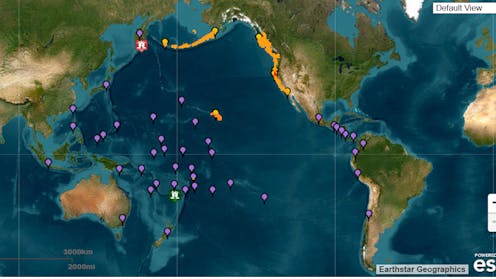
Zonas afectadas por el tsunami generado por el terremoto de Rusia, con epicentro en las Islas Comandante, mar de Bering, al este de la península de Kamchatka. NOAA / National Weather Service, CC BY

El 30 de julio de 2025, un terremoto de magnitud 8,8 ha sacudido la península de Kamchatka, en el extremo oriental de Rusia, desencadenando alertas de tsunami en gran parte del océano Pacífico, desde Japón y Hawái hasta la costa oeste de Estados Unidos, Centroamérica y Oceanía. Este seísmo, uno de los más intensos de las últimas décadas y el octavo más fuerte registrado en la era moderna, ocurrió a menos de 20 kilómetros de profundidad y provocó olas de hasta 4 metros en zonas costeras cercanas, obligando a evacuar a la población y causando importantes daños materiales.

Cuando la tierra tiembla, el volcán Kliuchevskoi ruge

Tras el potente terremoto, el volcán Kliuchevskoi, el más alto y activo de Eurasia, despertó con una violenta erupción, expulsando ceniza y material incandescente desde su cráter principal de unos 700 metros de diámetro. Ríos de lava descendieron por su ladera occidental, un espectáculo que sorprendió a los científicos, ya que el volcán había estado inactivo durante varios meses.

Según los expertos, la fuerte sacudida sísmica probablemente alteró la presión interna del sistema magmático, facilitando la salida del magma acumulado. Con más de un centenar de erupciones registradas en los últimos 3 000 años, este gigante ha demostrado ser especialmente sensible a estas alteraciones tectónicas, lo que representa un riesgo adicional para las poblaciones cercanas.

¿Por qué tiembla tanto Kamchatka?

Kamchatka se sitúa en una de las zonas con mayor actividad sísmica del planeta, la fosa de Kuriles-Kamchatka, donde la enorme placa tectónica del Pacífico se hunde bajo la de Okhotsk. Este proceso, conocido como subducción provoca una acumulación constante de tensión tectónica, que se libera cada cierto tiempo en forma de terremotos de gran magnitud. No es un fenómeno nuevo, ya que en 1952 se registró un seísmo similar, con magnitud cercana a 9, lo que originó un tsunami con olas de hasta 18 metros. El reciente terremoto responde al mismo mecanismo físico, una fractura súbita en esta falla activa.

Magnitud, profundidad y energía liberada

El Servicio Geológico de Estados Unidos (USGS) estimó la magnitud del terremoto en 8,8, con un hipocentro situado a unos 18,2 kilómetros de profundidad. Esta combinación genera una liberación de energía colosal, equivalente a miles de veces la bomba atómica de Hiroshima. Para ponerlo en perspectiva, fue aproximadamente 30 veces más fuerte que el terremoto de Kaikoura (Nueva Zelanda, 2016) y comparable, aunque algo menor, al de Tōhoku (Japón, 2011). Además, se esperan réplicas durante los próximos días o semanas, algunas de ellas potencialmente destructivas.

Cuando el mar se convierte en amenaza

El tsunami asociado se ha producido por el desplazamiento vertical del lecho marino durante el seísmo. Esta alteración súbita del fondo oceánico desplaza enormes volúmenes de agua, generando ondas que pueden cruzar el océano a velocidades superiores a los 700 km/h. Al acercarse a la costa, la velocidad disminuye, pero la altura de las olas aumenta considerablemente. En localidades rusas como Severo-Kurilsk se registraron olas superiores a los 3 metros, mientras que en Japón, aunque eran de menor intensidad (alrededor de 60 cm), se mantuvo la alerta durante varias horas.

De Japón a América, el océano pone a prueba los sistemas de alerta

La respuesta internacional ha sido inmediata. Japón ordenó la evacuación de alrededor de 2 millones de personas, incluyendo trabajadores de la central nuclear de Fukushima. Estados Unidos activó las alertas en Hawái, Alaska y toda la costa oeste, incluyendo California y Oregón. En América Latina, países como Perú, Ecuador y México pusieron también en marcha sus protocolos de emergencia.

Aunque las olas fueron moderadas en la mayoría de estas regiones, las medidas preventivas evitaron posibles tragedias. La buena coordinación entre agencias sismológicas y meteorológicas durante esta emergencia demuestra el valor de la cooperación internacional para gestionar riesgos en tiempo real, evitar daños materiales y salvar vidas.

¿Qué nos dice la ciencia sobre este tipo de fenómenos?

Cada terremoto de estas características supone una oportunidad para avanzar en el conocimiento científico. Los datos recogidos por sismógrafos, satélites y boyas oceánicas permiten a los geofísicos estudiar con más precisión cómo se propagan las ondas sísmicas y los tsunamis. Además, sirven para poner a prueba los modelos de predicción y mejorar los sistemas de alerta temprana. Gracias a estos avances, es posible avisar a la población con minutos de antelación, un tiempo que puede salvar miles de vidas.

Un contexto histórico de actividad sísmica extrema

Aunque no se trata del mayor terremoto registrado, el seísmo de Kamchatka entra en el grupo de los más intensos de la historia reciente. Su magnitud lo sitúa el nivel del devastador terremoto de Sumatra en 2004 y del ya citado de Tōhoku en 2011. Esta región ha vivido otros grandes temblores en el pasado, como los de 1952 y 1737, que provocaron tsunamis de hasta 60 metros de altura. Todo este historial nos recuerda que Kamchatka es una de las zonas más activas y peligrosas dentro del Cinturón de Fuego del Pacífico.

¿Estamos preparados para el próximo gran terremoto?

El suceso ha puesto a prueba la capacidad de respuesta de los países afectados. Si bien los protocolos han funcionado de forma razonable, sigue habiendo diferencias notables entre regiones en cuanto a infraestructuras, medios técnicos y preparación ciudadana. En zonas menos desarrolladas o con acceso limitado a comunicaciones, la capacidad de reacción sigue siendo limitada. La prevención, a través de la educación, la arquitectura sismorresistente y el fortalecimiento de las redes de alerta, es clave para afrontar futuros eventos de esta magnitud.

La advertencia silenciosa que viene del subsuelo

El terremoto de Kamchatka es un recordatorio contundente del poder de la naturaleza y de la necesidad de estar preparados. Su impacto no solo ha sido físico, sino también social y científico. Nos recuerda que vivimos en un planeta dinámico, en constante movimiento, y que la vigilancia geológica y la cooperación internacional son herramientas imprescindibles para reducir riesgos. Comprender estos fenómenos, anticiparse a ellos y actuar con rapidez puede marcar la diferencia entre una catástrofe contenida y una tragedia.

The Conversation

Las personas firmantes no son asalariadas, ni consultoras, ni poseen acciones, ni reciben financiación de ninguna compañía u organización que pueda obtener beneficio de este artículo, y han declarado carecer de vínculos relevantes más allá del cargo académico citado anteriormente.

ref. El terremoto de Rusia sacude el Pacífico, despierta un volcán y pone a prueba la ciencia – https://theconversation.com/el-terremoto-de-rusia-sacude-el-pacifico-despierta-un-volcan-y-pone-a-prueba-la-ciencia-262250

Israel’s attack on Syria: Protecting the Druze minority or a regional power play?

Source: The Conversation – Canada – By Spyros A. Sofos, Assistant Professor in Global Humanities, Simon Fraser University

A new round of violence recently erupted in southern Syria, where clashes between local Druze militias and Sunni fighters have left hundreds dead.

In response, Israel launched airstrikes in and around the province of Sweida on July 15, saying it was acting to protect the Druze minority and to deter attacks by Syrian government forces.

The strikes mark Israel’s most serious escalation in Syria since December 2024, and they underline a growing trend in its foreign policy: the use of minority protection as a tool of regional influence and power projection.

The Druze minority

The Druze, a small but strategically significant ethno-religious group, have historically occupied a precarious position in the politics of Syria, Israel and Lebanon.

With an estimated million members across the Levant — a sub-region of west Asia that forms the core of the Middle East — the Druze have often tried to preserve their autonomy amid broader sectarian and political upheavals. In Syria, they make up about three per cent of the population, concentrated largely in the southern province of Sweida.

Following the collapse of Bashar al-Assad’s regime in Syria in late 2024 and the rise of a new Islamist-led government under Ahmed al-Sharaa, the Druze in southern Syria have resisted central authority.

Though not united in their stance, many Druze militias have rejected integration into the new Syrian army, preferring to rely on local defence networks. The latest wave of violence, sparked by the abduction of a Druze merchant, has been met with both brutality from pro-government forces and military retaliation by Israel.

Truly protecting Syrian minorities?

Israeli officials says they intervened to protect the Druze, which is not unprecedented. Over the past year, Israel has increasingly portrayed itself as a defender of threatened minorities in Syria — rhetoric that echoes past efforts to align with non-Arab or marginalized groups, such as the Kurds and certain Christian communities.

This strategy may be less about humanitarian goals and, in fact, much more deeply political.

By positioning itself as a regional protector of minorities, Israel could be seeking to craft a narrative of moral authority, particularly as it faces growing international outrage over its policies in the West Bank and Gaza. This is an example of what scholars refer to as strategic or nation branding by states to cultivate legitimacy and influence through selective interventions and symbolic gestures.

But Israel’s actions may not just concern image. They could also be part of a broader geopolitical strategy of containment and fragmentation.

The new authorities in Syria are seen as a significant threat, particularly because of the presence of Islamist factions operating near the Israeli-occupied Golan Heights. By creating what is in effect a buffer zone in southern Syria, Israel’s goal may be to prevent the entrenchment of hostile entities along its northern border while also capitalizing on Syria’s internal fragilities.

Strategic risks

With sectarian tensions resurfacing in Syria, the Israeli government probably sees an opportunity to build informal alliances with disaffected groups like the Druze, who may be skeptical of the new Syrian government. This reflects a shift in Israel’s foreign policy from reactive deterrence to proactive strategic disruption.

This approach is not without risks. While some Druze leaders have welcomed Israeli support, others — particularly in Syria and Lebanon — have accused Israel of stoking sectarian tensions to justify military intervention and advance territorial or security aims.

Such accusations echo longstanding criticisms that Israel’s involvement in regional conflicts is often guided less by humanitarian concern and more by cold strategic calculation.

This new phase in Israeli foreign policy also fits into a broader pattern I’ve previously written about — the increasing revisionism of Israel’s regional strategy under Benjamin Netanyahu’s leadership. That strategy seemingly seeks to upend multilateral norms, bypass traditional diplomacy and pursue influence through direct engagement — often militarized — with non-state entities and marginalized communities.


Read more:
How Israel’s domestic crises and Netanyahu’s aim to project power are reshaping the Middle East


Israel’s July 15 strikes, and an attack on Syria’s Ministry of Defence in Damascus the following day, have drawn strong condemnation from Arab states, Turkey and the United Nations.

While Israeli officials have justified the attacks as defensive and humanitarian, the intensity and symbolic targets suggest a deeper intention: to demonstrate operational reach, and, more importantly, actively engage in a redesign of the region with fragmentation and state weakness as the main objective.

Fragmentation of the Middle East

The United States, while expressing concern over the violence, has largely remained silent on Israel’s expanding role in Syria. This could further embolden Israeli actions in a region where international norms are being increasingly upended and traditional great power engagement is waning.

Sectarian clashes are likely to continue in Sweida and beyond as Syria’s central government struggles to reassert control. That means that for Israel, the opportunity to deepen its footprint in southern Syria under the guise of minority protection remains.

But despite its effort to present itself as a stable, moral presence in an otherwise chaotic neighbourhood, Israel could be undermining the very stability it says it wants to protect as it militarizes humanitarianism.

The world is not not just witnessing a series of airstrikes or another episode of sectarian violence in the Middle East. It’s watching a profound transformation in the regional order — one in which traditional borders, alliances and identities are being reshaped.

Amid this environment, Israel’s role could evolve not just as a military power, but as a revisionist nation navigating, and helping to bring about, the fragmentation of the Middle East.

The Conversation

Spyros A. Sofos does not work for, consult, own shares in or receive funding from any company or organisation that would benefit from this article, and has disclosed no relevant affiliations beyond their academic appointment.

ref. Israel’s attack on Syria: Protecting the Druze minority or a regional power play? – https://theconversation.com/israels-attack-on-syria-protecting-the-druze-minority-or-a-regional-power-play-261648

‘Pay us what you owe us:’ What the WNBA’s collective bargaining talks reveal about negotiation psychology

Source: The Conversation – Canada – By Ryan Clutterbuck, Assistant Professor in Sport Management, Brock University

WNBA all-star players, led by Indiana Fever’s Caitlin Clark and the Minnesota Lynx’s Naphessa Collier, recently made headlines by wearing “Pay Us What You Owe Us” T-shirts during the pregame warm-up.

The T-shirts, which are now available for purchase, were a demonstration of players’ frustrations with the WNBA owners and the ongoing collective bargaining agreement negotiation. The collective agreement sets out the terms and conditions of employment (like salaries and benefits) between the league and its players, and is set to expire Oct. 31, 2025.

Reportedly, players are asking for increased revenue sharing (the current agreement stipulates WNBA players receive only nine per cent of league revenue, relative to their NBA peers who receive 50 per cent), increased compensation (the average WNBA salary is US$147,745) and other benefits.

Central to these demands is the perception that, despite a surge in popularity, media attention and viewership, WNBA players are still being underpaid and are undervalued.

Negotiations for a new collective agreement are ongoing. But as the T-shirts and subsequent public statements from the players and the WNBA show, there is increasing frustration with how the process is unfolding.

What is ‘owed’ to WNBA players?

Debate over what is “owed” to WNBA players has intensified recently. ESPN commentator Pat McAfee, for example, has suggested the league should simply increase players’ salaries by US$30,000 per player, saying that contracts like Clark’s are “an embarrassment.”

But others argue this discussion should go beyond players’ salaries. Syracuse University sport management professor Lindsey Darvin writes:

“The question isn’t whether the WNBA can afford to pay players what they’re worth; it’s whether the league can afford not to make the investments necessary to realize its full potential.”

According to Darvin, because the WNBA is an economically inefficient — and arguably exploitative — business, its focus should be on increasing revenue, and not simply on reducing its labour costs. For example, with the goal to satisfy increasing market demands for the WNBA, strategies to increase revenue could include expanding the league to new markets, scheduling more games at the 3 p.m. Eastern time slot and increasing the number of regular season games from 44 to 60 or more.

In sport management classrooms and negotiation workshops at Brock University, we call this “expanding the pie” — working collaboratively, as opposed to combatively, to grow the game and the business so that both players and owners benefit over the long term. But this is easier said than done.

Information shapes negotiation outcomes

While it’s still early in the negotiation process, there are lessons that can be learned from this round of collective bargaining. One of those lessons has to do with making and receiving first offers. In particular, two psychological concepts are at play: information asymmetry and the anchoring effect.

Information asymmetry occurs when one party holds more relevant knowledge than the other. For example, in a typical job negotiation, the employer knows the number of applicants for the position, how much the company is willing to pay and what compensation trends look like across the sector. The candidate, by contrast, lacks most if not all of this information and thus enters the negotiation at a distinct disadvantage.

The question is: who should make the first salary offer? The general rule is that when you lack critical information, it’s better to let the other side make the first move.

In the case of the WNBA’s negotiations, the information asymmetry problem is not so obvious. The owners likely have a certain perspective on what is acceptable in terms of sharing league revenue and improving working conditions. But the players possess their own kind of leverage, regarding their willingness to protest or walk out entirely.

The league made its initial proposal to the players in early July, but it was not well received.

The ‘anchoring effect’ can skew negotiations

Another problem influencing negotiations is the “anchoring effect.” This occurs when an initial offer influences subsequent offers and counteroffers, and ultimately has an impact on the final outcome.

Garage-sale aficionados may recognize this tendency, as buyers often negotiate with the seller’s sticker price in mind, haggling to earn a 25 or 50 per cent discount on an item without considering whether the item is actually worth the cost. Here, the sticker acts as the anchor.

While sticker prices and first offers are not inherently malicious, some sale prices and first offers are intended to manipulate buyers and negotiators representing the other side. Savvy negotiators deploy strategic anchors, but even they can sometimes miss.

In maritime terms, anchor scour occurs when a ship’s anchor fails to catch hold and instead drags across the seabed, destroying ecosystems caught in its path.

In negotiations, a similar process can unfold. When initial moves and first offers fail to catch hold because they are perceived to be unfair by the other side, it can damage relationships and can make subsequent negotiations even more difficult.

Now, the WNBA may face the consequences of a poorly received anchor. According to WNBA player representative, Satou Sabally, the WNBA’s initial offer was a “slap in the face”.

New York Liberty’s Breanna Stewart called the players’ meeting with the league on July 17 to discuss a new collective bargaining agreement a “wasted opportunity” while Chicago Sky player Angel Reese called the negotiations “disrespectful.”

It’s time to right the ship

Though it’s still early days, we expect negotiations to heat up in the coming weeks as the Halloween deadline to reach a deal approaches.

There is still time to right the ship, so to speak, but to do so, WNBA players and owners must internalize the potentially disastrous impacts that can come from negotiating over an imagined “fixed pie” instead of expanding it, and dropping anchors that fail to address the other sides’ key interests.

WNBA players and WNBA team owners now have, in front of them, a once-in-a-generation opportunity to transform professional women’s sport in North America, through creatively and collaboratively expanding the pie and paying the players what they’re owed.

The Conversation

Michele K. Donnelly has received funding from the Social Sciences and Humanities Research Council (SSHRC).

Michael Van Bussel and Ryan Clutterbuck do not work for, consult, own shares in or receive funding from any company or organisation that would benefit from this article, and have disclosed no relevant affiliations beyond their academic appointment.

ref. ‘Pay us what you owe us:’ What the WNBA’s collective bargaining talks reveal about negotiation psychology – https://theconversation.com/pay-us-what-you-owe-us-what-the-wnbas-collective-bargaining-talks-reveal-about-negotiation-psychology-261731

Car tires are polluting the environment and killing salmon. A global plastics treaty could help

Source: The Conversation – Canada – By Timothy Rodgers, Postdoctoral Fellow in Environmental Engineering, University of British Columbia

In the 1990s, scientists restoring streams around Seattle, Wash., noticed that returning coho salmon were dying after rainstorms. The effects were immediate: the fish swam in circles, gasping at the surface, then died in a few hours.

Over the next several decades, researchers chipped away at the problem until in 2020 they discovered the culprit: a chemical called 6PPD-quinone that forms when its parent compound, a tire additive called 6PPD, reacts with ozone.

6PPD-quinone kills coho salmon at extraordinarily low concentrations, making it one of the most toxic substances to an aquatic species that scientists have ever found.

Today, a growing body of evidence shows that tire additives and their transformation products, including 6PPD-quinone, are contaminating ecosystems and showing up in people.

Now, alongside the researchers who made that initial discovery, we’re calling for international regulation of these chemicals to protect people and the environment.

Our recently published research outlines the hazard posed by tire additives due to their demonstrated toxicity and high emissions near people and sensitive ecosystems, how current regulations don’t do enough to protect us, and how we can do better.

Tires are complex chemical products

Tires are far from simple rubber rings. They’re complex chemical products made to endure heat, friction and degradation. For example, 6PPD is in tires to protect them from ozone, which causes tires to crack.

Unfortunately, little attention was paid to these chemicals until scientists discovered the impacts of 6PPD-quinone and realized these chemicals could be hazardous.

Once they started looking, researchers found many tire additives, including 6PPD-quinone, in streams near roads, in dust and in the air — wherever there are roads, there is tire additive contamination.

Although 6PPD-quinone is most lethal to coho, it is also lethal to several other species of salmonids, and it may be toxic to aquatic plants and terrestrial invertebrates.

We know that exposure to tire wear particles and the chemicals that leach from them affect other aquatic species that are used as indicators of toxicological risk. This widespread contamination occurs because emissions of tire additives are high.

Every time we drive, we produce particles from tire wear, and those particles release additives into the environment. Tires lose 10-20 per cent of their mass over their lifetime. That means driving emits over one million tonnes of tire particles to the environment in both the United States and the European Union every year.

All those tire particle emissions represent a large source of chemicals to the environment and high human exposures, especially in cities. Researchers have started to find tire additives and their transformation products in people.

Although more research is needed on how tire additives affect people, 6PPD is classified as a reproductive toxin, and other tire additives and their transformation products have been associated with increased cancer risk in exposed populations.

Emerging research with mice indicates that some tire additives and their transformation products impact mammals, with studies showing neurotoxicity, damage to multiple organ systems and impaired fertility from 6PPD-quinone.

That’s why our team of environmental scientists is calling for urgent global action.

Plastics treaty

We’re not arguing that tires shouldn’t have additives, but those additives must be safer. That’s why we are calling for a process that replaces 6PPD and other tire additives with safer alternatives. Tire additives should be nonhazardous across their entire life cycle, and manufacturers should be transparent about what tire additives they are using and what their hazards are.

Next week, governments from around the world are meeting to negotiate a global treaty to end plastic pollution. We call for tires to be explicitly included in the treaty, and we want to see strong measures around plastic additives including tire additives.

We want to see:

  • Deadlines for phasing out hazardous chemicals;
  • The ability to mandate alternatives;
  • Transparency around the chemicals used in tires;
  • Independent panels for evaluating additive alternatives and for assessing additive effects;
  • Dedicated working groups focused on tire additives due to their large emissions and demonstrated ecological impacts.

The good news is that we’ve done this before. After scientists found a hole in the ozone layer, the world banded together under the Montréal Protocol to phase out the most damaging chemicals to the ozone layer. Today, the ozone layer is recovering, averting millions of cases of skin cancer and helping combat climate change. We need the same level of ambition and urgency now.

Making tires nonhazardous for the environment would help safeguard coho salmon populations, restoring traditional foods to Indigenous Peoples across the Pacific Northwest and protecting a species vital for aquatic ecosystems.

Since roads are built where people are, reducing the hazard from tire particle pollution would reduce one source of exposure to potentially toxic chemicals, and ensure a future where fewer people are impacted by chemical pollution. It’s time for global action on tire additives, before their impacts become even harder to ignore.

The Conversation

Timothy Rodgers receives funding from the British Columbia Salmon Restoration and Innovation Fund.

Rachel Scholes receives funding from the Natural Sciences and Engineering Research Council of Canada, the Canadian Foundation for Innovation, the BC Knowledge Development Fund, and the BC Salmon Restoration and Innovation Fund.

Simon Drew receives funding from the British Columbia Salmon Restoration and Innovation Fund.

ref. Car tires are polluting the environment and killing salmon. A global plastics treaty could help – https://theconversation.com/car-tires-are-polluting-the-environment-and-killing-salmon-a-global-plastics-treaty-could-help-261832

8 policies that would help fight poverty in South Africa’s economic hub Gauteng

Source: The Conversation – Africa – By Adrino Mazenda, Senior Researcher, Associate Professor Economic Management Sciences, University of Pretoria

Poverty goes beyond income. It often arises when health, education and opportunities fall short of meeting people’s needs.

Individuals are classified as impoverished when they face deprivation in one-third or more of the indicators in a multidimensional poverty index. The index reflects the various influences on socioeconomic class. These include housing, sanitation, electricity, cooking fuel, nutrition and school attendance.

The index is one of the most comprehensive measures of poverty. The fact that the multidimentional index captures multiple dimensions enables it to reflect overlapping disadvantages. And provides a fuller picture of well-being. Other monetary measures such as income aren’t as comprehensive.

About 18% of the world’s population are poor by the definition of the multidimentional poverty index. Sub-Saharan Africa is especially affected, with a multidimensional poverty rate nearing 59%.

In South Africa, it is at around 40%. This means it experiences four in 10 of the dimensions of poverty.

The province of Gauteng is South Africa’s economic hub. Nevertheless it contains pockets of severe deprivation. About 4.6% of households are poor. In some wards up to 68% are severely deprived.

We are social scientists with research histories in food systems and livelihoods, public policy and economics of human capital. We recently conducted a study focused on Gauteng. We wanted to determine what could enable poor and vulnerable households to move out of those categories.

We used a modelling exercise that allowed us to isolate the most relevant factors for this transition.

The study found six factors: education, age, income, working time, medical aid and being a recipient of a low income municipal support grant. We concluded from this that attending to these six variables was the foundation for upward mobility.

Conversely, vulnerability to economic shocks, such as job loss or food insecurity, can trigger rapid downward mobility.

Based on our findings we make eight policy recommendations. These include boosting education and skills training, better healthcare and affordable, reliable transport.

Range of factors

Multidimensional poverty intersects with socioeconomic class structures. It reinforces inequality by placing individuals into hierarchical groups. These range from the affluent and middle class to the transient, vulnerable, and chronically poor.

These disparities shape access to resources, opportunities and upward mobility.

Lower-class households differ from middle-class and affluent (non-poor) households across multiple dimensions. These differences include income stability, consumption patterns, access to services, asset ownership, social capital and vulnerability to shocks.

In the light of this we adopted a multidimensional poverty approach to classify households. We used various dimensions and indicators of poverty to assess the extent of deprivation and associated poverty levels.

We calculated the deprivation score and classified households into three levels: not poor, moderate poverty (vulnerable), and severe poverty (chronically poor).

Working time had the strongest effect. Part- or full-time work greatly lowered odds of severe poverty (chronic poverty) and moderate poverty (transient poverty). Working time refers to the duration that a person is engaged in paid employment or work-related activities. This is usually between 35 and 45 hours per week for full-time employment. And fewer than 35 hours per week for part-time employment.

Some factors only influenced certain groups. For severe poverty, transport access, household health, food parcel reliance, household size, and skipping meals were significant. For moderate poverty, gender, food parcel reliance and skipping meals mattered. And for the vulnerable non-poor (middle class), distance from public transport was the only additional factor.

Social grants and being part of the black population group showed little influence. Transitions and the ability to transcend poverty classes were driven mainly by direct socio-economic factors.

These dynamics underscore the precariousness of low-income households. They also highlight the importance of targeted interventions to break cycles of poverty.

Higher education, stable income and access to full-time work, drastically reduce the odds of remaining in severe or moderate poverty or being vulnerable. Medical aid access and municipal assistance programmes that provide free or subsidised basic services, also serve as protective factors. These help households meet essential health and welfare needs.

However, several structural and socio-economic constraints hinder transitions out of poverty. For example, living a greater distance from public transport increases the likelihood of severe poverty and vulnerability.

Food insecurity, measured by skipping meals or dependence on food parcels, remains a persistent marker of entrenched deprivation.

Gender disparities suggest underlying labour market or social vulnerabilities that require targeted policy interventions. For example, male-headed households are more likely than female-headed households to be moderately poor.

What can be done

Escaping multidimensional poverty in Gauteng requires targeted, practical and complementary interventions. Examples include subsidised transport, decentralised clinics, or housing closer to jobs.

This will enable grants to be translated to improved well-being.

We suggest eight areas for improvement:

  • access to education, vocational training and digital skills. This will help to increase employment prospects

  • public works and youth entrepreneurship support. This will boost income generation

  • social protection like indigent benefits, food vouchers and subsidised medical aid

  • food security. This can be done through community gardens and nutrition programmes

  • support for female-headed households and young people

  • affordable, reliable public transport. Services also need to be decentralised

  • data-driven municipal planning to guide infrastructure and service investments

  • consistently tracking progress against defined objectives.

The province implements multiple poverty-reduction initiatives. These include expanded public works, township economy support, food gardens, free basic services, subsidised housing, and public transport projects.

These efforts address income, food security and mobility. But they have limited impact due to persistent barriers. This is because many, particularly young people, don’t have market-relevant skills. In addition, spatial inequality results in long, costly commutes. And housing shortages and rising food prices deepen vulnerability.

Fragmented funding, weak coordination and inadequate data tracking also undermine progress.

The Conversation

Massimiliano Tani receives funding from Australian Research Council (unrelated to this article).

Adrino Mazenda and Catherine Althaus do not work for, consult, own shares in or receive funding from any company or organisation that would benefit from this article, and have disclosed no relevant affiliations beyond their academic appointment.

ref. 8 policies that would help fight poverty in South Africa’s economic hub Gauteng – https://theconversation.com/8-policies-that-would-help-fight-poverty-in-south-africas-economic-hub-gauteng-261388

Modi’s visit to Ghana signals India’s broader Africa strategy. A researcher explains

Source: The Conversation – Africa (2) – By Veda Vaidyanathan, Associate, Harvard University Asia Center, Harvard Kennedy School

Ghana has historically been an anchor of Indian enterprise and diplomacy on the African continent.

New Delhi and Accra formalised ties in 1957. At the time, their partnership was grounded in shared anti-colonial ideals and a common vision for post-independence development. India offered counsel on building Ghana’s institutions, including its external intelligence agency. Meanwhile, Indian teachers, technicians, and traders regularly travelled to the west African country in search of opportunity.

The July 2025 visit of the Indian prime minister, Narendra Modi, to Ghana – the first by an Indian leader in over three decades – came at a critical moment for the continent. As the global order shifts towards multi-polarity, countries like Ghana are navigating a complex landscape, which includes western donors scaling back commitments. This has opened space to deepen cooperation through pragmatic, interest-driven collaborations with longstanding partners like India. Speaking at the Munich Security Conference, Ghana’s President John Mahama captured the spirit of this global realignment, noting that

as bridges are burning, new bridges are being formed.

Against this backdrop, Prime Minister Modi’s visit offered an opportunity to both revive and recalibrate bilateral ties. The visit carried a strong economic and strategic orientation. Ghana positioned itself as a partner in areas where India holds comparative advantage, such as pharmaceuticals. Over 26% of Africa’s generic medicines are sourced from India. The Food and Drugs Authority’s (Ghana’s regulator of pharmaceutical standards) listing of foreign pharmaceutical manufacturing facilities is dominated by Indian firms.

Defence cooperation was also on the agenda. Ghana is looking to India for training, equipment and broader security engagement in response to rising threats from the Sahel and coastal piracy.

This emphasis on shared security interests is underscored by Ghana’s alignment with India on counter-terrorism. President Mahama for instance has condemned the Pahalgam terrorist attacks that occurred in April, 2025.

Reviving economic ties

Economic ties are at the heart of this renewed engagement between the two countries. Bilateral trade currently stands at around US$3 billion. Both leaders aim to double it to US$6 billion over the next five years. Currently, Ghana enjoys a trade surplus with India. This is mainly due to gold exports, which account for over 70% of its shipments. Cocoa, cashew nuts, and timber are also key exports, while imports from India include pharmaceuticals, machinery, vehicles, and various industrial goods.

India has invested more than US$2 billion in Ghana. These investments span private capital, concessional finance and grants across 900 projects. India now ranks among Ghana’s top investors. Indian firms and state-backed institutions play a key role in critical infrastructure development. Landmark projects include the 97km standard gauge Tema-Mpakadan Railway Line and the Ghana-India Kofi Annan ICT Centre, a hub for innovation and research.

In an earlier study, I documented the perspectives of Indian entrepreneurs in Ghana. The findings underscored the country’s appeal as a land of economic opportunity. In interviews, Indian businesses highlighted Ghana’s stable political environment. An expanding consumer base, and relatively transparent regulatory framework were also mentioned. Together, these factors continue to attract investor interest.

This economic momentum likely paved the way to pursue a closer bilateral relationship, marked by the elevation to a ‘Comprehensive Partnership’.

While delegates in the July visit addressed issues such as financial inclusion, healthcare and agriculture, the tangible outcomes were limited. Four memoranda of understanding were signed. They cover cooperation on traditional medicine, regulatory standards and cultural exchange. The creation of a joint commission to structure and advance bilateral collaboration across priority sectors was also signed.

Moving forward, Ghana offers India an entry point into west Africa’s resource landscape. With reserves of gold, bauxite, manganese and lithium, Ghana is well positioned to contribute to India’s needs for critical minerals. President Mahama’s invitation for investment in mineral extraction and processing aligns with India’s National Critical Mineral Mission, New Delhi is looking for supply chains for its energy transition. It creates an opportunity for Indian mining companies to expand into African markets.


Read more:
The world is rushing to Africa to mine critical minerals like lithium – how the continent should deal with the demand


Pragmatic diplomacy

With nearly US$100 billion in trade, cumulative investments of nearly US$75 billion, and a 3.5 million strong diaspora, the broader contours of India’s Africa policy is increasingly pragmatic and issue based.

New Delhi’s evolving relations with Accra reflects this. It comes as Ghana is making sweeping economic reforms domestically, particularly in fiscal management and debt restructuring.

This ambitious “economic reboot” hinges on attracting private sector investment. In this context, the Indian diaspora, already deeply embedded in Ghana’s commercial networks, is well positioned to foster stronger economic ties.

In his address to Ghana’s Parliament, The Indian Prime Minister spoke of development cooperation that is demand driven and focused on building local capacity and creating local opportunities. This approach “to not just invest, but empower”, signals India’s growing intent to anchor relationships in mutual agency, rather than dependency.

The Conversation

Veda Vaidyanathan is Fellow, Foreign Policy and Security Studies, at a leading Indian think tank.

ref. Modi’s visit to Ghana signals India’s broader Africa strategy. A researcher explains – https://theconversation.com/modis-visit-to-ghana-signals-indias-broader-africa-strategy-a-researcher-explains-261187

Ancient India, Living Traditions: an earnest effort to show how the art of Hinduism, Buddhism and Jainism is sacred and personal

Source: The Conversation – UK – By Ram Prasad, Fellow of the British Academy and Distinguished Professor in the Department Politics, Philosophy and Religion, University of Leicester

The British Museum’s Ancient India, Living Traditions exhibition brings together exhibits on the sacred art of Hinduism, Buddhism and Jainism. It also encompasses the spread of the devotional art of these traditions to other parts of Asia.

The exhibition speaks to religious identity and relationships. Buddhism and Jainism distinguish themselves from the vast surrounding traditions that together we call Hinduism; but they have close kinship with it in practices, beliefs and iconography. Museums that have presented sculptures in isolation have usually not attempted to narrate this complex history.

Not all the items displayed, some going back 2,000 years, are of purely historical interest. There are representations of traditions that are continuously living in a way the gods of ancient Egypt or classical Europe are not.

The most instantly recognisable example for visitors of such living ancient tradition is likely to be statues of the elephant-headed deity Ganesha. Visitors can see a rare and valuable 4th century sandstone Ganesha on show. They can also see a small bronze version of that ancient Ganesha that is like the kind you would find in people’s home and to which a quick prayer would be addressed every morning.

The question of how to respect that sense of the sacred while still mounting an exhibition is a moral and aesthetic challenge that few museums (including in India) have started to address. It’s not uncommon to see such pieces wrenched from the reality of their continued practice and presented in secular art displays. Here, however, the curators have tried to make connections between “statues” on display and “icons” in temples and homes.


Looking for something good? Cut through the noise with a carefully curated selection of the latest releases, live events and exhibitions, straight to your inbox every fortnight, on Fridays. Sign up here.


Finally, there’s the problematic history of the imperial museum and its need to reckon with its past. Most objects on display in this exhibition, and The British Museum more widely, have been presented with scarcely any acknowledgement of how they came to be acquired.

The exhibition makes an earnest effort to tackle most of these issues.

Ancient but not dead

The spaces of the exhibition are structured to be respectful of the historical and contemporary sensitivities of Buddhism and Jainism. This is signalled through subtle changes of colour and the placement of translucent drapery, allowing for transitions between distinct Jain, Buddhist and Hindu displays.

At the same time, conceptual and sensory commonalities are powerfully conveyed. The first space focuses on nature spirits and demi-deities that are shared across all the ancient traditions. The air is filled with the sound of south Asian birds and musical instruments. The explanatory labels draw attention to the percolation of iconographic features between traditions, for instance, those between the Buddha and the Jaina teachers, or the direct inclusion of the deity of learning (Sarasvati) in both Hindu and Jain worship.

Also well presented is a final space on the spread of south Asian iconography to central, east and southeast Asia. This is a long story that needs its own telling, but can only be hinted at through some beautifully chosen figures.

It’s the curators’ use of a community advisory panel of people who practice such traditions today that gives the information its sensitivity. Their inclusion in the exhibition’s production can be seen in a marked mindfulness that the content and symbols of these inert objects are alive and sacred to hundreds of millions.

For example, one Ganesha from Java in Indonesia draws attention to different elements of his iconography. There is the trans-continentally stable depiction of his having a broken tusk (which, as Hindus will know, he is said to have broken off to write down the epic Mahabharata). But this Ganesha also holds a skull, which is unique to the Javanese version. The label gently points out that “various communities understood and worshipped him differently”.

The combination of community engagement and creative presentation not only conveys a sense of respect for the traditions, but also elicits a respectful response from visitors. Those from within the tradition will note with satisfaction the description of a symbol or icon. Those from outside the traditions are invited to look at the exhibits with attention and care as they might in a cathedral.

I saw a pair of young Indian Americans looking at a fossilised ammonite from Nepal that is taken as a symbolic representation of god for worshippers of Vishnu. They animatedly compared it to the one in their own diasporic home.

Elsewhere in the exhibition, I caught an elderly English couple stood in wondering silence in front of a drum slab from the famous 1st century BC Amaravathi Buddhist site in south India. This slab was carved just before figural representations of the Buddha rapidly gained in popularity. Here, there are symbols associated with him, but the Buddha himself is represented by the empty seat from whence he has gone.

How did it all get here?

One potential interpretive danger lies in the emphasis on continuity between past objects and present realities. Hindus today from social backgrounds that did not have the privilege of reaching back to high sacred art might ask where they sit in the smoothed out historical narrative. More broadly, there is no acknowledgement of the complexity of Hindu identity and its formation across centuries, regions, social strata, languages and theologies.

The weakest part of this exhibition’s generally innovative retelling is the faint-hearted way in which it obliquely acknowledges the dubious acquisition process of the British Museum. To say something was “collected” by a major general “while serving in the East India Company army” is hardly facing up to the question with which the exhibition boldly begins: “How did it get here?”

This exhibition offers a powerful visual narrative of the multi-spiritual traditions of ancient India, mounted with sensitivity to their living communities today. Its immersive presentation is appealing, and the story it tells is respectful and innovative.

The task of honest self-representation and difficult conversations on reparation remain. Within that larger imperative, Ancient India, Living Traditions is a step in the right direction. It is a direction towards addressing context, responsiveness and engagement that museums can no longer ignore.

Ancient India, Living Traditions in on at The British Museum, London until October 19 2025


Get your news from actual experts, straight to your inbox. Sign up to our daily newsletter to receive all The Conversation UK’s latest coverage of news and research, from politics and business to the arts and sciences.

The Conversation

Ram Prasad does not work for, consult, own shares in or receive funding from any company or organisation that would benefit from this article, and has disclosed no relevant affiliations beyond their academic appointment.

ref. Ancient India, Living Traditions: an earnest effort to show how the art of Hinduism, Buddhism and Jainism is sacred and personal – https://theconversation.com/ancient-india-living-traditions-an-earnest-effort-to-show-how-the-art-of-hinduism-buddhism-and-jainism-is-sacred-and-personal-262163

Windrush scandal: those left to apply for compensation without legal help missed out on tens of thousands of pounds

Source: The Conversation – UK – By Jo Wilding, Lecturer in law, University of Sussex

The Windrush scandal has been one of the biggest miscarriages of justice in Britain, affecting tens of thousands of people. The government set up a scheme in 2019 to award compensation to those who had been wronged by racist immigration legislation over decades, left unable to prove their immigration status.

But in a new report, I have found that how much victims receive through the scheme has little to do with how they were wronged, and more to do with whether they can access a lawyer. Those who applied without legal support were offered tens of thousands of pounds less than when they appealed with legal representation.

The research, produced with law reform charity Justice and Dechert LLP’s pro bono team, provides empirical evidence of precisely what lawyers do that makes a difference.

Our research participants, who were claiming compensation over the Windrush scandal were offered, on average, £11,000 when applying to the scheme without a lawyer. But when applying for review with legal representation, the award was more than £83,000. One of our participants was refused any compensation when he applied alone, but eventually received £295,000 with the help of a lawyer.

Why lawyers are needed

We conducted an in-depth review of ten files where a claimant first applied for compensation without a lawyer, received a refusal or a low offer of compensation, and then applied with a lawyer for review of that decision.

We reviewed another seven files from people who could never have claimed alone, because of street homelessness, dementia or serious health conditions.

The team interviewed each lawyer and (where possible) the claimant, to identify exactly what a lawyer does that makes a difference.

The Home Office insists lawyers are unnecessary because the scheme’s own caseworkers will help find evidence. But our findings suggest serious failings in those efforts. One of the main contributions of lawyers was expertise in finding decades-old evidence and demonstrating how it meets the standard of proof for the Windrush compensation scheme.

One of our claimants applied for compensation for having been refused housing assistance (leaving her homeless) based on a misunderstanding of her immigration status. The Home Office caseworkers emailed her local council and asked whether there was a record of her being refused housing assistance 20 years earlier. The council replied that there was not. The caseworker treated that as evidence that she had never made an application.

When a lawyer got involved, he asked the council to confirm how long they kept housing application records. The answer was 12 years, so there was never any prospect of evidence existing from 20 years ago. The lawyer then managed to track down her housing file with the housing solicitors who represented her.

Lawyers knew how to request files from public bodies, understood the references to statutes in those files and, most importantly, were able to spot when key documents were missing.

The lawyers in the cases we reviewed took detailed witness statements from claimants. Those made by claimants alone averaged 1.5 pages, whereas those made by lawyers were at least 15 pages, containing far more relevant detail showing how the claimant met the scheme criteria.

Lawyers acted as a “buffer” between claimant and Home Office. Claimants told our research team that they felt the Home Office spoke to them with more respect once they had a lawyer. Often, claimants were ready to give up and accept the refusal because they were exhausted and frustrated with fighting the Home Office.

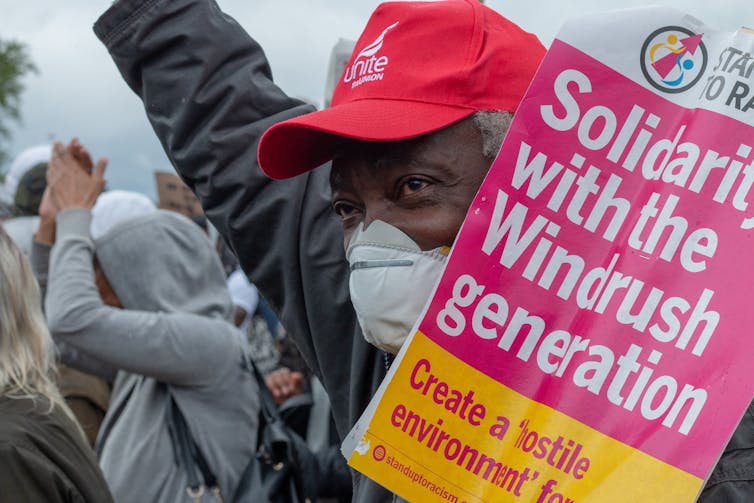
A man at a protest holding a sign that reads 'solidarity with the Windrush generation'
The Windrush scandal has affected tens of thousands of people.
James Ivor Wadlow/Shutterstock

The findings are consistent with other peer-reviewed research exploring what lawyers or representatives add to cases in the family courts and the tribunals: a 15%-18% “representation premium” in chances of success. In some cases, this can be achieved through pre-hearing advice.

All of our participants had a lawyer either through Law Centres funded by a charity, a university law clinic, or private law firms doing the work pro bono. Some firms also do the work on a no-win-no-fee basis, typically taking 25%-30% of the claimant’s damages but on occasion up to 67%. Given that it takes 32-103 hours to prepare the case, the lawyer’s fee may still underrepresent the work they did.

Compensation schemes and legal support

Recent reports have revealed serious problems with the compensation schemes for both the Post Office and the infected blood scandals. The chairs of the respective public inquiries, Sir Wyn Williams and Sir Brian Langstaff, criticised gaps in the provision of access to legal advice and recommended funded legal advice for all claimants.

The Post Office Horizon IT scandal has four compensation schemes for different categories of victim. In each, claimants can choose between a fixed payment (£75,000) or an individual assessment of loss. In three of those schemes, funded legal advice is available to help claimants choose between those options. In the Horizon Shortfall Scheme, though, it is not available unless and until they reject the fixed payment and opt for individual assessment.

The infected blood compensation scheme includes funded legal representation for “core” route claimants – those directly affected. But the inquiry report says it should also be available for claims by affected family members.

Only the Windrush scheme has no provision at all for funded legal representation at any stage. All representation is either a matter of charity, or paid for from the damages, which may leave very little for the claimant.

Yet the Windrush scheme is arguably the most complicated, with a 44-page claim form compared with just eight for the Horizon Shortfall Scheme. The infected blood claim form is largely completed by medical personnel. The Windrush scheme has complex eligibility requirements compared with the other schemes, and often demands an immigration lawyer’s expertise.

As our research found, lawyers were able to advise Windrush claimants on whether the offer of compensation was fair or whether they should apply for review. Our empirical evidence, along with the reports, suggest all compensation schemes involving state harm to citizens should include free legal representation for claimants.

In response to the report, a Home Office spokesperson told the Guardian: “Earlier this year, we launched a £1.5m advocacy support fund to provide dedicated help from trusted community organisations when victims are applying for compensation. However, we recognise there is more to be done, which is why ministers are continuing to engage with community groups on improvements to the compensation scheme, and will ask the new Windrush commissioner to recommend any further changes they believe are required.”


Get your news from actual experts, straight to your inbox. Sign up to our daily newsletter to receive all The Conversation UK’s latest coverage of news and research, from politics and business to the arts and sciences.

The Conversation

Jo Wilding does not work for, consult, own shares in or receive funding from any company or organisation that would benefit from this article, and has disclosed no relevant affiliations beyond their academic appointment.

ref. Windrush scandal: those left to apply for compensation without legal help missed out on tens of thousands of pounds – https://theconversation.com/windrush-scandal-those-left-to-apply-for-compensation-without-legal-help-missed-out-on-tens-of-thousands-of-pounds-261046

The dirty truth about what’s in your socks: bacteria, fungi and whatever lives between your toes

Source: The Conversation – UK – By Primrose Freestone, Senior Lecturer in Clinical Microbiology, University of Leicester

Marko Aliaksandr/Shutterstock

Your feet are microbial hotspots. The area between your toes is packed with sweat glands, and when we wrap our feet in socks and shoes, we trap that moisture in a warm, humid cocoon that’s ideal for microbial growth. In fact, your feet may be home to a miniature rainforest of bacteria and fungi, with anywhere from 100 to 10 million microbial cells per square centimetre of skin surface.

Not only do feet host a huge variety of microorganisms – up to 1,000 different species per person – but they also have a wider range of fungal species than any other part of the body. That means your feet aren’t just sweaty or smelly – they’re genuinely biodiverse.

Because your feet are microbe-rich, your socks become prime real estate for these same bacteria and fungi. Studies show that socks harbour both harmless skin residents, like coagulase-negative staphylococci, and potentially dangerous pathogens, including Aspergillus, Staphylococcus, Candida, Histoplasma and Cryptococcus. These microbes thrive in the warm, moist spaces between your toes, feeding on sweat and dead skin cells.

Their byproducts, such as volatile fatty acids and sulphur compounds, are what give sweaty feet, socks and shoes that notorious odour. It’s not the sweat itself that smells, but the microbial metabolism of that sweat. Perhaps unsurprisingly, smelly feet are so common the NHS has dedicated pages of advice on the issue.

The sock microbiome isn’t just influenced by your feet – it also reflects your environment. Socks pick up microbes from every surface you walk on, including household floors, gym mats, locker rooms and even your garden. They act as microbial sponges, collecting bacteria and fungi from soil, water, pet hair and dander, and the general dust of everyday life. In one study, socks worn for just 12 hours had the highest bacterial and fungal counts of any clothing item tested.

And those microbes don’t stay put. Anything living in your socks can transfer to your shoes, your floors, your bedding – and even your skin. In a hospital study, slipper socks worn by patients were found to carry floor microbes, including antibiotic-resistant pathogens, into hospital beds. It’s a reminder that foot hygiene isn’t just a personal issue – it can have broader implications for infection control and public health.

Super-spreaders

Socks can also play a key role in spreading fungal infections like Tinea pedis (better known as athlete’s foot), a highly contagious condition that primarily affects the toes but can spread to the heels, hands, or even the groin. The infection is caused by dermatophyte fungi, which love warm, damp environments – exactly the kind you find in sweaty socks and tight shoes.

To prevent this, experts recommend avoiding walking barefoot in shared spaces like gyms and pools, not sharing socks, towels, or shoes, and practising good foot hygiene, which includes washing and drying thoroughly between the toes. Topical antifungal treatments are usually effective, but prevention is key.

It’s also important to note that socks can retain fungal spores even after washing. So if you’ve had athlete’s foot, wearing the same pair again – even if it looks clean – could trigger reinfection.

The safest approach is to wear fresh socks daily and allow your shoes to dry out completely between wears. Choose breathable fabrics and avoid footwear that traps heat or causes excessive sweating.

How to wash your socks properly

Most laundry advice focuses on preserving fabric, colour and shape – but when it comes to socks, hygiene matters more. Studies show that washing at typical domestic temperatures (30–40°C) may not be sufficient to kill bacteria and fungi. In fact, under-cleaned socks can act as infection vectors, especially in households with vulnerable people.

To properly sanitise your socks:

  • turn them inside out before washing to expose the inner surface where most microbes accumulate

  • use an enzyme-based detergent, which helps break down sweat and skin debris

  • wash at 60°C when possible, as the higher temperature helps detach and kill microbes

  • steam iron your socks if you need to wash at lower temperatures – heat from ironing can destroy residual spores.

Cotton socks tend to tolerate higher temperatures better than synthetic blends, making them a better option for those prone to fungal infections. Drying socks in direct sunlight can also help: UV light has known antimicrobial effects.

The forensic power of sock microbiomes

Your socks might say more about you than you realise. In a US murder investigation, forensic scientists used soil bacteria found on a suspect’s socks to link them to the burial site of a victim.

The microbial profile of the socks closely matched that of the crime scene – suggesting the socks had picked up and preserved location-specific soil microbes. This emerging field of forensic microbiology shows how microbial signatures can offer valuable clues in legal contexts.

It’s a reminder that the ecosystems we carry on our bodies – and in our clothing – are not only complex and revealing but also surprisingly durable. Whether it’s helping to solve crimes or fuelling a fungal outbreak, your socks are far more biologically active than they appear.

So next time you peel off a sweaty pair at the end of the day, spare a thought for the microscopic universe you’ve been walking around in. And maybe, just maybe, opt for that 60-degree wash.

The Conversation

Primrose Freestone does not work for, consult, own shares in or receive funding from any company or organisation that would benefit from this article, and has disclosed no relevant affiliations beyond their academic appointment.

ref. The dirty truth about what’s in your socks: bacteria, fungi and whatever lives between your toes – https://theconversation.com/the-dirty-truth-about-whats-in-your-socks-bacteria-fungi-and-whatever-lives-between-your-toes-261580