Le « brain freeze » : d’où vient cette impression de gel du cerveau quand on consomme une glace ou une boisson très froide ?

Source: The Conversation – in French – By José Miguel Soriano del Castillo, Catedrático de Nutrición y Bromatología del Departamento de Medicina Preventiva y Salud Pública, Universitat de València

Le « brain freeze », ou « céphalée due à un stimulus froid », se ressent quand on mange une glace ou quand on consomme une boisson très froide. Les études menées sur ce phénomène, généralement sans gravité mais soutenu par des mécanismes neurologiques plus complexes qu’il n’y paraît, aident à approfondir les connaissances sur les réactions du cerveau soumis au froid, mais aussi sur les facteurs de risque de migraine.


Vous êtes en train de prendre un granité, cette boisson à base de glace pilée ou de mordre trop rapidement dans une crème glacée. Et soudain, vous ressentez une douleur aiguë, glaciale et lancinante, aussi brève qu’intense, qui vous traverse le front. Selon la classification internationale des céphalées, il s’agit d’une « céphalée due à un stimulus froid », également connue sous le nom de « mal de tête dû à la glace », en anglais brain freeze. Et bien que cela puisse paraître trivial, ce phénomène révèle une complexité neurologique et médicale surprenante.

Ces dernières années, plusieurs recherches ont révélé que ce petit « mal de l’été » pourrait nous en apprendre davantage sur le traitement des migraines, les réactions cérébrales au froid et, de manière surprenante, sur la manière de protéger le cerveau dans des situations critiques.

Un signal envoyé au cerveau

Le brain freeze est une douleur frontale ou temporale de courte durée, qui peut être intense. Chez les personnes sensibles, elle est provoquée par le passage d’un élément froid (solide, liquide ou gazeux) au niveau du palais et/ou de la paroi postérieure du pharynx.

Ce changement brusque de température provoque une vasoconstriction, suivie d’une vasodilatation des vaisseaux sanguins dans cette zone. Le nerf trijumeau, qui relie le visage au cerveau, interprète ce changement comme une menace thermique et envoie un « signal de douleur » au cerveau.

Ce qui est curieux, c’est que cette douleur n’est pas ressentie dans la bouche, mais au niveau du front ou des tempes. C’est ce qu’on appelle « une douleur référée » (On parle aussi de douleur projetée, ndlr) : le cerveau interprète mal la source du stimulus, ce qui est très courant dans d’autres types de douleurs viscérales.

Un article publié dans Critical Care Medicine, en 2010, sous le titre provocateur « Can an ice cream headache save your life? » (en français « Un mal de tête causé par une glace peut-il vous sauver la vie ? »), suggérait que les mécanismes à l’origine du brain freeze pourraient inspirer des stratégies cliniques visant à protéger le cerveau après un arrêt cardiaque, en ayant recours à l’hypothermie thérapeutique. Ce type de réactions neurovasculaires rapides aiderait à réguler la pression intracrânienne, le flux sanguin cérébral et les réflexes autonomes.

En d’autres termes, une glace peut activer des mécanismes que les médecins tentent de reproduire de manière contrôlée en soins intensifs.

Une douleur qui en dit plus long qu’il n’y paraît

Un article publié en 2023, qui faisait la synthèse sur la bibliographie disponible sur ce sujet, a examiné comment des structures profondes du crâne telles que le nerf trijumeau et le ganglion sphénopalatin – tous deux connus pour être impliqués dans les migraines, les céphalées en grappe et les névralgies faciales – peuvent jouer un rôle dans ce phénomène.

De plus, de nombreux travaux de recherche ont montré que la réponse douloureuse au froid pourrait révéler une hypersensibilité du système trigéminal, en particulier chez des personnes prédisposées. La prévalence de ce phénomène varie entre 15 et 37 % dans la population générale. Mais elle est nettement plus élevée chez les enfants et les adolescents, chez qui elle atteint des chiffres compris entre 40,6 % et 79 %, selon les données recueillies dans la littérature scientifique.

Une étude clé, menée en Allemagne auprès d’élèves âgés de 10 à 14 ans, de leurs parents et de leurs enseignants, a montré une prévalence de 62 % chez les enfants et de 31 % chez les adultes. Cette différence pourrait s’expliquer par une combinaison de facteurs : l’apprentissage comportemental visant à éviter les déclencheurs de la douleur, une plus grande stabilité neuronale face au froid avec l’âge et des différences anatomiques qui rendent les enfants plus sensibles à une stimulation rapide des récepteurs du froid.

D’autre part, la douleur provoquée par le froid est étroitement liée aux antécédents de migraine. Les personnes souffrant de ce type de douleur présentent une prévalence comprise entre 55,2 % et 73,7 %, bien supérieure à celle des personnes souffrant de céphalées de tension (23-45,5 %). Une étude a même révélé une prévalence surprenante de 94 % chez les personnes ayant des antécédents de céphalées en coup de poignard. Cela suggère que le brain freeze pourrait servir de marqueur clinique indirect d’une sensibilité trigéminale accrue commune à d’autres céphalées plus invalidantes.

D’autres facteurs de risque ont été identifiés, notamment des antécédents de traumatisme crânien et, en particulier, des antécédents familiaux : les enfants dont les parents souffrent de céphalées induites par le froid présentent un risque significativement plus élevé de développer cette affection. Si la mère en a souffert, le risque pourrait être multiplié par 10,7 et, si c’est le père, par 8,4.

Toutes ces données révèlent que ce qui est souvent perçu comme une simple « douleur due à la glace » est en réalité l’expression de processus neurologiques complexes. Loin d’être banale, cette sensation pourrait aider à mieux comprendre les seuils de douleur et la prédisposition à des troubles neurosensoriels plus larges.

Est-ce dangereux ?

En général, non. Il s’agit d’un phénomène bénin, qui disparaît spontanément et sans conséquences médicales. Cependant, il existe un cas clinique extraordinaire, publié en 1999 dans l’American Journal of Forensic Medicine and Pathology, où un jeune homme s’est effondré après avoir bu de l’eau très froide. Les médecins légistes ont soupçonné un réflexe vagal extrême comme cause du décès, non pas un brain freeze classique, mais une réponse autonome incontrôlée dans un contexte de chaleur extrême et de prédisposition physiologique.

Cet événement, qui reste isolé, sert davantage à montrer la capacité du corps à réagir de manière drastique à des stimuli extrêmes qu’à susciter une inquiétude concernant les glaces ou les boissons froides.

Comment l’éviter ?

La bonne nouvelle, c’est que cette céphalée particulière peut être évitée grâce à quelques stratégies simples.

La stratégie la plus efficace consiste à manger ou à boire lentement. Lorsque nous ingérons des aliments froids à grande vitesse, le stimulus thermique au niveau du palais est trop brusque pour que le corps puisse le compenser à temps, ce qui déclenche la réponse douloureuse.

Il est également important d’éviter que les aliments dont la température est basse entrent en contact direct avec le palais supérieur, car cette zone est très vascularisée et proche du trajet du nerf trijumeau. Utiliser une paille, garder le liquide sur la langue avant d’avaler ou ne pas laisser la glace fondre trop rapidement dans la bouche peut aider.

Et si la douleur s’est déjà manifestée, il existe une astuce simple : appuyez votre langue contre le palais. Ce contact aide à rétablir la température et à soulager la gêne en quelques secondes.

Donc la prochaine fois qu’une cuillère de glace vous gèle le front, rappelez-vous : ce que vous ressentez n’est pas exagéré. Votre système nerveux est juste en train de tester une réaction que les scientifiques tentent encore de comprendre… et peut-être d’exploiter.

The Conversation

José Miguel Soriano del Castillo ne travaille pas, ne conseille pas, ne possède pas de parts, ne reçoit pas de fonds d’une organisation qui pourrait tirer profit de cet article, et n’a déclaré aucune autre affiliation que son organisme de recherche.

ref. Le « brain freeze » : d’où vient cette impression de gel du cerveau quand on consomme une glace ou une boisson très froide ? – https://theconversation.com/le-brain-freeze-dou-vient-cette-impression-de-gel-du-cerveau-quand-on-consomme-une-glace-ou-une-boisson-tres-froide-262544

Somalia’s education crisis: why so few children attend school and what could be done to change that

Source: The Conversation – Africa – By Abdifatah Ismael Tahir, Honorary Research Fellow, Global Development Institute, University of Manchester

Around 98 million children and youth in sub-Saharan Africa are out of school, accounting for nearly 40% of the global out-of-school population. This is disproportionately high, considering that the region accounts for roughly 15% of the world’s population. In simple terms, “out-of-school children” is defined as those within the age bracket for primary or lower secondary education who are not enrolled in either level.

One of the primary barriers to access is conflict. This is particularly evident in Somalia, which has endured violence and upheaval since the collapse of its central government in 1991. Various armed groups, including clan militias and al-Shabaab militants, have vied for control over the capital, with devastating consequences.

At present, nearly 3 million children and youth are out of school in Somalia out of an estimated 7.6 million school-age population. As the epicentre of conflict and displacement, Mogadishu experiences profound disruptions to educational access. Less than 23% of children eligible for primary education are enrolled, according to 2020 government statistics. Only 17% progress to secondary education.

I am a scholar of urban geography with a research focus on urban politics and governance. My co-researcher and I sought to examine the historical, social and economic factors over and above conflict contributing to the high number of out-of-school children in Mogadishu.

We found that public education is both limited and unevenly distributed. Government-run schools make up only 4% of the total number of schools in the city. These few public schools are disproportionately located in areas dominated by major clans, leaving minority communities and conflict-displaced populations with limited access to formal education.

A key barrier is the prohibitive cost of schooling. Equally important are entrenched cultural dynamics in areas populated by minority clans, where formal education, particularly for girls, is often undervalued in favor of technical skills or small-scale entrepreneurial training passed down through generations. Much like Somali society’s historical resistance to colonial education through Islamic schooling, many minority communities today rely on vocational skills as strategies of autonomy from dominant clans that control political and economic power and often restrict their access to opportunity.

By narrowing our focus to Mogadishu, our study offers a more detailed and localised understanding of the educational barriers within the city. It highlights the everyday choices, institutional fragmentation, and socio-religious imperatives that reproduce exclusion in ways that other studies have overlooked. It contributes to a more nuanced analysis of Somalia’s educational challenges, supporting the development of more targeted and effective policy recommendations and interventions.

The findings

Our qualitative study was conducted in two stages. We started with a review of academic literature, government and non-governmental reports and education policy documents. The aim was to trace the historical and structural causes of exclusion. This was followed by 21 semi-structured interviews with families of out-of-school children, teachers, education officials and policymakers at both regional and federal level.

Our findings suggest that the reasons children are out of school in Mogadishu are complex and deeply structural. On one level, we found that formal education is largely inaccessible. Government-funded public education is limited by the small number of schools and by its uneven distribution. Formal private school fees on the other hand range from US$120 to US$300 per year. This is far beyond the reach of most households, whose average monthly income stands at US$350.


Read more:
Somalia at 65: what’s needed to address its dismal social development indicators


Though no official statistics exist, anecdotal evidence suggests that hundreds of thousands of children are enrolled in Qur’anic schools, also known as madrassas. This is because madrassa instruction is culturally embedded and widely trusted. Many families also rely on madrassas because the fees are lower or negotiable and they offer flexible arrangements, such as discounted fees or waivers.

However, these institutions typically exclude academic subjects such as science, mathematics and language.

Families must choose between two parallel systems – formal and Islamic – that are neither harmonised nor mutually reinforcing. In many cases, children complete madrassa instruction without acquiring basic literacy or numeracy skills, stalling their educational progression.

This two-track education system goes back to the colonial era. There was resistance to western-style schools introduced in the 1930s which were seen as a foreign influence and religious dilution.

Spatial inequality and social identity also exclude people. Peripheral districts and neighbourhoods where minorities are concentrated suffer from underinvestment in educational infrastructure. These areas may be absent from national and municipal development plans. Some existing schools lack adequate sanitation facilities, libraries, and trained teaching staff.

For internally displaced persons, tenure insecurity and legal ambiguity further limit access to public services, including education.

What needs to happen

This situation is not unique to Somalia, but the scale of exclusion in Mogadishu is alarming. Education is more than academic instruction – it offers safety, structure and hope. When children can’t go to school, the consequences are profound: increased poverty, higher crime and weakened social cohesion.

The solution requires more than constructing classrooms. Based on our research and policy analysis, we propose some recommendations.

With a federal budget of only US$1 billion, the options are limited. For a start, the government should authorise madrassas to provide education up to grade 6 and repurpose primary schools into secondary institutions.

Flexible madrassas and mobile classrooms have shown notable resilience in times of crisis. In Hodan district of Mogadishu, Qur’anic schools adapted to the influx of the internally displaced by extending hours and reducing fees. These locally embedded systems should be formally recognised. They also deserve direct national support to ensure quality and alignment with strategic education goals.


Read more:
How schools are kept afloat in Somaliland


Many community-run schools currently operate outside public planning and budgeting frameworks, yet they deliver critical services. In Somaliland, some schools have been financed through zakat (charitable donations) and diaspora contributions. Mogadishu should adapt this model.

While Islamic education enjoys broad legitimacy, its narrow curriculum constrains students’ prospects. This calls for a hybrid curriculum blending Qur’anic instruction with core academic subjects: literacy, numeracy and science. This has proven successful in pilot schools in Puntland state.

Finally, school construction and rehabilitation efforts should go to historically underserved districts first.

Mogadishu’s out-of-school children are not invisible. They are the future of the city. Including them requires more than donor-led programmes or technical solutions. It requires a political commitment to equity. This means formally recognising community efforts, bridging religious and secular traditions, and investing where it is needed most.

The Conversation

The research was supported by Education Above All (EAA), a global foundation based in Doha, Qatar, dedicated to ensuring equitable access to quality education, especially for vulnerable and marginalized populations. EAA was not involved in the research design, data analysis, interpretation of findings, or the writing of this paper, and holds no influence over its content or conclusions.

ref. Somalia’s education crisis: why so few children attend school and what could be done to change that – https://theconversation.com/somalias-education-crisis-why-so-few-children-attend-school-and-what-could-be-done-to-change-that-261721

Namibia’s forgotten genocide: how Bushmen were hunted and killed under German colonial rule

Source: The Conversation – Africa – By Robert J. Gordon, Emeritus Professor, University of Vermont and Research Associate, University of the Free State

The genocide of Namibia’s Ovaherero and Nama people by German colonial forces (1904-1907) is widely documented. But much less is made of what came next – the genocide of the country’s Bushmen, also known as the San.

In 1992, anthropologist Robert J. Gordon published a book, The Bushman Myth and the Making of a Namibian Underclass, about these indigenous people of Namibia and how they were hunted and turned into servants by German colonisers.

Now it has been thoroughly revised and has been republished as The Bushman Myth Revisited: Genocide, Dispossession and the Road to Servitude. We asked him five questions.


Why a revised, rewritten book?

Today, most Bushmen still live a life of servitude in their own country. Local San and human rights activists encouraged me to bring out an updated and inexpensive version, which the University of Namibia Press has just published. The original editions were published in the US, making them virtually unobtainable in Namibia, where they needed to be read and discussed.

Since the first edition, an extraordinary number of books on German colonialism have been published, including my own. These inspired the use of key concepts in the book like platzgeist, where a particular zeitgeist (spirit of the times) is anchored in a specific place (platz) that makes people engage in activities they might not normally do.

What was life like for indigenous people before colonialism?

The Kalahari Basin in southern Africa is one of the world’s richest ethnographic zones (areas with distinct cultures). The region is home to some of the oldest languages still in existence and the genetic diversity found in the zone indicates that it is home to one of the world’s original ancestral populations.

“Bushman” is used as a blanket term encompassing more than 200 ethnic groups. There is no “typical Bushman”; rather, they constitute a miscellany of fluid groups. “Bushman” is preferred by many local communities, possibly as a form of resistance against officialdom’s categorisation of them as San and “Marginals”. The term “San” is found only in one language, Khoekhoegowab, and means the same as Bushman.

I see them as convivial with a strong ideology of sharing. Colonial power is based on controlling access to what people desire, like money or livestock. Bushmen lived as hunter-gatherers, roaming across the landscape. They had a different concept of property, desiring neither money or livestock; they were uncontrollable and so they were treated as animals and subject to annihilation.

What was the genocidal platzgeist?

First, some background. Today’s Namibia was a German colony called German South West Africa from 1884. The 1904-1907 genocidal Herero-Nama war was decisive, as Germany sought to create a German haven by encouraging settlers.

The north-east arc of the territory, stretching from Otavi to Gobabis with Grootfontein as the epicentre, served as a magnet, with a newly completed railway line, mines, vast agricultural potential and accessible land. In Grootfontein alone, the number of settler farms increased from 15 in 1903 to 175 by 1913. Almost all these cattle ranches were on land occupied by Bushmen.


Read more:
Namibian genocide: why Germany’s bid to make amends isn’t enough


Settlers were soon in trouble. By 1911, the Namibian press headlines screamed “Bushman Plague”. Two factors fed the panic. First, the killing of a policeman and a few white farmers. And second, Bushman activities, allegedly “brigandage” or banditry, were hindering the flow of sorely needed migrant contract workers from the Owambo and Kavango regions to work on the newly discovered Luderitzbucht diamond fields. The Chamber of Mines wanted the area “sanitised”.

Accordingly, the German governor ordered that Bushmen could be shot if they were believed to be attempting to resist arrest by officials or settlers. Over 400 anti-Bushman patrols covering some 60,000km² were deployed from 1911 to 1913.

But settlers and officials considered these measures inadequate. Settlers continued to terrorise Bushmen without as much as a slap on the wrist. “Bushman hunts” continued until the South African takeover of the territory in 1915 when the country became known as South West Africa.

We don’t know how many Bushmen died, but as I explain in my book, official estimates put Bushmen numbers in 1913 at 8,000-12,000. In 1923 it was 3,600. This gives an indication of the magnitude of the killings.

What oiled the genocide was the settler platzgeist. The dominant ethos was one of besiegement, of being threatened by unpredictable external forces. The farmers, attracted by generous government support and subsidies, were mostly discharged soldiers, ill-trained in farming, lacking crucial local knowledge, and schooled in racist arrogance. The situation bred insecurity, fear and hyper-masculinity.

Bushmen, with their reputed ability to camouflage themselves and to track and hunt using poisoned arrows for which there was no known antidote, epitomised their worst nightmare as they sought to establish overlordship on their isolated farms. Believed to be like predatory game, Bushmen had to be exterminated as a group. This was genocide.

What happened after the genocide?

Repression continued under South African rule from 1915 until independence in 1990, although it was less extreme. The possession of Bushman bows and arrows was made illegal. Bushmen were steadily dispossessed of their territory to make way for game reserves and settler farms.

As late as the 1970s, the administration was still thinking of relocating 30,000 Bushmen to the proclaimed artificially created Bushmanland, which constituted 2% of the territory they had once occupied.


Read more:
German colonialism in Africa has a chilling history – new book explores how it lives on


The vast majority remained in their traditional areas now under the overlordship of settler farmers, where they sank into a situation of servitude. With Namibia’s independence, the situation worsened. New labour laws set a minimum wage, making it uneconomical to keep Bushmen workers. And many farmers switched to game farming or sold to black farmers who preferred to hire their kinsfolk.

The result was that Bushmen were forced into communal areas or peri-urban informal settlements, where they eke out a precarious living.

Where does this find these people today?

Bushmen are currently found in varying states of servitude, doing largely menial labour in the north and north-eastern regions, where they were once the ancestral inhabitants. The government is trying to assist Bushmen, mainly with welfare grants and a few overcrowded resettlement farms.

Search “Namibian Bushmen” on the internet and one is bombarded with glamourised images of Bushmen in traditional dress demonstrating hunting and tracking. Such narratives, largely the result of tourism boosters, reinforce the myth of the “pristine” Bushmen. The history of genocide and servitude is airbrushed out.

The Conversation

Robert J. Gordon does not work for, consult, own shares in or receive funding from any company or organisation that would benefit from this article, and has disclosed no relevant affiliations beyond their academic appointment.

ref. Namibia’s forgotten genocide: how Bushmen were hunted and killed under German colonial rule – https://theconversation.com/namibias-forgotten-genocide-how-bushmen-were-hunted-and-killed-under-german-colonial-rule-261267

Rétention des mineurs à Mayotte : la loi qui inquiète juristes et associations

Source: The Conversation – France in French (3) – By Florian Aumond, Maître de conférences en droit public, Université de Poitiers

Le 10 juillet dernier, la loi de programmation pour la refondation de Mayotte a été définitivement adoptée par le Sénat. Si ce texte comprend un volet social, l’un de ses articles organise la création de lieux où pourront être enfermés des mineurs étrangers. Une pratique pourtant en principe interdite par le droit français.


Adopté définitivement par le Sénat le jeudi 10 juillet 2025, le projet de loi de programmation pour la refondation de Mayotte s’inscrit dans le processus législatif engagé à la suite des dommages causés par le cyclone Chido, qui avait ravagé l’île dans la nuit du 13 au 14 décembre 2024. Ce nouveau texte affirme « l’ambition de la France pour le développement de Mayotte », à travers une série de mesures structurelles.

La loi couvre des domaines variés, comme l’encadrement de l’habitat illégal, la convergence accélérée vers le droit commun des prestations sociales, ou encore la modification du mode de scrutin applicable à Mayotte. Mais ce texte approfondit également la dérogation au droit commun en matière d’immigration, inscrit dans le Code de l’entrée et du séjour des étrangers et du droit d’asile (Ceseda) – pourtant en vigueur à Mayotte depuis 2014.

Le titre II de la loi, intitulé « Lutter contre l’immigration clandestine et l’habitat illégal », introduit ainsi une série de dispositions qui durcissent substantiellement les conditions de séjour des personnes étrangères à Mayotte. Deux titres de séjour « vie privée et familiale » se voient fortement limités : ils étaient jusqu’ici perçus comme permettant la régularisation d’un trop grand nombre d’étrangers. Désormais, l’accès à ces titres de séjour sera soumis à la condition d’être entré régulièrement sur le territoire et à une résidence à Mayotte depuis au moins sept ans pour les titres délivrés en raison des « liens personnels et familiaux ».

Le texte prévoit en outre des dispositions relatives à la lutte contre les reconnaissances frauduleuses de paternité et de maternité, ainsi qu’un chapitre sur la lutte contre l’immigration irrégulière. C’est au sein de ce dernier que se trouve une disposition significative de cette loi. Inscrite à l’article 14, elle porte sur la création de lieux de rétention « spécialement adaptés à la prise en charge des besoins de l’unité familiale ».

À l’instar des autres dispositions relatives aux droits des étrangers, la perspective de création de nouveaux centres de rétention « familiaux » a suscité de vives critiques dès la présentation du projet de loi. De nombreuses voix, notamment associatives, ont souligné la violation par cette mesure du principe d’intérêt supérieur de l’enfant. Il s’agit pourtant d’un pilier du régime juridique de protection des droits de l’enfant, depuis sa consécration par la Convention internationale sur le sujet, en 1989.

Pour Unicef France,

« la création prévue d’unités familiales […] ne (fait) que perpétuer une logique d’enfermement des familles avec enfants, alors que la fin de l’enfermement administratif des enfants était initialement prévue en 2027. »

La « zone d’attente », une fiction juridique qui permet l’enfermement des mineurs

Pour comprendre la réaction d’Unicef France, il convient de rappeler le cadre juridique actuel en matière de privation de liberté des personnes étrangères.

Le droit français distingue deux régimes : la rétention administrative concerne les étrangers déjà présents sur le territoire français et permet à l’administration d’exécuter une décision d’éloignement ; la « zone d’attente », quant à elle, ne s’applique qu’aux étrangers non admis sur le territoire français, arrivés par voie ferroviaire, maritime ou aérienne.

Cette « zone d’attente » s’apparente à une fiction juridique. Elle permet en effet de considérer qu’un étranger physiquement sur le territoire français n’y est pas juridiquement présent. Une telle fiction comporte des conséquences majeures pour les mineurs étrangers, car s’il n’est pas possible d’édicter une mesure d’éloignement à leur encontre. Il est en revanche tout à fait autorisé de leur interdire l’entrée sur le territoire, les contraignant ainsi à retourner dans leur pays d’origine ou dans le dernier pays par lequel ils ont transité.

Les zones d’attente sont donc des sas permettant de mettre en œuvre ces mesures. Celles-ci sont non seulement susceptibles de concerner les mineurs accompagnants – souhaitant entrer en France avec leur famille ou un adulte référent –, mais également les mineurs non accompagnés.

La loi n°2024-42 du 26 janvier 2024 pour contrôler l’immigration, améliorer l’intégration a enregistré une avancée significative par rapport à cette situation en consacrant l’interdiction générale de placer les mineurs en rétention, y compris lorsqu’ils accompagnent un adulte. L’article L.741-5 du Ceseda, inséré par la loi de janvier 2024, dispose désormais expressément que

« l’étranger mineur de 18 ans ne peut faire l’objet d’une décision de placement en rétention ».

Toutefois, l’entrée en vigueur de cette disposition a été repoussée pour Mayotte au 1er janvier 2027 en raison, selon le ministre de l’intérieur, « des spécificités de ce territoire – les mineurs rest(ant) moins de quarante-huit heures en moyenne dans le centre de rétention administrative de Mayotte, voire moins d’une journée » et, plus généralement, en raison des « difficultés particulières qui se posent sur ce territoire ».

La première justification ne convainc guère, si l’on constate que la durée de maintien en rétention n’est pas spécifiquement courte à Mayotte : elle est même souvent moindre dans l’Hexagone. Pour ce qui est des conditions spécifiques à Mayotte, s’il est indéniable que l’île connaît un contexte migratoire particulier, rien ne permet d’assurer que déroger au droit commun en enfermant des mineurs en migration y apportera une quelconque solution.

La France a déjà été condamnée pour l’enfermement de mineurs par la justice européenne

C’est dans ce contexte que s’inscrit l’article 14 de la loi de programmation pour la refondation de Mayotte. Il déroge à l’interdiction de placer en rétention un étranger mineur en introduisant de nouveaux lieux : des unités familiales « spécialement aménagées et adaptées », qui devront garantir « aux membres de la famille une intimité adéquate, dans des conditions qui tiennent compte de l’intérêt supérieur de l’enfant ».

Le gouvernement justifie la mesure par le fait qu’elle permettrait de « maintenir les capacités opérationnelles d’éloignement de ce public », c’est-à-dire les familles avec enfants.

Malgré les précautions terminologiques, ces « unités familiales » constituent bien des lieux de rétention administrative, ainsi qu’il ressort expressément de l’exposé des motifs de la loi, dans lequel le ministre des outre-mer évoque « une [unité familiale pour la rétention des mineurs] ». Leur création va donc à rebours des engagements pris par le gouvernement dans la loi de janvier 2024, qui en consacrait une interdiction générale. Ces engagements visaient à aligner le droit français avec la jurisprudence de la Cour européenne des droits de l’homme (CEDH), laquelle a déjà condamné à 11 reprises la France pour des situations de privation de liberté de mineurs en migration.

Le gouvernement a pris des mesures pour éviter que ce texte ne lui vaille de nouvelles condamnations par la CEDH. À la suite de l’avis du Conseil d’État relatif au projet de loi, il a été précisé que le placement en rétention des mineurs ne pouvait excéder une durée de 48 heures. Il est en effet connu que la CEDH retient la durée de la rétention parmi les critères pris en compte afin de conclure à la violation de l’article 3 de la Convention européenne des droits de l’homme, relatif à l’interdiction de la torture et des peines et traitements inhumains ou dégradants.

Elle s’appuie cependant également sur l’âge des personnes enfermées, et les conditions du maintien en centre de rétention administrative (CRA), où sont retenues les personnes migrantes en situation irrégulière. Or, dans un rapport remis en 2023, le contrôleur général des lieux de privation de liberté dénonçait les conditions qui prévalent dans le CRA de Mayotte – situé à Pamandzi –, notamment les difficultés d’accès à l’eau, le maintien des lumières allumées toute la nuit, l’état et l’insuffisance des sanitaires ou l’impossibilité de changer de vêtements.

Une mesure en contradiction avec toutes les recommandations des associations et des organisations internationales

La création de ces nouveaux lieux d’enfermement entre, par ailleurs, en totale contradiction avec les avis de différentes institutions et autorités indépendantes, comme le défenseur des droits, la commission nationale consultative des droits de l’homme, ou encore le contrôleur général des lieux de privation de liberté, toutes ayant rappelé que la rétention – même temporaire et aménagée – compromet le développement psychique et affectif de l’enfant.

Le défenseur des droits a ainsi mis en avant que « la place d’un enfant n’est pas dans un lieu d’enfermement, fût-il conçu pour accueillir des familles ».

La France va également à l’encontre des recommandations du Comité des droits de l’homme des Nations unies, qui l’a appelée à réexaminer les régimes dérogatoires en matière d’immigration dans les territoires ultramarins et à « accélérer l’extension de l’interdiction de la rétention administrative des mineurs à Mayotte ».

Saisi le 16 juillet 2025 par le premier ministre et plus de soixante députés, le Conseil constitutionnel devra se prononcer dans un délai d’un mois sur la conformité de ces dispositions avec les droits fondamentaux garantis par la Constitution.

The Conversation

Les auteurs ne travaillent pas, ne conseillent pas, ne possèdent pas de parts, ne reçoivent pas de fonds d’une organisation qui pourrait tirer profit de cet article, et n’ont déclaré aucune autre affiliation que leur organisme de recherche.

ref. Rétention des mineurs à Mayotte : la loi qui inquiète juristes et associations – https://theconversation.com/retention-des-mineurs-a-mayotte-la-loi-qui-inquiete-juristes-et-associations-261611

How states are placing guardrails around AI in the absence of strong federal regulation

Source: The Conversation – USA – By Anjana Susarla, Professor of Information Systems, Michigan State University

The California State Capitol has been the scene of numerous efforts to regulate AI. AP Photo/Juliana Yamada

U.S. state legislatures are where the action is for placing guardrails around artificial intelligence technologies, given the lack of meaningful federal regulation. The resounding defeat in Congress of a proposed moratorium on state-level AI regulation means states are free to continue filling the gap.

Several states have already enacted legislation around the use of AI. All 50 states have introduced various AI-related legislation in 2025.

Four aspects of AI in particular stand out from a regulatory perspective: government use of AI, AI in health care, facial recognition and generative AI.

Government use of AI

The oversight and responsible use of AI are especially critical in the public sector. Predictive AI – AI that performs statistical analysis to make forecasts – has transformed many governmental functions, from determining social services eligibility to making recommendations on criminal justice sentencing and parole.

But the widespread use of algorithmic decision-making could have major hidden costs. Potential algorithmic harms posed by AI systems used for government services include racial and gender biases.

Recognizing the potential for algorithmic harms, state legislatures have introduced bills focused on public sector use of AI, with emphasis on transparency, consumer protections and recognizing risks of AI deployment.

Several states have required AI developers to disclose risks posed by their systems. The Colorado Artificial Intelligence Act includes transparency and disclosure requirements for developers of AI systems involved in making consequential decisions, as well as for those who deploy them.

Montana’s new “Right to Compute” law sets requirements that AI developers adopt risk management frameworks – methods for addressing security and privacy in the development process – for AI systems involved in critical infrastructure. Some states have established bodies that provide oversight and regulatory authority, such as those specified in New York’s SB 8755 bill.

AI in health care

In the first half of 2025, 34 states introduced over 250 AI-related health bills. The bills generally fall into four categories: disclosure requirements, consumer protection, insurers’ use of AI and clinicians’ use of AI.

Bills about transparency define requirements for information that AI system developers and organizations that deploy the systems disclose.

Consumer protection bills aim to keep AI systems from unfairly discriminating against some people, and ensure that users of the systems have a way to contest decisions made using the technology.

a mannequin wearing a device across the chest with four wires attached to circular pads attached to the torso
Numerous bills in state legislatures aim to regulate the use of AI in health care, including medical devices like this electrocardiogram recorder.
VCG via Getty Images

Bills covering insurers provide oversight of the payers’ use of AI to make decisions about health care approvals and payments. And bills about clinical uses of AI regulate use of the technology in diagnosing and treating patients.

Facial recognition and surveillance

In the U.S., a long-standing legal doctrine that applies to privacy protection issues, including facial surveillance, is to protect individual autonomy against interference from the government. In this context, facial recognition technologies pose significant privacy challenges as well as risks from potential biases.

Facial recognition software, commonly used in predictive policing and national security, has exhibited biases against people of color and consequently is often considered a threat to civil liberties. A pathbreaking study by computer scientists Joy Buolamwini and Timnit Gebru found that facial recognition software poses significant challenges for Black people and other historically disadvantaged minorities. Facial recognition software was less likely to correctly identify darker faces.

Bias also creeps into the data used to train these algorithms, for example when the composition of teams that guide the development of such facial recognition software lack diversity.

By the end of 2024, 15 states in the U.S. had enacted laws to limit the potential harms from facial recognition. Some elements of state-level regulations are requirements on vendors to publish bias test reports and data management practices, as well as the need for human review in the use of these technologies.

a Black woman with short hair and hoop earrings sits at a conference table
Porcha Woodruff was wrongly arrested for a carjacking in 2023 based on facial recognition technology.
AP Photo/Carlos Osorio

Generative AI and foundation models

The widespread use of generative AI has also prompted concerns from lawmakers in many states. Utah’s Artificial Intelligence Policy Act requires individuals and organizations to clearly disclose when they’re using generative AI systems to interact with someone when that person asks if AI is being used, though the legislature subsequently narrowed the scope to interactions that could involve dispensing advice or collecting sensitive information.

Last year, California passed AB 2013, a generative AI law that requires developers to post information on their websites about the data used to train their AI systems, including foundation models. Foundation models are any AI model that is trained on extremely large datasets and that can be adapted to a wide range of tasks without additional training.

AI developers have typically not been forthcoming about the training data they use. Such legislation could help copyright owners of content used in training AI overcome the lack of transparency.

Trying to fill the gap

In the absence of a comprehensive federal legislative framework, states have tried to address the gap by moving forward with their own legislative efforts. While such a patchwork of laws may complicate AI developers’ compliance efforts, I believe that states can provide important and needed oversight on privacy, civil rights and consumer protections.

Meanwhile, the Trump administration announced its AI Action Plan on July 23, 2025. The plan says “The Federal government should not allow AI-related Federal funding to be directed toward states with burdensome AI regulations … ”

The move could hinder state efforts to regulate AI if states have to weigh regulations that might run afoul of the administration’s definition of burdensome against needed federal funding for AI.

The Conversation

Anjana Susarla does not work for, consult, own shares in or receive funding from any company or organization that would benefit from this article, and has disclosed no relevant affiliations beyond their academic appointment.

ref. How states are placing guardrails around AI in the absence of strong federal regulation – https://theconversation.com/how-states-are-placing-guardrails-around-ai-in-the-absence-of-strong-federal-regulation-260683

Iron nanoparticles can help treat contaminated water – our team of scientists created them out of expired supplements

Source: The Conversation – USA – By Ahmed Ibrahim Yunus, Ph.D. Candidate in Environmental Engineering, Georgia Institute of Technology

Scientists used pharmaceutical waste to create a new material with interesting properties. Mitrija/iStock via Getty Images

Today, approximately 1,800,000 acres of land in the United States is used for landfill waste disposal. In terms of volume, the U.S alone generated over 290 million tons of solid waste in 2018, an amount equivalent to about 235,000 Olympic-size swimming pools, assuming an average solid waste density of a half ton per cubic meter.

Roughly 9% – about 26 million tons – of this waste is made up of iron and steel. These are resources with a stable market value used in various civil infrastructure projects. As a team of environmental engineers, we wanted to know whether we could use iron-rich waste to produce iron oxide nanoparticles – a useful tool for combating water pollution and building engineering hardware.

All about nanoparticles

Iron oxide nanoparticles consist of iron and oxygen atoms and, because of their size, they exhibit unique physical and chemical properties. They are extremely small, typically at the nanoscale – one-billionth of a meter – in diameter.

The iron oxide nanoparticles we synthesized were a distinctive group called magnetite and maghemite. Initial studies have shown that nanoparticles in this group could help drugs get to the right part of the body, make batteries in electric vehicles more efficient and improve sensors for detecting toxic gas, as well as sound and motion.

Because these nanoparticles are made of iron, they’re both magnetic and stable. Their tiny size gives them a large surface area relative to their volume, allowing them to grab pollutants in water. Additionally, their magnetic nature makes them ideal for building extremely small and thin electrical components.

In our work, we wanted to find a new way to produce them using waste materials. In our newest study, published in the RSC Sustainability journal, we developed an eco-friendly method to synthesize iron oxide nanoparticles from expired over-the-counter iron supplements. This approach not only gives value to discarded products but also supports a more sustainable and circular method of production.

The research process

To conduct our study, we used a method called hydrothermal carbonization to produce these magnetic nanoparticles. We were able to source a large amount of expired iron supplements from a local health care center.

The hydrothermal carbonization process uses a turbocharged version of the kind of pressure cooker you might have in your kitchen. For our recipe, we combined 20 grams each of expired iron supplements and water in a specialized pressure reactor. We then cooked the mixture at 527 degrees Fahrenheit (275 degrees Celsius) for six to 12 hours. Under this intense temperature and pressure, the supplements broke down, which produced tiny – 10- to 11-nanometer – particles.

The end product included a solid charcoal-like material called hydrochar, which made up about 20% to 22% of the product. The hydrochar consisted of the iron oxide nanoparticles and graphite, a carbon-rich material that gave the hydrochar its charcoal-like look. The rest became gas and a dark, tarlike liquid separate from the hydrochar.

Hydrothermal carbonization is not the only method used to make iron oxide nanoparticles. There are other conventional methods such as coprecipitation, which involves mixing chemicals to form solids. Another method is pyrolysis, where materials are heated in the absence of oxygen. And finally, gasification, which heats materials in the presence of oxygen.

These methods usually require a higher energy input, around 1,292 to 1,832 degrees Fahrenheit (700 to 1,000 C), or harsh salt chemicals. In contrast, hydrothermal carbonization, the method we used, is water-based and can happen at a low temperature.

A diagrom showing the research process -- in the first column, the creation of the particles from expired supplements, in the 2nd, three tests the researchers run, and in the third, potential applications including sensors, semiconductors, treating water
Initial research shows that nanoparticles created from iron clears some pollutants from wastewater. After creating the nanoparticles, researchers test them using a variety of scientific techniques. The nanoparticles have several potential future applications in the technology field.
Ahmed Yunus

We compared our hydrothermal carbonization process’s energy use with other methods and found it had the lowest environmental impact.

From polluted water to clean

The iron oxide nanoparticles we created are very useful for water treatment. They are particularly good at removing oil and heavy metals such as lead, cadmium, zinc and chromium from water. These are pollutants known to cause serious health issues, including cancer.

You can either mix them with polluted water or allow the water to pass through them, similar to a common household filter.

To test their performance, we mixed our iron oxide nanoparticles in wastewater samples containing methylene blue dye, a common pollutant in textile and manufacturing wastewater. We found they removed over 95% of the dye, and because the particles are magnetic, we could remove them from the treated water using a magnet so they didn’t contaminate the water.

Two vials of water, one a bright blue and one more clear.
Water polluted with methylene blue cleared up after treatment with iron oxide nanoparticles over 48 hours, and the nanoparticles attach to a magnet.
Yunus et al., 2025

Depending on the type of pollutants in the water, iron oxide nanoparticles can sometimes be reused after they’re heated again.

Moving forward

We produced a small amount of these nanoparticles in the lab for this study. However, large quantities of iron waste are sent to landfills. These include materials such as steel sludge and metal scraps. So in theory, many more of these nanoparticles could be produced in the future. If produced in large enough quantities, large water and wastewater plant filtration systems could use these particles to treat much larger amounts of water.

But landfill waste isn’t all one type of waste. Iron-rich waste may be contaminated with other materials, making its sourcing, sorting and recycling both resource-intensive and costly. To scale up this technology sustainably, researchers will need to first overcome these challenges.

On the bright side, economists predict that alternative metals, including iron oxide nanoparticles, may help meet production demands for future technologies and artificial intelligence. These nanoparticles can be used to manufacture high-performance computing components. These components include magnetic memory storage and semiconductors found in our everyday technologies.

Lots of the critical metals currently used are expensive, scarce or geopolitically sensitive: cobalt, nickel and lithium. As a result, our team is starting to explore how this hydrothermal carbonization-based method can be scaled and applied to other types of waste materials.

Our long-term goal is to expand the tool kit for sustainable nanoparticle production while continuing to address both environmental challenges and materials demands for future innovations.

The Conversation

Ahmed Ibrahim Yunus receives funding from Georgia Tech Renewable Bioproduct Institute and the United States Department of Energy. This research project was headed by Dr. Samuel Darko while supported by Dr. Yongsheng Chen and Dr. Joe F. Bozeman III.

Joe Frank Bozeman III receives funding from the Georgia Institute of Technology’s Renewable Bioproduct Institute.

ref. Iron nanoparticles can help treat contaminated water – our team of scientists created them out of expired supplements – https://theconversation.com/iron-nanoparticles-can-help-treat-contaminated-water-our-team-of-scientists-created-them-out-of-expired-supplements-260364

Philadelphia is using AI-driven cameras to keep bus lanes clear – transparency can help build trust in the system

Source: The Conversation – USA – By Murugan Anandarajan, Professor of Decision Sciences and Management Information Systems, Drexel University

More than 150 Southeastern Pennsylvania Transportation Authority buses across Philadelphia are equipped with cameras that detect vehicles blocking bus lanes. Han Zheng via Wikimedia Commons, CC BY-SA

The Southeastern Pennsylvania Transportation Authority piloted a new enforcement tool in Philadelphia in 2023: AI-powered cameras mounted on seven of its buses. The results were immediate and dramatic: In just 70 days, the cameras flagged over 36,000 cars blocking bus lanes.

The results of the pilot gave the transportation authority, also called SEPTA, valuable data into bus route obstruction and insights into the role of technology to combat these problems.

In May 2025, SEPTA and the Philadelphia Parking Authority officially launched the program citywide. More than 150 buses and 38 trolleys across the city are fitted with similar artificial intelligence systems that scan license plates for possible violations. The system uses AI-powered cameras that use computer vision technology to spot vehicles blocking bus lanes and scans license plates to identify the vehicles breaking the rules. If the system flags a possible infraction, a human reviewer confirms it before a fine is issued: US$76 in Center City, $51 elsewhere.

This rollout comes as SEPTA faces a $213 million budget shortfall, with imminent service cuts and fare hikes.

I’m a professor of information systems and the academic director of LeBow College of Business’s Center for Applied AI and Business Analytics at Drexel University. The center’s research focuses on how organizations use AI, and what that means for trust, fairness and accountability.

In a recent survey the center conducted with 454 business leaders from industries including technology, finance, health care, manufacturing and government, we found that the use of AI is often rolled out faster than the governance needed to make sure it works fairly and transparently.

That gap between efficiency and oversight is especially common in public-sector organizations, according to our survey.

That’s why I believe it’s important for SEPTA to manage its AI enforcement system carefully to earn public trust, while minimizing risks.

Fairness and transparency

When cars block a bus lane, they clog traffic. The resulting delays can mess up a person’s day, causing missed connections or making riders late for work. That can leave riders with the feeling they can’t rely on the transit system.

So, if AI enforcement helps keep those lanes clear, it’s a win. Buses move faster, and commutes are quicker.

A promo video for the Southeastern Pennsylvania Transportation Authority and Philadelphia Parking Authority’s new camera system that detects cars blocking bus lanes.

But here’s the issue: Good intentions don’t work if the system feels unfair or untrustworthy. Our survey also found that more than 70% of the surveyed organizations don’t fully trust their own data. In the context of public enforcement, whether it’s transit agencies or parking authorities, that’s a warning sign.

Without trustworthy data, AI-powered ticketing can turn efficiency into costly mistakes, such as wrongly issued citations that must be refunded, lost staff time correcting errors, and even legal challenges. Public confidence matters here because people are most likely to follow the rules and accept penalties when they see the process as accurate and transparent.

Furthermore, this finding from our survey really caught my attention: Only 28% of organizations report having a well-established AI governance model in place. Governance models are the guardrails that keep AI systems trustworthy and aligned with human values.

That’s troubling enough when private companies are using AI. But when a public agency like SEPTA looks at a driver’s license plate and sends the driver a ticket, the stakes are higher. Public enforcement carries legal authority and demands a higher level of fairness and transparency.

The AI label effect

One may ask, “Isn’t this ticketing system just like red-light or speed cameras?”

Technically, yes. The system detects rule-breaking, and a human reviews the evidence before a citation is issued.

But simply labeling the technology as AI can transform how it’s perceived. This is known as the framing effect.

Just calling something AI-driven can make people trust it less. Research has shown, whether a system is grading papers or hiring workers, that the exact same process draws more skepticism when AI is mentioned than when it isn’t. People hear “AI” and assume the machine is making judgment calls, so they start looking for flaws. Even if they think that AI is accurate, the trust gap never closes.

That perception means public agencies need to align AI-based enforcement with transparency, visible safeguards and easy ways to challenge mistakes. These measures increase trust in AI-based enforcement.

We’ve seen what can go wrong, and how quickly trust can erode, when an AI-based enforcement system malfunctions. In late 2024, AI cameras on Metropolitan Transportation Authority buses in New York City wrongly issued thousands of parking tickets, including nearly 900 cases where the drivers had actually followed the rules and parked legally.

Even if such errors are rare, they can damage public confidence in the system.

Build trust into the system

The Organization for Economic Cooperation and Development, the international body setting AI policy standards across dozens of countries, has found that people are most likely to accept AI-driven decisions when they understand how those decisions are made and have a clear, accessible way to challenge mistakes.

In short, AI enforcement tools should work for people, not just on them. For SEPTA, that could mean the following:

–Publishing clear bus-lane rules and any exceptions, so people know what’s allowed.

–Explaining safeguards, like the fact that every bus-camera violation is reviewed by Philadelphia Parking Authority staff before a ticket is issued.

–Offering a straightforward appeals process with management review and a right to appeal.

–Sharing enforcement data, such as how many violations and appeals are processed.

These steps signal that the system is fair and accountable, helping shift it from feeling like a ticketing machine into a public service that people can trust.

Read more of our stories about Philadelphia.

The Conversation

Murugan Anandarajan does not work for, consult, own shares in or receive funding from any company or organization that would benefit from this article, and has disclosed no relevant affiliations beyond their academic appointment.

ref. Philadelphia is using AI-driven cameras to keep bus lanes clear – transparency can help build trust in the system – https://theconversation.com/philadelphia-is-using-ai-driven-cameras-to-keep-bus-lanes-clear-transparency-can-help-build-trust-in-the-system-262180

History shows why FEMA is essential in disasters, and how losing independent agency status hurt its ability to function

Source: The Conversation – USA (2) – By Susan L. Cutter, Distinguished Professor of Geography and Director of the Hazards Vulnerability & Resilience Institute, University of South Carolina

FEMA workers help residents who lost homes in the 2025 Los Angeles wildfires apply for aid. Allen J. Schaben/Los Angeles Times via Getty Images

When the head of the Federal Emergency Management Agency’s urban search and rescue team resigned after the deadly July 4, 2025, Texas floods, he told colleagues he was frustrated with bureaucratic hurdles that had delayed the team’s response to the disaster, acccording to media reports. The move highlighted an ongoing challenge at FEMA.

Ever since the agency lost its independent status and became part of the Department of Homeland Security in the early 2000s, it has faced complaints about delays caused by layers of bureaucracy and red tape, leaders at the top with little experience in emergency response, and whiplash policy changes.

Now, the Trump administration is cutting jobs at FEMA and talking about dismantling the agency, which would push more responsibility for disaster response to the states.

Yet, federal emergency management is crucial in America.

I run the Hazards Vulnerability & Resilience Institute at the University of South Carolina and for years have worked with states and communities facing hazards and disasters. To better understand FEMA’s value, let’s take a look back at how the nation responded to disasters before the agency existed, and what history reveals about when FEMA was most effective.

Disaster response without the US government

Before 1950, disaster relief and response were not considered a federal responsibility. When a hurricane, flood or tornado hit, community members and humanitarian groups, such as the American Red Cross or Salvation Army, brought in food, shelter and medical aid and solicited charitable donations to help people rebuild.

State and local governments had primary responsibility for disaster response. But mostly people relied on family, neighbors and charity.

Three men ride on the outside of a car going through floodwater all around it.
The water stretched for miles during the Great Mississippi River Flood. This highway, between the cities of Mounds and Cairo, Ill., was flooded on March 25, 1927.
Archival Photography by Steve Nicklas, NOS, NGS.

Federal aid was approved on a case-by-case basis. War Department guidelines in 1917 stated that aid would be allowed only if a senior military officer certified that responding to the disaster would exceed local and state resources.

Then the Great Mississippi Flood of 1927 and the 1930s Dust Bowl gave new meaning to the concept of disaster in America.

In 1927, the Mississippi River broke through its levees, submerging more than 1 million acres of land across seven states. An estimated 700,000 people were displaced from their homes and workplaces.

Rows of tents with people sitting in front of them.
Thousands of people displaced by the 1927 Mississippi River flood stayed in tents set up by the federal government, like at this refugee camp on high ground in Vicksburg, Miss.
Historic NWS Collection/NOAA via Wikimedia Commons

Herbert Hoover, then U.S. commerce secretary, was given full authority to create, coordinate and carry out the federal relief effort. The Red Cross set up camps using tents provided by the War Department. Coast Guard and Navy boats rescued people stranded by flooding. But the response drew criticism for the lack of direct federal money to help flood survivors and the treatment of Black sharecroppers and laborers.

A few years later, the droughts of the Dust Bowl era began destroying crops in the Great Plains, causing widespread damage.

Federal disaster aid begins to take shape

After the flood, the federal government began to formalize its role in disaster management.

Flood control projects became a federal responsibility with the passage of the Flood Control Act of 1928. President Franklin D. Roosevelt’s New Deal provided emergency relief to farmers in the Great Plains and set up the Soil Conservation Service to help them reduce the effects of future droughts. These were among the first disaster mitigation policies at the federal level.

A farmer tends a young tree.
A farmer in Pratt, Kan., tends to trees planted as part of a Soil Conservation Service effort to help prevent soil from blowing during the Dust Bowl.
AP Photo

There was little coordination among agencies, however. Various aspects of disaster relief and recovery were handled by the departments of Defense, Agriculture, and Housing and Urban Development and the Small Business Administration. Each had its own rules and requirements.

In 1950, Congress passed the Federal Disaster Relief Act, establishing the first permanent authority for federal disaster relief.

The act gave the president the responsibility to determine how aid would be distributed and which agencies would be involved. The legislation also broadened the federal mission to include disaster preparedness and mitigation and formalized the process for issuing presidential disaster declarations.

The creation of FEMA

By the 1970s, large-scale disasters such as hurricanes Betsy (1965) and Camille (1969), and the fragmented disaster response, led the National Governors Association to call for a single comprehensive emergency management agency. Its report provided the blueprint for President Jimmy Carter’s 1979 executive order that established the Federal Emergency Management Agency, or FEMA.

The new agency became the home for emergency management within the executive branch. It was intentionally designed as an independent federal administrative agency that could work across federal agencies to support state and local governments in times of crisis.

People around a table, several with government agency logos on their clothes.
FEMA Director James Lee Witt, second from left, and other federal officials meet with New Jersey Gov. Christine Todd Whitman, Sen. Frank Lautenberg and Rep. Marge Roukema to discuss disaster recovery aid following Hurricane Floyd in 1999.
Andrea Booher/FEMA News Photo

FEMA wasn’t created to lead the disaster response. Instead it helps state and local officials by mobilizing federal resources, such as search and rescue, debris removal and funding when a disaster overwhelms the state’s capacity. FEMA could do this quickly because of established federal contracts and its ability to move equipment and responders into the region before a disaster hits.

When things began to fall apart

However, FEMA’s ability to act fast changed after the Sept. 11, 2001, terrorist attacks. The agency was restructured as a unit in the newly formed Department of Homeland Security. But the Department of Homeland Security’s focus was on terrorism and law enforcement, not natural disasters.

The loss of autonomy and direct reporting to Congress, unfunded mandates outside the scope of the 1988 Stafford Disaster Relief and Emergency Assistance Act, and major increases in the number of large and complex disasters stretched FEMA’s capabilities.

When Hurricane Katrina hit New Orleans in 2005, FEMA’s response drew widespread criticism. It was slow to deploy people and supplies and lacked enough experienced responders who knew what to do. Decision-makers were not familiar with new national response plans. Further breakdowns in communications and a lack of coordination among agencies led Congress to declare the Hurricane Katrina response a failure of initiative and agility.

A woman with a Red Cross T-shirt talks to an evacuee holding a baby and sitting on a cot in the Superdome football stadium. The floor is filled with cots and people.
A Red Cross volunteer talks with a woman whose home flooded during Hurricane Katrina in 2005. The Superdome was turned into an evacuation center and drew widespread complaints about cleanliness and safety.
AP Photo/Andrea Booher

FEMA’s reputation improved after the government brought in more experienced leadership and committed to preparedness planning and better response capabilities.

However, the first Trump administration, from 2017 to 2021, reversed those gains. Three different heads of FEMA in four years led to understaffing and conflicting directions.

FEMA had to battle misinformation during Hurricane Helene in 2024, including some amplified by then-presidential candidate Donald Trump.

As Trump took office for the second time in 2025, he and his administration talked about dismantling FEMA and pushing more disaster management to states. Job cuts and resignations at FEMA reduced the number of employees with training and experience vital in disasters. Political appointees to senior roles in the agency and in the Department of Homeland Security lacked emergency management training and experience.

A new policy that all purchases over US$100,000 be personally approved by Homeland Secretary Kristi Noem led to more resignations. For disaster response, a delay in waiting for a signature to work its way up the chain can cost lives.

What now?

Dismantling FEMA and leaving little or no federal coordination of disaster response puts states in a difficult position.

States must balance their budgets every year, and increasingly “rainy day” funds are insufficient to cover unexpected large disasters. As the federal government shifts other financial responsibilities to states, funds will diminish further.

A single disaster can cause hundreds of millions of dollars in damage and require widespread disaster response and then relief efforts. Since 1980, the cumulative cost of weather-related disasters has exceeded $2.9 trillion. With a warming atmosphere producing more intense storms, increasing human and economic harm are likely.

Members of Congress have proposed making FEMA an independent, Cabinet-level agency again. I see some distinct advantages in doing so:

  • Fewer management layers would enable faster deployment of federal supplies and personnel to assist disaster response.

  • A streamlined, more nimble agency could cut red tape for disaster survivors needing assistance, meaning delivering relief funding faster and more equitably.

  • If an independent FEMA had responsibility for recovery beyond its current 180-day reimbursement limits, that could improve long-term recovery efforts, especially if Congress provided permanent funding streams and consistent rules and regulations.

The Trump administration’s efforts to dismantle FEMA are shortsighted in my view. Instead, I believe the best move is to restore FEMA as an independent executive agency as it was originally envisioned.

The Conversation

Susan L. Cutter receives funding from the U.S. National Science Foundation.

ref. History shows why FEMA is essential in disasters, and how losing independent agency status hurt its ability to function – https://theconversation.com/history-shows-why-fema-is-essential-in-disasters-and-how-losing-independent-agency-status-hurt-its-ability-to-function-262477

Trump has promised to eliminate funding to schools that don’t nix DEI work – but half of the states are not complying

Source: The Conversation – USA (2) – By Hilary Lustick, Associate Professor of Education, UMass Lowell

While other presidential administrations have issued ‘Dear Colleague’ letters to schools, the Trump administration is the first to treat the letter like a law that mandates action. iStock/Getty Images Plus

It’s been about six months since the U.S. Department of Education sent a “Dear Colleague” letter to all schools that receive federal funding, warning them that they could risk losing this money if they promote what the department calls “pervasive and repugnant” racial preferences.

The letter, among other things, reversed previous presidents’ positions on how diversity, equity and inclusion influences schools’ disciplinary measures. It advised schools to, within two weeks, begin to eliminate all discipline protocols rooted in DEI, on the grounds that this work is discriminatory against white students.

Trump also issued an executive order, “Reinstating Commonsense School Discipline Policy,” in April 2025, doubling down on the letter.

Trump’s letter and executive order exert an unusual level of influence over how schools can decide the best way to teach and, when necessary, discipline students. It also cuts against recognized research that Black, Latino and Native American students are disciplined more frequently and harshly than white and Asian students.

I am an educational scholar who has spent the past 13 years analyzing school discipline policy. While previous administrations have issued “Dear Colleague” letters to schools, Trump’s is the first that frames itself as though it were law – setting a potential new precedent for the executive branch to issue educational mandates without the approval of the judicial or congressional branches of government.

While all but two states have responded to Trump’s letter, about half of them have said they are not going to comply with its terms – despite the administration’s threat of cutting funding if they do not follow the guidance.

An older man with white hair and a black blazer holds up a folder with paper inside it and faces an older woman wearing a light blue suit.
President Donald Trump displays an executive order on education alongside Secretary of Education Linda McMahon on March 20, 2025.
Associated Press

Understanding DEI in education

Equity-oriented education, or diversity, equity and inclusion, refers to an ideology and programming that intend to ameliorate patterns of racial inequality. In the context of discipline in schools, DEI strategies could include teachers having conversations with children about their behavior, rather than immediately suspending them.

Research shows that these techniques can help reduce racial discipline gaps in academic achievement and disciplinary outcomes.

The Obama administration in 2014 recognized this research in its own “Dear Colleague” letter to schools. The administration advised schools to either reform their discipline practices toward nonpunitive alternatives to suspension or risk being investigated for discrimination.

The first Trump administration rescinded this letter in 2018.

Then, in 2023, the Biden administration released a document along the same lines as Obama’s letter.

Trump’s February 2025 letter grouped all of these recommendations under the banner of “DEI” and argued that such practices are discriminatory, privileging students of color over white and Asian students.

In his April executive order, Trump reiterated that if schools did not eliminate DEI, they would be out of compliance with Title VI of the 1964 Civil Rights Act. This act prohibits discrimination on the basis of race, color or national origin,

Public school districts regularly have to issue a certificate of compliance to the government showing that their work is in line with Title VI.

While the Trump administration characterizes DEI as “smuggling racial stereotypes and explicit race-consciousness into everyday training, programming, and discipline,” it does not define exactly what constitutes DEI programming.

This puts school districts at risk of losing funding if they maintain any initiatives related to racial equality.

Legal concerns with Trump’s directives

The executive office and members of Congress typically issue “Dear Colleague” letters, which are not legally binding, to advise schools and others on policy.

Yet Trump’s letter was written like a mandate and reinforced by an executive order, which is legally binding.

Some scholars are calling the letter an “overreach” of legal authority.

In the spring of 2025, I analyzed states’ responses to Trump’s letter and executive order.

Two states, Iowa and Tennessee, had not yet provided public responses.

Twenty-three states complied with the administration’s directive by signing the letter as of May 30. Some, like Oklahoma, not only certified the letter but also passed state laws banning DEI policies and programs.

The remaining 25 states refused to certify the letter, asserting that they already complied with Title VI and that their policies are not discriminatory.

In addition, 19 of those 25 states sued the Trump administration over the letter in April, culminating in a court injunction later that month that temporarily released states from having to comply with its demands.

I noticed that many states that refuted Trump’s letter used the same exact words in their responses, signaling a concerted effort to resist Trump’s directives. States that did not sign on to the letter but objected to its intent generally resisted on legal grounds, ethics or both.

A legal argument

Most states that rejected it grounded their refusal to sign Trump’s letter in federal law. They cited the Civil Rights Act and the Paperwork Reduction Act, which protects states from having to file redundant paperwork. Because these states already certified compliance with Title VI, this argument goes, they should not have to do so again under Trump’s directive.

Education commissioners from a few states, including Illinois and Minnesota, also cited specific language used by Betsy DeVos, Trump’s former education secretary in his first term, who supported DEI policies.

Charlene Russell-Tucker, the education commissioner for Connecticut, also pointed out that in order for the federal government to cancel DEI programming, it would have to first legally change the definition of Title VI.

States resisting on other grounds

Some education officials also argued that their DEI work is ideologically necessary for providing supportive learning environments for all students.

Patrick Tutwiler, Massachusetts’ interim education commissioner, wrote in an April 16 letter, for example, that “Massachusetts will continue to promote diversity in our schools because we know it improves outcomes for all of our kids.”

Other officials displayed more subtle resistance. Randy Watson, Kansas’ education commissioner, for example, affirmed the state’s “commitment to comply with all Federal statutes,” including Title VI – but did not explicitly address Trump’s “Dear Colleague” letter.

Similarly, Kentucky informed the Department of Education of its compliance with federal law, while simultaneously encouraging local districts to continue diversity, equity and inclusion work.

Mississippi’s state department of education pointed out that school districts operate independently, so the state cannot force policies on them. However, Mississippi signaled compliance by citing a new state law banning DEI and confirmed that each of its individual school districts have already certified compliance with federal laws.

A middle-aged Black man wears a black blazer and white shirt and stands near a white woman with a navy blue blazer.
Massachusetts Secretary of Education Patrick Tutwiler, seen in Boston on March 7, 2025, is among the state education officials who have pushed back against Trump’s ‘Dear Colleague’ letter.
Jonathan Wiggs/The Boston Globe via Getty Images

More legal pushback

It is not yet clear what might follow the April court injunction, which largely prevented the Department of Education from cutting federal funding to schools that continued their DEI-related programs and policies.

While the Trump administration has made major cuts to the Department of Education, it has not announced that states refusing to certify the letter will lose funding.

This is the first time an administration is issuing such a direct threat to withhold K-12 funding, placing schools in an unknown place, without a clear blueprint of how to move forward.

The Conversation

Hilary Lustick does not work for, consult, own shares in or receive funding from any company or organization that would benefit from this article, and has disclosed no relevant affiliations beyond their academic appointment.

ref. Trump has promised to eliminate funding to schools that don’t nix DEI work – but half of the states are not complying – https://theconversation.com/trump-has-promised-to-eliminate-funding-to-schools-that-dont-nix-dei-work-but-half-of-the-states-are-not-complying-260479

Insurance warning signs in doctors’ offices might discourage patients from speaking openly about their health

Source: The Conversation – USA (2) – By Helen Colby, Assistant Professor of Marketing, Indiana University

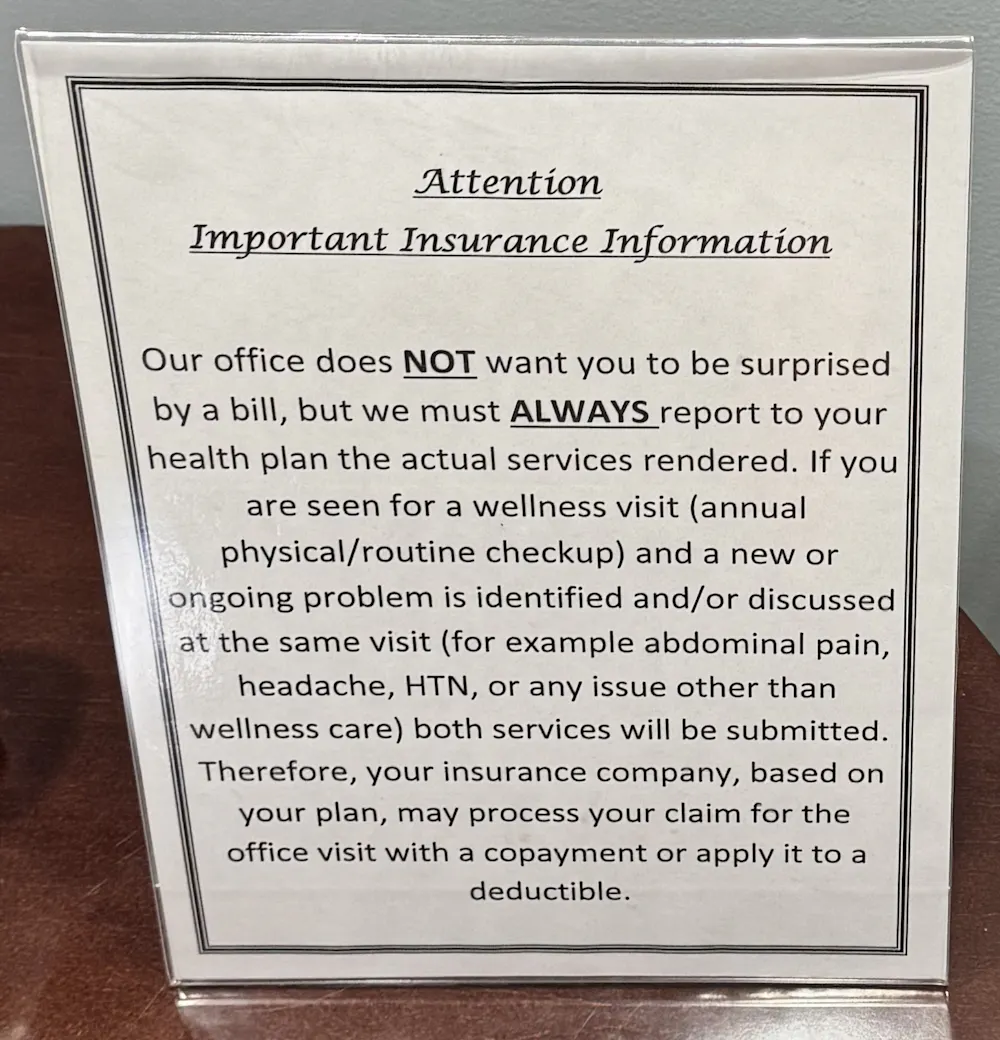
Have you ever noticed a sign in a doctor’s office saying that you may have to pay extra insurance costs if you discuss additional problems with your physician?

If so, you’re not alone. As health care spending continues to rise, providers are being asked to warn patients about any potential unexpected costs – for example, insurance charges for additional services at an otherwise fully covered annual wellness visit.

A sign labeled 'Attention: Important insurance information' reads 'Our office does NOT want you to be surprised by a bill, but we must ALWAYS report to your health plan the actual services rendered.'
The sign that inspired it all.
Helen Colby

But our research shows these warning signs could have an unintended consequence, discouraging patients from speaking openly with their doctors.

We are professors who research how people make spending decisions and were inspired to study this issue by real signs at a university-affiliated health care office. Other researchers have found many reasons why people hesitate to speak openly with their doctors, and we wondered whether these signs might be another factor. So we conducted some experiments.

In two studies, we found that when people saw an insurance warning sign, they were less willing to raise a wide variety of issues during a physical exam. These included both short-term issues such as headaches, fatigue and arthritis pain in the finger joints, and previously diagnosed, chronic conditions including high blood pressure, Type 2 diabetes and asthma.

In a third study, we tested whether it was what the sign said – or just the mere presence of a sign mentioning costs – that made people reluctant to speak up. We showed participants either no sign, an insurance warning sign, or a sign about a prescription drug discount program, which was also modeled after a real sign in the same doctor’s office. Only people who saw the insurance sign were less likely to speak up.

Why it matters

Frank conversations between patients and providers are essential for good health care. They allow providers to tailor medications, reduce side effects and find treatments that are right for each patient. What’s more, treating issues earlier rather than later generally leads to better outcomes and costs less in the long run.

We found that insurance warning signage, no matter how necessary or well intended, can discourage patients from sharing important health information. This could cause delays in important care, leading to unnecessary discomfort and stress as patients suffer with untreated issues.

Health care offices need to include certain insurance disclosures to inform patients of their rights under the No Surprises Act, which took effect in 2022. However, providers and administrators should be aware that their patients may often have cost concerns.

Doctors’ offices can try to find ways to communicate potential insurance costs while also encouraging patients to have open and honest discussions with their providers. The signage at the office that inspired this work had many words bolded and underlined, which may have made it feel especially aggressive to some patients.

It’s important for patients to know that they should never ignore symptoms. In fact, raising a concern as early as possible with a doctor or another health care provider can save more money down the road.

What still isn’t known

We weren’t able to study the long-term impacts of such signs, and it’s possible they have even more negative effects than we uncovered – for example, by making patients reluctant to have annual wellness visits.

It’s also unclear how often health care professionals actually report such conversations to insurers, especially when the issues are brought up briefly during a checkup and don’t require additional testing or treatment at that time.

But the research is clear on one point: When patients feel they can speak freely to their doctors, they get better care. That’s why doctors and other health care professionals should be aware that even well-intended warning signs may encourage patients to keep silent.

The Research Brief is a short take on interesting academic work.

The Conversation

Deidre Popovich has received grant funding from BlueCross BlueShield of Texas and Providence Health.

Helen Colby and Tony Stovall do not work for, consult, own shares in or receive funding from any company or organization that would benefit from this article, and have disclosed no relevant affiliations beyond their academic appointment.

ref. Insurance warning signs in doctors’ offices might discourage patients from speaking openly about their health – https://theconversation.com/insurance-warning-signs-in-doctors-offices-might-discourage-patients-from-speaking-openly-about-their-health-262303