How medieval monks tried to stay warm in the winter

Source: The Conversation – UK – By Giles Gasper, Professor in High Medieval History, Durham University
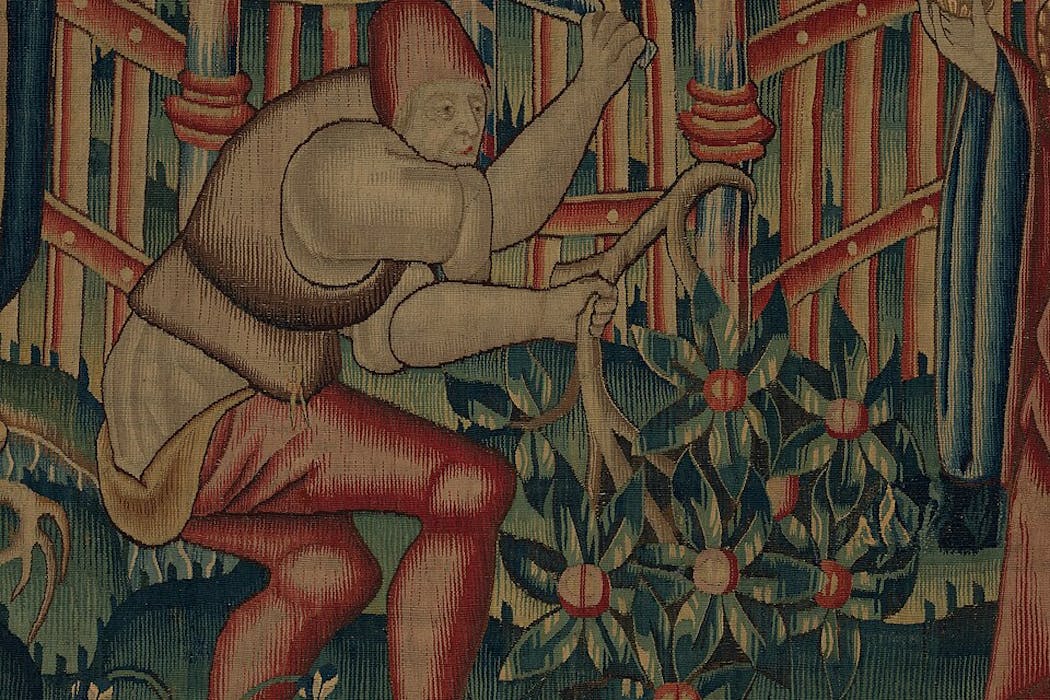
A medieval woodcutter chops down branches for firewood. Bequest of George Blumenthal, 1941

The best location for a monastery was one that was close to water and wood. Many monastic chroniclers mention this.

Orderic Vitalis, born in England near Shrewsbury in 1075 and sent to the Norman monastery of St Évroult at the age of five, was explicit about this twin need. Water for washing, sanitation, drinking, for making ink, for making lime mortar, and wood for building, and perhaps for keeping warm.

The Benedictine version of monastic life was the most popular across the medieval period, although many others existed. The rule attributed to St Benedict was set down, in 73 chapters, to provide guidance for how monks should live their lives. They should be focused on the world that is to come, on life after death, as well as on obedience and humility.

Monks could not own anything or have personal wealth, even though monasteries as institutions could be very rich indeed. Material comfort was not high on the agenda, at least in theory. Indeed, a contrasting relationship between material discomfort and spiritual worth is often identifiable in the religious expression of the period. In many ways it was seen as the greater the physical discomfort, the greater the spiritual value. The Cistercians, who emerged as a distinctive monastic grouping at the very end of the 11th century, and who followed the Rule of St Benedict too, laid great emphasis on austerity in all areas of their lives.

The regulation of monastic communities provides the context for their attitudes towards being cold. Concession to cold in the Rule of Benedict was limited – that monks in colder regions would need more clothes is recognised. In general the only difference between winter and summer wear was a thick and woolly cowl (a hood which extended across the shoulders) for the colder months and otherwise a thinner one.

Benedict was writing in 6th-century Italy. Conditions in northern regions in later medieval centuries were quite different, in many respects, to the early medieval Mediterranean. Not least in how cold monasteries could get. Orderic had a description of the effects of the winter at the end of his fourth book (of 13) of his Historia ecclesiastica. After writing a little about disputes and clashes on the frontier between Normandy and Maine, in what is now France, he notes that:

Mortal men are oppressed by many misfortunes, which would fill great volumes if the whole take of them were written down. But now, numbed by the winter cold, I turn to other pursuits; and weary with toil, resolve to end my present book here. When the warmth of spring returns I will relate in the following books everything that I have only briefly touched upon or omitted altogether.

But one room in a monastery was kept warm in cold weather. The calefactorium, or calefactory, that is to say, the warming room, was equipped with a fire, and in some cases other treats.

Very few buildings within monastic compounds had fireplaces. The church buildings would have been unheated, and so would the dormitories. The warming house was an unusual and important location in this respect. While some warming rooms were larger they would still not have been able to fit all that many people in at a time. It is easy to imagine a group of ten or so monks huddled round the fireplace, with wood crackling, talking quietly (talking was also discouraged in monastic houses), and seeking some measure of warmth in a cold environment. And that image is probably not far from the truth.

Despite their evident value to the community warming houses do not feature prominently in written records. Nevertheless, surviving examples of buildings and textual references do allow insights into monastic lives, and the difference that the calefactory must have made. Examples from medieval England included the Cistercian house of Meaux in Yorkshire. Founded in 1141 nothing survives of the building but an extensive chronicle does.

The record of new buildings made under Abbot Thomas from 1182 onwards includes mention not only of a fine refectory (dining room) for the monks, built in stone, but also the warming house and a small kitchen. That these should be be entered into the chronicle amongst the achievements of the abbot, as a record to future generations of the community, says a lot about the value placed upon it. It is of interest too that while the refectory went up quickly, paid for by a donor to the monastery, the kitchen and warming room were put together gradually and as resource allowed.

The value of fire

While the warming house of Meaux exists only in its historical record, good surviving examples of other warming houses are common enough. Rievaulx Abbey in north Yorkshire is a good example.

The warming house at Rievaulx is next to the refectory, and was altered quite substantially over the period from the 12th to the 16th century. Eventually two storeys, the warming complex also included clothes-washing facilities for the monks in winter.

And then to Durham. Here we turn to The Rites of Durham, a wonderful treatise from the 16th century (and later), the last memory of the practices of the pre-Reformation monastic house.

It reveals that the warming room, here referred to as a common house, was on the right-hand side as you exited the cloister. And inside there was:

a fyer keept all winter for the mouncks to come and warme at, being allowed no fire but that onely; except the masters and officers which had their seuerall fires.

While medieval buildings were difficult to heat, the presence of warm rooms was an indication of the value put on warmth. And in the case of the Durham Cathedral priory’s common house the monks were provided with additional treats around Christmas time, if the account is to be believed. Figs, raisins, cakes and ale were offered and taken in moderation.

Don’t have time to read about climate change as much as you’d like?

Get a weekly roundup in your inbox instead. Every Wednesday, The Conversation’s environment editor writes Imagine, a short email that goes a little deeper into just one climate issue. Join the 47,000+ readers who’ve subscribed so far.


The Conversation

Giles Gasper receives funding from Arts and Humanities Research Council, Research England, the John Templeton Foundation and the Leverhulme Trust

ref. How medieval monks tried to stay warm in the winter – https://theconversation.com/how-medieval-monks-tried-to-stay-warm-in-the-winter-270829

Hamnet: by centring Anne Hathaway, this sensuous film gives Shakespeare’s world new life

Source: The Conversation – UK – By Roberta Garrett, Senior Lecturer in Literature and Cultural Studies, University of East London

For films and books about Shakespeare’s life, there is little source material to draw on beyond the few known facts of the great writer’s parentage, hometown, marriage, children, property and death. Shakespeare biopics therefore require considerable speculation and invention on the part of writers and directors.

Director Chloe Zhao’s earthy and sensuous film Hamnet is based on the book by Maggie O’ Farrell, who also co-wrote the screenplay. It not only foregrounds Shakespeare’s personal rather than professional life but does this by focusing chiefly on the experience of his previously maligned wife, Anne Hathaway (referred to as Agnes in the film).

From the 18th century to well into the 20th, Shakespeare biographers and researchers tended to represent Hathaway in highly negative terms. She was viewed as the “shrewish” wife that Shakespeare impregnated, was forced to marry and later escaped by fleeing Stratford for the exciting world of the London theatre.

This perception of Hathaway is grounded in sexist assumptions drawn from the few known facts of their marriage. Namely, that she was eight years his senior, he was only 18 when they wed, she was already pregnant and he spent many years of their marriage working in London.

The trailer for Hamnet.

The popular 1998 romantic comedy, Shakespeare in Love, reproduced the “shrewish” Hathaway narrative. She is absent from the film, but Shakespeare (Joseph Fiennes) dolefully comments on his sexless, loveless marriage and finds genuine passion instead with London-based heroine, Viola (Gwyneth Paltrow).

The more recent film, All Is True (2018) offers a different view. It depicts Hathaway and Shakespeare’s marriage in their twilight years, when the playwright has resettled in Stratford and is finally mourning the death of his son, Hamnet. Although Hathaway is central to the drama, she is depicted as an ageing and conformist provincial wife. Casting Judy Dench in the role alongside the much younger Kenneth Branagh as Shakespeare, also accentuated their age difference.

Hamnet’s Agnes

In sharp contrast, Hamnet’s Agnes (Jessie Buckley) is a young, robust and free-spirited woman who is associated with nature rather than dull domesticity.

Zhao and O’Farrell establish the themes of the film early on by opening with a scene of Agnes wandering in the richly toned mossy forest with her hawk. This view of Agnes draws on Shakespeare’s vision of the magical “green world”. But it also captures the atmosphere and skilled world-building of O’Farrell’s novel in which Agnes, like her long dead mother, is skilled and knowledgeable in turning herbs and flowers into remedies that are valued by the local community.

While many representations of Elizabethan life are centred on the largely male-dominated culture of politics and courtly life, Hamnet offers an account of the busy and productive life of an ordinary (if eccentric) Elizabethan wife and mother. Agnes is in charge of the labour-intensive life of the household. Her family home is situated in the centre of Stratford, boarded by a muddy, dirty, bustling thoroughfare. Women are shown as managing the core human processes of birth and death, birthing in an all-female environment and desperately struggling to keep their children alive in an age of precarious health and mortality.

As other critics have argued, the film’s climax – in which Hamlet is interpreted as the artistic expression of Shakespeare’s personal grief over the loss of his son – is one of the less convincing aspects of the film. Hamlet is essentially a revenge tragedy and Shakespeare’s plots were largely derived from classical and historical sources rather than personal experience.

Yet its heart-wrenching portrayal of Agnes’ anguish over her child’s untimely death is moving and persuasive, offsetting the modern misconception that as child mortality was higher, these experiences were less painful. The death of Hamnet is therefore recast as a tragedy for his mother, who birthed and raised him, rather than just the writer-genius, Shakespeare.

Hamnet’s representation of Agnes/Anne is, of course, almost entirely speculative. Only the wealthiest of women were literate at this time, so unlike her husband, Hathaway left no written traces. However, as Zhao and O’Farrell’s feminist film clearly illustrates, women’s lack of formal education and career opportunities did not mean that they contributed less to their communities – or that we should regard their lives as less meaningful.


Looking for something good? Cut through the noise with a carefully curated selection of the latest releases, live events and exhibitions, straight to your inbox every fortnight, on Fridays. Sign up here.


The Conversation

Roberta Garrett does not work for, consult, own shares in or receive funding from any company or organisation that would benefit from this article, and has disclosed no relevant affiliations beyond their academic appointment.

ref. Hamnet: by centring Anne Hathaway, this sensuous film gives Shakespeare’s world new life – https://theconversation.com/hamnet-by-centring-anne-hathaway-this-sensuous-film-gives-shakespeares-world-new-life-272969

Chemistry is stuck in the dark ages – ‘chemputation’ can bring it into the digital world

Source: The Conversation – UK – By Lee Cronin, Regius Chair of Chemistry, University of Glasgow

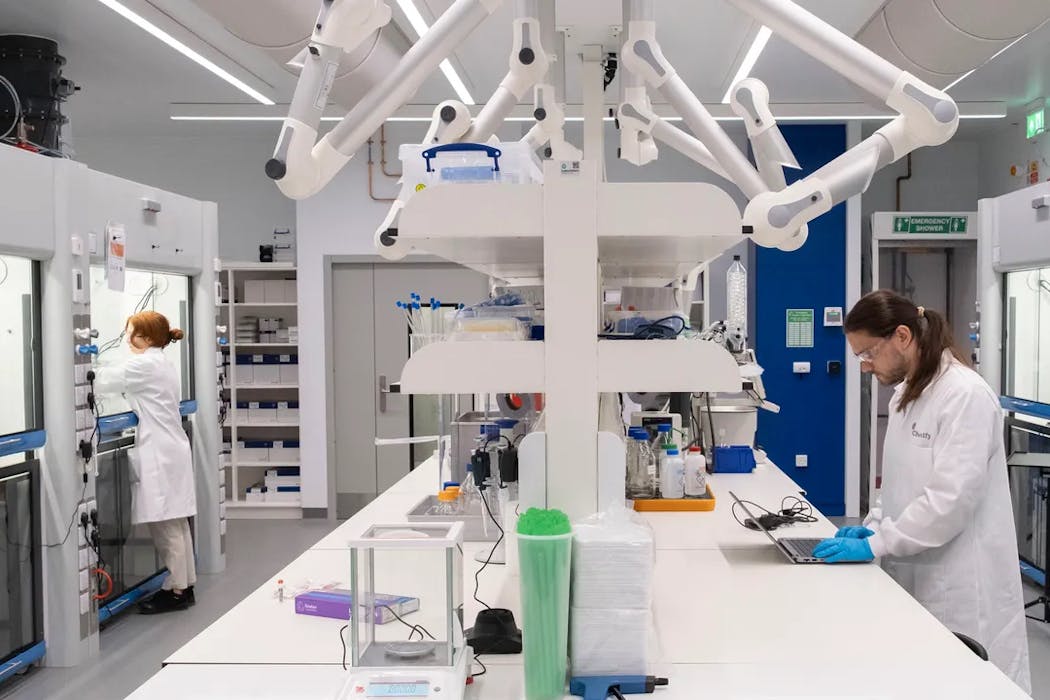
In Chemify’s laboratories, AI-proposed molecules are compiled into chemical code which robots execute and test in real time. Chris James/Chemify, CC BY-NC-SA

Chemistry deals with that most fundamental subject: matter. New drugs, materials and batteries all depend on our ability to make new molecules. But discovery of new substances is slow, expensive and fragile. Each molecule is treated as a bespoke craft project. If a synthesis works in one lab, it often fails in another.

The problem is that any single molecule could have an almost infinite number of routes to creation. These routes are published as static text, stripped of the context, timing and error correction that made them work in the first place. So while chemistry is often presented as one of the most advanced sciences, its day-to-day practice remains surprisingly manual.

For centuries prior to the emergence of modern chemistry, alchemists worked by hand, mixing substances, adjusting conditions by feel, passing knowledge from teacher to student while keeping many secrets. Today’s chemists use far more analytical tools, yet the core workflow has barely changed.

We still design molecules manually using the rules of chemistry, then ask highly trained humans to translate these ideas into reality in the laboratory, step by step, reaction by reaction.

At the same time, we are living through an explosion in artificial intelligence and robotics – and chemists have rushed to apply these tools to molecular discovery. AI systems can propose millions of candidate molecules, rate and optimise them, and even suggest reaction pathways.

But frustratingly, these tools frequently hallucinate chemicals that cannot be made, because (unlike in the case of proteins) no one has yet captured all the practical rules for making molecules digitally.

Chemistry cannot become truly digital unless it is programmable. In other words, we need to be able to write down, in a machine-readable way, how to assemble molecules – including instructions, conditionals, loops and error handling – and then execute these instructions on different hardware in different places with the same outcome.

Without a language that allows chemistry to be executed, not just described, today’s cutting-edge AI tools risk generating little more than plausible-looking illusions of new chemical substances. This is where using the computer as an architecture to build a digital chemistry system, or “chemputer”, becomes imperative in my view.

Digital chemistry at the University of Glasgow.

Before computers, calculation was manual and mechanical. People used slide rules, tables and specialist devices built for specific tasks. But when Alan Turing showed that any computable problem could be expressed as instructions for a simple abstract machine, computation was liberated from having to be done on specific hardware – and progress became exponential.

Chemistry has never made that jump. Akin to chefs using individual methods to achieve the perfect souffle, researchers around the world have different ways of preparing chemicals. So while automation in chemistry exists, research remains largely artisanal in nature.

An AI can design a thousand hypothetical drugs overnight. But if each one requires a human chemist to manually work out how to make it because the molecules generated are not constrained by the real-world rules of chemistry, we have simply moved the bottleneck. Design has gone digital, making has not.

Chemistry by computers

To properly digitise chemistry, we need a programmable language for matter to encode these real-world rules. This idea led me, with colleagues in my research laboratory at the University of Glasgow, to develop the process of chemputation back in 2012.

We built a concrete abstraction of what a chemical code would look like – with steps such as “add/subtract matter then add/subtract energy”. By translating these steps into binary code, it was possible to build the components of a chemputer.

The premise is simple. Chemistry can be treated as a form of computation carried out in the physical world. Instead of publishing chemistry as prose, it is published in executable code, as described in our new preprinted article. Reagents are data. Operations like mixing, heating, separating and purifying are instructions. A range of machines, such as those shown in the image below, play the role of processors.

Elements of the chemputation process.
Lee Cronin, CC BY-NC-SA

Once chemistry becomes programmable, we expect many things to change. Reproducibility improves because processes are no longer interpreted by humans. Sharing becomes meaningful because a synthesis can be run, not re-imagined. Importantly, programmable chemistry allows feedback loops for error correction, with sensors monitoring reactions in real time.

Self-driving laboratories

Our ambitions for chemputation took a major step forward in June 2025 when Chemify, our University of Glasgow corporate spin-out, launched the world’s first chemifarm. At this facility in Glasgow’s Maryhill district, the process of chemputation is applied to making new molecules for drug and materials discovery.

It uses AI and robotics to enable the entire system to “self-learn”, and thus get better at making more advanced molecules over time. Discovery becomes an iterative, programmable process rather than a linear gamble.

This fits with the wider emergence of “self-driving” laboratories – robotic labs we pioneered that use AI and automation to enhance the speed and breadth of research.

Chemistry began as alchemy – a human art shaped by intuition and mystery, making potions, manipulating precious metals and building the first laboratory equipment. It has since grown into a rigorous science, yet never fully escaped its manual roots. If we want chemistry to keep pace with the digital age, especially in an era dominated by AI, we must now finish that transition.

The Conversation

Lee Cronin is the CEO and shareholder in Chemify and is the regius Professor at the University of Glasgow and recieves funding from many organisations including the UKRI Engineering and Physical Sciences Research Council.

ref. Chemistry is stuck in the dark ages – ‘chemputation’ can bring it into the digital world – https://theconversation.com/chemistry-is-stuck-in-the-dark-ages-chemputation-can-bring-it-into-the-digital-world-272610

Greenland is rich in natural resources – a geologist explains why

Source: The Conversation – UK – By Jonathan Paul, Associate Professor in Earth Science, Royal Holloway, University of London

Greenland’s concentration of natural resource wealth is tied to its hugely varied geological history over the past 4 billion years. Jane Rix/Shutterstock

Greenland, the largest island on Earth, possesses some of the richest stores of natural resources anywhere in the world.

These include critical raw materials – resources such as lithium and rare earth elements (REEs) that are essential for green technologies, but whose production and sustainability are highly sensitive – plus other valuable minerals and metals, and a huge volume of hydrocarbons including oil and gas.

Three of Greenland’s REE-bearing deposits, deep under the ice, may be among the world’s largest by volume, holding great potential for the manufacture of batteries and electrical components essential to the global energy transition.

The scale of Greenland’s hydrocarbon potential and mineral wealth has stimulated extensive research by Denmark and the US into the commercial and environmental viability of new activities like mining. The US Geological Survey estimates that onshore northeast Greenland (including ice-covered areas) contains around 31 billion barrels of oil-equivalent in hydrocarbons – similar to the US’s entire volume of proven crude oil reserves.

But Greenland’s ice-free area, which is nearly double the size of the UK, forms less than a fifth of the island’s total surface area – raising the possibility that huge stores of unexplored natural resources are present beneath the ice.

Greenland’s concentration of natural resource wealth is tied to its hugely varied geological history over the past 4 billion years. Some of the oldest rocks on Earth can be found here, as well as truck-sized lumps of native (not meteorite-derived) iron. Diamond-bearing kimberlite “pipes” were discovered in the 1970s but have yet to be exploited, largely due to the logistical challenges of mining them.

Geologically speaking, it is highly unusual (and exciting for geologists like me) for one area to have experienced all three key ways that natural resources – from oil and gas to REEs and gems – are generated. These processes relate to episodes of mountain building, rifting (crustal relaxation and extension), and volcanic activity.

Greenland was shaped by many prolonged periods of mountain building. These compressive forces broke up its crust, allowing gold, gems such as rubies, and graphite to be deposited in the faults and fractures. Graphite is crucial for the production of lithium batteries but remains “underexplored”, according to the Geological Survey of Denmark and Greenland, relative to major producers such as China and South Korea.

But the greatest proportion of Greenland’s natural resources originates from its periods of rifting – including, most recently, the formation of the Atlantic Ocean from the beginning of the Jurassic Period just over 200 million years ago.

Map of Greenland's major geologic provinces with their rock types.
Greenland’s major geologic provinces with rock types and ages.
Geophysical Research Letters, CC BY-NC-SA

Greenland’s onshore sedimentary basins such as the Jameson Land Basin appear to hold the greatest potential of oil and gas reserves, analogous to Norway’s hydrocarbon-rich continental shelf. However, prohibitively high costs have limited commercial exploration. There is also a growing body of research suggesting potentially extensive petroleum systems ringing the entirety of offshore Greenland.

Metals such as lead, copper, iron and zinc are also present in the onshore (mostly ice-free) sedimentary basins, and have been worked locally, on a small scale, since 1780.

Difficult-to-source rare earth elements

While not as intimately related to volcanic activity as nearby Iceland – which, uniquely, sits at the intersection of a mid-ocean ridge and a mantle plume – many of Greenland’s critical raw materials owe their existence to its volcanic history.

REEs such as niobium, tantalum and ytterbium have been discovered in igneous rock layers – similar to the discovery (and subsequent mining) of silver and zinc reserves in south-west England, which were deposited by warm hydrothermal waters circulating at the tip of large volcanic intrusions.

Critically among REEs, Greenland is also predicted to hold sufficient sub-ice reserves of dysprosium and neodymium to satisfy more than a quarter of predicted future global demand – a combined total of nearly 40 million tonnes.

These elements are increasingly seen as the most economically important yet difficult to source REEs because of their indispensable role in wind power, electric motors for clean road transport, and magnets in high-temperature settings like nuclear reactors.

The development of known deposits such as Kvanefield in southern Greenland – not to mention those not yet discovered in the island’s central rocky core – could easily affect the global REE market, owing to their relative global scarcity.

An unfortunate dilemma

The global energy transition came about due to increasing public recognition of the manifold threats of burning fossil fuels. But climate change has major implications for the availability of many of Greenland’s natural resources that are currently blanketed by kilometres of ice – and which are a key part of that energy transition.

An area the size of Albania has melted since 1995, and this trend is likely to accelerate unless global carbon emissions fall sharply in the near future.

Recent advances in survey techniques, such as the use of ground-penetrating radar, allow us to peer with increasing certainty beneath the ice. We are now able to obtain an accurate picture of bedrock topography below up to 2 km of ice cover, providing clues as to the potential mineral resources in Greenland’s subsurface.

However, progress is slow in prospecting under the ice – and sustainable extraction is likely to prove even harder.

Soon, an unfortunate dilemma may need to be addressed. Should Greenland’s increasingly available resource wealth be extracted with gusto, in order to sustain and enhance the energy transition? But doing so will add to the effects of climate change on Greenland and beyond, including despoiling much of its pristine landscape and contributing to rising sea levels that could swamp its coastal settlements.

Currently, all mining and resource extraction activities are heavily regulated by the government of Greenland through comprehensive legal frameworks dating from the 1970s. However, pressures to loosen these controls, and to grant new licences for exploration and exploitation, may increase amid the US’s strong interest in Greenland’s future.

The Conversation

Jonathan Paul does not work for, consult, own shares in or receive funding from any company or organisation that would benefit from this article, and has disclosed no relevant affiliations beyond their academic appointment.

ref. Greenland is rich in natural resources – a geologist explains why – https://theconversation.com/greenland-is-rich-in-natural-resources-a-geologist-explains-why-273022

Arrow tips found in South Africa are the oldest evidence of poison use in hunting

Source: The Conversation – Africa (2) – By Marlize Lombard, Professor with Research Focus in Stone Age Archaeology, Palaeo-Research Institute, University of Johannesburg

Boophone disticha. Ton Rulkens from Mozambique, CC BY-SA 2.0, via Wikimedia Commons, CC BY

The oldest evidence for the use of arrow poison globally was long thought to come from Egypt, dating to 4,000 years ago. It was a black, toxic residue on bone arrowheads from a tomb at the Naga ed Der archaeological site.

New evidence from southern Africa is challenging this.

New research has found poison on stone arrow tips from South Africa dating to 60,000 years ago. It is the oldest direct evidence for hunting with poisoned arrows.

This adds to what is already known about the know-how of ancient African bowhunters. These abilities may have contributed to our species’ long and flourishing evolution in the region, and ultimately the successful spread of Homo sapiens out of Africa.

Hunter-gatherers in southern Africa

The evidence comes from Umhlatuzana Rock Shelter, in South Africa’s KwaZulu-Natal province. The site was partly excavated in the 1980s to preserve archaeological material that could be damaged during the construction of the N3 highway between the cities of Durban and Pietermaritzburg.

Umhlatuzana is recognised as an important Stone Age site where hunter-gatherers lived at least 70,000 years ago. It is one of only a few sites in southern Africa where people continued to live until just a few thousand years ago.

In southern Africa, people have a long history of hunting with poisoned arrows. For example, a team of South African and Swedish archaeologists found residues on arrow tips dating to between a few centuries and 1,000 years ago, that revealed how different arrow poison recipes were used.

Recently, three bone arrowheads stored in a poison-filled bone container were reported from Kruger Cave in South Africa dating to almost 7,000 years ago. This pushed back direct molecular evidence of arrow poison use to about 3,000 years before the Egyptian poisoned arrows.

Traces of poison have previously been found on a stick and in a lump of beeswax dating to between 35,000 and 25,000 years ago at Border Cave in KwaZulu-Natal. These were seen as indirect suggestions of early hunting poisons.

As a researcher in cognitive and Stone Age archaeology, I studied some of the artefacts from Umhlatuzana almost 20 years ago, finding use traces and adhesive residues on some of the quartz backed microliths (small, shaped stone tools) from 60,000 years ago. This showed that they were probably used as arrow tips.

Now, Sven Isaksson in the archaeology laboratory at Stockholm University has been able to identify molecular traces of toxic plant alkaloids (chemical substances), known to be an arrow poison, on a handful of these artefacts.

Poison from indigenous plants

This latest research revealed the presence of buphandrine and epibuphanisine toxic alkaloids on five out of ten analysed arrow tips from Umhlatuzana. The same alkaloids were also found on bone arrowheads collected by Swedish travellers in the region 250 years ago. This tells us that the same arrow poison was used for many millennia in southern Africa.

Both alkaloids can be found in several southern African species of Amaryllidaceae, a family of flowering plants growing from bulbs. But only what is colloquially known as gifbol (poison bulb, Boophone disticha) is well-recorded as the source of an arrow poison. The plant’s bulb contains a toxic juice (exudate).

Finding these specific alkaloids on five out of the ten quartz arrow tips studied cannot be coincidental. Ancient hunter-gatherers would have been familiar with the toxic properties of the gifbol exudates. For example, by about 77,000 years ago, people of the same region also understood the insecticidal and larvicidal properties of some aromatic leaves that were used for bedding. So they probably would not have kept the gifbol substance in their living space.

Substances with buphandrine and epibuphanisine molecules are not used commercially or in archaeological conservation, ruling out accidental modern contamination of the arrow tips.

Gifbol bulbs can survive for a century or more, despite drought cycles and fire regimes. The plant is indigenous to South Africa, thriving in grassland, savanna and Karoo vegetation. It is widespread throughout the southern, eastern and northern regions of South Africa, growing within a day’s walk from Umhlatuzana Rock Shelter today. For various reasons, it’s likely that it was also available to the inhabitants of the site thousands of years ago.

The toxic chemicals in the bulb last a long time. They don’t decompose easily, even in wet environments, and they interact well with mineral surfaces like stone arrow tips. That’s probably why they survived for 60,000 years at Umhlatuzana.

Implications of the world’s oldest known poisoned arrow tips

The quartz arrow tips with gifbol poison now represent the first direct evidence for hunting with poisoned arrows in southern Africa, and globally – at 60,000 years ago.

It demonstrates that these ancient bowhunters possessed a knowledge system enabling them to identify, extract and apply toxic plant exudates effectively. They must have also understood prey ecology and behaviour to know that the delayed effect of poison shot into an animal would weaken it after some time. That would make it easier to run down, a technique known as persistence hunting.

Such out-of-sight, long-distance action is a convincing indicator of complex cognition that requires response inhibition (being able to delay an action for a reason). Because poison is not a physical force, but functions chemically, the hunters must also have relied on advanced planning, abstraction and causal reasoning.

Thus, apart from providing the first direct evidence of hunting with poisoned arrows, the findings contribute to the understanding of human adaptation, techno-behavioural complexity and modern human behaviour in southern Africa.

The Conversation

Marlize Lombard works for the University of Johannesburg

ref. Arrow tips found in South Africa are the oldest evidence of poison use in hunting – https://theconversation.com/arrow-tips-found-in-south-africa-are-the-oldest-evidence-of-poison-use-in-hunting-271444

Les coupures d’Internet se multiplient de façon spectaculaire en Afrique : un nouveau livre explique pourquoi

Source: The Conversation – in French – By Tony Roberts, Digital Research Fellow, Institute of Development Studies

Entre 2016 et 2024, 193 coupures d’Internet ont été imposées dans 41 pays africains. Cette forme de contrôle social est une tendance croissante sur le continent, selon un nouvel ouvrage en libre accès. Il s’agit de la toute première analyse comparative rédigée par des chercheurs africains sur la manière dont les États africains recourent aux coupures d’Internet et les raisons qui les poussent à le faire.

Le livre, coédité par Felicia Anthonio, militante des droits numériques et spécialiste des coupures d’Internet, et Tony Roberts, chercheur sur le numérique, propose 11 études de cas approfondies sur les coupures d’Internet imposées par les États. Nous leur avons posé cinq questions à ce sujet.


Qu’est-ce qu’une coupure d’Internet et pourquoi se produit-elle ?

En termes simples, une coupure d’Internet est une interruption intentionnelle des communications en ligne ou mobiles. Elle est généralement ordonnée par l’État et mise en œuvre par des entreprises privées, des fournisseurs d’accès à Internet ou des opérateurs de téléphonie mobile, ou parfois les deux.

Le livre soutient que les coupures d’Internet ne sont ni légales, ni nécessaires, ni proportionnées au regard du cadre juridique international des droits humains. Les coupures empêchent délibérément la libre circulation de l’information et de la communication. Elles perturbent la vie sociale, économique et politique en ligne. Ainsi, chaque coupure d’Internet viole généralement les droits fondamentaux de millions de citoyens. Cela inclut leurs droits à la liberté d’expression, au commerce, au débat démocratique et à la participation civique en ligne.

Notre recherche a examiné des études de cas provenant de 11 pays entre 2016 et 2024. Elle révèle que ces coupures sont programmées au moment d’élections ou de manifestations pacifiques afin de réprimer l’opposition politique et d’empêcher la diffusion d’informations en ligne.

Au Sénégal, cinq coupures motivées par des raisons politiques en seulement trois ans ont transformé le paysage numérique du pays. Elles ont privé les citoyens de l’accès au travail en ligne à l’éducation et aux informations liées à la santé.

Le chapitre consacré à l’Ouganda montre comment le gouvernement a imposé des coupures des réseaux sociaux pendant les élections. Il craignait les voix dissidentes en ligne, notamment celle du musicien et homme politique Bobi Wine.

En Éthiopie, les coupures d’Internet sont calées sur les manifestations de l’opposition pour empêcher la couverture en direct de la répression violente de l’État.

Au Zimbabwe, le gouvernement a coupé l’Internet en 2019 pour réprimer les manifestations antigouvernementales.

Il est préoccupant que les régimes imposent ces pratiques autoritaires numériques avec une fréquence croissante et en toute impunité.

Quelles sont les grandes tendances ?

Le rapport alerte sur l’utilisation des coupures d’Internet pour conserver le pouvoir grâce à des contrôles autoritaires. Dans toute l’Afrique, les gouvernements normalisent leur utilisation pour réprimer la dissidence, étouffer les manifestations et manipuler les résultats électoraux.

Ces coupures sont de plus en plus fréquentes et de plus en plus importantes, passant de 14 coupures en 2016 à 28 en 2024. Les conséquences sont dévastatrices dans un monde de plus en plus connecté numériquement.

Les coupures d’Internet sont également de plus en plus sophistiquées. Les coupures partielles peuvent cibler des provinces ou des sites web spécifiques, afin de couper l’accès aux zones d’opposition. Ces dernières années, des États étrangers, des régimes militaires et des parties belligérantes ont également recouru à la coupure d’Internet comme arme de guerre. Cela a été fait en ciblant et en détruisant les infrastructures de télécommunications.

L’Éthiopie a connu le plus grand nombre de coupures d’Internet en Afrique, avec 30 coupures au cours des 10 dernières années. Ces coupures sont devenues une tactique courante de l’État pour tenter de faire taire la dissidence dans les régions Oromo et Amhara.

Les coupures sont synchronisées avec les répressions des manifestations ou les opérations militaires pour empêcher toute couverture en direct des violations des droits humains. L’Éthiopie est un exemple clair de la manière dont les coupures d’Internet reflètent et amplifient les intérêts politiques et ethniques existants.

Le Zimbabwe est l’un des nombreux exemples cités dans le livre pour illustrer les racines coloniales des coupures. Les premières coupures des médias au Zimbabwe ont été imposées par les Britanniques, qui ont fermé les journaux pour faire taire les appels à l’indépendance politique. Après la libération, le nouveau gouvernement a utilisé son propre contrôle autoritaire sur les médias pour diffuser de la désinformation et restreindre les appels de l’opposition en faveur de la justice et d’une démocratie pleine et entière.

Vers la fin du règne de l’ancien président Robert Mugabe, le gouvernement a imposé plusieurs coupures d’Internet à l’échelle nationale. Il a également réduit la vitesse de l’Internet mobile, dégradant suffisamment le service pour perturber considérablement l’expression et l’organisation de l’opposition.

Le Soudan a connu 21 coupures d’Internet au cours de la dernière décennie. Celles-ci se sont multipliées ces dernières années à mesure que les actions politiques et militaires s’intensifiaient. L’État a systématiquement recouru à des perturbations intentionnelles de l’accès à Internet lors de manifestations et de périodes de troubles politiques, en particulier en réponse aux mouvements de résistance et aux soulèvements civils pendant le conflit en cours.

Y a-t-il eu une résistance efficace aux coupures ?

Les militants résistent en utilisant des logiciels de réseau privé virtuel (VPN) pour dissimuler leur emplacement. Ou en utilisant des connexions satellites non contrôlées par le gouvernement et des cartes SIM étrangères. Ils mobilisent également des manifestations hors ligne malgré une répression violente.

Le Nigeria n’a pas subi le même nombre de coupures d’Internet que le Soudan ou l’Éthiopie. Cela s’explique en partie par le fait que la société civile est plus forte et capable d’opposer une résistance plus vigoureuse face à la violation par l’État du droit à la liberté d’expression. Lorsque des coupures d’Internet ont été imposées au Nigeria, l’État n’a pas bénéficié de la même impunité que le gouvernement du Zimbabwe ou d’autres pays.

Lorsque les Nigérians se sont trouvés dans l’impossibilité de travailler en ligne ou de participer à la vie sociale et politique en ligne de la communauté, ils ont pris des mesures décisives en agissant collectivement. Ils ont intenté des poursuites judiciaires ciblées contre le gouvernement. Cela a conduit les tribunaux à statuer que la coupure d’Internet n’était ni légale, ni nécessaire, ni proportionnée. Le gouvernement a été contraint de lever l’interdiction.

Comment s’est déroulée l’année 2025 en matière de coupures d’Internet ?

Nous avons observé des tendances à la fois positives et négatives en 2025. Le nombre total de coupures d’Internet sur le continent continue d’augmenter. La capacité croissante des régimes à cibler de manière précise des zones spécifiques est très préoccupante, car elle permet à l’État de punir les bastions de l’opposition tout en privilégiant les autres.

Du côté positif, nous avons constaté une montée de la résistance, tant en termes d’utilisation de technologies de contournement que de capacité émergente des organisations de la société civile à tenir tête aux gouvernements répressifs.

Que faut-il faire pour empêcher les coupures ?

Le droit au travail, la liberté d’expression et d’association, ainsi que le droit à l’éducation sont des droits humains fondamentaux, hors ligne comme en ligne. Les gouvernements africains sont signataires de la Convention universelle des droits de l’homme et de la Charte africaine des droits de l’homme et des peuples. Pourtant, les politiciens ignorent trop souvent ces engagements afin de préserver leur emprise personnelle sur le pouvoir.

Dans certains pays africains, les citoyens exercent désormais leur propre pouvoir pour demander des comptes à leurs gouvernements, mais cela est plus facile dans les pays qui disposent d’une société civile forte, d’une justice indépendante et de médias relativement libres. Même lorsque ce n’est pas le cas, la cour constitutionnelle est une option pour soulever des objections lorsque l’État restreint les libertés fondamentales.

Et si ce sont les États qui ordonnent les coupures d’Internet, ce sont les entreprises privées de téléphonie mobile et d’Internet qui les mettent en œuvre. Les entreprises privées ont l’obligation de promouvoir et de protéger les droits humains. Si les entreprises s’engageaient collectivement à ne pas contribuer aux violations des droits et refusaient d’imposer des coupures d’Internet, cela constituerait un grand pas en avant pour mettre fin à cette pratique autoritaire.

The Conversation

Tony Roberts reçoit un financement de l’Open Society Fund.

ref. Les coupures d’Internet se multiplient de façon spectaculaire en Afrique : un nouveau livre explique pourquoi – https://theconversation.com/les-coupures-dinternet-se-multiplient-de-facon-spectaculaire-en-afrique-un-nouveau-livre-explique-pourquoi-272840

La marche, premier mode de déplacement en France : ce que disent vraiment les statistiques de mobilité

Source: The Conversation – France (in French) – By Frédéric Héran, Économiste des transports et urbaniste émérite, Université de Lille

Les statistiques de mobilité orientent les politiques publiques. Or en France, la manière de les présenter, héritée des années du tout automobile, minore la part de la marche, ce qui pénalise le développement des mobilités actives. Et si on s’inspirait des approches statistiques déjà déployées ailleurs, par exemple en Suisse, pour mieux comptabiliser le temps passé à marcher ?


Les statistiques ne sont jamais neutres : elles sont le reflet de choix politiques répondant à un contexte historique spécifique. La manière de présenter les résultats des enquêtes statistiques sur la mobilité des personnes en France, qui a déjà 50 ans, n’échappe pas à cette règle. Elle conduit à sous-estimer fortement les déplacements à pied, au risque de continuer à favoriser des politiques en faveur des modes de déplacement motorisés.

Il est grand temps de réformer cet usage, comme l’a fait la Suisse il y a déjà 30 ans, si l’on souhaite redonner aujourd’hui davantage de place aux mobilités actives, tant pour des raisons sociales, économiques qu’environnementales.

Pour rappel, la marche est le mode de déplacement le plus inclusif, le plus démocratique et le moins nuisible à l’environnement, et pas seulement dans le cœur des grandes villes.


À lire aussi :
Atteindre les objectifs climatiques améliorera aussi la santé publique


Ce que disent les statistiques sur la mobilité

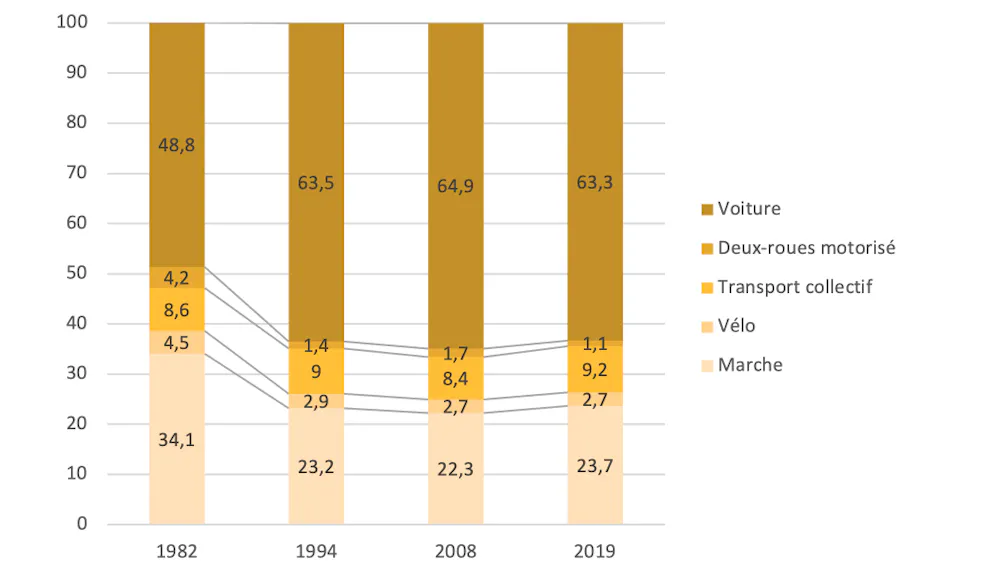
En France, depuis la standardisation des enquêtes sur la mobilité des personnes en 1976, les déplacements sont généralement présentés sous forme de « parts modales ». Il s’agit des parts, sur l’ensemble des déplacements comptabilisés, réalisées avec chaque mode de déplacement : voiture, deux-roues motorisé, transports collectifs, vélo, marche…

Évolution des parts modales en France, entre 1982 et 2019, pour les déplacements en semaine.
Dernières enquêtes nationales sur la mobilité des personnes

Dans les présentations classiques des données recueillies, la part modale de la marche apparaît très inférieure à celle de la voiture. Pourtant, quand on regarde l’autre grande source statistique que représentent les enquêtes sur la mobilité réalisées dans les grandes villes, les déplacements à pied dominent dans les centres-villes, et parfois également dans les banlieues denses de la proche périphérie. Mais partout ailleurs, c’est largement le contraire et le triomphe de la voiture apparaît ainsi incontestable.

Voitures stationnées directement sur le trottoir, ce qui empêche de l’utiliser.
Fourni par l’auteur

En conséquence, pour qui découvre ces statistiques ainsi présentées , dans la plupart des territoires, il paraît nécessaire de s’occuper en priorité des voitures, de leur accorder davantage de place pour circuler et stationner, même si cela doit se faire au détriment des espaces publics, des trottoirs, des places publiques et autres terre-pleins.

Ce qu’oublient de préciser ces représentations

Examinons ces chiffres de plus près. En réalité, ce qu’on nomme habituellement la « part modale de la marche » ne concerne que la « marche exclusive », c’est-à-dire les déplacements entièrement faits à pied, par les résidents, sur l’espace public et hors du temps de travail.

Par convention, on oublie ainsi :

  • la marche intermodale, c’est-à-dire les déplacements à pied pour rejoindre ou quitter un transport public ou une place de stationnement pour voiture, vélo ou deux-roues motorisé,

  • la marche effectuée dans des espaces privés ouverts au public, comme les centres commerciaux ou les gares,

  • la promenade ou la randonnée,

  • la marche pendant le travail, y compris quand elle est effectuée sur l’espace public, qui est pourtant très importante dans certaines professions,

  • la marche au domicile pour effectuer toutes sortes d’activités : du ménage au jardinage, en passant par le bricolage, etc.,

  • enfin, la marche réalisée par les visiteurs (touristes et autres non-résidents) du territoire.


À lire aussi :
Mobilité : et si on remettait le piéton au milieu du village ?


Comment expliquer une approche si restrictive ?

Les conventions statistiques sur la mobilité ont été élaborées dans les années 1960-1970 à l’époque du « tout automobile », puis des premiers efforts réalisés pour relancer les transports publics. Dans ce contexte, il fallait avant tout prévoir et dimensionner la voirie pour absorber un trafic motorisé fortement croissant, les piétons étant très peu considérés et les cyclistes censés disparaître.

Par convention dans les enquêtes sur la mobilité, un déplacement, c’est une personne qui va d’un lieu d’origine à un lieu de destination, avec un ou plusieurs modes et pour un motif particulier. Les modes sont hiérarchisés avec priorité aux plus lourds : d’abord les transports publics, puis la voiture, puis les deux-roues et enfin la marche.

Autrement dit, si une personne se rend à pied à un arrêt de bus, prend le bus, puis termine son trajet à pied, le déplacement est considéré comme ayant été fait en transport public et la part de marche est tout simplement ignorée. Dans cette approche, la marche devient un « résidu » statistique, c’est-à-dire ce qui reste une fois qu’on a pris en compte tous les autres modes de déplacement. Pourtant, les usagers des transports publics passent environ la moitié de leur temps à pied à marcher ou à attendre.


À lire aussi :
Réduire l’empreinte carbone des transports : Quand les progrès techniques ne suffisent pas


Ces pays qui comptabilisent les déplacements différemment

Or, cette représentation des statistiques de déplacement en France est loin d’être la seule possible.

En Suisse par exemple, depuis une réforme des statistiques de la mobilité introduite en 1994, les résultats des enquêtes de mobilité sont présentés sous trois angles différents : les distances parcourues, le temps de trajet et le nombre d’étapes.

Par étape, on entend ici les segments d’un déplacement effectués à l’aide d’un seul mode de transport. Un déplacement en transport public, par exemple, compte le plus souvent une première étape à pied, puis une deuxième en transport public et une troisième à nouveau à pied : on parle de marche intermodale.

Ainsi, en 2021, en ne tenant compte que de la marche exclusive et de la marche intermodale, les Suisses ont passé chaque jour plus de temps à pied qu’en voiture.

Parts modales des moyens de transport utilisés en Suisse en 2021.
Office fédéral de la statistique suisse

Ailleurs, on réfléchit aussi à d’autres manières de présenter les résultats des enquêtes sur la mobilité, comme en Belgique ou au Royaume-Uni.

En réalité, 100 % de nos déplacements intègrent au moins une part de marche, même minimale lorsqu’il s’agit par exemple de simplement sortir de sa voiture sur le parking de son lieu de travail. La marche est à l’origine de toutes les autres formes de mobilité et les autres modes ne sont que des « relais du piéton ». Parce que nous sommes des bipèdes, la marche est évidemment notre premier mode de déplacement.

Vers une nouvelle approche en France ?

La France peut-elle changer sa façon de présenter les statistiques de mobilité, dans le sillage de ce que propose la Suisse ?

Pour prendre conscience de l’importance journalière de la marche, il convient de l’aborder en temps de déplacement total à pied. Une récente étude de l’Ademe révèle que nous passons chaque jour une heure et douze minutes à pied, soit beaucoup plus que la durée moyenne passée en voiture chaque jour, qui est de 37 minutes.

Ces résultats montrent aussi que la prise en compte de la marche intermodale augmente de 75 % la durée de la seule marche exclusive (dite « déplacements locaux intégralement à pied » dans le graphique ci-après). En tenant compte de tous les temps consacrés à se déplacer, la marche est sans conteste le premier mode de déplacement, loin devant la voiture.

Cette étude repose sur l’utilisation de deux enquêtes existantes mais sous-exploitées (l’enquête mobilité des personnes et l’enquête emploi du temps des Français) et en adoptant plusieurs hypothèses prudentes.

En quelques centaines de milliers d’années d’évolution humaine, la bipédie s’est hautement perfectionnée. Elle a permis de libérer nos mains, nous a rendus très endurants à la course et a contribué à développer notre cerveau. Puis, en 150 ans seulement avec l’avènement du transport motorisé, la marche utilitaire quotidienne s’est effondrée.

Pourtant, de par notre constitution, marcher régulièrement est essentiel pour rester en bonne santé, pour bien grandir, vivre mieux et bien vieillir. C’est un enjeu de santé publique. C’est pourquoi, il convient de réaliser des espaces publics confortables, de libérer les trottoirs du stationnement sauvage et autres obstacles, de ménager des traversées piétonnes sécurisées et de calmer la circulation automobile, sa vitesse et son volume. Pour appuyer de telles politiques, encore faudrait-il revoir notre manière de représenter la marche dans les résultats des enquêtes de mobilité.

The Conversation

Frédéric Héran est membre du conseil d’administration de l’association et groupe de réflexion Rue de l’Avenir

ref. La marche, premier mode de déplacement en France : ce que disent vraiment les statistiques de mobilité – https://theconversation.com/la-marche-premier-mode-de-deplacement-en-france-ce-que-disent-vraiment-les-statistiques-de-mobilite-272718

Peut-on encourager le covoiturage avec des subventions locales ?

Source: The Conversation – France (in French) – By Guillaume Monchambert, Maître de conférences en économie, Université Lumière Lyon 2

Les personnes qui bénéficient des subventions locales pour le covoiturage ne sont pas toujours d’anciens automobilistes solos. Cette réalité limite donc les bénéfices de ces aides. Rawpixel.com/Freepik, CC BY

Le covoiturage est souvent perçu comme une des façons les plus simples de baisser les émissions de gaz à effet de serre des transports. Si le premier bilan des subventions locales visant à généraliser cette pratique est encourageant, il masque en vérité plusieurs aspects.


Face à l’urgence climatique et aux embouteillages chroniques des métropoles françaises, les pouvoirs publics cherchent des solutions pour réduire l’usage de la voiture individuelle. Les automobiles des particuliers sont la principale source des émissions de gaz à effet de serre du transport en France. Elles sont également émettrices de particules fines qui dégradent la qualité de l’air et augmentent les risques de maladies respiratoires et cardiovasculaires.

Face à cette réalité, le covoiturage est une piste qui suscite beaucoup d’espoir, car elle ne nécessite pas d’infrastructures lourdes supplémentaires, s’appuyant sur des ressources existantes de véhicules et de conducteurs. Parmi les solutions incitatives, les aides financières locales au covoiturage, notamment via des plateformes numériques, se développent depuis 2019. Mais ces subventions encouragent-elles vraiment plus de covoiturage ? Et quels sont les gains environnementaux dus à ces subventions ?

Des résultats probants, mais variables selon les territoires

La loi d’orientation des mobilités (LOM), promulguée en 2019, autorise les autorités organisatrices de mobilité à verser une incitation financière aux conducteurs et passagers d’un trajet en covoiturage. Le versement de cette subvention s’effectue principalement via des plateformes numériques qui organisent le covoiturage. La subvention moyenne pour un déplacement en covoiturage de 22 kilomètres s’élève à 1,60 euros.

Pour voir si ce levier est efficace, un jeu de données est précieux : celui du registre de preuve de covoiturage. Il centralise les données de trajets transmises par les plateformes partenaires. Notre étude récente utilise ces données pour mesurer la pratique du covoiturage organisé via plateforme dans 1 123 collectivités locales françaises entre 2019 et 2024.

Elle révèle que ce levier est effectivement puissant. En moyenne, l’introduction d’une subvention locale attribuée pour chaque déplacement augmente d’environ 5 trajets mensuels le nombre de trajets de covoiturage à courte distance (inférieurs à 80 kilomètres) sur plateforme pour 1 000 habitants concernés. Chaque euro de subvention supplémentaire par déplacement génère près de 4 trajets mensuels additionnels par 1 000 habitants. Autrement dit, les finances publiques locales, investies dans ce type d’incitation, produisent un effet tangible et mesurable sur le terrain.

Ce résultat masque cependant une forte diversité. L’effet des subventions est nettement plus marqué dans les zones urbaines denses et peuplées. À l’inverse, dans les territoires peu denses et ruraux, la subvention n’a quasiment aucun effet, traduisant les difficultés du covoiturage à s’implanter sans une masse critique d’usagers. Cette disparité met en lumière le rôle central des effets de réseau propres aux plateformes numériques : plus il y a d’utilisateurs, plus elles deviennent utiles, ce qui amplifie l’impact des subventions.

D’autres réalités doivent également être soulevées pour comprendre l’efficacité ou non de ces subventions, notamment du point de vue environnemental.

L’effet d’aubaine : inciter ceux qui viendraient de toute façon

L’effet d’aubaine se produit lorsque des utilisateurs auraient covoituré via la plateforme même en l’absence de toute subvention. Par exemple, un salarié habitué à organiser son covoiturage quotidien sur une application continue simplement à le faire, mais touche désormais une prime financière.

Ici, la dépense publique n’a donc pas changé son choix ni augmenté le nombre total de trajets partagés, ce qui dilue l’efficacité de la politique.

L’effet d’opportunité : attirer les covoitureurs informels sans créer de nouveaux trajets

L’effet d’opportunité correspond lui aux covoitureurs qui, sans subvention, auraient continué à partager leurs trajets en dehors des plateformes numériques (par exemple via le bouche-à-oreille ou des groupes privés). Lorsque la subvention est instaurée, ils transfèrent leur pratique sur la plateforme pour bénéficier des aides. Ainsi, le volume de trajets enregistrés croit artificiellement, sans que la part réelle du covoiturage dans la mobilité globale n’augmente. Par exemple, deux voisins qui organisaient ensemble leur trajet en voiture hors plateforme rejoignent l’application pour percevoir la prime, sans modification de leur habitude de déplacement. Une enquête du Centre d’études et d’expertise sur les risques, l’environnement, la mobilité et l’aménagement (Cerema) montre qu’un tiers des nouveaux covoitureurs attirés par les dispositifs d’incitation financière covoituraient déjà avant la mise en place de l’incitation.

Le report modal : comprendre d’où viennent les nouveaux passagers

Le facteur le plus décisif concerne cependant les sources du report modal : il s’agit d’identifier le mode de transport qu’un passager du covoiturage aurait utilisé si la subvention n’existait pas. Contrairement à l’idée reçue, une grande partie des nouveaux passagers du covoiturage issu de la subvention ne sont pas d’anciens automobilistes solo, mais d’anciens usagers du transport collectif (bus, train) ou parfois des modes actifs (comme le vélo ou la marche).

Prenons l’exemple d’une passagère qui renonce au TER pour un trajet covoituré subventionné : cela ne retire pas une voiture de la circulation, et les bénéfices pour la réduction des émissions sont nettement moindres que si elle avait quitté la voiture solo.

D’après l’enquête nationale sur le covoiturage pilotée par l’Agence de l’environnement et de la maîtrise de l’énergie (Ademe), 35 % des passagers du covoiturage courte distance via plateforme faisaient le déplacement en transports en commun avant de pratiquer le covoiturage, 11 % utilisaient un mode actif et 10 % ne faisaient pas ce trajet. Ce constat est valable tant pour le covoiturage court que longue distance, freinant fortement l’effet net de la politique sur les émissions de gaz à effet de serre.

Combien coûte réellement la tonne de CO₂ évitée ?

Pour obtenir une mesure de l’impact net des subventions, il est donc indispensable de corriger les chiffres bruts du nombre de trajets en tenant compte de ces trois effets. Selon notre étude, ces phénomènes expliquent qu’entre un tiers et la moitié de l’augmentation observée n’est pas associée à une réelle réduction de l’autosolisme ou des émissions.

Une manière de mesurer l’efficacité d’une politique de réduction des émissions de gaz à effet de serre, et de la comparer à d’autres politiques, est de calculer le montant nécessaire pour éviter l’émission d’une tonne de CO2. Dans le cas du covoiturage, chaque tonne de CO2 évitée coûte à la collectivité entre 1 000 et 1 300 euros en subventions.

Ce chiffre se situe dans la fourchette haute des instruments de politique climatique en Europe, ce qui dénote une efficacité très relative. À titre de comparaison, le dispositif d’encouragement de l’adoption de la motorisation électrique a un coût pour les finances publiques de l’ordre de 600 euros par tonne de CO₂ évitée.

Vers une stratégie de long terme, ciblée et combinée

Ces résultats montrent bien la nécessité de concevoir des politiques qui ciblent précisément les changements de comportement les plus à même de réduire les émissions de CO2. Ces politiques seront d’autant plus efficaces qu’elles convainquent des autosolistes d’abandonner leur voiture pour covoiturer en tant que passager. Pour cela, des stratégies combinées seront nécessaires : incitations financières, infrastructures adaptées comme les voies réservées, développement de l’intermodalité…

Enfin, l’effet des subventions croissant dans le temps et le développement de la pratique du covoiturage invitent à une vision de long terme, loin des mesures ponctuelles d’effet d’annonce.

The Conversation

Guillaume Monchambert est membre du conseil scientifique de la Société des Grands Projets (SGP). Il a reçu des financements de la Région Auvergne-Rhône-Alpes (Projet Covoit’AURA) et de la BPI (projet Mobipart). Il a effectué des activités de conseil pour SNCF Réseau et SNCF Voyageurs.

ref. Peut-on encourager le covoiturage avec des subventions locales ? – https://theconversation.com/peut-on-encourager-le-covoiturage-avec-des-subventions-locales-271261

Does running wear out the bodies of professionals and amateurs alike?

Source: The Conversation – France – By Sylvain Durand, Professeur de physiologie humaine au département STAPS, chercheur au laboratoire Motricité, Interactions, Performance, Le Mans Université

Running counts among today’s most popular sports. Sometimes the race is on even before the competition itself has started, as tickets for events sell out within hours. In France, this has got people talking about a “race for the runner’s bib”.

So, while running enjoys the reputation of a wholesome sport, the reality is that some of us feel stress at the simple prospect of donning a bib, while even a greater number of us face exhaustion upon completing a race such as a marathon or trail. So, what exactly is the toll of the sport on our bodies, and does our status as an amateur or a pro make a difference?

Working it out like a pro

It’d be easy to place professional and amateur runners in two separate boxes. Indeed, pros train hard–up to three times a day ahead of certain races. Life at those times is austere, punctuated by meals, runs and sleep, leaving little room for improvisation. And while you might think that the countless events around the world might dilute some of the demand for them, competition in such a universal sport is in fact fierce and professional runners need to push their bodies to the limit to get better at it.

High-level careers are often brief, lasting five or six years. Stories such as that of Eliud Kipchoge, the first man to run a marathon in under two hours (under non-certifiable conditions), sixteen years after becoming world champion in the 5,000 metres on the track, remain exceptions.

The significant mechanical stress inherent in the sport weighs on the muscles, tendons and skeleton. There are times when rest periods are short and it’s increasingly common to see athletes injuring themselves during competitions on live television, a surefire sign of physical and mental exhaustion. Some might consider these factors to be fairly typical: after all, these are top-level athletes.

Similarities between professionals and amateurs

But are world champs, next-door champs and ordinary runners really that different? Considering the tip of the iceberg of this question, the answer seems obvious: they don’t run at the same speed and therefore don’t spend the same time exerting themselves. But what about the submerged part: the pre-race prep, training, the individuals’ investment and self-sacrifice? When you want to break a record–your own record–don’t you give 100% of yourself, both physically and mentally?

Let’s consider the figures for the Paris Marathon in 2025: 56,950 registered for the race, 55,499 finishers. The mass event spells the same challenge for all: 42,195 km (around 26 mi) for the fifty or so athletes who might be considered elite and all the others who have to juggle it with their professional and family lives.

In truth, regardless of your level or speed, there are many similarities in how you prepare for a marathon, with identical training loads. Marathon training typically lasts ten to twelve weeks and includes essential elements such as “long runs”, a training session of around thirty kilometres recommended once a week.

No one escapes it. And there’s a whole range of science-based books on running, designed to guide the general public.

However, as training takes its toll on both body and morale, the risk of injury rises.

Trail or marathon prepping: increased risk of injury for amateurs

In fact, we most often see stress-related injuries among amateurs.

A high-level athlete doesn’t need to see a sports doctor. Why is that? Because they have built their careers over many years and have specific genetic characteristics that allow them to take on heavy training loads. They follow a specific programme that includes dietary measures, recovery phases and processes.

Professional athletes benefit from much better general and medical support than novice or amateur runners who, whether for individual or collective challenges, embark on projects such as marathons or trail running. This is how a runner like Christelle Daunay, after fifteen years of practice and modest beginnings at the national level, patiently built herself up to win the European Marathon Championships in Zurich in 2014.

French athlete Christelle Daunay wins the marathon at the European Athletics Championships in Zurich in 2014
French athlete Christelle Daunay wins the marathon at the European Athletics Championships in Zurich in 2014.
Erik van Leeuwen, CC BY

When physical stress takes its toll on professionals

The issue of physical stress has been raised for a long time. In the 1990s, it was already reported that simply running for 45 minutes rather than 30 minutes a day could double the frequency of injuries. Going from three to five weekly sessions had similar effects.

Christelle Daunay was no exception. She suffered a stress-related fracture in 2018, which prevented her from defending her title as European marathon champion in 2014. It should be noted that a “stress fracture” is a bone injury, similar to a crack, which can be caused by running long distances.

When ultra-trail puts body and mind to the test

The recent development of trail running (i.e. running in the great outdoors) only reinforces these concerns, with not just the wilderness but “ultra” aspect appealing to many.

The extreme sport has its own particularities. Due to the irregular terrain, its practice requires different joint and muscle movements and therefore greater concentration than road running. Add to that the effort’s duration, ranging from a few hours to a full day or more, the issues of nutrition, effort management, and muscle damage that sets in over time, and it’s easy to understand why these events lead to mental and physical fatigue, not only during the event itself, but also in the long term.

The conditions of running-related physical wear depend on many factors and vary from person to person. For example, on whether you jog to hit a speed or mileage goal.

Wearing out the body at a given moment to increase its resistance… to wear and tear

Whatever the focus, people often engage in specific training programmes, with physical and physiological progress relying on the human body’s remarkable adaptive capacity.

Note the paradox here: one of the principles of training is to stimulate the body, to “wear it out” at a given moment in time in order to trigger the physiological processes that will lead to improved capabilities, the fight against fatigue… and, ultimately, increased resistance to physical stress.

This fundamental process is the basis of physical rehabilitation/recovery programmes, which are increasingly used in physiopathological contexts, for example to treat peripheral artery disease or obesity.

However, at its most intense, training can require mental commitment, resistance to weariness, and a strong will to continue the effort over time despite fatigue.

Stress can therefore also be mental. This is perhaps the major difference between amateurs and professionals, who have no choice but to put their bodies under severe strain in order to progress in the high-level hierarchy.

Pros or amateurs, the importance of good coaching

Seeking to push their physical and mental limits can lead any runner to feel “worn out”. All these factors highlight the importance of being well supervised and advised (by coaches, in clubs, etc.) in order to train with a certain progression, both in terms of quantity and intensity, and to adapt one’s lifestyle.

No technical equipment is needed to run – an advantage which allows you to ideally experience your own body, provided you’re aware of races’ risks and limitations. And rest assured, if you still don’t enjoy this sport, there are plenty of other options available so you can find something that suits you and enjoy the health benefits of physical activity. What’s important is to keep moving.

Extract from What I Talk About When I Talk About Running by Haruki Murakami:

“Human beings naturally continue doing things they like, and they don’t continue what they don’t like. That’s why I’ve never recommended running to others. It doesn’t suit everybody. Similarly, not everyone can become a novelist.”


Benoît Holzerny, a health-promoting sports coach, and Cédric Thomas, a top athlete trainer (including the 2014 European marathon champion, Christelle Daunay), contributed to writing this article.

The Conversation

Sylvain Durand ne travaille pas, ne conseille pas, ne possède pas de parts, ne reçoit pas de fonds d’une organisation qui pourrait tirer profit de cet article, et n’a déclaré aucune autre affiliation que son organisme de recherche.

ref. Does running wear out the bodies of professionals and amateurs alike? – https://theconversation.com/does-running-wear-out-the-bodies-of-professionals-and-amateurs-alike-270507

As the US eyes Greenland, Europe must turn a global problem into an opportunity

Source: The Conversation – UK – By Francesco Grillo, Academic Fellow, Department of Social and Political Sciences, Bocconi University

Shutterstock/Bendix M

The so-called world order and the international rule of law are both officially dead in the wake of operation “absolute resolve”, the US infiltration of Venezuela to capture its president Nicolás Maduro.

It is true that both have been sick for some time – and Venezuela is a demonstration of this. Maduro was condemned by foreign leaders for illegally seizing power as long ago as 2013 – years before Donald Trump even became president. No concrete action was ever taken.

Operation “absolute resolve”, however, is a red line crossed.

Even when the US invaded Panama in 1989, there was some attempt to preserve a world order that no longer seems to matter. This invasion (more humbly named “just cause”) was anticipated by a declaration of war that came from Panama. The US Congress was, at least, informed and some countries even tried a mediation.

More importantly, the reaction when the US went ahead was much stronger. Even before the capture of Panamanian president Manuel Noriega, the General Assembly of the United Nations, the Organization of the American States (which includes the US) condemned the invasion as illegal. The European Parliament did the same immediately after.

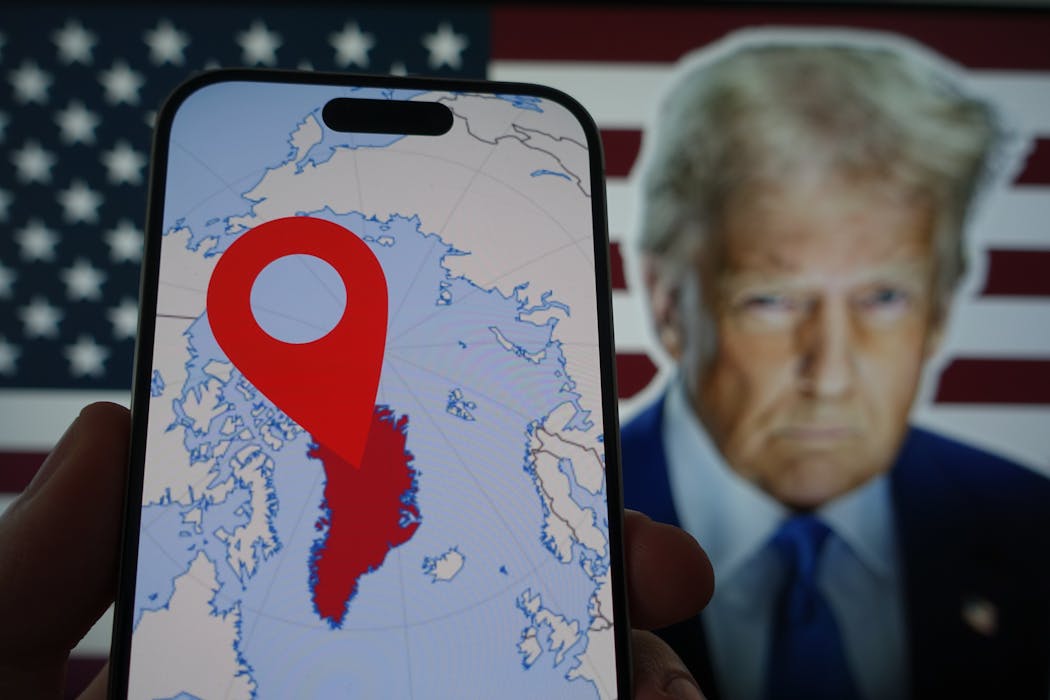
In the case of Venezuela, the silence is deafening. And seeing that no one has challenged it, the US government has immediately started talking about taking Greenland, hinting that it wouldn’t even need to use force. The world order is dead because nobody is willing to defend it.

However, it is equally evident that the alternative to the defunct world order cannot be no order at all. It’s not feasible that the world should operate according to the law of the jungle. It is too complex and big to be governed by just one empire.

This much was acknowledged even in the controversial US security strategy published at the end of 2025, which says that US elites “badly miscalculated America’s willingness to shoulder forever global burdens” and that “they overestimated America’s ability to fund … a massive military, diplomatic, intelligence, and foreign aid complex”.

“We live in a world in which you can talk all you want about international niceties and everything else,” Stephen Miller, deputy chief of staff to Donald Trump, now says of the US’s changed vision. “But we live in a world, in the real world…that is governed by strength, that is governed by force, that is governed by power.”

But a world governed on these terms is obviously a world heading towards mutual destruction. In such a system, all countries would, legitimately, scramble to defend themselves militarily. For those countries not already equipped, the pursuit of nuclear weapons would be the only obvious route to invulnerability.

Turning crisis into opportunity

So, what should Europe do in the face of this problem? And in the current world order, it’s possible that I do really mean Europe rather than the EU.

This situation requires cooperation with the UK, Norway, and probably Canada and Switzerland. If necessary, it may require moving ahead without Hungary or whichever other EU countries are still doubtful about the need for an urgent, defence-based European integration.

In theory, a world without a world order is a much greater problem for Europe than for any other economy of the world. According to the World Bank, trade with other countries represents more than 60% of the five biggest GDPs in Europe but less than 40% of the GDPs of China, the US and Russia.

However, Europe is also probably the part of the world that is best equipped to try to be the broker a new framework. It has fewer enemies than other contenders and more friends (16 of the 20 countries whose passports enable entry to other states without a visa are European).

It has the strongest tradition of being a global meeting place (the top five host cities for international organisations are all in Europe).

So yes, Europe can, in theory, transform its biggest problem into its biggest opportunity. Indeed, I would even say that the only way to survive the chaos is by being ambitious. Europe must present itself as the only credible broker of a difficult and yet indispensable new world order.

Miller is right that this will take force, strength and power – but it is the force of standing up without double or triple standards over defending those rights that once inspired a “universal declaration” inspired by the United States.

It is about having the strength of ideas for drafting new institutions to reinforce those values. But also, it’s about having the power, even one based on a military deterrence, to defend freedom if somebody wants to impose a different vision of what civilisations are about.

Will Europe find the courage to be strong? It probably needs a trigger to wake up. Greenland could be that trigger.

If Europeans don’t manage to negotiate what they’ve mastered so far – another humiliating compromise that would only serve US interests and reinforce Miller’s worldview – then an incident over Greenland may be the end of an alliance that is already increasingly unstable. But it would also be an opportunity to draft a new vision for governing the world.

The Conversation

Francesco Grillo is affiliated with the think tank Vision which is the convenor of the Siena conference on the Europe of the Future.

ref. As the US eyes Greenland, Europe must turn a global problem into an opportunity – https://theconversation.com/as-the-us-eyes-greenland-europe-must-turn-a-global-problem-into-an-opportunity-272872