De l’accord de Paris à un capitalisme climatique porté par la Chine

Source: The Conversation – in French – By Michel Damian, Professeur honoraire, Université Grenoble Alpes (UGA)

En 2015, la COP21 se clôturait par la signature de l’accord de Paris, jugé alors historique pour sa promesse de limiter le réchauffement climatique à 1,5 °C avant la fin du siècle. Un peu plus de dix ans plus tard, l’objectif semble dur à tenir, mais le monde est désormais sur les rails d’un capitalisme climatique dont la Chine a pris la tête.


« Paris est définitivement l’une des meilleures COP jamais organisées – les Français ont fait un boulot fantastique », écrivait, en 2015, le juriste Daniel Bodansky, qui a suivi les grandes conférences sur le climat depuis les négociations pour la convention-cadre des Nations unies sur les changements climatiques signée en 1992.

Du 30 novembre au 12 décembre 2015, il y a dix ans, la France pilotait un accord unanimement salué comme un succès. Dans son discours de clôture, Laurent Fabius, ministre des affaires étrangères, président de la conférence, ne cachait pas sa satisfaction :

« Ce texte sera […] un tournant historique. Le succès est à portée de toutes nos mains réunies. Le monde retient son souffle et il compte sur nous tous. »

Son contenu majeur, à savoir des promesses de réductions strictement nationales des émissions, sans aucun engagement contraignant de la part des États (dans le langage onusien, des « contributions déterminées au niveau national »), n’a toutefois pas été impulsé par l’Hexagone : il s’agissait, pour l’essentiel, d’une construction sino-américaine.


À lire aussi :
De Rio à Dubaï : les rivalités entre les États-Unis et la Chine dans les négociations climatiques


Des promesses de réduction des émissions trop faibles

Pour la première fois, les pays parties à la Convention climat se sont officiellement dotés d’une cible d’augmentation des températures à ne pas dépasser.

L’objectif, porté dans les ultimes jours de la COP21 par une coalition de petits États insulaires et de pays particulièrement vulnérables, était désormais de « contenir le réchauffement climatique nettement en dessous de 2 °C par rapport aux niveaux préindustriels et de poursuivre l’action menée pour limiter l’élévation des températures à 1,5 °C ».

La Conférence de Paris a ainsi franchi le pas d’inscrire la décarbonation de l’économie mondiale dans le temps long. Mais elle l’a fait sans imposer aux États le moindre engagement contraignant : simplement en se convainquant que le socle de transformations nationales volontaires suffirait.

Le problème, c’est que les « contributions nationales » communiquées par les parties à la COP, à supposer qu’elles ne restent pas de vaines promesses, emmenaient de toute façon vers un réchauffement bien supérieur à l’engagement fixé : environ +3 °C minimum sur le siècle.

L’écart donne le vertige : pour coller aux 2 °C – et a fortiori aux 1,5 °C – visés, il eût fallu que les contributions nationales ne soient rien moins que, respectivement, de 30 % et de 41 % plus ambitieuses d’ici à 2030.

S’était-on naïvement imaginé qu’elles seraient rapidement relevées après ce premier tour de chauffe ? L’accord de Paris ne s’était-il pas doté, dans l’ombre, d’une porte de sortie, ou d’une échappatoire, dont on n’a probablement saisi ni la subtilité ni la teneur en 2015 ?

La capture et le stockage du carbone indispensable ?

L’adoption d’un objectif de stabilisation des températures appelait mécaniquement – c’est une contrainte physique imposée par la dynamique de la chimie atmosphérique – celui de zéro émission nette, c’est-à-dire un équilibre entre les émissions anthropiques par les sources et les absorptions anthropiques par les puits de gaz à effet de serre.

C’est par l’angle d’efforts de décarbonation colossaux que cet objectif de neutralité carbone a été introduit à l’article 4 de l’accord. Mais, insidieusement, il avait ouvert une brèche : pour faire tenir cette impossible balance entre un objectif aussi ambitieux et des « contributions nationales » aussi insuffisantes, la condition impérative était de retirer massivement du CO2 de l’atmosphère.

Et pour cela de recourir à des technologies comme la capture et le stockage du carbone. Cela n’a pas été crié sur les toits de Paris, mais sans le recours à des solutions technologiques, et en particulier à la capture du carbone, les ambitions de l’accord de Paris étaient absolument inatteignables.

Une nouvelle vague d’investissements

Les premiers investissements dans la transition énergétique et les technologies bas carbone sont déjà anciens. Mais ils ne sont manifestes que depuis le début de la décennie 2000 et n’ont enfin décollé qu’à la suite de la COP21 de Paris.

Ils ont été multipliés par 15 entre 2004 et 2020, pour s’élever à 755 milliards de dollars en 2021, soit un peu plus de 648 milliards d’euros, dont au moins la moitié en Asie. Ils ont ensuite grimpé à 1 100 milliards de dollars (859 millions d’euros) en 2022, avec la Chine premier investisseur pour 546 milliards de dollars (469,4 milliards d’euros), contre 141 milliards de dollars (121,2 milliards d’euros) pour les États-Unis. En 2024, ces investissements atteignaient 2 000 milliards de dollars (1 718 milliards d’euros).

Ces investissements, qui portent ce que nous nommons « capitalisme climatique », ont été largement mobilisés par la Conférence de Paris.

Comme l’écrit l’économiste Jean Pisani-Ferry :

« Les engagements de réduction des émissions ont ensuite atteint une crédibilité suffisante pour qu’une fraction significative des entreprises mondiales investisse dans la construction d’une économie décarbonée. S’est ainsi engagée une guerre entre un capitalisme “brun” et un nouveau capitalisme “vert”, qui parie sur le développement de technologies propres. »

Le capitalisme climatique chinois fait la course en tête

Par capitalisme climatique, nous entendons la reconfiguration des structures productives – technologies, institutions, comportements – qui inscrirait le changement climatique comme une dimension nouvelle de la production de valeur et de l’accumulation du capital, c’est-à-dire de la recherche de profit et de l’investissement.

Aujourd’hui, le capitalisme climatique chinois, alors que la Chine est le premier pays émetteur de gaz à effet de serre et le premier pays consommateur mondial de charbon, fait la course en tête pour la décarbonation et la transition écologique.

La stratégie chinoise a positionné la décarbonation industrielle comme une puissante arme géoéconomique. C’est manifeste pour la puissance installée en renouvelables, les marchés des terres rares, des panneaux photovoltaïques, des batteries, celui des véhicules électriques, mais aussi pour les dépôts de brevet sur les énergies propres et, depuis peu, l’installation et le marché des batteries géantes de stockage de l’électricité, parties pour rebattre les cartes de la transition énergétique.

Dès la fin de la décennie 2000, la Chine s’était lancée dans la diminution de la pollution atmosphérique (alors de grande ampleur), se proposant d’édifier une « société écologique », avec l’apparition des tout premiers deux-roues et bus électriques dans de grandes villes.

Dans les années précédant l’accord de Paris, elle a pensé et construit l’un des plus déterminants de ses plans de développement, officialisé au printemps 2015 sous le nom de plan « Made in China 2025 ». L’optique annoncée était de devenir un leader industriel, notamment dans le secteur des véhicules électriques et de l’énergie propre. Dix ans plus tard, ce plan s’affirme comme une réussite.

Le capitalisme climatique, qui est porté par la Chine et qui dame le pion au pétro-État que sont les États-Unis, se renforce et se sera certainement consolidé à l’horizon 2050.

The Conversation

Michel Damian ne travaille pas, ne conseille pas, ne possède pas de parts, ne reçoit pas de fonds d’une organisation qui pourrait tirer profit de cet article, et n’a déclaré aucune autre affiliation que son organisme de recherche.

– ref. De l’accord de Paris à un capitalisme climatique porté par la Chine – https://theconversation.com/de-laccord-de-paris-a-un-capitalisme-climatique-porte-par-la-chine-273970

Face à la crise climatique, l’éducation active peut-elle transformer les institutions ?

Source: The Conversation – in French – By Michela Arciero, Associate research scientist, Università di Cassino e del Lazio Meridionale

En donnant à voir immédiatement le résultat du scénario de réduction d’émissions envisagé, le numérique est une aide précieuse pour les participantes et participants. Fournis par les auteurs, CC BY

Sensibiliser ne suffit pas à changer les pratiques collectives. En plaçant les personnes participantes en situation de décider concrètement des trajectoires climatiques de leur institution, l’éducation active ouvre la voie à une transformation plus profonde, où apprentissage et gouvernance se rejoignent.


Depuis quelques années, les dispositifs de formation et de sensibilisation aux enjeux de transition socioécologique se multiplient : ateliers participatifs, jeux sérieux, fresques, conférences interactives. Jamais la prise de conscience n’a été aussi accessible sur de nombreux enjeux, du changement climatique à la crise du logement, en passant par la biodiversité ou l’organisation du travail. Pourtant, un malaise s’installe.

Plusieurs études récentes montrent que, si la sensibilisation éveille et motive, elle ne transforme pas forcément durablement les pratiques collectives. S’agissant des enjeux climatiques, l’accent mis sur les « petits gestes » individuels peut même se révéler contre-productif, en individualisant la responsabilité et en occultant le rôle des organisations sociales, économiques et institutionnelles.

Résultat : face à l’ampleur de la crise climatique, le sentiment d’impuissance domine souvent. Sentiment légitime, puisque même dans le cas d’un scénario « héroïque », où une famille adopterait toutes les actions possibles pour réduire ses émissions « carbonées » (alimentation, transport, énergie domestique), la diminution globale de son empreinte resterait limitée à 30–40 %. Mais une voie alternative existe : diffuser largement les principes de l’éducation active pour guider les décisions des institutions.

L’éducation active : passer de l’individuel au collectif

Comment l’éducation peut-elle aller au-delà de la sensibilisation individuelle pour devenir un levier de transformation collective et institutionnelle ? Il ne s’agit plus seulement d’informer sur la gravité du problème ou les solutions pour le résoudre, mais de construire une prise de conscience collective et de stimuler le « faire ensemble » en mettant le public en situation de faire des choix collectifs. De plus, l’éducation active s’appuie sur des dispositifs délibératifs qui revisitent les cadres dans lesquels les choix sont débattus et rendus possibles, en tenant compte du public, de son expérience et du temps disponible (par exemple les conventions citoyennes). Ces dispositifs délibératifs reposent sur trois principes clés :

D’abord, permettre la contextualisation des données : les ordres de grandeur et les informations utilisées sont directement liés au collectif concerné et deviennent ainsi un objet concret, ancré dans des pratiques réelles et des contraintes institutionnelles.

Ensuite, offrir un cadre délibératif structuré. Celui-ci s’appuie souvent sur des dispositifs pédagogiques stimulants, tels que la mise en situation par jeu de rôle ou l’exploration de scénarios. Les choix sont alors abordés comme des hypothèses collectives, et non comme des positions individuelles à défendre. Répétés dans le temps et intégrés à des trajectoires institutionnelles, ces dispositifs permettent de suivre l’évolution des arbitrages collectifs, des priorités et des compromis ; bien au-delà d’un événement de sensibilisation sans lendemain.

Enfin, ancrer la démarche dans un cadre décisionnel réel. Les résultats de ces expériences doivent être conçus comme des engagements concrets, destinés à guider et à contraindre les choix futurs des institutions impliquées. Ces dispositifs sont ainsi efficaces car ils rapprochent apprentissage, délibération et gouvernance, en constituant une des étapes d’un cycle de décision. L’éducation active devient alors une composante à part entière des processus de décision collective, et non un simple outil d’enseignement descendant ou de communication.

Quand l’institution entre dans le jeu

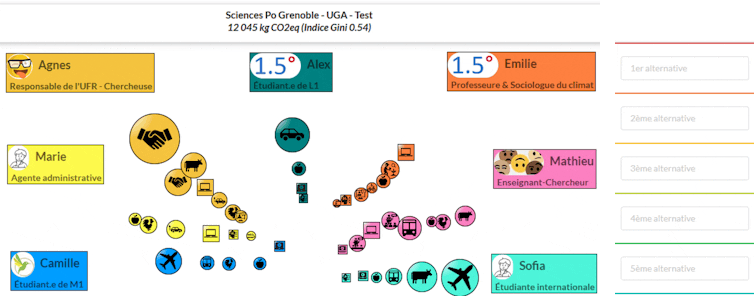
C’est pour explorer cette voie que Sciences Po Grenoble-UGA a expérimenté à grande échelle l’usage du dispositif participatif Ma Terre, qui s’appuie sur une interface graphique ergonomique, immersive et modulable, pour favoriser la prise de décision collective autour de choix concrets pour la transition socioécologique et visualiser en temps réel et de manière dynamique, les effets des scénarios. Le 20 octobre 2025, le MaTerrathon a réuni près de 300 participantes et participants – étudiantes, étudiants, personnels, animatrices et animateurs – à Sciences Po Grenoble-UGA.

Interface Ma Terre (adaptée à Sciences Po Grenoble-UGA), phase de négociation autour des « empreintes carbone » des personnages. La surface de chaque jeton est proportionnelle à l’empreinte carbone. La couleur et le logo du jeton décrivent son porteur et l’activité, respectivement. Les jetons donnant lieu à des alternatives sont reportés à droite.
Fourni par les auteurs, CC BY

Le MaTerrathon a pris la forme d’un jeu de rôle participatif, fondé sur des ordres de grandeur et des données issues du bilan carbone propre à l’établissement. Les personnes participantes ont été réparties en 36 groupes de 6 à 8 personnages fictifs, mais réalistes, représentatifs de la diversité des genres, des âges et des fonctions dans l’Institut – une étudiante, un enseignant-chercheur, un agent administratif ou encore une directrice de recherche. Cela a permis de délibérer sur un pied d’égalité, chaque décision étant discutée comme une hypothèse collective : il s’agissait d’identifier des priorités concrètes d’action et de comprendre les compromis nécessaires pour réduire l’empreinte carbone. L’objectif était clair : accélérer la contribution concrète de Sciences Po Grenoble-UGA au projet bas carbone de l’Université Grenoble Alpes, avec une cible affichée de réduction de 40 % des émissions de gaz à effet de serre d’ici 2030.

L’animation en binôme a été confiée à des élèves, des personnels de l’établissement et du collectif Ma Terre. La participation de toute la promotion de troisième année a été rendue obligatoire, afin que chacun et chacune prennent part aux choix stratégiques de l’institution avec une volonté explicite : ne pas dissocier celles et ceux qui prennent les décisions de celles et ceux qui vivent au quotidien les environnements concernés.

MaTerrathon : quelques résultats

Les ateliers se sont déroulés sur une matinée, et une restitution des premiers résultats l’après-midi. Cette restitution rapide a rendu possible un débat collectif, permettant d’analyser ensemble, à chaud et de manière objective, les résultats numériques obtenus.

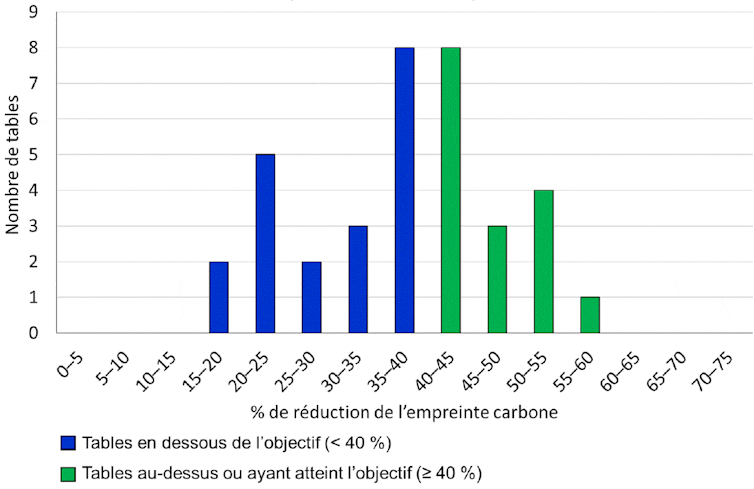
En tenant compte de l’objectif clé de réduire de 40 % l’empreinte carbone de l’établissement, la distribution des résultats des ateliers est très encourageante. Concrètement, 16 tables sur 36, soit environ 45 % du total, ont atteint ou dépassé cet objectif. Fait intéressant, de nombreux résultats se regroupent autour de cette valeur cible : près de la moitié des tables se situent dans une fourchette de 35 à 45 % de réduction (médiane de réduction de toutes les tables d’environ 39 %). Cela montre que l’objectif de 40 % n’est pas une cible isolée, mais bien atteignable pour une part significative des participantes et participants.

Intention de réduction de l’empreinte carbone exprimée pour les 36 ateliers du MaTerrathon, la cible indiquée par la direction de l’établissement était de 40 %.
Fourni par les auteurs, CC BY

Cette distribution laisse également apparaître une variabilité naturelle entre les différents groupes de travail. Elle montre que l’atteinte de l’objectif n’est pas un coup de chance ponctuel, et est le fruit de multiples discussions dont la nature, le déroulé et les résultats sont différents construisant une dynamique collective cohérente. Enfin, les réductions observées dans différents secteurs ne sont pas le fruit du hasard : la restauration, les transports, le secteur de l’énergie et des achats ont enregistré les baisses les plus importantes en pourcentage, allant de 38 à 52 %.

Au-delà des réductions, une originalité marquante du dispositif Ma Terre consiste à produire un indicateur indirect de l’acceptabilité des mesures, en qualifiant leur spontanéité et leur popularité. En créant un cadre à la fois structuré et ludique, le MaTerrathon a favorisé l’expression des désaccords tout en limitant la polarisation. Il a rendu visibles les contraintes et les marges de manœuvre des différentes catégories d’usagers et de personnel, ainsi que celles de l’institution dans son ensemble, et a permis en définitive de qualifier l’acceptabilité du plan d’action collectif construit.

Estimation de l’acceptabilité des mesures et quantification (par la surface) de leur potentiel en termes de réduction de l’empreinte carbone.
Fourni par les auteurs, CC BY

Cette expérience transformationnelle illustre comment un dispositif d’éducation active peut devenir une véritable mini-convention citoyenne, combinant formation, participation et décision collective, intégrant bases scientifiques, principes éducatifs et mécanismes institutionnels. Cette approche renforce la cohésion et le sentiment d’appartenance.

Il est cependant crucial de garder à l’esprit que ces chiffres reflètent des intentions de changement, qui pourront, ou pas, se transformer en actions concrètes à réaliser. Un écart peut persister entre l’intention et la mise en œuvre effective, rendant essentiels le suivi des engagements et l’évaluation du dispositif pour transformer ces ambitions en résultats tangibles.

Changer d’échelle, sans perdre le sens

Le projet ne s’arrête pas à l’université alpine. L’ENS-Lyon et d’autres ont aussi expérimenté ce dispositif délibératif dans l’enseignement supérieur. Une version intitulée « Ma Terre en classe » a été adaptée pour les élèves de collège et de lycée et des déploiements s’initient à l’échelle européenne au travers de projets transfrontaliers Erasmus+ (CitEuropass, EU Voices et EFEU).

Pour les scolaires, il s’agit de donner la parole aux générations de demain afin qu’elles comprennent, dès le plus jeune âge, l’impact de leurs choix et adoptent un mode de vie durable. Les jeunes expérimentent concrètement que leur voix compte et qu’ils peuvent agir sur l’avenir. Ces dispositifs s’inscrivent dans les recommandations du rapport Jouzel-Abbadie, qui souligne l’importance de former tôt à l’action collective, à la coopération et aux enjeux de la transition écologique. Pour l’Europe, il s’agit de se confronter à la diversité des langues et des cultures.

Pas une solution clé en main

Les expériences d’éducation active – qu’elles prennent la forme d’ateliers en milieu scolaire (Ma Terre en classe), de mini-conventions citoyennes dans l’enseignement supérieur (Ma Terre en 180 minutes, MaTerrathon), ou de projets de coopération européenne – n’offrent pas de solutions clé en main à la transition socioécologique. Elles invitent cependant à repenser le rôle de l’éducation comme un espace où se construisent des diagnostics partagés, des arbitrages discutés et des décisions prises dans un contexte clair et fondées sur des données pertinentes. En ce sens, l’éducation active apparaît comme une composante à part entière des transformations démocratiques requises par et pour la transition socioécologique, et offre la possibilité d’une évolution des normes sociales.


Cet article s’appuie tout particulièrement sur le travail de Jean Adam, chargé de mission transformation écologique, Sciences Po Grenoble-UGA et ENSAG-UGA, membre actif du comité d’organisation du MaTerrathon.

The Conversation

Nicolas Champollion a reçu des financements pour la recherche, à partir du Programme d’Investissement d’Avenir France 2030, au travers de PEPRs, et des tutelles CNRS, IRD, UGA, INRAE, Sciences-Po Grenoble-UGA. Ces soutiens permettent l’élaboration et la diffusion des ateliers Ma Terre en 180 minutes et Ma Terre en classe (suite Ma Terre). Nicolas Champollion appartient au Groupement de Recherche Labos 1point5 et est membre du comité scientifique d’ABC, l’association pour la transition bas-carbone.

Nicolas Gratiot a reçu des financements pour la recherche, à partir du Programme d’Investissement d’Avenir France 2030, au travers de PEPRs, et des tutelles CNRS, IRD, UGA, INRAE, Sciences-Po Grenoble-UGA. Ces soutiens permettent l’élaboration et la diffusion des ateliers Ma Terre en 180 minutes et Ma Terre en classe (suite Ma Terre).
Nicolas Gratiot appartient au Groupement de Recherche Labos1point5 et est membre du comité scientifique d’ABC, l’association pour la transition bas-carbone.

Simon Persico est Directeur de Sciences Po Grenoble – UGA et membre du conseil de surveillance de la Fondation de l’écologie politique.

Michela Arciero ne travaille pas, ne conseille pas, ne possède pas de parts, ne reçoit pas de fonds d’une organisation qui pourrait tirer profit de cet article, et n’a déclaré aucune autre affiliation que son organisme de recherche.

– ref. Face à la crise climatique, l’éducation active peut-elle transformer les institutions ? – https://theconversation.com/face-a-la-crise-climatique-leducation-active-peut-elle-transformer-les-institutions-276810

Comment la Chine développe « l’économie de basse altitude »

Source: The Conversation – in French – By Fabien M. Gargam, Associate Professor of Management, Renmin University of China et Chercheur Associé, Université Paris-Saclay

Située en dessous de 3 000 mètres d’altitude en Chine, l’« économie de basse altitude » représente une industrie stratégique pour l’empire du Milieu. Drones, véhicules volants, aéronefs électriques à décollage et atterrissage verticaux, ou eVTOL, les nouveaux appareils sont légion. Comment la définir et expliquer son développement si soudain ?


En janvier 2025, l’entreprise chinoise DJI dévoile la série Matrice 4, la première gamme de drones intégrant une puissance de calcul IA ouverte. En mars 2025, l’eVTOL EH216-S de l’entreprise EHang devient le premier véhicule aérien sans pilote avec passagers à obtenir les quatre certificats – type, navigabilité, production, exploitation. Ces deux réalisations historiques s’inscrivent dans l’économie de basse altitude.

Ce concept fut proposé en 2009 par le professeur associé Weimin Li de l’Université de l’aviation civile de Chine, une période où le pays était confronté à des défis persistants au niveau de l’aviation générale.

En décembre 2023, l’économie de basse altitude est désignée comme une industrie émergente stratégique lors de la Conférence centrale sur le travail économique. En décembre 2025, la Commission nationale du développement et de la réforme chinoise la définit comme « un modèle économique global axé sur les activités aériennes à basse altitude qui stimulent l’innovation industrielle et les applications concrètes ».

Comment expliquer son développement ? Les avis divergent sur la question.

Cet article s’appuie sur deux concepts, l’avantage au premier entrant et l’avantage au dernier entrant, créés par les gestionnaires Marvin Lieberman et David Montgomery en 1988, pour caractériser le bond en avant de l’économie de basse altitude. Notre étude liée à ce sujet est en cours de publication en mandarin.

Marché de 432 milliards d’euros d’ici 2035

En janvier 2025, Zhiyong Song, directeur de l’Administration de l’aviation civile chinoise, déclare que l’économie de basse altitude est sur le point de saisir une opportunité stratégique similaire au « dépassement », observé dans le secteur des véhicules à énergie nouvelle.

Le développement de ce modèle économique global combine de manière innovante l’avantage au premier entrant et l’avantage au dernier entrant. Il présente une double caractéristique : réaliser des percées dans des secteurs émergents et combler les lacunes de l’aviation générale. Sa chaîne de valeur l’expose clairement. Aujourd’hui, le marché chinois de l’économie de basse altitude a dépassé les 500 milliards de yuans (62 milliards d’euros). Selon les projections, il atteindra les 1 000 milliards de yuans (124 milliards d’euros) d’ici 2026 et les 3 500 milliards de yuans d’ici 2035 (432 milliards d’euros).

Les puissances aéronautiques traditionnelles n’ont pas d’équivalent direct à l’économie de basse altitude, puisqu’elles possèdent déjà un marché mature de l’aviation. De ce fait, les États-Unis poursuivent l’initiative Advanced Air Mobility et l’Union européenne se concentre sur l’initiative Innovative Air Mobility pour améliorer les systèmes de transport et moderniser les technologies associées.

Avantage au premier entrant : rôle de moteur

La Chine mobilise l’avantage au premier entrant comme un moteur pour permettre à son économie de basse altitude un dépassement en changeant de voie. Ce concept découle de trois dimensions : (1) la domination technologique, (2) l’acquisition précoce d’actifs essentiels et (3) les coûts de transfert pour les clients.

Domination technologique

La Chine s’est assurée l’initiative en matière de brevets grâce à des percées en recherche et développement (R&D) qui tirent parti de la réutilisation intersectorielle. Si l’on prend l’exemple des véhicules volants, environ 85 % de leur chaîne industrielle est liée aux véhicules électriques dits « intelligents ».

Les entreprises de véhicules à énergie nouvelle, telles que BYD et CATL, utilisent les plateformes d’électrification éprouvées pour adapter les technologies des trois systèmes électriques et les chaînes d’approvisionnement de l’automobile aux aéronefs à basse altitude.

L’équipe du professeur Xiaobo Qu de l’Université Tsinghua estime que l’exploitation des chaînes d’approvisionnement automobiles pourrait faire baisser le coût des véhicules volants électriques de plusieurs millions à 200 000 yuans, soit 24 700 euros.

L’entreprise chinoise DJI est le leader mondial des drones.
HUArtandPhotography/Shutterstock

Acquisition précoce d’actifs essentiels

La Chine a été le premier pays à investir massivement dans ce nouveau secteur d’activité. Avec un territoire de 9,6 millions de kilomètres carrés, le potentiel économique de son espace aérien à basse altitude est immense.

La base de fabrication de voitures volantes de Xpeng Aridge à Guangzhou est la première usine moderne au monde à intégrer les normes de fabrication aéronautique et les capacités de production automobile de masse. Spécialisée dans le développement d’un Land Aircraft Carrier modulaire, elle vise une capacité de production annuelle de 10 000 unités et prévoit des livraisons à grande échelle d’ici 2026.

Coûts de transfert pour les clients

La Chine a mis l’accent sur la fidélisation des utilisateurs et la création de nouveaux marchés. Par exemple, elle a consolidé sa position de premier marché mondial des drones grand public en 2024, avec un chiffre d’affaires de 1,51 milliard de dollars états-uniens. L’entreprise DJI détient régulièrement 70 à 85 % des parts du marché mondial des drones grand public, tout en dépassant 50 % des parts de marché dans les applications industrielles telles que l’agriculture, la topographie et la sécurité.


À lire aussi :
Le bond en avant de l’industrie automobile chinoise de 1953 à nos jours


Cette domination remonte à 2006 lorsqu’elle a tiré parti de la base de fabrication électronique de pointe du Guangdong pour être la pionnière de l’adoption civile et de la commercialisation à l’étranger des drones de photographie aérienne.

Avantage au dernier entrant : rôle d’assise

La Chine mobilise l’avantage au dernier entrant comme une assise pour permettre à son économie de basse altitude un dépassement en changeant de voie. Ce concept découle de quatre dimensions : (1) la capacité de profiter des investissements réalisés par les acteurs en place, (2) la résolution de l’incertitude, (3) les opportunités émanant des discontinuités technologiques et (4) l’inertie des acteurs en place.

Profiter des investissements réalisés par les acteurs en place

La Chine s’aligne sur les normes de navigabilité de la Federal Aviation Administration (États-Unis), tout en se référant à des cadres réglementaires internationaux faisant autorité, afin de diminuer les coûts liés aux essais et de réduire les barrières réglementaires.

L’acquisition par l’entreprise Aviation Industry Corporation of China (AVIC), spécialisée dans la construction aéronautique, d’entreprises états-uniennes telles que Cirrus, réputée pour son système de parachute balistique CAPS, accélère le développement et le renouvellement des équipements aéronautiques nationaux.


À lire aussi :
Comac : la menace chinoise pour Airbus et Boeing


Résolution de l’incertitude

La Chine a contourné les coûts initiaux et les goulets d’étranglement déjà rencontrés par les États-Unis dans le secteur des drones. Ainsi, elle est parvenue à une pénétration commerciale progressive en tirant parti notamment de la taille de son marché domestique et des avantages offerts par les réseaux de communication tels que la 5G et la 5G-A. En 2025, la Chine établit deux records mondiaux dans la catégorie des feux d’artifice tirés par des drones.

Opportunités émanant des discontinuités technologiques

La Chine possède la chaîne d’approvisionnement en batteries électriques la plus complète et la plus sophistiquée au monde. En novembre 2024, l’aéronef électrique EH216-S de EHang réalise le premier essai en vol au monde d’une batterie à l’état solide pour les eVTOL.

Inertie des acteurs en place

La Chine a publié les premières normes réglementaires de navigabilité pour les systèmes aériens sans pilote avec passagers. L’Administration de l’aviation civile a mis en place une procédure simplifiée pour accompagner les demandes simultanées de certificat de type et de certificat de production.

En revanche, pour obtenir ces deux certificats, la Federal Aviation Administration et l’Agence de l’Union européenne pour la sécurité aérienne exigent un protocole séquentiel, ce qui rend la démarche plus lente. En outre, le JAS4-1 de l’entreprise Joby a soumis sa demande de certificat de type à la Federal Aviation Administration en 2018 et se trouve encore aujourd’hui aux dernières étapes du processus de certification.


Cet article a été corédigé par Yuzhen Xie (écrivaine et conférencière), diplômée de Renmin University of China.

The Conversation

Fabien M. Gargam ne travaille pas, ne conseille pas, ne possède pas de parts, ne reçoit pas de fonds d’une organisation qui pourrait tirer profit de cet article, et n’a déclaré aucune autre affiliation que son organisme de recherche.

– ref. Comment la Chine développe « l’économie de basse altitude » – https://theconversation.com/comment-la-chine-developpe-leconomie-de-basse-altitude-276211

Les enfants illégitimes dans « House of the Dragon » à l’aune du médiévalisme

Source: The Conversation – in French – By Mauréna Benteboula, Doctorante en histoire médiévale, Université de Lille

Alors que la promotion de la troisième saison de House of the Dragon, annoncée pour 2026, s’impose progressivement dans le paysage médiatique, les premières images divulguées réaffirment le choix esthétique fondamental qui caractérise la saga : l’inscription résolue dans un imaginaire « médiévalisant ».


House of the Dragon, adaptation du roman Feu et Sang de George R. R. Martin, est le premier prequel de la série Game of Thrones sortie en 2011. Armures polies, châteaux vertigineux, alliances dynastiques fragiles et guerres de succession s’y combinent pour donner forme à un Moyen Âge de fiction, immédiatement reconnaissable mais profondément retravaillé. Dans cet univers où la référence médiévale sert moins de modèle que de réservoir symbolique, la bâtardise occupe une place particulièrement féconde.

En filigrane des pages de Feu et Sang comme dans la série, les bâtards apparaissent, disparaissent, réapparaissent, au point de constituer un réseau latent, une cartographie discrète de l’illégitimité qui structure la société westerienne. Loin d’être un simple motif pittoresque, la bâtardise devient un outil privilégié pour interroger la manière dont George R. R. Martin réélabore les codes politiques, juridiques et sociaux de la fin du Moyen Âge afin d’en tirer une matière narrative adaptée aux sensibilités contemporaines.

La bâtardise comme catégorie hybride

Dans l’Europe médiévale, la bâtardise n’est pas une condition univoque. Elle ne renvoie ni à un statut juridique homogène ni à une expérience sociale uniforme. Selon les contextes politiques, les stratégies des lignages et les cadres normatifs, l’enfant né hors mariage peut être marginalisé, toléré, intégré, voire instrumentalisé. La bâtardise constitue ainsi une catégorie souple, située à l’intersection du droit, de la morale et des pratiques sociales, dont la signification varie selon les milieux et les époques.

Feu et Sang, écrit sous la forme d’une chronique, pastiche brillamment les textes tardo-médiévaux, comme la chronique d’Olivier de La Marche (v.1425-1502) par exemple, tout en le simplifiant. Le narrateur du roman (et de la série), l’archimestre Gyldayn, dissémine dans son récit des mentions de bâtards issus de lignages variés, de seigneurs comme de servantes, et les projette dans des temporalités longues. Ce procédé fabrique une continuité pseudo-historique où la répétition des naissances illégitimes devient un fil rouge permettant de penser les logiques du pouvoir, les hiérarchies implicites et les mécanismes d’exclusion qui cimentent la société.

Mais Martin opère une transformation fondamentale : là où les documents médiévaux associaient l’épithète de « bâtard » à un individu précis (Antoine de Bourgogne dit « le Grand Bâtard de Bourgogne », v. 1430-1504, ou encore Jean bâtard de Bourbon, comte de Velay, v. 1413-1485) l’auteur systématise la dimension onomastique (liée aux noms propres). Les enfants illégitimes se voient attribuer des noms hérités non de leurs mères mais des régions dont sont issus leurs pères : Snow pour le Nord, Rivers pour le Conflans, Hill pour l’Ouest, et ainsi de suite.

Cette territorialisation ancre la bâtardise dans une logique patrilinéaire immédiatement lisible, en assignant aux enfants naturels un patronyme régional qui signale d’emblée leur naissance hors mariage. Toutefois, cette lisibilité demeure parfois trouble, car le nom désigne moins une filiation précise qu’une absence de filiation reconnue.

Alys Rivers en constitue l’emblème. Sorcière à la figure trouble, son nom, plus qu’une simple indication géographique, matérialise une identité fracturée. Née d’un père mal identifié, probablement un Fort, elle incarne la figure même de la marginalité.

Alys Rivers (interprétée par Gayle Rankin) dans la saison 2 de House of the Dragon (2024).
HBO

Les femmes, principales victimes du fait bâtard

Si les hommes bâtards de Westeros peuvent, selon les circonstances, être intégrés, reconnus ou tolérés, la situation des femmes et des enfants nés d’elles révèle un tout autre régime de marginalisation. Dans Feu et Sang, les bâtards dont les mères sont des nobles sont fréquemment dissimulés, masqués par des assignations fictives de paternité lorsque l’épouse est mariée, ou abandonnés si elle ne l’est pas.

Ce traitement littéraire trouve un écho puissant dans les sociétés médiévales, où le corps féminin constitue un lieu de contrôle et de suspicion. La figure fictive de Rhaenyra Targaryen en est une démonstration éclatante. Officiellement mère de trois fils Velaryon, elle devient l’objet d’une campagne de délégitimation qui mobilise l’imaginaire sexuel comme arme politique : on attaque sa moralité, la vraisemblance de ses maternités et, par ricochet, son droit à gouverner. Elle devient « la mère des bâtards » (Jacaerys, Lucerys et Joffrey) ou « la putain de Peyredragon ».

Le parallèle historique avec Isabeau de Bavière (v. 1370-1435), dont la fidélité fut publiquement mise en cause durant les crises de folie de Charles VI (1380-1422), éclaire ce traitement. Comme Rhaenyra, Isabeau vit son rôle politique attaqué par des accusations visant la légitimité de ses enfants, en particulier le futur Charles VII (1422-1461). Son image de mauvaise reine trouve ses racines dans la campagne de propagande genrée construite par ses opposants politiques en pleine guerre civile. On tente de fragiliser son pouvoir en lui imputant des aventures, notamment avec Louis d’Orléans, propre frère du roi…

Christine de Pizan offrant la Cité des dames à Isabeau de Bavière, miniature, vers 1410-1414, Londres, British Library, Harley 4431.
British Library

De même, le scandale de la tour de Nesle (1314) rappelle à quel point inouï de violence l’adultère féminin, perçu comme menace dynastique, était puni au Moyen Âge.

Martin s’inspire de ces imaginaires, mais les réordonne : ainsi, lorsque Lady Coryanne tombe enceinte d’un garçon d’écurie, c’est l’amant qui fait l’objet d’un châtiment exemplaire. On peut ici faire le parallèle avec l’adultère de Marguerite de Bourgogne (v. 1290-1315), belle fille du roi de France Philippe IV (1285-1314), qui mourut en prison. Son amant a connu les tourments de la torture – la roue, le plomb brûlant, l’émasculation – et de la décapitation. Le garçon d’écurie qui séduit la lady fictive est lui aussi émasculé, mais il a la vie sauve et il est conduit au Mur – une gigantesque muraille de glace et de pierre qui, dans la fiction, sépare le royaume des Sept Couronnes des terres glacées et sauvages situées au-delà. Mais contrairement à Marguerite, Lady Coryanne n’avait pas attenté à la majesté royale.

Westeros présente une version atténuée, mais non dépourvue de dureté, des rapports médiévaux entre genre, sexualité et pouvoir. Les bâtards issus des femmes de l’aristocratie demeurent malgré tout des figures d’ombre, rarement nommés, souvent oubliés du récit. Les enfants de la princesse Saera Targaryen (princesse déchue et prostituée) n’apparaissent qu’en marge et Hugh Marteau, son fils, refuse explicitement d’adopter un nom de bâtard pour échapper à l’héritage infamant de sa mère. Cette invisibilisation, qu’elle soit volontaire ou systémique, inscrit la bâtardise féminine dans une dynamique d’identité d’entre deux, où ces femmes se trouvent à la fois à l’écart des catégories sociales établies et sans place claire dans la hiérarchie.

La bâtardise comme outil d’émotion historique

La puissance de Feu et Sang ne réside pas tant dans sa fidélité aux réalités médiévales que dans sa capacité à créer une illusion d’authenticité. La bâtardise y devient un marqueur narratif doublement opératoire : elle signale immédiatement la coloration médiévale de l’univers tout en étant remodelée pour répondre aux attentes d’un public contemporain, sensible aux questions d’identité, de reconnaissance et de justice. La diabolisation des bâtards par le personnage d’Alicent Hightower, qui va jusqu’à faire du « sang de bâtard » un argument de déshumanisation, traduit moins les mentalités du XVᵉ siècle que nos propres inquiétudes face au stigmate et à l’altérité.

En cela, Martin s’écarte de la réalité historique. À la fin du Moyen Âge, les bâtards princiers, qu’ils soient légitimés ou non, jouent parfois des rôles majeurs : ce fut le cas de Jean de Dunois (1403-1468), dit le bâtard d’Orléans, héros de la guerre de Cent Ans, ou de César Borgia (1475-1507), dont l’ascension politique fut fulgurante. Dans Westeros, rares sont ceux qui atteignent la même stature. Orys Baratheon, un étranger, fait figure d’exception tandis que la majorité demeure cantonnée aux marges du pouvoir, témoignant du choix narratif de privilégier l’exclusion comme horizon dramatique.

Cette recomposition est au cœur du médiévalisme martinien. Feu et Sang ne cherche pas à reproduire le Moyen Âge mais à le réinventer comme espace d’intensification émotionnelle. Un lieu où la filiation devient enjeu existentiel, où la marge produit du tragique, où la bâtardise, loin d’être un simple statut, condense les tensions entre appartenance et altérité. Par ce prisme, Martin parle moins du passé que du présent : de nos obsessions pour les origines, de nos interrogations sur les frontières de l’identité, de nos propres dispositifs d’exclusion.

L’illégitimité y fonctionne comme un miroir, le miroir des sociétés médiévales, dont elle retient certains codes, et le miroir de notre temps, dont elle absorbe les sensibilités.

The Conversation

Mauréna Benteboula ne travaille pas, ne conseille pas, ne possède pas de parts, ne reçoit pas de fonds d’une organisation qui pourrait tirer profit de cet article, et n’a déclaré aucune autre affiliation que son organisme de recherche.

– ref. Les enfants illégitimes dans « House of the Dragon » à l’aune du médiévalisme – https://theconversation.com/les-enfants-illegitimes-dans-house-of-the-dragon-a-laune-du-medievalisme-275117

A new face for ‘Little Foot’, the most complete Australopithecus skeleton to date

Source: The Conversation – France – By Amélie Beaudet, Paléoanthropologue (CNRS), Université de Poitiers

What did the face of our ancestors look like 3 million years ago? Meet the reconstructed face of “Little Foot” – the most complete biological Australopithecus specimen that ever existed.

What did the face of one of our ancestors look like more than 3 million years ago? Our international team has answered this question by virtually reconstructing the facial fragments of “Little Foot,” the most complete Australopithecus skeleton yet discovered. This reconstruction sheds light on the influence of the environment on how our face evolved. Our findings have just been published in the Comptes Rendus Palevol journal, and the new 3D face of “Little Foot” can be explored online on the MorphoSource platform.

The search for human origins has never been more fruitful, with fossil discoveries pushing back the appearance of the earliest humans (members of the genus Homo) to 2.8 million years ago, and the development of cutting-edge methods for analysing these remains such as recovering genetic information from fossils over 2 million years old.

Yet, while our knowledge of extinct human species grows with each discovery, the story of our ancestors before the first humans appeared remains blurry. It is during this pivotal period that the traits defining our humanity emerged, enabling our genus’ evolutionary success.

Although the identity of our direct pre-Homo ancestor is far from resolved, one fossil group plays a central role in this search: Australopithecus. This genus, to which the famous “Lucy” belongs (discovered 50 years ago in Ethiopia), inhabited much of Africa and survived for over 2 million years. Australopithecus is known from many fossil remains, but often these are highly fragmentary, isolated, and have sometimes been distorted over the millions of years they have been buried. Notably, only a handful of skulls preserve nearly the entire face, a part of our anatomy that has profoundly shaped who we are today.

Through digestive, visual, respiratory, olfactory, and non-verbal communication systems, the face is at the heart of interactions between individuals and their physical and social environments.

Significant changes occurred in the facial region throughout human evolution, with most structures generally becoming less robust. However, the factors driving these changes remain unclear. Were they caused by shifts in diet, social behaviour, or both? Only the discovery of more complete skulls can clarify this debate, and this is why the skull of “Little Foot” is crucial.

The “Cradle of Humankind”

South Africa has been and remains a crucial region for researching into human origins. A century ago, the iconic “Taung Child” was published in Nature as a representative of a new African branch of humanity, Australopithecus. While scientific attention had previously focused on Eurasia, this discovery inspired decades of exploration and major finds across Africa. In particular, South Africa saw a proliferation of palaeontological sites in a region now UNESCO-listed and known as the “Cradle of Humankind.” Among these, Sterkfontein has proven exceptionally rich in fossils, many attributed to the hominin genus Australopithecus, and including numerous remarkably preserved specimens. But it was in 1994 and 1997 that Sterkfontein yielded its most spectacular find: the skeleton of “Little Foot,” over 90% complete, and the oldest human ancestor found in Southern Africa. To date, it is the most complete Australopithecus skeleton ever discovered, far surpassing “Lucy,” of which only 40% of the anatomy is preserved.

Our team has been studying this skeleton since its complete excavation concluded in 2017. The skull, in particular, has been the focus of our attention, as it is relatively complete, preserving all parts of the head – the cranium and mandible. However, 3.7 million years of burial underground have fragmented and displaced parts of its fossilised face. This process is especially visible in the forehead and eye sockets (orbits), making it impossible to quantitatively analyse these informative areas. Given the exceptional and unique nature of this fossil, we decided to harness the most recent technological advances in imaging to restore the face of “Little Foot.”

“Little Foot” in Europe

Creating a digital copy of “Little Foot” was essential to allow the virtual isolation and repositioning of the fragments without damaging the original skull. However, conventional X-ray scanning technologies have limitations. Through burial and fossilisation process, cavities were created in “Little Foot’s” skull as soft tissues disappeared and filled with sediment. As a result, X-rays struggle to penetrate this extremely dense sedimentary matrix, limiting image contrast and quality. After several unsuccessful attempts, we turned to a more powerful alternative: synchrotron radiation scanning. A synchrotron is a high-energy particle accelerator used to produce ultra-high-resolution images (at micron or even sub-micron scale).

With this in mind, we took “Little Foot’s” skull to England for scanning at the I12 beamline of the Diamond Light Source synchrotron. In the summer of 2019, “Little Foot” made its first journey outside Africa, carefully escorted across the world and housed in a secure vault during its stay in the UK.

A new face for Australopithecus

Several days were required to scan the entire skull at a resolution of 21 microns. The exceptional images generated revealed intimate details of “Little Foot’s” anatomy, and also provided the necessary data for facial reconstruction. However, the high quality of the data came at a computational cost: over 9,000 images were generated, representing terabytes of information to process. To virtually isolate the fragments, these images were processed using the supercomputer at the University of Cambridge (England). Once rendered in 3D, the fragments were repositioned according to their anatomical location, and missing parts were recreated to finally restore the complete face of “Little Foot.”

Little Foot’s face reconstructed.
Fourni par l’auteur

The size and shape of “Little Foot’s” orbits, previously obscured by displaced fragments, are among the most striking features of our reconstruction. In primates, the orbital region is heavily influenced by functional (visual) and behavioural (ecological) adaptations. “Little Foot’s” proportionally large orbits compared to other hominins suggest a strong reliance on sensory information, likely for foraging. This hypothesis is supported by a previous study showing that its visual cortex was more developed than that of modern humans.

The second major result of this study has implications for our understanding of the relationships between Australopithecus groups living in Africa between 4 and 2 million years ago. Although the comparative sample is limited, it includes specimens from both East and South Africa. Surprisingly, “Little Foot,” from a South African site, shows strong similarities with East African specimens. These similarities may indicate that “Little Foot” shared close ancestors with East African populations, while its probable descendants in South Africa later developed distinct anatomy through local evolution.

While the face provides valuable insights into our ancestors’ adaptations to their environment, the rest of “Little Foot’s” skull will offer further key elements for understanding our evolutionary history. Notably, the braincase, affected by “plastic” deformation, will require similar work to reconstruct and explore the neurological features of this fossil group.

The Conversation

This research was supported by the Agence Nationale de la Recherche, the Centre National de la Recherche Scientifique, the Claude Leon Foundation, the DST-NRF Center of Excellence in Palaeosciences, the French Institute of South Africa, Diamond Light Source, and the ISIS facility of the Science and Technology Facilities Council (STFC).

Dominic Stratford est membre de organisation:

Department of Anatomical Sciences, Renaissance School of Medicine, Stony Brook University, Stony Brook, NY, 11794, USA

Funding: Already stated by Dr Beaudet

– ref. A new face for ‘Little Foot’, the most complete Australopithecus skeleton to date – https://theconversation.com/a-new-face-for-little-foot-the-most-complete-australopithecus-skeleton-to-date-277278

Arrowhead points found in Central Asia could prove the presence of ‘Homo sapiens’ 80,000 years ago

Source: The Conversation – France – By Hugues Plisson, archéologue spécialisé en tracéologie (reconstitution de la fonction des outils préhistoriques par l’analyse de leurs usures), Université de Bordeaux

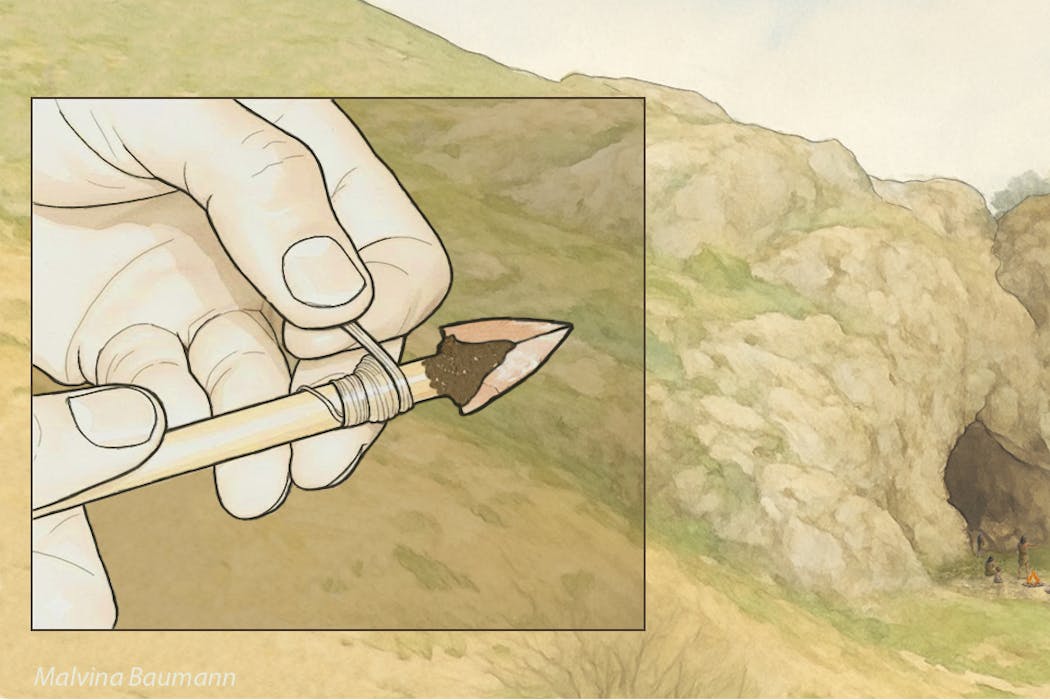
Obi-Rakhmat rock shelter in Uzbekistan, micro-point hafting and main game hunted around the site 80,000 years ago (artwork courtesy of Malvina Baumann). Malvina Baumann, Fourni par l’auteur

Unretouched triangular microlithic projectile points have been identified from their impact traces in the oldest occupation layers of the Obi-Rakhmat site in Uzbekistan, dating to 80,000 years ago. Their size corresponds to small arrowheads, which are directly comparable to those produced by Homo sapiens during an incursion into Neanderthal territory in the Rhône Valley, 25,000 years later. This new study, published in PLOS One journal, provides a strong argument that could rewrite history on Homo sapiens‘ first settlement in Europe.

The chrono-cultural and anthropological frameworks of prehistory, along with the evolutionary models they inspired, were first created in Western Europe, especially France, in the second half of the 19th century. They were initially linear and Eurocentric: Cro-Magnons (European early modern humans), descending from Neanderthals, laid the foundations for the civilisational superiority claimed by this part of the world at the time. It was not until a century later that the African origin of Homo sapiens, as well as the technological and social features that characterised the Western Upper Palaeolithic (symbolic productions, long-distance networks, and diversified lithic and bone tools and weapons), were recognised.

The earliest evidence of Homo sapiens in Australia, dating back around 65,000 years (Clarkson et al., 2017), predates that found in Europe by 10 millennia, while the ways in which our ancestors initially colonised Western Eurasia over 45,000 years ago remain contentious. The temporal alignment of the earliest European Upper Palaeolithic settlements with those in the Levant, which are considered the closest in terms of typology and technology, is still not satisfactory. This is either because the Levantine data comes from old excavations or because it does not fit into the supposed direct lineage. Despite its geographical proximity to Africa, the origins of the Initial Upper Palaeolithic in the Levant are themselves uncertain. This is why the possibility of a Central Asian origin suggested by archaeologist Ludovic Slimak in 2023 (Slimak, 2023) deserves attention.

A site in Central Asia

View from the Obi-Rakhmat rock shelter on the end of the Tien Shan. Hugues Plisson.
Fourni par l’auteur

Depending on climatic conditions, Central Asia has served as a corridor facilitating movement between the western and eastern parts of the continent or as a refuge zone. The archaeological record in this region is limited but includes several significant Palaeolithic sites.

Among them is the Obi-Rakhmat rock shelter in Uzbekistan, discovered in 1962, whose latest excavation campaigns were led by Andrei Krivoshapkin. At the south-western end of the Talassky Alatau range of the Tien Shan mountains, at an altitude of 1,250 metres, the settlement provides a remarkably consistent lithic industry, comprising points, large blades, and bladelets across a stratigraphic sequence spanning over 10 metres, dating from approximately 80,000 to 40,000 years ago. This industry was initially classified as part of the Initial Upper Palaeolithic but it appears to derive from the Levantine Early Middle Palaeolithic. The early Middle Palaeolithic, associated with archaic Homo sapiens at the Misliya cave (Hershkovitz et al., 2018), disappeared from the Near East around 100,000 years ago. At Obi-Rakhmat, the skull remains of a child found in a layer dating back ~70,000 years show features considered to be Neanderthal and others to be anatomically modern, a combination that could be the result of hybridisation.

Massive blades but microlithic points

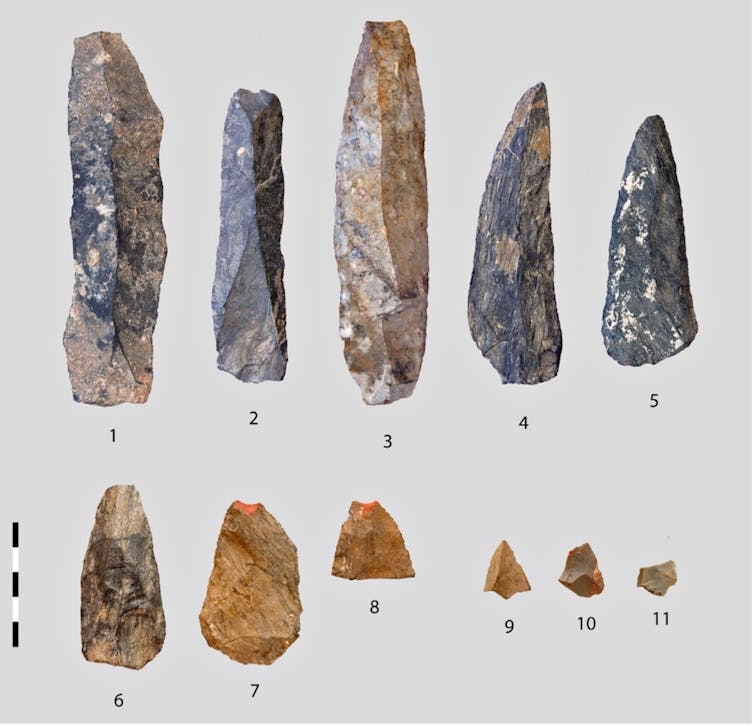
Elements of lithic industry from layer 21 at Obi-Rakhmat: unretouched blades (1-2), large retouched blade (3), pointed retouched blades (4-5), impacted retouched points (6-8), unretouched Levallois micro-point (9), unretouched impacted micro-points (10-11). Hugues Plisson.
Fourni par l’auteur

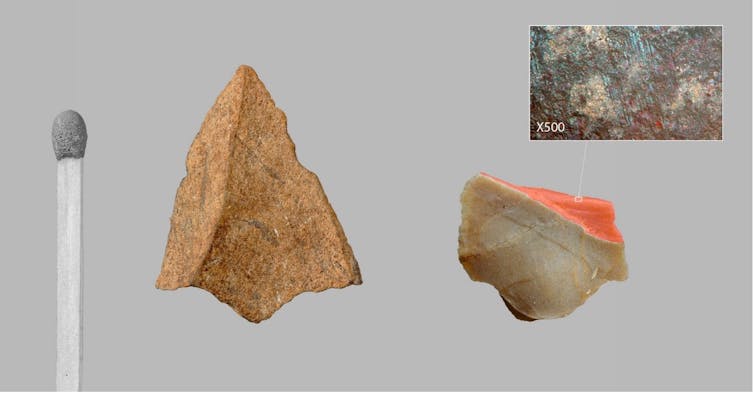
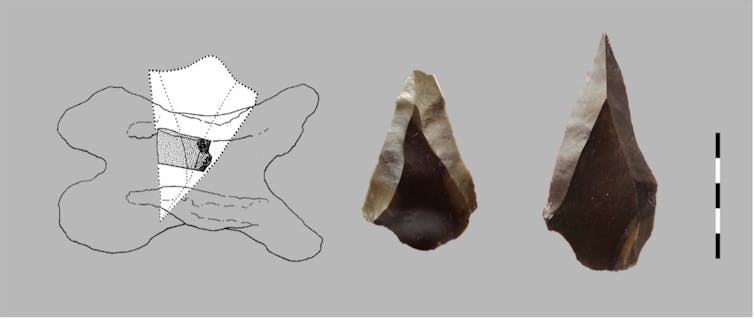
In this context, our international multidisciplinary team has identified tiny, unretouched, triangular projectile points within the lithic debris of the oldest stratigraphic layers. These points were distinguished based on their macroscopic and microscopic impact marks, which were compared to experimental reference data. Due to their small size (less than 2 cm in width and weighing only a few grams) and brittleness, they would have been unsuitable for mounting on heavy shafts. The width of their cutting edges corresponds to the diameter of arrow shafts documented ethnographically for low-poundage bows, consistent with transcultural invariants rooted in physical and ballistic constraints.

Two unretouched micro-points recovered from layer 21 of Obi-Rakhmat. One is intact, while the other is broken and shows scratches resulting from use as a projectile head. The matchstick illustrates their small size.
Fourni par l’auteur

A question of ballistics

Thrown piercing weapons are complex systems whose components are not interchangeable from one type of weapon to another, as they meet different requirements in terms of intensity and nature of stress.

The significant impact force of spears held or thrown by hand makes the robustness of the weapon an essential parameter, both in terms of effectiveness and the hunter’s survival, with mass ensuring robustness, impact force and penetration. In contrast, the penetration of light projectiles shot from a long distance depends on their sharpness, because their kinetic energy, which is much lower, comes mainly from their speed, which, unlike mass, decreases very rapidly along the trajectory and in the target. As this speed cannot be achieved by the extension of the human arm alone, it necessarily depends on the use of a throwing instrument. Arrowheads and spearheads or javelin heads are therefore not designed according to the same criteria and cannot be mounted on the same shafts, the dimensions and degree of elasticity of which are also essential in terms of ballistics. Thus, as in palaeontology, where the shape of a tooth reveals the type of diet and suggests the mode of locomotion, the characteristics of a point provide clues as to the type of weapon of which it is the wounding element.

Weaponry specific to ‘Sapiens’?

The tiny size of Obi-Rakhmat’s points cannot be regarded as a default choice, not only because there is no shortage of good-quality lithic raw material on site from which large blades were made, but microscopic examination of traces of use or wear also shows that within this same assemblage there are also much more robust retouched points (15 to 20 times heavier and 3 to 4 times thicker), similarly impacted by use as axial projectile points (the size of spearheads or javelin heads).

Returning to the bibliography and our own work on Middle Palaeolithic tools (Plisson et Beyries, 1998), we found that the presence in the same assemblage of various types of projectile points and inserts, some of which were microlithic and produced for this purpose, is only known at Homo sapiens sites. The oldest documented occurrences are in South Africa in the Pre-Still Bay (more than 77,000 years old) and later cultural layers of the Sibudu cave. In contrast, lithic points damaged by use as projectile heads are rare in the Neanderthal record. When present, they tend to be large and do not notably differ in size, manufacture or type from points used for activities other than hunting, such as gathering plants or butchery. This difference in the design of tools and weapons takes on anthropological significance.

Levallois points from the Um El Tlel site in Syria, from the Late Middle Palaeolithic period in the Levant attributed to Neanderthals. From left to right: graphic reconstruction based on a fragment found embedded in a donkey vertebra, plant knife blade, butcher knife blade. These multipurpose points are 2 to 3 times wider than the micro-points from Obi-Rakhmat. Hugues Plisson.
Fourni par l’auteur

Given their respective dates, the distance between South Africa and Central Asia (14,000 km) and the difference in the manufacture of the Obi-Rakhmat and Sibudu weapon heads (unretouched knapped stone points vs. shaped stone points or retouched inserts, shaped bone points), the hypothesis of independent centres of invention is the most likely.

From the foothills of the Tien Shan to the Rhône Valley 25,000 years later

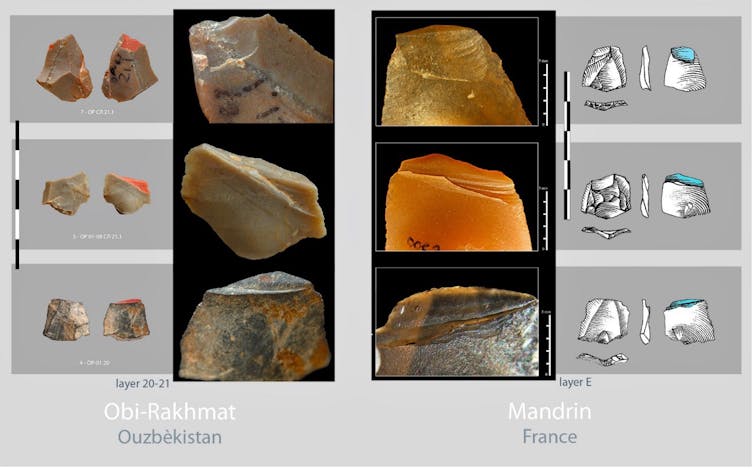
The micro-points from Obi-Rakhmat have no known equivalents in the Eurasian Middle Palaeolithic, except for identical projectile points identified by Traceology expert Laure Metz (Lewis et al., 2023) at the Mandrin site, in the Rhône Valley, France, in a layer dating to approximately 54,000 years ago – some ten thousand years before the disappearance of local Neanderthals. Notably, a Homo sapiens milk tooth was also recovered from this layer (Zanolli et al., 2022. The similarity between the micro-points from Obi-Rakhmat and Mandrin, despite being separated by more than 6,000 km and 25 millennia, is such that they could be interchanged without any detail other than the stone betraying the substitution.

Morphological and functional similarity between the micro-points of Obi-Rakhmat and Mandrin, broken by their use as projectile head. The location and extent of their fracture (highlighted in red and blue and macroscopic detail) are indicative of axial impact. Hugues Plisson.
Fourni par l’auteur

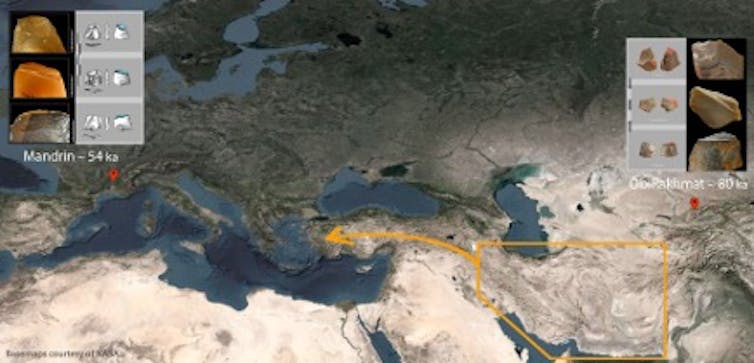
Recent work published by paleogeneticists Leonardo Vallini (Vallini et al., 2024) and Stéphane Mazières (Mazières et al., 2025) defines the Persian Plateau, on the north-eastern edge of which Obi-Rakhmat is located, as a population hub where the ancestors of all present-day non-Africans lived between the early phases of expansion out of Africa – long before the Upper Palaeolithic – and the wider colonisation of Eurasia. This resource-rich environment may have provided a refuge conducive to demographic regeneration after the genetic bottleneck of the exit from Africa, interaction between groups and, consequently, technical innovations.

On either side of the Persian plateau (orange box), genetically identified as a refuge area for the concentration and demographic development of first Homo sapiens who left Africa, Obi-Rakhmat and Mandrin share the same micro-projectile points, 25,000 years and 6,000 km apart. Hugues Plisson.
Fourni par l’auteur

Obi-Rakhmat and Mandrin may represent two geographical and temporal milestones within the same process of dispersal, as suggested by Ludovic Slimak (Slimak, 2023), characterised by the dissemination of a key technological innovation unique to Homo sapiens. So far unnoticed because they are unretouched, tiny and fragmentary, it is likely that the micro-projectile points for which recognition criteria have now been defined will begin to appear at sites between Central Asia and the western Mediterranean.

Premises for a new scenario of the western peopling by ‘Homo sapiens’

This discovery is stimulating in several ways.

It validates the consistency of the research conducted at the Mandrin site, which came to the conclusion that Sapiens armed with bows made a brief incursion into Neanderthal territory. Several elements of this study had been criticised (Klaric et al., 2024)– which is, however, normal in science when a new proposal deviates too far from established knowledge – but its predictive dimension had not been considered at the time.

The similarity between Mandrin and Obi-Rakhmat’s micro-points cannot be a mere coincidence. It is not only their shape that is similar, but also the way they are made, which requires real expertise, as evidenced by the meticulous preparation of their striking platform and their function. One could debate the appropriate instrument for shooting arrows armed with such tiny tips, the bow being in filigree, or whether it is preferable to remain cautious and speak only of shooting, but this already contrasts with what we know about Neanderthal hunting weapons and their design.

Another remarkable aspect, which is still relatively uncommon, is the convergence and complementarity of data from material culture and from our genetic memory, which did not influence each other given the dates of the respective studies and publications. Together, they sketch out a rewriting of the scenario of Homo sapiens’ arrival in Europe: it was thought that he came directly from Africa by the shortest route 45,000 years ago, but we now discover that he had been established in the heart of the Eurasian continent for a long time, well before expanding in search of more territories.


A weekly e-mail in English featuring expertise from scholars and researchers. It provides an introduction to the diversity of research coming out of the continent and considers some of the key issues facing European countries. Get the newsletter!


The Conversation

Les auteurs ne travaillent pas, ne conseillent pas, ne possèdent pas de parts, ne reçoivent pas de fonds d’une organisation qui pourrait tirer profit de cet article, et n’ont déclaré aucune autre affiliation que leur organisme de recherche.

– ref. Arrowhead points found in Central Asia could prove the presence of ‘Homo sapiens’ 80,000 years ago – https://theconversation.com/arrowhead-points-found-in-central-asia-could-prove-the-presence-of-homo-sapiens-80-000-years-ago-276550

I study why zebrafish larva prefer to circle left or right, to understand how and why human brains encode right- and left-handedness

Source: The Conversation – USA – By Eric Horstick, Associate Professor of Biology, West Virginia University

Having a hand preference speaks to more than just your preferred way to write. Domingo/iStock via Getty Images Plus

Being right- or left-handed is a familiar fact about yourself you likely don’t think about much on a day-to-day basis. However, your handedness affects how you interact with the world.

For many people, it determines how they brush their teeth, use tools, play sports, write, eat and much more. Simply try to enjoy a bowl of soup or sign your name with your nondominant hand to appreciate the impact a hand preference can have on your daily life.

Interestingly, this behavioral asymmetry is not unique to humans. Preferences for using the right or left hand, paw or eye exist in most species. For example, many primate species have individual left- or right-hand preferences for manual tasks. Similarly, different bird species have varying eye preferences for distinct visual tasks. Even the largest animal alive, the blue whale, shows a preference for the direction of its rolls during feeding. This inherent and often-overlooked feature of behavioral asymmetry is a widespread phenomenon in the animal kingdom.

The universality of behavioral asymmetry suggests that having an assigned hand, eye or other preference is beneficial. But depending on one hand for so many important tasks means that a single injury could be devastating. This paradox poses an important question: Why would having handedness be better for survival than not?

Insights from fish ‘handedness’

To address this question, scientists have tried to understand the genetics of handedness. While large-scale genetic studies in humans have identified dozens of genes associated with handedness, researchers also found that genetics alone only partially accounts for whether someone is left- or right-handed. This means behavioral asymmetry like handedness is likely the product of complex interactions between genetics, development and the environment.

For the past six years, my research lab has been interested in understanding behavioral asymmetry and how such behaviors get encoded in the brain. We primarily use larval zebrafish to explore the neural basis of behavioral asymmetry. These animals have transparent bodies and rapidly develop into adults in just a few days, making them ideal models to study. Additionally, the genetics and brain structure of zebrafish are highly similar to those of humans.

Fish have a form of handedness called motor asymmetry, which involves sustained periods of turning in the same direction. I had previously found that when light was cut off, larval zebrafish start circling in a leftward or rightward direction, sometimes for up to a minute or more. The fish would continue to preferentially turn in that same direction over the course of hours, days and even weeks, looking for a light source. This meant that vision drove their motor asymmetry.

Microscopy image of violet, symmetrical outline of the top of a fish with two white lines and nodules extending down its length
Zebrafish make it easy to see their neural activity. Eyes are to the left, and neurons are colored white.
National Institute on Deafness and Other Communication Disorders/Flickr, CC BY-NC-SA

Students in my lab recorded the zebrafish’s neural activity in response to loss of environment light – the trigger for motor asymmetry. They found a subset of approximately 60 neurons in the thalamus – a region of the brain that is evolutionarily conserved among vertebrates and involved in relaying sensory information – was functionally linked to motor asymmetry. Removing these neurons eliminated this motor asymmetry, suggesting a potential neural basis for where behavioral asymmetry is established in the fish brain.

When my lab repeated our experiments on five additional species of larval fish from around the world, we found similar motor asymmetry in response to light. Much like handedness in primates, it appears that handedness in fish is likely more of a rule than an exception.

However, we did find one exemption: the Mexican tetra, also known as cavefish. These animals are found in perpetually dark cave environments and are naturally blind. In collaboration with our colleagues at the Duboué Lab at Florida Atlantic University, we found that these animals showed no motor asymmetry.

These findings suggest that the universal nature of behavioral asymmetries are likely crucial responses to common challenges that different organisms encounter.

Behavioral asymmetry may solve challenges

Hurting your dominant hand does more than just ruin your softball or ultimate frisbee game. Handedness is associated with broad neural asymmetries in the brain that are linked to performance in language comprehension and working memory tasks. In addition, having atypical handedness – such as preferring different hands for different activities – is associated with a range of neurological conditions, including autism and attention-deficit/hyperactivity disorder.

Understanding why animals have behavioral asymmetries offers clues about how the environment influences broader cognitive function. If environmental challenges indeed drive handed behaviors, what problems does motor asymmetry solve for fish?

Close-up of a silver fish looking up at a pink-tinged fish without eyes
Astyanax mexicanus living on the surface have eyes (bottom), while those living in caves do not (top).
Daniel Castranova/NICHD/NIH via Flickr, CC BY-NC-ND

In nature, animals often circle when searching for something, such as a food source. For larval zebrafish, light is an important resource for their ability to see and capture prey. When we placed a light source at varying locations around them, the larval zebrafish start circling to quickly navigate into illuminated environments conducive to hunting. Based on our work, we hypothesize that the asymmetries in fish that allow them to search more efficiently work in parallel ways to those of other animals, like eye movement in birds or language comprehension in people.

Prior research has suggested that brain asymmetries improve cognitive performance by reducing competition between the two sides of the brain. Our work supports these hypotheses by showing how, for zebrafish, motor asymmetry provides a default response to find light and efficiently catch a needed snack.

With a helping hand from fish handedness, researchers are getting a clearer idea of the universality of behavioral asymmetry and how the environment may be shaping the brain so that one hand, or fin, provides an advantage in daily life.

The Conversation

Eric Horstick receives funding from the National Institutes of Health and National Science Foundation.

– ref. I study why zebrafish larva prefer to circle left or right, to understand how and why human brains encode right- and left-handedness – https://theconversation.com/i-study-why-zebrafish-larva-prefer-to-circle-left-or-right-to-understand-how-and-why-human-brains-encode-right-and-left-handedness-274578

With Artemis II facing delays, NASA announces big structural changes to the lunar program

Source: The Conversation – USA – By Marcos Fernandez Tous, Assistant Professor of Space Studies, University of North Dakota

Top NASA officials give an update on major changes to the Artemis program on Feb. 27, 2026. Miguel J Rodriguez Carrillo/AFP via Getty Image

Throughout February 2026, people at the Kennedy Space Center got to witness an exciting sight: NASA’s behemoth Space Launch System rocket, SLS, standing on the launch pad, aimed toward the sky. The launch system has been key to the Artemis program – an ambitious series of missions intended to culminate in a sustained human presence on the Moon. NASA had initially planned to launch the second Artemis mission, which would take a crew of four people around the Moon, in February.

But as anticipation for launch built, an issue with the liquid propellant arose. A few days later, the SLS faced another problem, this time with the rocket’s upper stage, and had to roll back from the pad.

I’m an aerospace expert who is deeply passionate about aerospace technology and what it means for the U.S. and humanity’s future. I’ve been following the Artemis program’s timeline – February 2026 has represented a pivotal moment for U.S. spaceflight. Artemis II faced a number of delays, and NASA officials announced a shake-up of the larger program’s timeline.

A rocket attached to scaffolding on a rolling pad, against a sunset.
NASA’s Artemis II SLS Moon rocket, along with the Orion spacecraft, slowly rolls back toward the vehicle assembly building at the Kennedy Space Center on Feb. 25, 2026.
AP Photo/John Raoux

Springing leaks

It started on Feb. 2, during Artemis II’s first wet dress rehearsal. During this major test, engineers assemble all components of the Space Launch System and fill its tanks with a combined 700,000 gallons of super-cold liquid hydrogen and liquid oxygen. These liquids act as the propellant for the rocket during launch.

During the test, the team detected a hydrogen leak at the interface of a 33‑foot-high (10 meters) service mast, the removable structure that brings the hydrogen and oxygen to the tank. They attributed the cause of the issue to moisture accumulated in the Teflon seal of two interfaces between that mast and the vehicle’s tank.

On the following day, NASA decided to postpone the launch until March 6. A new wet dress rehearsal would take place on Feb. 19 to verify everything was working as expected.

On the day of the second wet dress rehearsal, hydrogen operations proceeded smoothly, seemingly confirming plans for a March launch for Artemis II. Engineers at NASA likely breathed a sigh of relief, but they did so too early. A couple of days later another problem surfaced: They found the exploration upper stage was leaking helium. This upper stage of the rocket kicks in above 62 miles (100 kilometers), once the core stage expends all its propellant.

Because helium is essential for pressurizing cryogenic tanks and for purging the pipelines that will carry highly reactive liquid oxygen, the leak raised concerns.

Notably, these issues echoed the challenges SLS encountered ahead of its first launch for the Artemis I mission in 2022. Artemis I launched nearly six years after NASA’s original target date, ultimately accumulating 25 scrubbed or delayed launch attempts. Recurring hydrogen leaks in the tail service mast umbilical – a very similar issue – caused several of these delays.

Trouble with the SLS

On Feb. 25, the same day SLS rolled back to the vehicle assembly building for more work, NASA’s independent Aerospace Safety Advisory Panel released its annual report. This panel began in the aftermath of the January 1967 Apollo command module fire that claimed the lives of three astronauts, and NASA headquarters takes its assessments very seriously.

Citing the problems encountered on Artemis I and II, the panel warned of elevated risks for Artemis III, which planned to land on the Moon. They strongly recommended NASA restructure the program to reduce the likelihood of similar issues on future missions.

On Feb. 27, NASA made a major announcement: Artemis IV, scheduled for 2028, would now include a lunar landing. Artemis IV would then overlap with another landing planned in the same year, Artemis V.

NASA head Jared Isaacman discusses changes to the Artemis program on Feb. 27, 2026.

NASA also confirmed that it plans to replace the exploration upper stage – the source of the helium leak – with a different upper stage known as the interim cryogenic propulsion stage. While the exploration upper stage was designed to use four engines, the interim cryogenic propulsion stage relies on a single engine.

The interim cryogenic propulsion stage previously flew on Artemis I, after which NASA intended to transition to the exploration upper stage for future missions. With the restructuring, however, the exploration upper stage program has been canceled, and NASA is returning to the interim cryogenic propulsion stage instead. With this change, Artemis appears to be going back to the basics and returning to simpler, proven hardware.

While Artemis II will not launch before April, the plan for the mission itself remains the same: It will still fly around the Moon.

But this new situation poses a question: If Artemis IV will now carry out the lunar landing, what will become of Artemis III, which had originally been planned as humanity’s return to the Moon? In essence, NASA is accelerating the schedule by adding more launches and tests before the first lunar landing attempt, and these changes are not necessarily to Artemis’ detriment.

A new timeline

NASA aims to increase the cadence of launches up to every 10 months starting in April 2026, incorporating fewer changes from mission to mission each time. This approach reduces technological uncertainty and stands in sharp contrast to the more than three‑year gap between the 2022 launch of Artemis I and the potential 2026 launch of Artemis II.

Artemis III will now become a tightly focused rehearsal mission lasting 30 days. NASA will test each mission component independently rather than checking them all together as a unit. Instead of visiting the Moon, Artemis III will remain closer to Earth.

NASA Administrator Jared Isaacman explained to CBS on Feb. 27 that Artemis III will launch the Orion spacecraft, which holds the astronaut crew, into low Earth orbit, where it will dock with one or both lunar landers – Blue Origin’s Blue Moon lander and SpaceX’s Human Landing System.

Jeff Bezos stands in front of a large spacecraft lander labeled 'Blue Moon'
Jeff Bezos, founder of Blue Origin, introduces its newly developed lunar lander Blue Moon.
Jonathan Newton/The Washington Post via Getty Images

The Human Landing System will be a modified version of SpaceX’s Starship, the company’s enormous, superheavy spacecraft. The docking maneuver will help NASA confirm that the lander can handle the forces involved in connecting with Orion in space – essentially checking that the structure behaves as expected and can safely support the crew and their equipment.

Isaacman also pointed out that Artemis III may allow for NASA to test out the new spacesuit Axiom Space is designing for forays outside of the spacecraft.

The mission may also test navigation, communication, propulsion and life‑support systems. Interestingly, this series of tests aligns Artemis III more closely with the historical role of Apollo 7, which focused on evaluating the command and service module in Earth orbit.

In short, the new plans reshape Artemis III into a proof‑of‑concept mission intended to validate several critical systems before the two lunar landings planned for 2028 with Artemis IV and V. If successful, this approach should greatly improve the reliability of the missions that will finally return humans to the lunar surface. The revised timeline creates more opportunities to test and troubleshoot all the systems required for a safe landing.

It will also keep the missions more straightforward. With the same configuration across all missions, the tests will build on each other.

For now, you will need to wait a bit longer to watch humans walk in the Moon’s south pole region, where icy craters may hold clues to the early history of our solar system. But if February 2026 sets the tone, this next chapter will be anything but dull. Fasten your seat belts.

The Conversation

Marcos Fernandez Tous does not work for, consult, own shares in or receive funding from any company or organization that would benefit from this article, and has disclosed no relevant affiliations beyond their academic appointment.

– ref. With Artemis II facing delays, NASA announces big structural changes to the lunar program – https://theconversation.com/with-artemis-ii-facing-delays-nasa-announces-big-structural-changes-to-the-lunar-program-277169

AI and 3D printing help researchers create heat- and pressure-resistant materials for aerospace and defense applications

Source: The Conversation – USA – By Houlong Zhuang, Associate Professor of Engineering, Arizona State University

Hypersonic aircraft, like NASA’s X-43A shown here, are exposed to extreme heat and pressure. Jim Ross/NASA via Getty Images

From hypersonic aircraft to nuclear-powered submarines, many of today’s most advanced defense systems rely on a special class of materials known as refractory alloys. This class refers to metals that do not melt or weaken easily, even in extreme heat.

An alloy is a material made by combining two or more metallic elements to achieve properties no single metal can offer on its own – greater strength, for example, or better resistance to corrosion. Refractory alloys are based on elements such as tungsten, niobium and molybdenum, which have some of the highest melting points of any metals.

Their atoms are held together by strong chemical bonds and arranged in a stable crystal structure that resists deforming, even at extreme temperatures. Where conventional alloys begin to soften and slowly deform under constant stress, refractory alloys retain their strength, making them essential for components exposed to extreme heat, stress and radiation.

Most refractory alloys in service today were designed decades ago. They predate modern 3D printing of metal parts, also called additive manufacturing, and artificial intelligence.

To execute metal 3D printing, a laser or electron beam melts successive thin layers of metal powder.

This builds up a 3D part directly from a computer model by adding material layer by layer, rather than using molds or removing material from a solid block. 3D printing allows shapes that are impossible with traditional manufacturing methods. However, many current refractory alloys are difficult or impossible to manufacture reliably using these techniques.

This mismatch can slow the domestic production of new parts. To help address these manufacturing and supply-chain challenges, our team of materials researchers at Arizona State University and UNSW Sydney has formed a new international collaboration to redesign high-temperature alloys.

Old alloys in a new manufacturing world

Additive manufacturing allows defense and aerospace manufacturers to produce complex components locally, on demand and with far less material waste. In principle, it is ideal for producing replacement parts for aircraft, spacecraft and naval systems.

In practice, many refractory alloys crack, warp or develop internal defects when 3D-printed. Their compositions were optimized for casting or forging, not for the rapid melting and solidification involved in laser-based printing. In 3D printing, a laser melts and resolidifies metal thousands of times in quick succession, creating steep temperature gradients that generate enormous internal stresses. Several key refractory metals are brittle at room temperature and cannot absorb those stresses without cracking.

The inside of a 3D printer where a piece deposits a thin stream of material onto a round part.
3D printers deposit thin layers of material on top of each other until they build up the part based on the design.
brightstars/Photographer’s Choice RF via Getty Images

Redesigning these alloys using traditional trial-and-error methods would take decades.

Teaching computers to design new metals

Our alternative approach uses reinforcement learning, a form of artificial intelligence best known for training computers to master games such as Go or chess.

Designing a new alloy is a bit like mixing ingredients for a recipe, but at the atomic level. Instead of planning moves on a board, the AI system explores thousands of possible alloy recipes – for example, different combinations of chemical elements. Even tiny changes in the ingredients can completely change how the final material behaves.

The AI evaluates each candidate virtually against multiple criteria, including strength at temperatures above 1,800 degrees Fahrenheit (1,000 degrees Celsius) and resistance to damage caused by reacting with oxygen at high heat, as well as weight, cost and, crucially, whether it can be reliably 3D-printed.

A diagram showing AI leaning to 3D printing, then testing and analysis, then next-generation materials
The research team uses reinforcement learning to figure out combinations of metals to create alloys, then uses 3D printing to manufacture parts with less waste than traditional methods.
Vitor Rielli

Alloys that should perform well are rewarded, while those that fail are discarded. Over repeated cycles, the system learns which chemical combinations work best.

We can then manufacture and test the most promising AI-designed alloys in the laboratory. Their real-world performance feeds back into the model, steadily improving its predictions.

Strategic benefits beyond the laboratory

The implications of our research extend beyond the lab.

For defense agencies, faster materials development means quicker deployment for next-generation engines, hypersonic vehicles and systems that protect against heat. AI-designed alloys can be optimized for strength, heat resistance and manufacturability. For example, NASA’s GRX-810 alloy, designed with computational methods and 3D-printed, is 1,000 times more durable at high temperatures compared with traditional alloys.

Traditional manufacturing of refractory metals wastes up to 95% of the raw material through machining – removing unwanted material to create the precise shape – but 3D printing can bring that figure close to zero.

Our work is an international collaboration. At Arizona State University, the focus is on AI-driven computational design. UNSW Sydney’s facilities allow for high-temperature testing by looking at the metal’s microstructure and conducting additive manufacturing under realistic conditions.

Researchers use AI to design materials that can function under extreme heat and pressure.

Challenges still ahead

This approach is not without hurdles. One of the biggest is data scarcity: AI models learn from existing experimental results, and for refractory alloys, that data is limited. Far fewer alloys in this class have been systematically tested, compared with more common materials like steel or aluminum.

There are also practical constraints. Refractory metal powders suitable for 3D printing are expensive and difficult to source, and scaling up from small laboratory samples to full-sized components is difficult. An alloy that performs well as a thumbnail-sized test sample may behave very differently when printed as a large, complex part.

Finally, AI predictions must always be validated experimentally – and those experiments are costly and time-consuming. The system does not eliminate the need for rigorous physical testing.

A new model for defense-focused research

Our collaboration is in its early stages. We are currently building the AI model and assembling the experimental databases it will learn from. Later this year, the first candidate alloy compositions will be selected for 3D printing and laboratory testing. The results will feed back into the model.

We are also working with defense research agencies to ensure our work aligns with real-world needs and to lay the groundwork for larger-scale programs.

In an era where technological advantage increasingly depends on speed and adaptability, reimagining how we design the metals behind defense systems can improve the systems themselves.

The Conversation

Houlong Zhuang receives funding from Security and Defence PluS Alliance.

Vitor Rielli receives funding from Security and Defence PluS Alliance

– ref. AI and 3D printing help researchers create heat- and pressure-resistant materials for aerospace and defense applications – https://theconversation.com/ai-and-3d-printing-help-researchers-create-heat-and-pressure-resistant-materials-for-aerospace-and-defense-applications-273687

Why the U.S. is unlikely to curtail China’s critical minerals dominance

Source: The Conversation – Canada – By Craig Anthony Johnson, Professor of Politics, University of Guelph

The United States government recently hosted a critical minerals summit aimed at reducing China’s predominant role in the global production of smartphones, weapons systems, lithium-ion batteries and electric vehicles (EVs).

The meeting, which included representatives from Argentina, Australia, Bolivia, Canada, Chile, the Democratic Republic of Congo, India, the European Union, Japan, South Korea and the United Kingdom, is part of a larger structural trend that Canadian Prime Minister Mark Carney recently called a “rupture” to the rules-based international order.

At first glance, the U.S. government’s weaponization of tariffs and trade indicate changing dynamics in global trade and the development of critical minerals, advanced manufacturing and emerging technologies. On closer inspection, American efforts to weaken China’s dominance over the critical minerals industry face a more complicated reality and an intricate web of public- and private-sector investment agreements tied to Chinese firms.

According to the International Energy Agency, China accounts for more than 80 per cent of global battery production. The figure jumps to 90 per cent for grid scale batteries that are used to store wind and solar power.

Global battery sales have grown sixfold since 2020, a direct result of falling prices and the competitiveness of China’s low-cost manufacturing model. Over the same period, manufacturing of grid-scale battery systems has expanded 20-fold.

Within this reality, the idea that the U.S. can strategically reduce China’s role in the production and processing of critical minerals appears highly unlikely.

Competition for critical minerals

My research focuses on environmental politics, extractive industries and the expansion of renewable energy value chains in Latin America. I am currently leading a study on the politics of lithium extraction in Argentina, Australia, Bolivia, Canada and Chile.

Over the past year, the U.S. upped its efforts to reduce China’s involvement in South America, a region that accounts for more than 50 per cent of the world’s known lithium deposits.

In 2025, the U.S. government acquired a five per cent share in Lithium Americas, a Canada-based company that has a long presence in Argentina. In February, the U.S. government announced another deal to acquire a 10 per cent stake in the mining company USA Rare Earth.

In 2025, the White House used the threat of tariffs and a US$20 billion bailout package to negotiate a new trade agreement with Argentina. Meanwhile, the U.S.-dominated Inter-American Development Bank signed an agreement to provide more than US$140 million to improve critical mineral production and processing capacity in Latin America.

However, decoupling China from regional production networks raises deeper questions about whether it makes good business or strategic sense to disrupt a global production network that produces 80-90 per cent of the world’s lithium-ion batteries.

At a time when the U.S. is pursuing an “America first” policy of onshoring the production and processing of critical minerals, China has used joint ventures and public-private partnerships to secure access while offshoring the dirtier parts of critical minerals production.

The Chinese company Ganfeng Lithium has been active in Argentina for about a decade and is currently expanding its presence through joint ventures.

In August 2025, the company signed joint ventures with Canadian company Lithium Americas, expanding its operations in the salt flats of Pozuelos, Pastos Grandes and Cauchari-Olaroz. The vast majority of Ganfeng’s production goes to battery and EV assembly hubs in China and Southeast Asia.

In contrast, China’s involvement in Chile has largely been limited to a minority share in the Chilean mining company SQM since 2018. Under the left-wing government of Gabriel Boric, Chile’s National Lithium Strategy promised to restrict new licences to state-owned copper and mining companies Codelco and Enami.

However, the recent electoral victory of President-elect José Antonio Kast, a right-wing politician with close ties to Chile’s business sector, raises new questions about the future viability of the nationalist policy.

Similarly, questions have been raised about whether the Bolivian government will maintain its state-led model of resource nationalism under the newly elected right-wing government of Rodrigo Paz Pereira.

Chinese and Russian companies have a strong presence in Bolivia. In 2024, the majority state-owned lithium company, YLB, signed a US$1 billion agreement with the Chinese consortium CBC to start developing the Uyuni salt flat. But Bolivia’s lithium production has remained negligible, reflecting longstanding challenges of extracting lithium from the Uyuni salt flat and resolving domestic conflicts over the distribution of profits.

Looking ahead

In theory, the election of right-wing governments in Argentina, Bolivia and Chile should favour the U.S. This is most evident in Argentina, where libertarian president Javier Milei has already established strong ties with the White House and with U.S. President Donald Trump personally.

Compared with Argentina, Chile appears less likely to concede to American concerns about China. This reflects the Chilean state’s dominant role in the global copper market, domestic conflicts over the nationalization of Chile’s lithium sector and the enduring influence of Chinese political and diplomatic interests.

Looking ahead, major questions remain about whether American companies have the willingness and capacity to assume China’s role in the global production of lithium-ion batteries and whether they’ll align themselves with U.S. foreign policy interests. For instance, the U.S.-based Albemarle Corporation is one of the world’s largest lithium companies, but it is publicly traded and owned by multiple investors.

Outside of South America, global lithium production remains dominated by American, Chinese and Australian firms, including Rio Tinto, the Anglo-Australian mining giant that is currently consolidating lithium operations in Argentina and Chile. Almost all have joint ventures with Tianqi, Ganfeng and other Chinese companies.

The North American economy has neither the capacity nor the wage competitiveness to replace China’s role in producing and processing critical minerals for batteries, energy storage systems and EVs.

Reducing China’s dominant role in the global critical minerals industry would entail developing a robust supply chain that can out-compete China’s. Given current economic and geopolitical realities, this seems improbable in the foreseeable future.

The Conversation

Craig Anthony Johnson receives funding from the Social Sciences and Humanities Research Council of Canada.

– ref. Why the U.S. is unlikely to curtail China’s critical minerals dominance – https://theconversation.com/why-the-u-s-is-unlikely-to-curtail-chinas-critical-minerals-dominance-275416