Rien ne dit que les ressources naturelles du Groenland se transformeront en superprofits

Source: The Conversation – in French – By Lukas Slothuus, Postdoctoral Research Fellow, School of Global Studies, University of Sussex
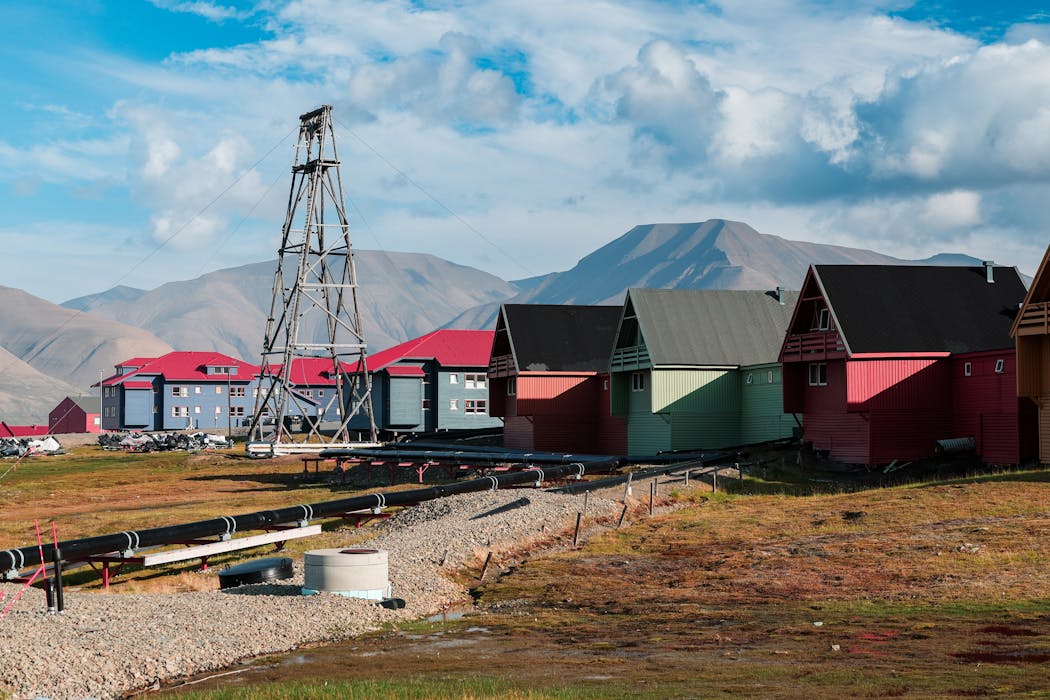
Le sous-sol du Groenland est riche. Mais peut-il être exploité dans de bonnes conditions économiques ? Sur la photo, une mine abandonnée. Dave Primov/Shutterstock

Le sous-sol du Groenland regorge de richesses, qui expliquent en partie la convoitise des États-Unis. Rien ne dit pourtant qu’il est possible pour le moment de les extraire, de les exploiter, puis de les exporter dans des conditions économiques satisfaisantes.


Les États-Unis renouent avec une rhétorique martiale concernant le Groenland. Les richesses naturelles de ce vaste territoire refont surface dans le débat, un an après que Michael Waltz, alors conseiller américain à la sécurité nationale, avait résumé l’enjeu ainsi : « Il est question de minéraux critiques. Il est question de ressources naturelles. »

Car l’île est dotée à la fois de combustibles fossiles et de matières premières essentielles. Elle possède au moins 25 des 34 matières premières considérées comme telles par l’Union européenne.

La loi européenne 2024 sur les matières premières critiques vise à améliorer la sécurité de l’approvisionnement européen pour ces matériaux. Le président des États-Unis, Donald Trump, comme l’UE souhaitent affaiblir la domination chinoise dans ce commerce. Parallèlement, d’immenses réserves de pétrole se trouvent au large dans l’est et l’ouest du Groenland. La valeur de ces ressources est difficile à estimer, car les prix du pétrole et des matières premières essentielles fluctuent énormément.


À lire aussi :
Donald Trump ou pas, le Groenland, futur pivot logistique arctique


Comme pour le pétrole vénézuélien, il faudra beaucoup d’argent pour construire les infrastructures nécessaires à l’exploitation des ressources naturelles au Groenland. Les projets miniers et de combustibles fossiles sont très consommateurs de capital, nécessitant d’importants investissements initiaux avec de longs délais avant que les projets ne génèrent des bénéfices.

Un manque de logistique portuaire

En dehors de sa capitale, Nuuk, le Groenland dispose de très peu d’infrastructures routières et de ports en eau profonde capables d’accueillir de grands pétroliers et des porte-conteneurs.

À travers le monde, les entreprises privées des secteurs minier et des énergies fossiles peuvent s’appuyer sur des infrastructures publiques – routes, ports, production d’électricité, logements et main-d’œuvre spécialisée – pour rendre leurs activités rentables.

Au Groenland, en revanche, d’énormes investissements en capital seraient nécessaires pour extraire la toute première cargaison de minerais et le premier baril de pétrole. Dans ce contexte, le gouvernement est confronté à un dilemme classique : laisser des multinationales privées exploiter les ressources au risque de perdre l’essentiel des revenus, ou bien imposer une propriété étatique tout en peinant à réunir les capitaux et les capacités publiques nécessaires pour lancer l’extraction.

Mines passées et présentes

La richesse minérale du Groenland est connue depuis longtemps. En avril 2025, le radiodiffuseur public danois DR a diffusé un documentaire montrant comment le Danemark avait, historiquement, capté les profits d’une mine de cryolite au Groenland. Cette émission avait provoqué une importante crise politique et médiatique, certains estimant qu’elle remettait en cause l’idée selon laquelle le Groenland serait financièrement dépendant du Danemark.

Les minerais constituent un enjeu majeur, mais aussi sensible, dans les relations du Groenland avec le reste du monde. Depuis des décennies, des entreprises étrangères tentent d’y développer une industrie minière viable… sans résultats probants. En réalité, contrairement aux affirmations du président américain Donald Trump, les entreprises américaines ont depuis longtemps la possibilité d’entrer sur le marché minier groenlandais. L’ampleur des investissements requis, conjuguée à des conditions climatiques extrêmement rigoureuses, a jusqu’à présent empêché toute entreprise de lancer une exploitation minière commerciale.

Dépendance à la pêche

La ministre groenlandaise des ressources naturelles Naaja Nathanielsen déclarait en 2025 souhaiter que l’exploitation minière devienne un « très bon complément stable » à la dépendance écrasante du pays à l’industrie de la pêche. Pourtant, en 2021, le nouveau gouvernement Inuit Ataqatigiit (d’orientation socialiste) groenlandais a interdit l’extraction de l’uranium pour des raisons environnementales. En 2023, l’entreprise australienne Energy Transitions Minerals (ETM) a poursuivi le Groenland et le Danemark pour un montant de 76 milliards de couronnes (environ 10 milliards d’euros), soit près de quatre fois le PIB du Groenland.

L’entreprise minière a affirmé avoir été privée de profits futurs après l’abandon de son projet d’uranium à Kuannersuit/Kvanefjeld. Les tribunaux danois ont rejeté la plupart des recours d’ETM, les jugeant infondés, et des inquiétudes ont été exprimées quant à la possibilité qu’ETM se déclare en faillite, ce qui lui permettrait potentiellement d’éviter le paiement de lourds frais de justice.

Dans un communiqué, ETM a affirmé que sa filiale GM avait « travaillé de bonne foi pendant plus d’une décennie, en étroite coopération avec les gouvernements groenlandais et danois ». L’entreprise a ajouté que ces deux gouvernements avaient utilisé GM pour promouvoir le Groenland comme une destination sûre pour les investisseurs miniers. Mais des travaux de recherche publiés en 2025 ont qualifié ce type de comportement de « victimisation feinte ». Il s’agit généralement de situations dans lesquelles des entreprises se perçoivent – ou se présentent – comme des victimes de procédures injustes, plutôt que comme des acteurs puissants avant tout soucieux de leurs profits.

Partage des profits

Forer dans le sous-sol groenlandais aurait des répercussions jusqu’à Copenhague, le Groenland ayant conclu avec le Danemark un accord de partage des profits miniers. Dans le cadre du transfert progressif de compétences du Danemark vers le Groenland, ce dernier détient désormais la propriété de ses ressources naturelles.

Toutefois, le Danemark verse chaque année une dotation globale de 3,9 milliards de couronnes (un peu plus de 500 millions d’euros) – soit environ la moitié du budget de l’État groenlandais – afin de soutenir l’économie intérieure, largement dominée par le secteur de la pêche.

Cette dotation est réduite à hauteur de 50 % des bénéfices miniers, ce qui signifie que, jusqu’à concurrence du montant de la subvention, les profits de l’exploitation minière sont en pratique partagés à parts égales entre le Groenland et le Danemark.

Récemment, le groupe australo-américain Critical Metals a obtenu l’autorisation de construire un bureau permanent pour son projet Tanbreez, destiné à fournir des terres rares – y compris des terres rares lourdes – dans le sud du Groenland.

Le lendemain, la société minière Amaroq a annoncé que les États-Unis envisageaient d’investir dans ses projets miniers dans le sud du Groenland par l’intermédiaire de l’EXIM, la banque américaine d’export-import. Si ce prêt public est approuvé, il s’agirait du premier financement accordé par l’administration Trump à un projet minier à l’étranger.

France 24, février 2025.

Cinq milliards de dollars

Un récent décret présidentiel de Donald Trump a par ailleurs réservé 5 milliards de dollars (4,2 milliards d’euros) au soutien de projets miniers jugés essentiels à la sécurité nationale. Cela illustre l’étroite imbrication entre les industries extractives et les enjeux militaires.

La production d’énergies fossiles, en revanche, a peu de chances de voir le jour à court terme. En 2021, pour des raisons environnementales, le gouvernement groenlandais a interdit l’exploration et l’exploitation des hydrocarbures. Une majorité parlementaire continue de soutenir cette interdiction.

Compte tenu de la volatilité des prix du pétrole et du gaz, et des mêmes contraintes climatiques et d’infrastructures que pour les autres ressources naturelles, une production d’hydrocarbures au Groenland paraît peu plausible, même en cas de prise de contrôle totale par les États-Unis.

Les raisons pour lesquelles l’administration Trump pourrait chercher à renforcer sa domination dans l’Arctique sont nombreuses, notamment pour accroître son avantage stratégique face à la Russie et à la Chine. Mais l’extraction des ressources naturelles est peu susceptible d’y jouer un rôle central.

D’autant plus que les États-Unis disposent déjà de bases militaires au Groenland, en vertu d’un accord de défense conclu avec le Danemark. Les initiatives états-uniennes récentes semblent ainsi s’inscrire dans un nouvel épisode du retour de leurs ambitions impérialistes.

The Conversation

Lukas Slothuus a reçu des financements de l’Engineering and Physical Sciences Research Council.

ref. Rien ne dit que les ressources naturelles du Groenland se transformeront en superprofits – https://theconversation.com/rien-ne-dit-que-les-ressources-naturelles-du-groenland-se-transformeront-en-superprofits-273908

Pourquoi les jeux de société sont-ils plus populaires que jamais ?

Source: The Conversation – in French – By Heike Baldauf-Quilliatre, analyse interactionnelles, interaction en situation de jeux, interaction avec des robots sociaux, interaction à travers des dispositifs technologiques, Université Lumière Lyon 2

Lors d’une banale partie de *Skyjo*, il se dit et se fait beaucoup de choses au prétexte du jeu. Isabel Colón de Carvajal, Fourni par l’auteur

Si l’on veut comprendre le jeu et sa place dans nos sociétés, il faut s’intéresser aux joueurs et à leurs interactions. Filmer les situations de jeu offre une lecture renouvelée qui en dévoile le potentiel d’expérimentation sociale.


Des rayons pleins, des ludothèques et magasins spécialisés, des associations, un festival international des jeux annuel en France, des revues scientifiques (Sciences du jeu, Board Games Studies Journal) et même un dictionnaire qui leur est consacré – les jeux sont loin d’être un simple passe-temps d’enfant. Et celui qui pense uniquement aux jeux vidéo ou aux jeux télévisés ou encore aux jeux d’argent, lorsqu’il est question des adultes, se trompe. Les jeux de société aussi occupent une place importante pour ces derniers.

Dans un article paru en 2021, Vincent Berry, sociologue et spécialiste du jeu, remarque une hausse continue du chiffre d’affaires dans ce secteur, un développement constant de nouveaux jeux et une hausse du temps consacré aux jeux en tant qu’activité de loisir. Mais que peut-on trouver dans cette activité pour qu’elle gagne autant en popularité ? Pourquoi des personnes de différents âges se réunissent-elles autour des jeux de société ?

Penser le jeu au cœur de la vie sociale

Un élément de réponse se trouve déjà dans cette dernière question. Le jeu est une activité sociale qui réunit des personnes, à travers les âges, autour d’une même activité. Cela ne va pas de soi, pour plusieurs raisons. D’une part, parce que le jeu n’est pas systématiquement lié à une activité ludique. Lorsqu’on est dans une situation de confrontation, ou en train de perdre, le jeu n’est pas principalement un plaisir. Le côté ludique est construit, par les joueurs et joueuses, pendant et à travers le jeu. Évidemment, le cadre du jeu favorise ce côté ludique, mais il ne l’implique pas obligatoirement.

D’autre part, le jeu n’existe pas en dehors de tout autre cadre ou activité sociale : on joue à la maison, dans un bar, au travail, en famille, entre collègues, avec des inconnus. Et, pendant qu’on joue, on boit, on mange, on répond au téléphone, on parle avec des gens qui passent, etc.

Enregistrer les situations de jeu

Si l’on veut comprendre le jeu et sa place dans nos sociétés, il faut donc s’intéresser au jeu en tant que tel, mais également aux joueurs et à ce qu’ils font dans une situation et à un moment précis. C’est sur ce point que débutent nos recherches.

Dans notre approche, on porte l’attention aux pratiques des joueurs et joueuses et on essaye de comprendre comment ils et elles construisent cette activité dans une situation sociale donnée. Pour cela, nous filmons et enregistrons des situations de jeu, dans leur cadre naturel. Les personnes qui jouent acceptent d’être filmées pendant des sessions de jeu de société, sans instruction particulière, dans des situations de jeu qui se seraient déroulées même sans l’enregistrement. Le tout sur la base d’un appel à une participation volontaire au projet de recherche.

Nous transcrivons par la suite tout ce que nous entendons et voyons, et analysons ces situations en prêtant attention à tous les détails (parole, gestes, mimique, manipulation d’objets). Nous nous appuyons sur la méthodologie de l’analyse conversationnelle, dont le but est de décrire comment nous organisons et construisons nos sociétés à travers les interactions.

Nous ne nous intéressons pas tant à ce que disent les personnes, mais plutôt à la manière dont elles agissent ensemble, les pratiques par lesquelles elles construisent leur activité. On peut ainsi observer comment les joueurs et joueuses construisent ensemble des (ou leurs) visions du monde, comment ils intègrent le jeu dans leurs pratiques du quotidien, comment ils (s’)expérimentent en transgressant des règles, en créant ou inversant des catégories. Nos différentes analyses apportent des briques d’éléments de réponse à la grande question : pourquoi les gens jouent-ils aux jeux de société ?

Apprendre, s’organiser et s’amuser

Différentes activités sociales sont associées au jeu. Autrement dit, que font les personnes lorsqu’elles jouent ? Dans nos données, qui contiennent essentiellement des jeux en famille et entre amis à la maison, ou bien entre collègues au travail, nous avons observé trois grands types d’activités : apprendre, s’organiser et s’amuser.

L’apprentissage dans un sens très large n’est pas limité aux jeux éducatifs ou aux enfants. En jouant, on se confronte à différentes visions du monde et on se construit en tant qu’individu et comme groupe, à travers des règles et des normes morales. Cela va de l’apprentissage de ce qui est accepté, souhaité ou recommandé dans un jeu particulier à la connaissance et aux pratiques sociétales de manière générale.

Dans l’extrait en ligne d’une famille jouant à Timeline Inventions, l’année de naissance de la mère a permis de construire des repères pour situer l’invention dans la ligne temporelle du jeu.

D’une part, les échanges autour de tout et de n’importe quoi permettent de découvrir d’autres façons de voir les choses, d’autres préoccupations, et ainsi d’élargir nos horizons. D’autre part, ces échanges participent à la construction discursive du groupe en tant que tel et, dans une perspective plus large, de nos sociétés. Pour donner un exemple, Emilie Hofstetter et Jessica Robles ont montré dans un article sur la manipulation stratégique dans le jeu, que les types de manipulation autorisés (jusqu’où peut-on aller pour gagner ?) sont constamment et négociés pendant le jeu sur la base de certaines valeurs d’équité et de moralité.

L’aspect organisationnel concerne la régulation du jeu, c’est-à-dire l’alternance des tours de jeu, le respect des règles, mais aussi la vie sociale qui se poursuit autour. Car, lorsqu’on joue, le monde ne s’arrête pas de tourner. Il y a des personnes et des activités autour des joueurs qui existent en dehors du jeu : d’autres personnes dans la même pièce, un téléphone qui sonne, des conversations entre certains joueurs, des activités parallèles comme manger et boire. L’analyse conversationnelle parle ici de multiactivité qui est gérée de différentes manières. Cependant, ce n’est pas la multiactivité en soi qui est recherchée dans le jeu, mais plutôt les possibilités qu’ouvre cette implication dans différentes activités :on ne joue pas pour pouvoir faire plusieurs activités en même temps, mais on utilise les opportunités qui s’offrent grâce à cela.

Ainsi, des activités parallèles permettent de gagner du temps dans le jeu ou bien, à l’inverse, le jeu permet d’adoucir une discussion sérieuse, un reproche ou une transgression des règles sociales du groupe. Par exemple, les pleurs d’une fille ouvrent pour les parents un moment éducatif tout en gardant le focus principal sur le jeu (et donc sur le plaisir partagé).

L’expérimentation de pratiques sociales peu appréciées, sans craindre de sanctions

Enfin, l’amusement paraît certainement le type d’activité le plus évident lorsqu’on parle du jeu. Nos données et nos analyses montrent de manière plus détaillée en quoi consiste cet amusement. Le jeu permet par exemple d’expérimenter des catégorisations sociales, bien évidemment en adossant des identités dans le jeu, mais également en jouant avec les ambiguïtés entre le monde du jeu et le monde des joueurs : être la princesse et donc solliciter l’aide des autres pour ranger ses cartes, être pauvre dans le jeu et dans la vie et demander de l’aide aux autres, être sérieux dans son rôle du jeu ou, au contraire, ne pas le prendre au sérieux et donc brouiller les pistes pour les autres.

Dans cet extrait en ligne, qui montre une partie du jeu Catane entre trois amis, Romain rappelle Marie à l’ordre pour ranger ses cartes. Elle refuse en se référant à ses cartes et en indiquant qu’une princesse a bien le droit de déléguer ces tâches.

Il permet aussi d’inverser les rôles entre parents et enfants (les enfants expliquent et applaudissent les parents), ou bien de jouer avec la compétition (renforcer le caractère compétitif ou bien collaboratif d’un jeu, indépendamment du type de jeu). Il permet d’expérimenter des pratiques sociales peu appréciées ou peu communes, sans la crainte d’une sanction sociale : dans le jeu, on peut se moquer des autres, on peut apprécier les attaques, et on peut même explicitement « détester » une personne présente, comme dans cet extrait en ligne, dans une partie de Splendor.

Cela ne situe pas le jeu en dehors du cadre social, comme on le pensait au début des études sur le jeu, mais comme un espace de la vie où l’on peut expérimenter.

Et si l’on n’aime pas le jeu ? Ce n’est évidemment pas bien grave. On le répète, le côté ludique n’est pas directement lié au jeu, on peut le trouver, le construire partout dans ses activités sociales. Faire du sport et même travailler peut également avoir des moments ludiques, autant que le jeu n’est pas ludique en soi. D’où notre intérêt pour les interactions qui permettent d’observer comment les joueurs et joueuses construisent ce côté ludique dans des situations concrètes.

The Conversation

Heike Baldauf-Quilliatre a reçu des financements de l’ENS de Lyon et du LabEx ASLAN (ANR).

Isabel Colon de Carvajal a reçu des financements de l’ENS de Lyon et du LabEx ASLAN (ANR).

ref. Pourquoi les jeux de société sont-ils plus populaires que jamais ? – https://theconversation.com/pourquoi-les-jeux-de-societe-sont-ils-plus-populaires-que-jamais-272919

La démocratie est-elle seulement une question de vérité ?

Source: The Conversation – France in French (3) – By Frank Chouraqui, Senior University Lecturer in Philosophy, Leiden University

Illustration tirée de l’édition par Ambroise et Jérôme Drouart, au XVII<sup>e</sup>&nbsp;siècle, du poème _Civitas veri sive morum_ (_la Cité de la vérité_), de Bartolomeo del Bene (1515-1595). University of Illinois

La crise de la démocratie est liée à une crise du rapport à la vérité mais aussi à une crise de sens, qu’il est important de distinguer de la première. La démocratie cherche à construire un monde porteur de sens, et pas seulement un univers de connaissances permettant la délibération. La rupture des liens sociaux, historiques ou culturels, qui donnent du sens à nos existences, est une aubaine pour les ennemis de la démocratie.


Nous sommes au cœur d’une crise de la vérité. La confiance dans les institutions publiques du savoir (les écoles, les médias traditionnels, les universités et les experts) n’a jamais été aussi faible, et des menteurs éhontés obtiennent des victoires politiques partout dans le monde. On pourrait penser que, collectivement, nous avons cessé de nous soucier de la vérité.

La fébrilité des démocrates face à cette crise repose en partie sur l’idée qu’il n’y a pas de démocratie sans vérité. Mais cette approche n’est pas sans conséquence. Surestimer la valeur de la vérité peut conduire à négliger d’autres exigences démocratiques, ce que ne manquent pas d’exploiter les ennemis de la démocratie. Les philosophes ont avancé plusieurs arguments en faveur d’un lien entre vérité et démocratie. Il semble que l’idée soit si répandue qu’on oublie de l’examiner : la démocratie représente tout ce que nous aimons, et la vérité en fait partie.

Mais il existe des manières plus sophistiquées d’exprimer cette conception. Le philosophe allemand Jürgen Habermas soutient qu’une démocratie en bonne santé possède une culture délibérative, et que la délibération exige des « prétentions à la validité ». Lorsque nous parlons de politique, nous devons nous donner la peine d’essayer de nous assurer que ce que nous disons est vrai.

Maria Ressa, journaliste philippine et lauréate du prix Nobel de la paix, soutient de manière similaire que la démocratie a besoin de la vérité parce que : « Sans faits, il ne peut y avoir de vérité. Sans vérité, il ne peut y avoir de confiance. Sans ces trois éléments, nous n’avons pas de réalité partagée, et la démocratie telle que nous la connaissons – ainsi que toute entreprise humaine porteuse de sens – disparaissent. »

Mais avons-nous vraiment besoin de la vérité pour partager la réalité ? En pratique, la plupart de nos expériences de réalités communes n’impliquent pas la vérité. Pensez aux mythes, au sentiment de voisinage, ou au sens de la communauté, peut-être même à la religion, et certainement à la réalité partagée ultime : la culture elle-même. On ne peut soutenir que nous partageons la culture de notre communauté parce qu’elle est vraie ou parce que nous la croyons vraie. Certains pourraient affirmer que la démocratie est liée à la vérité parce que la vérité serait en quelque sorte neutre : ceux qui cherchent à dire la vérité, contrairement aux menteurs ou aux populistes de l’ère de la post-vérité, doivent rendre des comptes. Ils sont soumis aux règles de la vérité. Concluons que le lien entre démocratie et vérité ne tient qu’à cela : la démocratie est sans doute plus liée à la responsabilité qu’elle ne l’est nécessairement à la vérité.

Une entreprise humaine porteuse de sens

Quoi qu’il en soit, le problème demeure : comme Ressa et Habermas le reconnaissent eux-mêmes, le but de la démocratie est de promouvoir des « entreprises humaines porteuses de sens ». La démocratie a pour vocation de construire un monde dans lequel les êtres humains peuvent vivre de manière pleinement humaine. Or, cela ne peut être assuré par la seule vérité. Une vie véritablement humaine exige non seulement la connaissance de faits concernant la réalité, mais aussi une compréhension subjective du monde et de la place que l’on y occupe. Nous oublions souvent que, bien qu’elles aillent fréquemment de pair, ces deux exigences peuvent aussi entrer en conflit. Cela tient au fait que la vérité relève des faits, tandis que le sens relève de la compréhension.

La compréhension, contrairement à la connaissance, relève de la manière dont nous regardons le monde, de nos habitudes de pensée et de nos constructions culturelles – principalement les identités, les valeurs et les institutions. Ces éléments remplissent leur fonction, qui est de nous faire sentir chez nous dans le monde, sans pour autant formuler la moindre prétention à la vérité. Selon la philosophe allemande Hannah Arendt, il s’agit là de la seule fonction de la politique, proprement entendue.

Trop souvent, l’esprit démocratique disqualifie ces éléments en les réduisant à des préjugés et à des superstitions. L’association populaire entre démocratie et vérité conduit à une dévalorisation du domaine du sens, qui demeure le but d’une politique humaniste. C’est ce qu’ont bien vu nombre de critiques de la modernité et du capitalisme quand ils critiquent la tendance des démocraties modernes à se soumettre a une « raison instrumentale » qui privilégie le prouvable sur le valable.

Les défenseurs de la vérité démocratique feraient bien de se souvenir que la démocratie cherche à construire un monde porteur de sens, et pas seulement un univers de connaissances arides et de recherche factuelle. L’actualité montre que négliger ce principe implique de lourdes conséquences politiques. L’insistance sur la vérité et la dévalorisation du sens ont conduit à la dépression moderne bien connue, souvent décrite comme un sentiment d’aliénation – une rupture des liens sociaux, historiques et traditionnels. Et cela a des répercussions politiques. Car le valable prendra sa revanche sur le prouvable, au risque de le sacrifier. C’est ce que l’on observe sous le néologisme de post-vérité ; un humanisme monstrueux et tordu mais qui trouve son succès dans le faiblesses de l’association entre démocratie et vérité. Car cette aliénation a également constitué un terrain fertile pour les populistes et les antidémocrates qui prétendent répondre à la crise du sens. Ce n’est pas un hasard si les thèmes récurrents du populisme contemporain sont ceux de l’appartenance, de la tradition, de l’identité, des origines et de la nostalgie.

Nous traversons une crise de la vérité, mais nous sommes aussi confrontés à une crise du sens. Lorsque nous accordons une importance excessive à la vérité au détriment du sens, nous nourrissons un sentiment d’aliénation et livrons les citoyens aux mains des ennemis de la démocratie. Nous ferions bien de construire nos démocraties en gardant à l’esprit que l’attachement à la vérité n’est qu’une condition parmi d’autres – et très partielle – d’une vie véritablement humaine.

The Conversation

Frank Chouraqui est membre (non actif) du parti politique néerlandais Groenlinks-PvdA (centre gauche).

ref. La démocratie est-elle seulement une question de vérité ? – https://theconversation.com/la-democratie-est-elle-seulement-une-question-de-verite-273685

Russia’s drone pipeline: How Iran helps Moscow produce an ever-evolving unmanned fleet

Source: The Conversation – Global Perspectives – By Amy McAuliffe, Visiting Distinguished Professor of the Practice, University of Notre Dame

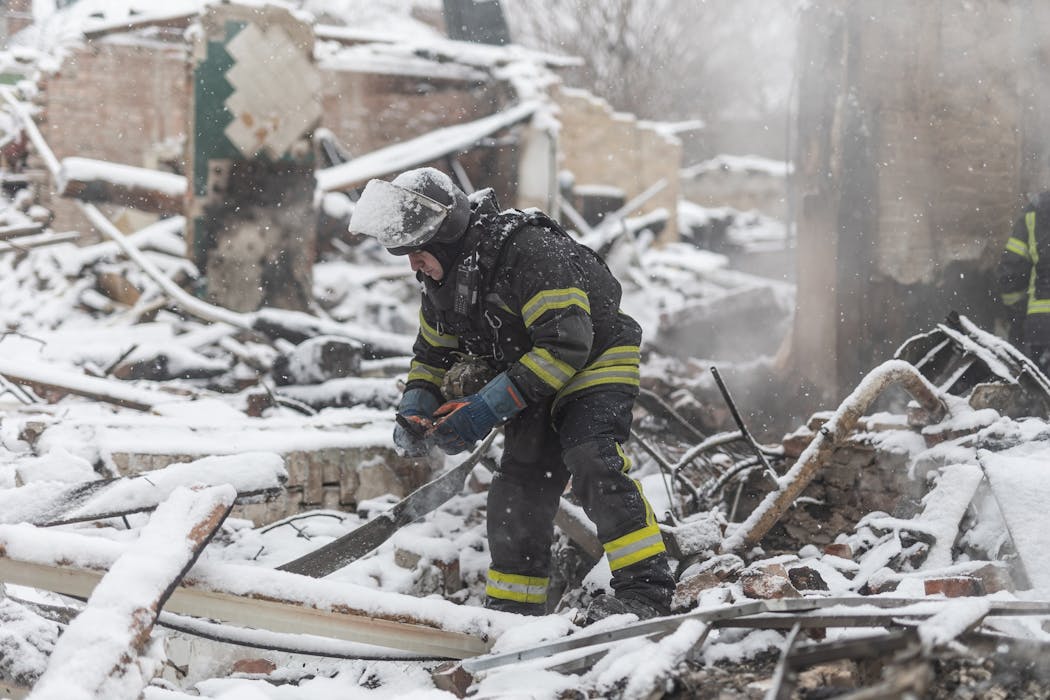
Ukrainian firefighters extinguish a fire in a house after it was hit by a Russian drone on Jan. 15, 2026. Diego Herrera Carcedo/Anadolu via Getty Images

With Russian ground troops bogged down in a grinding war of attrition, Moscow is striving to press home its advantage in the skies – through an ever-evolving army of drones, courtesy of Iran.

In early January, wreckage of a drone found in Ukraine hinted at a new high-speed model of drone being deployed by Russia in the conflict. It prompted Ukraine President Volodymyr Zelenskyy to air fears over failing to keep pace. “We produce (drones) at about 1,000 a day. We really produce them, but it’s not enough. It’s still not enough,” he told an audience of political business leaders at the World Economic Forum on Jan. 22, 2026.

Ukrainian intelligence suggests that Moscow, too, will also soon be pumping out 1,000 drone units a day, in large part thanks to the support and technical assistance of Iran. A central concern for Ukraine is Russia’s increasing production of long-range attack drones that it has used in mass attacks to strike targets in Ukraine.

Tehran’s role in supplying Russia with hundreds of long-range, kamikaze-style drones is long known. But what has gone largely unnoticed outside Ukraine is Iran’s central role in teaching Russia to produce these drones itself.

As an expert on weapons technology and former assistant director of the CIA for weapons and counterproliferation, I believe use of Iranian technology has helped Russia develop a fleet of sophisticated drones able to erode Ukrainian air defenses and strain the country’s resolve. By doing so, Moscow is able to preserve more expensive missiles for long-range precision strikes.

Designed in Iran, produced in Russia

Both Ukraine and Russia have ramped up drone production since the beginning of the current conflict in February 2022.

Russia was initially unable to produce large numbers of kamikaze drones, and the country’s military seemingly did not at first understand the decisive role long-range strike drones could play. Instead, Moscow invested in traditional battlefield weapons, such as missiles. It mainly thought of drones as carrying out the roles of intelligence, reconnaissance and surveillance.

Tehran had the expertise Russia needed. It also had an existing defense relationship with Russia. Moreover, faced with a cash-strapped economy due to yearslong sanctions, Iran needed money.

Since probably about early 2022, Tehran has been providing drones and drone technology to Russia for use in Ukraine. Later that year, Russia and Iran signed the agreement to set up a production plant in Russia for Iranian-designed attack drones.

With Iranian blueprints and technology, a production plant in Tatarstan in western Russia now produces large numbers of drones originally designed by Iran. At this factory, Russia manufactures the Geran-2, Moscow’s name for the Iranian Shahed-136 strike drone.

Easily identifiable by its delta-wing shape, the drone has optimized certain design features, such as range, endurance and weight capacity. It can carry an estimated 90 to 110 pounds of explosives hundreds of miles.

Meanwhile, the delta-wing design optimizes precision diving, helps prevent stalling at low speeds, and increases the drone’s stability during the attack phase.

These features enable targeting of strategic infrastructure at much less cost than long-range missiles.

Two men look over a winged aerial vehicle
Remains of a Russian drone in Vinnytsia Oblast on March 18, 2024.
National Police of Ukraine/Wikimedia Commons, CC BY-SA

Russia can now produce hundreds of one-way Geran-2 attack drones a day. It may soon be able to launch thousands in salvos.

Russia is also modifying and enhancing the drones with features such as precise navigation, heavier warheads and new engines.

Some reports claim Russia is testing telemetry and video links to fly drones remotely, a significant improvement over its current preprogrammed design that would improve accuracy and range. Iran also supplied Russia with technology to build a jet-powered drone variant based on the Shahed-238 that can fly faster.

Called the Geran-3, Russia has produced and used fewer of these drones, whose jet power makes them more challenging for Ukrainian air defense to detect and intercept. New generations of the drone – Geran-4s and Geran-5s – have since been rolled out and apparently deployed in the war with Ukraine.

Sanctions-busting procurement

Even with the blueprints and Iranian assistance, Russia is still reliant on Western and Chinese suppliers for some drone components, many of them commercial, off-the-shelf technology. These include the engine, fuel pump, GPS and navigation systems, semiconductors and components for antennas.

To assist Russia, Iran exploits its networks of brokers and companies in acquiring Western components to evade international sanctions.

A procurement network headed by the Iranian company Sahara Thunder used shipping firms in the UAE and India to sell Russia the original Iranian drones and components and to negotiate the deal for the production plant.

The U.S. Treasury Department has sanctioned this firm and others involved in the drone sales, but Iran set up new companies to help Moscow acquire components. Multiple studies and reports documenting the inclusion of foreign components in downed Geran-2s show Moscow’s continued acquisition of these parts, almost certainly with Iranian assistance.

A weapon of terror

Russia uses the Geran and other longer-range Iranian and Russian models to purposefully target civilians and civilian infrastructure in Ukraine, including residential housing in Ukrainian cities. Russia has even targeted first responders and humanitarian distribution points, according to a United Nations account.

In fact, the U.N. concluded in October 2025 that Russia’s use of short-range, unmanned aerial vehicles against civilians in southern Ukraine constituted a crime against humanity and a war crime.

An explosion is seen with smoke around it.
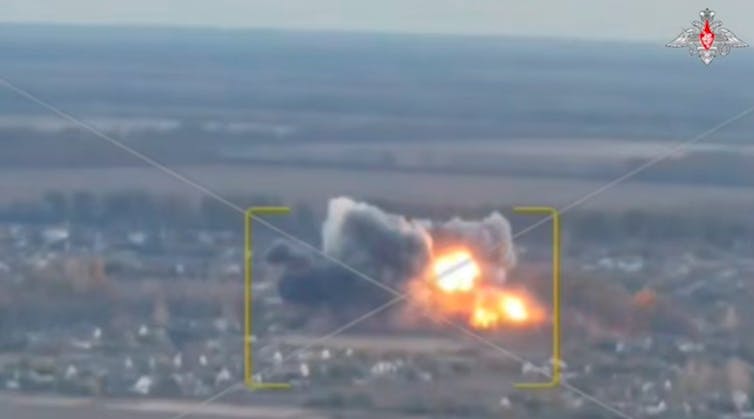
A screen grab from a video shows Russian strikes in the Kharkiv region of Ukraine on Dec. 23, 2025.
The Russian Ministry of Defense/Anadolu via Getty Images

A two-day attack in May 2025 on the Ukrainian cities of Kharkiv in the northeast and Odessa in the south highlights the destructive power and human cost of the drone attacks. According to accounts in the Kyiv Post, Russia launched over 100 drones. In Kharkiv, three blocks were burned down, including 90 shops, and two people were injured. In Odessa, the drones killed one person and damaged residential buildings.

Beyond psychologically tormenting the Ukrainian population, these drones have a profound effect on the battlefield.

Ukraine has responded to Russia’s battlefield success with the Iranian-designed drones by diversifying the types of drones it manufactures, attacking Russian infrastructure for manufacturing drones and developing counter-drone technologies.

A mutually beneficial arrangement

Iran also benefits from this terror campaign. Reeling from the economic impact of sanctions, Iran will make an estimated US$1 billion to $1.75 billion from the deal for drones and the production facility. Russia is reportedly paying Iran a portion of the bill in gold.

A screen shows flying vehicles.
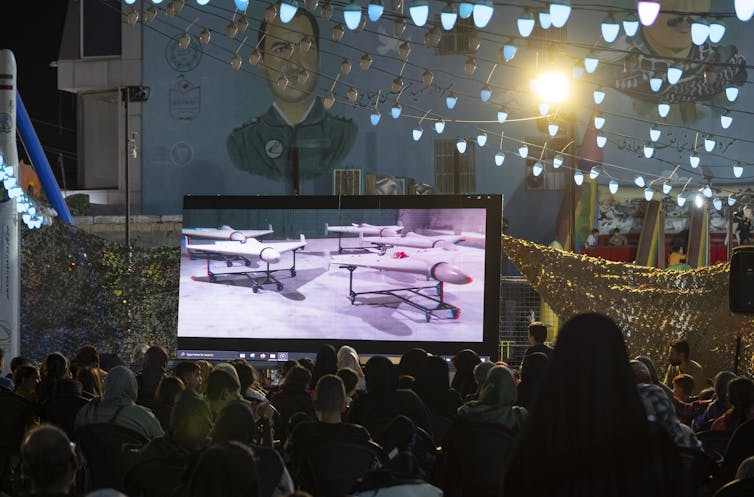
Iranian families watch a video clip of Iranian-made unmanned aerial vehicles during a ceremony commemorating the 45th anniversary of the Iran-Iraq war in Tehran on Sept. 25, 2025.
Morteza Nikoubazl/NurPhoto via Getty Images

Iran is unlikely to stop its assistance anytime soon, given its own economic problems. Helping Moscow obtain drone components and even modify new versions of the Geran-2 will also benefit Iran militarily as it, too, learns to make the new drones and use them itself.

But the main beneficiary of this relationship is Moscow. Without Iranian support, Russia would face more difficult trade-offs on the battlefield. The lower-cost drones allow Russia to preserve its expensive advanced missiles for the most significant targets in Ukraine and to employ large swarms of drones to target Ukrainian infrastructure.

And with the ground offensive yielding little progress of late for Moscow, that could be crucial as the war enters its fifth year.

The Conversation

Amy McAuliffe does not work for, consult, own shares in or receive funding from any company or organization that would benefit from this article, and has disclosed no relevant affiliations beyond their academic appointment.

ref. Russia’s drone pipeline: How Iran helps Moscow produce an ever-evolving unmanned fleet – https://theconversation.com/russias-drone-pipeline-how-iran-helps-moscow-produce-an-ever-evolving-unmanned-fleet-272016

Tanzania is losing fertile land to soil erosion: what’s happening and what can be done

Source: The Conversation – Africa – By Maarten Wynants, Marie Curie Global Postdoctoral Fellow, Ghent University

Across large parts of northern Tanzania, gully erosion – soil erosion caused by flowing water – is cutting deep scars through fertile farmland, grazing areas, roads and even villages. These gullies grow faster every year and what was once a slow environmental process has accelerated into a humanitarian threat. It has serious consequences for food and livelihood security, infrastructure and biodiversity.

Soil erosion is a natural process. Rainfall breaks soil into particles, and flowing water transports them downslope into rivers and lakes. In Tanzania, however, erosion has intensified dramatically over the past 120 years.

The region’s steep terrain, highly variable rainfall and fragile volcanic soils make it naturally vulnerable. What has turned this into a crisis is the change in how people interact with the land.

The Jali Ardhi (Swahili for “Care for the Land”) programme is an international collaboration of scientists from several universities. We use interdisciplinary tools to investigate what’s causing increased soil erosion and how communities can restore the land. Results from multiple projects over a decade point to runaway gully erosion as a key driver of land degradation in Tanzania. Urgent and widespread restoration programmes are needed.


Read more:
Soil erosion is tearing DRC cities apart: what’s causing urban gullies, and how to prevent them


From fertile volcanic soils to runaway gully erosion

The Tanzanian highlands are blanketed by soils formed from volcanic basalt erupted over millions of years as the East African Rift opened. These volcanic soils are rich in fine clay minerals with high levels of exchangeable sodium and calcium. Contact with water after a dry period can cause them to rapidly disperse into fine particles in the water.

Normally, these soils are covered by a stable topsoil layer protected by plant cover, roots and soil organic carbon. But land clearing – the removal of natural vegetation for agricultural purposes – and overgrazing remove the natural protection of these soils and increase runoff. When intense rainfall follows, water rapidly flows downhill, concentrating in valleys and carving out gullies.

Indigenous land conservation practices such as seasonal grazing and shifting cultivation recognised this vulnerability by allowing the vegetation and soil to recover. However, these were gradually eroded by colonial and postcolonial governance, which prioritised formal land tenure and permanent settlement but paid little attention to soil productivity and protection from erosion. In the meantime, Tanzania’s population has been growing fast, doubling roughly every 25 years for the past century, and is now exceeding 70 million.

Large areas of natural forests and savannahs have been cleared for agriculture. Pastoralist groups, such as the Maasai, were forced into permanent settlements, replacing their traditional practice of moving livestock seasonally to follow rainfall and fresh pasture. Livestock densities have tripled over the past half century and areas that were once allowed to recover are now farmed and grazed year-round, leaving soils permanently exposed to the elements.

Rainfall in these regions is naturally erratic, alternating between dry spells and wet years. We have not observed a long-term change in rainfall but wet conditions following drought can trigger massive erosion events.

Together, these pressures pushed the landscape past a critical threshold. Once gullies form in these volcanic soils, they are difficult to stop. Like a boulder pushed downhill, erosion accelerates once it starts. Gullies can continue growing even if the original trigger, such as deforestation or overgrazing, has ended. They form highly connected channels that quickly remove rainfall, nutrient-rich topsoil, and seeds away from the land. This makes it difficult for vegetation to recover and the landscape to stabilise.

The cost of losing land

We calculated that the erosion rates in Tanzania are about 20 times higher than they were a century ago. Over 50% of the total area of Tanzania is experiencing rapid land degradation. It is one of the fastest degrading areas in the world.

When land is lost to erosion, so too is food and income. Since roughly 70% of Tanzanians are smallholder farmers and they produce most of the country’s food intake, over 50% of the population has already experienced moderate to severe food insecurity. The consequences are potentially disastrous.

To make matters worse, we saw from repeat visits and photographs that these mega gullies undercut roads and bridges as quickly as a decade after construction. This is an enormous loss in a country working to develop basic services. Farmers tell us that they are cut off from market access and are forced to grow less-perishable or subsistence crops such as maize and beans, instead of higher-value agricultural production. This reinforces low-income and low-investment cycles.

The effects do not stop here, though.

Eroded sediments fill reservoirs and lakes, threatening water availability, fisheries, biodiversity and tourism. We found that Lake Manyara National Park, a Unesco Man and Biosphere Reserve, is filling up due to the enormous amounts of sediment coming from its catchment. This places pressure on an ecosystem that supports more than 350 bird species as well as iconic wildlife such as elephants and lions.

Working together to join the cracks

Despite the scale of the problem, solutions do exist. Across east Africa, communities have long used indigenous techniques such as earth bunds (banks), stepwise terraces, leaky dams, and re-establishment of grasses and trees. These work with natural processes and materials to slow water flow and capture soil.

NGOs such as the LEAD foundation and Justdiggit are revitalising these community-led approaches. We set up a soil and gully monitoring network combining scientific sampling and sensor technology with citizen science approaches to evaluate the evolution of gullies and success of restoration approaches.

In some cases, collective community action has successfully stabilised small gullies and improved soil quality. But many mega gullies are now too large for resource-poor communities to address alone. While the Tanzanian government has committed to the United Nations Convention to Combat Desertification’s Land Degradation Neutrality initiative, long‑term investment and action plans are lacking. This is partly due to the mismatch between national politics and local action needs.


Read more:
Key insights into land degradation from seven African countries


Ultimately, erosion control cannot be treated as a solely environmental problem. Halting this crisis will require coordinated and large-scale land restoration investment, while simultaneously addressing socio-economic issues linked to poverty, corruption, education and economic development. More than half of Tanzanians are under 18, growing up on landscapes already under strain. Whether these systems can continue to support a growing population will require action before the cracks in the earth widen any further.

The Conversation

Maarten Wynants receives funding from the European Union Marie Sklodowska Curie Fellowship – AsFoRESEEN – 101109315, and from the VLIR-UOS short initiative ‘From Monitoring to Managing Soil and Water Degradation in Tanzanian Gullies’.

ref. Tanzania is losing fertile land to soil erosion: what’s happening and what can be done – https://theconversation.com/tanzania-is-losing-fertile-land-to-soil-erosion-whats-happening-and-what-can-be-done-273283

Not all mindfulness is the same – here’s why it matters for health and happiness

Source: The Conversation – USA (3) – By Ronald S. Green, Professor and Chair of the Department of Philosophy and Religious Studies, Coastal Carolina University

Mindfulness practices can take many forms, depending on tradition and intention. Dingzeyu Li dingzeyuli via Wikimedia Commons, CC BY

Over the past two decades, the concept of mindfulness has become hugely popular around the world. An increasingly ubiquitous part of society, it’s taught everywhere from workplaces and schools to sports programs and the military.

On social media, television and wellness apps, mindfulness is often shown as one simple thing – staying calm and paying attention to the moment.

Large companies like Google use mindfulness programs to help employees stay focused and less stressed. Hospitals use it to help people manage pain and improve mental health. Millions of people now use mindfulness apps that promise everything from lowering stress to sleeping better.

But as a professor of religious studies who has spent years examining how mindfulness is defined and practiced across different traditions and historical periods, I’ve noticed a surprising problem beneath the current surge of enthusiasm: Scientists, clinicians and educators still don’t agree on what mindfulness actually is – or how to measure it.

Because different researchers measure different things under the label “mindfulness,” two studies can give very different pictures of what the practice actually does. For someone choosing a meditation app or program based on research findings, this matters.

The study you’re relying on may be testing a skill like attention, emotional calm, or self-kindness that isn’t the one you’re hoping to develop. This makes it harder to compare results and can leave people unsure about which approach will genuinely help them in daily life.

From ancient traditions to modern science

Mindfulness has deep roots in Buddhist, Hindu, Jain, Sikh and other Asian contemplative lineages. The Buddhist “Satipatthana Sutta: The Foundations of Mindfulness” emphasizes moment-to-moment observation of body and mind.

The Hindu concept of “dhyāna,” or contemplation, cultivates steady focus on the breath or a mantra; Jain “samayika,” or practice of equanimity, develops calm balance toward all beings; and Sikh “simran,” or continuous remembrance, dissolves self-centered thought into a deeper awareness of the underlying reality in each moment.

In the late 20th century, teachers and clinicians began adapting these techniques for secular settings, most notably through mindfulness-based stress reduction and other therapeutic programs. Since then, mindfulness has migrated into psychology, medicine, education and even corporate wellness.

It has become a widely used – though often differently defined – tool across scientific and professional fields.

Why scientists disagree about mindfulness

In discussing the modern application of mindfulness in fields like psychology, the definitional challenge is front and center. Indeed, different researchers focus on different things and then design their tests around those ideas.

Some scientists see mindfulness mainly in terms of emphasizing attention and paying close attention to what’s happening right now.

Other researchers define the concept in terms of emotional management and staying calm when things get stressful.

Another cohort of mindfulness studies emphasizes self-compassion, meaning being kind to yourself when you make mistakes.

And still others focus on moral awareness, the idea that mindfulness should help people make wiser, more ethical choices.

These differences become obvious when you look at the tests researchers use to measure mindfulness. The Mindful Attention Awareness Scale, or MAAS, asks about how well someone stays focused on the present moment. The Freiburg Mindfulness Inventory – FMI – asks whether a person can notice thoughts and feelings as they come and accept them without judgment. The Comprehensive Inventory of Mindfulness Experiences – CHIME – adds something most other tests leave out: questions about ethical awareness and making wise, moral choices.

As a result, comparative research can be tricky, and it can also be confusing for people who want to be more mindful but aren’t sure which path to take. Different programs may rely on different definitions of mindfulness, so the skills they teach and the benefits they promise can vary a lot.

This means that someone choosing a mindfulness course or app might end up learning something very different from what they expected unless they understand how that particular program defines and measures mindfulness.

Why different scales measure different things

John Dunne, a Buddhist philosophy scholar at the University of Wisconsin–Madison, offers a helpful explanation if you’ve ever wondered why everyone seems to talk about mindfulness in a different way. Dunne says mindfulness isn’t one single thing, but a “family” of related practices shaped by different traditions, purposes and cultural backgrounds.

Three women sit on yoga mats, eyes closed, palms resting over their hearts in meditation.
Mindfulness isn’t just one thing, and that is why its practice can look different.
FG Trade Latin/E+ via Getty Images

This explains why scientists and people trying to be mindful often end up talking past each other. If one study measures attention and another measures compassion, their results won’t line up. And if you’re trying to practice mindfulness, it matters whether you’re following a path that focuses on calming your mind, being kind to yourself, or making ethically aware choices.

Why this matters

Because mindfulness isn’t just one thing, that affects how it’s studied, practiced and taught. That’s important both at the institutional and individual level.

Whether for places like schools and health care, a mindfulness program designed to reduce stress will look very different from one that teaches compassion or ethical awareness.

Without clarity, teachers, doctors and counselors may not know which approach works best for their goals. The same rough idea applies in business for organizational effectiveness and stress management.

Despite the disagreements, research does show that different forms of mindfulness can produce different kinds of benefits. Practices that sharpen attention to the moment are associated with improved focus and workplace performance.

Approaches oriented towards acceptance tend to help people better manage stress, anxiety and chronic pain. A focus on compassion-based methods can support emotional resilience. Programs that emphasize ethical awareness may promote more thoughtful, prosocial behavior.

These varied outcomes help explain why researchers continue to debate which definition of “mindfulness” should guide scientific study.

For anyone practicing mindfulness as an individual, this is a reminder to choose practices that fit your needs.

The Conversation

Ronald S. Green does not work for, consult, own shares in or receive funding from any company or organization that would benefit from this article, and has disclosed no relevant affiliations beyond their academic appointment.

ref. Not all mindfulness is the same – here’s why it matters for health and happiness – https://theconversation.com/not-all-mindfulness-is-the-same-heres-why-it-matters-for-health-and-happiness-264096

Trump’s framing of Nigeria insurgency as a war on Christians risks undermining interfaith peacebuilding

Source: The Conversation – USA (3) – By Aili Mari Tripp, Vilas Research Professor of Political Science, University of Wisconsin-Madison

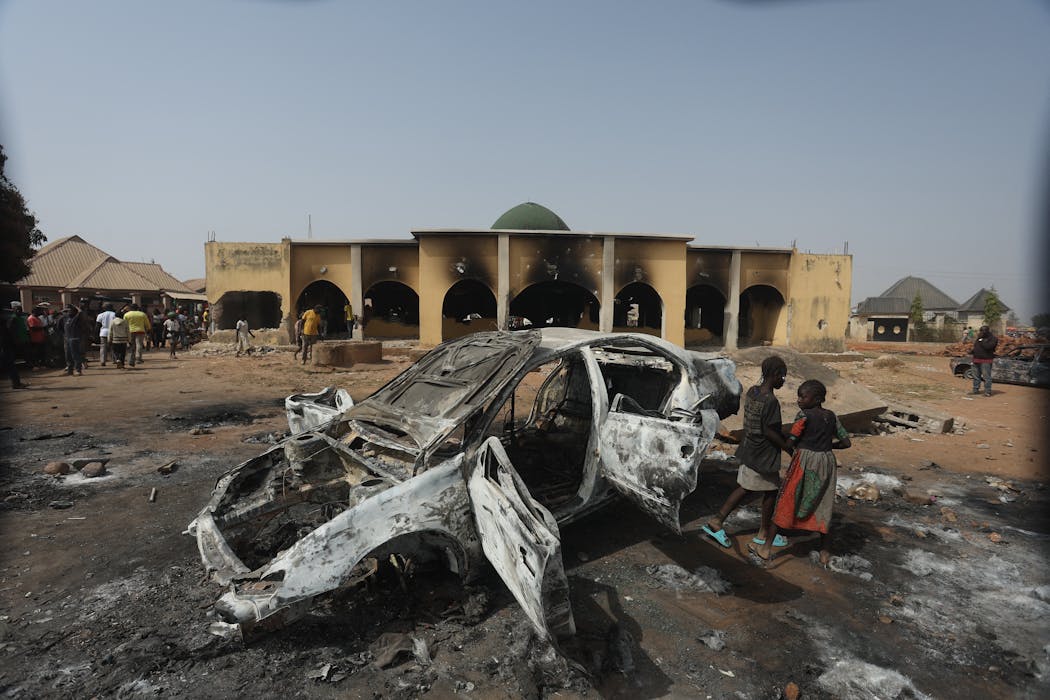
Mosques, as well as churches, in Nigeria are targets of insurgent groups.
Kola Sulaimon/AFP via Getty Images

Nigeria “must do more to protect Christians,” a senior U.S. State Department official demanded on Jan. 22, 2026, during a high-level security meeting in the African nation’s capital, Abuja.

The comment followed an attack just days earlier in which more than 160 worshipers were kidnapped from three churches in Nigeria’s northern Kaduna state.

The security meeting came a month after the United States, in cooperation with the Nigerian government, launched an airstrike from a U.S. Navy ship in the Gulf of Guinea on the northwest Sokoto state. During the Christmas Day incident, 16 Tomahawk missiles costing around US$32 million hit several locations the U.S. claimed were being used by extremist groups.

There were no verifiable casualties, although the strike did send a signal that the U.S. administration is willing to take military action when it is deemed necessary. President Donald Trump heralded the attack a “Christmas present” to Christians and later warned that there would be more strikes if the killings of Christians continued.

As a scholar of African politics, I know that calling the insurgency in Nigeria a persecution of Christians – as the U.S. administration has repeatedly done – is simplistic and ill-informed. Yes, Christians have been killed and kidnapped as part of the prolonged terrorism campaign by Boko Haram and other extremist groups. But so too have other groups in the country, including Muslims. Moreover, the religious identity of the victims masks other motives of the militant groups involved.

I recently carried out interviews in Maiduguri, Borno State – the epicenter of Boko Haram activities in northeast Nigeria – as part of research into interfaith efforts to counter threats from Islamic extremists. For many of those interviewed, the insurgency and violence have often served to unite Nigerians with different religious identities against a common enemy: the groups making their life a misery. The danger of Trump’s narrative of this being a war on Christians is that it could undermine such efforts to build cross-community trust.

A complex conflict

Since 2009 there have been 54,000 deaths related to the violence in Nigeria and the surrounding Lake Chad region, according to independent violence monitor ACLED.

The Christmas airstrike by the U.S. was in northwest Nigeria, targeting a small group of Lakurawa militants. But 85% of all incidents related to Islamic fighters in 2025 were in northeast Nigeria, according to ACLED.

Northern Nigeria is primarily populated by Muslims, in contrast to the whole of the country, whose 240 million people are split roughly 56%-43% between Muslims and Christians.

Many of those killed and abducted in the insurgency in the north have been Christian. But the exclusive focus on Christians by the U.S. administration overlooks the complex realities behind the violence in Nigeria, which incorporates not just extremist groups but also farmer-herder tensions, land and water disputes exacerbated by climate change, ethnic rivalries, poverty and organized criminal gangs referred to as “bandits.”

Boko Haram, which regards the Nigerian state as its main target, has killed both Christians and Muslims, as has the Ansaru, an al-Qaida affiliate. The Islamic State – West Africa Province, another major insurgency group, targets state forces and Christians.

While the most recent high-profile attacks have been on churches, Boko Haram also targets markets, mosques and homes. They are opportunistic attacks that don’t discriminate between Muslims and Christians.

To be sure, the Nigerian government’s response to the insurgency has been inadequate. But again, the reasons are complex and the result of a confluence of factors, including corruption in the security sector, negligence and the difficulty of targeting groups that employ guerrilla tactics outside of government control, which make them especially elusive. Political factors may also be at play, since elements within the Nigerian government may be complicit with northern politicians backing some of the land-grabbing and kidnapping bandits.

Even with these barriers, some progress has been made. According to the Africa Center for Strategic Studies, Boko Haram attacks have declined by 50% since 2014-2016, when they were most active, although rates have been increasing again since 2023.

Interfaith efforts

The Nigerian government itself has welcomed assistance from the U.S. targeting insurgents, but with the proviso that Nigeria’s sovereignty and territorial integrity be respected.

The concern is that military action on the part of the U.S. under the guise of protecting Christians in Nigeria could make matters worse. It risks exacerbating tensions within the country and giving credence to those in Nigeria and abroad who focus only on the killing of Christians for their own narrow purposes.

At the same time, it could undermine the efforts of civil society organizations and women’s associations, in particular, that have worked hard to build interfaith trust between Muslims and Christians to tackle the insurgency threat.

Some of these organizations, such as the Women of Faith Peacebuilding Network, have been at the forefront of the fight against militant groups. An interfaith movement founded in 2011, it now comprises over 10,000 Christian and Muslim women. It carries out vocational training and promotes interfaith dialogue and strategies to reduce conflict.

People stand in a street.
Residents gather near the scene of the explosion at a mosque in the Gamboru market in Maiduguri on Dec. 25, 2025.
Audu Marte/AFP via Getty Images

Following the abduction of over 300 schoolgirls by Boko Haram in Chibok, Borno State, in 2014, a coalition of women’s rights organizations – comprising both Christian and Muslim members – mobilized to protest the kidnappings.

The Federation of Muslim Women’s Associations in Nigeria, or FOMWAN, is another organization that is actively engaged in interfaith initiatives nationwide. In a January 2024 interview, a FOMWAN member based in Maiduguri told me that the Boko Haram crisis has united women across religious divides more than ever before.

Maryam, whose name I have changed along with other interviewees to protect their identity, explained: “FOMWAN has been in existence for many years before the insurgency. And in our activities we had been teaching our Muslim women religious tolerance in Borno. But the insurgency has made us put more efforts into making sure there is religious tolerance among Muslims and Christians.”

A Christian evangelist preacher, Mary, told me that working together had significantly reduced the mutual fear and mistrust between Muslims and Christians. Before the rise of Boko Haram, interfaith collaboration between the two groups was low. But today, she noted, it is far higher.

“We came to understand that this set of people doing this killing are neither Christian nor Muslim. They’re working for selfish interests, not for religious interests. We now strategize and come together to work as one. The key issue to (the conflict) is poverty. The only solution is for us is to speak with one voice. That’s the only way for us to survive.”

‘Each other’s keeper’

The U.S. administration would, I believe, do well to listen to the voices of these Christian and Muslim peacebuilders in northern Nigeria who live with the daily threat of violence.

Their lived experience has informed an approach to Nigeria’s insurgency based on shared purpose that cuts across religious divides.

In the words of activist Mama Pro, when asked why she was so keen to build interfaith bridges in Northern Nigeria: “We are always each other’s keeper.”

The Conversation

Aili Mari Tripp receives funding from National Science Foundation.

ref. Trump’s framing of Nigeria insurgency as a war on Christians risks undermining interfaith peacebuilding – https://theconversation.com/trumps-framing-of-nigeria-insurgency-as-a-war-on-christians-risks-undermining-interfaith-peacebuilding-272418

Life in fossil bones: what we can learn from tiny traces of ancient blood chemicals

Source: The Conversation – Africa (2) – By Timothy G. Bromage, Professor, New York University

Blood tests are useful tools for doctors and scientific researchers: they can reveal a lot about a body’s health. Usually, a blood sample is taken to get a picture of the large molecules that are present, such as cholesterols, lipids and proteins. This is called a metabolic profile.

For more specific information, another kind of blood test looks at the tiny traces of chemical processes taking place at tissue, organ, and even cellular levels. This fine-scale kind of test, metabolomics, studies metabolites – the by-products of metabolism (the body’s way of producing energy and recycling chemicals).

You’d never think this kind of test could be done for animals that lived millions of years ago. But what was very recently science fiction is now reality: it’s called “palaeometabolomics”.

Why would anyone want to know about the metabolites of long-dead creatures?

Metabolites are a way for scientists like me (a biological anthropologist) to learn more about the health, diet, environment and evolution of those creatures – including early humans.

What makes this possible is the way bones are formed: by special cells secreting a soft matrix – mainly collagen – that later crystallises and hardens into a porous material.

Metabolites in the blood that leak from blood vessels during bone formation are so tiny that they become trapped inside the bone matrix (the material that makes up bone) as it hardens. The spaces where they are trapped are so small (nanometre in scale) that bacteria and fungi, which are much bigger, can’t always get in there. Not even in a million years. And because bone mineral structures at these fine scales contain minute traces of water, metabolites are preserved there in fossils.

Studying the metabolites in animal fossils has given us a new way to discover more about the environment at sites where early humans evolved.

My colleagues and I looked at rodent fossils from Olduvai Gorge in Tanzania (about 1.8 million to 1.7 million years old); elephant tooth fossil material from the Chiwondo Beds in Malawi (2.4 million years old); and an antelope bone fossil from Makapansgat in South Africa (about 3 million years old). Fossils of ancient relatives of humans (species of Australopithecus, Paranthropus, and early Homo) have also been found at these sites.

For 100 years, scientists have devised methods for reconstructing the environment that early humans lived in and adapted to. Until now, these methods depended mainly upon geological clues and the kinds of animal and plant fossils found at a site. Now, by performing palaeometabolomics – especially by analysing the chemical traces left in animal bones by the plants that the animals ate – we have established a “molecular ecological” approach for describing ancient habitats.

This new method can add very specific information to other kinds of reconstructions. The metabolites allow us to describe soil pH, minimum and maximum rainfall and temperature, the type of tree cover, and elevations above sea level of plants.

We also made a surprising finding about the relationship between soil and living things.

How to give a fossil a blood test

To perform palaeometabolomics, we established a method to dissolve bits of bone no larger than a pea in a tube containing weak acid. The acid is strong enough to slowly pass the mineral into a solution, but weak enough not to degrade the metabolites. This take several days. We then let the large proteins sink to the bottom of the tube and spin it at high speed in a centrifuge, which leaves the smallest and lightest molecules at the top. We inject the metabolite “soup” into a mass spectrometer, a piece of equipment designed to measure the weights of all small molecule compounds, and refer these to a library of known masses. That’s how we identify the metabolites.

The ones generated within the body – “endogenous” metabolites – offer clues about the health and well-being of an animal. That’s interesting enough, but it’s not the full picture.

All living organisms produce metabolites, including plants. Plants also have metabolisms reflecting their physiological adaptations to the environment. If an animal eats a plant, metabolites of that plant circulate through the animal’s bloodstream and are also trapped at developing bone surfaces. These are called “exogenous” metabolites, and they tell us about the diet of the animal.

What was just interesting now becomes remarkable, because if we can identify the plant that a metabolite came from, we should also be able to reconstruct the environment the plant was adapted to.

What the body says about the bigger picture

The endogenous metabolites we identified from our fossils depict a variety of normal mammalian biological functions and disease states. The exogenous metabolites provide evidence of the environment in the distant past.

For instance, some of our fossil samples had a metabolite derived from the parasite that causes sleeping sickness in humans after a bite from an infected tsetse fly. Wild animals are tsetse fly reservoirs for the parasite. Tsetse flies have very specific environmental conditions, so that helped our reconstructions.


Read more:
Tooth enamel provides clues on tsetse flies and the spread of herding in ancient Africa


We also identified plant metabolites which implied that the Tanzanian and South African sites were wetter than they are now. Minimum temperatures were warmer, and the landscape contained more forest shade. It seems to have been a mixed, seasonally dry and wet tropical habitat. The reconstructed conditions of the Malawi site indicate a wetter environment, also with wet and dry seasons.

Reading the soil

There was one particularly interesting surprise.

Going into this study, we assumed that metabolites from ancient soils surrounding the fossils – known as palaeosols – should be considered contaminants and be disregarded from our analyses. But when we analysed metabolites of modern animals of the same fossil species living near the sites, whose bones never touched the soil, we found that both the modern and fossil animals shared large percentages of the palaeosol metabolites.

This means that the palaeosol reflects the lives of all the organisms living there. Once plants and animals live on that soil, their metabolites become a part of the soil matrix. The animals and the soil are completely connected by shared metabolites, which represent the flow of materials that sustain the habitat. They are not contaminants to be disregarded.

Our biomolecular approach – using metabolites from fossil bones and teeth as a way to reconstruct ancient environments – is a new one. It might one day make it possible to describe past habitats as precisely as we can describe modern ones.

The Conversation

Timothy G. Bromage receives funding from The Leakey Foundation.

ref. Life in fossil bones: what we can learn from tiny traces of ancient blood chemicals – https://theconversation.com/life-in-fossil-bones-what-we-can-learn-from-tiny-traces-of-ancient-blood-chemicals-273906

The end of ‘Pax Americana’ and start of a ‘post-American’ era doesn’t necessarily mean the world will be less safe

Source: The Conversation – USA – By Peter Harris, Associate Professor of Political Science, Colorado State University

President Donald Trump’s America First policies have reshaped the nation’s stance regarding global security and trade. AP Photo/Evan Vucci

America’s role in the world is changing. If this wasn’t obvious before, it should be now, following President Donald Trump’s efforts to take over Greenland and his visibly strained relations with traditional allies in Europe and elsewhere.

But how much will the world change if America’s stance is different?

Some scholars of international relations argue that because Washington has been central to global governance for so long, Trump’s “America First” turn – suggesting isolationism on some issues and unilateral action on others – spells the end of the international order as we’ve known it.

The most pessimistic analysts caution that the era of “Pax Americana,” or the long period of relative world calm since World War II due to U.S. leadership, is coming to a close. They forecast a turbulent transition to a more chaotic world.

This view may well prove correct in the long run. But it is too early to say with confidence. As a scholar who studies U.S. foreign policy, I see some grounds for optimism. The world can become a more just, stable and secure place despite the diminishment of American leadership.

For the remaining three years of Trump’s presidency, all bets are off. Trump is famously difficult to predict. That world leaders genuinely believed in recent weeks that the United States could invade Greenland – and still might – should give pause to anyone who thinks they can foretell the remainder of Trump’s second term.

The unprecedented raid on Venezuela and Trump’s oscillation between threatening Iran and calling for negotiations with Tehran provide additional examples of Trump’s volatile foreign policy maneuvers.

But the long-term trends are clear: The United States is losing its enthusiasm (and capacity) for global leadership. The rest of the world can assume that, after Trump, there will continue to be a decline in America’s participation in world affairs. His recent actions suggest America’s security guarantees to others will become more dubious, its markets will become less accessible to foreigners, and its support for international institutions will weaken.

Does this mean a cascade of disorder for smaller nations? Perhaps – but not necessarily.

Are US allies more vulnerable?

Certainly U.S. foreign policy and its wars and other actions abroad have sparked criticism over the past few decades. Still, the prospect of U.S. retrenchment understandably causes anxiety for those who have long sheltered under America’s security umbrella.

Once U.S. forces, spread throughout the globe, have decamped to the continental United States, the argument goes, there won’t be much stopping large countries such as Russia and China from steamrolling their vulnerable neighbors in Europe and East Asia.

This is an overly pessimistic assessment, in my view. It must be remembered that America’s alliance commitments and vast military deployments date from the early Cold War of the 1950s, an era that bears few similarities with the present day. Back then, U.S. forces were needed to deter the Soviet Union and China from attacking their neighbors, who were almost uniformly weak and impoverished following the Second World War.

Today, the European members of NATO and America’s allies in Asia are among the world’s wealthiest countries. These governments are easily rich enough to afford the sort of national militaries needed to deter potential aggressors and uphold stability in their respective regions. Indeed, they can likely do a better job of securing themselves than the United States presently manages on their behalf.

Preserving free trade

Will the world become poorer and perhaps more dangerous if global economic integration falls by the wayside?

This is a reasonable concern given the standard view that free trade leads to economic growth and, in turn, that economic growth can help foster world peace.

But again, it is wrong to assume that the worst will happen. Instead of accepting that globalization is irreversibly in retreat, there is every chance that governments will relearn the benefits of economic integration and defend an open world economy, even absent U.S. leadership. After all, Trump’s trade wars have visibly harmed U.S. firms and consumers, as well as caused friction with America’s allies. Future leaders in Washington and around the world will presumably learn from such fallout.

Finally, there is no reason to conclude that global governance must collapse in the absence of strong U.S. leadership. As Canadian Prime Minister Mark Carney proposed at the recent Davos conference in Switzerland, so-called middle powers, such as Australia, Brazil and Canada itself, have the capacity to rescue the world’s most vital international organizations for the benefit of future generations, and to create new institutions as necessary.

A video screen shows Canadian Prime Minister Mark Carney as he addresses the audience at Davos.
Canadian Prime Minister Mark Carney gave a speech at Davos that suggested possible outlines for a post-American world.
AP Photo/Markus Schreiber

Nations such as Canada, Japan, Australia and the members of the European Union obviously lack the overwhelming military power and economic clout of the United States. But they could choose instead to implement a more collective approach to global leadership.

No safe bets

There are obviously no guarantees that the post-Pax Americana era will be an unbridled success. There will be war and suffering in the future, just as there has been war and suffering under U.S. leadership. The idea of Pax Americana has always rung hollow to some people, including citizens of countries that have been attacked by the United States itself.

The question is whether the international system will become any more violent and unstable in the absence of U.S. leadership and military dominance than it has been during America’s long period of global dominance. It well might, but the international community shouldn’t resign itself to fatalism.

The United States has lost influence. The silver lining is that more countries – including America’s friends and allies – might rediscover their own capacity to shape world affairs.

The post-American era is therefore up for grabs.

The Conversation

Peter Harris is a Non-Resident Fellow with Defense Priorities.

ref. The end of ‘Pax Americana’ and start of a ‘post-American’ era doesn’t necessarily mean the world will be less safe – https://theconversation.com/the-end-of-pax-americana-and-start-of-a-post-american-era-doesnt-necessarily-mean-the-world-will-be-less-safe-274354

Des fossiles datés de 773 000 ans éclairent l’histoire de nos origines

Source: The Conversation – in French – By Jean-Jacques Hublin, Paléoanthropologue, Collège de France; Académie des sciences

Le site de la grotte aux Hominidés à Casablanca, sur la côte atlantique du Maroc, offre l’un des registres de restes humains les plus importants d’Afrique du Nord. Il est connu depuis 1969 et étudié par des missions scientifiques impliquant le Maroc et la France. Ce site éclaire une période cruciale de l’évolution humaine : celle de la divergence entre les lignées africaines qui donneront nos ancêtres directs, les Néandertaliens en Europe et les Dénisoviens en Asie.

Une étude très récente publiée dans Nature décrit des fossiles d’hominines datés de 773 000 ans. Le groupe des hominines rassemble à toutes les espèces qui ont précédé la nôtre depuis la divergence de la lignée des chimpanzés. Ces fossiles (des vertèbres, des dents et des fragments de mâchoires) ont été découverts dans une carrière qui a fait l’objet de fouilles pendant de nombreuses années. Les découvertes les plus importantes et les plus spectaculaires ont eu lieu en 2008-2009. La raison pour laquelle ce matériel n’avait pas été révélé plus tôt à la communauté scientifique et au public est que nous n’avions pas de datation précise.

Comment cette découverte a-t-elle pu être réalisée ?

Grâce à l’étude du paléomagnétisme, nous avons finalement pu établir une datation très précise. Cette technique a été mise en œuvre par Serena Perini et Giovanni Muttoni de l’Université de Milan (Italie). Ces chercheurs s’intéressent à l’évolution du champ magnétique terrestre. Le pôle Nord magnétique se déplace au cours du temps, mais il y a aussi de très grandes variations : des inversions. À certaines époques, le champ devient instable et finit par se fixer dans une position inverse de la précédente. Ce phénomène laisse des traces dans les dépôts géologiques sur toute la planète.

Certaines roches contiennent des particules sensibles au champ magnétique, comme des oxydes de fer, qui se comportent comme les aiguilles d’une boussole. Au moment où ces particules se déposent ou se fixent (dans des laves ou des sédiments), elles « fossilisent » l’orientation du champ magnétique de l’époque. Nous connaissons précisément la chronologie de ces inversions passées du champ magnétique terrestre et, dans cette carrière marocaine, nous avons identifié une grande inversion datée de 773 000 ans (l’inversion Brunhes-Matuyama). Les fossiles se trouvent précisément (et par chance) dans cette couche.

En quoi cette recherche est-elle importante ?

En Afrique, nous avons pas mal de fossiles humains, mais il y avait une sorte de trou dans la documentation entre un million d’années et 600 000 ans avant le présent. C’était d’autant plus embêtant que c’est la période pendant laquelle les chercheurs en paléogénétique placent la divergence entre les lignées africaines (qui vont donner nos ancêtres directs), les ancêtres des Néandertaliens en Europe et les formes asiatiques apparentées (les Dénisoviens).

Ce nouveau matériel remplit donc un vide et documente une période de l’évolution humaine assez mal connue. Ils nous permettent d’enraciner très loin dans le temps les ancêtres de notre espèce – les prédécesseurs d’Homo sapiens – qui ont vécu dans la région de Casablanca.

Le manque d’informations pour la période précédant Homo sapiens (entre 300 000 ans et un million d’années) a poussé quelques chercheurs à spéculer sur une origine eurasienne de notre espèce, avant un retour en Afrique. Je pense qu’il n’y a pas vraiment d’argument scientifique pour cela. Dans les débuts de la paléoanthropologie, les Européens avaient du mal à imaginer que l’origine de l’humanité actuelle ne se place pas en Europe.

Plus tard, au cours du XXᵉ siècle, le modèle prépondérant a été celui d’une origine locale des différentes populations actuelles (les Asiatiques en Chine, les Aborigènes australiens en Indonésie et les Européens avec Néandertal). Ce modèle a été depuis largement abandonné face notamment aux preuves génétiques pointant vers une origine africaine de tous les hommes actuels.

Quelles sont les suites de ces recherches ?

Notre découverte ne clôt peut-être pas définitivement le débat, mais elle montre que, dans ce qui était un vide documentaire, nous avons des fossiles en Afrique qui représentent un ancêtre très plausible pour les Sapiens. On n’a donc pas besoin de les faire venir d’ailleurs.

Nous avons en projet de réaliser le séquençage des protéines fossiles peut-être préservées dans ces ossements. Si ces analyses sont couronnées de succès, elles apporteront des éléments supplémentaires à la compréhension de leur position dans l’arbre des origines humaines.


Tout savoir en trois minutes sur des résultats récents de recherches, commentés et contextualisés par les chercheuses et les chercheurs qui les ont menées, c’est le principe de nos « Research Briefs ». Un format à retrouver ici.

The Conversation

Jean-Jacques Hublin ne travaille pas, ne conseille pas, ne possède pas de parts, ne reçoit pas de fonds d’une organisation qui pourrait tirer profit de cet article, et n’a déclaré aucune autre affiliation que son organisme de recherche.

ref. Des fossiles datés de 773 000 ans éclairent l’histoire de nos origines – https://theconversation.com/des-fossiles-dates-de-773-000-ans-eclairent-lhistoire-de-nos-origines-273872