How Maduro’s capture went down – a military strategist explains what goes into a successful special op

Source: The Conversation – Global Perspectives – By R. Evan Ellis, Senior Associate, Americas Program, The Center for Strategic and International Studies

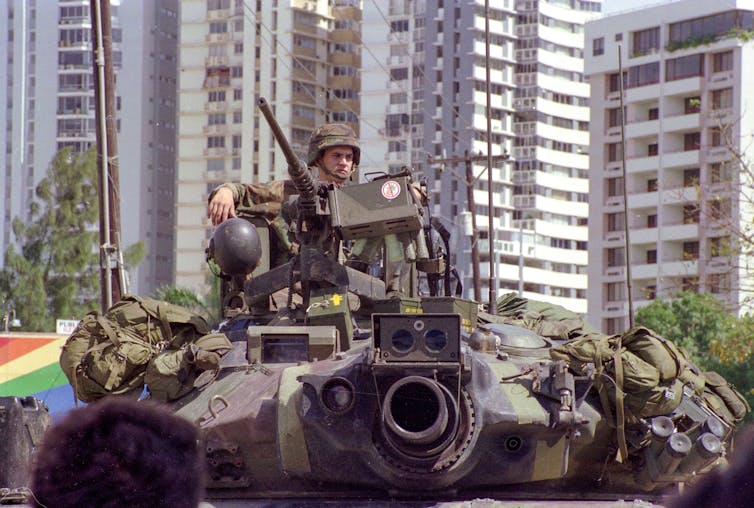
U.S. military fighter jets sit on the tarmac at José Aponte de la Torre Airport in Puerto Rico, on Jan. 3, 2026. Miguel J. Rodriguez Carrillo / AFP via Getty Images

The predawn seizure of Venezuelan President Nicolás Maduro on Jan. 3, 2026 was a complicated affair. It was also, operationally, a resounding success for the U.S. military.

Operation Absolute Resolve achieved its objective of seizing Maduro through a mix of extensive planning, intelligence and timing. R. Evan Ellis, a military strategist and former Latin America policy adviser to the U.S. State Department, walked The Conversation through what is publicly known about the planning and execution of the raid.

How long would this op have been in the works?

Operation Absolute Resolve was some months in the planning, as the Pentagon acknowledged in its briefing on Jan. 3. My presumption is that from the beginning of the U.S. military buildup in the Caribbean and the establishment of Joint Task Force Southern Spear in the fall, military planners were developing options for the president to capture or eliminate Maduro and other key Chavista leadership, should coercive efforts at persuading a change in the Venezuelan situation fail.
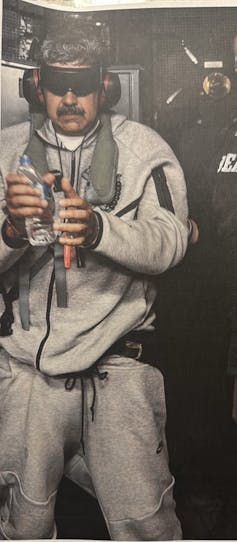
A man in a blindfold holds a bottle of water.
An image of a captured Nicolás Maduro released by President Donald Trump on social media.
Truth Social

Prior to Southern Spear, U.S. military activities in the region were directly overseen by Southern Command – the part of the Department of Defense responsible for Central America, South America and most of the Caribbean. But establishing a dedicated joint task force in October 2025 helped facilitate the coordination of a large operation, like the one conducted to seize Maduro.

Planning for the Jan. 3 operation likely became more detailed and realistic as the administration settled on a concrete set of options. U.S. forces practiced the raid on a replica of the presidential compound. “They actually built a house which was identical to the one they went into with all the same, all that steel all over the place,” President Donald Trump told “Fox & Friends Weekend.”

Why did the US choose to act now?

The buildup had been going on for months, and the arrival of the USS Gerald R. Ford in November was a key milestone. That gave the U.S. the capability to launch a high volume of attacks against land targets and added to the already huge array of American military hardware stationed in the Caribbean.

It joined an Iwo Jima Amphibious Ready Group, which included a helicopter dock ship and two landing platform vessels. An additional six destroyers and two cruisers were stationed in the region with the capability of launching hundreds of missiles for both land attack and air defense, as well as a special operations mother ship.

Trump’s authorization of CIA operations in Venezuela was probably also a key factor. It is likely that individuals inside Venezuela played invaluable roles not only in obtaining intelligence, but also in cooperating with key people in Maduro’s military and government to make sure they did – or did not do – certain things at key moments during the Jan. 3 operation.

With the complex array of plans and preparations in place by December, the U.S. military was likely ready to execute, but it had to wait for opportune conditions to maximize the probability of success.

What constitutes the opportune moment?

There are arguably three things needed for the opportune moment: good intelligence, the establishment of reliable cooperation arrangements on the ground, and favorable tactical conditions.

Intel would have been crucial. Trump acknowledged his authorization of covert CIA operations in Venezuela in October, and evidently, by the end of the year, analysts had gathered the information needed to make this operation go smoothly. The intelligence would have had to include knowing exactly where Maduro would be at the time of the operation, and the situation around him.

Over the past few months, according to media reporting, the intelligence community had agents on the ground in Venezuela, likely having conversations with people in the military, the Chavista leadership and beyond, who had crucial information or whose behavior was relevant to different parts of the operation – such as perhaps shutting down a system, standing down a military unit or being absent from a post at a key moment. A report from The New York Times indicates that the U.S. had a human source close to Maduro who was able to provide details of his day-to-day life, down to what he ate.

The more tactical conditions that were needed for the opportune moment involved things like the weather – you didn’t want storms or high winds or cloud cover that would put U.S. aircraft in danger as they flew in some very treacherous low-level routes through the mountains that separate Fort Tiun – the military compound in Caracas where Maduro was captured – from the coast.

How did the operation unfold?

Gen. Dan Caine, chairman of the Joint Chiefs of Staff, has given some details about how the plan was executed.

We know the U.S. launched aircraft from multiple sites – the operation involved at least 20 different launch sites for 150 planes and helicopters. These would have involved aircraft for jamming operations, some surveillance, fighter jets to strike targets, and some to provide an escort for the helicopters bringing in a special forces unit and members of the FBI.
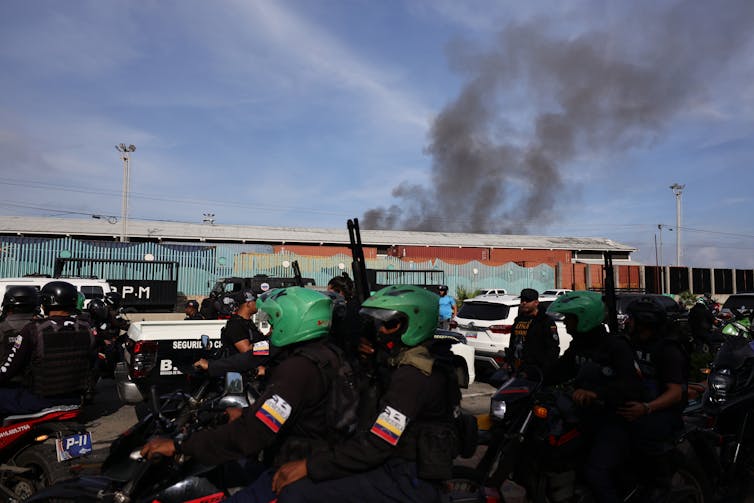
A cloud of black smoke is seen above a building.
Smoke is seen billowing above the Port of La Guaira on Jan. 3, 2026, in Venezuela.
Jesus Vargas/Getty Images

As an integral part of the operation, the U.S. carried out a series of cyber activities that may have played a role in undermining not only Venezuela’s defense systems, but also its understanding of what was going on. Although the nature of U.S. cyber activities is only speculation here, a coherent, alerted Venezuelan command and control system could have cost the lives of U.S. force members and given Maduro time to seal himself in his safe room, creating a problem – albeit not an insurmountable one – for U.S. forces.

There was also, according to Trump, a U.S.-generated interruption to some part of the power grid. In addition, it appears that there may have been diversionary strikes in other parts of the country to give a false impression to the Venezuelan military that U.S. military activity was directed toward some other, lesser land target, as had recently been the case.

U.S. aircraft then basically disabled Venezuelan air defenses.

As U.S. rotary wing and other assets converged on the target in Caracas – with cover from some of the most capable fighters in the U.S. inventory, including F-35s and F-22s, as well as F-18s – other U.S. assets decimated the air defense and other threats in the area.

It would be logical if elite members of the U.S. 160th Special Operations Aviation Regiment were used in the approach to the compound in Caracas. Their skills would have been required if, as I presume, they came in via the canyon route that separates Caracas from the coast. I have driven the road through those mountains, and it is treacherous – especially for an aircraft at low altitude.

Once the team landed, it would have have taken a matter of minutes to infiltrate the compound where Maduro was.

Any luck involved?

According to Trump, the U.S. team grabbed Maduro just as he was trying to get into his steel vault safe room.

“He didn’t get that space closed. He was trying to get into it, but he got bum-rushed right so fast that he didn’t get into that,” the U.S. president told Fox & Friends Weekend.

Although the U.S. was reportedly fully prepared for that eventuality, with high-power torches to cut him out, that delay could have cost time and possibly lives.

It was thus critical to the U.S. mission that forces were able to enter the facility, reach and secure Maduro and his wife in a minimal amount of time.

The Conversation

The views expressed in this article are those of the author and do not represent the Department of Defense or the US government.

ref. How Maduro’s capture went down – a military strategist explains what goes into a successful special op – https://theconversation.com/how-maduros-capture-went-down-a-military-strategist-explains-what-goes-into-a-successful-special-op-272671

The US has invaded countries and deposed leaders before. Its military action against Venezuela feels different

Source: The Conversation – Global Perspectives – By Juan Zahir Naranjo Cáceres, PhD Candidate, Political Science, International Relations and Constitutional Law, University of the Sunshine Coast

In the early hours of Saturday morning, US special forces captured Venezuelan President Nicolás Maduro from his home in Caracas and flew him out of the country. US President Donald Trump announced that Maduro and his wife, Cilia Flores, would face federal narco-terrorism charges in New York.

For anyone familiar with the history of US interventions in Latin America and the Caribbean, the basic pattern is grimly familiar: a small state in Washington’s “backyard”, a leader deemed unacceptable, military force applied with overwhelming effect, and a government removed overnight.

Yet what makes Venezuela’s case different – and profoundly alarming – is the brazen nature of the months-long US military operations against the country based on shifting and shaky justifications, with little evidence.

This moment is also significant, with many scholars already warning that international law is in deep crisis.

A long tradition of removing ‘unacceptable’ leaders

Venezuela is not the first country in the region to see its leader overthrown or seized with direct US involvement or acquiescence.

In 1953, the British government suspended the constitution of its colony British Guiana (now Guyana) and removed the democratically elected government of Cheddi Jagan after just 133 days. The British believed Jagan’s social and economic reforms would threaten its business interests.

A decade later, the CIA conducted a sustained covert operation to destabilise Jagan’s later administration, culminating in rigged 1964 elections that ensured his rival, Forbes Burnham, would win.

In 1965, US President Lyndon Johnson sent more than 22,000 US troops to the Dominican Republic to prevent the return of former President Juan Bosch, overthrown in a 1963 coup, and another communist regime forming in the region.

Following the violent overthrow and execution of Prime Minister Maurice Bishop of Grenada in 1983, President Ronald Reagan ordered an invasion. His administration justified the action by citing the need to protect US medical students and prevent the island from becoming a “Soviet-Cuban colony”.

In December 1989, President George H.W. Bush launched a full-scale invasion of Panama involving about 24,000 US troops to remove General Manuel Noriega, who had been indicted on drug-trafficking charges (like Maduro). He was subsequently flown to the United States, tried and imprisoned.

And in 2004, Haitian President Jean-Bertrand Aristide was removed from power and flown to Africa in what he described as a US-orchestrated coup and “kidnapping”. In 2022, French and Haitian officials told The New York Times that France and the US had collaborated to remove him.

Why Maduro’s case is different

In all of these cases, Washington asserted control over what it has long considered its sphere of influence, intervening when governments threatened its interests through ideology, alliances or defiance.

But Venezuela in 2026 is not Grenada in 1983 or Panama in 1989. It is a much larger country with some 30 million people and significant armed forces, which has spent years preparing for a possible US invasion. More importantly, the operation unfolded in an entirely different global context.

During the Cold War, US interventions were often condemned but rarely threatened the legitimacy of the international order itself.

Today, by contrast, the Maduro operation has been met with swift and sharp condemnation from across the political spectrum.

Colombian President Gustavo Petro called the strikes an “assault on the sovereignty” of Latin America, while Brazilian President Luiz Inácio Lula da Silva said the attack “crossed an unacceptable line” and set an “extremely dangerous precedent”. Mexican President Claudia Sheinbaum said the strikes were in “clear violation” of the UN Charter.

Even traditional US allies expressed discomfort. France’s foreign minister said the operation contravened the “principle of non-use of force that underpins international law” and that lasting political solutions cannot be “imposed by the outside”.

And a statement from UN Secretary-General Antonio Guterres said he was “deeply alarmed” about the “dangerous precedent” the United States was setting and the rules of international law not being respected.

The UN Charter prohibits the use of force against the territorial integrity or political independence of any state under Article 2(4).

For years, scholars have warned that repeated violations of the UN Charter by the United States were steadily eroding the basic rules governing the use of force.

Venezuela may represent the moment that erosion becomes collapse. When a permanent Security Council member not only bombs another state but abducts its head of state, the precedent is indeed profound.


Read more:
A predawn op in Latin America? The US has been here before, but the seizure of Venezuela’s Maduro is still unprecedented


Regional consequences

The immediate consequences for Latin America are already being felt. Colombia has moved troops to its border with Venezuela, while neighbouring Guyana has activated its own security plans.

It’s unclear at this point if further US military operations are planned. Trump has said the US will “run” Venezuela until a “safe transition” is complete, but analysts question whether Washington has the appetite for such an open-ended commitment. Venezuela’s defence minister has also pledged to continue to fight against what he called “criminal aggression”.

The operation has also deepened divisions that already existed in Latin America over Venezuela. After Maduro’s 2024 election, the results were immediately contested: Maduro’s government claimed victory, while the opposition said it won based on voting tallies it published online.

Regional governments split over which narrative to accept, with some recognising Maduro’s government and others backing the opposition. These fault lines have made a coordinated regional response to the Trump administration’s actions impossible.

The broader risk is that Venezuela becomes a precedent not only for great powers, but for regional actors. If Washington can seize a head of state without legal sanction, what stops others from doing the same?

A dangerous new normal

Maduro’s removal may or may not bring the political change Trump desires. But the manner of his removal – brazen, unilateral, defended in the language of US exceptionalism – has already done serious damage to the fragile architecture of international law.

If sovereignty can be set aside when inconvenient, heads of state can be abducted without UN approval, and the most powerful decide which governments may exist, then we have returned to a world governed by force – not the law. And in that world, no state can consider itself truly secure.

The Conversation

Juan Zahir Naranjo Cáceres does not work for, consult, own shares in or receive funding from any company or organisation that would benefit from this article, and has disclosed no relevant affiliations beyond their academic appointment.

ref. The US has invaded countries and deposed leaders before. Its military action against Venezuela feels different – https://theconversation.com/the-us-has-invaded-countries-and-deposed-leaders-before-its-military-action-against-venezuela-feels-different-272682

Pourquoi les politiques n’écoutent-ils pas les citoyens ordinaires ?

Source: The Conversation – France in French (3) – By Awenig Marié, Postdoctoral research fellow, Université Libre de Bruxelles (ULB)

L’année 2025 a notamment été marquée par le débat sur la taxe Zucman, rejetée par les députés mais plébiscitée par une très large majorité de Français. Cette décision révèle, de façon spectaculaire, la déconnexion entre les décisions politiques et l’opinion des citoyens. Ce phénomène, étudié par la science politique, est au cœur de la crise démocratique. Comment y remédier ?


Les sondages sont sans appel : une large majorité de Français, 86 % selon une enquête Ifop, se déclare en faveur d’une taxation des plus riches. Pourtant, l’Assemblée nationale a rejeté en octobre la taxe Zucman : 228 députés ont voté contre l’amendement visant à taxer les patrimoines supérieurs à 100 millions d’euros, tandis que 172 députés ont voté pour. La déconnexion entre opinion publique et décision politique n’est pas nouvelle. D’autres exemples illustrent ce phénomène, comme la réforme des retraites, rejetée par une majorité de Français, ou l’interdiction de la corrida, soutenue par la population mais rejetée par les députés. Comment expliquer que des mesures massivement soutenue par la population puissent être rejetées par leurs représentants ?

Quand les politiques écoutent (ou pas) l’opinion publique

La connexion entre opinion publique et décision politique a fait l’objet de nombreux travaux en science politique. Ces recherches, qui étudient la capacité du système représentatif à répondre aux intérêts et préférences des citoyens, montrent que si l’opinion publique peut influencer les décisions politiques, ce n’est pas toujours le cas. Pour de nombreux enjeux, il existe une déconnexion entre la volonté populaire et les décisions prises par les gouvernants, qu’ils soient de gauche ou de droite.

Plusieurs facteurs peuvent expliquer ces écarts. D’abord, la capacité des gouvernants à suivre l’opinion peut dépendre du contexte économique : en période de contraintes budgétaires, les marges de manœuvre se réduisent et certaines décisions peuvent ne pas refléter totalement les préférences des citoyens. Ensuite, les représentants sont plus à l’écoute sur les sujets très médiatisés et peu techniques du fait de leur importance dans le débat public. Plusieurs recherches soulignent aussi un déficit récent de représentation sur les enjeux économiques. Du fait de la montée des sujets culturels (immigration, sécurité, identité) dans le débat et des contraintes externes sur l’économie (crises, intégration européenne), les gouvernants parviennent à mieux écouter l’opinion sur les sujets culturels, devenus des marqueurs de la vie politique. Enfin, le contexte politique : dans un environnement parlementaire fragmenté, les difficultés à négocier entre partis peuvent entraver la traduction de l’opinion publique en décisions.

Représentation politique et inégalités économiques

Un autre facteur expliquant la déconnexion entre opinion publique et décision politique est celui des inégalités de représentation. En effet, lorsque les citoyens les plus riches et les plus pauvres s’opposent sur une politique publique, ce sont les préférences des plus aisés qui l’emportent. Les travaux du politiste américain Martin Gilens ont révélé cette tendance : une politique publique a plus de chances d’être adoptée si elle est soutenue par les citoyens fortunés que par les citoyens modestes. Ces résultats ont été confirmées dans plusieurs pays européens : les décisions politiques reflètent davantage les positions des citoyens à revenu élevé.

L’exemple de la taxe Zucman illustre parfaitement cette dynamique. Si une majorité de Français la soutient, il est probable que la fraction de la population la plus fortunée, directement impactés financièrement par une telle taxe, s’y oppose.


À lire aussi :
L’affrontement sur la taxe Zucman : une lutte de classe ?


Si de nombreuses études ont mesuré ces inégalités dans les décisions politiques, d’autres se sont particulièrement intéressé aux élus, analysant leurs positions et la façon dont ils perçoivent l’opinion publique. Des inégalités sont aussi présentes à ce niveau. En effet, les élus ont des préférences politiques plus proches de celles des électeurs les plus riches, et leur lecture de l’opinion publique est biaisée en faveur des plus fortunés.

Les déterminants des inégalités de représentation politique

Trois facteurs principaux expliquent ces inégalités de représentation. Le premier est le profil socio-économique des élus : ils sont massivement issus des classes sociales supérieures. À l’Assemblée nationale, 67 % des députés sont issues des catégories cadres et professions intellectuelles supérieures, contre 11 % dans la population française. Ces élus partagent avec les citoyens les plus riches des valeurs et intérêts communs, ce qui les rend plus sensibles à leurs besoins. C’est ce que j’ai montré dans une étude menée sur les parlementaires suisses : les perceptions de l’opinion publique des députés issus de milieux favorisés s’alignent plus fortement avec les préférences des citoyens les plus riches.

Le deuxième facteur concerne les inégalités d’expression politique : tous les citoyens n’ont pas la même voix dans l’espace politique. Les plus aisés disposent d’un poids politique supérieur : ils votent davantage, contactent plus souvent les parlementaires, et peuvent apporter un soutien direct en faisant des dons aux partis politiques. À l’inverse, les citoyens modestes participent moins à la vie politique et ont moins de poids sur le succès électoral des partis politiques. Les élus ont donc moins d’intérêt à écouter et traduire leurs préférences en décisions.

Ces inégalités se reflètent aussi au niveau des groupes d’intérêts exerçant des activités de lobbying : les groupes représentant des intérêts privés et sectoriels (entreprises, associations professionnelles) disposent de plus de ressources que les associations citoyennes ou les ONG pour influencer les décisions politiques. Concernant la taxe Zucman, il est évident que les lobbies patronaux (Medef et Afep) ont mobilisé leurs réseaux pour orienter le débat public et la décision parlementaire. Les liens personnels entre responsables politiques (dont le premier ministre Sébastien Lecornu) et grands patrons, facilitent aussi cette influence, offrant à ces derniers un accès direct pour défendre leurs intérêts.

Enfin, l’idéologie compte : les élus de droite représentent davantage les préférences des citoyens les plus riches et surestiment leur poids dans la population, comme je l’ai montré dans une étude portant sur les parlementaires de quatre pays européens. Cependant, si les élus de gauche ont des positions moins biaisées, des inégalités persistent. Pourquoi ? D’abord parce que l’origine sociale joue à gauche comme à droite : la majorité des parlementaires de gauche viennent aussi des catégories supérieures, ce qui les rend plus sensibles aux intérêts des citoyens privilégiés. Ensuite, même lorsqu’ils sont idéologiquement proches des citoyens défavorisés, les élus de gauche au pouvoir se heurtent à des contraintes structures (mondialisation, règles européennes) qui réduisent leur marge de manœuvre.

Inégalités de représentation : comment répondre au problème ?

Si le droit de vote est universel, garantissant une égalité formelle, l’égalité réelle est loin d’être acquise : les citoyens les moins favorisés pèsent moins dans les décisions politiques, questionnant le caractère démocratique de notre modèle de représentation.

Les citoyens les moins bien représentés font moins confiance aux institutions représentatives. Le problème n’est pas qu’une politique publique isolée diverge de l’opinion publique : c’est la récurrence du phénomène qui pose question et le biais systématique envers une partie de la population qui pose question. Lorsque, sur plusieurs politiques publiques, le système représentatif n’est pas sensible à l’opinion et qu’une partie de l’électorat voit systématiquement ses préférences ignorées, la légitimité du système représentatif pourrait s’en trouver fragilisée.

Plusieurs pistes sont envisageables pour réduire ces inégalités. D’abord, améliorer la représentativité sociale des élus permettrait d’élargir la diversité des perspectives discutées au Parlement, mieux prendre en compte les citoyens les moins privilégiés, et permettre à ces derniers de mieux s’identifier avec le personnel politique. Ensuite, multiplier les échanges entre parlementaires et citoyens, via la présence en circonscription et les forums délibératifs, faciliterait la transmission de la diversité des opinions vers le système politique. Renforcer les organisations de la société civile et syndicats permettrait aussi de contrebalancer le poids des groupes d’intérêts privés. Enfin, des réformes comme le vote obligatoire ou l’encadrement des dons politiques inciterait les élus à considérer tous les citoyens, et pas seulement les plus privilégiés.

The Conversation

Awenig Marié est fondateur et membre de l’association Datan.

ref. Pourquoi les politiques n’écoutent-ils pas les citoyens ordinaires ? – https://theconversation.com/pourquoi-les-politiques-necoutent-ils-pas-les-citoyens-ordinaires-270804

How US intervention in Venezuela mirrors its actions in Panama in 1989

Source: The Conversation – UK – By Adriana Marin, Lecturer in International Relations, Coventry University

The US dramatically escalated its confrontation with Venezuela on January 3, moving from sanctions and targeted strikes on alleged drug-trafficking vessels to direct military action. In a pre-dawn operation, US forces captured the Venezuelan president, Nicolás Maduro, and his wife, Cilia Flores, and removed them from the country.

The operation has prompted historical comparisons with the US invasion of Panama in late 1989. Although separated by more than three decades and unfolding in different international contexts, the two episodes reveal a continuity in how the US approaches intervention, sovereignty and legality in the western hemisphere.

The US invasion of Panama was justified at the time through a now-familiar set of claims. US officials argued they were protecting American citizens, restoring democracy following contested elections, combating drug trafficking and upholding treaty obligations linked to the Panama canal.

However, none of these arguments provided a solid legal basis for the use of force under the UN charter. Panama had not attacked the US, there was no imminent armed threat and the operation was not authorised by the UN security council. The invasion prompted international condemnation and was denounced by the UN general assembly as a violation of international law.

Yet concern over the legality of the operation mattered far less to the US than its political outcome. The Panamanian leader, Manuel Noriega, was removed from power and transferred to the US where he was tried on criminal charges. The US achieved its strategic objectives quickly and international condemnation produced no lasting consequences.

Panama thus established a powerful precedent: a smaller state could be reshaped forcibly without multilateral approval, provided the intervention was framed persuasively and executed decisively.

A US military vehicle in the Punta Paitilla neighbourhood of Panama City.
A US military vehicle in the Punta Paitilla neighbourhood of Panama City in December 1989.
Amador Diversified / Shutterstock

Central to that framing was what I call the criminalisation of sovereignty. Noriega was portrayed by US politicians not simply as an authoritarian ruler, but as a criminal figure. This mattered because it blurred the line between war and law enforcement, enabling regime change to be recast simply as an arrest.

Panama’s sovereignty, in turn, appeared less like a legal right and more like a shield open to abuse by criminals. While legal issues remained, the framing reduced political resistance, particularly within the US. This logic has reemerged in US discourse surrounding Venezuela.

Venezuela’s authorities have long been portrayed by Washington as criminal, corrupt and illegitimate. The US has designated drug networks linked to Venezuela, such as the so-called Cartel de los Soles, as terrorist organisations. It has also issued indictments against Maduro and other government officials on narco-terrorism and drug-trafficking charges.

As was the case in Panama, this framing shifts the debate away from inter-state relations and towards enforcement against individuals. This weakens the perceived legitimacy of Venezuelan sovereignty and helps normalise coercive external action.

It may also hint at Maduro’s eventual fate. The US state department did not recognise Noriega as Panama’s head of state, which made his later prosecution easier because it was argued he was not entitled to immunity.

Maduro, in a similar way, has been described by the state department as the “de facto but illegitimate ruler of Venezuela”. This purported lack of democratic legitimacy could mean the two men ultimately face a similar outcome in court.

Democracy plays a rhetorical role in both cases. The invasion of Panama was presented as a response to cancelled elections and democratic breakdown. In Venezuela, claims of democratic illegitimacy, contested elections and authoritarian governance have been also used to justify sustained external pressure and, now, direct intervention.

In neither case does democracy function as a legal basis for the use of force. International law does not permit military action to restore or impose democracy, nor does it allow states to determine the legitimacy of other governments unilaterally. Democracy in these contexts operates as a moral narrative rather than a lawful justification.

Pattern of intervention

There are, of course, differences between the two cases. The operation in Panama saw tens of thousands of US troops deployed on the ground. The US intervention in Venezuela was more targeted, relying on a mix of economic sanctions, diplomatic isolation and the selective use of force.

But rather than signalling a transformation in strategic intent, this reflects changes in military technology, media scrutiny and political risk.

Unlike in 1989, modern interventions unfold under real-time global media coverage and social media scrutiny, sharply increasing reputational costs. Greater domestic sensitivity to foreign entanglements also raises the political risk of overt military action.

However, notwithstanding these changes, the objective in both cases remains the same: rapid political disruption designed to weaken or remove an unfriendly regime while avoiding the costs of prolonged occupation.

The international environment has also changed. Panama took place at the end of the cold war, when US dominance in the western hemisphere was largely uncontested. Venezuela unfolds in a more fragmented global order, where regional and global players are more willing to challenge US actions.

Yet this difference cuts both ways. While global opposition may be louder, the enforcement capacity of international law remains limited. As Panama demonstrated, condemnation without consequence does little to deter future interventions.

What ultimately unites the two cases is the principle of selective sovereignty. In both Panama and Venezuela, sovereignty has been treated not as a universal legal protection but as a conditional status. States governed by leaders that have been labelled as criminal, illegitimate or destabilising are seen as having forfeited their rights.

This is not how sovereignty functions in international law, but it is how power often operates in practice. Each time this logic is applied, it weakens the credibility of the rules-based international order and reinforces the idea that legality bends to strength.

Panama’s significance lies precisely in this normalisation, showing that intervention could succeed politically even when it failed legally. Venezuela suggests that this lesson has not only been learned, but refined. Where Panama involved overt illegality, Venezuela reflects a more diffused form of coercion, spread across legal, economic and military domains.

Recent events in Venezuela thus do not represent a dramatic break from past practice. They represent continuity. Panama was not an aberration of the late cold war but a formative moment in post-war US interventionism. Venezuela is its modern-day echo.

The language has evolved and the methods have adapted, but the underlying assumption remains stable: that when powerful states deem it necessary, sovereignty can be suspended, legality reinterpreted and intervention justified after the fact.

That is the real significance of the comparison. Panama then and Venezuela now show a durable pattern in how intervention is imagined, defended and repeated.

The Conversation

Adriana Marin does not work for, consult, own shares in or receive funding from any company or organisation that would benefit from this article, and has disclosed no relevant affiliations beyond their academic appointment.

ref. How US intervention in Venezuela mirrors its actions in Panama in 1989 – https://theconversation.com/how-us-intervention-in-venezuela-mirrors-its-actions-in-panama-in-1989-272659

Alberta’s proposed $11-million reading tests won’t actually help struggling learners

Source: The Conversation – Canada – By Hetty Roessingh, Professor, Werklund School of Education, University of Calgary

The Alberta government recently introduced Bill 6, a proposed amendment to the Education Act, that it says will “prioritize literacy and numeracy and ensure the province’s youngest learners receive the help they need as early as possible.”

Large classes with students who have a range of learning needs, including tailored learning plans, are among the factors that can make it difficult for teachers to ensure each child’s needs are being met. Implementing early literacy and numeracy tests with the intent of early intervention for at risk learners has intuitive appeal.

If passed, Alberta’s Bill 6 legislation would mandate reading and math tests from kindergarten to Grade 3, effective by fall 2026. According to ministry officials, its goal is to identify learning gaps early using short, simple and non-graded activities.

The announcement has received swift and forceful reaction from academics, the Alberta Teachers’ Association and senior-level school administrators.

Their concerns relate to the validity and reliability of the tests, how they were developed and their instructional value. Critics also raise concerns over the lack of teacher consultation and involvement, additional time teachers will need to administer and score the tests and whether the test results will change teaching and learning practices.

Questions also remain about whether schools will need additional resources to address learning gaps identified by way of the tests, since the bill doesn’t include any mention of this. The $11 million dollar pricetag of Bill 6 may not reap the insights needed to identify and meaningfully intervene for young children at risk.

Why early literacy matters

The testing proposed in Bill 6 misses important dimensions of literacy development. Early reading proficiency depends largely on two skills: phonemic awareness (the awareness to notice and work with different sounds) and phonics (mapping sounds to letters).

These foundational concepts and skills are learned by the majority of young children by the end of Grade 2, including English language learners (ELL) and children disadvantaged by socio-economic status. Exposure to two languages may heighten ELLs’ keen perception of sounds, helping them to apply their knowledge of how letters and their sounds relate and different letter patterns to correctly pronounce written words.

A learning-to-read school book I had as a child, Friends and Neighbours, is still on my bookshelf. As a newly arrived immigrant to Canada at age four from Indonesia, I was relatively proficient in conversational English by Grade 2. I learned the process of reading, including how to sound out letters and their English language patterns, by drawing on the vocabulary I developed and by interacting with native English-speaking children in the neighbourhood, on the playground and in the classroom.

However, a child’s strengths in recognizing and working with the sounds that make up individual words — phonemic awareness and phonics — may provide a false sense of security. These strengths can mask the needs of children at risk of reading failure as they transition to Grade 4, when the focus shifts from learning to read to reading to learn. At this stage, vocabulary knowledge becomes critical.

Beginning in Grade 4, the litmus of reading success is a child’s ability to comprehend increasingly complex and academically demanding texts. The testing proposed in Bill 6 misses the important role of vocabulary knowledge in this process.

The fourth-grade slump

The well-documented “fourth-grade slump” refers to the drop in reading performance many students experience around Grade 4. Children must shift from learning to read to reading to learn — a shift that is dependent on vocabulary depth and breadth.

A seminal 2003 study from researchers Jeanne S. Chall and Vicki A. Jacobs underscored the crucial role of vocabulary knowledge in reading success in Grade 4. They found that disadvantaged learners in Grades 2 and 3 scored as well as peer learners from higher socio-economic backgrounds.

At this early stage of reading development, phonemic awareness and phonics provides an important foundation for learners. The researchers found that it is not until Grade 4 that scores decelerate for children from lower socio-economic backgrounds.

Without attention to vocabulary knowledge, young children may find themselves woefully under-prepared for the accelerating demands of Grade 4.

What Bill 6 overlooks

Given decades of research on reading development, Bill 6’s current focus is too narrow and offers only limited utility in early identification of young learners who will be at risk by Grade 4. Most children readily learn these skills already. The relative minority who struggle with these skills respond well to direct, explicit and intensive interventions.

To support students effectively, Alberta must measure vocabulary knowledge among young children. In addition, handwriting should also be assessed. Handwriting plays an enormous role in unlocking vocabulary in Grade 3, and as a skill, unfolds from kindergarten to Grade 3 years along a developmental continuum.

Devising tools to assess vocabulary and handwriting is more than a matter of short, simple and non-graded activities. More comprehensive assessments, such as studying samples of children’s writing on a familiar and engaging topic, would provide much more useful data for transforming classroom pedagogy and practice.

Such assessments would take more time to administer and score, but they would be a far better use of $11 million than narrow assessments that capture only the tip of the iceberg of what matters for long-term literacy success.

The Conversation

Hetty Roessingh does not work for, consult, own shares in or receive funding from any company or organisation that would benefit from this article, and has disclosed no relevant affiliations beyond their academic appointment.

ref. Alberta’s proposed $11-million reading tests won’t actually help struggling learners – https://theconversation.com/albertas-proposed-11-million-reading-tests-wont-actually-help-struggling-learners-269791

Your new health habit may be just a mental shift away

Source: The Conversation – Canada – By Mandi Baker, Assistant Professor, Faculty of Kinesiology and Recreation Management, University of Manitoba

The new year starts for many by making resolutions to live healthier lives. This can mean getting fitter by joining a gym, signing up to Pilates classes or starting a new diet.

For many, these resolutions are hard to maintain and the new habits slip away. Unfortunately, there are many reasons why our best intentions fail; the kids get sick so you can’t get out for a class, the costs of equipment or membership become too steep, and kale just isn’t cutting it for dinner anymore. In the end, motivation for our new habits runs out.


Read more:
The science behind building healthy habits can help you keep your New Year’s resolution


When we choose activities for our leisure that do not bring intrinsic enjoyment and/or satisfaction, we find it hard to preserve. External motivations, like gaining a reward (a particular body shape) or avoiding a consequence (minimizing the risks related to heart health), can only take us so far.

When we do things that we truly love, that are aligned with our values and/or sense of self, or we would do even if no one was watching, then the chances of maintaining those physical activities are much higher. That means the goal of resolution-setting is to find the things that tap into our intrinsic motivations.

How we frame health

Another challenge to sticking with new health-related habits, is the very individual way that health is framed. Health is positioned as being not only an individual’s responsibility, but that the individual is to blame if they are unwell. While the medical model serves a purpose in identifying problems and addressing them, applying a deficiency-model rationality obscures critical awareness about the complex and many ways that social factors impact health.

Social models of health, such as The Social Determinants of Health by Dahlgreen & Whitehead (1991), demonstrate that not only do our physiology, lifestyle choices, social and community networks matter, but socio-economic, cultural and environmental conditions do too. This shifts the responsibilities for health away from loading individuals up on guilt to shared collective responsibilities among all strata of community, government and institutions for a population’s health.

The notion that health is an individual problem, or deficiency, can be isolating, making the work of an individual’s wellness goals an effort that they feel they must do alone, and against broad systemic constraints.

Sociologists have long warned us of how these ideas, among others, lead us to think and treat ourselves poorly when it comes to moving our (fabulous and functional) bodies. Blaming ourselves or seeing physical activity, fitness and health as beyond our reach is both demoralizing and demotivating. Let alone added layers of social, economic, geographical and political inequities. This can be as heavy, if not heavier, than anything you might “lift” at the gym.

Getting physically active

Getting physically active for the first time, or after years, or only after the holidays means exercising your mental prowess. This list offers some insights into how to do the mental exercise to get your body moving and enjoying it:

  • Be in your body: be embodied. Often made popular by mindfulness movements, the idea is to slow down your sophisticated mental processing to focus on your five senses and simply be in the moment. This teaches our nervous systems to take a break from processing stressful stimulus.

  • Get active for no other reason than to enjoy yourself! Leisure theory tells us that seeking external rewards can make free time feel like work. Look for physical activity that brings you joy — make it the thing you look forward to rather than dread.

  • Focus on what your body can DO rather than how it looks. Views of beautiful, attractive or healthy bodies constantly change. Focusing on what your body can and does do (a strengths-based approach to vitality) can be a subtle yet powerful mental shift to improve your quality of life.

  • Find your activity people. Get active with people who share your philosophies about health. Find supportive people who don’t judge, who understand motivation’s ups and downs, who acknowledge that bodies come in different shapes and sizes AND that bodies are capable and beautiful things of joy.

  • Get outside. Science tells us that heart rates and worrying (anxiety, depression and rumination) come down when spending just a little time in nature. No need for remote corners of the Earth — just a walk down the street can make a big difference.

Engaging in physical activities that are joy-filled is not only a pleasure but can be a political act of hopefulness and self-respect. It acts to resist social norms about individuating discourses about health and associated assumptions of body shape, size and fitness.

Celebrating bodies in their diversity, getting out and enjoying movement, representing that healthy bodies are diverse and getting active with friends can all be political acts that celebrate countercultural ideas about health.

Movin’ and groovin’ with friends celebrates community and the value-altering, motivational shift of joy-filled embodiment and physical activity.
This subtle shift in thinking, and moving, could be the puzzle piece you’ve been missing for maintaining healthy habits.

The Conversation

Mandi Baker receives funding from the Social Sciences and Humanities Research Council of Canada and has received funding from summer camps organisations and government bodies such as the Departments of Jobs, Precincts and Regions in Victoria, Australia, the Australian Camps Association and the YMCA Camps Victoria, Australia. She is affiliated with the Canadian Camps Association, the American Camp Association and Outward Bound Vietnam.

ref. Your new health habit may be just a mental shift away – https://theconversation.com/your-new-health-habit-may-be-just-a-mental-shift-away-271923

Feeling stuck at work as the New Year begins? It may be a sign of professional growth

Source: The Conversation – Canada – By Leda Stawnychko, Associate Professor of Strategy and Organizational Theory, Mount Royal University

As the new year starts, it’s natural to feel torn between gratitude and restlessness. December often disrupts routines: fewer meetings, quieter inboxes and a rare chance to take stock and reflect.

During this time, people may feel pride in how far they have come, alongside a growing sense that the path they are on no longer fits.

This discomfort is especially common at stages of life when professionals expect to feel more settled, yet instead feel stagnant. It’s easy to dismiss such feelings as impatience or a lack of commitment.

But research on adult learning and development suggests that feeling stuck is often a signal of growth. It’s evidence that our internal development has outpaced our external circumstances.

In educational research, this tension is often described as a disorienting dilemma: an experience that unsettles our assumptions and highlights a mismatch between how we see ourselves and the contexts we are in.

While these moments are often uncomfortable, they act as necessary catalysts for meaningful learning and change, motivating people to reassess their goals, values and direction. Seen this way, yearning for new beginnings is a rational response to growth.

Diagnosing the source of restlessness

If you’re ready for change but unsure of where to begin, a useful first step is clarifying what is driving the sense of restlessness. Is it the work itself, the people you work with or the broader organizational culture?

When organizations are generally supportive, growth doesn’t necessarily require leaving. Change may be possible within the same environment. In these cases, conversations with supervisors can reveal opportunities that are not immediately obvious, such as stretch assignments, special projects or support for further learning.

Research shows that people who stay with organizations over the long term often do so because of strong relationships, a good fit with their broader lives and what scholars call “job embeddedness” — the financial, social and psychological benefits of the position that make leaving costly.

But when the cost of staying is stifling your growth, it’s worth exploring how you might either renegotiate growth where you are or thoughtfully prepare to move on.

Re-evaluating what matters now

Whether you’re considering a shift within your organization or beyond it, taking time to reassess your needs, goals and values is essential. What mattered to you earlier in your career may not matter in the same way now. Income, learning, flexibility, stability and meaning all rise and fall in importance across life stages.

Clarifying your values does not mean choosing one priority forever. It simply provides a clearer map for evaluating opportunities.

Some people prioritize mentorship or employer-supported education. Others need predictable schedules, strong health benefits or flexibility to care for family members.

Understanding what matters most now helps narrow your options and reduces the paralysis that often accompanies big decisions.

Focusing on activities rather than titles

Another way to gain clarity is to imagine your ideal role without fixating on job titles.

Titles can be misleading and often mask the day-to-day reality of the work. Instead, focus on activities. How will you spend most of your time? What skills will you be using day to day?

One useful question is what activities you would gladly do without being paid. These often point to core strengths and motivations worth taking seriously. Organizational psychologists describe this as intrinsic motivation — the internal drive to engage in an activity because it is inherently satisfying.

For example, early in my career, I began to notice a pattern in my volunteer work. I was consistently drawn to supporting professionals through moments of career transition, conflict and change. Over time, that realization helped me recognize that mentoring and coaching were activities I already valued enough to do for free.

With that insight, I began targeting roles in my own career that rewarded those same activities, ensuring that my work consistently included elements that felt both meaningful and energizing.

Preparing for the next step

Once priorities and interests are clearer, look closely at the qualifications and experiences the roles you are drawn to actually require and begin developing them intentionally.

This can occur through low-risk avenues, including projects in your current job, entrepreneurial or side work, volunteer roles or targeted learning opportunities.

Consistently taking small, purposeful steps can help you systematically bridge the gap between your current capabilities and the demands of your next chapter. By actively cultivating these skills, you transform a period of restlessness into a constructive phase of professional readiness.

As you consider what comes next, use your network strategically to learn and ask questions. New beginnings unfold through conversations, experiments and choices made over time.

Also pay attention to the beliefs shaping your actions. Assumptions about what you can or cannot do can limit options more than skills ever do. Feeling stuck is an invitation to evolve and may mark the start of an exciting new chapter you can begin writing today.

The Conversation

Leda Stawnychko receives funding from SSHRC.

ref. Feeling stuck at work as the New Year begins? It may be a sign of professional growth – https://theconversation.com/feeling-stuck-at-work-as-the-new-year-begins-it-may-be-a-sign-of-professional-growth-270878

Why you’re wise on Tuesday and foolish on Sunday: Practising wisdom in uncertain times

Source: The Conversation – Canada – By Igor Grossmann, Professor of Psychology, University of Waterloo

It’s that time of year when the internet turns into a giant group chat about self-improvement. New year, new you. Better habits. Better boundaries. A year older, and maybe wiser.

Right on cue, the wisdom hucksters appear. They are the “one weird trick” crowd — the gurus with a microphone, a smirk and a promise of instant ascendance if you just buy the book, sign up for the training program, use their AI tool or subscribe to their Substack.

But there is no “enlightenment pill” that works overnight and never wears off. The evidence points the other direction: wisdom isn’t a permanent halo you wear. It’s a set of mental processes you can practise — and lose — depending on whether it’s a calm Tuesday or a stressful Sunday.

To understand why we often fail to be wise when we need it most, we must stop treating wisdom like a fixed personality trait.

What is wisdom?

In modern psychology, wisdom isn’t an ethereal, mystical quality. It’s made of specific metacognitive skills — mental processes that help us navigate the crazy uncertain world we live in.
These include:

  • Intellectual humility: Admitting you could be wrong or that your knowledge is limited.

  • Recognition of uncertainty: Understanding that situations can unfold in many different ways.

  • Consideration of diverse viewpoints: The ability to see how a situation looks from another side.

  • Integration and compromise: Searching for solutions that balance competing interests rather than just scoring points.

These mental processes are ways of thinking that matter when life gets messy — whether dealing with interpersonal conflict, political disagreement or financial challenges. But here is where the “magic pill” story starts to collapse.

Wisdom isn’t a fixed personality trait

If you have ever successfully navigated a complex political disagreement at work on a Thursday, only to lose your temper over a broken dishwasher on a Sunday, you know that wisdom doesn’t work like a software update.

For a long time, psychologists treated wisdom as a stable personality trait, as something you have, like blue eyes or extraversion. The assumption is that if you measure a person once, you’ve basically captured who they are.

But major scientific advances, including a new yearlong study our team just conducted, suggest that this is exactly where the culture goes wrong.

We often use static snapshots to make big claims about how people change over time. This practice risks committing an “ecological fallacy,” which is the trap of assuming that what makes one person different from another (between-person differences) explains how a single person changes over time (within-person change).

Translation: Just because “wiser people” on average are doing better doesn’t mean each individual becomes wiser in the same way, on the same timeline or for the same reasons.

New research: Wisdom acts like a system

To test this idea, our team conducted a year-long, multi-wave study of nearly 500 North American adults. The results recently appeared in the Journal of Experimental Psychology: General.

We asked participants to reflect on real adversities — social conflicts, health scares, job losses — as they occurred over the course of a year.

Participants rated their use of four core wisdom features: intellectual humility, recognizing uncertainty and change, consideration of diverse viewpoints and searching for compromise.

The headline results are disruptive for anyone selling instant transformation.

First, wisdom fluctuates. While personality traits like extraversion or neuroticism remained stable, wisdom features fluctuated significantly from moment to moment. You can be wise on Thursday and a fool on Sunday.

Second, it’s a network, not a monolith. We found that wisdom is best modelled as a network of loosely interconnected skills rather than a single underlying “wisdom trait.”

Third, context matters. People were generally wiser when reflecting on social conflicts than when dealing with personal health issues or trauma.

Most importantly, we found that patterns between people didn’t match patterns within individuals over time. What predicts who is generally wiser doesn’t necessarily predict how individuals become wiser.

Therefore, if you’ve ever thought to yourself “I know what the wise thing is… why can’t I do it when I’m emotional?” — congratulations! Your lived experience is more scientifically accurate than half the pop-science advice market.

The good news about wisdom

If wisdom isn’t an update you install, is there anything you can actually do?

Yes. In our yearlong study, we found a specific predictor of growth. When people reported higher-than-usual self-distancing at one point in time, they reported higher levels of wisdom-related features three months later.

In other words, when people step back and view a difficult situation from a third-person perspective, they are more likely to reason wisely in the future, including by practising intellectual humility, searching for compromise and recognizing uncertainty and change.

That finding is correlational. But in a separate experiment published in Psychological Science, we tested whether training in distanced reflection changes wise reasoning.

For one month, participants kept a daily diary about the most important issues of the day. One group wrote typically (first-person), while the other group was trained to write about their daily challenges using the third-person (for example, asking “What did Chris feel?” rather than “What did I feel?”).

The result? The group trained in distanced reflection showed significant increases in wise reasoning about interpersonal challenges compared with the control group. This shift in language helped broaden their self-focus, breaking the egocentric cycle that often blocks wisdom.

How to practise wisdom (no app required)

So, what do you do practically when life gets heated? Based on this research, here’s a toolkit of repeatable practices for spiralling arguments, regrets or looming decisions in the year ahead:

1. Practise self-distancing. Instead of asking “Why am I like this?” try asking “What is [Your Name] missing right now?” It might feel awkward, but it helps with your mental geometry: you are widening the frame.

2. Ask the humility question. Ask yourself: “What would change my mind here?” If the answer is “nothing,” you aren’t reasoning but defending a position.

3. Allow two truths to coexist. Wisdom is rarely a knockout punch; it is usually an integration. Ask: “What is true on my side, and what might be true on theirs?”

Will this make you instantly wise forever? No. That’s the point. Wisdom is closer to physical fitness than a magic pill: it is trainable, context-dependent and annoyingly easy to lose when you’re tired, stressed or flooded with emotion.

The more evidence we gather, the clearer the message: if someone is promising enlightenment now, they aren’t teaching wisdom. They are selling false certainty. And certainty is often the opposite of what wisdom requires.

The Conversation

Igor Grossmann receives funding from Social Sciences and Humanities Research Council of Canada (Insight Grant 435-2014-0685), John Templeton Foundation (grant 62260), and Templeton World Charity Foundation (grant TWCF-2023-32568).

Jackson A. Smith receives funding from the Canadian Institutes of Health Research (CIHR) through the Vanier Canada Graduate Scholarship.

ref. Why you’re wise on Tuesday and foolish on Sunday: Practising wisdom in uncertain times – https://theconversation.com/why-youre-wise-on-tuesday-and-foolish-on-sunday-practising-wisdom-in-uncertain-times-272230

Ce que révèle une vaste enquête citoyenne sur la qualité de l’eau en France

Source: The Conversation – France in French (2) – By Nicolas Dietrich, Professeur des universités en génie des procédés, INSA Toulouse

Partout en France, des citoyens ont participé à la recherche scientifique en prélevant et testant la qualité de l’eau de leur région. Marielle Duclos/La Grande Synchr’Eau, Collectif Hodos, Fourni par l’auteur

En 2023, des milliers de citoyens ont pris part à un projet de recherche participative visant à cartographier la qualité de l’eau sur le territoire français. Une démarche qui en apprend beaucoup aux chercheurs et qui sensibilise les bénévoles.


Le 29 septembre 2023, partout en France, des milliers de personnes ont endossé, le temps d’un week-end, la casquette du chercheur. Armés de leur smartphone, d’une bandelette colorée et d’une fiche d’instructions, ils se sont lancés dans une expérience collective inédite : mesurer la qualité des eaux de France dans les rivières, les fontaines, les lacs, les puits et les flaques. En quelques jours, près de 800 échantillons ont été collectés et plus de 20 000 données ont été mesurées.

Carte de France indiquant où les mesures ont été effectuées
Localisation des mesures réalisées dans le cadre de la Grande Synchr’Eau.
La Grande Syncr’Eau, Fourni par l’auteur

Derrière ces chiffres impressionnants se cache une aventure humaine et scientifique : la Grande Synchr’Eau, une initiative massive de science participative récompensée par l’une des médailles de la médiation du CNRS en 2025 pour son originalité et son impact sur la société. Cette expérience participative inédite a permis de révéler la diversité chimique des eaux françaises.

Le principe est simple : tremper une bandelette dans l’eau, observer les pastilles se colorer, puis les comparer à une échelle. Ce geste, à la fois simple et ludique, cache en réalité des mesures précieuses : le pH (ou l’acidité), la concentration en nitrates issus des engrais, en chlore, ainsi qu’en métaux lourds tels que le cuivre ou le plomb. Pour beaucoup, l’expérience provoque un effet « waouh » : « On avait l’impression de jouer, mais en fait, on faisait de la vraie science », racontait une mère venue vivre l’expérience avec sa fille. C’est là toute la force de la science citoyenne : permettre à chacun de participer à la recherche, tout en produisant des données utiles aux scientifiques.

Quatre photographies de volontaires qui récoltent de l’eau, comprenant des enfants et des adultes dans des paysages différents, urbains ou ruraux
Des citoyens de tous âges à l’œuvre : mesurer, observer et comprendre l’eau partout en France.
La Grande Synchr’Eau, Fourni par l’auteur

Une mosaïque de réalités locales

Les résultats, compilés par les équipes de l’INSA Toulouse et du Toulouse Biotechnology Institute, révèlent une France de l’eau pleine de contrastes. En Bretagne et dans le Massif central, l’eau est plus acide, en raison des sols granitiques et volcaniques, car ces roches contiennent peu de minéraux capables de « tamponner » l’acidité. L’eau de pluie, naturellement légèrement acide, n’est donc pas neutralisée en traversant ces terrains, contrairement aux régions calcaires où les roches relarguent du carbonate qui remonte le pH. Dans les plaines agricoles de la Beauce et de la Champagne, les nitrates dépassent parfois 100 mg/L, témoins directs de l’usage intensif des engrais.

En ville, d’autres signaux apparaissent : à Lyon, Toulouse ou Marseille, les citoyens ont détecté du cuivre jusqu’à 6 mg/L, un niveau trois fois supérieur à la limite de qualité de l’eau potable (2 mg/L), généralement lié à la corrosion des vieilles canalisations en cuivre. Dans certaines zones rurales, le chlore est quasi absent, alors qu’en Île-de-France ou dans le Rhône, la concentration atteint des niveaux dix fois supérieurs à ceux observés dans les campagnes du Massif central. Cela reste compatible avec les normes, mais reflète une désinfection beaucoup plus marquée des grands réseaux urbains, expliquant parfois les goûts d’eau chlorée rapportés par certains usagers.

Autrement dit, il n’existe pas une eau française, mais une mosaïque d’eaux locales, chacune portant la marque de son sol, de ses usages et de ses infrastructures.

Des flaques chlorées et des puits ferrugineux

Parmi les échantillons, certaines eaux sortent franchement du lot. Si, globalement, le pH reste dans des valeurs normales (entre 6 et 7,6), la diversité chimique surprend. Le chlore total, c’est-à-dire à la fois le chlore libre (désinfectant actif) et le chlore combiné (qui a déjà réagi avec d’autres substances), atteint parfois 10 mg/L, soit cinq fois la concentration d’une piscine publique.

Certaines flaques urbaines semblent avoir reçu un traitement sanitaire involontaire : ruissellement des trottoirs, résidus de produits ménagers, lessivage des surfaces. Bref, si l’eau des flaques n’est pas potable, certaines sont surprenamment bien désinfectées !

La France de l’eau en un coup d’œil : six cartes citoyennes révélant la diversité chimique du territoire.
La Grande Synchr’Eau, Fourni par l’auteur

Certains puits battent tous les records de fer, avec des concentrations pouvant atteindre 25 mg/L, soit 500 fois la limite de potabilité. À ce stade, l’eau prend une teinte orangée et un goût métallique prononcé. Sur le millier de prélèvements effectués, 8,4 % des eaux ont été jugées brunes par les citoyens, un signe d’oxydation intense du fer dans les captages locaux. Ce phénomène, fréquent dans certaines zones rurales, n’est pas dangereux en soi, mais rend l’eau impropre à la consommation et peut entraîner des dépôts, des taches et un encrassement des installations domestiques. Il illustre la forte variabilité chimique des eaux locales et les enjeux propres aux puits non traités.

Autre découverte : l’ammonium, présent jusqu’à 40 mg/L dans certains échantillons. Ce composé, issu de la décomposition de la matière organique ou du ruissellement agricole, témoigne d’une activité biologique intense : en clair, une eau très vivante, mais pas forcément celle qu’on a envie de boire.

L’eau, miroir de nos modes de vie

Derrière les anecdotes et les chiffres, ces mesures citoyennes racontent une vérité simple : l’eau enregistre nos modes de vie. Elle circule, transporte et mémorise nos activités. Dans les villes, elle se charge de chlore, de cuivre et de résidus ménagers. Dans les campagnes, elle emporte du nitrate, de l’ammonium ou du fer. Et dans les zones naturelles, elle reste souvent plus équilibrée, mais jamais totalement vierge de l’empreinte humaine.

En plus des cartes, la Grande Synchr’Eau dessine une France curieuse et engagée. L’enquête menée auprès de 120 participants révèle une mobilisation intergénérationnelle : 22 % ont moins de 18 ans, 21 % sont entre 46 et 55 ans, et 45 classes de primaire et de collège ont participé à l’expérience. Les motivations sont variées : 54 % y voient une façon de protéger l’environnement, 43 % de contribuer à la recherche, 28 % pour apprendre et 25 % par curiosité. Autrement dit, mesurer devient un moyen de comprendre et d’agir.

Nourrir la recherche tout en sensibilisant les citoyens

Les effets de la démarche sur les volontaires sont marquants : 81 % des participants estiment que l’expérience a changé leur regard ou leurs comportements, et 82 % ont eu le sentiment de participer à la protection de l’environnement. Lorsqu’on leur demande les mots auxquels ils pensent pour qualifier l’eau, ceux qui reviennent le plus sont vie, vitale et précieuse, ce qui traduit un rapport sensible, presque affectif, à cette ressource commune.

Enfin, à la question « Qui doit agir pour préserver l’eau ? », 83 % citent l’État, 79 % les scientifiques, 71 % les associations et 54 %… eux-mêmes. La science n’est plus perçue comme un domaine réservé : elle devient un espace partagé, où la connaissance se construit à plusieurs et où chacun assume sa responsabilité sociétale.

Au final, peut-on boire l’eau des flaques d’eau ? Non, car elles contiennent parfois plus de chlore qu’une piscine. Mais on peut toujours les observer, les mesurer et les comparer. Ces expériences rappellent qu’il n’y a pas besoin d’un laboratoire pour faire de la science : un peu de curiosité, une bandelette colorée et l’envie de comprendre suffisent à faire émerger une connaissance collective. La Grande Synchr’Eau en est la preuve : la science peut jaillir de partout, même d’une simple flaque.

The Conversation

Nicolas Dietrich a reçu des financements dans le cadre du projet Grande Expérience Participative (2023), financé par l’initiative Nuit Européenne des Chercheur·e·s dans le cadre des Actions Marie Sklodowska-Curie. Un financement complémentaire a été obtenu dans le cadre du projet SMARTER, soutenu par le programme Horizon 2020 de l’Union européenne (Grant Agreement No. 772787)

Johanne Teychené et Nathalie Clergerie ne travaillent pas, ne conseillent pas, ne possèdent pas de parts, ne reçoivent pas de fonds d’une organisation qui pourrait tirer profit de cet article, et n’ont déclaré aucune autre affiliation que leur poste universitaire.

ref. Ce que révèle une vaste enquête citoyenne sur la qualité de l’eau en France – https://theconversation.com/ce-que-revele-une-vaste-enquete-citoyenne-sur-la-qualite-de-leau-en-france-271866

Los antecedentes en América Latina del ataque estadounidense a Venezuela

Source: The Conversation – (in Spanish) – By Manuel Torres Aguilar, Catedrático de Historia del Derecho y de las Instituciones y director de la Cátedra UNESCO de Resolución de Conflictos, Universidad de Córdoba

El general Eduardo Noriega, custodiado por agentes de la DEA tras su detención el 3 de enero de 1990, en el transcurso de la invasión estadounidense de Panamá (20 de diciembre de 1989-31 de enero de 1990). Wikimedia Commons, CC BY

Está de moda estos días escribir sobre la Doctrina Monroe, formulada en 1823 por James Monroe, el quinto presidente de los Estados Unidos, que advertía contra la colonización o intervención las nuevas naciones americanas y proclamaba: “América para los americanos”. Y hay motivos para ello.

La extracción del presidente venezolano Nicolás Maduro por parte de fuerzas especiales estadounidenses el 3 de enero de 2026 es una nueva fase de la vieja doctrina Monroe. Ahora, esta política exterior se enmarca en el reposicionamiento geoestratégico estadounidense para hacerse de nuevo con el control de su región y, sobre todo, para que el petróleo venezolano no siga fluyendo hacia Rusia y China.

Espíritu expansionista

Tras la independencia de sus trece colonias fundacionales, en 1770, Estados Unidos tuvo la necesidad de un espacio de influencia que garantizase el futuro expansionista de un proyecto político que iba más allá de la separación de Inglaterra.

Si en un principio no hubo un afán imperialista, poco después comenzó la ocupación de tierras para la agricultura, ganando territorios a los indígenas (y también a los colonizadores franceses). La acumulación de capital, la naciente industrialización y la doctrina del “Destino manifiesto” (que les faculta para ir ganando terreno al oeste de su territorio) fructifican y fortalecen un ideal de expansión constante.

Luego, la debilidad institucional, social y política de México permitió la colonización de Texas, California y otros territorios del antiguo virreinato de Nueva España por parte de Estados Unidos.

Imperialismo estadounidense en América

El relato imperialista de EE. UU. ha ido cambiando con el discurrir de la historia. Un argumento útil para expoliar a México a principios del XIX fue la defensa de los derechos de sus colonos y del libre comercio. El marco doctrinal formulado inicialmente por Monroe pretendía el “noble” objetivo de evitar que las potencias europeas mantuviesen su hegemonía en la región, una vez desaparecido el dominio colonial.

Nada más loable que dejar que los países americanos rigiesen su nuevo futuro. Pero, en ese escenario, las islas de Cuba, Puerto Rico y Filipinas seguían representando la presencia europea en lo que ya Estados Unidos consideraba su espacio vital.

La guerra hispano-estadounidense de 1898, a cuenta de la independencia de Cuba, marcó el fin del siglo XIX. Si ya entonces Estados Unidos se postulaba como candidato al dominio global, aún debía demostrar su control sobre su espacio circundante. La presunta independencia de Cuba fue un primer ejemplo de control político e institucional sobre un país a través de sus instituciones y de su propia Constitución.

Ocho años después del estallido de la guerra de independencia de Cuba, la situación política de la isla no era del todo favorable a las aspiraciones estadounidenses y por ello la ocuparon nuevamente. En ese mismo período, apoyaron que Panamá, entonces un departamento colombiano, se separase de Colombia. Así favorecieron la construcción del canal bajo su hegemonía.

En 1916, y hasta 1924, ocuparon militarmente la República Dominicana con el argumento del incumplimiento de pagos. El objetivo real era sofocar un movimiento insurgente que pretendía establecer un régimen fuera del control comercial y político de EE. UU. Los marines estadounidenses volverían en 1965, tras el asesinato del dictador Trujillo, para garantizar la estabilidad del país.

De nuevo la protección de sus intereses y ahuyentar la influencia europea sirvieron de excusa para ocupar militarmente Haití desde 1915 hasta 1934, y Nicaragua desde 1912 hasta 1933, con el objetivo de proteger un presunto proyecto de canal.

Tras este período de intenso intervencionismo militar en “la América para los americanos”, vino un cierto relajamiento ocasionado por la participación estadounidense en la Segunda Guerra Mundial.

Imperialismo en tiempos de Guerra Fría

La Guerra Fría abrió una nueva etapa en la que mostrar la hegemonía estadounidense en su “patio trasero”. En 1954, Jacobo Árbenz, presidente democráticamente elegido en Guatemala, propició una reforma agraria contraria a los intereses de la United Fruit Company. Ese fue motivo suficiente para declararlo comunista y apoyar un golpe de estado orquestado por la CIA.

En 1961, grupos de cubanos exiliados, armados por el gobierno de Estados Unidos, intentaron invadir la isla desembarcando en Bahía de Cochinos. Aunque fue un sonoro fracaso, la invasión supuso un nuevo empuje a la política intervencionista estadounidense en América Latina, con el argumento de proteger sus intereses y evitar el comunismo cerca de sus fronteras.

Cuatro años después (1965) se produjo una nueva invasión militar en República Dominicana para evitar el triunfo de la izquierda.

Sin necesidad de ocupación militar, pero con el apoyo estratégico de una parte del ejército de Chile, encabezado por el general Augusto Pinochet, en 1973 se puso fin al gobierno democrático de Salvador Allende. El argumento fue, de nuevo, el peligro del triunfo del marxismo en la región, aunque otro objetivo claro era la protección de los intereses sobre el cobre de las empresas mineras estadounidenses.

Diez años después, en 1983, de nuevo el riesgo del marxismo sirvió como argumento para invadir la isla caribeña de Granada.

El colofón del siglo XX lo marcó la invasión a Panamá (Operación Causa Justa, 1989) con el objetivo de acabar con el dictador Manuel Noriega, al que EE. UU. acusaba de favorecer el nacotráfico.

A estas intervenciones directas habría que añadir otras más taimadas, pero no menos evidentes: desde el apoyo a las dictaduras del Cono Sur en los setenta y los ochenta, al de los gobiernos autoritarios de Centroamérica durante sus guerras civiles en ese mismo periodo.

¿Por qué Venezuela ahora?

Cabe preguntarse por qué Estados Unidos ha tolerado un régimen dictatorial en Venezuela durante apenas un cuarto de siglo mientras que Cuba va ya para más de sesenta años de bloqueo sin una intervención militar directa. Podría decirse que durante la Guerra Fría no era posible. Pero ¿y después? La respuesta: Cuba no tiene petróleo.


Leer más:
Venezuela o la maldición de los recursos naturales


A estas alturas ya nadie cree que la defensa de la democracia y los derechos humanos sean el eje vertebrador de estas acciones. Si así fuera, hay muchos otros países con sus derechos mermados. Sin embargo, sus regímenes no solo son legitimados sino que, además, participan en acuerdos económicos, militares y políticos con los Estados Unidos de Norteamérica.

The Conversation

Manuel Torres Aguilar no recibe salario, ni ejerce labores de consultoría, ni posee acciones, ni recibe financiación de ninguna compañía u organización que pueda obtener beneficio de este artículo, y ha declarado carecer de vínculos relevantes más allá del cargo académico citado.

ref. Los antecedentes en América Latina del ataque estadounidense a Venezuela – https://theconversation.com/los-antecedentes-en-america-latina-del-ataque-estadounidense-a-venezuela-272662