Chute de Maduro : « Trump a pris un pari sans précédent et très risqué », dit un historien

Source: The Conversation – in French – By Jacob Blanc, Professeur agrégé d’histoire et des études du développement international, McGill University

Dans la nuit du 2 au 3 janvier, les forces armées américaines ont mené une opération militaire afin de capturer puis exfiltrer le président vénézuélien Nicolás Maduro et sa femme, transportés de Caracas à New York. Ils sont accusés de narcoterrorisme, de complot, de trafic de drogue et de blanchiment d’argent.

Donald Trump a annoncé que les États-Unis « dirigeraient » temporairement le Venezuela, jusqu’à une « transition sûre, appropriée et judicieuse ».


À lire aussi :
A predawn op in Latin America? The US has been here before, but the seizure of Venezuela’s Maduro is still unprecedented


Ce n’est pas d’hier que les États-Unis souhaitent la fin du régime Maduro. Dès le premier mandat de Trump, en mars 2020, Nicolas Maduro est inculpé par la justice américaine pour narcoterrorisme et trafic de cocaïne. Une prime de 15 millions de dollars américains est promise pour son arrestation. La pression s’est cependant accentuée depuis plusieurs mois par des manœuvres tant militaires que diplomatiques.

Ce n’est pas d’hier non plus que les États-Unis interviennent militairement en Amérique latine, comme on l’a vu à Grenade et au Panama, en 1983, ou au Honduras, en 1988. Mais une intervention de cette ampleur dans un grand pays d’Amérique du Sud est sans précédent, comme l’explique Jacob Blanc, spécialiste de l’Amérique latine, professeur au département d’histoire de l’Université McGill.


La Conversation Canada : Est-ce que l’intervention américaine à Caracas vous a surpris ?

Jacob Blanc : Oui, quand même, surtout en raison de son caractère audacieux. Il y a une longue histoire d’interventions américaines en Amérique latine, mais dans les pays plus importants, ça s’est généralement passé de manière plus subtile. Les États-Unis appuyaient les changements de régime perçus comme pro-communistes ou anti-américains. Mais là, une intervention militaire en pleine nuit, au palais présidentiel, et l’enlèvement du dirigeant d’un pays moderne, c’est inusité. En plus, Trump ne touche pas au système politique, il laisse le régime en place, la vice-présidente Delcy Rodriguez étant devenue présidente par intérim. C’est sans précédent.

Quel genre de relations les États-Unis entretenaient-ils avec le Venezuela ?

J.B. : Le Venezuela a une importance particulière pour les Américains, car c’est le pays où s’est déroulé un des premiers mouvements d’indépendance contre les Espagnols. C’est là que les guerres coloniales ont pris racine, avec les idées du [chef militaire et polique] Simón Bolívar, soit celle d’un hémisphère sud-américain unifié, solidaire, avec la création d’une confédération. Ça n’a pas eu de succès, mais le Venezuela a été à l’avant-scène de ce mouvement. Puis, il y a eu la découverte du pétrole au XXe siècle dans plusieurs pays au nord de l’Amérique du Sud, dont le Venezuela (avec les plus importantes réserves au monde) mais aussi la Colombie. L’économie en a profité, mais ça a aussi créé des problèmes régionaux.

La région a pris de l’importance pour les Américains, particulièrement dans les années 1990, avec l’instabilité au Moyen-Orient. Avec l’arrivée au pouvoir de Hugo Chávez, [président de 1999 jusqu’à sa mort], et de ses idées de gauche, les relations se sont refroidies. Chavez est devenu la bête noire des Américains, qui l’accusaient notamment de corruption. Il y a eu l’instauration d’un embargo pétrolier dès 2019. Le secteur pétrolier s’est beaucoup affaibli par la suite. Sous Hugo Chavez, il était déjà au ralenti, en raison notamment de la corruption. Et ça prendra des années et énormément d’argent avant que le secteur pétrolier soit remis sur les rails par les Américains… qui ont eux-mêmes créé en partie le problème avec l’embargo.

LCC : Comment les autres pays sud-américains interprètent-ils cette intervention ?

J.B. : Ça dépend de leur idéologie. Le Brésil, le Mexique et la Colombie, plus à gauche, ont dénoncé cette intervention, mais l’Argentine et le Chili l’ont soutenue. À mon avis, cela va accentuer l’éloignement des deux idéologies en présence en Amérique du Sud, mais cette situation n’est pas tant nouvelle. Pour Cuba, la menace est réelle. Mais une intervention américaine sur l’île serait purement idéologique, le pays n’a presque rien à offrir. Ça serait pour Trump un trophée à exhiber.

LCC : La rhétorique guerrière de Trump contre la Colombie est quand même surprenante, le pays étant une démocratie. Comment l’interpréter ?

J.B. : Oui, ça m’étonne un peu. Mais en même temps, c’est logique : la justification officielle pour l’intervention contre le Venezuela, c’est la drogue qui entre illégalement aux États-Unis. Mais le Venezuela est un petit joueur. Au contraire de la Colombie, qui est un très gros exportateur. Alors si la justification est vraie, ça sera encore plus facile de faire la même chose en Colombie…

LCC : Quel message envoie Trump au reste du monde ?

J.B. : Les actions de Trump rappellent ce que fait Poutine en Ukraine, et à ce que pourrait faire Xi Jinping à Taïwan ou dans d’autres pays voisins. Cela met en péril les règles internationales que les nations se sont données après la Seconde Guerre mondiale. Elles ont mis en place un système, faible, certes, mais un système quand même pour éviter les guerres.

LCC : Quelle est la suite pour le Venezuela ?

J.B. : Tout va dépendre du type d’administration que Trump va soutenir. Pour l’instant, il ne change pas le régime ni le système, et dit vouloir gérer à distance, avec différents incitatifs. Je crois que l’administration Trump se croise les doigts en espérant que la nouvelle présidence n’implose pas, en raison des factions internes. On peut s’attendre à des luttes intestines au sein du pouvoir actuel, ainsi qu’avec l’armée.

Plusieurs veulent le pouvoir. Donald Trump, lui, veut le beurre et l’argent du beurre : faire passer l’opération pour une victoire sans risque ni coût, c’est-à-dire sans l’envoi de soldats susceptibles d’y perdre la vie. Mais rien n’est moins certain. Et si le chaos s’étend dans la région, en Colombie notamment, ça sera la faute de Trump. Il a pris un pari très, très risqué.

La Conversation Canada

Jacob Blanc ne travaille pas, ne conseille pas, ne possède pas de parts, ne reçoit pas de fonds d’une organisation qui pourrait tirer profit de cet article, et n’a déclaré aucune autre affiliation que son organisme de recherche.

ref. Chute de Maduro : « Trump a pris un pari sans précédent et très risqué », dit un historien – https://theconversation.com/chute-de-maduro-trump-a-pris-un-pari-sans-precedent-et-tres-risque-dit-un-historien-272862

A Namib desert beetle runs to stay cool: how scientists solved the puzzle of this unique and speedy species

Source: The Conversation – Africa – By Duncan Mitchell, Honorary Professorial Research Fellow, University of the Witwatersrand

The Namib desert of south-western Africa can be extremely hot – the surface temperature can be over 50°C. But a surprising number of around 200 beetle species live on its bare, inhospitable-looking sand dunes.

Scientists studying them were perplexed by the astonishing behaviour of one of the beetle species – a darkling beetle, Onymacris plana.

Like most desert darkling beetles, it is black – a colour that absorbs heat. And it has a flattened body, a big surface area exposed to heat. Scientists didn’t expect to find it active on the sand surface in the dangerous heat of the day. But it sprints in the sun, sometimes pausing in the shade of a desert shrub.

In fact, it’s the fastest of all the invertebrates of the Namib desert sands. This tiny beetle can run as fast as a human can walk.

When humans and other animals run, the fuel burning in our muscles produces heat. The faster we run, the more oxygen we use and the hotter we get.

But not so these beetles.

In an astonishing discovery, we established that the beetle in fact gets cooler when it exercises. This is the first land animal to have been found with this capability (and the first research of its type on a pedestrian animal).

Their cooling system enables them to move around to find their wind-blown food before it’s covered by sand. And they can be active when other animals (predators and competitors) are not. Finally, males can spend more time looking for mates. So we believe they are adapted to move in the sun because it’s good for survival.

The hunt

In the early 1980s, entomologist Sue Nicolson and her co-workers from various universities and research institutes went out on the dunes in the hot sun to measure the temperature of the beetles. They used a thermometer in a fine hypodermic needle to measure each beetle’s temperature without harming it. The needle went into the beetle’s thorax, from underneath. They looked for beetles that had just finished a sprint and others that had rested for the same time in the shade of a shrub. The beetles that had finished a sprint were no hotter than those that stayed in the shade.

In the 1980s, comparative physiologist George Bartholomew and his co-workers from various universities measured how much oxygen the beetles used while running on a treadmill. Running fast took hardly any more oxygen than running slowly. So, running faster would not make the beetles much hotter.

So, we knew how hot the beetles were after a sprint (not very hot), and how much oxygen they used while running (not much). But what no-one had done was to measure the temperature of the beetles while they were running.

We’re a team of scientists who work on how animals’ bodies cope with heat. Much of our desert research is done in the Namib Desert. We wanted to know how the beetles achieved something that looked impossible physiologically: run in the Namib sun.

We attached a fine thermocouple thermometer fed through the end of a fishing pole.

One of our team followed the beetle while it was running in the sun, keeping the weight and drag of the thermometer off it. But the beetles did not get hotter when they ran – they got cooler.

Run like the wind

We calculated what should have happened to the temperature of the beetle. Because it was black, we could estimate how much of the sun’s radiation it would have absorbed. The Namib’s sun is so intense that the radiation falling on a tabletop would boil a kettle.

We measured how far the beetles had run and in what time, so we knew their speed. We could calculate how much heat they were generating in their muscles. Adding the sun’s heating to the heat coming from the muscles, we calculated that, in the hottest Namib sun, the beetles’ temperature should have risen by 5°C per minute. That should have killed them.

The Namib desert’s sand can be burningly hot but its air, blowing in off the Atlantic Ocean, is cool. Running generates a wind over the body. We concluded that the heat from the sun and from the muscles must be carried away by that cool wind.

The males have an especially flattened body shaped like the wing of an aircraft so that they almost float, clear of the hot sand.

We needed to confirm that what we had observed on the sand dune did not conflict with what engineers know about heat transfer (moving thermal heat from one object to another). So, we took beetles into the laboratory. We put them under a lamp which heated them as much as the sun would have done.

Then we blew cool air over them from the front at the speed at which they would have run. So, we mimicked the cool wind they would have felt when they were running on the dune. Switching on the fan dropped the temperature of the beetles by as much as 13°C.

Our laboratory experiments confirmed that the wind generated by running could carry away all the heat that the beetles absorbed from the desert sun. But to survive on the dunes, they had to run. Standing still in the sun in windless conditions would have meant death by overheating.

So evolution has delivered an animal that is cooled by running. This is unique for a pedestrian animal so far, though we think that some desert ants may also be able to do it. Many aquatic animals do cool by swimming and some insects cool by flying.

Carole S. Roberts, Mary Seely, Liz McClain and Victoria Goodall of the Gobabeb Namib Research Institute, Walvis Bay, Namibia, contributed to this research and article.

The Conversation

Duncan Mitchell has received funding from South African National Research Foundation, South African Medical Research Council, Oppenheimer Memorial Trust, Australian Research Council.

ref. A Namib desert beetle runs to stay cool: how scientists solved the puzzle of this unique and speedy species – https://theconversation.com/a-namib-desert-beetle-runs-to-stay-cool-how-scientists-solved-the-puzzle-of-this-unique-and-speedy-species-269433

Land reform in South Africa: how new landholders could prosper from wildlife and not just farming

Source: The Conversation – Africa – By Hayley Clements, Senior Researcher, African Wildlife Economy Institute and Centre for Sustainability Transitions, Stellenbosch University

South Africa has a thriving wildlife economy – enterprises like trophy and meat hunting, ecotourism, live wildlife sales and game meat production.

Over the past few decades private (predominantly white) farmers have converted millions of hectares once reserved for livestock into game ranches. These enterprises generate profits and jobs while maintaining natural vegetation and conserving indigenous large mammals.

Government policy considers the sector key to integrating conservation with rural development. The national 2024 strategy is to grow “sustainable and inclusive eco-tourism-based businesses by 10%” every year.

It is also projected that the GDP contribution of game meat will increase from US$4.6 billion (2020) to US$27.6 billion by 2036. The overarching aim is to:

  • grow the wildlife economy to include more black landholders and communities

  • expand the amount of land that is conserved “from 20 million ha (hectares) to 34 million ha by 2040”.

In South Africa, land uses based on wildlife could address the twin land reform objectives of economic development and empowerment, while also conserving biodiversity.

Land reform is central to the country’s strategy to rectify historical inequities in land access. Beneficiaries of reform include black individuals, families and communities.

Yet little is known about how land reform beneficiaries – who often begin with fewer resources – might realistically participate in the wildlife economy.

We are conservation and wildlife economy researchers with a focus on South Africa’s inclusive conservation agenda. In a recent paper, we explored whether land reform beneficiaries were engaging in the wildlife economy, and what might hold them back or help them.

Knowing more about this would be useful for policymakers.

We found that new landholders were not yet participating meaningfully in the wildlife economy. With focused government help and investment they could benefit from the land through mixed livestock–wildlife enterprises that align with their experience and resources. In this way, South Africa could promote inclusive economic development while safeguarding its wildlife.

The study

Since 1994, the Department of Land Reform and Rural Development has pursued a constitutional mandate of land restitution, land tenure reform and land redistribution. The intention is to redress the historical injustices of apartheid and promote equitable access to land and livelihoods. Many redistributed farms fall within areas of high biodiversity value that are well-suited to wildlife-based enterprises.

In South Africa’s Eastern Cape province, for instance, herds of kudu and springbok are a common sight on hillsides. The land that they roam is no longer managed by white farmers only, but also by black farmers, enabled in part by the country’s land reform programme.

During our study in Addo-Amathole Biodiversity Economy Node we interviewed 19 land reform beneficiaries. It is one of the government’s focal areas in the Eastern Cape for promoting the wildlife economy. It also overlaps with one of the “mega living landscapes” in South African National Parks’ new Vision 2040. The farms in our study cover nearly 50,000ha. They represent two-thirds of the land reform beneficiaries in the province who aspire to be part of the wildlife economy.

To date, land reform programmes in rural South Africa have focused strongly on agriculture. In the Addo-Amathole region, this means livestock farming.

Interviews were conducted in English and isiXhosa and covered wildlife and livestock numbers, revenue streams, infrastructure, business planning, employment, skills and barriers to market access.

We set out to understand how the characteristics of land reform farms align with existing wildlife ranches, what types of infrastructure and investment they would need to grow, and where their strengths already lie. These 19 properties were compared with 74 established wildlife ranches in the region.

The findings

One of the most striking findings is that land reform farms in this region hold a lot of ecological value. Most of the land overlaps with critical biodiversity areas.

Yet only 42% of the farms earned any income from wildlife. On average it contributed less than 5% of total income. Almost all income still came from livestock, despite all of the beneficiaries’ business plans being focused on wildlife enterprises.

The greatest barrier was the lack of basic infrastructure needed to participate legally and commercially in wildlife markets.

Only six farms out of 19 had any perimeter game fencing. Water systems, vehicles and access to game meat processing facilities were very limited. Accommodation for visitors was scarce, with about two-thirds of farms lacking suitable facilities.

Another important finding was that almost all of the land reform beneficiaries’ business plans (submitted to government in their application for land) emphasised specialised trophy hunting or high-end ecotourism enterprises.

These enterprises require hundreds of millions of rands in infrastructure, charismatic wildlife such as rhinos and lions, skilled staff and access to specialised markets.

However, the size and current wildlife densities on land reform farms closely resemble mixed livestock–wildlife ranches. These focus on a mix of trophy and meat hunting, game meat sales and domestic tourism, alongside more traditional livestock farming.

Mixed ranches require far less initial investment and align more closely with the skills many emerging farmers already have. As seen in the COVID-19 pandemic, diversified wildlife ranches can also be more resilient.

What should happen

South Africa’s wildlife economy could become more inclusive if land reform farms were supported to adopt realistic business models in stages. It’s not realistic to copy the high-capital enterprises of some established ranches.

This starts with growing mixed livestock-wildlife enterprises that match existing knowledge and allow farmers to build experience and capital.

The first investment should not be animals, but infrastructure – notably perimeter fencing, water systems and modest visitor accommodation. Then wildlife numbers should be boosted, using existing programmes such as South African National Parks’ innovative game loan and donation programme.

Landscape partnerships like conservancies – where landowners cooperate to manage their land for environmental and economic sustainability – are an option.

National and regional government entities responsible for agriculture, land reform or the environment need to work together.

Joint initiatives could also allow for private investment via the government’s Biodiversity Sector Investment Platform. The platform aims to connect investors with investment opportunities in the sector.

Meanwhile, established ranchers and private operators can mentor emerging wildlife ranchers and help them access markets. Beneficiaries could build on their existing livestock experience while gradually expanding into wildlife activities that match their capacities and resources.

Inclusive wildlife economies could connect economic opportunity, land justice and biodiversity conservation in ways that advance South Africa’s transformation and development goals.

But this will only happen if support is grounded on evidence from research.

Naledi Mneno co-authored the research on which this article is based.

The Conversation

Hayley Clements receives funding from Agence Française de Développement, Oppenheimer Generations Research and Conservation, the Benjamin Raymond Oppenheimer Trust, Jamma Communities and Conservation, and Kone Foundation

Alta De Vos has received funding from gence Française de Développement, the National Research Foundation, Google, the National Institute for the Humanities and Social Sciences, the Global Resilience Partnership, and the Australian Research Council.

Matthew Child and Siviwe Shwababa do not work for, consult, own shares in or receive funding from any company or organisation that would benefit from this article, and have disclosed no relevant affiliations beyond their academic appointment.

ref. Land reform in South Africa: how new landholders could prosper from wildlife and not just farming – https://theconversation.com/land-reform-in-south-africa-how-new-landholders-could-prosper-from-wildlife-and-not-just-farming-270986

Measures of academic value overlook African scholars who make a local impact – study

Source: The Conversation – Africa – By Eutychus Ngotho Gichuru, PhD Candidate in Educational Management, Makerere University

Marek Studzinski, Unsplash

Academics today, around the world, are confined by the way their research output is measured. Indicators that count the number of times their work is cited by other academics, and the relative prestige of journals that publish their papers, determine everything: from career development to research funding.

What does this international system mean for African scholars like ourselves? Our work has found that metrics for measuring excellence are instead acting as a disadvantage for academics who seek to generate knowledge relevant for their communities.

The higher the traditional indicators like citation counts and impact factors are for African scholars, the lower their score for local relevance and community impact. The globally accepted metrics punish what matters most, while blocking African scholars’ career progress.

Our findings show that there’s a need for a philosophical and practical alternative to the existing system. Ngotho’s work towards a PhD in educational management offers one: an assessment framework built on the African ethical principle of ubuntu – “a person is a person through others”. The PhD work suggests a practical, quantifiable assessment tool to create an ubuntu score for academic output.

Taking an academic’s measure

The doctoral study first looked at the evaluation mechanisms being used across all African Research Universities Alliance member universities.

It found that the indicators used as the basis for academic assessment across the globe appear objective in design, but they are not. They foster a deep bias against African scholarship.

  1. The h-index measures both publication productivity and citation impact. This inherently disadvantages collaborative scholarship, particularly community-based work, which is essential for social transformation. Our research indicates that 73% of faculty who are engaged in participatory research have h-indices that fail to reflect their true impact. The index has other flaws: it can be artificially inflated through self-citations, and its value changes depending on which database calculates it.

  2. Journal impact factors favour journals from the global north. Western Europe and North America dominate academic publishing, contributing 74% of indexed public health journals. Africa represents just 2%. This forces scholars to bypass excellent regional journals that their peers and policymakers actually read. In effect, it silences locally important conversations.

  3. Citation counts reinforce negative tendencies against African scholarship in fields like public health and agricultural development. The constant pressure for high publication counts values quantity over quality. According to the PhD research, 61% of African faculty report excessive pressure to publish, leaving insufficient time for the deep contextual analysis that our communities need.

  4. Even altmetrics, designed to track broader societal impact, are calibrated for global north social media ecosystems. They typically ignore how knowledge is transmitted in African contexts, for example through community radio programmes, speaking and local workshops. This means promotion committees, focused on social media mentions and blog citations, overlook how African academics actually engage with their communities.

Many African scholars suffer from geographical bias before their work is even read. As the study contends, abstracts have even been rejected if reviewers have low regard for the authors’ institution or country of origin.

Ubuntu: an African alternative

The PhD thesis research provides a philosophical and practical alternative to this dysfunctional system. It’s an assessment framework founded on the African ethical principle of ubuntu, “I am because we are”, which means that any individual’s identity is fundamentally connected to collective wellbeing.

An “ubuntu score” allows for traditional measurement, complemented or surpassed by a collaborative impact quotient. It measures co-creation of knowledge with communities, interdisciplinary teamwork, custodian partnerships, and similar cooperative efforts in forming indigenous knowledge. Ubuntu metrics invert assessment from individual prestige to collective wellbeing, placing value on:

  • analytics addressing African developmental challenges

  • scholarship published in African languages

  • research disseminated in regionally relevant venues like the African press.

From theory to practice: early successes

Preliminary trials carried out in Addis Ababa University in Ethiopia and the University of Nairobi in Kenya revealed that 68% of faculty disadvantaged by the traditional journal impact factor rated highly on the ubuntu-based evaluation, which measured their contribution to society.

Pilot stakeholder panels were conducted at the University of Pretoria (South Africa) and echoed this finding. High-impact scholars who were overlooked by promotion committees wedded to citation counts were identified by community residents. Their excellence, embedded and serving their communities, was erased by conventional metrics.

This is in line with the growing realisation that African universities must shift from being research institutions to innovation engines.

The issue is far bigger than just creating new measures; it involves an entire transformation of academia’s culture.

Ranking systems should come from the African universities themselves. Encouraging citations of relevant articles from one’s region could build up the presence and influence of African publications.

Beyond alternative metrics, a total recomposition of academic values is what ubuntu-style assessment buys into. It does not ask “How visible is this scholar to the world?” but “How has this scholar’s work strengthened their community?” It measures not citations in far-away journals but solutions in local contexts.

The Conversation

The authors do not work for, consult, own shares in or receive funding from any company or organisation that would benefit from this article, and have disclosed no relevant affiliations beyond their academic appointment.

ref. Measures of academic value overlook African scholars who make a local impact – study – https://theconversation.com/measures-of-academic-value-overlook-african-scholars-who-make-a-local-impact-study-269201

Le Groenland, le Danemark et l’UE au défi de l’ordre trumpien : la doctrine Monroe en marche

Source: The Conversation – France in French (3) – By Cécile Pelaudeix, est chercheuse associée en sciences politiques à Pacte Sciences Po Grenoble-UGA, Université Grenoble Alpes (UGA)

Alors que l’attaque sur le Venezuela vient de confirmer la détermination des États-Unis à user de la force pour contrôler l’ensemble du continent américain, au détriment du droit international, l’avenir du Groenland, également dans la ligne de mire de Washington, requiert une attention accrue de la part de l’Europe.


« L’attaque contre le Venezuela est l’exemple effrayant d’un scénario où la politique de puissance prend le dessus. Nous ne savons pas encore ce qui se passe et où nous allons. Mais nous devrons tous réfléchir à notre vision du monde et prendre position. » Ce message posté sur LinkedIn (en danois) par la ministre groenlandaise de l’économie, du commerce, des minéraux et de la justice Najaa Nathanielsen traduit bien l’inquiétude qui règne à Nuuk, et qui s’est encore amplifiée depuis les événements du 3 janvier 2026 à Caracas. De son côté, la première ministre danoise Mette Frederiksen s’est alarmée :

« Si les États-Unis choisissent d’attaquer militairement un autre pays de l’Otan, alors c’est la fin de tout. »

Les menaces états-uniennes sur le Groenland, exprimées dès le retour au pouvoir de Donald Trump il y a un an, se sont nettement intensifiées au cours de ces dernières semaines, notamment avec la nomination, le 22 décembre 2025, d’un « envoyé spécial pour le Groenland » en la personne du gouverneur de Louisiane Jeff Landry. Celui-ci décrit ouvertement sa mission comme étant l’annexion du Groenland aux États-Unis (« make Greenland a part of the U.S. »).

La nomination témoigne, sans surprise, de la ténacité du président états-unien en ce qui concerne son projet d’annexion du territoire danois. L’accent mis par Donald Trump et par Jeff Landry sur l’histoire de la Louisiane, vendue par la France en 1803 aux États-Unis, dont elle représentait alors plus de 22 % de la surface, reflète – là aussi sans surprise – la logique transactionnelle de la politique promue par l’administration Trump, une logique de marché qui s’immisce sans complexe dans le domaine de la sécurité internationale.

Mais le Groenland est-il réellement, pour les États-Unis, une affaire de « sécurité nationale et internationale » qui justifierait son annexion ? Et si non, quelles sont les ambitions réelles de Washington ?

Créer la division entre le Groenland et le Danemark

Coutumier des fausses allégations, Donald Trump conteste de nouveau la souveraineté danoise sur le Groenland : « [Il y a trois cents ans], nous aussi étions là, avec des bateaux, j’en suis sûr. » Or la souveraineté danoise sur le Groenland ne fait aucun doute. Elle a été statuée par la Cour permanente de justice internationale en 1931 et officiellement reconnue par les États-Unis en 1951. Aucun changement sur le statut de l’île ne peut se faire sans l’accord du Danemark, conformément à l’accord de 2009 entre le Danemark et le Groenland sur l’autonomie du territoire groenlandais.

Lorsque, le 7 janvier 2025, Mette Frederiksen répond à la proposition américaine d’achat du Groenland que l’avenir de l’île appartient aux Groenlandais, la réponse ménage le Groenland mais elle est incomplète. Le Groenland est toujours danois, et un vote du Parlement danois, le Folketing, est notamment requis pour une éventuelle accession à l’indépendance. Donald Trump joue à dessein de l’histoire coloniale entre le Danemark et le Groenland pour écarter un acteur clé de la situation – qui plus est, État membre de l’Union européenne.

De même, il est faux de prétendre que le gouvernement danois n’a engagé aucune dépense pour la défense du Groenland, comme le Trump l’affirme. Certes, jusqu’à récemment, la participation danoise était modeste (présence du Joint Arctic Command à Nuuk, de patrouilleurs et frégates et de la patrouille en traîneau à chiens Sirius couvrant la côte nord du Groenland). « Nous pouvons faire plus dans le cadre qui existe aujourd’hui », assurait en 2025 le ministre danois des affaires étrangères Lars Løkke Rasmussen. Deux programmes de défense ont été approuvés en 2025 par le Danemark pour un montant total avoisinant 6 milliards d’euros, et Copenhague a également approuvé une commande de 16 avions de combat américains F35 : la bonne volonté danoise ne suffit pas visiblement à calmer les ardeurs conquérantes de Washington.

La guerre de récits engagée par les États-Unis en soutien du projet d’annexion du Groenland n’est pas anodine. Elle cherche à ancrer dans les esprits le doute sur la légitimité de la souveraineté du Danemark et, en jouant sur son passé colonial, à créer la division entre le Groenland et le Danemark. Un autre aspect du discours de Washington est la surestimation de la menace militaire russe et chinoise au Groenland.

Des risques surdimensionnés pour justifier l’annexion du Groenland

Sur le plan de la sécurité, Donald Trump a, à plusieurs reprises, mentionné la présence de navires militaires russes et chinois autour du Groenland. Il s’agit d’une contre-vérité : les navires en question ont été repérés au large des côtes de l’Alaska.

La projection de puissance de la marine russe dans la zone d’étranglement GIUK (zone maritime entre le Groenland, l’Islande et le Royaume-Uni) est problématique et motive notamment les opérations Northern Viking de l’Otan. Elle est également redoutée au Groenland en ce qui concerne les infrastructures critiques (notamment les câbles sous-marins de télécommunications). Les risques en matière de sécurité ne sont donc pas nuls, d’autant que la Chine renforce sa puissance militaire dans le monde et, notamment, sa capacité en porte-avions.

Pour autant, s’il est important d’exercer un contrôle du territoire groenlandais, il n’y a pas de risque militaire significatif immédiat pour le Groenland qui justifierait son annexion par les États-Unis. Le risque est volontairement exagéré par Donald Trump afin de légitimer l’appropriation du Groenland, à laquelle le Groenland et le Danemark s’opposent.

Au-delà de la rhétorique et des fausses allégations, répétées à l’envi, les menaces de Washington sont à prendre au sérieux, car elles s’accompagnent de mesures concrètes et plus discrètes.

Dans leur rapport annuel de 2025, les services de renseignement danois ont, pour la première fois, fait état d’inquiétudes concernant les États-Unis. Le Danemark, historiquement l’un des plus atlantistes des pays européens, prend ses distances avec Washington.

Un expansionnisme au service d’intérêts bien pensés

En réalité, l’administration Trump est moins concernée par les questions de sécurité (même s’il s’agit de son argument officiel) que par un expansionnisme réactivant la doctrine Monroe, qui revendique un contrôle américain exclusif de l’« hémisphère occidental ». La nouvelle stratégie nationale de sécurité des États-Unis remet clairement au goût du jour cette doctrine (« Nous appliquerons un “corollaire Trump” à la doctrine Monroe », y est-il indiqué).

Cet expansionnisme de circonstance à l’approche des élections de mi-mandat promet de frapper fort. Annexer le Groenland est sans doute plus flatteur pour les ambitions du locataire de la Maison Blanche que renforcer des partenariats de défense pour des besoins non avérés, d’autant qu’il a clairement affirmé que les Européens devraient, dans le futur, assurer leur sécurité eux-mêmes.

Or, si la stratégie nationale de sécurité de 2025 peut très bien être « la plus longue note de suicide de l’histoire des États-Unis », pour reprendre les termes de l’historienne Anne Applebaum, elle n’en représente pas moins un danger immédiat pour l’Europe où, dans un renversement surréel, la démocratie et le supranationalisme sont non seulement décrits par l’administration Trump comme des menaces, mais plus encore comme des périls plus dangereux que les régimes autoritaires de la Russie ou de la Chine.

Contrairement aux affirmations de Trump, qui prétend que les États-Unis ne sont pas intéressés par les richesses minérales de l’île (« Nous avons tellement de sites pour les minéraux, le pétrole et tout le reste »), les investissements américains se développent au Groenland. Ronald Lauder, l’héritier milliardaire d’Estée Lauder qui aurait été le premier à avoir suggéré à Donald Trump l’idée d’« acheter » le Groenland, a pris des participations dans des entreprises groenlandaises et a manifesté son intérêt pour la construction d’une centrale hydroélectrique sur le plus grand lac du Groenland, Tasersiaq, afin d’alimenter en énergie une fonderie d’aluminium.

Des responsables de l’administration Trump seraient en pourparlers pour que le gouvernement états-unien prenne une participation dans l’entreprise américaine privée Critical Metals Corp, qui détient l’un des plus grands projets d’exploitation de terres rares au Groenland, Tanbreez. Cette opération donnerait aux États-Unis un accès direct à l’extraction de terres rares au Groenland, alors que la Chine détient le quasi-monopole mondial de leur extraction et raffinement.

Enfin, des rétorsions économiques visant des industries danoises ont déjà été mises en place : des contrats pour cinq projets éoliens offshore sur la côte est des États-Unis ont été suspendus, dont deux sont développés par la société danoise Ørsted.

Une réponse groenlandaise, danoise et européenne

Il est donc urgent d’adopter des mesures groenlandaises, danoises mais aussi européennes. Le premier ministre du Groenland Jens-Frederik Nielsen a clairement exprimé à Strasbourg, le 8 octobre 2025 devant le Parlement européen, son ouverture à une coopération plus approfondie avec l’UE :

« Nous avons besoin de coopération et de partenariats avec des pays et des institutions qui partagent nos valeurs. »

Le 6 janvier 2026, dans un message posté sur son compte Facebook, il remercie plusieurs États européens de leur soutien face aux menaces de Washington : les dirigeants de la France, de l’Allemagne, de l’Italie, de la Pologne, de l’Espagne, mais aussi du Royaume-Uni, ont déclaré qu’« il revient au Danemark et au Groenland, et à eux seuls, de décider des questions concernant le Danemark et le Groenland », et que « la sécurité dans l’Arctique doit donc être assurée collectivement, en coopération avec les alliés de l’Otan, y compris les États-Unis. »

Trois points sont donc saillants. Premièrement, sur le plan narratif, l’affirmation de la souveraineté du Danemark sur le Groenland ne se fait pas au détriment de l’autodétermination du peuple groenlandais, mais elle protège pour l’instant le Groenland d’une OPA américaine sur un territoire qui a bien, selon le droit danois, et en conformité avec le droit international, la capacité de décider de son futur selon les termes de l’accord d’autonomie de 2009.

Deuxièmement, sur le plan économique, une interdépendance trop forte avec les États-Unis peut déboucher sur une vulnérabilité politique et mettre en péril la démocratie au Groenland. Les Groenlandais ont déjà adopté des mesures claires de protection : le Parlement (Inatsisartut) a notamment voté en urgence en février 2025 une loi sur le financement des partis politiques, qui interdit les dons étrangers ou anonymes aux partis et aux candidats, et qui plafonne les contributions privées à l’échelle locale. Le Parlement examine en ce moment un projet de loi sur le filtrage des investissements directs étrangers visant à permettre aux autorités d’examiner, d’approuver, de conditionner ou de bloquer les investissements étrangers susceptibles de constituer une menace pour la sécurité nationale ou l’ordre public. L’UE s’est dotée d’un instrument similaire en 2019.

Troisièmement, en matière de sécurité, il est essentiel de penser une coopération européenne au bénéfice du Groenland et en accord avec le Danemark, une coopération qui peut dans un premier temps prendre la forme d’un dialogue stratégique régulier sur la sécurité et la résilience dans l’Arctique entre l’UE, le Groenland et le Danemark – et ce, sans attendre les résultats des élections de mi-mandat aux États-Unis.

Ce dialogue stratégique aurait pu commencer dès le début de l’année 2025. Mais les menaces de Washington n’ont pas été prises au sérieux, et un retard considérable a été pris. Il n’est pas sûr que la proposition des pays européens d’une réponse dans le cadre de l’Otan soit suffisante pour convaincre les États-Unis de renoncer à la force pour annexer le Groenland. Il est donc urgent de comprendre que l’UE doit avoir le courage de repenser sa relation avec les États-Unis, et de se penser et de s’affirmer sans détour comme puissance.

The Conversation

Cécile Pelaudeix ne travaille pas, ne conseille pas, ne possède pas de parts, ne reçoit pas de fonds d’une organisation qui pourrait tirer profit de cet article, et n’a déclaré aucune autre affiliation que son organisme de recherche.

ref. Le Groenland, le Danemark et l’UE au défi de l’ordre trumpien : la doctrine Monroe en marche – https://theconversation.com/le-groenland-le-danemark-et-lue-au-defi-de-lordre-trumpien-la-doctrine-monroe-en-marche-272666

Budget 2026 : les conséquences de l’échec de la commission mixte paritaire et du choix de la loi spéciale

Source: The Conversation – France in French (3) – By Alexandre Guigue, Professeur de droit public, Université Savoie Mont Blanc

L’échec de la commission mixte paritaire sur le projet de loi de finances pour 2026 place le gouvernement face à un choix délicat. Le premier ministre entend déposer un projet de loi spéciale, comme en décembre 2024, après le renversement du gouvernement de Michel Barnier. Ce choix soulève d’importantes questions de conformité constitutionnelle et de portée juridique. Décryptage.


Après l’échec de la commission mixte paritaire (CMP), vendredi 19 décembre, qui n’est pas parvenue à proposer un texte de compromis, le premier ministre se retrouvait avec trois options : donner le dernier mot à l’Assemblée nationale et tenter de forcer l’adoption par l’article 49 alinéa 3 de la Constitution, attendre l’expiration du délai de soixante-dix jours pour mettre en œuvre le projet de loi de finances (PLF) par ordonnance, ou déposer un projet de loi spéciale. C’est cette dernière voie qui a été choisie. Pourquoi ? Et est-ce conforme au droit ?

Les trois options qui s’offraient au premier ministre

L’option de l’article 49 alinéa 3 de la Constitution

Cette option pouvait être écartée assez facilement. D’abord, le premier ministre Sébastien Lecornu l’avait lui-même écartée en début de procédure. Ensuite, c’est une voie très risquée. C’est celle qui a fait chuter le gouvernement de Michel Barnier, le 4 décembre 2024, sur l’adoption du projet de loi de financement de la Sécurité sociale pour 2025. Certes, contrairement à Michel Barnier, Sébastien Lecornu est parvenu à obtenir le vote du PLFSS 2026. Mais, au regard des débats tendus sur le projet de loi de finances, le premier ministre prendrait un très grand risque en recourant à cette procédure. De toute façon, en cas de renversement, il aurait été contraint, en tant que premier ministre démissionnaire, de procéder exactement comme l’a fait Michel Barnier en décembre 2024, c’est-à-dire de déposer un projet de loi spéciale.

L’option d’une mise en œuvre du projet par ordonnance

L’article 47 alinéa 3 de la Constitution prévoit que « si le Parlement ne s’est pas prononcé dans un délai de soixante-dix jours, les dispositions du projet peuvent être mises en vigueur par ordonnance ». Le PLF a été déposé à l’Assemblée nationale le 14 octobre 2025. La fin de la période de soixante-dix jours calendaires est le 23 décembre, à minuit. En conséquence, si le Parlement « ne s’est pas prononcé », et seulement dans ce cas (ce qui exclut un rejet du PLF), le gouvernement peut se passer du Parlement complètement. Cela signifie que l’État fonctionnerait en 2026 sur la seule base du projet initial du gouvernement, en retenant éventuellement les amendements votés par les deux assemblées (ce point a prêté à discussion entre spécialistes. A priori, rien n’empêche le gouvernement d’admettre des amendements votés par les deux assemblées).

La possibilité d’une mise en œuvre par ordonnance dépend donc de deux conditions : l’écoulement du délai de soixante-dix jours et l’absence de rejet définitif par l’Assemblée nationale.

Cependant, comme pour l’article 49 alinéa 3, Sébastien Lecornu a annoncé qu’il n’aurait pas recours aux ordonnances. Cette position, qui peut être critiquée dans la mesure où un premier ministre se prive ainsi de pouvoirs que la Constitution lui donne, a une certaine logique, puisque les deux procédures s’apparentent à un passage en force. En effet, dans les deux cas, le PLF est mis en œuvre sans vote formel du Parlement. Dans le premier, il est considéré comme adopté sauf si une motion de censure est votée ; dans le second, le PLF est mis en œuvre par ordonnance sans que le Parlement n’ait pu se prononcer.

Sébastien Lecornu privilégie donc la concertation et l’approbation du Parlement, en excluant tout passage en force. Le vote positif du projet de loi de financement de la Sécurité sociale (PLFSS) le conforte dans cette direction. Après l’échec de la commission mixte paritaire, le premier ministre choisit donc de déposer un projet de loi spéciale.

L’option de la loi spéciale

Sans l’épisode mouvementé de 2024, cette option paraîtrait extraordinaire puisque deux situations seulement avaient donné lieu à des lois de finances spéciales.

En 1962, après le renversement de son gouvernement, le premier ministre Georges Pompidou avait fait adopter, le 22 décembre 1962, un projet de loi de finances partiel comportant la seule première partie du PLF. Un autre projet de loi de finances spéciale comportant la deuxième partie avait été adopté le 26 janvier 1963.

La deuxième situation s’est produite en 1979. Par une décision du 24 décembre 1979, le Conseil constitutionnel a invalidé le PLF 1980 pourtant adopté par le Parlement. Pris au dépourvu, le gouvernement s’est alors inspiré des textes existants en faisant adopter une loi spéciale, le 27 décembre 1979. Saisi une nouvelle fois, le Conseil constitutionnel avait validé ce choix en constatant que, comme les textes n’avaient pas prévu cette situation, « il appartenait, de toute évidence, au Parlement et au gouvernement, dans la sphère de leurs compétences respectives, de prendre toutes les mesures d’ordre financier nécessaires pour assurer la continuité de la vie nationale ; qu’ils devaient, pour ce faire, s’inspirer des règles prévues, en cas de dépôt tardif du projet de loi de finances, par la Constitution et par l’ordonnance portant loi organique, en ce qui concerne tant les ressources que la répartition des crédits et des autorisations relatifs aux services votés » (décision du 29 décembre 1979).

En 2024, après le renversement du gouvernement Barnier, le président de la République Emmanuel Macron avait annoncé le dépôt d’un projet de loi de finances spéciale. Après un vote à l’unanimité par les députés et les sénateurs, la loi spéciale a été promulguée onze jours avant la fin de l’année (20 décembre 2024).

En décembre 2025, si la situation est comparable, elle présente tout de même quelques différences.

Les conditions sont-elles remplies pour le dépôt d’un projet de loi de finances spéciale ?

L’article 47 de la Constitution et l’article 45 de la loi organique relative aux lois de finances (LOLF) posent chacun une condition pour une loi de finances spéciale. Aucune des deux n’est remplie par Sébastien Lecornu.

La condition de l’absence de dépôt « en temps utile » du PLF

L’article 47 alinéa 4 de la Constitution, qui prévoit la possibilité d’une loi de finances spéciale, pose la condition de l’absence d’un dépôt « en temps utile de la loi de finances pour être promulguée avant le début de l’exercice » (le 1er janvier 2026). Cela renvoie à la situation dans laquelle le PLF a été déposé avec un retard tel que le Parlement n’a pas pu disposer du temps d’examen prévu par la Constitution, c’est-à-dire soixante-dix jours. Or, si Sébastien Lecornu a déposé le PLF en retard, le 14 octobre 2025, le Parlement a bien, théoriquement, disposé de soixante-dix jours calendaires, le délai s’achevant le 23 décembre à minuit. En conséquence, la condition n’est pas remplie pour déposer un projet de loi spéciale
(ce point a été confirmé par le rapporteur de la commission des finances de l’Assemblée nationale dans son rapport sur le projet de loi spécial de 2024).

Qu’à cela ne tienne, le premier ministre le fera quand même, comme Michel Barnier en décembre 2024. Cette petite entorse de la Constitution semble implicitement assumée par le gouvernement. Il faut dire que, pour respecter la lettre du texte, le premier ministre devrait retirer le PLF qui est à l’Assemblée, en redéposer un autre, constater que le dépôt n’a pas été fait en temps utile et déposer un projet de loi spécial. En 2024, Michel Barnier ne le pouvait pas, car étant démissionnaire, il n’en avait pas le pouvoir. En 2025, Sébastien Lecornu en a le pouvoir, mais le temps presse et, surtout, cela revient au même.

La condition d’un dépôt du projet de loi spéciale avant le 19 décembre

L’article 45 de la LOLF prévoit que le projet de loi de finances spéciale doit être déposé avant le 19 décembre. Or, l’échec de la commission mixte paritaire est intervenu le 19 décembre, justement. Pour déposer un projet de loi spéciale, le gouvernement doit d’abord recueillir l’avis du Conseil d’État puis l’arrêter en Conseil des ministres.

Sébastien Lecornu, même en allant très vite, n’est pas en mesure de respecter ce délai. Le dépôt intervient donc avec quelques jours de retard. Est-ce problématique ? La LOLF n’est pas respectée, mais de peu. Ce n’est problématique que si le Conseil constitutionnel est saisi et que s’il applique strictement la règle du 19 décembre. Il y a des raisons pour le premier ministre de ne pas être inquiet. En décembre 2024, le projet de loi spéciale avait été adopté à l’unanimité et le Conseil n’avait pas été saisi.

Même si le Conseil est saisi en 2025, il est fort probable qu’au regard de sa jurisprudence antérieure il considère que le premier ministre a bien tout mis en œuvre pour assurer la continuité de la vie nationale et, par surcroît, avec l’aval du Parlement.

Le contenu de la loi spéciale

En 1979, le gouvernement s’était contenté de prévoir le strict minimum prévu par l’article 47 alinéa 4 de la Constitution, c’est-à-dire la perception des impôts existants. En décembre 2025, le gouvernement s’est montré plus audacieux.

Partant du principe que la Constitution se contente de prévoir ce contenu obligatoire, il a considéré que d’autres dispositions pouvaient être ajoutées. Le Conseil d’État a confirmé cette lecture dans son avis sur le projet de loi spéciale de 2024. La loi spéciale de 2024 comportait quatre articles. Le premier portait sur la perception des impôts existants. Le deuxième prévoyait le prélèvement sur recettes au profit des collectivités territoriales. Le troisième portait autorisation pour le gouvernement d’emprunter. Le quatrième a permis aux organismes de sécurité sociale de percevoir leurs ressources non permanentes.

En 2025, le gouvernement est parvenu à faire adopter le PLFSS. Par conséquent, il n’a pas besoin de prévoir le quatrième article. Comme il n’y a pas de raison qu’il en prévoit d’autres, le projet comportera sans doute les trois premiers articles.

Le Parlement devrait rapidement voter le projet de loi spéciale. Si, comme en 2024, il le fait à l’unanimité, il n’y aura vraisemblablement pas de saisine du Conseil constitutionnel.

Le 1er janvier 2026, le gouvernement fonctionnera avec le minimum, comme début 2025. Il restera alors à faire à adopter par le Parlement un PLF complet. François Bayrou y était parvenu, le 5 février 2025. La voie du compromis choisie par Sébastien Lecornu lui permettra-t-elle de le faire comme ce fut le cas pour le PLFSS ?

The Conversation

Alexandre Guigue est membre de membre de la Société française de finances publiques, association reconnue d’utilité publique réunissant universitaires et praticiens des finances publiques.

ref. Budget 2026 : les conséquences de l’échec de la commission mixte paritaire et du choix de la loi spéciale – https://theconversation.com/budget-2026-les-consequences-de-lechec-de-la-commission-mixte-paritaire-et-du-choix-de-la-loi-speciale-272501

Today Venezuela, tomorrow Iran: can the Islamic Republic survive a second Trump presidency?

Source: The Conversation – USA – By Aaron Pilkington, Fellow at the Center for Middle East Studies, University of Denver

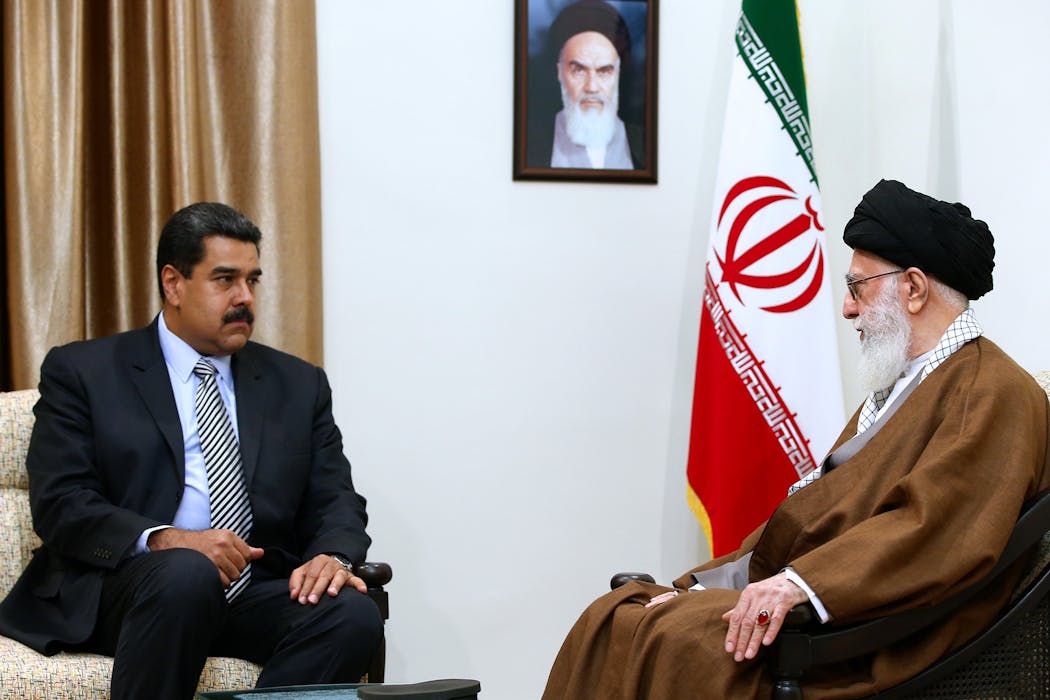
Better days: Venezuelan President Nicolas Maduro, left, met the supreme leader of Iran, Ali Khamenei, in Tehran on Oct. 22, 2016. Pool/Supreme Leader Press Office/Anadolu Agency/Getty Images

Perhaps no one outside of Venezuela or Cuba should care more about the U.S. capture of nominal President Nicolás Maduro than the Islamic Republic of Iran’s supreme leader, Ali Khamenei.

Khamenei and his regime are in trouble, and it’s not clear how they would survive should the Trump administration decide to support the millions who want a new government system without Khamenei and his ilk.

Iran has no state allies that would be willing to intervene militarily on its behalf. Further, its once-powerful network of partner and proxy militias – Lebanese Hezbollah, the Houthi rebels in Yemen, and other members of the Axis of Resistance – has been rendered incapable or reluctant to get involved. And Iran’s economy is in shambles in the midst of an ongoing water crisis with no relief in sight.

Further, the Iranian people have again taken to the streets to air their grievances against harsh economic conditions as well as government corruption, mismanagement and hypocrisy, echoing similar conditions to Venezuela in recent years.

Lastly, President Donald Trump has returned his attention to Iran. On Jan. 2, Trump warned Khamenei that if his forces violently suppress protesters, Iran would be “hit very hard” by the U.S.

Trump’s warning and show of solidarity will likely embolden protesters, which will almost certainly cause Iran’s internal security to crack down harder, as has happened in the past. Such U.S. intervention could lead to the overthrowing of the ayatollah, intended or not. Furthermore, Maduro’s fate demonstrates that the Trump administration is willing to use military force for that purpose if deemed necessary.

As an analyst of Middle East affairs focusing on Iran, I believe that these conditions place Khamenei’s regime under greater threat today than perhaps any other time in its 46-year history.

Protesters and security forces clash in Tehran’s Grand Bazaar in a video released on Jan. 6, 2026.

Growing threats, internal and external

If Khamenei hopes to survive politically or mortally, I believe he has three options.

First, he could capitulate to U.S. demands to halt Iran’s nuclear enrichment program. Second, Iran could sprint toward a nuclear bomb. Lastly, he could flee.

In hopes of restoring deterrence, Khamenei could also continue rebuilding his country’s military capabilities, which were significantly degraded during the June 2025 12-day war in which Israel and the U.S. aimed to destroy Iran’s nuclear capability.

Israel is eager to stifle Iran’s reconstitution plans, protests are spreading and growing more intense, and Trump – through hostile rhetoric and offensive military action – has put Khamenei on notice.

Khameini’s problems aren’t his alone. The revolutionary theocratic system of government that he leads is in danger of falling. And his military and internal security apparatus may not have the time or ability to address its growing and interrelated internal and external threats simultaneously.

There are two fundamental factors analysts like me consider when assessing enemy threats: offensive capability to inflict damage and hostile intentions to use these capabilities to harm enemies.

Determining offensive capability involves evaluating the quality of a country or organization’s complete arsenal – air, ground, maritime, cyber and space capabilities – and how trained, disciplined, integrated and lethal their forces might be. Determining intentions involves evaluating if, when and under what conditions offensive capabilities will be used to achieve their goals.

If states hope to survive when they come under such pressure, their defense strategy should account for differences between their own military capability and the enemy’s, especially if enemies intend to attack. Or states need to convince enemies to be less hostile, if possible.

Maduro’s mistake was his inability to defend against a far superior U.S. military capability while believing that U.S. leaders would not remove him from office. Maduro gambled and lost.

Bad choices

Iran’s supreme leader faces a similar conundrum: First, there is no foreseeable path that allows Tehran to produce or acquire the military capabilities necessary to deter Israel or defeat the United States, unless Iran develops a nuclear weapon.

And decades of mutual hostility, the memory of Iran’s once-clandestine nuclear weaponization program and recent Iranian lawmaker calls to develop nuclear bombs minimizes the prospect that U.S. leaders view Khamenei’s intentions as anything but hostile.

But as the clear weaker party, it is in Tehran’s interest to change Trump’s mind about Tehran’s hostile intent. The way to do that would be by abandoning nuclear enrichment.

In terms of threat analysis, the regime’s oft-repeated chants of “Death to America” and “Death to Israel” perhaps have sent an easily misinterpreted message: that Iran’s hostile leaders intend to destroy the U.S. and Israel. But they simply lack the capability, for now.

President Theodore Roosevelt famously said “speak softly and carry a big stick; you will go far.” Today, he might say that Khamenei is unwise for speaking with such vitriol considering the size of Iran’s stick. The United States and Israel possess military capabilities far superior to Iran’s – as demonstrated by the 12-day war – but they did not then share the same intent. Though both Israel and the U.S. operations shared the objective of neutralizing Iran’s nuclear capability, Israel’s objectives were more broad and included targeting senior Iranian leaders and destabilizing the regime.

To Khamenei’s momentary personal and institutional fortune, Trump immediately called for a ceasefire following U.S. B-2 strikes on Iranian nuclear facilities, delineating the United States’ narrower objectives that at the time did not include regime change in Iran.

But that was before U.S. forces removed Maduro from Caracas and before the outbreak of protests in Iran, both of which coincide with Israel’s signaling preparations for Round 2 against Iran.

A fighter jet taxiing behind a person holding lights.
Israel is telegraphing its ambitions for another attack on Iran; fighter jets like this taxiing F-16I would likely be part of Israel’s next campaign.
Israel Defense Forces (IDF) / Handout/Anadolu via Getty Images)

Iran without Khamenei?

During Trump’s Dec. 29 press conference at Mar-a-Lago with Israeli Prime Minister Benjamin Netanyahu, he warned that the U.S. could “knock the hell” out of Iran if the country reconstitutes its nuclear facilities.

This is separate from the ominuous warning that the U.S. could intervene on behalf of Iranian protesters; it would almost certainly differ in scale.

Nevertheless, a potential U.S. intervention could embolden protesters and further undermine and destabilize the Islamic Republic regime. Khamenei has predictably scoffed at and dismissed Trump’s warning.

I believe this is a serious mistake.

Secretary of State Marco Rubio warned on Jan. 3, 2025, that Khameini should not “play games” as Maduro did. Khamenei, Rubio said, should take Trump’s warnings seriously. I agree.

If Iran refrains from violent crackdowns on protesters, there is a chance that anti-government protestors overthrow the government. But the supreme leader’s chances of surviving a popular uprising are probably greater than surviving an unbridled U.S. or Israeli military intent on ushering in a new – post-Islamic Republic – Iran.

Otherwise, Khamenei has to address superior U.S. and Israeli military capability, quickly. But Iran is broke, and even if sanctions were not continuously strangling Iran economically, the country could probably never purchase its way to military parity with the U.S. or Israel.

Alternatively, Iran could determine that it must move quickly to develop a nuclear weapon to mitigate U.S. and Israeli military capabilities and deter future aggression. However, it is extremely unlikely Iran could do this without U.S. and Israeli intelligence discovering the project, which would immediately trigger an overwhelming military campaign that would likely expedite regime change in Iran.

And like Maduro, the supreme leader is utterly alone. None of Maduro’s closest partners – China, Russia, Cuba and even Iran – were willing to fight in his defense, despite weeks of forewarning and U.S. military buildup near Venezuela.

Under these circumstances, it may be impossible for Khamenei to address overwhelming U.S. and Israeli military capabilities. He could, however, reduce the threat by doing what is necessary to ensure the United States’ objectives for Iran remain narrow and focused on the nuclear program, which may also keep Israel at bay.

However, Khamenei would have to demonstrate unprecedented restraint from cracking down violently on protesters and a willingness to give up nuclear enrichment. Due to historical animosity and distrust toward the U.S., both are unlikely, increasing, I believe, the probability of a forthcoming Iran without Khamenei.

The Conversation

Dr. Aaron Pilkington is a U.S. Air Force Senior Analyst of Middle East affairs and a Fellow at the University of Denver’s Center for Middle East Studies. The views expressed are those of the author and do not reflect the official position of the Department of War, the Department of the Air Force, or any other organizational affiliation.

ref. Today Venezuela, tomorrow Iran: can the Islamic Republic survive a second Trump presidency? – https://theconversation.com/today-venezuela-tomorrow-iran-can-the-islamic-republic-survive-a-second-trump-presidency-272693

Why 2026 could see the end of the Farm Bill era of American agriculture policy

Source: The Conversation – USA (2) – By Christopher Neubert, Deputy Director, Swette Center for Sustainable Food Systems, Arizona State University

Federal funding is a key support for programs that provide free food to needy families. Joseph Prezioso/AFP via Getty Images

With Congress back in session, legislators will take up a set of issues they haven’t comprehensively addressed since 2018 – the year the last farm bill passed.

Farm bills are massive pieces of legislation that address a diverse constellation of topics, including agricultural commodities, conservation, trade, nutrition, rural development, energy, forestry and more. Because of their complexity, farm bills are difficult to negotiate in any political environment. And as the topics have expanded since the first iteration in 1933, Congress has generally agreed to take the whole thing up once every five years or so.

However, the most recent farm bill’s provisions expired in 2023. They have been renewed one year at a time ever since, but without the comprehensive overhaul that used to accompany farm bills.

As former federal employees handling agriculture policy who now study that topic, it’s unclear to us whether a comprehensive, five-year farm bill can be passed in 2026, or ever again.

The July 2025 enactment of the so-called “One Big Beautiful Bill Act,” the Trump administration’s budget priorities in the tax and spending bill, revised funding levels for many programs that were historically handled in the farm bill. For instance, that law included a 20% cut in funding to the Supplemental Nutrition Assistance Program, known as SNAP, which helps low-income families buy food. And it doubled support for the largest farm subsidy programs.

Those changes and current divisions in Congress mean the nation’s food and agriculture policy may remain stuck in limbo for yet another year.

A man in a field reaches toward a plant.
An Indiana soybean farmer examines his crop.
AP Photo/Michael Conroy

Cuts to SNAP used for farm subsidies

For decades, political conventional wisdom has held that sweeping federal farm bills are able to pass only because farmers seeking subsidies and anti-hunger advocates wanting increased SNAP dollars recognize the mutual advantage in working together. That’s how to build a broad, bipartisan consensus strong enough to garner the 60 votes in the U.S. Senate to avoid a filibuster and actually pass a bill.

But the One Big Beautiful Bill Act tax and spending law did not create a compromise between those competing interests. It slashed SNAP spending by US$186 billion over the next decade. At the same time, it boosted price support for farmers who grow key crops like corn, soybeans and wheat by $60 billion, in addition to a $10 billion economic relief package passed at the end of 2024 to address high costs of seeds, fertilizer and other farming supplies.

Supporters of anti-hunger programs are furious that these funds for farmers are being paid for by cutting SNAP benefits to families.

In addition, about one-third of the SNAP cuts came by shifting the program’s cost to state budgets. States have always carried some of the costs to administer SNAP, but they have never before been required to fund billions of dollars in benefits. Many states will be unable to cover these increased costs and will be forced to either reduce benefits or opt out of SNAP altogether, dramatically cutting the help available to hungry Americans.

Groups that support SNAP are unlikely to help pass any bill relating to food or farm policy that does not substantially reverse the cuts to SNAP.

A crowd of people moves through an area with many boxes.
Californians collect free food at a community gathering.
Justin Sullivan/Getty Images

And farmers who receive money under the two largest farm subsidy programs are not even required to grow the specific crops those programs are meant to support. Rather, they must simply own farmland that was designated in 1996 as having grown that crop in the early 1980s.

Farmers have repeatedly said they would prefer federal farm policies that support markets and create conditions for stable, fair commodity prices. And evidence shows that spending more money on farm subsidies does little to actually improve underlying economic conditions affecting the costs of farming or the prices of what is grown.

And yet, in early December 2025, the Department of Agriculture released an additional $12 billion to help offset losses farmers experienced when Trump’s tariffs reduced agricultural exports. In mid-December, the National Farmers Union said that money still wasn’t enough to cover losses from consistently low commodity prices and high seed and fertilizer costs.

A regular five-year farm bill may be out of reach

The success of any bill depends on political will in Congress and outside pressure coming together to deliver the required number of votes.

Some leaders in Congress remain optimistic about the prospects of a farm bill passing in 2026, but major legislation is rare with midterm elections looming, so meaningful progress appears unlikely. It seems to us more likely that the ongoing stalemate will continue indefinitely.

In September 2025, Politico reported that instead of a complete five-year farm bill, the House and Senate committees on agriculture might take up a series of smaller bills to extend existing programs whose authorizations are expiring. Doing so would be an effective declaration that a permanent five-year farm bill is on indefinite hold.

Prospects for sustainable farm policy

By using financial incentives cleverly, Congress has shifted farming practices over time in ways that lawmakers determined were in the public’s interest.

The 2022 Inflation Reduction Act, for instance, allocated $20 billion over four years to encourage farmers to reduce or offset carbon emissions, which the Agriculture Department calls “climate-smart agriculture.” Those funds, along with a separate Department of Agriculture initiative with similar aims, were well received by American farmers. Farmers applied for far more money than was actually available.

A large green machine moves through rows of crops.
A Georgia farmer harvests corn from a field.
AP Photo/Mike Stewart

The One Big Beautiful Bill Act tax and spending law cut those funds and repurposed them for traditional Agriculture Department programs for farmers who want to implement conservation practices on their land.

But unexpectedly, the Trump administration’s “Make America Healthy Again,” or MAHA, agenda contains some ideas that climate-smart advocates have previously advanced. These include scathing indictments of the effects of conventional agriculture on Americans’ health, including concerns over pesticide use and the so-far-undefined category of “ultra-processed foods.”

The MAHA agenda could be an opportunity for organic farmers to secure a boost in federal funding. In December, the Agriculture Department committed $700 million toward “regenerative” practices, but that’s a trifling amount compared with the billions commodity farmers received in 2025.

And the administration’s allies who support conventional agriculture have already expressed concerns that MAHA efforts might reduce the nation’s agricultural productivity. The administration may end up caught between the MAHA movement and Big Ag.

Overall, in this new political environment, we believe advocates for changes in agriculture and food aid will likely need to rethink how to advance their agendas without the promise of a farm bill coming anytime soon.

The Conversation

Neubert was previously staff on the Senate Committee on Agriculture, Nutrition and Forestry (2023-2025) and on the Senate Committee on the Budget (2021-2023).

Merrigan was USDA deputy secretary and COO (2009-2013) and staff on the Senate Committee on Agriculture, Nutrition and Forestry (1987-1992).

ref. Why 2026 could see the end of the Farm Bill era of American agriculture policy – https://theconversation.com/why-2026-could-see-the-end-of-the-farm-bill-era-of-american-agriculture-policy-270722

How facial recognition for bears can help ecologists manage wildlife

Source: The Conversation – USA (2) – By Emily Wanderer, Associate Professor of Anthropology, University of Pittsburgh

Can you tell these bears apart now? Would you recognize them if you saw them again tomorrow? Education Images/Universal Images Group via Getty Images

When a grizzly bear attacked a group of fourth- and fifth-graders in western Canada in late November 2025, it sparked more than a rescue effort for the 11 people injured – four with severe injuries. Local authorities began trying to find the specific bear that was involved in order to relocate or euthanize it, depending on the results of their assessment.

The attack, in Bella Coola, British Columbia, was very unusual bear behavior and sparked an effort to figure out exactly what had happened and why. That meant finding the bear involved – which, based on witness statements, was a mother grizzly with two cubs.

Searchers combed the area on foot and by helicopter and trapped four bears. DNA comparisons to evidence from the attack cleared each of the trapped bears, and they were released back to the wild. After more than three weeks without finding the bear responsible for the attack, officials called off the search.

The case highlights the difficulty of identifying individual bears, which becomes important when one is exhibiting unusual behavior. Bears tend to look a lot alike to people, and untrained observers can have a very hard time telling them apart. DNA testing is excellent for telling individuals apart, but it is expensive and requires physical samples from bears. Being trapped and having other contact with humans is also stressful for them, and wildlife managers often seek to minimize trapping.

Recent advances in computer vision and other types of artificial intelligence offer a possible alternative: facial recognition for bears.

As a cultural anthropologist, I study how scientists produce knowledge and technologies, and how new technology is transforming ecological science and conservation practices. Some of my research has looked at the work of computer scientists and ecologists making facial recognition for animals. These tools, which reflect both technological advances and broader popular interest in wildlife, can reshape how scientists and the general public understand animals by getting to know formerly anonymous creatures as individuals.

New ways to identify animals

A facial recognition tool for bears called BearID is under development by computer scientists Ed Miller and Mary Nguyen, working with Melanie Clapham, a behavioral ecologist working for the Nanwakolas Council of First Nations, conducting applied research on grizzly bears in British Columbia.

It uses deep learning, a subset of machine learning that makes use of artificial neural networks, to analyze images of bears and identify individual animals. The photos are drawn from a collection of images taken by naturalists at Knight Inlet, British Columbia, and by National Park Service staff and independent photographers at Brooks River in Katmai National Park, Alaska.

Bears’ bodies change dramatically from post-hibernation skinny in the spring to fat and ready for winter in the fall. However, the geometry of each bear’s face – the arrangement of key features like their eyes and nose – remains relatively stable over seasons and years.

BearID uses an algorithm to locate bear faces in pictures and make measurements between those key features. Each animal has a unique set of measurements, so a photograph of one taken yesterday can be matched with an image taken some time ago.

A photo of bears with lines marking the distances between their facial features.
Measuring the distance between a bear’s facial features can help identify individual animals.
BearID Project

In addition to helping identify bears that have attacked humans or are otherwise causing trouble for people, identifying bears can help ecologists and wildlife managers more accurately estimate bear population sizes. And it can help scientific research, like the behavioral ecology projects Clapham works on, by allowing individual tracking of animals and thus better understanding of bear behavior.

Miller has built a web tool to automatically detect bears in the webcams from Brooks River that originally inspired the project. The BearID team has also been working with Rebecca Zug, a professor and director of the carnivore lab at the Universidad San Francisco de Quito, to develop a bear identification model for Andean bears to use in bear ecology and conservation research in Ecuador.

Animal faces are less controversial

Human facial recognition is extremely controversial. In 2021, Meta ended the use of its face recognition system, which automatically identified people in photographs and videos uploaded to Facebook. The company described it as a powerful technology that, while potentially beneficial, was currently not suitable for widespread use on its platform.

In the years following that announcement, Meta gradually reintroduced facial recognition technology, using it to detect scams involving public figures and to verify users’ identities after their accounts had been breached.

When used on humans, critics have called facial recognition technology the “plutonium of AI” and a dangerous tool with few legitimate uses. Even as facial recognition has become more widespread, researchers remain convinced of its dangers. Researchers at the American Civil Liberties Union highlight the continued threat to Americans’ constitutional rights posed by facial recognition and the harms caused by inaccurate identifications.

For wildlife, the ethical controversies are perhaps less pressing, although there is still potential for animals to be harmed by people who are using AI systems. And facial recognition could help wildlife managers identify and euthanize or relocate bears that are causing significant problems for people.

People stand in the dark holding lit candles.
Mourners in Wyoming honor Bear 399, a bear who became well-loved in the community but was killed when hit by a car in October 2024.
Natalie Behring/Getty Images

A focus on specific animals

Wildlife ecologists sometimes find focusing on individual animals problematic. Naming animals may make them “seem less wild.” Names that carry cultural meaning can also frame people’s interpretations of animal behavior. As the Katmai rangers note, humans may interpret the behaviors of a bear named Killer differently than one named Fluffy.

Wildlife management decisions are meant to be made about groups of animals and areas of territory. When people become connected to individual animals, including by naming them, decisions become more complicated, whether in the wild or in captivity.

When people connect with particular animals, they may object to management decisions that harm individuals for the sake of the health of the population as a whole. For example, wildlife managers may need to move or euthanize animals for the health of the broader population or ecosystem.

But knowing and understanding bears as individual animals can also deepen the fascination and connections people already have with bears.

For example, Fat Bear Week, an annual competition hosted by explore.org and Katmai National Park, drew over a million votes in 2025 as people campaigned and voted for their favorite bear. The winner was Bear 32, also known as “Chunk.” Chunk was identified in photographs and videos the old-fashioned way, based on human observations of distinguishing characteristics – such as a large scar across his muzzle and a broken jaw.

In addition to identifying problematic animals, I believe algorithmic tools like facial recognition could help an even broader audience of humans deepen their understanding of bears as a whole by connecting with one or two specific animals.

The Conversation

Emily Wanderer receives funding from the Wenner-Gren Foundation for Anthropological Research and the National Science Foundation.

ref. How facial recognition for bears can help ecologists manage wildlife – https://theconversation.com/how-facial-recognition-for-bears-can-help-ecologists-manage-wildlife-271371

LA fires 1 year later: Chemicals from smoke lingered inside homes long after the wildfires were out – studies tracked the harm

Source: The Conversation – USA (2) – By Yifang Zhu, Professor of Environmental Health Sciences, University of California, Los Angeles

Smoke rolls up a hillside from the Palisades Fire on Jan. 11, 2025, in Los Angeles. AP Photo/Eric Thayer

When wildfires began racing through the Los Angeles area on Jan. 7, 2025, the scope of the disaster caught residents by surprise. Forecasters had warned about high winds and exceptionally dry conditions, but few people expected to see smoke and fires for weeks in one of America’s largest metro areas.

Environmental health scientist Yifang Zhu studies air quality at UCLA and began collecting samples from inside and outside homes the day after the fires began. In this Q&A, she describes findings by her team, a consortium of universities and local projects, that are painting a picture of the health risks millions of Los Angeles-area residents faced.

Their research offers both a warning and steps people everywhere can take to protect their homes and themselves from wildfire smoke in the future.

What made the LA fires unusual?

Urban fires are unique in a sense that it’s not just trees and other biomass burning. When homes and vehicles catch fire, plastics, electronics, cleaning chemicals, paints, textiles, construction material and much more burns, releasing chemicals and metals into the air.

More than 16,000 buildings burned in LA. Electric vehicles burned. A dental clinic burned. All of this gets mixed into the smoke in complicated ways, creating complex mixtures that can have definite health risks.

One thing we’ve found that is especially important for people to understand is that the concentration of these chemicals and metals can actually be higher inside homes compared with outside after a fire.

Satellite image of fire outlines.
A composite of satellite images from January 2025 shows outlines, in red, of the largest fires in the Los Angeles area. Altadena is on the right, and Pacific Palisades is on the lower left.
MMGIS, Caltech/JPL

What are your health studies trying to learn?

To understand the health risks from air pollution, you need to know what people are exposed to and how much of it.

The LA Fire HEALTH Study, which I’m part of, is a 10-year project combining the work of exposure scientists and health researchers from several universities who are studying the long-term effects of the fire. Many other community and health groups are also working hard to help communities recover. A local program called CAP.LA, or Community Action Program Los Angeles, is supporting some of my work, including establishing a real-time air quality monitoring network in the Palisades area called CAP AIR.

During an active wildfire, it’s extremely difficult to collect high-quality air samples. Access is restricted, conditions change quickly, and research resources are often limited and take time to assemble. When the fires broke out not far from my lab at UCLA, my colleagues and I had been preparing for a different study and were able to quickly shift focus and start collecting samples to directly measure people’s exposure to metals and chemicals near and around the fires.

A neighborhood with smoke in the air.
Wildfire smoke, like this during the Palisades Fire on Jan. 7, 2025, can get into a home under doors and around windows.
AP Photo/Ethan Swope

My group has been working with people whose homes were exposed to smoke but didn’t burn and collecting samples over time to understand the smoke’s effects. We’re primarily testing for volatile organic compounds off-gassing from soft goods – things like pillows, textiles and stuffed animals that are likely to absorb compounds from the smoke.

Our testing found volatile organic compounds that were at high levels outdoors during the active fire were still high indoors in February, after the fires were contained. When a Harvard University team led by environmental scientist Joe Allen took samples in March and April, they saw a similar pattern, with indoor levels still high.

What health risks did your team find in homes?

We have found high levels of different kinds of volatile organic compounds, which have different health risks. Some are carcinogens, like benzene. We have also found metals like arsenic, a known carcinogen, and lead, which is a neurotoxin.

Mike Kleeman, an air quality engineer at the University of California Davis, found elevated levels of hexavalent chromium in the nanometer-size range, which can be a really dangerous carcinogen. In March, he drove around collecting air samples from a burn zone. That was testing which government agencies would not have routinely done.

Fires have a long list of toxic compounds, and many of them aren’t being measured.

Chart shows spike in visits in early January 2025
Data from the Centers for Disease Control and Prevention shows emergency room visits spiking during the fires in early January 2025. The bold line shows the daily percentage of emergency department (ED) encounters that were associated with wildfires, and the dashed line shows the outdoor air quality index (AQI) values.
CDC

What do you want people to take away from these results?

People are exposed to many types of volatile organic compounds in their daily lives, but after wildfires, the indoor VOC levels can be much, much higher.

I think that’s a big public health message from the LA fires that people really need to know.

In general, people tend to think the outdoor air is worse for their health, particularly in a place like LA, but often, the indoor air is less healthy because there are several chemical emission sources right there and it’s an enclosed space.

Think about cooking with a gas stove, or burning candles or spraying air fresheners. All of these are putting pollutants into the air. Indoor pollution sources like cleaning fluids and PFAS from furniture and carpets are all around.

We often hear from people who are really worried about the air quality outside and its health risk during fires, but you need to think about the air indoors too.

A man walks on a beach with a dog as smoke rise from a fire in the background.
Thick smoke from a wildfire spreads over homes in Pacific Palisades, as seen from the Venice Beach section of Los Angeles on Jan. 7, 2025.
AP Photo/Jae C. Hong

What are some tips for people dealing with fires?

The LA fires have given us lots of insights into how to restore homes after smoke damage and what can be cleaned up, or remediated. One thing we want to do is develop an easy-to-follow decision tree or playbook that can help guide future fire recovery.

When the fires broke out, even I had to think about the actions I should take to reduce the smoke’s potential impact, and I study these risks.

First, close all your windows during the wildfire. If you have electricity, keep air purifiers running. That could help capture smoke that does get into the home before it soaks into soft materials.

Once the outside air is clean enough, then open those windows again to ventilate the house. Be sure to clean your HVAC system and replace filters, because the smoke leaves debris. If the home is severely impacted by smoke, some items will have to be removed, but not in every case.

And you definitely need to do testing. A home might seem fine when you look at it, but our testing showed how textiles and upholstery inside can continue off-gassing chemicals for weeks or longer.

But many people don’t have their homes tested after wildfires. They might not know how to read the results or trust the results. Remediation can also be expensive, and some insurance companies won’t cover it. There are probably people who don’t know whether their homes are safe at this point.

So there needs to be a clear path for recovery, with contamination levels to watch for and advice for finding help.

This is not going to be the last fire in the Los Angeles area, and LA will not be the last city to experience fire.

The Conversation

Yifang Zhu is working with CAP.LA (Community Action Project Los Angeles), which is funded by the R&S Kayne Foundation, and the LA Fire Health Study, which is funded by private philanthropists, including the Speigel Family Fund. Her work has also been partially funded by the Gordon and Betty Moore Foundation, the Danhakl Family Foundation, and the California Air Resources Board.

ref. LA fires 1 year later: Chemicals from smoke lingered inside homes long after the wildfires were out – studies tracked the harm – https://theconversation.com/la-fires-1-year-later-chemicals-from-smoke-lingered-inside-homes-long-after-the-wildfires-were-out-studies-tracked-the-harm-272473