Si nos capacités de concentration n’ont pas forcément été altérées par les nouvelles technologies, le fait de passer constamment d’une tâche à l’autre altère la qualité de notre attention.FujiCraft/Getty
Sollicités en permanence par les notifications de nos ordinateurs ou de nos téléphones, nous avons l’impression que notre attention se morcelle. Et à raison, car notre cerveau n’est pas vraiment « multitâche ». Heureusement, il est possible de reprendre la main sur notre concentration.
« Ding ! » – ce son de notification, conçu pour capter notre attention, ne nous est que trop familier. En moyenne, un adulte qui utilise un smartphone aux États-Unis recevrait chaque jour au moins 46 notifications push, soit une toutes les 20 minutes environ, durant les heures de veille.
Or, des résultats de recherches démontrent que ces fonctionnalités destinées à capter l’attention augmentent le stress et réduisent la productivité. Elles peuvent même avoir des conséquences mortelles : sur les routes australiennes, la distraction liée au téléphone coûte la vie à 29 personnes chaque année.
Dans nos sociétés modernes, se concentrer sur une seule tâche à la fois est devenu un défi qui peut sembler impossible à relever. Pourtant, il existe des moyens de reprendre le contrôle de notre attention.
Comment fonctionne notre attention
Notre attention sélective, autrement dit le processus par lequel nous nous concentrons sur les informations pertinentes en ignorant le reste, dépend de la mise en réseau de différentes régions de notre cerveau.
Concrètement, ce sur quoi nous dirigeons notre attention dépend d’un équilibre entre nos objectifs et ce qui se passe autour de nous. Cela signifie que des événements soudains peuvent capter notre attention et la détourner de ce que nous sommes en train de faire.
D’un point de vue évolutif, on pense que ce mécanisme d’attention sélective a été privilégié, car il permet de renforcer la sécurité. Si, pendant que l’on cueille des baies en forêt, un soudain bruissement de feuilles se fait entendre à proximité, mieux vaut que notre attention se détourne de notre activité pour se focaliser sur ce son, car il peut s’agir d’un prédateur prêt à attaquer.
Aujourd’hui, toutefois, ce même mécanisme est détourné de sa fonction par nos environnements modernes, au profit de choses bien moins importantes ou urgentes – par exemple, par la vibration qui signale qu’une nouvelle demande de contact est arrivée sur notre smartphone.
Le problème de la technologie
Les plateformes numériques sont conçues pour capter et retenir instantanément notre attention, en exploitant les systèmes de récompense et de motivation du cerveau. C’est pourquoi il peut être plus difficile de résister aux distractions qui offrent une forme de récompense, comme un like sur une publication. Cela complique également la capacité à rester concentré sur des tâches qui requièrent une attention soutenue.
Des recherches suggèrent que ces interruptions fréquentes pourraient réduire notre aptitude à rester focalisé sur une activité. Cette diminution d’attention ne résulterait pas d’une altération de nos capacités fondamentales à nous concentrer, mais plutôt d’une augmentation de la fréquence à laquelle nous passons d’une activité à l’autre.
Disons-le tout net : la capacité à être « multitâche », autrement dit à pouvoir accomplir deux tâches exigeantes en même temps, relève du mythe. En réalité, notre capacité d’attention est limitée : nous ne pouvons pas traiter simultanément tout ce qui se passe autour de nous. Être « multitâche » revient en réalité à alterner entre les tâches, c’est-à-dire à basculer rapidement de l’une à l’autre plutôt que de les mener réellement de front.
Il est cependant possible de « muscler notre attention » grâce à quelques ajustements de notre mode de vie.
1. Limiter les distractions liées aux dispositifs électroniques
Vous pouvez pour cela activer le mode « Concentration » de votre téléphone. Celui-ci limite automatiquement les distractions en filtrant les notifications reçues, en particulier pendant le travail ou la conduite. Vous pouvez aussi désactiver toutes les notifications des applications, et définir des plages horaires précises pour les consulter – dix minutes avant le déjeuner, par exemple – utilisant une minuterie pour vous y tenir.
Certaines applications permettent un suivi du temps d’écran. Elles peuvent être utiles, mais évitez celles qui transforment en jeu le temps passé loin de votre téléphone. En effet, de façon plutôt ironique, ces fonctionnalités ludiques sont, elles aussi, conçues pour capter votre attention… Privilégiez plutôt des outils qui vous décourageront d’utiliser vos appareils et qui vous procureront des données susceptibles de vous aider à prendre du recul sur vos usages des écrans.
2. Choisir des activités qui exigent de la concentration
Les données scientifiques sont claires : le fait de constamment alterner entre différentes tâches affaiblit notre concentration. Pour y remédier, privilégiez les activités qui requièrent une attention soutenue.
Des recherches ont démontré que s’adonner à des activités « immersives », telles que la pratique d’un instrument de musique ou d’un sport de compétition, plusieurs fois par semaine peut améliorer la capacité de concentration. Cela pourrait s’expliquer par le fait que ces activités exigent, pour atteindre les objectifs visés, de rester attentif sur des périodes prolongées.
Vous pouvez également utiliser des outils tels que les minuteurs Pomodoro, qui vous aideront à alterner des intervalles de 25 minutes de concentration sur une tâche avec des pauses de cinq minutes.
3. Réduire l’utilisation de la technologie
Des études ont révélé que les personnes qui évitent d’utiliser leurs appareils avant de dormir et qui ne les gardent pas avec eux dans la chambre dorment mieux. D’autres travaux indiquent également que ces pratiques peuvent améliorer la concentration le lendemain.
Lorsque vous disposez d’un peu de temps libre, résistez à l’envie de saisir immédiatement votre appareil. Des résultats de recherche suggèrent que s’accorder régulièrement des pauses pour laisser son esprit vagabonder permet au cerveau de traiter l’information et de tisser de nouveaux liens entre différents concepts et expériences, ce qui laisse le champ libre à la créativité.
En définitive, reprendre le contrôle de son attention n’exige pas nécessairement de se plier à des règles rigides ou d’observer des routines strictes. Cela commence par l’intention d’accomplir divers petits gestes destinés à nous rendre davantage « présent ».
L’attention est une ressource précieuse : investissons-la judicieusement.
Anina Rich bénéficie d’un financement du Conseil australien de la recherche. Elle est codirectrice de « Rethinking the Brain », une entreprise spécialisée dans les neurosciences éducatives.
Patricia Morada Macabulos ne travaille pas, ne conseille pas, ne possède pas de parts, ne reçoit pas de fonds d’une organisation qui pourrait tirer profit de cet article, et n’a déclaré aucune autre affiliation que son organisme de recherche.
Source: The Conversation – in French – By Bruno Deffains, Professeur de Sciences Économique, Membre honoraire de l’Institut Universitaire de France, Université Paris-Panthéon-Assas
Trois thèses sur l’IA semblent s’affronter : abondance des contenus, rareté de l’accès, banalisation par l’open source. Elles partagent pourtant un même constat : la valeur se déplace, aujourd’hui, du calcul vers le discernement et le jugement. C’est ce que la formation devra désormais cultiver, et c’est sur ce terrain que l’Union européenne peut encore agir.
Deux thèses sur l’intelligence artificielle (IA) paraissent s’affronter. L’une, défendue ici en mai dernier, décrit un monde d’abondance cognitive où les modèles produisent à profusion. L’autre, formulée par Anton Leicht dans le Grand Continent, annonce l’inverse, non l’abondance mais la rareté (l’accès aux systèmes de pointe sera filtré, géopolitiquement disputé, économiquement contraint). Une troisième arrive dans les débats, selon laquelle l’open source rattrape la frontière, et le fait vite.
Ces thèses ne se contredisent pas, elles désignent ensemble un même point d’aboutissement et la même urgence.
Deux étages, pas deux camps
Le mot « abondance » qui sépare les deux premières thèses est, en réalité, un faux ami. L’abondance évoquée porte sur l’output (ce qu’un modèle produit, une fois qu’on en dispose). La rareté que décrit Leicht porte sur l’accès au modèle lui-même (qui obtient, et à quel prix, le droit de s’en servir). Ce sont deux étages d’un même édifice, l’un décrit l’offre de l’outil, l’autre l’offre de contenu pour ceux qui en disposent.
Reconnaître cette structure révèle deux inégalités qui se superposent. À l’intérieur d’un pays doté d’un accès, la capacité d’exploitation reste inégale ; entre les pays, l’accès lui-même est inégal. La pyramide à trois étages qui en résulte (ceux qui cumulent accès et compétence et captent la valeur ; ceux qui ont l’accès sans la compétence et valident sans juger ; ceux qui n’ont ni l’un ni l’autre) n’apparaît dans aucune des deux thèses prises seules.
Quand l’open source change la donne
C’est ici que la troisième thèse intervient, et elle peut sembler tout renverser. Les modèles reposant sur des technologies « open source » rattrapent la frontière avec environ un an de retard, tournent désormais sur du matériel grand public, et bénéficient d’un soutien géostratégique chinois qui voit dans la diffusion ouverte un moyen de contenir l’avance américaine. Si cette dynamique se confirme, comme l’anticipent les travaux récents sur la diffusion des modèles ouverts (Bommasani et coll., 2023), l’étage du haut finira par céder. L’intelligence se « commoditise ». Le problème de modèle économique qu’anticipe Gary Marcus pour les laboratoires de pointe en est le symptôme, on ne capte pas de rente sur un bien banalisé.
Faut-il en conclure que la thèse de l’abondance triomphe et celle de la rareté s’effondre ? Ce serait passer à côté de l’essentiel. Quand l’étage supérieur d’un édifice cède, le poids ne disparaît pas. Il se transmet vers le bas. Si l’intelligence devient un consommable disponible partout, la seule ressource encore rare, donc la seule qui distingue et crée de la valeur, devient le jugement. La rente migre de l’accès vers le discernement. L’open source ne réfute pas la thèse de la rareté ; il la déplace, et la radicalise. La rareté change d’étage, elle quitte le sommet du calcul pour s’installer en aval, dans la capacité humaine à décider de ce que vaut un output.
Comment se forme un jugement
Cette capacité, contrairement à un modèle, ne se duplique pas. Le jugement professionnel (qualifier un fait incertain, sentir qu’une analyse fait fausse route, trancher une question mal posée) n’est pas un don. C’est une compétence qui ne se forme que par l’effort. Les travaux de Robert Bjork (1994) sur la « difficulté désirable » l’ont bien démontré. Un apprentissage est d’autant plus durable que son acquisition a coûté un travail mental. Le savoir qui en émerge est tacite, au sens de Polanyi (1966), il ne se transmet pas séparément de la pratique.
Or l’IA générative supprime, par construction, cet effort. Un essai contrôlé sur près d’un millier de lycéens (Bastani et coll., 2024) l’a mesuré. Les élèves utilisant GPT-4 progressaient pendant les séances assistées, mais une fois l’outil retiré, ils obtenaient des scores inférieurs de 17 % à ceux du groupe témoin. Le résultat décisif est ailleurs car ce déficit s’efface presque entièrement dans un groupe doté d’un tuteur muni de garde-fous, conçus pour guider l’élève vers la solution sans la livrer. Le danger n’est pas que l’IA soit trop difficile, c’est qu’elle soit trop serviable.
Décomposable ou holiste ?
Une objection s’impose. Déléguer une tâche cognitive n’a rien d’inédit (le juriste a toujours confié la recherche documentaire à un collaborateur). La réponse dépend d’une question plus fondamentale : le raisonnement professionnel est-il décomposable, ou holiste ? S’il est décomposable, on peut déléguer les sous-tâches routinières, en préservant intacte la part noble. S’il est holiste, ces sous-tâches sont des compléments et c’est en s’exerçant aux opérations basses qu’on devient capable des opérations hautes.
La prudence penche vers l’hypothèse holiste, parce que le savoir tacite se forme du frottement de l’exécution. La question n’est pas tant que les experts d’aujourd’hui perdent leur capacité, ils l’ont acquise, que les experts de demain ne l’acquièrent jamais.
La fabrique de la certitude d’emprunt
Les neurosciences cliniques offrent un éclairage complémentaire. Les travaux du psychiatre Raphaël Gaillard suggèrent que le cerveau, lorsqu’il ne parvient plus à maintenir une représentation stable du monde, fabrique des certitudes de secours, des idées rigides qui colmatent l’angoisse de l’indétermination.
Sénat, 2024.
La certitude d’emprunt, qu’elle vienne de l’idéologie ou désormais d’une IA générative qui convertit l’incertain en verdict d’allure autorisée, court-circuite ce travail psychique productif. Or, cette tolérance à l’indétermination est précisément le cœur des métiers de jugement. L’outil offre une certitude prête à l’emploi qui a toute l’apparence du jugement sans en être un.
L’échelle temporelle de la rupture
Reste la question de l’échelle. L’externalisation cognitive est une histoire longue. Marx, dans le « Fragment sur les machines » des Grundrisse, décrivait l’absorption du « general intellect » dans le capital fixe. Hannah Arendt, dans Condition de l’homme moderne, s’alarmait du désir moderne d’échanger une condition donnée contre une condition fabriquée. Ces lignées n’avaient pas anticipé la vitesse de la rupture en cours.
Max Bennett rappelle que le plus récent saut évolutif de l’intelligence humaine n’est pas biologique mais culturel. L’évolution génétique se compte en centaines de milliers d’années ; la transmission culturelle, en deux ou trois décennies par génération. Si l’IA absorbe les tâches qui constituent le cœur formateur des métiers de jugement, le risque n’est pas une régression évolutive, qui se jouerait sur une horloge géologique, mais une désaccoutumance culturelle, qui peut s’accomplir en deux générations oublieuses. Une désaccoutumance n’est pas un destin. C’est un choix par défaut, donc réversible, par une pédagogie active.
Une démonstration en temps réel
Cette analyse n’est plus théorique. Le 12 juin 2026, le département du commerce américain a ordonné à Anthropic de suspendre Mythos 5 et Fable 5, ses modèles de pointe, pour tout ressortissant non américain, contraignant l’entreprise à les couper globalement. La Commission européenne a protesté contre une mesure jugée discriminatoire. La thèse de Leicht est devenue, en quelques jours, le mode d’opération de la frontière, et l’Europe n’a pas eu son mot à dire.
D’où la conclusion. La rareté d’accès se durcit, l’abondance d’output continuera, l’open source rattrapera (à l’image de GLM 5.2 dévoilé, il y a quelques jours, par l’entreprise chinoise Zhipu AI). Mais le jugement restera rare quoiqu’il arrive car il est la seule ressource qui plafonne la valeur, et la seule sur laquelle l’Europe peut effectivement agir. Pas par décret, mais par la formation. Le sommet de la pyramide n’est pas géopolitique, il est pédagogique. Et c’est, justement, ce qui le rend gouvernable. Il ne faut sans doute pas tarder.
Bruno Deffains ne travaille pas, ne conseille pas, ne possède pas de parts, ne reçoit pas de fonds d’une organisation qui pourrait tirer profit de cet article, et n’a déclaré aucune autre affiliation que son organisme de recherche.
Source: The Conversation – in French – By Nick Turner, Professor and Croft Chair in Management, Haskayne School of Business, University of Calgary
De nouvelles recherches outre-Atlantique explorent la psychologie qui sous-tend « l’amour du travail » et ses implications pour les entreprises.
Que signifie aimer son travail ? Le champ lexical de l’amour revient souvent dans les débats lorsqu’on parle du monde du travail. Les gens disent vouloir aimer leur travail ; les entreprises promettent des postes que les candidats adoreront ; les offres d’emploi présentent le travail comme un engagement émotionnel davantage qu’une simple transaction économique.
Malgré son omniprésence, l’expression « aimer son travail » est rarement définie avec précision. Que signifie réellement aimer son travail ? Ce type d’amour est-il toujours bénéfique pour les employés et les organisations ?
C’est pourquoi nos recherches visent à comprendre ce que les employés décrivent lorsqu’ils disent aimer leur travail, et si cette expérience est toujours avantageuse à la fois pour leur entreprise et eux-mêmes.
À travers plusieurs études impliquant des milliers d’employés, nous nous sommes rendu compte qu’aimer son travail n’a pas la même signification qu’être satisfait de son travail ou se sentir impliqué. Au contraire, cette locution est au croisement de trois situations professionnelles singulières.
La première concerne l’enthousiasme pour son travail. Les personnes qui aiment leur métier apprécient sincèrement ce qu’elles font et se sentent stimulées. Cette perception va au-delà d’une satisfaction momentanée ; elle reflète une connexion émotionnelle profonde avec son travail.
La seconde a trait à l’engagement envers son entreprise. Aimer son travail implique de s’y sentir attachée à son organisation, de considérer que ses problèmes sont nos problèmes et de trouver un sens à son propre rôle au sein de cette organisation.
La troisième porte sur le lien avec l’autre au travail. Il ne s’agit pas de tout partager avec ses collègues ou de mettre systématiquement de la distance vis-à-vis de la sphère professionnelle. Au contraire, ce lien reflète le fait de se sentir émotionnellement connecté à ses collègues ou à l’équipe. Ce sentiment d’appartenance et de confiance donne au travail une dimension personnelle importante.
De nombreux employés sont satisfaits de leur travail, sans s’y sentir émotionnellement liés. D’autres se sentent très impliqués sans pour autant percevoir leur travail comme porteur de sens. D’autres encore peuvent aimer leur travail, mais ressentent peu d’attachement à leur organisation ou aux personnes qui les entourent.
L’amour du travail change en fonction de ces différentes situations. Un espace-temps où l’enthousiasme, l’implication et la connexion aux autres se rejoignent simultanément.
Pourquoi l’amour du métier peut être puissant
Lorsque ces éléments convergent, l’amour de son métier peut constituer une ressource psychologique considérable.
Dans nos recherches, l’amour du travail ne s’est pas avéré être associé à une considération ayant trait uniquement à la satisfaction professionnelle et l’engagement vis-à-vis de son organisation. Les employés qui aimaient leur travail déclarent ressentir un meilleur bien-être psychologique et se sentent davantage impliqués au quotidien.
Quant aux organisations, cette distinction est majeure. L’amour du travail n’est pas simplement synonyme de motivation ou d’engagement. Cette locution reflète une forme d’attachement plus profonde qui aide à expliquer pourquoi certains employés restent investis même lorsque le travail devient exigeant.
Avec des conditions favorables, aimer son travail peut contribuer à la fois au bien-être individuel et à des performances durables.
Quand l’amour devient une vulnérabilité
Il existe toutefois certains inconvénients potentiels. Bien que nous n’ayons pas trouvé de preuves que l’amour du travail entraîne directement l’épuisement professionnel, la surcharge de travail ou l’exploitation, des recherches antérieures suggèrent qu’un attachement profond au travail peut créer une vulnérabilité lorsque les conditions organisationnelles sont mauvaises.
Les employés qui aiment leur travail éprouvent souvent un fort sentiment de responsabilité envers leur organisation et leur fonction. Dans des environnements favorables, c’est sans doute un atout ; dans des environnements toxiques, c’est peut-être plus difficile de prendre du recul, de fixer ses limites ou se rendre compte que les exigences deviennent déraisonnables.
En d’autres termes, l’amour du travail peut accroître l’exposition des employés aux effets d’un mauvais management. C’est d’autant plus vrai dans les organisations qui encouragent les employés à s’investir pleinement dans leur travail ou qui considèrent le travail comme une vocation – qu’on pourrait appeler en France un « métier passion ».
Lorsqu’une organisation valorise un attachement émotionnel fort sans proposer une charge de travail réaliste, une rémunération équitable ou un respect des limites posé par l’employé, le dévouement peut se transformer en obligation.
Paradoxe pour les organisations
Les résultats de notre recherche mettent en lumière un paradoxe. Les employés qui déclarent aimer davantage leur travail sont plus enclins à aller au-delà de leurs fonctions officielles. Plus généralement, les organisations ont tendance à valoriser les employés qui se soucient profondément de leur travail, les considérant comme plus investis.
Mais encourager l’amour du travail sans protéger ceux qui le vivent peut être contre-productif, même pour les employés que les organisations valorisent. L’amour ne peut être fabriqué, exigé ou traité comme un indicateur de performance. Il ne peut pas non plus se substituer à de bonnes pratiques de management.
Encourager l’amour du travail signifie créer des conditions où le plaisir, l’engagement et le lien peuvent se développer naturellement grâce à un travail valorisant, un leadership bienveillant et une conception saine des tâches. L’amour du travail ne remplace pas un bon management ; il en dépend.
Des décennies de recherche sur la conception des postes, le leadership et le bien-être des employés montrent qu’un attachement positif durable au travail nécessite des attentes claires, des exigences gérables et une sécurité psychologique. L’amour ne peut compenser une surcharge chronique, des rôles flous ou un manque de soutien.
Aimer son travail peut être épanouissant lorsque cet amour s’exprime librement dans des conditions saines. Lorsque l’amour est attendu ou utilisé à la place d’un bon management, il peut devenir une source de tension plutôt qu’une force.
Nick Turner reçoit des fonds de recherche de Cenovus Energy Inc., du Fonds d’avenir de l’École de commerce Haskayne et du Conseil de recherches en sciences humaines du Canada (CRSH).
Julian Barling receives funding from the Social Sciences and Humanities Research Council of Canada and the Borden Chair of Leadership.
Kaylee Somerville a reçu des financements de Conseil de recherches en sciences humaines (CRSH).
Zhanna Lyubykh a reçu des financements de the Social Sciences and Humanities Research Council of Canada (SSHRC).
Source: The Conversation – in French – By Patrick De Wever, Professeur, géologie, micropaléontologie, Muséum national d’histoire naturelle (MNHN)
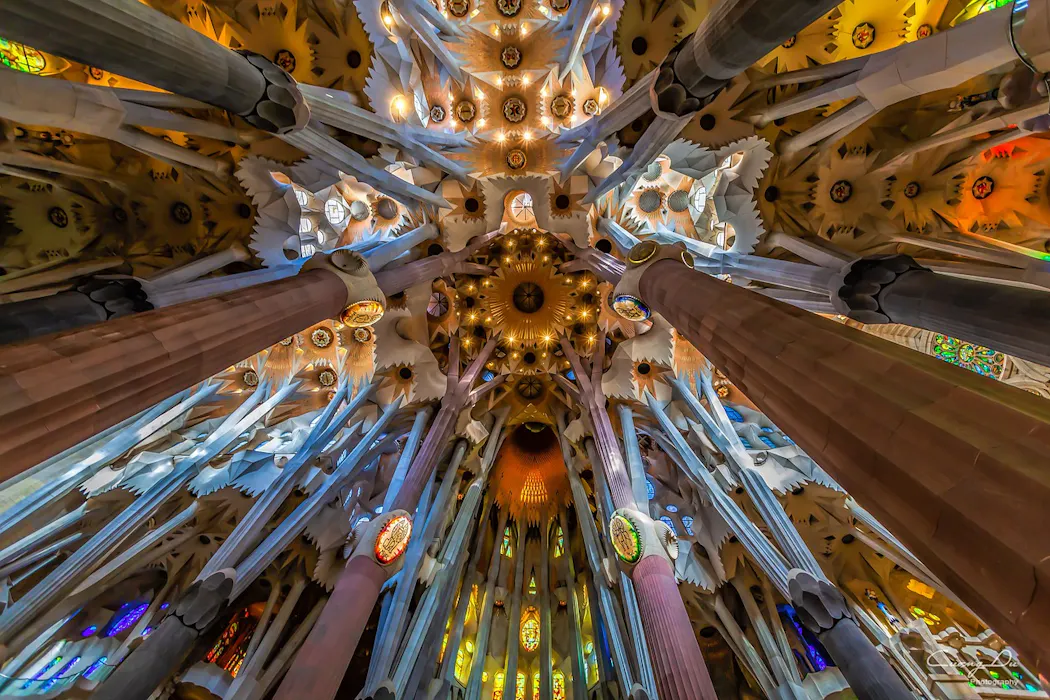
Vue de l’intérieur de la Sagrada Familia. La coupole s’appuie sur des piliers comme des segments de radiolaires se prolongent par des épines.CD_Photosaddict/Pixabay, CC BY-SA
Au-delà du sport, le Tour de France donne aussi l’occasion de (re)découvrir nos paysages et parfois leurs bizarreries géologiques. La toute première étape de son édition 2026, le samedi 4 juillet, met Barcelone à l’honneur. La ville espagnole est connue pour sa fameuse basilique la Sagrada Familia, conçue par l’architecte Antoni Gaudi. Celui-ci s’est notamment inspiré, au plan esthétique, de la géologie et du vivant, et en particulier des microfossiles.
La toute première étape du Tour de France fait un détour par l’Espagne, plus précisément par Barcelone. La ville abrite l’emblématique Sagrada Familia, conçue par l’architecte espagnol Antoni Gaudi.
L’occasion de revenir sur les liens entre architecture, vivant et géologie, très présents dans l’Art nouveau, qui ont beaucoup inspiré Antoni Gaudi. Ces influences qui se retrouvent, comme on va le voir, dans le chef-d’œuvre de l’architecte.
Quand la nature inspire l’Art nouveau
Quelques radiolaires (Cyrtoidea) que l’architecte Binet préférait : il considérait Clathrocanium reginae (rangée supérieure, le deuxième à partir de la gauche) comme le plus beau et Pterocanium trilobum (le plus à droite de la rangée du milieu), celui qui aurait inspiré la porte monumentale. Ernst Haeckel, « Kunstformen der Natur » (1904)
L’Art nouveau, mouvement artistique né à la fin du XIXᵉ siècle, s’appuie sur l’esthétique (des lignes, des couleurs, des ornementations) de la nature et de ses structures. Prendre la nature comme référence, c’est alors réagir contre le rationalisme du début de l’ère industrielle.
Pour le biologiste allemand Ernst Haeckel (1834-1919), la nature est apparentée à l’art. Il fut notamment marqué par la symétrie des microorganismes tels les radiolaires. Ses dessins d’organismes du plancton, obtinrent une grande célébrité, en particulier ses ouvrages Kunstformen der Natur (Formes artistiques de la nature), parus de 1899 à 1904 sous la forme de nombreux cahiers.
Ses représentations de micro et de macroorganismes ont considérablement influencé l’art du début du XXᵉ siècle. Les meilleurs exemples de cette fusion sont visibles au Musée océanographique de Monaco, dont le lustre méduse de Constant Roux, mais aussi les quatre lampes « radiolarium » et les fresques réalisées à partir des dessins d’Ernst Haeckel.
Le lustre Radiolaire du Musée océanographique de Monaco.
Les radiolaires de l’exposition universelle et l’essor du fonctionnalisme
Il en est de même pour la porte monumentale, à l’exposition universelle de Paris en 1900, de l’architecte français René Binet (1866-1911). La publication par Binet d’Esquisses décoratives, inspirée de Haeckel, fut une des bases de l’Art nouveau.
La porte monumentale de l’exposition universelle de Binet est inspirée d’un groupe de radiolaires, les cyrtoïdes, et plus particulièrement du Pterocanium trilobum. Library of Congress, Domaine public via Wikimedia
Les formes naturelles résultent de leur aptitude à une fonction et de règles morphologiques. Tout cela inspire considérablement les architectes de l’époque.
L’architecte français Eugène Viollet-le-Duc (1814-1879) a écrit qu’il fallait « chercher la raison de toute forme car toute forme a sa raison » dans sa préface des Entretiens sur l’architecture. Ce courant de pensée culmine avec la publication, en 1917, de l’ouvrage de D’Arcy Wentworth Thompson (1860-1948) Forme et Croissance, qui connaît un immense succès auprès des architectes.
Pour les fonctionnalistes (du courant fonctionnaliste en architecture), la forme et l’apparence d’un bâtiment devraient découler de sa fonction. En 1923, le biologiste autro-hongrois Raoul Francé (1874-1943) écrit :
« La nécessité prescrit certaines formes pour certaines qualités. (…) Dans la nature, toute forme (…) est une création de la nécessité. »
Ces parallèles avec l’architecture sont repris par l’architecte français Le Corbusier (1887-1965), qui déclare :
« La biologie est désormais le maître mot en architecture et urbanisme. »
Les influences géologiques de Montserrat à Barcelone
En France, Eugène Viollet-le-Duc sera l’inspirateur de nombreux architectes de l’Art nouveau, qui triomphe à l’Exposition universelle de Paris en 1900. Barcelone aussi s’illustre par des monuments Art nouveau, parmi lesquels ceux de l’architecte Antoni Gaudí, avec la basilique de la Sagrada Familia commencée en 1882. Pour lui :
« L’architecture du futur construira en imitant la nature, parce que c’est la plus rationnelle, durable et économique des méthodes. »
Alors qu’il était étudiant, Antoni Gaudi avait travaillé à l’abbaye de Montserrat (Catalogne) dont le paysage l’a marqué à tel point que l’on considère parfois que les tours de la Sagrada Familia sont une ode à Montserrat.
Paysages autour de l’abbaye bénédictine Santa Maria de Montserrat (Catalogne, Espagne). P. De Wever, Fourni par l’auteur
Ses tours, semblables à des aiguilles de pierre, reproduisent la verticalité des pics de Montserrat, tandis que les façades, sculptées comme par l’érosion, rappellent les parois rocheuses. Ces falaises sont constituées d’un conglomérat qui résulte de l’érosion des Pyrénées.
Ce même type de roche donne des reliefs similaires ailleurs, eux aussi accueillant parfois également des hommes d’Église, comme dans les monastères des Météores, en Grèce.
Les formations rocheuses dans les Météores, formation géologique du nord de la Grèce. Un monastère niché dans un repli. Stathis Floros, CC BY-SA
Le biomimétisme en architecture, des radiolaires aux diatomées
Revenons-en aux radiolaires, et plus particulièrement à leurs microfossiles. Le squelette est le seul élément d’étude du micropaléontologue.
Or, la géométrie du squelette des radiolaires répond aux mêmes lois de physique fondamentale que celles qui régissent les interfaces entre fluides ou entre fluides et solides. Il existe aussi une similitude frappante de formes entre une association de bulles de savon et certains squelettes de ces organismes.
Une expérience permet de bien comprendre le processus lié aux volumes créés par des tensions superficielles moindres en plongeant des structures rigides en fil de fer dans un bain d’eau savonneuse. On observe alors des structures similaires, parce que les forces physiques jouent de la même façon.
Structures tétraédriques en fil de fer plongées dans un bain d’eau savonneuse. a. – Le tétraèdre sorti du bain montre des voiles d’eau savonneuse, formant une structure interne plus complexe. b. – Avec un tétraèdre arrondi : la forme interne, proche de la précédente, évoque le squelette d’un radiolaire connu (voir c). c. – Squelette d’un radiolaire actuel : Callimitra agnesae, dessiné par Haeckel. P. De Wever et al. 2001, Fourni par l’auteur
Les structures de la nature résultent, elles, de centaines de millions d’années d’essais et d’erreurs, qui tiennent par exemple à la résistance mécanique ou aux économies de moyens, notamment en matière d’énergie nécessaire pour déposer le matériau (siliceux ou calcaire…). Les formes qui en sont issues répondent à des nécessités physiques et chimiques. Il n’est guère surprenant qu’elles inspirent les architectes et qu’elles invitent à établir un pont entre art et science à travers le biomimétisme.
Au-delà de l’Art nouveau, ce monde microscopique a continué d’influencer les architectes de structures monumentales telles la Géode du parc de la Cité des sciences, porte de la Villette à Paris, inaugurée en 1985, ou encore la Biosphère du pavillon des États-Unis à l’Exposition universelle de Montréal en 1967.
Bâtiment des hippopotames au jardin zoologique de Berlin, érigé en 1996, par l’architecte Jörg Gribl avec la coopération de M. F. Manleitner – ouvrir l’image en grand🔍. Kristof Magnusson, CC BY-SA
Plus curieux encore, car il ne s’agit pas de copie cette fois, mais d’une ressemblance fortuite : il est tout à fait extraordinaire de constater que la structure du dôme de Sainte-Sophie à Istanbul, évoque celle d’une diatomée alors même qu’à l’époque de sa construction (VIᵉ siècle) on ne connaissait pas encore la forme des diatomées ! Or, ce dôme est justement construit avec de la diatomite, seule roche suffisamment légère, pour une telle taille. Ou quand la science rejoint, des siècles plus tard, l’imagination des architectes.
Comparaison de la coupole du dôme de Sainte-Sophie (Istanbul, Turquie) vue de l’intérieur dans son état actuel (à gauche), avec un dessin de diatomée de Haeckel (à droite). Haeckel 1904/Eusebius, CC BY
Patrick De Wever ne travaille pas, ne conseille pas, ne possède pas de parts, ne reçoit pas de fonds d’une organisation qui pourrait tirer profit de cet article, et n’a déclaré aucune autre affiliation que son organisme de recherche.
Source: The Conversation – in French – By Marie-Elisabeth Lei Pihl, Postdoctoral Researcher in the Department of Communication, University of Copenhagen
De plus en plus de personnes déclarent se sentir seules, y compris lorsqu’elles sont entourées.Piotr Arnoldes/Pexels, CC BY
Nous accordons souvent la priorité au couple, à la famille et au travail, reléguant l’amitié au second plan. Pourtant, à mesure que les liens sociaux s’effritent, l’amitié apparaît comme une ressource essentielle pour élargir nos horizons, nourrir notre curiosité et donner du sens à nos vies.
Il y a quelques années, j’ai acheté une maison. Jeunes diplômés, mon mari et moi avions eu toutes les peines du monde à convaincre les banques de nous accorder un prêt immobilier. Et pour compliquer les choses, j’étais issue des sciences humaines, un parcours qui ne garantissait pas exactement une insertion professionnelle facile.
Après avoir essuyé plusieurs refus, nous avons finalement réussi à convaincre un conseiller bancaire bienveillant de nous faire confiance. Du jour au lendemain, nous nous sommes retrouvés installés en banlieue, dans une maison de 190 mètres carrés, avec deux enfants et un trampoline dans le jardin.
Un soir d’été, alors que les enfants dormaient, nous étions assis sur la terrasse, baignés par les derniers rayons du soleil. Nous avions bien mangé, allumé quelques bougies et buvions un verre de vin. Cela ressemblait à la soirée parfaite…
Sur le papier, nous avions réalisé notre rêve. Le problème, c’est que je ne le ressentais pas ainsi. J’avais l’étrange impression qu’il manquait quelque chose, alors même que j’adore ma famille. Ce qui manquait, c’étaient des amis. Et si je me sentais seule, je n’étais pas la seule dans ce cas. Des études montrent que beaucoup d’entre nous ont déjà éprouvé ce sentiment de solitude.
Mes recherches portent sur l’amitié et, ces dernières années, je me suis plongée dans tout ce qui touche à ce sujet, des études scientifiques aux textes littéraires. C’est d’ailleurs surtout la littérature qui m’a offert un regard nouveau, à la fois professionnel et personnel, sur ce que sont les amis et sur ce que l’amitié peut être.
Autrement dit, j’ai tout ce que les comédies romantiques et la culture populaire nous présentent comme essentiel : un partenaire, des enfants, un emploi et un crédit immobilier. Mais cela ne suffit pas tout à fait.
Et cela m’a amenée à me demander si le parcours de vie que beaucoup d’entre nous – moi comprise – suivons ne comporte pas, en réalité, des défauts intrinsèques. Cette trajectoire laisse-t-elle trop peu de place aux relations fondées sur le choix et l’égalité ? À ces relations qui ne consistent pas à fonder une famille, mais à nouer des amitiés ?
En manque d’amitié
Nous sommes élevés pour suivre un scénario social bien précis. Un scénario dans lequel la carrière, le mariage et les enfants occupent le devant de la scène, tandis que l’amitié se voit attribuer un rôle secondaire.
Beaucoup d’entre nous laissent derrière eux leur jeunesse – période où l’amitié occupe souvent une place centrale – au profit de la relation amoureuse « sérieuse » associée à l’âge adulte. Plus largement, certaines personnes considèrent l’amitié comme une sorte de cerise sur le gâteau, plutôt que comme la pâte qui lui donne sa cohésion.
Mais que se passe-t-il si ce scénario ne nous rend pas heureux ? Et si nous nous privions de quelque chose d’essentiel ? Dans son ouvrage fondateur, la Femme mystifiée, l’écrivaine et militante féministe Betty Friedan a décrit le profond mal-être ressenti par de nombreuses femmes dans les années 1960.
L’un des arguments centraux du livre est le suivant : les femmes qui restent au foyer pour s’occuper des enfants sont condamnées à l’insatisfaction en raison de structures sociales plus larges qui les maintiennent dans cette situation. Un phénomène qu’elle a qualifié de « problème sans nom ».
Bien sûr, le fait d’être fatiguée de prendre soin des autres et de ne pas être au centre de sa propre vie jouait un rôle important dans mon sentiment de tristesse et de manque. Mais cela n’expliquait pas tout : j’avais un emploi et des activités en dehors de la maison, contrairement à de nombreuses femmes des années 1960. J’avais des projets, des envies. L’analyse de Friedan ne rendait donc pas entièrement compte de mon problème.
Un phénomène du milieu de vie
Vous reconnaîtrez peut-être ce sentiment de manque d’amitié, même si vous ne vivez pas en banlieue, ne passez pas vos journées à gérer une vie de famille ou ne vous identifiez pas comme une femme. Peut-être avez-vous construit votre existence de façon très différente de la mienne et vous êtes-vous pourtant déjà demandé où étaient passés vos amis. Car au fond, à quel moment nos amis disparaissent-ils de nos vies ? C’est particulièrement au milieu de la vie qu’il devient difficile de trouver du temps pour eux.
Les psychologues américains Willard Hartup et Nan Stevens ont montré que nous passons moins de 10 % de notre temps d’éveil avec nos amis durant les années où le travail et la famille accaparent l’essentiel de notre temps et de notre énergie. Une autre étude, également menée aux États-Unis, aboutit à une conclusion similaire : plus de 40 % des adultes interrogés ont déclaré souhaiter être émotionnellement plus proches de leurs amis et aimeraient passer davantage de temps en leur compagnie.
Concrètement, nous passons aujourd’hui moins de trois heures par semaine avec nos amis, contre six heures il y a une décennie. Une division par deux, tout simplement. Cette évolution s’inscrit dans un mouvement plus large qui traverse nos sociétés : de moins en moins de personnes adhèrent à des partis politiques, l’appartenance aux institutions religieuses recule, et la participation aux syndicats ou aux clubs sportifs locaux diminue également. Des transformations que le politologue américain Robert D. Putnam a décrites dans son ouvrage de 1995, Bowling Alone (non traduit en français).
Dans mon propre cas, l’amitié occupait une grande place au début de ma vingtaine. Je vivais en résidence universitaire et, rétrospectivement, ce qu’il y avait de mieux dans cette période, c’est que je n’avais pas besoin d’organiser quoi que ce soit pour avoir une vie sociale.
Il y avait toujours quelqu’un dans la cuisine avec qui discuter. Toujours quelqu’un avec qui prendre un café. C’était une vie où l’amitié était intégrée au quotidien. Alors pourquoi quitter ce type de vie collective ? Pourquoi avoir des enfants, tout simplement, et, dans mon cas, déménager en banlieue ?
C’est une question légitime, et je me la suis souvent posée. La réponse la plus simple est que je suis tombée enceinte et que les enfants n’étaient pas autorisés dans les résidences étudiantes. À cela s’ajoute le fait que le logement dans les grandes villes – comme Copenhague – est devenu pratiquement inaccessible aux jeunes et aux jeunes familles. Pour le dire franchement, nous sommes poussés hors des villes.
Cela dit, j’étais aussi un peu lasse des fêtes des autres et du désordre des autres. Et parfois, on a simplement envie de boire son café seul. S’il avait été possible de rester dans une forme d’habitat partagé compatible avec la présence d’enfants tout en conservant une cuisine privée, je l’aurais fait sans la moindre hésitation. Mais ce type de solution est rare. Nous revenons donc au scénario social que j’évoquais plus tôt.
Ce que l’on pourrait appeler à la fois les structures sociales et l’organisation matérielle de nos lieux de vie laisse peu de place à des modes d’existence qui sortent du modèle du couple, de la famille nucléaire ou de la vie en solitaire (alors même que plus de personnes que jamais vivent désormais seules). D’où une aspiration croissante à de nouvelles normes autour de l’amitié et de la vie en communauté.
La littérature et la compagnie des autres
Certains soutiennent que la famille est une institution oppressive qui devrait être purement et simplement abolie. Cette position s’inscrit dans le prolongement du féminisme radical des années 1970. Des penseuses comme Shulamith Firestone défendaient ainsi l’idée que la reproduction devrait être confiée à la technologie afin de libérer totalement les femmes de cette charge. Plus récemment, Sophie Lewis a développé un argument similaire. Dans son ouvrage Pour en finir avec la famille, elle plaide pour le démantèlement de la structure sociale de la famille au profit d’une culture du soin plus collective.
Je comprends les motivations qui sous-tendent ce type d’arguments. Mais si des personnes souhaitent tomber amoureuses et avoir des enfants ensemble au sein d’un couple, alors elles doivent pouvoir le faire. Peu importe ce qu’un intellectuel peut en penser. Les familles posent-elles parfois problème ? Peuvent-elles nous rendre plus isolés en accaparant du temps qui pourrait être consacré aux amitiés ? Oui, dans les deux cas.
Peuvent-elles aussi être une source de joie et de sens ? Tout autant. La raison pour laquelle j’évoque cette critique de la famille est qu’elle reflète une tendance plus large dans les livres, les films et la culture en général : une volonté croissante de remettre en question nos modes de vie et la place que l’amitié devrait occuper dans nos existences. J’ai déjà écrit sur cette évolution, en expliquant que l’amitié gagne en importance et en proposant trois pistes pour comprendre pourquoi.
L’une de ces explications est la progression de la solitude, qui rend l’amitié d’autant plus précieuse qu’elle devient plus rare.
Une autre tient au fait que l’amitié peut aujourd’hui conférer du statut et du prestige dans un monde façonné par les réseaux sociaux et la culture de l’image.
Enfin, j’avancerais qu’il existe une curiosité culturelle croissante pour l’idée que les amitiés puissent servir de cadre de vie au même titre que les relations amoureuses l’ont historiquement fait.
La star de la littérature française Édouard Louis figure parmi les auteurs les plus en vue qui s’interrogent aujourd’hui sur l’amitié. Dans Changer : méthode (2021), il raconte comment sa vie a été marquée par un éloignement progressif de sa famille. À la place, il recherche différentes amitiés qui l’aident à échapper à un milieu ouvrier homophobe du nord de la France et à se rapprocher du monde littéraire parisien.
Il décrit comment son amitié avec Elena, une jeune femme issue de la classe moyenne, bouleverse complètement sa vision du monde, puis comment il se lie d’amitié avec les intellectuels français Didier Eribon et Geoffroy de Lagasnerie. Ce dernier a décrit leur amitié à trois comme un « mode de vie » et une « forme de vie radicale » rompant avec l’ordre établi.
On pourrait objecter que de telles représentations culturelles de l’importance de l’amitié constituent l’aboutissement de l’individualisme contemporain. Pour Édouard Louis, il s’agit de vivre exactement comme il souhaite vivre, totalement affranchi des conventions et des attentes sociales. Une démarche qui renvoie effectivement à une forme très contemporaine d’individualisme.
Mais elle exprime aussi un désir profond des autres et de la vie en communauté. Il semble poser la question suivante : est-il possible de renverser les conventions sociales existantes pour inventer nos propres normes en matière d’amitié et de vie collective ? Louis comme Geoffroy de Lagasnerie répondent par l’affirmative : oui, cela est possible.
Rompre avec les conventions
Les récits de l’écrivain danois Thomas Korsgaard consacrés à Tue présentent un parallèle intéressant avec ceux d’Édouard Louis : Tue est issu d’un milieu modeste, non universitaire, de province et, comme Édouard Louis, il quitte son environnement d’origine pour s’installer en ville et se construire une nouvelle vie.
Dans son roman Man skulle nok have været der (Il aurait sans doute fallu être là, non traduit en français), publié en 2021, Korsgaard raconte les débuts mouvementés de Tue à Copenhague. Pendant longtemps, celui-ci vit dans une grande précarité, presque sans domicile, avant de rencontrer Victoria (une sorte d’équivalent danois d’Elena) qui lui apprend les codes sociaux de la bourgeoisie intellectuelle. Peu à peu, il entame la même transformation que celle décrite par Édouard Louis.
L’histoire culturelle et littéraire offre également de nombreux exemples d’amitiés féminines ayant permis à certaines personnes de vivre en dehors des normes établies et d’être pleinement elles-mêmes. L’écrivaine suédoise Selma Lagerlöf ne s’est jamais mariée et a entretenu des relations très étroites avec d’autres femmes. De même, la vie et l’œuvre de Virginia Woolf ont été profondément marquées par des amitiés féminines intenses.
Pendant de nombreuses années, il n’était pas considéré comme suspect ou déplacé que des femmes entretiennent entre elles des relations romantiques, voire à la frontière de l’érotisme. Dans bien des cas, celles-ci étaient perçues comme de simples amitiés intimes.
L’homosexualité masculine, en revanche, a souvent suscité l’hostilité et la réprobation selon les époques et les contextes historiques, à l’exception notable de la Grèce antique et de certaines sociétés classiques.
Les récits d’Édouard Louis, de Thomas Korsgaard, de Geoffroy de Lagasnerie et de bien d’autres témoignent tous d’un puissant désir de rompre avec les structures qui nous dictent la manière dont nous devrions vivre. Ils nous rappellent aussi l’importance de nous demander si nous vivons selon nos propres critères – ou selon ceux de quelqu’un d’autre.
L’amitié à l’âge adulte
Le sentiment de manquer d’amis, celui qui m’a frappée ce soir-là sur la terrasse, renvoie peut-être à quelque chose de plus profond que le simple fait de ne pas avoir beaucoup de personnes à inviter à son anniversaire ou à appeler un jour de pluie. C’est avant tout ce que la littérature m’a permis de comprendre. Mon besoin d’amitié ne relevait pas tant d’un besoin d’être entourée. Il s’agissait davantage d’un besoin d’élargir mon horizon et d’entendre d’autres points de vue.
Ce n’étaient pas seulement mes amis qui me manquaient ; c’étaient aussi des perspectives différentes, de nouvelles idées et d’autres façons de penser. Les amitiés peuvent nous aider à découvrir et à explorer des aspects insolites et non conventionnels de l’existence et, ce faisant, à remettre en question l’ordre établi, à l’image des représentations que l’on trouve dans la littérature. En somme, elles peuvent nous amener à voir le monde autrement.
Lorsque j’étais à l’école primaire, l’une de mes plus proches amies était une femme d’environ 70 ans qui s’était occupée de moi lorsque j’étais enfant. Alors même qu’elle n’était plus ma baby-sitter, j’ai continué à aller la voir. Elle s’appelait Lise et était née en 1928. Avec son humour noir, ses boucles de cheveux et sa garde-robe remplie de chaussures à talons, son appartement était mon refuge préféré. Elle était d’origine juive et, à l’âge de 15 ans, elle avait fui les nazis au Danemark à bord d’un bateau de pêche suédois.
J’adorais ses histoires et, au-delà, tout ce qu’elle était. Elle cuisinait très mal, me faisait toujours des cadeaux et était d’une élégance irréprochable. Notre amitié transcendait toutes les frontières habituelles. Elle était atypique, voire étrange. Mais c’était exactement ce dont nous avions besoin, l’une comme l’autre.
Que peut-on faire ?
Inspirés par les nombreux exemples que nous offre la littérature, pouvons-nous mener une vie dans laquelle les amis occupent davantage de place, où les amitiés sont autorisées à bousculer nos certitudes sur l’existence ? Et ce, même si nous ne sommes ni prêts ni désireux de jeter aux oubliettes la famille et toutes les autres conventions sociales ?
Je suis convaincue que c’est possible. Mais cela suppose de résister, au moins un peu, à l’importance accordée aujourd’hui au choix individuel et à l’individualisme, et de faire quelque chose qui n’est plus vraiment à la mode : envoyer un message au lieu de faire défiler son écran. S’engager. Inviter quelqu’un chez soi. Peut-être même quelqu’un que l’on n’aurait jamais considéré comme un ami. Mais qui pourrait pourtant se révéler précieux dans notre vie.
Cela suppose aussi de considérer les inconnus comme des amis potentiels. Car au fond, l’amitié n’est rien d’autre que cela : des inconnus que l’on apprend à connaître, à apprécier et à qui l’on accorde sa confiance – une définition que je développe plus en détail dans mon livre Venskab fra Aristoteles til Snapchat (l’Amitié d’Aristote à Snapchat, non traduit en français).
Dites bonjour à votre voisin. Souriez et échangez quelques mots avec les personnes que vous croisez dans les magasins ou dans le bus, car ces fameuses « relations faibles » sont en réalité très bénéfiques : elles renforcent notre sentiment d’appartenance. Parfois, c’est aussi simple que cela : soyez aimable.
Il est également utile d’aller vers celles et ceux qui, sur le papier, ne nous ressemblent pas. Et ce faisant, de dépasser l’idée selon laquelle les semblables s’attirent pour nouer des liens avec des personnes différentes de nous, comme l’ont fait Édouard Louis, Tue chez Thomas Korsgaard ou encore Geoffroy de Lagasnerie.
Cela implique aussi de reconnaître que l’amitié peut prendre de multiples formes et qu’elle n’a pas besoin de ressembler aux fêtes parfaites ou aux baby showers qui envahissent les réseaux sociaux. Pour certains, la lecture d’un livre ou le fait de passer du temps dans la nature peut même susciter un sentiment d’amitié, y compris lorsque ces activités se pratiquent dans la solitude.
Aussi étrange que cela puisse paraître, l’amitié ne nécessite peut-être même pas toujours la présence d’autres personnes. J’ai récemment assisté à une conférence donnée à Copenhague par le sociologue allemand et penseur Hartmut Rosa, dont les réflexions sur la résonance m’ont beaucoup aidée à penser l’amitié. Selon Rosa, nous entrons en résonance avec d’autres êtres, mais aussi avec le monde au sens large – et pas uniquement avec d’autres personnes.
Pour ma part, j’ai commencé à réunir plus souvent des amis, y compris des personnes que je n’avais pas vues depuis longtemps. Ce n’est pas particulièrement comparable à la vie étudiante : les gens viennent souvent avec leurs enfants, et une partie du temps est consacrée à construire des Lego ou à arbitrer des disputes. Mais cela n’a finalement que peu d’importance. Ce qui compte pour moi, c’est que nous puissions nous faire une place les uns aux autres à travers les différentes étapes de la vie.
J’ai également élargi ma conception de l’amitié pour y inclure les interactions du quotidien, qu’il s’agisse de quelques mots échangés avec d’autres parents à la crèche, de déjeuners entre collègues ou de messages amicaux envoyés en ligne.
Car il n’est pas nécessaire d’avoir un vaste cercle d’amis. À mes yeux, l’amitié est avant tout une pratique. C’est une manière d’être au monde, quelque chose que l’on fait plutôt que quelque chose que l’on possède. Ce changement de perspective a véritablement apaisé mon sentiment de manque. Aujourd’hui, je regarde ma vie de banlieue sous un autre jour. J’ai compris qu’il ne me manquait rien ; il s’agit simplement de passer à l’action.
Abandonner l’idée selon laquelle l’amitié devrait nécessairement prendre une forme bien précise m’a également beaucoup aidée. Car les amitiés existent sous une infinité de formes : des micro-interactions du quotidien aux liens qui durent toute une vie. Peut-être même avec un arbre ou un chien ?
Cet article a été réalisé dans le cadre d’un partenariat entreVidenskab.dket The Conversation. Vous pouvez lire la version danoise de cet article ici.
Marie-Elisabeth Lei Pihl a reçu des financements de la fondation Carlsberg.
Du biberon aux cantines, du glanage à l’aide alimentaire, donner à manger, c’est l’acte le plus ordinaire qui soit. Mais à quelles conditions nourrir sans asservir ? Dans quelle mesure l’alimentation peut-elle poser la première pierre d’une société plus démocratique ?
Recevoir d’autrui à manger est une nécessité vitale. Tous et toutes autant que nous sommes dépendons d’autrui à plusieurs stades de notre vie, à la naissance, dans l’enfance, dans la vieillesse et la maladie, et même au quotidien, puisque personne dans le monde actuel ne produit la totalité de la nourriture dont il a besoin.
La question qui se pose est fondamentale : comment convertir cette nécessité de recevoir d’autrui à manger en une libération d’auto-développement et d’accomplissement de soi ? Et réciproquement, comment donner à manger à autrui de manière à l’accompagner vers son indépendance ?
Du biberon aux cantines, du glanage à l’aide alimentaire, le fait de nourrir l’autre, banal et omniprésent, recouvre toute une diversité de situations, avec des asymétries plus ou moins grandes, et un enjeu politique fort, au cœur des démocraties depuis leurs premières formulations théoriques.
Pas d’indépendance politique sans indépendance alimentaire ; pas de cité libre en l’absence d’une autonomie matérielle, écrivait Aristote, penseur de la politeia. Pas de peuple libre en l’absence d’une nourriture locale, avait affirmé vers 1750 le père de la patrie corse et du constitutionnalisme, Pasquale Paoli, selon qui le châtaignier était tout à la fois « arbre à pain » et « arbre de la liberté ».
La condition d’une vie véritablement libre réside tout autant dans un certain contrôle sur nos conditions de vie les plus matérielles que dans notre participation active à la vie publique. L’institution de la citoyenneté repose sur une économie, au sens littéral du terme, une oikonomía.
Or, il est aisé de remarquer que le système alimentaire mondial a évolué de manière à supprimer la « souveraineté alimentaire » des pays, des régions, des localités, affectant tout autant les capacités d’autogouvernement local que les régions colonisées pour produire et livrer les denrées nécessaires. Par exemple, le taux d’autosuffisance de l’Île-de-France, pourtant fortement agricole, oscille entre 10 et 20 % et Paris disposerait d’une autonomie alimentaire de 5 à 7 jours.
En outre, le processus d’industrialisation des méthodes de production des aliments débouche sur l’art d’enrégimenter au maximum les mangeurs au profit des produits proposés. La rentabilité de l’agriculture et des produits issus de l’industrie agroalimentaire repose en effet sur la captation et la subordination d’une masse de plus en plus grande de « consommateurs ».
Leur perte d’indépendance se marque à tous les niveaux : perte de capacité de production, dépendance à l’égard de marchés lointains, perte d’accès à la terre et perte des connaissances agroalimentaire, perte des savoirs culinaires et des savoir-faire traditionnels (et ce dans les contrées les plus préservées), ce que l’anglais « food illiteracy » exprime clairement. À quoi s’ajoutent bien sûr les actions en faveur du développement d’addictions à des produits transformés de manière à favoriser des comportements de dépendance, notamment ceux, nous le savons, au sucre.
En contradiction absolue par rapport aux prétentions de l’agriculture industrielle à « nourrir la planète », les faits relatifs aux pathologies alimentaires, à la dénutrition, à la malnutrition, à l’addiction et au lent empoisonnement des gens aux composants toxiques touchent, toutes catégories confondues, plus d’un être humain sur deux. Nous sommes malades de la nourriture. Pis, les pathologies dont nous souffrons sont également celles de notre environnement naturel et de nos démocraties désormais combattues sur tous les fronts.
Ne pas dissocier âme et corps
Afin de mettre en exergue les gestes, les dispositifs, les habitudes qui consistent à bien donner à manger, la différence entre aliments et nourriture s’impose. Alimenter consiste à maintenir en fonctionnement tel ou tel mécanisme. L’essence alimente le moteur, l’argent alimente mon compte en banque, l’aliment est une ration qui maintient l’organisme en vie.
Nourrir (de nutrire, en latin) signifie en revanche prendre soin, préserver, élever, faire croître. L’aliment réduit la stature humaine à celle d’un consommateur passif, souvent infantilisé, tandis que la nourriture réalise l’humain dans toutes ses possibilités à la fois physiques et culturelles, matérielles et spirituelles.
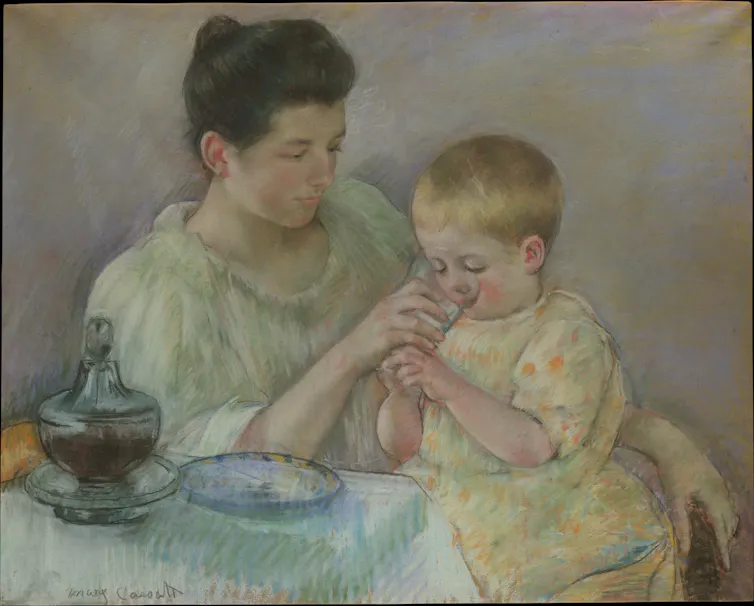
Mother Feeding Child (1898), Mary Cassatt. Wikimédia
Pour savoir comment bien donner à manger, il faut se départir de l’habitude d’opposer l’âme et le corps. La nourriture est un trait d’union entre eux. Ce qui me nourrit fait l’objet d’une intériorisation qui impacte à la fois mes organes et mon esprit. Contrairement à ce qui se limite à nous alimenter, la nourriture s’accompagne d’une réflexivité. Dans le livre de l’Exode (Exode 16 : 15), la fameuse manne qui tombe pendant quarante ans du ciel signifie littéralement « qu’est-ce que c’est ? » (« man hou »). Pas de nourriture sans question sur la nourriture.
Ainsi, bien donner à manger consiste à créer un espace dialogique au sein duquel peuvent émerger et s’énoncer des questions sur la nourriture. Dans d’autres termes, cela signifie que la personne destinataire, loin d’être passive, participe activement à la situation nourricière. Elle en fait une « expérience » individualisée en fonction de laquelle elle oriente le cours de son existence et développe sa personnalité.
Dans l’acte de bien donner à manger, la nourriture n’est pas imposée, elle est offerte. Elle fait l’objet d’une proposition à la constitution de laquelle le mangeur peut contribuer. Par exemple, le nouveau-né, au sein ou au biberon, n’est idéalement ni écrasé contre soi ni livré à lui-même. Il est tenu durant le nourrissage de manière à permettre un contact visuel avec la donatrice ou le donateur, à créer un espace de gesticulation et de jeu, à instaurer un va-et-vient de sons et de mimiques, et ainsi de suite.
Les échanges qui s’instaurent, et qui sont essentiels pour la croissance mentale et physique de l’enfant, n’adviendraient pas en l’absence du repas, mais ils ne s’y réduisent pas. Bien donner à manger est une nécessité requalifiée par les initiatives des partenaires de l’interaction, comme muée en liberté.
Une interaction nourricière
Il en va de même concernant les personnes dites en perte d’autonomie dont beaucoup souffrent d’une « anorexie de la vieillesse ». Comment conserver, voire réaugmenter, l’indépendance qui leur reste ? Afin d’être nourricière, et non alimentaire, l’aide au repas consiste en une interaction.
Par exemple, au plateau-repas succède une assiette dans laquelle sont disposées des denrées adaptées sur le plan de la texture, des saveurs et de la taille. Aux couverts traditionnels sont substitués des couverts coudés, des assiettes à rebord, parfois le « manger main ». Un échange, au minimum fait de sourires et d’encouragements, s’instaure.
Bien que relatif à une situation tout à fait asymétrique, le repas demeure la première pierre de l’édifice social le plus inclusif qu’on puisse imaginer.
Considérons donc aussi les cantines scolaires, les repas servis dans les collectivités locales, à l’hôpital, en prison, dans les Ehpad, aux migrants naufragés dont l’estomac est détraqué après des voyages épuisants, des tortures et de longs séjours en mer, les personnes de plus en plus nombreuses qui souffrent de maladies inflammatoires chroniques de l’intestin (MICI) et sont nourries par intraveineuse 12 heures sur 24, les centaines de millions de victimes de la faim, les personnes sans domicile, indigentes et sous emprise de drogues diverses, etc., et l’on constatera que l’acte de donner à manger, loin d’être anecdotique ou accessoire, est au cœur de nos problématiques socio-politiques les plus brûlantes.
Joëlle Zask ne travaille pas, ne conseille pas, ne possède pas de parts, ne reçoit pas de fonds d’une organisation qui pourrait tirer profit de cet article, et n’a déclaré aucune autre affiliation que son organisme de recherche.
Le 250e anniversaire de la Déclaration d’indépendance des États-Unis dépasse le cadre d’une simple commémoration. Survenant dans un contexte de forte polarisation politique, il suscite des débats qui illustrent la multiplication des lectures concurrentes de l’histoire. Donald Trump, comme ses opposants, cherche ainsi à s’approprier l’héritage de 1776, avec en point de mire l’approche des cruciales élections de mi-mandat qui se tiendront en novembre prochain.
Le 250e anniversaire de la Déclaration d’indépendance, célébré le 4 juillet 2026, intervient à un moment où la mémoire nationale est devenue, aux États-Unis, un enjeu politique majeur. Rarement un anniversaire national aura été autant chargé d’enjeux symboliques, politiques et mémoriels.
Le retour de Donald Trump à la Maison-Blanche il y a un an et demi, la polarisation idéologique qui ne cesse de s’intensifier et les interrogations sur la signification contemporaine de 1776 transforment cette commémoration en un moment de redéfinition du récit américain. Loin d’être un simple rituel civique, l’anniversaire devient un miroir des tensions qui traversent la société et un instrument de légitimation pour les acteurs politiques.
À chacun sa vision du 4-Juillet
La Déclaration d’indépendance demeure la matrice intellectuelle du système politique américain. Adoptée le 4 juillet 1776, elle ne se limite pas à proclamer la rupture avec la Couronne britannique : elle fonde une théorie politique reposant sur les droits naturels, le consentement des gouvernés et le droit de résister à la tyrannie.
En affirmant que « tous les hommes possèdent des droits inaliénables », elle inaugure une conception nouvelle de la légitimité politique, rompant avec les fondements dynastiques et religieux de l’Ancien Monde. La Constitution de 1787, la séparation des pouvoirs, le fédéralisme et la protection des libertés individuelles s’inscrivent dans cet horizon intellectuel.
Depuis deux siècles et demi, chaque génération politique relit 1776 à travers ses propres préoccupations : Lincoln l’invoque pour justifier l’abrogation de l’esclavage ; Roosevelt y voit un fondement moral dans le cadre de sa lutte contre les totalitarismes ; Reagan s’y réfère au nom de l’exceptionnalisme américain. Cette plasticité explique la centralité persistante de la Déclaration dans la culture politique des États-Unis.
C’est dans ce contexte qu’a été conçu le programme America 250. Son ambition dépasse largement l’organisation de cérémonies commémoratives. Il s’agit d’une entreprise de refondation mémorielle visant à produire un récit national capable de rassembler une société fragmentée.
Bien que les festivités culminent en 2026, le projet trouve son origine dans une loi adoptée par le Congrès le 22 juillet 2016 et promulguée par le président Barack Obama, créant l’United States Semiquincentennial Commission. Cette commission fédérale indépendante constitue l’organe officiel de pilotage des célébrations nationales. Elle est composée de membres désignés par le Congrès, de représentants de l’exécutif, ainsi que de personnalités issues des secteurs culturel, éducatif, patrimonial et économique. Son organisation repose sur le principe du bipartisme afin de garantir une gouvernance équilibrée et de faire de cet anniversaire un événement fédérateur dépassant les alternances politiques.
America 250 se présente comme un dispositif fédérateur, mobilisant institutions fédérales, États fédérés, écoles, universités, musées, organisations civiques et acteurs culturels. L’objectif est de faire de l’année 2026 une séquence pédagogique d’ampleur nationale, destinée à transmettre l’histoire américaine aux nouvelles générations et à réaffirmer les principes fondateurs de la République.
Cette ambition prend une dimension particulière dans un contexte où les débats sur l’esclavage, la mémoire coloniale, les discriminations ou les violences raciales occupent une place centrale dans l’espace public. America 250 se veut une réponse à la fragmentation mémorielle, un moyen de réinscrire la nation dans une continuité historique commune. Mais cette entreprise se heurte à une question fondamentale : existe-t-il encore un récit national partagé aux États-Unis ? L’initiative révèle ainsi une tension entre volonté de cohésion et pluralité des interprétations, entre pédagogie civique et instrumentalisation politique.
L’année 2026 est marquée par une multiplication d’événements sur l’ensemble du territoire. Philadelphie, lieu d’adoption de la Déclaration, constitue l’épicentre des commémorations, avec lectures publiques, conférences, rassemblements autour de l’Independence Hall et de la Liberty Bell. À Washington, le National Mall accueille concerts patriotiques, spectacles multimédias et expositions de documents historiques, dont certains rarement présentés au public. Les États fédérés organisent reconstitutions, programmes éducatifs et cérémonies civiques. L’ensemble compose une scénographie mémorielle d’une ampleur inédite, destinée à inscrire 2026 dans la longue durée des grands anniversaires nationaux.
Concurrence mémorielle
Mais cette célébration n’est pas politiquement neutre. Les célébrations interviennent quelques mois seulement avant les élections de mi-mandat du 3 novembre prochain, ce qui confère à la mémoire nationale une dimension stratégique. Donald Trump mobilise depuis plusieurs années une rhétorique centrée sur la restauration de la grandeur américaine et sur la défense des valeurs fondatrices de la République. Dans son discours, les révolutionnaires de 1776 deviennent les précurseurs d’un combat contemporain pour la souveraineté nationale, la protection des frontières et la défense du peuple américain.
Trump cherche ainsi à inscrire son action dans une continuité historique prestigieuse et à renforcer sa légitimité dans un contexte électoral incertain. La gauche états-unienne, de son côté, insiste sur les promesses inachevées de la Déclaration et sur les luttes successives pour élargir les droits civiques. L’anniversaire devient ainsi le théâtre d’une concurrence mémorielle structurante.
Cette conflictualité s’inscrit dans une évolution historiographique plus large. Longtemps perçus comme des figures consensuelles, Washington, Jefferson, Madison ou Hamilton font désormais l’objet d’une relecture critique. Les historiens ont mis en évidence les contradictions entre les principes universalistes de 1776 et les réalités sociales de l’époque : esclavage, exclusion des femmes, traitement brutal des populations amérindiennes. Il ne s’agit pas d’un rejet, mais d’un changement de paradigme mémoriel : les fondateurs ne sont plus des icônes intouchables, mais des acteurs historiques complexes dont l’œuvre doit être contextualisée.
L’esprit des Pères fondateurs apparaît ainsi comme un ensemble de principes généraux — souveraineté populaire, limitation du pouvoir, gouvernement représentatif, méfiance envers la concentration de l’autorité — plutôt qu’une doctrine unifiée. Les désaccords entre Jefferson et Hamilton illustrent la diversité intellectuelle de la période. Les fondateurs deviennent des « ressources symboliques » mobilisées pour légitimer des projets politiques divergents.
Cette évolution marque le passage d’une mémoire consensuelle à une mémoire concurrentielle. Paradoxalement, cette conflictualité témoigne de la vitalité persistante de leur héritage : deux cent cinquante ans après 1776, les Américains continuent de débattre avec leurs fondateurs.
Qui contrôle le passé contrôle l’avenir
On l’aura compris : derrière les cérémonies et les festivités organisées à l’occasion du 250ᵉ anniversaire de l’indépendance, une lutte pour le contrôle du récit national est en cours.
En réinvestissant les symboles de 1776, Donald Trump cherche à présenter son mouvement comme le prolongement contemporain de l’œuvre des Pères fondateurs. Son objectif est moins de commémorer l’histoire que de la mobiliser au service d’une vision particulière de l’avenir du pays. Les élections de mi-mandat de 2026 constitueront un premier test de l’efficacité de cette stratégie.
Frédérique Sandretto ne travaille pas, ne conseille pas, ne possède pas de parts, ne reçoit pas de fonds d’une organisation qui pourrait tirer profit de cet article, et n’a déclaré aucune autre affiliation que son organisme de recherche.
Nous transformons le visage de la planète à un rythme inédit. Forêts coupées, zones humides drainées, cours d’eau enserrés par le béton : partout, les paysages se transforment. Pourtant, nous ignorons largement comment les impacts de ces transformations se propagent entre écosystèmes, menant potentiellement à des effets en cascade à l’échelle du paysage.
Nos travaux, menés dans deux cours d’eau du Québec, en offrent un aperçu clair. Les conséquences de la perte d’habitat naturel voyagent loin de leur point de départ, traversent les frontières entre l’eau et la terre, et reconfigurent silencieusement des communautés écologiques entières.
Des insectes qui font le pont entre deux mondes
Tout part d’un groupe d’organismes dont on parle peu, mais qui joue un rôle écologique essentiel : les insectes aquatiques émergents.
Ces espèces (éphémères, plécoptères, trichoptères, etc.) croissent sous l’eau, puis s’envolent à l’âge adulte pour vivre quelques jours sur la terre ferme. Ce passage de l’aquatique au terrestre n’est pas qu’un simple trait de vie. C’est l’un des plus grands transferts d’énergie qui existent entre les cours d’eau et les systèmes terrestres.
Chaque printemps, le long des rivières ou des ruisseaux à travers le monde, ce sont des milliards d’insectes qui sortent de l’eau et deviennent une ressource alimentaire pour les oiseaux, les chauves-souris, les amphibiens et les araignées riveraines, parmi lesquels plusieurs espèces voient leurs populations décliner. Pour certains prédateurs terrestres, comme les araignées, jusqu’à 99 % du carbone de leur corps provient de cette nourriture originaire de l’eau.
Ce sont précisément ces insectes que nos travaux ont examinés le long des rivières Milette et aux Sables, situées à Trois-Rivières, au Québec, deux cours d’eau qui représentent un gradient d’urbanisation.
Bien que ces rivières partagent des caractéristiques physiques similaires, notamment la taille de leur bassin versant, leur profondeur ainsi que des sédiments fins hérités de l’ancien delta de la rivière Saint-Maurice, l’utilisation du territoire entraîne des contrastes marqués. De l’amont de la rivière aux Sables à l’aval de la rivière Milette, le paysage se transforme progressivement, passant de la forêt à des parcs urbains vers des zones résidentielles, puis commerciales. En réponse à une quantité grandissante de zones imperméables (stationnements, routes) qui la ceinture, la rivière Milette est beaucoup moins stable hydrologiquement, avec une propension aux crues éclair.
Notre étude a révélé un constat clair : plus le bassin versant est imperméabilisé par des surfaces bétonnées ou asphaltées, plus la communauté d’insectes qui émergent devient uniforme, dominée par des moucherons tolérants à la pollution dont la taille est très petite. Les espèces plus sensibles et de plus grandes tailles, elles, s’effacent graduellement.
La cause principale potentielle est liée à la capacité d’absorption de l’eau par les sols. En milieu boisé, les surfaces végétalisées retiennent les précipitations, tandis qu’en milieu urbain, l’eau ruisselle davantage vers la rivière. Chaque pluie y déclenche alors des crues brèves et violentes, des « pulses » de ruissellement qui perturbent fortement les habitats aquatiques. Seules les espèces à cycle de vie court, capables de recoloniser rapidement entre deux perturbations, parviennent à s’y maintenir. Et ce sont précisément les plus petites !
Malgré ce changement de composition, nos mesures sur la quantité totale de biomasse sont demeurées pratiquement inchangées. En effet, si l’on se contente de peser ce que la rivière urbaine exporte, tout semble bien aller. Mais si l’on examine la composition de cette biomasse, le portrait est bien différent.
Déjà des milliers d’abonnés à l’infolettre de La Conversation. Et vous ? Abonnez-vous gratuitement à notre infolettre pour mieux comprendre les grands enjeux contemporains.
Un festin pour certaines araignées
Les conséquences de l’imperméabilisation des sols ne s’arrêtent pas là. En analysant la composition chimique des tissus d’araignées sur les berges, nous avons reconstitué leur régime alimentaire. Lorsque la rivière exporte de plus petits insectes, on observe une variation dans la diète des araignées en plus d’une réorganisation de leur communauté.
Ce résultat tient à une réalité mécanique souvent sous-estimée : un prédateur ne peut pas attraper n’importe quelle proie. Sa taille, la robustesse de sa toile et la puissance de ses pièces buccales imposent une fenêtre de capture précise. Ainsi, certaines araignées comme Tetragnatha elongata, fines et allongées, sont particulièrement bien adaptées aux petites proies abondantes que livrent les rivières urbaines. Nous avons ainsi documenté une cascade maillon par maillon qui résume une propagation spatiale de l’utilisation du territoire jusqu’à des animaux situés à plusieurs kilomètres de la perturbation.
Ce que notre étude a documenté dans deux petits cours d’eau québécois n’est certainement pas un cas isolé.
Partout sur la planète, les villes s’étendent et les surfaces imperméables se multiplient. Or, les rivières urbaines, où qu’elles soient, partagent les mêmes symptômes : un cocktail de stress chimique, hydrologique et biologique que les chercheurs nomment le syndrome du cours d’eau urbain.
Si les bassins versants urbanisés présentent partout des perturbations apparentes, alors les cascades écologiques que nous avons observées au Québec se déploient vraisemblablement dans des milliers d’entre eux à travers le monde. C’est donc ce qui pousse notre groupe de recherche à réfléchir aux meilleures façons de protéger le paysage dans son intégralité en tenant compte de la connectivité entre les systèmes naturels.
L’image d’une réaction en chaîne évoque souvent un événement spectaculaire dont on peut mesurer l’impact, comme une bombe. Ce que l’humain déclenche aujourd’hui sur les écosystèmes est tout aussi puissant, mais plus insidieux : une multitude de cascades qui se propagent à travers des paysages que nous croyions jadis délimités par des frontières impénétrables, et qui reconfigurent des communautés écologiques que nous ne pensions pas avoir touchées.
Mieux comprendre ces chaînes, c’est commencer par mesurer l’étendue réelle de notre empreinte. Et c’est aussi reconnaître qu’aucune perturbation, aussi locale soit-elle, n’est restreinte à son point d’origine.
Eric Harvey a reçu des financements du Conseil de recherches en sciences naturelles et en génie du Canada, du programme des Chaires de Recherche du Canada, ainsi que des Fonds de recherche du Québec.
Charles Gagnon est étudiant à l’Université de Montréal. Il a reçu du financement du Conseil de recherches en sciences naturelles et en génie du Canada.
L’écotoxicologie est une discipline scientifique encore jeune. Née dans les années 1960, sa mission est de comprendre les contaminations des écosystèmes par les polluants chimiques ainsi que leurs impacts pour éclairer la décision publique. Mais elle doit aujourd’hui s’adapter et évoluer face aux nouveaux défis environnementaux.
Depuis les années 1960, l’écotoxicologie s’est imposée comme une discipline clé pour comprendre les effets des substances chimiques sur l’environnement. À la croisée de la toxicologie et de l’écologie, elle étudie la contamination des écosystèmes, la circulation et la transformation des polluants chimiques, ainsi que leurs impacts sur les organismes et les processus écologiques. Son but ultime est d’éclairer les décisions publiques encadrant l’usage de ces composés.
Pour cela, elle s’est principalement focalisée sur le développement et l’utilisation de protocoles standardisés d’évaluation rapide du risque environnemental, conçus pour générer des résultats fiables, comparables, facilement communicables et donc rapidement exploitables pas les décideurs. Ces approches constituent aujourd’hui le cadre d’évaluation du risque environnemental (ERA), un socle de réglementations nationales et internationales. Parmi elles, on peut citer le règlement européen REACH, qui vise à protéger la santé humaine et l’environnement des risques associés aux substances chimiques.
Mais cette standardisation, à savoir l’établissement de tests aux conditions normées et supposés réplicables dans tout laboratoire, laisse de côté de nombreux processus dits « éco-évolutifs ». En effet, la contamination environnementale a aujourd’hui, au-delà de ses effets de court terme étudiés dans des conditions simples, d’autres impacts à long terme, des effets intergénérationnels, autrement dit, des conséquences populationnelles et écosystémiques. Autant de dimensions que l’écotoxicologie, aujourd’hui, ne sait pas mettre en évidence.
C’est en particulier le cas dans le contexte des changements environnementaux globaux que nous connaissons, qui posent des questions inédites pour l’écotoxicologie. Les xénobiotiques en particulier, c’est-à-dire les substances présentes dans un organisme mais qui lui sont étrangères, comme les pesticides, pourraient jouer un rôle significatif en modifiant le potentiel adaptatif des organismes.
Dans ce contexte, la pertinence de l’écotoxicologie est parfois questionnée. Mais de notre côté, nous pensons que la discipline peut évoluer pour s’adapter et mieux prédire les effets des polluants.
L’écotoxicologie repose aujourd’hui sur des tests normalisés, généralement validés par l’Organisation de coopération et de développement économique (OCDE), qui sont établis de façon à être robustes (à la fois fiables et faisables) et réplicables par différents laboratoires. Toutefois, ces protocoles prennent rarement en compte ce qui se passe après l’exposition. Or, certains effets peuvent apparaître bien plus tard, parfois à l’âge adulte après une exposition embryonnaire, voire affecter les générations suivantes.
C’est le cas de certains perturbateurs endocriniens, pour lesquels une exposition précoce peut entraîner des troubles de la reproduction sur plusieurs générations. Si ces phénomènes commencent à être inclus dans certains cadres d’évaluation, ils restent encore largement sous-estimés.
Ces lacunes s’ajoutent à d’autres. Citons par exemple l’absence de prise en compte de possibles effets cocktails car les tests portent sur des substances isolées (pourtant présentes en mélanges complexes dans l’environnement), l’utilisation presque exclusive d’espèces animales modèles ou la simplification des conditions de laboratoire. Tout ceci ignore les interactions écologiques et les variations environnementales.
Un autre point critique de ces tests concerne la diversité génétique au sein des espèces. Pour garantir la reproductibilité, les expériences utilisent généralement des lignées d’organismes standardisées, c’est-à-dire génétiquement homogènes, considérant la variabilité génétique comme un « bruit » à éliminer. Cette simplification pose problème.
D’une part, elle limite la représentativité des résultats : une seule souche ne reflète pas nécessairement la réponse de toute une espèce.
D’autre part, elle empêche de comprendre les capacités d’adaptation des populations, notamment face aux pesticides, pour lesquels de nombreuses résistances génétiques sont identifiées chez les espèces cibles.
Cela pose un véritable problème non seulement aux utilisateurs et aux fabricants des substances testées, mais aussi en matière de santé publique.
Les polluants ne se contentent en outre pas d’affecter les organismes à court terme : ils peuvent aussi influencer leur évolution. Cette dimension reste pourtant peu considérée dans l’évaluation du risque.
Les organismes disposent de plusieurs mécanismes pour répondre aux stress environnementaux. À court terme, ils peuvent ajuster leur physiologie grâce à la plasticité phénotypique, qui désigne le fait qu’un génotype exprime différents phénotypes selon l’environnement. Certains de ces ajustements reposent sur des mécanismes épigénétiques, qui modulent l’expression des gènes sans en modifier la séquence.
Or, ces mécanismes peuvent être influencés par les contaminants. Ils peuvent modifier les processus développementaux, la physiologie ou la reproduction. Certaines de ces modifications peuvent même être transmises à la descendance, ouvrant la voie à des effets intergénérationnels encore mal décrits. Cette plasticité épigénétique permet aux organismes de répondre rapidement à un stress environnemental, parfois de façon réversible, mais elle soulève des questions sur la stabilité de ces réponses et leur influence sur la dynamique évolutive des populations.
Parce que oui, les polluants peuvent aussi, à plus long terme, orienter l’évolution des populations. L’adaptation repose alors sur une combinaison de processus macroévolutifs et microévolutifs (la microévolution décrivant les changements au sein d’une même espèce, et la macroévolution ceux qui portent plutôt sur la spéciation et l’évolution des groupes d’espèces), en lien avec les pressions actuelles.
Ces processus peuvent donner lieu à l’émergence rapide de résistances, par sélection de variants génétiques, à l’apparition de mutations avantageuses ou encore à la transmission de modifications épigénétiques induites par l’environnement. L’évolution des résistances aux pesticides en est une illustration frappante. Ces dynamiques, parfois rapides, montrent que les polluants ne modifient pas seulement l’état de santé des organismes, mais aussi leur trajectoire évolutive.
Ces processus – plasticité, héritage épigénétique, évolution génétique – influencent profondément la manière dont les populations réagissent aux polluants, mais sont encore rarement pris en compte dans les évaluations réglementaires.
Vers une écotoxicologie plus prédictive
Face aux défis environnementaux actuels, la prise en compte de toutes ces interactions par l’écotoxicologie devient impérative : elle ne peut plus se contenter d’évaluer des effets à court terme dans des conditions simplifiées. Il est à cet égard réconfortant de noter l’émergence de nouvelles approches. Par exemple :
à l’échelle évolutive, certaines méthodes statistiques s’appuient par exemple sur les relations de parenté entre espèces, ou encore la conservation de familles de protéines cibles pour identifier un signal phylogénétique permettant de prédire la sensibilité des unes à partir de la sensibilité des autres ;
à l’échelle des populations, les outils de génomique facilitent la détection de signatures d’adaptation ou de plasticité en réponse aux polluants, mettant en évidence des dynamiques microévolutives ;
enfin, certaines études tentent de mettre en évidence les compromis induits par l’adaptation aux contaminants : celle-ci est susceptible d’augmenter la sensibilité à d’autres stress, voire de réduire la capacité générale d’adaptation des organismes, exacerbant potentiellement les effets délétères des autres changements globaux sur la biodiversité dans son ensemble.
Ces avancées contribuent à intégrer une nouvelle dimension dans l’évaluation du risque : la vulnérabilité des espèces et des populations, qui dépend non seulement de leur exposition aux polluants, mais aussi de leur capacité à y répondre et à s’y adapter.
L’écotoxicologie doit dès lors évoluer en intégrant l’ensemble des processus écoévolutifs et en tenant compte des différents rythmes auxquels ils se déroulent. Ceci permettrait d’améliorer à la fois la capacité prédictive de l’écotoxicologie et sa pertinence vis-à-vis des dynamiques écosystémiques.
L’enjeu est de taille : il ne s’agit plus seulement d’accompagner la mise sur le marché des substances chimiques, au rythme des priorités définies par les pouvoirs publics, mais de comprendre leur influence sur la capacité d’adaptation des organismes aux changements environnementaux.
Une écotoxicologie plus intégrative des processus écoévolutifs pourrait ainsi permettre d’améliorer à la fois la capacité prédictive de l’écotoxicologie et sa pertinence pour répondre aux défis environnementaux du XXIᵉ siècle.
Marie-Agnès Coutellec a reçu des financements de: INRAE, ANSES, ANR, CNRS.
Cassandre Aimon et Thomas Sol Dourdin ne travaillent pas, ne conseillent pas, ne possèdent pas de parts, ne reçoivent pas de fonds d’une organisation qui pourrait tirer profit de cet article, et n’ont déclaré aucune autre affiliation que leur poste universitaire.
Source: The Conversation – France (in French) – By Romain Garrouste, Chercheur à l’Institut de systématique, évolution, biodiversité (ISYEB), Muséum national d’histoire naturelle (MNHN)
Nous sommes désormais saturés d’images mettant en scène la transformation des paysages et l’effondrement de la biodiversité sous l’effet des activités humaines. Ce « photographocène », contraction de « photographie » et d’« anthropocène », façonne non seulement nos imaginaires, mais aussi nos capacités d’action. Quand bien même cette démarche entend alerter, elle tombe parfois dans l’esthétisation et tronque notre perception de la catastrophe en cours. Dans ces conditions, comment penser une véritable écologie du regard ?
À l’occasion des quatre cents ans du Muséum national d’histoire naturelle et des deux cents ans de la photographie, cet article propose de revenir sur une transformation décisive des sciences : l’entrée des images dans la fabrique des savoirs et leur appropriation par les scientifiques.
Certains parlent d’anthropocène pour décrire la période que nous vivons, même si elle n’est pas officiellement reconnue par les géologues. Il n’en reste pas moins que la période actuelle est profondément marquée par les activités humaines, qui modifient le climat, les cycles géochimiques, la biosphère (c’est-à-dire, l’ensemble du vivant) et sa composition (certaines espèces disparaissant au profit d’autres, par exemple les espèces anthropophiles).
Mais on pourrait tout autant parler de « photographocène ». Nous connaissons surtout l’anthropocène à travers des images : glaciers qui fondent, forêts en feu, mégafeux ou lumières nocturnes vues depuis l’espace, mines à ciel ouvert, marées noires, zones industrielles avec panache de fumée, constructions à perte de vue… S’y ajoutent aussi de belles images de nature et de paysages qui peuvent parfois paraître « naturels », alors qu’ils ont été considérablement transformés (agrosystèmes notamment, comme le bocage ou les prairies).
Or, nous ne vivons pas seulement la crise écologique de façon sensible. Nous la vivons aussi à travers les images. La théoricienne de la photographie Ana Peraica a proposé en 2020 le terme de « photographocène » pour décrire ce phénomène. Tandis que l’anthropocène renvoie à une période marquée par un ensemble de processus physico-biologiques, la photographocène désigne, pour sa part, le moment où ces transformations sont enregistrées, documentées, narrées et débattues par la photographie.
Les biologistes débattent encore de la définition stricte d’« extinction de masse », mais convergent sur un point : les taux actuels de disparition d’espèces et d’effondrement de populations dépassent largement les régimes connus dans les archives fossiles.
Mais cette sixième extinction est aussi devenue un événement visuel. Le projet Extreme Ice Survey du photographe James Balog, par exemple, installe des caméras sur des glaciers pour produire des time-lapse de leur recul. Largement relayées dans le National Geographic et le film Chasing Ice, ces images ont marqué les esprits.
De leur côté, le photographe Edward Burtynsky et ses collaborateurs documentent mines, décharges et infrastructures à grande échelle dans The Anthropocene Project. Ces photographies sont devenues des icônes de l’anthropocène : elles structurent ce que nous imaginons quand nous pensons réchauffement, pollution, artificialisation, etc.
Aperçu du travail d’Edward Burtynsky.
Mais que regardons-nous exactement à travers ces images ? Qu’est-ce qu’on voit, et surtout qu’est-ce qu’on ne voit pas ? C’est ici qu’intervient l’idée d’une « écologie du regard ».
Une écologie du regard pour interroger l’anthropocène
Classiquement, l’écologie étudie les relations entre les êtres vivants, avec leurs milieux ainsi qu’avec les grands cycles géochimiques et thermiques de la planète.
Par analogie, on peut parler d’écologie du regard pour désigner l’attention portée à ce qui est rendu visible – ou invisible – par les images. Quels lieux sont montrés, quelles espèces, quels corps ? Depuis quels points de vue et avec quelles conséquences sur notre compréhension des choses ? Quelles émotions sont provoquées en les voyant ?
L’expression circule dans les mondes de l’art et de l’architecture. On la retrouve par exemple dans le livre de Martine Francillon, qui relie représentations de l’arbre, écologie environnementale et « écologie mentale ».
Le directeur artistique Christophe Laloi a lui aussi utilisé l’expression dès 2007, par exemple avec une projection intitulée « Climax – Pour une écologie du regard » aux Rencontres d’Arles.
En 2020, l’historienne de l’art Bénédicte Ramade a montré comment une partie de la photographie environnementale oscille entre alerte éthique et esthétisation du désastre, au risque de produire lassitude et distance plutôt que mobilisation. De son côté, Ana Peraica parle d’« images totales » : vues satellites, orthophotographies, cartographies interactives qui donnent l’illusion d’un surplomb neutre sur la planète.
Dans ce contexte, le photographocène se confond avec l’anthropocène tel qu’il est montré dans ces images. L’écologie du regard, qui désigne une approche critique et sensible de l’observation du vivant, consiste à les interroger.
Qui est visible dans les images de la sixième extinction ?
On peut distinguer trois grandes caractéristiques du photographocène.
D’abord, le fait que les grands récits visuels de la crise mettent souvent en avant des paysages spectaculaires (glaciers effondrés, mégafeux, carrières géantes, littoraux artificialisés, inondations,etc.) et des espèces charismatiques (ours polaire, orang-outan, grands prédateurs et bien entendu les baleines et le panda).
Pendant ce temps, une grande partie de la biodiversité – insectes, invertébrés marins, microfaune du sol, plantes « ordinaires », champignons – reste quasi invisibles. Pourtant, les études montrent des déclins rapides pour beaucoup de ces groupes, que l’on sait être d’importance majeure dans le fonctionnement des écosystèmes.
Le deuxième élément tient au point de vue. Les images emblématiques de la photographocène sont souvent des vues aériennes (drone, avion, satellite) ou accélérées (time lapse). Elles rendent visibles des transformations imperceptibles à l’échelle d’une vie humaine, mais installent aussi notre regard à distance, comme si nous contemplions la Terre depuis un ailleurs abstrait – comme dans les images de la Terre vue du ciel, de Yann Arthus-Bertrand – ou comme si nous n’en faisions plus vraiment partie.
Court-métrage tourné et réalisé par Yann Arthus-Bertrand dans le cadre de l’exposition « Vues d’en haut » pour le compte de Metz Métropole.
Enfin, il y a la répétition. Les mêmes motifs reviennent : incendie, iceberg, pipeline, fumées, ours blanc fatigué ou à terre, celui-ci étant devenu un véritable emblème. Les recherches en communication environnementale suggèrent pourtant que cette répétition d’images catastrophistes, sans récit d’action possible, peut conduire à une forme de fatigue du regard, voire à des formes de déni, plutôt qu’à l’engagement recherché.
Exposition de Cristina Mittermeier en Italie, début 2026.
Il ne s’agit plus seulement de produire de « belles images » de l’anthropocène, mais de documenter des menaces précises, ou encore de donner davantage de visibilité à des espèces ou à des communautés locales. Cela permet de nourrir des campagnes de plaidoyer, des décisions politiques, et dans certains cas, d’accompagner la recherche scientifique, par exemple en participant à des inventaires d’espèces.
Dans le cadre d’une écologie du regard, la photographie de conservation rappelle que le choix des sujets, des cadrages, des contextes peut faire basculer une image de simple symptôme à outil pour infléchir, même un peu, le cours de la sixième extinction. Il en va de même de la manière dont les photographies sont partagées avec les ONG, les scientifiques ou encore les habitants d’un territoire.
Articuler exigence scientifique et écriture visuelle
Plusieurs photographes français travaillent, chacun à leur manière, à cette écologie du regard en articulant exigence scientifique et écriture visuelle.
Le biologiste et photographe sous-marin Laurent Ballesta mène depuis plus de dix ans les expéditions Gombessa au sein d’Andromède Océanologie. Ces projets associent « mystère scientifique, défi de plongée et promesse d’images inédites », comme « des cœlacanthes à 120 mètres de fond », « 70 requins de Fakarava la nuit », selon la page du projet. Ses images, diffusées notamment par National Geographic, ne se contentent pas de montrer des espèces spectaculaires : elles construisent une immersion dans des écosystèmes méconnus, en lien direct avec des protocoles scientifiques. À la clé, un véritable récit d’exploration, où des espèces souvent minuscules sont magnifiées par la prise de vue.
Affiche du film la Panthère des neiges.
On peut aussi songer au photographe animalier Vincent Munier, qui développe depuis plusieurs décennies, un travail au long cours sur les milieux froids et la faune discrète. Par exemple : chouettes harfangs, loups arctiques, grues, hiboux, ou encore les panthères des neiges au Tibet. Son film la Panthère des neiges, coréalisé avec Marie Amiguet, repose sur une esthétique de la patience et de la non-spectacularisation : beaucoup de temps passé à ne rien voir et à simplement habiter un paysage, avant que l’animal apparaisse. C’est une forme d’éloge du temps long, en regard de nos sociétés de consommation ultrarapides, y compris en termes de consommation de médias.
Le photographe Frédéric Larrey, enfin, travaille sur les littoraux, les cétacés et les grands prédateurs, avec la maison d’édition et de diffusion Regard du Vivant. Son ouvrage Littoral propose un portrait aérien des côtes françaises qui articule beauté formelle et enjeux de conservation. Dans Tibet, en harmonie avec la panthère des neiges, il s’est lui aussi intéressé au grand félin discret, en mêlant éthologie photographique et attention aux relations entre bergers et prédateurs.
Ces démarches n’utilisent pas nécessairement le vocabulaire du photographocène, mais elles incarnent très concrètement une autre écologie du regard : moins centrée sur le choc et le spectaculaire, plus attentive aux milieux, aux relations, au temps long de l’observation et aux usages concrets des images pour la conservation et la sensibilisation du public et des habitants des régions traversées.
Parler de photographocène, ce n’est donc pas simplement ajouter un néologisme de plus à la liste des mots en « -cènes ». C’est aussi rappeler une évidence que l’on sous-estime souvent : dans l’anthropocène, le destin du vivant est aussi lié à la manière dont nous le regardons.
Trois questions pour un photographocène plus incarné
Nos photographies de la sixième extinction ne sont ni neutres ni secondaires : elles sélectionnent certains lieux, certaines espèces, certains points de vue. Mais ce faisant, elles en occultent d’autres. Elles proposent des récits de catastrophe, de nostalgie, parfois de résistance.
Une écologie du regard invite à se poser, au minimum, trois questions simples.
Que montrons-nous systématiquement – et que laissons-nous hors champ ?
Depuis quel point de vue regardons-nous la crise écologique (plongée, survol, immersion, cohabitation, regard animal, regard scientifique, images et imageries par dispositifs : microscopes électroniques, synchrotrons, lumières non conventionnelles, etc.) ?
Quels types d’images nous aident réellement à nous sentir concernés et à agir, plutôt qu’à nous résigner ?
Est-ce que les relations entre art et sciences aident à ce questionnement ? Il est probable que oui, quand ces relations co-construisent des projets narratifs où l’esthétique et la science dialoguent
Pour aller vers un photographocène plus incarné, la question ne serait plus seulement de se demander « comment représenter l’anthropocène ? », mais : quel regard voulons-nous cultiver pour continuer à cohabiter avec le vivant, à l’heure de la sixième extinction ? Cela suppose probablement de déplacer nos appareils autant que nos habitudes : vers des milieux moins visibles, des espèces moins spectaculaires, des régimes de lumière différents – y compris ceux que les autres vivants perçoivent, et que nous commençons seulement à apprendre à voir.
Romain Garrouste a reçu des financements de MNHN, CNRS, Sorbonne Université, Labex BCDiv, Labex CEBA, Institut de la Transition environnementale de Sorbonne Univ., MRAE, National Gegraphic, ANR