Les minerais africains sont échangés contre la sécurité : pourquoi c’est une mauvaise idée

Source: The Conversation – in French – By Hanri Mostert, SARChI Chair for Mineral Law in Africa, University of Cape Town

Un accord de paix, négocié par les États-Unis entre la République démocratique du Congo (RDC) et le Rwanda, prévoit un arrangement préoccupant. L’une des parties cède ses ressources minérales à une grande puissance en échange de promesses floues de sécurité.

L’accord de paix, signé en juin 2025, vise à mettre fin à trois décennies de conflit entre la RDC et le Rwanda.

Un élément clé de l’accord engage les deux pays à développer un cadre d’intégration économique régionale. Cet arrangement prévoit une coopération élargie entre la RDC, le Rwanda, le gouvernement américain et les investisseurs américains pour établir des “chaînes d’approvisionnement en minerais transparentes et formalisées”.

Malgré ses immenses richesses minérales, la RDC figure parmi les cinq pays les plus pauvres du monde. Elle cherche à attirer les investissements américains dans son secteur minier.

De leur côté, les Etats-Unis promettent un programme d’investissement de plusieurs milliards de dollars pour sécuriser leurs chaînes d’approvisionnement en minerais sur ce territoire traumatisé et appauvri.

La paix promise par l’accord de juin 2025 dépend ainsi de l’approvisionnement des États-Unis en minerais, en échange d’une présence militaire puissante, mais définie de manière vague, de la part de Washington.

L’accord de paix établit en outre un comité de mixte surveillance composé de représentants de l’Union africaine, du Qatar et des États-Unis, chargé de recevoir les plaintes et de résoudre les différends entre la RDC et le Rwanda.

Mais au-delà de ce comité mixte de surveillance, l’accord de paix ne prévoit aucune obligation spécifique en matière de sécurité pour les États-Unis.

Les relations entre la RDC et le Rwanda sont marquées par des guerres et des tensions depuis les première (1996-1997) et deuxième (1998-2003) guerres particulièrement sanglantes du Congo. Ces conflits ont alimenté la rivalité, l’exploitation et la violence armée.

Ce dernier accord de paix instaure un arrangement de type « ressources contre sécurité ». De tels accords ne sont pas nouveaux en Afrique. Ils ont fait leur apparition au début des années 2000 sous la forme de transactions « ressources contre infrastructures ». Dans ce type d’accord, un État étranger s’engage à construire des infrastructures économiques et sociales (routes, ports, aéroports, hôpitaux) dans un État africain. En échange, il obtient une participation importante dans une société minière publique ou un accès préférentiel aux ressources minérales du pays hôte.

Nous étudions le droit minier et la gouvernance en Afrique depuis plus de 20 ans. La question qui se pose aujourd’hui est de savoir si un accord de type « ressources contre sécurité » négocié par les États-Unis permettra à la RDC de mieux tirer profit de ses ressources.

Nos recherches sur l’exploitation minière, le développement et la durabilité nous font penser que cela est peu probable.

En effet, l’échange de ressources contre la sécurité est la dernière version d’une approche de troc de ressources que la Chine et la Russie ont mise en place dans des pays tels que l’Angola, la République centrafricaine et la RDC.

Le troc de ressources en Afrique a affaibli la souveraineté et le pouvoir de négociation des nations riches en minerais telles que la RDC et l’Angola.

En outre, ces accords sont moins transparents et plus complexes que les accords antérieurs de troc de ressources.

Les failles sécuritaires de la RDC

La RDC est dotée d’importants gisements de minerais essentiels tels que le cobalt, le cuivre, le lithium, le manganèse et le tantale. Ces minerais sont les éléments constitutifs des technologies du XXIe siècle : intelligence artificielle, véhicules électriques, énergie éolienne et matériel de sécurité militaire. Le Rwanda est moins riche en minerais que son voisin, mais il est le troisième producteur mondial de tantale, utilisé dans l’électronique, l’aérospatiale et les appareils médicaux.

Depuis près de 30 ans, les minerais alimentent les conflits et les violences extrêmes, en particulier dans l’est de la RDC. Le tungstène, le tantale et l’or (appelés « 3TG ») financent et alimentent les conflits. Les forces gouvernementales et environ 130 groupes armés se disputent le contrôle de sites miniers lucratifs. Plusieurs rapports et études ont accusé les voisins de la RDC – le Rwanda et l’Ouganda – de soutenir l’extraction illégale des 3TG dans cette région.

Le gouvernement de la RDC n’arrive pas à imposer la sécurité sur son vaste territoire (2,3 millions de kilomètres carrés peuplé de (109 millions d’habitants, issus de 250 groupes ethniques. Le manque de ressources, la corruption et des défis logistiques affaiblissent ses forces armées.

Ce contexte rend le soutien militaire des États-Unis extrêmement attractif. Mais nos recherches montrent que cet appui cache de nombreux pièges.

Quels États risquent de perdre ?

Les accords de type “ressources contre infrastructures” ou “ressources contre sécurité” offrent souvent des avantages à court terme : financements, stabilité, reconnaissance internationale. Mais ils ont un coût à long terme : la perte de contrôle sur les ressources nationales.

Voici comment cela se passe :

L’Afrique regorge d’exemples de pertes, partielles ou totales, de souveraineté liées à ce type d’accords. Par exemple, en 2004, l’Angola a contracté un prêt de 2 milliards de dollars adossé au pétrole auprès de la China Eximbank.

Ce prêt était remboursable par des livraisons mensuelles de pétrole, dont les recettes étaient versées sur des comptes contrôlés par la Chine. La conception du prêt privait les autorités angolaises de tout pouvoir de décision sur cette source de revenus avant même que le pétrole ne soit extrait.

Ces accords contribuent également à diluer les responsabilités. Ils impliquent souvent plusieurs ministères (tels que la défense, les mines et le commerce), ce qui empêche tout contrôle ou redevabilité. Cela favorise la captation des ressources par les élites. Des personnalités influentes peuvent détourner les accords à leur profit personnel.

En RDC, cela a donné naissance à une kleptocratie violente, où les richesses issues des ressources naturelles sont systématiquement détournées au détriment de la population.

Enfin, ces accords risquent d’aggraver les traumatismes liés à l’extraction : déplacements forcés des communautés, dégradations de l’environnement, pertes de moyens de subsistance et tensions sociales.

Ces problèmes ne sont pas nouveaux. Mais en les liant à la sécurité ou aux infrastructures, ils cessent d’être temporaires et s’installent dans la durée.

Ce qui doit changer

Les minerais critiques sont dits “critiques” parce qu’ils sont difficiles à extraire ou à remplacer.

De plus, leurs chaînes d’approvisionnement sont stratégiquement vulnérables et politiquement exposés. Celui qui contrôle ces minéraux contrôle l’avenir. L’Afrique doit veiller à ne pas brader cet avenir.

Dans un monde où les minerais critiques redessinent les rapports de force, les États africains ne doivent pas sous-estimer la valeur stratégique de leurs ressources. Ils disposent d’un levier puissant.

Mais ce levier n’a d’effet que s’il est utilisé avec stratégie. Pour ce faire, il faut :

  • investir dans le renforcement des institutions et des capacités juridiques afin de négocier de meilleurs accords

  • exiger la création et la valeur ajoutée locales

  • exiger la transparence et le contrôle parlementaire des accords relatifs aux minéraux

  • refuser les accords qui ne respectent pas les normes en matière de droits humains, d’environnement ou de souveraineté.

L’Afrique dispose des ressources. Elle doit préserver ce levier de pouvoir qu’elles lui confèrent.

The Conversation

Hanri Mostert est financée par la National Research Foundation (NRF) d’Afrique du Sud. Elle est membre du groupe d’experts sur l’expropriation et membre du comité directeur du groupe consultatif académique (AAG) de l’Association internationale du barreau (IBA) dans le secteur du droit de l’énergie, de l’environnement, des ressources et des infrastructures (SEERIL).

Tracy-Lynn Field est financée par la Fondation Claude Leon. Elle est directrice non exécutive de la Wildlife and Environment Society of South Africa.

– ref. Les minerais africains sont échangés contre la sécurité : pourquoi c’est une mauvaise idée – https://theconversation.com/les-minerais-africains-sont-echanges-contre-la-securite-pourquoi-cest-une-mauvaise-idee-261875
Yosemite embodies the long war over US national park privatization

Source: The Conversation – USA (2) – By Michael Childers, Associate Professor of History, Colorado State University

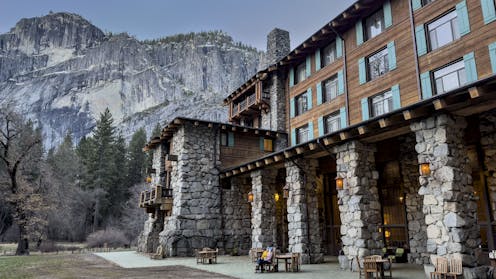
The Ahwahnee is a privately run hotel inside Yosemite National Park. George Rose/Getty Images

The Trump administration’s cuts to the National Park Service’s budget and staffing have raised concerns among park advocates and the public that the administration is aiming to further privatize the national parks.

The nation has a long history of similar efforts, including a wildly unpopular 1980 attempt by Reagan administration Interior Secretary James Watt to promote development and expand private concessions in the parks. But debate over using public national park land for private profit dates back more than a century before that.

As I explain in my forthcoming book, no park has played a more central role in that debate than Yosemite, in California.

Early concerns

In early 1864, Central American Steamship Transit Company representative Israel Ward Raymond wrote a letter to John Conness, a U.S. senator from California, urging the government to move swiftly to preserve the Yosemite Valley and the Mariposa Grove of giant sequoia trees to prevent them from falling into private hands. Five months later, President Abraham Lincoln signed the Yosemite Grant Act, ceding the valley and the grove to the state of California, “upon the express conditions that the premises shall be held for public use, resort, and recreation.” This was years before Yellowstone became the first federal land designated a national park in 1872.

A sepia-toned image of a lake with massive trees and even bigger mountains behind it.
For centuries, the natural beauty of the Yosemite Valley has impressed visitors.
Sepia Times/Universal Images Group via Getty Images

Controversy arose quickly at Yosemite. Two men – James Lamon and James Hutchings – had claimed land in the valley before the federal government gave it to California. Both began commercial operations, Lamon growing cash crops and Hutchings operating a hotel.

California said their businesses threatened the state’s ability to develop roads and trails in Yosemite by competing for tourist dollars. A legal battle ensued and was not resolved until an 1872 U.S. Supreme Court ruling found that the men’s land claims had not been fully validated according to the procedures of the time. The California legislature paid both men compensation for their land, and both left the park.

In 1890, neighboring parts of the Yosemite area became America’s third national park – and in 1906, the federal government again took possession of the Yosemite Valley itself and the Mariposa Grove, specifically to incorporate them into an expansion of the national park.

Development rights

Yet, as my research has found, the role of private interests in the park remained unsolved. Private companies under contract to the National Park Service have long provided needed amenities such as lodging and food within the national parks. But questions over what is acceptable in national parks in the pursuit of profit have shaped Yosemite’s history for generations.

In 1925, I found, the question centered on the right to build the first gas station inside the park, in Yosemite Valley. Two private businesses, the Curry Camping Company and the Yosemite National Park Company, had long competed for tourist dollars within the park. Each wanted to build a gas station to boost profits.

Frustrated over the need to decide, National Park Service Director Horace Albright ordered the rival firms to simplify management of the park’s concessions. The companies merged, and the newly formed Yosemite Park and Curry Company was granted the exclusive rights to run lodges, restaurants and other facilities within the park, including the new gas station.

But as I found in my research, the park service and the concessions company did not always see eye to eye on the purpose of the park. The conflict between profit and preservation is perhaps most clearly illustrated by the construction of a ski area within the park in the early 1930s. The park service initially opposed the development of Badger Pass Ski Area as not conducive to the national park ideal, but the Yosemite Park and Curry Company insisted it was key to boosting winter use of the park.

In 1973, the Music Corporation of America, an entertainment conglomerate, bought the Yosemite Park and Curry Company. The company already had a tourist attraction operating near Hollywood, where visitors could pay to tour movie sets, but had not yet changed its name to Universal Studios or launched major theme parks in Florida and California. Its purchase of the park’s concessions set off a firestorm of controversy over fears of turning Yosemite into a theme park.

That didn’t happen, but annual park visitor numbers climbed from 2.5 million to 3.8 million over the 20 years MCA ran the concessions, which sparked concerns about development and overcrowding in the park. Conservationists argued the park service had allowed the corporate giant to promote and develop the park in ways that threatened the very aspects of the park most people came to enjoy.

With three restaurants, two service stations with a total of 15 gas pumps, two cafeterias, two grocery stores, seven souvenir shops, a delicatessen, a bank, a skating rink, three swimming pools, a golf course, two tennis courts, kennels, a barbershop, a beauty shop, Badger Pass Ski Area and three lodges, the Yosemite Valley was a busy commercial district. Critics argued that such development contradicted the park service’s mandate to leave national parks unimpaired for the enjoyment of future generations.

A few people stand in a large gap within a tree trunk while other people stand nearby.
Crowds gather at some of Yosemite’s most popular sites, such as the California Tunnel Tree.
David McNew/AFP via Getty Images

Who owns the names?

Falling profits and consolidation within the music industry led MCA to sell its concessions rights in Yosemite in 1993. The Delaware North Companies, a global hospitality corporation, took over and ran the park’s concessions until 2016, when it sold the rights to Aramark.

But in that sale, the question of public resources and private profits arose again. Delaware North demanded $51 million in compensation for Aramark continuing to use the names of several historic properties within the park, such as the Ahwahnee, a hotel, and Curry Village, another group of visitor accommodations. The company claimed those names were a part of its assets under its contract with the park service.

The park service rejected the claim, saying the names, which dated back more than a century, belonged to the American people. But to avoid legal problems during the transition, the agency temporarily renamed several sites, including calling the Ahwahnee the Majestic Yosemite Hotel and changing Curry Village to Half Dome Village. Public outrage erupted, denouncing the claim by Delaware North as commercial overreach that threatened to distort Yosemite’s heritage. In 2019, the park service and Aramark agreed to pay Delaware North a total of $12 million to settle the dispute, and the original names were restored.

Protesters unfurl an upside-down U.S. flag from the top of El Capitan in Yosemite National Park in February 2025, protesting Trump administration changes to the National Park Service.

Renewed interest in commercial efforts

In June 2025, Yosemite again took center stage in the dispute over the role of federal funding versus private interests at the start of the second Trump administration when a group of climbers unfurled an American flag upside down off El Capitan in protest of the administration’s cuts in personnel and slashing of the park service’s budget.

Conservationists, including former National Park Service Director Jonathan Jarvis, argued that by defunding the park service and laying off as much as a quarter of its workforce, the Trump administration was “laying the groundwork to privatize” the national parks by allowing corporate interests more access to public lands. Those concerns echo ones raised during the first Trump administration, when the White House argued privatization would better serve the American public by improving visitor experiences and saving federal dollars.

Whichever side prevails in the short term, the debate over the role of private interests within national parks like Yosemite will undoubtedly continue.

The Conversation

Michael Childers does not work for, consult, own shares in or receive funding from any company or organization that would benefit from this article, and has disclosed no relevant affiliations beyond their academic appointment.

– ref. Yosemite embodies the long war over US national park privatization – https://theconversation.com/yosemite-embodies-the-long-war-over-us-national-park-privatization-261133

Black teachers are key mentors for Philly high school seniors navigating college decisions

Source: The Conversation – USA (2) – By Joseph Sageman, Postdoctoral Researcher in Sociology, University of Pennsylvania

In Pennsylvania, nearly 15% of students are Black, but less than 4% of teachers are. JohnnyGreig/E+ Collection via Getty Images

Zikia, a 12th grader in Philadelphia, was stressing over where she would attend college in the fall. Her charter school’s college decision ceremony was the next day, and she was torn between her two top choices.

At a crossroads, she reached out to her favorite teacher, the only Black educator on her course schedule. “I texted him at nighttime,” she recalled. “I didn’t feel like I could do that with my other teachers.”

In my research
on college and career readiness, I did not initially set out to study the impact of Black teachers, but students like Zikia readily brought up the topic.

In interviews, students insisted on the importance of having Black educators. They consistently named their Black teachers and counselors as the most influential adults in their planning for life after graduation.

Black educators, though, are severely underrepresented in the local teaching workforce. At Zikia’s school, over 75% of students are Black compared to only about 15% of teachers.

The picture is just as striking in Pennsylvania as a whole. Statewide, the share of Black students is four times the share of Black teachers – 14.5% of students are Black, while only 3.7% of teachers are. A majority of public schools in Pennsylvania do not employ a single teacher of color despite serving racially diverse communities.

These statistics are particularly concerning because strong evidence suggests that minority students benefit greatly from working with same-race teachers.

Over the past two decades, a wave of studies from economists and education scholars have documented that when Black students are assigned to Black teachers, their math and reading scores improve, their rates of absenteeism and suspensions drop, and over the long run, they are more likely to enroll in honors classes, complete high school and go to college.

This research is mostly quantitative and does more to establish that Black teachers are effective than explain why they are able to deliver such impressive results.

To answer this latter question, I went directly to the source.

I conducted interviews with roughly 100 Philadelphia 12th graders, asking them how they came to trust and depend on Black educators when weighing one of the most consequential decisions of their lives: whether and where to go to college. I spoke with students at five city high schools, including district-run and charter schools, as well as some of the teachers and counselors involved in their college decisions.

Zikia and the other names used in this story are pseudonyms to protect the confidentiality of research participants.

Inspiration, empathy and insight

The presence of Black educators mattered to students for several reasons.

Some of my respondents felt inspired by seeing Black people in school leadership positions. LaMont, for instance, said that taking classes from Black teachers motivated him: “Just to see success is achievable. A teacher is something in life. And it shows that people that look like me are able to overcome something. Having Black teachers gives you a sense of confidence.”

LaMont’s seeing his own identity and background reflected in his teachers is what sociologists and political scientists call descriptive representation. His classmates agreed that it was important to have teachers who looked like them. Their connection, they insisted, was more than skin deep. Most of them gravitated to Black teachers because of how those teachers did their jobs and advocated for minority students, a concept called substantive representation.

For instance, many students felt most comfortable asking for help from Black teachers because they regarded them as more empathetic listeners and felt they were invested in their holistic well-being, not just in their grades or academic performance.

When I asked Ramir to tell me about the teachers he had strong relationships with, he offered a typical answer: “Most of them are African American,” he said. “But it’s not even just about that. I like a teacher who tries to understand you for who you are. Not look at you as a student but as a human being and build with you.”

Students also credited Black teachers with making them feel like they belonged at school. They sought out advice from teachers who believed in their potential and held them to high academic and behavioral standards. These qualities were by no means unique to Black teachers, but white teachers sometimes found it difficult to balance authority with warmth in their relationships with students.

“There are some teachers that act like siblings and some that act like parents,” said Emily, a white social studies teacher. “And it’s very rare that a white teacher can act like a parent and have the kids still like them.”

Black educators also had culturally relevant insights into college that students valued highly. They often had deeper knowledge of local historically Black colleges and universities, or they could speak to the experience of being a racial minority at a predominantly white institution. Students valued guidance more when it came from a source they felt was relatable.

These findings suggest that Black educators are effective not only because of shared identity or experiences, but also because of the skills and dispositions they bring into the classroom: proactively building relationships, coupling high expectations with high levels of support, and bringing schoolwork to life. As a result, minority students held out hope not only for more representation in the classroom but also that all their teachers – regardless of race – would integrate these practices into their tool kits.

Read more of our stories about Philadelphia.

The Conversation

Joseph Sageman does not work for, consult, own shares in or receive funding from any company or organization that would benefit from this article, and has disclosed no relevant affiliations beyond their academic appointment.

– ref. Black teachers are key mentors for Philly high school seniors navigating college decisions – https://theconversation.com/black-teachers-are-key-mentors-for-philly-high-school-seniors-navigating-college-decisions-261732

What is personalized pricing, and how do I avoid it?

Source: The Conversation – USA (2) – By Jay L. Zagorsky, Associate Professor Questrom School of Business, Boston University

Recently, Delta Air Lines announced it would expand its use of artificial intelligence to provide individualized prices to customers. This move sparked concern among flyers and politicians. But Delta isn’t the only business interested in using AI this way. Personalized pricing has already spread across a range of industries, from finance to online gaming.

Customized pricing – where each customer receives a different price for the same product – is a holy grail for businesses because it boosts profits. With customized pricing, free-spending people pay more while the price-sensitive pay less. Just as clothes can be tailored to each person, custom pricing fits each person’s ability and desire to pay.

I am a professor who teaches business school students how to set prices. My latest book, “The Power of Cash: Why Using Paper Money is Good for You and Society,” highlights problems with custom pricing. Specifically, I’m worried that AI pricing models lack transparency and could unfairly take advantage of financially unsophisticated people.

The history of custom pricing

For much of history, customized pricing was the normal way things happened. In the past, business owners sized up each customer and then bargained face-to-face. The price paid depended on the buyer’s and seller’s bargaining skills – and desperation.

An old joke illustrates this process. Once, a very rich man was riding in his carriage at breakfast time. Hungry, he told his driver to stop at the next restaurant. He went inside, ordered some eggs and asked for the bill. When the owner handed him the check, the rich man was shocked at the price. “Are eggs rare in this neighborhood?” he asked. “No,” the owner said. “Eggs are plentiful, but very rich men are quite rare.”

Custom pricing through bargaining still exists in some industries. For example, car dealerships often negotiate a different price for each vehicle they sell. Economists refer to this as “first-degree” or “perfect” price discrimination, which is “perfect” from the seller’s perspective because it allows them to charge each customer the maximum amount they’re willing to pay.

A black-and-white photo shows a fleet of delivery trucks for the John Wanamaker Department Store parked side by side.
Wanamaker’s department store in Philadelphia was a pricing pioneer.
Hulton Archive/Getty Images

Currently, most American shoppers don’t bargain but instead see set prices. Many scholars trace the rise of set prices to John Wanamaker’s Philadelphia department store, which opened in 1876. In his store, each item had a nonnegotiable price tag. These set prices made it simpler for customers to shop and became very popular.

Why uniform pricing caught on

Set prices have several advantages for businesses. For one thing, they allow stores to hire low-paid retail workers instead of employees who are experts in negotiation.

Historically, they also made it easier for stores to decide how much to charge. Before the advent of AI pricing, many companies determined prices using a “cost-plus” rule. Cost-plus means a business adds a fixed percentage or markup to an item’s cost. The markup is the percentage added to a product’s cost that covers a company’s profits and overhead.

The big-box retailer Costco still uses this rule. It determines prices by adding a roughly 15% maximum markup to each item on the warehouse floor. If something costs Costco $100, they sell it for about $115.

The problem with cost-plus is that it treats all items the same. For example, Costco sells wine in many stores. People buying expensive Champagne typically are willing to pay a much higher markup than customers purchasing inexpensive boxed wine. Using AI gets around this problem by letting a computer determine the optimal markup item by item.

What personalized pricing means for shoppers

AI needs a lot of data to operate effectively. The shift from cash to electronic payments has enabled businesses to collect what’s been called a “gold mine” of information. For example, Mastercard says its data lets companies “determine optimal pricing strategies.”

So much information is collected when you pay electronically that in 2024 the Federal Trade Commission issued civil subpoenas to Mastercard, JPMorgan Chase and other financial companies demanding to know “how artificial intelligence and other technological tools may allow companies to vary prices using data they collect about individual consumers’ finances and shopping habits.” Experiments at the FTC show that AI programs can even collude among themselves to raise prices without human intervention.

To prevent customized pricing, some states have laws requiring retailers to display a single price for each product for sale. Even with these laws, it’s simple to do custom pricing by using targeted digital coupons, which vary each shopper’s discount.

How you can outsmart AI pricing

There are ways to get around customized pricing. All depend on denying AI programs data on past purchases and knowledge of who you are. First, when shopping in brick-and-mortar stores, use paper money. Yes, good old-fashioned cash is private and leaves no data trail that follows you online.

Second, once online, clear your cache. Your search history and cookies provide algorithms with extensive amounts of information. Many articles say the protective power of clearing your cache is an urban myth. However, this information was based on how airlines used to price tickets. Recent analysis by the FTC shows the newest AI algorithms are changing prices based on this cached information.

Third, many computer pricing algorithms look at your location, since location is a good proxy for income. I was once in Botswana and needed to buy a plane ticket. The price on my computer was about $200. Unfortunately, before booking I was called away to dinner. After dinner my computer showed the cost was $1,000 − five times higher. It turned out after dinner I used my university’s VPN, which told the airline I was located in a rich American neighborhood. Before dinner I was located in a poor African town. Shutting off the VPN reduced the price.

Last, often to get a better price in face-to-face negotiations, you need to walk away. To do this online, put something in your basket and then wait before hitting purchase. I recently bought eyeglasses online. As a cash payer, I didn’t have my credit card handy. It took five minutes to find it, and the delay caused the site to offer a large discount to complete the purchase.

The computer revolution has created the ability to create custom products cheaply. The cashless society combined with AI is setting us up for customized prices. In a custom-pricing situation, seeing a high price doesn’t mean something is higher quality. Instead, a high price simply means a business views the customer as willing to part with more money.

Using cash more often can help defeat custom pricing. In my view, however, rapid advances in AI mean we need to start talking now about how prices are determined, before customized pricing takes over completely.

The Conversation

Jay L. Zagorsky does not work for, consult, own shares in or receive funding from any company or organization that would benefit from this article, and has disclosed no relevant affiliations beyond their academic appointment.

– ref. What is personalized pricing, and how do I avoid it? – https://theconversation.com/what-is-personalized-pricing-and-how-do-i-avoid-it-262195

Strengthening collective labor rights can help reduce economic inequality

Source: The Conversation – USA (2) – By Skip Mark, Assistant professor of political science, University of Rhode Island

Only about 1 in 10 U.S. workers belong to unions today. champc/iStock via Getty Images Plus

Despite the strength of the U.S. economy, the gap between rich and poor Americans is increasing.

The wealthiest 1% of Americans have more than five times as much wealth as the bottom 50%, according to the U.S. Federal Reserve. That’s up from four times as much in the year 2000. In 2024 alone, the wealthiest 19 families got a total of US$1 trillion richer – the largest one-year increase on record.

And yet 59% of Americans don’t have enough money saved up to cover an unexpected $1,000 expense.

We are political scientists who study human rights and political economy.

In a 2023 study, our team looked at 145 countries, including the U.S., to understand the link between labor rights and inequality. We found evidence that strengthening collective labor rights may reduce economic inequality.

Empowering workers

Collective labor rights include the rights to form and join a union, bargain collectively for higher pay and better working conditions, go on strike, and get justice if employers punish workers who exercise these rights.

In the U.S., where less than 10% of workers belong to unions, union members typically earn higher wages than their nonunion counterparts.

Through negotiations on behalf of their members, unions can pressure employers to provide fair wages and benefits. If negotiations break down, the union can call for a strike – sometimes winning better benefits and higher wages as a result.

Some U.S. unions don’t have the right to strike, including air traffic controllers, teachers and those working on national security issues. But most unions have some ability to implement work stoppages and impose costs on employers to negotiate for raises and better benefits and conditions.

Reducing inequality

For our study, we analyzed the human rights in the CIRIGHTS dataset, which uses human rights reports from the U.S. State Department, Amnesty International and other sources to measure government respect for 24 human rights, including the rights to unionize and bargain collectively. The dataset is produced by the University of Rhode Island, Binghamton University and the University of Connecticut. One of us, Skip Mark, serves as a co-director of the project.

Using a scoring guide, a team of researchers reads human rights reports and gives each country a score of zero if they have widespread violations, one point if they have some violations, or two if they have no evidence of violations. The team has assigned scores for all 24 rights from 1994 through 2022.

Using this data, we created a measure of collective labor rights by adding scores for the right to workplace association and the right to collective bargaining. The resulting collective labor rights score ranges from zero to four.

Countries where workers’ rights are routinely violated, such as Afghanistan, China and Saudi Arabia, scored a zero. The United States, Macedonia and Zambia, three countries with little in common, were among those that tended to get two points, placing them in the middle. Countries with no reported violations of the rights to workplace association and collective bargaining, including Canada, Sweden and France, got four points.

According to the CIRIGHTS dataset, the strength of respect for collective labor rights around the world declined by 50%, from 2.06 in 1994 to 1.03 in 2022.

At the same time, according to the World Inequality Dataset, the share of income earned by the 1% with the biggest paychecks increased by 11%.

We used advanced statistical methods to figure out whether better worker protections actually reduce inequality or are just associated with it.

Gaps between individuals and ethnic groups

We also measured what’s been happening to economic inequality, using two common ways to track it.

One of them is vertical inequality, the gap between what people earn within a country – the rich versus the poor. The more unequal a society becomes, the higher its vertical inequality score gets. We measured it using the disposable income measure from the Gini index, a commonly used indicator of economic inequality that captures how much money individuals have to spend after taxes and government transfers.

We found that a one-point increase in collective labor rights on our four-point scale reduces vertical inequality by 10 times the average change in inequality. For the U.S., a one-point increase in collective labor rights would be about enough to undo the increase in inequality that occurred between 2008 and 2010 due to the Great Recession and its aftermath. It would also likely help stem the growing wealth gap between Black and white Americans. That’s because income disparities compound over time to create wealth gaps.

We also assessed the connection between horizontal inequality, which measures income inequality between ethnic or other groups, and collective labor rights.

Negative horizontal inequality measures the amount of a country’s income held by the poorest ethnic group. Higher scores for this metric indicate that the lowest-earning ethnic group has less income relative to the rest of society. Black Americans have the lowest median income of any racial or ethnic group, according to the U.S. Census Bureau.

Positive horizontal inequality measures the income earned by the richest ethnic group. When positive horizontal inequality rises, that means the richest ethnic group has more income relative to the rest of society. According to the same Census Bureau report, Asian Americans had the highest median earnings.

We found that stronger collective labor rights, both in law and in practice around the world, also reduce both types of horizontal inequality. This means they raise the floor by helping to improve the income of the poorest ethnic groups in society. They also close the gap by limiting the incomes of the richest ethnic group, which can reduce the likelihood of conflicts.

That is, our findings suggest that when workers are free to advocate for higher wages and better benefits for themselves, it also benefits society as a whole.

The Conversation

Stephen Bagwell is a researcher with the Human Rights Measurement Initiative, a charitable trust registered in New Zealand

Skip Mark does not work for, consult, own shares in or receive funding from any company or organization that would benefit from this article, and has disclosed no relevant affiliations beyond their academic appointment.

– ref. Strengthening collective labor rights can help reduce economic inequality – https://theconversation.com/strengthening-collective-labor-rights-can-help-reduce-economic-inequality-254258

Are you really allergic to penicillin? A pharmacist explains why there’s a good chance you’re not − and how you can find out for sure

Source: The Conversation – USA (3) – By Elizabeth W. Covington, Associate Clinical Professor of Pharmacy, Auburn University

Penicillin is a substance produced by penicillium mold. About 80% of people with a penicillin allergy will lose the allergy after about 10 years. Clouds Hill Imaging Ltd./Corbis Documentary via Getty Images

Imagine this: You’re at your doctor’s office with a sore throat. The nurse asks, “Any allergies?” And without hesitation you reply, “Penicillin.” It’s something you’ve said for years – maybe since childhood, maybe because a parent told you so. The nurse nods, makes a note and moves on.

But here’s the kicker: There’s a good chance you’re not actually allergic to penicillin. About 10% to 20% of Americans report that they have a penicillin allergy, yet fewer than 1% actually do.

I’m a clinical associate professor of pharmacy specializing in infectious disease. I study antibiotics and drug allergies, including ways to determine whether people have penicillin allergies.

I know from my research that incorrectly being labeled as allergic to penicillin can prevent you from getting the most appropriate, safest treatment for an infection. It can also put you at an increased risk of antimicrobial resistance, which is when an antibiotic no longer works against bacteria.

The good news? It’s gotten a lot easier in recent years to pin down the truth of the matter. More and more clinicians now recognize that many penicillin allergy labels are incorrect – and there are safe, simple ways to find out your actual allergy status.

A steadfast lifesaver

Penicillin, the first antibiotic drug, was discovered in 1928 when a physician named Alexander Fleming extracted it from a type of mold called penicillium. It became widely used to treat infections in the 1940s. Penicillin and closely related antibiotics such as amoxicillin and amoxicillin/clavulanate, which goes by the brand name Augmentin, are frequently prescribed to treat common infections such as ear infections, strep throat, urinary tract infections, pneumonia and dental infections.

Penicillin antibiotics are a class of narrow-spectrum antibiotics, which means they target specific types of bacteria. People who report having a penicillin allergy are more likely to receive broad-spectrum antibiotics. Broad-spectrum antibiotics kill many types of bacteria, including helpful ones, making it easier for resistant bacteria to survive and spread. This overuse speeds up the development of antibiotic resistance. Broad-spectrum antibiotics can also be less effective and are often costlier.

Figuring out whether you’re really allergic to penicillin is easier than it used to be.

Why the mismatch?

People often get labeled as allergic to antibiotics as children when they have a reaction such as a rash after taking one. But skin rashes frequently occur alongside infections in childhood, with many viruses and infections actually causing rashes. If a child is taking an antibiotic at the time, they may be labeled as allergic even though the rash may have been caused by the illness itself.

Some side effects such as nausea, diarrhea or headaches can happen with antibiotics, but they don’t always mean you are allergic. These common reactions usually go away on their own or can be managed. A doctor or pharmacist can talk to you about ways to reduce these side effects.

People also often assume penicillin allergies run in families, but having a relative with an allergy doesn’t mean you’re allergic – it’s not hereditary.

Finally, about 80% of patients with a true penicillin allergy will lose the allergy after about 10 years. That means even if you used to be allergic to this antibiotic, you might not be anymore, depending on the timing of your reaction.

Why does it matter if I have a penicillin allergy?

Believing you’re allergic to penicillin when you’re not can negatively affect your health. For one thing, you are more likely to receive stronger, broad-spectrum antibiotics that aren’t always the best fit and can have more side effects. You may also be more likely to get an infection after surgery and to spend longer in the hospital when hospitalized for an infection. What’s more, your medical bills could end up higher due to using more expensive drugs.

Penicillin and its close cousins are often the best tools doctors have to treat many infections. If you’re not truly allergic, figuring that out can open the door to safer, more effective and more affordable treatment options.

An arm stretched out on an examining table gets pricked with a white needle by the hands of a clinician administering an allergy test.
A penicillin skin test can safely determine whether you have a penicillin allergy, but a health care professional may also be able to tell by asking you some specific questions.
BSIP/Collection Mix: Subjects via Getty Images

How can I tell if I am really allergic to penicillin?

Start by talking to a health care professional such as a doctor or pharmacist. Allergy symptoms can range from a mild, self-limiting rash to severe facial swelling and trouble breathing. A health care professional may ask you several questions about your allergies, such as what happened, how soon after starting the antibiotic did the reaction occur, whether treatment was needed, and whether you’ve taken similar medications since then.

These questions can help distinguish between a true allergy and a nonallergic reaction. In many cases, this interview is enough to determine you aren’t allergic. But sometimes, further testing may be recommended.

One way to find out whether you’re really allergic to penicillin is through penicillin skin testing, which includes tiny skin pricks and small injections under the skin. These tests use components related to penicillin to safely check for a true allergy. If skin testing doesn’t cause a reaction, the next step is usually to take a small dose of amoxicillin while being monitored at your doctor’s office, just to be sure it’s safe.

A study published in 2023 showed that in many cases, skipping the skin test and going straight to the small test dose can also be a safe way to check for a true allergy. In this method, patients take a low dose of amoxicillin and are observed for about 30 minutes to see whether any reaction occurs.

With the right questions, testing and expertise, many people can safely reclaim penicillin as an option for treating common infections.

The Conversation

Elizabeth W. Covington does not work for, consult, own shares in or receive funding from any company or organization that would benefit from this article, and has disclosed no relevant affiliations beyond their academic appointment.

– ref. Are you really allergic to penicillin? A pharmacist explains why there’s a good chance you’re not − and how you can find out for sure – https://theconversation.com/are-you-really-allergic-to-penicillin-a-pharmacist-explains-why-theres-a-good-chance-youre-not-and-how-you-can-find-out-for-sure-253839

How FDA panelists casting doubt on antidepressant use during pregnancy could lead to devastating outcomes for mothers

Source: The Conversation – USA (3) – By Nicole Amoyal Pensak, Researcher of Caregiver Stress Management and Clinical Psychologist, University of Colorado Anschutz Medical Campus

Research shows that the risks of untreated depression in pregnancy is much larger than the risks posed by SSRIs. RyanKing999/iStock via Getty Images Plus

At a meeting held by the Food and Drug Administration on July 21, 2025, a panel convened by the agency cast doubt on the safety of antidepressant medications called selective serotonin reuptake inhibitors, or SSRIs, in pregnancy.

Panel members discussed adding a so-called black box warning to the drugs – which the agency uses to indicate severe or life-threatening side effects – about the risk they pose to developing fetuses. Some of the panelists who attended had a history of expressing deep skepticism on antidepressants.

SSRIs include drugs like Prozac and Zoloft and are the most commonly used medicines for treating clinical depression. They are considered the first-line medications for treating depression in pregnancy, with approximately 5% to 6% of North American women taking an SSRI during pregnancy.

We are a psychologist certified in perinatal mental health and a reproductive psychiatrist and neuroscientist who studies female hormones and drug treatments for depression. We are concerned that many claims made at the meeting about the dangers of those drugs contradict decades of research evidence showing that antidepressant use during pregnancy is low risk when compared with the dangers of mental illness.

As clinicians, we have front-row seats to the maternal mental health crisis in the U.S. Mental illness, including suicide and overdose, is the leading cause of maternal deaths. Like all drugs, SSRIs carry both risks and benefits. But research shows that the benefits to pregnant patients outweigh the risks of the SSRIs, as well as the risks of untreated depression.

The panel did not address the safety of SSRIs following delivery, but numerous studies show that taking SSRI antidepressants while breastfeeding is low risk, usually producing low to undetectable drug levels in infants.

The biology of maternal brain health

Pregnancy and the months following childbirth are characterized by so many emotional, psychological and physical changes that the transition to motherhood has a specific name: matrescence. During matrescence, the brain changes rapidly as it prepares to efficiently take care of a baby.

The capacity for change within the brain is known as “plasticity.” Enhanced plasticity during pregnancy and the postpartum period is what allows the maternal brain to become better at attuning to and carrying out the tasks of motherhood. For example, research indicates that during this period, the brain is primed to respond to baby-related stimuli and improve a mother’s ability to regulate her emotions. These brain shifts also act as a mental buffer against aging and stress in the long term.

On the flip side, these rapid brain changes, fueled by hormonal shifts, can make people especially vulnerable to the risk of mental illness during and after pregnancy. For women who have a prior history of depression, the risk is even greater.

Clinical depression interferes with brain plasticity, such that the brain becomes “stuck” in patterns of negative thoughts, emotions and behaviors.

This leads to impairment in brain functions that are essential to motherhood. New mothers with depression have decreased brain activity in regions responsible for motivation, regulation of emotion and problem-solving. They are often withdrawn or overprotective of their infants, and they struggle with the relentless effort needed for tasks that arise with child-rearing like soothing, feeding, stimulating, planning and anticipating the child’s needs.

Research shows that SSRIs work by promoting brain plasticity. This in turn allows individuals to perceive the world more positively, increases the experience of gratification as a mother and facilitates cognitive flexibility for problem-solving.

Graphic illustration showing an array of brain cells and nerve endings on the left, with an up-close view of the junction where two nerves communicate.
SSRI antidepressants are thought to work by restoring healthy communication between brain cells.
wildpixel/iStock via Getty Images Plus

Assessing the risks of SSRIs in pregnancy

Prescription drugs like SSRIs are just one aspect of treating pregnant women struggling with mental illness. Evidence-based psychotherapy, such as cognitive behavioral therapy, can also induce adaptive brain changes. But women with severe symptoms often require medication before they can reap the benefits of psychotherapy, and finding properly trained, accessible and affordable psychotherapists can be challenging. So sometimes, SSRIs may be the most appropriate treatment option available.

Multiple studies have examined the effects of SSRIs on the developing fetus. Some data does show a link between these drugs and preterm birth, as well as low birth weight. However, depression during pregnancy is also linked to these effects, making it difficult to disentangle what’s due to the drug and what’s due to the illness.

SSRIs are linked to a condition called neonatal adaption syndrome, in which infants are born jittery, irritable and with abnormal muscle tone. About one-third of infants born to mothers taking SSRIs experience it. However, research shows that it usually resolves within two weeks and does not have long-term health implications.

The FDA-convened panel heavily focused on potential risks of SSRI usage, with several individuals incorrectly asserting that these drugs cause autism in exposed youth, as well as birth defects. At least one panelist discussed clinical depression as a “normal” part of the “emotional” experience during pregnancy and following birth. This perpetuates a long history of of women being dismissed, ignored and not believed in medical care. It also discounts the rigorous assessment and criteria that medical professionals use to diagnose reproductive mental health disorders.

A summary of the pivotal studies on SSRIs in pregnancy by the Massachusetts General Hospital Center for Women’s Health discusses how research has shown SSRIs to not be associated with miscarriage, birth defects or developmental conditions in children, including autism spectrum disorder.

Antidepressants – white pills spilling out of a pill bottle onto wooden table
Antidepressants such as SSRIs are thought to work by promoting brain plasticity.
Cappi Thompson/Moment via Getty Images

The risks of untreated mental illness

Untreated clinical depression in pregnancy has several known risks. As noted above, babies born to mothers with clinical depression have a higher risk of preterm birth and low birth weight.

They are also more likely to require neonatal intensive care and are at greater risk of behavioral problems and impaired cognition in childhood.

Women who are clinically depressed have an increased risk of developing preeclampsia – a condition involving high blood pressure that, if not identified and treated quickly, can be fatal to both mother and fetus. Just as concerning is the heightened risk of suicide in depression. Suicide accounts for about 8% of deaths in pregnancy and shortly after birth.

Compared with these very serious risks, the risks of using SSRIs in pregnancy turn out to be minimal. While women used to be encouraged to stop taking SSRIs during pregnancy to avoid some of these risks, this is no longer recommended, as it exposes women to a high chance of depression relapse. The American College of Obstetricians and Gynecologists recommends that all perinatal mental health treatments, including SSRIs, continue to be available.

Many women are already reluctant to take antidepressants during pregnancy, and given the choice, they tend to avoid it. From a psychological standpoint, exposing their fetus to the side effects of antidepressant medications is one of many common reasons for women in the U.S. to feel maternal guilt or shame. However, the available data suggests such guilt is not warranted.

Taken together, the best thing one can do for pregnant women and their babies is not to avoid prescribing these drugs when needed, but to take every measure possible to promote health: optimal prenatal care, and the combination of medications with psychotherapy, as well as other evidence-based treatments such as bright light therapy, exercise and adequate nutrition.

The panel failed to address the latest neuroscience behind depression, how antidepressants work in the brain and the biological rationale for why doctors use them in the first place. Patients deserve education on what’s happening in their brain, and how a drug like an SSRI might work to help.

Depression during pregnancy and in the months following birth is a serious barrier to brain health for mothers. SSRIs are one way of promoting healthy brain changes so that mothers can thrive both short- and long-term.

Should the FDA, as a result of this recent panel, decide to place a black-box warning on antidepressants in pregnancy, researchers like us already know from history what will happen. In 2004, the FDA placed a warning on antidepressants describing potential suicidal ideation and behavior in young people.

In the following years, antidepressant-prescribing decreased, while the consequences of mental illness increased. And it’s easy to imagine a similar pattern in pregnant women.

The Conversation

I receive royalties for the sales of my book RATTLED, How to Calm New Mom Anxiety with the Power of the Postpartum Brain.

Dr Novick has a career development award from the National Institute of Child Health and Development (K23HD110435) to study the neurobiology of hormonal contraception. This funding was not used to support the preparation or publication of this article. The views expressed here are those of the author and do not represent those of the National Institutes of Health or the University of Colorado School of Medicine.

– ref. How FDA panelists casting doubt on antidepressant use during pregnancy could lead to devastating outcomes for mothers – https://theconversation.com/how-fda-panelists-casting-doubt-on-antidepressant-use-during-pregnancy-could-lead-to-devastating-outcomes-for-mothers-261825

The quiet war: What’s fueling Israel’s surge of settler violence – and the lack of state response

Source: The Conversation – USA (3) – By Arie Perliger, Director of Security Studies and Professor of Criminology and Justice Studies, UMass Lowell

An Israeli soldier prays in the Evyatar outpost in the Israeli-occupied West Bank on July 7, 2024. AP Photo/Ohad Zwigenberg

Since Oct. 7, 2023, as Israel’s war against Hamas drags on in the Gaza Strip, a quieter but escalating war has unfolded in the West Bank between Israelis and Palestinians.

While precise figures are elusive, United Nations estimates indicate that Jewish settlers have carried out around 2,000 attacks against Palestinians since the war in Gaza began. That number represents a dramatic surge compared with any previous period during the nearly six decades Israel has controlled the West Bank.

Attacks include harassment of Palestinian villagers trying to access their crops or work outside their villages, as well as more extreme and organized violence, such as raiding villages to vandalize property. While many of the attacks are unprovoked, some are what settlers call “price tag” actions: retaliation for Palestinian violence against Israelis, such as car-rammings, rock-throwing and stabbings.

Settlers’ attacks displaced more than 1,500 Palestinians in the first year of the war in Gaza, and gun violence is increasingly common. Since October 2023, more than 1,000 Palestinians in the West Bank have been killed. While most of these fatalities resulted from military operations, some were killed by settlers.

A crowd of women in dresses and headscarves look out of open windows.
Mourners attend the funeral of three Palestinians who were killed when Jewish settlers stormed the West Bank village of Kafr Malik, on June 26, 2025.
AP Photo/Leo Correa

As a scholar who has studied Jewish religious extremism for over two decades, I contend this campaign is not merely a result of rising tension between the settlers and their Palestinian neighbors amid the Gaza conflict. Rather, it is fueled by a confluence of ideological fervor, opportunism and far-right Israelis’ political vision for the region.

Religious redemption

Israel has occupied the West Bank since 1967’s Six-Day War against Egypt, Jordan and Syria, transforming this small region of around 2,000 square miles (5,200 square kilometers) to an amalgam of Jewish and Palestinian enclaves. Most countries other than Israel consider Jewish settlements illegal, but they have rapidly expanded in recent decades, becoming a major challenge for any settlement of the Israeli-Palestinian conflict.

The ideological roots of violence lie within religious Zionism: a worldview embraced by about 20% of Israel’s Jewish population, including most West Bank settlers.

The great majority of the leaders of the early Zionist movement held strong secular views. They pushed for the creation of a Jewish state over the objections of Orthodox figures, who argued that it should be a divine creation rather than a human-made polity.

Religious Zionists, on the other hand, view the creation of modern-day Israel and its military victories as steps in a divine redemption, which will culminate in a Jewish kingdom led by a heaven-sent Messiah. Adherents believe contemporary events, particularly those asserting Jewish control over the entire historical land of Israel, can accelerate this process.

In recent decades, influential religious Zionist leaders have argued that final redemption requires Israel’s total military triumph and the annihilation of its enemies, particularly the Palestinian national movement. From this perspective, the devastation of Oct. 7 and the subsequent war are a divine test – one the nation can only pass by achieving a complete victory.

This belief system fuels most religious Zionists’ opposition to ending the war, as well as their advocacy for scorched-earth policies in Gaza. Some hope to rebuild the Jewish settlements in the strip that Israel evacuated in 2005.

A blue-and-white sign hangs from a window on a three-story stone building.
Some religious Zionists hope to reestablish Jewish settlements in Gaza.‘
Sally Hayden/SOPA Images/LightRocket via Getty Images

The violence in the West Bank reflects an extension of the same beliefs. Extreme groups within the settler population aim to solidify Jewish control by making Palestinian communities’ lives in the region unsustainable.

Opportunistic violence

Hamas’ Oct. 7 massacre, which killed over 1,200 Israelis, traumatized the nation. It also hardened many Jewish Israelis’ conviction that a Palestinian state would be an existential threat, and thus Palestinians cannot be partners for peace.

This shift in sentiment created a permissive environment for violence. While settler attacks previously drew criticism from across the political spectrum, extremist violence faces less public condemnation today – as does the government’s lack of effort to curb it.

This increase in violence is also enabled by a climate of impunity. Israeli security forces have been stretched thin by operations in Gaza, Syria, Iran and beyond. In the West Bank, the military increasingly relies on settler militias known as “Emergency Squads,” which are armed by the Israeli military for self-defense, and army units composed primarily of religious Zionist settlers, such as the Netzah Yehuda Battalion. Such groups have little incentive to stop attacks on Palestinians, and at times, they have participated.

This dynamic has dangerously blurred the line between the state military and militant settlers. The Israeli police, meanwhile, under the command of far-right National Security Minister Itamar Ben-Gvir, appear focused on protecting settlers. Police leadership has been accused of ignoring intelligence about planned attacks and failing to arrest violent settlers or enforce restraining orders. Yesh Din, an Israeli human rights group, asserts that just 3% of attacks have resulted in a conviction.

In June 2025, military attempts to curb settler militancy triggered a violent backlash, as extremist settlers attacked military commanders and tried to set fire to military facilities. Settlers view efforts to restrict their actions as illegitimate and a betrayal of Jewish interests in the West Bank.

Political vision

Violence by extremist settlers is not random; it is one arm of a coordinated pincer strategy to entrench Jewish control over the West Bank.

Three people walk through a field where the remains of a fire are smoldering.
Emergency volunteers put out a fire during an attack by Israeli right-wing settlers on the West Bank village of Turmusaya on June 26, 2025.
Ilia Yefimovich/picture alliance via Getty Images

While militant settlers create a climate of fear, Israeli authorities have undermined legal efforts to stop the violence – ending administrative detention for settler suspects, for example. Meanwhile, the government has intensified policies that undermine Palestinians’ economic development, freedom of movement and land use. In May, finance minister and far-right leader Bezalel Smotrich approved 22 new settlements, calling it a “historic decision” that signaled a return to “construction, Zionism, and vision.”

Together, violence from below and policy from above advance a clear strategic goal: the coerced depopulation of Palestinians from rural areas to solidify Israeli sovereignty over the entire West Bank.

Levers for change

The militant elements of the settler movement constitute a fractional segment of Israeli society. When it comes to improving the situation in the West Bank, broad punitive measures against the entire country, such as economic boycotting and divestment, or blocking access to scientific, economic and cultural programs and organizations, have historically proved ineffective.

Instead, such policies seem to entrench many Israelis’ perception of international bias and double standards: the sense that critics are antisemitic, or that few outsiders understand the country’s challenges – particularly in light of threats from entitles like Iran, Hamas and Hezbollah, which openly seek Israel’s elimination.

More targeted policies aim specifically at the Israeli far right, including sanctions – economic, political or cultural – directed at settler communities and their infrastructure. Canada, Australia, New Zealand, Norway and the U.K. have imposed travel bans on Ben-Gvir and Smotrich, and frozen their assets in those countries. Similarly, I believe decisions to ban goods produced in the West Bank settlements, as Ireland has recently debated, would be more effective than banning all Israeli products.

This targeted approach, I would argue, would allow the international community to cultivate stronger alliances with the many Israelis concerned about the settlements and Palestinians’ rights in the West Bank.

The Conversation

Arie Perliger does not work for, consult, own shares in or receive funding from any company or organization that would benefit from this article, and has disclosed no relevant affiliations beyond their academic appointment.

– ref. The quiet war: What’s fueling Israel’s surge of settler violence – and the lack of state response – https://theconversation.com/the-quiet-war-whats-fueling-israels-surge-of-settler-violence-and-the-lack-of-state-response-261990

Roman Empire and the fall of Nero offer possible lessons for Trump about the cost of self-isolation

Source: The Conversation – USA (3) – By Kirk Freudenburg, Brooks and Suzanne Ragen Professor of Classics, Yale University

A marble statue of Nero on loan from the Louvre in Paris is seen at the Landesmuseum in Germany in 2016. Harald Tittel/Picture Alliance via Getty Images

President Donald Trump’s first term saw a record-high rate of turnover among his Cabinet members and chief advisers. Trump’s second term has, to date, seen far fewer Cabinet departures.

But some political commentators have observed that the president this time around has primarily appointed loyal advisers who will not challenge him.

As Thomas Friedman pointed out in The New York Times on June 3, 2025, “In Trump I, the president surrounded himself with some people of weight who could act as buffers. In Trump II, he has surrounded himself only with sycophants who act like amplifiers.”

As a scholar of Greco-Roman antiquity, I have spent many years studying the demise of truth-telling in periods of political upheaval. Spanning the period from 27 B.C.E. to 476 C.E., the Roman Empire still offers insights into what happens to political leaders when they interpret possibly helpful advice as dissent.

Particularly telling is the case of Nero, Rome’s emperor from 54 to 68 C.E., who responded to a disastrous fire in 64 with extreme cruelty and self-worship that did nothing to help desperate citizens.

Suppressing honest advice under Nero

Rome’s first emperor, Augustus, established a handpicked circle of advisers – called the consilium principis in Latin, meaning emperor’s council – to give a republican look to his autocratic regime. Augustus became the emperor of Rome in 27 B.C.E. and ruled over the empire, which stretched from Europe and North Africa to the Middle East at its peak, until his death in 14 C.E.

Augustus wanted to hear what others thought about the empire’s needs and his policies. At least some of Augustus’ advisers were bold enough to assert themselves and risk incurring his displeasure. Some, such as Cornelius Gallus, paid for their boldness with their lives, Gallus apparently took his own life, so that might not be the best example – unless it was a forced suicide while others, such as Cilnius Maecenas, managed to push their political agendas in softer ways that allowed them to maintain their influence.

But the Roman emperors who came after Augustus were either less skilled at maintaining a republican facade, or less interested in doing so.

Nero was the last of the emperors from the noble Julio-Claudian dynasty in ancient Rome at its peak of power. Historians who describe Nero’s rise and fall from power describe the first five years of his reign, or the quinquennium neronis in Latin, as a period of relative calm and prosperity for the empire.

Because Nero was just 16 years old when he acceded to power, he was assigned advisers to guide his policies. Their opinions carried significant weight.

But five years into his reign, chafing at their continued oversight, Nero began to purge these advisers from his life, via execution, forced suicide and exile.

Nero instead collected a small cadre of self-interested enablers who derived power for themselves by encouraging their leader’s delusions, such as his desire to project himself as the incarnation of the sun god, Apollo.

The single most unspeakably corrupt and nefarious of these preferred advisers was Ofonius Tigellinus. Tigellinus had caught Nero’s eye early in 62 by urging the senate to convict a Roman magistrate of treason for having composed poems that he deemed insulting to the emperor. Later that year, Tigellinus was appointed the head of the emperor’s personal army.

As praetorian prefect, Tigellinus was charged not only with protecting Nero from physical harm, but also with crafting and guarding the leader’s public image. Tigellinus urged Nero to stage an ongoing series of public spectacles – like theatrical performances and athletic competitions – that featured him as a divine ruler and a god on Earth.

A black-and-white painting shows a person wearing a long robe, with many people dressed in robes surrounding him.
The Roman Emperor Nero surveys the city of Rome after the disastrous fire in 64 C.E.
Hulton Archive/Getty Images

Up in flames

It was likely at Tigellinus’ urging that, in the aftermath of the great fire of 64 that raged for six days in Rome, Nero staged an exorbitant garden party where Christians were soaked in flammable oils and lit as human torches to illuminate a decadent late-night feast.

But, try as he might, Nero couldn’t outrun the fire and its aftermath by indulging in clever cruelties. Huge swathes of the city had been razed by the fire. Thousands of citizens lacked clothing. They were hungry, displaced and homeless.

For answers, the fire’s countless victims looked to Nero, their earthly Apollo, for help. But they did not encounter a sympathetic leader sweeping in to address their needs. Instead, they found a man desperate to place blame on others – in this case, foreigners from the east.

In order to squelch rumors that Nero had lit the fire, Tigellinus’ army unit rounded up Christians, falsely blamed them for starting the fire and executed them.

But this move just showcased Nero’s failure to focus on the dire needs of the poor, the very people who worshipped him. Instead, he sought to rise above the ashes by doubling down on his divine pretensions.

Once the rubble left by the fire was cleared away, Nero built a magnificent new home for himself. This palace, called the domus aurea in Latin, meaning house of gold, covered more than 120 acres in the heart of Rome. It featured spectacular water fountains, elaborate works of art and, standing tall in the entryway, a 120-foot bronze statue of Nero as the sun god, Apollo.

No truth-teller was there to tell Nero that maybe he shouldn’t rub his people’s noses in their suffering. (can we say ‘Maybe he shouldn’t exploit his people’s suffering in this way’?) this suggestion needs either accepted or rejected

Nero’s delusional response to the fire did not put an end to his career, but it did much to hasten its end.

Less than four years later, with armies bearing down on the city, Nero committed suicide. Rome tumbled into civil war.

A man with white hair and a dark suit and red tie pumps a fist in front of Mount Rushmore.
President Donald Trump appears at an Independence Day event at the Mount Rushmore national monument near Keystone, S.D., in 2020.
Saul Loeb/AFP via Getty Images

Self-worship in the Trump era

Trump has long expressed a desire to have his face carved on Mount Rushmore, a national memorial in South Dakota that features the likenesses of legendary American presidents George Washington, Abraham Lincoln, Thomas Jefferson and Theodore Roosevelt.

This dream became a bit closer to reality when Tennessee Representative Andy Ogles in July 2025 urged the Department of the Interior to explore adding Trump’s image to Mount Rushmore – even though such an addition might not be possible because of geological issues.
Trump’s critics have long noted the president’s propensity to focus on himself and his own greatness and power, rather than the needs of citizens.

As far away as the Roman Empire might seem, Nero’s rise and fall offers a lesson in what can happen when honest criticism of a political leader is sidelined in favor of idolatry.

Instead of honest solutions to real problems, what Romans got was a colossal statue that portrayed their leader as a god on Earth.

The Conversation

Kirk Freudenburg does not work for, consult, own shares in or receive funding from any company or organization that would benefit from this article, and has disclosed no relevant affiliations beyond their academic appointment.

– ref. Roman Empire and the fall of Nero offer possible lessons for Trump about the cost of self-isolation – https://theconversation.com/roman-empire-and-the-fall-of-nero-offer-possible-lessons-for-trump-about-the-cost-of-self-isolation-257871

How Rupert Murdoch helped to build brand Trump – podcast

Source: The Conversation – UK – By Gemma Ware, Host, The Conversation Weekly Podcast, The Conversation

Donald Trump’s lawyers are pushing to get Rupert Murdoch deposed, and quickly.

The US president is suing the billionaire media owner, alongside the Wall Street Journal and Dow Jones and others, for libel after it published an article alleging that Trump once wrote a “bawdy” birthday letter to the convicted sex offender, the late Jeffrey Epstein.

Trump is seeking US$10 billion in damages. In a court filing in late July, his lawyers asked the court to order a swift deposition, citing Murdoch’s age at 94.

Trump and Murdoch have a transactional friendship that goes back decades. Despite past tensions, this rupture is something new in a relationship that has continued to serve both men’s interests.

In this episode of The Conversation Weekly podcast, professor of journalism Andrew Dodd at the University of Melbourne takes us back to where their relationship began in 1970s New York, to understand how Murdoch helped to build brand Trump.

Murdoch was already a very successful media magnate in Australia and the UK before he made his move to America. In 1976, after dabbling in two newspapers in Texas, he bought the New York Post.

“ Murdoch wanted to make it big in the US and to do that he really needed to break into New York,” says Dodd. US television networks were all based in US, he explains, “so by influencing what was going on in Manhattan, he was influencing the entire country’s media.”

Meanwhile, Trump was a young property developer from Queens. “ He’s wanting to develop and build, and he’s also wanting a profile because the profile will help him along the way,” says Dodd. “But he’s also an egomaniac. He needs publicity for its own sake, and so he’s attracted to the media.” Trump became easy and frequent fodder for the new Page Six gossip column of Murdoch’s New York Post.

Dodd says that both men saw in each other “opportunities for their own advancement”. For Trump, it was about access to notoriety. For Murdoch, a newcomer and foreigner in New York, he needed to make friends quickly and start establishing relationships. “He’s becoming ingratiated with power in the city, and so they’re all using one another,” he says.

Listen to the conversation with Andrew Dodd about Trump and Murdoch and the power they now wield over each other, on The Conversation Weekly podcast.

This episode of The Conversation Weekly was written and produced by Mend Mariwany and Gemma Ware with assistance from Ashlynne McGhee. Mixing and sound design by Eloise Stevens and theme music by Neeta Sarl.

Newclips in this episode from ITV News, MSNBC and The Independent.

Listen to The Conversation Weekly via any of the apps listed above, download it directly via our RSS feed or find out how else to listen here. A transcript of this episode is available on Apple Podcasts or Spotify.

The Conversation

Andrew Dodd does not work for, consult, own shares in or receive funding from any company or organisation that would benefit from this article, and has disclosed no relevant affiliations beyond their academic appointment.

– ref. How Rupert Murdoch helped to build brand Trump – podcast – https://theconversation.com/how-rupert-murdoch-helped-to-build-brand-trump-podcast-262158