Source: The Conversation – (in Spanish) – By Emilio José García Gómez-Caro, Responsable Unidad de Cultura Científica, Instituto de Astrofísica de Andalucía (IAA-CSIC)
Este artículo forma parte de la sección The Conversation Júnior, en la que especialistas de las principales universidades y centros de investigación contestan a las dudas de jóvenes curiosos de entre 12 y 16 años. Podéis enviar vuestras preguntas a tcesjunior@theconversation.com
Pregunta formulada por Ismael de la Rosa, de 14 años. IES Giner de los Ríos (Motril, Granada)
Imagina que eres un personaje de Minecraft y que pasas el tiempo recogiendo recursos, apilando cubos o luchando contra algún monstruo. De repente, un buen día, sin saber cómo ni por qué, adquieres conciencia de ti mismo y sospechas que ese mundo cúbico que habitas no es más que un juego creado por seres que viven fuera de él. Incluso sientes que no eres más que el avatar de un jugador que podría aburrirse de ti y borrar tu existencia con un clic.
En definitiva, te preguntas si no estarás viviendo en una simulación, si no serás parte de ella.
¿Y si la realidad no es más que una ilusión?
No hace falta ser un personaje de videojuego autoconsciente para preguntarse por la naturaleza de lo “real”. Mucho antes de que existieran videojuegos, computadoras o la propia palabra “simulación”, filósofos como Parménides, Platón, Descartes, Zhuang Zhou o Bertrand Russell ya habían puesto en duda si la realidad no es más que una ilusión, e incluso si habría alguna manera de confirmar que vivimos en un sueño.
En 2003, el filósofo de la Universidad de Oxford Nick Bostrom publicó un artículo con un título directo: ¿Estás viviendo en una simulación?. Allí planteaba la hipótesis de que seamos el NPC –las siglas en inglés de non playable character o “personaje no jugable” en un videojuego– de un universo creado por una especie tecnológicamente superior (humana, máquina, extraterrestre o deidad).
Es más, planteaba si esa especie no sería, a su vez, otra realidad simulada, y nosotros, como la serie de dibujos animados que ven los Simpson: una ficción dentro de otra ficción. Y así hasta quién sabe cuántos niveles de realidades anidadas. Algunos estudios posteriores incluso calcularon que la probabilidad de que seamos una simulación es solo un poco menor del 50 %.
Pero ¿por qué íbamos a vivir en una simulación? ¿Cuáles son las bases para creerlo? El argumento de Bostrom es relativamente sencillo. Imagina una civilización “posthumana”, con un desarrollo tecnológico y una capacidad de computación tan enormes que pueden simular universos con leyes bien definidas y habitantes autoconscientes. Llamemos a esa sociedad la “realidad base”.
Imagina ahora que no solo tienen la capacidad, sino también la voluntad de hacerlo, y que comienzan a generar simulaciones de todo tipo, algunas con capacidad para crear a su vez nuevas simulaciones. Si estas dos premisas se cumplen, para Bostrom resulta casi inevitable que seamos una de esas simulaciones.
Es pura estadística: de la infinidad de mundos posibles, solo existe una “realidad base”, el resto son simulaciones de simulaciones. Lo lógico es pensar que nosotros seamos una de ellas y no la realidad original. Lo paradójico es que Bostrom y su artículo también serían fruto de una simulación.
En busca del “fallo en la Matrix”
Para muchos, esto no pasa de ser un juego lógico-filosófico, casi una conversación divertida entre colegas. Para otros, es un tema de mayor calado, sobre todo cuando surge la pregunta de si habría alguna manera de demostrar, mediante la observación del mundo que nos rodea, si realmente vivimos en una simulación o no. O, dicho de otro modo: ¿puede la ciencia ayudarnos a encontrar un “fallo en la Matrix”? Pues tal vez sí.
Antes que nada, Houman Owhadi, experto en matemáticas computacionales del Instituto Tecnológico de California, nos advierte: “Si la simulación tuviera una potencia de cálculo infinita, no habría forma de saber si vivimos en ella, porque podría simularse con todo el realismo que se quisiera”. Es decir, en ese caso sería imposible ver las costuras del juego.
Asumamos entonces que nuestros programadores tienen una capacidad de cálculo grande, pero limitada. Para diseñar un mundo tan complejo como el nuestro, necesitan tomar algunos “atajos computacionales”, igual que hacemos en videojuegos y simulaciones numéricas. Estos atajos podrían provocar paradojas o irregularidades que, según algunos autores, podrían detectarse con experimentos de física cuántica o con observaciones cosmológicas. Sería como si nuestro personaje de Minecraft encontrara un bug (error) en el juego.
Por ejemplo, uno de estos atajos podría ser la discretización del espacio y del tiempo. La física teórica actual empieza a asumir que quizás no sean continuos, sino que vayan “a saltos”. Es decir, están discretizados. Esta estrategia es muy habitual en las simulaciones numéricas que hacemos en ordenadores para ahorrar recursos. Bajo la hipótesis de la simulación, demostrar que nuestro espacio-tiempo es discreto podría ser como “ver las tripas” del programa.
Un mundo solo para tu mente
Otros autores defienden que, si los programadores viven en un universo como el nuestro, simular nuestras leyes físicas exigiría una cantidad de energía y de potencia informática de tal calibre que sus propias leyes lo impedirían. Una alternativa en este caso es no recrear toda la realidad, sino únicamente la que tú –quien lees estas líneas– percibes. Así, los programadores solo tendrían que encargarse de simular un universo en tu mente, algo mucho menos costoso desde el punto de vista computacional.
En ese escenario, este artículo y yo mismo no seríamos más que parte de la ficción diseñada para ti.
El museo interactivo Parque de las Ciencias de Andalucía y su Unidad de Cultura Científica e Innovación colaboran en la sección The Conversation Júnior.
Emilio José García Gómez-Caro recibe fondos de CSIC/FECYT
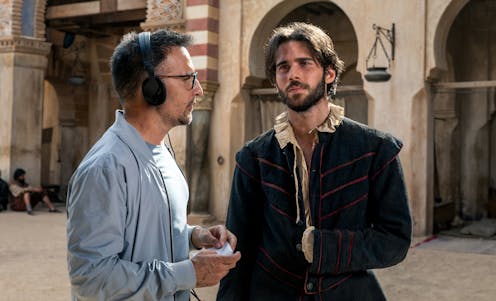
Alejandro Amenábar y Julio Peña durante el rodaje de _El cautivo_.Disney
Alejandro Amenábar estrena el 12 de septiembre una película biográfica sobre Miguel de Cervantes, titulada El cautivo, cuya trama describe el encarcelamiento del escritor en Argel, entre 1575 y 1580, tras la batalla de Lepanto.
Como la mayoría de producciones cinematográficas acerca de personajes históricos (más incluso cuando son tan conocidos), la cinta de Amenábar no escapa de la lupa de los historiadores, preocupados por dilucidar el grado de exactitud del argumento con lo verdaderamente acontecido según las fuentes.
Esta curiosidad, sin embargo, no provendrá solo de los historiadores. Después de todo, el espectador medio ha conformado en su mente una imagen del escritor de El Quijote como fruto de la educación recibida, de sus lecturas y de cuanto nos han informado los medios de comunicación.
A raíz de este estreno, merece la pena reflexionar sobre por qué al espectador le puede interesar visionar un relato de ficción con Cervantes como protagonista. Y, lo que aún es más relevante, qué faceta del escritor ha atraído más a Amenábar y a su equipo, por qué han deseado contar esta historia y qué valor han descubierto en ella para desear transmitírselo al público.
Porque, de hecho, no es la primera vez que el medio audiovisual se aproxima a Miguel de Cervantes. Atender a las obras cinematográficas que narran su biografía puede decirnos mucho sobre la sensibilidad de cada momento histórico.
Una buena lección moral
Durante la posguerra española, en un momento álgido de producción de películas sobre personajes históricos patrios, se presentó a la Dirección General de Cinematografía un proyecto titulado En un lugar de la Mancha.
La revista Fantasía. semanario de la invención literaria se hizo eco del trabajo que se estaba haciendo en el proyecto En un lugar de la mancha publicando un resumen del guion del largometraje. TodoColección
De alguna manera (así lo entendió la censura), la tesis de fondo sería: “las amarguras de Cervantes constituyen una buena lección moral”, identificándose la vida del escritor con la propia vida de don Quijote.
Por tanto, se valoraba la capacidad del medio audiovisual para transmitir virtudes a los espectadores, en tanto que narraba una vida considerada virtuosa. La única preocupación radicaba en que el resultado final de la película “no estuviera a la altura del tema tratado”. El proyecto obtuvo el beneplácito de la administración, pero con el paso de los meses no comenzó el rodaje y por razones desconocidas (posiblemente económicas) se canceló.
El Cervantes aventurero
Fue en 1967 cuando se estrenó la primera película sobre el escritor: Cervantes, una coproducción europea dirigida por el estadounidense Vincent Sherman.
Suponía la adaptación de una novela publicada por el escritor alemán Bruno Frank en 1934, titulada Un hombre llamado Cervantes. En unos años caracterizados por la crisis del cine frente a la televisión y la consecuente búsqueda de la épica y la espectacularidad, Cervantes se concibió como un filme de aventuras en torno a los años vividos por el escritor en Italia, la batalla de Lepanto y el cautiverio en Argel.
Cervantes aparecía como un pícaro y un buscavidas de esmerada inteligencia, un idealista, a ratos ingenuo, en continua búsqueda de la verdad. Así, no había asomo de exaltación de la Hispanidad ni tampoco del catolicismo, en un tono incluso respetuoso hacia el islam. A pesar de la escasa popularidad de esta cinta, queda como testimonio del interés de una época hacia esta faceta del escritor.
Cervantes espadachín y Gina Lollobrigida en las aventuras del escritor según Vincent Sherman. IMDB
El Cervantes didáctico
En 1981, RTVE emitió una miniserie de 9 episodios también titulada Cervantes. Fue la primera de las miniseries de carácter biográfico producidas por RTVE durante la democracia, a la cual siguieron Ramón y Cajal (1982), Teresa de Jesús (1984) y Goya (1985), entre otras.
La serie suponía una aproximación completa a la vida del escritor, narrada a través de continuos flashbacks desde 1616, momento en el que un joven licenciado visita a un Cervantes moribundo. Sus conversaciones e investigaciones al tratar con diferentes personajes son lo que permite elaborar el relato de la vida del escritor.
Así, hay en la miniserie cierta finalidad didáctica, dado el interés de la televisión pública por educar a los espectadores de la naciente democracia española. El licenciado se erigía como espejo del ciudadano democrático español, preocupado por profundizar en la cosmovisión cervantina, clave de bóveda de los valores democráticos en su condena de la corrupción, su concepción del hispanismo y su defensa de la libertad.
El Cervantes sombrío
Ahora, Alejandro Amenábar estrena El cautivo. A excepción de unos escasos datos históricos acerca del cautiverio en Argel (presentes en la película), casi todo cuanto digamos acerca de cómo Cervantes afrontó esos años es mera especulación, nadie lo sabe.
Julio Peña y Alessandro Borrghi en El cautivo. Disney
Y sin embargo, frente a los cientos de Cervantes posibles que Amenábar podía imaginar, ha optado por presentarnos a uno cínico, un cobarde obsesionado por salvar su pellejo aún a costa de traicionar a los demás. La crudeza del cautiverio se muestra, en nombre del realismo, sin atisbo de esperanza ni de virtud. Solo cuenta sobrevivir, y como espectadores (propone el director) deberíamos compadecer a Cervantes y asumir que haríamos exactamente lo mismo si estuviésemos en su lugar, aunque nos cause tristeza.
Sin duda, una visión desmitificadora del autor que Amenábar es muy libre de ofrecer al espectador. Cabe preguntarse, así, si quizá esta visión sea reflejo de una época que rechaza la heroicidad, que cree no necesitar héroes ni modelo alguno. Una época que sospecha de cualquier atisbo de virtud, porque la virtud no se considera realista.
Pablo Úrbez Fernández es miembro del Círculo de Escritores Cinematográficos y crítico de las revistas FilaSiete y Omnes
Source: The Conversation – UK – By Melissa Butcher, Professor Emeritus, Social and Cultural Geography, Royal Holloway University of London
In December 2021, I was in an exhibition hall in Phoenix, Arizona, with 10,000 young people who had come to hear a lineup of “America first” speakers, from Tucker Carlson to Ted Cruz. This was AmericaFest, an annual rally led by Turning Point USA, a conservative youth organisation whose founder and CEO, Charlie Kirk, was murdered on September 10.
I have spent the past four years listening most days to Kirk’s view of the world while carrying out research for my upcoming book, The Trouble With Freedom. He was charismatic, combative and at times inflammatory. But he was also strategic and clever.
He loved the US, freedom, family and football, and possessed an immense drive to “save America” from what he felt was its decline from greatness. With a national radio show and speaking tours focused on university campuses, his platform reached millions. There were times when he disseminated disinformation, but there were also times when I found myself agreeing with him.
Kirk was emblematic of a country polarised and imploding. At AmericaFest, and across a constellation of organisations and commentators working to “save freedom, save America”, the US is divided into those who are “loved” and those who are “hated”. This division is mirrored in progressive or liberal spheres.
Retribution is threatened and others are blamed. Opposing sides, each struggling for “the soul of the nation”, define the other by emotional indicators such as “angry”, “bitter”, “miserable”, “destroying”, “vicious”, “menacing”, “thugs”, “extremists”, “resentful”, “weak” or “unhinged”.
These sentiments serve a purpose. As cultural theorist Sara Ahmed argued in her 2004 book, The Cultural Politics of Emotion, it is through intensifying emotions that an “other” takes shape.
But while sharing emotions – rage as well as love – creates bonds, it also drives us away from others. This was something I experienced at AmericaFest as presenters repeatedly told the 10,000 young people present that people like me – childless, unmarried, atheist academics – hated them for being conservatives.
As people arrange themselves – where they live and who they socialise with – on the basis of how they feel, the end result can be a form of “partisan segregation”. Democrats and Republicans now appear increasingly unlikely to live with those who hold different political views.
Faced with rapid and profound changes, the idea of America and what it represents – freedom and prosperity – is slipping out of reach for some. This is creating feelings of loss and anger. In discussions I held with people from across the political spectrum, in social clubs, shooting ranges, workplaces and homes, people named points of cultural rupture.
Conversations were haunted by a feeling that community is breaking down. The promise of an affluent future is disappearing in the face of environmental collapse and successive financial crises. Deindustrialisation and the shift to a digital economy brings with it precarity. And fractious governance oversees divisions along generational, gendered, class, racial, religious, and rural and urban lines.
How people live together, and how they remember, has changed. The result is an anxiety-inducing realisation that safety can be contingent, random, luck of birth or where you happen to sit on a bus. Cultural breakdown can be watched incessantly, on repeat and archived for future reference as we doom scroll on our phones.
Responses to this rupturing and reshaping of life that was once taken for granted can range from psychological discomfort to murderous rage, as the world has just seen with Kirk’s assassination.
The US president, Donald Trump, understands this response and exacerbates it. He focuses on law and order, dystopian cities and out of control borders. He talks of a third world war not being far away, increasing anxiety and the subsequent desire for firmer ground, or a strong leader, to hang on to.
“Liberal” criticism of nationalist or populist responses neglects the pain some feel in managing change and the fears of being unsafe that go with it. This entrenches divisions further. More than just “angry Trump supporters” suffering from the loss of conservative leadership, the 2024 US election results suggest there is a broad spectrum of people who felt uncomfortable with a changing America that Democrats were held responsible for.
This is what Kirk tapped into and is encapsulated by Ines, one of the gen Z participants in my research. She said “generations that are growing up now don’t know a world where there wasn’t a school shooting every week … we were born into disaster and like our world is literally dying. So it’s like our generation doesn’t know a time when things were safe and comfortable.”
These divisions – alongside increasing inequalities, the misinformation and disinformation spread on social media and paralysed political systems – appear to be sending us collectively backwards into violent autocracy.
Even if it doesn’t feel like it right now, we can find ways to handle change and the emotions that come with it. In every conversation I’ve had across the political spectrum in the US, people talk about wanting to be part of something bigger – to care about more than just themselves, or to feel safe again through community. There’s a longing to bring back a sense of connection and care.
Even at their most angry, conversations indicated a desire to live in meaningful, caring relationships. Without a doubt, too much love and the boundaries of community become hard and less adaptable to change. But connection can also hold the potential to work against feelings of loss, ambivalence, hate and subsequent violence.
Melissa Butcher has received funding from UKRI and the ECR. She is affiliated with Cumberland Lodge.
Wherever you stand on his political views, Charlie Kirk’s murder is a tragedy on a personal level. He was just 31 and a husband and father of young children. But as a public figure his death represents a dangerous moment, as it threatens to deepen divides between conservatives and liberals in America and beyond.
Many commentaries on Kirk’s life will focus on his significance as a political activist and the important – some would say decisive – role he played in turning out the youth vote for Trump’s presidential election victory in 2024. But it is important to recognise how significant he had become as a public leader for what a growing number of scholars have referred to as white Christian nationalism.
While there is some variation in political views and theological beliefs among white Christian nationalists, a central, shared conviction is that the US was originally established as a Christian nation. For Christian nationalists, the idea of the separation of church and state is taken to refer only to not having an official state church. The complete separation of Christianity from public institutions is anathema and secular institutions such as public schools and universities are often regarded as hostile ground.
Given their view of America’s original religious calling, many Christian nationalists therefore believe that secular, liberal society is in terminal crisis. So America will only be put right when it returns to Christian laws or principles. This view of political disagreement is inherently binary. There are those who trust in God and support God’s work to transform society. Then there are those who oppose it. These people are mired in spiritual darkness.
Kirk’s Christian nationalist views and activism were not always comfortable watching. For example, along with others on the Christian right, Kirk publicly and vehemently challenged the place and legacy of Martin Luther King Jr, a hugely honoured figure in the US. In 2024, he chose the week in which the US celebrates a national holiday in honour of the murdered civil rights leader to label King “a serial adulterer, an alleged rapist, a reparations proponent, and a race Marxist”.
His organisation, Turning Point USA, also created Professor Watchlist. This online resource encouraged conservative students to name and shame college professors who had what were judged to be problematic views or activism linked to categories including “antifa”, “socialism” and “feminism”.
But while there is an element to white Christian nationalism which risks overturning basic democratic principles (as shown by the insurrection of January 6 2021), Kirk also had a better legacy. He became widely known on social media for his roadshows on college campuses which invited students to debate with him. He would put forward his views robustly, but also listened to his opponents.
These roadshows could be challenging for more liberally inclined students unused to having to defend their views. But at their best they provided surprising opportunities to find common ground. In one filmed discussion, for example, a feminist student had an engaged and respectful discussion with Kirk about his views about essential differences between men and women. They also agreed about the harmful effects of some forms of masculinity and the normalisation of pornography in youth culture. He maintained this commitment to these open public events despite the risks involved. It ultimately cost him his life.
Charlie Kirk debates a student.
Debate over Kirk’s legacy
This ambivalence between conflict and democratic engagement in Kirk’s work and the wider Christian nationalist movement is now finding expression in responses to his murder. On Fox News, as news of his death broke, shocked and distressed reaction nonetheless highlighted an interesting divide in the commentary. There were those who wanted to see this a turning point in the battle against the side of evil, the people who opposed his Christian mission. But others saw in his legacy a commitment to engagement and debate with those whom he disagreed with.
It remains to be seen which side of this legacy wins out. It should be observed, however, that much of Kirk’s following takes its cues from the current incumbent of the White House, whose instinct is usually to lean into division. And it was not different when the US president expressed his grief and anger at Kirk’s assassination, blaming the “radical left” for rising political violence in the US.
Most of the American people are neither ardent liberals nor committed Christian nationalists. But there is an ever-deepening political divide between those on the political left and right who no longer see each other as decent, trustworthy fellow citizens. As the political scientists Steven Levitsky and Daniel Ziblatt have argued, such polarisation is often a route to the death of true democracy.
At this moment of crisis, America – and the watching world – need to hope and work hard to ensure that Kirk’s legacy of democratic engagement and debate wins out. If this does not happen, the future for America is looking bleaker today.
Gordon Lynch does not work for, consult, own shares in or receive funding from any company or organisation that would benefit from this article, and has disclosed no relevant affiliations beyond their academic appointment.
Source: The Conversation – UK – By Katie Pruszynski, PhD Candidate, Department of Politics and International Relations, University of Sheffield
Charlie Kirk, figurehead of the American far right, took a question at a 2023 event in Salt Lake City about the second amendment to the US constitution and gun-related deaths. He answered: “I think it’s worth to have a cost of, unfortunately, some gun deaths every single year, so that we can have the second amendment to protect our other God-given rights.”
Two years later, once again in Utah, Kirk was killed with a gun. His death comes against a backdrop of increased political violence in the US, driven by a new set of political, societal and technological factors, and its future trajectory will determine the health of American democracy.
Political violence is differentiated from other crimes and it is helpful to have clarity about its particular meaning. It is defined specifically as acts intended to achieve political goals or intimidate opponents through the use of physical force or threats to influence a political outcome or silence dissent. While most of these incidents come from the far right, violence is used by extremists on both sides.
Over the past decade there has been a dangerous escalation in political violence driven by rage and resentment without clearly defined goals by self-radicalised individuals rather than organised extremist groups. High profile incidents have dominated headlines. These include the insurrection of January 6 2021, the shooting at a baseball practice session of Republican members of Congress in 2018, the plot to kidnap Michigan governor, Gretchen Whitmer in 2020, the vicious attack on Paul Pelosi – the husband of the speaker of the House of Representatives – in 2022, the torching of Pennsylvania governor Josh Shapiro’s family home in April this year. And, of course, the assassination attempts on Donald Trump on the campaign trail in 2024.
But the threat has spread beyond the very visible faces of US democracy to targets such as judges, election officials, journalists and even private citizens based upon their perceived political affiliation.
It is shocking yet unsurprising, given the new factors fuelling rage in an already deeply divided society. These can be broadly summarised by three characteristics.
Hyper-partisanship at boiling point
The way politics is discussed today shows that division can’t be seen in merely partisan terms. Opponents have become enemies and those with different worldviews have become traitors. In many examples, pundits, politicians and their mouthpieces indulge in dehumanising rhetoric. Research has consistently found that dehumanisation contributes to a more ready justification of violence.
Indeed, Trump and other high-profile figures have incited violence, even when not actually issuing direct calls to action. This was most notably evident on January 6 2021, when Trump goaded supporters in Washington to march on the Capitol, telling them: “And we fight. We fight like hell. And if you don’t fight like hell, you’re not going to have a country anymore.”
Fight like hell: Donald Trump’s ‘Save America’ rally.
Digital echo chambers
These pressure cooker arguments play out on social media and online forums that help spread conspiracy theories, disinformation and violent content. Highly influential creators are able to conjure up “bespoke realities” for their followers, generating huge personal wealth from the fomenting of rage and hate. Citizens are consuming deeply flawed, incendiary political content in isolation. This fuels self-radicalisation when people become detached from reality of the world outside their bubble.
When faith in government, the justice system, and the electoral process erodes, citizens may come to believe that the established systems are rigged, unresponsive, or illegitimate. This makes traditional avenues for change seem futile. In this environment, violence can be rationalised as the only effective means to “correct” the broken system. The American right has long railed against a corrupt and malevolent “deep state” convincing some citizens that democratic norms no longer apply.
What next? There are three possible scenarios. The worst case is an escalation of violence in both its frequency and its organisation.
The far right has been pushing for strict limits on civil liberties, and the most extreme members may use Kirk’s assassination as an excuse for violent retaliation. Widespread civil unrest is a persistent threat, particularly approaching the 2026 midterm elections. Many fear that if Trump’s allies sense they can use escalating disorder to declare an emergency suspension of democratic processes, they will push him to do so.
More likely, but no less unsettling, is a stagnation in which political violence becomes a normalised feature of American political life without escalating to an existential crisis. This has potentially far-reaching consequences as more moderate politicians on both sides perceive the risks of being in public life to be too high and vacate their offices. This paves the way for more extreme candidates to fill the gaps. With the more moderate voices gone, it’s less likely the conversation will cool down.
But things could improve. It will require bipartisan condemnation of political violence and a reconnecting of politicians to their constituents. Both sides need to work together to drag a bigger portion of the political debate back into the real world. Meanwhile social media platforms and the legacy media alike must be held accountable for the tenor and veracity of the content they feed to the public.
And efforts must be made by political elites, the media and the public to rebuild civic trust. As the foundation stone of a healthy democracy, citizens’ trust in their government and in each other must be carefully pieced back together.
America does not need to accept violence as the norm, in fact, it must collectively and consistently reject it. The future of its democracy may depend on it.
Katie Pruszynski does not work for, consult, own shares in or receive funding from any company or organisation that would benefit from this article, and has disclosed no relevant affiliations beyond their academic appointment.
Historically, lavender marriages refer to unions — often between two consenting LGBT+ individuals — formed as a way of concealing same-sex attraction in a society where being openly queer could mean social ostracism, career ruin or even criminalization.
Crucially, they were not loveless. On the contrary, they were bonds of protection and safety between two people navigating the reality of bias, prejudice and discrimination of society and politics.
Lavender marriages can be confused with mixed orientation marriages, but there is a difference: in mixed-orientation marriages, partners have different sexual orientations from one another. That doesn’t mean these relationships don’t make sense — plenty of couples do well without sharing the same orientation.
But are lavender marriages actually making a comeback? The answer is complicated. While social progress has made queer lives more visible, many still fear coming out because of social, religious, cultural and political pressures.
Dating today can feel like a mix of endless swipes, red flags and shifting expectations. From decoding mixed signals to balancing independence with intimacy, relationships in your 20s and 30s come with unique challenges. Love IRL is the latest series from Quarter Life that explores it all.
These research-backed articles break down the complexities of modern love to help you build meaningful connections, no matter your relationship status.
The roots of lavender marriages
Nowhere were lavender marriages more visible than during Hollywood’s Golden Age (1930-60s), when the Motion Picture Production Code — known as the Hays Code after the president of the Motion Picture Producers and Distributors of America from 1922 to 1945 — imposed restrictions on “immorality” and demanded that stars maintain a carefully constructed image.
For example, the 1933 film Queen Christina portrayed an androgynous queen who shared a kiss with another woman. If the film were released a year later than it was, the androgynous image and kiss would have had to be removed to comply with Hays Code.
Notable examples in Hollywood include actor Rock Hudson, whose studio reportedly orchestrated a marriage to shield his private life from public scrutiny, and stage actress Katharine Cornell, whose marriage to director Guthrie McClintic was widely regarded as a partnership of convenience that allowed both to live more authentically in private.
Earlier still, silent film idol Rudolph Valentino faced speculation about his sexuality, and was rumoured to have entered into marriages that offered him protection amid tabloid attacks.
For these celebrities, lavender marriages were not only about survival in a hostile era, but also a way of retaining access to their careers, audiences and cultural influence.
Queer censorship today
It is unsurprising that lavender marriages have returned to public discussion, given that similar concerns of queer censorship are currently happening.
Inside Out 2 (2024) was rumoured to remove a transgender character to avoid international backlash, while Elio (2025) was also rumoured to erase queer subtext from the movie’s final cut.
These realities were poignantly illustrated in the 2022 Pakistani film Joyland, which captures the grief and danger of living inauthentically when family bonds, social safety and political punishment are at stake.
Trailer for the 2022 film ‘Joyland.’
Similar stories are surfacing in real life. In 2024, People profiled a 90-year-old grandmother who came out as bisexual after her husband’s death, revealing their 63-year union had been a lavender marriage of mutual protection.
The pressure to pass as heterosexual — whether by marrying, dating or travelling with opposite-sex friends — remains a strategy of safety for many queer people around the world.
Lavender and lesbians
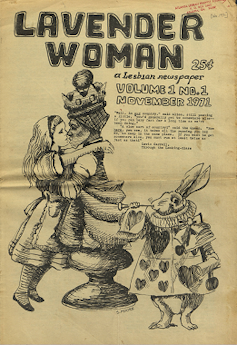
November 1971 issue of Lavender Woman, a lesbian periodical produced in Chicago, Illinois, from 1971 to 1976. The title comes from lavender’s association with lesbianism dating back to the 1950s and 60s. (Women’s Caucus of Chicago Gay Alliance)
The symbolism of lavender itself has particular resonance in lesbian culture. Throughout the 20th century, the colour became a coded reference to women who loved women, at once stigmatizing and unifying.
During the “Lavender Scare” of the 1950s, the U.S. government dismissed and persecuted lesbians and gay men in federal employment under the guise of “security risks.”
Yet lavender was also reclaimed as a badge of solidarity and resistance. Early lesbian feminists incorporated lavender into marches, protest sashes and art, using it as a way of asserting presence and pride in a culture that demanded invisibility.
The impact of concealment
Academic research consistently shows that concealment of sexual orientation remains widespread. A 2019 global public health study from estimated that 83 per cent of lesbian, gay and bisexual people worldwide hide their orientation from most people in their lives.
In Canada, a 2022 study of LGBTQ+ health professionals revealed how concealing one’s identity shapes daily decisions about disclosure, often producing stress and internal conflict in professional settings. Bisexual individuals frequently report concealing their orientation to avoid stigma from both heterosexual and queer communities.
“Passing” as straight is often a survival strategy shaped by stigma, with lasting consequences for identity, relationships and health. Lavender marriages remind us that queer lives have always been shaped by the tension between resistance and survival. Visibility itself can be an act of defiance, whether on a movie screen, in a march or in daily life.
These histories and contemporary examples reveal that marriage and partnership have never been one-size-fits-all.
For queer people, unions can be built around protection, friendship, parenting, finances or chosen kinship, just as much as romance or desire. To call them all “lavender marriages” risks oversimplifying the complex ways people craft love and survival.
Modern marriage is not bound by tradition alone; it is defined by the people who build it and by the choices they make to balance safety, authenticity and resistance in a world still learning to accept them.
This dual significance — lavender as both concealment and resistance — helps explain why the term continues to resonate today, as scholars, activists and communities revisit these marriages not simply as personal compromises, but as reflections of broader homophobia and gendered policing that continue to share queer history.
Gio Dolcecore does not work for, consult, own shares in or receive funding from any company or organisation that would benefit from this article, and has disclosed no relevant affiliations beyond their academic appointment.
Dans un nouvel acte choquant de violence politique aux États-Unis, Charlie Kirk a été abattu alors qu’il débattait avec des étudiants dans une université de l’Utah. Il s’était fait connaître en tant qu’influenceur conservateur et partisan de Donald Trump,
Âgé de 31 ans, il était devenu célèbre en confrontant ses idées avec tous ceux qui souhaitaient s’engager avec lui. Il était indéniablement la figure conservatrice la plus influente chez les jeunes.
L’annonce de son assassinat a immédiatement enflammé les réseaux sociaux, où les camps politiques opposés se sont mutuellement accusés d’alimenter le climat de tension actuel aux États-Unis. Elle a aussi ravivé les craintes d’une nouvelle escalade de violence.
Qui était Charlie Kirk ?
La modeste tente où Kirk s’installait sur les campus universitaires américains pour débattre avec les étudiants ne doit pas faire oublier l’ampleur de son influence.
Son organisation politique, Turning Point USA (TPUSA), avait un chiffre d’affaires de 78 000 dollars lorsqu’il l’a fondée en 2012. L’année dernière, ses revenus annuels avaient atteint 85 millions de dollars américains.
Son podcast, The Charlie Kirk Show, attirait entre 500 000 et 750 000 téléchargements par épisode, le plaçant parmi les 25 podcasts les plus populaires au monde. Le compte X de Kirk, avec ses sept millions d’abonnés, dépasse celui de MSNBC (cinq millions).
En dehors du monde virtuel, TPUSA est aujourd’hui présent dans plus de 3 500 écoles et campus universitaires, regroupant plus de 250 000 étudiants membres et plus de 450 employés à temps plein et à temps partiel. Mais le chiffre le plus révélateur est celui d’une enquête TikTok menée auprès de jeunes de moins de 30 ans : parmi les électeurs pro-Trump, Kirk jouissait d’une confiance supérieure à celle de toute autre personnalité.
Bien que Kirk ait suscité de nombreuses critiques, notamment pour ses positions sur les Noirs, les Juifs, les personnes transgenres et les immigrants, ainsi que pour sa lutte contre ce qu’il qualifiait de « propagande gauchiste » chez les professeurs, il restait prêt à débattre avec presque n’importe qui.
Que ce soit dans les amphithéâtres renommés d’Oxford ou sur des campus progressistes américains, Kirk participait à des débats politiques avec quiconque voulait s’exprimer, invitant souvent les étudiants à « prouver qu’il avait tort ». Les vidéos de ces échanges — souvent un étudiant progressiste posant une question à Kirk, qui lui répondait avec une argumentation vive — ont cumulé des centaines de millions de vues sur les réseaux sociaux.
Soutien à Trump
Kirk s’est d’abord fait connaître en défendant des politiciens républicains plus conventionnels, notamment le sénateur du Texas Ted Cruz et l’ancien gouverneur du Wisconsin Scott Walker. Mais il a fini par soutenir Trump en 2016, et il lui est resté fidèle depuis.
En effet, alors que beaucoup — en particulier au sein du parti républicain — cherchaient à se distancier de Trump après des incidents tels que les violences au Capitole américain, le 6 janvier 2021, Kirk a maintenu le cap.
Sa loyauté indéfectible envers Trump et sa popularité grandissante chez les jeunes électeurs lui ont permis de gagner en influence dans les cercles conservateurs. Grâce à ce pouvoir, son organisation a financé à hauteur de plusieurs millions de dollars différentes campagnes pro-Trump. TPUSA a aussi renforcé son soutien à Pete Hegseth, candidat controversé au poste de secrétaire à la Défense, et lancé des actions pour évincer Ronna McDaniel, ancienne présidente du Comité national républicain.
La victoire politique la plus marquante de Kirk reste peut-être d’avoir mobilisé un nombre record de jeunes électeurs pour Trump en 2024. Il était alors la plus jeune personne à avoir dirigé une campagne présidentielle républicaine.
Violence politique aux États-Unis
Certains pourraient voir dans cet épisode meurtrier de violence politique aux États-Unis un événement ponctuel et se demander s’il aura un impact durable. Pourtant, la naissance du pays même résulte d’un acte de violence politique — la guerre d’indépendance. Depuis, d’autres périodes marquées par des violences politiques ont jalonné son histoire, comme la guerre civile, la reconstruction et le mouvement des droits civiques, entre autres.
Cependant, même si l’histoire des États-Unis est truffée de tels incidents, on ne peut nier que la situation s’est aggravée, en particulier au cours des dernières années.
Plusieurs études ont montré que le nombre d’attaques et de complots visant élus, candidats, responsables de partis et militants politiques a considérablement augmenté ces dernières années. En examinant les données des trois dernières décennies, le Center for Strategic and International Studies (CSIS) a constaté que le nombre d’attaques et de complots au cours des cinq dernières années est près de trois fois supérieur à celui des 25 années précédentes combinées.
Déjà des milliers d’abonnés à l’infolettre de La Conversation. Et vous ? Abonnez-vous aujourd’hui à notre infolettre pour mieux comprendre les grands enjeux contemporains.
Mais au-delà des chiffres, de plus en plus de politiciens américainsévoquent la menace de la violence comme l’une des raisons de leur retrait de la vie politique ou, plus inquiétant, comme un facteur ayant influencé leurs choix de vote.
Il ne fait guère de doute que les États-Unis continueront à souffrir de la violence politique. La question est plutôt de savoir dans quelle mesure et à quel prix.
La mort de Kirk aura des répercussions bien au-delà de ses proches, notamment sa veuve et ses deux jeunes enfants. Aujourd’hui, le mouvement conservateur américain perd l’une de ses voix les plus influentes.
Jared Mondschein ne travaille pas, ne conseille pas, ne possède pas de parts, ne reçoit pas de fonds d’une organisation qui pourrait tirer profit de cet article, et n’a déclaré aucune autre affiliation que son organisme de recherche.
Source: The Conversation – (in Spanish) – By José Ygnacio Pastor Caño, Catedrático de Universidad en Ciencia e Ingeniería de los Materiales, Universidad Politécnica de Madrid (UPM)
Las manchas de leopardo encontradas en el crater Jerezo de Marte podrían indicar que, hace miles de millones de años, las reacciones químicas en esta roca podrían haber sustentado vida microbianaNASA/JPL-Caltech/MSSS, CC BY
Una roca moteada, bautizada como “Cheyava Falls” y situada en un antiguo cauce fluvial del cráter Jezero, ha encendido de nuevo una pregunta antigua con traje moderno: ¿hay o hubo vida en Marte?
Este es un análisis –con los pies en los datos– sobre pistas, escalas de certeza y lo que significaría oír, por fin, un “sí, esto es vida extraterrestre”. Pero aún no ha llegado el momento.
Los indicios de vida que han visto las sondas de la NASA
Desde hace años, la NASA ha ido informando de hallazgos que se acercan a lo que podría parecerse a una huella de vida.
En 1976, las sondas Viking realizaron los primeros experimentos biológicos en Marte. Sus resultados fueron intrigantes, pero también muy polémicos, y no se consideraron una prueba concluyente de vida. Desde entonces, ninguna misión ha vuelto a llevar experimentos tan directos. La lección de Viking es clara: en la exploración del planeta rojo, conviene mantener la curiosidad… pero también la cautela en las expectativas.
En 2018, la NASA informó de indicios de vida orgánica en barro antiguo de Marte. Entonces el rover Curiosity detectó en el cráter Gale moléculas orgánicas preservadas en lutitas lacustres (un tipo de roca sedimentaria, compuesta por partículas muy finas de arcilla y limo que se depositaron en el fondo de los lagos) de aproximadamente 3500 millones de años y una variación estacional del metano de fondo. Son ingredientes y pistas, pero no es propiamente vida.
En el estudio reciente, la NASA informa que en la zona conocida como Bright Angel, el instrumento SHERLOC del rover Perseverance también identificó la presencia de moléculas orgánicas, mientras que el instrumento PIXL mapeó minerales como vivianita y greigita en un lodo rico en hierro, fósforo y azufre.
Pero este tipo de mezcla puede formarse tanto por la acción de microorganismos como por procesos puramente químicos. Así que puede ser un indicio de vida, o no.
Esa ambigüedad es justo lo que resalta la síntesis publicada en Nature, que subraya cómo estos hallazgos mantienen abierto el debate sobre si Marte albergó vida o no.
Las muestras de metano
Anteriormente, el Curiosity detectó variaciones locales y estacionales en la presencia de metano en el planeta vecino, algo que también podría asociarse con una biofirma. Sin embargo, el orbitador europeo TGO (de la misión ExoMars) no ha encontrado prácticamente nada: sus mediciones ponen un límite global muy estricto, menos de 0,05 partes por mil millones.
El reto ahora es conciliar ambos resultados: ¿se trata de pequeñas emisiones superficiales que la atmósfera elimina rápidamente, o de mediciones que están sesgadas por factores aún desconocidos? La ciencia sigue en curso y la respuesta todavía no está cerrada.
¿Qué sería una prueba irrefutable?
Tras varias decepciones, la comunidad científica ha elaborado una “escala de confianza” para detectar vida, llamada Confidence of Life Detection (CoLD).. Es como una escalera de siete peldaños: primero se detecta una posible señal y después hay que descartar contaminación; demostrar que la biología sería viable en ese entorno; excluir explicaciones no biológicas; encontrar otra señal independiente; derrotar hipótesis alternativas… y, por último, conseguir confirmación por distintos equipos. ¿Cómo se sube esa escalera? No con un único hallazgo espectacular, sino con varias pruebas que, juntas, formen un caso sólido.
Una química orgánica compleja con homoquiralidad (se refiere a moléculas que tienen una estructura no superponible con su imagen especular, similar a la de nuestras manos) sería un buen indicio, porque es extremadamente difícil de generar sin vida.
Otro rastro lo darían los isótopos: variaciones en elementos como el carbono o el azufre que, dentro de su contexto geológico, se ajusten a lo que esperaríamos de procesos biológicos. Sin ese contexto, el isótopo puede engañar.
También podrían encontrarse texturas microscópicas que recuerden a células o biofilms, siempre asociadas a moléculas orgánicas e isótopos de “firma biológica”.
Una sola pista nunca basta: se necesitan varias, y que se repitan de manera independiente, con instrumentos distintos.
¿Y en qué otros mundos podría asomarse la vida? Estos son los candidatos:
Europa (Júpiter). Es el favorito: oculta un océano salado bajo el hielo. la misión Europa Clipper, que llegará hacia 2030, hará casi 50 sobrevuelos para estudiar si allí existen condiciones habitables. No busca vida directamente, pero sí comprobar si podría haberla.
Encélado (luna de Saturno). Sus espectaculares géiseres conectan el océano interno con el espacio. Allí se ha detectado fósforo en abundancia, un nutriente esencial para la vida. Es, literalmente, un laboratorio natural abierto.
Titán (luna de Saturno). Con su atmósfera densa y rica en compuestos orgánicos, es un lugar único para explorar química prebiótica. La misión Dragonfly despegará a finales de esta década (si no entra en el grupo de recortes de Donald Trump) y aterrizará hacia mediados de los 30, para estudiar si podrían darse formas de bioquímica distintas a las terrestres.
Venus. En sus nubes se han detectado posibles rastros de fosfina, aunque el debate sigue abierto. Para unos es una señal sugerente; para otros, un artefacto de las observaciones. El debate es un buen antídoto contra el autoengaño.
¿Y si se encuentra vida?
En ciencia y tecnología, aceleraríamos las misiones de retorno de muestras y desarrollaríamos sistemas de contención de máximo nivel, además de nuevas herramientas para detectar formas de vida “no terráqueas”; en filosofía, nos obligaría a dejar de confundir singularidad con privilegio; en religión, probablemente inspiraría lecturas más inclusivas de la creación, más que crisis de fe; en política y ética, reforzaría la necesidad de no contaminar otros mundos ni traer riesgos a la Tierra.
Pero más allá de lo práctico, nos brindaría una cura contra el provincianismo: nos recordaría que no somos el centro del universo.
¿Cuándo podríamos afirmarlo rotundamente?
Hay dos ventanas realistas. En primer lugar, hacia la década de 2030. El rover europeo Rosalind Franklin, cuyo lanzamiento está previsto para 2028, llegará a Marte en unos cinco años. Está diseñado para perforar hasta dos metros bajo la superficie, donde la radiación no ha destruido los compuestos más delicados. Con su instrumento MOMA podría encontrar moléculas orgánicas complejas, señales de quiralidad (esa preferencia por una “mano” molecular que suele asociarse a la vida) y posibles texturas biológicas. No será fácil, pero las posibilidades están ahí.
La segunda ventana sería el retorno de muestras. La misión conjunta de NASA y ESA, que busca traer rocas marcianas a la Tierra, se ha encarecido y retrasado, por lo que lo más probable es que su “veredicto de laboratorio” no llegue antes de la década de 2040.
Eso sí, incluso si la roca Cheyava Falls ofrece biofirmas tentadoras, la confirmación no llegará con un único indicio. Habrá que recorrer toda la “escalera CoLD”: descartar explicaciones no biológicas y repetir pruebas de forma independiente, idealmente en laboratorios terrestres. El calendario es incierto. Mientras tanto, el escepticismo no supone un freno: es la dirección en la que vamos.
Si la vida marciana existe o existió, nos esperará, no tiene nuestras prisas. Y si no existió nunca, el hallazgo más grande será comprender por qué aquí sí. Esa respuesta también nos pertenece y entusiasma.
José Ygnacio Pastor Caño no recibe salario, ni ejerce labores de consultoría, ni posee acciones, ni recibe financiación de ninguna compañía u organización que pueda obtener beneficio de este artículo, y ha declarado carecer de vínculos relevantes más allá del cargo académico citado.
On the morning of September 10, Nato jets were scrambled over eastern Poland to defend the airspace of an alliance member against an incursion by Russian drones. It was the first time that the west fired shots in the Kremlin’s war against Ukraine.
This incursion marks a serious escalation by Moscow. But it also highlights yet again that the west has no clear red lines and is unprepared to respond decisively if red lines that were taken for granted in the past – like the territorial integrity of Nato members – are crossed.
This latest Russian escalation isn’t the usual war of words. It was only last week that Russia’s president, Vladimir Putin, warned that foreign troops in Ukraine would be legitimate targets for his invasion force.
He slightly qualified his comments by noting that this would be the case “especially now, while the fighting is ongoing”. But the message was nevertheless clear. Russia will oppose any international security guarantees that involve western troops in Ukraine. This has been a long-standing and frequently articulated position by Russia. Yet, Putin’s rhetoric threatening to target western troops clearly ups the ante.
But these are not the only ways in which the Kremlin has markedly turned up the pressure over the past few weeks and months. Russia has also retained some momentum in its military campaign in Ukraine and has been further empowered by several successes on the diplomatic front.
On the battlefield, Russia has continued to demonstrate significant advantages in manpower and military hardware.
Where the entire Nato alliance struggled to cope with the incursion of just 19 drones, Ukraine has been subject to an intense air campaign with hundreds of drones and often dozens of missiles every night for months.
The attacks have become more brazen – recently targeting Ukraine’s government building in Kyiv. They have also become more deadly, leading to increasing loss of civilian lives. As in past years, Russia has also targeted Ukrainian energy infrastructure, which bodes ill for another grim winter for the country.
On the ground, Russian gains have been small and Ukraine has regained strategically important territory around the key city of Pokrovsk in the Donetsk region. Nonetheless, and this is what matters for Putin’s messaging, Russia is advancing, however incrementally and costly it might be.
The state of the conflict in Ukraine, September 10 2025. Institute for the Study of War
Putin’s aggressive moves
Diplomatically, Putin received an important boost from the annual summit of the Shanghai Cooperation Organisation in Tianjin and subsequent bilateral deals agreed with China. He will have been cheered by the cordial relations on display between Russian, Chinese and North Korean leaders at the September 3 military parade to mark China’s victory over Japan in the second world war.
The Russian president can now be more assured than ever that his partners will have his back – economically in the case of China and India, and militarily in the case of North Korea.
Buoyed by such “successes” that his war machine will not suddenly grind to a halt, the Russian president felt confident enough to demand that Ukraine negotiate an end to the war with him or face the consequences of him ending the war by force.
Putin’s idea of a negotiated end to the war, however, is anything but that. What he has in mind is that Ukraine and its western allies should simply accept his longstanding demands: territorial losses, no Nato membership and no western forces to secure any peace deal.
This multi-layered Russian pressure campaign is not merely an accidental confluence of unrelated forces somehow magically lining up in Putin’s favour. It is part of a carefully crafted campaign for Russia to retain relevance in what will probably shape up as a future bipolar US and Chinese-dominated international order. If Putin has accepted Chinese dominance in Asia, he still sees opportunities for Russia to be the dominant power in Europe – and restore at least part of its Soviet-era zone of influence.
For that to be achieved, the Kremlin needs to demonstrate that Ukraine’s western partners are feckless in the face of Russian determination. So far, Putin is doing well. All of the deadlines and ultimatums set by the US president, Donald Trump, have been ignored by Russia – at zero cost.
Trump’s response to Russian drones in Polish airspace was a short post on his Truth Social network that indicated surprise more than an actual response to what could quickly develop into a serious crisis. Meanwhile, Trump has yet to offer his support for a bipartisan bill in the US senate to put more sanctions pressure on Russia.
Western response
Similarly, while European leaders have been quick and forceful in their condemnations of this latest Russian provocation, their reactions have, as usual, been at the rhetorical level.
Poland merely invoked Nato’s Article 4 procedure for formal consultations among allies in the North Atlantic Council. But the outcome of this consultation was little more than a meek statement by Mark Rutte, Nato’s secretary general, that “a full assessment of the incident is ongoing” and that the alliance “will closely monitor the situation along our eastern flank, our air defences continually at the ready”.
Where the debris from Russia’s drones was found in Poland. Institute for the Study of War
The statement by the EU’s foreign affairs chief, Kaja Kallas, offered solidarity with Poland and promised to “raise the cost for Moscow further by ramping up sanctions significantly on Russia and its enablers”. Given that the EU is on its 18th sanctions package and the war in Ukraine continues unabated, it’s hard to see a gamechanger here. Delivered the morning after the Russian drone incursions into Poland, the annual state of the union address by Ursula von der Leyen offered little more than confirmation of EU aspirations “to be able to take care of our own defence and security”.
None of this will have Putin worried. It should, however, worry Ukrainians and the rest of Europe.
Stefan Wolff is a past recipient of grant funding from the Natural Environment Research Council of the UK, the United States Institute of Peace, the Economic and Social Research Council of the UK, the British Academy, the NATO Science for Peace Programme, the EU Framework Programmes 6 and 7 and Horizon 2020, as well as the EU’s Jean Monnet Programme. He is a Trustee and Honorary Treasurer of the Political Studies Association of the UK and a Senior Research Fellow at the Foreign Policy Centre in London.
Le mouvement international #MeToo de lutte contre les violences sexuelles et sexistes a, en quelques années, mis en évidence le poids et l’enracinement historique des dominations exercées sur les femmes dans la société moderne. Que signifie l’expression « culture du viol » apparue dès lors dans l’espace public pour en rendre compte ? Quelle réalité traduit-elle ?
Depuis #MeToo, on commence à reconnaître le caractère massif et structurel des violences sexuelles et sexistes. Mais il reste à percer un mystère : pourquoi sont-elles si omniprésentes dans nos sociétés ? C’est ce que vise à comprendre l’expression « culture du viol », qui a émergé dans le débat public, mais qui est souvent mal comprise et semble donc exagérée à beaucoup, qui rétorquent :
« Mais enfin, nous ne vivons pas dans une société qui promeut le viol ! Tous les hommes ne sont pas des violeurs ! »
C’est vrai. Mais l’expression « culture du viol » vise à analyser une réalité bien plus diffuse et dérangeante. La notion a été élaborée dans les années 1970 aux États-Unis par des sociologues féministes pour saisir un point aveugle de notre organisation sociale. Elle désigne à la fois une contradiction puissante et la stratégie collective de défense qui nous permet de faire avec.
La culture du viol : sous l’expression choc, une réalité complexe
Quand on pense au mot « viol », on a en tête une scène bien identifiée : l’agression sauvage d’une femme, jeune et jolie et court vêtue, au fond d’un parking, par un inconnu armé et dangereux. Cette image nous repousse… mais elle nous rassure aussi. Car elle est aux antipodes de la réalité statistique des violences sexuelles et sexistes (VSS).
Dans la vie réelle, les agressions sont avant tout commises par des proches, et n’impliquent donc que rarement une violence déchaînée, mais plutôt d’autres formes de contrainte moins visibles (économique, affective, psychologique, etc.).
Et ce n’est pas un hasard si notre image type du viol nous empêche de voir en face la réalité des violences sexistes et sexuelles. Elle est faite pour ça, pour nous empêcher de voir ou plutôt nous permettre de ne pas voir. Et pour rendre ainsi supportable le gouffre qui sépare, d’un côté, les valeurs d’une société démocratique moderne qui se veut acquise à l’égalité femmes/hommes ; d’un autre côté, ou plutôt en dessous de cette surface lisse et valorisante, un imaginaire collectif bien plus sombre. Lequel nourrit encore nos normes et nos institutions et continue à invisibiliser, normaliser et érotiser des formes d’asymétrie, de domination et de violences exercées par le groupe social des hommes.
C’est cela, la culture du viol. Dans mon essai le Viol, notre culture (2025), j’interroge spécifiquement la responsabilité des productions culturelles dans sa perpétuation. Si le fait d’associer le mot « culture », qui évoque les arts, le savoir, le raffinement, à celui de « viol » choque nos oreilles et notre sensibilité, il n’en reste pas moins que, selon moi, la culture du viol est un problème indissolublement politique et esthétique. Car les abus sexuels sont toujours aussi des abus de langage et impliquent une déformation de nos perceptions.
La culture du viol, une question esthétique autant que politique
Les professionnels de la prise en charge des auteurs de violences sexistes et sexuelles ont repéré une stratégie de défense, à la fois psychique et rhétorique, récurrente chez les personnes qui commettent ces violences, résumée par l’acronyme anglo-saxon « DARVO » pour :
le « déni » (qui comprend la dénégation mais aussi l’euphémisation des faits ; par exemple, dire « pousser » en lieu et place de « frapper », etc.) ;
la « attaque » (insulter, dénigrer la victime)
et le « renversement des rôles de victime et d’agresseur » – en anglais, « offender » (« C’est elle qui m’a cherché », « Elle m’a poussé à bout », etc.).
Mais, à vrai dire, cette stratégie de défense largement inconsciente n’est pas seulement le fait des personnes qui commettent des violences, elle est partagée par beaucoup d’entre nous. Il faut dire que voir les violences et croire les personnes qui les dénoncent, impliquerait d’agir. Or, cela a un coût : se mettre à dos une personne qui a quasiment toujours plus de pouvoir que ses victimes – car, autre idée reçue, les VSS ne sont pas une question de pulsion sexuelle, mais de domination.
Il est une autre notion clé sur laquelle s’accordent les experts des VSS, mais qui passe encore mal dans le débat public, parce qu’elle implique la remise en cause de comportements beaucoup plus fréquents et banalisés que les agressions les plus graves : la notion de_ continuum_. C’est qu’il est difficile d’admettre que, de la blague sexiste au viol ou au féminicide, il existe une différence de degré, bien sûr, mais pas de nature.
Ces mécanismes et ces systèmes de valeur, nous les absorbons par le biais de nos récits collectifs et notamment des représentations culturelles, qui jouent ainsi un rôle important dans la perpétuation de cette culture du viol. Elles façonnent nos manières de sentir, de percevoir et d’interpréter ce qui nous arrive et beaucoup (trop souvent) nous apprennent à douter de nos perceptions en matière de violences sexistes et sexuelles.
Certains veulent croire que cette culture du viol serait limitée à certaines époques – le « monde d’avant », situé quelque part entre l’Ancien Régime et les années 1970 – ou à certains genres de productions culturelles – le rap ou la pop culture. C’est faux. Elle traverse toutes les époques, tous les arts et tous les styles. On la retrouve dans les grands classiques de la littérature d’hier comme dans la culture légitime d’aujourd’hui.
De Blanche-Neige et les Sept nains (1937), dont on retient que l’héroïne de conte de fées est sauvée par son prince charmant en oubliant qu’il l’a embrassée sans son consentement, jusqu’aux comédies romantiques comme Love Actually (2003), où le harcèlement est sublimé en preuve d’amour, l’histoire des arts et du divertissement regorge d’images où les viols, les féminicides et d’autres formes d’abus plus ou moins graves se cachent sous le désir brûlant ou sous la passion amoureuse. Elle nourrit en chacun de nous un imaginaire saturé par le male gaze, autre notion clé pour comprendre comment opère la culture du viol.
Le « male gaze », un regard prédateur qui organise le monde entre proies et chasseurs
Contrairement à ce que l’expression pourrait laisser croire, ce regard prédateur n’est pas tant un regard masculin que masculiniste et misogyne. Il réduit en effet les personnages de femmes à des corps, et ces corps à des objets de désir et même à des proies à chasser. La culture du viol passe par ce regard qui opère sur plusieurs plans :
L’image (la caméra qui déshabille l’actrice).
Le récit (le plus souvent construit selon des scripts sexuels et relationnels où l’homme jouit de conquérir du terrain et de faire céder sa partenaire, laquelle se trouve comblée de se soumettre à ce désir insistant plutôt que d’écouter le sien).
Le mode de narration et d’énonciation, soit le point de vue qui nous est présenté à la fois comme digne de confiance et comme universel dans les œuvres, puisque c’est celui depuis lequel le monde et les personnages sont regardés. C’est l’outil le plus puissant pour nous faire incorporer le male gaze, car il implique que l’on s’identifie tous et toutes à ce regard masculin, qu’il nous profite ou non.
C’est ce qui explique l’empathie différenciée pour ce point de vue masculin (l’himpathy, selon la philosophe Kate Manne) de l’empathie pour celles qui subissent ces assauts – non seulement dans les fictions mais aussi dans la vraie vie. Ce que nous enseignent les œuvres qui relèvent de la culture du viol, c’est, in fine, de voir le monde dans la version de l’agresseur. Et cet apprentissage est d’autant plus efficace que les stratégies esthétiques sont diverses. J’en ai repéré trois principales.
Trois stratégies esthétiques au service de la culture du viol
La première stratégie consiste à assumer fièrement la violence misogyne. C’est ce qu’on voit par exemple dans certaines chansons de rap d’Orelsan (« Sale Pute » et « Suce ma bite pour la Saint-Valentin » notamment) qui ont donné lieu à des procès intentés par des associations féministes pour « incitation à la haine envers les femmes ». Cette violence décomplexée a de quoi faire peur tant elle s’affiche aujourd’hui dans le discours d’hommes politiques de premier plan à l’échelle internationale (Trump, Erdogan, etc.) aussi bien que sur les réseaux sociaux où les discours masculinistes prolifèrent. Cependant, cette stratégie n’est pas la plus dangereuse pour nos imaginaires. Elle a en effet le mérite d’être claire.
Les deux autres sont bien plus retorses et ancrent d’autant plus la culture du viol qu’elles nous leurrent. Elles maquillent en effet les violences jusqu’à les rendre méconnaissables.
La seconde stratégie consiste à dénoncer le viol… tout en érotisant les violences sexuelles et en les banalisant, les transformant en simple ressort dramatique. Je consacre un chapitre entier au film Irréversible, de Gaspard Noé (2002), exemplaire de cette stratégie.
La troisième, enfin, consiste à maquiller la violence en amour ou en humour. En amour, c’est le féminicide caché du roman Rebecca, de Daphné du Maurier (1938), et de l’adaptation Hitchcock du même nom (1940) ; c’est aussi l’érotisation de la zone grise comme dans la chanson Blurred Line, de Pharrell Williams et Robin Thicke (2013) ; c’est encore le culte des amours toxiques qui a toujours le vent en poupe en 2025, dans les dernières séries de dark romance pour adolescentes ou dans le blockbuster français L’Amour Ouf, de Gilles Lellouche (2024).
En humour, ce sont les grosses blagues qui tachent d’un Jean-Marie Bigard ou d’un Patrick Sébastien, dont la mécanique comique repose intégralement sur les stéréotypes sexistes, ou le rire d’humiliation pratiqué à l’écran, sur les plateaux ou dans la chambre à coucher par le cinéaste culte estampillé « de films d’auteur » Bertrand Blier.
Que faire ? Ni censure ni déni : apprendre à voir, à entendre et à dire les violences
Face à celles et à ceux qui critiquent cette culture du viol, on crie volontiers à la « cancel culture » et à la censure, et on en appelle à la défense de la liberté d’expression.
Sans développer les diverses réponses que j’aborde dans l’essai que j’ai publié, je veux insister ici sur le fait que, pour la plupart de celles et ceux qui dénoncent la culture du viol, il n’est pas question d’interdire les œuvres. Il s’agit tout au contraire, pour les œuvres d’aujourd’hui comme d’hier, d’apprendre à les lire/relire, à les contextualiser et à voir et à nommer les violences, à développer un regard critique qui n’empêche pas l’amour des œuvres, mais permette de les regarder en face, avec lucidité et en rompant avec le déni de ce qu’elles racontent.
L’expression « culture du viol » n’est pas un slogan, mais une grille de lecture qui permet de mieux comprendre comment les productions culturelles participent de la perpétuation d’un imaginaire qui promeut les violences de genre tout en les invisibilisant. Elle invite à un regard nouveau, critique sans être ascétique, sur notre héritage culturel. Elle permet aussi, par contraste, de mettre en lumière les œuvres qui déjouent cette culture du viol aujourd’hui comme hier, et d’explorer les stratégies esthétiques qu’elles déploient pour rendre les violences visibles comme telles, mais aussi pour valoriser d’autres imaginaires érotiques et affectifs fondés sur la liberté, sur l’égalité et sur la réciprocité du désir et du plaisir pour toutes et pour tous.
Bérénice Hamidi a reçu des financements de l’IUF, la MSH Lyon Saint Etienne.