Reform UK: will high-profile defections change the party’s image?

Source: The Conversation – UK – By Parveen Akhtar, Senior Lecturer: Politics, History and International Relations, Aston University

A core function of political parties is to nurture talent and, in some cases, provide a credible path to power for ambitious politicians. In this fraught climate, Reform UK increasingly appears to be an alternative route for those who see no such path via the Conservative party.

Before Robert Jenrick’s sacking (over his own supposed plan to defect), Nadhim Zahawi was the latest, and arguably the most high-profile, Conservative to throw his lot in with Reform. It seems a growing number of former Conservative MPs and councillors see Reform as a second chance at political relevance.

A former chancellor of the exchequer, albeit for just two months at the tail end of Boris Johnson’s premiership, Zahawi brings with him the symbolic capital of high office.

In announcing his switch, Zahawi claimed that only a “glorious revolution” could fix a “broken” Britain: “Nothing works, there is no growth, there is crime on our streets, and there is an avalanche of illegal migration that anywhere else in the world would be a national emergency.” The rhetoric is familiar, but the messenger matters.

Zahawi’s defection comes at a delicate moment for Nigel Farage. As Farage faces renewed scrutiny over allegations of racism and antisemitism during his school days, the recruitment of high-profile, non-white former Conservatives is both politically convenient and strategically risky.

Although Reform has undergone a rapid programme of “professionalisation” under its chairman, Zia Yusuf, these defections remain significant. Reform can now more plausibly claim to house people who have sat around the Cabinet table and understand how government works. Zahawi brings name recognition and governing experience to a party still widely caricatured as a vehicle for political amateurs. This matters for a party attempting to shift from a protest movement to an electoral contender.

Reform’s anti-Muslim reputation

But Zahawi represents more than experience. Alongside Reform’s London mayoral candidate, Laila Cunningham, his presence helps Farage rebut accusations that Reform is an anti-Muslim or racist party. Cunningham, formerly a Conservative councillor in London, defected to Reform in June 2025. She cited frustration with both main political parties and their failure on crime and immigration.

At a time when diversity within Reform has become a flashpoint for internal dissent, this is no accident.

For Farage, this is a familiar manoeuvre. His relationship with Islam has always been more complicated than that of Europe’s explicitly ethnonationalist right. He left Ukip in 2018 after then party leader Gerard Batten appointed far-right activist Tommy Robinson as an adviser to the party. Farage criticised Batten’s fixation with Islam, and said Ukip was drifting into a singularly anti-Muslim posture.

He has repeatedly distanced himself from Robinson, and his clashes with figures such as former Reform MP Rupert Lowe reflect an ongoing effort to differentiate Reform from the far right. The aim is clear: to position Reform as uncompromising on immigration without being reducible to crude racial politics.

The presence of non-white, Muslim politicians may therefore make Reform appear a viable option for voters who want “change”, but are reluctant to back a party they perceive as overtly racist or anti-Muslim.

Yet this same strategy risks alienating other Reform supporters. Farage knows that his digital base is often significantly further to the right.

Farage currently faces claims from a number of former classmates who describe a pattern of racist bullying during his schooldays. Farage has denied the claims – while acknowledging he engaged in “aggressive banter”, he said that he “never directly racially abused anybody”.*

For someone who has built a career on denying personal racism while mobilising grievance politics, this is uncomfortable territory. Zahawi’s defection, like others before it, functions as reputational insulation: evidence that Reform is inclusive, pragmatic and electorally serious.

Meanwhile, Farage is receiving increasing financial backing from wealthy donors, which provides a sense of security and room to manoeuvre, even if parts of his grassroots support online revolts. In some ways, Farage is skating on thin ice. But he knows his backers have significant resources. He is willing to compromise on his most vociferous base in the immediate term if the bigger vision still holds true.

In this sense, Zahawi’s move exposes a central contradiction about Reform. Is it a refuge for failed politicians rejected by the Conservatives? Or is it a party making a serious attempt to broaden its electoral coalition? The answer may be both.

What is clear is that Farage is attempting to play two games at once: reassuring sceptical voters that Reform is not racist, while continuing to benefit from a base that thrives on racialised outrage.

The Conversation

Parveen Akhtar has previously received funding from the ESRC and the British Academy

Tahir Abbas has received research funding from the European Commission via the H2020 Framework Programme for the DRIVE project, and via the Internal Security Fund Police stream for the PROTONE project.

ref. Reform UK: will high-profile defections change the party’s image? – https://theconversation.com/reform-uk-will-high-profile-defections-change-the-partys-image-273533

Las negociaciones entre Estados Unidos y Groenlandia se han estancado: tres formas en que podría terminar la crisis

Source: The Conversation – (in Spanish) – By Michele Testoni, Professor of International Relations, IE University

Rokas Tenys/Shutterstock

Persiste un “desacuerdo fundamental”. Este fue el único resultado concreto de la reunión celebrada en la Casa Blanca entre representantes estadounidenses, daneses y groenlandeses el 14 de enero, ya que cada parte mantuvo su posición original sobre la soberanía de Groenlandia. La Administración Trump argumentó que Estados Unidos debe asumir el control directo de la isla, mientras que los dirigentes daneses y groenlandeses rechazaron firmemente la idea.

Quizás esto era de esperar. La recientemente publicada Estrategia de Seguridad Nacional de EE. UU. dejó una cosa muy clara: la política exterior estadounidense se define ahora por un enfoque asertivo hacia todo el hemisferio occidental. Washington reclama el derecho a intervenir en los asuntos internos de otros países, incluso militarmente si es necesario, con el fin de garantizar los intereses estratégicos y corporativos de Estados Unidos.

Esta nueva “doctrina Donroe” es una versión renovada de la diplomacia de las cañoneras que configuró la política exterior estadounidense hacia América Latina (y la región Asia-Pacífico) a principios del siglo XX.

Trump quiere Groenlandia

Trump ha dicho en repetidas ocasiones que Estados Unidos necesita asumir el control directo de Groenlandia por razones de “seguridad nacional”. Las redes sociales de la Casa Blanca ahora publican regularmente mensajes sobre el control de la isla por parte de Estados Unidos, pero Trump lleva tiempo haciendo alarde de su poderío militar: “La conseguiremos, de una forma u otra”, afirmó en un discurso ante el Congreso en febrero de 2025. Su nombramiento del actual gobernador de Luisiana, Jeff Landry, como enviado especial para Groenlandia en diciembre de 2025 confirmó esta línea de actuación.

Para Trump, Groenlandia es estratégicamente vital. Aunque escasamente poblada, la isla es potencialmente rica en materias primas, incluidos minerales críticos de tierras raras. Esto la convierte en un objetivo para los gigantes tecnológicos estadounidenses.


Leer más:
El talón de Aquiles de Europa: las tierras raras dejan a la UE expuesta a las condiciones de negocio impuestas por China


También encaja perfectamente en su idea de unos Estados Unidos imperiales, junto con la extraña propuesta de convertir a Canadá en el 51.º estado de EE. UU. y el controvertido cambio de nombre del golfo de México por el de “golfo de América”.

Como parte de su retórica sobre seguridad nacional, Trump ha afirmado que los barcos chinos y rusos están “por todas partes” en Groenlandia. Sin embargo, altos funcionarios nórdicos con acceso a la inteligencia de la OTAN han declarado pública y explícitamente que no hay registros de ello en los últimos años.

Geográficamente, Groenlandia es la puerta de entrada de América del Norte al Ártico. El cambio climático ha hecho que la región sea cada vez más fácil de navegar, y se espera que se convierta en un escenario de fuerte competencia entre las mayores potencias mundiales.


Leer más:
Estos son los motivos por los que las grandes potencias mundiales se están disputando Groenlandia


Respuesta danesa y europea

Los responsables políticos europeos han empezado a tomarse en serio las palabras de Trump, y con razón: en este segundo mandato está demostrando que quiere –y, en ocasiones, es capaz– de alinear sus palabras (incluso las más radicales y extremas) con la acción política. A pesar de formar parte de Dinamarca, que es aliada de la OTAN y miembro de la Unión Europea, Groenlandia parece una presa fácil.

El Gobierno autónomo de Groenlandia ha declarado en repetidas ocasiones, tanto antes como después de la reunión del 14 de enero, que no quiere ser anexionado por Estados Unidos.

Tras un largo periodo de mediación y un enfoque discreto, el primer ministro danés también ha adoptado una postura firme, ahora respaldada por otros socios europeos y el Reino Unido.

Por su parte, la Comisión Europea se ha mostrado indecisa, expresando su solidaridad con Dinamarca y Groenlandia, pero siendo decepcionantemente ambigua en lo que respecta a compromisos concretos en materia de seguridad. Por el contrario, el Gobierno danés ha optado por ampliar su presencia militar en la región. Ha puesto en marcha la Operación Resistencia Ártica en estrecha colaboración con aliados como Francia, Alemania, Noruega y Suecia. Finlandia y los Países Bajos aún están evaluando la propuesta danesa.

Desde una perspectiva militar, se trata en gran medida de una medida simbólica, pero políticamente tiene una enorme relevancia, ya que supone un nuevo mínimo histórico en las relaciones transatlánticas. Las tropas europeas están ahora desembarcando en Groenlandia para defenderla de una amenaza real que no proviene de Rusia ni de China, sino de Estados Unidos, su socio en materia de seguridad desde hace décadas.

Tres posibles resultados

Dadas las circunstancias actuales, parece que hay tres posibles formas de superar este punto muerto.

La primera es que Trump dé marcha atrás, renuncie a su plan de “conseguir Groenlandia” y respete el statu quo. Esto es muy improbable: la escalada verbal del presidente ya ha llegado a un punto sin retorno, y ahora se encuentra en la posición de tener que vender la cuestión de Groenlandia a su electorado como una victoria histórica.

La segunda opción es, por lo tanto, la ocupación militar. Esto se rige por la lógica de la teoría de juegos del “juego del gallina”. Las fuerzas armadas estadounidenses son más numerosas, están mucho más preparadas para luchar y cuentan con el apoyo de una Administración que ya ha demostrado que puede utilizar la fuerza de forma deliberada y unilateral, con o sin la aprobación del Congreso, tal y como prescribe la Constitución de los Estados Unidos. En el momento de la verdad, Trump puede pensar que los europeos se asustarán y se retirarán.

Este es el peor de los escenarios, que podría conducir al fin de la OTAN. También podría desencadenar un efecto dominó de deterioro de las relaciones, lo que podría amenazar la unidad de la UE.

Es cierto que Trump puede verse tentado a continuar con su enfoque errático de “la fuerza hace el derecho” (que algunos analistas han bautizado de forma pintoresca como la estrategia Fuck Around and Find Out (“juega y descúbrelo”). Sin embargo, también podría verse frenado por las crecientes preocupaciones dentro de su propio partido, como las expresadas recientemente por el poderoso senador republicano Mitch McConnell.

La tercera posibilidad es negociar un compromiso que beneficie a ambas partes. Estados Unidos y Dinamarca podrían revisar su acuerdo bilateral de 1951 y, de esta manera, proporcionar a Washington una mayor presencia militar en la isla (como, por ejemplo, el permiso para construir una base para submarinos nucleares estadounidenses) junto con una concesión especial para los derechos mineros. Al mismo tiempo, Dinamarca y otros aliados de la OTAN se comprometerían a aumentar su presencia militar en Groenlandia y en todo el Ártico.

Se dice que el secretario general de la OTAN, Mark Rutte, está trabajando activamente para lograr este resultado. Sería una solución beneficiosa para todas las partes y muy bienvenida.

The Conversation

Michele Testoni no recibe salario, ni ejerce labores de consultoría, ni posee acciones, ni recibe financiación de ninguna compañía u organización que pueda obtener beneficio de este artículo, y ha declarado carecer de vínculos relevantes más allá del cargo académico citado.

ref. Las negociaciones entre Estados Unidos y Groenlandia se han estancado: tres formas en que podría terminar la crisis – https://theconversation.com/las-negociaciones-entre-estados-unidos-y-groenlandia-se-han-estancado-tres-formas-en-que-podria-terminar-la-crisis-273720

Robert Jenrick sacked by Tories and embraced by Reform – what his Newark constituency tells us about the future

Source: The Conversation – UK – By Thomas Lockwood, PhD Researcher in Politics, York St John University

Within just a few hours of being publicly sacked from the shadow cabinet by Conservative leader Kemi Badenoch, , Robert Jenrick held a press conference to announce he was joining Reform. Badenoch cited “clear, irrefutable evidence” the Jenrick had been plotting to defect to Reform in a maximally damaging way.

In his press conference, Jenrick attacked his former party, painted a bleak view of the state of Britain and declared that Nigel Farage was the only person who could save it.

Jenrick has said that he doesn’t intend to trigger a by-election, which means the people of Newark, his constituency in the English East Midlands, have lost a Conservative MP and gained a Reform one. Newark will then, come a general election, become a test of Reform’s penetration into traditional Tory shire heartlands. Here, the 2024 election results already looked like a warning light: the Conservatives held on against Labour but Reform emerged as a meaningful third force. Newark is an affluent market-town and rural seat, where traditional Tory loyalty has long dominated.

Jenrick held Newark (contested under new boundaries) quite comfortably in 2024. He won 20,968 votes, taking 38.2% of the vote share, and ending up with a majority of 3,572 over Labour, which came second with 17,396 or 32.5% of the vote. Reform had 15.5% of the vote – 8,280 votes.

Newark’s vote in 2024

A pie chart showing the election result in Newark in 2024.
How the Newark vote broke down in 2024.
UK Parliament

In the 2025 Nottinghamshire County Council elections, Reform gained control regionally (taking 40 of 66 seats), but the Conservatives held or narrowly beat Reform in Newark-area divisions, indicating shire Tory loyalty persists against the insurgent wave.

Those 2024 general election numbers in the constituency really do matter though. They show Newark is no longer a seat where the Conservatives can rely on a big cushion. The party held on, but it did so in a fragmented contest with nine candidates and amid a clear anti-Conservative mood nationally.

It’s also clear that Reform’s 15% is not an incidental protest vote. It is large enough to be decisive if the right splits further – or to become the base for a serious challenge if it consolidates, such as via an electoral pact, as unlikely as that currently looks.

Yet the most useful indicator of whether Reform can consolidate is what happens between general elections – in contests where party organisation and motivated voters matter.

In Newark & Sherwood District Council by-elections in November 2025, Reform won two seats and the details are striking. In the Castle ward, Reform’s Michelle Home won with 204 votes, narrowly ahead of the Local Conservatives on 193.

In Balderton North & Coddington, Reform’s Kay Smith won with 545 votes, beating Local Conservatives on 480.

By-elections can be weird: turnout is low, issues can be hyper-local, and parties sometimes don’t throw full resources at them. But taken together, these results suggest Reform has crossed an important threshold: it can win actual contests in areas such as these, not just rack up national vote share.

Wider local election data points the same way. In Newark & Sherwood’s 2025 results (reported at district level), Reform’s vote share sits virtually level with the Conservatives (33.7% vs 33.6%), while Reform wins multiple seats.

The constituency profile: fertile territory

Newark has characteristics often associated with Reform’s strongest performances, including a mixed economy of market town, suburban edges and rural hinterland.

A government local data profile for Newark-on-Trent reports roughly 95.3% identifying as white. That are pockets of deprivation and education and skills gaps in the constituency, which can prove receptive to narratives about being overlooked by distant decision-makers.

It’s important to stress that none of this mechanically produces a Reform MP. It does, however, help to explain why messages about immigration, institutions and “broken politics” might resonate; and why a candidate pitching themselves as an insurgent against the status quo might find an audience.

But the crucial variable is Jenrick himself. He is not a blank slate. He has high name recognition, ministerial experience and a public profile built around “tough” issues (especially immigration and crime) that overlap with Reform’s core terrain. He has, lately, been shifting further to the right, posting provocative social media videos about immigration, ticket fare dodgers and crime.

This matters because of what might be called a permission slip effect: when a familiar, high-status politician validates a challenger party, it can give cautious voters “permission” to treat that party as credible rather than purely protest. This is why Reform has been pleased to welcome other defectors from the Conservative party who had previously served in ministerial roles, such as former chancellor Nadhim Zahawi.

For a “Jenrick-as-Reform” candidacy to top Labour in Newark, Reform needs to add at least 17 points from elsewhere. These would almost certainly come from former Conservative voters and non-voters. Jenrick would need to pull about half of his 2024 Conservative coalition across with him. That is possible but far from guaranteed. Some may, of course, wish to punish him.

The right vote could split in a way that hands Labour the seat even if Reform rises with Jenrick as its candidate. Newark’s 2024 margin was already tight enough for that scenario to be plausible.

Wanting “a Reform MP” is also different from wanting “Reform-ish politics”. That is the final complication: Reform has built its appeal partly on being an anti-Tory option. It remains to be seen whether voters like the convenience of a known figure as Reform candidate or reject it as recycled politics.

Either way, Newark is no longer just Jenrick’s seat. It is now a live laboratory test for the future of the British right – and for the fragmentation and reinvention of British politics.

The Conversation

Thomas Lockwood does not work for, consult, own shares in or receive funding from any company or organisation that would benefit from this article, and has disclosed no relevant affiliations beyond their academic appointment.

ref. Robert Jenrick sacked by Tories and embraced by Reform – what his Newark constituency tells us about the future – https://theconversation.com/robert-jenrick-sacked-by-tories-and-embraced-by-reform-what-his-newark-constituency-tells-us-about-the-future-273646

Rapatriement ou restitution des biens culturels africains ? Les mots que nous utilisons ont leur importance

Source: The Conversation – in French – By Victoria Gibbon, Professor in Biological Anthropology, Division of Clinical Anatomy and Biological Anthropology, University of Cape Town

Les musées et les universités du monde entier possèdent d’immenses collections d’objets culturels, d’œuvres d’art, de biens matériels et même de restes ancestraux. Beaucoup d’entre eux n’ont pas été offerts librement, mais ont été arrachés pendant la période coloniale, par la force, la manipulation, le vol ou la violence. Pendant des décennies, ils ont été entreposés et exposés dans des vitrines. Ils ont été classés dans des catégories telles que l’anthropologie, l’histoire naturelle ou l’ethnologie, séparés des personnes et des communautés auxquelles ils appartenaient autrefois.

Ces dernières années, on reconnaît de plus en plus que ces collections sont porteuses d’un héritage douloureux.

Les appels à leur restitution font désormais partie d’un débat mondial sur la décolonisation, la justice et la guérison. En 2018, le président français Emmanuel Macron a publié un rapport appelant à une nouvelle éthique de l’humanité, suscitant une nouvelle volonté de restituer les œuvres d’art et la culture matérielle africaines. Mais les appels africains à la restitution ont été lancés au moins cinq décennies plus tôt à la suite du discours de l’ancien président de la République démocratique du Congo, Mobutu Sese Seko, devant l’ONU.

Dans tous ces débats, deux mots sont souvent utilisés : rapatriement et restitution.

À première vue, ils semblent avoir la même signification et impliquent tous deux la restitution de quelque chose. Mais en tant que chercheurs sud-africains travaillant dans les domaines de l’histoire, des études muséales et de la biologie humaine, nous affirmons que la différence entre ces termes n’est pas seulement sémantique. Le choix des mots reflète des enjeux politiques plus profonds liés à la justice, à la reconnaissance et à la réparation.

Dans notre récent article, nous avons expliqué comment nous percevons cette différence et pourquoi le travail de restitution redonne aux personnes le pouvoir sur leur avenir et leur donne un sentiment d’autonomie. Nous soutenons que, pour sa part, le rapatriement est devenu une notion moins centrée sur reconstruction des communautés. Il renvoie davantage à un exercice administratif et logistique. A l’inverse, la restitution renvoie directement à la justice.

Rapatriement : le langage du retour

Le mot « rapatriement » vient du latin patria, qui signifie « patrie ». Traditionnellement, il désigne le retour d’une personne ou de ses restes mortels dans son pays d’origine. Les gouvernements utilisent souvent ce terme pour désigner le transfert logistique et juridique de personnes, d’œuvres d’art ou de restes ancestraux à travers les frontières nationales.

Dans les pays qui ont été colonisés, comme les États-Unis, le Canada, l’Australie et la Nouvelle-Zélande, le terme « rapatriement » est devenu le terme dominant. Cela s’explique en partie par des lois et des cadres spécifiques. Aux États-Unis, par exemple, la loi sur la protection et le rapatriement des sépultures amérindiennes (Native American Graves Protection and Repatriation Act) oblige les musées à restituer de manière proactive les restes humains et les objets culturels aux communautés autochtones.

En Nouvelle-Zélande, le musée national Te Papa joue un rôle central dans le rapatriement des restes ancestraux maoris et morioris provenant d’institutions étrangères avant de les restituer aux communautés locales. En Australie, le choix du rapatriement par les militants, les communautés et les universitaires visait également à établir un lien stratégique avec le retour des restes des soldats tombés au combat.

Dans ces contextes, le rapatriement est souvent présenté comme un processus de restitution. Les États ou les musées prennent l’initiative, et les communautés reçoivent.

Certains universitaires et militants autochtones ont contesté cette formulation, soulignant ses connotations patriarcales et étatistes.

Ils ont introduit le concept de « rematriation », qui désigne un retour à la « Terre Mère » ancré dans les perspectives féministes autochtones, la spiritualité et l’équilibre communautaire.

En Afrique du Sud également, le terme « rapatriement » a été utilisé, en particulier lorsque l’État a organisé le retour de restes humains depuis l’étranger, comme dans le cas du retour de Sarah Baartman depuis la France.

Baartman était une femme khoï (autochtone sud-africaine) du XIXe siècle exposée dans des spectacles de monstres en Europe. Son corps a ensuite été disséqué par des scientifiques dans le cadre de la science raciale et intégré aux systèmes de collecte et d’exposition du Musée de l’Homme à Paris. Après être devenue un symbole international de l’oppression des femmes noires, Baartman a également été au centre des revendications de restitution formulées par les Khoï et d’autres militants et mouvements sociaux en Afrique du Sud.

Le rapatriement a également été utilisé pour la restitution des dépouilles d’anciens combattants et d’autres patriotes.

Mais un malaise a commencé à se faire sentir. Ce langage était-il adapté au travail profond de justice et de guérison que les communautés réclamaient ? Ou était-il davantage axé sur le prestige national que sur la restauration de la communauté ?

Restitution : la politique de la justice au-delà de la transaction

La restitution consiste à rendre quelque chose à son propriétaire légitime, et non pas simplement à transférer un bien, mais comme un acte de reconnaissance, de réparation et de guérison.

La restitution n’est pas seulement un événement, comme la remise d’un objet d’art lors d’une cérémonie. C’est un processus qui prend du temps, qui est émotionnel et souvent douloureux. Elle implique des recherches sur la manière dont les objets ont été acquis, des conversations avec les communautés descendantes et des décisions sur la manière de prendre soin ou d’honorer ce qui a été restitué. Elle reconnaît que les biens pris n’étaient pas seulement des curiosités ou des objets, mais qu’ils étaient liés à la communauté, à la langue, aux cérémonies et à l’identité.


Read more:
Restituer les biens culturels à l’Afrique : idée d’avenir ou dépassée ?


Dans de nombreux cas, les restes ancestraux ont été classés et objectivés comme restes humains et spécimens, dépouillés de leur humanité. La restitution, en revanche, leur rend leur dignité et leur autonomie en tant qu’ancêtres.

Le travail de restitution : guérison et reconnexion

Notre recherche utilise l’expression « travail de restitution » pour décrire l’ensemble des efforts nécessaires. Ce travail va bien au-delà de la diplomatie, de la logistique et du transport. Il comprend :

  • La reconnaissance de l’injustice : il s’agit d’admettre que les objets ont été pris à tort, que ce soit par la violence, la coercition ou le vol.

  • La désobjectivation : traiter les restes ancestraux et les biens culturels non pas comme des restes humains et des objets de musée, mais comme des ancêtres ou des trésors culturels.

  • L’implication de la communauté : veiller à ce que les groupes de descendants et les communautés locales décident de ce qui se passera après le retour, en concertation avec les musées et les gouvernements nationaux.

  • Processus de guérison : créer des espaces pour le deuil, les cérémonies et le rituel de passage.

  • Nouvelles perspectives : considérer la restitution non seulement comme une réconciliation avec le passé, mais aussi comme une ouverture vers le renouveau culturel et la justice sociale.


Read more:
Débat : la restitution d’oeuvres d’art africain ravive les ambiguïtés d’une relation inéquitable


Par exemple, le programme de restitution des terres en Afrique du Sud a montré que la restitution ne consiste pas simplement à rétablir ce qui existait autrefois. Il s’agit de créer les conditions nécessaires à la justice aujourd’hui et de possibilités pour demain.

De même, la restitution culturelle ne consiste pas tant à « remettre les choses à leur place d’origine » qu’à donner aux communautés les moyens de renouer avec leur patrimoine d’une manière pertinente et vivante aujourd’hui.

Pourquoi le choix des mots est-il important ?

La distinction entre rapatriement et restitution n’est pas un débat académique abstrait. Les mots influent sur les rapports de pouvoir. Si le retour est présenté comme un rapatriement, l’accent est souvent mis sur celui qui donne, celui qui rend, l’État ou le musée, qui accorde quelque chose en retour. S’il est présenté comme une restitution, l’accent est mis sur le demandeur, sur la communauté qui fait valoir ses droits et exige justice.

La restitution ne consiste pas à retrouver un passé perdu. Ce passé ne peut être restauré tel qu’il était. Il s’agit plutôt de créer un nouvel avenir fondé sur la justice, la dignité et le respect. Pour les communautés du monde entier qui vivent encore avec l’héritage de la spoliation coloniale, cette distinction est très importante.

The Conversation

Victoria Gibbon bénéficie d’un financement de la Fondation nationale sud-africaine pour la recherche (NRF). Les opinions exprimées et les conclusions formulées sont celles des auteurs et ne reflètent pas nécessairement celles de la NRF.

Ciraj Rassool bénéficie d’un financement de la Fondation Volkswagen et a précédemment reçu des fonds de la Fondation Andrew W. Mellon et des Fondations Open Society. Les opinions exprimées et les conclusions formulées sont celles des auteurs.

ref. Rapatriement ou restitution des biens culturels africains ? Les mots que nous utilisons ont leur importance – https://theconversation.com/rapatriement-ou-restitution-des-biens-culturels-africains-les-mots-que-nous-utilisons-ont-leur-importance-273302

Northern England’s rail upgrade could signal change in direction for public transport

Source: The Conversation – UK – By Marcus Mayers, Visiting Research Fellow, Manchester Metropolitan University

M Barratt/Shutterstock

The UK government says it has learned valuable lessons from the expense, delays and political embarrassment of HS2. And now it has laid out detailed plans for train passengers in northern England who have been so badly “let down” in the past.

Northern Powerhouse Rail will apparently bring new and upgraded routes from east to west of the region, linking Liverpool, Manchester, Bradford, Leeds, Sheffield and Hull. Major capacity and journey time improvements have been promised.

Away from the actual tracks though, the scheme could come to represent a welcome change in the direction of travel for public transport more generally.

Funding for example, will follow a new hybrid model – with central government retaining overall control but with local authorities also contributing through devolved transport budgets and regional investment plans.

Delivery of the project will also involve a large amount of collaboration between the London-based Department for Transport (DfT) and politicians in the north of England. This could signal a welcome political commitment to a nationally significant scheme being shaped through regional collaboration.

But it could also prove to be quite a test for a government department that is often criticised for being too centralised and overly complex. So is the DfT ready to implement a genuinely devolved transport system?

As it is, the department has a fairly broad range of responsibility. Apart from railways, it covers roads and local transport, maritime issues and security, and decarbonisation and technology.

Over the years, each of these areas within the department has developed close relationships with the industries they oversee. And while such collaboration can be beneficial, it also risks creating a revolving door between government and industry.

This can distract from the fundamental objective of delivering an efficient transport system, as decisions are made which benefit industries rather than the travelling public.

Moving forward

An alternative approach for the department would be to redefine transport outputs more clearly in terms of social or economic value. After all, if journeys do not create value, why are they being made?

The department could then be reorganised to focus on specific demands and needs rather than particular modes of transport. There could be a section focused on commuting and local travel for example, with another specialising in intercity travel, and another devoted to international passengers.

For instance, suppose there is a departmental goal to support 150,000 business meetings and 150,000 social interactions each day between Manchester and Birmingham. A broad mix of tactics to achieve this might include high-speed rail, intercity coaches, private car travel and digital connectivity through virtual meetings.

Some devolved regions are already experimenting with this kind of demand-based approach. Manchester’s “Bee network” initiative – the first mayoral authority to take buses back from commercial operators – is one example.

Railway track stretches ahead to horizon.
On the right tracks?
semen semyonitch/Shutterstock

What is certain is that the DfT must adapt if it is to serve the UK population effectively, especially as regional powers grow and digital technology continues to reshape how people connect.

As the transport pioneer Henry Ford observed: “If you always do what you’ve always done, you’ll always get what you’ve always got.”

New links

The challenge for the UK government, beyond a plan to improve rail travel in northern England, is to configure the DfT’s resources in a way that ensures both physical and digital transport are fit to support the people and economy of the UK.

Northern Powerhouse Rail therefore becomes a test not just of investment ambition, but of institutional and operational design. Had the DfT been organised more clearly around outcomes or needs (rather than modes of transport), a more integrated set of solutions might have emerged sooner, combining rail, road and digital connectivity as a single system.

Even so, the programme signals a long overdue and welcome shift in direction. By forcing new ways of working between Whitehall and the regions, it creates the conditions for a more integrated approach to transport over time.

If the department is willing to learn from this experiment in devolution, Northern Powerhouse Rail could mark not just a new railway for the north, but the beginning of a more adaptive and effective transport system across the whole of England.

The Conversation

Marcus Mayers receives is a transport advisor to the MP JJulia Buckley.

David Bamford does not work for, consult, own shares in or receive funding from any company or organisation that would benefit from this article, and has disclosed no relevant affiliations beyond their academic appointment.

ref. Northern England’s rail upgrade could signal change in direction for public transport – https://theconversation.com/northern-englands-rail-upgrade-could-signal-change-in-direction-for-public-transport-273516

How adults can use Stranger Things to talk to young people about their mental health

Source: The Conversation – Global Perspectives – By Stephen Goldsmith, Tutor in Mental Health Nursing, Swinburne University of Technology

Netflix

Beyond its monsters and 1980s nostalgia, Stranger Things resonates because it tells stories of struggles familiar to young people: trauma that lingers, identity that wavers, and friendships that buffer against fear.

And by turning inner struggles into visible monsters, Stranger Things can provide a lens to discuss trauma, identity and resilience.

Here are some of Stranger Things’ insights into adolescent development and mental health – and how adults can use the show to talk to teenagers about their own mental health.

Facing our fears

In the series, the Upside Down is a dark mirror of the Hawkins township – a shadow world where threats feed on secrecy and avoidance. It works as a metaphor for “unseen” unprocessed experiences, shame and anxious avoidance.

Avoidance often reduces fear in the short term, but it can maintain post traumatic stress symptoms over time and interfere with recovery. Avoidance and thought suppression have been shown to increase severity of post traumatic stress disorder (PTSD) symptoms.

One of the most effective ways to reduce trauma symptoms is exposure to feared memories, sensations or situations in safe, planned ways. Exposure-based treatment, including trauma-focused cognitive behaviour therapy (TF-CBT) and prolonged exposure produce meaningful reductions in PTSD symptoms for adolescents and adults.

Stranger Things dramatises this principle: the young people at the heart of the show must face their fears to overcome their power.

Teens can experience what we might call “Upside Down moments”: times when they feel overwhelmed, ashamed or tempted to withdraw. Adults can validate their feelings and then gently pivot toward exposure. This could be small, supported steps to face what’s difficult (a conversation, a memory, a classroom presentation), rather than escape.

Facing shame

Vecna’s attacks dramatise shame and self-criticism. His voice echoes characters’ darkest self-judgments: Max hears accusations about Billy’s death; Eleven relives failures to protect friends.

Shame and self criticism are strongly linked with adolescent distress and risk behaviours. Skills like reappraisal (rethinking a situation) and self-compassion reduce shame-proneness and improve emotion regulation.

Two characters in an eerie red world.
The show externalises inner battles, making coping strategies visible.
Netflix

The show externalises these inner battles, making coping strategies visible.

You can help young people by reminding them the harsh voice in their head isn’t who they are. It’s just a thought, like a bully they can fight. Ask, “What would you say to a friend in your shoes?” or “What’s one small step to feel more in control?”

Turn shame into something they can face, not something they are.

Grounding yourself

Max’s use of Kate Bush’s Running Up That Hill to break Vecna’s trance is a vivid example of sensory grounding. Teens can replicate this coping tool with music, movement or other sensory anchors during distress.

Music-based activities can support emotion regulation and grounding techniques are practical ways to reduce flashbacks and anxiety.

Adults can help teenagers “ground” by asking them to notice and name things around them, by counting down from five. This might look like naming five things they can see, four things they can touch, three things they can hear, two things they can smell, and one thing they can taste.

You might also like to work with young people to create a “Vecna playlist” as a sensory anchor – sounds, textures or scents a young person can use when anxiety spikes.

Impinging on daily life

Will experiences flashbacks and panic long after he escapes the Upside Down. In the show, these are dramatised as him vomiting slugs, sensing the Mind Flayer, and freezing during school events.

Will’s trauma persists beyond his reaching physical safety, mirroring post-traumatic symptoms.

Max embodies complicated grief and survivor guilt after her brother’s death. Her withdrawn demeanour, risk taking and fight-or-flight responses echo patterns seen in adolescents grappling with bereavement and trauma, where avoidance and rumination can amplify distress.

Max in the school hallway.
Max, played by Sadie Sink, embodies complicated grief and survivor guilt after her brother’s death.
Netflix

After Billy’s death, Max pulls away from her friends and starts taking risks, like skating alone at night. Her fight-or-flight response surges when Vecna targets her, showing how grief can spiral into something more complicated.

When grief becomes tangled like this, people often cope by avoiding reminders of their loss or getting stuck in painful, repetitive thoughts. Both patterns can make the hurt even harder to bear.

Like Will and Max, some teens experience persistent flashbacks, panic, avoidance or guilt. If symptoms impair daily life, adults should consider professional support. Trauma-focused CBT and exposure based therapies are evidence-based treatments for adolescent PTSD.

Friendship as a buffer

At its heart, Stranger Things is a friendship story.

The party’s loyalty and shared rituals provide a scaffold against isolation and fear. Rituals of D&D campaigns, walkie-talkie check-ins and bike rides create a safety net.

When Eleven loses her powers, friends rally to protect her. When Max is cursed, they mobilise with music and shared problem-solving.

The characters in Stranger Things hug.
At its heart, Stranger Things is a story of friendship.
Netflix

Supportive peer relationships in early adolescence are linked with better mental and physical health. Peer support can improve coping, happiness and self-esteem and reduce loneliness and depressive symptoms among young adults.

Adults can point out how the characters in Stranger Things share burdens and protect one another.

Teachers and parents can help teens build belonging by supporting activities like clubs, group hobbies and gaming nights, alongside creating family rituals. Connection reduces perceived threat and buffers stress. In schools, interventions that strengthen positive interactions among students and staff can enhance belonging and wellbeing.

The Conversation

Stephen Goldsmith does not work for, consult, own shares in or receive funding from any company or organisation that would benefit from this article, and has disclosed no relevant affiliations beyond their academic appointment.

ref. How adults can use Stranger Things to talk to young people about their mental health – https://theconversation.com/how-adults-can-use-stranger-things-to-talk-to-young-people-about-their-mental-health-272809

Does adding ‘please’ and ‘thank you’ to your ChatGPT prompts really waste energy?

Source: The Conversation – Global Perspectives – By Richard Morris, Postdoctoral Fellow, Faculty of Agriculture and Life Sciences, Lincoln University, New Zealand

Serene Lee/Getty Images

Cut the words “please” and “thank you” from your next ChatGPT query and, if you believe some of the talk online, you might think you are helping save the planet.

The idea sounds plausible because AI systems process text incrementally: longer prompts require slightly more computation and therefore use more energy. OpenAI’s chief executive Sam Altman has acknowledged it all adds to operating costs at the scale of billions of prompts.

At the same time, it is a stretch to suggest that treating ChatGPT politely comes at significant environmental cost. The effect of a few extra words is negligible compared with the energy required to operate the underlying data centre infrastructure.

What is more important, perhaps, is the persistence of the idea. It suggests that many people already sense AI is not as immaterial as it appears. That instinct is worth taking seriously.

Artificial intelligence depends on large data centres built around high-density computing infrastructure. These facilities draw substantial electricity, require continuous cooling, and are embedded in wider systems of energy supply, water and land use.

As AI use expands, so does this underlying footprint. The environmental question, then, is not how individual prompts are phrased, but how frequently and intensively these systems are used.

Why every AI query carries an energy cost

One structural difference between AI and most familiar digital services helps explain why this matters.

When a document is opened or a stored video is streamed, the main energy cost has already been incurred. The system is largely retrieving existing data.

By contrast, each time an AI model is queried it must perform a fresh computation to generate a response. In technical terms, each prompt triggers a fresh “inference” – a full computational pass through the model – and that energy cost is incurred every time.

This is why AI behaves less like conventional software and more like infrastructure. Use translates directly into energy demand.

The scale of that demand is no longer marginal. Research published in the journal Science estimates that data centres already account for a significant share of global electricity consumption, with demand rising rapidly as AI workloads grow.

The International Energy Agency has warned that electricity demand from data centres could double by the end of the decade under current growth trajectories.

Electricity is only one part of the picture. Data centres also require large volumes of water for cooling, and their construction and operation involve land, materials and long-lived assets. These impacts are experienced locally, even when the services provided are global.

AI’s hidden environmental footprint

New Zealand offers a clear illustration. Its high share of renewable electricity makes it attractive to data centre operators, but this does not make new demand impact-free.

Large data centres can place significant pressure on local grids and claims of renewable supply do not always correspond to new generation being added. Electricity used to run servers is electricity not available for other uses, particularly in dry years when hydro generation is constrained.

Viewed through a systems lens, AI introduces a new metabolic load into regions already under strain from climate change, population growth and competing resource demands.

Energy, water, land and infrastructure are tightly coupled. Changes in one part of the system propagate through the rest.

This matters for climate adaptation and long-term planning. Much adaptation work focuses on land and infrastructure: managing flood risk, protecting water quality, maintaining reliable energy supply and designing resilient settlements.

Yet AI infrastructure is often planned and assessed separately, as if it were merely a digital service rather than a persistent physical presence with ongoing resource demands.

Why the myth matters

From a systems perspective, new pressures do not simply accumulate. They can drive reorganisation.

In some cases, that reorganisation produces more coherent and resilient arrangements; in others, it amplifies existing vulnerabilities. Which outcome prevails depends largely on whether the pressure is recognised early and incorporated into system design or allowed to build unchecked.

This is where discussion of AI’s environmental footprint needs to mature. Focusing on small behavioural tweaks, such as how prompts are phrased, distracts from the real structural issues.

The more consequential questions concern how AI infrastructure is integrated into energy planning, how its water use is managed, how its location interacts with land-use priorities, and how its demand competes with other social needs.

None of this implies that AI should be rejected. AI already delivers value across research, health, logistics and many other domains.

But, like any infrastructure, it carries costs as well as benefits. Treating AI as immaterial software obscures those costs. Treating it as part of the physical systems we already manage brings them into view.

The popularity of the “please” myth is therefore less a mistake than a signal. People sense AI has a footprint, even if the language to describe it is still emerging.

Taking that signal seriously opens the door to a more grounded conversation about how AI fits into landscapes, energy systems and societies already navigating the limits of adaptation.

The Conversation

Richard Morris is the co-founder of Kirini Ltd, a nature-based solutions consultancy. He receives funding from Lincoln University.

ref. Does adding ‘please’ and ‘thank you’ to your ChatGPT prompts really waste energy? – https://theconversation.com/does-adding-please-and-thank-you-to-your-chatgpt-prompts-really-waste-energy-272258

Googoosh, the ‘Voice of Iran,’ has gone quiet – and that’s her point

Source: The Conversation – Global Perspectives – By Richard Nedjat-Haiem, Ph.D. Candidate in Comparative Literature, University of California, Santa Barbara

Googoosh performs at Scotiabank Arena on Jan. 17, 2025, in Toronto. Jeremy Chan Photography/Getty Images

Before Beyoncé, before Cher, before Madonna, there was Googoosh.

The 75-year-old Iranian megastar catapulted to stardom in Iran during the 1970s, only to be silenced by the Islamist regime that took power after the 1979 Islamic Revolution. In 2000, she was finally allowed to leave Iran to live in exile.

For Iranians – particularly those in the diaspora – Googoosh symbolizes an era of cosmopolitanism in late-Pahlavi Iran, the period from the mid-1950s until 1979 when Iran’s popular music, cinema, television and fashion embraced modernity and questioned social norms.

But as protests roil Iran and the nation’s clerical leaders find their grip on power slipping, the “Voice of Iran,” as Googoosh is known, hasn’t turned up the volume. Instead, she’s found herself putting her farewell tour on pause.

“Everyone is waiting for my last concert in LA,” Googoosh told reporters in December 2025, “but … I am not going to sing until my country is rescued.”

Googoosh’s refusal to sing is not a sign of hesitation but a conscious political gesture – one that draws its force from her singular position in Iran’s cultural history.

Over the past several years, I’ve studied Googoosh’s trajectory as a musical and cultural icon. For Iranians inside and outside the country, she’s been a canvas onto which they’ve projected nostalgia for pre-revolutionary Iran, memories of rupture and loss, and fantasies of resistance.

A star is born

Born Faegheh Atashin in 1950, Googoosh was raised in Tehran by Muslim Azeri parents who had fled Soviet Azerbaijan. Although civil authorities registered her under the Perso-Arabic name Faegheh, her stage name, “Googoosh” – actually a male Armenian name – endured.

She grew up onstage and onscreen. Her father, an acrobat, incorporated her into his act when she was just 3 years old; by the age of 4, she was the family’s primary breadwinner.

As she matured, Googoosh moved across music, cinema, fashion and dance, rising to prominence within a cultural landscape shaped by Western influences and aligned with the state’s modernizing ambitions. By the mid-1970s, she had become the most recognizable figure of Iran’s pre-revolutionary popular culture.

According to Iranian studies scholar Abbas Milani, Googoosh “embodied the frivolous joys, the reckless abandon, the exuberant era of social experimentation, the defiant desire to debunk tradition and its taboos, and the vigor and vitality of youth.”

Onscreen, she wore the newest styles and cuts. Young Iranians copied her hair and hemlines. She danced, posed and sang like a global star – alongside Persian, she recorded in English, French, Italian, Spanish, Arabic and Turkish – and, in the process, redefined what a female pop star could look like in Iran.

Exiled from the stage

Yet to some Islamist critics of the Pahlavi order, she symbolized “gharbzadegi,” also known as “Westoxication” – the belief that by embracing the West, Iranians were betraying the traditions of their people and bringing about moral decay.

In the year preceding the 1979 Islamic Revolution, Googoosh had a residency at a Los Angeles club. Yet while many artists fled Iran in the wake of the revolution to rebuild their careers, Googoosh returned, only to be swiftly punished for her past.

Authorities charged her in 1979 with “moral corruption.” A couple of years later, the new regime briefly incarcerated her, confiscated her passport and prohibited her from publicly performing.

Just like that, a central figure in the nation’s cultural life was removed from the spotlight. It would be 21 years before she would perform again.

Googoosh wasn’t alone; musicians and performers across the country encountered the same fate: Ayatollah Ruhollah Khomeini, Iran’s supreme leader from 1979 to 1989, saw music as a vice. The regime also categorically prohibited women from performing solo in public.

Googoosh performs ‘Hejrat,’ one of her last big hits before the fall of the shah.

In December 2025, she published her memoir, “Googoosh: A Sinful Voice.” In it, she opens up about this period of her life – and her decision to return to Iran.

Even though she was at the height of her fame in the late-1970s, she alleges that her managers had misappropriated her earnings. As revolutionary unrest intensified and the Pahlavi regime imposed martial law and closed cabarets and theaters in an attempt to appease conservatives, her sources of income vanished. This prompted the move to Los Angeles. But mounting debt and substance abuse issues influenced her decision to return home.

She writes that revolutionary hostility wasn’t simply directed at popular culture; it went after pleasure itself, particularly when embraced, celebrated or expressed by women. To the Islamic Republic, music was not a form of art or a vocation; it was a provocation and a moral abomination.

Googoosh, who’d been a practicing Shiite Muslim who prayed, fasted and went on pilgrimage, describes the shock she felt that so much cruelty could coexist with claims of religious piety following the Islamic Revolution. Personal faith and public, secular performances had not been seen as contradictions in pre-revolutionary Iran.

That all changed in 1979.

Iranian culture in exile

The revolution catalyzed a mass cultural exodus: Millions of Iranians fled the country, with many settling in California, where other popular singers such as Hayedeh, Mahasti and Homeyra rebuilt their careers in exile.

A magazine cover featuring three young women wearing colorful, Western clothing and sipping drinks from straws.
An issue of Zan-e Rooz magazine, which translates to ‘Women of Today,’ features, from left, Googoosh, Mahasti and Ramesh, three of Iran’s biggest pop stars in the 1970s.
ramesh._music/Instagram

A proxy Iranian entertainment industry emerged in Los Angeles, allowing Iranian popular culture to live on outside the Islamic Republic. In what came to be called “Tehrangeles,” studios recorded Persian-language music and television, while entrepreneurs opened cabaret-style performance venues.

The entertainment infrastructure built in Tehrangeles later expanded to Europe, Canada and the Persian Gulf; much of the programming was saturated with motifs of memory, longing and nostalgia.

Meanwhile, Googoosh’s two decades off the stage had only amplified her mystique. When she finally received permission to leave Iran in 2000, she performed her first concert at Toronto’s Air Canada Centre before a sold-out crowd.

Since then, she’s recorded nine albums. Yet most of her fans have shown limited interest in these newer offerings. When she sings them, chants of “Ghadimi! Ghadimi!” (“Old! Old!”) often rise from the crowd.

Like many in the diaspora, they turn to Googoosh not to engage the present but to transport themselves to an earlier era – effectively freezing her, and their memories of Iran, in the past.

Silence reclaimed

Once silenced by the Islamic Republic, Googoosh now voluntarily withholds her voice in solidarity.

I see this refusal as a reclamation of her agency; with Iran again roiled by mass mobilization and protest, her silence resonates as loudly as her songs once did.

If Googoosh has long functioned as a vessel for collective memory, she now stands as a reminder that memory alone is not enough – that nostalgia cannot stand in for a political reckoning, and that voices shaped by exile remain tethered to unfinished struggles at home.

Googoosh performs her track “Pishkesh” in the mid-1970s.

The Conversation

Richard Nedjat-Haiem does not work for, consult, own shares in or receive funding from any company or organization that would benefit from this article, and has disclosed no relevant affiliations beyond their academic appointment.

ref. Googoosh, the ‘Voice of Iran,’ has gone quiet – and that’s her point – https://theconversation.com/googoosh-the-voice-of-iran-has-gone-quiet-and-thats-her-point-273447

The Insurrection Act is one of at least 26 legal loopholes in the law banning the use of the US military domestically

Source: The Conversation – USA – By Jennifer Selin, Associate Professor of Law, Arizona State University

Federal law enforcement agents confront anti-ICE protesters during a demonstration outside the Bishop Whipple Federal Building in Minneapolis, Minnesota, on January 15, 2026. Octavio Jones / AFP via Getty Images

As protesters and federal law enforcement clashed in Minneapolis in the wake of a second shooting of a civilian on Jan. 14, 2026 by federal agents, President Donald Trump threatened to invoke the Insurrection Act to send troops to Minnesota in response to protests.

This is not the first time Trump has invoked the act.

Is Trump’s warning just bluster? Does the president have the authority to send the military into American cities?

The answer to this question involves a web of legal provisions that help define the president’s constitutional roles as commander in chief and chief executive of the country and that simultaneously try to balance presidential power with the power of state leaders.

A social media post from January 15, 2026 by President Donald Trump, threatening to use the Insurrection Act to send U.S. military to Minneapolis.
Truth Social Donald Trump account

‘Protect states in times of violence’

Tracing back to the Magna Carta, the British charter of liberty signed in 1215, there is a longstanding tradition against military involvement in civilian affairs.

However, the U.S. Constitution guarantees that the national government will protect the states in times of violence and permits Congress to enact laws that enable the military to aid in carrying out the law.

Almost immediately after the Constitution’s enactment in 1787, Congress passed a law that allowed the president to use the military to respond to a series of citizen rebellions.

Troops serving as what’s called “posse comitatus,” which translates roughly to “attendants with the capacity to act,” could be called to suppress insurrections and help carry out federal laws.

Following the Civil War, the national government used troops in this capacity to aid in Reconstruction efforts, particularly in states that had been part of the Confederacy.

The use of troops in this manner may even have influenced the outcome of the 1876 presidential election of Republican Rutherford B. Hayes. That happened when, in return for agreeing to withdraw federal troops from the South, Democrats informally agreed to the election of Hayes when the disputed election was thrown to a congressional commission.

Two years later, Hayes signed into law the Posse Comitatus Act, which prohibited the use of the military in civilian matters.

The Posse Comitatus Act has not changed much since that time. The law prohibits the use of the military in civilian matters but, over time, Congress has passed at least 26 exemptions to the act that allow the president to send troops into states.

The exemptions range from providing military personnel to protect national parks to helping states in carrying out state quarantine and health laws.

Military troops arrive in Los Angeles to restore order after rioting occurred in the wake of the verdict in the Rodney King case in 1992.
Peter Turnley/Corbis/VCG via Getty Images

Insurrection Act

One of these exemptions is the Insurrection Act, which governs certain circumstances when the president can use the military. Signed by Thomas Jefferson in 1807, Congress originally passed the law in order to help fight citizen rebellions against federal taxes.

Over time, the law has evolved to allow the use of troops in other circumstances. For example, Presidents Eisenhower, Kennedy and Johnson used the Insurrection Act in the 1950s and 1960s to send the military to enforce court desegregation orders and to protect civil rights marchers.

It was last invoked by President George H.W. Bush in 1992, when he ordered 4,500 troops to Los Angeles after rioting erupted in response to the acquittal of police officers charged with beating Rodney King.

The Insurrection Act says that the president may use the armed forces to subdue an insurrection or rebellion and take such measures as he considers necessary to suppress violence.

But before doing so, he must issue a proclamation ordering insurgents to disperse and return to their homes.

While state governors and legislatures also have the legal authority to ask the president to use troops in this manner, the states have preferred to rely on a combination of local law enforcement and the National Guard, which is under state command, not federal.

Not only does this strategy enable governors to maintain authority over their states, but it also keeps things more straightforward legally and politically.

After President Trump’s threat in 2020 to send troops to quell violence, Illinois Gov. J.B. Pritzker, middle, told CNN ‘I reject the notion that the federal government can send troops into the state of Illinois.’
Chris Sweda-Pool via Getty Images

In December 2025, the Supreme Court refused to let President Trump deploy the National Guard in response to protests against ICE in Illinois. Yet in a concurring opinion, Justice Brett Kavanagh noted, “As I read it, the Court’s opinion does not address the President’s authority under the Insurrection Act.”

Authority uncertain

Reliance on the Insurrection Act raises a host of legal, political and practical questions about who is in charge when the military sends troops into a state.

For example, despite the fact that the act was invoked in response to the Rodney King riots, the military actually was not used as directed. The Joint Task Force Commander in control of the mission appears to have been confused regarding how the Insurrection Act worked alongside the provisions of the Posse Comitatus Act. He issued an order prohibiting troops from directly supporting law enforcement and that led to numerous denials of requests for assistance.

Questions about the federal government’s authority in the wake of the 2005 Hurricane Katrina in Louisiana raised similar concerns.

The administration of President George W. Bush determined that it had authority under the Insurrection Act to send federal troops to the area, despite the fact that Louisiana’s governor was opposed to military assistance.

For political reasons, President Bush did not end up deploying troops but, in 2006, Congress amended the law to address concerns that the military was unable to provide effective assistance to states in emergency situations.

The amendment was later repealed when all 50 state governors raised objections to what they perceived as a grant of unilateral power to the president.

These examples suggest a real difficulty balancing governmental responses to domestic crises. States need the flexibility and authority to respond as they see fit to the needs of their citizens.

But the federal government can and often does serve as a supplemental resource. As the events of the past week illustrate, striking an effective balance is rarely a straightforward thing.

This story is an update to a story originally published on June 2, 2020.

The Conversation

Jennifer Selin does not work for, consult, own shares in or receive funding from any company or organization that would benefit from this article, and has disclosed no relevant affiliations beyond their academic appointment.

ref. The Insurrection Act is one of at least 26 legal loopholes in the law banning the use of the US military domestically – https://theconversation.com/the-insurrection-act-is-one-of-at-least-26-legal-loopholes-in-the-law-banning-the-use-of-the-us-military-domestically-273649

Global power struggles over the ocean’s finite resources call for creative diplomacy

Source: The Conversation – USA (2) – By Jonas Gamso, Associate Professor and Deputy Dean of Knowledge Enterprise for the Thunderbird School of Global Management, Arizona State University

Oceans shape everyday life in powerful ways. They cover 70% of the planet, carry 90% of global trade, and support millions of jobs and the diets of billions of people. As global competition intensifies and climate change accelerates, the world’s oceans are also becoming the front line of 21st-century geopolitics.

How policymakers handle these challenges will affect food supplies, the price of goods and national security.

Right now, international cooperation is under strain, but there are many ways to help keep the peace. The tools of diplomacy range from formal international agreements, like the High Seas Treaty for protecting marine life, which goes into effect on Jan. 17, 2026, to deals between countries, to efforts led by companies, scientists and issue-focused organizations.

Examples of each can be found in how the world is dealing with rising tensions over Arctic shipping, seafloor mining and overfishing. As researchers in international trade and diplomacy at Arizona State University in the Thunderbird School of Global Management’s Ocean Diplomacy Lab, we work with groups affected by ocean pressures like these to identify diplomatic tools – both inside and outside government – that can help avoid conflict.

Arctic shipping: New sea lanes, new risks

As the Arctic Ocean’s sea ice cover diminishes, shipping routes that were once impassable most of the year are opening up.

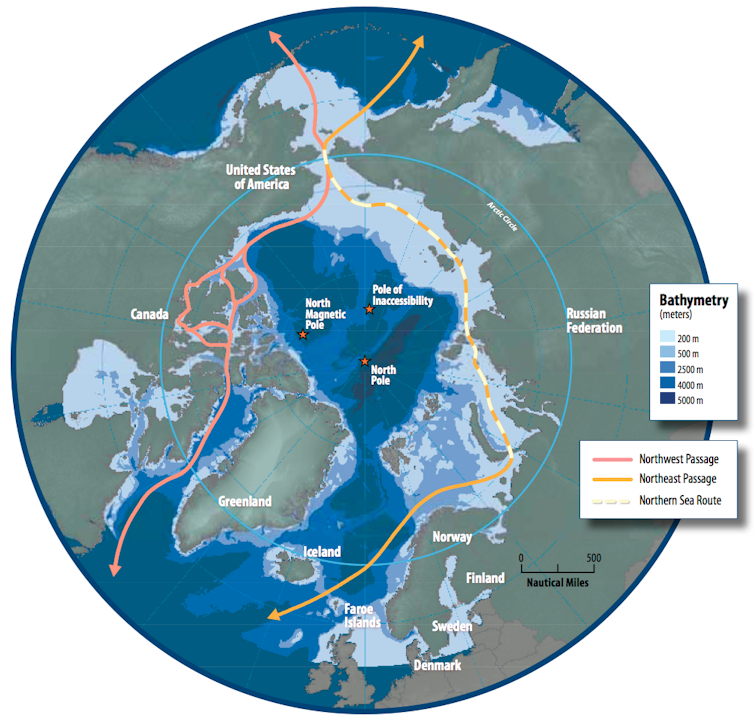
For companies, these routes – such as the Northern Sea Route along Russia’s coast and the Northwest Passage through Canada’s Arctic Archipelago – promise shorter transit times, lower fuel costs and fewer choke points than traditional passages.

However, Arctic shipping also raises complex challenges.

Declining sea ice is opening two shipping routes to greater use: the Northern Sea Route, off the Russian coast, and the Northwest Passage, along Alaska’s coast and through the Canadian islands.
Susie Harder/Arctic Council

The U.S., Russia, China and several European countries have each taken steps to establish an economic and military presence in the Arctic Ocean, often with overlapping claims and competing strategic aims. For example, Russia closed off access to much of the Barents Sea while it conducted missile tests near Norway in 2025. NATO has also been patrolling the same sea.

Geopolitical tensions compound the practical dangers in Arctic waters that are poorly charted, where emergency response capacity is limited and where extreme weather is common.

As more commercial vessels move through these waters, a serious incident – whether triggered by a political confrontation or weather – could be difficult to contain and costly for marine ecosystems and global supply chains.

A fleet of military ships at dusk with mountains in the background.
German Naval vessels sail near Harstad, Norway, during Arctic exercises on Oct. 13, 2025.
Sean Gallup/Getty Images

The Arctic Council is the region’s primary official forum for the Arctic countries to work together, but it is explicitly barred from addressing military and security issues – the very pressures now reshaping Arctic shipping.

The council went dormant for over a year starting in 2022 after Russia, then the Arctic Council president, invaded Ukraine. While meetings and projects involving the remaining countries have since resumed, the council’s influence has been undercut by unilateral moves by the Trump administration and Russia, and bilateral arrangements between countries, including Russia and China, often involving access to oil, gas and critical mineral deposits.

In this context, Arctic countries can strengthen cooperation through other channels. An important one is science.

For decades, scientists from the U.S., Europe, Russia and other countries collaborated on research related to public safety and the environment, but Russia’s invasion of Ukraine disrupted those research networks.

Going forward, countries could share more data on ice thaw, extreme weather and emergency response to help prevent accidents in a rapidly opening shipping corridor.

An image of the Arctic shows sea ice concentrations in 2025 were less than the 20-year average, and much less than the 20 years before then.
Arctic sea ice has been declining, with less multiyear ice and less coverage. The map shows the Arctic sea ice at its minimum extent in 2025, in September.
NOAA and CIRES/University of Colorado Boulder.

Critical minerals: Control over the seabed

The global transition to clean energy is driving demand for critical minerals, such as nickel, cobalt, manganese and rare earth elements, that are essential for everything from smartphones and batteries to fighter jets. Some of the world’s largest untapped deposits lie deep below the ocean’s surface, in places like the Clarion-Clipperton Zone near Hawaii in the Pacific. This has sparked interest from governments and corporations in sea floor mining.

Harvesting critical minerals from the seabed could help meet demand at a time when China controls much of the global critical mineral supply. But deep-sea ecosystems are poorly understood, and disruptions from mining would have unknown consequences for ocean health. Forty countries now support either a ban or a pause on deep sea mining until the risks are better understood.

These concerns sit alongside geopolitical tensions: Most deep-sea minerals lie in international waters, where competition over access and profits could become another front in global rivalry.

A map shows one area where companies are interested in mining.
A map of the Pacific Ocean between Mexico and Hawaii shows exploration targets for mining seafloor nodules that contain critical minerals in the Clarion-Clipperton Zone. National waters are shown in blue. The striped APEI squares are protected areas.
KA McQuaid, MJ Attrill, MR Clark, A Cobley, AG Glover, CR Smith and KL Howell, 2020, CC BY

The International Seabed Authority was created under the United Nations Convention on the Law of the Sea to manage seabed resources, but its efforts to establish binding mining rules have stalled. The U.S. never ratified the convention, and the Trump administration is now trying to fast-track its own permits to circumvent the international process and accelerate deep-sea mining in areas that are outside national jurisdictions.

Against this backdrop, a loose coalition of issue-focused groups and companies have joined national governments in calling for a pause on deep-sea mining. At the same time, some insurers have declined to insure deep-sea mining projects.

A visualization of deep-sea mining and the debris clouds created that could harm sea life.

Pressure from outside groups will not eliminate competition over seabed resources, but it can shape behavior by raising the costs of moving too quickly without carefully evaluating the risks. For example, Norway recently paused deep-sea mining licenses until 2029, while BMW, Volvo and Google have pledged not to purchase metals produced from deep-sea mines until environmental risks are better understood.

Overfishing: When competition outruns cooperation

Fishing fleets have been ranging farther and fishing longer in recent decades, leading to overfishing in many areas. For coastal communities, the result can crash fish stocks, threatening jobs in fishing and processing and degrading marine ecosystems, which makes coastal areas less attractive for tourism and recreation. When stocks decline, seafood prices also rise.

Unlike deep-sea mining or Arctic shipping, overfishing is prompting cooperation on many levels.

In 2025, a critical mass of countries ratified the High Seas Treaty, which sets out a legal framework for creating marine protected areas in international waters that could give species a chance to recover. Meanwhile, several countries have arrangements with their neighbors to manage fishing together.

For example, the European Union and U.K. are finalizing an agreement to set quotas for fleets operating in waters where fish stocks are shared. Likewise, Norway and Russia have established annual quotas for the Barents Sea to try to limit overfishing. These government-led efforts are reinforced by other forms of diplomacy that operate outside government.

Market-based initiatives like the Marine Stewardship Council certification set common sustainability standards for fishing companies to meet. Many major retailers look for that certification when making purchases. Websites like Global Fishing Watch monitor fishing activity in near real time, giving governments and advocacy groups data for action.

Collectively, these efforts make it harder for illegal fishing to hide.

How well countries are able to work together to update quotas, share data and enforce rules as warming oceans shift where fish stocks are found and demand continues to grow will determine whether overfishing can be stopped.

Looking Ahead

At a time when international cooperation is under strain, agreements between countries and pressure from companies, insurers and issue-focused groups are essential for ensuring a healthy ocean for the future.

The Conversation

The authors do not work for, consult, own shares in or receive funding from any company or organization that would benefit from this article, and have disclosed no relevant affiliations beyond their academic appointment.

ref. Global power struggles over the ocean’s finite resources call for creative diplomacy – https://theconversation.com/global-power-struggles-over-the-oceans-finite-resources-call-for-creative-diplomacy-272320