Cómo autocontrolar la presión arterial sin cometer errores

Source: The Conversation – (in Spanish) – By Victoria Mazoteras Pardo, PROFESORA TITULAR DE UNIVERSIDAD, Universidad de Castilla-La Mancha

Fernando Avendano/Shutterstock

La hipertensión es traicionera: normalmente no avisa. Solo midiéndola correctamente con regularidad podemos detectarla, hacer seguimiento y evitar que se complique dando lugar a enfermedades cardiovasculares, que son la primera causa de muerte en el mundo.

Lo malo es que, según la Organización Mundial de la Salud, una de cada tres personas adultas tiene la tensión elevada y más de la mitad lo desconoce. La evidencia muestra que hasta un 80-90 % de las dudas en el diagnóstico o el control podrían resolverse mediante mediciones realizadas por el propio paciente, siempre que se sigan criterios correctos y se utilicen dispositivos validados.

El autocontrol de la presión arterial es un reto

Medirse a uno mismo la presión arterial (AMPA, siglas de Automedición de la Presión Arterial), pese a parecer sencillo, es una tarea rodeada de errores frecuentes. Para colmo, en ocasiones usamos dispositivos de dudosa validez.

Tiene como ventaja que ofrece valores más representativos de la presión arterial real, evitando el “efecto de bata blanca”, que puede dar cifras de tensión alta en la consulta, o la “hipertensión enmascarada”, que se produce cuando las mediciones son normales en el centro sanitario pero altas en casa. Medir la tensión arterial en el entorno doméstico, habitual, predice mejor el riesgo cardiovascular.

Además, la automedición fomenta la participación activa del paciente, mejora la adherencia al tratamiento y reduce la necesidad de visitas clínicas, además de contribuir a la prevención incluso en personas sin hipertensión.

Quién puede realizar la automedición

Antes de recomendar la AMPA, los profesionales deben valorar si el paciente o su cuidador son candidatos adecuados. Deben descartarse limitaciones físicas o cognitivas que impidan el manejo del aparato, y evitarla en casos de arritmias graves, temblores intensos o un alto nivel de nerviosismo ante la toma.

Además, el paciente debe aprender el uso del dispositivo, la frecuencia de medición y las condiciones adecuadas mediante una correcta educación sanitaria. Sin una formación correcta, la automedición puede generar errores o ansiedad.

Las guías aconsejan realizarla durante siete días consecutivos, tres veces por la mañana y tres por la noche, descartando el primer día y calculando la media del resto. Para el seguimiento a largo plazo, bastaría con repetirla uno o dos días por semana.

Errores frecuentes que alteran los resultados

Los fallos más comunes se deben a factores internos (estrés, dolor, arritmias) o externos (postura incorrecta, manguito inadecuado o falta de reposo).

La medición debe hacerse en una habitación tranquila con una temperatura entre 20 y 25 ºC, tras cinco minutos de reposo, evitando comer, fumar o hacer ejercicio media hora antes. El brazo debe apoyarse a la altura del corazón, la espalda recta y los pies en el suelo. El manguito ha de colocarse directamente sobre la piel, ajustado pero sin comprimir.

Los dispositivos de muñeca solo son recomendables cuando el de brazo no puede usarse. En la primera sesión se aconseja medir ambos brazos y tomar como referencia el que muestre valores más altos.

No todos los dispositivos son iguales

Muchos dispositivos, incluidos relojes inteligentes y aplicaciones móviles, no han sido validados ni calibrados según los estándares internacionales.

Un error de pocos milímetros de mercurio puede alterar un diagnóstico. Por ello, los tensiómetros para AMPA deben ser automáticos, de brazo y con marcado CE. Su exactitud debe estar respaldada por protocolos de validación reconocidos, como el acuerdo AAMI/ESH/ISO, y figurar en las listas de dispositivos validados de iniciativas como STRIDE BP.

Las guías recomiendan revisarlos al menos una vez al año para asegurar su calibración.

La salud digital como aliada

Las nuevas tecnologías han abierto un escenario prometedor. La llamada M-Salud permite monitorizar la presión arterial mediante aplicaciones, relojes inteligentes y plataformas digitales. Se estima que la mitad de los usuarios de teléfonos recopilan información sobre su salud y uno de cada cinco utiliza una app sanitaria.

En la hipertensión, estas herramientas ayudan a reducir la presión arterial en torno a 5 mmHg, mejoran la adherencia al tratamiento y aumentan la conciencia sobre factores que influyen en la tensión, como el estrés o la actividad física. Además, facilitan la comunicación entre pacientes y profesionales y reducen costes sanitarios al evitar visitas innecesarias.

Aun así, no todas las aplicaciones son fiables. Es fundamental elegir aquellas basadas en evidencia científica y con respaldo de instituciones sanitarias.

En un mundo donde las enfermedades cardiovasculares siguen siendo la principal causa de muerte, promover el conocimiento ciudadano sobre cómo y cuándo medirse la tensión es una herramienta poderosa de prevención.

Medir bien la tensión no es un gesto trivial: es una forma de participar activamente en el propio cuidado y de reducir el impacto de la hipertensión en la población.

The Conversation

Victoria Mazoteras Pardo no recibe salario, ni ejerce labores de consultoría, ni posee acciones, ni recibe financiación de ninguna compañía u organización que pueda obtener beneficio de este artículo, y ha declarado carecer de vínculos relevantes más allá del cargo académico citado.

ref. Cómo autocontrolar la presión arterial sin cometer errores – https://theconversation.com/como-autocontrolar-la-presion-arterial-sin-cometer-errores-267148

Seven albums to listen to during a breakup – from Lily Allen to Marvin Gaye

Source: The Conversation – UK – By Charlotte Curran, PhD researcher, applied ethics and moral philosophy, University of Leeds

Lily Allen’s bombshell new album, West-End Girl, has caused a sensation for its depiction of a marriage torn apart. Though the singer has described it as a blend of fact and fiction, fans have taken it to be an account of her breakup with Stranger Things actor David Harbour.

West-End Girl is a vulnerable account of divorce, with accusations of infidelity and betrayal. The album feels confessional, with lyrical details such as the retelling of personal phone calls and private messages. This is likely why it has received such admiration – it gives space for the listener to relate it to their own breakups.

Heartbreak has inspired countless artists to channel their emotions into their creative outlets. Here are six that stand out.


Dating today can feel like a mix of endless swipes, red flags and shifting expectations. From decoding mixed signals to balancing independence with intimacy, relationships in your 20s and 30s come with unique challenges. Love IRL is the latest series from Quarter Life that explores it all.

These research-backed articles break down the complexities of modern love to help you build meaningful connections, no matter your relationship status.


Rumours by Fleetwood Mac (1977)

Rumours is perhaps the most famous breakup album, not least because the breakups were occurring within the band itself. At the time of recording, drummer Mick Fleetwood had discovered his wife’s affair and bass player John McVie and singer/keyboardist Christine McVie were going through a divorce after eight years of marriage.

Silver Springs by Fleetwood Mac.

Most notably, the songs Dreams, Go Your Own Way, and the B-side Silver Springs detail the relationship breakdown between front-woman Stevie Nicks and guitarist Lindsey Buckingham. All these personal tensions created one of the bestselling albums of all time.

Rumours is a great listen for anyone going through a breakup and wanting to feel hopeful for the future.

Best lyric (Dreams):

But listen carefully to the sound of your loneliness / Like a heartbeat drives you mad in the stillness of remembering what you had and what you lost.

21 by Adele (2011)

Adele’s second studio album, 21, is a heart-wrenching tale of a painful breakup. It so resonated with listeners that it became the longest-running number one album by a female solo artist in the US and UK charts.

Someone Like You by Adele.

The album explores the juxtaposed emotions of anger and sadness that come with the ending of a significant relationship, particularly a first love. It concludes with the cathartic ballad Someone Like You, which presents Adele coming to terms with her ex finding new love and having the optimism to move on too. It’s the perfect breakup album for listeners who want to let their feelings out and bring all of their emotions to the surface.

Best lyric (Rolling in the Deep):

The scars of your love remind me of us / They keep me thinking that we almost had it all.

Here, My Dear by Marvin Gaye (1978)

Described by critics as an “ode to divorce”, Here, My Dear was created as part of Gaye’s alimony and child support negotiations during his divorce from his wife, Anna.

Here, My Dear by Marvin Gaye.

Gaye had intended for this album to be simple and quick, but it turned into his first double-album once he had found passion in writing about his relationship and its end. Here, My Dear is painful and at times petty, dedicating the album to Anna in the first line of the title track and ending with the song Falling In Love Again, to celebrate falling in love with someone new. The album is a great listen for those who are still trying to find closure.

Best lyric (When Did You Stop Loving Me, When Did I Stop Loving You):

Memories of the things we did / Some we’re proud of / Some we hid / So when two people have to part – sometimes it makes them stronger.

Back To Black by Amy Winehouse (2006)

The songs featured on Back to Black detail Winehouse’s tumultuous relationship with long-term partner Blake Fielder-Civil and explore themes of grief and forgiveness.

Back to Black is a complicated reflection on breakups. Its lyrics describe turning to unhealthy coping mechanisms and returning to old flames. The ballad Love is a Losing Game details the loneliness that comes from losing love, paired with the acceptance that a relationship is truly over.

Love is a Losing Game by Amy Winehouse.

This album gives a refreshingly human portrayal of breakups and has been praised as one of the most influential albums of the 21st century. Back to Black is a great choice for anyone not wanting to feel alone in their emotions after a breakup.

Best lyric (Wake Up Alone):

He’s fierce in my dreams seizes my guts / He floods me with dread / Soaked in soul / He swims in my eyes by the bed / Pour myself over him / Moon spilling in / And I wake up alone.

IGOR by Tyler, the Creator (2019)

Many of Tyler, the Creator’s songs point to themes of unrequited love, but it underpins the entirety of his album IGOR. Lyrics throughout imply hurt and lost love in different kinds of relationships, not just romantic.

ARE WE STILL FRIENDS by Tyler, the Creator.

The song ARE WE STILL FRIENDS? points to not wanting to lose a friend, potentially after expressing loving feelings for them. IGOR perfectly captures the pain of confusing breakups, where there are still things left unsaid and questions that need answers. IGOR is a top choice for anyone going through a complicated relationship ending, perhaps with a close friend or family member.

Best lyric (GONE GONE/THANK YOU):

You never lived in your truth / I’m just happy I lived in it / But I finally found peace, so peace.

For Emma, Forever Ago by Bon Iver (2007)

For Emma, Forever Ago was the first album Justin Vernon released under his moniker Bon Iver. It’s a beautifully melancholy take on loss and heartbreak. The album was composed after Vernon had experienced a difficult year, which included a relationship breakup and being asked to leave his previous band.

Blindsided by Bon Iver.

The songs on Emma, Forever ago are emotionally haunting, and its candid storytelling makes listeners feel that they are mourning a loss alongside Vernon. The lyrical transparency on tracks such as Blindsided expresses the sorrow of having a long-term relationship fall apart and the pain of wondering what went wrong.

This album is for anyone wanting to process the grief and sadness of losing someone they wanted to spend forever with.

Best lyric (The Wolves Act I & II):

And the story’s all over you / In the morning, I’ll call you / Can’t you find a clue / When your eyes are all painted Sinatra blue?

What’s your favourite breakup album? Let us know in the comments below.

The Conversation

Charlotte Curran does not work for, consult, own shares in or receive funding from any company or organisation that would benefit from this article, and has disclosed no relevant affiliations beyond their academic appointment.

ref. Seven albums to listen to during a breakup – from Lily Allen to Marvin Gaye – https://theconversation.com/seven-albums-to-listen-to-during-a-breakup-from-lily-allen-to-marvin-gaye-268801

Involving women in peace deals reduces chance of a conflict restarting by up to 37%

Source: The Conversation – UK – By Giuditta Fontana, Associate Professor in International Security, University of Birmingham

Twenty-five years ago, on October 31, 2000, the United Nations unanimously adopted its landmark security council resolution 1325 (WPS 1325). The resolution on women, peace and security reaffirmed “the important role of women in the prevention and resolution of conflicts, peace negotiations, peace-building, peacekeeping, humanitarian response and in post-conflict reconstruction”. It also stressed the “importance of their equal participation and full involvement in all efforts for the maintenance and promotion of peace and security”.

The significance of women to building sustainable peace is undeniable. Our research, supported by the United States Institute of Peace, has found that on average the incorporation of measures to include women in post-conflict society in a peace agreement reduces the probability of conflict recurrence by 11%. Even more significantly, if this process occurs alongside UN leadership, the probability of conflict recurrence is reduced by 37%.

So the anniversary of WPS 1325 should be a reason to celebrate. Instead, the UN secretary general, António Guterres, opened his report to the security council’s annual debate on women, peace and security on October 6 with a warning. Guterres said the UN too often “falls short when it comes to real change in the lives of women and girls caught in conflict”. He specifically noted the lack of inclusion of women in peace negotiations, the failure to protect women and girls from sexual violence, and the underfunding of women peacebuilders.

Over the past 25 years, the security council has adopted almost 1,000 resolutions related to WPS 1325. In 2015, resolution 2242 aimed for the more systematic integration of the women, peace and security agenda into “all country-specific situations on the security council’s agenda”. To facilitate this, the UN security council set up an informal group of experts.

There is no doubt that the women, peace and security agenda has had a positive impact. Guterres noted that “gender provisions in peace agreements have become more common, and women’s organisations have helped transform post-conflict recovery and reconciliation in communities worldwide”. He declared that “women-led civil society and women peace builders … are the drivers behind holistic and sustainable peace.”

Yet according to a UN Women survey in early 2025, global cuts to foreign aid budgets make it harder for women to make these vital contributions to peace and security.

The situation is similarly challenging for UN peacekeeping. The cumulative budget shortfall in mid-2025 stood at almost US$2.7 billion (£2.04 billion), with the US, China and Russia the three largest debtors. Despite a significant decrease over the past decade in the peacekeeping budget from US$8.4 billion in 2014-15 to US$5.2 billion in 2024-25, the share of unpaid contributions has more than tripled from 13% to 41% over the same period.

If these two trends persist, the prospects for sustainable conflict resolution will dramatically diminish.

Women as peacebuilders

Aiming to explore how to prevent civil wars from recurring, we analysed 14 protracted peace processes in recurrent civil wars. This analysis revealed that the UN, working with local women’s organisations, was able to create and sustain multi-level coalitions committed to concluding, maintaining and implementing peace accords.

We then tested these findings statistically against 286 agreements concluded in violent conflicts worldwide. This confirmed that – together – UN leadership and the inclusion of women in post-conflict society significantly increase the odds of a peace agreement surviving for more than five years.

Finally, we conducted in-depth case studies of peace processes in the Bangsamoro region in the island of Mindanao in the Philippines, as well as in Burundi, Côte d’Ivoire, Liberia and Sierra Leone. This enabled us to establish how the UN and women-led organisations are able to help prevent civil wars from recurring.

What we found was that women’s participation was able to make the needs and experiences of previously marginalised groups visible and address them in peace agreements. For example, Unifem, the UN development fund for women, sponsored an all-party women’s conference at the margins of the Arusha peace negotiations in Burundi in 2000. This ensured that the subsequent peace agreement contained extensive provisions to enhance the socioeconomic inclusion of women in post-conflict society.

When the UN and women-led organisations work together, people who might have been left out of the peace process can be involved in its implementation. Liberia’s peace huts (supported by UN Women) are a visible example of how women can contribute to sustaining peace. Adapted from the traditional Liberian palava hut system, peace huts provide spaces for dialogue, mediation of disputes and the sharing of information.

Cooperation between the UN and women-led organisations can also help provide early warning and action in response to local tensions. This can prevent them from escalating into renewed violent conflict. This dynamic was evident in the key roles played by women-led civil society organisations (often supported by the UN) in creating mechanisms for dialogue before, during and after agreements were signed across all the peace processes we examined.

Our research findings thus offer empirical support for many of the aspirations of the UN’s women, peace and security agenda. But they also show the risks of inaction and, worse, rolling back the fragile progress that has been made in the decades since this vision was formally adopted.

The UN comes in for a lot of criticism. But our findings suggest that it’s probably the only organisation able to leverage the diplomatic, financial and military resources to assist the conclusion and sustainable implementation of peace accords.

Our key finding is that civil wars can be prevented from recurring. But this won’t happen if the very people that can build and nurture sustainable peace are disempowered. World leaders queued up at the annual UN general assembly debate in September to stress their commitment to peace and conflict resolution. But to demonstrate this commitment they need to enable the UN to exercise decisive leadership in peace processes through unwavering diplomatic and financial support. And they need to invest in the local women’s organisations that can facilitate sustainable and legitimate peace on the ground.

The Conversation

Giuditta Fontana is a past recipient of grant funding from the Leverhulme Trust, the Northern Ireland Department for the Economy, the UK Global Challenges Research Fund, the United States Institute of Peace, and British Academy. She is co-convenor of the Political Studies Association Specialist Group on Ethnopolitics and University of Birmingham Representative for the European Consortium of Political Research.

Argyro Kartsonaki has received funding from the German Federal Foreign Office and the Organization for Security and Co-operation in Europe (OSCE). She is past recipient of grants from the United States Institute of Peace and from the Economic and Social Research Council (UK). She is a part of the Centre for OSCE Research at IFSH, co-editor of OSCE Insights, and consults the OSCE as a member of the OSCE Expert Network.

Natascha Neudorfer, or the projects she worked on, have received funding from the ESRC (UK), USIP (US), the Bavarian State (Germany), the Daimler and Benz Foundation (Germany), and the European Union’s Fifth Framework Programme.

Stefan Wolff is a past recipient of grant funding from the Natural Environment Research Council of the UK, the United States Institute of Peace, the Economic and Social Research Council of the UK, the British Academy, the NATO Science for Peace Programme, the EU Framework Programmes 6 and 7 and Horizon 2020, as well as the EU’s Jean Monnet Programme. He is a Trustee and Honorary Treasurer of the Political Studies Association of the UK and a Senior Research Fellow at the Foreign Policy Centre in London.

ref. Involving women in peace deals reduces chance of a conflict restarting by up to 37% – https://theconversation.com/involving-women-in-peace-deals-reduces-chance-of-a-conflict-restarting-by-up-to-37-268325

Why do some of us love AI, while others hate it? The answer is in how our brains perceive risk and trust

Source: The Conversation – UK – By Paul Jones, Associate Dean for Education and Student Experience at Aston Business School, Aston University

Kundra

From ChatGPT crafting emails, to AI systems recommending TV shows and even helping diagnose disease, the presence of machine intelligence in everyday life is no longer science fiction.

And yet, for all the promises of speed, accuracy and optimisation, there’s a lingering discomfort. Some people love using AI tools. Others feel anxious, suspicious, even betrayed by them. Why?

The answer isn’t just about how AI works. It’s about how we work. We don’t understand it, so we don’t trust it. Human beings are more likely to trust systems they understand. Traditional tools feel familiar: you turn a key, and a car starts. You press a button, and a lift arrives.

But many AI systems operate as black boxes: you type something in, and a decision appears. The logic in between is hidden. Psychologically, this is unnerving. We like to see cause and effect, and we like being able to interrogate decisions. When we can’t, we feel disempowered.

This is one reason for what’s called algorithm aversion. This is a term popularised by the marketing researcher Berkeley Dietvorst and colleagues, whose research showed that people often prefer flawed human judgement over algorithmic decision making, particularly after witnessing even a single algorithmic error.

We know, rationally, that AI systems don’t have emotions or agendas. But that doesn’t stop us from projecting them on to AI systems. When ChatGPT responds “too politely”, some users find it eerie. When a recommendation engine gets a little too accurate, it feels intrusive. We begin to suspect manipulation, even though the system has no self.

This is a form of anthropomorphism – that is, attributing humanlike intentions to nonhuman systems. Professors of communication Clifford Nass and Byron Reeves, along with others have demonstrated that we respond socially to machines, even knowing they’re not human.

We hate when AI gets it wrong

One curious finding from behavioural science is that we are often more forgiving of human error than machine error. When a human makes a mistake, we understand it. We might even empathise. But when an algorithm makes a mistake, especially if it was pitched as objective or data-driven, we feel betrayed.

This links to research on expectation violation, when our assumptions about how something “should” behave are disrupted. It causes discomfort and loss of trust. We trust machines to be logical and impartial. So when they fail, such as misclassifying an image, delivering biased outputs or recommending something wildly inappropriate, our reaction is sharper. We expected more.

The irony? Humans make flawed decisions all the time. But at least we can ask them “why?”

Students increasingly turn to AI chatbots to help them draft essays.
Teaching is among the professions where AI is replacing parts of their work.
BongkarnGraphic / Shutterstock

For some, AI isn’t just unfamiliar, it’s existentially unsettling. Teachers, writers, lawyers and designers are suddenly confronting tools that replicate parts of their work. This isn’t just about automation, it’s about what makes our skills valuable, and what it means to be human.

This can activate a form of identity threat, a concept explored by social psychologist Claude Steele and others. It describes the fear that one’s expertise or uniqueness is being diminished. The result? Resistance, defensiveness or outright dismissal of the technology. Distrust, in this case, is not a bug – it’s a psychological defence mechanism.

Craving emotional cues

Human trust is built on more than logic. We read tone, facial expressions, hesitation and eye contact. AI has none of these. It might be fluent, even charming. But it doesn’t reassure us the way another person can.

This is similar to the discomfort of the uncanny valley, a term coined by Japanese roboticist Masahiro Mori to describe the eerie feeling when something is almost human, but not quite. It looks or sounds right, but something feels off. That emotional absence can be interpreted as coldness, or even deceit.

In a world full of deepfakes and algorithmic decisions, that missing emotional resonance becomes a problem. Not because the AI is doing anything wrong, but because we don’t know how to feel about it.

It’s important to say: not all suspicion of AI is irrational. Algorithms have been shown to reflect and reinforce bias, especially in areas like recruitment, policing and credit scoring. If you’ve been harmed or disadvantaged by data systems before, you’re not being paranoid, you’re being cautious.

This links to a broader psychological idea: learned distrust. When institutions or systems repeatedly fail certain groups, scepticism becomes not only reasonable, but protective.

Telling people to “trust the system” rarely works. Trust must be earned. That means designing AI tools that are transparent, interrogable and accountable. It means giving users agency, not just convenience. Psychologically, we trust what we understand, what we can question and what treats us with respect.

If we want AI to be accepted, it needs to feel less like a black box, and more like a conversation we’re invited to join.

The Conversation

Paul Jones does not work for, consult, own shares in or receive funding from any company or organisation that would benefit from this article, and has disclosed no relevant affiliations beyond their academic appointment.

ref. Why do some of us love AI, while others hate it? The answer is in how our brains perceive risk and trust – https://theconversation.com/why-do-some-of-us-love-ai-while-others-hate-it-the-answer-is-in-how-our-brains-perceive-risk-and-trust-268588

Design and technology’s practical and creative skills should see it revived in the school curriculum

Source: The Conversation – UK – By Matt McLain, Senior Lecturer in Education and Professional Learning, Liverpool John Moores University

AnnaStills/Shutterstock

Studying design and technology (D&T) at school gives children the opportunity to get up from behind a desk and learn practical skills. It’s the only subject in the national curriculum in which children can develop and create tangible solutions to real problems.

They can get an insight into whether they might enjoy careers in design, fashion, engineering, technology or food. And they can learn skills that will be useful to them at home, in the workplace and in society.

D&T could play a crucial role in the government’s aim to revitalise the national curriculum in England, enrich children’s learning, and prepare young people for vocational education and training. The practical and hands-on approach children learn through D&T in primary and secondary schools can raise their awareness of vocational options and prepare them for technical and vocational education after their GCSEs, whether or not they chose an overtly D&T-related career pathway.

Once a thriving part of the national curriculum, D&T has suffered years of decline. The ongoing review of the national curriculum in England provides the ideal opportunity for national education policy to revive the value of practical and creative learning for its pupils.

D&T was a compulsory GCSE until 2004. It has since plummeted in popularity. The number of GCSE entries has shrunk in England from over 400,000 entries in 2004 to 137,016 in 2025. School funding has also decreased in real terms, affecting relatively expensive subjects such as D&T.

Graph of D&T GCSE entries
GCSE Design and Technology entries from 1996 to 2024.
Matt McLain, CC BY-NC-SA

The introduction of the English Baccalaureate (EBacc), which compares schools based on how many students take certain GCSEs, has added to this issue. The EBacc is weighted towards traditionally academic subjects: English, maths, the sciences, geography or history and a language. It incentivises schools to encourage students towards these subjects.

The knock-on effect of this has been the drastic reduction of curriculum time and budgets for more practical and creative subjects, such as D&T, in many secondary schools. This prioritisation of certain subjects over others may also affect how young people think about learning skills that prepare them for work in the creative and manufacturing industries.

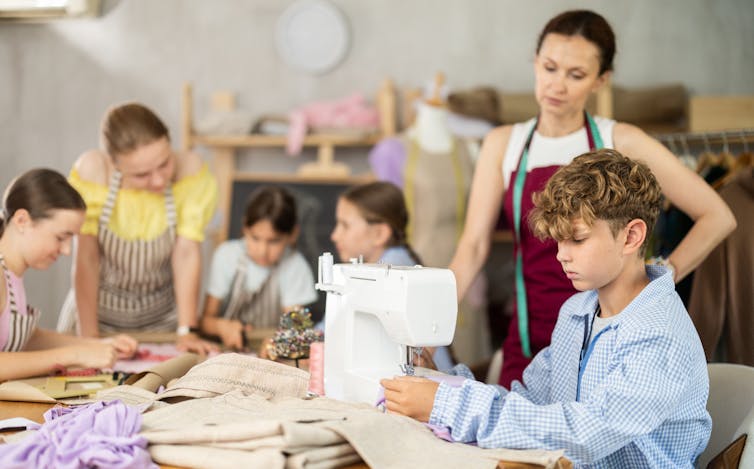
Boy using sewing machine in class
Design and technology teaches young people practical skills.
BearFotos/Shutterstock

There also aren’t enough D&T teachers. Government census data for England shows that in 2024-25, just 618 D&T trainees were recruited – 39% of the target number. It was an even lower number the year before.

Bursaries for new teachers are also lower for D&T than for subjects such as chemistry, computing, mathematics and physics. This means graduates in Stem subjects – science, technology, engineering and maths – who would be good candidates to teach D&T may opt for science or maths instead. In 2018, the Department for Education excluded D&T from a list of what it considered Stem subjects.

Yet in a world facing rapid technological change, climate challenges and skills shortages, practical and creative subjects such as D&T are more vital than ever. England faces a critical skills gap in design, engineering and manufacturing. These are industries essential for growth.

The World Economic Forum’s 2025 Future of Jobs report outlines the core skills prioritised by employers. Many of these are promoted by D&T: they include creative thinking, technological literacy, quality control, and design and user experience.

Design and technology is not a nostalgic throwback or a soft alternative to academic rigour. It is a challenging and vital part of preparing young people for the future. As England faces economic, environmental and social challenges, we need a curriculum that equips students to think creatively, solve real-world problems and engage with technology meaningfully.

The final report of England’s review of school curriculum and assessment, due for publication this autumn, presents an opportunity for a renaissance in practical and creative learning, as well as a revaluing of experience alongside knowledge.

The Conversation

Matt McLain received funding from the Department for Education to draft the current subject content for GCSE and A Level design and technology. He is also a trustee for the Design and Technology Association, who support the teaching of the subject in schools.

ref. Design and technology’s practical and creative skills should see it revived in the school curriculum – https://theconversation.com/design-and-technologys-practical-and-creative-skills-should-see-it-revived-in-the-school-curriculum-266123

The planet wants you to eat more offal – here’s how to increase consumption

Source: The Conversation – UK – By Tennessee Randall, PhD Candidate in Social Psychology, Swansea University

Many people in the UK are not keen to eat offal, but there’s an environmental movement that suggests eating the whole animal has benefits. Scout901/Shutterstock

Meat has a large environmental impact, but could consuming more of it be part of the answer?

Meat-eaters in western countries today typically focus on the muscle tissue of animals and often avoid consuming offal (internal organs like the heart, liver and kidney). But eating more offal could lower the number of animals that are killed for food and so the greenhouse gases produced by the meat industry.

Offal also has potential health benefits. It’s packed with protein, vitamins, minerals and essential fatty acids and often contains more nutrients than the meat that we would usually eat. For example, 100 grams of liver provides around 36% of your recommended daily iron but eating the same amount of minced meat would provide around 12%.

Offal was once a popular food choice in the UK during the second world war. In Japan, eating offal is motivated by cultural values such as mottainai, which describes a sense of regret around being wasteful. Similarly, “nose-to-tail” eating is becoming more popular in the UK, which is also based on principles around reducing food waste and respecting the animal’s sacrifice.

The nose-to-tail cooking movement is taking off.

Despite the potential health and environmental benefits, getting consumers to accept offal is more difficult than one might expect. Typically, people who haven’t tried offal are disgusted by the thought of eating it and often consider it to be contaminated. Others are put off because they just don’t know how to make a tasty meal that their children will also eat.

One way to overcome this is to use offal in a familiar meal with other ingredients. I explored this with other researchers in a recent study of 390 UK meat eaters. Specifically, we looked at their opinions of offal in its natural form and compared it to when offal (liver and kidney) was included as an ingredient within minced meat (for instance, “offal-enriched” mince).

We found the offal-enriched mince was considered more acceptable and was expected to be tastier, more satisfying, intriguing and easier to prepare than livers and kidneys. Although, livers and kidneys were expected to be more natural, have less fat and better for the environment than offal-enriched mince.

Men v women

When we compared these ratings across men and women, it was clear that men felt more positive about eating “pure” offal than women. Whereas men and women expressed similar opinions about eating offal within minced meat.

We also compared opinions across six different types of offal-enriched meals, which included a burger, curry, spaghetti bolognese, meatballs, shepherd’s pie and a stir fry. The spaghetti bolognese was a clear favourite for its expected taste, but people were equally curious to try the stir fry, which they also believed would be healthier and more natural than the other meals.

Consumers also answered questions on their personality type and motives for choosing food, which meant we could flesh out the psychology behind why some people are more open to trying offal-enriched meals than others.

On the plus side, it turns out that people who prioritise their health when choosing food think offal-enriched meals would be tastier and more intriguing. However, people who are fearful of eating new foods think the opposite. In psychology, this is known as “food neophobia” and has been linked with less healthier food choices in some populations. In our sample, women had higher food neophobia than men.

Tackling the stigma

There may also be some stigma around eating offal, as we found that people who were more likely to control how they were viewed by others formed more negative opinions of offal-enriched meals. This type of social interaction is known as “impression management” and has been shown to influence food choices.

Much of the offal produced in the UK is exported because the consumer demand is low. This means that offal is much cheaper than other meat cuts, such as a steak or a lamb’s leg. However, this could fuel misperceptions about the meat being a lower quality, or that it is chosen by those who cannot afford the expensive cuts.

In reality, eating more of the animal could support a healthy diet and could be a more achievable recommendation for sustainable eating, especially for the men who love their meat.


Don’t have time to read about climate change as much as you’d like?

Get a weekly roundup in your inbox instead. Every Wednesday, The Conversation’s environment editor writes Imagine, a short email that goes a little deeper into just one climate issue. Join the 45,000+ readers who’ve subscribed so far.


The Conversation

Tennessee Randall receives funding from the Economic Social Research Council Wales Doctoral Training Partnership.

ref. The planet wants you to eat more offal – here’s how to increase consumption – https://theconversation.com/the-planet-wants-you-to-eat-more-offal-heres-how-to-increase-consumption-267051

How 18th-century politician Charles Fox mastered personality politics long before Trump and Farage

Source: The Conversation – UK – By Callum Smith, Historian of Modern British History & Head of Online Learning, Aberystwyth University

It’s hard to think about politics today without immediately picturing the face of a party’s leader, charismatic or otherwise. Whether delivering a rousing conference speech, squirming through a TV interview, or being caught by a “hot mic”, figures like Nigel Farage, Jeremy Corbyn, Donald Trump and Boris Johnson have dominated the political landscape in recent years.

We often talk about them more than the parties they represent. In many ways, the party has become a faction of its leader. But is this rise in personality politics really anything new? History – particularly 18th-century history – suggests otherwise.

Nobody embodied this form of politics better than Charles James Fox, as my latest book explores. Fox was as famous for his charisma and scandals as he was for his statesmanship. Though an aristocrat, he was known as the “man of the people”, with a loyal following within and outside of parliament.

Fox might technically have belonged to the Whig party, over its rival the Tory party. But such distinctions in his day were almost useless. Politics in Fox’s era was factional and centred around personality as much as politics.

So strong was the draw and bond of the Foxites’ leader, that when Fox died in 1806, his movement collapsed, and his followers scattered. A testament to the fragility of leader-based politics.

Rather than voting or speaking in terms of party we often talk of “Faragists”, “Corbynistas” or “Trumpites”. Just as with the Foxites, these terms can not only describe the popular following, but also the political group itself. These factions are often not united by a shared or defined political philosophy, but more by allegiance to their chosen leader.

Which raises the question, have we returned to the Foxite era of factionalism and the cult of personality? Modern case studies indicate that this trend is not just a phenomenon of the right or left, but a theme across the political spectrum. And it’s evident on both sides of the Atlantic.

From Fox to Farage and Corbyn

Take Nigel Farage. He led Ukip into mainstream notoriety in the early 2010s, but the party fractured as its leader grew. It was always more about brand Farage than brand Ukip.

In quick succession the party morphed into the Brexit party, and now Reform UK. Just as Fox did during the election of 1784, Farage positioned himself as the “man of the people”, never far from his trademark pint of ale, an enduring symbol of working-classness. He spoke not as the leader of a political machine, but as an individual apparently freed from the constraints of conventional internal party structures.

Former Labour leader Jeremy Corbyn essentially mirrored this approach. Momentum – created to mobilise his supporters – took on a life of its own. It expanded into Corbyn’s primary political and organisational body, faction in all but name. Rather than riding to victory under Corbyn’s popular appeal, the Labour party struggled with internal conflict, overshadowed by its leader.

Personality politics persists on the left, with the recent election of outspoken Zack Polanski beginning to dominate Green party output. The party’s traditional milder-mannered eco focus is transforming under Polanksi’s banner to become an insurgent electoral force and a threat to Labour. Are we seeing the genesis of the Polanski faction?

None of the aforementioned politicians – Fox included – ever reached the highest political office. But personality politics did catapult Boris Johnson to Number 10 and Donald Trump to the Oval Office. Both show how leader-led movements can insulate a figure from traditional political and media accountability.

Johnson’s carefully crafted popular appeal endured a number of scandals. It took a global pandemic, and public outcry at lockdown partying, to finally oust the then prime minister.


Read more:
The Conservatives always adapt to survive – or do they?


Much like the Foxites in 1806, the Tory party fractured in Johnson’s wake. Not only as a result of scandal, but because their previous electoral success was build on the bedrock of Johnson’s popularity.

Far from being a British phenomenon, Trump’s two terms in office are the very epitome of personality politics. You would be forgiven for forgetting that the president has any relationship with the Republican party. Maga has fast become the faction of Trump. As with Fox, the man eclipsed the institution.

An oil painting depicting Charles Fox in a suit and top hat holding a piece of paper.
Portrait of Charles Fox by Karl Anton Hickel from 1794.
Anton Hickel/National Portrait Gallery

The charisma trap

This form of politics was and is only possible because of the media attention awarded to individual leaders at the expense of party. In the 18th century, Fox was satirised and simultaneously promoted to the public. He could attract a cult following, because the media inflated his cult status.

Although forms of media have evolved from caricatures and broadside, television, tabloids and social media continue to favour individual charisma and controversy over collectivism and party unity.

But, as my book argues, as the importance of the factional leader grows, so too do the risks of sudden and dramatic downfall. History suggests that we are destined to repeat and follow the patterns of Fox’s era. But it also suggests that such factions rarely outlast their leaders. Which raises the question, what comes next?

The Conversation

Callum Smith has previously received research funding from the AHRC, a branch of UKRI, more specifically from the South, West and Wales DTP.

ref. How 18th-century politician Charles Fox mastered personality politics long before Trump and Farage – https://theconversation.com/how-18th-century-politician-charles-fox-mastered-personality-politics-long-before-trump-and-farage-267480

How narcissism ruins teamwork – and why it matters in the workplace

Source: The Conversation – UK – By Claire Hart, Associate Professor of Psychology, University of Southampton

BearFotos/Shutterstock

Teamwork can bring out both the best and the worst in people. Working together means sharing ideas and coordinating actions. But sometimes, it can also involve swallowing pride, particularly when people with strong personalities, such as those with narcissism, take charge.

In our new study, we explored how grandiose narcissism – the inflated belief that you’re brighter, bolder and more capable than everyone else – affects cooperation in a team.

Instead of running surveys in a lab, we took narcissism into the wild: with more than 100 people locked in commercial escape rooms, racing the clock to solve puzzles together.

Personality psychologists distinguish between two sides of grandiose narcissism. Narcissistic admiration is the charming, confident, magnetic side that wins people over. Narcissistic rivalry, by contrast, is the defensive, combative side – quick to take offence when its status feels threatened.

Both protect a grandiose self-image, but in different ways: admiration draws people in, rivalry pushes them away. We wanted to see which side helps or harms teamwork when the pressure’s on.

The escape-room experiment

Participants were split into small teams of four or five, most meeting for the first time. After a quick ice-breaker, they entered a jungle-themed escape room with 60 minutes to find clues and escape. Success depended on communication, trust and problem-solving: exactly what makes real-world teams thrive.

Before and after the escape-room challenge, players rated themselves and one another on traits like likeability, empathy and confidence. This let us see how first impressions held up when the pressure kicked in.

We also measured the two sides of narcissism – admiration (charm, confidence, leadership) and rivalry (defensiveness, competitiveness). Finally, we tracked how well the teams gelled together, how much conflict emerged and how successful they were – not just how successful they felt, but how many rooms they actually escaped.

This was what’s called a round-robin design: every team member rated both themselves and each of their teammates. This let us capture not just how narcissistic people see themselves, but how they’re actually seen by others – giving a rare glimpse into real-time reputation and perception within teams.

Rivalry wrecks performance

The findings were striking. Teams high in narcissistic rivalry performed worse than others, making around one-third less progress in the escape challenge. They solved fewer puzzles, reported less unity and generally found the experience more frustrating.

Why? Rivalry undermined team cohesion: the sense of unity that keeps people working towards a shared goal. Under pressure, rivalrous people tended to withdraw, dismiss others’ suggestions or hold back information. They didn’t always start arguments, but their defensiveness quietly slowed the group down.

The takeaway is simple: ego doesn’t just make teammates annoying, it breaks the collective bond that gets the job done.

The admiration side of narcissism told a more seductive story. Those high in admiration looked confident, likeable and ready to lead. Early on, they seemed to boost morale. But by the end of the task, teammates saw them as more arrogant and less empathic.

In other words, the charisma that first impressed others soon wore thin once teamwork required genuine give and take. It’s the office classic: the confident self-promoter who dazzles in the meeting, but frustrates everyone by the project’s end.

Modern workplaces run on collaboration: hybrid meetings, agile teams, constant “visibility”. Yet confidence and self-promotion are still too often mistaken for competence.

Our research shows that the wrong kind of confidence can quietly undermine trust, creativity and performance. As organisations rethink leadership and teamwork in the wake of the pandemic and remote work, it’s worth asking: are we rewarding charisma over collaboration? Are our “team players” actually playing for themselves?

Narcissistic business manager pointing to herself.
People get bored with narcissists in the end.
Nicoleta Ionescu/Shutterstock

The fix isn’t to sideline confident people. But it’s to value good listeners as much as good talkers. Leaders who prize only assertiveness risk breeding rivalry instead of cooperation.

Building psychologically safe teams, where members can speak up without fear of ridicule, helps counteract the corrosive effects of ego.

Even team-building games reveal this dynamic. Escape rooms, often sold as fun bonding exercises, also expose who dominates, who supports and who quietly gives up when they’re not centre stage. Those moments tell you far more about teamwork than any personality test.

The escape-room setting gave us a rare window into narcissism in motion. Participants couldn’t hide behind screens or polish their image: every decision, glance and interruption played out in real time.

What we saw was clear: rivalry isolates, admiration impresses but fades.
The most successful teams weren’t the loudest, but the ones that stayed cohesive, communicative and generous – even when the clock was ticking.

The Conversation

The authors do not work for, consult, own shares in or receive funding from any company or organisation that would benefit from this article, and have disclosed no relevant affiliations beyond their academic appointment.

ref. How narcissism ruins teamwork – and why it matters in the workplace – https://theconversation.com/how-narcissism-ruins-teamwork-and-why-it-matters-in-the-workplace-268460

Bonfire Night: why it’s never a good idea to mess around with fireworks

Source: The Conversation – UK – By Adam Taylor, Professor of Anatomy, Lancaster University

Sparklers can also be harmful. CandyRetriever/ Shutterstock

Around 2,000 people visit A&E every year due to injuries caused by fireworks. Although fireworks are an essential part of Bonfire Night celebrations for many revellers, these colourful pyrotechnics can be as dangerous as they are spectacular. And the injuries you might sustain from them can range from minor to downright gruesome if you aren’t careful.

The most common injuries caused by fireworks are, of course, burns. These account for approximately two-thirds of injuries caused by fireworks – typically due to people holding onto a firework when lighting them or when they explode. This is also why approximately 40% of fireworks-related injuries occur in the hands or wrist.

But the force generated in these blasts won’t just burn you. They’re also powerful enough to deglove fingers or hands, which, as the name suggests, is where the skin is removed like a glove.

These blasts can also snap or separate bones – either from each other or from the hand completely. While the skin and bones of the fingers can sometimes be reattached and regain function, this isn’t always the case.

Standing too close to fireworks, treading on smouldering debris or being impaled by a firework that has been launched at spectators are also all risks for injury. Alongside burns, fractures and breaks, there have been cases where the shards of metal that give fireworks their colour have become lodged in the skin and underlying tissue of the feet. Sadly, in one instance, a man had to have his leg amputated after he tripped over a firework mortar and it hit his leg.

Typically, the most common head injuries are those affecting the ears – such as ringing in the ears and perforated ear drums. These injuries happen when fireworks go off in close proximity to the head. Eye injuries are also not uncommon. In fact, one charity reports that ten people in the UK are blinded each year due to fireworks-related accidents – with another 300 suffering eye injuries.

More significant, traumatic injuries to the eye, eye socket and skull itself have been reported. This includes burns, eyeball rupture, damage to soft tissues and blood vessel damage in the skull and throat, which can affect breathing.

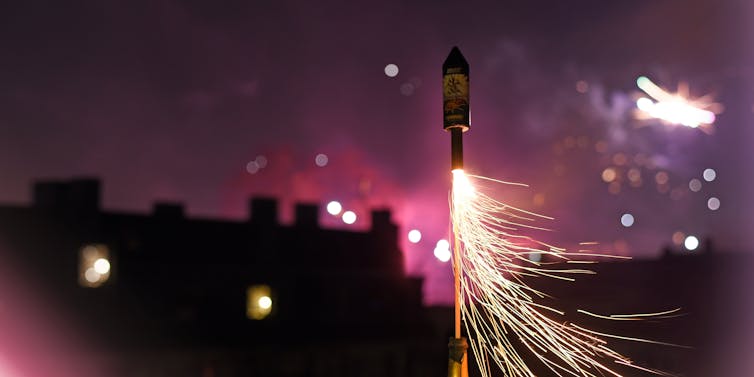
A lit firework is being launched into the sky.
Fireworks can cause all sorts of injury if proper precautions aren’t taken.
marco martins/ Shutterstock

Injuries to the head and neck are often challenging to recover from and require multiple specialist teams to repair. Still, in many cases, visual impairment can persist long after recovery.

Teeth may also be at risk on Bonfire Night. In 2021, a UK woman ate what she thought was popping candy – but turned out to be fun snaps. These snaps are mini-fireworks made of sand or gravel mixed with explosive silver fulminate, all wrapped in paper. These exploded in her mouth, breaking her tooth and leaving her with burns to her lips and mouth.

More dangerous than fireworks

Perhaps even more dangerous than fireworks in general are sparklers specifically, which many see as a harmless way to join in on the Bonfire Night fun. But sparklers account for a significant proportion of injuries that are caused by fireworks.

Children are most at risk of sparkler injuries. Two-thirds of sparkler injuries happen to children under five. They burn at incredibly hot temperatures, some close to 1000°C. This is ten times hotter than boiling water. As you’d expect the most typical injuries from sparklers are burns affecting the fingers and hands. But since many people wave sparklers around while using them, this could put the face, eyes and many other parts of the body at risk of injury if not careful.

Younger children have thinner skin, so heat that an adult could normally tolerate will cause more significant damage to a child’s skin.

There’s also the possibility of sparklers igniting children’s clothing, which can result in significant burns across their whole body. One case saw a child receive full thickness burns – where all layers of the skin are destroyed and the underlying muscle and bone is damaged – across nearly 50% of their body after a sparkler ignited their clothes.

Wearing gloves can help prevent against burn injuries from sparklers, however the glove material can be a fire risk if it’s synthetic. If gloves do set on fire, they can melt to the skin, so do not try to remove them as this may cause more damage to the skin.

Approximately 75% of fireworks injuries occur in men and the majority of fireworks injuries occur at private or family displays rather than professionally organised events. So if you are planning to celebrate Bonfire Night at home with some fireworks, be sure to wear sensible clothing made of natural fibres which cover as much skin as possible.

If you are organising Bonfire Night celebrations at home, whoever is in charge of lighting fireworks should be wearing protective equipment, such as goggles and gloves. They should only launch fireworks from sturdy ground – and launch away from observers. Keep material on-hand to extinguish any stray fireworks and water for any potential burns. All these can help reduce the risk of significant injury.

Take extra precautions if you use sparklers. Wearing gloves made of natural fibres may help prevent burns and aim to keep them at arm’s length, away from the face. Always keep children under close supervision and remember they’re a risk to themselves and others with sparklers.

Emergency services also advocate for attending organised events for Bonfire Night, which have stringent safety protocols in place for fireworks displays.

The Conversation

Adam Taylor does not work for, consult, own shares in or receive funding from any company or organisation that would benefit from this article, and has disclosed no relevant affiliations beyond their academic appointment.

ref. Bonfire Night: why it’s never a good idea to mess around with fireworks – https://theconversation.com/bonfire-night-why-its-never-a-good-idea-to-mess-around-with-fireworks-263766

Milei’s win should lock in financial backing from Trump. But at what cost to Argentinians?

Source: The Conversation – UK – By Matt Barlow, Lecturer International Political Economy, University of Glasgow

In late October Argentina’s president, Javier Milei, won a decisive victory in the country’s midterm elections. The scale of the result caught most political commentators off-guard. It now gives the president the legislative capacity to push through his much touted programme of labour and tax reforms.

While voter turnout hit a historic low, those who did vote overwhelmingly supported Milei’s Liberty Advances party, strengthening his chances of consolidating his radical economic agenda of austerity and free-market capitalism.

Milei’s defeat in local legislative elections in Buenos Aires province only a month earlier had led me to ask whether his economic agenda was at risk of being derailed. But this time around, in the same province – a traditional stronghold of the opposition Peronist party – Milei’s party took most of the seats.

Even in his historic presidential election victory in 2023, this was a province that Milei had been unable to win. So victory now could be seen as a validation of his wider austerity policies – and a mark of his popularity.

It is a popularity that seemingly transcends borders – all the way to the White House. In the run-up to the election, much was written on US intervention into Argentine politics. US president Donald Trump offered a US$40 billion (£30 billion) bailout while simultaneously warning the country’s electorate that the offer was conditional on strong voter support for Milei in the midterms.

Immediately after his electoral victory, members of the Trump administration heaped praise on Milei, calling him a patriot and freedom fighter who would make Argentina great again.

Such is the deepening of relations between the US and Argentina that even during the fanfare of President Trump’s east Asia trip, US Treasury Secretary Scott Bessent talked with Milei and posted support for his political and economic agenda on social media. Meanwhile, Milei thanked the US for its “unwavering” support.

Bessent’s post also alluded to the fact that the market should easily meet the “republic’s financing needs for 2026”. This is a bold statement when the market has long been sceptical about Argentina, even when its governments have pursued market-friendly policies.

Investors reacted enthusiastically to the election result, however, pushing the value of the Argentine peso up by 10% (at one point) against the US dollar on the Monday after the vote.

Uncertainty about future government policies towards the peso, which floats in an exchange rate band that prevents it from moving beyond upper and lower levels, meant that all the currency gains had been virtually wiped out by the Tuesday.

Yet there remains an optimism in Argentina that Milei’s electoral victory opens up opportunities for debt sales that could provide a pathway for much needed US dollars to make their way into the economy.

Argentinian oil companies YPF and Tecpetrol have sparked an early bond rush by issuing fresh debt into the markets, while provincial governments are reportedly negotiating with banks to package and sell debt to investors abroad. All of this signals growing investor confidence and could bolster the value of the peso.

A bumpy road ahead

It is of course not all plain sailing. While Milei’s policies have so far tamed inflation – and delivered a surplus for the government finances – they come with risks and high social costs.

Many Argentinians do not, as yet, feel better off. A fall in purchasing power thanks to things like rising supermarket prices and transport costs has meant that many citizens are not feeling the benefit of the lower overall rate of inflation. Some 250,000 jobs have been lost across public and private sectors and 18,000 business have closed, leading to high unemployment and underemployment. Many people must now borrow money to make it to the end of the month.

Milei has previously employed vetoes to stall funding increases in higher education, disability allowances and pensions. These are all emotive policy areas and are likely to generate public backlash as well as placing some of the most vulnerable at risk.

The national budget could also come under renewed pressure. Debt repayments including US$3.3 billion to the IMF are due next year and investment is badly needed into Argentine infrastructure.

Milei has sought investment into extractive industries such as lithium and shale gas and oil as part of his growth strategy. But the infrastructure projects that allow for the transportation of these commodities – and which attract investment – fell under his chainsaw as part of major austerity cuts in 2024.

Half of the 2,700 public work projects unfinished from former president Alberto Fernández’s administration have seen no progress during Milei’s presidency.

Meanwhile, the US bailout is not free money, and voters have voiced worries around the potential costs of Trump’s support. This is not just about economic costs but also autonomy, with some commentators describing Argentina as a new US colony.

It is easy to see why. The Argentine government removed export taxes on grain to increase sales and boost dollar reserves in September, only to re-impose them 72 hours later.

This occurred at the same time as leaked messages show there was concern in the US government that Argentina had an unfair advantage through not paying export taxes. This led Bessent to reassure American farmers that the tax advantage enjoyed by farmers in Argentina would end soon, which it did.

The midterms were both an incredible result for Milei and a moment of reflection for the opposition and political analysts. The vote ended a volatile period of Argentine politics, which was recently described to me as being like a Netflix series.

But as with all good series, there are often sequels. Milei has weathered his first electoral challenge, but many others remain that could hinder the economic growth and prosperity that he has promised.

The Conversation

Matt Barlow does not work for, consult, own shares in or receive funding from any company or organisation that would benefit from this article, and has disclosed no relevant affiliations beyond their academic appointment.

ref. Milei’s win should lock in financial backing from Trump. But at what cost to Argentinians? – https://theconversation.com/mileis-win-should-lock-in-financial-backing-from-trump-but-at-what-cost-to-argentinians-268806