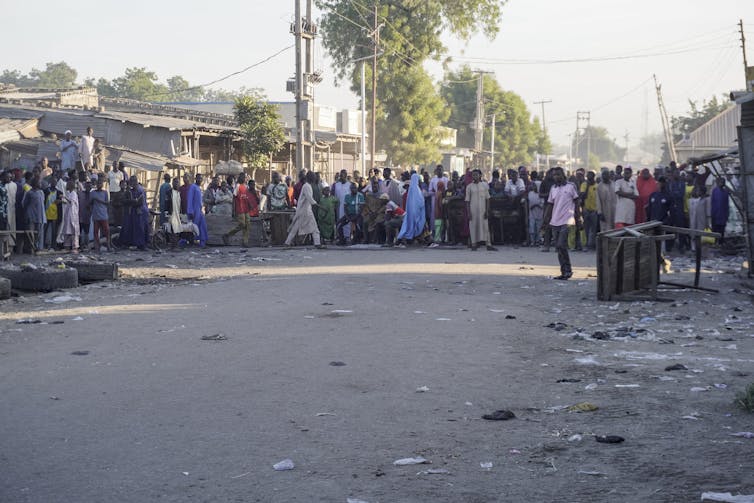
Can the US ‘run’ Venezuela? Military force can topple a dictator, but it cannot create political authority or legitimacy

Source: The Conversation – USA – By Monica Duffy Toft, Professor of International Politics and Director of the Center for Strategic Studies, The Fletcher School, Tufts University

Supporters of Venezuelan President Nicolás Maduro gather during a demonstration in Caracas on Jan, 4, 2026.
Pedro Mattey/Anadolu via Getty Images

An image circulated over media the weekend of Jan. 3 and 4 was meant to convey dominance: Venezuela’s president, Nicolás Maduro, blindfolded and handcuffed aboard a U.S. naval vessel. Shortly after the operation that seized Maduro and his wife, Cilia Flores, President Donald Trump announced that the United States would now “run” Venezuela until a “safe, proper and judicious transition” could be arranged.

The Trump administration’s move is not an aberration; it reflects a broader trend in U.S. foreign policy I described here some six years ago as “America the Bully.”

Washington increasingly relies on coercion – military, economic and political – not only to deter adversaries but to compel compliance from weaker nations. This may deliver short-term obedience, but it is counterproductive as a strategy for building durable power, which depends on legitimacy and capacity. When coercion is applied to governance, it can harden resistance, narrow diplomatic options and transform local political failures into contests of national pride.

There is no dispute that Maduro’s dictatorship led to Venezuela’s catastrophic collapse. Under his rule, Venezuela’s economy imploded, democratic institutions were hollowed out, criminal networks fused with the state, and millions fled the country – many for the United States.

But removing a leader – even a brutal and incompetent one – is not the same as advancing a legitimate political order.

A man wearing sweatpants and a sweatshirt, in handcuffs and blindfolded.
An image of Venezuelan President Nicolás Maduro after his capture, posted by President Donald Trump and reposted by the White House.
White House X.com account

Force doesn’t equal legitimacy

By declaring its intent to govern Venezuela, the United States is creating a governance trap of its own making – one in which external force is mistakenly treated as a substitute for domestic legitimacy.

I write as a scholar of international security, civil wars and U.S. foreign policy, and as author of “Dying by the Sword,” which examines why states repeatedly reach for military solutions, and why such interventions rarely produce durable peace.

The core finding of that research is straightforward: Force can topple rulers, but it cannot generate political authority.

When violence and what I have described elsewhere as “kinetic diplomacy” become a substitute for full spectrum action – which includes diplomacy, economics and what the late political scientist Joseph Nye called “soft power” – it tends to deepen instability rather than resolve it.

More force, less statecraft

The Venezuela episode reflects this broader shift in how the United States uses its power. My co-author Sidita Kushi and I document this by analyzing detailed data from the new Military Intervention Project. We show that since the end of the Cold War, the United States has sharply increased the frequency of military interventions while systematically underinvesting in diplomacy and other tools of statecraft.

One striking feature of the trends we uncover is that if Americans tended to justify excessive military intervention during the Cold War between 1945–1989 due to the perception that the Soviet Union was an existential threat, what we would expect is far fewer military interventions following the Soviet Union’s 1991 collapse. That has not happened.

Even more striking, the mission profile has changed. Interventions that once aimed at short-term stabilization now routinely expand into prolonged governance and security management, as they did in both Iraq after 2003 and Afghanistan after 2001.

This pattern is reinforced by institutional imbalance. In 2026, for every single dollar the United States invests in the diplomatic “scalpel” of the State Department to prevent conflict, it allocates US$28 to the military “hammer” of the Department of Defense, effectively ensuring that force becomes a first rather than last resort.

“Kinetic diplomacy” – in the Venezuela case, regime change by force – becomes the default not because it is more effective, but because it is the only tool of statecraft immediately available. On Jan. 4, Trump told the Atlantic magazine that if Delcy Rodríguez, the acting leader of Venezuela, “doesn’t do what’s right, she is going to pay a very big price, probably bigger than Maduro.”

Lessons from Afghanistan, Iraq and Libya

The consequences of this imbalance are visible across the past quarter-century.

In Afghanistan, the U.S.-led attempt to engineer authority built on external force alone proved brittle by its very nature. The U.S. had invaded Afghanistan in 2001 to topple the Taliban regime, deemed responsible for the 9/11 terrorist attacks. But the subsequent two decades of foreign-backed state-building collapsed almost instantly once U.S. forces withdrew in 2021. No amount of reconstruction spending could compensate for the absence of a political order rooted in domestic consent.

Following the invasion by the U.S. and surrender of Iraq’s armed forces in 2003, both the U.S. Department of State and the Department of Defense proposed plans for Iraq’s transition to a stable democratic nation. President George W. Bush gave the nod to the Defense Department’s plan.

That plan, unlike the State Department’s, ignored key cultural, social and historical conditions. Instead, it proposed an approach that assumed a credible threat to use coercion, supplemented by private contractors, would prove sufficient to lead to a rapid and effective transition to a democratic Iraq. The United States became responsible not only for security, but also for electricity, water, jobs and political reconciliation – tasks no foreign power can perform without becoming, as the United States did, an object of resistance.

Libya demonstrated a different failure mode. There, intervention by a U.S.-backed NATO force in 2011 and removal of dictator Moammar Gadhafi and his regime were not followed by governance at all. The result was civil war, fragmentation, militia rule and a prolonged struggle over sovereignty and economic development that continues today.

The common thread across all three cases is hubris: the belief that American management – either limited or oppressive – could replace political legitimacy.

Venezuela’s infrastructure is already in ruins. If the United States assumes responsibility for governance, it will be blamed for every blackout, every food shortage and every bureaucratic failure. The liberator will quickly become the occupier.

Men carrying guns and celebrating, with huge black clouds behind them.
Iraqi Sunni Muslim insurgents celebrate in front of a burning U.S. convoy they attacked earlier on April 8, 2004, on the outskirts of the flashpoint town of Fallujah.
Karim Sahib, AFP/Getty Images

Costs of ‘running’ a country

Taking on governance in Venezuela would also carry broader strategic costs, even if those costs are not the primary reason the strategy would fail.

A military attack followed by foreign administration is a combination that undermines the principles of sovereignty and nonintervention that underpin the international order the United States claims to support. It complicates alliance diplomacy by forcing partners to reconcile U.S. actions with the very rules they are trying to defend elsewhere.

The United States has historically been strongest when it anchored an open sphere built on collaboration with allies, shared rules and voluntary alignment. Launching a military operation and then assuming responsibility for governance shifts Washington toward a closed, coercive model of power – one that relies on force to establish authority and is prohibitively costly to sustain over time.

These signals are read not only in Berlin, London and Paris. They are watched closely in Taipei, Tokyo and Seoul — and just as carefully in Beijing and Moscow.

When the United States attacks a sovereign state and then claims the right to administer it, it weakens its ability to contest rival arguments that force alone, rather than legitimacy, determines political authority.

Beijing needs only to point to U.S. behavior to argue that great powers rule as they please where they can – an argument that can justify the takeover of Taiwan. Moscow, likewise, can cite such precedent to justify the use of force in its near abroad and not just in Ukraine.

This matters in practice, not theory. The more the United States normalizes unilateral governance, the easier it becomes for rivals to dismiss American appeals to sovereignty as selective and self-serving, and the more difficult it becomes for allies to justify their ties to the U.S.

That erosion of credibility does not produce dramatic rupture, but it steadily narrows the space for cooperation over time and the advancement of U.S. interests and capabilities.

Force is fast. Legitimacy is slow. But legitimacy is the only currency that buys durable peace and stability – both of which remain enduring U.S. interests.

If Washington governs by force in Venezuela, it will repeat the failures of Afghanistan, Iraq and Libya: Power can topple regimes, but it cannot create political authority. Outside rule invites resistance, not stability.

The Conversation

Monica Duffy Toft does not work for, consult, own shares in or receive funding from any company or organization that would benefit from this article, and has disclosed no relevant affiliations beyond their academic appointment.

ref. Can the US ‘run’ Venezuela? Military force can topple a dictator, but it cannot create political authority or legitimacy – https://theconversation.com/can-the-us-run-venezuela-military-force-can-topple-a-dictator-but-it-cannot-create-political-authority-or-legitimacy-272683

I wrote a book on the politics of war powers, and Trump’s attack on Venezuela reflects Congress surrendering its decision-making powers

Source: The Conversation – USA – By Sarah Burns, Associate Professor of Political Science, Rochester Institute of Technology

Explosions were seen across Caracas after the U.S. launched large-scale attacks on Venezuela and captured its leader and his wife.
AFP via Getty Images

Americans woke up on Jan. 3, 2025, to blaring headlines: “US CAPTURES MADURO, TRUMP SAYS,” declared The New York Times, using all capital letters. The U.S. had mounted an overnight military raid in Venezuela that immediately raised questions of procedure and legality. Prime among them was what role Congress had – or should have had – in the operation.

Politics editor Naomi Schalit interviewed political scientist Sarah Burns, author of the book “The Politics of War Powers” and an expert at Rochester Institute of Technology on the historical struggle between Congress and U.S. presidents over who has the power to authorize military action.

Is this a war?

I wouldn’t call it a war. This is regime change, and whether or not it has a positive impact on the United States, whether or not it has a positive impact on Venezuela, I think the likelihood is very low for both of those things being true.

How does Congress see its role in terms of military action initiated by the United States?

Congress has been, in my view, incredibly supine. But that’s not just my word. Having said that, it is true that Congress – in the House, predominantly – tried to pass a war powers act recently, saying that President Donald Trump was not allowed to do any action against Venezuela, and that failed on very close votes.

So you see some effort on the part of Congress to assert itself in the realm of war. But it failed predominantly on party lines, with Democrats saying we really don’t want to go into Venezuela. We really don’t want to have this action. Republicans predominantly were supporting the president and whatever it happens to be that he would like to do. Moderate Republicans and Republicans who are in less safe districts were and are more likely to at least stand up a little bit to the president, but there’s a very small number of them.

The Congress building in mid-December
Congress has been largely absent as President Donald Trump has escalated his verbal and military attacks on Venezuela.
AP Photo/J. Scott Applewhite

So there may be an institutional role for Congress, a constitutional role, a role that has been confirmed by legal opinion, but politics takes over in Congress when it comes to asserting its power in this realm?

That’s a perfect way of putting it. They have a legal, constitutional, one might even say moral, responsibility to assert themselves as a branch, right? This is from Federalist 51 where James Madison says “Ambition must be made to counteract ambition.” So it should be that as a branch, they assert themselves against the president and say, “We have a role here.”

In the 1940s, presidential scholar Edward Corwin said that in the realm of foreign policy, it is an invitation for Congress and the president to struggle. So it should be that Congress and the president are struggling against each other to assert, “I’m in charge.” “No, I’m in charge.” “No, I’m in charge,” in an effort to create a balance between the two branches and between the two things that each of the branches does well. What you want from Congress is slow deliberation and a variety of opinions. What you want from the president is energy and dispatch.

So certainly, if we have an attack like 9/11, you would want the president to be able to act quickly. And you know, conversely, in situations like the questions around what the U.S. is doing in Venezuela, you want slow deliberation because there is no emergency that requires energy and dispatch and speed. So the president shouldn’t be entirely in the driver’s seat here, and Congress should very much be trying very hard to restrain him.

What power does Congress have to restrain him?

They have to pass legislation. They aren’t particularly well suited right now to passing legislation, so effectively there is not a very clear way for them to restrain the president.

One of the things that members of Congress have attempted to do several times, with very little positive impact, is go to the courts and say, “Can you restrain the president?” And political scientist Jasmine Farrier has written that the courts have regularly said to members of Congress: “You have the power to stop the president, and you are ineffective at that. And so if you want to stop the president, you shouldn’t turn to us. You should work together to create legislation that would restrain the president.”

What would such legislation do? Cut off money for troops? Is it finger-wagging, or is it something really concrete?

There are a few different tiers. Joint resolutions are finger-wagging. They just say, “Bad, Mr. President, don’t do that.” But they have no effect in law.

The War Powers Resolution, first passed in 1973, is a legitimate way of trying to restrain the president. Congress intended to say to presidents, “You cannot start a war and continue a war without our authorization.” But what they said instead was “You could have a small war or a short war – of 60 to 90 days – without our authorization, and then you have to tell us about it.” That just sort of said to presidents the opposite of what they intended. So President Barack Obama took advantage of that with the military engagement in Libya, as well as Trump in his first administration.

This is not a partisan issue. It’s not Republican presidents who do it. It’s not Democratic presidents who do it. It’s every president since the War Powers Resolution was passed, and the only time that Congress has drawn down troops or drawn down money was the Vietnam War.

Other than that disastrous war, we have not seen Congress willing to put themselves on the politically negative side, which is taking money away from the troops. Because if you take away money right now, they’re going to be harmed.

a white man in a suit stands at a podium with the presidential seal, while several other men stand behind him
President Donald Trump and his national security team discuss the U.S. strikes on Venezuela at his Mar-a-Lago club in Palm Beach, Fla., on Jan. 3, 2026.
AP Photo/Alex Brandon)

What is the War Powers Resolution?

The War Powers Resolution from 1973, also known as the War Powers Act, was Congress – during the Vietnam War – saying definitively to President Richard Nixon, “You have overstepped your bounds.” They had explicitly said in law, you cannot go into Cambodia. And Nixon went into Cambodia.

So that was their way of trying to reassert themselves very aggressively; as I mentioned before, it didn’t work effectively. It worked insofar as presidents don’t unilaterally start wars that are large scale, the way that World War II was large scale. But they do have these smaller actions at varying levels.

Then we get to 9/11 and we see the 2001 authorization for the use of military force, and the 2002 authorization for the use of military force. The 2001 law authorized going after anyone in al-Qaida and associated with 9/11. The 2002 authorization was directly related to Iraq, saying “There is a problem with Iraq, we have to do something.” Both of them were extremely vague and broad, and that’s why we’ve seen four presidents, including Trump, using the 2001 and 2002 authorizations to carry out all sorts of operations that had very little to do with Saddam Hussein or al-Qaida.

In 2021, senators Mike Lee, Bernie Sanders and Chris Murphy collectively got together and tried to create a national security document that would restrain presidential unilateralism. It was a good effort on the part of members of Congress from a variety of different ideological views to attempt to restrain the president. It did not even sort-of pass – it barely got out on the floor.

Since that time, we haven’t seen a lot of efforts from members of Congress. They haven’t really reasserted themselves since the war in Korea, which began in 1950. It’s very clear that ambition is no longer checking ambition the way that it was meant to by the founders.

When you woke up this morning and saw the news, what was your first thought?

Here we go again. This is not a Republican or a Democratic issue. Lots of presidents have made this error, which is that they think if you do this smaller-scale action, you are going to get a positive result for the nation, for the region, for international stability. And very rarely is that the case.

The Conversation

Sarah Burns does not work for, consult, own shares in or receive funding from any company or organization that would benefit from this article, and has disclosed no relevant affiliations beyond their academic appointment.

ref. I wrote a book on the politics of war powers, and Trump’s attack on Venezuela reflects Congress surrendering its decision-making powers – https://theconversation.com/i-wrote-a-book-on-the-politics-of-war-powers-and-trumps-attack-on-venezuela-reflects-congress-surrendering-its-decision-making-powers-272668

Oldest known cremation in Africa poses 9,500-year-old mystery about Stone Age hunter-gatherers

Source: The Conversation – USA – By Jessica C. Thompson, Assistant Professor of Anthropology, Yale University

Why did this community burn one woman’s remains in such a visible, spectacular way? Patrick Fahey

Near the equator, the Sun hurries below the horizon in a matter of minutes. Darkness seeps from the surrounding forest. Nearly 10,000 years ago, at the base of a mountain in Africa, people’s shadows stretch up the wall of a natural overhang of stone.

They’re lit by a ferocious fire that’s been burning for hours, visible even to people miles away. The wind carries the smell of burning. This fire will linger in community memory for generations − and in the archaeological record for far longer.

We are a team of bioarchaeologists, archaeologists and forensic anthropologists who, with our colleagues, recently discovered the earliest evidence of cremation – the transformation of a body from flesh to burned bone fragments and ashes – in Africa and the earliest example of an adult pyre cremation in the world.

Small map of Africa next to a big image of a bare rock mountaintop at sunset. The slopes are covered in forest.
The pyre was found under a giant boulder near the base of Mount Hora. The site is in Malawi, which is outlined in black within the Zambezian forest (colored green) on the map of Africa.
Jessica Thompson and Natural Earth

It’s no easy task to produce, create and maintain an open fire strong enough to completely burn a human body. While the earliest cremation in the world dates to about 40,000 years ago in Australia, that body was not fully burned.

It is far more effective to use a pyre: an intentionally built structure of combustible fuel. Pyres appear in the archaeological record only about 11,500 years ago, with the earliest known example containing a cremated child under a house floor in Alaska.

Many cultures have practiced cremation, and the bones, ash and other residues from these events help archaeologists piece together past funeral rituals. Our scientific paper, published in the journal Science Advances, describes a spectacular event that happened about 9,500 years ago in Malawi in south-central Africa, challenging long-held notions about how hunter-gatherers treat their dead.

people with digging tools against a landscape that looks like hardpacked earth
Excavators standing at the depth of the pyre at the Hora 1 site in northern Malawi.
Jessica Thompson

The discovery

At first it was just a hint of ash, then more. It expanded downward and outward, becoming thicker and harder. Pockets of dark earth briefly appeared and disappeared under trowels and brushes until one of the excavators stopped. They pointed to a small bone at the base of a 1½-foot (0.5-meter) wall of archaeological ash revealed under a natural stone overhang at the Hora 1 archaeological site in northern Malawi.

The bone was the broken end of a humerus, from the upper arm of a person. And clinging to the very end of it was the matching end of the lower arm, the radius. Here was a human elbow joint, burned and fractured, preserved in sediments full of debris from the daily lives of Stone Age hunter-gatherers.

We wondered whether this could be a funeral pyre, but such structures are extremely rare in the archaeological record.

man kneeling on a board measures down into the excavated area
Excavators began finding a thick ash deposit about 2 feet (0.6 meters) under the modern-day surface of the rock shelter.
Jessica Thompson

Finding a cremated person from the Stone Age also seemed impossible because cremation is not generally practiced by African foragers, either living or ancient. The earliest evidence of burned human remains from Africa date to around 7,500 years ago, but that body was incompletely burned, and there was no evidence of a pyre.

The first clear cases of cremation date to around 3,300 years ago, carried out by early pastoralists in eastern Africa. But overall the practice remained rare and is associated with food-producing societies and not hunter-gatherers.

We found more charred human remains in a small cluster, while the ash layer itself was as large as a queen bed. The blaze must have been enormous.

When we returned from fieldwork and received our first radiocarbon dates, we were shocked again: The event had happened about 9,500 years ago.

Piecing together the events

We built a team of specialists to piece together what had happened. By applying forensic and bioarchaeological techniques, we confirmed that all the bones belonged to a single person who was cremated shortly after her death.

This was a small adult, probably a woman, just under 5 feet (1.5 meters) in height. In life, she was physically active, with a strong upper body, but had evidence of a partially healed bone infection on her arm. Bone development and the beginnings of arthritis suggested she was probably middle-aged when she died.

Three images showing thin marks on a gray bone fragment. The images get more zoomed in moving to the right.
Marks incised on the shaft of the lower arm bone (radius) were inflicted by a stone tool. The bone then turned gray as it burned. The area in the box on the left is enlarged on the right of the image.
Jessica Thompson

Patterns of warping, cracks and discoloration caused by fire damage showed her body was burned with some flesh still on it, in a fire reaching at least 1,000 degrees Fahrenheit (540 degrees Celsius). Under the microscope we could see tiny incisions along her arms and at muscle connections on her legs, revealing that people tending the pyre used stone tools to help the process along by removing flesh.

Six fragments of shiny white and brown stone on a black background.
Tiny pointed tools made from local stone were found within the pyre. They were probably made at the same time that it burned.
Justin Pargeter

Within the pyre ash, we found many small pointed chips of stone that suggested people had added tools to the fire as it burned.

And the way the bones were clustered inside such a large fire showed that this was not a case of cannibalism: It was some other kind of ritual.

Perhaps most surprisingly, we found no evidence of her head. Skull bones and teeth usually preserve well in cremations because they are very dense. While we can’t know for sure, the absence of these body parts suggest her head may have been removed before or during the cremation as part of the funeral ritual.

A communal spectacle

We determined that the pyre must have been built and maintained by multiple people who were actively engaged in the event. During new excavations the following year, we found even more bone fragments from the same ancient woman, displaced and colored differently from in the main pyre. These additional remains suggest that the body was manipulated, attended and moved during the cremation.

Microscopic analysis of ash samples from across the pyre included blackened fungus, reddened soil from termite structures, and microscopic plant remains. These helped us estimate that people collected at least 70 pounds (30 kg) of deadwood to do the task and stoked the fire for hours to days.

We also learned that this was not the first fire at the Hora 1 site – nor its last. To our astonishment, what had seemed during fieldwork to be a single massive pile of ash was in fact a layered series of burning events. Radiocarbon dating of the ash samples showed that people began lighting fires on that spot by about 10,240 years ago. The same location was used to construct the cremation pyre several hundred years later. As the pyre smoldered, new fires were kindled on top of it, resulting in fused ashes in microscopic layers.

A mix of grey, brown, white and black colors showing what soil and ash looks like under a microscope.
Loose, sandy, burned soil was mixed on top of very thin layers of ash, showing that the pyre was lit over and over again.
Flora Schilt

Within a few hundred years of the main event, another large fire was built again at the exact same place. While there is no evidence that anyone else was cremated in the subsequent fires, the fact that people repeatedly returned to the spot for this purpose suggests its significance lived on in community memory.

A new view of ancient cremation

What does all of this tell us about ancient hunter-gatherers in the region?

For one, it shows that entire communities were engaged in a mortuary spectacle of extraordinary scale. An open pyre can take more than a day of constant tending and an enormous amount of fuel to fully reduce a body, and during this time the sights and smells of burning wood and other remains are impossible to hide.

This scale of mortuary effort is unexpected for this time and place. In the African record, complex multigenerational mortuary rituals tied to specific places are generally not associated with a hunting-and-gathering way of life.

flames of a pyre against dark black background
The pyre event was a spectacle that required many hours of communal effort and would have been impossible to hide.
Anders Blomqvist/Stone via Getty Images

It also shows that different people were treated in different ways in death, raising the possibility of more complex social roles in life. Other men, women and children were buried at the Hora 1 site beginning as early as 16,000 years ago. In fact, those other burials have provided ancient DNA evidence showing they were part of a long-term local group. But those burials, and others that came a few hundred years after the pyre, were interred without this labor-intensive spectacle.

What about this person was different? Was she a beloved family member or an outsider? Was this treatment because of something she did in life or a specific hope for the afterlife? Additional excavation and data from across the region may help us better understand why this person was cremated and what cremation meant to this group.

Whoever she was, her death had important meaning not just to the people who made and tended the pyre, but also to the generations that came after.

The Conversation

Jessica C. Thompson has received funding for this research from the Wenner-Gren Foundation, National Geographic Society, and Hyde Family Foundations. She is affiliated with the Yale Peabody Museum and the Institute of Human Origins.

Elizabeth Sawchuk and Jessica Cerezo-Román do not work for, consult, own shares in or receive funding from any company or organization that would benefit from this article, and have disclosed no relevant affiliations beyond their academic appointment.

ref. Oldest known cremation in Africa poses 9,500-year-old mystery about Stone Age hunter-gatherers – https://theconversation.com/oldest-known-cremation-in-africa-poses-9-500-year-old-mystery-about-stone-age-hunter-gatherers-268074

LA fires showed how much neighborliness matters for wildfire safety – schools can do much more to teach it

Source: The Conversation – USA (2) – By Elizabeth A. Logan, Associate Director of the Huntington-USC Institute on California and The West, USC Dornsife College of Letters, Arts and Sciences

Eaton fire survivors gather in Altadena, Calif., to talk about recovery six months after the LA fires. Sarah Reingewirtz/MediaNews Group/Los Angeles Daily News via Getty Images

On Jan. 7, 2025, people across the Los Angeles area watched in horror as powerful winds began spreading wildfires through neighborhood after neighborhood. Over three weeks, the fires destroyed more than 16,000 homes and businesses. At least 31 people died, and studies suggest the smoke and stress likely contributed to hundreds more deaths.

For many of us who lived through the fires, it was a traumatic experience that also brought neighborhoods closer together. Neighbors scrambled to help each other as burning embers started spot fires that threatened homes. They helped elderly and disabled residents evacuate.

A man turns a hose on a burning house while another runs.
Samuel Girma runs to get another hose as he and others try to stop the Eaton fire from spreading to more homes in Altadena, Calif. Girma was in the area on a construction job. The other man lives nearby.
Robert Gauthier/Los Angeles Times via Getty Images

As the LA region rebuilds a year later, many people are calling for improvements to zoning regulations, building codes, insurance and emergency communications systems. Conversations are underway about whether rebuilding in some locations makes sense at all.

But managing fire risk is about more than construction practices, regulations and rules. It is also about people and neighborliness – the ethos and practice of caring for those in your community, including making choices and taking steps on your own property to help keep the people around you safe.

Three men, one an older man, stand in the still-smoky ruins of what was once a home, with fire damage all around them.
Neighbors who lost their homes to a fire in Altadena, Calif., on Jan. 9, 2025, talk amid the ruins.
Zoë Meyers/AFP via Getty Images

As LA-area residents and historians who witnessed the fires’ destruction and have been following the recovery closely, we believe building a safer future for fire-risk communities includes increasing neighborliness and building shared knowledge of the past. Much of that starts in the schools.

Neighborliness matters in community fire safety

Being neighborly means recognizing the connectedness of life and addressing the common good, beyond just the individual and family network.

It includes community-wide fire mitigation strategies that can help prevent fires from spreading.

During the Southern California fires, houses, fences, sheds, roofs and dry vegetation served as the fuel for wind-blown fires racing through neighborhoods miles away from forested land. Being neighborly means taking steps to reduce risks on your own property that could put your neighbors at risk. Following fire officials’ recommendations can mean clearing defensible space around homes, replacing fire-prone plants and limiting or removing burnable material, such as wood fencing and sheds.

A woman closes her eyes as she hugs her cat.
Denise Johnson holds her cat Ramsey after the Eaton Fire. Her home was one of the few in her immediate neighborhood that survived, but recovery will take time for everyone.
AP Photo/Jae C. Hong

Neighborliness also recognizes the varying mental health impacts of significant wildfire events on the people who experience them. Being neighborly means listening to survivors and reaching out, particularly to neighbors who may be struggling or need help with recovery, and building community bonds.

Neighbors are often the first people who can help in an emergency before local, state and federal responders arrive. A fast neighborhood response, whether helping put out spot fires on a lawn or ensuring elderly residents or those without vehicles are able to evacuate, can save lives and property in natural disasters.

Fire awareness, neighborliness start in school

Community-based K-12 schools are the perfect places for learning and practicing neighborliness and providing transformative fire education.

Learning about the local history of wildfires, from the ecological impact of beneficial fire to fire disasters and how communities responded, can transform how children and their families think about fires and fire readiness.

However, in our view, fire history and safety is not currently taught nearly enough, even in fire-prone California.

A man pushes an older woman in a shopping cart along a pathway with apartments on one side and sand on the other, and thick smoke behind them.
Jerome Krausse pushes his mother-in-law in a shopping cart on a path along the beach as they evacuate amid fires in Pacific Palisades on Jan. 7, 2025.
AP Photo/Richard Vogel

California’s Department of Education Framework and Content Standards for K-12 education offer several opportunities to engage students with innovative lessons about wildfire causes, preparedness and resilience. For example, fourth grade history and social science standards include understanding “how physical environments (e.g., water, landforms, vegetation, climate) affect human activity.” Middle school science standards include mapping the history of natural hazards, though they only mention forest fires when discussing technology.

Schools could, and we believe should, include more fire history, ecological knowledge and understanding of the interconnectedness of neighborhoods and neighbors when it comes to fire safety in those and other classes.

Elementary schools in many states bring in firefighters to talk about fire safety, often through programs run by groups like the California Fire Prevention Organization. These efforts could spend more time looking beyond house fires to discuss how and where wildfires start, how they spread and how to make your own home and neighborhood much safer.

Models such as the U.S. Fire Administration’s collaboration with Sesame Workshop on the Sesame Street Fire Safety Program for preschool kids offer examples, blending catchy phrases with safety and science lessons.

The National Fire Protection Association’s Sparky the Fire Dog shares some simple steps that kids can do with their parents and friends to help keep their neighborhood safer from wildfire.

Including knowledge from Indigenous tribal elders, fire management professionals and other community members can provide more robust fire education and understanding of the roles people play in fire risk and risk reduction. Introducing students to future career pathways in fire safety and response can also help students see their roles in fire safety.

As LA recovers from the 2025 fires, fire-prone states can prepare for future fires by expanding education about fire and neighborliness, and helping students take that knowledge home to their families.

Remembering, because it will happen again

Neighborliness also demands a pivot from the reflexive amnesia regarding natural and unnatural disasters to knowing that it will happen here again.

There’s a dangerous, stubborn forgetfulness in the vaunted Land of Sunshine. It is all part of the myth that helped make Southern California such a juggernaut of growth from the late 19th century forward.

The region was, boosters and public officials insisted, special: a civilization growing in the benign embrace of the environment. Anything grew here, the endless Los Angeles Basin could absorb everyone, and if there wasn’t enough water to slake the thirst of metropolitan ambitions, engineers and taxpayers would see to it that water from far away – even very far away – would be brought here.

The Southland is beautiful, but a place can be both beautiful and precarious, particularly in the grip of climate change. These are lessons we believe should be taught in K-12 classrooms as an important step toward lowering disaster risk. Living with fire means remembering and understanding the past. That knowledge, and developing more neighborly behavior, can save your life and the lives of your neighbors.

The Conversation

Elizabeth A. Logan receives funding from the Sierra Nevada Conservancy and the WHH Foundation.

William Deverell receives funding from the Sierra Nevada Conservancy and the WHH Foundation.

ref. LA fires showed how much neighborliness matters for wildfire safety – schools can do much more to teach it – https://theconversation.com/la-fires-showed-how-much-neighborliness-matters-for-wildfire-safety-schools-can-do-much-more-to-teach-it-272505

West Coast levee failures show growing risks from America’s aging flood defenses

Source: The Conversation – USA (2) – By Farshid Vahedifard, Professor of Civil and Environmental Engineering, Tufts University

Days of heavy rain caused a levee on the White River to breach, sending water into Pacific, Wash., on Dec. 16, 2025. Brandon Bell/Getty Images

In recent weeks, powerful atmospheric river storms have swept across Washington, Oregon and California, unloading enormous amounts of rain. As rivers surged, they overtopped or breached multiple levees – those long, often unnoticed barriers holding floodwaters back from homes and towns.

Most of the time, levees don’t demand attention. They quietly do their job, year after year. But when storms intensify, levees suddenly matter in a very personal way. They can determine whether a neighborhood stays dry or ends up underwater.

The damage in the West reflects a nationwide problem that has been building for decades. Across the U.S., levees are getting older while weather is getting more extreme. Many of these structures were never designed for the enormous responsibility they now carry.

A paved bicycling path atop a levee is broken and slabs of asphalt pavement are tilted into a breach where water poured through.
Crews inspect damage to a Green River levee in the Seattle suburbs on Dec. 15, 2025. Thousands of people were urged to evacuate during a series of atmospheric river storms, and the National Guard was sent to monitor and reinforce several levees considered at risk.
AP Photo/Manuel Valdes

As a civil engineer at Tufts University, I study water infrastructure, including the vulnerability of levees and strategies for making them more resilient. My research also shows that when levees fail, the consequences don’t fall evenly on the population.

Levees became critical infrastructure almost by accident

Many people assume levees were built as part of modern, carefully engineered flood-control systems. In reality, many of the levees still in use today began much more humbly.

Decades ago, farmers built simple earthen embankments to protect their fields and livestock from seasonal flooding. These early levees were practical solutions, shaped by experience rather than formal engineering. They were not constructed using rigorous design standards, and they did not follow consistent construction or maintenance guidelines.

Over time, the landscape around these levees changed. Farmland gave way to neighborhoods. Roads, railways, factories and ports expanded into floodplains. Populations grew. What were once modest, local structures protecting farms gradually became the first line of defense for millions of people in homes and workplaces.

During the Great Mississippi Flood of 1927, the river poured over and broke through levees, flooding thousands of square miles of land. Both overtopping and a breach are visible in this photo.
National Weather Service Archival Photography by Steve Nicklas, NOS, NGS

Without much public debate or planning, these semi-engineered levees took on a critical and unintended role. The question that still lingers is whether they were ever prepared for it.

Vast, aging levee system now protecting millions

Today, the National Levee Database counts more than 24,000 miles (38,600 kilometers) of levees in the U.S., with an average age of about 61 years and many of them much older. Together, they protect over 23 million people, around 7 million buildings and nearly US$2 trillion in property value.

That’s an extraordinary level of responsibility for a system that is unevenly maintained with varying oversight. Some levees are inspected regularly. Others are owned by small local agencies or private entities with limited funding. In some cases, responsibility is unclear or fragmented.

One levee that was breached along the Green River in Washington state during storms in mid-December 2025 had been due for repairs for several years, but disagreements among governments had recently held up needed work, The Seattle Times reported. The breach forced thousands of people to evacuate

A map shows many breaches in the Midwest, as well as in Washington state and the Northeast.
Many states have at-risk levees. The map shows all levees in the U.S. National Levee Database (in red) and 478 levee segments where overtopping is known to have occurred in the previous 15 years (in blue).
S. Flynn, et al., 2025

The American Society of Civil Engineers’ 2025 Report Card for American Infrastructure, which I contributed to, gave the nation’s levees a D-plus grade, citing aging infrastructure, inconsistent monitoring and long-term underinvestment. A new dataset that colleagues and I created of levee damage includes 487 cases where rivers poured over levees, known as overtopping, in the past 15 years. That doesn’t mean levees are failing everywhere; it means that many are operating with little margin for error.

How levees fail

Levee failures are rarely sudden collapses. More often, they start quietly.

The most common reason levees fail is overtopping, when water from a river, stream or lake behind the levee flows over the top. Once that happens, erosion can begin on the landward side, weakening the structure from behind. What starts as a slow trickle can quickly grow into a breach, creating a large gap in the levee where water can pour in.

Two illustrations. One of overtopping points out that age, height and the materials used can weaken the levee, leading to a breach, which cuts into the levee allowing a faster, deeper steam of water to pour through.
An illustration shows the difference between overtopping and a breach, and some of the reasons a levee can fail.
S. Flynn et al., 2025

Atmospheric river storms make the risk of overtopping and breaches much higher. These storms deliver enormous amounts of rainfall across wide areas in a matter of hours, often combined with snowmelt. Rivers rise faster and stay high longer. Many levees were never designed for that kind of sustained pressure.

When a levee breaches, flooding can be rapid and deep, leaving little time for evacuation and causing damage that spreads far beyond the floodplain.

Who relies on levees today?

Millions of Americans live and work in area protected by levees, often without realizing it. Homes, schools, highways, rail corridors, ports and power facilities depend on the integrity of these structures.

A recent national study found that across the contiguous U.S., urban expansion into floodplains occurred more than twice as fast after levee construction as it did in surrounding counties, highlighting how levees can affect communities’ perception of danger.

In fact, when levees fail, flooding can be worse than in areas without levees, because water rushes in quickly and drains slowly.

The risks are also uneven, shaped by history, economics and policy decisions.

That reality became painfully clear during an atmospheric river storm in March 2023 when a levee along California’s Pajaro River failed, flooding the town of Pajaro. Pajaro is home to many low-income farmworkers. Floodwaters forced hundreds of residents to evacuate, and some people were trapped as water levels rose.

How the Pajaro Valley flooded after intense rainfall from an atmospheric river in March 2023, breaching a levee protecting a small California town.

What made the disaster especially troubling was what emerged afterward. Officials and engineers had known for decades that the Pajaro River levee was vulnerable. Reports documented its weaknesses, but repairs were repeatedly delayed.

Interviews by The Los Angeles Times and public records showed that part of the reason was financial. Decision-makers did not prioritize investing in a levee system protecting the low-income community. The risk was known, but the protection was deferred.

Pajaro is not an isolated case. Across the country, disadvantaged communities and communities of color are more likely to rely on older levees or levees that are not part of major federal programs. Rural towns often depend on agricultural levees. Urban neighborhoods may rely on structures built for a much smaller population.

When levees fail, the impacts cascade, closing roads, knocking out power, contaminating water supplies and disrupting lives for years.

A map shows highest disparities in Idaho, Utah, Colorado, Iowa, Ohio, Tennessee, Georgia, North Carolina, Virginia, Maine, Massachusetts and Vermont.
Disparity refers to the percentage of each state’s residents protected by levees who are considered disadvantaged, based on the U.S. Council on Environmental Quality’s Climate and Economic Justice Screening Tool. All levees in the National Levee Database are counted.
F. Vahedifard et al., 2023

Why this moment matters

Advances in engineering, monitoring and risk assessment have improved how levees are evaluated and designed.

Hurricane Katrina marked a turning point in 2005 when its storm surge broke through levees protecting New Orleans. Hundreds of people died in the flooding. The disaster exposed the consequences of neglect and fragmented responsibility for levee upkeep.

At the same time, there has been real progress. Over the past two decades, significant federal investments have strengthened the condition and management of many of the nation’s levees, particularly through the work of federal agencies such as the U.S. Army Corps of Engineers.

Still, the legacy of decisions made decades ago remains, and climate change is raising the risks. Heavier rainfall, fast snowmelt and rising seas are pushing water control systems beyond what many levees were designed to handle. Events once considered rare are becoming more frequent.

As atmospheric rivers test levees in the West and flood risks grow nationwide, the challenge is no longer just technical. It’s about how society values protection, communicates risk and decides whose safety is prioritized.

Levees will continue to play a vital role in protecting communities. Understanding their history, and their limits, is essential as the storms of the future arrive.

The Conversation

Farshid Vahedifard received funding from the National Science Foundation (NSF) and the National Oceanic and Atmospheric Administration (NOAA). He is affiliated with the United Nations University Institute for Water, Environment and Health (UNU-INWEH).

ref. West Coast levee failures show growing risks from America’s aging flood defenses – https://theconversation.com/west-coast-levee-failures-show-growing-risks-from-americas-aging-flood-defenses-272556

What loving-kindness meditation is and how to practice it in the new year

Source: The Conversation – USA (3) – By Jeremy David Engels, Liberal Arts Endowed Professor of Communication, Penn State

Loving-kindness, the feeling cultivated in metta meditation, is very different from romantic love. Anna Sunderland Engels

A popular New Year’s resolution is to take up meditation – specifically mindfulness meditation. This is a healthy choice.

Regular mindfulness practice has been linked to many positive health benefits, including reduced stress and anxiety, better sleep and quicker healing after injury and illness. Mindfulness can help us to be present in a distracted world and to feel more at home in our bodies, and in our lives.

There are many different types of meditation. Some mindfulness practices ask meditators simply to sit with whatever thoughts, sensations or emotions arise without immediately reacting to them. Such meditations cultivate focus, while granting more freedom in how we respond to whatever events life throws at us.

Other meditations ask practitioners to deliberately focus on one emotion – for example, gratitude or love – to deepen the experience of that emotion. The purpose behind this type of meditation is to bring more gratitude, or more love, into one’s life. The more people meditate on love, the easier it is to experience this emotion even when not meditating.

One such meditation is known as “metta,” or loving-kindness. As a scholar of communication and mindfulness, as well as a longtime meditation teacher, I have both studied and practiced metta. Here is what loving-kindness means and how to try it out for yourself:

Unbounded, universal love

Loving-kindness, or metta, is the type of love which is practiced by Buddhists around the world. Like many forms of meditation today, there are both secular and religious forms of the practice. One does not need to be a Buddhist to practice loving-kindness. It is for anyone and everyone who wants to live more lovingly.

Loving-kindness, the feeling cultivated in metta meditation, is very different from romantic love. In the ancient Pali language, the word “metta” has two root meanings: The first is “gentle,” in the sense of a gentle spring rain that falls on young plants, nourishing them without discrimination. The second is “friend.”

Metta is limitless and unbounded love; it is gentle presence and universal friendliness. Metta practice is meant to grow people’s ability to be present for themselves and others without fail.

A guided loving-kindness meditation practice.

Metta is not reciprocal or conditional. It does not discriminate between us and them, rich and poor, educated and uneducated, popular or unpopular, worthy and unworthy. To practice metta is to give what I describe in my research as “the rarest and most precious gift” – a gift of love offered without any expectation of it being returned.

How to practice loving-kindness meditation

In the fifth century, a Sri Lankan monk, Buddhaghosa, composed an influential meditation text called the “Visuddhimagga,” or “The Path of Purification.” In this text, Buddhaghosa provides instructions for how to practice loving-kindness meditation. Contemporary teachers tend to adapt and modify his instructions.

The practice of loving-kindness often involves quietly reciting to oneself several traditional phrases designed to evoke metta, and visualizing the beings who will receive that loving-kindness.

Traditionally, the practice begins by sending loving kindness to ourselves. It is typical during this meditation to say:

May I be filled by loving-kindness

May I be safe from inner and outer dangers
May I be well in body and mind

May I be at ease and happy

After speaking these phrases, and feeling the emotions they evoke, next it’s common to direct loving-kindness toward someone – or something – else: It can be a beloved person, a dear friend, a pet, an animal, a favorite tree. The phrases become:

May you be filled by loving-kindness

May you be safe from inner and outer dangers

May you be well in body and mind

May you be at ease and happy

Next, this loving-kindness is directed to a wider circle of friends and loved ones: “May they …”

The final step is to gradually expand the circle of well wishes: including the people in our community and town, people everywhere, animals and all living beings, and the whole Earth. This last round of recitation begins: “May we …”

In this way, loving-kindness meditation practice opens the heart further and further into life, beginning with the meditator themselves.

Loving-kindness and mindful democracy

Clinical research shows that loving-kindness meditation has a positive effect on mental health, including lessening anxiety and depression, increasing life satisfaction and improving self-acceptance while reducing self-criticism. There is also evidence that loving-kindness meditation increases a sense of connection with other people.

The benefits of loving-kindness meditation are not just for the individual. In my research, I show that there are also tremendous benefits for society as a whole. Indeed, the practice of democracy requires us to work together with friends, strangers and even purported “opponents.” This is difficult to do if our hearts are full of hatred and resentment.

Each time meditators open their hearts in metta meditation, they prepare themselves to live more loving lives: for their own selves, and for all living beings.

The Conversation

Jeremy David Engels does not work for, consult, own shares in or receive funding from any company or organization that would benefit from this article, and has disclosed no relevant affiliations beyond their academic appointment.

ref. What loving-kindness meditation is and how to practice it in the new year – https://theconversation.com/what-loving-kindness-meditation-is-and-how-to-practice-it-in-the-new-year-270984

AI agents arrived in 2025 – here’s what happened and the challenges ahead in 2026

Source: The Conversation – USA – By Thomas Şerban von Davier, Affiliated Faculty Member, Carnegie Mellon Institute for Strategy and Technology, Carnegie Mellon University

AI agents have emerged from the lab, bringing promise and peril. tadamichi/iStock via Getty Images

In artificial intelligence, 2025 marked a decisive shift. Systems once confined to research labs and prototypes began to appear as everyday tools. At the center of this transition was the rise of AI agents – AI systems that can use other software tools and act on their own.

While researchers have studied AI for more than 60 years, and the term “agent” has long been part of the field’s vocabulary, 2025 was the year the concept became concrete for developers and consumers alike.

AI agents moved from theory to infrastructure, reshaping how people interact with large language models, the systems that power chatbots like ChatGPT.

In 2025, the definition of AI agent shifted from the academic framing of systems that perceive, reason and act to AI company Anthropic’s description of large language models that are capable of using software tools and taking autonomous action. While large language models have long excelled at text-based responses, the recent change is their expanding capacity to act, using tools, calling APIs, coordinating with other systems and completing tasks independently.

This shift did not happen overnight. A key inflection point came in late 2024, when Anthropic released the Model Context Protocol. The protocol allowed developers to connect large language models to external tools in a standardized way, effectively giving models the ability to act beyond generating text. With that, the stage was set for 2025 to become the year of AI agents.

AI agents are a whole new ballgame compared with generative AI.

The milestones that defined 2025

The momentum accelerated quickly. In January, the release of Chinese model DeepSeek-R1 as an open-weight model disrupted assumptions about who could build high-performing large language models, briefly rattling markets and intensifying global competition. An open-weight model is an AI model whose training, reflected in values called weights, is publicly available. Throughout 2025, major U.S. labs such as OpenAI, Anthropic, Google and xAI released larger, high-performance models, while Chinese tech companies including Alibaba, Tencent, and DeepSeek expanded the open-model ecosystem to the point where the Chinese models have been downloaded more than American models.

Another turning point came in April, when Google introduced its Agent2Agent protocol. While Anthropic’s Model Context Protocol focused on how agents use tools, Agent2Agent addressed how agents communicate with each other. Crucially, the two protocols were designed to work together. Later in the year, both Anthropic and Google donated their protocols to the open-source software nonprofit Linux Foundation, cementing them as open standards rather than proprietary experiments.

These developments quickly found their way into consumer products. By mid-2025, “agentic browsers” began to appear. Tools such as Perplexity’s Comet, Browser Company’s Dia, OpenAI’s GPT Atlas, Copilot in Microsoft’s Edge, ASI X Inc.’s Fellou, MainFunc.ai’s Genspark, Opera’s Opera Neon and others reframed the browser as an active participant rather than a passive interface. For example, rather than helping you search for vacation details, it plays a part in booking the vacation.

At the same time, workflow builders like n8n and Google’s Antigravity lowered the technical barrier for creating custom agent systems beyond what has already happened with coding agents like Cursor and GitHub Copilot.

New power, new risks

As agents became more capable, their risks became harder to ignore. In November, Anthropic disclosed how its Claude Code agent had been misused to automate parts of a cyberattack. The incident illustrated a broader concern: By automating repetitive, technical work, AI agents can also lower the barrier for malicious activity.

This tension defined much of 2025. AI agents expanded what individuals and organizations could do, but they also amplified existing vulnerabilities. Systems that were once isolated text generators became interconnected, tool-using actors operating with little human oversight.

The business community is gearing up for multiagent systems.

What to watch for in 2026

Looking ahead, several open questions are likely to shape the next phase of AI agents.

One is benchmarks. Traditional benchmarks, which are like a structured exam with a series of questions and standardized scoring, work well for single models, but agents are composite systems made up of models, tools, memory and decision logic. Researchers increasingly want to evaluate not just outcomes, but processes. This would be like asking students to show their work, not just provide an answer.

Progress here will be critical for improving reliability and trust, and ensuring that an AI agent will perform the task at hand. One method is establishing clear definitions around AI agents and AI workflows. Organizations will need to map out exactly where AI will integrate into workflows or introduce new ones.

Another development to watch is governance. In late 2025, the Linux Foundation announced the creation of the Agentic AI Foundation, signaling an effort to establish shared standards and best practices. If successful, it could play a role like the World Wide Web Consortium in shaping an open, interoperable agent ecosystem.

There is also a growing debate over model size. While large, general-purpose models dominate headlines, smaller and more specialized models are often better suited to specific tasks. As agents become configurable consumer and business tools, whether through browsers or workflow management software, the power to choose the right model increasingly shifts to users rather than labs or corporations.

The challenges ahead

Despite the optimism, significant socio-technical challenges remain. Expanding data center infrastructure strains energy grids and affects local communities. In workplaces, agents raise concerns about automation, job displacement and surveillance.

From a security perspective, connecting models to tools and stacking agents together multiplies risks that are already unresolved in standalone large language models. Specifically, AI practitioners are addressing the dangers of indirect prompt injections, where prompts are hidden in open web spaces that are readable by AI agents and result in harmful or unintended actions.

Regulation is another unresolved issue. Compared with Europe and China, the United States has relatively limited oversight of algorithmic systems. As AI agents become embedded across digital life, questions about access, accountability and limits remain largely unanswered.

Meeting these challenges will require more than technical breakthroughs. It demands rigorous engineering practices, careful design and clear documentation of how systems work and fail. Only by treating AI agents as socio-technical systems rather than mere software components, I believe, can we build an AI ecosystem that is both innovative and safe.

The Conversation

Thomas Şerban von Davier does not work for, consult, own shares in or receive funding from any company or organization that would benefit from this article, and has disclosed no relevant affiliations beyond their academic appointment.

ref. AI agents arrived in 2025 – here’s what happened and the challenges ahead in 2026 – https://theconversation.com/ai-agents-arrived-in-2025-heres-what-happened-and-the-challenges-ahead-in-2026-272325

The ‘sacred’ pledge that will power the relaunch of far-right militia Oath Keepers

Source: The Conversation – USA – By Alexander Lowie, Postdoctoral associate in Classical and Civic Education, University of Florida

Enrique Tarrio, left, former leader of the far-right group the Proud Boys, shakes hands with Oath Keepers founder Stewart Rhodes in Washington on Feb. 21, 2025. Chip Somodevilla/Getty Images

Stewart Rhodes, the founder of the Oath Keepers, a far-right militia, announced in November 2025 that he will relaunch the group after it disbanded following his prison sentence in 2023.

Rhodes was sentenced to 18 years in prison for seditious conspiracy and other crimes committed during the U.S. Capitol riot on Jan. 6, 2021.

In January 2025, President Donald Trump granted clemency to the over 1,500 defendants convicted of crimes connected to the storming of the Capitol.

Trump did not pardon Rhodes – or some others found guilty of the most serious crimes on Jan. 6. He instead commuted Rhodes’ sentence to time served. Commutation only reduces the punishment for a crime, whereas a full pardon erases a conviction.

As a political anthropologist I study the Patriot movement, a collection of anti-government right-wing groups that include the Proud Boys, Oath Keepers and Moms for Liberty. I specialize in alt-right beliefs, and I have interviewed people active in groups that participated in the Capitol riot.

Rhodes’ plans to relaunch the Oath Keepers, largely composed of current and former military veterans and law enforcement officers, is important because it will serve as an outlet for those who have felt lost since his imprisonment. The group claimed it had over 40,000 dues-paying members at the height of its membership during Barack Obama’s presidency. I believe that many of these people will return to the group, empowered by the lack of any substantial punishment resulting from the pardons for crimes committed on Jan. 6.

In my interviews, I’ve found that military veterans are treated as privileged members of the Patriot movement. They are honored for their service and military training. And that’s why I believe many former Oath Keepers will rejoin the group – they are considered integral members.

Their oaths to serving the Constitution and the people of the United States are treated as sacred, binding members to an ideology that leads to action. This action includes supporting people in conflicts against federal agencies, organizing citizen-led disaster relief efforts, and protesting election results like on Jan. 6. The members’ strength results from their shared oath and the reverence they feel toward keeping it.

Who are the Oath Keepers?

Rhodes joined the Army after high school and served for three years before being honorably discharged after a parachuting accident in 1986. He then attended the University of Nevada and later graduated from Yale Law School in 2004. He founded the Oath Keepers in 2009.

Oath Keepers takes its name from the U.S military Oath of Enlistment, which states:

“I, , do solemnly swear (or affirm) that I will support and defend the Constitution of the United States against all enemies, foreign and domestic; that I will bear true faith and allegiance to the same; and that I will obey the orders of the President of the United States …”

Several men wearing hats cheer in front of a federal building.
From left, Stewart Rhodes, leader of the Oath Keepers, and Enrique Tarrio, Joe Biggs and Zach Rehl, members of the far-right group the Proud Boys, rally outside the U.S. Capitol on Feb. 21, 2025.
Chip Somodevilla/Getty Images

Informed by his law background, Rhodes places a particular emphasis on the part of the oath that states they will defend the Constitution against all enemies, foreign and domestic.

He developed a legal theory that justifies ignoring what he refers to as “unlawful orders” after witnessing the aftermath of Hurricane Katrina. Following the natural disaster, local law enforcement was assigned the task of confiscating guns, many of which officers say were stolen or found in abandoned homes.

Rhodes was alarmed, believing that the Second Amendment rights of citizens were being violated. Because of this, he argued that people who had military or law enforcement backgrounds had a legal duty to refuse what the group considers unlawful orders, including any that violated constitutionally protected rights, such as the right to bear arms.

In the Oath Keepers’ philosophy, anyone who violates these rights are domestic enemies to the Constitution. And if you follow the orders, you’ve violated your oath.

Explaining the origin of the group on the right-wing website “The Gateway Pundit” in November 2025, Rhodes said: “… we were attacked out of the gate, labeled anti-government, which is absurd because we’re defending the Constitution that established the federal government. We were labeled anti-government extremists, all kinds of nonsense because the elites want blind obedience in the police and military.”

Rebuilding and restructuring

In 2022, the nonprofit whistleblower site Distributed Denial of Secrets leaked more than 38,000 names on the Oath Keepers’ membership list.

The Anti-Defamation League estimated that nearly 400 of the names were active law enforcement officers, and that over 100 were serving in the military. Some of these members were investigated by their workplaces but never disciplined for their involvement with the group.

Some members who were not military or law enforcement did lose their jobs over their affiliation. But they held government-related positions, such as a Wisconsin alderman who resigned after he was identified as a member.

This breach of privacy, paired with the dissolution of the organization after Rhodes’ sentencing, will help shape the group going forward.

In his interview with “The Gateway Pundit,” where he announced the group’s relaunch, Rhodes said: “I want to make it clear, like I said, my goal would be to make it more cancel-proof than before. We’ll have resilient, redundant IT that makes it really difficult to take down. … And I want to make sure I get – put people in charge and leadership everywhere in the country so that, you know, down the road, if I’m taken out again, that it can still live on under good leadership without me being there.”

There was a similar shift in organizational structure with the Proud Boys in 2018. That’s when their founder, Gavin McInnes, stepped away from the organization. His departure came after a group of Proud Boys members were involved in a fight with anti-fascists in New York.

Several men dressed in military gear stand in front of a federal building.
Members of the Oath Keepers stand on the East Front of the U.S. Capitol on Jan. 6, 2021.
AP Photo/Manuel Balce Ceneta, File

Prosecutors wanted to try the group as a gang. McInnes, therefore, distanced himself to support their defense that they weren’t in a gang or criminal organization. Ultimately, two of the members were sentenced to four years in prison for attempted gang assault charges.

Some Proud Boys members have told me they have since focused on creating local chapters, with in-person recruitment, that communicate on private messaging apps. They aim to protect themselves from legal classification as a gang. It also makes it harder for investigators or activist journalists to monitor them.

This is referred to as a cell style of organization, which is popular with insurgency groups. These groups are organized to rebel against authority and overthrow government structures. The cell organizational style does not have a robust hierarchy but instead produces smaller groups. They all adhere to the same ideology but may not be directly associated.

They may have a leader, but it’s often acknowledged that they are merely a figurehead, not someone giving direct orders. For the Proud Boys, this would be former leader Enrique Tarrio. Proud Boys members I’ve spoken to have referred to him as a “mascot” and not their leader.

Looking ahead

So what does the Rhodes interview indicate about the future of Oath Keepers?

Members will continue supporting Trump while also recruiting more retired military and law enforcement officers. They will create an organizational structure designed to outlive Rhodes. And based on my interactions with the far-right, I believe it’s likely they will create an organizational structure similar to that of the cell style for organizing.

Beyond that, they are going to try to own their IT, which includes hosting their websites and also using trusted online revenue generators.

This will likely provide added security, protecting their membership rolls while making it more difficult for law enforcement agencies to investigate them in the future.

The Conversation

Alexander Lowie does not work for, consult, own shares in or receive funding from any company or organization that would benefit from this article, and has disclosed no relevant affiliations beyond their academic appointment.

ref. The ‘sacred’ pledge that will power the relaunch of far-right militia Oath Keepers – https://theconversation.com/the-sacred-pledge-that-will-power-the-relaunch-of-far-right-militia-oath-keepers-269775

Has the Fed fixed the economy yet? And other burning economic questions for 2026

Source: The Conversation – USA (2) – By D. Brian Blank, Associate Professor of Finance, Mississippi State University

The U.S. economy heads into 2026 in an unusual place: Inflation is down from its peak in mid-2022, growth has held up better than many expected, and yet American households say that things still feel shaky. Uncertainty is the watchword, especially with a major Supreme Court ruling on tariffs on the horizon.

To find out what’s coming next, The Conversation U.S. checked in with finance professors Brian Blank and Brandy Hadley, who study how businesses make decisions amid uncertainty. Their forecasts for 2025 and 2024 held up notably well. Here’s what they’re expecting from 2026 – and what that could mean for households, workers, investors and the Federal Reserve:

What’s next for the Federal Reserve?

The Fed closed out 2025 by slashing its benchmark interest rate by a quarter of a percentage point – the third cut in a year. The move reopened a familiar debate: Is the Fed’s easing cycle coming to an end, or does the cooling labor market signal a long-anticipated recession on the horizon?

While unemployment remains relatively low by historical standards, it has crept up modestly since 2023, and entry-level workers are starting to feel more pressure. What’s more, history reminds us that when unemployment rises, it can do so quickly. So economists are continuing to watch closely for signs of trouble.

So far, the broader labor market offers little evidence of widespread worsening, and the most recent employment report may even be more favorable than the top-line numbers made it appear. Layoffs remain low relative to the size of the workforce – though this isn’t uncommon – and more importantly, wage growth continues to hold up. That’s in spite of the economy adding fewer jobs than most periods outside of recessions.

Gross domestic product has been surprisingly resilient; it’s expected to continue growing faster than the pre-pandemic norm and on par with recent years. That said, the recent shutdown has prevented the government from collecting important economic data that Federal Reserve policymakers use to make their decisions. Does that raise the risk of a policy miscue and potential downturn? Probably. Still, we aren’t concerned yet.

And we aren’t alone, with many economists noting that low unemployment is more important than slow job growth. Other economists continue to signal caution without alarm.

Consumers, the largest driver of economic growth, continue spendingperhaps unsustainably – with strength becoming increasingly uneven. Delinquency rates – the share of borrowers who are behind on required loan payments in housing, autos and elsewherehave risen from historic lows, while savings balances have declined from unusually high post-pandemic levels. A more pronounced K-shaped pattern in household financial health has emerged, with older higher-income households benefiting from labor markets and already seeming past the worst financial hardship.

Still, other households are stretched, even as gas prices fall. This contributes to a continuing “vibecession,” a term popularized by Kyla Scanlon to describe the disconnect between strong aggregate economic data and weaker lived experiences amid economic growth. As lower-income households feel the pinch of tariffs, wealthier households continue to drive consumer spending.

For the Fed, that’s the puzzle: solid top-line numbers, growing pockets of stress and noisier data – all at once. With this unevenness and weakness in some sectors, the next big question is what could tip the balance toward a slowdown or another year of growth. And increasingly, all eyes are on AI.

Is artificial intelligence a bubble?

The dreaded “B-word” is popping up in AI market coverage more often, and comparisons to everything from the railroad boom to the dot-com era are increasingly common.

Stock prices in some technology firms undoubtedly look expensive as they rise faster than earnings. This may be because markets expect more rate cuts coming from the Fed soon, and it is also why companies are talking more about going public. In some ways, this looks similar to bubbles of the past. At the risk of repeating the four most dangerous words in investing: Is this time different?

Comparisons are always imperfect, so we won’t linger on the differences between this time and two decades ago when the dot-com bubble burst. Let’s instead focus on what we know about bubbles.

Economists often categorize bubbles into two types. Inflection bubbles are driven by genuine technological breakthroughs and ultimately transform the economy, even if they involve excess along the way. Think the internet or transcontinental railroad. Mean-reversion bubbles, by contrast, are fads that inflate and collapse without transforming the underlying industry. Some examples include the subprime mortgage crisis of 2008 and The South Sea Company collapse of 1720.

If AI represents a true technological inflection – and early productivity gains and rapid cost declines suggest it may – then the more important questions center on how this investment is being financed.

Debt is best suited for predictable, cash-generating investments, while equity is more appropriate for highly uncertain innovations. Private credit is riskier still and often signals that traditional financing is unavailable. So we’re watching bond markets and the capital structure of AI investment closely. This is particularly important given the growing reliance on debt financing in some large-scale infrastructure projects, especially at firms like Oracle and CoreWeave, which already seem overextended.

For now, caution, not panic, is warranted. Concentrated bets on single firms with limited revenues remain risky. At the same time, it may be premature to lose sleep over “technology companies” broadly defined or even investments in data centers. Innovation is diffusing across the economy, and these tech firms are all quite different. And, as always, if it helps you sleep better, changing your investments to safer bonds and cash is rarely a risky decision.

A quiet but meaningful shift is also underway beneath the surface. Market gains are beginning to broaden beyond mega-cap technology firms, the largest and most heavily weighted companies in major stock indexes. Financials, consumer discretionary companies and some industrials are benefiting from improving sentiment, cost efficiencies and the prospect of greater policy clarity ahead. Still, policy challenges remain ahead for AI and housing with midterms looming.

Will things ever feel affordable again?

Policymakers, economists and investors have increasingly shifted their focus from “inflation” to “affordability,” with housing remaining one of the largest pressure points for many Americans, particularly first-time buyers.

In some cases, housing costs have doubled as a share of income over the past decade, forcing households to delay purchases, take more risk or even give up on hopes of homeownership entirely. That pressure matters not only for housing itself, but for sentiment and consumption more broadly.

Still, there are early signs of relief: Rents have begun to decline in many markets, especially where new supply is coming online, like in Las Vegas, Atlanta and Austin, Texas. Local conditions such as zoning rules, housing supply, population growth and job markets continue to dominate, but even modest improvements in affordability can meaningfully affect household balance sheets and confidence.

Looking beyond the housing market, inflation has fallen considerably since 2021, but certain types of services, such as insurance, remain sticky. Immigration policy also plays an important role here, and changes to labor supply could influence wage pressures and inflation dynamics going forward.

There are real challenges ahead: high housing costs, uneven consumer health, fiscal pressures amid aging demographics and persistent geopolitical risks.

But there are also meaningful offsets: tentative rent declines, broadening equity market participation, falling AI costs and productivity gains that may help cool inflation without breaking the labor market.

Encouragingly, greater clarity on taxes, tariffs, regulation and monetary policy may arrive in the coming year. When it does, it could help unlock delayed business investment across multiple sectors, an outcome the Federal Reserve itself appears to be anticipating.

If there is one lesson worth emphasizing, it’s this: Uncertainty is always greater than anyone expects. As the oft-quoted baseball sage Yogi Berra memorably put it, “It’s tough to make predictions, especially about the future.”

Still, these forces may converge in a way that keeps the expansion intact long enough for sentiment to catch up with the data. Perhaps 2026 will be even better than 2025, as attention shifts from markets and macroeconomics toward things that money can’t buy.

The Conversation

The authors do not work for, consult, own shares in or receive funding from any company or organization that would benefit from this article, and have disclosed no relevant affiliations beyond their academic appointment.

ref. Has the Fed fixed the economy yet? And other burning economic questions for 2026 – https://theconversation.com/has-the-fed-fixed-the-economy-yet-and-other-burning-economic-questions-for-2026-272127

Why 70-plus species of sharks and rays needed new international trade limit protections

Source: The Conversation – USA (2) – By Gareth J. Fraser, Associate Professor of Evolutionary Developmental Biology, University of Florida

Watching a whale shark swim at the Georgia Aquarium. Zac Wolf/Wikimedia Commons, CC BY-SA

The world’s oceans are home to an exquisite variety of sharks and rays, from the largest fishes in the sea – the majestic whale shark and manta rays – to the luminescent but rarely seen deep-water lantern shark and guitarfishes.

The oceans were once teeming with these extraordinary and ancient species, which evolved close to half a billion years ago. However, the past half-century has posed one of the greatest tests yet to their survival. Overfishing, habitat loss and international trade have cut their numbers, putting many species on a path toward extinction within our lifetimes.

Scientists estimate that 100 million (yes, million) sharks and rays are killed each year for food, liver oil and other trade.

The volume of loss is devastatingly unsustainable. Overfishing has sent oceanic shark and ray populations plummeting by about 70% globally since the 1970s.

A manta ray gliding with fish.
A manta ray’s wingspan can be 12 to 22 feet, and some giant ocean rays can grow even larger.
Jon Hanson/Flickr, CC BY-SA

That’s why countries around the world agreed in December 2025 to add more than 70 shark and ray species to an international wildlife trade treaty’s list for full or partial protection.

It’s an important move that, as a biologist who studies sharks and rays, I believe is long overdue.

Humans put shark species at risk of extinction

Sharks have had a rough ride since the 1970s, when overfishing, habitat loss and international trade in fins, oil and other body parts of these enigmatic sea dwellers began to affect their sensitive populations. The 1975 movie “Jaws” and its portrayal of a great white shark as a mindless killing machine didn’t help people’s perceptions.

One reason shark populations are so vulnerable to overfishing, and less capable of recovering, is the late timing of their sexual maturity and their low numbers of offspring. If sharks and rays don’t survive long enough, the species can’t reproduce enough new members to remain stable.

Losing these species is a global problem because they are vital for a healthy ocean, in large part because they help keep their prey in check.

The bowmouth guitarfish, shown here at the Shedd Aquarium in Chicago, is considered critically endangered.

Endangered and threatened species listings, such as the International Union for Conservation of Nature’s Red List, can help draw attention to sharks and rays that are at risk. But because their populations span international borders, with migratory routes around the globe, sharks and rays need international protection, not just local efforts.

That’s why the international trade agreements set out by the Convention of International Trade in Endangered Species, or CITES, are vital. The convention attempts to create global restrictions that prevent trade of protected species to give them a chance to survive.

New protections for sharks and rays

In early December 2025, the CITES Conference of the Parties, made up of representatives from 184 countries, voted to initiate or expand protection against trade for many species. The votes included adding more than 70 shark and ray species to the CITES lists for full or restricted protection.

The newly listed or upgraded species include some of the most charismatic shark and ray species.

The whale shark, one of only three filter-feeding sharks and the largest fish in the ocean, and the manta and devil rays have joined the list that offers the strictest restrictions on trade, called Appendix I. Whale sharks are at risk from overfishing as well as being struck by ships. Because they feed at the surface, chasing zooplankton blooms, these ocean giants can be hit by ships, especially now that these animals are considered a tourism must-see.

A manta ray swims with its mouth open. You can see the gill structure inside
Manta rays are filter feeders. Their gills strain tiny organisms from the water as they glide.
Gordon Flood/Flickr, CC BY

Whale sharks now join this most restrictive list with more well-known, cuddlier mammals such as the giant panda and the blue whale, and they will receive the same international trade protections.

The member countries of CITES agree to the terms of the treaty, so they are legally bound to implement its directives to suspend trade. For the tightest restrictions, under Appendix I, import and export permits are required and allowed only in exceptional circumstances. Appendix II species, which aren’t yet threatened but could become threatened without protections, require export permits. However, the treaty terms are essentially a framework for each member government to then implement legislation under national laws.

Another shark joining the Appendix I list is the oceanic whitetip shark, an elegant, long-finned ocean roamer that has been fished to near extinction. Populations of this once common oceanic shark are down 80% to 95% in the Pacific since the mid-1990s, mostly due to the increase in commercial fishing.

A large shark with several stripped fish swimming with it.
An oceanic whitetip shark (Carcharhinus longimanus) swims with pilot fish. Whitetip sharks are threatened in part by demand for their fins and being caught by commercial fisheries.
NOAA Fisheries

Previously the only sharks or rays listed on Appendix I were sawfish, a group of rays with a long, sawlike projection surrounded by daggerlike teeth. They were already listed as critically endangered by the IUCN’s Red List, which assesses the status of threatened and endangered species, but it was up to governments to propose protections through CITES.

Other sharks gaining partial protections for the first time include deep-sea gulper sharks, which have been prized for their liver oil used for cosmetics. Gulper shark populations have been decimated by unsustainable fishing practices. They will now be protected under Appendix II.

Gulper sharks are long, slim, deep-water dwellers, typically around 3 to 5 feet long.
D Ross Robertson/Smithsonian via Wikimedia Commons

Appendix II listings, while not as strong as Appendix I, can help populations recover. Great white shark populations, for example, have recovered since the 1990s around the U.S. after being added to the Appendix II list in 2005, though other populations in the northwest Atlantic and South Pacific are still considered locally endangered.

Tope and smooth-hound sharks were also added to the Appendix II list in 2025 for protection from the trade of their meat and fins.

Several species of guitarfishes and wedgefishes, odd-shaped rays that look like they have a mix of shark and ray features and have been harmed by local and commercial fishing, finning and trade, were assigned a CITES “zero-quota” designation to temporarily curtail all trade in their species until their populations recover.

A fish with a triangular head and long body that looks like a mix between a ray and a shark.
An Atlantic guitarfish (Rhinobatus lentiginosus) swims in the Gulf of Mexico.
SEFSC Pascagoula Laboratory; Collection of Brandi Noble/Flickr, CC BY

These global protections raise awareness of species, prevent trade and overexploitation and can help prevent species from going extinct.

Drawing attention to rarely seen species

Globally, there are about 550 species of shark today and around 600 species of rays (or batoids), the flat-bodied shark relatives.

Many of these species suffer from their anonymity: Most people are unfamiliar with them, and efforts to protect these more obscure, less cuddly ocean inhabitants struggle to draw attention.

So, how do we convince people to care enough to help protect animals they do not know exist? And can we implement global protections when most shark-human interactions are geographically limited and often support livelihoods of local communities?

Increasing people’s awareness of ocean species at risk, including sharing knowledge about why their numbers are falling and the vital roles they play in their ecosystem, can help.

The new protections for sharks and rays under CITES also offer hope that more global regulations protecting these and other shark and rays species will follow.

The Conversation

Gareth J. Fraser is an Associate Professor at the University of Florida, and receives funding from the National Science Foundation (NSF).

ref. Why 70-plus species of sharks and rays needed new international trade limit protections – https://theconversation.com/why-70-plus-species-of-sharks-and-rays-needed-new-international-trade-limit-protections-271386