When Washington and the states are in conflict, the ultimate winner is not always certain

Source: The Conversation – USA – By Kenneth Michael White, Associate Professor of Political Science & Criminal Justice, Kennesaw State University
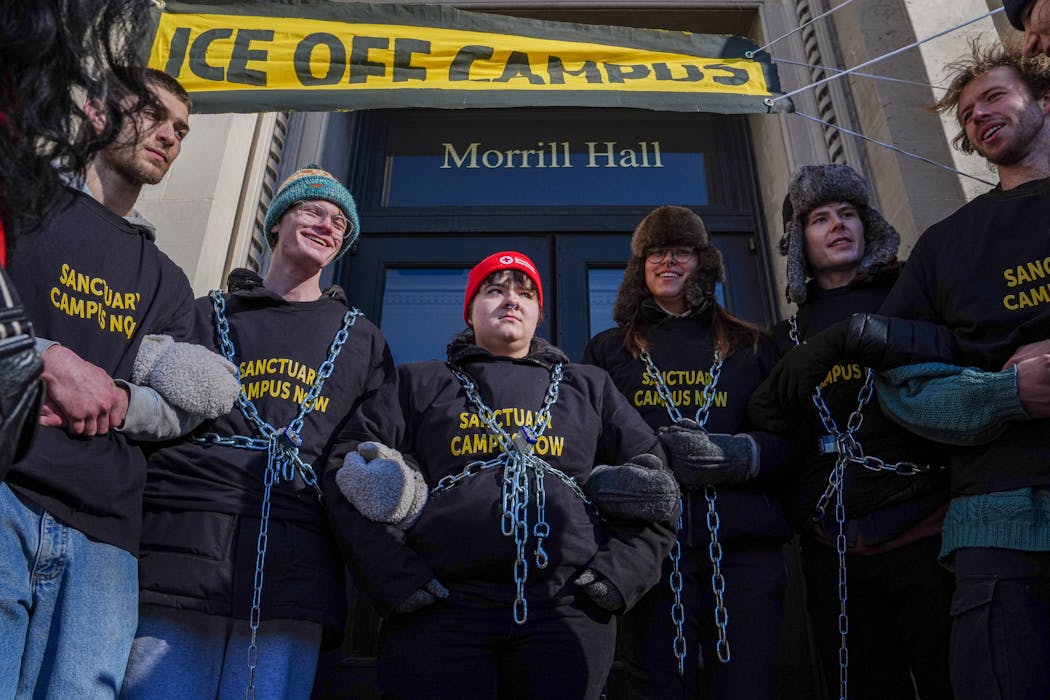
Trump administration immigration policies have received pushback from leaders of sanctuary jurisdictions, as well as protesters. AP Photo/Ryan Murphy

The Trump administration’s aggressive policies on immigration are receiving pushback not just on Capitol Hill but across the country. Democratic leaders in multiple states are refusing to cooperate with immigration arrests.

In response, the federal government is refusing to share evidence with state investigators in the deaths of Renee Good and Alex Pretti, who were killed by federal officers while protesting immigration enforcement in Minneapolis.

Throughout U.S. history, there have been many moments of conflict between the federal and state governments, such as on slavery, racial segregation, school testing requirements, health care, abortion and climate change. Conversely, there has also been a long history of cooperation between the different levels of government in matters such as disaster relief, law enforcement and antiterrorism efforts.

But what happens when the various states and the federal government see the same legal issue differently? Which side wins in a dispute? This is an ongoing and open question, as evidenced by the frequent lawsuits being filed against Trump administration policies by state attorneys general.

As a legal scholar, I study issues related to constitutional law, including federalism, or the division of power between the various levels of government in the U.S. system. Ultimately, the question of who prevails when there’s a dispute depends on whether the issue is more national or local in scope. It may also matter whether the issue affects fundamental rights, which no government may justly infringe.

Layers of authority

The framers of the Constitution saw the division of power between the states and federal government as part of the U.S. system of checks and balances. Just as the judicial, executive and legislative branches check each other, so do the different levels of government. “The true barriers of our liberty in this country are our state governments,” Thomas Jefferson wrote in 1811.

Still, it’s easy to assume that the federal government has greater power. The U.S. Constitution states that federal laws are “the supreme Law of the Land.” This is a model known as vertical federalism – in essence, putting the federal government above the states and localities.
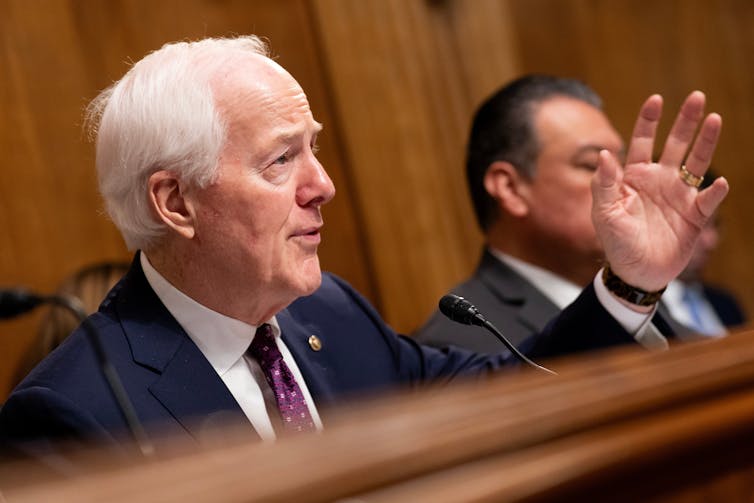
Texas Sen. John Cornyn gestures with his left hand while speaking at a committee hearing.
U.S. Sen. John Cornyn, a Texas Republican, speaks at a Senate hearing investigating fraud in the Medicaid program in Minnesota. Medicaid is a joint federal-state program.
AP Photo/Nathan Howard

There are areas of law where that framework clearly prevails. For example, immigration is an issue that the Constitution places squarely under the authority of the federal government. States cannot nullify, or invalidate, federal law. That is vertical federalism.

But the 10th Amendment says “powers not delegated to the United States … are reserved to the States respectively.” There are areas where states retain authority and the relationship between the levels of government is more horizontal, or flat or equal.

Consider cannabis. In 1996, California voters approved a ballot initiative making their state the first to allow the medical use of marijuana since prohibition started in the early 1900s. This was despite the fact that federal law viewed all cannabis as contraband. But California determines its own criminal code.

Californians could not stop the federal government from enforcing a valid federal law in their state, but that did not mean that California – or the vast majority of other states that have since passed their own medical or recreational marijuana measures – have to participate in a federal policy choice.

Federal agencies have continued occasional cannabis raids in California. But for state law enforcement officials, failing to punish a person for the medical use of cannabis is not a federal crime. In 1997, the Supreme Court ruled that the federal government cannot force a state “to enact or enforce a federal regulatory program.” That is horizontal federalism.

Constraints on all governments

The federal government is limited to its enumerated powers – which is to say, the powers spelled out directly by the U.S. Constitution. But states possess “police powers,” which is a broader authority to regulate health, safety and morality.

The federal government is responsible for foreign policy and regulating interstate commerce. But states and localities regulate vaccine mandates, police and fire services, and operate or oversee water and sewer systems, as well as taking stances on moral issues, including alcohol and gambling, due to their potential to cause harm.

Three bags of cannabis, seized by law enforcement, are on display on a table.
Most states have passed laws legalizing marijuana for recreational or medical use, but the drug remains illegal under federal law.
AP Photo/Thomas Peipert

But both the federal government and the states are limited by the Constitution. Neither can justly violate the freedom of the press, for example, under the First Amendment.

And the reality is that, at least at this point in history, there is no neat division between federal and state authority on a broad range of issues. The federal government, for example, pays for the bulk of interstate highway construction. But those roads are actually paved by states.

When the federal government is paying a share of the cost of carrying out its policies, the Supreme Court has ruled that it can, in fact, tell states what to do, such as enforcing a legal drinking age of 21 or risk a share of federal highway funds. But it has also found that federal demands on states can be unconstitutionally excessive or “coercive,” as with a mandate under the Affordable Care Act to expand Medicaid, which the court struck down, even though Washington was paying most of the bill.

Federalism and the question of which level of government has the ultimate say is often complex and messy. But for that reason, as the framers foresaw, it remains an important safeguard of liberty, preventing too much power from residing in one place.

The Conversation

Kenneth Michael White does not work for, consult, own shares in or receive funding from any company or organization that would benefit from this article, and has disclosed no relevant affiliations beyond their academic appointment.

ref. When Washington and the states are in conflict, the ultimate winner is not always certain – https://theconversation.com/when-washington-and-the-states-are-in-conflict-the-ultimate-winner-is-not-always-certain-276485

How does Iran go about selecting a new supreme leader? And who is in the running?

Source: The Conversation – USA (3) – By Eric Lob, Associate Professor of Politics and International Relations, Florida International University

The killing of Ayatollah Ali Khamenei on Feb. 28, 2026, set off the process of selecting a new supreme leader. It is only the second such transition in the Islamic Republic’s 47-year history and the first since the ailing Ayatollah Ruhollah Khomeini transferred power to Khamenei in June 1989.

As stipulated in Article 111 of the Iranian Constitution, a three-person Interim Leadership Council was created on March 1, 2026. It consists of President Masoud Pezeshkian, Chief Justice Gholam-Hossein Mohseni-Eje’i and Ayatollah Alireza Arafi, who is also a candidate for supreme leader.

The council has temporarily assumed the duties of the supreme leader until a new one is appointed by the Assembly of Experts – an elected body of 88 clerics. The assembly is expected to swiftly elect the next supreme leader, especially with Iran being in a state of war.

A group of clerics wearing traditional head coverings and long beards sit on seats arranged in concentric rows.
Members of Iran’s Assembly of Experts attend a session of the assembly in Tehran on Sept. 4, 2007.
AP Photo/Vahid Salemi

Assuming it can be carried out, a swift succession is meant to signal to domestic dissidents and external enemies alike that the regime – or ruling system, nezam – remains in place. During the assembly’s first meeting to select a new supreme leader on March 3, Israel bombed its building in the city of Qom. The building was evacuated before the strike, and no casualties were reported.

Some media reports have portrayed Khamenei’s son, Mojtaba, as a top contender, even though he lacks the status of a senior cleric. Although his is just one of a number of names that has been talked of as a potential successor.

Israel’s defense minister, Israel Katz, said that Israel would kill any successor to Khamenei that is selected. Nevertheless, the Assembly of Experts appears determined to carry out its constitutional duty and appoint a new supreme leader.

As a scholar of Iranian politics, I argue that the succession process, irrespective of its outcome, has never been free or transparent.

The history of succession

The Iranian supreme leader serves for life and is the highest religious and political authority in the Islamic Republic.

He is the commander in chief of the armed forces and oversees other key institutions, such as the judicial branch and state media.

He also supervises the Guardian Council, which has the power to vet electoral candidates and veto parliamentary legislation.

In this capacity, the supreme leader has the final say on foreign policy and different areas of domestic policy.

The first leader of the Islamic Republic – Khomeini – ruled between 1979 and 1989. In addition to being a revolutionary and charismatic figure, Khomeini was a grand ayatollah and a “source of emulation,” or marja’ al-taqlid.

A grand ayatollah and source of emulation is among a select few of the highest-ranking clerics. He is considered a “sign of God” in Twelver Shiism, the largest branch of Shiism and the state religion of Iran. A grand ayatollah and source of emulation has the authority to make legal decisions for his lay followers and for lower-ranking clerics in Iran and the wider Shiite world.

There are several dozen grand ayatollahs and sources of emulation in the world. Most of them reside and run seminaries in the holy cities of Qom in Iran and Najaf in Iraq. Shiites can choose which one they want to follow as a senior figure of the faith, making the institution decentralized.

The electoral facade

The members of the Assembly of Experts serve eight-year terms and are authorized to elect, supervise and, if necessary, dismiss the supreme leader. Article 111 of the Iranian Constitution grants the assembly the authority to remove the supreme leader if he is deemed incapable or unqualified politically and religiously. However, it is unlikely to do so given that its members are first vetted by the Guardian Council before being elected by a popular vote of Iranian men and women ages 18 and older.

It should be noted that the members of the Guardian Council are appointed by the supreme leader and the chief justice, or head of the judiciary, who is also appointed by the supreme leader.

Therefore, through the council, the supreme leader approves the candidates. They are potentially elected to a body that oversees him, making the process far from free and fair.

In the last election for the Assembly of Experts in March 2024, which had a historically low voter turnout of about 40%, the Guardian Council disqualified many candidates.

This was particularly the case with moderates and reformists, who tended to oppose the supreme leader on various issues. For this reason, the assembly has not been known to seriously supervise or challenge the supreme leader, and its proceedings have remained strictly confidential or closed to the public.

The 1989 succession

As Khomeini approached the end of his life in 1989, the constitution was amended so that a lower-ranking cleric like Khamenei could assume the position.

A bearded man wearing a black turban and a long robe speaks on microphones while holding white flowers in one hand. On the wall next to him are photographs of two men, also wearing black turbans.
The leader of the Islamic Republic of Iran, Ayatollah Ali Khamenei, speaks at Friday prayers in Tehran on Oct. 30, 1998. Beside him is a picture of his predecessor, Khomeini.
AP Photo/Mohammad Sayyad

As a seminary student of Khomeini who was more interested in politics than religion, Khamenei ranked below an ayatollah. Within the Shiite clerical hierarchy, and like other Islamic scholars who studied under an ayatollah, he earned the title Hojjat al-Eslam, or “proof of Islam.” He possessed the foundational knowledge of Islam without the advanced and independent reasoning – ijtihad – required for an ayatollah.

After being appointed to succeed Khomeini, Khamenei’s rank was elevated overnight to a grand ayatollah. The reason for the appointment was that Khamenei was a longtime loyalist and regime insider, even though he lacked the charismatic and religious authority of Khomeini.

Until 1989, Grand Ayatollah Hussein-Ali Montazeri – a prominent theologian and revolutionary leader – was expected to take over as the supreme leader. That year, however, he was ultimately passed over by Khomeini and detained by the Revolutionary Guard.

Montazeri succumbed to this fate because he had questioned Khamenei’s qualifications as supreme leader and condemned the regime for its repression, especially the execution of thousands of political prisoners in 1988 by a committee of four prosecutors. After continuing to criticize Khamenei in 1997, Montazeri was placed under house arrest under the pretext of protecting him from hard-liners. In 2003 he was released by the reformist president Mohammad Khatami, who had received pressure from parliamentarians to do so.

The situation with succession today

For years, rumors circulated that Mojtaba Khamenei, the son of the recently slain supreme leader, could be named the next one. However, such a scenario seemed unlikely during the lifetime of Ayatollah Ali Khamenei, who openly opposed it.

He did so to avoid antagonizing parts of the political and religious establishment that categorically reject hereditary or dynastic succession. After all, the concept is considered antithetical or anathema to the Iranian Revolution, which deposed the monarchy led by the shah, Mohammad Reza Pahlavi, in 1979.

From a political perspective, Mojtaba has never held public office. By contrast, his father served as Iran’s third president between 1981 and 1989.

Several men surround a bearded, spectacled man wearing a black headdress.
Mojtaba Khamenei, center, attends the annual Quds Day, or Jerusalem Day, rally in Tehran on May 31, 2019.
AP Photo/Vahid Salemi, File

Religiously speaking, Mojtaba – like his father before he became the supreme leader – is only a midranking cleric, though he teaches theology at the renowned Qom Seminary. As with his father, and for political purposes, the Assembly of Experts would have to elevate Mojtaba’s status to a grand ayatollah, even without the requisite religious credentials.

It is worth mentioning that Mojtaba is being considered for supreme leader alongside some seniors clerics whose credentials come closer to that of a grand ayatollah. Alireza Arafi, whose name has also come up as a potential successor, attained the rank of an ayatollah, or mujtahid, after publishing over 20 books and articles on Islamic jurisprudence and philosophy.

That said, in 2022 his religious qualifications were called into question. That year he joined the Assembly of Experts without taking the required written exam administered by the Guardian Council, even though he had been a member of it since 2019. Instead, he was appointed to the assembly by Khamenei through a legal loophole and without being elected. This incident indicated that Arafi was favored by Khamenei and may have an advantage as a candidate for supreme leader.

Another candidate, Ayatollah Mohammad Mehdi Mirbagheri, is an Islamic philosopher and theoretician. In this capacity, he serves as the head of the Qom Academy of Islamic Sciences and has been a member of the Assembly of Experts since 2016.

Yet another contender is Ayatollah Hashem Hosseini Bushehri. He was educated in the Qom Seminary and became the Friday prayer leader of the city. Alongside Arafi, Bushehri serves as a deputy chairman of the Assembly of Experts.
As the current conflict continues, and even with the Interim Leadership Council in place, the Assembly of Experts is under immense pressure to rapidly rule on succession to preserve the system.

Mojtaba Khamenei’s election, as I see it, would continue the trend of prioritizing political preferences over religious principles that started in 1989.

This piece includes material from an earlier one published on May 23, 2024.

The Conversation

Eric Lob is affiliated with the Carnegie Endowment for International Peace.

ref. How does Iran go about selecting a new supreme leader? And who is in the running? – https://theconversation.com/how-does-iran-go-about-selecting-a-new-supreme-leader-and-who-is-in-the-running-277249

Persian Gulf desalination plants could become military targets in regional war

Source: The Conversation – USA (2) – By Michael Christopher Low, Associate Professor of History; Director, Middle East Center, University of Utah

The Ras al-Khair water desalination plant in eastern Saudi Arabia is just one of many along the Persian Gulf coast. Fayez Nureldine/AFP via Getty Images

Saudi Arabia, the United Arab Emirates and neighboring countries in the Persian Gulf region use the fossil fuels under their desert lands not only to make money, but also to make drinking water. The petroleum they produce powers more than 400 desalination plants, which turn seawater into drinkable water.

In the war that began on Feb. 28, 2026, with U.S. and Israeli attacks on Iran, retaliatory attacks from Iranian forces have hit oil refineries and natural gas plants and disrupted tourism and aviation. Those attacks all hurt Gulf nations’ economies and their hard-won reputations for safety and stability.

But Iranian strikes have also already hit close to a key desalination plant in Dubai. Iranian strikes on March 2 on Dubai’s Jebel Ali port hit about 12 miles (20 kilometers) away from a massive complex with 43 desalination units that are key to the city’s production of more than 160 billion gallons of water each year.

And there has already been damage to the UAE’s Fujairah F1 power and water plant and at Kuwait’s Doha West plant. In both cases, the damage seems to have stemmed from attacks on nearby ports or from falling debris from drone interceptions.

Three people walk through a massive space with many large pipes and valves.
The internal workings of desalination plants can be massive and very complex.
Fayez Nureldine/AFP via Getty Images

Saltwater kingdoms

The region’s monarchies are often described as petro-states, but they have also become what I call saltwater kingdoms, global superpowers in the production of human-made fresh water drawn from the sea. Desalination is part of the reason there are golf courses, fountains, water parks and even indoor ski slopes with manufactured snow.

All together, eight of the 10 largest desalination plants in the world are in the Arabian Peninsula. Israel’s two Sorek plants round out the list.

The countries of the Arabian Peninsula have about 60% of global water-desalination capacity. And plants close to Iran, around the Persian Gulf and the Arabian Sea, produce more than 30% of the world’s desalinated water.

Roughly 100 million people in the Gulf region rely on desalination plants for their water. Without them, almost nobody would be able to live in Kuwait, Qatar and the UAE – or much of Saudi Arabia, including its capital, Riyadh.

Under a massive roof, skiers slide down snow-covered slopes while others sit in a chairlift.
A massive indoor ski area in Dubai is just one of the ways Gulf nations use desalinated water.
Karim Sahib/AFP via Getty Images

Sabotage of water supplies

CIA worries about attacks on Gulf region desalination plants date back to the 1980s. During Saddam Hussein’s 1990 invasion of Kuwait, those worries became real.

After coalition forces began bombing Iraqi positions in January 1991, part of Iraqi troops’ response was to release millions of barrels of crude oil into the Persian Gulf. As the massive oil slick drifted south, U.S. and Saudi officials feared it was meant to sabotage desalination systems.

Workers installed protective booms to shield intake valves at major plants, especially the one that supplies much of Riyadh’s water. In Kuwait, Iraqi sabotage damaged or destroyed much of the country’s desalination capacity.

Kuwaiti authorities also turned to Turkey and Saudi Arabia to supply some 750 water tankers and 200 trucks to import an 18-ton emergency supply of bottled water. U.S.-supplied generators and mobile desalination units provided additional temporary relief, though the full recovery took years.

A beach with black oil on it and large buildings in the background.
Oil washes up on a Persian Gulf beach near a Saudi desalination plant in late January 1991.
Chris Lefkow/AFP via Getty Images

More recent threats

Fears of attacks on desalination plants resurfaced after Yemen’s Houthi movement launched drones and missiles at Saudi facilities at Al-Shuqaiq in 2019 and 2022 – though they did no lasting damage.

Iran’s weapons are far more numerous and sophisticated than the Houthis’, though, so if it attacked desalination plants, the damage could be significant.

There is an irony here: Iran’s capital city of Tehran has a water shortage crisis so serious that in 2025 the government reportedly considered relocating the drought-stricken capital to the coast. But Iran is less vulnerable to attacks on desalination, because its water supply relies instead on dams and wells.

Whatever else the war may be about, water could well become a major factor in the violence and leave lasting political scars. And if either side were to intentionally attack water sources or desalination plants, it would clearly be a human-rights violation.

The Conversation

Michael Christopher Low does not work for, consult, own shares in or receive funding from any company or organization that would benefit from this article, and has disclosed no relevant affiliations beyond their academic appointment.

ref. Persian Gulf desalination plants could become military targets in regional war – https://theconversation.com/persian-gulf-desalination-plants-could-become-military-targets-in-regional-war-277597

How Denver’s Northeast Park Hill community reduced youth violence by 75%

Source: The Conversation – USA – By Beverly Kingston, Director and Senior Research Associate, Center for the Study and Prevention of Violence, University of Colorado Boulder

The neighborhood had nearly double the youth arrest rate of the other 76 Denver neighborhoods combined. Royalty-free/Getty Images

Northeast Park Hill, a Denver neighborhood, has a long history of violence. During Denver’s summer of violence in the early 1990s, it was considered ground zero for gang conflict.

From the late 1990s through 2014, violent crime in Northeast Park Hill declined from its peak in the early ’90s but remained persistently higher than city averages. In 2016, Northeast Park Hill recorded 1,086 youth arrests per 100,000 young people. The arrest rate for the combination of the other 76 Denver neighborhoods was 513.

With a population of approximately 9,600, 19% of families in the neighborhood lived below the federal poverty line, 39% of residents identified as Black, and 27% identified as Hispanic.

Yet, Northeast Park Hill is also a community defined by collective action. In 2013, residents started organizing in response to a series of violent events. They laid the foundation for an emerging movement committed to rebuilding community safety.

Building on these community strengths, researchers at the University of Colorado Boulder’s Center for the Study and Prevention of Violence partnered with local leaders to implement Communities That Care in 2016. The program is a science-based prevention process designed to help communities use data, evidence and collective action to reduce youth violence.

As a sociologist and director of the Center for the Study and Prevention of Violence, my work examines the root causes of youth violence. I study how community-led, data-driven prevention efforts can reduce risk and build supports that help young people stay safe and connected. Working alongside leaders and residents in Northeast Park Hill, I’ve seen firsthand what’s possible and what their remarkable success can teach all of us.

A welcome change

After just five years, the youth arrest rate in Northeast Park Hill fell to 276 per 100,000 – a 75% reduction.

This drop in youth arrests reflects a decades-long nationwide trend. Across the country as a whole, juvenile arrests peaked in 1996 and then began a steady decline.

But not all neighborhoods benefited equally. To measure the impact of local prevention work in Northeast Park Hill, we compared its arrest rate to a carefully constructed “look-alike” community made up of similar Denver neighborhoods that did not receive the intervention. We found Northeast Park Hill saw a sharper and earlier decline than its comparison community – pointing to an impact beyond national trends and tied to the local interventions.

Impacts of youth violence

Youth violence is a major cause of harm.

This is especially true for urban communities that have endured decades of chronic disinvestment. That includes neglected infrastructure, deteriorating housing and long-standing environmental and health inequities. Such environments often lack the opportunities, resources and support that are essential for healthy youth development.

In the 1960s, Park Hill became a burgeoning mecca for affluent Black families. Redlining, a federal practice that deemed certain minority neighborhoods “hazardous” and denied those residents mortgages and insurance, changed the community. A 9News report looks back at how redlining defined Park Hill.

Young people in these neighborhoods are more likely to face increased exposure to violence and daily challenges associated with navigating violent communities, such as witnessing shootings near their homes and schools. They also face ongoing experiences of marginalization and discrimination. Many young people move through daily life in a constant state of vigilance. Some youth withdraw, carry weapons for protection or turn to substances to cope with chronic anxiety.

Building a prevention infrastructure

As part of Communities That Care, the community formed a prevention coalition of approximately 25 members, known as Park Hill Strong, to guide the work.

Three Black leaders, Troy Grimes, Jonathan McMillan and Dane Washington Sr., who grew up in the neighborhood and experienced the violence of the 1990s firsthand, chaired the coalition.

Following the Communities That Care model, they began by creating a community profile. They used local data, including youth and parent surveys, and neighborhood indicators, such as access to safe parks, after-school programs and healthy foods. The data helped the coalition identify the biggest sources of risk and what protective supports were available in the community.

That data pointed to several factors that increase the likelihood of youth violence. Many youth felt disconnected from their community and had limited supervision or inconsistent support at home. The data also highlighted early and persistent problem behaviors among youth, including aggression and defiance, which can place young people on a pathway toward later violence.

The data also revealed protective supports to build on. It showed that opportunities for young people to participate in positive activities were limited. Community recognition of youths’ healthy and constructive contributions was also low — highlighting important areas for improvement.

Once the profile was complete, the coalition developed a community action plan describing the community prevention strategies the coalition would use to address their prioritized risk and protective factors.

Community-level prevention strategies

The coalition selected three community-level prevention strategies.

First, a youth-led media campaign called the Power of One (PO1) addressed the risk factor of low neighborhood attachment. The campaign challenged the idea that young people themselves are the cause of violence, instead highlighting how decades of redlining, concentrated poverty and limited access to quality schools and jobs have shaped the conditions they are navigating. The campaign also highlighted positive stories about young people and their communities. The Power of One has reached more than 3,000 youth and adults through social media and hosted six community block parties.

Power of One campaign teaser.

Second, the coalition selected Promoting Alternative Thinking Strategies, known as PATHS. This evidence-based program aims to reduce early and persistent problem behaviors. It was implemented in all three of the elementary schools in Northeast Park Hill. PATHS helps students learn social and emotional skills, including managing strong emotions by recognizing when they are feeling angry and using calming strategies before reacting. Strengthening these competencies is associated with lower rates of aggression.

Third, pediatric health care providers identified youth at risk for carrying out future serious violence through the violence, injury protection and risk screening tool. Youth identified as high or medium risk after completing a 14-item screening tool that assesses violence and victimization history and other risk factors are referred to appropriate services. A total of 222 youth ages 10 to 14 were screened between 2016 and 2021.

Funding is in jeopardy

For more than two decades, the Centers for Disease Control and Prevention has funded the National Academic Centers of Excellence in Youth Violence Prevention, which includes programs like ours. But recent CDC funding cuts threaten the continuation of this work.

Since 2000, these efforts have contributed to reductions in violence in communities across the nation, including Chicago; Denver; Flint, Michigan; Richmond, Virginia; and Youngstown, Ohio.

In Flint, community groups mowed and removed trash from vacant lots between 2009 and 2013. The surrounding areas saw 40% fewer assaults and violent crimes between the months of May and September compared to areas surrounding unmaintained lots.

Likewise, in Youngstown, during the summer months from 2016 to 2018, violent crime fell at twice the rate on streets surrounding vacant lots transformed into gardens and play spaces by community residents than on streets where professional mowers did the greening.

Funding for programs like these is critical for neighborhoods where resources are already scarce and the burden of violence has been concentrated for generations. Without continued investment, communities risk losing hard-won gains and the capacity to create safe and supportive environments for young people.

Read more of our stories about Colorado.

The Conversation

Beverly Kingston receives funding from the Centers for Disease Control and Prevention’s National Centers of Excellence in Youth Violence Prevention under Cooperative Agreement Number, 5 U01 CE002757. The findings and conclusions are those of the author and do not necessarily represent the official position of the Centers for Disease Control and Prevention.

ref. How Denver’s Northeast Park Hill community reduced youth violence by 75% – https://theconversation.com/how-denvers-northeast-park-hill-community-reduced-youth-violence-by-75-265943

Operational secrecy kept the US from making evacuation plans – and that means Americans in the Mideast could wait days

Source: The Conversation – USA – By Donald Heflin, Executive Director of the Edward R. Murrow Center and Senior Fellow of Diplomatic Practice, The Fletcher School, Tufts University

Canceled flights due to the Iran war have made it difficult for Americans to leave countries in the Middle East. Marcin Golba/NurPhoto via Getty Images

As the U.S. and Israel launched strikes on Iran, American citizens living in or visiting the Middle East found themselves stranded in countries facing bombing attacks by Iran. The State Department on March 2, 2026, urged Americans in 14 Middle Eastern countries to leave via “available commercial transportation, due to serious safety risks.” But commercial air travel and airports were shut down in many of those places and the U.S. wasn’t offering to evacuate its citizens.

Media reports featuring frustrated and frightened Americans stuck in places where danger was mounting, as well as growing criticism that the U.S. hadn’t handled the situation well or according to normal procedure, led the State Department to scramble and send charter flights to evacuate U.S. nationals from a handful of countries.

The Conversation’s politics editor Naomi Schalit interviewed former ambassador Donald Heflin, a veteran diplomat who now teaches at Tufts University’s Fletcher School, to understand how such situations are normally handled – and how the current situation diverged from longstanding practices.

A Facebook post with a message from the State Department on March 3, 2026, urging 'Americans to DEPART NOW' from the countries listed.
A Facebook post from the U.S. State Department on March 3, 2026, urging ‘Americans to DEPART NOW’ from the countries listed.
Facebook

What is the customary way that the United States and the State Department deal with U.S. nationals who are abroad in an area that becomes dangerous?

Over my 35-year career, I was ambassador to a small country and I worked a lot on African affairs. But most of my time was spent in consular affairs, which is the part of the State Department that does this work. And over the last 20 or 30 years, we’ve made a lot of progress. We’ve developed a model that works pretty well.

When you’re in a country with instability, what you want to do is to get the population of Americans down as small as you can. So the first thing that happens is you have some instability, and you tell Americans, “Listen, we advise against traveling here.” See if you can discourage everybody except missionaries or people whose employers really want them to go there to make money or people visiting family members, but get rid of the casual tourist.

Then, a little more time goes by and things start to get bad, and you say, “You should consider leaving.” And then, a little while later, the embassy gives its own employees and their families what they call “authorized departure,” which is, “It’s OK for you to go back to the U.S., and in fact we’ll help pay for it.” And we tell the public that, and we hope that that’ll help spur more people to leave.

And the step after that?

Next step: We order departure, where we tell parts of the embassy, “You’ve got to go home. You can’t make the decision to stay here, you and your kids go home.” And we tell the public that, and hopefully that makes the number of Americans remaining in the country smaller and smaller.

Then – and it doesn’t always happen – the last step is we evacuate. We say, “We’re getting our people out of here on planes, we’ve got space for you on the planes, you should have listened to us before.”

That’s the standard model. Unfortunately, it didn’t get followed very well this week.

What did you see this week, and how did it diverge from the normal procedure?

We went from zero to 60 very quickly. Look, the Mideast is unstable on a good day, but there had not been a new instability where people should be getting scared and going home. And then what happened was we launched the attack, and all of a sudden there was that instability.

Logically, you would think, there were two places that Americans should be getting out of. One was Iran, where we’ve told people not to be for many years. The other was Israel, because Israel is going to be attacked.

But no, the Iranians attacked over half a dozen countries. So now, all of a sudden, you’ve got Americans who feel unsafe in places that have never really been considered unsafe, like Oman, Cyprus or Turkey.

So now you have a long list of countries where you want to encourage Americans to leave and where they want to leave. There’s some demand, and you haven’t got that drawdown, where it makes things smaller, and also you haven’t done anything about arranging charter flights or military flights to get them out. So they’re going to have to stay where they are and feel unsafe for X number of days.

That’s when this started generating news stories.

This led to lot of people calling a member of Congress, a lot of people talking to the press, saying, “We got to get us out of here.” That’ll continue until the evacuation is arranged. There’s a bit of an analogy to COVID. When COVID first took off, we had a lot of Americans stuck overseas. They wanted to get home to their families. They figured U.S. health care to be the best that’s available, and it took us awhile to arrange charter flights. It was a very expensive process to get everybody home. They just kind of had to hunker down. That’s where we are right now.

On March 3, 2026, the State Department’s recorded message said the U.S. couldn’t help evacuate nationals in the Mideast; a more helpful message appeared the next day.

Do you think this problem that’s being faced by Americans in the Middle East now should have been anticipated by the State Department?

Yes and no. I think a big part of the problem here was that the Trump administration kept the knowledge of the impending attack to a very small circle of people for operational security reasons. You can’t launch a surprise attack if half of Washington knows about it.

You can see a scenario by which a very trusted State Department officer has to eventually talk to a charter plane company about chartering a whole bunch of planes. They’re going to figure out pretty quickly what’s going to happen, and then you’ve got a security leak.

At the same time, I think going back weeks and months, maybe people should have been arranging charter flights and military flights, kind of on spec so that you could flip the switch and get that going right away. They’re kind of starting from scratch this week.

You’ve got people who are stranded, afraid and can’t get on with their lives. What should happen next?

All these Iranian strikes, the casualty numbers aren’t high. So objectively speaking, I think that very few of the Americans over there are in actual, real danger.

But casual tourists do get afraid, and they don’t travel overseas that much. This may be their first time in the Mideast, and all of a sudden this is happening. They want out bad. They’re scared, whether, objectively speaking, they have a good reason to be scared or not. And it’s better for everybody – the U.S. embassy, the host country, for people in Washington – if we get them out of there and get them home.

This will sort itself out. There will be planes, we’ll get all the people out who want to get out, but it’s going to take at least a few days, maybe a week.

The Conversation

Donald Heflin does not work for, consult, own shares in or receive funding from any company or organization that would benefit from this article, and has disclosed no relevant affiliations beyond their academic appointment.

ref. Operational secrecy kept the US from making evacuation plans – and that means Americans in the Mideast could wait days – https://theconversation.com/operational-secrecy-kept-the-us-from-making-evacuation-plans-and-that-means-americans-in-the-mideast-could-wait-days-277578

2025 was hotter than it should have been – 5 influences and a dirty surprise offer clues to what’s ahead

Source: The Conversation – USA (2) – By Michael Wysession, Professor of Earth, Environmental, and Planetary Sciences, Washington University in St. Louis

The sun rises over New York City as a heat wave arrives in June 2025. Gary Hershorn/Getty Images

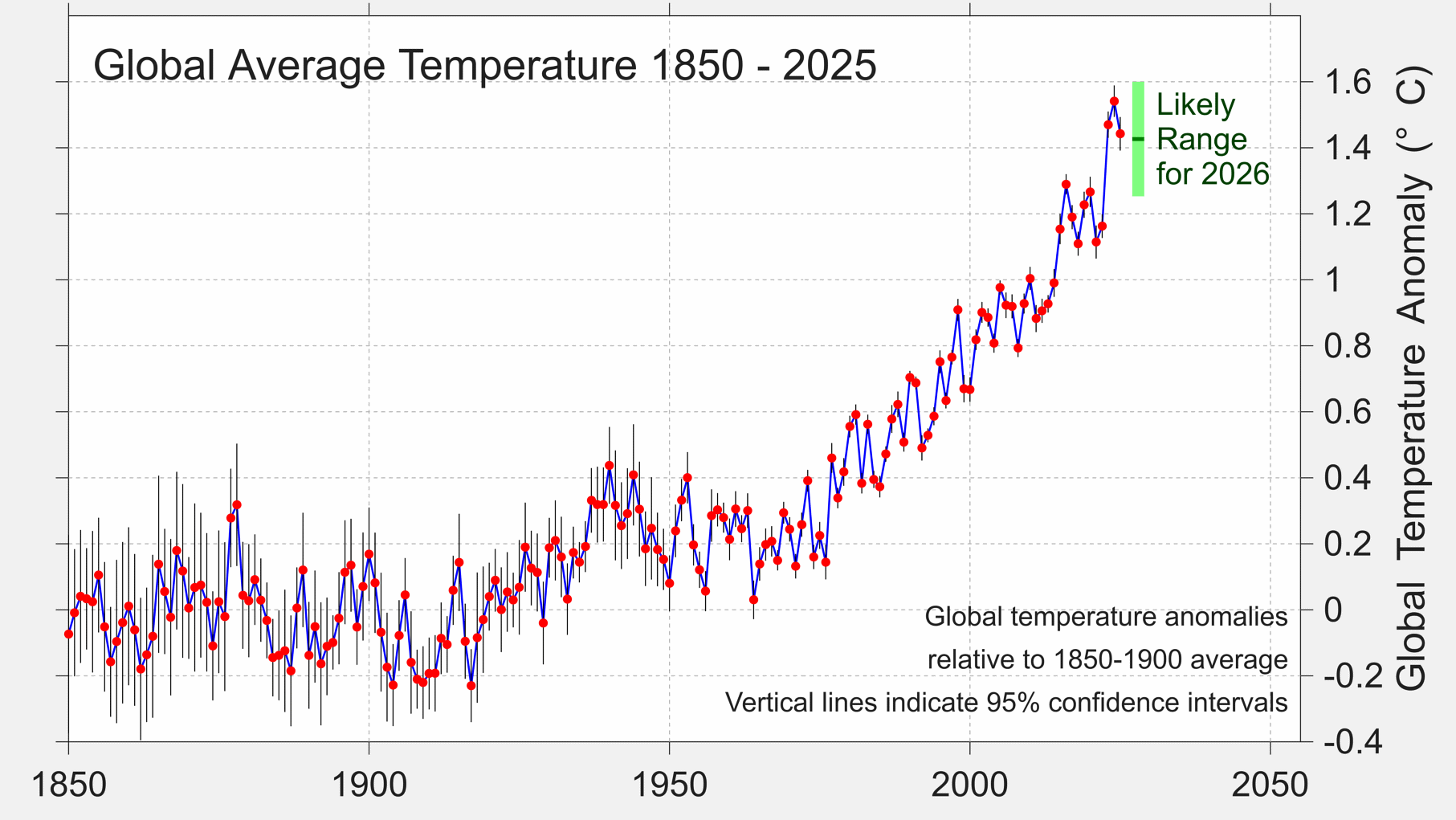
The past three years have been the world’s hottest on record by far, with 2025 almost tied with 2023 for second place. With that energy came extreme weather, from flash flooding to powerful hurricanes and severe droughts. Yet, by most indicators, the planet should have been cooler in 2025 than it was.

So, what happened, and what does that say about the year ahead?

As an earth and environmental scientist, I study influences that affect global temperatures year to year, such as El Niño, wildfires and solar cycles. Some make Earth hotter. Some make it cooler. And one particularly unhealthy influence has been quietly hiding a large amount of global warming – until now.

Chart shows temperatures rising
The past three years have been the warmest on record. The chart compiled by the European Union’s Copernicus Climate Change Service shows the comparison to preindustrial-era temperatures in the second half of the 1800s.
C3S/ECMWF

Factors that made 2025 cooler than 2024

The Earth’s climate is the result of many factors that change from year to year. Some that helped make 2025 cooler than 2024 include:

La Niña’s arrival: La Niña is part of the El Niño-Southern Oscillation, a natural climate pattern that fluctuates between warm El Niño conditions and cooler La Niña conditions. During El Niño, the Pacific Ocean heats up along the equator, influencing the atmosphere in ways that can cause intense storms, droughts and heat waves around the planet. La Niña does the opposite; it’s like putting an ice pack on the atmosphere.

Both 2023 and 2024 were El Niño years, but in 2025 conditions shifted to neutral and then to La Niña starting in September.

The solar cycle: The Sun reached its solar maximum near the end of 2024, the peak of its energy output in an approximately 11-year cycle, and began declining in 2025. So, while the sun’s output was still stronger than average in 2025, it was less than in 2024.

Fewer wildfires: Despite some destructive blazes, the world also saw fewer wildfires during 2025 than 2024, which put less carbon dioxide – a planet-warming greenhouse gas – into the atmosphere.

How different factors affected temperature over a decade.
Major warming and cooling influences from 2016 to 2025. Each graph starts at 2016. Anthropogenic warming, natural carbon sinks and sulfur dioxide (SO2) reductions start from zero in 2016 to illustrate cumulative changes to existing reservoirs; El Niño/La Niña and the solar cycle show real-time influences on the global temperature, relative to mean values.
Michael Wysession. Data: Global Carbon Project (Anthropogenic Global Warming, Natural Carbon Sinks); NOAA (El Niño/La Niña, Solar Cycle); SO2 Reductions (FaIR Analysis by Carbon Brief)

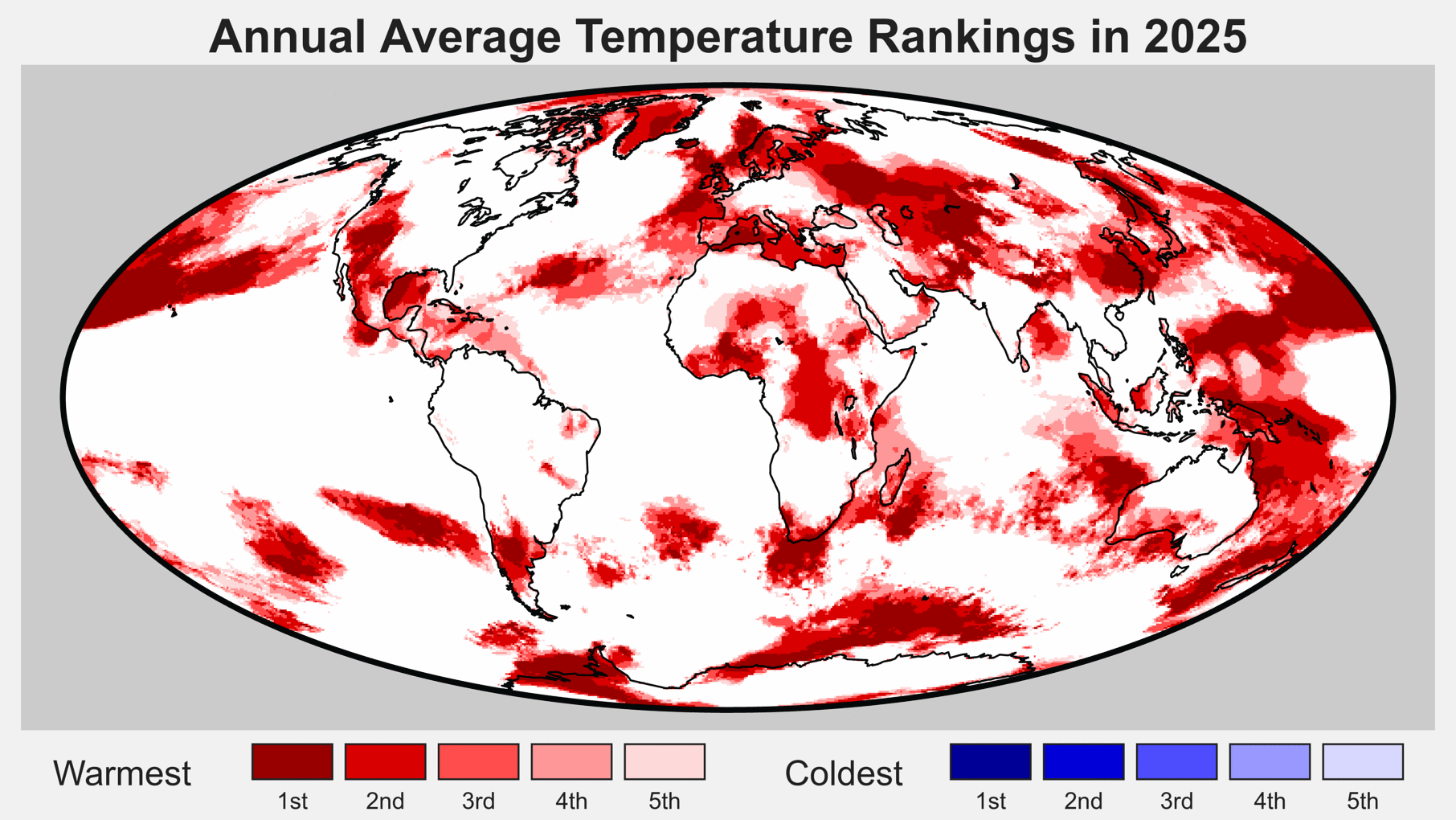
Despite those points, 2025 still ended up as the third-hottest year in over 175 years of record-keeping and likely one of the warmest in at least several thousand years. It was nearly as warm as 2023, at 2.6 degrees Fahrenheit (1.47 Celsius) above the 1850-1900 average, according to the European Union’s Copernicus Climate Change Service. It also had the second-highest average land temperature recorded, up 3.6 F (2 C) compared to preindustrial years, with more than 10% of the land experiencing record-high temperatures.

Factors that made 2025 warmer than expected

Several other factors made 2025 warmer than expected, and some are likely to continue to increase in 2026. They include:

Greenhouse gas emissions: The big driver of global warming is excess greenhouse gas emissions, largely from burning fossil fuels, and 2025 had plenty.

Greenhouse gases trap heat near Earth’s surface like a blanket, raising the temperature. They also linger in the atmosphere for years to centuries, meaning gases released today will continue to warm the planet well into the future. The levels of carbon dioxide, methane and nitrous oxide in the atmosphere all increased in 2025.

Coal is the largest source of carbon dioxide emissions, followed by oil and gas.
Sources of worldwide carbon dioxide emissions that have grown the most in recent decades.
Carbon Brief, CC BY

Rising energy demand drove an increase in fossil fuel use. About 80% of the increasing electric power demand came from emerging economies, largely for rising air conditioning demands as the world gets hotter. In the U.S., the rapid growth of data centers for AI and cryptocurrency mining helped boost U.S. carbon dioxide emissions by 2.4%.

China has become the largest carbon dioxide emitter in the past 20 years. U.S. emissions have fallen.
Countries that have been the largest sources of carbon dioxide emissions in recent decades.
Carbon Brief, CC BY

Earth’s energy imbalance: Other sources can disrupt the natural balance between the amount of sunlight that reaches Earth and the lesser amount radiated back to space. A recent study found that Earth’s energy uptake surged and temperatures rose quickly when a rare three-year La Niña in 2020-2022 shifted to El Niño in 2023-2024.

Declining polar ice, which efficiently reflects sunlight back into space, also affects the energy balance. As sea ice declines, it leaves dark ocean water that absorbs most of the sunlight that reaches it. In a spiraling feedback, warmer water melts sea ice, allowing more sunlight into the ocean, warming it faster; 2025 had the lowest winter peak of Arctic sea ice on record and the third-lowest minimum extent of Antarctic ice.

Air pollution: Sulfate aerosol pollution from coal combustion and burning heavy fuel oil in shipping has also been affecting Earth’s energy balance. It has been masking the full effects of human-caused greenhouse gases for years by reflecting sunlight back into space, creating a cooling effect. But sulfate aerosol pollution is also a serious health hazard, blamed for about 8 million human deaths per year from lung diseases.

Recent reductions in sulfate pollution – now 40% less than 20 years ago – have meant about a 0.2 F (0.13 C) increase in global temperatures. Much of the reduction was from China’s efforts to reduce its notoriously bad air pollution in recent years and international shipping rules in effect since 2020 that have reduced sulfur emissions from large ships by 85%.

Lines show 2025 was among lost sea ice years for both Arctic and Antarctic sea ice.
Sea ice levels were near record lows for both Arctic and Antarctic ice in 2025.
Carbon Brief, CC BY

Taking all factors together, humans are now warming the planet at a faster rate than at any point in human history: at about 0.5 F (0.27 C) per decade. That extra heat can fuel extreme weather, including flash floods, heat waves, extended droughts, wildfires and coastal flooding, affecting human lives and economies.

Predictions for 2026

Most climate models predict 2026 will be about as hot as 2025, depending on whether a Pacific El Niño develops, which forecasters give about a 60% chance of happening. The planet is already starting the year out warm, even if it doesn’t feel like that everywhere. While January was very cold in parts of the U.S., globally, Earth saw its fifth-warmest January on record, and much of the western U.S. saw one of its warmest winters on record.

Solar output will continue to decrease slowly in 2026. However, the International Monetary Fund projects strong global economic growth at about 3.3%, suggesting electricity demand will also continue to grow. The International Energy Agency expects global electricity demand to increase by 3.6% per year through at least 2030.

Even though global renewable energy use is growing quickly, it isn’t growing fast enough to meet rising demand, meaning more fossil fuel use in the coming years. More fossil fuels burned means more emissions and more warming, while the ability of the ocean and land to absorb carbon dioxide continues to decrease. As a result, the atmosphere and oceans heat up, increasing the risks of passing tipping points – glaciers disappear, Atlantic Ocean circulation shuts down, permafrost thaws, coral reefs die.

If greenhouse gas emissions continue at a high rate, humanity may look back at 2025 as one the coolest years globally in the rest of our lives.

The Conversation

Michael Wysession does not work for, consult, own shares in or receive funding from any company or organization that would benefit from this article, and has disclosed no relevant affiliations beyond their academic appointment.

ref. 2025 was hotter than it should have been – 5 influences and a dirty surprise offer clues to what’s ahead – https://theconversation.com/2025-was-hotter-than-it-should-have-been-5-influences-and-a-dirty-surprise-offer-clues-to-whats-ahead-276605

We designed an AI tutor that helps college students reason rather than give them answers

Source: The Conversation – USA (2) – By Saharnaz Babaei-Balderlou, Teaching Assistant Professor of Economics, University of Wisconsin-La Crosse

If prompted, an AI tool can be tailored to help students think through their own reasoning rather than just feed them answers. Issarawat Tattong/iStock/Getty Images

Students using AI to cheat on homework or tests is a source of much discussion. But some scholars argue the greater risk of students using AI is that they will simply not learn.

Approximately 90% of 1,100 U.S. students surveyed at two-year and four-year colleges in 2025 reported using generative AI for everything from drafting assignments to clarifying complex concepts.

But when students use AI as a tutor or study partner, not as an immediate answer generator, does it make it easier or harder for them to learn?

We are economists who tried to answer this question by designing an AI tool using ChatGPT’s custom GPT feature, with the web access of the chatbot disabled.

We named the tool Macro Buddy and trained it to guide some students at one of our undergraduate macroeconomics classes at the University of Wisconsin, La Crosse, through their reasoning rather than giving them direct answers.

We found in our research, conducted in spring 2025, that students who used Macro Buddy, alongside peer discussion, earned higher exam scores than students who worked alone, without this AI tutor.

An image shows a row of college-aged people sitting at a long desk in a library.
College students are increasingly using AI to help them with their studies.
Maskot/iStock/Getty Images

Meet your new tutor

One of our macroeconomics courses enrolled 140 undergraduate students, mostly in their first or second year of college, divided across four sections.

Students’ course materials, assignments and exams were identical across all four sections. Students were generally not allowed to use AI tools or collaborate with classmates during exams. Students took all tests in person and were not allowed to reference any notes or other materials during the exam.

As a result, exam scores reflected what students understood and could explain on their own – without the help of AI or any other outside source.

After all students took their first exam, we randomly assigned the four class sections to take on a different study format.

We prompted one group of students to work individually, without Macro Buddy; another group of students worked in groups, without Macro Buddy; a third group of students worked individually, with Macro Buddy; and a fourth group of students worked in groups, with Macro Buddy.

We wanted to compare how different study approaches – working alone, working with classmates, using Macro Buddy or combining both – altered how well students did on exams.

Macro Buddy’s skills

We trained Macro Buddy with the help of lecture transcripts, slides and homework questions specifically from this macroeconomics course.

Macro Buddy had internet access turned off, so it relied only on the instructor’s course materials.

Macro Buddy was designed to act like a tutor, not an answer machine. Instead of giving students complete solutions, Macro Buddy asked follow-up questions meant to guide students toward an answer.

For example, if a student asked why lower prices might increase consumers’ spending, Macro Buddy would not offer a quick, full explanation. It might instead ask what happens to people’s purchasing power when prices fall. The student would then have to connect the concepts and explain their reasoning, in their own words, step by step.

This distinction between explaining an idea and receiving a finished answer matters.

An AI tool that simply delivers answers can allow students to skip thinking through a problem. One study found that when college students rely on a chatbot as a crutch, they perform worse when they no longer have access to it. A tool that asks questions requires students to do the work themselves, even while receiving guidance. This is the very process that makes learning stick.

What happened to students’ learning

The one group of students that continued working individually, without AI, served as our control group.

The other three groups changed how they studied: One began working in groups without AI, one worked individually with Macro Buddy, and the last group combined group work with Macro Buddy.

All of the students’ average scores declined when they took their second exam, across all four study groups.

By the third exam, however, differences across sections became clearer.

Students who used both Macro Buddy and group discussion earned the highest average scores. Students who used Macro Buddy alone also scored higher than those who worked alone without Macro Buddy. Students who worked in groups without Macro Buddy showed smaller improvements, when compared to the students in other groups.

The third exam happened several weeks after we introduced the new study formats.

By that point, students in the combined group may have grown more comfortable using Macro Buddy to test their understanding, while also explaining ideas to classmates. Working with peers meant having to articulate reasoning clearly and respond to questions, which can deepen understanding over time.

Why this matters

Some critics of AI worry that students will rely on AI to do the hardest parts of learning for them. This reflects a fear that students may stop practicing the skills that build expertise. Students become experts in their fields while struggling with confusing material, revising explanations and seeing whether they truly understand an idea.

Our experiment suggests erosion of learning when using AI is not inevitable.

We found that when AI is designed as a tutor that asks questions instead of simply giving answers – and when students are also required to explain their reasoning to classmates – the technology can support learning rather than replace it.

Most students today use general-purpose chatbots that are not designed as tutors. They type in a question and receive a response. But our findings suggest that even small design choices, such as building an AI chatbot with guiding questions, can shape how students engage with the material.

Peer discussion also adds something to the learning process that AI cannot provide: social accountability and exposure to alternative reasoning.

Together, these practices encourage students to think through problems more actively.

The evidence from our experiment highlights a practical distinction: AI can be used to replace thinking, or it can be used to support it. The impact may depend less on the technology itself and more on how it is structured and integrated into learning.

The Conversation

The authors do not work for, consult, own shares in or receive funding from any company or organization that would benefit from this article, and have disclosed no relevant affiliations beyond their academic appointment.

ref. We designed an AI tutor that helps college students reason rather than give them answers – https://theconversation.com/we-designed-an-ai-tutor-that-helps-college-students-reason-rather-than-give-them-answers-276584

Nearly a third of Pennsylvania gamblers are at risk of problem gambling − but few seek treatment

Source: The Conversation – USA (3) – By Gillian Russell, Assistant Research Professor, Penn State

Pennsylvania legalized online gambling in 2017. Tatiana Maksimova/Moment Collection via Getty Images

Nearly three times as many Pennsylvania adults gamble online today than just a few years ago.

And as online platforms make gambling easier and more convenient, some Pennsylvanians are gambling more often and may be more prone to developing problems.

We are researchers at Penn State’s Criminal Justice Research Center and the University of Kentucky’s College of Social Work who recently published these findings in a report on online gambling in Pennsylvania. The report was produced in partnership with the Pennsylvania Department of Drug and Alcohol Programs.

We surveyed over 3,500 Pennsylvania adults and found that between 2.5% and 6.4% could be classified as problem gamblers.

An additional nearly 30% fell into “at-risk” categories, meaning they show meaningful signs of harm but do not yet meet the threshold for problem gambling.

Here are five of our key findings and why they matter:

1. Most Pennsylvanians still gamble offline, not online – but the distance between the two is shrinking

When Pennsylvania legalized online gambling in 2017, it required an annual assessment on the impacts of the legislation on Pennsylvania residents’ gambling behaviors. The assessment began two years after the first licenses were issued.

In the first two years of the survey, which were used to produce the 2021 and 2022 annual reports, approximately 11% of Pennsylvania adults reported gambling online. That number rose to as high as 30% in the most recent 2025 report, which was released in January 2026.

The 2025 report, which used both online and phone survey methods, identified that between 61% and 74% of Pennsylvania adults had gambled at least once in the past year. These numbers were consistent with previous reports. Depending on the sampling method, between 56% and 69% of adults reported they had gambled offline – for example, playing slot machines at brick-and-mortar casinos or buying lottery tickets at a store. Between 17% and 30% had gambled online.

Lottery games and raffles remain the most popular offline gambling format, while sports betting remains the most popular online gambling format. This finding has been consistent through all five years of the report.

But the line between “online gamblers” and “offline gamblers” is blurry. Among those who had gambled online, more than three-quarters also gambled offline.

We grouped Pennsylvania gamblers into three subgroups and found that about 43% gambled exclusively offline, about 4% exclusively online, and somewhere between 14% to 27% were “mixed-mode” gamblers, meaning they gambled both online and offline.

Thumb shown touching mobile phone with betting apps on its display
The number of online gamblers in Pennsylvania has nearly tripled over the past three years.
AP Photo/Jeff Chiu

2. The more ways people gamble, the more they tend to gamble overall

Those who engaged in mixed-mode gambling participated in nearly twice as many gambling formats as those who gambled only offline or only online.

They also gambled most often: close to once a week on average, compared with about once a month for those who gamble offline only.

Mixed-mode gamblers also spent more time and more money on gambling. People who gambled offline-only or online-only spent a median of about US$20-$40 per month on gambling. Mixed-mode gamblers, meanwhile, spent about $105-$230 per month. Mixed-mode gamblers also had the largest single-day gambling losses.

3. Nearly a third of Pennsylvania gamblers are at risk of problem gambling

This year’s report is the first to estimate how many Pennsylvanians meet criteria for problem gambling in the general population.

Between 2.5% and 6.4% of adults could be classified as current problem gamblers, according to the “problem gambling measure.” This is an evidence-based measure of problem gambling that classifies individuals as recreational, at-risk and problem gamblers.

Nearly 30% fell into “at-risk” gambling categories. They showed meaningful signs of harm but did not yet meet the threshold for problem gambling.

People who engage in mixed-mode gambling are significantly more likely to fall into at-risk and problem gambling categories than people who gamble offline only or online only.

4. Most people with gambling problems do not seek help

Despite the size of the at-risk and problem gambling groups, very few people seek treatment or other assistance.

Only about 1.5% of Pennsylvanians said they felt they had a gambling problem in the past year. Just 0.2% said they had sought help.

Even among those who met criteria for problem gambling, only about 6% reported getting help.

Some people did reach out proactively for others. About 0.4% of residents said they had contacted the 1-800-GAMBLER helpline because of someone else’s gambling.

This gap between harm and help-seeking is not unique to Pennsylvania. But it matters more as gambling becomes easier, faster and more continuous, and as people are more exposed to gambling content through social media and streaming platforms.

5. Young men are particularly vulnerable

Pennsylvania’s experience with gambling mirrors what public health research has long shown with alcohol, tobacco and more recently cannabis: When a behavior becomes more accessible and easier to repeat, overall use rises and harm concentrates among a smaller, more vulnerable group.

Features of online gambling – such as ease of access and acceptance of online payment methods, including cryptocurrencies – are particularly appealing to younger adults, many of whom have shown declining interest in traditional forms of gambling, such as casinos or lotteries. Online platforms offer them the opportunity to gamble on their phones, at all hours, with rapid feedback and minimal barriers to entry. This matters because younger people, especially young men, are disproportionately vulnerable to different types of addictive behaviors, including misuse of alcohol and illicit substances.

For most Pennsylvanians, gambling remains a casual pastime. But as with drinking or substance use, increased availability expands both experimentation and the number of people who progress to harmful levels of engagement. As the online gambling market grows, the data suggests that entertainment and harm may be rising together, following a pattern that public health has seen before with alcohol and cannabis.

Read more of our stories about Philadelphia and Pennsylvania, or sign up for our Philadelphia newsletter on Substack.

The Conversation

Gillian Russell receives funding from the Commonwealth of Pennsylvania.

Glenn Sterner receives funding from the Commonwealth of Pennsylvania.

ref. Nearly a third of Pennsylvania gamblers are at risk of problem gambling − but few seek treatment – https://theconversation.com/nearly-a-third-of-pennsylvania-gamblers-are-at-risk-of-problem-gambling-but-few-seek-treatment-272240

Billions of dollars, decades of progress spent eliminating devastating diseases may be lost with undoing of USAID

Source: The Conversation – USA – By Sarah Greene, Instructor in Pediatrics and Infectious Diseases, Washington University in St. Louis

The parasites that cause river blindness and elephantitis have been afflicting people for centuries. Alexis Huguet/AFP via Getty Images

In Greek mythology, King Sisyphus was condemned by the god Zeus to spend eternity rolling a boulder up a hill only to have it roll back down, having to start anew every day.

His story captured our attention as researchers studying neglected tropical diseases – a collection of conditions that primarily affect poor people in low-income countries. These diseases do not kill people at the rates of more well-known infections, such as HIV, malaria and tuberculosis, but cause significant pain and disability. As chronic infections that can cause disfigurement, they are also stigmatizing and economically devastating.

For over 50 years, researchers, clinicians and policymakers in the global health community have worked to eliminate infections such as onchocerciasis (also known as river blindness) and lymphatic filariasis (elephantiasis). They’ve done this through controlling black flies and mosquitoes, the vectors that spread these diseases, as well as huge campaigns to distribute antiparasitic medications to entire communities in areas where these diseases are endemic.

Unfortunately, the Trump administration’s sudden defunding of the U.S. Agency for International Development in 2025 has created a real-life Sisyphean struggle for countries working to eliminate neglected tropical diseases. Withdrawal of USAID support is abandoning the boulder of disease elimination partway up the mountain. When countries are unable to provide treatment, the parasites that cause these diseases will spread to infect more people.

Inevitably, the boulder will roll backward, undoing decades and billions of dollars of work.

Ancient foes

Lymphatic filariasis and onchocerciasis are centuries-old afflictions. An Egyptian statue of Pharaoh Mentuhotep II from 2000 B.C. is suggestive of lymphatic filariasis.

Filarial worms can live for years within humans, causing a variety of different problems. In lymphatic filariasis, adult worms live in the lymphatic vessels, a network running throughout the body that returns fluid back to the circulatory system. This disruption of the lymphatic system can cause the extremities or the scrotum to swell tremendously.

In onchocerciasis, adult worms live in small nodules under the skin. The larval forms of these parasites migrate through the skin and can invade the eyes, causing chronic inflammation that can lead to blindness.

Close-up of a person's legs, one significantly swollen in comparison
Lymphatic filariasis, also known as elephantitis, causes significant disfigurement and disability.
Noah Seelam/AFP via Getty Images

In recognition of the significant suffering these diseases cause, the World Health Organization coordinated global efforts to eliminate them: onchocerciasis starting in 1974 and lymphatic filariasis in 2000.

Since then, these public health campaigns have distributed hundreds of millions of doses of treatment for lymphatic filariasis and onchocerciasis. Medications vary somewhat by location, but they often involve the use of the Nobel Prize-winning drug ivermectin. Merck, the manufacturer of ivermectin, provides the drug for free to each country’s disease control program. Similarly, the companies GlaxoSmithKline and Eisai respectively donate the antiparasitic medications albendazole and diethylcarbamazine citrate for these campaigns.

Together, these programs have dramatically reduced the numbers of people exposed to these infections. For lymphatic filariasis, as of 2024, 871 million people no longer need preventive medications, and 21 countries have eliminated this infection. Five countries have eliminated onchocerciasis.

A job partially completed

Despite significant progress in controlling these infections, it remains logistically challenging to map endemic areas, deliver medications, test for ongoing infection and decide which areas have active outbreaks.

While each country runs its own medication delivery programs, these efforts have been supported by the World Health Organization as well as USAID or USAID-funded nongovernmental organizations. The Trump administration’s funding cuts to USAID halted over 40 drug distribution drives in 2025, affecting over 140 million people. Importantly, the U.S was the largest financial contributor to the World Health Organization until it withdrew its membership in January 2026.

The end of USAID has caused famine and disease outbreaks.

We and others working on eliminating these neglected diseases are concerned that the rapid decrease in funding for these programs will destabilize efforts to treat infections. Stopping medication delivery now can allow these infections to spread unchecked and roll back decades of progress. Donated medications can be effective only if they are delivered to those who need them. This might mean that these campaigns will have to be combined with other public health efforts already underway, or that each country reallocates resources toward these efforts.

If the world turns its back on eliminating these diseases, millions of people will be hurt by the boulder rolling back down.

The Conversation

Sarah Greene has received funding from the NIH.

Philip Budge has received funding from the Gates Foundation and the NIH. He is a member of the Infectious Diseases Society of America and the American Society of Tropical Medicine and Hygiene.

ref. Billions of dollars, decades of progress spent eliminating devastating diseases may be lost with undoing of USAID – https://theconversation.com/billions-of-dollars-decades-of-progress-spent-eliminating-devastating-diseases-may-be-lost-with-undoing-of-usaid-266195

Why are some stars always visible while others come and go with the seasons?

Source: The Conversation – USA – By Vahe Peroomian, Professor of Physics and Astronomy, USC Dornsife College of Letters, Arts and Sciences

Stars near the north celestial pole circle the North Star, Polaris. Photographed in the Eastern Sierra Nevada, Calif. Vahé Peroomian

As a space scientist, every time I go outside with my family, I tell my children to look up at the sky. The front door of our home looks southeast, and on winter nights the constellation Orion hangs majestically just above the horizon as soon as it grows dark enough to see stars.

One summer night, my son came running in and exclaimed, “Dad, Orion’s not there!” It was time for his first real astronomy lesson.

We went outside and I asked him to find the Big Dipper, the easily identifiable pattern of stars that make up a portion of the constellation Ursa Major. I reminded him that we could always see the Big Dipper no matter what time of the year it was.

So, why is it that Orion is not always visible in the night sky, and certainly not in the same location month after month, while the Big Dipper always is? The answer is intimately tied to a few concepts: how astronomers measure the length of a day, the motion of the Earth around the Sun during a year, and the cadence with which stars rise and set night after night.

Sidereal time

If you look eastward at the same hour for two nights in a row, you’ll find that the stars seem to be in the same place. But they’re not, and this movement becomes apparent if you continue observing at the same hour for a week or more. A combination of the Earth’s daily rotation on its axis and its yearly orbit around the Sun cause them to appear to move across the sky.

Earth spins on its axis, which runs from the South Pole through the center of the Earth to the North Pole, once a day. Astronomers measure a day in two different ways: They measure a solar day, 24 hours long, with the position of the Sun from high noon to high noon. They measure a sidereal day with respect to distant stars that are fixed in the sky. A sidereal day is 23 hours and 56 minutes long.

A diagram showing the Earth and the Moon, with a sidereal day demarcated as an angle at 90 degrees from the North pole and a solar day demarcated as a 91 degree angle, adding 4 minutes to the rotation time.
Rather than measuring a day as how long it takes for the Earth to rotate with respect to the Sun, a sidereal day measures how long it takes for Earth to rotate with respect to faraway stars. A sidereal day doesn’t account for the small amount Earth moves on its orbit around the Sun, which is why it is slightly shorter than a solar day.
James O’Donoghue/Interplanetary, CC BY

The constellation Orion – and every star in the night sky – will appear in exactly the same place every 23 hours and 56 minutes. Because of this slight offset, stars will appear to rise four minutes earlier every 24 hours on successive nights. Over the course of a month, a star that was close to the eastern horizon at 10 p.m. will now be much higher in the sky, having risen two hours earlier.

So while the constellation Orion appears close to the horizon at sunset in late December, it is nearly overhead in February and March.

Bright stars visible over a rushing river.
The constellation Orion is visible in the sky. You can find it by seeing three bright, evenly spaced stars that represent Orion’s belt.
Vahé Peroomian

You can use an interactive star chart to see this phenomenon. Do you want to find Orion in August in North America? Just wake up at 4:30 a.m. and look eastward.

Unlike Orion, the Big Dipper is always visible at night in most of the Northern Hemisphere. This is because of how Earth’s daily rotation is projected onto the stars.

Circumpolar stars

Astronomers use a common set of reference points to project Earth’s north and south poles, and the equator, onto the celestial sphere, an imaginary sphere encompassing the sky.

The idea of the celestial sphere evolved in ancient times from the notion that the Earth was the unmoving center of the universe. The projection of Earth’s equator delineates the celestial equator, and the poles project onto the north and south celestial poles.

The motion of stars near the celestial poles differs from how Orion and other constellations behave. Presently, the north celestial pole is very close to the star Polaris, also known as the North Star. Stars close to Polaris never rise or set. They appear to circle counterclockwise around that star as the Earth spins on its rotation axis once a day.

The number of these circumpolar stars increases as you move toward the North Pole. There are no circumpolar stars at the equator. Every star and constellation rises in the east and sets in the west because Earth rotates west to east on its axis.

If you are standing at the North Pole, every northern constellation is circumpolar, circling the North Star and never rising or setting. The pattern is similar in the Southern Hemisphere, with the southern constellations circling clockwise around the south celestial pole.

Earth’s precession

Millennia ago, people charted the path of the Sun through the constellations of the zodiac, which birthed the practice of astrology.

What does it mean for the Sun to be in Sagittarius, for example? It means that to see the constellation Sagittarius, you have to be looking toward the Sun. That would make it daytime, when the stars are not visible. Wait for nightfall, and you can see Gemini high in the sky. Six months later, the Sun is in Gemini, and Sagittarius is visible in the night sky. This pattern repeats year after year, as the Earth orbits the Sun. Your zodiac signs depend on which constellation the Sun was in when you were born.

The constellations of the zodiac form a beltlike circle around the Earth and Sun in space.

There is one other change in the night sky that occurs on time scales much longer than a human lifetime. Because of the gravitational influence of the Sun, and to a lesser extent Jupiter, on Earth’s daily rotation, Earth’s spin axis precesses, or moves in a circle, like a toy top spun on a table.

Because of this motion, which also subtly changes Earth’s orbit in space, Polaris will no longer be the North Star a thousand years from now. Wait 12,000 years, and the bright star Vega will be closest to the north celestial pole, more than 50 degrees across the night sky from its present location near Polaris.

Another consequence of this motion, sometimes referred to as the precession of the equinoxes, is that today the constellations of the zodiac no longer align with the traditional dates associated with them.

For example, when horoscopes and astrological signs were originally devised, the Sun was in the constellation Sagittarius from Nov. 22 to Dec. 21. However, because of precession over thousands of years, the Sun now crosses this constellation from Dec. 18 to Jan. 19. It spends the early part of December in Ophiuchus, which is not part of the traditional 12 constellations of the zodiac.

These changes in the night sky take weeks, months or even hundreds of years to be visible. If you’re not that patient, you can fly to the opposite hemisphere to see Orion upside down and the night sky turning in the opposite direction above.

The Conversation

Vahe Peroomian has, in the past, received funding from the National Science Foundation (NSF) and from the National Aeronautics and Space Administration (NASA) for research in the field of space science.

ref. Why are some stars always visible while others come and go with the seasons? – https://theconversation.com/why-are-some-stars-always-visible-while-others-come-and-go-with-the-seasons-274096