In LGBTQ+ storybook case, Supreme Court handed a win to parental rights, raising tough questions for educators

Source: The Conversation – USA (3) – By Charles J. Russo, Joseph Panzer Chair in Education and Research Professor of Law, University of Dayton

The parents who brought the case had requested that their children be excused when books with LGBTQ+ characters were used in class. SDI Productions/E+ via Getty Images

The Supreme Court tends to save its blockbuster orders for the last day of the term – and 2025 was no exception.

Among the important decisions handed down June 27, 2025, was Mahmoud v. Taylor – a case of particular interest to me, because I teach education law. Mahmoud, I believe, may become one of the court’s most consequential rulings on parental rights.

An interfaith coalition of Muslim, Orthodox Christian and Catholic parents in Montgomery County, Maryland – including Tamer Mahmoud, for whom the case is named – questioned the school board’s refusal to allow them to opt their young children out of lessons using picture books with LGBTQ+ characters. Ruling in favor of the parents, the court found that the board violated their First Amendment right to the free exercise of religion by requiring their children to sit through lessons with materials inconsistent with their faiths.

Case history

The parents in Mahmoud challenged the use of certain storybooks that the board had approved for use in preschool and elementary school. “Pride Puppy!” for example – a book the schools later removed – portrays a family whose pet gets lost at a LGBTQ+ Pride parade, with each page devoted to a letter of the alphabet. The book’s “search and find” list of words directs readers to look for terms in the pictures, including “(drag) queen” and “king,” “leather” and “lip ring.” Other materials included stories about same-sex marriage, a transgender child, and nonbinary bathroom signs.

Initially, school administrators agreed to allow opt-outs for students whose parents objected to the materials. A day later, however, educators changed their minds. School officials cited concerns about absenteeism, the feasibility of accommodating opt-out requests, and a desire to avoid stigmatizing LGBTQ+ students or families.

In August 2023, a federal trial court rejected the parents’ claim that officials had violated their fundamental due process right to direct the care, custody and education of their children. The following year, the U.S. Court of Appeals for the 4th Circuit affirmed in favor of the board, finding that officials did not violate the parents’ rights to the free exercise of their religious beliefs, as protected by the First Amendment.

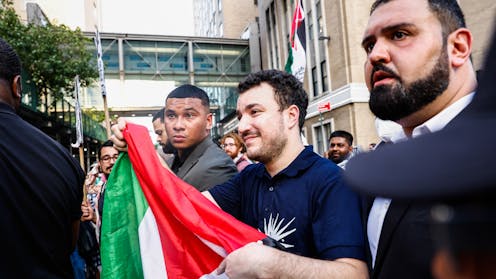
A protest outside, with people walking down a street as they carry placards.
A group of parents in Montgomery County, Maryland, protest the lack of opt-outs on July 20, 2023.
Celal Gunes/Anadolu Agency via Getty Images

On appeal, a 6-3 Supreme Court reversed in favor of the parents. Justice Samuel Alito, who authored the court’s opinion, was joined by Chief Justice John Roberts, plus Justices Clarence Thomas, Neil Gorsuch, Brett Kavanaugh and Amy Coney Barrett.

Supreme Court

In brief, the court held that by denying the parental requests to opt their children out of instruction inconsistent with their beliefs, school officials violated their First Amendment right to the free exercise of religion.

Alito largely grounded the court’s rationale in a dispute from 1925, Pierce v. Society of Sisters of the Holy Name of Jesus and Mary, and even more heavily on 1972’s Wisconsin v. Yoder. Both cases recognize the primacy of parental rights to direct the education of their children. According to Pierce’s famous dictum, “the child is not the mere creature of the state; those who nurture him and direct his destiny have the right, coupled with the high duty, to recognize and prepare him for additional obligations.”

In Yoder, Amish parents – an Anabaptist Christian community that avoids using many modern technologies – objected to sending their children to school after eighth grade because this would have violated their religious beliefs. The justices unanimously agreed with the parents that their children received all of the education they needed in their communities. The justices added that requiring the children to attend high school would have violated the parents’ rights to direct their children’s religious upbringing.

Accordingly, the court acknowledged that the parental right “to guide the religious future and education of their children” was “established beyond debate.”

Similarly, in Mahmoud the court declared that “the Board’s introduction of the ‘LGBTQ+-inclusive’ storybooks, along with its decision to withhold opt-outs, places an unconstitutional burden on the parents’ rights to the free exercise of their religion.”

Thomas agreed fully with the court, yet wrote a separate concurrence, which emphasized “an important implication of this decision for schools across the country.” Citing Yoder, Thomas contended that rather than support inclusion, the board’s policy “imposes conformity with a view that undermines parents’ religious beliefs, and thus interferes with the parents’ right to ‘direct the religious upbringing of their children.’”

Justice Sonia Sotomayor’s dissent, joined by Justices Elena Kagan and Ketanji Brown Jackson, feared “the result will be chaos for this Nation’s public schools. Requiring schools to provide advance notice and the chance to opt out of every lesson plan or story time that might implicate a parent’s religious beliefs will impose impossible administrative burdens on schools.”

A handful of people stand outside holding placards with messages including 'Read with pride not prejudice.'
Supporters of LGBTQ+ rights demonstrate outside the U.S. Supreme Court during oral arguments in Mahmoud v. Taylor on April 22, 2025.
Oliver Contreras/AFP via Getty Images

She maintained that “simply being exposed to beliefs contrary to your own” does not violate a person’s free exercise rights. Insulating children from different ideas, she wrote, denies them of an experience that is crucial for democracy: “practice living in our multicultural society.”

Implications

After the decision was handed down, Montgomery County’s Board of Education issued a statement promising to “analyze the Supreme Court decision and develop next steps in alignment with today’s decision, and as importantly, our values.”

Mahmoud raises challenging questions about the scope or reach of how far parents can question curricular content.

On the one hand, parents should not be able to micromanage curricular content via the “heckler’s veto,” because this can lead to larger issues. Moreover, while Mahmoud concerns religious rights, what happens if parents question teachings based on another type of sincerely held belief – discussing war if they are pacifist, for example, or capitalism if they are socialists? While Mahmoud dealt with free-exercise rights, it may open the door to other types of First Amendment challenges from parents wishing to exempt their children from lessons.

On the other hand, Mahmoud highlights the need to take legitimate parental concerns into consideration. While educators typically control instruction, how can they be respectful of parents’ rights as primary caregivers of their children when conflicts arise?

Mahmoud may go a long way in defining parents’ free-exercise rights in public schools. Still, such disputes are likely far from over in America’s increasingly diverse religious culture.

The Conversation

Charles J. Russo does not work for, consult, own shares in or receive funding from any company or organization that would benefit from this article, and has disclosed no relevant affiliations beyond their academic appointment.

ref. In LGBTQ+ storybook case, Supreme Court handed a win to parental rights, raising tough questions for educators – https://theconversation.com/in-lgbtq-storybook-case-supreme-court-handed-a-win-to-parental-rights-raising-tough-questions-for-educators-260064

1 in 4 Americans reject evolution, a century after the Scopes monkey trial spotlighted the clash between science and religion

Source: The Conversation – USA (3) – By William Trollinger, Professor of History, University of Dayton

The 1925 Scopes trial, in which a Dayton, Tennessee, teacher was charged with violating state law by teaching biological evolution, was one of the earliest and most iconic conflicts in America’s ongoing culture war.

Charles Darwin’s “Origin of Species,” published in 1859, and subsequent scientific research made the case that humans and other animals evolved from earlier species over millions of years. Many late-19th-century American Protestants had little problem accommodating Darwin’s ideas – which became mainstream biology – with their religious commitments.

But that was not the case with all Christians, especially conservative evangelicals, who held that the Bible is inerrant – without error – and factually accurate in all that it has to say, including when it speaks on history and science.

The Scopes trial occurred July 10-21, 1925. Between 150 and 200 reporters swooped into the small town. Broadcast on Chicago’s WGN, it was the first trial to be aired live over radio in the United States.

One hundred years after the trial, and as we have documented in our scholarly work, the culture war over evolution and creationism remains strong – and yet, when it comes to creationism, much has also changed.

The trial

In May 1919, over 6,000 conservative Protestants gathered in Philadelphia to create, under the leadership of Baptist firebrand William Bell Riley, the World’s Christian Fundamentals Association, or WCFA.

Holding to biblical inerrancy, these “fundamentalists” believed in the creation account detailed in chapter 1 of Genesis, in which God brought all life into being in six days. But most of these fundamentalists also accepted mainstream geology, which held that the Earth was millions of years old. Squaring a literal understanding of Genesis with an old Earth, they embraced either the “day-age theory” – that each Genesis day was actually a long period of time – or the “gap theory,” in which there was a huge gap of time before the six 24-hour days of creation.

This nascent fundamentalist movement initiated a campaign to pressure state legislatures to prohibit public schools from teaching evolution. One of these states was Tennessee, which in 1925 passed the Butler Act. This law made it illegal for public schoolteachers “to teach any theory that denies the story of divine creation of man as taught in the Bible, and to teach instead that man has descended from a lower order of animals.”

The American Civil Liberties Union persuaded John Thomas Scopes, a young science teacher in Dayton, Tennessee, to challenge the law in court. The WCFA sprang into action, successfully persuading William Jennings Bryan – populist politician and outspoken fundamentalist – to assist the prosecution. In response, the ACLU hired famous attorney Clarence Darrow to serve on the defense team.

A large group of men and women standing outside, intently looking ahead.
A huge crowd attending the Scopes trial.
Bettmann/Contributor via Getty Images

When the trial started, Dayton civic leaders were thrilled with the opportunity to boost their town. Outside the courtroom there was a carnivalesque atmosphere, with musicians, preachers, concession stands and even monkeys.

Inside the courtroom, the trial became a verbal duel between Bryan and Darrow regarding science and religion. But as the judge narrowed the proceedings to whether or not Scopes violated the law – a point that the defense readily admitted – it seemed clear that Scopes would be found guilty. Many of the reporters thus went home.

But the trial’s most memorable episode was yet to come. On July 20, Darrow successfully provoked Bryan to take the witness stand as a Bible expert. Due to the huge crowd and suffocating heat, the judge moved the trial outdoors.

The 3,000 or so spectators witnessed Darrow’s interrogation of Bryan, which was primarily intended to make Bryan and fundamentalism appear foolish and ignorant. Most significant, Darrow’s questions revealed that, despite Bryan’s’ assertion that he read the Bible literally, Bryan actually understood the six days of Genesis not as 24-hour days, but as six long and indeterminate periods of time.

A man in a white shirt and black bow tie stands with arms outstretched while talking, while others seated in rows around him look on.
American lawyer and politician William Jennings Bryan during the Scopes trial in Dayton, Tenn.
Hulton Archive/Getty Image

The very next day, the jury found Scopes guilty and fined him US$100. Riley and the fundamentalists cheered the verdict as a triumph for the Bible and morality.

The fundamentalists and ‘The Genesis Flood’

But very soon that sense of triumph faded, partly because of news stories that portrayed fundamentalists as ignorant rural bigots. In one such example, a prominent journalist, H. L. Mencken, wrote in a Baltimore Sun column that the Scopes trial “serves notice on the country that Neanderthal man is organizing in these forlorn backwaters of the land.”

The media ridicule encouraged many scholars and journalists to conclude that creationism and fundamentalism would soon disappear from American culture. But that prediction did not come to pass.

Instead, fundamentalists, including WCFA leader Riley, seemed all the more determined to redouble their efforts at the grassroots level.

But as Darrow’s interrogation of Bryan made obvious, it was not easy to square a literal reading of the Bible – including the six-day creation outlined in Genesis – with a scientific belief in an old Earth. What fundamentalists needed was a science that supported the idea of a young Earth.

In their 1961 book, “The Genesis Flood: The Biblical Record and its Scientific Implications, fundamentalists John Whitcomb, a theologian, and Henry Morris, a hydraulic engineer, provided just such a scientific explanation. Making use, without attribution, of the writings of Seventh-day Adventist geologist George McCready Price, Whitcomb and Morris made the case that Noah’s global flood lasted one year and created the geological strata and mountain ranges that made the Earth seem ancient.

“The Genesis Flood” and its version of flood geology remains ubiquitous among fundamentalists and other conservative Protestants.

Young Earth creationism

Today, opinion polls reveal that roughly one-quarter of all Americans are adherents of this newer strand of creationism, which rejects both mainstream geology as well as mainstream biology.

A large wooden ship resting on the ground with people walking nearby.
Replica of Noah’s Ark at the Ark Encounter, near Williamstown, Ky.
Ron Buskirk/UCG/Universal Images Group via Getty Images

This popular embrace of young Earth creationism also explains the success of Answers in Genesis – AiG – which is the world’s largest creationist organization, with a website that attracts millions of visitors every year.

AiG’s tourist sites – the Creation Museum in Petersburg, Kentucky, and the Ark Encounter in Williamstown, Kentucky – have attracted millions of visitors since their opening in 2007 and 2016. Additional AiG sites are planned for Branson, Missouri, and Pigeon Forge, Tennessee.

Presented as a replica of Noah’s Ark, the Ark Encounter is a gigantic structure – 510 feet long, 85 feet wide, 51 feet high. It includes representations of animal cages as well as plush living quarters for the eight human beings who, according to Genesis chapters 6-8, survived the global flood. Hundreds of placards in the Ark make the case for a young Earth and a global flood that created the geological strata and formations we see today.

Ark Encounter has been the beneficiary of millions of dollars from state and local governments.

Besides AiG tourist sites, there is also an ever-expanding network of fundamentalist schools and homeschools that present young Earth creationism as true science. These schools use textbooks from publishers such as Abeka Books, Accelerated Christian Education and Bob Jones University Press.

The Scopes trial involved what could and could not be taught in public schools regarding creation and evolution. Today, this discussion also involves private schools, given that there are now at least 15 states that have universal private school choice programs, in which families can use taxpayer-funded education money to pay for private schooling and homeschooling.

In 1921, William Bell Riley admonished his opponents that they should “cease from shoveling in dirt on living men,” for the fundamentalists “refuse to be buried.” A century later, the funeral for fundamentalism and creationism seems a long way off.

The Conversation

The authors do not work for, consult, own shares in or receive funding from any company or organization that would benefit from this article, and have disclosed no relevant affiliations beyond their academic appointment.

ref. 1 in 4 Americans reject evolution, a century after the Scopes monkey trial spotlighted the clash between science and religion – https://theconversation.com/1-in-4-americans-reject-evolution-a-century-after-the-scopes-monkey-trial-spotlighted-the-clash-between-science-and-religion-258163

Pop, soda or coke? The fizzy history behind America’s favorite linguistic debate

Source: The Conversation – USA (2) – By Valerie M. Fridland, Professor of Linguistics, University of Nevada, Reno

‘I’ll have a coke – no, not Coca-Cola, Sprite.’ Justin Sullivan/Getty Images

With burgers sizzling and classic rock thumping, many Americans revel in summer cookouts – at least until that wayward cousin asks for a “pop” in soda country, or even worse, a “coke” when they actually want a Sprite.

Few American linguistic debates have bubbled quite as long and effervescently as the one over whether a generic soft drink should be called a soda, pop or coke.

The word you use generally boils down to where you’re from: Midwesterners enjoy a good pop, while soda is tops in the North and far West. Southerners, long the cultural mavericks, don’t bat an eyelash asking for coke – lowercase – before homing in on exactly the type they want: Perhaps a root beer or a Coke, uppercase.

As a linguist who studies American dialects, I’m less interested in this regional divide and far more fascinated by the unexpected history behind how a fizzy “health” drink from the early 1800s spawned the modern soft drink’s many names and iterations.

Bubbles, anyone?

Foods and drinks with wellness benefits might seem like a modern phenomenon, but the urge to create drinks with medicinal properties inspired what might be called a soda revolution in the 1800s.

Drawing of hexogonal soda fountain with three visible spouts.
An 1878 engraving of a soda fountain.
Smith Collection/Gado via Getty Images

The process of carbonating water was first discovered in the late 1700s. By the early 1800s, this carbonated water had become popular as a health drink and was often referred to as “soda water.” The word “soda” likely came from “sodium,” since these drinks often contained salts, which were then believed to have healing properties.

Given its alleged curative effects for health issues such as indigestion, pharmacists sold soda water at soda fountains, innovative devices that created carbonated water to be sold by the glass. A chemistry professor, Benjamin Stillman, set up the first such device in a drugstore in New Haven, Connecticut, in 1806. Its eventual success inspired a boom of soda fountains in drugstores and health spas.

By the mid-1800s, pharmacists were creating unique root-, fruit- and herb-infused concoctions, such as sassafras-based root beer, at their soda fountains, often marketing them as cures for everything from fatigue to foul moods.

These flavored, sweetened versions gave rise to the linking of the word “soda” with a sweetened carbonated beverage, as opposed to simple, carbonated water.

Seltzer – today’s popular term for such sparkling water – was around, too. But it was used only for the naturally carbonated mineral water from the German town Nieder-Selters. Unlike Perrier, sourced similarly from a specific spring in France, seltzer made the leap to becoming a generic term for fizzy water.

Black and white photo of the interior of a drug store, with various health remedies sold on the right side, and a soda fountain with stools on the left.
Many late-19th-century and early 20th-century drugstores contained soda fountains – a nod to the original belief that the sugary, bubbly drink possessed medicinal qualities.
Hall of Electrical History Foundation/Corbis via Getty Images

Regional naming patterns

So how did “soda” come to be called so many different things in different places?

It all stems from a mix of economic enterprise and linguistic ingenuity.

The popularity of “soda” in the Northeast likely reflects the soda fountain’s longer history in the region. Since a lot of Americans living in the Northeast migrated to California in the mid-to-late 1800s, the name likely traveled west with them.

As for the Midwestern preference for “pop” – well, the earliest American use of the term to refer to a sparkling beverage appeared in the 1840s in the name of a flavored version called “ginger pop.” Such ginger-flavored pop, though, was around in Britain by 1816, since a Newcastle songbook is where you can first see it used in text. The “pop” seems to be onomatopoeic for the noise made when the cork was released from the bottle before drinking.

A jingle for Faygo touts the company’s ‘red pop.’

Linguists don’t fully know why “pop” became so popular in the Midwest. But one theory links it to a Michigan bottling company, Feigenson Brothers Bottling Works – today known as Faygo Beverages – that used “pop” in the name of the sodas they marketed and sold. Another theory suggests that because bottles were more common in the region, soda drinkers were more likely to hear the “pop” sound than in the Northeast, where soda fountains reigned.

As for using coke generically, the first Coca-Cola was served in 1886 by Dr. John Pemberton, a pharmacist at Jacobs’ Pharmacy in Atlanta and the founder of the company. In the 1900s, the Coca-Cola company tried to stamp out the use of “Coke” for “Coca-Cola.” But that ship had already sailed. Since Coca-Cola originated and was overwhelmingly popular in the South, its generic use grew out of the fact that people almost always asked for “Coke.”

Advertisement for orange soda reading 'a soft drink made from real oranges.'
No alcohol means not ‘hard’ but ‘soft.’
Nostalgic Collections/eBay

As with Jell-O, Kleenex, Band-Aids and seltzer, it became a generic term.

What’s soft about it?

Speaking of soft drinks, what’s up with that term?

It was originally used to distinguish all nonalcoholic drinks from “hard drinks,” or beverages containing spirits.

Interestingly, the original Coca-Cola formula included wine – resembling a type of alcoholic “health” drink popular overseas, Vin Mariani. But Pemberton went on to develop a “soft” version a few years later to be sold as a medicinal drink.

Due to the growing popularity of soda water concoctions, eventually “soft drink” came to mean only such sweetened carbonated beverages, a linguistic testament to America’s enduring love affair with sugar and bubbles.

With the average American guzzling almost 40 gallons per year, you can call it whatever you what. Just don’t call it healthy.

The Conversation

Valerie M. Fridland does not work for, consult, own shares in or receive funding from any company or organization that would benefit from this article, and has disclosed no relevant affiliations beyond their academic appointment.

ref. Pop, soda or coke? The fizzy history behind America’s favorite linguistic debate – https://theconversation.com/pop-soda-or-coke-the-fizzy-history-behind-americas-favorite-linguistic-debate-259114

Coral reefs face an uncertain recovery from the 4th global mass bleaching event – can climate refuges help?

Source: The Conversation – USA (2) – By Noam Vogt-Vincent, Postdoctoral Fellow in Marine Biology, University of Hawaii

The Great Barrier Reef stretches for 1,429 miles just off Australia’s northeastern coast. Auscape/Universal Images Group via Getty Image

Tropical reefs might look like inanimate rock, but these colorful seascapes are built by tiny jellyfish-like animals called corals. While adult corals build solid structures that are firmly attached to the sea floor, baby corals are not confined to their reefs. They can drift with ocean currents over great distances to new locations that might give them a better chance of survival.

The underwater cities that corals construct are home to about a quarter of all known marine species. They are incredibly important for humans, too, contributing at least a trillion dollars per year in ecosystem services, such as protecting coastlines from wave damage and supporting fisheries and tourism.

Unfortunately, coral reefs are among the most vulnerable environments on the planet to climate change.

Since 2023, exceptionally warm ocean water has been fueling the planet’s fourth mass coral bleaching event on record, causing widespread mortality in corals around the world. This kind of harm is projected to worsen considerably over the coming decades as ocean temperatures rise.

A healthy coral reef in American Samoa, left, experiencing coral bleaching due to a severe marine heatwave, center, and eventually dying, right.
The Ocean Agency and Ocean Image Bank., CC BY-NC

I am a marine scientist in Hawaii. My colleagues and I are trying to understand how coral reefs might change in the future, and whether new coral reefs might form at higher latitudes as the tropics become too warm and temperate regions become more hospitable. The results lead us to both good and bad news.

Corals can grow in new areas, but will they thrive?

Baby corals can drift freely with ocean currents, potentially traveling hundreds of miles before settling in new locations. That allows the distribution of corals to shift over time.

Major ocean currents can carry baby corals to temperate seas. If new coral reefs form there as the waters warm, these areas might act as refuges for tropical corals, reducing the corals’ risk of extinction.

Coral reefs made up of many individual coral polyps.
A close-up of double star corals (Diploastrea heliopora) off Indonesia.
Bernard DuPont/Flickr, CC BY-SA

Scientists know from the fossil record that coral reef expansions have occurred before. However, a big question remains: Can corals migrate fast enough to keep pace with climate change caused by humans? We developed a cutting-edge simulation to find the answer.

Field and laboratory studies have measured how coral growth depends on temperature, acidity and light intensity. We combined this information with data on ocean currents to create a global simulation that represents how corals respond to a changing environment – including their ability to adapt through evolution and shift their ranges.

Then, we used future climate projections to predict how coral reefs may respond to climate change.

We found that it will take centuries for coral reefs to shift away from the tropics. This is far too slow for temperate seas to save tropical coral species – they are facing severe threats right now and in the coming decades.

How coral reefs form.

Underwater cities in motion?

Under countries’ current greenhouse gas emissions policies, our simulations suggest that coral reefs will decline globally by a further 70% this century as ocean temperatures continue to rise. As bad as that sounds, it’s actually slightly more optimistic than previous studies that predicted losses as high as 99%.

Our simulations suggest that coral populations could expand in a few locations this century, primarily southern Australia, but these expansions may only amount to around 6,000 acres (2,400 hectares). While that might sound a lot, we expect to lose around 10 million acres (4 million hectares) of coral over the same period.

In other words, we are unlikely to see significant new tropical-style coral reefs forming in temperate waters within our lifetimes, so most tropical corals will not find refuge in higher latitude seas.

Even though the suitable water temperatures for corals are forecast to expand poleward by about 25 miles (40 kilometers) per decade, corals would face other challenges in new environments.

Our research suggests that coral range expansion is mainly limited by slower coral growth at higher latitudes, not by dispersal. Away from the equator, light intensity falls and temperature becomes more variable, reducing growth, and therefore the rate of range expansion, for many coral species.

It is likely that new coral reefs will eventually form beyond their current range, as history shows, but our results suggest this may take centuries.

Two fish hide among the spikes of coral.
Fish hide out in the safety of Kingman Reef, in the Pacific Ocean between the Hawaiian Islands and American Samoa. Coral reefs provide protection for many species, particularly young fish.
USFWS, Pacific Islands

Some coral species are adapted to the more challenging environmental conditions at higher latitudes, and these corals are increasing in abundance, but they are much less diverse and structurally complex than their tropical counterparts.

Scientists have used human-assisted migration to try to restore damaged coral reefs by transplanting live corals. However, coral restoration is controversial, as it is expensive and cannot be scaled up globally. Since coral range expansion appears to be limited by challenging environmental conditions at higher latitudes rather than by dispersal, human-assisted migration is also unlikely to help them expand more quickly.

Importantly, these potential higher latitude refuges already have rich, distinct ecosystems. Establishing tropical corals within those ecosystems might disrupt existing species, so rapid expansions might not be a good thing in the first place.

A temperate reef near southern Australia, which could be threatened by expansions of tropical coral species.
Stefan Andrews/Ocean Image Bank, CC BY-NC

No known alternative to cutting emissions

Despite enthusiasm for coral restoration, there is little evidence to suggest that methods like this can mitigate the global decline of coral reefs.

As our study shows, migration would take centuries, while the most severe climate change harm for corals will occur within decades, making it unlikely that subtropical and temperate seas can act as coral refuges.

What can help corals is reducing greenhouse gas emissions that are driving global warming. Our study suggests that reducing emissions at a faster pace, in accordance with the Paris climate agreement, could cut the coral loss by half compared with current policies. That could boost reef health for centuries to come.

This means that there is still hope for these irreplaceable coral ecosystems, but time is running out.

The Conversation

Noam Vogt-Vincent receives funding from the National Oceanic and Atmospheric Administration (NOAA).

ref. Coral reefs face an uncertain recovery from the 4th global mass bleaching event – can climate refuges help? – https://theconversation.com/coral-reefs-face-an-uncertain-recovery-from-the-4th-global-mass-bleaching-event-can-climate-refuges-help-255804