Data that taxpayers have paid for and rely on is disappearing – here’s how it’s happening and what you can do about it

Source: The Conversation – USA (2) – By Margaret Levenstein, Research Professor at the Institute for Social Research, University of Michigan
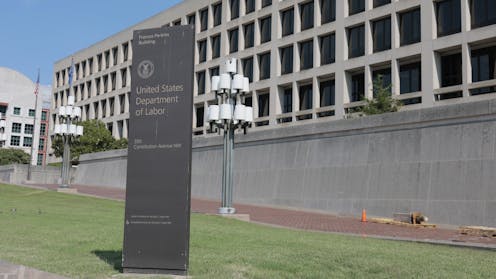
Many U.S. government agencies collect data and make it publicly available. Anna Moneymaker/Getty Images

People rely on data from federal agencies every day – often without realizing it.

Rural residents use groundwater level data from the U.S. geological survey’s National Water Information System to decide where to dig wells. High school coaches turn to weather apps supported by data from the National Weather Service to decide when to move practice inside to avoid life-threatening heat. Emergency managers use data from the Census Bureau’s American Community Survey to ensure that residents without vehicles have seats on evacuation buses during local emergencies.

On Jan. 31, 2025, websites and datasets from across the federal government began to disappear. As that happened, archivists and researchers from around the world sprang into action, grabbing what they could before it was gone.

Trust in the federal statistical system took another hit when Bureau of Labor Statistics Commissioner Erika McEntarfer was fired on the heels of a dismal Aug. 1, 2025, employment report.

And reduced data collection at the bureau was already causing concern before her dismissal. The bureau has ceased collection of critical inputs to the Consumer Price Index, likely reducing that inflation indicator’s accuracy, especially at the level of specific locations and products.

As researchers of economics and epidemiology at the University of Michigan, we have spent years working with data, often from the federal government. When data and information began to disappear, we were spurred into action to preserve these important public goods.

The Inter-university Consortium for Political and Social Research, where we work – commonly known as ICPSR – has been making data from governments and researchers available for more than 60 years. We are stewards of this data, preserving it and ensuring that it is accessible in a safe and responsible manner.

Unfortunately, government data is now at risk of becoming less available or disappearing. But there are steps that researchers – and the public – can take to reduce that risk.

Data at risk

Some 8,000 pages were removed from federal websites within a few days of Jan. 31, 2025. Though many were soon restored following substantial outcry and some court orders, it’s still unclear how the restored webpages and datasets may have been changed.

Webpage showing a search bar, several categories of data, and a mission statement about open government data
Data.gov, launched in 2009, lists many datasets available from the government, providing pointers back to the agency where the data resides. Congress codified this data transparency in the Open Government Data Act in 2019.
Screenshot by The Conversation, CC BY-SA

In one preliminary examination, researchers found that 49% of the 232 datasets they reviewed had been substantially altered, including the replacement of the word “gender” with “sex.” This alteration can obscure nonbinary gender identities. Only 13% of the changes the researchers found were documented by the government.

U.S. government data has also become less accessible because of mass firings of federal workers and the dismantling of entire agencies.

Important efforts like the Data Rescue Project and the Internet Archive have been able to preserve a great deal of knowledge and data, but they are mostly limited to publicly available data and information.

No one left to vet data

Many important government data resources contain sensitive or identifying information. This means officials must vet requests before they grant access to data rescue efforts. But many agencies have had their ability to conduct vetting and manage access severely curtailed and, in some cases, eliminated altogether.

Take the Pregnancy Risk Assessment Monitoring System, which provides key data on maternal and child health from around the United States. The Centers for Disease Control and Prevention integrates data collected at state and local levels and adds population information to come up with estimates. While some of this data is publicly available, access to most data from 2016 and later requires a request to the CDC and a signed data use agreement.

At the start of 2025, multiple researchers reported to our team at the Inter-university Consortium for Political and Social Research that the CDC had stopped processing these requests. In February, researchers discovered that the Pregnancy Risk Assessment Monitoring System would be discontinued.

The CDC suggested that data collection would restart at some point. But on April 1, the entire Pregnancy Risk Assessment Monitoring System team was laid off. This made one of the most valuable sources of data on the health of mothers and babies largely inaccessible, and put plans for its future in limbo.

Similar situations have played out at other agencies, including the dismantled U.S. Agency for International Development and the National Center for Education Statistics. Data collected, cleaned and harmonized using taxpayer dollars is now languishing on inaccessible servers.

Inaccessible data

The portal that researchers use to apply for access to restricted federal statistical data now includes a list of data that researchers can no longer access.
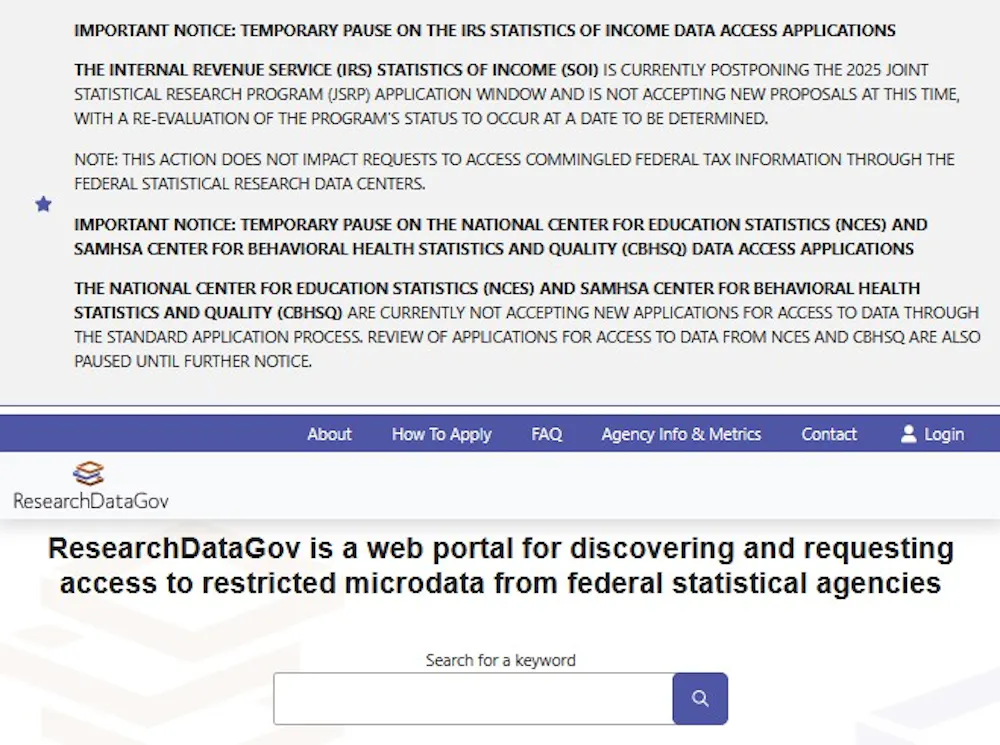
Screenshot of the dataset search bar with a notice above listing datasets that are not available
The portal that researchers use to apply for access to restricted datasets from 16 agencies has added a list of several large datasets that are no longer available.
The Conversation, CC BY-ND

Some organizations are leading efforts to restore access to particular datasets. The Inter-university Consortium for Political and Social Research, for instance, has an agreement with USAID to preserve and provide access to USAID’s education data. Unfortunately, these efforts barely scratch the surface. With very few staff left, there isn’t a clear estimate of which other USAID resources remain inaccessible.

According to our count, 354 restricted datasets from the federal statistical system’s Standard Application Portal have become unavailable due to firings, layoffs and funding cuts.

Data is critical for people and the state and local governments that represent them to make good decisions. Federal data is also used for oversight, so that researchers can verify that the government is doing what it’s supposed to in accordance with its congressionally mandated missions. Government efficiency requires accountability.

And accountability requires high-quality and timely data on operations.

The mass firings of federal employees means that those tasked with ensuring this accountability are doing so while struggling to obtain necessary data.

So where do we go from here?

While the pace of intentional government data removal appears to have slowed, it hasn’t stopped. New datasets under threat of disappearing are being rescued daily. Restructured federal agencies and related changes to – or neglect of – official websites can make data difficult or impossible to find.

What you can do

If you identify data that is at risk, perhaps because its collection has been discontinued or it covers a controversial topic, you can report your observations to the Data Rescue Project, a grassroots effort of archivists, librarians and other concerned people.

The Data Rescue Project has been working for months to identify data and preserve government data, including in the Inter-university Consortium for Political and Social Research’s DataLumos open-access archive.

Similarly, the Public Environmental Data Partners, a coalition of nonprofits, archivists and researchers, are preserving federal environmental data and have a nomination form.

Efforts to identify restored data that has been altered are also gaining steam.

Dataindex tracks Federal Register notices that describe proposed changes to 24 widely used datasets from across the federal government, including the American Community Survey from the Census Bureau, the National Crime Victimization Survey from the Bureau of Justice Statistics, and the National Health Interview Survey from the CDC. The website also facilitates comment on proposed alterations.

You can help researchers understand the scale of data alterations that have been, and continue to be, made. If you notice changes in public datasets, you can share that information with the American Statistical Association’s FedStatMonitoring project.

The Inter-university Consortium for Political and Social Research is continuing our efforts to ensure the preservation of, and access to, existing data, including from the Bureau of Labor Statistics and the Consumer Financial Protection Bureau.

At the same time, we and other groups are planning future efforts in data collection to avoid gaps in our knowledge.

The federal statistical system is both large and complex, including hundreds of thousands of datasets that people depend on in many ways, from weather forecasts to local economic indicators. If the federal government continues to step back from its role as a provider of high-quality, trusted data, others – including state and local governments, academia, nonprofits and companies – may need to fill the gap by stepping up to collect it.

The Conversation

Margaret Levenstein receives or has received funding from the National Science Foundation, the National Institutes of Health, and the U.S. Census Bureau.

John Kubale receives funding from the National Institutes of Health and Flu Lab. He previously worked for the US Centers for Disease Control and Prevention. .

ref. Data that taxpayers have paid for and rely on is disappearing – here’s how it’s happening and what you can do about it – https://theconversation.com/data-that-taxpayers-have-paid-for-and-rely-on-is-disappearing-heres-how-its-happening-and-what-you-can-do-about-it-251787

Twelver Shiism – a branch of Islam that serves both as a spiritual and political force in Iran and beyond

Source: The Conversation – USA (3) – By Massumeh H. Toosi, PhD Student in Philanthropic Studies, Indiana University

Iranian Shiite mourners during Ashura, the 10th day of Muharram, on July 6, 2025, in Tehran. Photo by Majid Saeedi/Getty Images

Twelver Shiism is the largest branch within Shiism – one of the two major sects within Islam. Shiism is the second-largest tradition within Islam overall, following the Sunni tradition.

Iran is the only country to have Twelver Shiism as its official religion. In this tradition, religious leaders known as the marājiʿ al-taqlīd – the highest-ranking cleric within Twelver Shiism – and other high-ranking clerics, including ayatollahs, are regarded as moral and spiritual authorities whose guidance extends to both religious and political matters.

The second-largest population of Twelvers after Iran is in Iraq. Other major communities live in Pakistan, India, Lebanon, Azerbaijan and other countries of the Persian Gulf, such as Bahrain and Kuwait. There are also Twelver communities in some Western countries.

I am a practicing Twelver and have worked for an anthropological research project that highlights the rich cultural traditions of ethnic groups across Iran, based on written historical documents that cover various topics. This experience deepened my appreciation for Iran’s diversity, including the many ways in which Twelver Shiism is practiced and understood. Twelver Shiism is deeply rooted in a spiritual, theological and ethical tradition with over a millennium of history.

In Twelver Shiism, these values touch many aspects of daily and communal life. They are present in traditions and rituals, such as during Muḥarram, the first month of the Islamic calendar. They are also reflected in art, architecture and philanthropy as moral and religious obligations.

History and core beliefs

According to the Shiite tradition, the Prophet Muhammad’s family holds a special, divinely guided role in both religious and political leadership of the Muslim community.

Twelver Shiites, however, believe in a continuous line of 12 imams, considered to be descendants of the prophet through his daughter Fatima and son-in-law Ali. These imams represent moral integrity and spiritual authority and have a deep knowledge of the Quran and Islamic law.

The origin of Shiite identity traces back to the period following Muhammad’s death in A.D. 632. One group of Muslims supported Abu Bakr, a close companion of the prophet, as the first caliph – the successor to Muhammad and the leader of the Muslim community. This group later came to be known as Sunnis. Others believed that Ali, the prophet’s cousin and son-in-law, had been designated to lead. This group became known as Shi‘at Ali – the Party of Ali – which eventually evolved into the Shiite branch of Islam.

In the following years, Imam Hussein ibn Ali – the grandson of Muhammad – refused to recognize the authority of the Umayyad caliph Yazid, the ruler of the Umayyad dynasty from 680 to 683. Yazid’s rule marked the beginning of dynastic succession in the caliphate, a change many Shiites criticized as a departure from earlier Islamic principles of leadership. Hussein objected to Yazid’s claim on both political and moral grounds. He questioned Yazid’s legitimacy and refused to pledge allegiance to a ruler he believed was unjust.

Accompanied by a small group of companions and family members, Hussein embarked on a journey toward Kufa, Iraq, where he was intercepted and ultimately killed at the Battle of Karbala in 680. In Twelver Shiism, this death is revered as martyrdom, and the event holds enormous historical and religious significance, as it stands as a symbol of resistance to injustice when faced with tyranny. The remembrance of Karbala stands at the heart of the Shiite worldview. Within the Twelver tradition, it affirms the right to resist injustice.

In the following centuries, further differences over succession led to divisions within Shiites. Twelver Shiites recognize 12 imams, while other groups, such as the Ismailis and Zaydis, follow different descendants of Ali and have formed their own interpretations of religious authority.

Mourning and reflection

The battle of Karbala is mourned as a tragedy but remembered as a moral triumph among Shiite Muslims.

During the month of Muḥarram, the first 10 nights are set aside for reflection on the martyrdom of Hussein. This period culminates on the 10th day known as Āshūrā.

People seated in rows on a carpet, listening to a man in a black robe and white turban, in a hall with ornate decorations and a large chandelier.
The observances of Ashura, the 10th day of Muharram, on July 6, 2025, in Tehran.
Majid Saeedi/Getty Images

During these nights, Shiite families and communities create spaces of grief and remembrance. In many neighborhoods, shrines and mosques – grand or modest – are adorned with black flags, handwritten prayers, chains and candles.

Taziyyah – elegies and processions – enact the story of the martyrdom of Hussein as a symbol of resistance and sacrifice.

During those 10 days, people often turn living rooms, basements or alleyways into mourning spaces. They hang black, red and green cloth on the walls, and they light candles. Families and neighbors gather to recite poetic elegies and serve tea and food. These moments bring mourning into the rhythm of daily life.

The ritual and the art of the Taziyyah.

Culture and art

Love for the prophet’s family, and a continuing search for justice and spiritual meaning, has inspired poetry, architecture, ritual and daily practice among Twelver Shiites across generations.

In Twelver contexts, especially in Iran and Iraq, grief is expressed through shrine design. Holy shrines are decorated with mirror mosaics, glowing tiles and engraved prayers. This architecture has symbolic and spiritual significance that deepens the sense of awe and respect in visitors, conveying a sense of hope for divine light and inviting reflection on martyrdom as the most honored form of death, or ashraf al-mawt.

Ornately designed ceiling with mirrors set amid colorful and artistically designed tiles.
Decorative ceiling of the Imam Hussein Shrine in Karbala, Iraq.

There are other examples of how the spiritual memory of Karbala has inspired Twelver Shiites across generations: Artists in the the Saqqakhana movement, an Iranian art movement that emerged in the 1950s and ‘60s, drew inspiration from devotional structures and other popular rituals of Shiite piety. The word saqqakhanan – house of the water-giver – refers to small shrinelike fountains installed on neighborhood corners, where water is offered in remembrance of Hussein’s thirst at Karbala.

These structures, often decorated with chains, candles, mirrors and handwritten prayers, serve as modest devotional spaces where passersby pause for reflection or prayer. The artists used materials such as calligraphy, amulets, talismans, prayer beads and cloth, and combined them with techniques from modern painting and sculpture. Their goal was not to depict faith directly but to translate its emotional and symbolic language of devotion into visual expression. This movement carried into modern art galleries.

Philanthropic practices

This living tradition also shapes how Twelver Shiism understands generosity and philanthropy as a moral and religious obligation.

Philanthropy in Twelver Shiism evolved under the guidance of contemporary “marāji,” the highest-ranking religious scholars, who interpret the obligations of giving in light of present-day realities.

Like all Muslims, Twelvers are required to give zakat, a key Islamic philanthropic tradition and an obligatory act of giving. In addition, Shiite tradition uniquely includes Khums, a 20% religious obligation on annual savings and surplus income, which Twelvers pay directly to recognized Shiite religious authorities or their appointed representatives. Half is allocated to the needy descendants of the prophet, while the other half is entrusted to religious authorities to support religious, educational and charitable initiatives.

Shiite communities also sustain charitable giving through the institution of waqf, or charitable endowment, which supports mosques, religious schools and aid for the poor.

According to Islamic scholar Seyyed Hossein Nasr, the diversity within Islam, including the Shiite tradition, reflects the richness of Islam. Twelver Shiism, in this view, stands as a profound spiritual path within the broader Islamic tradition.

The Conversation

Massumeh H. Toosi does not work for, consult, own shares in or receive funding from any company or organization that would benefit from this article, and has disclosed no relevant affiliations beyond their academic appointment.

ref. Twelver Shiism – a branch of Islam that serves both as a spiritual and political force in Iran and beyond – https://theconversation.com/twelver-shiism-a-branch-of-islam-that-serves-both-as-a-spiritual-and-political-force-in-iran-and-beyond-259853

Cultivating for color: The hidden trade-offs between garden aesthetics and pollinator preferences

Source: The Conversation – USA (2) – By Claire Therese Hemingway, Assistant Professor of Ecology & Evolutionary Biology, University of Tennessee

Colorful gardens can be pollinator-friendly with native flowering plants. Borchee/E+ via Getty Images

People often prioritize aesthetics when choosing plants for their gardens. They may pick flowers based on colors that create visually appealing combinations and varieties that have bigger and brighter displays or more fragrant and pleasant-smelling flowers. Some may also choose species that bloom at different times in order to maintain a colorful display throughout the growing season.

Many gardeners also strive for ecological harmony, seeking to maintain pollinator-friendly gardens that support bees, butterflies, hummingbirds and other pollinators. But there are some notable ways in which the preferences of humans and pollinators have the potential to diverge, with negative consequences for pollinators.

As a cognitive ecologist who studies animal decision-making, I find that understanding how pollinators learn about and choose between flowers can add a helpful perspective to garden aesthetics.

Pollinator preferences and rewards

Over millions of years, plants have evolved suites of floral traits to attract specific types of pollinators.

A hummingbird with its beak inside a small, bright red flower with a narrow tube-like shape
Hummingbirds are attracted to and pollinate red, tubular flowers.
AGAMI stock/iStock via Getty Images Plus

Pollinators can be attracted to flowers based on color, pattern, scent and texture. For instance, hummingbirds typically visit bright red and orange flowers with narrow openings and a tubular shape. The striking red cardinal flower is one that is primarily pollinated by hummingbirds, for example.

Bees are often attracted to blue, yellow and white flowers that can be either narrow and tubular or open. Lavender, sage and sunflower plants all bear flowers that attract bee pollinators.

A bee perching on a lavender sprig with many small, purple flowers
Bees pollinate blue, purple, white and yellow flowers, such as the lavender flowers here.
Leila Coker/iStock via Getty Images Plus

Flowers offer rewards to visiting pollinators. Nectar is a sugar-rich solution that flowers produce to attract pollinators, which use it to meet their energy needs.

Flowers have an ulterior motive for providing this energy source. While drinking the nectar, pollen can get stuck on the pollinator and transferred to the next flower it visits. This process is essential for the plant’s reproductive success. Pollen contains the plants’ male gametes, which, when deposited onto another flower in the right place, can fertilize the female gametes and produce seeds that grow into new plants. Pollen is also nutrient-rich, containing proteins, lipids and amino acids. Many species, such as bees, collect pollen to feed their developing young.

A battle for resources

Pollinators visit flowers in search of floral rewards. But modifying the features of flowers for aesthetics can be a hindrance to pollinators trying to get these rewards. For example, popular garden plants such as roses and peonies are often bred to have more petals and larger flower heads, making them more visually striking and appealing to humans. But these extra petals may block a pollinator’s access to the center of the flower, where floral rewards are located.

Further, plants have limited resources. Spending them on building aesthetically pleasing but energetically expensive features can mean there’s less left to invest in signals and rewards essential for attracting pollinators. In extreme cases, breeding for aesthetics has led to plants with what scientists and gardeners call “double flowers.” In these varieties, extra petals replace reproductive parts entirely. These plants are often altogether unrewarding for pollinators, since the flowers no longer produce nectar or pollen. Double flowers occur from mutations that convert the pollen-producing stamens and other reproductive organs into petals. They can occur naturally but are rare in wild populations.

Since these double flowers cannot spread pollen or produce seeds effectively, they are unable to reproduce in the wild and pass these mutations on. To cultivate them as garden varieties, people propagate these plants through cuttings – small sections cut from the stem that can be rooted to grow clones of the parent plant. Many common garden plants have popular double-flowered varieties, including roses, peonies, camellias, marigolds, tulips, dahlias and chrysanthemums.

Roses, for example, have become synonymous with having many densely-packed petals. But these popular garden varieties are usually double-flowered or have many extra petals blocking access to the center of the rose and provide no rewards to pollinators.

Consider making your gardens friendlier to pollinators by avoiding these double-flowered plants, and ask your local garden center for recommended varieties if you need help.

Two pink flowers side by side, the left one has five petals, visible and accessible stamens in the center. The right one has many more petals packed densely, and no stamens visible
The five-petaled wild rose, left, is much better for pollinators than garden roses with double flowers and many more petals but no reproductive parts.
(L) Clara Nila/iStock and (R) Alex Manders/iStock via Getty Images Plus

Sometimes gardeners intentionally prevent plants from flowering, which limits or eliminates their value to pollinators.

For example, herbs such as thyme, oregano, mint and basil are generally most flavorful and tender before the plant begins to flower. Once it flowers, the plant diverts energy to reproductive structures, and leaves become tougher and lose flavor. As a result, gardeners often pinch off flower buds and harvest leaves frequently to promote continued growth and delay flowering. Letting some of your herbs flower occasionally can help pollinators without affecting your kitchen supplies too much.

Stems of a flowering basil plant with green leaves and tiny white flowers
Letting garden herbs such as basil flower can be beneficial to pollinators.
Rafael Goes/iStock via Getty Images Plus

Finding the right flowers

Flowers with unusual colors and stronger fragrances can be difficult for pollinators to detect and recognize.

People might favor bright and unusual flower colors in their gardens over naturally occurring shades. But this preference might not align with what the pollinators have evolved to favor in nature. For example, planting human-preferred colors, such as white or pink morphs of hummingbird-pollinated flowers that are typically red, can reduce a flower’s visibility and attractiveness. Even when cultivated varieties have a similar enough color to natural ones to attract pollinators, they may lack other important visual components, such as ultraviolet floral patterns that can guide pollinators to nectar sources.

Breeding plant varieties to accentuate particular aesthetic traits may have unintended consequences for other traits. Changes in flower color through selective breeding can also affect leaf color, as genes involved in pigment production can affect multiple plant tissues. Besides changing the overall appearance of the plant, changing leaf color may alter background contrast between flowers and the leaves, which can make flowers less conspicuous to pollinators.

Many pollinators use a combination of color and scent to detect and discriminate between flowers. But breeding for traits such as color and brightness can alter floral scents due to unintended genetic changes or energetic trade-offs.

Scent helps pollinators locate flowers from farther distances, so unfamiliar or reduced fragrance may make flowers harder to find in the first place. Disruption in either color or scent can make flowers less noticeable to pollinators expecting a familiar pairing and can hinder a pollinator’s ability to learn which flowers are suitable for them in the first place.

A balanced approach for healthy gardens

When flowers are harder to find, pollinators are less likely to visit them. When they offer poor or no rewards, pollinators quickly abandon them for better options. This disruption in plant-pollinator interactions has implications not only for pollinator health but also for garden vitality. Many plants rely on animal pollinators to reproduce and make mature seeds. These are either collected by gardeners or allowed to drop to the ground and sprout on their own to grow new flowering plants the following year.

A close-up of a bee covered in pollen on top of a yellow flower
Pollinators not only transfer pollen from flower to flower, they also gather pollen to feed their young.
John Kimbler/500px via Getty Images

When selecting plants for a garden, gardeners who want to support pollinators might consider choosing native varieties that have evolved alongside local pollinators.

In most areas of the country, there are native plants with colorful and interesting flowers that bloom at different times, from early spring to late fall. These plants tend to produce reliable floral signals and offer the nectar and pollen needed to support pollinator nutrition and development.

Sterile varieties and double flowers offer little or no rewards for pollinators, and gardens with them may not attract as many pollinators. Letting herbs flower after some harvesting is another simple way to support beneficial insects.

With choices informed by not just your aesthetic preferences but also those of pollinators, you can create colorful gardens that support wildlife and stay in bloom across various seasons.

The Conversation

Claire Therese Hemingway does not work for, consult, own shares in or receive funding from any company or organization that would benefit from this article, and has disclosed no relevant affiliations beyond their academic appointment.

ref. Cultivating for color: The hidden trade-offs between garden aesthetics and pollinator preferences – https://theconversation.com/cultivating-for-color-the-hidden-trade-offs-between-garden-aesthetics-and-pollinator-preferences-261631

Trump-Putin summit: Veteran diplomat explains why putting peace deal before ceasefire wouldn’t end Ukraine War

Source: The Conversation – USA – By Donald Heflin, Executive Director of the Edward R. Murrow Center and Senior Fellow of Diplomatic Practice, The Fletcher School, Tufts University

U.S. President Donald Trump (R) and Russian President Vladimir Putin leave at the conclusion of a press conference on Aug. 15, 2025 in Alaska. Andrew Harnik/Getty Images

If you’re confused about the aims, conduct and outcome of the summit meeting between U.S. President Donald Trump and Russian leader Vladimir Putin held in Anchorage, Alaska, on August 15, 2025, you’re probably not alone.

As summits go, the meeting broke with many conventions of diplomacy: It was last-minute, it appeared to ignore longstanding protocol and accounts of what happened were conflicting in the days after the early termination of the event.

The Conversation U.S.’s politics editor Naomi Schalit interviewed Donald Heflin, a veteran diplomat now teaching at Tufts University’s Fletcher School, to help untangle what happened and what could happen next.

It was a hastily planned summit. Trump said they’d accomplish things that they didn’t seem to accomplish. Where do things stand now?

It didn’t surprise me or any experienced diplomat that there wasn’t a concrete result from the summit.

First, the two parties, Russia and Ukraine, weren’t asking to come to the peace table. Neither one of them is ready yet, apparently. Second, the process was flawed. It wasn’t prepared well enough in advance, at the secretary of state and foreign minister level. It wasn’t prepared at the staff level.

What was a bit of a surprise was the last couple days before the summit, the White House started sending out what I thought were kind of realistic signals. They said, “Hopefully we’ll get a ceasefire and then a second set of talks a few weeks in the future, and that’ll be the real set of talks.”

Two men in dark clothes hugging each other.
UK Prime Minister Keir Starmer, here embracing Ukrainian President Volodymyr Zelenskyy in London on Aug. 14, 2025, is one of many European leaders voicing strong support for Ukraine and Zelenskyy.
Jordan Pettitt/PA Images via Getty Images

Now, that’s kind of reasonable. That could have happened. That was not a terrible plan. The problem was it didn’t happen. And we don’t know exactly why it didn’t happen.

Reading between the lines, there were a couple problems. The first is the Russians, again, just weren’t ready to do this, and they said, “No ceasefire. We want to go straight to permanent peace talks.”

Ukraine doesn’t want that, and neither do its European allies. Why?

When you do a ceasefire, what normally happens is you leave the warring parties in possession of whatever land their military holds right now. That’s just part of the deal. You don’t go into a 60- or 90-day ceasefire and say everybody’s got to pull back to where they were four years ago.

But if you go to a permanent peace plan, which Putin wants, you’ve got to decide that people are going to pull back, right? So that’s problem number one.

Problem number two is it’s clear that Putin is insisting on keeping some of the territory that his troops seized in 2014 and 2022. That’s just a non-starter for the Ukrainians.

Is Putin doing that because that really is his bottom line demand, or did he want to blow up these peace talks, and that was a good way to blow them up? It could be either or both.

Russia has made it clear that it wants to keep parts of Ukraine, based on history and ethnic makeup.

The problem is, the world community has made it clear for decades and decades and decades, you don’t get what you want by invading the country next door.

Remember in Gulf War I, when Saddam Hussein invaded and swallowed Kuwait and made it the 19th province of Iraq? The U.S. and Europe went in there and kicked him out. Then there are also examples where the U.S. and Europe have told countries, “Don’t do this. You do this, it’s going to be bad for you.”

So if Russia learns that it can invade Ukraine and seize territory and be allowed to keep it, what’s to keep them from doing it to some other country? What’s to keep some other country from doing it?

You mean the whole world is watching.

Yes. And the other thing the world is watching is the U.S. gave security guarantees to Ukraine in 1994 when they gave up the nuclear weapons they held, as did Europe. The U.S. has, both diplomatically and in terms of arms, supported Ukraine during this war. If the U.S. lets them down, what kind of message does that send about how reliable a partner the U.S. is?

The U.S. has this whole other thing going on the other side of the world where the country is confronting China on various levels. What if the U.S. sends a signal to the Taiwanese, “Hey, you better make the best deal you can with China, because we’re not going to back your play.”

Police dressed in combat gear help an old woman across rubble left after a bombing.
Ukrainian police officers evacuate a resident from a residential building in Bilozerske following an airstrike by Russian invading forces on Aug. 17, 2025.
Pierre Crom/Getty Images

At least six European leaders are coming to Washington along with Zelenskyy. What does that tell you?

They’re presenting a united front to Trump and Secretary of State Marco Rubio to say, “Look, we can’t have this. Europe’s composed of a bunch of countries. If we get in the situation where one country invades the other and gets to keep the land they took, we can’t have it.”

President Trump had talked to all of them before the summit, and they probably came away with a strong impression that the U.S. was going for a ceasefire. And then, that didn’t happen.

Instead, Trump took Putin’s position of going straight to peace talks, no ceasefire.

I don’t think they liked it. I think they’re coming in to say to him, “No, we have to go to ceasefire first. Then talks and, PS, taking territory and keeping it is terrible precedent. What’s to keep Russia from just storming into the three Baltic states – Estonia, Latvia, and Lithuania – next? The maps of Europe that were drawn 100 years ago have held. If we’re going to let Russia erase a bunch of the borders on the map and incorporate parts, it could really be chaotic.”

Where do you see things going?

Until and unless you hear there’s a ceasefire, nothing’s really happened and the parties are continuing to fight and kill.

What I would look for after the Monday meetings is, does Trump stick to his guns post-Alaska and say, “No, we’re gonna have a big, comprehensive peace agreement, and land for peace is on the table.”

Or does he kind of swing back towards the European point of view and say, “I really think the first thing we got to have is a ceasefire”?

Even critics of Trump need to acknowledge that he’s never been a warmonger. He doesn’t like war. He thinks it’s too chaotic. He can’t control it. No telling what will happen at the other end of war. I think he sincerely wants for the shooting and the killing to stop above all else.

The way you do that is a ceasefire. You have two parties say, “Look, we still hate each other. We still have this really important issue of who controls these territories, but we both agree it’s in our best interest to stop the fighting for 60, 90 days while we work on this.”

If you don’t hear that coming out of the White House into the Monday meetings, this isn’t going anywhere.

There are thousands of Ukrainian children who have been taken by Russia – essentially kidnapped. Does that enter into any of these negotiations?

It should. It was a terror tactic.

This could be a place where you can make progress. If Putin said, well, “We still don’t want to give you any land, but, yeah, these kids here, you can have them back,” it’s the kind of thing you throw on the table to show that you’re not a bad guy and you are kind of serious about these talks.

Whether they’ll do that or not, I don’t know. It’s really a tragic story.

The Conversation

Donald Heflin does not work for, consult, own shares in or receive funding from any company or organization that would benefit from this article, and has disclosed no relevant affiliations beyond their academic appointment.

ref. Trump-Putin summit: Veteran diplomat explains why putting peace deal before ceasefire wouldn’t end Ukraine War – https://theconversation.com/trump-putin-summit-veteran-diplomat-explains-why-putting-peace-deal-before-ceasefire-wouldnt-end-ukraine-war-263314

Afghans in US face uncertainty after the cancellation of their humanitarian relief

Source: The Conversation – USA – By Mitra Naseh, Assistant Professor of Migration, Washington University in St. Louis

Members of the Afghanistan community and their supporters take part in a demonstration calling for an ‘open door’ policy for Afghanistan refugees on Aug. 28, 2021, in Los Angeles. AP Photo/Ringo H.W. Chiu

Thousands of Afghans living in the United States face an uncertain future after a federal appeals court ruled on July 21, 2025, that the Trump administration can end a humanitarian relief program that provided them work permits and protection from deportation.

The program, temporary protected status, known as TPS, grants legal status to people from certain foreign countries who are already in the U.S. and have fled armed conflict or natural disasters. It’s usually granted for 18 months, with an option of an extension.

About 8,000 Afghans and 7,900 Cameroonians benefiting from this humanitarian protection were affected by the May 2025 decision from the administration to terminate TPS.

Afghans in the U.S. first received TPS in 2022, after the Taliban returned to power in Afghanistan in late 2021.

The Taliban enforce a repressive interpretation of Islamic law that includes banning women and girls from attending school or working outside their home. The Taliban emerged in the early 1990s and controlled Afghanistan from 1996 to 2001. They were overthrown after the U.S.-led invasion of Afghanistan in 2001 but regained control in 2021 after the withdrawal of U.S. and NATO forces.

In 2023, the Department of Homeland Security extended TPS for Afghans through 2025, as the conditions that triggered the initial designation – namely, armed conflict in Afghanistan – were deemed to be ongoing.

In May 2025, however, Secretary of Homeland Security Kristi Noem announced the termination of TPS for Afghans, stating that Afghanistan no longer poses a threat to the safety of its nationals abroad and that Afghan nationals can safely return to their country.

“We’ve reviewed the conditions in Afghanistan with our interagency partners, and they do not meet the requirements for a TPS designation,” Noem said in May 2025. “Afghanistan has had an improved security situation, and its stabilizing economy no longer prevent them from returning to their home country.”

Most Afghans who have arrived in the U.S. since 2021 share a fear of persecution by the Taliban. That includes people who worked for the former government, advocated for women’s rights or worked with the U.S. military in Afghanistan.

As a migration policy scholar, I believe the cancellation of TPS for these Afghans won’t lead to voluntary repatriation, as the fear of persecution by the Taliban remains a serious concern for many. Instead, it will likely force thousands of people into unlawful residency in the U.S. That, in turn, would not only leave thousands at risk of deportation but limit their employment opportunities in the U.S. and keep them from financially supporting the families they left behind in Afghanistan.

US asylum process

Unlawful U.S. residency can disqualify Afghans from accessing benefits such as Medicaid and Temporary Assistance for Needy Families, a federal program that provides cash assistance and support services to low-income families with children.

For Afghan TPS holders without any other pending legal status – such as asylum claims, for example – the termination also means the loss of work authorization, as their employment authorization document was tied to having TPS. This can cut off thousands of Afghans from financial stability, according to the nonprofit group Global Refuge.

Many Afghans are likely to seek alternative legal pathways to remain in the U.S., most commonly through the already underresourced asylum process. For these people, the outlook looks daunting. Filing an asylum application with U.S. Citizenship and Immigration Services means joining an unprecedented backlog.

Several masked security personnel walk alongside a burqa-clad woman on a street.
Taliban security personnel stand guard as an Afghan woman walks along a street in the Baharak district of Badakhshan province on Feb. 26, 2024.
Wakil Kohsar/AFP via Getty Images

At the end of 2024, nearly 1.5 million asylum applications were pending with USCIS, according to the American Immigration Council, a nonprofit advocacy organization. Most applicants faced estimated wait times of up to six years for a decision.

Asylum applicants are allowed to remain in the U.S. while their application is pending. And they can apply for work authorization, but only after the asylum application has been pending for at least 150 days. However, the work authorization is not issued until a minimum of 180 days has passed since filing for asylum.

So Afghan nationals applying for asylum following the TPS termination face a mandatory six-month period without legal work authorization. This period can stretch even longer, depending on how long it takes applicants to retain an attorney and complete the complex application process.

Financial lifelines

Like many forcibly displaced populations, Afghans often arrive in the U.S. with extremely limited financial resources.

Forced migration is typically abrupt and unplanned, leaving little opportunity to liquidate assets or withdraw funds. The small amount of cash or valuables that this population manages to carry is often just enough to reach immediate safety.

Against this background, the ability to work is a critical issue for Afghans in the U.S. Most Afghans in the U.S. are also supporting older parents and immediate or extended family members in Afghanistan, according to unpublished research I’m conducting with my colleagues, Proscovia Nabunya and Nhial Tutlam. This makes timely access to legal employment not only a matter of survival for themselves but also a lifeline for loved ones left behind.

TPS was never intended as a long-term solution. And the number of Afghan nationals who held it as their sole legal status in the U.S. was relatively small – estimated at around 8,000 – compared with the over 180,000 Afghans who have arrived in the U.S. since 2021.

What is more concerning for Afghans in the U.S., however, are the government’s assertions surrounding the termination of TPS for this group. If the U.S. government now maintains that Afghanistan is safe for return, it raises concerns about how this stance may influence the adjudication of Afghan asylum claims.

Although most Afghan asylum applications are grounded in a combination of factors – fears based on nationality, ethnicity, religion and political opinion – labeling Afghanistan as safe for return could undermine claims that rely on nationality as a central basis for protection.

The Conversation

Mitra Naseh does not work for, consult, own shares in or receive funding from any company or organization that would benefit from this article, and has disclosed no relevant affiliations beyond their academic appointment.

ref. Afghans in US face uncertainty after the cancellation of their humanitarian relief – https://theconversation.com/afghans-in-us-face-uncertainty-after-the-cancellation-of-their-humanitarian-relief-261627

Sanctuary cities in the US were born in the 1980s as Central American refugees fled civil wars

Source: The Conversation – USA – By Laura Madokoro, Associate Professor of History, Carleton University

Protesters outside the federal courthouse in San Antonio, Texas, rally to oppose a Texas ‘anti-sanctuary cities’ bill on June 26, 2017. AP Photo/Eric Gay

Sanctuary cities in the United States, which limit local cooperation with federal immigration enforcement, have drawn the ire of President Donald Trump during both of his administrations.

Border czar Tom Homan said in July 2025 that the Trump administration would target sanctuary cities across the country and “flood the zone” with agents from U.S. Immigration and Customs Enforcement to pursue deportation goals.

I am a historian of migration. I have found that the concept of sanctuary takes many forms, from gestures of kindness and advocacy to more formal approaches such as churches protecting migrants at risk of arrest and deportation.

In the U.S., sanctuary city policies have historically been designed to support undocumented immigrants and refugees, especially those facing deportation. Ordinances based on these policies are often used by local authorities to signal the need for substantive immigration reform.

New public sanctuary policies

Today’s sanctuary practices, and the federal targeting of sanctuary cities, are largely the result of the way sanctuary took shape across the U.S. in the 1980s.

During this period, churches, city officials and activists assisted migrants fleeing the violent conditions created by U.S. proxy wars in El Salvador, Nicaragua and Guatemala.

In the early 1980s, migrants arriving in the U.S. confronted restrictive asylum processes. To a large extent, this was the result of the Reagan administration’s refusal to acknowledge the extent of human rights violations perpetrated by U.S.-supported regimes in Central America.

In 1984, the federal government approved less than 3% of U.S. asylum claims by applicants who had fled El Salvador and Guatemala. By comparison, asylum claims were approved for over 30% – and in some cases, 60% – of refugees from Iran, Afghanistan and Poland.

In response, U.S. activists and church and city leaders began to advocate on behalf of refugees from Central America. They sought to effect change at home and abroad, eventually coalescing into what became known as the Sanctuary Movement.

This largely decentralized coalition focused on protecting refugees by providing safe housing, often in churches, and advocating for their right to seek asylum. And they engaged in public outreach to raise awareness about the conditions in Central America and the U.S. government’s role in conflicts there.

The goal was to change U.S. policy. As one sanctuary worker in Texas said in 1985, according to accounts compiled at the Benson Latin American Collection at the University of Texas at Austin: “Sanctuary offers a way, by which folks can, number one, be safe from the fear of death, and, number two, speak out as to what is really going on in Central America.”

Three men lay down inside a makeshift shelter.
Father Richard Sinner, left, and Salvadoran hunger strikers sit outside the Immigration and Naturalization Service processing center to protest immigration measures on Feb. 21, 1989, in Brownsville, Texas.
Walt Frerck/AFP/Getty Images

The Sanctuary Movement also led to organized visits to the U.S.-Mexico border to witness the ways in which migrants were being treated by U.S. immigration officials. In Texas between 1983 and 1985, for instance, people were invited to document the activities of immigration officials at Port Isabel Detention Center.

Members of the Sanctuary Movement also shared some of the horrors they learned about from missionaries and refugees arriving from Central America, according to accounts in the Benson Latin American Collection.

As a member of the Rio Grande Border Witness group conveyed, according to records preserved in the Benson Latin American Collection, there were repeated stories out of Central America “of women being raped and stabbed” and “of fathers being murdered in front of their families.”

As awareness about violence in Central America increased, more people and congregations in the U.S. became involved in the Sanctuary Movement. At its peak in 1986, the movement included 300 churches that endorsed sanctuary for Central American migrants and the principles underpinning the Sanctuary Movement.

Public and symbolic

It was during this peak that U.S. cities first began making sanctuary declarations and later passed binding ordinances.

In 1985, Berkeley, California, which had previously declared itself a sanctuary city for conscientious objectors to the Vietnam War, made one of the first sanctuary city declarations on behalf of refugees from Central America. Its resolution reaffirmed the city’s “support for the principle of sanctuary and for those groups which engage in this time-honored tradition of humanitarian assistance.”

City officials said that no city employee would “violate the established sanctuaries by assisting in investigations, public or clandestine, by engaging in or assisting with arrests for alleged violation of immigration laws by the refugees in the sanctuaries or by those offering sanctuary.”

A priest walks inside a crowded hallway.
A member of the clergy with New Sanctuary Coalition enters an immigration courtroom as federal agents wait outside on July 8, 2025, in New York.
AP Photo/Olga Fedorova

Cities such as San Francisco and Santa Fe, New Mexico, followed with declarations or binding ordinances. These initiatives were often specifically crafted for migrants from Central America and contained critiques of U.S. foreign policy and asylum policy.

A 1989 San Francisco ordinance, which is still in effect, was inspired by the notion that the U.S. had special obligations to the citizens of El Salvador and Guatemala because of its role in the conflicts there.

There was powerful rhetoric and symbolism in the sanctuary city resolutions passed in the 1980s. This holds true for the present, as sanctuary declarations and policies have become increasingly polarizing in today’s political climate.

Moreover, as I note in my own work, public acts of sanctuary can come at a cost, often at the expense of the very people they are meant to help. In an effort to raise public awareness and sympathy, those in need of refuge often have their most harrowing moments laid bare for public consumption.

The Sanctuary Movement that began in the 1980s, in part to protest U.S. support for repressive governments, has endured for more than 40 years as an expression of concern for and solidarity with immigrants who come to the U.S.

The question now is how the movement will evolve in the face of the Trump administration’s threats.

Some sanctuary city leaders, such as Boston Mayor Michelle Wu, have responded by pointing to the value of policies that foster community trust and help keep all residents safe. How other leaders and communities respond remains to be seen.

The Conversation

Laura Madokoro receives funding from the Social Sciences and Humanities Research Council (SSHRC) and the Fonds de Recherches de Québec Société et Culture (FRQSC).

ref. Sanctuary cities in the US were born in the 1980s as Central American refugees fled civil wars – https://theconversation.com/sanctuary-cities-in-the-us-were-born-in-the-1980s-as-central-american-refugees-fled-civil-wars-257718

Grand Canyon’s Dragon Bravo megafire shows the growing wildfire threat to water systems

Source: The Conversation – USA (2) – By Faith Kearns, Scientist and Director of Research Communication for the Arizona Water Innovation Initiative, Arizona State University

Tourists watch smoke from the Dragon Bravo wildfire float through the Grand Canyon. Scott Olson/Getty Images

As wildfire crews battled the Dragon Bravo Fire on the Grand Canyon’s North Rim in July 2025, the air turned toxic.

A chlorine gas leak had erupted from the park’s water treatment facility as the building burned, forcing firefighters to pull back. The water treatment facility is part of a system that draws water from a fragile spring. It’s the only water source and system for the park facilities on both rims, including visitor lodging and park service housing.

The fire also damaged some of the area’s water pipes and equipment, leaving fire crews to rely on a fleet of large water trucks to haul in water and raising concerns about contamination risks to the water system itself.

By mid-August, Dragon Bravo was a “megafire,” having burned over 140,000 acres, and was one of the largest fires in Arizona history. It had destroyed more than 70 structures, including the iconic Grand Canyon Lodge, and sent smoke across the region.

A worker in a hard hat picks his way carefully over wet rocks below a split in an exposed water line.
A National Park Service worker assesses a split in an exposed section of the Grand Canyon’s fragile water lines in 2014. The water pipeline, installed in the mid-1960s, feeds water from Roaring Springs, located approximately 3,500 feet below the North Rim.
Grand Canyon National Park via Flickr

Wildfires like this are increasingly affecting water supplies across the U.S. and creating a compounding crisis that experts in water, utilities and emergency management are only beginning to wrestle with.

A pattern across the West

Before 2017, when the Tubbs Fire burned through neighborhoods on the edge of Santa Rosa, California, most research on the nexus of wildfire and water had focused on issues such as drought and how climate change effects ecosystems.

The Tubbs Fire destroyed thousands of buildings and also melted plastic water pipes. After the fire, a resident’s complaint about the taste and odor of tap water led to the discovery that the fire’s damage had introduced contaminants including benzene, a carcinogen, into parts of the public water system.

It quickly became obvious that the damage discovered at the Tubbs Fire was not unique.

Similar damage and pollutants were discovered in another California water system after the 2018 Camp Fire destroyed much of Paradise, a town of over 25,000 people.

The list of incidents goes on.

In southern Oregon, the 2020 Almeda Fire damaged water pipes in buildings, leaving water to flow freely. That contributed to low system pressure just when people fighting the fire needed the water.

A fire melted the plastic cover of a water meter
Water meters and pipes are vulnerable to damage during a fire.
Andrew Whelton/Purdue University, CC BY

In Colorado, the 2021 Marshall Fire burned through urban water lines, damaging six public drinking-water systems along with more than 1,000 structures in the Boulder suburbs. All six systems lost power, which in some cases led to a loss of water pressure, hampering firefighting.

As firefighters worked on the Marshall Fire, water system operators raced to keep water flowing and contaminants from being transported into the water systems. But tests still detected chemical contamination, including benzene, in parts of the systems a few weeks later.

Then, in January 2025, the Los Angeles fires supercharged concerns about water and wildfire. As firefighters raced to put out multiple fires, hydrants ran dry in some parts of the region, while others at higher elevations depressurized. Ultimately, over 16,000 structures were damaged, leading to insured losses estimated to be as high as US$45 billion.

A firefighter sprays water from a hose on flames in a canyon area below a porch.
Water supplies are crucial to fighting fires. In cities, fire crews like this one battling the Palisades Fire in Los Angeles in January 2025 can often rely on hydrants. But water systems can lose pressure and potentially the power to run their pumps during fires.
AP Photo/Etienne Laurent

Water infrastructure is not merely collateral damage during wildfires – it is now a central concern.

It also raises the question: What can residents, first responders and decision-makers reasonably expect from water systems that weren’t designed with today’s disasters in mind?

Addressing the growing fire and water challenge

While no two water systems or fires are the same, nearly every water system component, ranging from storage tanks to pipelines to treatment plants, is susceptible to damage.

The Grand Canyon’s Roaring Springs system exemplifies the complexity and fragility of older systems. It supplies water to both rims of the park through a decades-old network of gravity-fed pipes and tunnels and includes the water treatment facility where firefighters were forced to retreat because of the chlorine leak.

Many water systems have vulnerable points within or near flammable wildlands, such as exposed pump houses that are crucial for pulling water from lower elevations to where it is needed.

A burned area with a blackened pipe.
A stand pipe at Zorthian Ranch in Altadena, Calif., failed during the January 2025 fire there, making it even more difficult for Alan Zorthian to fight the flames sweeping across his property. He used a pump drawing water from a swimming pool to try to fight the flames, but numerous structures were destroyed.
Myung J. Chun/Los Angeles Times via Getty Images

In addition, hazardous materials such as chlorine or ammonia may be stored on-site and require special considerations in high fire risk areas. Staff capacity is often limited; some small utilities depend on a single operator, and budgets may be too constrained to modernize aging infrastructure or implement fire mitigation measures.

As climate change intensifies wildfire seasons, these vulnerabilities can become disaster risks that require making water infrastructure a more integral part of fighting and preparing for wildfires.

Ways to help everyone prepare

As a researcher with Arizona State University’s Julie Ann Wrigley Global Futures Laboratory, I have been working with colleagues and fire and water systems experts on strategies to help communities and fire and water managers prepare.

Here are a few important lessons:

  • Prioritizing fire-resistant construction, better shielding of chemicals and, in some cases, decentralizing water systems can help protect critical facilities, particularly in high-risk zones. Having backup power supplies, mobile treatment systems and alternate water sources are essential to provide more security in the face of a wildfire.

  • Emergency command protocols and interagency coordination are most effective when they include water utilities as essential partners in all phases of emergency response, from planning to response to recovery. Fire crews and water operators can also benefit from joint training in emergency response, especially when system failure could hinder firefighting itself.

  • Longer term, protecting upstream watersheds from severe fire by thinning forests and using controlled burns, along with erosion control measures, can help maintain water quality and reduce water pollution in the aftermath of fires.

  • Smaller and more isolated systems, particularly in tribal or low-income communities, often need assistance to plan or implement new measures. These systems may require technical assistance, and regional support hubs could support communities with additional resources, including personnel and equipment, so they can respond quickly when crises strike.

Looking ahead

The Dragon Bravo Fire isn’t just a wildfire story, it’s also a water story, and it signals a larger, emerging challenge across the West. As fire seasons expand in size and complexity, the overlap between fire and water will only grow.

The Grand Canyon fire offers a stark illustration of how wildfire can escalate into a multifaceted infrastructure crisis: Fire can damage water infrastructure, which in turn limits firefighting capabilities and stresses water supplies.

The question is not whether this will happen again. It’s how prepared communities will be when it does.

The Conversation

Faith Kearns does not work for, consult, own shares in or receive funding from any company or organization that would benefit from this article, and has disclosed no relevant affiliations beyond their academic appointment.

ref. Grand Canyon’s Dragon Bravo megafire shows the growing wildfire threat to water systems – https://theconversation.com/grand-canyons-dragon-bravo-megafire-shows-the-growing-wildfire-threat-to-water-systems-263104

Kids need soft skills in the age of AI, but what does this mean for schools?

Source: The Conversation – USA (2) – By Jennifer L. Steele, Professor of Education, American University

Generative AI is forcing K-12 schools to reconsider what key skills to teach students. Cavan Images via Getty Images

For the past half-century, the jobs that have commanded the greatest earnings have increasingly concentrated on knowledge work, especially in science and technology.

Now with the spread of generative artificial intelligence, that may no longer be true. Employers are beginning to report their intent to replace certain white-collar jobs with AI. This raises questions over whether the economy will need as many creative and analytic workers, such as computer programmers, or support as many entry-level knowledge economy jobs.

This shift matters not just for workers but for K-12 teachers, who are accustomed to preparing students for white-collar work. Families, too, are concerned about the skills their children will need in an economy infused with generative AI.

As a professor of education policy who has studied AI’s effect on jobs and a former K-12 teacher, I think the answer for teachers and families lies in understanding what AI cannot – and perhaps will not – be able to do.

Prior waves of automation replaced routine and manual jobs, boosting the earnings advantage of cognitively demanding work. But generative AI is different. It excels at pattern-matching in ways that allow it to simulate human coding, writing, drawing and data analysis, leaving the lower rungs of these occupations vulnerable to automation.

On the other hand, because its output mimics patterns in existing data, generative AI has a harder time handling complicated reasoning tasks, much less complex problems whose answers depend on many unknowns. Moreover, it has no understanding of how humans think and feel.

This means that the “soft skills” – attributes that allow people to interact well with others and to be attuned their own emotional states – are likely to be ascendant. That’s because they are integral to solving complex problems and working with people. Though soft skills such as conscientiousness and agreeableness are considered to be personality traits, research suggests these are emotional tools that can be taught.

Teaching emotional awareness

The good news is that soft skills can be taught in tandem with traditional subjects such as math and reading – those areas for which teachers are held accountable – using techniques teachers already know.

For example, teachers often ask students to submit “exit tickets” as they depart the classroom at the end of a lesson. These are brief, written reflections or questions about the concepts students just learned.

Exit tickets can also be used to help students burnish their emotional and social skills along with their academic learning. In practice, teachers can give prompts that focus on moments of intellectual bravery, emotional regulation or interpersonal understanding, such as:

  • Write about a time when you helped someone today.
  • Tell me about someone who was kind to you today. How were they kind?
  • Describe a time this week when you learned something that seemed very hard. How did you do it?

The point of the task is not just to boost students’ mood or engagement, though these are great byproducts. The goal is to help students realize that their emotional responses to external circumstances fall within their control. Enhanced awareness of their own emotions predicts children’s ability to manage frustration, to perceive and anticipate the emotions of others and to work smoothly with other people. All of these are vital workplace skills that will likely become more valuable with the rise of generative AI.

Teaching problem-solving

Teachers can also have students practice solving messy problems whose answers are not known. For example, as elementary students learn to calculate perimeters, areas or volumes, they can work in groups to find the measurements of objects around the school, including large or oddly shaped items. Teachers can prompt students to reflect not just on the correctness of their answers but on how they framed and approached each problem.

Real-world problem-solving, also known as authentic assessment, can be taught in any discipline, with examples that include:

  • Testing the soil slopes and moisture levels on school grounds and proposing landscaping solutions.
  • Creating and pilot-testing video campaigns for social causes.
  • Reimagining how history might have played out if leaders had made different choices, and considering policy implications for today.

Teaching children to unpack complexity helps them understand the difference between seeking textbook answers versus testing possibilities when the best option is unknown. Solving novel, complex problems will continue to befuddle AI, not only because there are many steps and unknowns, but also because AI lacks our spatial and emotional understanding of the world. Even in the long term, countless variables that humans instinctively grasp will be difficult for computers to intuit.

Protecting slow learning

The technology complaint I hear most often from teachers is that students are having generative AI do their work for them. This happens not because students are deceptive or evil but because humans are self-regulating creatures. We take shortcuts on tasks that seem dull or too daunting in order to prioritize tasks that feel more rewarding.

But when students are building new skills, delegating work to AI is a huge mistake. By making slow things fast, AI undermines learning, because effort is needed to learn hard things.

4th grade students in a California classroom presenting their work and working on computers.
Old-school practices such as oral presentations or writing assignments by hand can be incorporated to help students reflect on their learning and how they are using technology to learn.
Associated Press

For this reason, I think teachers must protect the classroom as a place where basic skills are learned slowly, alongside other students. For many lessons, this will mean harking back to the days before computers, in which students wrote assignments by hand or presented their work orally, learning to anticipate and respond to different viewpoints. If students are permitted to use digital automation tools, they should be prompted to reflect on how they used them, what they learned from them and which skills they weren’t able to practice – such as spelling, long division or bibliography formatting – when they delegated work to the tool.

The soft skill to rule them all

The truth is no one knows exactly what will happen to workers in an AI-enabled economy. People disagree about the skills AI will complement or replace. But the skills that underpin modern technology, such as math and reading, will likely continue to matter, as will the intra- and interpersonal skills that make us distinctly human.

Perhaps the most important skill schools can teach children today is the self-awareness to prioritize learning over shortcuts, and to refrain from delegating work to machines until they know how to do it themselves. It will also become even more important to be able to work with others in order to unpack hard problems.

An AI-enabled society will not be a society in which complex problems simply disappear. Even as the labor market reorders itself, I believe opportunities will abound for those who can work well with others to tackle the great challenges that lie ahead.

The Conversation

Jennifer L. Steele does not work for, consult, own shares in or receive funding from any company or organization that would benefit from this article, and has disclosed no relevant affiliations beyond their academic appointment.

ref. Kids need soft skills in the age of AI, but what does this mean for schools? – https://theconversation.com/kids-need-soft-skills-in-the-age-of-ai-but-what-does-this-mean-for-schools-261518

Why universities are hiring more chief marketing officers – even as budgets shrink

Source: The Conversation – USA (2) – By Prachi Gala, Associate Professor of Marketing, Kennesaw State University

Faculty hiring freezes. Department budget cuts. Declining public trust. Across the United States, higher education is navigating one of its most challenging periods in decades.

Yet, quietly, something else is happening: More universities are adding chief marketing officers, or CMOs, to their top management teams.

From flagship universities to small regional colleges, public universities are increasingly hiring high-level marketing executives to oversee branding, enrollment campaigns and public communications.

Why is this happening now? And is it paying off?

As a marketing professor who researches leadership structures, I recently co-authored one of the first major studies on CMOs in higher education, along with my colleagues Aisha Ghimire and Cong Feng. In the paper, which is under review at the European Journal of Marketing, we examined thousands of data points from 167 public universities from 2010 to 2021. Our goal was to see whether having a chief marketing officer actually affected performance.

Attracting more students, if not more donations

We found that having a chief marketing officer is linked to a significant boost in enrollment. On average, student enrollment rose by 1.6% more at schools that had chief marketing officers than at those that didn’t.

That may not sound like much, but in a competitive environment where many schools are struggling to maintain their numbers, even small gains can mean millions of dollars in tuition revenue. In this context, CMOs appear to help universities better understand prospective students, fine-tune recruitment messages and coordinate outreach across multiple channels – from social media to targeted advertising.

However, when it comes to endowment growth – the other big financial lever for universities – we found no overall positive effect. In fact, in some cases, having a CMO was linked to worse performance. For example, universities whose chief marketing officers held MBAs saw their endowments grow more slowly, or even shrink, over time. The same was true of universities that brought in CMOs from outside the institution.

This doesn’t mean these executives were bad at their jobs. Instead, it suggests that traditional corporate marketing experience doesn’t always translate neatly into the relationship-building that fuels giving in higher education.

Messaging matters more in a turbulent market

If higher education were coasting along, the rise of CMOs might seem like a luxury. But the timing tells a different story.

Since 2010, U.S. colleges and universities have faced declining enrollment, particularly among undergraduates. Public universities alone saw enrollment drop 4% in 2021. The COVID-19 pandemic accelerated these trends – enrollment has never fully recovered – and many states have slashed public funding for higher education. Adding to the pressure, experts expect to see fewer exchange students studying at U.S. universities in the near future.

In this environment, the ability to explain the value of higher education – and a particular institution – has never been more important. Colleges and universities hire CMOs to do exactly that: define and communicate the mission, brand and unique benefits of the university to the public.

Public universities, unlike elite private institutions such as Harvard or Princeton, cannot rely solely on prestige to attract applicants and donors. They compete not only with each other but with private colleges, for-profit institutions and online programs. For them, marketing is a matter of survival.

Inside the new higher ed marketing playbook

When most people think of university marketing, they imagine glossy brochures or billboards during college football season. While those still exist, much of the work is now highly targeted and data-driven.

A CMO might oversee digital ad campaigns aimed at specific students, or lead market research to identify what prospective students want from a degree. They may also handle crisis communications, alumni messaging and internal storytelling to boost morale and cohesion.

At some universities, marketing teams operate almost like internal agencies, serving multiple colleges, research centers and outreach programs. This level of coordination can be especially valuable in large, decentralized institutions where departments historically created their own messaging in isolation.

The rise of CMOs in higher education is not without controversy. Critics argue that growing executive teams — while faculty and other instructors face cuts – signals misplaced priorities. Some faculty worry that marketing language can oversimplify complex academic missions or shift a school’s focus toward revenue generation at the expense of scholarship.

The road ahead: Matching leaders to missions

Our research underscores that CMOs are most effective in specific domains, such as enrollment growth. They are not a one-size-fits-all solution for every challenge a university faces. And certain hiring decisions – such as prioritizing corporate experience over deep institutional knowledge – we believe, may have unintended consequences for fundraising.

This suggests universities need to be clear about why they’re hiring chief marketing officers and how they’ll integrate them into leadership. Without alignment between the CMO’s expertise and the institution’s strategic goals, the role risks becoming symbolic rather than meaningful.

The trend toward hiring CMOs is likely to continue, especially among public universities competing for a shrinking pool of students and constrained state and federal funding. But our findings suggest that simply adding a marketing executive is not enough. Success depends on matching the right leader to the institution’s needs and supporting them with resources, cross-campus cooperation and a clear mandate.

For some schools, that may mean seeking CMOs with deep experience in higher education advancement rather than corporate branding. For others, it may involve building stronger bridges between marketing and enrollment management, academic affairs and fundraising efforts.

The rise of CMOs isn’t a silver bullet for higher education’s enrollment and funding challenges. But it’s a sign that universities are rethinking how they present themselves to the world – and in today’s competitive, skeptical environment, that might be one of the most important strategic conversations they can have.

The Conversation

Prachi Gala does not work for, consult, own shares in or receive funding from any company or organization that would benefit from this article, and has disclosed no relevant affiliations beyond their academic appointment.

ref. Why universities are hiring more chief marketing officers – even as budgets shrink – https://theconversation.com/why-universities-are-hiring-more-chief-marketing-officers-even-as-budgets-shrink-262007

When workers’ lives outside work are more fulfilling, it benefits employers too

Source: The Conversation – USA (2) – By Louis Tay, Professor of Industrial-Organizational Psychology, Purdue University

If you never take a break, the extra hours of effort might not pay off. JGI/Tom Grill/Tetra images via Getty Images

Many employers are demanding more from workers these days, pushing them to log as many hours as possible.

Google, for example, told all its employees that they should expect to spend 60 or more hours in the office every week. Some tech companies are demanding 12-hour days, six days a week from their new hires.

More job applicants in health care, engineering and consulting have been told to expect long hours than previously demanded due to a weak job market.

On the other hand, companies such as Cisco, Booz Allen Hamilton and Intuit have earned a reputation of supporting a strong work-life balance, according to Glassdoor employee ratings.

To promote work-life balance, they offer flexible work options, give workers tips on setting boundaries and provide benefits to promote mental and physical well-being, including mindfulness and meditation training and personal coaching outside of work.

As a psychologist who studies workplace performance and well-being, I’ve seen abundant evidence that overworking employees can actually make them less productive. Instead, research shows that when employees have the time and space to lead a fulfilling life outside work, such as being free to spend time with their families or pursue creative hobbies, it improves their performance on the job.

Falling prey to the ‘focusing illusion’

For example, a team of researchers reviewed 70 studies looking at how managers support workers’ family lives. They found that when supervisors show consideration for workers’ personal roles as a family member, including providing help to workers and modeling work-family balance, those employees are more loyal and helpful on the job and are also less likely to think about quitting.

Another study found that workers who could take on creative projects outside of work became more creative at work, regardless of their own personalities. This was true even for workers who didn’t consider themselves to be very creative to start with, which suggests it was the workplace culture that really made a difference.

When employers become obsessed with their workers’ productivity, they can get hung up on tracking immediate goals such as the number of emails sent or sales calls made. But they tend to neglect other vital aspects of employees’ lives that, perhaps somewhat ironically, sustain long-term productivity.

Daniel Kahneman, the late psychologist whose research team won a Nobel Prize in economics, called this common misconception the “focusing illusion.”

In this case, many employers underestimate the hidden costs of making people work more hours than they can muster while maintaining some semblance of work-life balance.

Among them are mental health problems, burnout and high turnover rates. In other words, overly demanding policies can ultimately hinder the performance employers want to see.

Daniel Kahneman explains what the focusing illusion is.

Taking it from Simone Biles

Many top performers recognize the value of work while also valuing the time spent away from it.

“At the end of the day we’re human too,” said Simone Biles, who is widely considered the best gymnast on record. “We have to protect our mind and body, rather than just go out there and do what the world wants us to do.”

Elite athletes like Biles require time away from the spotlight to recuperate and hone their skills.

Others who are at the top of their professions turn to hobbies to recharge their batteries. Albert Einstein’s passion for playing the violin and piano was not merely a diversion from physics – it was instrumental to the famous and widely beloved scientist’s groundbreaking scientific insights.

Einstein’s second wife, Elsa Einstein, observed that he took short breaks to play music when he was thinking about his scientific theories.

Simone Biles, the champion gymnast floats through the air with her eyes firmly riveted on a bar.
Despite being the GOAT of gymnasts, Simone Biles says she is only human – just like everyone else.
Aytac Unal/Anadolu via Getty Images

Taking a break

I’ve reviewed hundreds of studies that show leisure time isn’t a luxury − it fulfills key psychological needs.

Taking longer and more frequent breaks from your job than your workaholic boss might like can help you get more rest, recover from work-related stress and increase your sense of mastery and autonomy.

That’s because when employees find fulfillment outside of work they tend to become better at their jobs, making their employers more likely to thrive.

That’s what a team of researchers found when they studied the workforce at a large city hospital in the U.S. Employees who thought their bosses supported their family life were happier with their jobs, more loyal and less likely to quit.

Unsurprisingly, the happier, more supported workers also gave their supervisors higher ratings.

Researchers who studied the daily leisure activities of 100 Dutch teachers found that when the educators could take some of their time off to relax and engage in hobbies outside work, they felt better and had an easier time coping with the demands of their job the next day.

Another study of German emergency service workers found that not having enough fun over the weekend, such as socializing with friends and relatives, can undermine job performance the following week.

Finding the hidden costs of overwork

The mental health consequences of overwork, spending too many hours on the job or getting mentally or physically exhausted by your work are significant and measurable.

According to the World Health Organization, working more than 55 hours per week is associated with a 35% higher risk of having a stroke and a 17% higher risk of developing heart disease.

Working too many hours can also contribute to burnout, a state of physical, emotional and mental exhaustion caused by long-term work stress. The World Health Organization officially recognizes burnout as a work-related health hazard.

A Gallup analysis conducted in March 2025 found that even employees who are engaged at work, meaning that they are highly committed, connected and enthusiastic about what they do for a living, are twice as likely to burn out if they log more than 45 hours a week on the job.

Burnout can be very costly for employers, ranging anywhere from US$4,000 to $20,000 per employee each year. These numbers are calculated from the average hourly salaries of employees and based on the impact of burnout on aspects such as missed workdays and reduced productivity at work. That means a company with 1,000 workers could lose around $4 million every year due to burnout.

Ultimately, employers that overwork their workers have high turnover rates.

One study found that the onset of mandatory overtime for South Korean nurses made more of them decide to quit their jobs.

Similarly, a national study of over 17,000 U.S.-based nurses found that when they worked longer hours, turnover increased. This pattern is evident in many other professions besides health care, such as finance and transportation.

Seeing turnover increase

Conservative estimates of the cost of turnover for employers ranges from 1.5 to two times an employee’s annual salary. This includes the costs of hiring, onboarding and training new employees. Critically, there are also hidden costs that are harder to estimate, such as losing the departed employee’s institutional knowledge and unique connections.

Over time, making workers work extra hours can undercut an employer’s performance and threaten its viability.

Abundant evidence indicates that supporting employees’ aspirations for happier and more meaningful lives within the workplace and beyond leaves workers and their employers alike better off.

The Conversation

Louis Tay is affiliated with ExpiWell, a mobile-first tech startup that enables researchers to capture momentary experiences of people.

ref. When workers’ lives outside work are more fulfilling, it benefits employers too – https://theconversation.com/when-workers-lives-outside-work-are-more-fulfilling-it-benefits-employers-too-260772