Rural women are at a higher risk of violence − and less likely to get help

Source: The Conversation – USA (3) – By Walter S. DeKeseredy, Professor of Sociology, West Virginia University

Rural areas have higher rates of violence against women than suburban and urban places. pocketlight/E+ via Getty Images

I have been teaching a course on rural criminology since 2014, and most of my students are surprised by the information on violence against women presented to them.

Due to the lack of media attention to rural areas, my students come to class with the impression that all countrysides and small towns are safer than urban and suburban locales. In reality, rates of violent crime are often higher in many rural communities, and at times there’s even more silence around it.

Nearly 50 years of research shows that male violence against women knows no geographical or demographic boundaries. It occurs among all socioeconomic groups and in almost all communities, regardless of their size and location. Yet, crime in rural and remote places is reported to the police at lower rates than in urban areas.

Most criminology scholars do not study violence of any type in rural communities, which partly contributes to the widespread belief that rural women are safer than their urban and suburban counterparts. Media reporting also overlooks brutal forms of violence perpetrated by men in intimate relationships with women.

Hidden in plain sight

Janet, from rural southeast Ohio, whom I interviewed along with sociologist Martin Schwartz in 2003, like some other women in this region we talked to, was beaten by her husband after going through brutal degradation:

“He wanted sex … or with his buddies or made me have sex with a friend of his. … He tied me up so I could watch him have sex with a 13-year-old girl. And then he ended up going to prison for it.”

Janet is by no means an outlier. I analyzed aggregate 1992 to 2005 National Crime Victimization Survey data along with criminologists Callie M. Rennison and Molly Dragiewicz. This data conclusively shows that rural women across the U.S. report physical and sexual violence at higher rates than those in more densely populated areas.

Research also shows that rural women in the U.S. are more likely to be killed by their current or former male partners compared to their urban and suburban counterparts. A study looking at data from 2005 to 2017 across 16 states, for example, found that female homicide rates are higher in rural places.

Another rural Ohio woman told Schwartz and me about the violence she suffered in her relationship: “He’d come home and pull a double barrel and cock both barrels and said he was going to kill me. And it was like, wait a minute here, you know, it was two o’clock in the morning.”

Why are rural women at higher risk?

Research conducted since 1988 has identified several reasons for rural women being at higher risk of violence compared to those living in urban and suburban places. These include geographic and social isolation, widespread acceptance of violence against women, and community norms prohibiting women from seeking social support. What makes it even worse is the absence of effective social support services and the higher rates of gun ownership.

A woman on the floor, face hidden in her knees, with the looming shadow of a man’s fist beside her.
Geographic and social isolation can make rural women more vulnerable.
funky-data/E+ via Getty Images

Many social workers, for example, must travel vast distances to reach rural battered women, often at their own expense. What is more, rural abusers “feed off” their female partners’ isolation.

As a woman Schwartz and I interviewed from Meigs County, Ohio, told us, “I didn’t have a car. I wasn’t allowed to go anywhere.” Her husband, however, who had “plenty of cars,” disabled them to stop her from seeking freedom and independence. “He taught me a lot about cars and I knew what parts I need. And there would be no spare. So, I couldn’t leave.”

In rural sections of Ohio and other states, as my research uncovered, there is common acceptance of abuse of women. In many rural areas, community norms often prohibit survivors from publicly talking about their experiences and from seeking help.

As one Appalachian woman put it: “I don’t sit around and share. I keep it to myself. Um, I, I believe that’s part of my mental illness. But I’m not one to sit around and talk about what’s happened.”

Jackie, another rural Ohio woman Schwartz and I interviewed, said that numerous women in her community suffer in silence: “It’s like we see, but we don’t. It’s like three monkeys: don’t see, don’t hear, don’t speak.”

Other women told similar stories of the unwillingness of people in their community to help them.

Gun ownership is a strong correlate of intimate partner violence in rural parts of the U.S.: In rural areas, 46% of adults own guns compared to 19% in urban places. Moreover, firearms are used in 54% of all rural domestic homicides.

What Neil Websdale, director of Arizona State University’s Family Violence Center, stated nearly 30 years ago still holds:

“Rural culture, with its acceptance of firearms for hunting and self-protection, may include a code among certain men that accepts the casual use of firearms to intimidate wives and intimate partners. In urban areas, it is more difficult for abusers to discharge their weapons and go undetected. People in the country are more familiar with the sound of gunshots and often attribute the sound to legitimate uses such as hunting.”

Gun ownership can create safety concerns for social workers, many of whom work alone.

Pathways to prevention

One, albeit highly controversial, prevention strategy is banning the possession, purchase, sale and transfer of handguns, which are the weapons men use the most to kill women regardless of where they live. That would greatly reduce the rate of male-to-female homicide in rural places, as it would in more densely populated areas.

For example, it is estimated that 38% fewer women are shot to death by intimate male partners in states where background checks are required for all handgun owners.

Similarly, the federal Violence Against Women Act includes provisions that, when an order of protection – also referred to as a restraining order – is granted, it leads to the person being restrained losing any gun permits or permission to keep guns at home.

This, in turn, leads to a reduction in intimate femicide. A number of states have gone further than the federal law, extending gun possession bans to people under temporary – not just permanent – restraining orders. Such bans have further reduced intimate partner homicide, by a best estimate of 14%.

Libraries as safe spaces

Rural libraries have proven to be a vital resource in the struggle to end interpersonal forms of abuse of women. They are more accessible in many U.S. rural communities than are shelters, public transportation and other services.

Rural librarians can direct survivors to legal assistance and domestic violence service websites, help find books and pamphlets that are useful for survivors, and provide programming for survivors’ children if survivors need time to think about their options.

The librarian could also help survivors travel from the library to the nearest shelter and work with the police to provide transportation assistance. Moreover, the librarian could help connect survivors with shelter workers via telephone and arrange for the arrival of survivors and their children at a shelter.

We are starting to see attorneys offering survivors legal advice in rural public libraries and providing libraries with information kiosks that include materials on legal issues related to the abuse of women.

A word of caution, though, is necessary. Libraries and other places that offer services to abused rural women require architectural changes that preclude people from hearing survivors talk about their violent experiences.

The chances that people might overhear survivors talking is much greater in smaller communities and hence more likely to jeopardize the safety of survivors and their children.

A multipronged strategy is always necessary. For example, some experts in the field call for setting up women’s police stations and safe houses in rural areas. They also recommend getting rural men to participate in anti-violence and anti-sexist community-based activities, such as holding town hall meetings to raise awareness about violence against women.

All too often, people think of ending violence as an event simple enough to fit on a bumper sticker or the side of a coffee mug. Just leave, and then it will be over.

Unfortunately, for a large number of women and children, particularly in rural areas, leaving and ending up in a safe place is a complex, ongoing process, and for some women and children it is one that never ends.

The Conversation

Walter S. DeKeseredy receives funding from West Virginia University..

ref. Rural women are at a higher risk of violence − and less likely to get help – https://theconversation.com/rural-women-are-at-a-higher-risk-of-violence-and-less-likely-to-get-help-258976


Forget the warm fuzzies of finding common ground – to beat polarization, try changing your expectations

Source: The Conversation – USA (3) – By Sarah Pessin, Professor of Philosophy, University of Denver

Americans are increasingly polarized in their political views. John M Lund Photography Inc/Getty Images

More than 70% of voters in Colorado’s Douglas County, conservative and progressive alike, voted “no” on home rule in June 2025. The ballot measure would have granted the county increased control over certain local matters such as building zoning, parking rules and sewer maintenance.

Historically Republican, but home to a growing population of vocal Democrats, the county is a microcosm of American political divides – from book ban debates to COVID mask controversies. Does this divided county’s bipartisan rejection of home rule mean that Coloradans have cracked the polarization problem?

Alas, not really.

It turns out both sides recoiled at the expensive and rushed nature of the election. It was hardly the heartwarming tale of opponents warming up to each other, which is often the civic solution good humans on both sides seem to be wishing for.

You can sense that longing in a public radio headline announcing the “liberal urban gardener breaking bread with a conservative military-family matriarch.” Or in Sarah Silverman’s “I Love You, America,” a TV series in which the comedian set out to high-five her way across a divided country. You see it in The Village Square, a nonprofit civic organization that describes itself as a “nervy bunch of liberals and conservatives” who promise bipartisan dialogue with disagreement but also “a good time.”

But what if this particular kind of trying sets the bar too high – or, at least, too comfy and cozy?

As a philosopher who studies meaning-making, ethics and politics across traditions, I’d like to suggest that Coloradans don’t need to hug it out or high-five their way forward. Rather, they can look to a variety of ethical traditions for insights about protecting each other even when they hate each other’s views and values.

On becoming fussy princesses

For starters, in American democracy some tensions are a feature, not a bug. While most would insist racism and sexism need to go, some disconnects – such as religious differences – are going to stay. So dreaming of full-on harmony with neighbors kind of misses the point.

Furthermore, as I’ve argued elsewhere, the unity dream can put well-meaning neighbors at risk of becoming the civic equivalents of the princess and the pea. from the Hans Christian Andersen fairy tale. Just like a royal so pure that even piles of plush mattresses can’t prevent her being awakened by the lumpiness of a single pea, constantly seeking common ground can dispose people to become sameness-seekers who are increasingly allergic to difference.

And this can make everyone’s stomachs churn even more furiously at all of their not-just-like-them neighbors.

The legacy of Hard Hope

When it comes to better civics, embracing each other is not the only alternative to erasing each other. I’ve been developing a different remedy for rancor in American civic life.

It’s based on my decades of studying philosophy and gravitating always to each text’s most precarious and vulnerable insights on human authenticity and ethical response.

I call it “Hard Hope.”

Hard Hope takes its inspiration from the theological and ethical politics of a wide array of thinkers from many different backgrounds.

Martin Luther King Jr speaks into microphones with people in the background.
Martin Luther King Jr. reflected on God’s request that his followers love their neighbors, not like them.
Bettmann/Getty Images

In a Christmas sermon in 1958, Martin Luther King Jr. reflected on the biblical injunction to “love thy enemy.” Referring to God, he notes: “It’s significant that he does not say, ‘Like your enemy.’ Like is a sentimental something, an affectionate something. There are a lot of people that I find it difficult to like.”

It’s an arresting insight that takes a moment to sink in: He’s saying that real neighborly love has little to do with heart emojis.

Similarly, Emmanuel Levinas, a Jewish philosopher, emphasizes being called upon to serve others not in light of shared ground but in light of their being “the absolutely other which I can not contain.” Levinas was inspired by Exodus 33:20 which says no human can see God’s face. He describes the utter otherness of the neighbor as an unknowable face to which people are nonetheless ethically beholden. People are beholden to others inasmuch as they are other, Levinas argues. Not inasmuch as people feel connected.

And in like spirit, the queer Chicana feminist Gloria Anzaldúa calls for a “spiritual activism” in which justice requires not only interrupting inequity, but also building with opponents. For such radical connection with others, Anzaldúa draws on the Nahuatl term for in between, “nepantla,” and issues a call to “nepantleras” – people who are able to navigate ambiguous thresholds within split perspectives.

“Honoring people’s otherness, las nepantleras advocate a ‘nos/otras’ position — an alliance between ‘us’ and ‘others.’ In nos/otras, the ‘us’ is divided in two, the slash in the middle representing the bridge – the best mutuality we can hope for at the moment,” she writes.

Hard Hope is a call to look out not only for neighbors we like but for neighbors we like least. That’s even as people take to voting booths to reject their opponents’ worst oversteps, and even as they work within and across communities to elevate justice and secure better futures for all. It’s not a call to change a group’s politics, though at times it can mean tempering them. And it always means distinguishing the call to engage politics from the call to engage people – even as it expects everyone to do both.

Hard Hope asks people to take a break from the bubblegum optimism of believing everyone is just moments away from seeing eye to eye and bursting into compassion, friendship and harmony across divides. Instead, Hard Hope invites people to take up the unusual mood of feeling a sense of debt to their neighbors without liking them. It’s a call to dig deep, beyond a sense of “shared humanity” to an even deeper sense of an “unshared otherness” that calls people into service to others.

It’s a radical form of hope that’s more about indebted coexistence than enthusiastic camaraderie.

And not a single loaf of bread needs baking or breaking in the process.

The Conversation

Sarah Pessin does not work for, consult, own shares in or receive funding from any company or organization that would benefit from this article, and has disclosed no relevant affiliations beyond their academic appointment.

ref. Forget the warm fuzzies of finding common ground – to beat polarization, try changing your expectations – https://theconversation.com/forget-the-warm-fuzzies-of-finding-common-ground-to-beat-polarization-try-changing-your-expectations-260890

The first stars may not have been as uniformly massive as astronomers thought

Source: The Conversation – USA – By Luke Keller, Professor of Physics and Astronomy, Ithaca College

Stars form in the universe from massive clouds of gas. European Southern Observatory, CC BY-SA

For decades, astronomers have wondered what the very first stars in the universe were like. These stars formed new chemical elements, which enriched the universe and allowed the next generations of stars to form the first planets.

The first stars were initially composed of pure hydrogen and helium, and they were massive – hundreds to thousands of times the mass of the Sun and millions of times more luminous. Their short lives ended in enormous explosions called supernovae, so they had neither the time nor raw materials to form planets, and they should no longer exist for astronomers to observe.

At least that’s what we thought.

Two studies published in the first half of 2025 suggest that collapsing gas clouds in the early universe may have formed lower-mass stars as well. One study uses a new astrophysical computer simulation that models turbulence within the cloud, causing fragmentation into smaller, star-forming clumps. The other study – an independent laboratory experiment – demonstrates how molecular hydrogen, a molecule essential for star formation, may have formed earlier and in larger abundances. The process involves a catalyst that may surprise chemistry teachers.

As an astronomer who studies star and planet formation and their dependence on chemical processes, I am excited at the possibility that chemistry in the first 50 million to 100 million years after the Big Bang may have been more active than we expected.

These findings suggest that the second generation of stars – the oldest stars we can currently observe and possibly the hosts of the first planets – may have formed earlier than astronomers thought.

Primordial star formation

Video illustration of the star and planet formation process. Credit: Space Telescope Science Institute.

Stars form when massive clouds of hydrogen many light years across collapse under their own gravity. The collapse continues until a luminous sphere surrounds a dense core that is hot enough to sustain nuclear fusion.

Nuclear fusion happens when two or more atoms gain enough energy to fuse together. This process creates a new element and releases an incredible amount of energy, which heats the stellar core. In the first stars, hydrogen atoms fused together to create helium.

The new star shines because its surface is hot, but the energy fueling that luminosity percolates up from its core. The luminosity of a star is its total energy output in the form of light. The star’s brightness is the small fraction of that luminosity that we directly observe.

This process where stars form heavier elements by nuclear fusion is called stellar nucleosynthesis. It continues in stars after they form as their physical properties slowly change. The more massive stars can produce heavier elements such as carbon, oxygen and nitrogen, all the way up to iron, in a sequence of fusion reactions that end in a supernova explosion.

Supernovae can create even heavier elements, completing the periodic table of elements. Lower-mass stars like the Sun, with their cooler cores, can sustain fusion only up to carbon. As they exhaust the hydrogen and helium in their cores, nuclear fusion stops and the stars slowly evaporate.

Two images showing spherical illustrations. The left shows a star exploding, shooting out colorful tendrils of light and color. The right shows a cloud of gas fading away.
The remnant of a high-mass star supernova explosion imaged by the Chandra X-ray Observatory, left, and the remnant of a low-mass star evaporating in a blue bubble, right.
CC BY

High-mass stars have high pressure and temperature in their cores, so they burn bright and use up their gaseous fuel quickly. They last only a few million years, whereas low-mass stars – those less than two times the Sun’s mass – evolve much more slowly, with lifetimes of billions or even trillions of years.

If the earliest stars were all high-mass stars, then they would have exploded long ago. But if low-mass stars also formed in the early universe, they may still exist for us to observe.

Chemistry that cools clouds

The first star-forming gas clouds, called protostellar clouds, were warm – roughly room temperature. Warm gas has internal pressure that pushes outward against the inward force of gravity trying to collapse the cloud. A hot air balloon stays inflated by the same principle. If the flame heating the air at the base of the balloon stops, the air inside cools and the balloon begins to collapse.

Two bright clouds of gas condensing around a small central region
Stars form when clouds of dust collapse inward and condense around a small, bright, dense core.
NASA, ESA, CSA, and STScI, J. DePasquale (STScI), CC BY-ND

Only the most massive protostellar clouds with the most gravity could overcome the thermal pressure and eventually collapse. In this scenario, the first stars were all massive.

The only way to form the lower-mass stars we see today is for the protostellar clouds to cool. Gas in space cools by radiation, which transforms thermal energy into light that carries the energy out of the cloud. Hydrogen and helium atoms are not efficient radiators below several thousand degrees, but molecular hydrogen, H₂, is great at cooling gas at low temperatures.

When energized, H₂ emits infrared light, which cools the gas and lowers the internal pressure. That process would make gravitational collapse more likely in lower-mass clouds.

For decades, astronomers have reasoned that a low abundance of H₂ early on resulted in hotter clouds whose internal pressure would be too hot to easily collapse into stars. They concluded that only clouds with enormous masses, and therefore higher gravity, would collapse – leaving more massive stars.

Helium hydride

In a July 2025 journal article, physicist Florian Grussie and collaborators at the Max Planck Institute for Nuclear Physics demonstrated that the first molecule to form in the universe, helium hydride, HeH⁺, could have been more abundant in the early universe than previously thought. They used a computer model and conducted a laboratory experiment to verify this result.

Helium hydride? In high school science you probably learned that helium is a noble gas, meaning it does not react with other atoms to form molecules or chemical compounds. As it turns out, it does – but only under the extremely sparse and dark conditions of the early universe, before the first stars formed.

HeH⁺ reacts with hydrogen deuteride – HD, which is one normal hydrogen atom bonded to a heavier deuterium atom – to form H₂. In the process, HeH⁺ also acts as a coolant and releases heat in the form of light. So, the high abundance of both molecular coolants earlier on may have allowed smaller clouds to cool faster and collapse to form lower-mass stars.

Gas flow also affects stellar initial masses

In another study, published in July 2025, astrophysicist Ke-Jung Chen led a research group at the Academia Sinica Institute of Astronomy and Astrophysics using a detailed computer simulation that modeled how gas in the early universe may have flowed.

The team’s model demonstrated that turbulence, or irregular motion, in giant collapsing gas clouds can form lower-mass cloud fragments from which lower-mass stars condense.

The study concluded that turbulence may have allowed these early gas clouds to form stars either the same size or up to 40 times more massive than the Sun’s mass.

A clump of small bright dots representing stars, shown near a bright spot in the center of the image.
The galaxy NGC 1140 is small and contains large amounts of primordial gas with far fewer elements heavier than hydrogen and helium than are present in our Sun. This composition makes it similar to the intensely star-forming galaxies found in the early universe. These early universe galaxies were the building blocks for large galaxies such as the Milky Way.
ESA/Hubble & NASA, CC BY-ND

The two new studies both predict that the first population of stars could have included low-mass stars. Now, it is up to us observational astronomers to find them.

This is no easy task. Low-mass stars have low luminosities, so they are extremely faint. Several observational studies have recently reported possible detections, but none are yet confirmed with high confidence. If they are out there, though, we will find them eventually.

The Conversation

Luke Keller does not work for, consult, own shares in or receive funding from any company or organization that would benefit from this article, and has disclosed no relevant affiliations beyond their academic appointment.

ref. The first stars may not have been as uniformly massive as astronomers thought – https://theconversation.com/the-first-stars-may-not-have-been-as-uniformly-massive-as-astronomers-thought-263016

A straight face, with a wink – the subtle humor of deadpan photography

Source: The Conversation – USA (2) – By Emilia Mickevicius, Norton Family Assistant Curator of Photography, University of Arizona

Installation view of ‘Funny Business: Photography and Humor,’ Phoenix Art Museum, 2025. Katie Jones-Weinert, CC BY-SA

Deadpan is not so much a type of joke as a mode of delivery, a manner of address to an audience that often provokes nervous laughter.

Comedian Nathan Fielder’s persona is marked by deadpan. In his hit HBO comedy series “The Rehearsal,” he maintains a blank facial expression as he listens to contestants fumble their auditions for “Wings of Voice,” his fake reality singing competition. He takes the task of donning the guise of an adult-size infant very seriously, in order to relive the childhood of heroic pilot Sully Sullenberger. His voice is steady and monotone as he converses with a male pilot who cluelessly describes the egregious behavior he’s displayed toward women colleagues.

What makes deadpan feel so off, so destabilizing, so dryly funny?

One reason is that performers – particularly comedians – are expected to be expressive and over the top, or even hint to the audience that they’re supposed to chuckle, similar to a sitcom laugh track.

As I recently organized an exhibition on photography’s relationship to humor, I found myself thinking about how deadpan works in photography. A still, deadpan image might seem like a paradox: Don’t you need a real, live performance? But exploring how photographers have deployed deadpan sheds light on just how powerful and incisive this form of humor can be.

Are you not entertained?

“Pan” was slang for “face” in the 19th century. The genre of deadpan humor was popularized in movies by actor Buster Keaton, whose expressionless, blunt and stilted presence before the camera inspired his nickname, “the Great Stone Face.”

Sprung upon an audience, deadpan can yield a reaction that reveals what philosopher Ted Cohen has described as the “conditional” nature of humor – that it plays into assumptions, expectations and prior knowledge precisely to disrupt them.

Puzzled by the unmet promise of a clear emotion or narrative, the audience laughs uncomfortably at their own bewilderment. The performer’s restraint registers as absurd.

The opposite of postcard perfect

As a medium, photography has historically been burdened by debates over its ability to convey ideas or expression. To early critics, a photograph seemed “mechanical” because it appeared only to reproduce the world, rather than express something new. Compared to drawing or painting, they reasoned, the camera could merely copy.

But I would argue that for these very reasons, photography is a rich lens to explore how deadpan works visually. In photography, deadpan doesn’t even need to involve people.

Take the work of Californian photographer Henry Wessel Jr. Known for his decades-long documentation of everyday life in California, Wessel was one of 10 photographers featured in the watershed 1975 exhibition “New Topographics” at the George Eastman Museum in Rochester, New York, which trained a lens on landscapes altered by humans rather than nature alone – think gas stations, parking lots and tract homes instead of national parks.

Yet the shift Wessel and the other photographers initiated did not simply concern subject matter, but the manner in which they presented it: coolly, at least by the standards of iconic landscape. Previously, photographers such as Ansel Adams had infused their pictures with drama and contrast to provoke the same reverence that they felt toward nature’s beauty. Museumgoers were accustomed to seeing these kinds of landscapes: picturesque and sublime, featuring sprawling mountain ranges and billowing clouds rendered in dramatic tonal ranges.

By contrast, Wessel photographed suburbia in the American West – and with irreverent affection. He composed his images with mock casualness and printed in a narrow tonal range, as if yielding to the leveling quality of the bright sunlight on the stucco and concrete.

This was puzzling; Wessel’s pictures seemed worlds away from fine art landscape photography. They resisted awe and transcendence in favor of dry bemusement. By 1970s standards, his subject matter and aesthetic were equivalents of deadpan’s monotone. Who in their right mind would make the effort to take such a plain picture of a humdrum house?

Yet by adopting this style, Wessel encouraged audiences to pay greater attention to their immediate surroundings: to read front porches, carports and landscaping as evidence of people’s lifestyles and values. His photographs demonstrate the wealth of information that lurks in the mundane.

To Wessel, the seemingly mundane was brimming with intrigue.

Why so serious?

Other photographers have marshaled deadpan to explore themes of identity and belonging.

Tseng Kwong Chi was a prominent personality in the East Village art scene in the 1980s and a friend of pop artist Keith Haring. In his landmark series of proto-selfies, “East Meets West,” the Hong Kong-born artist used a funny personal experience as the point of departure.

Dining at Windows on the World, the restaurant atop the North Tower of the World Trade Center, Tseng decided to wear a Zhongshan suit, or “Mao suit,” as it was known in the West, due to its association with the former Chinese leader Mao Zedong.

The restaurant’s staff treated him as a dignitary, inspiring Tseng to embark upon what ultimately became over 100 self-portraits in which he appeared in this guise of an “ambiguous ambassador.” In the series, Tseng appears in front of popular tourist destinations – Disneyland, Mount Rushmore, Cape Canaveral, Paramount Studios – but never cracks a smile. Goofy hams it up for the camera as Tseng’s suit and serious expression subvert the conventions of tourist snapshots.

In doing so, “East Meets West” deploys deadpan to tell a broader story about the search for belonging as an immigrant and a queer person of color.

Similarly, in his series “Entering Zig’s Indian Reservation,” Zig Jackson adopts a caricature-like persona to both mock and resist Native American stereotypes.

Jackson was the first member of his family to leave their reservation in North Dakota. He spent time in various western states before enrolling as a photography student at the San Francisco Art Institute in the early 1990s.

Early in his time there, as he went for a jog in the city’s sprawling Golden Gate Park, he heard grunting bison from the nearby paddock, a beloved San Francisco landmark since 1892. Jackson felt simultaneously at home and homesick, like he was “among relatives.”

Wearing a war bonnet, or feathered headdress – an item of regalia that is often appropriated by white people “playing Indian” – he returned to the site to “claim the buffalo as my own,” as he explained to me in an email.

In the image, Jackson meets the camera with an expressionless gaze, sitting next to a sign he made to mark his fictive reservation. This and other works from this series are deadpan: Jackson’s headdress registers as jarring with his street clothes, and the rules spelled out on the sign – including “NO PICTURE TAKING” and “NEW AGERS PROHIBITED” – read as tongue in cheek. But the photographs are also melancholy visualizations of feeling out of place.

The matter with fact

Sometimes I find myself wondering whether photography itself is inherently deadpan. It possesses a built-in bluntness that registers as absurd or confusing in certain contexts.

For her series “Skirts,” British conceptual artist Clare Strand rented banquet tables from a commercial catering company, covered them with linens and photographed them one by one. She then presented the images as a grid, as if they were specimens.

The viewer might initially assume that there is some sort of overarching narrative: Are they for a party? An award ceremony?

But Strand provides no answers. All dressed up with nowhere to go, the tables show that to photograph something is to transform it: In anointing an object, person or scene as worthy of being singled out, the photographer confers importance on it. From there, the viewer is left to fill in the blanks.

Scholar Heather Diack has argued that conceptual artists have subverted photography’s purported straightforwardness by making photographs that don’t simply copy or “capture” reality. Their work shows how photographs are anything but natural, literal or transparent.

Yet because people tend to associate photography with objectivity, it renders the medium ripe for deadpan humor – for crafting the appearance of a “straight face,” but with a wink.

The Conversation

Emilia Mickevicius does not work for, consult, own shares in or receive funding from any company or organization that would benefit from this article, and has disclosed no relevant affiliations beyond their academic appointment.

ref. A straight face, with a wink – the subtle humor of deadpan photography – https://theconversation.com/a-straight-face-with-a-wink-the-subtle-humor-of-deadpan-photography-258454

Misunderstood Malthus: The English thinker whose name is synonymous with doom and gloom has lessons for today

Source: The Conversation – USA (3) – By Roy Scranton, Associate Professor of English, University of Notre Dame

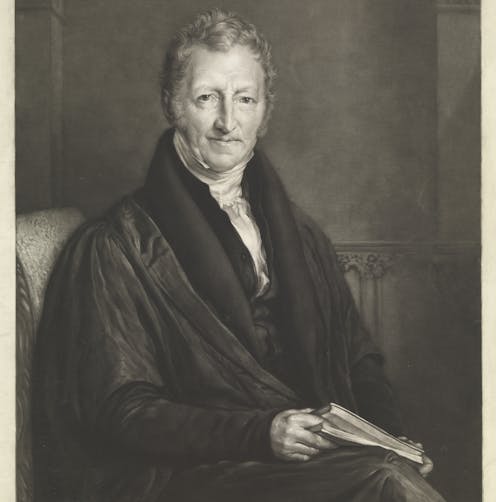
A portrait of Thomas Malthus by John Linnell. Wellcome Collection via Wikimedia Commons, CC BY

No one uses “Malthusian” as a compliment. Since 1798, when the economist and cleric Thomas Malthus first published “An Essay on the Principles of Population,” the “Malthusian” position – the idea that humans are subject to natural limits – has been vilified and scorned. Today, the term is lobbed at anyone who dares question the optimism of infinite progress.

Unfortunately, almost everything most people think they know about Malthus is wrong.

The story goes like this: Once upon a time, an English country parson came up with the idea that population increases at a “geometrical” rate, while food production increases at an “arithmetical” rate. That is, population doubles every 25 years, while crop yields increase much more slowly. Over time, such divergence must lead to catastrophe.

But Malthus identified two factors that reduced reproduction and held off disaster: moral codes, or what he called “preventative checks,” and “positive checks,” such as extreme poverty, pollution, war, disease and misogyny. In the all-too-common caricature, Malthus was a narrow-minded clergyman who was bad at math and thought the only solution to hunger was to keep poor people poor so they had fewer babies.

Understanding Malthus in a broader context reveals a very different character. As I discuss in my 2025 book “Impasse: Climate Change and the Limits of Progress,” Malthus was an innovative and insightful thinker. Not only was he one of the founding figures of environmental economics, but he also turned out to be a prophetic critic of the belief that history tends toward human improvement, which we call progress.

God and science

On the topic of progress, Malthus knew what he was talking about.

He was raised and educated by dissenters: progressivist English Protestants who advocated the separation of church and state. He was taught by the radical abolitionist Gilbert Wakefield, and his father was a friend and admirer of the Enlightenment philosopher Jean-Jacques Rousseau, whose ideas helped inspire the French Revolution.

Despite struggling with a cleft palate, Malthus distinguished himself at Cambridge, where he studied applied math, history and geography. Going into the clergy was a common choice for educated young men of middling means, and Malthus was able to secure a parsonage in Wotton, Surrey. But that didn’t mean giving up his interest in social science.

An Essay on the Principle of Population” was shaped by Malthus’ theological views, but it is also a deeply empirical work and became more so as he revised it in later editions. His argument about geometrical and arithmetical growth rates, for instance, was based on the rapid population growth witnessed in the American Colonies.

A painting in muted colors of a handful of people working in a grain field, as a man sits on a horse nearby.
‘Reapers,’ by 18th-century British artist George Stubbs.
Tate Britain/Yorck Project via Wikimedia Commons

It was also based on what he saw happening around him in Britain. Over the final decades of the 18th century, Britain was wracked by repeated food shortages and riots. The population rose from 5.9 million to 8.7 million, an increase of almost 50%, while agricultural production lagged. In 1795, hungry Londoners mobbed King George III’s coach demanding bread.

Boundless optimism

But why was Malthus talking about population in the first place? As Malthus himself explains, his essay was inspired by an argument with a friend about the journalist and novelist William Godwin – best known today as the father of Mary Shelley, author of “Frankenstein.”

Malthus and Godwin had similar backgrounds. Both came from dissenting middle-class families, were educated in progressive schools and began their careers as ministers. But Godwin’s extreme radicalism put him at odds even with his fellow dissenters, and he soon left the pulpit to take up the pen.

The book that made Godwin’s name and provoked Malthus was “An Enquiry Concerning Political Justice,” published in 1793. Today, it is considered a founding text of philosophical anarchism. Originally, however, Godwin’s “Enquiry” was seen as a thunderous articulation of Enlightenment progressivism.

A dark, painted portrait of a brown-haired man, seen from the side.
A portrait of William Godwin by James Northcote, now in the National Portrait Gallery in London.
Dea Picture Library/De Agostini via Getty Images

Godwin argued that all social problems could be eliminated by reason’s proper application. He advocated abolishing marriage, redistributing property and eliminating government. What’s more, he asserted that progress led inevitably to a utopian world, where humans will no longer have to reproduce because we’ll be immortal:

“There will be no war, no crimes, no administration of justice as it is called, and no government. … But beside this, there will be no disease, no anguish, no melancholy and no resentment. Every man will seek with ineffable ardour the good of all.”

Such things would come about in due time, Godwin assured his readers, solely through the spread of rational discussion.

From his poverty-stricken parsonage in Wotton, Malthus saw things differently. Historian Robert Mayhew describes Wotton at the time as an industrial wasteland afflicted by “agrarian poverty … high birth rates and short life spans.” Studying history led Malthus to conclude that societies moved not in an ever-ascending line of progress but in cycles of expansion and decline. Godwin’s utopian story didn’t seem to match the evidence.

Reform – within reason

Malthus aimed to puncture Godwin’s grandiloquent progressivism. But he wasn’t saying positive change was impossible, only that it was limited by the laws of nature.

“An Essay on the Principles of Population” was his attempt to ascertain where some of those limits might lie, so that policy could respond to social problems effectively, rather than exacerbating them by trying to achieve the impossible. As a writer and active member of the Whig Party, Malthus was a reformer who advocated free national education, the extension of suffrage, the abolition of slavery and free medical care for the poor, among other programs.

Since then, science and industry have made incredible advances, leading to changes Malthus would have scarcely found credible. When his essay was published, the global human population was around 800 million. Today it is over 8 billion, a tenfold increase in little more than two centuries.

Over that time, proponents of progress have scorned the idea that humans are subject to natural limits and denigrated anyone who questioned the fantasy of infinite growth
as “Malthusian.” Yet Malthus remains important because his pessimistic account of society so clearly articulates an insight that refuses to be repressed: The laws of nature apply to human society.

Indeed, “the Great Acceleration” in human development and impact over the past 80 years may have pushed society to the breaking point. Scientists warn that we’ve exceeded six of the nine boundary conditions for sustainable human life on Earth and are close to exceeding a seventh.

One of those conditions is a stable climate. Global warming threatens to not only raise sea levels, increase wildfires and supercharge storms, but also amplify drought and disrupt global agriculture.

Malthus may not have foreseen the developments that fueled human growth over the past two centuries. But his fundamental insight into the limits of growth has only become more relevant. As we face accelerating global ecological crisis, it may be time to revisit the pessimistic idea that we live in a world with limits. Reconsidering what we mean by “Malthusian” might be a good place to start.

The Conversation

Roy Scranton received funding from the John Simon Guggenheim Memorial Foundation.

ref. Misunderstood Malthus: The English thinker whose name is synonymous with doom and gloom has lessons for today – https://theconversation.com/misunderstood-malthus-the-english-thinker-whose-name-is-synonymous-with-doom-and-gloom-has-lessons-for-today-263101

Trump’s Epstein problem is real: New poll shows many in his base disapprove of his handling of the files, and some supporters are having second thoughts about electing him

Source: The Conversation – USA – By Tatishe Nteta, Provost Professor of Political Science and Director of the UMass Amherst Poll, UMass Amherst

Pollsters found that 47% of 2024 Trump voters disapprove of Trump’s handling of the Epstein controversy. These supporters are at a rally in Doral, Fla., on July 9, 2024. Giorgio Viera/AFP via Getty Images

Has President Donald Trump survived the latest and most serious firestorm of controversy over the Epstein scandal? Or has the Trump administration’s handling of the release of information concerning the prosecution of Jeffrey Epstein, a convicted child sex trafficker and Trump’s former friend, hurt the president?

A number of journalists, pointing to recent public opinion polls, have claimed that the scandal has hurt Trump. Others have argued that the public has largely moved on and the Epstein controversy no longer presents a political liability for Trump.

But both of these conclusions are based on limited polling about the Epstein controversy and thus may be premature.

Our recent University of Massachusetts Amherst national poll includes particularly detailed questions about the Epstein controversy and attitudes toward Trump, and thus provides fresh insights on how the controversy has affected public support for Trump.

We find that Trump’s handling of the Epstein controversy has done significant damage to his standing, particularly among his core supporters.

Trump ‘fumbling the matter’

Americans are paying close attention to the prolonged Epstein controversy. Our polling finds that 3 in 4 respondents have heard, read or seen “a lot” or “some” about Epstein.

Moreover, most believe that Trump is fumbling the matter.

Seven in 10 Americans believe that Trump is handling the matter “not well.” This includes pluralities of Trump’s most loyal supporters, 43% of Republicans, 43% of conservatives, and 47% of those who voted for him in 2024.

When we drill down on the 47% of 2024 Trump voters who disapprove of Trump’s handling of the Epstein controversy, we find significant cracks in the MAGA facade. Among members of this group, 28% now disapprove of Trump as president.

When we take demographics, ideology, partisanship and assessments of the economy into account, disapproval of Trump’s handling of the release of the Epstein files is still associated with an increase in disapproval of Trump.

Two men and two women pose at a party.
From left, Donald Trump, his future wife Melania Knauss, Jeffrey Epstein and Ghislaine Maxwell at the Mar-a-Lago club in Palm Beach, Fla., on Feb. 12, 2000.
Davidoff Studios/Getty Images

Voter regret

Even more significantly, we find that among 2024 Trump voters, negative views of Trump’s handling of the Epstein files are associated with an increased desire to make a different choice if the 2024 election could be rerun.

More specifically, among Trump voters who believe that the president has mishandled the release of the Epstein files, more than one quarter – 26% – indicate that they would not vote for Trump if they had the opportunity to vote again in the 2024 election.

While there are no election do-overs, it is clear that the Epstein scandal has hurt Trump among his base of voters.

Much can happen between now and the midterm elections in November 2026, of course.

But if Trump fails to satisfy his political base, perceptions among Trump voters that he has mishandled the controversy could reduce enthusiasm and participation in the elections. Even if the share of Republicans alienated by the Epstein controversy is relatively small, this could hurt Republicans in close contests.

With over a year to go, the facts on the ground will likely change. But as of today, the controversy over the release of the Epstein files remains relevant. Whether the president responds in a manner that satisfies his voters is a question that could have important political consequences.

The Conversation

Jesse Rhodes receives funding from the National Science Foundation, the Spencer Foundation, and Demos. He is a member of the American Civil Liberties Union.

Adam Eichen, Alexander Theodoridis, Raymond La Raja, and Tatishe Nteta do not work for, consult, own shares in or receive funding from any company or organization that would benefit from this article, and have disclosed no relevant affiliations beyond their academic appointment.

ref. Trump’s Epstein problem is real: New poll shows many in his base disapprove of his handling of the files, and some supporters are having second thoughts about electing him – https://theconversation.com/trumps-epstein-problem-is-real-new-poll-shows-many-in-his-base-disapprove-of-his-handling-of-the-files-and-some-supporters-are-having-second-thoughts-about-electing-him-263662

A Detroit street is named in honor of Vincent Chin – his death mobilized Asian American activists nationwide

Source: The Conversation – USA – By Jennifer Ho, Professor of Asian American Studies, University of Colorado Boulder

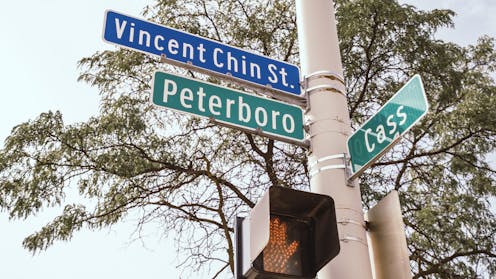
Peterboro Street was recently renamed Vincent Chin Street in his memory. Valaurian Waller/The Conversation, CC BY-ND

The legacy of Vincent Chin has recently been commemorated in a street sign bearing his name on the corner of Cass Avenue and Peterboro Street in Detroit’s historic Chinatown.

I was glad to see it. Watching the 1987 documentary “Who Killed Vincent Chin?” and learning about his life and Asian American activism changed my life.

I was 18 and taking my first Asian American studies class at the University of California, Santa Barbara. The film made me realize two things: Asian Americans are targets of racial violence, and Asian Americans across the ethnic spectrum could join together to fight for civil rights. This led to my passion for social justice.

I’m proud to now be a professor of Asian American studies and critical race theory who teaches my students about Vincent Chin.

So who was Chin, and why did his death catalyze an Asian American civil rights movement?

A fatal brawl

Chin, an Oak Park resident, was 27 years old on the night of his bachelor party, June 19, 1982. He got into a fight with two white men – Ronald Ebens, a Chrysler car plant supervisor, and Michael Nitz, an unemployed autoworker and Ebens’ stepson.

A young Asian man wearing glasses, a jacket and a tie. His hair is fairly long and parted on the side
Vincent Chin.
Bettmann Archive/via Getty Images

According to Racine Colwell, a dancer at the Fancy Pants Club in the Detroit area, Ebens shouted, “It’s because of you little motherf–kers that we’re out of work.” Detroit in the early 1980s was in an automotive slump. People blamed Japanese auto imports and the Japanese people, in general, for the economic downturn. The assailants didn’t seem to understand or care that Chin was actually Chinese.

After the fight between Chin and Nitz and Ebens, Chin and his friends ran out of the club. Ebens and Nitz ran after them, with Nitz grabbing a baseball bat from his car. When they found Chin outside a McDonald’s on Woodward Avenue, Nitz held Chin while Ebens beat his body and head with the bat. They were stopped by two off-duty police officers who had been inside the fast-food restaurant.

After the attack, Jimmy Choi, a member of the bachelor party, cradled Chin in his arms. He said that Chin’s last words were “It’s not fair.” Chin died four days later.

Ebens and Nitz were charged with second-degree murder, but their lawyers pleaded the charge down to manslaughter. At the end of the trial, Judge Charles Kaufman fined them US$3,000 each and sentenced each to three years’ probation, explaining: “These weren’t the kind of people you send to prison. … You don’t make the punishment fit the crime. You make the punishment fit the criminal.”

Asian Americans organize for legal justice

The sentencing enraged Chin’s friends, family and the greater Chinese and Asian American community of Detroit.

Activists of various Asian ethnicities and their non-Asian allies created American Citizens for Justice, an organization that pressured the Justice Department to investigate the violation of Chin’s civil rights and to see Ebens and Nitz imprisoned for Chin’s murder. Lily Chin, Vincent’s mother, was a key advocate in the pursuit of justice for her son, showing up to rallies and interviews to remind people of Vincent’s death for nearly a decade.

A middle-aged Asian woman throws her head back and wails. Two woman and a young man with spiked hair stand with her and support her.
Lily Chin leaves a courtroom in Detroit’s City-County Building in June 1982.
Bettmann archives/via Getty images

While there were other moments, such as the anti-eviction fight for the I-Hotel in San Francisco, that brought Asian Americans of all ethnicities together to fight for civil rights, Chin’s murder sparked a broad awareness. Asian Americans realized that what happened to Chin could happen to them.

American Citizens for Justice held press conferences and gained support from local African American activists in Michigan and national Black leaders like Jesse Jackson, whose presence helped bring more attention to the Chin tragedy.

Activists were successful in forcing the FBI to open an investigation. The resulting 1984 federal trial was the first time the Justice Department had argued that the civil rights of an Asian American person had been violated. Nitz was found not guilty on two counts. Ebens was found guilty and sentenced to 25 years in prison. However, a 1986 federal appeals court ruling overturned the conviction, freeing Ebens.

A civil suit filed against Ebens and Nitz on behalf of Lily Chin was settled out of court in 1987. Nitz agreed to pay $50,000 and Ebens $1.5 million – the projected income that Chin would have made had he lived.

Nitz fulfilled his debt, but Ebens made only a few payments. By 1987, Ebens had been unemployed for five years. He stopped making payments after he moved to Nevada. Estimates in 2016 place Ebens’ debt to the Chin estate at over $8 million, including accumulated interest.

Chin’s death had a profound impact on the criminal justice system in Michigan and nationally. Michigan made it harder to plead down murder charges to manslaughter and required prosecutors to be present at sentencings to face victims. Nationally, victim impact statements are now commonplace. Victims and their families now have more of a voice in the justice system.

Chin’s death spurred Pan-Asian American activism across the U.S., leading to the eventual founding of organizations like Asian Americans Advancing Justice in 1991 and Stop Asian American Pacific Islander Hate in 2020. During the COVID-19 pandemic, Stop AAPI Hate recorded violence against Asians happening in the U.S. and educated people about anti-Asian racism.

Today, Asian Americans fight for social justice through organizations like these and 18 Million Rising, a group that advocates for racial justice for Asian Americans and all marginalized people.

This is the lasting legacy of Vincent Chin.

The Conversation

Jennifer Ho does not work for, consult, own shares in or receive funding from any company or organization that would benefit from this article, and has disclosed no relevant affiliations beyond their academic appointment.

ref. A Detroit street is named in honor of Vincent Chin – his death mobilized Asian American activists nationwide – https://theconversation.com/a-detroit-street-is-named-in-honor-of-vincent-chin-his-death-mobilized-asian-american-activists-nationwide-262033

Tit-for-tat gerrymandering wars won’t end soon – what happens in Texas and California doesn’t stay there

Source: The Conversation – USA – By Gibbs Knotts, Professor of Political Science, Coastal Carolina University

Congressional redistricting – the process of drawing electoral districts to account for population changes – was conceived by the Founding Fathers as a once-per-decade redrawing of district lines following the decennial U.S. census. Today it has devolved into a near-constant feature of American politics – often in response to litigation, and frequently with the intent of maintaining or gaining partisan advantage.

Polls show widespread public disapproval of manipulating political boundaries to favor certain groups, a process known as gerrymandering. However, we currently see little hope of preventing a race to the bottom, where numerous states redraw their maps to benefit one party in response to other states drawing their maps to benefit another party.

The most recent round of tit-for-tat gerrymandering began in Texas. After drawing their post-census congressional maps in 2021, Republicans in the Texas Legislature, at President Donald Trump’s behest, are advancing a new set of maps designed to increase the number of Republican congressional seats in their state. The goal is to help Republicans retain control of the U.S. House of Representatives in the 2026 midterm elections by converting five Democratic seats to ones that will likely result in a Republican victory.

In response, California Democratic Gov. Gavin Newsom is pushing to redraw his state’s map. Under Newsom’s plan, Democrats could gain five House seats in California, offsetting Republican gains in Texas. The California Legislature approved the new maps on Aug. 21 and Gov. Newsom signed the bills that day. Next, the maps will be presented to California voters on the November 2025 ballot for approval.

Newsom vows that he isn’t trying to disband the independent redistricting process that California enacted in 2021. Rather, he proposes to shift to these partisan gerrymandered maps temporarily, then return to independent, nonpartisan redistricting in 2031.

Democrats in Illinois and New York, and Republicans in Indiana, Missouri and South Carolina, have signaled that they may follow Texas and California’s leads. Based on our research on politics and elections, we don’t expect that the wave will stop there.

Gerrymandering dates back to struggles over U.S. foreign policy in the early 1800s and is named for a signer of the Declaration of Independence, Elbridge Gerry.

Rules for mapmakers

Redistricting has always been an inherently political process. But the advent of widespread, easily accessible computer technology, increasingly predictable voting patterns and tight partisan margins in Congress have turbocharged the process.

There are ways to tweak this gerrymandering run amok and perhaps block a bad map or two. But none of these approaches are likely to stop partisan actors entirely from drawing maps to benefit themselves and their parties.

The most obvious strategy would be to create guardrails for the legislators and commissions who draw the maps. Such guidelines often specify the types of data that could be used to draw the maps – for example, limiting partisan data.

Anti-gerrymandering rules could also limit the number of political boundaries, such as city or county lines, that would be split by new districts. And they could prioritize compactness, rather than allowing bizarrely-shaped districts that link far-flung communities.

These proposals certainly won’t do any harm, and might even move the process in a more positive direction, but they are unlikely to end gerrymandering.

For example, North Carolina had an explicit limitation on using partisan data in its 2021 mapmaking process, as well as a requirement that lawmakers could only draw maps in the North Carolina State Legislative Building. It was later revealed that a legislator had used “concept maps” drawn by an aide outside of the normal mapmaking process.

In a world where anyone with an internet connection can log onto free websites like Dave’s Redistricting to draw maps using partisan data, it’s hard to prevent states from incorporating nonofficial proposals into their maps.

Courts and commissions

A second way to police gerrymandering is to use the courts aggressively to combat unfair or discriminatory maps. Some courts, particularly at the state level, have reined in egregious gerrymanders like Pennsylvania’s 2011 map, which was overturned in 2018.

At the national level, however, the U.S. Supreme Court ruled in Rucho v. Common Cause in 2019 that partisan gerrymandering claims presented “political questions beyond the reach of the federal courts” and ultimately were better suited to state courts. There are still likely to be claims in federal courts about racial dilution and other Voting Rights Act violations in gerrymanders, but the door to the federal courthouse for partisanship claims appears to be closed for the time being.

A third option is for states to hand map-drawing power to an independent body. Recent studies show that independent redistricting commissions produce maps that are more competitive and fairer. For example, a nonpartisan scholarly review of the 2021-2022 congressional and state legislative maps found that commissions “generally produce less biased and more competitive plans than when one party controls the process.”

Commissions are popular with the public. In a 2024 study with political scientists Seth McKee and Scott Huffmon, we found that both Democrats and Republicans in South Carolina preferred to assign redistricting to an independent commission rather than the state Legislature, which has been in Republican control since 2000.

Studies using national polling data have also found evidence that redistricting commissions are popular, and that people who live in states that use commissions view the redistricting process more positively than residents of states where legislators draw congressional lines.

A national solution or bust

While redistricting commissions are popular and effective in states that have adopted them, current actions in California show that this strategy can fail if it is embraced by some states but not others.

Unfortunately, there is no simple solution for tit-for-tat gerrymandering. Litigation can help at the margins, and independent redistricting can make a difference, but even the best intentions can fail under political pressure.

The only wholesale solution is national reform. But even here, we are not optimistic.

A proportional representation system, in which seats are divided by the portion of the vote that goes to each party, could solve the problem. However, removing single-member districts and successfully implementing proportional representation in the United States is about as likely as finding a hockey puck on Mars.

A national ban on gerrymandering might be more politically palatable. Even here, though, the odds of success are fairly low. After all, the people who benefit from the current system would have to vote to change it, and the filibuster rule in the Senate requires not just majority but supermajority support.

So, brace for what’s about to come. As James Madison famously observed, forming factions – groups of people united by a common interest that threatens the rights of others – is “sown in the nature of man.”

Gerrymandering helps factions acquire and retain power. If U.S. leaders aren’t willing to consider a national solution, it won’t disappear anytime soon.

The Conversation

The authors do not work for, consult, own shares in or receive funding from any company or organization that would benefit from this article, and have disclosed no relevant affiliations beyond their academic appointment.

ref. Tit-for-tat gerrymandering wars won’t end soon – what happens in Texas and California doesn’t stay there – https://theconversation.com/tit-for-tat-gerrymandering-wars-wont-end-soon-what-happens-in-texas-and-california-doesnt-stay-there-262835

Wildfire disasters are increasingly in the news, yet less land is burning globally – here’s why

Source: The Conversation – USA (2) – By Mojtaba Sadegh, Associate Professor of Civil Engineering; Senior Fellow at the United Nations University Institute for Water, Environment and Health, Boise State University

Residents try to put out flames as a wildfire threatens homes in Quito, Ecuador, in September 2024. AP Photo/Dolores Ochoa

Worldwide, an estimated 440 million people were exposed to a wildfire encroaching on their home at some point between 2002 and 2021, new research shows. That’s roughly equivalent to the entire population of the European Union, and the number has been steadily rising – up 40% over those two decades.

With intense, destructive fires often in the news, it can seem like more land is burning. And in parts of the world, including western North America, it is.

Globally, however, our team of fire researchers also found that the total area burned actually declined by 26% over those two decades.

How is that possible?

We found the driving reasons for those changes in Africa, which has the vast majority of all land burned, but the total burned area there has been falling. Agricultural activities in Africa are increasingly fragmenting wildland areas that are prone to burning. A cultivated farm field and roads can help stop a fire’s spread. But more farms and development in wildland areas also means more people can be exposed to wildfires.

Drawing on our expertise in climate and wildfire sciences and geospatial modeling, we analyzed global wildfire activity over the past two decades. The results highlight some common misperceptions and show how the fire risk to humans is changing.

Global burned area down, intense fires up

Wildfire is a natural process that has existed for as long as vegetation has covered the Earth. Occasional fires in a forest are healthy. They clear out dead wood and leaf and branch litter, leaving less fuel for future fires to burn. That helps to keep wildfires from becoming too intense.

However, intense fires can also pose serious threats to human lives, infrastructure and economies, particularly as more people move into fire-prone areas.

North and South America have both experienced a rise in intense wildfires over the past two decades. Some notable examples include the 2018 Camp Fire in California and the 2023 record-breaking Canadian wildfires, which generated widespread smoke that blanketed large parts of Canada and the eastern United States, and even reached Europe.

The increase in intense wildfires aligns with the intensification of fire weather around the world. Heat, low humidity and strong winds can make wildfires more likely to spread and harder to control. The number of days conducive to extreme fire behavior and new fire ignitions has increased by more than 50% over the past four decades globally, elevating the odds that the amount of land burned in a particular region sets a new record.

A high column of flames rises from a smoke-filled forest.
Flames rise amid the billowing smoke from a wildland fire burning along the ridges near the Ken Caryl Ranch development, southwest of Littleton, Colo., on,July 31, 2024.
AP Photo/David Zalubowski

But fire weather is not the only influence on wildfire risk. The amount of dry vegetation, and whether it’s in a continuous stretch or broken up, influences fire risk. So do ignition sources, such as vehicles and power lines in wildland areas. Human activities can start fires and fuel climate change, which further dries out the land, amplifying wildfire activity. Fire suppression practices that don’t allow low-intensity fires to burn can lead to the accumulation of flammable vegetation, raising the risk of intense fires.

North America is a fraction of total burned area

In recent years, a growing number of wildfire disasters in North America, Europe and Australia have captured global attention. From the deadly 2025 Los Angeles fires to the devastating 2019-2020 Australian bushfires and the 2018 wildfire in Athens, Greece, flames have increasingly encroached upon human settlements, claiming lives and livelihoods.

However, wildfire exposure isn’t limited to these high-profile regions − we simply hear more about them.

The United States, Europe and Australia collectively account for less than 2.5% of global human exposure to wildfire. Human exposure to fire occurs when people’s homes fall directly within the area burned by a wildfire.

In stark contrast, Africa alone accounts for approximately 85% of all wildfire exposures and 65% of the global burned area.

Remarkably, just five central African countries – the Democratic Republic of Congo, South Sudan, Mozambique, Zambia and Angola – experience half of all global human exposure to wildfires, even though they account for less than 3% of the global population. These countries receive sufficient moisture to support plant growth, yet they are dry enough that trees and plants burn in frequent fires that in some places occur multiple times per year.

Regional trends and drivers of wildfire

We found that wildfire exposure increased across all continents except Europe and Oceania, but the underlying drivers of the increase varied by region.

In Africa, agricultural expansion has led to more people living in fire-prone areas.

In North America, particularly the United States, intensifying fire weather – the hot, dry, windy conditions conducive to spreading fires – has led to increasingly uncontrollable wildfires that threaten human settlements.

Two firefighters spray water on the smoking remains of a building surrunuded by burned trees.
Firefighters hose down hot spots on a fire-ravaged property while battling the Bridge Fire on Sept. 11, 2024, in Wrightwood, Calif.
AP Photo/Eric Thayer

In South America, a combination of rising drought frequency and severity, intensifying heat waves and agricultural expansion has amplified wildfire intensity and increased the population in fire-prone regions.

In Asia, growing populations in fire-prone areas, combined with more days of fire-friendly weather, led to increased human exposure to wildfires.

In contrast, Europe and Oceania have seen declining wildfire exposures, largely due to more people moving to cities and fewer living in rural, fire-prone zones.

What to do about it

Communities can take steps to prevent destructive wildfires from spreading.

For example, vegetation management, such as prescribed fires, can avoid fueling intense fires. Public education, policy enforcement and engineering solutions – such as vegetation reduction and clearance along roads and power lines – can help reduce human-caused ignitions.

As climate change intensifies fire weather and people continue to move into fire-prone zones, proactive mitigation will be increasingly critical.

The Conversation

Mojtaba Sadegh receives funding from the US Joint Fire Science Program, the US National Science Foundation, and NASA. He is affiliated with the United Nations University Institute for Water, Environment and Health.

John Abatzoglou receives funding from the US National Science Foundation and US Joint Fire Science Program.

Seyd Teymoor Seydi does not work for, consult, own shares in or receive funding from any company or organization that would benefit from this article, and has disclosed no relevant affiliations beyond their academic appointment.

ref. Wildfire disasters are increasingly in the news, yet less land is burning globally – here’s why – https://theconversation.com/wildfire-disasters-are-increasingly-in-the-news-yet-less-land-is-burning-globally-heres-why-261072

By ‘focusing on the family,’ James Dobson helped propel US evangelicals back into politics – making the Religious Right into the cultural force it is today

Source: The Conversation – USA (3) – By Richard Flory, Executive Director, Center for Religion and Civic Culture, USC Dornsife College of Letters, Arts and Sciences

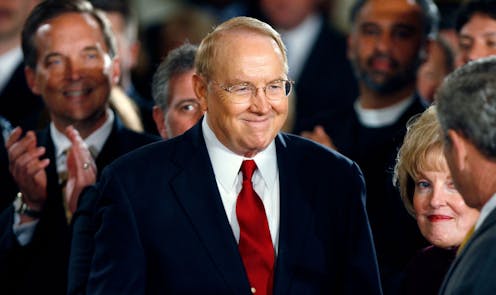
James Dobson, founder of Focus on the Family, participates in the National Day of Prayer ceremony at the White House on May 3, 2007. Chip Somodevilla/Getty Images

For decades, one name was ubiquitous in American evangelical homes: Focus on the Family. A media empire with millions of listeners and readers, its messages about parenting, marriage and politics seemed to reach every conservative Christian church and school.

And one man’s name was nearly synonymous with Focus on the Family: James Dobson.

Dobson, a primary figure of the Religious Right who died on Aug. 21, 2025, was born in 1936, when conservative Protestant Christianity was a far cry from what it is today. As a sociologist of religion who has studied American evangelicalism for 30 years, I believe Dobson’s influence and moral authority were instrumental in transforming the Religious Right into the powerful cultural and political force it has been for half a century.

A household name

Dobson earned a doctorate in psychology from the University of Southern California, where he taught for several years. In 1970, he published “Dare to Discipline,” a book encouraging parents to use corporal punishment to instill unquestioned respect for authority in their children.

“Dare to Discipline” arrived at a time when many evangelicals were alarmed about how their children were being influenced by “secular” American culture. The book was updated in 1992 and reissued several times, and Dobson’s introduction to a 2018 version claimed that the book has sold over 3.5 million copies. “Dare to Discipline” became an important source for Christian families seeking advice rooted in a “biblical” understanding of family, parental authority and child development – and it made Dobson a household name.

Capitalizing on that success, Dobson founded Focus on the Family in 1977. The organization’s signature radio program took his message about family and faith virtually anywhere people could go, and grew increasingly political. By 1995, Focus on the Family had a budget of more than US$100 million, and by 2008, the radio program had aired on over 3,000 stations in 160 countries.

Eight adults in business attire sit on chairs in a circle, heads bowed, in the middle of an open-floor office.
Focus on the Family employees in Colorado Springs pray during a morning devotion in 2004, before listening to the James Dobson radio program.
Craig F. Walker/The Denver Post via Getty Images

The primary theme throughout Dobson’s radio program and publications was that “family values” were under attack by a godless society embracing abortion, gay rights and gender equality. His views hearkened back to “Dare to Discipline”: Authoritarian patriarchal families with distinct gender roles for men and women would preserve the family and the future of the country.

From the family to the Supreme Court

Dobson left Focus on the Family in 2010 and founded the Dr. James Dobson Family Institute, originally named Family Talk. He and like-minded hosts dispensed folksy advice, along with guests well known to their audience. But they also addressed explicitly political issues, such as opposing policies that support abortion, same-sex marriage and some protections for LGBTQ+ people that they believe conflict with their religious liberty.

In addition, Dobson helped found other powerful evangelical organizations working toward the Religious Right’s ideological and political goals, such as the Family Research Council and the legal group Alliance Defending Freedom, which has supported several high-profile Supreme Court cases.

In 2022 and 2023, the Supreme Court made three rulings that advance long-held goals of the Christian Right. A slim majority overturned Roe v. Wade, the decision which established the constitutional right to an abortion in 1973. The ruling in a Colorado case, 303 Creative LLC vs. Elenis, determined that business owners could not be compelled to create messages that conflict with their “sincerely held beliefs” – meaning, in this case, that a wedding website designer could refuse same-sex clients because of her religious beliefs. And the court continued to soften limits on using state funding for students at religious schools.

Attorneys from the Alliance Defending Freedom worked on the abortion case and 303 Creative. The group submitted an amicus brief in favor of using state money for religious instruction in the third case, Carson v. Makin.

Retreat and reemergence

The roots of contemporary “evangelicalism” trace back to the Protestant fundamentalist movement that emerged in the early 20th century. Ever since, the movement has opposed ideas that it believes could undermine the core of America as a Christian nation.

In the wake of the Russian Revolution, for example, fundamentalists identified “Bolshevism” as a threat to Christian America. Today, a century later, some Christian conservatives criticize many types of history education and diversity programs as “neo-Marxist” or “cultural Marxism.”

Conservative Protestant groups have not always been such major political players, however. Around the turn of the 20th century, evangelical institutions like the Moody Bible Institute in Chicago and the Bible Institute of Los Angeles, now called Biola University, focused on individual faith and Bible training. Personal faith was promoted as the engine for social change and resistance to “un-Christian” ideas and practices, not political advocacy.

The famous Scopes Trial, the 1925 case that pitched Biblical teachings about creation against the theory of evolution, prompted some fundamentalist groups to retreat from public affairs and politics. Following Scopes, evangelicals established broad networks of their own independent churches, K-12 schools, universities and media organizations – including publishers and electronic media – thus creating a subculture within which to worship and raise their children.

Yet these organizations also laid the groundwork for what would finally emerge in the late 1970s as the Religious Right – with leaders like Dobson, televangelist Jerry Falwell and pastor and novelist Tim LaHaye.

‘One nation, under God’

Dobson’s influence will continue through his writings and the organizations he founded and influenced. In particular, his legacy can be seen in conservative evangelicals’ emphasis on the “traditional” or “biblical” family, defined as a married mother, father and children. He long promoted a gender hierarchy in marriage, with the husband being in “authority” over wife and children, and viewed LGBTQ+ rights as a threat to the family and to the nation.

Rows of people hold hands and raise them up as they assemble in a baseball stadium.
James Dobson spoke at a 2004 event in Seattle where approximately 20,000 people gathered to support defining marriage as between a man and a woman.
Ron Wurzer/Getty Images

This conception of the family has found its way into most evangelical institutions. More broadly, within the conservative movement, the patriarchal family is understood as the authentic expression of God’s law and is often viewed as the ultimate model for social institutions – including a Christian nation.

Numerous fundamentalists and evangelicals have argued that evangelical Christianity should be the true basis for a “Christian America.” What distinguishes Dobson’s approach was how he adapted Christian nationalism, framing it as a crucial issue for parents and families: translating ideas about Godly societies into guidance on “proper” child rearing and child development. His focus on the family as the foundation of Christian civilization mobilized millions of American evangelicals politically – on a scale that previous leaders never approached.

The Conversation

Richard Flory receives funding from the John Templeton Foundation, the Lilly Endowment, and the John Randolph and Dora Haynes Foundation.

ref. By ‘focusing on the family,’ James Dobson helped propel US evangelicals back into politics – making the Religious Right into the cultural force it is today – https://theconversation.com/by-focusing-on-the-family-james-dobson-helped-propel-us-evangelicals-back-into-politics-making-the-religious-right-into-the-cultural-force-it-is-today-206180