Despite claims they’d move overseas after the election, most Americans are staying put

Source: The Conversation – USA – By Amanda Klekowski von Koppenfels, Honorary Reader in MIgration and Politics, University of Kent

Not that many people are preparing to leave the U.S. gerenme/E+ via Getty Images

Based on pronouncements in 2024, you might think now is the time to see U.S. citizens streaming out of the country. Months before the 2024 presidential election, Americans were saying they would leave should candidate Donald Trump win the election. Gallup polling in 2024 found that 21% of Americans wanted to leave the United States permanently, more than double the 10% who had said so in 2011.

And indeed in June 2025, a Vermont legislator announced that she was resigning her seat and moving to Canada because of political concerns and economic opportunities. To be sure, people are moving. Even so, as a scholar of American migration overseas, my research finds that the vast majority of Americans are not about to depart for greener shores.

A western Massachusetts group

In October 2024, I surveyed 68 Americans in western Massachusetts, an area with a slight Democratic majority, asking if they wanted to leave the United States for a lengthy period of time, but not necessarily permanently. Over 90% said no, noting that there were factors limiting their mobility, such as financial obligations or having a partner who would not move, and that there were reasons that made them want to stay, such as owning property and having friends nearby.

Just three respondents indicated they were making plans to move, while an additional 11 said they wanted to move “someday.”

Reality strikes

After the November 2024 election, I interviewed seven of those respondents, two of whom had said prior to the election that they might leave the United States. After the election, they all said they planned to stay.

One who had said she wanted to leave acknowledged her reversal, saying: “I may have flippantly said, ‘Oh, if (Trump) gets voted in … I would leave,’ but I can’t see leaving. Part of it is because of my daughter,” who had recently become a mother. She continued, “It’s never crossed my mind seriously enough to even research it.”

Another told me, “I’m not going to let somebody push me out of what I consider my country and my home because he’s a jerk.”

Others spoke of needing to work several more years in order to receive a pension, or having family responsibilities keeping them in the country. None supported the current administration.

On a national level

In two nationally representative surveys, my colleague Helen B. Marrow, a sociologist of immigration, and I found no significant increase in migration aspiration between 2014 and 2019. We also found that respondents mentioned exploration and adventure much more often than political or economic reasons for wanting to move abroad.

Even though the U.S. passport grants visa-free visitor access to more than 180 countries, U.S. citizens still need residence and work visas. At home, they, like others, have family commitments and financial constraints, or may just not want to leave home. More than 95% of the world’s population do not move abroad – and U.S. citizens are no different.

Relocation coaching

In addition to my academic research on overseas Americans, I am also an international relocation coach. I help Americans considering a move abroad navigate the emotional, practical and professional complexities of relocation, whether they’re just starting to explore the idea or actively planning their next steps.

Many of my clients do not want to live in a United States that no longer aligns with their values, while others are concerned about their safety, particularly, but not only, due to racism or homophobia. They are finding jobs overseas, retiring abroad or acquiring a European citizenship through a parent or grandparent. Most recently, American academics seeking to leave are being courted by European universities.

But most are staying

In February 2025, a national poll found that 4% of Americans said they were “definitely planning to move” to another country.

That same month, I followed up with my seven interviewees from western Massachusetts, including one trans man. They all reiterated their choice to remain in the United States. One person, who might move abroad at some point, told me she hadn’t changed her mind about leaving soon: “Leaving doesn’t necessarily mean anything will be better for me, even if it was a financial possibility.”

Two people said that recent political developments actually meant that they were more committed to remaining in the United States. One told me, “Now, more than ever, individuals need to figure out what small actions can be taken to help our fellow Americans get through this dark period.”

But even those “definitely planning on moving” can have other factors intervene. Two clients of mine who were making serious plans had to stop when family members’ health situations changed for the worse.

So how many people are actually leaving? It is clear that a growing number of Americans are considering a move abroad. But far fewer are conducting serious research, seeking professional consultation or actually moving. Drawing on available data, my own academic research and my coaching experience, my educated estimate is that no more than 1% to 2% of U.S. citizens are actively making viable plans to leave the country. Nor are all of those leaving out of protest; many are still motivated by exploration, adventure, employment or to be with a partner.

Even so, that figure is roughly 3 million to 6 million people – which would be a significant increase over the estimated 5.5 million Americans currently living abroad. As with many migration flows, even the movement of a small percentage of a population can still have the potential to reshape both the United States and its overseas population.

The Conversation

Amanda Klekowski von Koppenfels does not work for, consult, own shares in or receive funding from any company or organization that would benefit from this article, and has disclosed no relevant affiliations beyond their academic appointment.

ref. Despite claims they’d move overseas after the election, most Americans are staying put – https://theconversation.com/despite-claims-theyd-move-overseas-after-the-election-most-americans-are-staying-put-250728


The rule of law is key to capitalism − eroding it is bad news for American business

Source: The Conversation – USA (2) – By Robert Bird, Professor of Business Law & Eversource Energy Chair in Business Ethics, University of Connecticut

Something dangerous is happening to the U.S. economy, and it’s not inflation or trade wars. Chaotic deregulation and the selective enforcement of laws have upended markets and investor confidence. At one point, the threat of tariffs and resulting chaos evaporated US$4 trillion in value in the U.S. stock market. This approach isn’t helping the economy, and there are troubling signs it will hurt both the U.S. and the global economy in the short and long term.

The rule of law – the idea that legal rules apply to everyone equally, regardless of wealth or political connections − is essential for a thriving economy. Yet globally the respect for the rule of law is slipping, and the U.S. is slipping with it. According to annual rankings from the World Justice Project, the rule of law has declined in more than half of all countries for seven years in a row. The rule of law in the U.S., the most economically powerful nation in the world, is now weaker than the rule of law in Uruguay, Singapore, Latvia and over 20 other countries.

When regulation is unnecessarily burdensome for business, government should lighten the load. However, arbitrary and frenzied deregulation does not free corporations to earn higher profits. As a business school professor with an MBA who has taught business law for over 25 years, and the author of a recently published book about the importance of legal knowledge to business, I can affirm that the opposite is true. Chaotic deregulation doesn’t drive growth. It only fuels risk.

Chaos undermines investment, talent and trust

Legal uncertainty has become a serious drag on American competitiveness.

A study by the U.S. Chamber of Commerce found that public policy risks — such as unexpected changes in taxes, regulation and enforcement — ranked among the top challenges businesses face, alongside more familiar business threats such as competition or economic volatility. Companies that can’t predict how the law might change are forced to plan for the worst. That means holding back on long-term investment, slowing innovation and raising prices to cover new risks.

When the government enforces rules arbitrarily, it also undermines property rights.

For example, if a country enters into a major trade agreement and then goes ahead and violates it, that threatens the property rights of the companies that relied on the agreement to conduct business. If the government can seize assets without due process, those assets lose their stability and value. And if that treatment depends on whether a company is in the government’s political favor, it’s not just bad economics − it’s a red flag for investors.

When government doesn’t enforce rules fairly, it also threatens people’s freedom to enter into contracts.

Consider presidential orders that threaten the clients of law firms that have challenged the administration with cancellation of their government contracts. The threat alone jeopardizes the value of those agreements.

If businesses can’t trust public contracts to be respected, they’ll be less likely to work with the government in the first place. This deprives the government, and ultimately the American people, of receiving the best value for their tax dollars in critical areas such as transportation, technology and national defense.

Regulatory chaos also allows corruption to spread.

For example, the Foreign Corrupt Practices Act, which prohibits businesses from bribing foreign government officials, has leveled the playing field for firms and enabled the best American companies to succeed on their merits. Before the law was enacted in 1977, some American companies felt pressured to pay bribes to compete. “Pausing” enforcement of the law, as the current presidential administration has done, increases the cost of doing business and encourages a wild west economy where chaos thrives.

When corruption grows, stable and democratic governments weaken, opportunities for terrorism increase and corruption-fueled authoritarian regimes, which oppose the interests of the U.S., thrive. Halting the enforcement of an anti-bribery law, even for a limited time, is an issue of national security.

Legal uncertainty fuels brain drain

Chaotic enforcement of the law also corrodes labor markets.

American companies require a strong pool of talented professionals to fuel their financial success. When legal rights are enforced arbitrarily or unjustly, the very best talent that American companies need may leave the country.

The science brain drain is already happening. American scientists have submitted 32% more applications for jobs abroad compared with last year. Nonscientists are leaving too. Ireland’s Department of Foreign Affairs has witnessed a 50% increase in Americans taking steps to obtain an Irish passport. Employers in the U.K. saw a spike in job applications from the United States.

Business from other countries will gladly accept American talent as they compete against American companies. During the Third Reich, Nazi Germany lost its best and brightest to other countries, including America. Now the reverse is happening, as highly talented Americans leave to work for firms in other nations.

Threats of arbitrary legal actions also drive away democratic allies and their prosperous populations that purchase American-made goods and services. For example, arbitrarily threatening to punish or even annex a closely allied nation does not endear its citizens to that government or the businesses it represents. So it’s no surprise that Canadians are now boycotting American goods and services. This is devastating businesses in American border towns and hurts the economy nationwide.

Similarly, the Canadian government has responded to whipsawing U.S. tariff announcements with counter-tariffs, which will slice the profits of American exporters. Close American allies and trading partners such as Japan, the U.K. and the European Union are also signaling their own willingness to impose retaliatory tariffs, increasing the costs of operations to American business even more.

Modern capitalism depends on smart regulation to thrive. Smart regulation is not an obstacle to capitalism. Smart regulation is what makes American capitalism possible. Smart regulation is what makes American freedom possible.

Clear and consistently applied legal rules allow businesses to aggressively compete, carefully plan, and generate profits. An arbitrary rule of law deprives business of the true power of capitalism – the ability to promote economic growth, spur innovation and improve the overall living standards of a free society. Americans deserve no less, and it is up to government to make that happen for everyone.

The Conversation

Robert Bird does not work for, consult, own shares in or receive funding from any company or organization that would benefit from this article, and has disclosed no relevant affiliations beyond their academic appointment.

ref. The rule of law is key to capitalism − eroding it is bad news for American business – https://theconversation.com/the-rule-of-law-is-key-to-capitalism-eroding-it-is-bad-news-for-american-business-254922

Legal wrangling over estate of Jimmy Buffett turns his widow’s huge inheritance into a cautionary tale

Source: The Conversation – USA (2) – By Reid Kress Weisbord, Distinguished Professor of Law and Judge Norma Shapiro Scholar, Rutgers University – Newark

Musician Jimmy Buffett and his wife, Jane Slagsvol, attend a Lincoln Center for the Performing Arts event in 2018 in New York. Evan Agostini/Invision via AP

Lawyers often tell their clients that everyone should have a will that clearly states who should inherit their assets after they die. But even having a will is not necessarily enough to avoid a costly and contentious legal dispute.

Consider what happened after Jimmy Buffett died of skin cancer at the age of 76 in 2023. The singer and entrepreneurial founder of the Margaritaville brand ordered in his will that his fortune be placed in a trust after his death. To manage the trust, Buffett named two co-trustees: his widow, Jane Slagsvol, and Richard Mozenter, an accountant who had served as the singer’s financial adviser for more than three decades.

In dueling petitions filed in Los Angeles and Palm Beach, Florida, in June 2025, however, Slagsvol – identified as Jane Buffett in her legal filing – and Mozenter are both seeking to remove each other as a trustee.

The outcome of this litigation will determine who gets to administer Buffett’s US$275 million estate.

As law professors who specialize in trusts and estates, we teach graduate courses about the transfer of property during life and at death. We believe that the Buffett dispute offers a valuable lesson for anyone with an estate, large or small. And choosing the right person to manage the assets you leave behind can be just as important as selecting who will inherit your property.

Buffett’s business empire

Buffett’s estate includes valuable intellectual property from his hit songs, including “It’s 5 O’Clock Somewhere,” “Oldest Surfer on the Beach” and “Cheeseburger in Paradise.” Buffett’s albums have sold more than 20 million copies worldwide and continue to generate some $20 million annually in royalties. Buffett also owned a yacht, real estate, airplanes, fancy watches and valuable securities.

In addition, he owned a 20% stake in Margaritaville Holdings LLC, a brand management company he and Slagsvol founded in the 1990s. Margaritaville owns 30 restaurants and 20 hotels, along with vacation clubs, casinos and cruise ships. It also sells branded merchandise.

According to Slagsvol’s petition, Buffett’s trust was set up to benefit his widow. Slagsvol, who married Buffett in 1977, is one of two trustees of that trust, which is required to have at least one “independent trustee” in addition to her “at all times.” That requirement is stated expressly in Buffett’s trust declaration.

Slagsvol receives all income earned by the trust – an estate-planning technique for giving away property managed by a trustee on behalf of the trust beneficiaries – for the rest of her life. She can also receive additional trust funds for her health care, living expenses and “any other purpose” that the independent trustee – Mozenter, as of July 2025 – deems to be in Slagsvol’s best interests.

The estate plan also created separate trusts for their three children: Savannah, Sarah “Delaney” and Cameron Buffett, who are in their 30s and 40s. Each child reportedly received $2 million upon Jimmy’s death. When Slagsvol dies, she can decide who will receive any remaining assets from among Buffett’s descendants and charities.

The structure of Buffett’s plan is popular among wealthy married couples. It provides lifelong support for the surviving spouse while ensuring that their kids and grandchildren can inherit the remainder of their estate – even if that spouse remarries. This type of trust typically cannot be changed by the surviving spouse without court approval.

Rear view of female caregiver walking with retired male on footpath.
If you’re fortunate enough to reach your golden years with a sizable nest egg, it helps your loved ones if you can draft a detailed will. You might also want to consider establishing a trust.
Maskot/Getty Images

Dueling trustee removal petitions

Slagsvol is trying to remove Mozenter as the trust’s independent trustee.

She claims he refused to comply with her requests for financial information, failed to cooperate with her as her co-trustee, and hired a trust attorney who pressured her to resign as trustee. Slagsvol also raised numerous questions about the trust’s income projections and compensation paid to Mozenter for his services.

Mozenter’s petition, filed in Florida, is not available to the public. According to media coverage of this dispute, he seeks to remove Slagsvol as trustee. He claims that, during his decades-long role as Buffett’s financial adviser, the musician “expressed concerns about his wife’s ability to manage and control his assets after his death.”

That led Buffett to establish a trust, Mozenter asserted, “in a manner that precluded Jane from having actual control” over it.

Estate planning lessons

We believe that the public can learn two important estate planning lessons from this dispute.

First, anyone planning to leave an estate, whether modest or vast, needs to choose the right people to manage the transfer of their property after their death.

That might mean picking a professional executor or trustee who is not related to you. A professional may be more likely to remain neutral should any disputes arise within the family, but hiring one can saddle the estate with costly fees.

An alternative is to choose a relative or trusted friend who is willing to do this for free. About 56% of wills name an adult child or grandchild as executor, according to a recent study. Some estates, like Buffett’s trust, name both a professional and a family member. An important consideration is whether the people asked to manage the estate will get along with each other – and with anyone else who is slated to inherit from the estate.

The second lesson is, whether you choose a professional, a loved one or a friend to manage your estate, make clear what circumstances would warrant their removal. Courts are reluctant to remove a handpicked trustee without proof of negligence, fraud or disloyalty. But trustees can be removed when a breakdown in cooperation interferes with their ability to administer the estate or trust.

Some trusts anticipate such conflicts by allowing beneficiaries to replace a professional trustee with another professional trustee. That can resolve some disputes while avoiding the cost of seeking court approval.

Preventing disputes from erupting in the first place can help people avert the costly and embarrassing kind of litigation now ensnaring Jimmy Buffett’s estate.

The Conversation

The authors do not work for, consult, own shares in or receive funding from any company or organization that would benefit from this article, and have disclosed no relevant affiliations beyond their academic appointment.

ref. Legal wrangling over estate of Jimmy Buffett turns his widow’s huge inheritance into a cautionary tale – https://theconversation.com/legal-wrangling-over-estate-of-jimmy-buffett-turns-his-widows-huge-inheritance-into-a-cautionary-tale-259116

Philadelphia’s $2B affordable housing plan relies heavily on municipal bonds, which can come with hidden costs for taxpayers

Source: The Conversation – USA (2) – By Jade Craig, Assistant Professor of Law, University of Mississippi

The Parker administration says it will issue $800 million in bonds over the next four years to fund affordable housing. Jeff Fusco/The Conversation, CC BY-NC-SA

Philadelphia Mayor Cherelle Parker’s Housing Opportunities Made Easy initiative, which was included in the city budget passed June 12, 2025, is an ambitious effort to address the city’s affordable housing challenges.

Parker has promised to create or preserve 30,000 affordable housing units throughout the city, at a cost of roughly US$2 billion.

To help fund the plan, the Parker administration says it will issue $800 million in housing bonds over the next three years.

In an April 2025 report on the housing plan, the Parker administration admits that, in light of declining federal investment in affordable housing, proceeds from municipal bonds issued by the local government “have taken on an outsized role” in Philadelphia’s housing programs.

Often, only city treasurers and the finance committees of city councils pay attention to the details behind these municipal bonds.

As a law professor who studies the social impact of municipal bonds, I believe it’s important that city residents understand how these bonds work as well.

While municipal bonds are integral to the city’s effort to increase access to affordable and market-rate housing, they can include hidden costs and requirements that raise prices in ways that make city services unaffordable for lower-income residents.

New construction housing in urban area on sunny day
The Parker administration has vowed to create or preserve 30,000 affordable housing units in Philly through new construction, rehabilitation and expanded rental assistance.
Jeff Fusco/The Conversation, CC BY-SA

How municipal bonds work

Most people are aware that companies sell shares on the stock market to raise capital. State and local governments do the same thing in the form of municipal bonds, which help them raise money to cover their expenses and to finance infrastructure projects.

These bonds are a form of debt. Investors can purchase an interest in the bond and, in exchange, the local government promises to pay the money back with interest in a specified time period. The money from investors functions like a loan to the government.

Municipal bonds are often used so that one generation of taxpayers is not having to bear the full cost of a project that will benefit multiple generations of residents. The cost of building a bridge, for example, which will be in use for decades, can be spread out over 30 years so that residents pay back the loan slowly over time rather than saddle residents with huge tax increases one year to cover the cost.

However, the cost of borrowing pushes up the cost of projects by adding interest payments the same way a mortgage adds to the overall cost of buying a house. Overall, the market and state and local governments have historically viewed this cost as a worthy trade-off.

Some municipal bonds have limits

The Parker administration has several options when it comes to raising capital on the municipal market.

The most common method is through general obligation bonds, which are backed by the city’s authority to impose and collect taxes. Bondholders rely on the city’s “full faith and credit” to assure them that if the city has difficulty paying back the debt, the city will raise taxes on residents to secure the payment.

The city plans to use general obligation bonds to help fund its affordable housing plan, but there are limits on how much it can borrow this way. The state constitution limits Philadelphia’s ability to incur debt to a total of 13.5% of the value of its assessed taxable real estate, based on an average of this amount for the preceding 10 years.

Block of colorful row homes on sunny day
Philadelphia is more affordable than several other big U.S. cities, according to a 2020 report from the Pew Charitable Trusts, but it has a high poverty rate.
Jeff Fusco/The Conversation, CC BY-SA

Philly has another option

The city, however, also has the authority to take on another form of debt: revenue bonds. Revenue bonds rely on specific sources of revenue instead of the government’s taxing power. Jurisdictions issue revenue bonds to fund particular projects or services – usually ones that generate income from fees paid by users.

For example, a publicly owned water utility or electric company relies on water and sewage fees or electricity rates and charges to pay back their revenue bonds. Likewise, a transportation authority will rely on tolls to pay back revenue bonds issued to build a toll road, such as the Pennsylvania Turnpike.

Under state law, revenue bonds are “non-debt debts.” They are not debts owed by the city, because the city has not promised to repay the debt through the use of its own taxing powers. Instead, the people who pay the fees to use the service are paying back the debt.

Since states began to place stricter limits on debt in the wake of the Great Depression in the 1930s, cities across the U.S. have increasingly used revenue bonds to get around state debt limits and still fund valuable public services, including affordable housing projects.

When another government entity – rather than the city – issues the bond, and the city pays them a service fee for doing so, it’s a form of what’s called conduit debt. That obligation to pay the service fee to the other government entity is the conduit debt that the city pays out of its general fund.

In Philadelphia, conduit debt includes revenue bonds issued by the Philadelphia Authority for Industrial Development and Philadelphia Redevelopment Authority.

From fiscal years 2012 to 2021, the city’s outstanding debt from general obligation bonds paid for out of its general fund was between $1.3 billion to $1.7 billion per year. However, the city’s conduit debt outstripped that number every year, ranging from $1.8 billion to nearly $2.3 billion. In more recent years, conduit debt has been less than the city’s debt from general obligation bonds.

The city keeps conduit debt on its books – and is obligated to pay it back – even though it comes from bonds issued by the development authorities, because these debts loop back to the city. In the bonds issued by these agencies, the city actually becomes like a client of the agency. The city is typically obligated to pay the agency service fees as part of a contractual obligation that cannot be canceled.

The revenue on which the development agencies’ bonds rely, the money from which bondholders expect to be paid back, does not come from fees that residents pay out of their own pocket – for example through ticket sales from a sports stadium built with revenue bonds. The money instead comes out of the city’s treasury.

A loophole to affordable housing

Essentially this is a loophole for the city to bypass debt limits set for Philadelphia in the state constitution. Sometimes creativity in government requires using loopholes to get the job done – to get to yes instead of a stalemate.

Consider this analogy. Say your sister takes out a bank loan to buy a car for you because your credit limit is maxed out. She is relying on you to pay her back, and she uses your payment to pay the bank. But if you don’t pay her back, she’s not responsible by law for paying the bank herself. So, it’s your debt, but she is the conduit.

If the city holds itself accountable, it can use conduit debt responsibly to make affordable housing construction a reality.

The mayor’s office did not respond to my questions about whether they plan to use conduit debt issued by a development authority, whether that conduit debt would include service fees, and what funds would be used to pay those fees.

In its quest to increase access to affordable housing, the Parker administration should, in my view, be mindful of limiting the service fees it agrees to pay – which have no legally prescribed limits – and also account for where it will find income to cover these costs. For example, will it come from the sale of city-owned land? Fees charged to developers? Or some other source?

Otherwise, taxpayers may be left to foot a bill that is essentially unlimited.

Read more of our stories about Philadelphia.

The Conversation

Jade Craig does not work for, consult, own shares in or receive funding from any company or organization that would benefit from this article, and has disclosed no relevant affiliations beyond their academic appointment.

ref. Philadelphia’s $2B affordable housing plan relies heavily on municipal bonds, which can come with hidden costs for taxpayers – https://theconversation.com/philadelphias-2b-affordable-housing-plan-relies-heavily-on-municipal-bonds-which-can-come-with-hidden-costs-for-taxpayers-253522

The Supreme Court upholds free preventive care, but its future now rests in RFK Jr.’s hands

Source: The Conversation – USA (3) – By Paul Shafer, Associate Professor of Health Law, Policy and Management, Boston University

The Affordable Care Act has survived its fourth Supreme Court challenge. Ted Eytan via Wikimedia Commons, CC BY

On June 26, 2025, the U.S. Supreme Court handed down a 6-3 ruling that preserves free preventive care under the Affordable Care Act, a popular benefit that helps approximately 150 million Americans stay healthy.

The case, Kennedy v. Braidwood, was the fourth major legal challenge to the Affordable Care Act. The decision, written by Justice Brett Kavanaugh with the support of Justices Amy Coney Barrett, Elena Kagan, Ketanji Brown Jackson and Sonia Sotomayor, ruled that insurers must continue to cover at no cost any preventive care approved by a federal panel called the U.S. Preventive Services Task Force.

Members of the task force are independent scientific experts, appointed for four-year terms. The panel’s role had been purely advisory until the ACA, and the plaintiffs contended that the members lacked the appropriate authority as they had not been appointed by the President and confirmed by the Senate. The Supreme Court rejected this argument, saying that members simply needed to be appointed by the Health and Human Services Secretary – currently, Robert F. Kennedy Jr. – which they had been, under his predecessor during the Biden administration.

This ruling seemingly safeguards access to preventive care. But as public health researchers who study health insurance and sexual health, we see another concern: It leaves preventive care vulnerable to how Kennedy and future HHS secretaries will choose to exercise their power over the task force and its recommendations.

What is the US Preventive Services Task Force?

The U.S. Preventive Services Task Force was initially created in 1984 to develop recommendations about prevention for primary care doctors. It is modeled after the Canadian Task Force on Preventive Health Care, which was established in 1976.

Female doctor with long hair, white coat and stethoscope examines a young child sitting on an exam table, while an adult stands behind the child.
Under the ACA, insurers must fully cover all screenings and interventions endorsed by the U.S. Preventive Services Task Force.
SDI Productions/E+ via Getty Images

The task force makes new recommendations and updates existing ones by reviewing clinical and policy evidence on a regular basis and weighing the potential benefits and risks of a wide range of health screenings and interventions. These include mammograms; blood pressure, colon cancer, diabetes and osteoporosis screenings; and HIV prevention. Over 150 million Americans have benefited from free coverage of these recommended services under the ACA, and around 60% of privately insured people use at least one of the covered services each year.

The task force plays such a crucial role in health care because it is one of three federal groups whose recommendations insurers must abide by. Section 2713 of the Affordable Care Act requires insurers to offer full coverage of preventive services endorsed by three federal groups: the U.S. Preventive Services Task Force, the Advisory Committee on Immunization Practices, and the Health Resources and Services Administration. For example, the coronavirus relief bill, which passed in March 2020 and allocated emergency funding in response to the COVID-19 pandemic, used this provision to ensure COVID-19 vaccines would be free for many Americans.

The Braidwood case and HIV prevention

This case, originally filed in Texas in 2020, was brought by Braidwood Management, a Christian for-profit corporation owned by Steven Hotze, a Texas physician and Republican activist who has previously filed multiple lawsuits against the ACA. Braidwood and its co-plaintiffs argued on religious grounds against being forced to offer preexposure prophylaxis, or PrEP, a medicine that prevents HIV infection, in their insurance plans.

At issue in Braidwood was whether task force members – providers and researchers who provide independent and nonpartisan expertise – were appropriately appointed and supervised under the appointments clause of the Constitution, which specifies how various government positions are appointed. The case called into question free coverage of all recommendations made by the task force since the Affordable Care Act was passed in March 2010.

In the ruling, Kavanaugh wrote that “the Task Force members’ appointments are fully consistent with the Appointments Clause in Article II of the Constitution.” In laying out his reasoning, he wrote, “The Task Force members were appointed by and are supervised and directed by the Secretary of HHS. And the Secretary of HHS, in turn, answers to the President of the United States.”

Concerns over political influence

The U.S. Preventive Services Task Force is meant to operate independently of political influence, and its decisions are technically not directly reviewable. However, the task force is appointed by the HHS secretary, who may remove any of its members at any time for any reason, even if such actions are highly unusual.

Kennedy recently took the unprecedented step of removing all members of the Advisory Committee on Immunization Practices, which debates vaccine safety but also, crucially, helps decide what immunizations are free to Americans guaranteed by the Affordable Care Act. The newly constituted committee, appointed in weeks rather than years, includes several vaccine skeptics and has already moved to rescind some vaccine recommendations, such as routine COVID-19 vaccines for pregnant women and children.

Kennedy has also proposed restructuring out of existence the agency that supports the task force, the Agency for Healthcare Research and Quality. That agency has been subject to massive layoffs within the Department of Health and Human Services. For full disclosure, one of the authors is currently funded by the Agency for Healthcare Research and Quality and previously worked there.

The decision to safeguard the U.S. Preventive Services Task Force as a body and, by extension, free preventive care under the ACA, doesn’t come without risks and highlights the fragility of long-standing, independent advisory systems in the face of the politicization of health. Kennedy could simply remove the existing task force members and replace them with members who may reshape the types of care recommended to Americans by their doctors and insurance plans based on debunked science and misinformation.

Partisanship and the politicization of health threaten trust in evidence. Already, signs are emerging that Americans on both side of the political divide are losing confidence in government health agencies. This ruling preserves a crucial part of the Affordable Care Act, yet federal health guidelines and access to lifesaving care could still swing dramatically in Kennedy’s hands – or with each subsequent transition of power.

Portions of this article originally appeared in previous articles published on Sept. 7, 2021; Dec. 1, 2021; Sept. 13, 2022; April 7, 2023; and April 15, 2025.

The Conversation

Paul Shafer receives research funding from the National Institutes of Health, Agency for Healthcare Research and Quality, and Department of Veterans Affairs. The views expressed in this article are those of the authors and do not necessarily reflect the position or policy of these agencies or the United States government.

Kristefer Stojanovski receives funding from the Robert Wood Johnson Foundation. The views expressed in this article are those of the authors and do not necessarily reflect the position or policy of these agencies or the United States government.

ref. The Supreme Court upholds free preventive care, but its future now rests in RFK Jr.’s hands – https://theconversation.com/the-supreme-court-upholds-free-preventive-care-but-its-future-now-rests-in-rfk-jr-s-hands-260072

AI is advancing even faster than sci-fi visionaries like Neal Stephenson imagined

Source: The Conversation – USA (2) – By Rizwan Virk, Faculty Associate, PhD Candidate in Human and Social Dimensions of Science and Technology, Arizona State University

In Stephenson’s novel ‘The Diamond Age,’ a device called the Young Lady’s Illustrated Primer offers emotional, social and intellectual support. Christopher Michel/Wikimedia Commons, CC BY-SA

Every time I read about another advance in AI technology, I feel like another figment of science fiction moves closer to reality.

Lately, I’ve been noticing eerie parallels to Neal Stephenson’s 1995 novel “The Diamond Age: Or, A Young Lady’s Illustrated Primer.”

“The Diamond Age” depicted a post-cyberpunk sectarian future, in which society is fragmented into tribes, called phyles. In this future world, sophisticated nanotechnology is ubiquitous, and a new type of AI is introduced.

Though inspired by MIT nanotech pioneer Eric Drexler and Nobel Prize winner Richard Feynman, the advanced nanotechnology depicted in the novel still remains out of reach. However, the AI that’s portrayed, particularly a teaching device called the Young Lady’s Illustrated Primer, isn’t only right in front of us; it also raises serious issues about the role of AI in labor, learning and human behavior.

In Stephenson’s novel, the Primer looks like a hardcover book, but each of its “pages” is really a screen display that can show animations and text, and it responds to its user in real time via AI. The book also has an audio component, which voices the characters and narrates stories being told by the device.

It was originally created for the young daughter of an aristocrat, but it accidentally falls into the hands of a girl named Nell who’s living on the streets of a futuristic Shanghai. The Primer provides Nell personalized emotional, social and intellectual support during her journey to adulthood, serving alternatively as an AI companion, a storyteller, a teacher and a surrogate parent.

The AI is able to weave fairy tales that help a younger Nell cope with past traumas, such as her abusive home and life on the streets. It educates her on everything from math to cryptography to martial arts. In a techno-futuristic homage to George Bernard Shaw’s 1913 play “Pygmalion,” the Primer goes so far as to teach Nell the proper social etiquette to be able to blend into neo-Victorian society, one of the prominent tribes in Stephenson’s balkanized world.

No need for ‘ractors’

Three recent developments in AI – in video games, wearable technology and education – reveal that building something like the Primer should no longer be considered the purview of science fiction.

In May 2025, the hit video game “Fortnite” introduced an AI version of Darth Vader, who speaks with the voice of the late James Earl Jones.

Older Black man wearing suit jacket poses on red carpet next to sinister-looking, costumed person wearing a black mask and black cape.
The estate of James Earl Jones gave Epic Games permission to use the late actor’s voice for an AI Darth Vader.
Jim Spellman/WireImage via Getty Images

While it was popular among fans of the game, the Screen Actors Guild lodged a labor complaint with Epic Games, the creator of “Fortnite.” Even though Epic had received permission from the late actor’s estate, the Screen Actors Guild pointed out that actors could have been hired to voice the character, and the company – in refusing to alert the union and negotiate terms – violated existing labor agreements.

In “The Diamond Age,” while the Primer uses AI to generate the fairy tales that train Nell, for the voices of these archetypal characters, Stephenson concocted a low-tech solution: The characters are played by a network of what he termed “ractors” – real actors working in a studio who are contracted to perform and interact in real time with users.

The Darth Vader “Fortnite” character shows that a Primer built today wouldn’t need to use actors at all. It could rely almost entirely on AI voice generation and have real-time conversations, showing that today’s technology already exceeds Stephenson’s normally far-sighted vision.

Recording and guiding in real time

Synthesizing James Earl Jones’ voice in “Fortnite” wasn’t the only recent AI development heralding the arrival of Primer-like technology.

I recently witnessed a demonstration of wearable AI that records all of the wearer’s conversations. Their words are then sent to a server so they can be analyzed by AI, providing both summaries and suggestions to the user about future behavior.

Several startups are making these “always on” AI wearables. In an April 29, 2025, essay titled “I Recorded Everything I Said for Three Months. AI Has Replaced My Memory,” Wall Street Journal technology columnist Joanna Stern describes the experience of using this technology. She concedes that the assistants created useful summaries of her conversations and meetings, along with helpful to-do lists. However, they also recalled “every dumb, private and cringeworthy thing that came out of my mouth.”

AI wearable devices that continuously record the conversations of their users have recently hit the market.

These devices also create privacy issues. The people whom the user interacts with don’t always know they are being recorded, even as their words are also sent to a server for the AI to process them. To Stern, the technology’s potential for mass surveillance becomes readily apparent, presenting a “slightly terrifying glimpse of the future.”

Relying on AI engines such as ChatGPT, Claude and Google’s Gemini, the wearables work only with words, not images. Behavioral suggestions occur only after the fact. However, a key function of the Primer – coaching users in real time in the middle of any situation or social interaction – is the next logical step as the technology advances.

Education or social engineering?

In “The Diamond Age,” the Primer doesn’t simply weave interactive fairy tales for Nell. It also assumes the responsibility of educating her on everything from her ABCs when younger to the intricacies of cryptography and politics as she gets older.

It’s no secret that AI tools, such as ChatGPT, are now being widely used by both teachers and students.

Several recent studies have shown that AI may be more effective than humans at teaching computer science. One survey found that 85% of students said ChatGPT was more effective than a human tutor. And at least one college, Morehouse College in Atlanta, is introducing an AI teaching assistant for professors.

There are certainly advantages to AI tutors: Tutoring and college tuition can be exorbitantly expensive, and the technology can offer better access to education to people of all income levels.

Pulling together these latest AI advances – interactive avatars, behavioral guides, tutors – it’s easy to envision how an AI device like the Young Lady’s Illustrated Primer could be created in the near future. A young person might have a personalized AI character that accompanies them at all times. It can teach them about the world and offer up suggestions for how to act in certain situations. The AI could be tailored to a child’s personality, concocting stories that include AI versions of their favorite TV and movie characters.

But “The Diamond Age” offers a warning, too.

Toward the end of the novel, a version of the Primer is handed out to hundreds of thousands of young Chinese girls who, like Nell, didn’t have access to education or mentors. This leads to the education of the masses. But it also opens the door to large-scale social engineering, creating an army of Primer-raised martial arts experts, whom the AI then directs to act on behalf of “Princess Nell,” Nell’s fairy tale name.

It’s easy to see how this sort of large-scale social engineering could be used to target certain ideologies, crush dissent or build loyalty to a particular regime. The AI’s behavior could also be subject to the whims of the companies or individuals that created it. A ubiquitous, always-on, friendly AI could become the ultimate monitoring and reporting device. Think of a kinder, gentler face for Big Brother that people have trusted since childhood.

While large-scale deployment of a Primer-like AI could certainly make young people smarter and more efficient, it could also hamper one of the most important parts of education: teaching people to think for themselves.

The Conversation

Rizwan Virk owns shares of investments funds which own stock in various private AI companies such as Open AI and X.ai. He owns public stock in Google and Microsoft. Virk has family members who work for a wearable AI company.

ref. AI is advancing even faster than sci-fi visionaries like Neal Stephenson imagined – https://theconversation.com/ai-is-advancing-even-faster-than-sci-fi-visionaries-like-neal-stephenson-imagined-257509

Trade in a mythical fish is threatening real species of rays that are rare and at risk

Source: The Conversation – USA (2) – By James Marcus Drymon, Associate Extension Professor in Marine Fisheries Ecology, Mississippi State University

These ‘pez diablo,’ or devil fish, are actually guitarfishes that have been caught, killed, dried and carved into exotic shapes. Bryan Huerta-Beltrán, CC BY-ND

From the Loch Ness monster to Bigfoot, also known as Sasquatch, to the jackalope of the U.S. West, mythical animals have long captured human imagination.

Some people are so fascinated with mythical creatures that they create their own, either working from pure fantasy or by modifying real animals. In a newly published study, we show that in countries such as Mexico, people are catching, drying and shaping guitarfishes – members of the rhino ray family, one of the most threatened groups of marine fishes – to create mythical specimens called “pez diablo,” or devil fish.

Depending on where these curios are sold, they might also be referred to as Jenny Hanivers, garadiávolos or rayas chupacabras. The origin and meaning of the term “Jenny Haniver” is unclear, but the most accepted explanation is “Jeune d’Anvers,” or “young girl from Antwerp” in French.

We found that pez diablo are made for many reasons, including as curios for the tourist trade and as purported cures for cancer, arthritis and anemia. Some are simply used for hoaxes. Regardless, the pez diablo trade could threaten the survival of guitarfishes.

Young guitarfishes on display at the New England Aquarium in Boston.

Fishy talismans

Skates and rays, including guitarfishes, are flat-bodied fishes related to sharks and are found worldwide. Together, they make up a group known as elasmobranchs, which are characterized by their unique skeletons made of cartilage rather than bone like most other fishes.

Skates have long been used to craft mythical creatures. The earliest known examples date back to 1558 in Europe, where they were fashioned to resemble dragons. These objects were thought to offer pathways to the divine or medicinal cures.

In the mid-20th century, dried guitarfishes emerged as a new generation of mythical creatures. This may be because their unique shape can be fashioned into more humanlike forms. Their long nostrils, which are positioned just above their mouths, can resemble eyes.

Three dried guitarfishes, each with two slanting, eye-like slits
The ‘eyes’ of these dried guitarfishes are actually nostrils on top of the fishes’ long, pointed snouts.
Bryan Huerta-Beltrán, CC BY-ND

The first known case of a modified guitarfish was described in 1933. Since then, specimens have made their way into museums, and dozens of North American newspapers have published stories featuring modified guitarfishes.

A real and endangered fish

Guitarfishes are one of the most threatened vertebrate groups on the planet: Without careful management, they are at risk of global extinction. As many as two-thirds of all guitarfishes are classified as threatened on the IUCN Red List, a global inventory that assesses extinction risks to wild species.

Guitarfishes are found in warm temperate and tropical oceans around the world. Fishers target them as an inexpensive source of protein. Guitarfishes may also be caught accidentally or collected live for the aquarium trade.

Ultimately, however, these species are worth more as pez diablo than for other uses. For example, an entire fresh guitarfish in Mexico is worth approximately US$2, whereas guitarfish that have been killed, dried and carved into pez diablo can be worth anywhere from $50–$500 on eBay and other e-commerce sites.

Curbing the pez diablo trade

Internationally, the guitarfish trade is regulated by the Convention on International Trade in Endangered Species of Wild Fauna and Flora, an international agreement between governments. This agreement requires member countries to manage guitarfish trade across international borders.

Most countries where guitarfishes occur, however, do not have national regulations to protect these species. As a result, people who create or sell pez diablo are likely unaware that these fishes are threatened.

There are as many as 37 species of guitarfish, some of which are at higher risk of extinction than others. Yet to the untrained eye, it can be hard to distinguish one guitarfish species from another. It’s especially hard to identify dried and mutilated guitarfishes that have been processed into pez diablo and look very different from their natural form.

A view from above of a flat ray-like fish and a dried specimen that has been carved into a devil-like figure.
An intact guitarfish, left, and a carved, dried version.
Bryan Huerta-Beltrán, CC BY-ND

This is a common challenge for agencies that monitor trade in animal products. The global wildlife trade is an enormous market, involving billions of animals moving through both legal and illegal channels. Many wildlife products are heavily altered, which makes it hard to identify the species and determine where the product came from.

Another source of confusion is that many people in Mexico also refer to an invasive freshwater fish that has overrun lakes and rivers across the nation as pez diablo. This “other” pez diablo is actually a suckermouth catfish and is not at all related to any of the threatened guitarfishes. Local education efforts need to distinguish clearly between these two species, since the desired outcome is to protect guitarfish while removing the invasive catfish.

View from above of a dried white fish and a dark fish with a rounded head
A dried and modified guitarfish, left, compared with an invasive suckermouth catfish.
Bryan Huerta-Beltrán, CC BY-ND

Guitarfish CSI

Fortunately, advances in wildlife forensics offer a way to distinguish between species. Molecular techniques have been used to identify many illegally traded species, including guitarfishes. By taking a small skin sample, scientists can use DNA to identify the species of individual pez diablo. This method can help protect endangered species by helping to ensure that laws against wildlife trafficking are followed.

Refining this kind of molecular tool is the most promising way to improve traceability in the trade of guitarfishes. By documenting where and how pez diablo are traded, scientists and conservationists can help clarify the threats to these species. The pez diablo is an imaginary creature, but it is doing real harm to threatened guitarfishes in the world’s warm oceans.

The Conversation

Bryan Huerta-Beltran receives funding from Save Our Seas Foundation.

Nicole Phillips is affiliated with the Sawfish Conservation Society and receives funding from the Save Our Seas Foundation.

James Marcus Drymon and Peter Kyne do not work for, consult, own shares in or receive funding from any company or organization that would benefit from this article, and have disclosed no relevant affiliations beyond their academic appointment.

ref. Trade in a mythical fish is threatening real species of rays that are rare and at risk – https://theconversation.com/trade-in-a-mythical-fish-is-threatening-real-species-of-rays-that-are-rare-and-at-risk-247433

Humans and animals can both think logically − but testing what kind of logic they’re using is tricky

Source: The Conversation – USA – By Olga Lazareva, Professor of Psychology, Drake University

For some mental processes, humans and animals likely follow similar lines of thinking. Catherine Falls Commercial/Moment via Getty Images

Can a monkey, a pigeon or a fish reason like a person? It’s a question scientists have been testing in increasingly creative ways – and what we’ve found so far paints a more complicated picture than you’d think.

Imagine you’re filling out a March Madness bracket. You hear that Team A beat Team B, and Team B beat Team C – so you assume Team A is probably better than Team C. That’s a kind of logical reasoning known as transitive inference. It’s so automatic that you barely notice you’re doing it.

It turns out humans are not the only ones who can make these kinds of mental leaps. In labs around the world, researchers have tested many animals, from primates to birds to insects, on tasks designed to probe transitive inference, and most pass with flying colors.

As a scientist focused on animal learning and behavior, I work with pigeons to understand how they make sense of relationships, patterns and rules. In other words, I study the minds of animals that will never fill out a March Madness bracket – but might still be able to guess the winner.

Logic test without words

The basic idea is simple: If an animal learns that A is better than B, and B is better than C, can it figure out that A is better than C – even though it’s never seen A and C together?

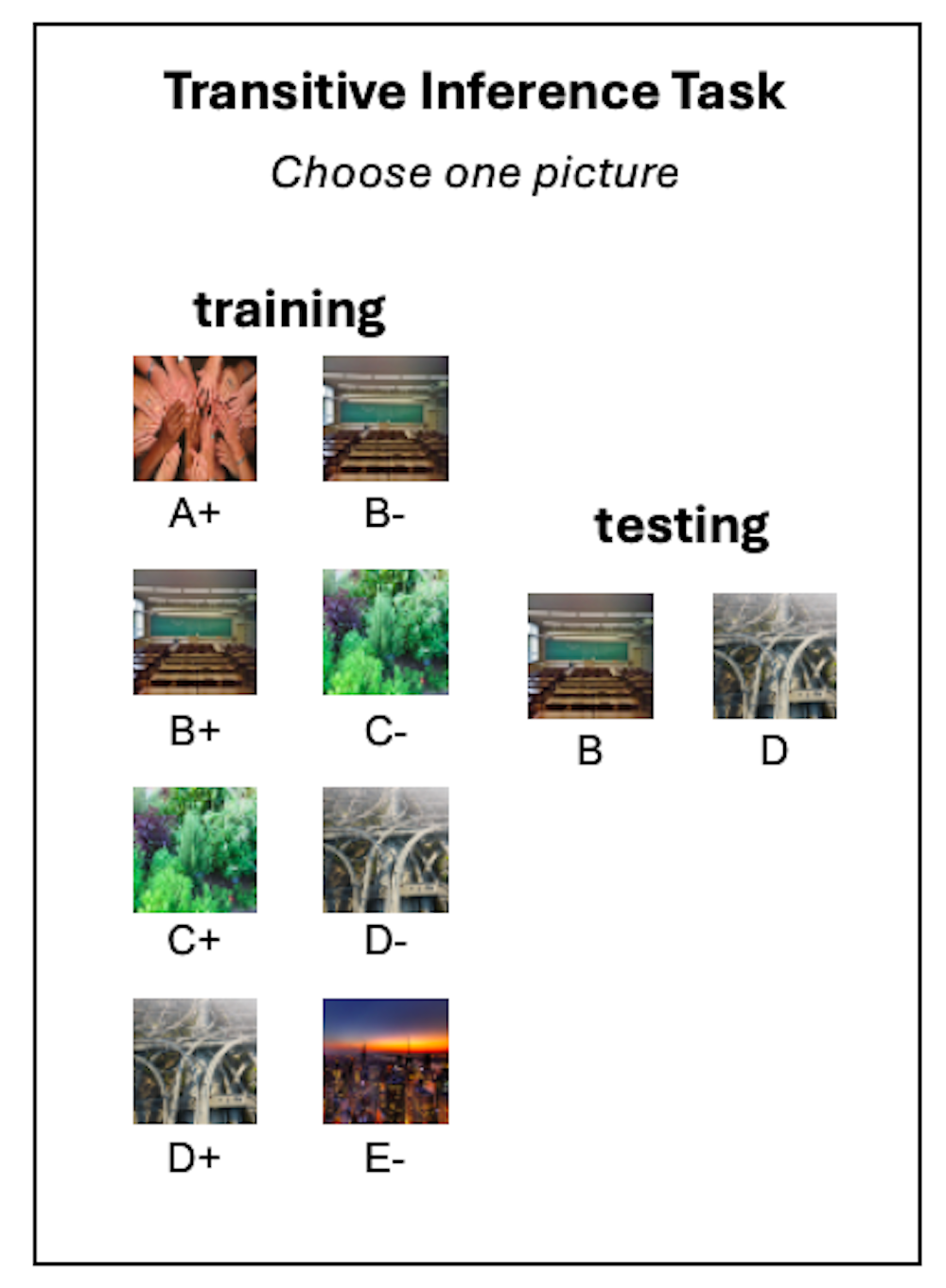
In the lab, researchers test this by giving animals randomly paired images, one pair at a time, and rewarding them with food for picking the correct one. For example, animals learn that a photo of hands (A) is correct when paired with a classroom (B), a classroom (B) is correct when paired with bushes (C), bushes (C) are correct when paired with a highway (D), and a highway (D) is correct when paired with a sunset (E). We don’t know whether they “understand” what’s in the picture, and it is not particularly important for the experiment that they do.

Comparing four pairs of images labeled a range of A to D in a training column, then one pair of images in the tesitng column
In a transitive inference task, subjects learn a series of rewarded pairs – such as A+ vs. B–, B+ vs. C– – and are later tested on novel pairings, like B vs. D, to see whether they infer an overall ranking.
Olga Lazareva, CC BY-ND

One possible explanation is that the animals that learn all the tasks create a mental ranking of these images: A > B > C > D > E. We test this idea by giving them new pairs they’ve never seen before, such as classroom (B) vs. highway (D). If they consistently pick the higher-ranked item, they’ve inferred the underlying order.

What’s fascinating is how many species succeed at this task. Monkeys, rats, pigeons – even fish and wasps – have all demonstrated transitive inference in one form or another.

The twist: Not all tasks are easy

But not all types of reasoning come so easily. There’s another kind of rule called transitivity that is different from transitive inference, despite the similar name. Instead of asking which picture is better, transitivity is about equivalence.

In this task, animals are shown a set of three pictures and asked which one goes with the center image. For example, if white triangle (A1) is shown, choosing red square (B1) earns a reward, while choosing blue square (B2) does not. Later, when red square (B1) is shown, choosing white cross (C1) earns a reward while choosing white circle (C2) does not. Now comes the test: white triangle (A1) is shown with white cross (C1) and white circle (C2) as choices. If they pick white cross (C1), then they’ve demonstrated transitivity.

Comparing two sets of three shapes labeled a range of A to C in a section, then one trio of shapes in the tesitng section
In a transitivity task, subjects learn matching rules across overlapping sets – such as A1 matches B1, B1 matches C1 – and are tested on new combinations, such as A1 with C1 or C2, to assess whether they infer the relationship between A1 and C1.
Olga Lazareva, CC BY-ND

The change may seem small, but species that succeed in those first transitive inference tasks often stumble in this task. In fact, they tend to treat the white triangle and the white cross as completely separate things, despite their common relationship with the red square. In my recently published review of research using the two tasks, I concluded that more evidence is needed to determine whether these tests tap into the same cognitive ability.

Small differences, big consequences

Why does the difference between transitive inference and transitivity matter? At first glance, they may seem like two versions of the same ability – logical reasoning. But when animals succeed at one and struggle with the other, it raises an important question: Are these tasks measuring the same kind of thinking?

The apparent difference between the two tasks isn’t just a quirk of animal behavior. Psychology researchers apply these tasks to humans in order to draw conclusions about how people reason.

For example, say you’re trying to pick a new almond milk. You know that Brand A is creamier than Brand B, and your friend told you that Brand C is even waterier than Brand B. Based on that, because you like a thicker milk, you might assume Brand A is better than Brand C, an example of transitive inference.

But now imagine the store labels both Brand A and Brand C as “barista blends.” Even without tasting them, you might treat them as functionally equivalent, because they belong to the same category. That’s more like transitivity, where items are grouped based on shared relationships. In this case, “barista blend” signals the brands share similar quality.

Child looking at colorful toy cars arranged in a line across a table or bed
How researchers define logical reasoning determines how they interpret results.
Svetlana Mishchenko/iStock via Getty Images

Researchers often treat these types of reasoning as measuring the same ability. But if they rely on different mental processes, they might not be interchangeable. In other words, the way scientists ask their questions may shape the answer – and that has big implications for how they interpret success in animals and in people.

This difference could affect how researchers interpret decision-making not only in the lab, but also in everyday choices and in clinical settings. Tasks like these are sometimes used in research on autism, brain injury or age-related cognitive decline.

If two tasks look similar on the surface, then choosing the wrong one might lead to inaccurate conclusions about someone’s cognitive abilities. That’s why ongoing work in my lab is exploring whether the same distinction between these logical processes holds true for people.

Just like a March Madness bracket doesn’t always predict the winner, a reasoning task doesn’t always show how someone got to the right answer. That’s the puzzle researchers are still working on – figuring out whether different tasks really tap into the same kind of thinking or just look like they do. It’s what keeps scientists like me in the lab, asking questions, running experiments and trying to understand what it really means to reason – no matter who’s doing the thinking.

The Conversation

Olga Lazareva does not work for, consult, own shares in or receive funding from any company or organization that would benefit from this article, and has disclosed no relevant affiliations beyond their academic appointment.

ref. Humans and animals can both think logically − but testing what kind of logic they’re using is tricky – https://theconversation.com/humans-and-animals-can-both-think-logically-but-testing-what-kind-of-logic-theyre-using-is-tricky-253001

Why the US bombed a bunch of metal tubes − a nuclear engineer explains the importance of centrifuges to Iranian efforts to build nuclear weapons

Source: The Conversation – USA – By Anna Erickson, Professor of Nuclear and Radiological Engineering, Georgia Institute of Technology

An image from Iranian television shows centrifuges lining a hall at Iran’s Natanz uranium enrichment facility in 2021. IRIB via APPEAR

When U.S. forces attacked Iran’s nuclear facilities on June 21, 2025, the main target was metal tubes in laboratories deep underground. The tubes are centrifuges that produce highly enriched uranium needed to build nuclear weapons.

Inside of a centrifuge, a rotor spins in the range of 50,000 to 100,000 revolutions per minute, 10 times faster than a Corvette engine’s crankshaft. High speeds are needed to separate lighter uranium-235 from heavier uranium-238 for further collection and processing. Producing this level of force means the rotor itself must be well balanced and strong and rely on high-speed magnetic bearings to reduce friction.

Over the years, Iran has produced thousands of centrifuges. They work together to enrich uranium to dangerous levels – close to weapons-grade uranium. Most of them are deployed in three enrichment sites: Natanz, the country’s main enrichment facility, Fordow and Isfahan. Inside of these facilities, the centrifuges are arranged into cascades – series of machines connected to each other. This way, each machine yields slightly more enriched uranium, feeding the gas produced into its neighbor to maximize production efficiency.

As a nuclear engineer who works on nuclear nonproliferation, I track centrifuge technology, including the Iranian enrichment facilities targeted by the U.S. and Israel. A typical cascade deployed in Iran is composed of 164 centrifuges, working in series to produce enriched uranium. The Natanz facility was designed to hold over 50,000 centrifuges.

Iran’s early intentions to field centrifuges on a very large scale were clear. At the peak of the program in the early 2010s it deployed over 19,000 units. Iran later scaled down the number of its centrifuges in part due to international agreements such as the since scrapped Joint Comprehensive Plan of Action signed in 2015.

Legacy of enrichment

Iran has a long history of enriching uranium.

In the late 1990s, it acquired a Pakistani centrifuge design known as P-1. The blueprints and some components were supplied via the A.Q. Khan black market network – the mastermind of the Pakistani program and a serious source of nuclear proliferation globally. Today, the P-1 design is known as IR-1. IR-1 centrifuges use aluminum and a high-strength alloy, known as maraging steel.

About one-third of the centrifuges that were deployed at the sites of the recent strike on June 21 are IR-1. Each one produces on the order of 0.8 separative work units, which is the unit for measuring the amount of energy and effort needed to separate uranium-235 molecules from the rest of the uranium gas. To put this in perspective, one centrifuge would yield about 0.2 ounces (6 grams) of 60%-enriched uranium-235 per year.

A typical uranium-based weapon requires 55 pounds (25 kilograms) of 90%-enriched uranium. To get to weapons-grade level, a single centrifuge would produce only 0.14 ounces (4 grams) per year. It requires more work to go higher in enrichment. While capable of doing the job, the IR-1 is quite inefficient.

The author explains the uranium enrichment process to CBS News.

More and better centrifuges

Small yields mean that over 6,000 centrifuges would need to work together for a year to get enough material for one weapon such as a nuclear warhead. Or the efficiency of the centrifuges would have to be improved. Iran did both.

Before the strike by U.S. forces, Iran was operating close to 7,000 IR-1 centrifuges. In addition, Iran designed, built and operated more efficient centrifuges such as the IR-2m, IR-4 and IR-6 designs. Comparing the IR-1 with the latest designs is like comparing a golf cart with the latest electric vehicles in terms of range and payload.

Iran’s latest centrifuge designs contain carbon fiber composites with exceptional strength and durability and low weight. This is a recipe for producing light and compact centrifuges that are easier to conceal from inspections. According to the international nuclear watchdog International Atomic Energy Agency, before the strike Iran was operating 6,500 IR-2m centrifuges, close to 4,000 IR-4 centrifuges and over 3,000 IR-6 centrifuges.

With each new generation, the separative work unit efficiency increased significantly. IR-6 centrifuges, with their carbon fiber rotors, can achieve up to 10 separative work units per year. That’s about 2.8 ounces (80 grams) of 60%-enriched uranium-235 per year. The International Atomic Energy Agency verified that the IR-6 cascades have been actively used to ramp up production of 60%-enriched uranium.

The most recent and advanced centrifuges developed by Iran, known as IR-9, can achieve 50 separative work units per year. This cuts down the time needed to produce highly enriched uranium for weapon purposes from months to weeks. The other aspect of IR-9 advanced centrifuges is their compactness. They are easier to conceal from inspections or move underground, and they require less energy to operate.

Advanced centrifuges such as the IR-9 drive up the risk of nuclear weapons proliferation significantly. Fortunately, the International Atomic Energy Agency reports that only one exists in testing laboratories, and there is no evidence Iran has deployed them widely. However, it’s possible more are concealed.

Bombs or talks?

Uranium enrichment of 60% is far beyond the needs of any civilian use. The International Atomic Energy Agency confirmed that Iran stockpiled about 880 pounds (400 kilograms) of highly enriched uranium before the attack, and it might have escaped intact. That’s enough to make 10 weapons. The newer centrifuges – IR-2m, IR-4 and IR-6 – would need a bit over eight months to produce that much.

It’s not clear what the U.S. attack has accomplished, but destroying the facilities targeted in the attack and hindering Iran’s ability to continue enriching uranium might be a way to slow Iran’s move toward producing nuclear weapons. However, based on my work and research on preventing nuclear proliferation, I believe a more reliable means of preventing Iran from achieving its nuclear aims would be for diplomacy and cooperation to prevail.

The Conversation

Anna Erickson receives funding from Department of Energy National Nuclear Security Administration (NNSA) related to nuclear nonproliferation technologies. She has previously served on the Board of Directors of the American Nuclear Society.

ref. Why the US bombed a bunch of metal tubes − a nuclear engineer explains the importance of centrifuges to Iranian efforts to build nuclear weapons – https://theconversation.com/why-the-us-bombed-a-bunch-of-metal-tubes-a-nuclear-engineer-explains-the-importance-of-centrifuges-to-iranian-efforts-to-build-nuclear-weapons-259883

The hidden cost of convenience: How your data pulls in hundreds of billions of dollars for app and social media companies

Source: The Conversation – USA – By Kassem Fawaz, Associate Professor of Electrical and Computer Engineering, University of Wisconsin-Madison

Many apps and social media platforms collect detailed information about you as you use them, and sometimes even when you’re not using them. Malte Mueller/fStop via Getty images

You wake up in the morning and, first thing, you open your weather app. You close that pesky ad that opens first and check the forecast. You like your weather app, which shows hourly weather forecasts for your location. And the app is free!

But do you know why it’s free? Look at the app’s privacy settings. You help keep it free by allowing it to collect your information, including:

  • What devices you use and their IP and Media Access Control addresses.
  • Information you provide when signing up, such as your name, email address and home address.
  • App settings, such as whether you choose Celsius or Fahrenheit.
  • Your interactions with the app, including what content you view and what ads you click.
  • Inferences based on your interactions with the app.
  • Your location at a given time, including, depending on your settings, continuous tracking.
  • What websites or apps that you interact with after you use the weather app.
  • Information you give to ad vendors.
  • Information gleaned by analytics vendors that analyze and optimize the app.

This type of data collection is standard fare. The app company can use this to customize ads and content. The more customized and personalized an ad is, the more money it generates for the app owner. The owner might also sell your data to other companies.

Screenshot from an android phone with the default opt-in selection radio button filled in
Many apps, including the weather channel app, send you targeted advertising and sell your personal data by default.
Jack West, CC BY-ND

You might also check a social media account like Instagram. The subtle price that you pay is, again, your data. Many “free” mobile apps gather information about you as you interact with them.

As an associate professor of electrical and computer engineering and a doctoral student in computer science, we follow the ways software collects information about people. Your data allows companies to learn about your habits and exploit them.

It’s no secret that social media and mobile applications collect information about you. Meta’s business model depends on it. The company, which operates Facebook, Instagram and WhatsApp, is worth US$1.48 trillion. Just under 98% of its profits come from advertising, which leverages user data from more than 7 billion monthly users.


Read more:
How Internet of Things devices affect your privacy – even when they’re not yours


What your data is worth

Before mobile phones gained apps and social media became ubiquitous, companies conducted large-scale demographic surveys to assess how well a product performed and to get information about the best places to sell it. They used the information to create coarsely targeted ads that they placed on billboards, print ads and TV spots.

Mobile apps and social media platforms now let companies gather much more fine-grained information about people at a lower cost. Through apps and social media, people willingly trade personal information for convenience. In 2007 – a year after the introduction of targeted ads – Facebook made over $153 million, triple the previous year’s revenue. In the past 17 years, that number has increased by more than 1,000 times.

Five ways to leave your data

App and social media companies collect your data in many ways. Meta is a representative case. The company’s privacy policy highlights five ways it gathers your data:

First, it collects the profile information you fill in. Second, it collects the actions you take on its social media platforms. Third, it collects the people you follow and friend. Fourth, it keeps track of each phone, tablet and computer you use to access its platforms. And fifth, it collects information about how you interact with apps that corporate partners connect to its platforms. Many apps and social media platforms follow similar privacy practices.

Your data and activity

When you create an account on an app or social media platform, you provide the company that owns it with information like your age, birth date, identified sex, location and workplace. In the early years of Facebook, selling profile information to advertisers was that company’s main source of revenue. This information is valuable because it allows advertisers to target specific demographics like age, identified gender and location.

And once you start using an app or social media platform, the company behind it can collect data about how you use the app or social media. Social media keeps you engaged as you interact with other people’s posts by liking, commenting or sharing them. Meanwhile, the social media company gains information about what content you view and how you communicate with other people.

Advertisers can find out how much time you spent reading a Facebook post or that you spent a few more seconds on a particular TikTok video. This activity information tells advertisers about your interests. Modern algorithms can quickly pick up subtleties and automatically change the content to engage you in a sponsored post, a targeted advertisement or general content.

Your devices and applications

Companies can also note what devices, including mobile phones, tablets and computers, you use to access their apps and social media platforms. This shows advertisers your brand loyalty, how old your devices are and how much they’re worth.

Because mobile devices travel with you, they have access to information about where you’re going, what you’re doing and who you’re near. In a lawsuit against Kochava Inc., the Federal Trade Commission called out the company for selling customer geolocation data in August 2022, shortly after Roe v Wade was overruled. The company’s customers, including people who had abortions after the ruling was overturned, often didn’t know that data tracking their movements was being collected, according to the commission. The FTC alleged that the data could be used to identify households.

Kochava has denied the FTC’s allegations.

Information that apps can gain from your mobile devices includes anything you have given an app permission to have, such as your location, who you have in your contact list or photos in your gallery.

If you give an app permission to see where you are while the app is running, for instance, the platform can access your location anytime the app is running. Providing access to contacts may provide an app with the phone numbers, names and emails of all the people that you know.

Cross-application data collection

Companies can also gain information about what you do across different apps by acquiring information collected by other apps and platforms.

Android screenshot – white and green text on a black background
The settings on an Android phone show that Meta uses information it collects about you to target ads it shows you in its apps – and also in other apps and on other platforms – by default.
Jack West, CC BY-ND

This is common with social media companies. This allows companies to, for example, show you ads based on what you like or recently looked at on other apps. If you’ve searched for something on Amazon and then noticed an ad for it on Instagram, it’s probably because Amazon shared that information with Instagram.

This combined data collection has made targeted advertising so accurate that people have reported that they feel like their devices are listening to them.

Companies, including Google, Meta, X, TikTok and Snapchat, can build detailed user profiles based on collected information from all the apps and social media platforms you use. They use the profiles to show you ads and posts that match your interests to keep you engaged. They also sell the profile information to advertisers.

Meanwhile, researchers have found that Meta and Yandex, a Russian search engine, have overcome controls in mobile operating system software that ordinarily keep people’s web-browsing data anonymous. Each company puts code on its webpages that used local IPs to pass a person’s browsing history, which is supposed to remain private, to mobile apps installed on that person’s phone, de-anonymizing the data. Yandex has been conducting this tracking since 2017, while Meta began in September 2024, according to the researchers.

What you can do about it

If you use apps that collect your data in some way, including those that give you directions, track your workouts or help you contact someone, or if you use social media platforms, your privacy is at risk.

Aside from entirely abandoning modern technology, there are several steps you can take to limit access – at least in part – to your private information.

Read the privacy policy of each app or social media platform you use. Although privacy policy documents can be long, tedious and sometimes hard to read, they explain how social media platforms collect, process, store and share your data.

Check a policy by making sure it can answer three questions: what data does the app collect, how does it collect the data, and what is the data used for. If you can’t answer all three questions by reading the policy, or if any of the answers don’t sit well with you, consider skipping the app until there’s a change in its data practices.

Remove unnecessary permissions from mobile apps to limit the amount of information that applications can gather from you.

Be aware of the privacy settings that might be offered by the apps or social media platforms you use, including any setting that allows your personal data to affect your experience or shares information about you with other users or applications.

These privacy settings can give you some control. We recommend that you disable “off-app activity” and “personalization” settings. “Off-app activity” allows an app to record which other apps are installed on your phone and what you do on them. Personalization settings allow an app to use your data to tailor what it shows you, including advertisements.

Review and update these settings regularly because permissions sometimes change when apps or your phone update. App updates may also add new features that can collect your data. Phone updates may also give apps new ways to collect your data or add new ways to preserve your privacy.

Use private browser windows or reputable virtual private networks software, commonly referred to as VPNs, when using apps that connect to the internet and social media platforms. Private browsers don’t store any account information, which limits the information that can be collected. VPNs change the IP address of your machine so that apps and platforms can’t discover your location.

Finally, ask yourself whether you really need every app that’s on your phone. And when using social media, consider how much information you want to reveal about yourself in liking and commenting on posts, sharing updates about your life, revealing locations you visited and following celebrities you like.


This article is part of a series on data privacy that explores who collects your data, what and how they collect, who sells and buys your data, what they all do with it, and what you can do about it.

The Conversation

Kassem Fawaz receives funding from the National Science Foundation. In the past, his research group has received unrestricted gifts from Meta and Google.

Jack West does not work for, consult, own shares in or receive funding from any company or organization that would benefit from this article, and has disclosed no relevant affiliations beyond their academic appointment.

ref. The hidden cost of convenience: How your data pulls in hundreds of billions of dollars for app and social media companies – https://theconversation.com/the-hidden-cost-of-convenience-how-your-data-pulls-in-hundreds-of-billions-of-dollars-for-app-and-social-media-companies-251698